Home Blog Page 1078

The Trump White House Under Siege

By Dan Steinbock                                          

Washington is planning to extend sanctions against Russia, once again. Meanwhile, the Trump administration is getting ready to cope with a special counsel’s investigation which seems to focus as much on Trump as Russia.

Last Wednesday, Secretary of State Rex Tillerson warned that Congress should not pass any legislation that would undercut “constructive dialogue” with Russia. Yet, the Senate voted 97-2 to advance a bipartisan agreement to launch new financial penalties on Russia and to let the Congress intervene before President Trump can lift sanctions. Afterwards, Trump tweeted that he is the subject of the “single greatest WITCH HUNT in American political history”, and one that he said is being led by “some very bad and conflicted people”.

Trump’s frustration originated from reports that the White House is under scrutiny over whether it obstructed justice, while his aides struggled to deflect questions about the probe and Vice President Pence hired a private lawyer to handle fallout from investigations into Russian election meddling.

What’s going on?

Regime Change

As I argued in spring 2016 (The World Financial Review, April 25, 2016), US election is a global risk and it would continue to be fought long after the Trump election win. In May, these political struggles moved to an entirely new phase. For months, top Republicans held off from backing tougher financial penalties against Russia in a bid to permit the Trump administration to improve the US-Russia relationship, which soured badly under the Obama administration.

But the backlash ensued. First, the Department of Justice (DOJ) dismissed James Comey, Director of the Federal Bureau of Investigation (FBI), reportedly only days after his request for increased resources to investigate Russia’s alleged interference in the election. A week later, DOJ appointed Robert Mueller, former director of the FBI (2001-13) as special counsel overseeing the investigation into alleged Russian interference in the 2016 election.

Mueller is unlikely to treat any Russian initiative – whether planned, unintended, alleged, or misrepresented – with silk gloves.

Both fired FBI Director Comey and special Russia-gate prosecutor Mueller have long histories as pliable political operatives, as ex-FBI official Coleen Rowley put it recently. “Mueller was chosen as Special Counsel not because he has integrity but because he will do what the powerful want him to do”, she says. It was Rowley’s 2002 memo to then-FBI Director Mueller that exposed the FBI’s pre-9/11 failures.

Indeed, there is little doubt about the political outcome of the investigation. Mueller is unlikely to treat any Russian initiative – whether planned, unintended, alleged, or misrepresented – with silk gloves.

In practice, Mueller seems more likely to go after Trump himself. Reportedly, he is already investigating Trump’s inner circle for “possible financial crimes” (Washington Post), “money laundering” and “financial payoff” from Russian officials (New York Times). Discrediting the messenger to distract attention from the message is the old practice by the “deep state”, say the critics.

New Cold War

After the dissolution of the Soviet Union in 1991, relations between Russia and the US remained generally warm until the US-inspired “shock therapy” caused Russia an economic nightmare that proved far worse than the Great Depression in the US. That’s also when three former Soviet satellites – Poland, Hungary and the Czech Republic – were invited to join the NATO. By mid-90s, Poland, Hungary, the Czech Republic, and the Baltic states were also ushered into NATO.

In 2001, President George W. Bush wanted to reset US Russia relations, until 9/11, unilateral foreign policy, US incursions into Afghanistan, withdrawal from the Anti-Ballistic Missile Treaty, and invasion of Iraq. Meanwhile, NATO began looking further eastward to Ukraine and Georgia, which Moscow saw as intrusions into its sphere of interest, along with US efforts to gain access to Central Asian oil and natural gas.

In his campaign trail, Trump spoke for friendlier relations with Russia. Meanwhile, FBI began investigating alleged connections between his aids and pro-Russian interests.

Like Clinton and Bush initially, President Obama wanted to reset US-Russia relations and by March 2010 both countries agreed to reduce their nuclear arsenals. The reset was not supported by Obama’s Secretary of State Hillary Clinton and subsequently rising tensions in Crimea were seized to bury the effort.

In his campaign trail, Trump spoke for friendlier relations with Russia. Meanwhile, FBI began investigating alleged connections between his aids and pro-Russian interests. In January 2017, Trump and Putin began phone conferences as the White House mulled lifting economic sanctions against Russia. But in February, Trump’s security adviser Michael Flynn was forced to resign. Only two months later, Secretary of State Tillerson said that US-Russia relations were at a new low point. The appointment of the special counsel was the last nail in the coffin.

In the coming months, those areas of the Trump agenda that require legislation (e.g. tax reforms) remain more vulnerable to constraints associated with the investigation. Whereas those areas of Trump’s agenda, which can be implemented mainly through executive action (e.g. trade policy), will be less exposed to such constraints. Finally, those areas of the agenda that are somewhere between executive and legislative action may prove easier to implement as well (e.g. sanctions).

Beware of Unintended Consequences

In the final analysis, the effort at Trump’s impeachment rests on the Wolfowitz Doctrine, a highly controversial policy blueprint developed amid the end of the Cold War by Undersecretary of Defense for Policy Paul Wolfowitz, the prophet of the Bush neoconservatives, and his deputy Scooter Libby, later an adviser to Vice President Cheney until his indictment.

When in 1989, Soviet President Mikhail Gorbachev and US President George H. W. Bush declared the Cold War over, in exchange for “iron-clad guarantees” the NATO would not expand “one inch eastward”, neoconservatives began to push Eastern Europe in the US orbit. They were inspired by the Wolfowitz Doctrine that announced the US’s status as the world’s only remaining superpower, which cannot tolerate the “re-emergence of a new rival, either on the territory of the former Soviet Union or elsewhere that poses a threat on the order of that posed formerly by the Soviet Union”.

Since 2001, this doctrine has legitimised several wars in the Middle East, while undermining the efforts of post-Cold War presidents to reset relations with Russia.

Unlike his precursors, Trump is fighting back. He has established his “war room” within the White House to combat leaks, disclosures and the investigation about his associates and Russia. If necessary, the war room could go offensive, by steering spotlight to the Clintons’ gross abuse of public funds, the Democratic leadership, and suspicious deaths of several Democratic operatives who were hoping to testify against such abuses.

Historically, the appointment of special counsel has often been accompanied by unintended consequences and collateral damage. Unfortunately, what happens in Washington is not likely to stay in Washington. The repercussions will be global.

The original commentary was released by The Manila Times on June 19, 2017

About the Author

Dan Steinbock is the Founder of Difference Group and has served as Research Director of International Business at the India China and America Institute (US) and a Visiting Fellow at the Shanghai Institutes for International Studies (China) and the EU Centre (Singapore). For more, see http://www.differencegroup.net

Behind the London Tower Block Fire Which Left Many Dead, Injured and Displaced

By Abayomi Azikiwe

People of colour, the working class and poor have been negatively impacted by British economic and housing policy. In this article, the author discusses the recent Grenfell Tower Fire, the unheard complaints of past residents turned victims, and the economic and social implications behind the tragedy.

Authorities in London, England announced on June 19 that 79 deaths have been officially recorded resulting from a fire which quickly swept through the Grenfell housing complex in North Kensington on June 13-14.

Immediately after the fire erupted many media outlets began to raise serious questions about the level of safety and preparedness inside the building.

Residents through their organisations had complained for several years about concerns related to the lack of sprinklers, fire alarms and effective maintenance of the structure. Apparently these complaints were not addressed by the Royal Borough of Kensington and Chelsea (RBKC) Council which is said to be the owners of the flats.

Hundreds of residents and their supporters attempted to storm the RBKC Council proceedings on June 16 demanding answers to their questions. The doors of the building where the Council was meeting were locked as demonstrators rallied outside.

Residents through their organisations had complained for several years about concerns related to the lack of sprinklers, fire alarms and effective maintenance of the structure.

Residents and their family members who were interviewed by the press spoke to the abject failure of the owners and the Kensington and Chelsea Tenant Management Organisation which was supposed to oversee the conditions in the building. These entities did not provide proper fire prevention and rescue operation protocols at Grenfell Towers. After the fire started some residents reported that they were instructed by municipal employees to remain within the building.

Nonetheless, hundreds of the residents were able to escape without being severely injured. Others remain in hospital with some under critical care.


Later people rendered homeless went to makeshift relief centres seeking food, clothing, water, blankets and counselling. Volunteers from throughout the community donated supplies and food to the affected residents.

London Mayor Sadiq Khan visited the area of the fire the following day and was met with loud protests by residents and community members. The criticism centred on the absence of information related to transitional housing, clothing and food. Other concerns voiced by residents were the desire of many who were burned out that they could remain in the same neighbourhood. Impacted tenants felt that these issues were not satisfactorily addressed by municipal and national governmental officials.

British Prime Minister Theresa May was admonished as well for failing to meet with residents and their families. She did visit the fire scene however the prime minister only spoke with firefighters and the police. Later she visited some of the injured victims in hospital.

Eyewitnesses, Community Organisations and Experts Blame Authorities for Disaster

Even the state-sponsored British Broadcasting Corporation (BBC) could not conceal or minimise the culpability of the municipal officials in creating the conditions for the fire and subsequent deaths. Although North Kensington is considered a high-income area of London undergoing rapid gentrification, there are still large numbers of marginalised residents many of whom are from people of colour communities with heritages in Africa, the Caribbean, South Asia, and the Middle East.

This racialised aspect of the disaster at Grenfell Tower became evident to readers and viewers of the media since a disproportionate number of people being interviewed were from nationally oppressed groups and the lower rungs of the working class. Anger is burgeoning among these groups who are saying the fire, its swift expansion, and the resulting injuries and deaths, were unnecessary. The general consensus is that if adequate safety precautions had been taken the fire may have never started or been confined to a small area of the housing block.

The channelling of marginalised and oppressed groups into what is called “social housing” in Britain is clearly a manifestation of the class and racial oriented approach to urban planning that permeates London and other major cities.

According to a post on the Grenfell Action Group website hours after the fire erupted, it says: “Watching breaking news about the Grenfell Tower fire catastrophe. Too soon (5am) to even guess at numbers of casualties and fatalities. Our heartfelt and sincere condolences (go out) to all who have perished, to the injured, to those who are bereaved or are still searching for missing loved ones. Regular readers of this blog will know that we have posted numerous warnings in recent years about the very poor fire safety standards at Grenfell Tower and elsewhere in RBKC. ALL OUR WARNINGS FELL ON DEAF EARS and we predicted that a catastrophe like this was inevitable and just a matter of time.”1

The channelling of marginalised and oppressed groups into what is called “social housing” in Britain is clearly a manifestation of the class and racial oriented approach to urban planning that permeates London and other major cities. Many of these social housing complexes are located in ageing buildings which have been refurbished in recent years utilising substandard materials creating a tinderbox.

Experts have cited the use of cladding at Grenfell Tower as a possible cause of the rapid spread of the fire. With this being a 24-story building firefighters did not have the equipment to reach the higher levels of the structure leaving people helpless in the face of imminent death.

Although higher-income housing developments are within the same general area as Grenfell Tower, the safety of the poor and working class residents are not treated with the same sense of urgency and necessity. Despite the fact that residents had repeatedly expressed their fears related to structural problems within the block no serious efforts by the municipal authorities were enacted.

Bloomberg, one of the world’s most widely-read financial publications, admitted in a report written by Leonid Bershidsky on the tragedy at Grenfell Tower that: “As in much of Europe, the use of tower blocks as public housing in the UK began in the 1950s with a decision to provide public subsidies based on building height. The 1965 Housing Subsidy Act spawned 4,500 tower blocks by 1979. It wasn’t a great idea for a lot of social reasons. By the end of the 1970s, a growing body of research showed that the social alienation of living in a high-rise increased psychological stress, that toxic materials used in industrial construction and insufficient thermal insulation led to health problems, and that widespread crime and disaffection was linked to the faulty urban planning.” (June 16)

Placing low-income residents from oppressed groups in high-rise tower blocks serves two obvious purposes. The buildings serve as a mechanism to contain the demographic shift of British and other European municipalities restricting the geographic spread of people of colour communities.

From a financial perspective, by concentrating African, Asian, Middle Eastern and other working class residents in confined spaces where maintenance and safety costs are de-emphasised, it provides the capacity for urban governments to channel tax revenue as incentives for private housing and commercial developments which is far more lucrative for corporations which specialise in these projects. What remains to be seen is whether the British government will learn from this calamitous event providing policy imperatives to construct housing units which are safer and more humane for the working poor and immigrants.

Tower Block Fire Compounds Political Crisis for the Conservative Government

Prime Minister Theresa May had good reason not to want to meet residents of Grenfell Towers and their neighbours. A recent election in the country, which many political pundits say was unnecessary, resulted in the Conservative Party losing its absolute majority in parliament forcing the ruling group to seek an alliance with the small Northern Ireland Democratic Unionist Party (DUP) in order to form a government. The prime minister could not afford to be seen on British and world television being heckled and denounced.

It is questionable whether May will be able to survive in her position in the coming weeks and months. Britain has been the site in recent months of several high-profile terrorist attacks in London and Manchester where many people have died.

As long as the wealthy elites enhance their status with disregard for the majority of the people within society, the mounting social contradictions will undoubtedly prompt further economic turbulence and protracted ideological conflict.

On June 18, a crowd of Muslims coming from the Finsbury Park Mosque in North London were targeted by a white racist who drove his van into pedestrians. One person died in the attack and several others were seriously injured. People in the area said the assailant remarked that he was intent on killing Muslims.

The following day on June 19, Britain began negotiations with the European Union (EU) over its delinking from the continental organisation. Brexit stemmed from another miscalculated election in June 2016 where the voters decided to withdraw from the EU, costing former Prime Minister David Cameron his position and triggering a recession inside the country due to the economic uncertainty going into the future.

Britain along with other western capitalist states will continue to experience political instability in light of the growing class and sectional differences among the populations. As long as the wealthy elites enhance their status with disregard for the majority of the people within society, the mounting social contradictions will undoubtedly prompt further economic turbulence and protracted ideological conflict.

About the Author

Abayomi Azikiwe is the Editor of the Pan-African News Wire, an electronic press agency that was founded in 1998. He has worked for decades in solidarity with the liberation movements and progressive governments on the African continent and the Caribbean. Azikiwe is a graduate of Wayne State University in Detroit where he earned undergraduate and graduate degrees in Political Science/Public Administration and Educational and Administrative Studies.

Reference

1. www.grenfellactiongroup.wordpress.com

North Korea: What Options Remain?

By Walter C. Clemens, Jr.

The ever-increasing tension between the United States and North Korea is a concern for the whole world. In this article, Walter Clemens elaborates on the past and hopefully future negotiations between the two nuclear-armed states.

Americans think they have done everything short of war to stop North Korea from becoming a nuclear weapons state. To be sure, Washington has encouraged the sporadic moves by Seoul and Pyongyang to cooperate and grope toward confederation. The US government has supported programmes to feed the hungry and treat the sick in North Korea. However Washington did nothing to help North Korean musicians to reciprocate the New York Philharmonic’s performance in Pyongyang in 2007. The US has supported radio broadcasts to show North Korea’s people the nature of their rulers – part of what one specialist calls “hack and frack”. The US Treasury and US diplomats at the United Nations have worked to tighten sanctions to choke Pyongyang’s weapons programmes and penalise its rulers for their abuse of human rights. Washington has importuned Beijing to rein in its rogue client, though to limited effect. The Clinton administration considered a surgical strike on North Korea’s nuclear facilities in 1994, but this option has become too dangerous to contemplate. As with the former Soviet Union, the United States has sought to contain a dangerous foe. Washington has maintained powerful forces in South Korea, Japan, and across the Pacific Ocean to reassure allies and deter North Korea aggression. None of this, however, has stopped the North from acquiring weapons of mass destruction.

Has the United States fully explored a negotiated settlement of its differences with the Democratic People’s Republic of Korea (DPRK)? The answer is both Yes and No. President George H. W. Bush gave an impetus to negotiation when he withdrew all nuclear weapons from South Korea in 1991. Within months, Seoul and Pyongyang agreed to denuclearise the peninsula. Soon, however, each side accused the other of violating parts of the accord. When signs mounted in 1994 that North Korea was building nuclear weapons, the Clinton administration mobilised to attack the North’s nuclear sites. Momentum toward war halted when former president Jimmy Carter flew to Pyongyang and drew up a plan with DPRK leader Kim Il Sung to freeze the North’s plutonium production in exchange for energy assistance and normalisation of DPRK ties with the United States. Their draft accord soon became an “Agreed Framework” signed by top US and DPRK diplomats in October 1994. Republicans in Congress, however, balked at paying for energy assistance to the North and US oil deliveries often arrived late. More troublesome, work on the two light water reactors promised to the North proceeded very slowly. Despite mutual suspicions, a top DPRK official came to the White House in 2000 and invited President Bill Clinton to Pyongyang. When Secretary of State Madeleine Albright went there in his stead, she reported that Kim Jong Il appeared ready to make a deal on missiles as well as nuclear weapons.

Succeeding Clinton as president in 2001, George W. Bush broke off these exchanges and, soon placed North Korea on an “axis of evil” along with Iraq and Iran. Soon, both Washington and Pyongyang denounced the Agreed Framework and the North resumed reprocessing plutonium. (Thanks to Pakistan, it could also enrich uranium, not specifically addressed in 1994). Despite all this, the Bush administration veered from its initial intransigence and promoted six-party talks with North Korea beginning in August 2003. These negotiations produced several joint statements that seemed to revive the 1994 principle of aid for arms control. Each accord withered, however, when buffeted by hard-liners in Washington and Pyongyang.

The six-party talks continued for three years even after Pyongyang exploded its first nuclear device in 2006. Censured by the UN Security Council for its nuclear and missile tests, however, North Korea declared in April 2009 that it would not continue the six-party negotiations. As of September 2016, the DPRK had conducted a total of six nuclear tests, one of which it claimed was thermonuclear.

Committed to negotiate with any adversary, Barack Obama’s administration focussed on Iran (which had never tested a nuclear weapon) but also explored a deal with North Korea. While Kim Jong Un was succeeding his father, Kim Jong Il, diplomats from North Korea and the US seemed to reach another agreed framework on February 29, 2012. The North pledged a halt to nuclear and long-range missile tests while the US committed to provide food aid. The deal fell apart in April when the North attempted to launch a satellite on a three-stage rocket. Washington did not buy Pyongyang’s argument that its “space” rocket was not a missile for military use.

Feeling let down by Pyongyang, the Obama administration settled into a posture of “strategic patience”. Usually the United States demanded that the DPRK again commit to denuclearisation before negotiations could resume. At other moments, Washington said only that negotiations – on a peace treaty and other matters – must include denuclearisation. Thus, Secretary of State John Kerry stated on September 10, 2016 that Washington was willing to negotiate with North Korea, but only if Pyongyang agrees that the goal of those talks was for it to give up its weapons. But then Kerry softened – nearly contradicting himself – by stating “All that Kim Jon Un needs to do is say, “I am prepared to talk about denuclearisation.” President Obama did a similar two-step on October 16, 2015 as he spoke alongside South Korea President Park Geun Hye. Such ambivalence sharpened the question of sequencing – who should go first and how.

Secretary of State John Kerry stated on September 10, 2016 that Washington was willing to negotiate with North Korea, but only if Pyongyang agrees that the goal of those talks was for it to give up its weapons.

The longer the present impasse continues, the more the DPRK leadership will oppose any dismantling of its advanced weaponry. Still, a conditional freeze of DPRK nuclear and missile development might benefit all sides. Stanford University nuclear expert Siegfried Hecker has suggested the United States and its partners pursue the “three no’s”. No more bombs, no better bombs (no more nuclear testing), and no export of nuclear technology and materials in return for one yes: American willingness to seriously address North Korea’s fundamental insecurity. A freeze would permit Pyongyang to claim a nuclear deterrent in addition to its conventional overkill poised to destroy Seoul.

If negotiations resumed – bilateral or six-party, what sort of deal could be arranged? At least seven points need to be addressed:

1. Security assurances for North Korea to compensate for limits on its nuclear deterrent;
2. A peace treaty to replace the 1953 armistice;
3. Adjustment of the Northern Limit Line to reduce conflict and share resources of the West Sea;
4. Establishment of diplomatic relations by Washington and Pyongyang and by Pyongyang and Seoul;
5. The gradual end to UN sanctions against the North in tandem with Pyongyang’s acceptance of a freeze of its nuclear and missile programmes;
6. Cultural, educational, family and information exchanges;
7. Agricultural and technological assistance to the North.

Such a deal would entail risks and uncertainties, but no more than an untrammelled arms race in Northeast Asia. Any grand bargain would need to serve the interests not only of the US and North Korea but also of South Korea, Japan, China and Russia. Mutual gain could be accomplished by a few compromises and commitments to “enlarge the pie”.

Featured Image: North Korea defending its nuclear weapons program but also seeking talks with the U.S. © KCNA, http://www.upi.com

About the Author

Walter Clemens Jr. is Professor Emeritus of Political Science, Boston University, and an Associate of Harvard University’s Davis Center for Russian and Eurasian Studies. He has written many books including Can Russia Change? (Abingdon, Oxon: Routledge, 2011). His most recent book is North Korea and the World: Human Rights, Arms Control, and Strategies for Negotiation (University Press of Kentucky, 2016). He can be reached at [email protected]

Venezuela – Confronting the Neoliberal Propaganda Media Machine

By Peter Koenig

Venezuela is arguably the only true democracy in the western world. In this article, Peter Koenig elaborates on the western world’s “demonisation” of countries that do not conform to the rules of empire, truths hidden by main stream media, and more.

On 8 of June, I had the privilege to attend a press conference hosted by the Venezuelan Ambassador in Bern, Switzerland. The purpose of the press conference was to clarify the current highly misrepresented situation in Venezuela, as well as explaining the process of electing a new National Constitutional Assembly (Asamblea Nacional Constituyente – ANC) on July 30, 2017.

In his hour-long presentation, the Ambassador introduced the issues at stake by explaining that Venezuela today has the largest known oil reserves in the world and the fourth largest deposits of gas; that the US is importing 60% of its lush energy use (a distant first of the globe’s per capita energy users), mostly from the Middle East, where it is subject to long and costly transport (40-45 days), and to many risk factors, including the Gulf of Hormuz, controlled by Iran, where today about one third of all the world’s petrol must pass through.

By contrast, shipments of petroleum from Venezuela across the Caribbean to the refineries in Texas take only 4-5 days.

This is the main reason why Venezuela is in the White House’s crosshairs, plus, of course, the fact that for Washington it is totally intolerable to have a sovereign socialist Republic in its “backyard” – and so close, the same syndrome applies also for Cuba, a genuinely successful socialist nation, having survived almost sixty years of atrocious and criminal American strangulation. There is no tolerance for sovereign independent countries that do not bend to the dictate of the United States and her behind the scene handlers.

The Ambassador then went on explaining the process of the upcoming election of the National Constitutional Assembly (ANC). He described the process of direct democracy, where Venezuelans elect their delegates by region and by sector, and where of course, the opposition was also supposed to participate, although the opposition’s leadership has already declared they would boycott the process.

There is no tolerance for sovereign independent countries that do not bend to the dictate of the United States and her behind the scene handlers.

The elected new ANC would then be called to amend the Constitution of 1999, to adapt it to today’s circumstances. The current Constitution was approved in a similar democratic process by the people and sanctioned by the ANC one year after President Hugo Chavez Frias became President in 1998. The 1999 Constitution is still valid and adhered to until this day. 

The July election will choose 545 members to the National Assembly, of which two thirds (364) would be elected on a regional or territorial basis, and one third (181) by sectors of professions or activities, i.e. students, farmers, unions of different labor forces, employees, business owners – and so on. This cross-section of people’s representation is the most solid basis for democracy.

The Ambassador assured the journalists that there will be a very high peoples’ participation in the elections, as was the case for the 19 democratic elections that took place since1998, when Comandante Chavez became President.

This election should be an opportunity for the opposition to gather as many Assembly seats as possible, and then help shape the new Constitution in a fully democratic process. Not by street violence.

The fact that the opposition is planning to boycott the election shows clearly, they are not interested in democracy. They have one goal only, to oust President Maduro and take power, privatise state assets, especially hydrocarbons (petroleum and gas) to hand them to international mainly US corporations to be exploited at no benefits for the Venezuelan people.

This was precisely the case before President Chavez took the reins of the country. Foreign corporations, almost all North Americans, left not a dollar in tax revenues in Venezuela.

Venezuela today is arguably the only true democracy in the western world, as said on numerous occasions by Professor Noam Chomsky, MIT.

To counter the neoliberal mainstream media’s (MSM) demonisation of the Bolivarian Revolution and the Bolivarian Republic of Venezuela and her President Nicolas Maduro, the Ambassador showed various videos demonstrating that the instigators of violence were clearly the armed opposition. They are constituted and led by a rich elite and supported ideologically and financially from outside.

Among different foreign sources  of support and funding, most of them American, is the infamous National Endowment for Democracy – NED, a so called “fake” NGO “think-tank” (sic), receiving from the US State Department hundreds of millions of dollars per year to “spread democracy” American style around the globe, i.e. training local rebel groups abroad and within the targeted country to provoke instability through unrest and violence; distribute anti-government propaganda, infiltrate the media, universities and so on. They are the same who were responsible for the so-called Arab Spring and the Colour Revolutions in former Soviet Republics, including Ukraine.

The Ambassador showed various videos demonstrating that the instigators of violence were clearly the armed opposition. They are constituted and led by a rich elite and supported ideologically and financially from outside.

The facts explained and demonstrated by the Ambassador showed clearly who was responsible for most of the 67 deaths and more than 1,200 injured within the last couple of months.

This is all supported by unmistakable videos, showing government supporters, who are despite what the western media are saying, the vast majority – between 70% and 80%, demonstrating peacefully and unarmed.

However, western media twists and manipulates the truth to become anti-Venezuela propaganda, including video clips presented out of context, or outright falsified, blame the aggression on the government supporters, accusing authorities and police of oppressing civil liberties, of dictatorship, of killing its own people. 

The western MSM do not show the weaponised right-wing opposition attacking police with explosives, putting police cars on fire and throwing Molotov cocktails and more sophisticated explosives at police and authorities.

This point of opposition violence, blackmail and more, is clearly demonstrated by a recent US journalist covering the riots for the pan-Latin American TeleSur TV. Ms. Abby Martin, the host of the Empire Files, an investigative programme, told RT (Russia Today) that she received numerous death threats from opposition fighters during her work on the ground in Venezuela. She says protesters threatened to lynch and burn her alive if she tried to contradict their narrative.1 This is to be taken seriously, because several journalists have already been murdered by the opposition.

The western MSM do not show the weaponised right-wing opposition attacking police with explosives, putting police cars on fire and throwing Molotov cocktails and more sophisticated explosives at police and authorities.

The Ambassador made two very important points that the west should listen to. He said, that despite the violent social upheavals, the government is respecting the principles of democracy and has not declared a State of Emergency or Martial Law, nor curtailed private-owned foreign media slandering Venezuela with lies.

This contrasts with other countries, like France which for the past two years has been under a declared State of Emergency, just a small step below Martial Law, and is about to put this state of permanent militarisation into her Constitution; or take Argentina which is suppressing foreign media like TeleSur (and were at the point of shutting down also RT), because they are telling Argentinians the inconvenient truth.

When the Ambassador opened the floor for questions and comments, most of the journalists present were polite, seeking clarifications of the election process. But there were two sore thumbs sticking out, the representatives of the two largest and most neoliberal Swiss newspapers, the Neue Zürcher Zeitung (NZZ) and the Tagesanzeiger.

They came with a specific agenda. It seems they didn’t listen to anything the Ambassador said. They simply hurled their list of insults, accusations and offensive negative lie-propaganda at the Ambassador. Both of them are what one would assume in Switzerland, educated people. They must know the truth. If they don’t say the truth, they are most likely bought agents of the Anglo-Zionist network that controls 90% of the news throughout the western world. After they accomplished their mission of insulting the Ambassador, they left the conference.

Isn’t it a journalist’s foremost obligation to adhere to a code of ethics? – That’s what they were taught at universities, to seek the truth and portray the truth as objectively as possible.

And what about Switzerland? A country that boasts about its neutrality, appears to have completely abandoned her noble principles and moved to become Europe’s epicentre of neoliberalism. No wonder, such alternative international media like TeleSur and RT are not publicly offered to households by the Swiss Broadcasting Corporation (SRG), the monopoly holder (90%) of Swiss television and radio providers.

Featured Image: Venezuela President Nicolás Maduro waving the flag of Venezuela. Image from Fernando Llano/AP

About the Author

koenig-webPeter Koenig is an economist and geopolitical analyst. He is also a former World Bank staff and worked extensively around the world in the fields of environment and water resources. He lectures at universities in the US, Europe and South America. He writes regularly for Global Research, ICH, RT, Sputnik, PressTV, The 4th Media, TeleSUR, TruePublica, The Vineyard of The Saker Blog, and other internet sites. He is the author of Implosion – An Economic Thriller about War, Environmental Destruction and Corporate Greed – fiction based on facts and on 30 years of World Bank experience around the globe. He is also a co-author of The World Order and Revolution! – Essays from the Resistance.

Reference

1. https://www.rt.com/news/391338-us-journalist-venezuela-threats/


Three Paradoxes of Digitalisation

By Hermawan Kartajaya and Ardhi Ridwansyah

 Management has been inevitably transformed by the digital era. Hermawan Kartajaya and Ardhi Ridwansyah discuss the Three Paradoxes of Digitalisation essential to a company’s success in winning the hearts and minds of its digital consumers.

More than 20 years ago, Charles Handy in the book “The Age of Paradox” called many world events, including the development of technology, a paradox. Many of those epiphanies stand true today. Interesting example can be found in Asia’s retail industry: amid the flourishing e-commerce, a contrasting trend is also emerging.

Some e-commerce companies in Asia are beginning to realise the importance of creating offline experience for shoppers. Moving beyond conventional cash-on-delivery model, Zalora, a Singapore-based online fashion retailer, offers a unique payment method. The websites provide a cash-on-collection option, a concept that has already gained popularity in Taiwan and Japan. Collaborating with some convenience store chains, Zalora gives its customers an option of picking up and paying for their items at an outlet of their choice. They have also started erecting “popup” stores across shopping centres to educate shoppers and encourage them to use their apps.

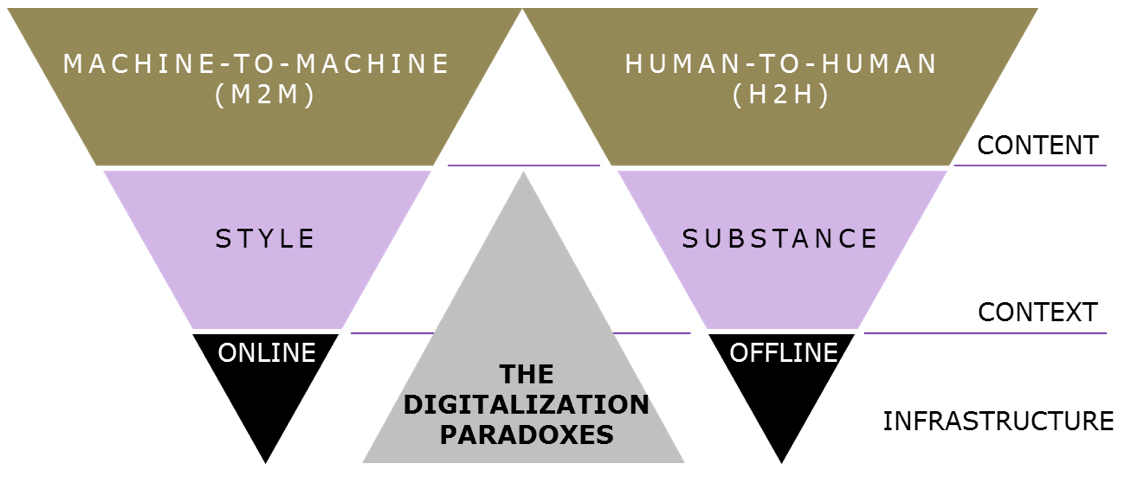
This represents one of the paradoxes occurring as a consequence of digitalisation in Asia. For businesses, in order to win over competition in this new digital era, three paradoxes described below need to be understood and managed appropriately.


Three Paradoxes of Digitalisation


Online vs Offline

Internet technology does provide convenience and high efficiency. The interaction between the company and the customer can take place anytime and anywhere. This is what is prompting companies in Asia to flock to the online world, building their official websites, nurturing online communities and setting up special social media teams to build relationships with customers. But as a matter of fact, the online world still have limitations which means that conventional approaches of the offline world cannot be completely replaced. Despite growing internet usage and the seemingly improving tech-savviness among Asians, most consumers may not yet be fully familiar with digital services or simply not be sufficiently confident to take jump on to the digital bandwagon. In order for companies to make the most of their ambitions to go digital, there is ostensibly a growing need to put special attention on customer education on the online world and much of it cannot be accomplished only online.

In order for companies to make the most of their ambitions to go digital, there is ostensibly a growing need to put special attention on customer education on the online world and much of it cannot be accomplished only online.

An online retailer like Zalora’s initiative to go offline via cash-on-collection option and popup stores is an example of how businesses are striving to make offline and online shopping work together seamlessly. Neither option is mutually exclusive. In fact, in the near future, perhaps we would stop comparing Zalora and the likes to traditional, brick-and-mortar, offline retailers. There will just be “shopping” and it will be an integrated online and offline experience.

Commenting on this integration of online and offline interaction, Kasireddy from Fonterra in China says: “differentiating online and offline is really a false distinction. It’s much more important to get the offline and the online working together seamlessly” (The Economist Corporate Network, 2015).

Substance vs Style

The development of internet has also created new patterns of information consumption. If, in the print media, readers have conventionally been familiar with a writing style that’s more elaborate, focusing on features and in-depth stories, readers of online news sites are more accustomed to shorter, crisper write-ups. On the shorter mobile phone screens, where consumers today spend plenty of their time, too much written content is perceived not only as un-user friendly but boring too.

Visual factors – images and illustrations serve to improve the design, frequently used by content providers to develop more engaging online content. Paula Ries (2012) in the book Visual Hammer even stressed the importance of the visual aspect as a verbal positioning booster to inculcate a certain perception in the minds of customers. This is the trend in the digital world that requires producers to include “style” in the content developed.

But of course, the company can not rely solely on style aspects (visuals, audio, design, etc.) to provide information that will touch the customers, both rationally and emotionally. The substance in their digital content should also be weighted. This is what presents the need for content producers to balance both: how to create content that is concise and interesting, yet still does not lose its core substance. For example, the makers of video advertisements  on Youtube must be creative to design a message that attracts the attention of viewers within the first 5 seconds, so that they will not skip the video. It is about style. But a compelling message will still be able to convey information about an advertised product effectively, and that is substance.

But of course, the company can not rely solely on style aspects to provide information that will touch the customers, both rationally and emotionally.

Machine-to-Machine (M2M) vs Human-to-Human (H2H)

Digitalisation has enabled “interaction” between various technology products. Existing data on our handsets could be transferred to other technology products in the form of instructions that produce a specific action or output. This is what is known as the Internet of Things (IOT) Machine-to-Machine (M2M) technology. The consumer space is a significant sector within the M2M universe that a range of players, including mobile operators and hardware manufacturers, are trying to address. There is a particular focus at present on both wearable devices and the potential of “smart homes”.

A range of new wearable devices have been launched over the past years, including the Samsung Gear and the LG Lifeband. Connected devices and sensors allow customers to employ a smarter, more efficient lifestyle, with their personal devices such as smartphones and tablets connected with devices in the home to enable automation. This helps users to remotely control functions, from lighting to basic security systems. Samsung Electronics has announced that 90 percent of its products – including everything from smartphones to refrigerators – would be able to connect to the Web by 2017. And by 2020, all of its products will be internet connected (CNET, 2015).

Technology must be optimised to create a human-to-human interaction that is more flexible (not constrained by space and time), and not quite create a separate space, which ends up replacing the intimate conventional ways of interaction.

But the technology does not make man into a machine without emotions. Instead, digital technology, particularly social media, has turned customers into more emotionally expressive beings. This is why the human-to-human (H2H) touch must not be forgotten. Technology must be optimised to create a human-to-human interaction that is more flexible (not constrained by space and time), and not quite create a separate space, which ends up replacing the intimate conventional ways of interaction.

Zappos, an online retailer Amazon acquired in 2009 with a value of USD1.2 billion, has a unique way to build H2H interaction with its customers. Although Zappos actively uses social media including Twitter, Youtube and Facebook to communicate with customers, the company has not abandoned the use of the phone. Tony Hsieh, CEO of Zappos once said: “We do not really look at Twitter as a marketing vehicle, so we do not look at how it translates into the bottom line. What we care about is being able to connect with our customers on a more personal level. We do that through the telephone as well as through Twitter. Nobody writes about the telephone because it’s not an interesting news story, but we believe it’s actually one of the best branding devices out there.”

Phone allows Zappos call centre staff to be able to establish a very personal (H2H) connection with its customers. As an assessment, their performance is evaluated based on customer satisfaction on the calls they handle, without being limited by time. The longest customer service call took almost six hours. This is what makes Zappos one of the highly recommended brands by its customers.

These are the three paradoxes which can actually be managed simultaneously, without having to negate each other. That requires creativity in order to build an integrated online-offline experience, develop content that has substance with style, as well as machine-to-machine (M2M) technology supported by human-to-human (H2H) touch. The company’s success in managing these three will create a strong competitive advantage in order to win the minds and hearts of digital consumers in Asia.

About the Authors

Hermawan Kartajaya(left) is Founder & Chairman of MarkPlus, Inc. Ardhi Ridwansyah(left) is Director of Executive MBA in Strategic Marketing, SBM-ITB/MarkPlus Institute

A Planetisation of Finance: Valuing the Planet as a Going Concern

By Joss Tantram

Valuing the planet in economic terms runs the risk of financialising, commodifying and privatising nature. The task in front of us is not to tinker with the methods, but to reverse this concept, moving from the financialisation of the planet to the planetisation of finance.

“We have statesmen and politicians who profess to guide our destinies. Whither are they guiding our destinies?” – H.G Wells

Valuing Continuing Existence

In recent decades considerable effort has been invested into describing and identifying the planet’s natural environment in terms that can be appreciated and integrated into the language of economics and finance.

From the 1997 work of Robert Constanza et al1 onwards, the TEEB coalition2 and the Natural Capital Coalition,3 to the multi capitals approaches to accounting and reporting that are forming part of efforts by organisations such as the SASB4 (Sustainability Accounting Standards Board) and the IIRC5 (International Integrated Reporting Council). Each is seeking to quantify and therefore consider the value of natural systems and their outputs in comparable financial terms.

To move beyond a critical analysis of the pros and cons of such multi-capitals approaches it seems that there is a simpler pre-existing conceptual vehicle that could be adapted to provide a forward-looking perspective on the value of the planet and its assets (natural, human, built and otherwise).

This is the concept of the going concern, the accounting approach to assessing the value of an enterprise based upon its potential for continuing existence. It is at the heart of our thought experiment to explore an IPO for the Earth;6 a finalist in the ICAEW/ Accounting for Sustainability Finance for the Future Awards 2014.

Opportunity Costs…and Benefits

Approaches to the valuation of currently under-represented/under-priced sources of capital (those which are not pure financial capital) predominantly focus upon two value aspects, of capital stocks and capital flows.7 A simple metaphor for these two categories is that of a bank account – where the stock is the money in the account and the flow is the interest that is generated by the capital.

However, beyond this categorisation of stock and flow value there is perhaps a more significant area worthy of attention – to focus upon the going concern value that the existence of healthy stocks and flows gives rise to. This is not a value of the stock or flow itself – but is derived from the opportunities that become possible because of the existence of the stocks and flows.

When viewed through this lens, natural capital becomes most powerful not when it is used to give rise to an asset value (“what would we get if we sell it?”) calculation, but a going concern value “what does the asset’s continued existence and health allow us to do and how valuable is that?”.

A distinction between asset price and the value of the opportunities that arise from the asset is partially reflected in the concept of stocks and flows. However, a going concern value goes far beyond a flow valuation. An example of these category differences for a company like Google would be as follows:

• Asset value – the market capitalisation of the company – what it would fetch if it were sold.

• Asset flow value – the yearly revenue of the company.

• Going concern value – in addition to the categories above, the value of all the things that exist because Google provides and facilitates fertile ground for a huge range of activity.

Our Planet as a Going Concern

If the motivation behind approaches to valuing natural, social and other capitals is to highlight their value to the economy rather than leave them as either economic externalities or considered as effectively free goods, shouldn’t we take a more creative approach to using the accounting techniques that already exist?

Wouldn’t it be far more productive to focus upon the value of the planet as a going concern – as a place to do sustainable business over the long term?

Luckily, there is a well-established approach to doing just that. Accountants do it all the time, all we need to do is expand its scope and scale somewhat, from the going concern value of a specific entity to the going (common) concern of the planet as a whole.

In accountancy, the going concern principle is “the assumption that an entity will remain in business for the foreseeable future”. If it can be assumed that a business will remain viable over time, it can be considered to be valuable because of its capacity to sustain economic activity “the value of an entity that is assumed to be a going concern is higher than its breakup value, since a going concern can potentially continue to earn profits.”8

Going for How Long?

While it may seem perverse to say so, in cold mechanistic terms the Earth’s value to humans lies in it providing us with the means to carry on doing stuff, not in either its inherent value (what we would pay to keep it) or in its value when broken up and traded (what we would get if we sold it).

The idea of planetary going concern value is too often ignored, partly because it asks us to project value into the future. In accounting terms, going concern assessments/judgments focus upon a consideration of “the foreseeable future” but this is only judged using one year forward time horizon (aligned to annual accounting and reporting).

At a planetary scale an annual going concern perspective wouldn’t get us very far, we need to be thinking about how to project the value of a going concern much further – say to 2050.

A going concern value “what does the asset’s continued existence and health allow us to do and how valuable is that?”.  

Such projections happen for smaller things happen all the time. The world is full of news stories and analysis saying “the market for X could be worth $10 billion by 2025” or “sales of Y set to grow by 200% over the next ten years”. All such projections assume a continuation of certain elements of business as usual (i.e. a reasonably similarly functioning market to today) and certain elements of change (e.g. increased disposable income, increased urbanisation etc.) that are interpreted from various trend analyses and forward predictions.

At the planetary scale a going concern calculation could be done for a range of scenarios, e.g. where no significant strategic response is made to evolve to meet the challenges of resources, consumption increase, reduction in soil fertility, increased pollution and climate uncertainty, as opposed to the planetary enterprise that would be possible if we made the transition to a sustainable economy fit for 9 billion interdependent citizens,9 all capable of making sovereign social and economic decisions.

It seems clear that the former would, by its nature, be less valuable than the latter.

Not Under Current Management…

Accountants judge a going concern according to a range of criteria that could easily be adapted to apply to the planet as a whole.

The Financial Reporting Council’s Statement of Auditing Standards on the issue in 1994 states that for financial audits seeking to judge whether an entity is a going concern, they should take the following into consideration:

• “Whether the period to which the directors have paid particular attention in assessing going concern is reasonable in the entity ’s circumstances and in the light of the need for the directors to consider the ability of the entity to continue in operational existence for the foreseeable future;

• The systems, or other means (formal or informal), for timely identification of warnings of future risks and uncertainties the entity might face;

• Budget and/or forecast information (cash flow information in particular) produced by the entity;

• Whether the key assumptions underlying the budgets and/or forecasts appear appropriate in the circumstances;

• The sensitivity of budgets and/or forecasts to variable factors both within the control of the directors and outside their control

• The existence, adequacy and terms of borrowing facilities, and supplier credit; and

• The directors’ plans for resolving any matters giving rise to the concern (if any) about the appropriateness of the going concern basis. In particular, the auditors may need to consider whether the plans are realistic, whether there is a reasonable expectation that the plans are likely to resolve any problems foreseen and whether the directors are likely to put the plans into practice effectively.”

The text above is mildly summarised in the interests of space, the full text is available in paragraph 23 of the Financial Reporting Council document “The going concern basis in financial statements”.10

If a planetary-scale auditor used the criteria noted above to assess the current de facto administration of the planet (our economic and market systems) would they judge the Earth to be a going concern, and if so, for how long?

Is the simple but frightening answer that the Earth is not capable of being considered as a going concern over the coming decades under current management?

Towards a Planetisation of Finance.

“The twelfth law is that such things as cannot be divided, be enjoyed in common…” – Thomas Hobbes’ 12th Law

The vast majority of approaches to bring under-priced or unpriced capitals within financial domains tend to do so by treating them as adjustments to existing prices (e.g. as carbon taxes etc.) rather than focussing upon and questioning the origination of their price in the first place.

Externalities should not be priced per se. However, price must reflect them (they shouldn’t really be externalities at all, just a fundamental aspect of costs that should be naturally recognised) if any approach to building a sustainable economy is to succeed.

At a planetary scale an annual going concern perspective wouldn’t get us very far, we need to be thinking about how to project the value of a going concern much further – say to 2050. 

The point of exploring the planetary going concern concept is to provide another driver towards the more innate consideration of sustainability as a defining aspect of financial success over the long term. The planet can only be considered as a going concern if we recognise that the environment is the ultimate source of all value. This recognition has to then be integrated into the heart of decision making rather than being considered after the fact, as most current approaches to “pricing externalities” currently require.

Without a fundamental reconsideration of what actually constitutes sustainable value, and an effort to align the origination of money (and price) against that, we are just building ever more rickety structures upon the already unsteady foundations of current economic and market processes.

Valuing the planet in economic terms runs the risk of financialising, commodifying and privatising nature. The task in front of us is not to tinker with the methods, but to reverse this concept, moving from the financialisation of the planet to the planetisation of finance.

Economics and markets based upon the value of the planet as a going concern might be a powerful and positive step towards aligning financial value with the physical facts of life on this planet – the only place we have (as yet) do to business.

Thanks

My profuse thanks go to Jane Gleeson-White11 for her feedback and comments on a draft of this piece. Any errors of logic or hyperbole are unquestionably mine. Her book Six Capitals: The revolution capitalism has to have – or can accountants save the planet?12 is a must-read for anyone keen to explore how we might meaningfully value the priceless.

This re-edited and updated article was first published on Terrafiniti LLP’s Towards 9 Billion blog  (http://www.terrafiniti.com/a-planetisation-of-finance-our-planet-as-a-going-concern/) on 29 May 2015. Joss Tantram/Terrafiniti LLP reserve the rights to the copyright of this material and grant The World Financial Review to re-publish this piece on a licence free of copyright.


About the Author

Joss Tantram is a founding partner at Terrafiniti LLP, a pioneering sustainability and systems consultancy. He leads Terrafiniti’s strategic services and their Towards 9 Billion innovation initiative; producing big, hopeful, playful ideas for an equitable and sustainable future. Joss is the author of the Towards 9 Billion eBook series, available from the Amazon Kindle store.

References

1. Constanza et al (1997), “The value of the world’s ecosystem services and natural capital”. Nature 387, 253 – 260. http://www.nature.com/nature/journal/v387/n6630/abs/387253a0.html
2. The Economics of Ecosystems and Biodiversity: http://www.teebweb.org/
3. The Natural Capital Coalition: http://naturalcapitalcoalition.org/ Sustainability Accounting Standards Board (SASB) Conceptual Framework: http://www.sasb.org/wp-content/uploads/2013/10/SASB-Conceptual-Framework-Final-Formatted-10-22-13.pdf
4. International Integrated Reporting Council, Multiple Capitals Background Paper: http://integratedreporting.org/wp-content/uploads/2013/03/IR-Background-Paper-Capitals.pdf
5. Terrafiniti LLP, an IPO for the Earth: http://www.terrafiniti.com/towards-9-billion/earth-public-offering/
6. Wikipedia: stocks & flows in economics: https://en.wikipedia.org/wiki/Stock_and_flow
7. Accounting Tools, The Going Concern Principle: http://www.accountingtools.com/going-concern-principle
8. Terrafiniti’s Towards 9 Billion Blog, Infinite economy on a finite planet – Part 1: http://www.terrafiniti.com/towards-9-billion-infinite-economy-finite-planet/
9. Financial Reporting Council (FRC), The going concern basis in financial statements: https://www.frc.org.uk/Our-Work/Publications/APB/SAS-130-The-Going-Concern-Basis-in-Financial-State.pdf
10. Jane Gleeson-White: https://janegleesonwhite.com/
11. Jane Gleeson-White: (2015) Six Capitals: The revolution capitalism has to have – or can accountants save the planet?. W.W. Norton & Co Inc and Allen & Unwin:
12. https://bookishgirl.com.au/six-capitals-the-revolution-capitalism-has-to-have-or-can-accountants-save-the-planet/
 

Dynamic Mechanism of “Social Modernisation” with Chinese Characteristics

 By Bao Zonghao, Xiang Kun and Zhang Shuangshuang

While the classic concept of “modernisation” and its logical extension are dedicated to “economic modernisation”,we argue that real modernisation should be “social modernisation”; “social modernisation” with Chinese characteristics is “modernisation of society” based on the economic and social reality and having a strong sense of future consciousness, comprehensiveness, interdisciplinarity and sustainable development, representing the trend of human civilisation’s development.

“Social Modernisation”: Discarding the Shortcomings of “Economic Modernisation”

The Original Meaning of “Modernisation” Is Not “Economic Modernisation”

Though in “industrialisation” and modernisation from the “takeoff” to “maturely propelling” the core content of “modernisation” was still economic modernisation, almost all farsighted scholars realised the multiple meanings of “modernisation” itself. In 1966, C. E. Black emphasised in The Dynamics of Modernization that modernisation should include profound changes not only in economy, but also in science and technology, culture and interpersonal relations; in 1966, Shmuel Eisenstadt discussed comprehensive revolutionary features of modernisation from the aspects of systems, politics, economy, ecology and culture in Modernization: Protest and Change; in 1968, Samuel P. Huntington specially demonstrated political responses to and consequences of modernisation from the perspectives of political participation, power structures and change in political authoritativeness in Political Order in Changing Societies; in 1974, Alex Inkeles analysed in Becoming Modern: Individual Change in Six Developing Countries the modern outlooks on family, money, religion, child-bearing and consumption and their behavioural models, and deemed that the core of modernisation should be modernisation of individuals; in 1982, Gilbert Rozman described the course of modernisation as multiple variables including the national work division system, the proportion of non-agricultural production, population quality, income distribution, organisational change, bureaucracy and popular culture in The Modernization of China.

Meanwhile, reflections on modernisation were made by the thinkers like Bell, Drucker, Toffler, Naisbitt, Carson and Giddens, and they proposed some new ideas, such as post-industrial society, knowledge society, post-modern society, risk society, sustainable development and reflexive society, not only enriching the modernisation theory and practice, but also highlighting the deepening of “modernisation”: whether in theoretical research or in practical action, modernisation should not be limited to “economic modernisation”.

Social Modernisation Is the Most Drastic and Profoundly Influential Social Change

Social modernisation is an innovation and correction of traditional “defects of modernisation”. It is a new thought on modernisation encompassing many aspects such as the economy, politics, culture, science and technology, education and environmental governance and giving more emphasis to systematic social projects, comprehensive social innovation and all-round social development. However, limitation to theory shows the theory itself is immature. A truly good “modernisation” theory should be practice-oriented and contribute to the people’s practice of social modernisation. Many Chinese scholars have realised the numerous problems and drawbacks of Western modernisation process, but in the practice of modernisation in the regions or country, they generally lack the idea of social modernisation, proceeding from “economic fields” consciously or unconsciously and then touching social, political and cultural fields. Therefore, some regions repeatedly showed the feature of “one-sided modernisation” that emerged in the early period of Western capitalist society, triggering the phenomena of environmental pollution, ecological crisis, energy crisis, alienation of man, social diseases, urban diseases and unfair social classes and structures.

In 1966, C. E. Black emphasised that modernisation should include profound changes not only in economy, but also in science and technology, culture and interpersonal relations.

The questions then deserve attention. Why can “economic modernisation” hardly go towards “social modernisation”? Why is “social modernisation” often “marginalised”? The reasons vary, but in view of “capital” as a dynamic mechanism driving “modernisation” and “economic modernisation”, it tends to realise its appreciation through “economic modernisation”. Therefore, as long as “capital” is not “restrained” and the various disadvantages of “uncivilised” “capital” are not rejected, “social modernisation” is certainly laid aside or “marginalised”.

In the above sense, in order not to be laid aside or marginalised, “social modernisation” must also take “capital” as a dynamic mechanism. However, to take “civilisation” of capital as a dynamic mechanism, social modernisation should embed economic “modernisation” into social functioning mechanisms and the whole course of social functioning in an all-round way, attaching importance to the harmony of social classes and structures, emphasising harmonious relations that should exist between people and nature, among people and between people and society.

“Civilisation” of Capital: Driving Force Behind Social Modernisation

Social modernisation driven by “civilisation” of “capital” should not be limited to numerous criticisms of “capital logic” while ignoring the effect of “capital” as a dynamic mechanism to social modernisation, especially the fact that capital is gradually “civilised” in the face of numerous social challenges and pressures. Under the premise that “elimination of capital” is impossible, “modernisation” of capital discards the numerous disadvantages of “uncivilised” capital and plays a positive role in promoting “social modernisation” with Chinese characteristics.

Capital: From its “Barbarisation” to “Civilisation”

 As we know, “capital” is not a pure economic concept or economic logic at any time but directly associated with politics, culture, ideology and prevailing customs of the whole society. Just as Marx said, though in actual production, “capital is rather the means of production transformed from capital”, “capital is not an object, but rather a definite social production relation, belonging to a definite historical formation of society.”1 To attain economic independence, the European bourgeoisie born in the Middle Ages must obtain “independent personality” and get rid of “religious control” and “imperial control” and highlight the new idea of “individualism” instead of the faith of the church and Pope in God. This was also the bourgeois spirit of Calvin’s Protestant Reformation. Such independent and free “religious personality” is an important aspect of the “spirit of capitalism” advocated by Max Weber. In other words, from the perspective of the history of human civilisation development, “capital came to the world dripping with blood and dirt” on the one hand, but on the other hand, “capital” was an objective product of abandonment of the shortcomings of the medieval civilisation’s heritage pushing forward the renewal and leap of the “European civilisation”. Besides, seen from the perspective of ideological revolutions, in the “Glorious Revolution” of Britain, the “Revolution” of France or the “Revolution for Independence” of the United States, the “revolutionary idea” advocated by the whole bourgeoisie was dedication to a free, democratic and equal modern society instead of a single “capitalist country”, which was obviously great historical progress compared with the previous capitalist society.

But the problem is that in the early stage of capitalism, especially the stage of primitive capital accumulation of the civilisation that dedicated to free, democratic and equal human civilisation and society, “barbarisation” of capital became a typical form of social development driven by “capital”. Here we will not repeat More’s words about “sheep devouring men” quoted by Marx or quote Marx’s indignant words about black slave trade and plundering of colonies’ gold and silver. Just in terms of the course of production, Marx believed that greedy desire and pursuit of surplus value had integrated with the whole capitalist system, leading to longer work time, higher labour intensity and unlimited exploitation of labourers. Anybody with conscience must stand out to denounce such situation. However, though there were various moral denunciations of “uncivilised” capital at that time, the whole society was under “barbaric” capital’s control due to lack of legal restraint.

Capital’s “barbarism” not only existed in the course of production, but also was prominently manifested as “capital war”, which includes competition between capitalists causing an anarchic state of the overall social production and huge waste of social production resources. It was also manifested as “national war” among national monopoly capital of different countries vying for capital profits. World War I that broke out then was essentially a “capital war”, showing the great “barbarism” of capital itself. Besides, people’s general discontent with capitalism due to such “barbarism” triggered the whole world’s socialist movement and gave rise to the first socialist country.

The Possibility of Capital’s “Civilised” Integration into Social Modernisation

Though many signs of “barbarisation” of capital could still be seen after entering the 21st century, it is an undeniable fact that the degree of capital “civilisation” is higher and higher: today’s capital is far from what capital looked like in the 19th and 20th centuries and capital power is under multiple supervision of politics, laws, morals and public opinion; the global corporate social responsibility movement has changed from the field of “corporate public relations” to an internal link of growth in “corporate value”; “in the marketplace, this means it is essential to balance the needs of customers, employees, suppliers, the environment and community and social groups”. 2

Nevertheless, within the framework of the capitalist system, “civilisation” of capital is always ruled by “absolute power” of capital. Responsibilities, obligations and morals “beyond capital” look pale and weak under many circumstances, therefore the United States is still the country that consumes the most energy and discharges the most pollutants in the world. To cater to enterprises’ need for “capital” appreciation, the Bush Administration lowered the standards of energy conservation and emission reduction, and refused to sign Kyoto Protocol. This indicated that under capitalist conditions, there are many restrictions that “civilisation” of capital cannot overcome. Only under the condition that goes for social modernisation can mechanisms for capital “civilisation” be built and real regulation of “capital” be possible. Thus, capital can push forward social modernisation in the course of “civilisation”.

Today, integration of capital “civilisation” into social modernisation with Chinese characteristics also needs to undergo the process of compliance with the national conditions of China’s social modernisation and adaptation to growth and development of China’s social needs. Divorce from social needs will also bring about many problems and hinder social development. Summarisation of lessons from the drastic change in the Soviet Union and East Europe, the Latin American model and the “Arab Spring” shows that social modernisation requires freedom, democracy, equality, fairness, justice and openness. However, if we carry out all-round liberalisation and deregulation and promote “free policies” that Western developed countries have “demonstrated” in the primary development stage of social modernisation, then the so-called “subject status” of modernisation will be under so much pressure that the initiative in social modernisation will be finally lost, national industry will become abnormal and “internal ability” of social modernisation will be ultimately harmed.

Social modernisation is more concerned with improvement of people’s social welfare level, including various kinds of social insurance such as education, medical care, employment and housing. The social welfare level is a basic requirement of socialist common prosperity, an implication of “social modernisation” and all people’s social need. In light of the fact that China is still in the primary stage of socialism, we cannot realise “high welfare” because this will weaken the dynamic mechanism of social competition, cut social accumulation and undermine the comprehensive driving force behind social modernisation. We should advocate a moderate “outlook on welfare” and an outlook on consumption and consumption model that can develop with social civilisation harmoniously and orderly to drive social modernisation with Chinese characteristics.

Paths of Building the Dynamic Mechanism of “Social Modernisation” with Chinese Characteristics

China, as a developing country, should make active efforts for construction of socialist “civilisation” of capital with Chinese characteristics and find a road of conscious “social modernisation” by using capital and going beyond capital suitable for China’s national conditions. If civilisation of “capital” in a capitalist society is “unconscious civilisation” lacking “restraint”, “control” and “governance”, then demand for and use of capital in social modernisation with Chinese characteristics should get capital out of the “barbaric” state, “adjust” to make “capital” go towards the state of “conscious civilisation” through orderly and effective “restraint” towards capital, and really turn capital into a tool beneficial to the people. Here, three paths for building the dynamic mechanism of social modernisation with Chinese characteristics are put forward mainly within the framework of the rule of law.

Regulating and Promoting “Civilisation” of Capital Based on the Socialist Market Economy

The socialist market economy addresses the efficiency of the market economy and the problem of social fairness. The market economy has never meant allocation of resources in a purely economic sense but shaped the life consciousness of primacy of “market interests”. Once such real “market interests” become the law of the whole society’s functioning, they will naturally form a social mechanism and everybody is concerned about fair “exchange value”. “Exchange value” in the market economy directly points to every participant in the market economy. This is the most direct and realistic soil for awakening of “individual consciousness”. The market economy mechanism shapes an objective choice attaching importance to real interests, making everybody pay attention to real life and abandon various kinds of “Utopian” life.3 In other words, the “market economy” departs from Utopia in any sense in the first place, and shapes a down-to-earth universally realistic life scene. Because of such reality, freedom, democracy and equality under the conditions of the market economy are most realistically “practical”. Any freedom, democracy or equality that cannot generate interests through the market economy is regarded as “non-freedom”, “non-democracy” or “non-equality”.

Social modernisation driven by “civilisation” of “capital” should not be limited to numerous criticisms of “capital logic” while ignoring the effect of “capital” as a dynamic mechanism to social modernisation, especially the fact that capital is gradually “civilised” in the face of numerous social challenges and pressures.

Such complicated features possessed by the “market economy” itself make us more resolutely believe that we must limit the disadvantages brought by “the market economy’s malfunction” through socialist public ownership and the power of national market regulation and be good at bringing the dual advantages of socialism and the market economy into full play. Then how to make people directly feel the dual advantages of the micro-mechanisms of market economy and the government’s macroeconomic market regulation interacting with each other? It is believed that the most direct and realistic path of realisation is regulating and promoting “civilisation” of capital according to law (e.g. building of the national credit system, the credibility system of “red and black lists”, etc.) to enable “capital” to go beyond narrow egoism in “capital logic” and internalise external costs while giving full play to market competitiveness instead of shirking the social responsibilities that should be shouldered by “capital”; abandoning various “uncivilised” means of “capital” and making “civilisation” of capital an important mechanism for pushing forward social modernisation with Chinese characteristics.

Orderly Pushing Forward New Urbanisation and Leading “Civilisation” of Capital

In today’s China, the construction of “civilisation” of “capital” under the conditions of the market economy focuses on the demand for “civilisation” of “capital” in the course of China’s new-type urbanisation. This is put forward on the basis of reflecting on traffic jams, environmental pollution, ecological crisis, social conflict, etc. caused by various phenomena of “uncivilised” “capital” in the course of China’s rapid urbanisation in the past more than 30 years. New-type urbanisation is the biggest “characteristic” of China’s social modernisation. New urbanisation will influence the effect of social modernisation with Chinese characteristics to some extent. The numerous phenomena of “uncivilised” “capital” emerged in the course of China’s rapid urbanisation today are fundamentally caused by “land capitalisation” operations.

With the deepening of urbanisation, cities driven by “capitalisation” with “land finance” as the core revealed four paradoxes of “uncivilised” capital. First, it caused the “purpose paradox” of sustainable urbanisation. Second, it caused the “economic paradox” of sustainable urbanisation. Third, it caused the “social paradox” of sustainable urbanisation. Fourth, it caused the “ecological paradox” of sustainable urbanisation.

An important path of solving the problem of new urbanisation driven by “land capital” (land finance) is: establishing the “state-owned land capital administration”, reforming the administrative system integrating land management and land use, separating the government’s function of land use, and effectively evaluating and monitoring standardised functioning of “land capitalisation”; meanwhile allowing farmers’ “collective land” and “private land” to enter the urban land market, so the relevant incomes can be used to ensure the long-term livelihood of farmer-turned citizens and ensure farmers’ obtainment of real benefits through the function of market mechanisms. At the same time, this is also conducive to restraining the one-sided growth of land finance, solving social conflict and promoting sustainable urbanisation at the source.

Ensuring “Civilisation” of Capital with Reform of State-owned Enterprises as Example

State-owned enterprises naturally tied to Chinese society play a leading role in social modernisation with Chinese characteristics. Therefore, to realise “civilisation” of capital, state-owned enterprises must be main players. Socialist state-owned enterprises with “state-owned capital” as the essential feature are different from the logic of general “capital” operations in that they “must not mercenarily” pursue economic efficiency, must turn in more profit (not tax in the general sense) than non-state-owned enterprises while promoting capital accumulation, and shoulder ultimate “bottom-line responsibilities” for the cause of socialist reform and opening up. In this sense, judging state-owned enterprises from the perspective of Western mainstream economics is obviously one-sided with ideological bias.

The purpose of restructuring state-owned enterprises is to change state-run enterprises’ shortcomings of low efficiency and weak driving force for innovation and bring the competition mechanism of the market economy into state-owned enterprises through introducing the “mixed economy” model. In the age of “capital” globalisation, we should make state-owned capital stronger and make Chinese state-owned enterprises’ “capital” go out to the world with a “civilised” attitude.


About the Authors

Bao Zonghao (left)is Professor at the East China University of Science and Technology, China,and Research Fellow at Urban Culture Research Center, Shanghai Normal University in China. Xiang Kun (middle)is Deputy Director at the Shanghai Academy of Huaxia Social Development Research in China. Zhang Shuangshuang (right)is in an Undergraduate at the College of Arts and Science, Boston University in the US.

References

1. Marx/Engels Collected Works, Volume 7, Page 922, People’s Publishing House, 2009.

2. Schwerin: Conscious Capitalism, Social Sciences Abroad, 1999(6):3.

3. We should oppose two “Utopian” thoughts and models. The first one is going beyond the primary stage of socialism to realize communism featuring “a larger scale and a higher level of socialist ownership”; the second one is that the “pure market economy” itself is also a utopia and does not exist in real life.

The Futures of Southeast Asia and the US Intertwine

By Vannarith Chheang   

The important role of ASEAN in regional security has already been realised by the world, particularly by the United States. Vannarith Chheang emphasises that more than regional security, the US must recognise ASEAN’s crucial role in the economic realm.

ASEAN member countries are concerned about US’s commitment in Asia amid changing global geopolitics. The US is reorienting its foreign policy by focusing more narrowly on the American interest under the motto “America First”– which is characterised by transactionalism, unilateralism, and bilateralism.

The US’s decision to withdraw from the Trans-Pacific Partnership (TPP) creates a wave of economic and strategic uncertainty across Asia. This also largely affects strategic credibility and moral legitimacy of the US.

Without clear strategy and concrete action plans towards Asia, particularly ASEAN, the US will lose its strategic leverage and influence in the region, which in turn will hurt the US’s core regional interests.

There are signs of relief after the visit by Vice-President Mike Pence to Indonesia and the ASEAN Secretariat to reassure ASEAN that the US remains committed to the region. Pence also confirmed that President Donald Trump will attend East Asia Summit (EAS) and ASEAN-US Summit in November.

Trump called the Philippine President in capacity as the chair of ASEAN after the 30th ASEAN Summit in Manila on April 30 to seek diplomatic support from this regional body in pressuring North Korea to give up its nuclear weapons peacefully. 

ASEAN took an unprecedented approach on North Korea by strongly condemning the nuclear tests by Kim Jong-un, and collectively urging North Korea to “immediately comply fully with its obligations arising from all relevant United Nations Security Council (UNSC) resolutions”.

ASEAN’s response to North Korea got a strong diplomatic point from the US. ASEAN needs to strengthen its diplomatic leverage and security role beyond Southeast Asia. ASEAN’s collective voice does matter on a wider multilateral forum. 

The US started realising the relevant role of ASEAN in regional security issue but not yet in economic realm. There would be a mistake if the US does not pay close attention to the economic role of ASEAN in Asia.

The US needs to recognise that ASEAN matters for the US in both economic and security sectors. ASEAN is the third largest economy in Asia and seventh largest economy in the world. ASEAN is America’s fourth-largest trading partner. The US is the largest source of foreign direct investment to ASEAN.

Along with East Asia, the fast-growing economies of ASEAN have become linchpins of global production networks and supply chains.

Now 50 years old, the Association of Southeast Asian Nations (ASEAN) is today a dynamic actor and a crucial partner in Southeast Asia, a region increasingly important to the world’s prosperity and security. Along with East Asia, the fast-growing economies of ASEAN have become linchpins of global production networks and supply chains.

ASEAN’s regional architecture, fostered by the cultivation of comprehensive, strategic partnerships with international dialogue partners, is critical to peace and stability in Southeast Asia, and ASEAN’s participation in important global forums and governance bodies have attracted growing international attention and engagement.

As a party to free trade agreements in the greater Asia-Pacific, ASEAN is assuming an important role in shaping regional economic governance in Southeast Asia. The ASEAN-led Regional Comprehensive Economic Partnership (RCEP) comprises 30 percent of global GDP – it is going to be a game changer in Asia’s multilateral trade arrangements.

ASEAN has played significant security role through promoting trust and confidence among states, facilitating dialogues and mutual understanding, and preventing conflicts. ASEAN is a role model of an inclusive and open regionalism and a relevant global actor.

To maintain its resident power in the Asia-Pacific, the US, in addition to strengthening the alliance system, needs to proactively and robustly engage ASEAN, which is the most important inter-governmental regional body in the Asia Pacific.

With its future increasingly intertwined with ASEAN, the United States must maintain the momentum of its rebalance towards the Asia-Pacific, focusing on three pillars: comprehensive and inclusive security networks, economic integration and connectivity, and soft power and people-to-people ties.

ASEAN member countries generally acknowledge the pre-eminence of the United States in maintaining regional peace and stability. The United States remains the Pacific power that has provided security in the Asia-Pacific region for the last seven decades.

Winning the hearts of the ASEAN people best serves the long-term interests of the United States in the region.

ASEAN welcomes the active engagement of all major powers in the region, but the continued presence of US military, economic, and soft power is paramount to future regional stability and prosperity. Nevertheless, strategic rivalry and competition between the United States and China have created a security dilemma for ASEAN member countries.

ASEAN member states are not interested in taking sides or being pulled into either camp. A stable and healthy US-China relationship must be the foundation of regional peace and stability. The United States should treat ASEAN as a regional entity independent of its own China strategy.

ASEAN member states dene their national interests primarily in terms of economic development. They want an inclusive and open regionalism in which all countries can benefit from regional cooperation and integration. Therefore, America’s Asia-Pacific rebalance should emphasise economic opportunities for the people of ASEAN. Winning the hearts of the ASEAN people best serves the long-term interests of the United States in the region.

Seven Engagement Policies that the US Should Implement Relating to ASEAN.

First, the needs to concretise the Sunnylands Declaration adopted at the special US-ASEAN Leaders’ Summit in 2016. Out of seventeenth points, the US and ASEAN commit to firmly adhering to a rules-based regional and international order that upholds and protects the rights and privileges of all states.

Second, the US must continue strengthening both security and economic multilateralism by supporting the ASEAN-led regional institutions such as ASEAN Regional Forum (ARF), ASEAN Defence Ministers Meeting Plus (ADMM Plus), and East Asia Summit (EAS).

Third, the United States should develop a more concrete action plan to assist ASEAN in realising its Vision 2025, particularly by strengthening the ASEAN-based regional architecture and promoting a rules-based international order.

Fourth, the US must continue strengthening its soft power in the region through implementing the existing initiatives such as Young Southeast Asian Leaders Initiatives (YSEALI) and the US-ASEAN Connect which focuses on business, energy, innovation, and policy.

Fifth, the United States should give more emphasis to the Lower Mekong Initiative by providing more technical assistance to the members of the Mekong River Commission, conducting scientific research on the impacts of climate change and hydropower dams, and developing measures to help people adapt when their livelihoods are threatened.

Sixth, the United States should continue to support civil society groups in Southeast Asia that promote the values of democracy and human rights, rule of law, inclusive development, and social justice. Civil society plays a significant role in promoting a people-centred ASEAN, which is the ideal goal of the ASEAN community-building process.

Seventh, education is the main bridge linking the people of ASEAN and the United States. The establishment of Fulbright University in Vietnam is an effective way to strengthen these people-to-people ties. The United States should consider establishing similar institutions in other ASEAN member countries, particularly those with the least developed economies – Cambodia, Laos, and Myanmar.

About the Author

Vannarith Chheang is a Visiting Fellow at ISEAS-Yusof Ishak Institute in Singapore. He is also a Co-Founder and Chairman of the Advisory Board of the Cambodian Institute for Strategic Studies (CISS) based in Phnom Penh. His research interest focuses on International Relations in the Asia Pacific region.

Investing in the Philippines: What to Expect in 2017

Makati City Skyline. Makati City is one of the most developed business district of Metro Manila and the entire Philippines.

By Alexander Chipman Koty

The Philippines garnered substantial international attention in 2016, owing largely to President Rodrigo Duterte’s controversies. Lost in the Philippines’ political drama, however, was the country’s strong economic performance. This article examines the Philippines’ business climate in 2017, and its leadership prospects and priorities as chair of ASEAN.

The Philippines garnered substantial international attention in 2016, owing largely to President Rodrigo Duterte’s rise to power, his litany of controversial remarks, and contentious war on drugs campaign. Lost in the Philippines’ political drama, however, was the country’s strong economic performance.

The Philippines posted a robust 6.8 percent GDP growth rate in 2016, outperforming popular investment spots such as China (6.7 percent) and Vietnam (6.2 percent). This follows years of sturdy growth under the previous Aquino administration, where growth averaged 6.2 percent per year.

FDI into the Philippines also increased in 2016, reaching US$6.2 billion in net inflows through the first 10 months of the year – a 22.2 percent increase over the US$5.1 billion accumulated over the same period the previous year. In 2015, total FDI amounted to US$5.7 billion. Intercompany borrowings accounted for almost two thirds of net FDI inflows (US$3.9 billion) in 2016, up 34.9 percent from US$2.9 billion in 2015. Despite improved FDI, the Philippines continues to lag behind fellow ASEAN countries such as Indonesia, Malaysia, and Thailand in this regard.

The Philippines may be better positioned than its more export-reliant neighbours to weather 2017’s uncertain global economic climate.

The Philippines’ strong economic performance is projected to continue into 2017, primarily on the back of healthy domestic spending, infrastructure development, and remittances. As opposed to many emerging Asian economies that are reliant on affordable exports, the Philippine economy is primarily bolstered by consumer spending, which accounts for about 70 percent of GDP and grew by seven percent year-on-year.

Consequently, the Philippines may be better positioned than its more export-reliant neighbours to weather 2017’s uncertain global economic climate.

Standard Chartered projects the Philippines’ economy to grow by 6.7 percent in 2017, while HSBC projects 6.5 percent growth. Meanwhile, the Philippine government is targeting growth between 6.5 and 7.5 percent in 2017 and to grow between 7-8 percent per year in the medium term, while aiming to attract US$7 billion in FDI over the coming year.

Tax Reform

One of the Duterte administration’s main initiatives in 2017 will be rolling out the Comprehensive Tax Reform Program (CTRP). The reform will see the highest personal income tax bracket rate reduced from 32 percent to 25 percent and corporate income tax lowered from 30 to 25 percent. The initiative aims to make the Philippines’ tax environment more competitive with its ASEAN peers, as the region as a whole has been gradually harmonising and lowering tax rates.

To offset losses from lowered personal income and corporate income tax rates, the government will expand the value-added tax (VAT) base by reducing exemptions, and add taxes on automobiles and fuel excise, among other measures.

Additionally, the government has announced that it will expand the tax collection powers of the Bureau of Internal Revenue (BIR), which will resume conducting field audits, and is also debating a tax amnesty to raise revenues and bring more companies into the formal tax regime.

Tax forms will also be simplified to encourage tax compliance and make the process more approachable for small taxpayers. Complicated and burdensome administrative measures, both in time and cost, often deter small taxpayers from participating in the official tax system.

Also to this end, Project Repeal: The Philippine Red Tape Challenge aims to improve the country’s inefficient bureaucracy – the Philippines is ranked 106th in the World Bank’s Ease of Doing Business index – by streamlining administrative and regulatory procedures and to remove unnecessary laws.

The tax reforms are projected to add an additional PHP 206.8 billion to government coffers, and the BIR is aiming to collect a record PHP 1.829 trillion in 2017. From January to November 2016, the BIR collected PHP 1.45 trillion in taxes.

Development Initiatives

The Philippine Development Plan covering the years 2017-2022 is set to be unveiled in the coming months, which will be a 10-point plan outlining measures and goals to raise the country’s standard of living. While more details will be released when the plan is officially announced, its central aim is to cut poverty incidence from 21.6 percent in 2016 to 14 percent by 2020.

The previous plan, which covered the years 2011-2016, sought to reduce multidimensional poverty from 2008’s levels of 28.2 percent to 16-18 percent by 2016. The plan calls for inclusive growth, fostering a trust-based society, and developing a knowledge-driven economy.

President Duterte’s pledge for economic growth to be more inclusive and tangibly raise the standards of living of the Philippines’ most vulnerable citizens ties into the goals of the Philippine Development Plan. Notably, point zero of the plan sets to achieve peace and order, which falls in line with Duterte’s drug eradication and crime reduction campaign and ties into a number of his economic and social policies.

In 2016, Duterte also signed an executive order that officially adopted the broader AmBisyon Natin 2040 project as the country’s long-term development vision. AmBisyon Natin 2040 envisions the Philippines tripling GDP per capita to US$11,000 and becoming a high-income country by 2040 by maintaining GDP growth of at least 6.5 percent per year.

ASEAN Integration

The Philippines will chair ASEAN for 2017, meaning that it will host a series of summits and events concerning the regional bloc’s integration and political, economic, and social issues, and will be expected to champion particular initiatives.

Areas of focus for the Philippines will be to reduce the cost of doing business across ASEAN, harmonise safety codes for products and services throughout the region, and support the creation of innovation-driven economies. Beginning in April, the government will host a series of nine conferences geared towards multinational small and mediums sized enterprises (MSMEs), startups, and attracting investment.

Areas of focus for the Philippines will be to reduce the cost of doing business across ASEAN, harmonise safety codes for products and services throughout the region, and support the creation of innovation-driven economies.

As has been the case in recent years, 2017’s ASEAN summits will be notable for how the regional bloc approaches an increasingly aggressive China. Duterte shocked the political world when he renounced the US in favour of China despite the contentious land disputes in which they are engaged in the South China Sea, and ASEAN as a unit has growing divisions over how they view China and its rise.

Industry Opportunities

Property, infrastructure, and consumption have all been important elements of the Philippines’ growth in recent years, and this should remain the case in 2017. The Philippines has long had a substantial infrastructure deficit, and Duterte seeks to address this by incrementally raising spending on hard infrastructure from five percent of GDP to seven percent by 2022.

For 2017, infrastructure spending is earmarked at PHP 850 billion – 5.3 percent of GDP. The Philippines has a wide variety of infrastructure needs, from the construction of new ports, airports, bridges, and expressways to electricity generation and telecommunications infrastructure.

The China-led Asian Infrastructure Investment Bank is already involved in two new projects in the Metro Manila region targetting flood prevention and mass rapid transport, and the government hopes to attract foreign funds, expertise, and technology to bridge its various infrastructure shortages. It is hoped that improved infrastructure will benefit multiple facets of the economy, including tourism, access to energy, and reducing the country’s infamous congestion.

Other sectors of the economy will benefit from the Philippines’ well-equipped workforce and sizeable service industry. Only three percent of employers in the Philippines cite inadequate skills in the workforce – the lowest rate in ASEAN. The Philippines is known for its Information Technology and Business Process Outsourcing (IT-BPO) industry, which will continue to be a key growth area in 2017.

As reflected in the Philippines’ development goals, the government hopes to parlay this area of expertise into higher value-added services, emphasising innovation, research and development, and the establishment of a knowledge-driven economy. The government also aims to expand its industry and manufacturing sector by leveraging the Philippines’ innovative capabilities in order to produce more highly value-added products than regional rivals skilled in mass-producing cheap exports.

Outlook

The Philippines’ economy appears well positioned for another year of steady growth in 2017 despite significant global political and economic uncertainty. However, the Philippines itself may contribute to this uncertainty under the unpredictable leadership of Duterte and his controversial anti-drug campaign and bold pivot to China.

That being said, increased investment from China would help mitigate any losses that may be incurred as a result of new US president Donald Trump’s protectionist tendencies, and Duterte has been building upon his predecessor’s macroeconomic reforms. There is also potential for a rapprochement between the Philippines and the US, as there appears to be more goodwill between Duterte and Trump than there was between Duterte and Obama.

Despite the focus on China and the US in the Philippines’ political and economic relationships, Japan is consistently the biggest provider of FDI into the Philippines – providing 28 percent of the total in 2015 – and Duterte paid a state visit to the country in late 2016, securing more investments in the process.

While the Philippines has traditionally lagged behind its Southeast Asian neighbours in attracting FDI, it is making steady progress to close the gap, and its economy as a whole looks quietly set for another year of potent growth.

This original post was released by the ASEAN Briefing last February 3, 2017.

Image Courtesy of KING RODRIGUEZ/PPD

About the Author

Alexander Koty contributes to Editorial and Research operations for Asia Briefing in Shanghai, China. He specialises in political and economic analysis, advising companies entering China and Southeast Asia’s rapidly changing business environments. His work as an editor and analyst includes producing business intelligence and commentary for Asia Briefing websites, magazines, business and tax guides, and special issue reports.

Hedge Funds: Past, Present, and Future

By H. Kent Baker and Greg Filbeck

“Hedge funds, private equity and venture capital funds have played an important role in providing liquidity to our financial system and improving the efficiency of capital markets. But as their role has grown, so have the risks they pose.” Jack Reed

During the past few decades, hedge funds have evolved from obscure investment vehicles to highly popular investments in the global market. Institutional investors including pension funds, endowments, insurance companies, private banks, and high-net-worth individuals and families are attracted to hedge funds. Not surprisingly, hedge funds have drawn considerable attention from investors, practitioners, and academics. The period after the financial crisis of 2007-2008, also called the Global Financial Crisis (GFC), was tumultuous for hedge funds and resulted in startling headlines. Today, hedge funds have become, and are likely to remain, an essential part of the financial landscape. After taking a brief historical look at hedge funds, we discuss current hedge fund debates and controversies, and take a glimpse into their future prospects.

A hedge fund is a pooled investment vehicle that uses various strategies to invest in different asset classes. Professional investment managers administer these privately offered funds. Hedge funds attempt to produce above-average investment returns using many strategies and tools ranging from traditional stock-picking to complex derivative and arbitrage plays.

Characteristics of Hedge Funds

Several key characteristics differentiate hedge funds from other types of pooled investments such as mutual funds as well as other alternative investments including private equity. First, not all investors have access to hedge funds. In the United States, for example, hedge funds are only open to “accredited” or qualified investors. Until recently, being qualified as an accredited investor simply involved having or making a sufficient amount of money. As of February 1, 2016, the US requirements changed. The Financial Services Committee and the US House of Representatives passed HR 2187, known as the Fair Investment Opportunities for Professional Experts Act. Now individuals can qualify as accredited investors based on measures of sophistication such as having a minimum amount of investments, certain professional credentials, and experience investing in exempt offerings, being knowledgeable employees of private funds, or by passing a qualifying accredited investor examination. The expanded definition of an accredited investor still continues to exclude many, if not most, investors.

Second, hedge funds have wider investment latitude than many other types of pooled investments. For example, hedge funds are highly flexible in their investment options because they can use financial instruments generally beyond the reach of mutual funds. Hence, they can engage in more aggressive strategies and positions, such as short selling, trading in derivative instruments including options, and using leverage (borrowing) to enhance the risk/reward profile of their bets.  However, a hedge fund does not necessarily use hedging techniques given that the classification scheme for hedge funds has broadened considerably over time. The only limitation to a hedge fund’s investment universe is its mandate. Thus, some hedge funds can invest in anything including stocks, derivatives, land, real estate, and currencies. By contrast, most mutual funds follow the traditional “long only” model of investing in that they mainly stick to investing in stocks or bonds. Few mutual funds short-sell stocks because they face some restrictions and the higher costs of operating a long-short portfolio.

Hedge funds are highly flexible in their investment options because they can use financial instruments generally beyond the reach of mutual funds. Hence, they can engage in more aggressive strategies and positions, such as short selling, trading in derivative instruments including options, and using leverage (borrowing) to enhance the risk/reward profile of their bets.

Third, hedge funds often use leverage. That is, they can borrow funds to potentially increase their returns. However, leverage can destroy hedge fund returns as seen during the GFC.

Fourth, the compensation or fee structure differs for hedge funds. Besides charging various fees, which are associated with more traditional pooled investments such as mutual funds, hedge funds also have a performance or incentive fee. For example, a once common fee structure called “2 and 20” enabled hedge fund managers to charge a flat 2 percent of total asset value as a management fee and an additional 20 percent of any profits earned. However, these fees have trended lower in recent years.

Finally, hedge funds are lightly regulated. Yet, as a result of the GFC, hedge funds have come under increased regulatory scrutiny. For example, as of July 2010, the Dodd-Frank Wall Street Reform Act requires hedge funds with more than $150 million in assets to register with the Securities and Exchange Commission (SEC). Further, under the “Volcker Rule”, banks are now restricted in their ability to sponsor hedge funds and are prohibited from proprietary trading of them.

Benefits and Risks

Hedge funds offer some notable benefits over traditional investment funds. For example, the investment strategies used by hedge funds can potentially generate positive returns in both rising and falling markets. Given that hedge funds may have low correlations with a traditional portfolio of stocks and bonds, including hedge funds in a portfolio offers potential diversification benefits. That is, adding hedge funds to a balanced portfolio might reduce overall portfolio risk and volatility and increase returns. The large number of strategies available to hedge fund managers can help them meet their investment objectives. Hedge funds offer a long-term investment solution that eliminates or at least reduces the need to correctly time entry to and exit from markets. Finally, hedge funds have some of the most talented investment managers. Not surprisingly, hedge fund investors have high expectations about the potential risk/return contributions that hedge funds can provide relative to more traditional portfolios.

Despite these potential benefits, hedge funds have structural disadvantages that subject investors to certain risks. For example, hedge funds are not only subject to less regulation than many other structures but also offer limited transparency. For example, hedge funds are not required to detail redemptions publicly. Consequently, managers often closely guard those numbers to avoid any trace of loss of confidence. The lack of investment constraints poses a greater risk of strategy and style drift. Some funds use investment strategies that expose investors to potentially large losses, such as using leverage. Hedge funds typically require investors to lock up money for a period of years resulting in a lack of liquidity. They often have a gate provision that gives managers the right to limit the amount of withdrawals on any withdrawal date to not more than a stated percentage of a fund’s net assets. Finally, hedge funds are subject to high fees and complex incentive structures, which can induce excessive risk-taking to exceed previous fund high water marks or attempt to generate greater performance fees. A high-water mark refers to the highest peak in value that an investment fund/account has reached. Typically, managers are eligible for performance fees if the value of their funds exceeds their previous high-water marks. Thus, hedge funds are not for everyone but they can meet the specific investment goals and needs of some investors.

Brief History of Hedge Funds

Although the origins of hedge funds can be traced to the 1920s, Alfred W. Jones introduced the term “hedged fund” and subsequently created the first hedge fund in 1949. Jones inspired a new investment model by incorporating technical analysis methods into forecasting to create the first long/short strategy. Long/short strategies incorporate both long positions in securities that are deemed to be underpriced and short positions on securities that are considered overpriced. Jones is also credited for the incentive fee structure used by hedge funds today. The incentive fee structure was initially established at 20 percent of realised profit.

By 2008, the hedge fund industry claimed almost $1.93 trillion in assets under management (AUM). Overall investments decreased in the aftermath of the GFC, but increased to a record $3.02 trillion during the fourth quarter of 2016, excluding $360.4 billion in funds of funds. According to data from Hedge Fund Research (HFR), which tracks performance and flows at global hedge funds, hedge fund liquidations in 2016 hit the highest number since the GFC. For 2016, liquidations totalled 1,057, surpassing the 1,023 liquidations from 2009, though falling well short of the record of 1,471 liquidations from 2008. The number of new launches totalled 729 in 2016, which represents a steep decline from the 968 launches in 2015 (HFR 2017). As a result of more liquidations and fewer launches, the number of hedge funds globally fell below 10,000 for the first time since 2014.

Current Issues, Debates, and Controversies

Several major debates and concerns surround hedge funds. According to a recent survey by Preqin (2017), performance (73 percent) and fees (64 percent) are the two key issues facing the industry. This debate tends to resurface especially when hedge fund performance is weak relative to other investment alternatives. Investors pay two types of fees: a management fee and an incentive or performance-based fee. Evidence suggests a slight trend for declining fees. According to HFR, at the end of 2016, average management fees had slipped to 1.48 percent, while the average performance fee dropped to 17.4 percent. For new launches in 2016, the average management fee for funds fell to 1.33 percent, declining from 1.6 percent for 2015 launches, while the average incentive fee for funds declined to 17.71 percent, down 4 basis points from 2015 fund launches. As Kenneth J. Heinz, President of HFR, notes, “The hedge fund industry fee structure continues the process of evolving to meet increased investor demands, as well as persistently low, albeit increasing, level of interest rate” (HFR 2017). Despite declining fees, hedge fund fees still remain high. Moreover, no regulatory limits exist on the fees hedge funds can charge.

According to a recent survey by Preqin (2017), performance (73 percent) and fees (64 percent) are the two key issues facing the industry.

After the GFC, high fees have not necessarily resulted in high returns. Beginning with the early 2009 bull market, hedge fund returns, on average, have lagged traditional asset returns (Martin and Copeland 2016). For example, the Barclay Hedge Fund Index shows returns of 2.88 percent, 0.04 percent, and 6.10 percent in 2014, 2015, and 2016, respectively. This index measures the average return of all hedge funds, excepting funds of funds, in the Barclay database (Barclay Hedge 2017).

Not surprisingly, performance results differ between different indexes because hedge funds are not required to report returns. For example, the HFRI Fund Weighted Composite Index® gained 5.5 percent in 2016 versus 6.10 using the Barclay Hedge Fund Index. Performance differs dramatically among hedge funds. For 2016, the top HFRI decile averaged a 32.7 percent return, while the bottom decile fell an average of – 15.5 percent. Dispersion between the top and bottom HFRI deciles was 48.2 percent in 2016 (HFR 2017). By comparison, the annual total return on the S&P 500 Index during 2014, 2015, and 2016 were 13.69 percent, 1.38 percent, and 11.96 percent, respectively (YCharts 2017).

Given high fees coupled with poor returns, frustrated hedge fund investors in 2016 continued to withdraw capital. In fact, investor dissatisfaction with hedge funds has not been this high since the GFC when they withdrew $154 billion in assets in 2008 and $131 billion in assets in 2009, according to HFR. In 2016, hedge fund liquidations increased, bringing the number of closed funds to the highest level since 2008. Nonetheless, the AUM of hedge funds increased each year since 2008.

Besides fees and performance, Preece (2017) notes other debates and controversies surround hedge funds. For example, one issue is whether reported hedge fund returns are overstated due to biases inherent in their reporting. Several factors, including serial correlation of returns, smoothed returns, survivorship bias, selection bias, and infrequent sampling, can affect reported returns. Other issues focus on the relative lack of regulatory oversight and transparency for hedge funds as well as the use of leverage and hedge fund malfeasance including accusations of fraud ranging from misstating results, engaging in bribery, and failing to disclose conflicts of interest. Finally, some question the role of hedge funds in society.

The Future of Hedge Funds

According to a survey by Ernst & Young (EY) (2016), the primary objective for the hedge fund industry going forward is the ability for it to adapt to evolving demands. EY’s analysis reveals four key metrics necessary for hedge funds to thrive going forward: (1) the need for continued asset growth (56 percent), (2) the ability to effectively manage talent (23 percent), (3) successful cost management and operational efficiency (11 percent), and (4) successful technological transformation (4 percent). To remain competitive, hedge funds must offer greater diversity in nontraditional hedge fund products as investors continue the trend of shifting assets toward investment strategies not easily replicated in the traditional space. Additionally, the average management fee rates continue to decline requiring hedge funds to seek new ways to reduce costs. Growth remains as the top strategic priority in achieving economies of scale, which are predicated on the ability to recruit and retain successful managers.

To remain competitive, hedge funds must offer greater diversity in nontraditional hedge fund products as investors continue the trend of shifting assets toward investment strategies not easily replicated in the traditional space.

In its annual survey, Preqin (2017) notes that 84 percent of investors had avoided hedge fund investments due to terms and conditions of hedge funds with two-thirds of investors indicating that hedge funds had not met their performance expectations. Yet investors plan to increase their hedge fund exposure to those using relative value, macro, event driven, and equity strategies. In total, Preqin reports that 51 percent of institutional investors allocate at least a portion of their portfolio to hedge funds and about 90 percent of these investors have a hedge fund target allocation of 5 percent or more.

Despite challenges, some experts predict that AUM for the hedge fund industry will grow faster than the market. For instance, Citi Investor Services (2014) predicts that the hedge fund industry is likely to nearly double from $2.63 trillion AUM in 2013 to $4.81 trillion AUM in 2018 with almost three fourths (74 percent) of those assets coming from institutional investors. 

Such investors as pension plans, endowments and foundations remain key investors going forward. Citi Investor Services predicts that endowments and foundations are likely to maintain a steady allocation of around 18 percent to hedge funds through 2018. Sovereign wealth funds are also likely to increase their weight in hedge funds by about 150 percent from around 8 percent in 2013 to 12 percent by 2018. According to Preqin (2017), 54 percent of institutional investors plan to maintain their current hedge fund allocation with 15 percent planning to increase allocation and 31 percent planning to decrease allocation. Hedge funds face increased competition with capital inflows into the alternative investment arena. Compared to hedge funds, Preqin reports that institutional investors are far more interested in increasing their long-term allocations in many other alternative asset classes such as private debt (62 percent), infrastructure (53 percent), private equity (48 percent), and real estate (36 percent).

Looking into the early 2020s, some subtle good and bad signs are present for market growth. On the upside, about 60 percent of hedge fund managers plan to expand their current array of investment strategies. On the downside, only 37 percent plan to broaden their global presence.

The key to sustained growth going forward appears to be in changing institutional investors’ perceptions of hedge funds. According to Preqin (2017), about 20 percent of institutional investors perceive hedge funds as a positive alternative asset class. By comparison, most of these investors have a positive view of several other alternative asset classes: private equity (about 80 percent), private debt (about 70 percent), and real estate (about 50 percent). Looking into the early 2020s, some subtle good and bad signs are present for market growth. On the upside, about 60 percent of hedge fund managers plan to expand their current array of investment strategies. On the downside, only 37 percent plan to broaden their global presence. Moreover, 17 percent plan to narrow their focus by repositioning their fund within a particular niche. Only 10 percent plan to acquire another firm, which suggests that most managers plan to grow internally with little consolidation from these activities (State Street 2014). The largest hedge fund managers are responding to current trends by moving toward multi-product asset managers (71 percent, up from 59 percent in the previous year survey) with fewer managers planning to offer only one core strategy (EY 2016).

Conclusions

Holzhauer (2017) notes that hedge funds are operating in a rapidly changing landscape. Because of lower returns generated since the GFC, the hedge fund industry faces growing pressure to lower fees while shoring up operational efficiencies. Thus, managers need to quickly adapt to new technology, especially in areas where it can decrease operating costs. In the future, managers must do a better job of convincing investors that their funds are worth the higher costs. The hedge fund industry has historically been quick to make changes. If managers can continue to find ways to meet investors’ increasing demands net of fees, the long-term future looks bright for the industry.

About the Authors

H. Kent Baker (DBA, PhD, CFA, CMA) is University Professor of Finance at American University’s Kogod School of Business in Washington, DC. He is the Author or Editor of 28 books and more than 165 refereed journal articles. The Journal of Finance Literature recognised him as among the top 1 percent of the most prolific authors in finance during the past 50 years. Professor Baker has consulting and training experience with more than 100 organisations. He has received many research, teaching and service awards including Teacher/Scholar of the Year at American University.

Greg Filbeck (DBA, CFA, FRM, CAIA, CIPM, PRM) holds the Samuel P. Black III Professor of Finance and Risk Management at Penn State Erie, the Behrend College and serves as the Interim Director for the Black School of Business. He formerly served as Senior Vice-President of Kaplan Schweser and held academic appointments at Miami University and the University of Toledo, where he served as the Associate Director of the Center for Family Business. Professor Filbeck is an author or editor of five books and has published more than 90 refereed academic journal articles.

References

1. Barclay Hedge. (2017). “Barclay Hedge Fund Index.” Available at https://www.barclayhedge.com/research/indices/ghs/Hedge_Fund_Index.html.
2. Citi Investor Services. (2014). “Opportunities and Challenges for Hedge Funds in the Coming Era of Optimization – Part 1: Changes Driven by the Investor Audience.” Citibank. Available at http://www.citibank.com/icg/global_markets/prime_finance/docs/Opportunities_and_ Challenges_for_Hedge_Funds_in_the_Coming_Era_of_Optimization.pdf.
3. Ernst & Young. (2016). “2016 Global Hedge Fund and Investor Survey.” November 15. Available at http://www.ey.com/Publication/vwLUAssets/ey-2016-globa-hf-survey/$FILE/ey-2016-globa-hf-survey.pdf.
4. HFR. (2017). “Hedge Funds Lower Fees as Fed Raises Rates.” March 17. Available at https://www.hedgefundresearch.com/news/hedge-funds-lower-fees-as-fed-raises-rates.
5. Holzhauer, Hunter. (2017). “Current Hedge Fund Debates and Controversies.” In. H. Kent Baker and Greg Filbeck (eds.), Hedge Funds: Structure, Strategies, and Performance. New York: Oxford University Press.
6. Martin, Timothy, and Rob Copeland. (2016). “Investors Pull Cash from Hedge Funds as Returns Lag Markets.” The Wall Street Journal, March 30. Available at http://www.wsj.com/articles/investors-message-to-hedge-funds-we-are-replacing-you-with-clones-1459348497.
7. Preece, Dianna. (2017). “Current Hedge Fund Debates and Controversies.” In. H. Kent Baker and Greg Filbeck (eds.), Hedge Funds: Structure, Strategies, and Performance. New York: Oxford University Press.
8. Preqin. (2017). “Preqin Investor Outlook: Alternative Assets – H1 2017.” Available at https://www.preqin.com/docs/reports/Preqin-Investor-Outlook-Alternative-Assets-H1-2017.pdf.
9. State Street. (2014). “The Alpha Game: Hedge Funds Step Up Operations to Capture New Growth.” Available at http://www.statestreet.com/content/dam/statestreet/documents/Articles/HedgeFunds_AltsReport_FIN.pdf.
10. YCharts. (2017). “S&P 500 Annual Total Return.” Available at https://ycharts.com/indicators/sandp_500_total_return_annual. 

EDITOR'S PICK OF THE WEEK

China economic growth

China’s Challenging Search for a New Model of Economic Growth

By Danny Leipziger China cannot continue to rely on exports to drive its growth, but what are the alternatives? China ran a $1.2 trillion trade surplus last year, and despite admonitions from the IMF to rely...

WISE DECISION MAKER GUIDE

POWER INFLUENCERS

Emerging Trends

The Future of Global Trade