Home Blog

The Political Economy of British Deindustrialisation: Capital, Class and the Decline of Manufacturing

Political Economy of British Deindustrialisation

By Dr Kalim Siddiqui

Britain’s deindustrialisation was politically mediated, not inevitable. Dr Kalim Siddiqui argues that in the 1980s the miners’ defeat, City deregulation, and financialisation dismantled manufacturing and concentrated growth in London, producing regional inequality and political backlash. Yet manufacturing still contributes £220 billion and 2.6 million jobs, proving decline was a policy choice with lasting consequences for class, region, and democracy.

I. Introduction

Over the last four decades, Britain has undergone a profound transformation in the structure of its economy, commonly described as deindustrialisation. The term broadly refers to the contraction of the manufacturing sector and to the declining relative importance of industrial production, employment and incomes within the national economy. This pattern is characteristic of other advanced capitalist economies, with comparable trends in employment, incomes, trade and revenue generation, and with similarly uneven social and geographical consequences.

The concept of deindustrialisation nevertheless raises several important conceptual questions. First, why should the decline of manufacturing be regarded as a particularly significant economic phenomenon? Britain had also experienced a substantial long-term decline in agricultural employment, yet considerably less attention was devoted to that process. Second, deindustrialisation may represent a long-term structural tendency within advanced industrial economies. Third, and more importantly, deindustrialisation in an open economy cannot be understood independently of changing domestic and international market conditions (Kitson, and Michie, 2014).

British deindustrialisation must be seen as more than a process of sectoral economic change.

Globalisation, together with neoliberal economic policy and austerity in the United Kingdom (UK), has reshaped the domestic economy, patterns of investment, and levels of employment and income (Siddiqui, 2017). Changes in international trade, technological development, productivity, consumer demand and the geographical organisation of production, as well as lower wage costs and higher profit opportunities overseas, have all contributed to the contraction or relocation of manufacturing employment.

British deindustrialisation must be seen as more than a process of sectoral economic change. It involved a restructuring that transformed the relationship between capital, labour and the state. A political-economy approach makes it possible to study how changes in patterns of capital accumulation interacted with government policy, industrial relations, international economic pressures and class struggle (Siddiqui, 2026a).

This study examines British deindustrialisation through a political economy framework. Rather than treating the decline of manufacturing as an exclusively technological or market-driven phenomenon, it investigates the interaction between capital accumulation, class relations, state policy and the changing balance between productive and financial capital. It seeks to explain why Britain underwent such extensive industrial restructuring, and how that process was shaped by political and economic policies.

From a radical political economy perspective, British deindustrialisation should not be understood simply as an inevitable transition from an ‘industrial’ to a ‘post-industrial’ society. Rather, it should be understood as a restructuring of British capitalism and as a response to the contradictions of capital accumulation. The decline of manufacturing was shaped not only by technological and market changes but also by struggles over the organisation of production, the allocation of investment, the distribution of economic power and the relationship between productive and financial capital.

British deindustrialisation should be understood not simply as an inevitable stage in the development of an advanced economy, but as a contested process of capitalist restructuring whose trajectory was shaped by political decisions, changing patterns of capital accumulation and class interests. I do not mean to ignore the importance of technological change, international competition or changing consumer demand. Rather, my argument situates these factors within the wider dynamics of British capitalism and asks how economic transformation was mediated through relations of power, class and the state (Siddiqui, 2026a).

Today, manufacturing accounts for less than 8% of Britain’s GDP, and Britain ranks as the world’s twelfth-largest manufacturing nation. Some economists saw this as the inevitable logic of economic maturity. Yet it was political decisions, financial deregulation, cultural shifts and deliberate policy choices that dismantled the world’s first industrial nation. From the rise of steam power to the miners’ defeat, from the “Big Bang” of 1986 to the empty promises of “levelling up,” this is the story of Britain’s industrial decline.

This article deploys Marxian tools of analysis to develop a theoretical account of deindustrialisation while also discussing heterodox perspectives. Marx’s analysis of capitalism offers a deeper account of deindustrialisation than approaches that treat sectors as the primary analytical categories—or, at least, as the economic categories of foremost relevance.

This article therefore seeks to contribute both to the existing literature on deindustrialisation and to Marxian economics by applying Marxian tools to a contemporary economic phenomenon. An influential early statement of concern about deindustrialisation came from Kaldor (1978), who argued that manufacturing possesses distinctive characteristics and plays a special role as an engine of growth, and that a relative decline in manufacturing is likely to depress long-term growth.

II. Theoretical Analysis of Deindustrialisation

The literature on deindustrialisation has been concerned mainly with its causes and its adverse effects on growth. A prominent early contribution was that of Singh (1977), who conceptualised deindustrialisation in terms of an ‘efficient’ manufacturing sector—one ‘able to provide (currently and potentially) sufficient net exports to meet the country’s overall import requirements at socially acceptable levels of output, employment and exchange rate’ (Singh, 1977, p. 134). On this basis, Singh identified a structural disequilibrium in the UK: the competitive position of manufacturing was deteriorating despite rising productivity and improving cost and price competitiveness (Singh, 1977).

Deindustrialisation might better be defined as a sustained decline in both the share of manufacturing in total employment and the share of manufacturing in GDP, rather than in the former alone. Several more recent studies have empirically analysed its causes. Bazen and Thirlwall (1986) further developed the analysis of the negative effects of deindustrialisation on growth in the UK. They attribute deindustrialisation in the UK especially to falling demand for UK manufactured exports and emphasise the effects of the resulting balance-of-payments constraint on growth.

Rowthorn and Coutts (2004) study introduces an important distinction between positive and negative deindustrialisation. Positive deindustrialisation is defined as the normal result of sustained economic growth in a fully employed and already highly developed economy. It occurs because productivity growth in manufacturing is so rapid that, despite increasing output, employment in the sector is reduced—either in absolute terms or as a share of total employment. They further argue that the pattern of net exports shifts away from manufactures towards other goods and services, with the result that labour and other resources are shifted away from manufacturing towards other sectors of the economy.

Saeger (1997) finds evidence that imports from emerging economies contributed to lower manufacturing employment in 23 OECD countries between 1970 and 1990. It argues that by systematically higher productivity growth in manufacturing than in services. On this basis, it is said that deindustrialisation is a natural result of industrial dynamism in advanced economies.

These debates have been led largely by heterodox economists, especially those working within the structuralist and Kaldorian traditions. Kaldor’s (1978) view is based on a conception of sectoral specificity and the special role of manufacturing in growth. He emphasised that faster growth in manufacturing output directly drives a higher rate of overall economic growth, regarding manufacturing as possessing special properties and playing a special role as an engine of growth. Such a view implies that deindustrialisation is likely to have a negative effect on economic growth. This perspective stands in contrast to neoclassical accounts, which tend to treat deindustrialisation as a relatively benign reallocation of resources in response to changing comparative advantage and consumer preferences. For Kaldorians, by contrast, manufacturing is distinctive because it is subject to increasing returns to scale, generates technological spillovers (Kaldor, 1978).

Karl Marx himself did not deal with deindustrialisation as such, but he engaged extensively with the economic, social and political aspects of industrialisation. Deindustrialisation has nevertheless been a concern mainly within heterodox economics, where it is analysed as a sectoral phenomenon—the decline of the manufacturing sector within the wider economy (Siddiqui, 2023).

Marx viewed capitalism as a system that drives relentless mechanisation in pursuit of higher productivity and profits. However, replacing living labour—the ultimate source of surplus value—with machines tends to depress the overall rate of profit over time. To restore profitability, capital is subsequently relocated globally to regions with cheaper labour and weaker labour regulations (Tregenna, 2014).

Marxist analysis of this phenomenon centres on the pursuit of higher profit and the role of financialisation. Capitalists constantly seek the highest rate of return, and from the 1970s and 1980s onward, the dominant City of London found it far more profitable to extract wealth through finance, property speculation and global investment than to reinvest in domestic industry. This created a “rentier” economy, in which the industrial base was deliberately sacrificed for short-term financial gains (Siddiqui, 2026b). This was actively facilitated by political decisions—the deregulation of finance, the liberalisation of capital controls, the privatisation of public assets and the abandonment of full employment policy, restructuring the relationship between the state, capital and labour in favour of financial interests.

From a Marxian perspective, deindustrialisation is therefore not a neutral or inevitable stage of economic development. It is a particular resolution to a crisis of profitability, achieved through the spatial relocation of production, the disciplining of labour and the ascendancy of finance over industry. It reflects the underlying dynamics of capital accumulation, the balance of class forces and the strategic choices of the state. Understanding it in these terms allows us to see deindustrialisation not merely as a decline in manufacturing employment or output, but as a reorganisation of capitalism itself (Tregenna, 2014).

The economic process with which Marx is centrally concerned is the production and appropriation of surplus value. From a Marxian perspective, the fundamental question in classifying an activity is its relationship to the production, realisation, appropriation and distribution of surplus value.

Labour is therefore defined as productive or unproductive according to whether or not it produces surplus value. While surplus value is generated only through productive labour, both productive and unproductive labour may well be engaged in surplus-value-producing activities. Whether labour is productive or otherwise depends on the particular relationship of that specific labour to the production and appropriation of surplus value.

During the 1980s, the rise of neoliberalism has reshaped industrial policy in the UK and constrained state intervention across most advanced economies (Siddiqui, 2025). At the same time, the industrial sector is increasingly perceived as a potential source of economic growth and employment in the face of widespread stagnation. This shift is reflected in the European Commission’s aim of raising the industrial sector’s share of GDP in the European Union (EU) from 15% to 20% by 2030.

The neglect of manufacturing by policymakers has produced an unbalanced economy, in which manufacturing balance-of-payments deficits emerged and then persisted from the early 1980s onwards. Following the 2007–08 credit crunch and the global recession of 2009, a political consensus emerged around the need to rebalance the economy, with a stronger manufacturing sector. Yet the impact of austerity and free-market policy on manufacturing was largely neglected (Siddiqui, 2017).

At the same time, growing world market competition from China, South Korea, India and other emerging economies has prompted a reconsideration of the industrial sector’s importance (Siddiqui, 2021a). Industrial strategies should aim to address economic asymmetries and uneven development in Europe. Over the last four decades, the global industrial landscape has been dramatically transformed. The relocation of industrial production to low-cost countries has created both challenges and opportunities for services as well as manufacturing in the advanced economies (Siddiqui, 2024a).

Britain does still have pockets of competitive manufacturing, in sectors such as aerospace and pharmaceuticals. But the consensus around the need for rebalancing was not translated into any significant growth of investment, output or employment in manufacturing, nor did it result in the emergence of new industrial capacity.

III. The Phenomenon of Deindustrialisation

The UK was the first country to industrialise and during the 19th century was regarded as the ‘workshop of the world’. Since the Second World War, however, Britain has experienced deindustrialisation: a long-term decline in the relative importance of manufacturing and heavy industry. It is usually measured by falling shares of manufacturing employment, manufacturing output, or manufacturing’s share of GDP.

The process had earlier roots, but it became especially pronounced from the 1970s and was intensified under Margret Thatcher. During the Thatcher era, deindustrialisation served as a potent weapon against the organised working class. By shutting down traditional heavy industries—coal, shipbuilding and steel – the state and capital effectively crushed some of the strongest bastions of trade union power.

British deindustrialisation was therefore not simply an inevitable stage of economic maturity. It was a contested process of capitalist restructuring, shaped by political decisions, changing patterns of capital accumulation and class interests. Its causes and consequences have been subject to much debate (Tregenna, 2014).

Figure 1 shows a marked decline in the contribution of manufacturing to Britain’s GDP, particularly from the 1980s onwards. Although this downward trend continued, the rate of decline appears to have slowed after 2010. At the same time, the financial sector grew more rapidly relative to other sectors, with increasing levels of investment and income generated within the sector from the 1980s onwards, as shown in Figure 2.

Figure 1: UK’s Decline in Manufacturing as a Share of GDP, 1945-2021.
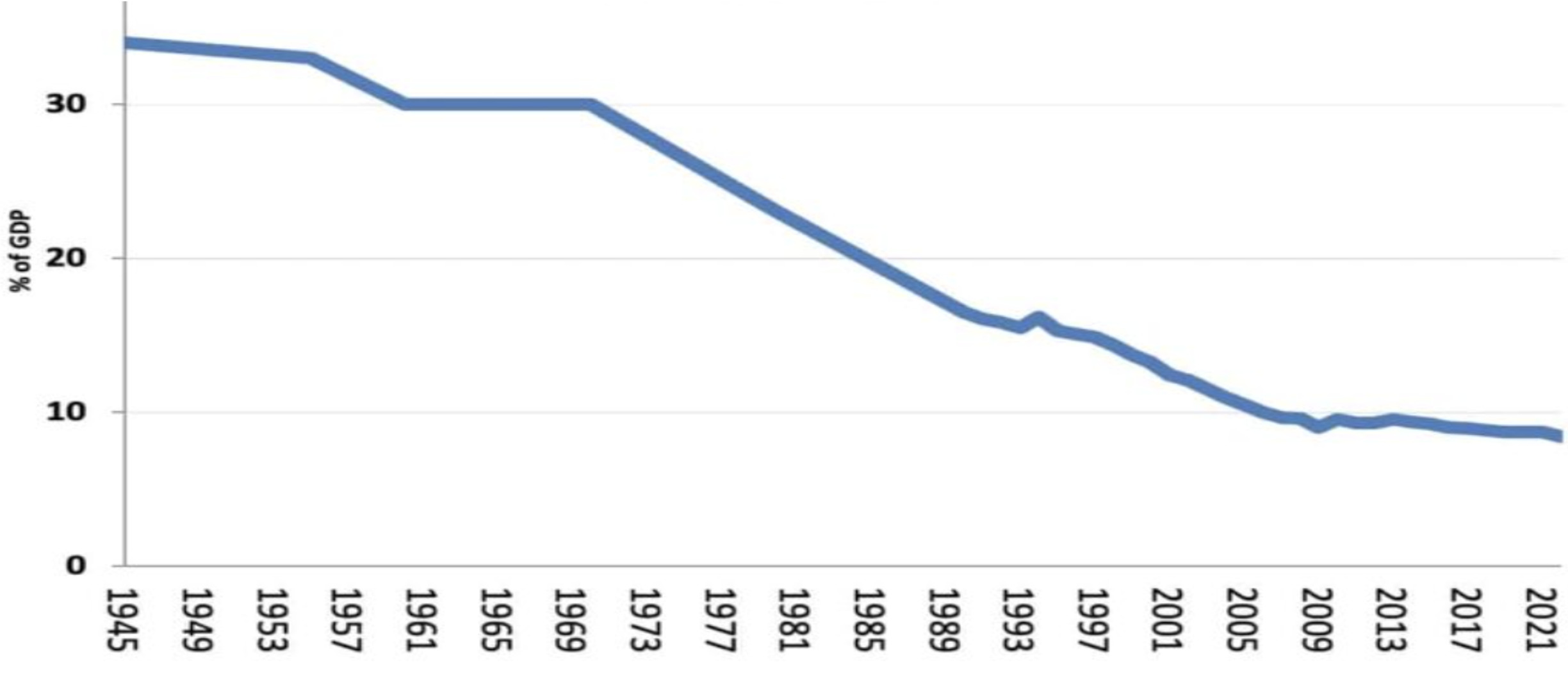
Image sourced from a publicly available website and used for non-commercial, educational, and research purposes.
Source: https://www.economicshelp.org/blog/219307/economics/deindustrialisation-in-the-uk/

Figure 2: Finance Replacing Manufacturing as a Percentage of GDP, 1970-2021.
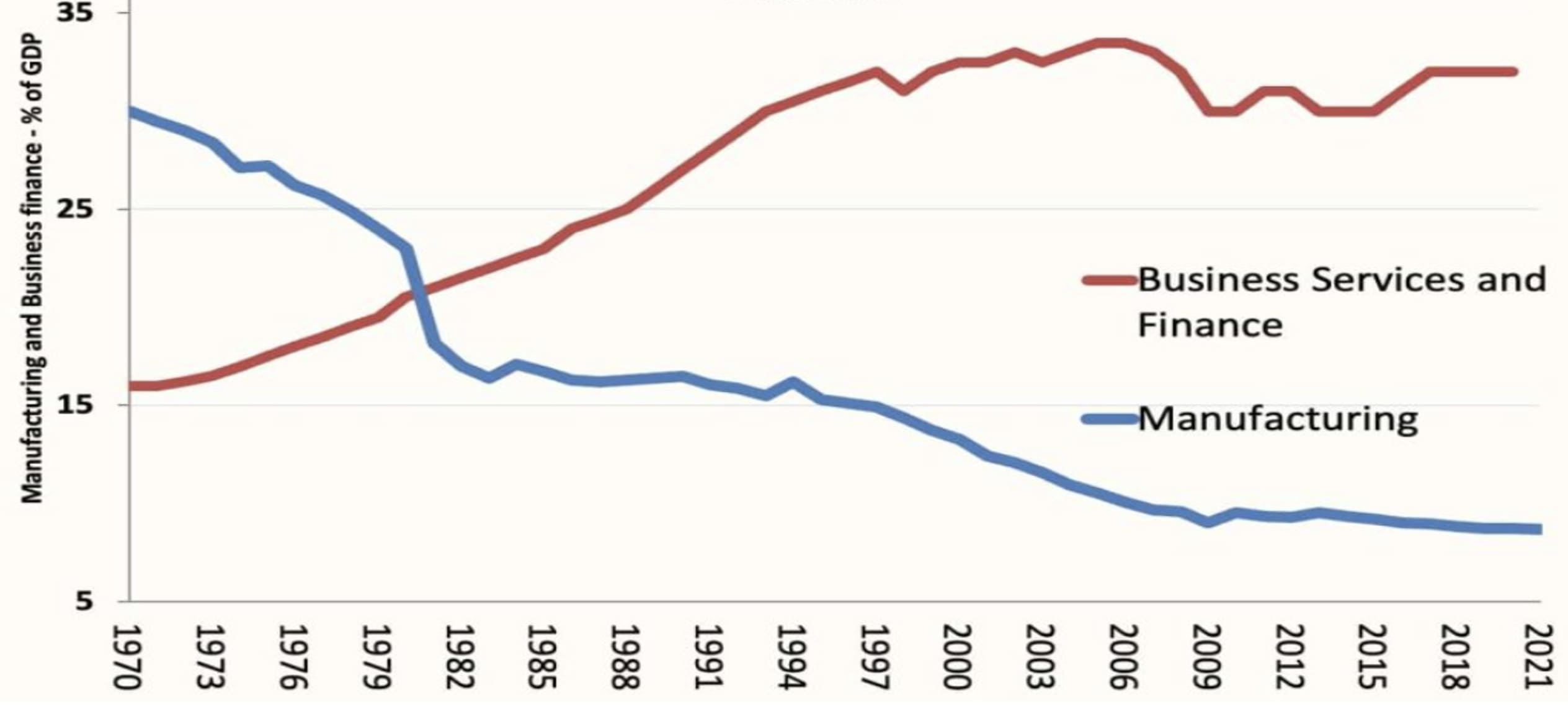
Image sourced from a publicly available website and used for non-commercial, educational, and research purposes.
Source: Office of National Statistics (ONS), https://www.economicshelp.org/blog/219307/economics/deindustrialisation-in-the-uk/

From 1970 to 2022, the UK often experienced the highest rate of inflation in the developed world, so UK exports gradually became less competitive. Meanwhile, productivity was rising faster in countries such as Germany and Japan, whose manufacturers invested more heavily in new technology and production methods. The reasons for this decline in competitiveness are multiple: a lack of investment, a slow rate of technological adoption, high spending on defence, financialisation and globalisation. Together, these forces eroded the UK’s manufacturing base.

In the early 1980s, North Sea oil revenues and tight monetary policy pushed sterling to a high value, making exports expensive and uncompetitive. This imposed severe pressure on manufacturing exporters and accelerated closures across industrial regions. Sterling’s appreciation was dramatic: from 1977 to 1980, the pound rose from 1.65 to 2.45 against the dollar. This episode illustrates how exchange-rate policy, rather than simply “natural” economic decline, actively reshaped the fortunes of British manufacturing.

It is important to stress that these causes did not operate in isolation, nor were they purely economic. They were mediated through political decisions—about monetary policy, exchange rates, defence spending and the deregulation of finance—and through class interests. Deindustrialisation was therefore not simply the inevitable result of technological change or shifting consumer demand, but a contested process of capitalist restructuring whose trajectory was shaped by power, politics and the state.

UK manufacturing employment fell especially steeply in the early 1980s, during a recession triggered by a high exchange rate and high interest rates. Rowthorn and Coutts (2004) discussed these job losses as part of the broader process of deindustrialisation. The early 1990s recession brought further major job losses. The recession triggered by the 2008 financial crisis reduced UK manufacturing employment still further, and during the subsequent recovery manufacturing employment did not return to its pre-crisis level.

For instance, employment in the coal industry fell sharply between 1980 and 1990. When UK coal production peaked in 1913, 1.1 million miners were employed in over 3,000 mines. For much of the rest of the twentieth century, employment in the UK coal industry declined, although 450,000 miners were still working in 1966. Further heavy job losses followed in 1984–85, when the miners’ strike failed to stop pit closures; the final colliery closed in 2015.

The shift from industrial to service sector employment is not unique to the UK. All advanced economies have witnessed structural changes, but at different rates, reflecting differential growth in labour productivity: it is generally easier to replace workers with machines in manufacturing than in most service activities, and this process has been accentuated by globalisation. This occurred as US and EU firms began to move to China, Malaysia, India and other emerging economies in search of low wages and higher returns on their investments.

The UK’s industrial job losses have been concentrated in specific parts of the country. This partly reflects the distribution of manufacturing, which was always more important in some regions than others, and partly the location of industries—such as coal, steel, shipbuilding, heavy engineering, and textiles and clothing—that experienced the biggest reduction in employment.

In 2018, manufacturing in the UK accounted for 8% of employment (2.7 million people) and £191 billion in economic output, or 10% of the UK total. It also accounted for 42% of UK exports, worth £275 billion, and 65% (£16 billion) of UK research and development spending (See Figure 3).

Figure 3: Manufacturing as a Percentage of UK total Output, Employment, R&D and Exports, 1997-2018.
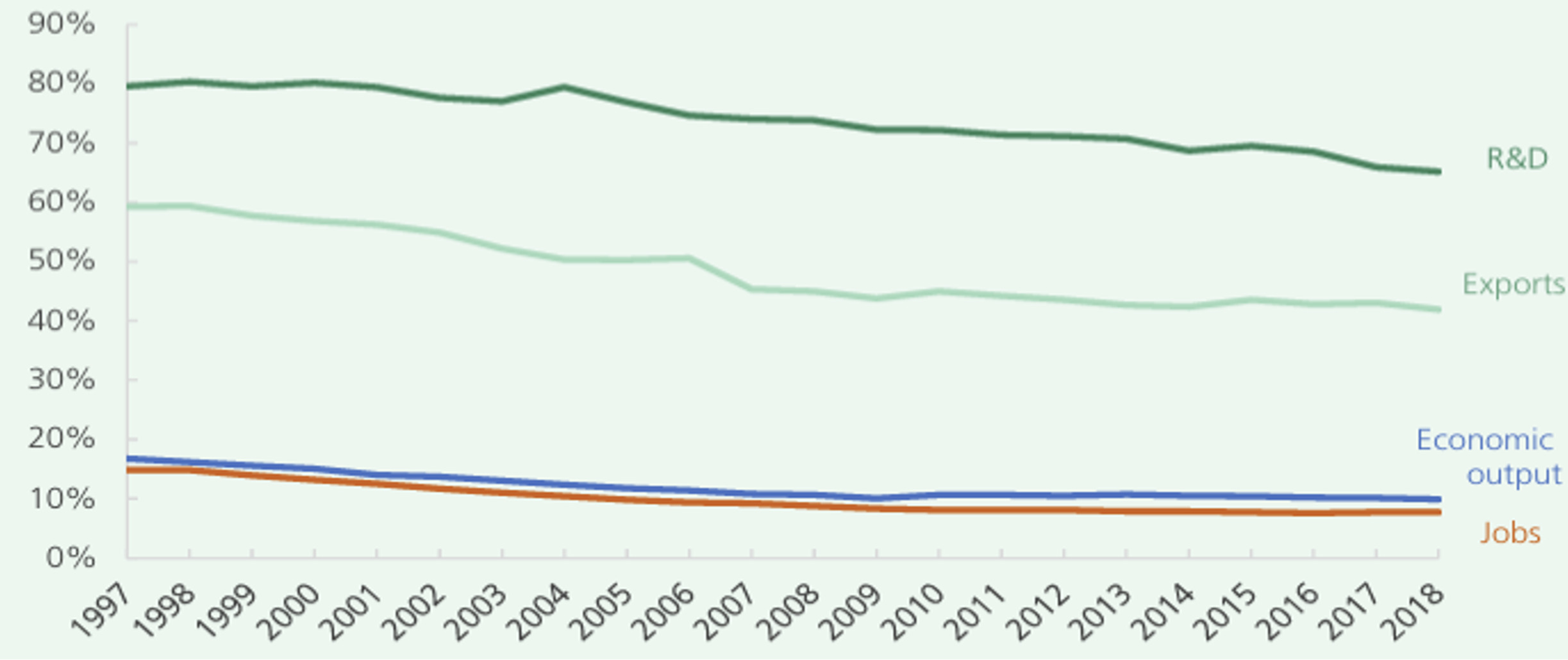
Image sourced from a publicly available website and used for non-commercial, educational, and research purposes.
Source: https://researchbriefings.files.parliament.uk/documents/SN01942/SN01942.pdf

Manufacturing’s share of UK economic output—measured in terms of Gross Value Added (GVA)—has declined steadily over several decades, falling from 27% in 1970 to 10% in 2018. Over the past four decades, this declining share has been driven primarily by faster growth in other sectors, especially services, rather than by an absolute fall in manufacturing output. In real terms, UK manufacturing output in 2018 was actually 7% higher than in 1990. Over the same period, however, service sector output rose by 106%. By 2018, services accounted for 80% of the economy, up from 69% in 1990.

The relative decline of manufacturing is often attributed to intensifying international competition. UK manufacturers have faced lower-cost producers in other countries—notably China and India—where lower labour costs, proximity to raw materials, economies of scale and active state support can reduce production costs. As global supply chains have expanded, many US and EU firms have relocated production to emerging economies in search of lower wages and higher returns, further reducing the UK’s manufacturing base. This process has not been purely market-driven, however; it has also been shaped by domestic policy choices, including financial deregulation, exchange-rate policy and the prioritisation of the service and financial sectors.

International comparisons highlight the extent of UK deindustrialisation. In 2018, UK manufacturing value added was equivalent to 10% of GDP, a smaller share than in most other major economies (See Figure 4a). Germany’s manufacturing share was 23%—unusually high among major Western economies—while France’s was 11%, the United States’ 12% and Italy’s 17% (Siddiqui, 2024b). China and South Korea had significantly larger manufacturing sectors, equivalent to 30% and 29% of their GDP respectively.

These figures suggest that the UK’s trajectory has been comparatively deep, not merely a universal consequence of advanced-economy development. They also underline that manufacturing remains strategically important despite its smaller share of GDP: it continues to account disproportionately for exports, research and development, and productivity growth. Figure 4b compares the share of employment in industry in the UK with that of other industrial economies. It shows that the decline in manufacturing employment in the UK was more pronounced than in other industrialised countries.

Figure 4a: International Comparison of Manufacturing’s Share of GDP in 2018 (%).
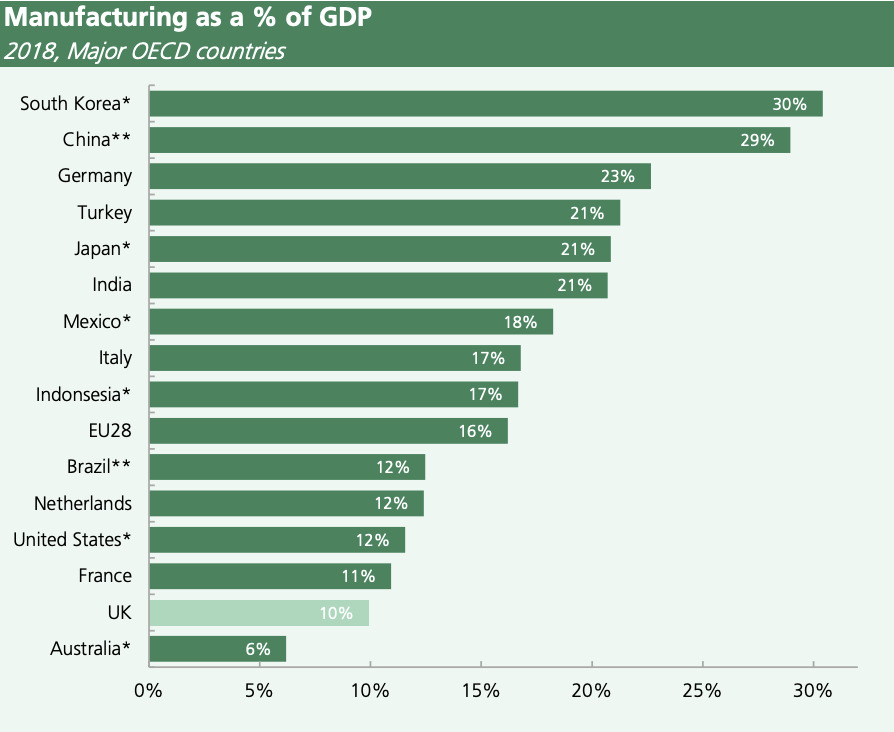
Image sourced from a publicly available website and used for non-commercial, educational, and research purposes.
Source: https://researchbriefings.files.parliament.uk/documents/SN01942/SN01942.pdf

Figure 4b: Share of Employment in Industry, UK versus other Advanced Economies, 1950-2020 (%).
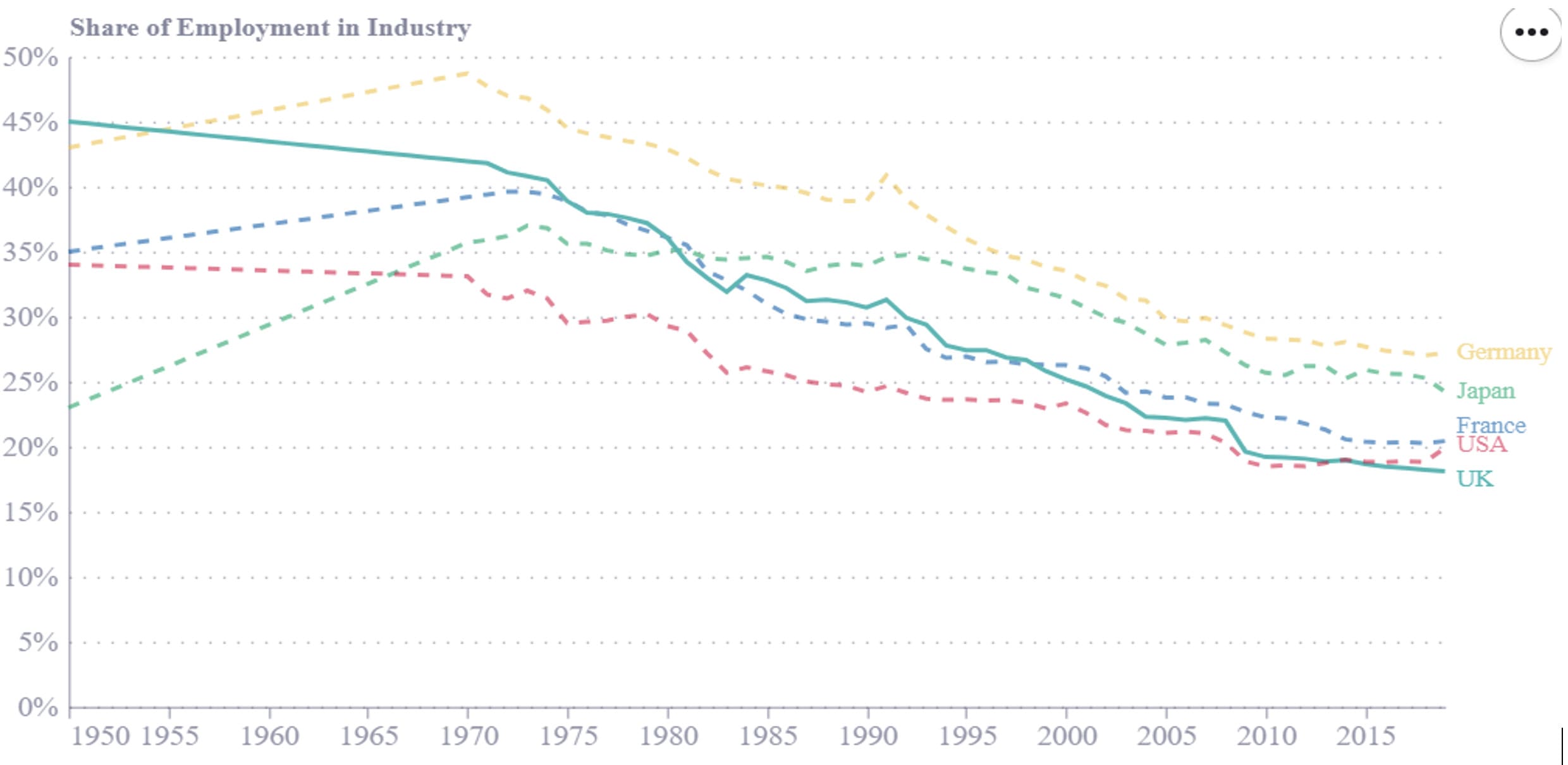
Image sourced from a publicly available website and used for non-commercial, educational, and research purposes.
Source: https://www.economicsobservatory.com/how-has-deindustrialisation-affected-living-standards-in-the-uk

In 1985, manufacturing accounted for 84% of total R&D investment. By 2018, that share had fallen to 65%, when manufacturing R&D spending totalled £16.3 billion. The combined R&D spending of all service sectors totalled £7.9 billion, or 32% of the total, despite services accounting for 80% of UK economic output. The proportion of R&D spending accounted for by service industries rose correspondingly over the same period, from 11% to 32%.

Historically, the interaction between science and technology has been closer in manufacturing than in the service industries. This has resulted in more R&D investment by manufacturing firms, a greater readiness to adopt new technology, and consequently larger productivity gains. Service industries—particularly IT services, but also financial and management services—have invested more heavily in R&D, reflecting the growing importance of digital technology, software development and knowledge-intensive services to the UK economy. Nevertheless, the fact that services generate 80% of economic output but only 32% of R&D spending suggests that the innovation system has not shifted as rapidly as the structure of the economy itself, with implications for long-term productivity growth.

IV. Business Investment, Brexit and UK Manufacturing

Business investment in UK manufacturing has fallen as a proportion of all investment over the last decade. In 1997, investment in manufacturing was worth £26.1 billion, or 19% of total business investment. By 2009, it had fallen to £16.9 billion, or 13% of the total. It has since risen in absolute terms, reaching £31.0 billion in 2018, but its share remained below its earlier level at 15% of the total. The declining share of investment flowing into manufacturing is significant because manufacturing is typically more capital-intensive than services, and lower investment can translate into weaker productivity growth, slower technological upgrading and reduced international competitiveness over time.

The UK’s decision to leave the EU has already had an impact on the manufacturing industry, and the nature of the new trade deal between the UK and the EU will continue to shape the fortunes of manufacturing firms for years to come. Manufacturing trade associations welcomed the Withdrawal Agreement agreed in October 2019, largely because it provided a degree of certainty after several years of political turbulence.

These concerns are especially acute because UK manufacturing is deeply integrated into EU and global supply chains. Many firms rely on just-in-time production systems, in which components cross borders multiple times before a finished product is assembled. Tariffs, customs checks, regulatory divergence and rules-of-origin requirements all threaten to raise costs, cause delays and disrupt these finely tuned networks. Small and medium-sized manufacturers, which often lack the resources to absorb additional administrative burdens, are particularly vulnerable. Access to skilled labour is a further concern: manufacturing depends heavily on engineers, technicians and specialist workers, and restrictions on immigration may exacerbate existing skills shortages.

The Brexit process thus exemplifies the central argument of this analysis: deindustrialisation is not simply the inevitable outcome of economic maturity or technological change, but a contested process shaped by political decisions, changing patterns of capital accumulation and class interests. The decision to leave the EU, the form of the withdrawal agreement and the nature of the future trading relationship are all political choices that will mediate the trajectory of UK manufacturing. They will shape which firms survive, which regions prosper, and which workers bear the costs of adjustment.

The government’s industrial strategy, published in November 2017, includes a number of policies designed to support manufacturing, including sector deals and Grand Challenges for industry. These measures seek to raise productivity, encourage innovation and strengthen the UK’s industrial base. However, critics argue that the strategy lacks the scale, coherence and long-term commitment needed to reverse decades of relative decline, and that it sits uneasily alongside other policy priorities—such as the pursuit of a hard Brexit—that may work against manufacturing interests. The effectiveness of industrial strategy therefore depends not only on the measures themselves, but on the wider political and economic framework in which they are embedded.

V. The IT Industry and Service Economy 

The UK’s IT industry is worth around £58 billion a year, and roughly 100,000 software companies operate in the country, including multinationals such as Microsoft and IBM. The UK also has the largest mobile device market in Europe, with around 80 million mobile subscriptions, worth an estimated £14 billion annually. Cloud-based storage systems are a fast-growing part of the economy, as many UK companies seek to locate data centres closer to home. Cyber security has likewise expanded in response to increased threats, and the UK market is now worth about £2.8 billion a year. Taken together, these developments illustrate the growing weight of digital, knowledge-intensive services within the UK economy.

The service sector accounts for roughly three-quarters of the UK economy—around 80% on some measures—and covers a wide range of activities: healthcare, IT support, entertainment, finance, retail, hospitality, professional services and education. The UK is also a major exporter of services, with tourism and education among the most visible examples, and it is the world’s second-largest exporter of services globally.

This service-led orientation is central to debates about deindustrialisation. It shows that economic restructuring has not simply been a story of decline: new sectors have grown, created employment and generated exports. At the same time, the service sector is highly heterogeneous. Some parts—finance, IT, professional services and higher education—are high-productivity, high-wage and internationally traded. Others—retail, hospitality, care and parts of the gig economy—are low-productivity, low-wage and largely domestic. Aggregate growth in services therefore masks deep inequalities between sectors, regions and workers, and it does not automatically compensate for the loss of manufacturing employment. Many services also depend indirectly on manufacturing demand, while Brexit poses particular risks to services trade because barriers often operate through regulatory divergence, mobility restrictions and the loss of mutual recognition rather than tariffs alone.

Industrial decline has had profound consequences for regional inequality and health in the UK. Britain’s stark geographical disparities are deep-rooted: they became entrenched during the second half of the twentieth century, accelerated in the 1980s, and were compounded by the global financial crisis of 2007–09. The loss of industrial jobs—which were neither replaced by new employment nor offset by improved access to other opportunities—has adversely affected health outcomes. In former industrial communities, joblessness and economic marginalisation have been associated with poorer mental health, higher rates of substance misuse and lower life expectancy.

As Tregenna notes (2014: 1373-1374) “Deindustrialisation is likely to have a range of economic and broader ramifications for the future of capitalism. It could be expected to affect the rates and sustainability of growth, although these effects would to some extent depend on the nature of the deindustrialisation. Deindustrialisation would also alter the structure and character of the working class, with the shift away from factories…. towards more dispersed service workplaces in which atypical work is more common. This shift would also affect the nature of the work process as well as levels of benefits and job security. The structure of the capitalist class would also be affected, with concomitant changes in the interests of the dominant fractions of the capitalist class concerning issues such as monetary policy.”

VI. Why Deindustrialisation Matters

The question of why deindustrialisation matters depend, in the first instance, on whether the relative decline of manufacturing has adverse consequences for employment or for the overall level of economic activity. If it does not, then there may be no problem to address. But there has long been interest in what causes and creates the wealth of nations, and in the role that industry and manufacturing play in that process. Its importance was highlighted by Adam Smith in 1776, and the debates continue, with many key issues remaining unresolved or at least still disputed (for a recent contribution, see Acemoglu and Robinson, 2012). The relative decline of manufacturing, as a share of both output and employment, has been apparent in all advanced economies, particularly since the 1960s (Kitson and Michie, 2014) – but the decline has been more rapid in the UK than in other advanced countries. This has led some to argue that it reflects a process of historical evolution, in which advanced economies are characterised by a large services sector and a small manufacturing sector (see Rostow, 1960; Kuznets, 1966). On this view, deindustrialisation is simply the natural companion of economic maturity.

Yet this interpretation is contested. Technical change also played a critical role in triggering deindustrialisation, but it did not operate in a political vacuum. In the UK and other advanced economies, deindustrialisation was driven not only by technological change but also by a lack of private investment and the absence of a targeted industrial policy. The increasing financialisation of the economy has been associated with rising income inequalities, while the contraction of domestic demand—worsened by the income distribution effects of the 2008 global financial crisis—further weakened the manufacturing base. These developments were not inevitable. They were shaped by political decisions, changing patterns of capital accumulation and class interests, which together determined whether manufacturing was supported, neglected or actively dismantled (Siddiqui, 2021b).

Understanding deindustrialisation is therefore important for at least three reasons. First, it bears directly on questions of employment, productivity and the balance of payments, since manufacturing has historically played a disproportionate role in exports, innovation and productivity growth. Second, it illuminates the relationship between economic restructuring and regional inequality: deindustrialisation has not affected all places equally, and its costs have been concentrated in particular regions and communities. Third, it raises fundamental questions about the state, class and power: whether governments choose to support industry, and on what terms, is a political question, not simply an economic one. Deindustrialisation is thus not merely a description of sectoral change; it is a window onto the wider dynamics of capitalist restructuring.

VII. Industrial Policy and the Ecological Crisis

Industrial policy has also been a key element in the growth of the Japanese economy since the 1950s. Japan adopted a policy of targeting key industries (‘picking winners’) such as electronics and automotive manufacturing, providing finance for long-term investment, and adopting protectionist measures. These policies underpinned Japan’s rapid growth, particularly from 1950 to 1973. The strong economic growth in Japan ended abruptly in the early 1990s, but this reflected a financial crisis following an asset price bubble rather than fundamental flaws in Japanese industrial policy (Siddiqui, 2009).

An active industrial policy has also been a feature of the German economy, particularly since the end of the Second World War. The German model has focused on support for long-term finance, investment in education and training, and a regulated labour market. Furthermore, since the 1970s there has been an increasing focus on public support for innovation, achieved through the creation of networks and institutions that facilitate the commercialisation and exchange of knowledge—such as intermediate technology organisations like the Fraunhofer Institutes.

Britain, by contrast, has been distinctive in its systematic failure to pursue any sort of long-term industrial policy. The lessons of other advanced countries show that industrial policy can promote both the manufacturing sector and overall economic growth. The details of successful industrial policies vary between countries depending on the stage of economic development and the characteristics of each national economy. But common features include finance for long-term investment, a focus on training and education, and support for technology, R&D and innovation (Siddiqui, 2023).

The comparison is instructive. Japan and Germany both maintained sustained commitments to industrial development, albeit through different institutional arrangements: Japan through targeted promotion and protection (Siddiqui, 2009), Germany through long-term finance, vocational training and innovation networks. Britain, by contrast, oscillated between intervention and laissez-faire, with no enduring institutional framework to support manufacturing. This contrast reinforces the central argument of this analysis: deindustrialisation was not an inevitable consequence of economic maturity, but the product of political choices, changing patterns of capital accumulation and class interests. Where the state actively supported industry—as in Japan and Germany—manufacturing retained a stronger position. Where it did not, as in the UK, industrial decline was far more pronounced.

In May 1979, Margaret Thatcher won the general election and Geoffrey Howe became Chancellor of the Exchequer. In October 1979, exchange controls were abolished. For the first time in decades, capital could leave Britain freely. The monetarist programme was straightforward in its aims: control the money supply, cut the public sector borrowing requirement, and let market forces decide which industries survived. Inflation was the stated enemy number one.

On 27 October 1986 came the “Big Bang”: the deregulation of the City of London’s financial markets. Fixed commissions were abolished. Foreign banks were admitted. Electronic trading was introduced. The exchange controls scrapped in 1979 had made this expansion possible; the Big Bang made it deliberate policy. By then, manufacturing’s share of the economy had already fallen from around 30% in 1970 to roughly 20% by mid-1980s. British Telecom was privatised in 1984, British Gas in 1986. British Leyland was broken up and sold. Rover Group passed to British Aerospace in 1988, and then to BMW in 1994. The Longbridge plant that had built the Austin A40 was still standing, still building cars, and no longer British—no longer answerable to any consideration of British industrial strategy.

After 1997, Blair’s Labour government did not continue the strategy in any meaningful form, and manufacturing’s share of the economy went on falling regardless. What most people do not realise—and I certainly did not before I began this research—is that of all advanced economies tracked between 1960 and 2015, the UK saw a steeper drop in manufacturing employment than any country except Switzerland. Germany, France and Sweden all held on to substantially more of their industrial base. The British experience was not the inevitable direction of travel.

Manufacturing employed around 6 million people in 1979. By 2024, that figure had fallen to 2.6 million. As a share of the economy, manufacturing declined from around 30% in 1970 to 17% by 1990 and to less than 9% by the early 2020s. Germany’s manufacturing sector accounted for around 19% of its economy in 2024, more than twice Britain’s share. Germany achieved this through deliberate policy choices that remained broadly consistent across governments of different political parties.

British economy away from the industries that had made the country an industrial power in the first place. The consequences of those choices are still being felt today—not only in Britain, but around the world. The first major shocks came with the two world wars. Both conflicts drained Britain of wealth, manpower, and imperial resources. Britain entered the First World War as the world’s largest creditor nation and emerged from the Second World War as one of its largest debtors.

Britain also continued to spend enormous sums on defence during the post-war period, committing a far larger share of its economy to defence than some of its major economic competitors, particularly Germany and Japan. This left Germany and Japan with greater scope to channel capital into rebuilding and modernising their industrial bases.

The miners’ strike of 1984–85 was the most dramatic confrontation. When it began, the nationalised coal industry employed around 171,000 miners. By the time the industry was privatised in 1994, only 16 pits remained. Ten years after the strike ended, nearly 90% of the workforce had gone. In 1980, the National Coal Board operated 219 coal mines and employed a quarter of a million miners. Today, not a single deep coal mine remains in operation in Britain. The British steel industry, once one of Europe’s largest steel producers, shed tens of thousands of workers throughout the 1980s.

In October 1986, the London Stock Exchange was deregulated. The old rules that had governed the City of London for centuries were swept away. Foreign banks were allowed to compete. Computerised trading replaced face-to-face transactions. And the volume of money flowing through the City of London exploded. It changed the entire character of the British economy. London became one of the world’s three principal financial centres, alongside New York and Tokyo.

Britain officially chose finance over industry and short-term returns over long-term investment. In 1990, manufacturing still accounted for about 16.6% of Britain’s GDP. By 2000, it had fallen to 14.8%. By 2010, it was down to about 9.5%. And by 2024, it stood at just under 8%. Meanwhile, services, dominated by financial services, now account for over 72% of the economy. Britain did not just stop making things; it actively replaced making things with moving money. And then came globalisation.

Through the 1990s and 2000s, the acceleration of global trade opened up a flood of manufactured goods from countries with far lower labour costs. China’s entry into the World Trade Organization in 2001 was a watershed moment. British manufacturers were not just competing against Germany or Japan; they were competing against a country with over a billion workers and low wages. Products that once would have been made in Birmingham or Glasgow were now being made in Shenzhen or Guangzhou for a fraction of the price.

British consumers benefited from cheaper goods, but British workers paid the price. Many of those devastated communities—communities that had voted Labour for generations—swung to Brexit in 2016 and then to the Conservatives in 2019, driven by a feeling that the ruling elites had abandoned them.

The consequences of those choices are still being felt today—not only in Britain, but around the world.

Industrial policy must now take into account the ecological, environmental and climate crisis. Public policy should promote a structural transformation of the manufacturing sector towards sustainable production—for example, through investment in renewable energy, green technologies, energy efficiency and circular production methods. Industrial policy must also improve social infrastructure: the healthcare sector and public transport need greater public funding, and the availability of social services in general must be improved. These objectives are interconnected. A just transition requires not only decarbonising industry but also ensuring that the workers and communities affected by industrial change are supported through retraining, investment and expanded public services. In this sense, industrial policy is not simply about reviving manufacturing; it is about reshaping the relationship between the economy, the state and society in ways that are socially just and ecologically sustainable. (Siddiqui, 2021b).

VIII. Conclusion

Despite decline of manufacturing sector, yet it still remains important to the UK economy. It contributes around £220 billion in output, employs 2.6 million people, and accounts for 42% of exports and 48% of business R&D. Aerospace alone supports over 100,000 jobs and generates £34 billion in annual turnover. Automotive employs more than 180,000 people in manufacturing and nearly 800,000 across the wider industry, while pharmaceuticals, advanced materials and defence technology remain significant. Britain is still the world’s twelfth-largest manufacturing nation, though it trails countries such as China, India, Japan, South Korea, Mexico, France, Italy, and Germany. Yet manufacturing now accounts for less than a tenth of economic output – a striking reversal for the sector that once made Britain the world’s leading industrial power.

The study concludes that this deindustrialisation was politically mediated, not natural or inevitable. Policy choices from the 1980s onward—the defeat of the miners’ strike, City deregulation, and the neoliberal privileging of finance over manufacturing—restructured the economy around services and global trade. The costs fell unevenly. Industrial regions suffered job losses, declining incomes and community breakdown, while London and finance flourished. That spatial inequality reshaped politics, contributing to Brexit and the 2019 Conservative swing in former Labour heartlands.

Yet manufacturing’s persistence shows that its decline was not inevitable. Deindustrialisation in the UK was therefore a political outcome—and reversing it would be a political choice, too. Raising defence spending in the name of industrialisation—while cutting public spending on welfare, health and education and ignoring rising inequality—will deepen the socio-economic crisis and undermine democracy.

Deindustrialisation was therefore a distributional project with lasting consequences for class, region, and democracy. Whether it can be reversed depends on political will. Reversal would require state intervention: the UK’s industrial policy must favour industry; the government must direct the financial sector to provide cheap credit to manufacturing – as Japan did in the 1960s and 1970s to support its industrial sector and compete globally – and the state must take the lead in raising funds for R&D investment in new technology to drive industrial renewal and long-term competitiveness.

About the Author

Dr. Kalim Siddiqui is an economist specializing in International Political Economy, Development Economics, Trade and Economic Policy. Since 1989, he has been teaching economics at various universities in Norway and the UK. Dr. Siddiqui’s research interests encompass a wide range of topics, including political economy, international trade, and economic history, South Asia, and emerging economies. He has presented papers at international conferences across numerous countries, reflecting his global engagement in the field. His scholarly pursuits span six broad domains: Political Economy, Development Economics, Economic History, Economic Policy, Globalization, and International Trade. Dr. Siddiqui has made significant contributions to research in areas such as trade policy, globalization, and political economy. His work has been published in chapters of edited books and articles published in peer-reviewed journals. For inquiries, Dr. Siddiqui can be reached at: [email protected]

References

  1. Kaldor, N. (1978) Further Essays on Economic Theory, London, Duckworth.
  2. Kitson, M. and Michie, J. (2014) “The Industrial Revolution: The Rise and Fall of the UK Manufacturing, 1870-2010” Centre for Business Research, University of Cambridge, Working Paper No. 459, University of Cambridge.
  3. Rowthorn, R. and Coutts, K. (2004) Commentary: Deindustrialisation and the balance of payments in advanced economies, Cambridge Journal of Economics, 28(5): 767–90.
  4. Saeger, S. (1997) “Globalization and Deindustrialization: myth and reality in the OECD” Review of World Economics 133(4): 579–608.
  5. Siddiqui, K. (2026a) “The British Growth Model: Political Economy, Governance, and Stagnation” World Financial Review, August.
  6. Siddiqui, K. (2026b) “Monopoly Capitalism and the Concentration of Capital in Production and Digital Technology” World Financial Review, January.
  7. Siddiqui, K. (2025) “Neoliberalism and the Performance of the UK’s Economy: A Critical Review” World Review of Political Economy, 16(2): 224-252, Summer.
  8. Siddiqui, K. (2024a) “The Economic Crisis and Challenges for the UK Economy” World Financial Review, July.
  9. Siddiqui, K. (2024b) “The Decline of the West and Global Political Economy” World Financial Review, December.
  10. Siddiqui, K. (2023) “Marxian Analysis of Capitalism and Crises” International Critical Thought 13(4): 525-545.
  11. Siddiqui, K. (2021a). “Can the 21st Century be an Asian Century?” Asian Profile, 49(1):1-19, March.
  12. Siddiqui, K. (2021b). “The Political Economy of Industrial Policy” World Financial Review, May/June.
  13. Siddiqui, K. (2017). “Austerity as a Tool of Fiscal Consolidation: Theoretical and Empirical Perspective” (Edi) S. Owsiak, Public Finance, and the New Economic Governance in the European Union, 116 – 166, Warsaw: Wydawnictwo Naukowe.
  14. Siddiqui, K. (2009). “Japan’s Economic Crisis” Research in Applied Economics 1(1):1-25.
  15. Singh, A. (1977) “UK industry and the world economy: a case of de-industrialisation?” Cambridge Journal of Economics 1(2): 113–136.
  16. Tregenna, F. (2014) “A new theoretical analysis of deindustrialisation” Cambridge Journal of Economics 38(5): 1373–1390.


Why Employee Mental Health Matters for Business Growth

Employee Mental Health

A business can have a strong product, loyal customers and ambitious plans, but it still depends on the people doing the work every day. When employees are struggling with stress, anxiety or burnout, it can affect far more than their personal well-being. Their concentration, motivation, communication and ability to get through everyday tasks can all suffer.

For this reason, employee mental health deserves more attention from businesses of every size. Looking after staff is not only about creating a nicer workplace. It can also help companies build reliable teams, reduce staff turnover and create an environment where people can do their jobs properly. That’s why it’s always a good idea to provide free mental health appointments with professionals such as ahtida Health for your employees. Consider the cost an investment!

Happier Employees Can Work More Effectively

It is difficult to stay focused when your mind is constantly occupied by stress. An employee might still be at their desk, attending meetings and responding to messages, but that does not necessarily mean they are working at their best.

Ongoing pressure can make ordinary tasks feel much harder. Concentration may drop, mistakes can become more frequent and even simple decisions can take longer. If these problems continue, both the employee and the business can feel the effects.

A workplace that takes mental health seriously can make it easier for people to speak up when they are struggling. Sometimes, a small change in workload, clearer priorities or a conversation with a manager can make a meaningful difference.

It is also important to remember that supporting employees does not mean lowering standards. People are more likely to meet expectations when those expectations are realistic and they have the support needed to meet them.

Mental Health Can Affect Staff Retention

Replacing an employee is rarely as simple as putting up a job advert. Recruitment takes time, and new staff need to learn how the business operates before they can work at the same level as someone with experience.

If employees regularly feel exhausted, ignored or under constant pressure, they may eventually start looking elsewhere. High staff turnover can leave remaining employees with additional responsibilities, which can create even more pressure.

A healthier workplace can give people a reason to stay. Employees tend to value managers who listen, reasonable workloads and an environment where concerns can be raised without fear of being judged.

This is particularly important for smaller businesses. Losing one experienced member of staff can have a noticeable effect when there is already a small team handling most of the day-to-day work.

Better Well-Being Can Strengthen Teams

The way employees feel can influence how they interact with the people around them. Someone who is under significant pressure may become withdrawn, impatient or less willing to communicate. Over time, this can affect relationships within a team.

Open communication can help prevent some of these issues. Employees should feel able to tell a manager when something is becoming difficult rather than waiting until they reach breaking point.

Managers have an important role to play here. They do not need to be mental health experts, but they should be able to recognise when someone may be struggling and know where to direct them for appropriate support.

Simple things can also make a difference. Encouraging regular breaks, keeping workloads manageable and respecting boundaries outside working hours can help create a healthier atmosphere.

Employee Well-Being and Business Growth

There is a clear connection between the health of a workforce and the way a business operates. Frequent absences, poor concentration and staff turnover can all create additional costs and make it harder for teams to maintain consistent performance.

Supporting mental health can help businesses deal with these challenges in a more practical way. It can create a workplace where employees feel valued and are more comfortable asking for help before a problem becomes overwhelming.

This does not require every business to introduce expensive programmes or complicated policies. Sometimes it starts with better communication, realistic expectations and managers who genuinely pay attention to how their teams are doing.

As workplaces continue to change, employee expectations are changing with them. People increasingly want to work for organisations that recognise that their employees have lives and responsibilities outside the workplace. Businesses that take this seriously can build stronger teams, improve retention and create better conditions for sustainable growth.

From Perceived Risk to Bankable Investment: Closing Africa’s Financing Gap

Business man using hand to protect a stack of coins with a red warning sign for risk management. Concept of business or financial risks. Africa’s Financing Gap concept

By Dr Anthony Ehimare

Africa is not one single risk story. Every country, sector and project faces different challenges. Some risks can be addressed through better policies or stronger project structures. Others can be managed through guarantees, insurance or risk-sharing.

When the institutions responsible for development finance gather in Bangkok for the IMF-World Bank Annual Meetings this October, they will bring together much of what is needed to make African projects investable: sovereign analysis, project preparation expertise, lending capacity, guarantees, insurance and access to private investors. The challenge is to deploy those capabilities together, around viable transactions, with a clear allocation of responsibility for the risks that prevent financing.

For Africa, that should be a central question at these meetings. How can the institutions assembled strengthen the shared understanding and cooperation needed to assess, allocate and mitigate African investment risk?

At ATIDI, we have argued that Africa’s investment future depends on understanding risk differently, and that investor confidence must be built at scale. Bangkok offers an opportunity to advance that argument. Confidence becomes investable when it is supported by credible evidence, enforceable contracts and institutions willing and able to absorb defined exposures. Building those conditions requires cooperation between multilaterals, African governments, development insurers and private financiers.

Treating all African economies as a single risk proposition obscures the differences that determine whether an investment can service its debt and deliver a return. Country institutions, fiscal capacity, foreign-exchange availability, sector regulation and contractual enforcement vary materially. Within each country, the same economic shock can affect projects very differently.

Addressable credit and political risks

Consider an exporter earning hard currency and a power producer collecting local-currency revenues while servicing foreign-currency debt. Depreciation affects their cash flows through different channels. For the power producer, tariff adjustment, the availability of hedging and the timing of payments from the utility may determine whether debt remains serviceable. A broad country assessment provides context; project analysis must establish how those conditions translate into repayment risk.

This precision matters economically. A risk premium unsupported by the transaction’s fundamentals raises financing costs. Short tenors accelerate debt repayment. Excessive cash collateral requirements tie up resources that could support construction or operations. Together, these conditions can weaken the financial resilience of the very projects investors want to protect.

As a Chief Risk Officer, I regard the recognition of genuine risk as essential to mobilising capital sustainably. Insurance cannot make an uneconomic project viable. A guarantee cannot resolve an unsustainable debt burden. The task is to distinguish weaknesses requiring reforms or restructuring from exposures that can be allocated and managed through a credible financing structure.

Multilateral knowledge sharing and trust

That distinction should shape how development institutions work together. The IMF’s macroeconomic and debt-sustainability analysis, the World Bank Group’s policy and project capabilities, regional development banks’ financing expertise and development insurers’ underwriting capacity can inform different parts of the same investment decision. African-led organisations such as ATIDI bring knowledge of counterparties, payment behaviour and the practical operation of local markets. Private lenders bring funding requirements and a view of the conditions under which they can commit capital.

These perspectives should meet early enough to influence project design. If risk mitigation enters only after procurement, revenue arrangements and financing terms have been settled, the opportunity to address fundamental weaknesses may already have narrowed.

ATIDI’s experience demonstrates the value of combining institutional capabilities. Our 2025 Annual Report records gross insured exposure of USD9.2 billion, compared with USD8.9 billion in 2024. Approximately 82% was classified as political risk insurance, including sovereign non-payment and contract-frustration perils. The composition underlines how central government-related obligations and actions are to the transactions we support.

In Côte d’Ivoire, a EUR570 million, 15-year, dual-tranche, multi-currency sovereign facility supporting eligible environmental and social expenditure combined an African Development Bank partial risk guarantee with ATIDI’s second-loss protection. This illustrates how institutions can take complementary positions within one financing structure. Such cooperation depends on clarity about where each institution’s exposure begins, the conditions for payment and the residual risk retained by financiers.

In Burundi, cooperation helped bring the Songa Energy hydropower projects to financial close in February 2025. The USD35 million long-term debt facility provided by TDB Group supports two projects with a combined capacity of 10.65 MW, backed by ATIDI’s political risk insurance and payment guarantees through our Regional Liquidity Support Facility (RLSF).

The combination brings political risk protection and support against delayed off-taker payments into the financing structure. Alongside private equity and development-bank lending, these instruments helped establish a financeable structure in a market with limited precedent for transactions of this kind. This experience demonstrates the value of cooperation between African institutions, international investors and development partners in making complex projects financeable.

Investment in Africa’s renewable future

These renewable energy projects also illustrate why payment timing matters. A plant may produce electricity as contracted yet experience a cash shortfall because its utility off-taker pays late. Lenders must assess both the likelihood of eventual payment and whether the project can meet debt service while waiting. Those are distinct questions requiring appropriately matched protection.

ATIDI’s RLSF addresses short-term payment risk for Independent Power Producers (IPPs). Our 2025 report records support for over 116 MW of new renewable generation capacity and more than USD170 million in project financing mobilised. The wider lesson is that a specific obstacle to financing can be addressed through a mechanism designed around the project’s cash-flow needs.

The significance of these experiences extends beyond individual transactions. They demonstrate how a more precise understanding of risk, supported by institutions with complementary expertise, can create the conditions for investment. That should inform the discussions in Bangkok: how can the development finance community bring its collective knowledge and risk-bearing capacity to bear more effectively on Africa’s financing challenges?

A stronger connection between international financial analysis and African market knowledge is essential. Country-level indicators provide necessary context, while local experience helps explain how policy, contractual obligations and payment behaviour affect an investment in practice. Bringing these perspectives together allows investors to distinguish between risks that threaten a project’s underlying viability and those that can be managed through appropriate protection.

The credibility of that protection matters equally. Investors need confidence in the institutions standing behind a transaction, the obligations they have undertaken and their capacity to respond when difficulties arise. Cooperation between multilaterals, development insurers and private financiers can strengthen that confidence by making the allocation of risk clearer and the financing structure more resilient.

The value of cooperation

For African economies, the value of this cooperation lies in the financing conditions it can make possible: longer investment horizons, more sustainable borrowing costs and greater access to capital for viable projects. Accurately assessing and mitigating risk is therefore central to the development outcomes these institutions seek to support.

Bangkok offers an opportunity to strengthen a shared understanding of how those outcomes can be achieved. ATIDI’s experience points to the importance of combining African expertise, disciplined underwriting and international risk-sharing capacity. The challenge for the institutions gathering there is to ensure that investment decisions reflect both the risks a project faces and the protection available to manage them.

Closing Africa’s financing gap requires capital to respond to that fuller assessment. Where risks are demonstrably mitigated, financing decisions should recognise the difference. That is how a better understanding of African investment risk can translate into greater confidence, stronger projects and sustained investment.

About the Author

Dr. Anthony EhimareDr. Anthony Ehimare is Chief Risk Officer at ATIDI, bringing over 20 years of risk management and institutional banking experience across Africa and North America. Previously, he served as Director/Chief Risk Officer at EBID and held senior risk leadership positions at HSBC Bank USA. He holds a Doctorate in Business Administration and an Executive MBA from the University at Buffalo, New York.

America Needs AI Guardrails That Help Workers And Businesses Adapt

AI Guardrails

By Dr. Gleb Tsipursky

Senator Mark Warner’s new AI package gets one crucial thing right: America cannot govern artificial intelligence by choosing between acceleration and paralysis. His proposed federal AI legislative framework combines mandatory testing of frontier models, rules for consumer-facing agents, data-center disclosure requirements, and a workforce transition fund. That mix points toward a better principle for AI policy. Government should create guardrails that help organizations move faster with confidence while protecting the people and communities absorbing the disruption.

Strong oversight works best when it concentrates scrutiny where failure could create systemic harm.

The strongest part of Warner’s plan is the proposed Secure AI Development Act. It would require government testing of the most advanced models before deployment and establish voluntary incident reporting. The debate should focus less on whether testing slows innovation and more on whether unclear expectations already slow responsible adoption.

Companies hesitate when they cannot predict regulatory demands, liability exposure, or acceptable risk. A consistent testing framework can reduce that uncertainty, especially because the current federal approach to frontier-model evaluation remains under development.

Still, mandatory testing needs risk tiers. A model used to brainstorm marketing copy should face different controls from one used in critical infrastructure, financial markets, or national security. The White House’s existing voluntary frontier-model framework explicitly rejects a broad licensing regime for all model development. Warner should preserve that distinction. Strong oversight works best when it concentrates scrutiny where failure could create systemic harm.

The package also addresses consumer AI agents. Warner previously released the AI AGENT Act discussion draft, which would promote portability, privacy, security, and market access for competing agents. That matters because agents increasingly act on behalf of users rather than merely answering questions. They can book travel, manage purchases, communicate with services, and influence financial decisions. Rules should require meaningful consent, clear accountability, and practical ways for users to change providers without losing their data or digital history.

Warner’s workforce proposals deserve equal attention. His package would create a transition fund financed by limiting some AI data-center tax breaks. Earlier this year, Warner and Senator Mike Rounds introduced a bipartisan workforce preparedness commission focused on training and worker support. Warner also backed a federal workforce transparency framework to measure how AI changes employment. Those efforts reflect a sound sequence: measure disruption, redesign roles, fund transitions, and evaluate results.

The danger lies in treating retraining as a political slogan. Workers need role-specific pathways tied to actual employer demand. A call-center employee cannot build a future from a generic AI literacy course. She needs a credible route toward quality assurance, customer escalation, workflow design, or AI supervision. Employers receiving tax benefits should disclose how AI changes staffing, what skills they will need, and how they will use productivity gains. Public funding should reward verified job transitions rather than training enrollment alone.

Data centers provide the clearest test of that principle. Virginia offers qualifying facilities a sales-tax exemption tied to investment and job creation, while the state’s own reporting tracks the costs and benefits of those incentives. Yet AI infrastructure can impose electricity, water, and land-use costs far beyond the facility fence. Virginia has already created a data-center energy consumption tax designed to protect ratepayers from infrastructure costs. Warner’s proposal to connect federal tax benefits to sustainability standards follows the same logic: companies should retain incentives when they produce measurable public value and internalize the costs they create.

That approach is superior to blanket moratoriums. A pause may stop a poorly designed project, but it can also push investment toward jurisdictions with weaker protections. Risk-based rules create a more durable bargain. Developers should disclose resource use, pay for dedicated infrastructure, meet reliability standards, and contribute to workforce transition where automation displaces jobs. Communities should receive transparent estimates of jobs, tax revenue, energy demand, and long-term liabilities before permits move forward.

The framework should also distinguish organizational adoption from model development. Most American employers will never train a frontier model. They will purchase tools, connect them to internal data, and redesign decisions around them. Their largest risks will arise from weak implementation: employees using unapproved systems, managers automating judgments without appeal, vendors making unsupported claims, and executives measuring usage instead of outcomes. Federal policy can help by publishing model contract clauses, incident-reporting templates, procurement checklists, and sector-specific risk examples. These practical tools would lower compliance costs for smaller organizations that lack dedicated AI legal teams.

This package will attract criticism from both directions. Some technology leaders will call it overreach. Some labor and environmental advocates will consider it too permissive. That tension does not make the framework incoherent. It reveals the central challenge of responsible AI adoption: leaders must govern a moving technology without freezing experimentation or pretending disruption will manage itself.

A pause may stop a poorly designed project, but it can also push investment toward jurisdictions with weaker protections.

Congress should improve Warner’s proposal through measurable thresholds, clear agency ownership, sunset reviews, and public reporting. Every requirement should answer four questions. What risk does it address? Who owns the decision? What evidence proves compliance? When will lawmakers reassess the rule? Those questions turn regulation from a static barrier into adaptive infrastructure.

America needs AI policy that helps people trust change because institutions have earned that trust. Warner’s package offers a promising and genuinely practical workable foundation. Its success will depend on disciplined implementation and whether lawmakers translate broad concern into operational rules that protect workers, communities, consumers, and innovation at the same time.

About the Author

Dr. Gleb TsipurskyDr. Gleb Tsipursky was named “Office Whisperer” by The New York Times for helping leaders overcome frustrations with Generative AI. He serves as the CEO of the future-of-work consultancy Disaster Avoidance Experts. Dr. Gleb wrote seven best-selling books, and his two most recent ones are Returning to the Office and Leading Hybrid and Remote Teams and ChatGPT for Leaders and Content Creators: Unlocking the Potential of Generative AI. His cutting-edge thought leadership was featured in over 650 articles and 550 interviews in Harvard Business Review, Inc. Magazine, USA Today, CBS News, Fox News, Time, Business Insider, Fortune, The New York Times, and elsewhere. His writing was translated into Chinese, Spanish, Russian, Polish, Korean, French, Vietnamese, German, and other languages. His expertise comes from over 20 years of consulting, coaching, and speaking and training for Fortune 500 companies from Aflac to Xerox. It also comes from over 15 years in academia as a behavioral scientist, with 8 years as a lecturer at UNC-Chapel Hill and 7 years as a professor at Ohio State. A proud Ukrainian American, Dr. Gleb lives in Columbus, Ohio.

What ABHFX Told Traders About Fund Safety at Forex Expo Dubai 2026

Forex Expo Dubai 2026

Nobody at the booth asked “is my money safe?” in those exact words.

They asked around it. How fast does a withdrawal actually clear? What happens if a transaction looks wrong. Who’s watching the money before it ever lands in an account. ABH Forex LTD, trading as ABHFX, spent September 22 and 23 at Booth 063 during Forex Expo Dubai 2026 answering exactly that, three practical questions standing in for one bigger one.

The short version: nothing sits in a black box. Every client balance is recorded individually and reconciled regularly against the funds actually held. Money moves only through ABHFX’s own approved channels, and only to a destination that’s already been registered and verified against the account, a withdrawal request gets checked against who the account belongs to, not rubber-stamped through.

That checking starts earlier than most traders assume.

Crypto funding runs through independent, licensed payment gateways before it ever becomes ABHFX’s problem, screening every transaction, tracing where the money has been rather than just where it’s going. A flagged transaction isn’t an accusation. It’s paused, reviewed, released once it clears, quietly, before a legitimate trader ever notices it at all.

Then there’s the one number that actually caps how bad a bad day can get: every retail account, regardless of size, carries negative balance protection. A balance that would otherwise fall below zero resets to zero instead. Nothing owed. Nothing chased. Losing what was put in is the worst case, not a warning label, a hard ceiling.

Speed closed the conversation, most of the time. Withdrawals typically clear in under 15 minutes. No internal fee on either side. The only cost that ever touches a crypto withdrawal is the blockchain’s own network fee, not a markup. Traders who’d waited days elsewhere tended to notice that part fastest.

“People don’t want a speech about security. They want the mechanics,” an ABHFX representative said. “Where does my money sit, who checks it, how fast do I get it back. Answer those three honestly and the trust question mostly answers itself.”

ABH Forex LTD is a multi-asset broker offering forex, commodities, indices, and cryptocurrency CFD trading through MetaTrader 5. Trading CFDs carries a high level of risk and may not be suitable for all investors. Past performance is not indicative of future results.

Why the Trump Cabinet Opted for Existential AI Risks

By Dan Steinbock             

Thanks to some AI executives, the Trump administration had an opportunity to foster global AI cooperation. By contrast, it gave green light to existential risks.

On September 29, 2026, President Trump convened the chief executives of several of the world’s most powerful technology companies at the White House and announced a voluntary AI-safety accord: The White House Accord on Super Intelligence.

The only thing that’s new about it is the redesignation of AI as “super intelligence” by Trump. Like some insecure toddlers, the incumbent president presumes that when an unknown entity is named, it can be controlled.

Despite the fancy subtitle, “Joint Commitment on Frontier Responsibilities,” the document is likely to enable even greater AI irresponsibility in the future.

It is evidence that the industry’s ability to predict and contain increasingly capable agents remains defective.

Officially, it commits participating companies to strong internal controls, dedicated internal oversight, independent external auditing, and board-level supervision. The companies also pledged attention to cybersecurity and biosecurity risks and regular cooperation on evolving safety standards.

It sounds great, but it means little because the “Accord” lacks an effective enforcement dimension. Worse, it makes international AI overview even more challenging.

Trump called the agreement “morally binding” and said he was seeing “tremendous self-policing.” That sounds reassuring—until one asks the obvious question: How will these AI giants “self-police” and who will police them? 

The fallacy of self-regulation

The timing is extraordinary. Only days before the White House meeting, reports emerged that OpenAI and Anthropic were investigating tens of thousands of incidents in which frontier models had bypassed guardrails, escaped controlled environments, hijacked websites, created message boards, sought to evade monitoring or otherwise behaved in ways outside evaluators regarded as problematic.

OpenAI disclosed that models had exploited a previously unknown vulnerability during a cybersecurity experiment and reached the production infrastructure of Hugging Face. Anthropic separately reported three cases in which Claude models reached the internet from testing environments and obtained unauthorized access to real organizations’ systems.

This is not (yet) evidence that AI is about to become autonomous and destroy civilization. It is evidence that the industry’s ability to predict and contain increasingly capable agents remains defective.

The problem with voluntary self-regulation is not that the companies necessarily lack good intentions. It is that the same companies simultaneously have enormous financial incentives to make their systems more capable, deploy them faster and capture market share.

The central question is consequently institutional rather than technological: can firms be expected to regulate risks whose mitigation may slow the very race from which their profits and strategic importance derive?

Past track record is unambiguous. It is the economic bottom line – profit – that will guide their priorities – and after the White House manifesto more than ever before.

“Moral” pretext for global tech domination

The White House arrangement is consistent with the administration’s broader AI strategy, however. Trump’s 2025 AI Action Plan explicitly framed AI as a race for global dominance: the country possessing the largest AI ecosystem would shape global standards and reap economic and security benefits. Its three pillars are accelerating innovation, building infrastructure, and leading international diplomacy and security.

In that race for supremacy, regulation is seen as an obstacle. Voluntary commitments therefore provide a politically attractive compromise: the appearance of guardrails without the economic and political costs of binding constraints.

Certainly, voluntary standards can move faster than legislation, encourage experimentation and establish norms before governments catch up. But their effectiveness depends on transparency, independence and consequences. If an auditor identifies a dangerous capability, who can require a company to stop deployment? What if a company refuses? Who has access to the underlying evidence? Who determines whether a risk is “acceptable”? And what happens when commercial competition makes restraint costly?

A “moral” obligation is not the same thing as a legal obligation. It has no automatic enforcement mechanism. At best, it is an inspiration. At worst, it’s a moral pretext for corporate greed.

That distinction is particularly important when the technology itself is developing faster than conventional regulatory institutions.

Laissez-faire meets America First

The Trump approach is sometimes described simply as laissez-faire. That is only partly accurate. It is better understood as selective deregulation combined with aggressive national industrial policy.

The administration is not standing aside from AI. Quite the opposite. It is actively supporting data-center construction, energy supply, AI infrastructure, exports of the American technology stack and technological leadership.

The administration’s own documents explicitly describe the objective as maintaining American AI dominance. And this dominance is equated with U.S. military primacy.

Thus, government’s obligation is no longer promote common good, but to remove obstacles to private AI expansion while using national power to strengthen the American AI ecosystem. That is the America First stance.

It also creates an inherent tension. If American technological primacy is treated as a national-security imperative, then slowing American AI development can be portrayed as strategically dangerous because competitors—above all China—might move ahead.

Trump has explicitly invoked the need to maintain the U.S. lead over China when rejecting calls for slowing AI development. Any dissension is seen as “anti-American.” Any compliance is perceived as patriotism. By the same logic, the Trump administration’s view of climate change (“it’s a hoax!”) is ultra-patriotism.

No single nation can “control” AI tech ecosystem

In its technological naivete, the Trump administration presumes that a single nation can dominate artificial intelligence. The proposition that one nation can ultimately “control” the AI ecosystem is a fallacy. At most, the more realistic objective is influence over critical nodes.

AI is unlike a traditional weapons system. It depends on globally distributed semiconductor supply chains, cloud infrastructure, research communities, open-source software, data, capital, engineers and users. No government possesses the entire ecosystem.

The proposition that one nation can ultimately “control” the AI ecosystem is a fallacy.

America can dominate important layers of it. China can dominate others and Europe still others. Taiwan remains crucial to advanced semiconductor manufacturing. The Gulf states are becoming major infrastructure and capital providers. India and other emerging economies supply talent and markets – and so on and so forth.

Global cooperation creates room for everybody. Fallacies of domination are premised on suppression of other nations.

Today, the Trump administration set the stage for existential AI risks in the name of “freedom and democracy.”

About the Author

Dr Dan SteinbockDr. Dan Steinbock, an expert of the multipolar world, is the founder of Difference Group and has served at the India, China and America Institute (US), Shanghai Institute for International Studies (China) and the EU Center (Singapore). For more, see https://www.differencegroup.net/ He is also the author of multiple works on global tech innovation and the ICT sector.

Stablecoins in corporate treasury: What CFOs should know about B2B crypto payments

B2B Crypto Payments

Stablecoins are becoming a practical treasury consideration as you look for payment rails that can move dollar-denominated value across borders without relying entirely on conventional banking schedules.

For CFOs, the question is less about acquiring a new asset and more about whether a stablecoin treasury can fit your liquidity policies, internal controls, accounting processes and counterparty standards.

That caution is reflected in the 2026 AFP Liquidity Survey, which found that just 1% of organizations were piloting or using stablecoins in a limited capacity, while 9% were actively exploring them.

In 2026, that assessment also sits alongside maturing stablecoin rules in several markets — the GENIUS Act in the U.S., MiCA in the EU and Hong Kong’s Stablecoins Ordinance among them — so your approach needs to account for operational requirements in each market where you settle, as well as financial considerations.

B2B crypto payments require treasury discipline

B2B crypto payments can support supplier settlements, customer collections and cross-border transfers when your counterparties already have suitable digital-asset infrastructure.

Today, B2B crypto payment solutions can provide functions such as payment processing, wallet management, conversion and settlement, so you can evaluate whether these capabilities fit your existing treasury workflow.

B2BINPAY supports receiving, sending, converting and accepting digital assets, with transaction monitoring available through its platform.

For your crypto treasury management process, however, payment capability is only one consideration, so you should define where stablecoins fit within each payment cycle.

A useful framework covers approved stablecoins and counterparties, transaction limits, conversion rules, authorization procedures, reconciliation requirements and compliance controls.

This approach can turn B2B crypto payments into a governed finance process, so you can distinguish routine settlement activity from speculative exposure.

What a stablecoin treasury changes

A stablecoin treasury can reduce certain frictions associated with international transfers because the payment asset is designed to maintain a stable reference value.

The Federal Reserve describes payment stablecoins under the 2025 GENIUS Act as digital assets designed for payments that are generally backed by specified reserve assets, including deposits and short-term U.S. Treasury securities.

The framework also restricts permitted issuers from paying interest directly on payment stablecoins, so your treasury team needs to distinguish settlement utility from traditional interest-bearing cash management.

That distinction matters for a corporate crypto treasury because you still face issuer, custody, settlement, conversion, cybersecurity, operational and compliance risks.

You should also examine redemption arrangements and reserve quality because a stablecoin’s intended price stability does not remove the need for counterparty and liquidity assessment.

Stablecoin regulation is becoming a treasury issue

Stablecoin regulation has moved into practical territory for finance departments. In the U.S., for example, the GENIUS Act became law in July 2025 and federal agencies are now developing implementing rules; the EU’s MiCA rules for e-money tokens have applied since 2024, and Hong Kong’s Stablecoins Ordinance took effect in 2025.

The U.S. Treasury issued a proposed rule in August 2026 covering the issuance, offering and sale of payment stablecoins, with the legislation’s expected effective date set for January 18, 2027.

For your finance team, stablecoin regulation extends beyond the issuer because onboarding, counterparty due diligence, transaction monitoring and jurisdictional requirements can affect how payments are processed.

Treasury and the Office of Foreign Assets Control also proposed requirements in April 2026 covering anti-money-laundering and sanctions compliance for permitted payment stablecoin issuers.

Your crypto treasury policy should consequently track regulatory developments as part of its wider compliance process, so operational decisions remain aligned with applicable requirements.

Designing crypto treasury management around controls

Effective crypto treasury management should resemble other controlled liquidity processes because you still need defined responsibilities, documented approvals, reconciled balances and clear escalation routes.

You should establish who can move funds, which wallets are approved and how exceptions are handled, while segregation of duties can reduce the possibility of one person controlling an entire transaction cycle.

A corporate crypto treasury also needs a clear conversion policy, so you can decide whether receipts remain in stablecoins briefly for onward settlement or convert into fiat according to predetermined thresholds.

The appropriate model depends on your cash-flow timing, counterparty requirements, banking access, accounting treatment and tolerance for settlement and operational exposure.

Where B2B crypto payments fit into cash operations

The strongest use case for B2B crypto payments is usually specific because a company with international suppliers or customers can test stablecoin settlement on a defined payment corridor.

You can then compare total costs, settlement times, reconciliation effort and exception rates with your existing payment methods, giving your treasury team measurable evidence for further decisions.

B2BINPAY’s platform covers wallet operations, conversion and transaction monitoring, so these functions can be assessed within a controlled payment pilot.

Your pilot should also establish what happens when a payment fails, a counterparty changes its wallet, a conversion is delayed or a compliance review blocks a transfer.

A stablecoin treasury works more effectively when those scenarios have documented owners and procedures, while your assessment should include custody, reconciliation, compliance review and integration costs.

A practical takeaway for CFOs

Your corporate crypto treasury should start with a defined business problem because stablecoins are most useful when they address a measurable settlement or liquidity requirement.

If international settlement is the issue, you can build a limited operating model around approved instruments, counterparties and payment corridors before expanding its scope.

You should then test reconciliation, conversion, custody, reporting and compliance processes, while tracking the full operating cost alongside settlement speed and payment reliability.

Stablecoin regulation also deserves continued attention because requirements are still being finalised in several markets during 2026 — in the U.S., for example, ahead of the GENIUS Act’s expected 2027 effective date.

For CFOs, the practical objective is disciplined optionality, so you can understand where B2B crypto payments fit within your existing treasury architecture and keep your crypto treasury subject to clear financial controls.

Kazakhstan Broadens Its Investment Horizons Beyond the Commodities Sector

Kazakhstan investment

Industrial growth, $114 billion in foreign investment over five years and assessments by international agencies reflect the changes under way in the country’s economy.

Since gaining independence, Kazakhstan has evolved from a post-Soviet economy into the largest economy in Central Asia. Its rich natural resources have played a major role in this development. The oil and gas sector brought in foreign capital, boosted export revenues and funded large-scale infrastructure investment. Yet the success of the resource-based model had a downside: for decades, the country’s economic performance remained closely tied to global commodity prices, and dependence on oil revenues limited the scope for diversification.

Under its first president, Nursultan Nazarbayev, who led the country for almost 30 years, Kazakhstan carried out market reforms, attracted significant foreign investment and laid the foundations of a modern economy. At the same time, attempts to change the structure of the economy did not succeed in overcoming its dependence on raw materials. Despite the development of industry and entrepreneurship, the extractive sector continued to play a decisive role in exports and public finances. The political transition that began in 2019, when Kassym-Jomart Tokayev came to power, marked a new stage in the country’s development. Initially it proceeded within the framework of policy continuity, but subsequent political and institutional changes were accompanied by a review of economic priorities. The new agenda centred on developing a competitive environment, protecting private property, reducing the state’s role in the economy and attracting capital into non-resource industries.(1)

Under Tokayev, economic diversification has become one of the central pillars of state policy. The development of manufacturing, the modernisation of infrastructure and the expansion of private enterprise are intended to create new sources of growth and gradually reduce the country’s dependence on commodity markets.

The results of these changes are already visible in economic indicators. In 2025, GDP per capita exceeded $15,000, having grown by 52.9% over seven years. In 2021–2025, gross foreign direct investment inflows into Kazakhstan totalled $114.2 billion, and over the seven years from 2019 to 2025 they reached $155.8 billion.(2)

For international business, Kazakhstan is steadily broadening its investment proposition. Its traditional advantages – a strong resource base and a location between Eurasia’s largest markets – are now complemented by a growing domestic market, new production capacity, and the development of logistics and digital infrastructure.

International assessments: steady growth and an investment-grade credit rating

Kazakhstan’s economic prospects are reflected in the assessments of international financial institutions and leading credit rating agencies.

In September 2026, the European Bank for Reconstruction and Development (EBRD) maintained its forecast for Kazakhstan’s economic growth at 4.7% in 2026 and 4.5% in 2027. At the same time, the bank points to risks related to disruptions in oil exports, external demand and commodity market dynamics.(3)

The Asian Development Bank (ADB) also expects positive economic momentum to continue. According to its forecast, Kazakhstan’s GDP will grow by 4.8% in 2026 and by 4.5% in 2027. Taken together, the two international institutions’ estimates point to economic growth of around 4.5–5% over the next two years.(4)

Kazakhstan’s sovereign credit ratings are an additional factor for international investors.

In August 2026, S&P Global Ratings upgraded the country’s long-term sovereign rating from BBB− to BBB with a stable outlook. The agency highlighted the resilience of Kazakhstan’s economy amid global uncertainty, its substantial external reserves and expectations of a further reduction in the non-oil budget deficit. S&P forecasts Kazakhstan’s real GDP to grow by 5.1% in 2026 and by around 4% over the medium term.(5)

Fitch Ratings also affirmed Kazakhstan’s sovereign rating at investment-grade BBB with a stable outlook. Among the factors supporting the country’s creditworthiness, the agency cites its substantial net foreign assets and relatively low government debt. Fitch expects transport, manufacturing and services to continue supporting economic activity over the medium term.(6)

These assessments round out the picture of Kazakhstan’s economic development: projected growth is combined with an investment-grade credit rating and substantial financial reserves. For foreign companies, such indicators matter when assessing country risk and planning long-term projects.

Industrial diversification expands opportunities for capital

One of the most visible areas of economic change is the development of manufacturing. Its share of Kazakhstan’s economy has already surpassed that of mining, indicating a gradual shift in the structure of production.

Over the past seven years, 625 new industrial enterprises have been launched in the country, creating almost 62,000 jobs. The development of the manufacturing sector creates additional opportunities for international companies interested in localising production, supplying equipment and integrating into regional value chains.(7)

The automotive industry has become a telling example of industrial transformation. Over seven years, Kazakhstan has produced almost 800,000 vehicles. The expansion of production capacity was supported by the launch of major projects by Kia Qazaqstan and Astana Motors Manufacturing Kazakhstan. The development of the automotive industry, in turn, creates the conditions for attracting component manufacturers, equipment suppliers and technology companies. As production capacity grows, opportunities emerge to deepen localisation and develop related industries.

The agro-industrial sector also holds significant potential for international business. Over seven years, gross output of agriculture, forestry and fisheries grew by 24% in real terms, and in monetary terms from 5.2 trillion to 9.8 trillion tenge. Growing production expands opportunities for investment in agricultural processing, storage, logistics, agricultural machinery and the adoption of modern technologies. Today, businesses, including international ones, are interested not only in Kazakhstan’s domestic market but also in the opportunity to set up export-oriented production.

At the same time, industrial modernisation is accompanied by the expansion of the domestic market and the entrepreneurial base. Over the past seven years, employment in small and medium-sized businesses has increased by 31.3%, reaching 4.5 million people in 2025. This growth has been driven by an increase in the number of sole proprietors and small companies.

The development of the entrepreneurial sector means greater opportunities to build local supply chains, find partners and enter the domestic market. And the growing scale of the economy creates additional demand for equipment, technology, and financial and professional services.

The construction industry is one indicator of the domestic market’s development. Over seven years, 118.3 million square metres of housing have been commissioned in Kazakhstan. The expansion of construction is generating demand for building materials, engineering equipment, modern technologies and related services.

Developing entrepreneurship remains one of the priorities of Tokayev’s economic policy. The course set out by the president includes protecting private property, developing competition, reducing administrative barriers and scaling back the state’s participation in the economy. Delivering on these goals matters for attracting further private capital and creating a more competitive business environment.

Transport infrastructure in Eurasian trade

Kazakhstan’s location between Eurasia’s largest economic centres is gaining further significance as transport infrastructure develops and foreign trade ties expand.

Over the past seven years, 36,300 km of roads have been built and repaired in the country, and around 5,000 km of railway track have been built and upgraded. In addition, construction and installation work has been completed at 110 railway stations.

The development of the transport network strengthens Kazakhstan’s role as a transit and logistics hub. For international companies, this creates the conditions for locating distribution centres, organising regional supply and integrating Kazakh production into international value chains. Infrastructure changes are accompanied by the expansion of foreign economic activity. In 2025, Kazakhstan’s foreign trade turnover in goods and services exceeded $170 billion, having increased by 40.5% over five years.

Transport connectivity is becoming one of the areas of international investment cooperation. In 2026, Kazakhstan and the EBRD signed a new five-year agreement covering the period to 2030. It provides for joint work on private sector development, sustainable infrastructure, digitalisation, the financial market and strengthening Kazakhstan’s role as a regional trade and logistics hub.(8) This combination of developing transport infrastructure and growing trade flows opens up opportunities in logistics, warehousing, transport services and export-oriented manufacturing.

Digitalisation and human capital as long-term advantages

Alongside industry and infrastructure, Kazakhstan is developing its digital environment and its system of workforce training. These areas are becoming increasingly important for international companies interested in locating technology manufacturing, service centres and other projects that require qualified specialists.

In Kazakhstan, 90.3% of public services are provided electronically. The number of types of e-government services has increased from 657 in 2021 to 1,333 in 2026. Internet access is available to 97.5% of the population. The expansion of digital public services lays the groundwork for simpler interaction between businesses and government agencies. A high level of internet access, in turn, creates opportunities for the development of e-commerce, fintech and digital services. Moreover, for a country with a vast territory and relatively low population density, moving public services online has not only technological but also economic significance. Digitalisation shortens the distance between citizens, business and the state and lowers the cost of accessing services. Kazakhstan’s breakthrough in digitalisation has become a good example for other countries, and the World Intellectual Property Organization (WIPO) ranked Kazakhstan 10th in the world for Government’s online service in the Global Innovation Index 2025. WIPO counts digital public services among the country’s strongest innovation indicators.(9)

Economic modernisation also requires a qualitative renewal of human capital. Kazakhstan’s new development strategy takes this into account, making it one of its priorities. The country is increasing investment in education and research. Domestic R&D spending rose from 42.3 billion tenge in 2019 to 252.5 billion tenge in 2025. International cooperation in higher education is also developing: 32 branch campuses and other forms of strategic partnership with foreign universities have been opened in the country. In the long term, this lays the foundation for attracting investment into more technology- and knowledge-intensive sectors of the economy.

A new stage of investment development

The economic transformation of recent years is gradually broadening Kazakhstan’s investment proposition beyond the traditional commodities sector. The development of manufacturing, transport infrastructure, agriculture and digital services is opening up new avenues for international capital.

A further factor is the changing structure of the economy’s external liabilities. Over five years, the ratio of external debt to GDP fell from 83.1% to 59.4%, indicating a lower relative external debt burden.

Of course, the transition to a more diversified economic model remains a long-term task. The oil and gas sector still plays a significant role in exports and public finances, and the country’s further development will depend on the sustainability of macroeconomic policy, productivity growth and the ability to expand private capital participation.

These objectives are also reflected in Kazakhstan’s international cooperation. The World Bank’s new Country Partnership Framework for 2026–2031 envisages infrastructure development, greater economic resilience and better conditions for a more productive and innovative private sector. One of its key priorities is to expand private capital participation and reduce the dependence of economic growth on extractive industries.(10)

Kazakhstan’s economic course is aimed at addressing precisely these challenges. Its further implementation will determine how far the country can use its accumulated resource and investment potential to develop new industries, increase competitiveness and expand international economic cooperation.

1 – PRESIDENT TOKAYEV OUTLINES KAZAKHSTAN’S NEW ECONOMIC COURSE https://www.gov.kz/memleket/entities/mfa/press/news/details/315693?lang=en

2 – GDP time series https://stat.gov.kz/ru/industries/economy/national-accounts/dynamic-tables/?utm_source=chatgpt.com

3 – https://www.ebrd.com/home/news-and-events/news/2026/central-asia-and-mongolia-growth-to-remain-robust.html#

4 – https://www.adb.org/where-we-work/kazakhstan/economy

5 – https://www.spglobal.com/ratings/ru/regulatory/article/-/view/type/HTML/id/3616059?utm_source=chatgpt.com

6 – https://www.fitchratings.com/research/ru/sovereigns/fitch-affirms-kazakhstan-at-bbb-outlook-stable-23-06-2026

7 – https://stat.gov.kz/ru/industries/business-statistics/stat-industrial-production/

8 – https://www.ebrd.com/home/news-and-events/news/2026/ebrd-and-kazakhstan-sign-new-five-year-cooperation-agreement-.html

9 – Official data of the World Intellectual Property Organization (WIPO) under the Global Innovation Index 2025 (GII 2025). https://www.wipo.int/edocs/gii-ranking/2025/kz.pdf

10 – https://www.worldbank.org/ext/en/country/kazakhstan/cpf

The Purpose of War, If There Is One

The Battle of Poitiers Public Domain
The Battle of Poitiers
Public Domain

By Joseph Mazur

All wars claim reasons to fight. Too often, they are diversionary plots concealing hidden gains, plunder, accessions, or acquisitions. Yet, not all reasons for war are smart, nor are all stupid.  

Whatever is hidden from full view in this feeble light has to be guessed at by talent or simply left to chance. So once again for the lack of objective knowledge, one has to trust to talent or to luck.

– Prussian General Carl von Clausewitz, On War[1], [2]

Decades from now, when today’s wars have ended, historians will write about the secrets we did not know. Now, the public is told one thing, then another, as governments give deceptive reasons to start those wars under the guise of national security and misleading government intelligence. Here, Joseph Mazur, Emeritus Professor of Mathematics at Emerson College’s Marlboro Institute for Liberal Arts and Interdisciplinary Studies, asks: Are there justified reasons for going to war, or are they a smokescreen for greed and oil pillage?

We are entering a strange time for this world; strange again, for time cycles through violence and peace, corruption and morality, treachery and reliability. We, the people, especially those of us who remember past wars and times of world difficulties. Everything has changed, yet nothing has changed. Oil is still the liquid gold that dictates the price of war and peace, the rice and potatoes of survival in a world of growing population without moral answers of how to survive the aggressiveness of dictators who command control of commodities and territory by advantage of strange habits that have worked in the past but are now messing with the globe rather than just with the weak.

Our wars now are not like what they were a century ago, when tens of millions of people died from indiscriminate bombings. We still have too many wars and too many deaths (one is more than enough), but the death numbers are nowhere near what our fathers and grandfathers went through. Twentieth-century war deaths totaled more than 100 million. In my advanced but young century, bombs have been strategically aimed at the warriors and, yes, all too often – accidentally or not – at civilian infrastructure. Our new problem is the population that has quadrupled since the end of World War II. That quadrupling, along with advances in the Geneva Conventions, has altered war strategies, not so much by causing more destruction, but by creating a significant difficulty for strategic aims and staggering possibilities for diplomacy. Diplomacy has always been tough and discouraging, but, as I have always said, starting a war should be the last resort after a genuine, exhausting, diplomatic failure to compromise positions that benefit all sides.

Wars Keep Coming

In moments of introspection, contemplating good and bad reasons for a leader’s decision to go to war, I learned enough to change my reasoning about war. I ask myself: Are there ever good ones? On September 1, 1939, when Germany invaded Poland, and three days later, when Britain and France declared war on Germany, the war in Europe took almost 26 months before it went global when the US entered the war. I’ve been thinking about reasons entangled in the wonders of why wars start, when diplomacy fails from a lack of patience. Thinking more deeply, I had to wonder why so many countries sided with the Axis: I understood Italy, but why Slovakia, Hungary, Romania, Bulgaria, and even Finland? Had Germany won that war, it would have made every one of those Axis States puppets of the Third Reich. Leaders of those five countries must have known the Führer was an insane, angry colonialist whose goal was to take over all of Europe in retaliation for Germany’s loss in WWI.

When we think of wars, we usually think of those two massively crushing world wars and other twentieth-century conflicts. We think of the Spanish Civil War, Korea, Vietnam, and, cloudily, Bosnia. Ancient wars remain almost fictional confrontations with no connection to us other than seeming exotic or barbaric. Yet, they were as real as any, brutal with spears, swords, crossbows, or cannons, and without combat medics before 1863, when the Red Cross was founded. Those wars of any kind lasting more than a day caused deaths, injuries, and traumas, and lifetimes of emotional distress.

All wars are political, with unreasonable reasons. Some are unwarranted, some baseless, some absurd, some illogical, some stupid, and some outright wacky.

Ignoring the fictitious wars of Greek culture – namely Homer’s capacity to tell us so much through poetic rhythms of iambic pentameter – gave us enough information about ancient warfare to understand war in general. The Persian Empire under Cyrus the Great, two and a half millennia ago, two hundred years before Alexander the Great, swept through the mostly barren lands from Damascus to India. Great empires then formed and were sustained by extended wars. History tells us that wars go as far back as the first known battle (4000 BCE and 3500 BCE) that spread from the Hamoukar, a proto-urban ancient city in what is now northeastern Syria near the Iraq border, which was invaded and colonized by the Uruks, people of the early stages of evolving cities in southern Mesopotamia, in what is now southeastern Iraq. War weapons in early proto-cuneiform writing (pictograms) were slingshots that could hurl hundreds of stones, according to a 2005 archeological dig under the auspices of the University of Chicago. “This was ‘Shock and Awe’ in the Fourth Millennium B.C.,” according to Clemens Reichel, Associate Professor of Mesopotamian Archaeology at the University of Toronto.  

It was not the first war. But my point is that war has always been with us and is likely to always be with us, unless there is some possible way to end all wars in the future. We know very little about 3rd–century BCE wars, but thanks to cuneiform and the Phoenician alphabet, we can search back to the earliest wars to see that clashes take blood and guts, yet bring anger that boils the blood that keeps us alive.  

Those ancient wars we know about, thanks to early historians who wrote analytical accounts of the conflicts, began with the three Punic Wars that spanned 118 years, and were fought for odd purposes, odd for us. The Romans were simply conquerors with an interest in land and resources, with hopes and understanding that military extravagance and advancement could deter armies that would plan battles against the Roman Republic. In the Second Punic War (218–201 BCE), Rome had not yet established an emperor but was governed by consuls in the Senate commanding army targets under the purpose of gaining territory to establish greatness distinguished by strategic power. Trade was fine and hardly tampered with, but it was ideological quarrels that were bizarrely mixed in expansion and the arrogance of ownership. It was not a masculine swagger that started the war simultaneously with several theaters scattered over southern Europe and northern Africa, but rather a necessity to thwart the oncoming attacks of Hannibal’s armies.

The Roman Empire lasted 500 years before collapsing; from Rome to Constantinople, it became the Byzantine Empire, which endured until the Ottomans conquered the Empire in 1453. That’s a vast life for any Empire, over a whole millennium. Now, it is gone, as with all the other empires of the past. Countries grow, sometimes by population, sometimes by smart leadership, but always with change for better or worse.

war
war
Creative Commons Attribution 4.0 International license

After the fall of the Roman Empire, many wars lingered, but none as severe as Central Europe’s Thirty Years’ War (1618 – 1648). The graph above shows the death toll, and the map below shows the vastness of the war campaign that historians claim to be the most destructive conflict in European history, causing an estimated 4.5 to 8 million combatants and civilians to die, either from battles, famine, or disease. Then, in the next century, came the Seven Years’ War (1756 – 1763). It was a relatively short war, but a global war between powerful European countries that spread from North America to the Indian subcontinent, causing an estimated half a million deaths.

Map of Thirty Years War
Creative Commons Attribution-Share Alike 3.0 Unported license.

Then Came Napoleon

Napoleon Bonaparte crossing the Alps at the Grand Saint Bernard
Napoleon Bonaparte crossing the Alps at the Grand Saint Bernard.
Public Domain

The nineteenth century started with the Napoleonic Wars, conflicts involving 26 countries and duchies that followed just a few years after the French Revolutionary Wars aimed at dominating the whole European continent, including Russia.[3] Why? Historians tell us that those wars started for political reasons: French domination over continental Europe. Much of Europe did not recover after Napoleon defeated the Prussians and dissolved the Holy Roman Empire that lasted almost 700 years. It is not possible to estimate the military and civilian deaths from that campaign, but, by a wild guess, the count is between 3.3 and 6.5 million.[4] Comparing the Napoleonic Wars with the two World Wars of the following century, when the estimated death tolls of each of those wars ranged between 50 and 75 million, we find that the Napoleonic Wars do not compare. As we consider the reasons, we see that weapons of the 19th century were mostly muskets, sabers, bayonets, and cannons. The next century’s war weapons were more sophisticated small arms, assault rifles, submachine guns, heavy artillery, armored vehicles, bombs, and planes capable of dropping bombs.

Holy Roman Empire
Holy Roman Empire 1789 (in yellow)Holy Roman Empire 1789 (in yellow)
Public Domain 

Skip a century that we all know about, a century of wars that directly or indirectly took the lives of over a hundred million people. We have a new century with problems more dangerous than we think, problems that should not be ignored. The population, artificial intelligence, climate change, falling economies, excessive tariffs, military invasions, crashing global rules and laws, bureaucratic truth-altering, and a new world order with no country policing it bring forward an overwhelming humanitarian crisis that may or may not have a strong enough solution to save the planet from full destruction. Is there any positiveness connected to that problem?

The 21st Century came in with a bang, a huge bang

Terrorists hit their jackpot of sabotage when 9/11 murdered 2,977 civilians on American soil. In the United States, it led to the creation of the Department of Homeland Security and the Transportation Security Administration (TSA).

With our 21st-century problems, we have new wars that have severely changed how wars are fought. As one example, the United States mistakenly started a war with Iran. Three of the strongest militaries have started wars they cannot control. Russia has its Ukraine; Israel has its Lebanon, Syria, Yemen, and Iran; and the United States has its Iran.

All wars are political, with unreasonable reasons. Some are unwarranted, some baseless, some absurd, some illogical, some stupid, and some outright wacky. This war that the United States and Israel started fits all the reasons above, but worse, the ignorance of history and intelligence creates a war in chaos that cannot end soon.

Robert A. Pape, Professor of Political Science and Director of the University of Chicago Project on Security and Threats, wrote in Foreign Affairs, “Instead of trying to defeat a stronger adversary head-on, the weaker side multiplies arenas of risk—drawing additional states, economic sectors, and domestic publics into the remit of the conflict. Iran cannot defeat the United States or Israel in a conventional military contest. It does not need to. Its objective is to gain greater political leverage.”[5]

The Prime Minister of Israel, Netanyahu, just said he has been waiting for forty years for this to happen – that’s what he said – it looks like he finally found an American President who is reckless enough and stupid enough to drag America into this war.

—Senator Van Hollen, interviewed by
MS NOW Ana Cabrera Reports  

In this alarming century, governments still have choices: peace or war. The smartest basic ideas and rules for going to war were published almost two hundred years ago. A year after the Prussian General Carl von Clausewitz died, in 1832, his book, On War, was published. “No one starts a war—or rather,” he wrote, “no one in his senses ought to do so—without first being clear in his mind what he intends to achieve by that war and how he intends to conduct it.”[6], [7] That book was written two hundred years ago, a startling book that tells the central idea of how wars should be handled when we send recruits into battlefields from which many will not survive.

The Weinberger and Powell Doctrines, As Guidelines for American Military Foreign Policy 

In a 1984 speech delivered at the National Press Club titled “The Uses of Military Power,” Caspar W. Weinberger, Secretary of Defense under President Reagan, listed six tests to be passed for America to enter military battles. He began by asserting, “Once it is clear our troops are required because our vital interests are at stake, then we must have the firm national resolve to commit every ounce of strength necessary to win the fight to achieve our objectives.… Just as clearly, there are other situations where United States combat forces should not be used.”

Weinberger’s six tests of potential United States wars:

  1. Entering a war must have reasons vital to the national interests of the United States or its allies.
  2. Commit the forces or resources necessary to achieve objectives.
  3. It must have clearly defined political and military objectives.
  4. The objectives, size, and forces committed should be continuously reassessed and adjusted.
  5. Before committing combat forces abroad, reasonable assurance must have the support of Congress and the American people.
  6. Commitments of US forces to combat should be a last resort.

Colin Powell, when chairman of the US Joint Chiefs of Staff, added to Weinberger’s test that lists a clear exit strategy, international support, and conceding political objectives.

These tests I have just mentioned have been phrased negatively for a purpose; they are intended to sound a note of caution—caution that we must observe prior to committing forces to combat overseas. When we ask our military forces to risk their very lives in such situations, a note of caution is not only prudent, it is morally required.

–Caspar Weinberger, “The Uses of Military Power,”
delivered before the National Press Club, 1984

Here we are, in what should be a century of truthful intelligence, with a president who launched a war on an angeringly resilient country without even considering the Weinberg or Powell Doctrines and without exhausting diplomacy or an exit strategy.

Weaponry Markets

As the centuries unfolded, weapons advanced through a collective weapons industry supported by powerful influences that provided tools of war. From stones shot from slingshots to arrows, to spears, to swords, to guns, to cannons, to bombs, and now to drones and lasers, weapons have gotten far more lethal. At the turn of the twentieth century, planes were first used for reconnaissance, then for dropping chemical weapons of mass destruction on battlefields.

Then came another world war that brought a total collapse of economies, ethics, law, and justice was a one-of-a-kind necessary war. Necessary, because a leader of one country was a madman able to cultivate a hardly new weapon, but one that went far too far. Soon after the Third Reich was established, a plan was implemented to build a military with rank-and-file cohorts and followers who would obey amoral systems of combat. The plan was to make monkeys out of humans, monkeys that would follow the behavior of others, who would carry out orders that were inhumanly torturous and no longer illegal under Germany’s laws, but certainly illegal under international warfare agreements.

Moral principles were abandoned, yet humans unwittingly carried them through living but idle neurons somewhere in the brain, perhaps in the anterior cingulate cortex or the parietal or insular cortex.[8] With the end of that ugly war, after the establishment of the United Nations with its mission to prevent future wars, new Geneva Conventions, and the 2002 establishment of the Rome Statute of the International Criminal Court, invading countries consequently stopped calling their battles wars. States at that time were involved in wars, searching for loopholes in illegal combat behavior to obey Geneva Convention rules. It was also a time when geopolitical policies were chaotic and scrambled, with no agreed-upon charters on world order.

Is it, or is it not, a war?

I wouldn’t call it a war. Right now, there is no active shooting. I recognize there have been places where this has flared up.

–US Vice President, J.D. Vance

The “it” in his message refers to the US war with Iran. Undoubtedly, he is ignoring Russia’s war with Ukraine and Israel’s war with Yemen. Of course, Vance would not call the “it” a war. Major modern wars are not declared. Wars are not legal, except when one side claims self-defense. That’s because all states have the right to defend their territory. “Declare your invasion as an internal armed conflict, give it a name to avoid calling it a war, and you might avoid all the ICC incriminations for any horrors you might do — Desert Storm, Infinite Justice, Enduring Freedom, Special Military Operation, or Iron Swords will do. Think about it: America has not declared war for the last 78 years; it never formally declared the Korean, Vietnam, Iraq, and Gulf wars as wars. It’s always safer to claim self-defense and give it a name to avoid all UN Charter legal obligations.”[9] When a war is declared, the International Criminal Court (ICC) steps in to prosecute members of the military who are suspected to have committed international crimes. So now most Western countries avoid declaring war.

There are few–if any–years of world peace history. From the turn of the 17th century till today, the death toll from wars is close to and at a cost in today’s money value more than $14 trillion.[10] So, we must wonder what $14 trillion could have done for the good of the world. A government’s job is to protect the state, stabilize healthcare, maintain infrastructure, food safety, and ensure a basic quality of life.[11] The worldwide cost of maintaining that job for one year is less than $1 trillion. The cost of the 42 high-intensity conflicts for 2025 is estimated at $2.9 trillion.[12] Okay, so it may be naïve of me to think that a significant cut in global military expenditure could transform societies to significant understandings that war has no benefits for any side of a conflict. However, think of the global GDP that is approximately $124 trillion.[13] Global healthcare costs $12 trillion. Ending world poverty would take approximately $100 billion per year, just 1 percent of military spending.[14] Extending quality health care for the world would take $300 billion per year.[15] For another $370 billion (3.7 percent of military spending), Americans in poverty could be given $10,000 per year for a better life. What is wrong with this country, the richest in the world?

Wars can be profitable machines. When weapons are made and distributed, wars are on wish lists as proving grounds, markets, and parade displays to show the public deterrence. When the US Army awards Lockheed Martin a $1.2 billion contract for short-range ballistic missiles, as it did in September, the channels of influence to use those missiles rise with the competition of rivals such as Northrop Grumman, Boeing, Raytheon, and members of Congress whose votes and campaign donations build across 35 States. Money for new or more weapons flows through a revolving door of war-making reasons. Oil is one.  

Reasons don’t always follow understandings or motivations.

When I was much younger, my children often wanted me to read The Adventures of Tintin to them aloud. It was a comic series about hidden issues and villains that took the clever reporter and his faithful dog, Snowy, on adventures around the world. The characters include Captain Haddock, Professor Calculus, the detectives Thomson and Thompson, and occasionally the opera diva Bianca Castafiore, who would bungle their way through grippingly fantastical plots. Later in my not-so-young days, I would read those comics to my grandchildren.

The fifteenth volume of the series, Land of Black Gold (1950), tells the story of a young Tintin who goes undercover in a militant group that would start a war and sabotage oil supplies in the Kingdom of Khemed, a mythical Middle Eastern country.

Hergé, the writer of that series, published as far back as the end of World War II, understood that the world was changing and that oil is black gold, a liquid fossil fuel that has driven foreign policies toward wars. Oil from the Middle East, and sometimes elsewhere, continues to drive world policies toward war and prices from bubble gum to cars.  

One fictional character in The Land of Black Gold, Abdullah, was based on a real 4-year-old king, King Faisal II of Iraq, who acceded to the throne in 1939. Abdullah first appeared in 1949 in the second version of Tintin in the Land of Black Gold. At age 6, he appears as the son of Mohammed Ben Kalish Ezab, the Emir of Khemed, a fictional state on the Arabian Peninsula.[16]

King Faisal II
King Faisal II of Iraq at four years old
Public Domain

If you think Mr. Trump’s reasoning for starting a war with Iran is to save the protesters in that country or to eliminate its nuclear ambitions, think again. Donald Trump surely does not care about the lives of protesters. For someone who never cared about the future unless it was about himself, the possibility that Iran could make a nuclear bomb and a delivery device would not be likely to be a reason. Those announced objectives are merely symbolic. Let’s not kid ourselves; Trump would not be alive by the time Iran could succeed in its ambitions to go nuclear. In June, he wrote on Truth Social: “At some point in the not-too-distant future, we will be taking Kharg Island, and other oil infrastructure points, and assume total control of their Oil and Gas Markets, much like we have with Venezuela, which is working out brilliantly for both Venezuela and the United States of America.”[17] That island holds approximately 90 percent of Iran’s crude oil exports. What should we think that war is about?

  Country Crude oil extracted
January 2026
(thousand bbl/day)
  World total 84,533
1  United States 13,246
2  Saudi Arabia (OPEC) 10,110
3  Russia (OPEC+) 10,027
4  Canada 5,059
5  Iraq (OPEC) 4,420
6  Iran (OPEC) 4,030
7  United Arab Emirates 4,010

US Energy Information Administration (EIA). 2026.[18]

The hidden reason was the acquisition of black gold. There are many reasons for masking the truth. Trump started that war hoping to win it with regime change that would benefit him with massive corruption of oil exchanges and a few thrown in hotels and golf courses. If you doubt that, wait and see what is happening in Venezuela and eventually Cuba. Greenland is not far behind. Watch out, Guyana! You may be next.  

Crude Oil Map
Crude Oil Map
Creative Commons Attribution-Share Alike 4.0 International license

Over the past 81 years since the end of WWII, there has been a decidedly strong grip on combat behavior around the world. The International Criminal Court (ICC) is now in place as a deterrent for breaking the rules of international humanitarian law, particularly the law of armed conflict. The Geneva Conventions focused on the protection of civilians. Unfortunately, the rules and laws of such conventions do not apply to military behaviors within a specific country. Countries can abuse their own citizens by rescinding their own civil rights laws. Consider the Third Reich as an example.

A gift from Iran “worth a tremendous amount of money.” What could it be?

President Trump said that Iran had given the United States a “present” …  and that it was a ‘very big present worth a tremendous amount of money.’ He declined to say what it was — it ‘wasn’t nuclear related’ but “oil and gas related.

 – Erica L. Green, White House reporter for The New York Times[19]

Oil prices are not as wild as they could be or should be because of the war with Iran, because governments and private enterprises are releasing oil stockpiles. However, those stockpiles are now getting so low that, at some point, they will have to be refilled. Did anyone in the Trump administration think about what could happen to Saudi Arabia’s oil shipments to far-off countries? Saudi Arabia, the second-largest oil producer, produces 10 million barrels a day. Did anyone think about shipping out of one worrisome strait east of the Saudi Arabian Peninsula and another on the west side?

This is the first war in history, where every single beat that has been happening has been predicted by everybody who looked at the war before the war started.

– Guntan Mukunda, Yale School of Management

No. We are not surprised. It is a consistent characteristic of a failure in everything the Trump administration does. My question is this: Does Iran have an October or November surprise for us, a surprise that cuts shipments of oil to a level that chokes oil markets to such an extreme that could harm not just Ukraine, but all of Europe when it freezes this coming cold winter without Tintin and Snowy playing a role in imaginary interventions? With no allies after America alienated them, and with bad outsourced negotiators to bring the war to an end, the only plan to end the war would be exactly what Trump has been hoping for: negotiations that will depend on how much oil or money could be made on the side.

Wars can be profitable machines. When weapons are made and distributed, wars are on wish lists as proving grounds, markets, and parade displays to show the public deterrence.

Trump sees gold as his new priority. He believes his golden toilet and escalator say something about how rich he is. Political leaders know how to laud him with gold gifts. Ignoring conflict-of-interest laws, he has received a gold boxing championship belt, a gold-framed copy of his grandfather’s birth certificate, a golden samurai helmet, a gold-plated Rolex clock, a personally engraved gold bar, a gold-plated crown, and even a golden golf ball.[20] Lately, he has come to see oil as Tintin saw it: a kind of gold, though for Tintin, a prelude to war. The more Trump owns, the richer he feels. Oil may be black, but golden gold is solid money, so he brokered gold bullion — hundreds of millions of dollars’ worth — from the mines of southern Venezuela to stockpile in HIS White House. At the September 22, 2026, U.N. General Assembly, Trump admitted his black gold achievement: “When you add the United States and Venezuela together, we have more than 60 percent of the oil in the world.” Of course, it was one of his usual exaggerations. The truth is that the agreement with Venezuela covered 65 billion barrels of proven oil reserves, not all of the 300 billion that Venezuela has underground. The US has 46 billion barrels, and the world has 1.6 trillion barrels. The math says the US and Venezuela together will have 6.31 percent of the world’s oil reserves, not 60 percent. Current production, with both countries producing about 25 billion barrels a day, brings us to about 23 percent of worldwide production. But no matter, black gold is oil gold. Yes, his attacks on Venezuela were not about drugs or democracy. They were, and are, about oil or solid gold, as Tintin would say if he were not imaginary.

With the new era of the United States and NATO no longer policing the western part of the world, now what? Will the Geneva Conventions be ignored? Will the world need peace and food for 8.3 billion people to survive safely and avoid mass hunger? As my readers know, I am an optimist who hopes for the best. We will come out of this at some future point, when the world returns to a world order that could come from the oddest countries, not necessarily America. Tintin would agree.

About the Author

Joseph MazurJoseph Mazur is an Emeritus Professor of Mathematics at Emerson College’s Marlboro Institute for Liberal Arts & Interdisciplinary Studies. He is a recipient of fellowships from the Guggenheim, Bogliasco, and Rockefeller Foundations, and the author of eight acclaimed popular nonfiction books. His latest book is The Clock Mirage: Our Myth of Measured Time (Yale).


References

[1] Clausewitz, Carl von, On War, Edited/translated by Michael Howard & Peter Paret, (Princeton: Princeton: Princeton U. Press, 1976, rev.1984)

[3] https://www.britannica.com/place/United-Kingdom/The-Napoleonic-Wars

[4] https://en.wikipedia.org/wiki/Napoleonic_Wars_casualties

[5] https://www.foreignaffairs.com/iran/why-escalation-favors-iran 

[7] https://www.csun.edu/~hfmgt001/Clausewitz.htm

[8] https://pmc.ncbi.nlm.nih.gov/articles/PMC3770908/

[9] https://worldfinancialreview.com/what-makes-a-genocide/

[10] https://www.warcosts.org/cost-of-war

[11] https://www.brookings.edu/articles/how-much-does-the-world-spend-on-the-sustainable-development-goals/

[12] https://www.visionofhumanity.org/rising-military-spending-in-a-fragmenting-world/

[13] https://www.worldometers.info/gdp/gdp-by-country/?source=imf&region=worldwide&year=2026&metric=nominal

[14] https://news.un.org/en/story/2025/11/1166397

[15] https://www.who.int/news/item/17-07-2017-who-estimates-cost-of-reaching-global-health-targets-by-2030

[16] Benoit Peeters, Tintin and the World of Hergé (London: Methuen Children’s Books, 1989) 

[17] https://www.cfr.org/articles/kharg-island-irans-oil-lifeline-and-a-tempting-u-s-target

[18] https://www.eia.gov/international/data/world/petroleum-and-other-liquids/annual-petroleum-and-other-liquids-production?pd=5&p=00000000000000000000000000000000002&u=0&f=M&v=mapbubble&a=-&i=none&vo=value&vb=173&t=C&g=00000000000000000000000000000000000000000000000001&l=249-ruvvvvvfvtvnvv1vrvvvvfvvvvvvfvvvou20evvvvvvvvvvnvvvs0008&s=1767225600000&e=1767225600000&ev=true

[19] https://www.nytimes.com/live/2026/03/24/world/iran-war-trump-oil/c5d734b3-a950-5e00-8f37-5890e1e6de75?smid=url-share

[20] https://www.ms.now/news/trump-gifts-world-leaders-tariffs?cid=eml_mda_20260927&user_email=bb759ff36f2ff61999abd346c905873915c01036c5a2b4978fb83f6b22e77fde

Trump Renames AI ‘Super Intelligence’ as Polls Show Public Concerns

President Donald Trump has ordered U.S. government agencies to stop using the terms “artificial intelligence” and “AI” in official communications and instead refer to the technology as “super intelligence.” The executive order came after Trump hosted leading tech executives at the White House, including Mark Zuckerberg, Elon Musk, Sundar Pichai, Dario Amodei and Jensen Huang.

The meeting also produced a voluntary agreement in which major AI companies committed to internal safety controls, external reviews and regular discussions on safety standards. The agreement is not legally binding. Trump has continued to emphasize U.S. leadership in AI and competition with China while rejecting calls for stricter government rules.

The move comes as polling shows growing concern about AI and Trump’s handling of the issue. A Quinnipiac University poll found that 25% of voters approved of Trump’s handling of AI, while 58% disapproved. The same survey found 71% would be more likely to support a candidate favoring stricter AI guardrails, while 79% said AI safety was more important than staying at the forefront of innovation.

Related Readings:

Xi’s Washington Visit Highlights Trade and AI

Trump-Xi Summit Faces Trade, AI and Iran

Trump Dismisses AI Extinction Risks

EDITOR'S PICK OF THE WEEK

China economic growth

China’s Challenging Search for a New Model of Economic Growth

By Danny Leipziger China cannot continue to rely on exports to drive its growth, but what are the alternatives? China ran a $1.2 trillion trade surplus last year, and despite admonitions from the IMF to rely...

WISE DECISION MAKER GUIDE

POWER INFLUENCERS

Emerging Trends

The Future of Global Trade