Home Blog Page 1040

Agriculture, WTO, Trade Liberalisation, and Food Security Challenges in the Developing Countries

By Kalim Siddiqui

The agriculture sector plays a historic and integral role in the socioeconomic development of the country – it has a significant contribution to the per-capita income of both industrialised and developing nations and has helped in shaping the early civilisation to progression. This article will trace how the policy and reform challenges in agricultural development have helped in restructuring the economic fabrics of the society, and why food security is a crucial contributing factor in the growth of both the regional and international economies.

I will discuss herein the impact of trade liberalisation (i.e., free trade) on the agricultural sector and also food security in the developing countries. The WTO (World Trade Organisation) entered into force in 1995 as the most powerful multi-lateral institution worldwide, not least because of bringing free trade into agriculture and its dispute settlement mechanism. It is understood that if a country, after for instance struggling with its internal finances, secures a bail-out from the IMF (International Monetary Fund), its obligations cease when it has repaid its loan in full, whereas once a country joins the WTO, in contrast, it will be locked into the organisation in perpetuity.

The WTO’s negotiations at Doha in 2001 were fundamentally flawed, as they were clearly designed to protect the interests of big corporations, especially those linked to agricultural commodities and based in the developed countries, while conferring very little benefit to farmers in the developing countries. Therefore, at the next WTO ministerial meeting, which is scheduled for June 2020 in Kazakhstan, it is important that developing countries propose reform within the WTO in order to protect their agricultural and industrial sectors and indeed their general interests.

The WTO’s trade liberalisation policy draws its theoretical support from David Ricardo’s ideas of ‘comparative advantage’ and ‘free market’ in order to achieve efficiency and cost reduction.6 ‘Market’ as a term, generally refers to a competitive environment and competition, but under capitalism it does not always mean this. Leon Walras defended the ‘advantage’ of the market, but unlike neo-liberal enthusiasts, he did not confuse the two. For Walras, capitalism only offers a non-optimal version of the market. The WTO is based on the argument that free trade favours the expansion of international trade and promotes the growth and well-being of trading countries. However, historically, there is no real evidence to support these propositions. Proponents of ‘free trade’ emphasise the idea that trade liberalisation leads to greater competition, which as a result achieves higher efficiency; however, historically, gains brought about by increases in productivity were much higher than those that could be obtained through competitive advantage. Moreover, relative prices are not determined by the market, but by the social conditions, i.e., beyond supply and demand, in which production operates.

In the developing countries, industrialisation was not a natural product of capitalist expansion but took place due to historical conditions created by the formal independence of these countries.

There is an urgent need to revisit the Uruguay Round Agreements, because some of the associated sections severely restrict the use of economic policy instruments which could be helpful in the promotion of late developers (i.e., developing countries) in terms of building their manufacturing sectors. The Doha Round largely sanctions an industrial and agricultural policy to favour those countries which are well advanced technologically and who are well equipped to compete in the global markets. This is the reason that late developer countries, such as the Germany and the USA, rejected ‘free trade’ policy during their early industrialisation period and found it an obstacle rather than a catalyst to building and modernising their economies.6 For example, in the 19th century both Friedrich List in Germany and Alexander Hamilton in the USA emphasised that the role of protectionist policy and industrial links with agriculture clearly show that no ‘one-size-fits-all’ prescriptions can work for all countries. The past tells us the connections between business elites, military power and development centred around the control of natural resources. Neo-classical economists (also known as mainstream) essentially failed to take into account the associated national social structures and international geopolitical aspects in their analyses.

In fact, in the developing countries, industrialisation was not a natural product of capitalist expansion but took place due to historical conditions created by the formal independence of these countries. During their struggles for independence, it was their stated goal to launch industrialisation in order to diversify their economies, save foreign exchange and to build self-sufficient economies. It was also viewed that such policies would lessen the burden on agriculture and raise incomes and employment.7; 10 At Doha negotiations, the WTO emphasised the idea that ‘agriculture and food production’ should be treated as any other form of production and be submitted to the rules of competition in deregulated and open markets. The free traders in agriculture argue that modern agriculture in Europe and North America is not only able to feed their own population, but also produces surplus for export. According to them, this should be repeated and emulated in the developing countries. Such arguments fail to consider that the European and North American agricultural models are almost impossible to adopt in the developing countries. When Europeans launched their modernisation of agriculture in the 19th and early 20th century, the available technology required labour-intensive efforts, while in the 21st century farming is far less labour intensive and does not absorb large numbers from the labour force due to the associated advancements in this same technology.

In order to be globally competitive, developing countries have to adopt modern technology and also to achieve economies of scale, meaning millions of peasants in the developing countries would be expelled from their lands, and for whom there are hardly any avenues of employment. Such adoption would simply mean a huge increase in the urban population and increased unemployment.8 In the 18th and 19th centuries, during the European transition from agriculture towards industrialisation, the surplus population emigrated from these countries to the Americas, Australia, New Zealand and South Africa. In the 19th century, there was extensive emigration of displaced peasants and workers from Europe, mainly to the New World, where they were party to essentially the largest land grab in history, eliminating the indigenous inhabitants and permanently seizing their vast lands and natural resources. They carried out unprecedented violence and, ultimately, genocide against the native populace. From Britain in the 19th century, the first nation to begin industrialising, on average nearly half the increment in population each year went on to emigrate to the ‘New World’, which carried on for nearly a century. For developing countries, at least at present, no such possibilities exist. This means that under WTO, trade liberalisation in the agricultural sector will lead to further exclusion and impoverishment of up to potentially 3 billion people, and will, of course, be ecologically disastrous.9

The deregulation policy is being imposed by international organisations such as the IMF, World Bank, and WTO where these organisations, in the name of good governance, are trying to shape the developing countries’ policies to create the most institutional environments favourable to allow them to open up to global markets.17 However, such policies would affect the possibilities of autonomous development in the developing countries by constraining the policy choices open to them and denying them the availability of the most important policy instruments used by the currently developed economies in their own initial phases of industrialisation and modernisation.11 For instance, TRIMS (Trade-Related Investment Measures) do not allow the use of local content specifications to increase linkages between foreign investors and local manufacturers or restriction on the outflow of capital by investors. Another WTO policy change includes TRIPS (Trade-Related Aspects of Intellectual Property Rights), which allows for further privatisation and concentration of knowledge into the hands of big corporations.20

The WTO must address real subsidies in agriculture rather than a theoretical construct as to the measure of support, which should also include the impact of subsidies in rich countries. Agricultural subsidies in the rich countries have been a problem for developing countries like India, South Africa and Ghana. In the developing countries, agriculture is highly dependent on weather, particularly rainfall. Because of this, agricultural production is open to fluctuation, which can make agricultural commodity prices volatile. This could lead to problems not only for consumers at times of shortage but also to small and medium farmers, who are resource-poor. During any period of food shortages, small and poor farmers have very little to sell to the market.

The WTO must address real subsidies in agriculture rather than a theoretical construct as to the measure of support, which should also include the impact of subsidies in rich countries.

In fact, unlike industries, agricultural production cannot take place throughout the entirety of the year, which means that prices can be lower during the harvest than the rest of the year. Small and medium farmers in the developing countries are often forced to sell their products soon after the harvest due to difficulties with storage, and the more practical fact that they need money to pay their debts. Government stockpiling with minimum price support is effective and helpful to farmers in terms of negating price fluctuations. This ensures that when there is an oversupply, then by government purchasing at remunerative prices it can safeguard farmers against lower prices and price fluctuations in the market. Furthermore, when there is a shortage in the market, then government can release food, so the prices and food security of the country is ensured. However, under WTO rules such stock holdings would be difficult to continue and farmers will be left essentially at the mercy of the markets.

Children and a herd of goats roaming over a dried-up rice field in the Bulacan province of the Philippines. Photo by Romeo Ranoco/ Reuters


Impact of trade liberalisation

Developing countries, with the exception of China, remain weak because they are marginal players in the global economy. For instance, India’s share of global trade is only 2.1%, but its strength lies in the size of its economy, US$ 2 trillion, currently growing at 7.5% annually.7 The last two decades have witnessed an increased dependence on food imports and a decline in food self-reliance, especially in the developing countries.

Agriculture subsidies were designed to minimise costs of production by providing inputs at lower prices than the market price. Many developed countries began to support the farmer to enhance production levels during the post-war period, and agricultural subsidies have become a tool for the developed countries to maintain supremacy in agricultural output.

Why do agriculture subsidies remain the most contentious issue in WTO meetings? Why do developed countries pressurise the developing countries to reduce subsidies?

The US and EU provide massive subsidies to their farmers and do not want to reduce them. According to the OECD, total world support to agriculture was about US$282 bn in 2016, which came down from $364 bn in 2012, and which was $337 bn in 1994. It also says that agricultural support has only marginally reduced in the developed countries. The global agricultural market is highly distorted due to huge subsidies and high tariffs. Developed countries’ markets like the US, EU, Japan and South Korea are highly protected in their respective agricultural sectors. Their average tariff rate figures could be misleading as a country can accord high protection for a few products while keeping average tariff rates low. Most developed countries support their farmers through subsidies rather than through import tariffs. As a result, this has resulted in the generation of a huge food surplus which, especially in the case of grain, is being dumped by selling at prices far below the cost of production. This is particularly true in sub-Saharan African countries, and is destroying their self-reliance in agricultural sectors. The WTO’s Agreement on Agriculture (AoA) will allow developed countries to continue subsidising of their own agriculture and big agrobusinesses, while preventing the farmers from developing countries from accessing even a small fraction of the subsidies.20

The last two decades have witnessed an increased dependence on food imports and a decline in food self-reliance, especially in the developing countries.

Modern capitalist agriculture currently includes both big land owners and business corporations, and these agro-corporations would like to gain greater market access for their products. They openly lobbied during the WTO’s negotiations at Doha in 2001. The peasantry occupies, in a global sense, more than half of the world’s population, and agricultural production is shared between these two groups in developed and developing countries. However, both groups are very different, and are entirely unequal in terms of size of operations, access to capital, and levels of efficiency. The capitalist farmers in North America, Latin America, Europe and Australia operate highly mechanised and capital-intensive agriculture, and each farmer’s productivity ranges between 10,000 and 20,000 quintals of cereal per worker per annum, while farmers in the developing countries in Asia and Africa have far less mechanised operations and production ranges from 100 to 500 quintals per farmer per annum.

Modernising agriculture

The WTO, IMF and World Bank support the capital-intensive solutions causing the current agrarian crises in the developing countries.10 They also extend support to increase cultivation of cash crops and export-led growth with the help of overseas investment in agriculture. These organisations ignore the fact that such policies will leave farmers in the developing countries increasingly vulnerable to global demands and price fluctuations. Such policies will also undermine any attempt to build food sovereignty and food security in the developing countries.

The policy essentially seems geared to remove the small farmers and landless people of the rural population and force them into cities in order to reduce the rural population, as occurred in the 19th and early 20th centuries in Europe. In the developing countries, on the pretext of modernising agriculture, the proponents of free trade in agriculture support such policy measures. As Dandekar(1994:29)2 argues, “to transform traditional subsistence agriculture into commercially viable agriculture, the surplus population must be withdrawn from agriculture, that is from current operations of cultivation and conditions must be created whereby capital from outside agriculture may flow into agriculture”.

Neoliberalism argues in favour of increased reliance on the market forces through economic development policies.11; 19 The crucial element in this is financialisation, which is the shift in emphasis of economic activity from industrial production towards the financial sector. Financialisation represents a much longer tendency toward the expansion of the size and importance of the financial superstructure in relation to the economic base. In fact, financialisation may lead to increased capital accumulation through a process of speculative expansion, but it could also contribute to the erosion of the entire economic and social order in the developing countries.12

Modern capitalist agriculture currently includes both big land owners and business corporations, and these agrocorporations would like to gain greater market access for their products.

Historically, enclosures in England forced direct producers from their means of production by the state; that is, people were forcibly removed, rather than removed through market forces, from whatever little access to social wealth they had. This policy was carried out in England in the 17th and 18th centuries by Acts of the British Parliament of enclosing commons lands. British colonies also witnessed largescale dispossession which resulted in large number of deaths. For instance, one might consider the British colony in Ireland during the English civil war, where local farmers were dispossessed and made into the tenants of English settlers. Soon after, land rents rose sharply and Ireland was forced to export wheat and animal products to Britain, while the tenants living under the burden of heavy rents mainly consumed potatoes. The great potato famine of 1846–1847 killed one million Irish out of the total population of 8 million, while during the famine, wheat and livestock products continued to be forcibly exported. Three million people died under British rule in the Bengal famine, in 1944, which is well known worldwide.

Britain’s colonies contributed over half of its total imports during the period from 1785 to 1810, and which never accounted for less than two-fifths thereafter. The commodity composition of Britain’s imports from South Asia and the West Indies shows that nearly two-thirds were comprised of food products by the end of the 18th century. This share increased to about 73% by 1815, before declining to just over three-fifths over the following two decades. Imports of raw materials increased sharply from one-fifth to more than two-fifths by the mid-19th century, but still remained below the 52% share of food products. In fact, food products from South Asia and the West Indies combined averaged as much as 32% of the total of ‘all’ imports into Britain during the last two decades of 18th century, which also coincided with the early phase of British industrialisation.19

According to the statistics, the imports from both the tropical colonies and Ireland trebled between 1785 and 1820. During the early phase of its industrialisation, the supply of food products from the colonies was crucial to Britain’s economic development and industrialisation. As Utsa Patnaik(2015:9)5 states, “By 1854-56, the value of imported primary products retained within the country was more than Britain’s domestic primary sector output value. But Britain could not have afforded to undertake such massive imports had they been from free, sovereign countries, because it lacked the ability to pay for them. The trade deficit with Asia and West Indies combined, ranged from nearly four to six percent of Britain’s GDP during the period of industrial revolution and adding the trade deficit with continental Europe raises the deficit 7 to 10 percent of GDP”.

In India, under colonial rule during the period 1900 to 1941, there was a 29% decline in food grain output per capita, while the market for export crops grew ten times faster than food grains. Indonesia, under the Netherlands, also witnessed a similar order of decline in rice output per head over same period, while sugarcane and rubber output were considerably increased.

In a number of countries which are net food exporters, substantial numbers of households suffer from malnutrition.

Historically, a pattern of global specialisation in the cultivation of agricultural commodities was initiated and forcibly imposed by today’s developed countries under colonial systems, which entailed their increasing dependence on primary imports from tropical countries. The basic reason for imposing such a pattern of specialisation lay in their permanently poor range of crop production, as dictated by climate, compared to the highly diversified productive capacity of tropical lands. The pressure on developing countries is enacted through international organisations such as the WTO, IMF and World Bank, urging them to remove all protection offered to their producers and engage in free trade.

The developed countries urge developing countries to give up domestic food security systems and import food grains from them.18 Trade liberalisation and food imports are not encouraged in order to prevent malnutrition and increase food consumption but to find markets for some developed countries who happen to have huge surpluses of agricultural commodities. Moreover, such policies are enacted when domestic demand is constrained by the deflationary neoliberal economic policies widely imposed on the developing countries.

Re-emergence of colonial period practices

After gaining independence from colonial rule, substantial improvements in food availability were registered as governments prioritised domestic food security over exports. In the present era of neoliberal reform and trade liberalisation, this process has been reversed, and indeed we can see the structural features of the colonial period re-emerging. Since the 1980s, many countries in Latin America, the whole of sub-Saharan Africa, and India from the 1990s, have seen declining grain output per head. Food imports have not compensated for the decline because whether imports are sufficient to meet the associated needs all depends on whether the purchasing power of poor populations can be maintained. If purchasing power is curtailed, then grain exports may be required even while the population is going hungry; the market responds not to hunger but to purchasing capacity. In the main, neoliberal policies involve not only free trade but also tight money and fiscal contraction, hence there is mass income deflation. We see declines in purchasing capacities, declines in food availability and worsening nutritional levels.

The developed countries urge developing countries to give up domestic food security systems and import food grains from them.

The so-called primitive accumulation, therefore, is nothing else than the historical process of divorcing the producer from their means of production. Primitive accumulation in the sense of appropriation of the resources of small farmers and producers could be seen as part of capital accumulation, namely in the sense of expansion through the reinvestment of profits. Rosa Luxemburg (1913), in her book Accumulation of Capital, noted the drive by capital to remove independent small farmers and producers not only within the Britain, but also in the colonies. She argued that capitalism needs external markets, and that it is not possible to sustain accumulation in the absence of colonies, i.e., external markets. This simply means that the development of capitalism and industrialisation involves the dispossession of small producers, notably the peasantry, after which a similar process can be expected from the industrialisation process in developing countries such as India.

Harvey has pointed out that capital can expand itself, through coercive forms of force and plunder, from the means of production which results in the separation of the direct producer from the means of production. This is the key feature of the entire history of capitalism. Under contemporary capitalism, Harvey argues accumulation takes place by dispossession, which helps the capitalists overcome the over accumulation crises by devaluing assets. Harvey (2003) emphasises accumulation by dispossession occurs in the context of the devaluation of capital through which capitalists respond to crises of over-accumulation. In the late 19th century, Karl Marx also identified and noted that during economic crises capital assets could be bought at lower prices, while at the same time higher unemployment compels workers to accept lower wages and as a result profitability is restored, which permits further accumulation. Harvey (2003:149-50) notes: “what accumulation by dispossession does it to release a set of assets (including labour power) at a very low (and in some cases zero) cost. Over accumulation capital can seize hold of such assets and immediately turn them to profitable use. [Accordingly] if capitalism has been experiencing a chronic difficulty of over accumulation since 1973, then the neoliberal project of privatisation makes a lot of sense as one way to solve the problem”.3

How can the surplus population from agriculture sector be absorbed into other sectors in the developing countries? This is only possible if the remaining sectors are not only growing quickly but also creating jobs and do not displace labour. In contrast to this, since 1991, India has adopted neoliberal reforms and their growth rates have risen, but these high growth rates have not been able to create additional employment and absorb the surplus labour from the agricultural sector. Moreover, in India, the proportion of labour engaged in the agricultural sector has seen as slow by steady decline, i.e., from 69.8% in 1971 to 64.9% in 1991, and to 54.6% in 2015. In contrast, the share of agriculture in GDP fell more sharply from 39.7% in 1971 to 29.5% in 1991 and further to 11% in 2015. Moreover, in India, Pakistan, Philippines and Sri Lanka, the relative wages of agricultural workers have declined due to the relative lack of employment opportunities being created in non-agricultural sectors. In contrast, other developing countries, such as China, Taiwan and Malaysia, have performed better in raising the incomes of agricultural workers due to rapid increases in employment possibilities in their non-agricultural sectors.13

Agrarian crisis in India

With the adoption of neoliberalism in India, the government has reduced its investment in irrigation and research extension services for agriculture. For the last two decades, the agrarian crisis has deepened, the origin of which lies in a number of policies such as trade liberalisation and cuts in government spending in agriculture sector, and also cuts in social services, such as education and health, and a greater emphasis on the reliance on private providers.14 On top of this, farmers have had to suffer the demonetisation of 2016 that took place soon after monsoon harvest season where, due to lack of finances, farmers were unable to sell their crops or buy the inputs to allow them to sow winter crops. The agrarian crisis is reflected in the increasing number of suicides, forced migration and in mass protests amongst farmers.

In short, neoliberal policies have given rise to increased cost of production while incomes have declined, which is the core issue behind mass protests by farmers in India.

The present agrarian crisis in India is grounded in the neoliberal economic policy reforms that have shaped India’s political economy since the early 1990s, and therefore it is crucial to examine this critically. Neoliberal reforms have led to a relative withdrawal of state intervention in the agricultural sector, such as through public investment in rural infrastructure and the removal of trade protection for agricultural commodities, resulting in a drastic cut in price subsides for inputs, while control over input and output prices has been removed.15 Financial liberalisation has led to a decline in the availability of institutional credits for farmers. In short, neoliberal policies have given rise to increased cost of production while incomes have declined, which is the core issue behind mass protests by farmers in India.

Soon after independence, India failed to implement radical land reforms which resulted in the continuation of rural inequality. The scope for further extending canal irrigation with the help of big dams is limited because they create huge negative externalities in the form of loss of forest land and displacement of people; however, there is further scope for rainwater harvesting and recharging ground water aquifers in India. Agricultural land is highly unequally distributed and neoliberalism has escalated this problem further. Nearly 40% of the agricultural workforce is wholly dependent on wage labour for their livelihoods, while the majority of cultivators have such small holdings that they need to supplement cultivation with wage labour. In India, it is estimated that about half of the total workforce is engaged in agriculture and roughly a third of this agricultural workforce consists of entirely landless labourers.

India’s population has increased rapidly since independence over the last seven decades, by a factor of 3.5 from 361 million to 1,300 million in 2018, while over the same period; its food grain production has risen five-fold from 51 million tonnes to nearly 255 million tonnes. India became self-reliant in terms of food production mainly through the adoption of the ‘green revolution’ in the 1970s through increased investment in irrigation, availability of credit and subsidised chemical fertilisers and pesticides which resulted in higher yields and output in certain crops. Moreover, the net sown area under cultivation increased between 1950 and 2015 by less than 18%. The gross irrigated area increased from 23 million hectares to 93 million hectares during the same period, which is a four-fold increase. Indian farmers are experiencing a deep crisis, while Modi’s government policy seems to be a fusion of neoliberalism and Hindutva (right-wing Hindu extremism), which basically is an authoritarian populism. Rural discontent is generated by agricultural stagnation, rising unemployment and state-sponsored land grabs. The Modi government has attempted to bring in a land acquisition bill which will allow the forcible acquisition of land from farmers and tribal people without proper compensation.

During the pre-neoliberal reform period in India, the state protected farmers from the vicissitudes of world’s market fluctuations. Inputs were subsidised, remunerative prices were provided through government procurement of crops and substantial investments in irrigation were undertaken. With the current move towards globalisation, it seems that the insulation of agriculture sector from global market price fluctuations is being systematically removed.

The squeeze on farmers’ incomes is mainly due to subsidies being cut and a reduction in availability of formal credit. As a result, small and medium farmers are forced to borrow from private money lenders. It also means the costs of production have risen sharply, while agricultural commodity prices have declined due to global price fluctuations. As a result, the profitability in agriculture has declined. India is the largest producer of wheat and the second-largest producer of rice. In 2017, production of wheat in India was about 96.6 million tonnes and consumption was almost the same, though India exported some 3 million tonnes from government stocks. In the same year, production of rice was 105 million tonnes and consumption was 103 million tonnes, but the country exported 11 million tonnes of rice, which was only possible due to the existence of stocks. However, for example, a large section of the population in India is food insecure due to high unemployment and poverty. Therefore, India cannot depend on the global market due to the various food-related problems faced by its society. India has a huge population, and during food shortages the country will need a huge amount of food which could push up the international prices, resulting in adverse consequences for Indian consumers.

Improving food security

Under the AoA, developing countries (including least developed countries or LDCs) have to remove non-tariff controls on agricultural products and convert these to tariffs. Developing countries are then required to progressively reduce these tariffs, while LDCs are exempt from this requirement. In many developing countries this has threatened the viability of small farms that are unable to compete with cheaper imports. Millions of small and medium farmers could be affected. The process has also increased fears of greater food insecurity in that the developing countries will become less self-sufficient in food. For many, food imports may not be an option due to the shortage of foreign exchange. Therefore, food sovereignty should prioritise the national economy and governments should empower peasants and families in terms of farmer-driven agriculture and improve the social and economic sustainability in the rural environment. These governments should ensure that the right to use and manage land, water, seed, livestock and bio-diversity are in the full control of the local communities producing the food. This also means new social relations of operations and greater equality between people and between countries.

Food sovereignty is a pre-condition to food security, and to implement it the developed countries should end the practice of dumping food and the wider use of food as a weapon of policy.

The particular strategy employed by individual countries to improve their food security status is one of the key factors in understanding the relationship between trade liberalisation and food security. Two broad options have been followed by countries attempting to achieve adequate levels of food security: food self-sufficiency, and food self-reliance. Food self-sufficiency means to increase food output with the help of domestic resources. While this approach implies the provision of sufficient domestic production to meet a substantial part of consumption requirements, it does not necessarily imply that all households in the country have access to all the food they require. In a number of countries which are net food exporters, substantial numbers of households suffer from malnutrition. Developing countries face a number of other risks associated with trade. Besides the declining terms of trade, a related problem is the volatility of world prices for the primary (especially agricultural) commodities they export.16 Furthermore, these prices are determined in markets that are beyond the influence of individual poor countries and typically affected by factors beyond their control. Related to this are supply side risks, especially the sensitivity of output to climatic variability. Droughts and excess rain that result in flooding can cause serious damage to agricultural output.

Workers harvesting corn from a commercial farm in Ethiopia. Photo by Barry Malone/Reuters

Food security is a basic human right, and this can only be realised in a system where food sovereignty is guaranteed. It is the right of each country to maintain and develop its own policy to produce food for its citizens. Food sovereignty is a pre-condition to food security, and to implement it the developed countries should end the practice of dumping food and the wider use of food as a weapon of policy. It is also the right of the people to define their own food requirements and to protect their food production and trade in order to achieve sustainable development. Such policies promote self-reliance in food production and people’s right to safe, healthy and ecologically sustainable production. As the Food and Agriculture Organization of the United Nations (FAO) states “the availability at all times of adequate world food supplies of basic foodstuffs to sustain a steady expansion of food consumption and to offset fluctuations in production and prices”(Cited in Patel, 2009:664)4

Neoliberal policies undermine the commitment to food security and in fulfilling the human rights mentioned in the Millennium Development Goals. The WTO emphasises market solutions to countries’ food crises, which are guided to protect global corporations and food businesses in which capital is dominant, and where food security has moved away from being purely about producing and distributing food towards being the nexus of concerns regarding social control, nutrition and public health. The understanding of food security is further elaborated in the declaration of the UN food submit “food security, at the household, national is achieved when all people, at all times, have physical and economic access to sufficient, safe and nutritious food to meet their dietary needs for an active and healthy life”.(Cited in Patel, 2009:665)4

The question of food security is clearly a very important issue in a highly populated country like India. Despite the increase in growth rates over the last 25 years, India has not addressed the basic issue of the need to ensure the food security of its populace. In fact, nutrition levels have remained the same, and per capita calorie consumption has in fact declined, which shows that the problem of hunger has not yet disappeared in India.

Food sovereignty should prioritise the national economy and governments should empower peasants and families in terms of farmer-driven agriculture and improve the social and economic sustainability in the rural environment.

There is an urgent need for policy change in order to transform industrial agriculture away from fossil fuel-based production and the overwhelming cultivation of cash crops for export towards an alternative agricultural paradigm that encourages local food production by small and medium farmers based on local resources and solar energy, primarily to improve nutritional levels and domestic consumption. This implies allowing peasants’ access to land, seed, water, credit and local markets, partly achieved through the creation of supportive economic policies, financial incentives, and market opportunities. As Altieri and Toledo (2011:588) argue “the diversification of farms in order to promote beneficial biological interactions and synergies among the components of the agroecosystem so that these may allow for the regeneration of soil fertility, and maintain productivity and crop protection. The core principles of agroecology include recycling nutrients and energy on the farm, rather than introducing external inputs; enhancing soil organic matter and soil biological activity; diversifying plant species and genetic resources in agroecosystems over time and space; integrating crops and livestock and optimising interactions and productivity of the total farming system, rather than the yields of individual species”.1

Since neoliberal economic reforms were adopted in a number of developing countries, the resultant cuts in public investment in agriculture and greater reliance on market forces have adversely affected productivity and farming income. A shift in land allocated with traditional food crops that were better suited to the local ecological and environmental conditions in favour of cash crops that largely rely on expensive inputs has become evident. Reversing such policies is essential, but this requires substantial public investment and public distribution to ensure both increased food output and delivery.

In conclusion, it is very important to re-emphasise the fact that food security is crucial to the developing countries, as it will protect rural employment and save foreign exchange. This is not only for reasons of sovereignty but also due to the fact that during the colonial period, their food production declined due to the metropolitan policy to expand production of cash crops which did not benefit the farmers in these countries, resulting in their per capita income remaining stagnant, while these countries witnessed repeated famines which killed millions of people and also increased indebtedness of the peasantry. Historically, cash crop cultivation has only ever benefited money lenders, planters and the colonial administration in terms of raising revenue and collecting high rents.

In order to revive the economy, it is crucial to understand that the obsession with exports and GDP growth is no longer feasible. Export-led growth is reaching its limits. We need to reverse this policy and introduce a new policy to address rising inequality, and unemployment. Therefore, food security must be given priority in the developing countries. The government should also play a crucial role in protecting small and medium farmers, and also in increasing public investment and productivity. Such measures should help to curb speculation by traders. Moreover, national food security should increase domestic food production so that a country with a large population, such as India, does not depend on food imports. This is strategically important for India as its entry into the world food market would affect global food prices. We also know that, in the past, the food has been used as a strategic weapon in international politics.

About the Author

Kalim Siddiqui is an economist, specialising in Development Economics and International Economics. His work, which combines elements of international and development economics, economic policy, economic history and political economy, often challenges prevailing orthodoxy about which policies promote overall development in less developed countries.


References

1. Altieri, M.A. and V.M. Toledo. 2011. The Agrological Revolution in Latin America: Rescuing Nature, Ensuring Food Sovereignty and Empowering Peasants”, Journal of Peasant Studies, 38(3): 587-612.

2. Dandekar, V M. 1994. “Transforming Traditional Agriculture: A Critic of Professor Schutz” Indian Economy 1947-92, Vol 1: Agriculture, New Delhi: Sage, pp 96-126.

3. Harvey, D. 2003. The New Imperialism, Oxford: Oxford University Press.

4. Patel, R. 2009. “Grassroots Voices: Food Sovereignty”, Journal of Peasant Studies, 36 (3): 663-706.

5. Patnaik, U. 2015. “The Origin and Continuation of First World Import Dependence on Developing Countries for Agricultural Products”, Agrarian South: Journal of Political Economy, 4 (1): 1-21.

6. Siddiqui, K. 2018a. “David Ricardo’s Comparative Advantage and Developing Countries: Myth and Reality”, International Critical Thought, 8(3): 1-28, September. Taylor & Francis Group. ISSN: 2159-8282 (Print) 2159-8312. DOI:10.1080/21598282.2018.1506264.

7. Siddiqui, K. 2018b. “The Political Economy of India’s Economic Changes since the last Century” Argumenta Oeconomica Cracoviensia, No.19. ISSN: 1642-168X.

8. Siddiqui, K. 2017. “Globalization, Trade Liberalisation and the Issues of Economic Diversification in the Developing Countries”, Journal of Business & Economic Policy 4(4): 30-43.

9. Siddiqui, K. 2016. “International Trade, WTO and Economic Development”, World Review of Political Economy, 7(4):424-450, winter, Pluto Journals

10. Siddiqui, K. 2015a. “Agrarian Crisis and Transformation in India”, Journal of Economics and Political Economy 2 (1):3-22. ISSN: 2148-8347,

11. Siddiqui, K. 2015b. “Trade Liberalisation and Economic Development: A Critical Review”, International Journal of Political Economy 44(3):228-247.Taylor & Francis ISSN: 0891-1916. Print/1558-0970. DOI: 10.1080/08911916.2015.1095050.

12. Siddiqui, K. 2015c. “Foreign Capital Investment into Developing Countries: Some Economic Policy Issues”, Research in World Economy 6(2): 14-29. doi: 10.5430/rwe.v6n2p14

13. Siddiqui, K. 2012. “Developing Countries’ Experience with Neoliberalism and Globalisation”, Research in Applied Economics 4(4): 12-37, December.

14. Siddiqui, K. 2008. “Politics and Economics of Recent Global Food Crisis”, Klassekampen, (in Norwegian), July 17. http://www.klassekampen.no/

15. Siddiqui, K. 1999. “New Technology and Process of Differentiation: Two Sugarcane Cultivating Villages in UP, India”, Economic and Political Weekly, 34 (52): A39-A53, December 25. ISSN (Online) – 2349-8846.

16. Siddiqui, K. 1998. “The Export of Agricultural Commodities, Poverty and Ecological Crisis: A Case Study of Central American Countries”, Economic and Political Weekly 33(39): A128-A137, September 26. ISSN (Online) – 2349-8846.

17. Siddiqui, K. 1996. “The Debt Crisis – Need for a New Strategy”, The News, May 17.

18. Siddiqui, K. 1995. “Food Security and Sustainable Agricultural Development”, The Nation, 2 September.

19. Siddiqui, K.1994. “The Economic Philosophy of Neo-liberalism” The Nation, 20 September.

20. WTO. 2017. Annual Report, World Trade Organisation (Accessed on February 10, 2019) https://www.wto.org/english/res_e/booksp_e/anrep_e/anrep17_e.pdf.

The Failure of U.S.-North Korean Summit and the Future of U.S. Global Leadership

By Timo Kivimäki

The author discusses the implications brought about by the failure of the U.S.-North Korea summit and its correlation to the actions that will be done by the U.S. government to establish global leadership. 

The second summit between North Korea and the U.S. was a failure as it did not narrow the gap between the positions of the two countries. According to President Donald Trump, the timing of the hearing of Michal Cohen, Trump’s former personal attorney, before a House Committee, affected the outcome of the summit. While the timing of Cohen’s hearings was not necessarily an intentional plot to obstruct American compromises in Hanoi (it may have been that, though), it is possible to claim that the domestic pressures Trump must face make peace promotion and compromises very difficult for the U.S. The top adviser to the president of South Korea, Prof. Chung-in Moon, described1 Trump’s domestic pressures related to the second U.S.-North Korean Summit by saying that success in it could have caused “an uproar over a deal perceived as too conciliatory”

“The purpose of foreign policy is not to get along with other countries”, but rather “to shape the behaviour of others in ways that are consistent with your interests…” –Richard Hass

The situation where the president of the United States is being pushed to belligerence and toughness is unnatural. Normally, Americans, the media and the foreign relations’ bureaucracy try to tone down presidential temperament and demand the president to give peace a chance. Recently, however, President Barack Obama was forced to tolerate the continued existence of the illegal, violent detainment of prisoners of war in the Guantanamo Bay, while according to important media outlets Trump “became the president of the United States”2 only once he has conducted his punitive military operation against Syrian air force in April 2017. While peace demonstrators pressured President Nixon and his security political advisor, Henry Kissinger refused to implement his belligerent, aggressive order3 of a nuclear strike against North Korea in 1969, Trump must defend his efforts at “getting along” with other countries. According to a senior diplomat, Richard Haass, “the purpose of foreign policy is not to get along with other countries”4 but rather “to shape the behaviour of others in ways that are consistent with your interests…”

While developing good relations was considered the task of President Nixon, the exercise of aggressive dominant power is seen as the task of the United States under Trump. This orientation to international relations makes it very difficult for the American president to be constructive for world peace. It threatens America’s usefulness for global governance of stability in the world. South Korea’s presidential advisers have tried to make it easier for Trump to make compromises by designing a choreography that demonstrates success already at early stages of negotiation. Public photo events have been a highly visible part of this strategy of “frontloading peace dividend”. Still, it seems, making compromises is considered treacherous in the current American political culture. In this situation, Trump is left with the only option of demanding North Korea to do all the compromises and agree to a “final, fully verified denuclearisation”5, rather than accepting to exchange compromises in a gradual process. Naturally, this will not work in any negotiation process.

Only a gradual process towards better relations could build the trust needed for North Korean compromises. How else would North Korea feel safe enough to give up its nuclear second-strike capability if it still felt that the U.S. could strike first? How else could Kim Jong-un feel that his compromises could ease sanctions and reduce, rather than increase, the likelihood of a violent regime change in his country? If we look at systematic evidence6 of the experiences of economic pressure since 1914, we can see that even sanctions seem to work only if their sender is not perceived by their target as an enemy. Thus, for persuasion to work, Trump needs to develop better relations with North Korea. The two countries will need to get along well before North Korea can conclude that it no longer needs nuclear deterrence. Yet, this is precisely what the current American political culture cannot tolerate.

A leader that does not manage to address global problems, but instead, is a hindrance to solutions, will not be considered a global leader.

If the United States cannot be constructive in the Korean peace process, it fails its leadership role just as it has failed its leadership in the global effort to prevent climate change. A leader that does not manage to address global problems, but instead, is a hindrance to solutions, will not be considered a global leader. In this sense the power-centric, war-mongering culture that has contaminated American politics does not only threaten peace in Korea; it also threatens the American power position in the world. America cannot be great again, it cannot be a constructive force in the world, before its people, media and the political establishment allow American president to contribute to peace and let Trump try to get along with other nations. 

About the Author

Timo Kivimäki is Professor of International Relations, and Director of Research at the Department of Politics, Languages and International Studies at University of Bath. In addition to purely academic work, he has been a frequent consultant to the Finnish, Danish, Dutch, Russian, Chinese, Indonesian and Swedish governments.


References

1. https://www.foreignaffairs.com/articles/north-korea/2019-03-14 -next-stage-korean-peace-process

2. https://edition.cnn.com/videos/politics/2017/04/07/fareed-zakaria -trump-became-president-syria-newday.cnn

3. https://www.theguardian.com/weekend/story/0,3605,362958,00.html

4. https://twitter.com/RichardHaass/status/1018816464634155008?s=03

5. https://www.washingtonpost.com/business/where-the-us-north-korea-nuclear-talks-stand/2019/02/06/a6a079fe-29f4-11e9-906e-9d55b 6451eb4story.html?noredirect=o n&utm_term=.39a71390355a

6. https://piie.com/bookstore/economic-sanctions-reconsidered-3rd -edition-paper

Zakat and Eco-fashion

By Randi Swandaru

As the fashion business grows and as the interminable need of human beings to respond to fast fashion continuously thrives, the clothing industry has become the second largest pollutants releasing industry in the world – it leaves tremendous amount of fashion carbon footprint that causes unimaginable harm to the environment. This article talks about how Zakat, a Moslem faith pillar will help shape not just the fashion world anew, but how it essentially helps restore harmony in how we perceive our roles as nature’s stewards.

Have you ever imagined where do our clothes come from and who made it in the first place? Does the process harm the environment and does the trade fairly compensate each actor? These questions are some reasons that initiate the idea of eco-fashion. This notion emerges alongside with the awareness of people to the fact that clothing is one of the most wastes that people produce. For instance, the average waste of Americans reaches up to 82 pounds of textile each year, which sums up to 11 million tons annually. Moreover, textile dyeing is the second largest polluter of clean water globally, after agriculture. In addition, the Tragedy of Rana Plaza has opened millions of eyes around the globe on how the capitalistic fashion industry has exploited workers in Bangladesh. It represents how the glamour and fancy fashion in the western world has shed blood and induced poverty in third world countries.

There are a lot of efforts taken to bring the pendulum on fashion industry toward a just economy and eco-friendly business. The True Cost, a documentary film, was one of the most staggering efforts that depict how fast fashion has bolstered a structural poverty and poisoned Mother Nature in underdeveloped countries. Another effort by Greenpeace under the Detox Campaign has pressured the fashion brands to eliminate toxic chemicals from their supply chain; nonetheless, there is still an urgent and genuine need to fix this situation especially in the underdeveloped countries where the impact is perceived the most and the lack of funds and awareness on this matter are explicit.

Zakat and eco-fashion embody the spirit of the moral economy as opposed to the market economy.

Regarding this, zakat actually could be an innovative financing facility to establish a just and eco-friendly fashion business. Zakat is one of the five pillars in Islam that requires Moslem to set aside 2.5% of their idle wealth for the less fortunate annually. The potential zakat fund in the Moslem-populated countries is imminent. For Indonesia alone, the potential zakat is up to 3.4% of its GDP. This fund can be channelled to promote eco-fashion socio-economic empowerment programme because zakat and eco-fashion have several profound alignments.

First, both zakat and eco-fashion embody the spirit of the moral economy as opposed to the market economy. Moral economy refers to a just and fair economy where economic activity is submerged into the social formation and determined by non-economic factors. In this sense, this system promotes mutuality and reciprocity in the community. It believes that the fulfilment of one’s utility function should respect others. In this context, eco-fashion clearly concerns on mutual benefit between the consumers and the producers. It endorses fair wages and fair trades in the fashion supply chain. It prohibits exploitative practises while fairly compensating the actors involved in the business process. Likewise, zakat represents the idea of sharing and moral economy, as it enables a wealth redistribution mechanism to the less fortunate to enable justice and harmony in the society.

Secondly, zakat and eco-fashion have a common moral filter for consumption and production. Both of them prohibit the single-minded pursuit of wealth creation and not allowing squandering consumption. They believe that the utilisation of resources by a private entity must align and recognise the public interest. They repel the excessive exploitation of public resources in the business process. In this framework, eco-fashion promotes the preservation of nature by prohibiting toxic chemical substance and reducing the consumption of water in the production process. It also advocates limited consumption by endorsing durable fashion, recycled fabrics, plant-based dyeing, and clothes sharing.

Having such noble commonalities, it is necessary to do community empowerment that is based on the spirit and model of zakat and eco-fashion.

Similarly, zakat as part of Islamic practice hinders spendthrift consumption (israf), wastage, and wrong or unethical production. The Quran and the history of the Prophets have abundant examples of how Islam perceived and respect nature and frequently elaborate how human has damaged the nature due to the greediness in business. Few of these examples are when Muhammad PBUH asks his companion not to overuse water for cleaning (thaharah), and when Prophet Sulaiman holds his soldier to give space for a kingdom of ant to cross a road while his army is on a parade for an expedition. In addition, Islam also prohibits any destruction to a tree in every combat and war.

Specifically on zakat, in regard to public resource consumption, the rate of zakat on agriculture is different based on the usage and impact on natural resources. The farm that depends on the rain for watering is penalised with higher rate than the farm that uses mechanistic irrigation. Moreover, the rate for mining is the highest one with up to 20% of the total wealth as it directly impacts the balance of the environment. Another point, zakat is aligned with the concept of limited consumption as zakat is only levied to wealth that is excessed of the basic needs. In this manner, Islam appreciates those who use durable goods for their daily activities by not penalising zakat on to those goods. The usage of durable goods will directly limit the use of natural resources and preserve nature. Moreover, zakat cannot be levied from unlawful wealth and business. The implementation of zakat induces people to not hoard their wealth but invest it into prospective and lawful business.

Zakat and Eco-Fashion Based Empowerment

Having such noble commonalities, it is necessary to do community empowerment that is based on the spirit and model of zakat and eco-fashion. BAZNAS, the Indonesia-zakat agency has started this initiative under the zakat community development program in three provinces namely: Ende, East Nusa Tenggara; Jirak, West Kalimantan; and Tuban, East Java. This program targets the poor by promoting eco-fashion as the core model of empowerment with two main products such as batik and weaving (tenun). There are three main interventions in this poverty alleviation program, such as capital support, production enhancement, and market penetration.

Eco-Fashion Week held in Jakarta, Indonesia in 2018.

The first intervention is capital support that channels zakat funds to the targeted zakat-eligible recipient community. Unlike the cash transfer program that gives money to individuals, this program channels funds to the targeted group who managed and utilised the funds based on their own aspirations and common goals. By having group intervention, this model shapes a social collateral among the group members that is considered as one of motivation source to push the member towards the goal of the program. The fund can be used to buy assets, tools, and raw materials for production and the group member supervises it. Second intervention is production enhancement that is not limited to the incremental production rate but also refers to capacity building and behaviour betterment of the community. In this context, BAZNAS, together with Sahabat Pulau and local BAZNAS provide training on eco-fashion production such as natural dyeing process, introduction of various contemporary patterns, and financial literacy. There is also one programme supervisor who guides, assists, and lives together with the community. In addition, this programme provides spiritual support to help the group members increase their knowledge and faith in Islam. The third intervention is market penetration by showcasing their product in several fashion events. There are at least two events that have been exposed in this product empowerment, namely the Eco-Fashion Week in Jakarta which was held last November 30 to December 2, 2018, and the 5th Indonesia’s Sharia Economic Festival in Surabaya which happened last December 11 to 15, 2018. During these events, the professional models on the catwalk wear the batik and weaving products. Some designers and fashion houses are also involved in the events to expand the network of the programme beneficiaries.

After three years, this zakat and eco-fashion programme will help achieve the poverty alleviation target and will bolster the emergence of sustainable communities as part of the Sustainable Development Goals.

Therefore, by implementing those interventions, it is expected that 75 families in this programme will be independent in three sectors. First, they will be economically independent by producing and trading the batik and weaving products. Second, it is expected that they can later form a local institution such as cooperation so that they can institutionally be independent. Having this institution is essential so that they will have legal standing to make contracts in a legal business and transactions and to raise their bargaining positions to the market and with the upper supplier. Lastly, it is hoped they will have behavioural betterment so that they become a community who knows how to run a business that sustains not only the nature, but also become a cohesive community who are solid in their faith. After three years, this zakat and eco-fashion programme will help achieve the poverty alleviation target and will bolster the emergence of sustainable communities as part of the Sustainable Development Goals.

About the Author

Randi Swandaru is a Durham Business School Alumni and the division head of Zakat Empowerment at Badan Amil Zakat Nasional (BAZNAS).


Development Path of the Contemporary Non-Western World

By Guanghua Yu

This note argues that the logic underlying the open access order is not the only way of economic and human development in the contemporary non-Western world.

Douglass C. North, John Joseph Wallis, and Barry R. Weingast divide countries or regions into natural states and open access orders. Natural states solve the problem of violence by limiting to elite coalition groups any access to political organisations and activities and to economic organisations and activities. In this way, natural states maintain stability and make wide social interaction possible. As natural states have to implement greater rents or privileges to please the dominant coalition, it is less likely for these countries or regions to have a vibrant and dynamic economy, compared with countries or regions with open access orders.

An open access in the political sphere makes it difficult for the government, or any faction, to manipulate the open access order in the economy.

The open access order advocated by North and his colleagues requires that a country have open access to political organisations and activities, and, open access to economic organisations and activities. An open access in the political sphere makes it difficult for the government, or any faction, to manipulate the open access order in the economy. Similarly, open access to economic organisations and activities requires political organisations to consider the broad interest of society in order to gain political power to run a government.

This note argues that the logic underlying the open access order is not the only way of economic and human development in the contemporary non-Western world. Elsewhere, the author has used the case of India to show that it is mainly the open access in the economic sphere, and the development of the interconnected institutions that have generated considerable economic growth since the beginning of 1980s or particularly the 1990s. Evidence from Japan is to the same effect that it is open access in the economic sphere and institutional building related to the protection of property rights and contract enforcement, financial market, rule of law, and human resource accumulation that determine economic and human development. The case of Singapore similarly supports the claim that open access in the political sphere is not a necessary condition for economic and human development. The successful development story of Singapore is consistent with my position that successful economic and human development requires open access in the economic sphere and the interconnected institutions supporting open access in the economic sphere. Evidence of the past forty years from China similarly indicates that open access in the political sphere or competitive democracy is not a necessary condition for economic development. The case of Brazil from 1985 provides strong evidence that open access in both the political sphere and the economic sphere is not a sufficient condition to successful outcomes. This is true at least in the absence of interconnected institutions supporting the open access in the economic sphere.

Evidence of the past forty years from China similarly indicates that open access in the political sphere or competitive democracy is not a necessary condition for economic development.

If it is true that it is open access in the economic sphere and institutional building related to the protection of property rights and contract enforcement, financial market, rule of law, and human resource accumulation that determine economic and human development in the contemporary non-Western countries and regions, we still need to know why the West led the world in the past several centuries. Put in another way, why did elite democracy promote significant economic development in the West when other countries still possessed an agricultural economy.

Feature Image: Image by Jason Goh from Pixabay

About the Author

Guanghua Yu is a professor of Law, teaching at the Faculty of Law in the University of Hong Kong. His specialised areas of teaching and research include Corporate Law, Contract Law, Constitutional Law, and Development. He graduated from the School of Law of York University and the University of Toronto.

How to Find an Exceptional Criminal Defense Attorney for Driving Under the Influence Cases

A DUI (driving under the influence) charge is a really serious thing to face, and a conviction has both short and long term effects. So, long after your driving license is pulled for a set period of time, you’ve paid out for all related fees and fines, and taken the punishment (which could be anything from community service to a jail sentence), be prepared for lots of DUI related problems for many years to come.


The long term influence of a DUI conviction

There are lots, and they include:

• High insurance premiums these are likely to be applied to any vehicles you purchase or rent post-conviction. They can easily be three or four times higher than they would be without a DUI.

• Possible loss of your driving license – for at least a couple of years. This could easily lead to you losing your job if you cannot get there without personal transport, and/or social isolation from both family and friends.

• Problems finding employment – or changing jobs if a background check is required. Some employers may be more understanding than others, depending on the type of work involved. The same thing applies to renting a property if the landlord does background checks on applicants.

• Difficulties finding a job – especially if it involves driving. So that rules out the obvious roles like cab or truck work, and sales or delivery jobs, and there are lots more which are less obvious, but still need a sober and responsible person on board.

• Awkward relationships with people you know – It’s natural to feel ashamed of a DUI, to believe you have let people down, and to avoid seeing them which can easily mean you drift away from support networks. Then there are your colleagues and boss –who may be less than understanding or forgiving than you would like. In some cases simply having the conviction is enough to allow termination of employment contract.

• Being passed over for scholarships – a DUI conviction can be a huge problem if you decide at any point to apply for a scholarship.

So considering that there is so much at stake with a DUI charge, doing all you can to avoid a conviction is extremely important; and for that you need a top-flight DUI Lawyer.


Tips on how to find an outstanding criminal defence lawyer to fight your DUI charge

Tip #1 – Where possible choose a criminal not a civil attorney

Unless you live in an extremely small or isolated location where the one lawyer around does practice both, you’ll find most specialize in either civil or criminal law. Civil attorneys often work in large forms, housed in a building with many colleagues, while a private criminal defence attorney will usually be found working solo or in a small company, and focus their workload on the county/state they are based in. A criminal defence lawyer has the experience you need.

Tip #2 – Hire local

Preferably choosing an attorney who has worked cases in the same courthouse your case will be heard in. This has the huge advantage of your attorney being familiar with how things work there, how the local prosecutors approach their cases, and lots of other useful insights which could give you an advantage when your case comes to trial.

Tip #3 – Choose an attorney with DUI case experience

Don’t assume that all criminal defence lawyers have practical experience with DUIs, as they do tend to specialize in a handful of areas which they can then do really well. No one lawyer could ever get a huge amount of experience in every single possible criminal law charge.

Don’t be afraid to ask a potential attorney for your case about their specialist experience, and (if relevant), if they have studied for any related license.

Tip #4 – Pick a criminal defence attorney you feel comfortable with

You need to be able to trust them, to be open, and feel able to share everything you need to, that the attorney involves you in the case, and really listens to what you have to say. The best outcomes tend to come from cases where the attorney was genuinely invested in their client.

Tip #5 – Work with someone who explains everything

Outstanding criminal defense attorneys in Orlando will happily guide you through the process ahead and explain all the options; from plea bargaining to understanding the possible outcomes – and all in a language you can understand.

Tip #6 – Look for transparent fee formulas

Any decent criminal defence attorney will have a fee scale which is always transparent, and both fair and affordable. You should never be subjected to vague agreements or open-ended charge plans without at least some form of ceiling officially in place.


Where are these amazing lawyers?

They are out there, you just need to do some legwork to find them. Beginning your search with extremely local companies is a great idea, and if you feel able to explain why you could easily ask friends and family in the area for recommendations. Even if they have no direct experience of using a criminal defence lawyer for themselves they may have contacts who know of someone.

There are official directories of lawyers, The General Bar Law Directory, which can be accessed to check on someone’s background, education, training and experience if you have a few names to research. There are also several lawyer review sites which may be useful.


Final thoughts

Choosing an outstanding criminal defence lawyer like lawyer Ross Hill to defend you on a DUI charge could be one of the most important decisions you ever made in your life – so give this search the priority, time and effort that it deserves. Don’t settle for someone who doesn’t make you feel confident about the outcome, or doesn’t take the time to explain everything at all stages so you are always genuinely involved. Remember the attorney you choose should be: local, certified, experienced, approachable, and of course, successful.

Probing the Minds of Elected Women Representatives on Village Councils in India

By Samir Sathe

The psychological construct of the Elected Women Representatives (EWRs) is a significantly relevant and yet surprisingly ignored subject in India. This article is a synopsis of some of the pathbreaking findings of a probe into the minds of EWRs.

Elected Women Representatives (EWRs) are the harbingers of change in rural political governance, a necessary ingredient for the economically inclusive prosperity in India. And yet, the psychology of EWRs remains unexplored, at worst, and tainted with gender bias, at best. The interrelationships between their own thoughts, emotions, and behaviours, as well as those of their families, Village Council (VC) members, and villagers reveal to us the underlying variables that could potentially move the needle from stagnation to progress at the grassroots of Indian villages. If EWRs were to play the role of improving the economic well-being of the villagers, perhaps, a necessary condition to make the growth “inclusive”, it is important to fathom the variables that influence their performance in effectively designing and implementing the village level agenda and thereby moving the needle.

In my search of the unconscious mind of EWRs, I examined over 150 emotions to understand what moves this needle and several themes stood out. I have commented on the three of them in this article. First, seven emotions – self-confidence, love, learning, authenticity, survival instinct, social engagement, and fairness have the most significant influence on the performance of EWRs. Second, performing EWRs see their leadership role in Village Councils as that of “mother-leaders” of an extended family of villagers, while underperforming EWRs see it as a competing commitment, which conflicts with their role as homemakers. Third, performing or successful EWRs succeeded in implementing their intended actions, as part of a progress plan drafted by the Village Council (VC). Underperforming EWRs were unable to garner support from VC members or villagers in implementing the agenda.

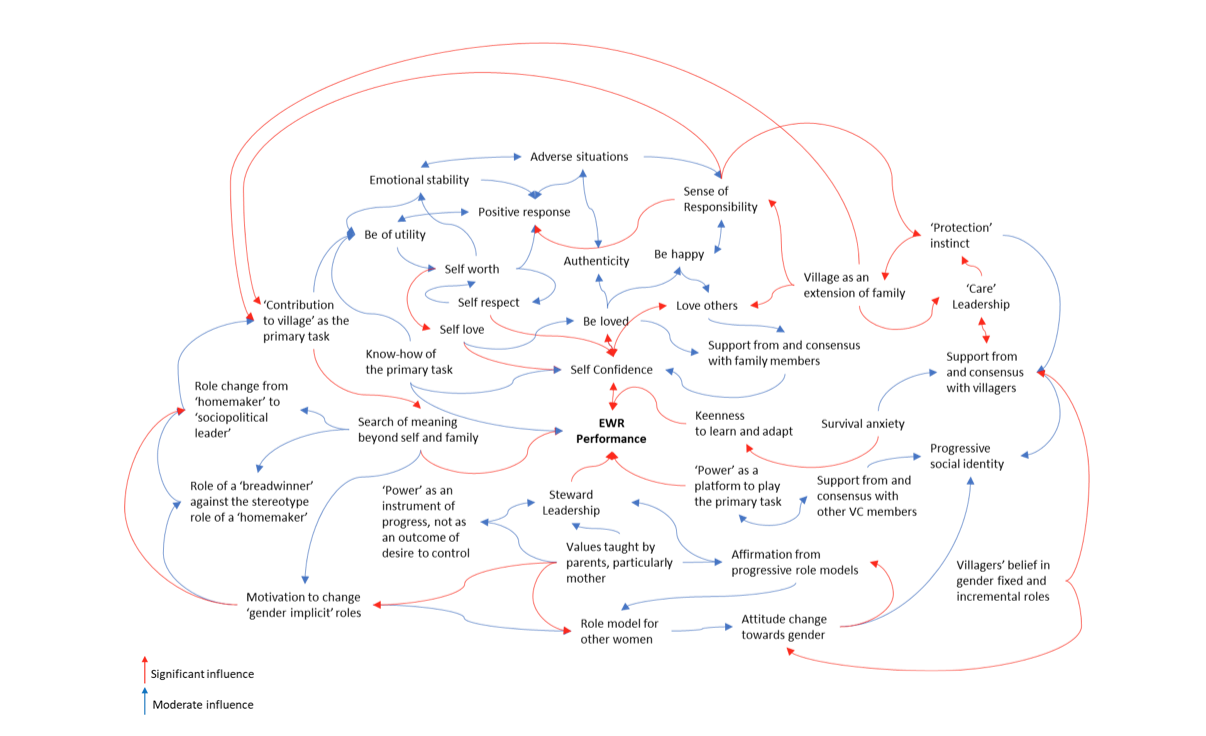
Exhibit 1 shows the complex tapestry of the influence of these variables on each other, finally influencing the performance of EWRs.

Exhibit 1


Among the three characteristics that characterised the performing EWRs, self-confidence emerged as the most important psychological attribute.

Successful or performing EWRs, unsurprisingly, have a positive mindset shadowing negative emotions. As I proved further, I found an astonishing correlation between the top three attributes that determine success – “Self-confidence”, “love” and “social engagement”. EWRs linked these attributes as “mutually reinforcing” towards their success, as they shared their lives, their struggles, their mental fortitude, and the approach to lives with me. On the other hand, less successful or underperforming EWRs were characterised by the attributes of “self-doubt”, “emotional incapacity” and “irresponsibility”.

Among the three characteristics that characterised the performing EWRs, self-confidence emerged as the most important psychological attribute.

Self-confident and successful EWRs usually solicit good support from family members (especially their husbands) and strongly believe in spreading universal attributes of love. They embrace most of the seven emotional attributes of love, learning, authenticity, fairness, survival instinct, social engagement, and leadership.

EWRs who spread love appear to love themselves. They demonstrate self-worth, self-belief, and self-esteem. EWRs with self-esteem and self-worth usually have strong survival instincts. They learn fast and adapt; this prompts them to make the effort to build the knowledge they need to accomplish their primary task. Spreading love does not come easily unless one loves oneself and has self-esteem and respect. An astounding 92% of the successful EWRs celebrated the ideas of self-esteem and self-respect, while over 80% of the sub-optimal performers thought the idea of self-respect was overrated!

Survival instinct is the primal force that we, as humans, have inherited from animals through evolution, spanning millions of years. In the case of successful EWRs, this trait appears to dominate their responses, helping them to learn and adapt better. Interestingly, it is not only existential anxiety that encourages them to learn; they also have a strong drive to expand their own physical and mental potential; this enables them to learn better and faster.

Spreading love does not come easily unless one loves oneself and has self-esteem and respect.

While the survival instinct is at the level of “self”, the drive to expand the potential is not at the level of “self” but relates to the level of the “family” and to villagers – “the extended family”. It is strongly correlated with a strong sense of responsibility, recalling the phrase “noblesse oblige” or “privilege entails responsibility”; it enables them to work hard to protect their families and extended families. The sense of responsibility that includes extended families also allows EWRs to direct and protect the people they feel responsible for. Both EWRs and villagers offer mutual support and cooperation, realising that they are interdependent parts of the “system” of a village. EWRs also demonstrate a third dimension, of “order”, which is characteristic of effective leaders.

Successful EWRs also share a social identity with their villagers. This finding provides increasing evidence that leaders who can build a common identity are more likely to rally their people to serve a common cause, rather than a cause espoused only by leaders. It seems plausible that leaders such as EWRs, who think of themselves as leading a common cause (advancing the villagers) are more successful than leaders who see themselves as merely occupying a position of duty or authority, as required by legislative changes.

Most EWRs have inherited from their parents or learned from their teachers that fairness is important, both when it comes to outcomes, and when it comes to the process one follows to arrive at a decision. This approach is authentic for women leaders who have overcome difficulties, because they know that the next generation of women will not live better lives if unfair practices and falsehoods that have governed society for centuries can continue, alongside the idea that these practices are necessary for survival. The notion of doing better for society and a burning desire to be useful can be passed on by parents or primary school teachers. More often than men, the EWRs appear to present their true selves, rather than projecting an image. Considering the social setting and their backgrounds, successful EWRs seemed remarkably authentic. This trait elicits a positive response from silent workers in the villages, amplifying the momentum of progress.

Successful EWRs have emotional capability and a huge capacity to reflect. Almost all successful EWRs demonstrate high levels of maturity and stability with respect to their emotions, even in the wake of trauma. Running a Village Council provides a perfect opportunity for them to exercise those faculties. Their primary tasks and roles at home and at work allow them to prioritise, choose, act, and seek feedback all the time. Less successful EWRs need to develop this capacity. In fact, emotionally capable EWRs enhance the emotional capital of the villagers. Collectively, it is a mutually reinforcing and rewarding relationship.

EWRs who suffer from guilt or a lack of self-worth end up doubting themselves, which constrains them in their roles. Emotionally shy EWRs (those unable to express themselves well) have also been found to be controversial at work, generating arguments in the Village Council and from male members.

Significant majority of successful EWRs think of villagers as the extension of their families. This new form of leadership can be termed being a “Mother Leader”, in cases where EWRs perceive themselves as acting like mothers to their extended families and working with them to achieve a common goal.

An astounding 92% of the successful EWRs celebrated the ideas of self-esteem and self-respect.

Looking after the family often comes naturally to these women because they see themselves as “care leaders”. Care leading is a behaviour derived from the instinct to “protect”. It can become an automatic (not authentic and yet positive) response to the situation of finding themselves elected as the leaders of villages. Care leading and protecting a family are behaviours often found in mothers.

EWRs have a strong sense of responsibility, which enables them to work hard to protect their families and extended families. They are also able to make hard choices in discharging their responsibilities. For example, several EWRs have sent their children to better schools in cities to look after villagers (i.e. members of their extended families). They tend to have a clear sense of what is best for their children and extended families. This allows them to win support and respect from the villagers, which in turn enables them to provide better for their children. These EWRs also direct the villagers, which becomes their primary task. EWRs who assume leadership at work tend to expect to be obeyed at home, in cases where their husbands willingly share the home responsibilities. The entire household tends to follow the EWR, even at home.

EWRs do not seek power or a position to fulfil a desire for dominance or control. Instead, they seek opportunities to contribute to their community as a way of finding meaning in life. They treat Village Councils as a platform for that opportunity. Successful EWRs recognise that power will allow them to contribute more and faster; they therefore learn to navigate Village Council politics effectively. By contrast, less successful EWRs view their roles as a job and may be relegated to the minority position in Village Councils.

Successful EWRs have emotional capability and a huge capacity to reflect. Almost all successful EWRs demonstrate high levels of maturity and stability with respect to their emotions, even in the wake of trauma.

EWRs who view their responsibility to the villagers as an additional duty tend to view it as a “competing commitment”  that may interfere with their commitment to their own families. This makes it harder for them to balance their roles as mothers to families and EWRs. 89% of the EWRs who faced these issues and were unable to meet them, met with uncooperative VC members or faced hindrance in implementation, from them, eventually causing delays or delivering a sub-optimal performance.

Successful EWRs have positive social identities and experience identity integration. Social identity  is a meaning attached to the self in the context of social surroundings of an individual. Their self-views are related to how they view their gender-identity and whether it conflicts with their leader-identity. Successful EWRs demonstrate that attributes expected from a woman and expected from a leader need not be conflicting. While gender stereotypes would advocate more affectionate behaviours from mothers while leaders would be expected to demonstrate more assertive, decisive and clinical behaviours, mother-leaders in EWRs defy this paradigm. Unsuccessful or underperforming EWRs inherently experience a tussle between these identities leading to less authentic leader behaviours, impaired decision making, stress and poor motivation to play leader roles often resulting in a spill-over to a role of a mother.

In the EWRs’ concept of their role in the “system” they see their potential selves as a new object of social identity. In that sense, they view themselves as part of the village and as the shaper of a new village or new order. In a strange way, they feel as if they are playing the role of goddesses within the village system. They consider themselves to be both separate individuals and part of the system they lead.

EWRs sometimes lose their own separate identities, apart from their families and the other villagers. Being one with the change has a deeper meaning. Perhaps, this is the very root of EWR’s success; the absence of this root causes other EWRs to be unsuccessful. The notion of being change agents and change itself in the context of their roles, needs a deeper understanding of underlying variables.

Village Council offices are transitional objects for successful EWRs. The objects fill a void, representing the much-cherished concept of “freedom” that womenfolk deserve, away from the walls of homes that confine them to mundane household duties; they also represent a “bond” with the extended families. The offices are vehicles that help them engage socially with the villagers and allow them to protect and direct these members of their extended families. Finally, these platforms offer them an opportunity to become the instrument of change for themselves and the society they live in.

As I reflect on my first affair with the psychological construct of the EWRs, I remain humbled by the inner strength that successful EWRs demonstrate, with such an astonishingly simple demeanour. I loved the humility due to the unawareness of the knowledge of the thermotical construct that is manufactured by the intellectual practising professionals (the community I belong to!) trying to change the world, that already resides in them. A lesson for us is, most certainly, that the change begins with oneself, the notion that EWRs practised fervently, intuitively and unknowingly!

Feature Image source: apolitical.co

About the Author

Samir Sathe is an Executive Vice President, Advantage Program, India, at Wadhwani Foundation, a global philanthropic enterprise. Samir is a Master in Change from INSEAD and has 25 years of research, strategy consulting and leadership experience. He is committed to the causes of entrepreneurship, employment and women.

References

1. Houghton, Pearce, Manz, Courtright & Stewart, 2015

2. Kegan & Laskow, 2001

3. Oyserman & Fryberg, 2006

NATO – No Need – NEXIT

10By Peter Koenig

“EXIT NATO!” – was the glaring title on a huge screen greeting the several hundred participants of the Anti-NATO Conference in Florence, Italy, on 7 April 2019. Officially it was called The International Conference on the 70th Anniversary of NATO, sponsored by Global Research of Canada and the International Coalition to Ban Uranium Weapons (ICBUW). I had the privilege to attend this important forum.

Following the EXIT NATO poster, was another huge slide decorating the conference wall – proclaiming that NATO, as a reward for all their work for Peace, should be rewarded with the Peace Nobel Prize. No doubt, nuclear armament and eventually nuclear wars – to be fought by NATO – by whom else – will make the world a safer place. Wars are actually good for Peace. They are also good for economics, but they are particularly good for Peace.

I’m not kidding you – these are declarations one can read – and has been able to read since practically 9/11, in such prominent “Truth News” papers like the Washington Post and the NYT. – So, why not the Peace Prize to NATO? – It wouldn’t make much difference, considering the track record of the Nobel Prize Committee – it would fall right into place.

Other than that, the conference basically outlined the atrocities committed by NATO, its associate and crony terrorist armies, ISIS, Al Qaeda, Al Nusra – and so on, changing names for revolving terrorists, recruited and trained by the CIA and funded by Saudi Arabia and other Gulf countries, and of course the US directly or through her many State Department funded and subsidiary NGOs, like the National Endowment for Democracy (NED) and many others. And of course, not to forget a prominent funder of terrorism, Turkey – who is now trying to make a smiling face to Russia and the east, even flirting with the idea of entering the club of the Shanghai Cooperation Organization (SCO); on the one hand purchasing Russian military defense systems – the S-400 – and at the same time US fighter planes F35, dancing on as many weddings simultaneously as they can. – Who would trust Turkey under Erdogan? – Turkey also still hosts one of the most strategic and most dangerous nuclear-equipped NATO bases – literally between east and west.

The Conference recalled the Cold War. By now everybody knows – really? – well, for those who don’t – that the so-called Cold War was one of the best propagated and fakest news of the 20th Century. It’s a brilliant idea that sprung out of the McCarthy Nazi-era – like NATO itself – to arm the US to the teeth – maximizing profits of the military industrial complex, under the pretext of halting the advancement of the Soviet Union into just liberated western Europe, just liberated from Hitler’s Nazi-Germany. Never mind that western Europe has been saved by the Soviet Union who lost 25-30 million people and basically their transport and production infrastructure. Yes, it was not the so-called allies – US, UK, and France – they came in last, when the bulk of the job was already done by what is today Russia. But of course, no western history book would tell you the truth. In fact, it must be said here too – the US funded Hitler’s war against the Soviet Union with money channeled from the FED, through Wall Street banks, and eventually through the Rothschild dominated Bank for International Settlement (BIS), located in Basel, Switzerland, right at the border to Germany, from where it was easy to pass the money on to the Reichsbank – Hitler’s Central Bank. Yes- that’s how the US was already then dancing on various fiestas at the same time; on the one hand bombing Germany and, on the other, financing Germany’s war against what the US already then perceived as an archenemy – The Red Scare – the Soviet Union. Well, these acts of treason then were the precursors of NATO today.

Anything socialist is evil for the US, still today. Trump himself and his minion clowns, Pompeo, Bolton, and Pence – are lambasting Venezuela and Cuba for being evil and destructive socialist countries – and that socialism will not be tolerated nowhere by the falling empire – sorry, falling it is – of the United States of America.

The other purpose of the Cold War farce, was to make the Europeans believe that they were under a constant threat of a Soviet invasion, that they had to arm themselves also to the teeth – imagine war-recovering Europe having to spend their money on arms for no use! – and of course most of these weapons had to be bought – yes, you guessed it – from the US military industrial complex – more profit for the war oligarchs. The Anglo-media giants even created a virtual barrier between western “free” Europe and the bad-bad Red Scare, the Soviet Union, the Iron Curtain. Yes, the Iron Curtain; children in school were indoctrinated to be aware that the enemy is hiding behind the Iron Curtain, and that the enemy always comes from the East. Hilarious, when you think back. At that time (almost) everybody believed it.

And the third, or perhaps first objective of the Cold War, was to block the Soviet Union from developing a viable and autonomous economy with which they could thrive, as most socialist countries do, until they are boycotted, punished and financially “sanctioned” into suffocation – by the west. These illegal financial manipulations with and within sovereign countries’ economies, are, of course, illegal by any standards of international laws – laws that have become meaningless in the light of US / NATO power, scary nuclear power. These acts of financial and human rights high crimes are only possible, because of the all dominating, fraudulent US-imposed – and NATO-protected – western monetary system.

The NATO-driven Cold War, a constant nuclear threat towards the Soviet Union, was intended to force Russia also to arm for their defense, instead of being able to use their economy’s added value to rebuild their devastated country. The USSR was never a threat to Europe. There was never an intention of the Soviet Union to invade western Europe. The same today, we are being made believe that Russia wants to invade Europe – that’s why NATO needs to build all these military bases, at the doorstep to Russia. Russia is by far the largest country, territory-wise, in the world, they don’t need to add more land. Historically, neither Russia or China have a record of expansionism.

In the end, the NATO-led Cold War managed to dismantle the Soviet Union by ‘buying’ some corrupt Soviet leaders, so that the new Russia, whose socialist system just was made to collapse, unprepared with legislation for what was to come – privatization by fire-sale of their entire economy. Like vultures, the financial institutions, IMF, World Bank, agents of the FED, descended on Moscow to literally steel by indebting whatever had any value. This misery still has not entirely abetted, as the Russian Central Bank was restructured, following the image of the FED – today, under President Putin, much has changed and was reformed, however, the financial sector is still heavily invaded by the Atlantists – or what you may also call the Fifth Columnists. And of course, even those are protected by NATO – as NATO issues threats, nobody knows from where they come – but you know who executes them, in case of…

The Florence Anti-NATO Conference also recalled some of the most abject killing sprees of NATO in its 70 years of existence, the wars in Afghanistan, Iraq, Libya, Syria, Sudan, Yemen, Ukraine – the Maidan massacre followed by the so-called Ukrainian civil war – and the crowning of sorts, the ten-year war on Yugoslavia – the total destruction of Yugoslavia, with the final blow 1999, the merciless bombing of Bosnia-Herzegovina and Kosovo. – Why Yugoslavia? – Let’s dwell just a moment on this war of cruel destruction and killing – because it is so typical for Pentagon-driven wars of annihilation. Yugoslavia, a socialist country, in the 1970s and 80s under Maoist President Tito, had a prosperous economy, much more so than the rest of Europe. The US-dominated west cannot let a socialist economy flourish. Other countries, especially stagnating western Europe, could get ideas.

Remember, socialism is evil. So, with what is today called the “Balkanization” – cut into pieces – of Yugoslavia was the old-old tactic of divide to conquer, as well as by creating internal chaos, the western powers kept control of the people, and eventually NATO was able to advance closer and ever closer to the Russian border, by occupying former Yugoslav republics with NATO bases (Albania, Croatia, Montenegro, Slovakia, Slovenia, and Kosovo is waiting in the wings), in addition to the further expansion east to Romania, Bulgaria, Czech Republic, Hungary, Poland, not to mention the former Soviet Republics of Estonia, Latvia, and Lithuania.

This expansion east – ever closer to Moscow, is a flagrant breach of a promise made by the allied forces. In 1991, then German Foreign Minister Genscher promised Russian President Gorbachev that NATO would not move one inch further east than Germany. In fact, he assured Gorbachev that NATO would not move into what before the German unification was Eastern Germany. This promise was unfortunately never recorded in writing, and Gorbachev was miserably betrayed. As we know by now, a betrayal by the west is very normal. In the meantime,12 more NATO bases east of Germany, including in former East-Germany, were built.

In their 70 years of existence, US-NATO, allied and proxy forces, as well as mercenaries, have killed between 20 and 25 million people around the globe, in wars and conflicts – in the eternal war against “terror” – that was “justified” by self-inflicted 9/11, the start to the final phase of the PNAC – Plan for a New American Century – to reach Full Spectrum Dominance.

Wars have a cost – a financial, economic and a social cost. The US official military budget for Fiscal Year (FY) 2018 is US$ 700 billion; for FY 2019 Trump proposes US$ 750. If approved it would be a 40% increase in the last 9 years. But that’s not all. This is just the officially published figure. The real cost for the war, defense, and security apparatus to which also the opaque CIA and associated secret services count – is well over a trillion dollars, perhaps as much as US$1.5 trillion – per year.

Wars have a cost – a financial, economic and a social cost. The US official military budget for Fiscal Year (FY) 2018 is US$ 700 billion; for FY 2019 Trump proposes US$ 750.

The US has currently about one million military personnel stationed in 175 countries around the globe. The Pentagon maintains about a thousand military bases in more than 100 countries. The war cost, in currently seven war theatres is prohibitive – medical costs for veterans, for social services to returning veterans – and we are not talking about the cost of off-battle ground lives, i.e. by ever-mounting suicide rates. The Veteran Administration released a study that covered suicides from 1999 to 2010, showing that roughly 22 veterans were dying by suicide per day, or one every 65 minutes.

The reality is most likely a much higher figure – and the despair and human depression from anxieties related to the never-ending wars has increased exponentially in the last 9 years – more suicides, more desperation, more broken families – – entire generations of kids with fathers at war. This cost cannot be put in figures of dollars and cents – it’s a social cost that bears its toll in years, perhaps generations from now.

The US spends per capita ten times more than the rest of the world together on military/war expenses. President Trump requests European NATO countries to increase their military budget by contributing more to NATO, first up to 2% of GDP – threatening he may decide to withdraw NATO from Europe, if Europe does not comply with his request, still making believe that NATO is a defensive force – protecting Europe- from what, and from whom? – Good-bye NATO. This is the moment to call Trump’s bluff.

But NATO – the Trans-Atlantic Treaty Organization – has also gone overseas to Latin America. NATO has since 2013 a Cooperation Agreement with Colombia, where the US has 5 military bases – which will automatically convert into NATO bases. NATO is also negotiating with Brazil’s new Nazi-leader, Bolsonaro, to enter Brazil, and, as such being a threat and a potential attack force to topple the Venezuelan democratically elected socialist government. Washington makes no secret – they want Venezuela’s hydrocarbon resources, the world’s largest reserves, gold and other minerals of which Venezuela is rich. NATO is perfect to do the dirty job.

But it gets worse, this Trump clown or the masters behind him had recently the audacity to ask for a European military budget increase to 4% of GDP – or else…. Yes. Let’s decide for else. Good riddance, NATO.

The overall NATO budget is well over a trillion dollars per year – yes, per year. And that is – people of Europe, people of the world! – that is to finance a killing machine that bulldozes countries into the ground with bombs and tanks, that kill indiscriminately civilians and other countries’ defensive military, countries that have never done any harm to the United States, nor to Europe which follows the Washington mandate like a bunch of vassals, what Europe has become.

Imagine, what could be done, with more than a trillion dollars or euros per year – in terms of building up education, health services, public infrastructure, and other social services – and expand these services to developing countries, to those very countries that are now bombarded mercilessly by NATO! – This, dear People of Europe, is your tax money. Do you want it to be spent killing people around the world for Washington’s world hegemony? – NATO does not protect you. NATO has been designed as an aggressive force – you were just never told. But look out of the window, the window of your ‘safe space’, and you will see the squandering of your tax money.

NATO is invading the space of Russia and China, countries that are seeking friendly relations with the rest of the world, they are seeking a multi-polar world, but encounter instead a response of aggression. NATO is preventing the natural, namely friendly relation and trading as equals within the huge Continent Eurasia, of which Europe has been artificially separated as a continent. This tremendous landmass Eurasia, includes also the entire Middle East and connects to Africa. This enormous mass of land and people and resources – does not need the west, the west, called America.

NATO is invading the space of Russia and China, countries that are seeking friendly relations with the rest of the world, they are seeking a multi-polar world, but encounter instead a response of aggression

Wouldn’t it be wise for countries and people of Eurasia, to just live sovereign lives, with friendly interactions, trading as equals not with a one-upmanship as is currently the norm for trading between the rich OECD nations dominating the World Trade Organization (WTO), with the rest of the world- which depends on trade but is always on the losing end?

One more point – that needs to be understood. Europe, the European Union as it was conceived and is limping along today – has never been the idea of Europeans, but was born during WWII in the heads of the CIA, then transplanted into some “willing” European heads and then ‘defended’ by NATO – the “unifying force”. Europe has no Constitution, only a number of non-binding accords, like Maastricht and Lisbon – but no Constitution that holds it together, that outlines a common vision in defense, in economic development, in monetary policy. The European Union results in a bunch of countries, some even hostile to each other. They have a common currency, the Euro, without even having a common economic base and development objective. This currency, forged as the little brother of the US-dollar, equally is nothing but fiat money, no backing whatsoever; this currency is not sustainable. So, the currency barely 20 years old, will eventually collapse or fade, and so will the European Union. It hasn’t happened yet, because NATO is holding it together, because Brussels is nothing but a puppet of the Pentagon. It is Washington through the Pentagon, and through NATO that is running Europe.

People of Europe – is it that what you want? Your tax money spent killing people and destroying countries around the globe, and having lost all independence, autonomy as a country, as well as monetary sovereignty – by being run by a military killing machine, called NATO?

It’s time to kill NATO, rather than being killed by NATO. Exit NATO now. It’s time for NEXIT.


Peter Koenig is an economist and geopolitical analyst. He is also a water resources and environmental specialist. He worked for over 30 years with the World Bank and the World Health Organization around the world in the fields of environment and water. He lectures at universities in the US, Europe and South America. He writes regularly for Global Research; ICH; RT; Sputnik; PressTV; The 21st Century; TeleSUR; The Saker Blog, the New Eastern Outlook (NEO); and other internet sites. He is the author of Implosion – An Economic Thriller about War, Environmental Destruction and Corporate Greed – fiction based on facts and on 30 years of World Bank experience around the globe. He is also a co-author of The World Order and Revolution! – Essays from the Resistance. Peter Koenig is a Research Associate of the Centre for Research on Globalization.

Featured image by © Primanews.org

What is Lot Size in Forex?

Lot is an important term in Forex. If you read about trading, you’ll probably encounter this word; but not all beginners know exactly what it means. So, what is Lot? How does it affect your forex trading? This article will give you the basic definition of Lot and explain the different types of Lots that traders often use in Forex.


What is Lot?

Lot represents the size of your trades in Forex. In another interpretation, Lot is the number of currency units you will trade in Forex.

There are 4 main types of Lots: Standard Lot, Mini Lot, Micro Lot, and Nano Lot.

  • Standard Lot: 1 standard lot is equivalent to the volume of 100,000 units. Whenever you purchase 1 lot of a currency pair, you buy 100,000 units of the base currency (the first currency in a pair). For instance, buying 1 lot of the EUR/USD means you buy 100,000 EUR. Another example is that you want to buy a currency pair EUR/USD at the exchange rate of 1.5 (1 EUR = 1.5 USD). Then, when you buy 1 lot of this currency pair (equal to 100,000 EUR), you purchase $150,000 (100,000*1.5). If you use a leverage of 1:100, you only pay $1,500 (150,000/100= $1,500) to open your position. To do this theoretical exercise with a current example, see this page for live forex rates).
  • Mini Lot: Beginner traders are often advised to trade with mini, micro or nano lots in order to avoid the risk of huge losses. A mini lot is equal to 10,000 units, which is 10% of a standard lot. Hence, when a trader opens an order of 0.1 lots, he is trading 1 mini lot.
  • Micro Lot: A micro lot is equal to 1000 units, which account for 1% of a standard lot. When a trader opens an order of 0.01 lots, he is trading 1 micro lot. For instance, buying 0.01 lots of GBP/USD means you buy 1,000 GBP. There are also several brokers that offer micro lots
  • Nano Lot: A nano lot, in Forex, is referred to 10 or 100 units. Why is there a difference of units? Because some forex brokers set nano lot to 10 units while some others set it to 100 units. However, nano lot is not common; only a few brokers offer it. Normally, the nano lot is the preferred choice of newcomers or strategy testers. Therefore, if you purchase a new expert advisor or want to test a new strategy, nano lot is suitable for you, at least for the first weeks.


It is important to know your trade volume because it affects your trading strategies and your profits.

Lot Sizes for Commodities

1 lot of Gold is equivalent to a hundred ounces and 1 lot of Silver is equivalent to 5000 ounces. 1 lot of Crude Oil is referred to 100 barrels. Meanwhile, 1 lot of Natural Gas is quantified by 100,000 cubic meters. Those statistics are not written in stone but can change depending on the broker. Therefore, you should obtain information about commodities from the broker you trade with, to get the best understanding.

In short, it is important to know your trade volume because it affects your trading strategies and your profits. A bigger lot may bring you greater risks, which means that you can see big profits or big losses, and smaller lot such as nano lot or mini lot are often suitable for beginner traders who are more comfortable trading with smaller sizes and lower risk.


From Cool Britannia to Fool Britannia

By Graham Vanbergen 

It took just twenty years to go from the euphoria of Cool Britannia to Fool Britannia in the guise of the economy destroying and politically toxic ideology of Brexit. The author explains what may be lurking around the corner in the years ahead.

Throughout most of the 1990s, Cool Britannia was a period of increased pride in the culture of Gt. Britain, which was inspired by the swinging 60s – enhanced by its modern-day youth culture. The iconography of the day was British rock and pop, fashion houses and magazines who rode on a high crest of a renewed feeling of optimism following the turbulent years of the 1970s and 80s. It was all Britpop, Euro96, and Alexander McQueen. The economy and mood of the nation were booming.

The cultural renaissance of London, in particular, was much celebrated in the press, it’s pinnacle reached with the election of Tony Blair in 1997 providing a boost to the feeling of optimism – indeed, euphoria.

It didn’t last long.

In 2003, Tony Blair burst the bubble with an illegal invasion of a foreign sovereign state that saw the biggest street protests in Britain and around the world in human history.

The police, National Crime Agency and Electoral Commission are slowly unravelling the frightening realisation that Britain’s democracy, like the children’s fable, has no clothes.

Iraq cast a dark shadow on the nation and when all was said and done, hundreds of thousands of innocent civilians would be dead. The nation bowed its head in shame. It was rapidly followed by corruption scandals; cash-for-honours, cash-for-influence – culminating in the massively damaging parliamentary expenses scandal. Next came cash-for-influence, cash-for-access – the list of political skulduggery only escalated. Then there were the accusations of sexual abuse and more recently rampant racism in the form of Windrush, Anti-Semitism and Islamaphobia at the very heart of the political establishment. In between all of this – the destruction of Libya was another symbol of Britain’s desperate foreign policy decisions that humiliated the nation.

From 1996 to 2016 – a period of just twenty years, Britain has gone from crooning the ‘Cool Britannia’ brand with a beaming collective national pride to a final swansong of Fool Britannia in the Brexit endgame. National resilience, a characteristic of the British people has been replaced with acrimony and hostility.

After abandoning the moderate centre ground, civil war has broken out in both political parties on the left and right.

In this environment, should it be of any surprise that the most financially supported political figure in Britain of 2018/19 is a right-wing thug with a criminal rap sheet as long as your arm – in the guise of Tommy Robinson?1

Tommy Robinson is though a warning shot of what is to come. He was only allowed oxygen in the first place because of the democratic decay that Britain is now experiencing. But it is the method of his emergence that has to be tackled most urgently. The names SCL Elections, Cambridge Analytica, Facebook allied with the words algorithm, dark money and micro-ads make many who should be better-informed scratch their heads. The police, National Crime Agency and Electoral Commission are slowly unravelling the frightening realisation that Britain’s democracy, like the children’s fable, has no clothes.

Democratic Audit charitably put it that there has been – “active external interference through ‘election hacking’ and other, subtler, forms of meddling.” In other words, obscure wealthy donors, foreign state powers and corporations hiding behind front charities and think tanks have attacked Britain’s democracy – and won.2

Today, Britain has a Prime Minister, who, with each new broken promise increases the loss of political capital that took centuries to build.

Every day, the public is now witnessing the unseemly spectacle of Cabinet ministers expressing fraudulent pledges of loyalty to the PM while vigorously fine-tuning their leadership campaigns, with others deserting the posts to which they were elected.

This has exposed nothing more than the pretence that politicians were acting in the national interest and it has led to a degenerating spiral of growing hatred in society through identity politics, finger pointing and shame-blaming.

Britain is unquestioningly marching in lockstep with a political and economic model characterised by moral bankruptcy, avarice and inevitable decline.

At the time of writing, Britain is facing a no-win political dilemma so bad that the government is preparing for a likely repeat (but of a much-intensified version) of the 2011 England riots, which saw looting, arson, and mass deployment of police that ended with £200 million of property damage alone. Its preparations include seconding and recruiting thousands to a new department to determine the ‘battle rhythm’ on the streets of Britain.3

It is also preparing for the genuine threat that violence will emanate from Northern Ireland once again. Almost one-quarter of the domestic surveillance agency MI5 has been relocated there.

It is now evident that the economy will nosedive. This week, the news came that London’s Financial Services industry had transferred nearly £1 trillion of assets to Europe in preparation of Brexit.4

Twenty years is all it took to go from a euphoric nation of optimists at the heart of the European Union project to the crash and burn casino politics of gambling the very prosperity and security of future generations without their explicit consent.


What really happened?

While China builds the One Belt, One Road project – a 21st century Maritime Silk Road, involving infrastructure development and investments in 152 countries with international organisations and institutions across Europe, Asia, Middle East, Latin America and Africa – Britain has mistakenly backed America.

The Chinese government calls the initiative “a bid to enhance regional connectivity and embrace a brighter future”. Some observers see it as a push for Chinese dominance in global affairs with a China-centred trading network. America sees it as nothing more than a threat to its dwindling economic prospects.

The Belt and Road Initiative is the largest infrastructure and investment project in history, covering more than 68 countries, including 65% of the world’s population and 40% of global GDP.

In contrast, the New American Century was defined not by infrastructure investment to encourage economic growth, trade or cultural exchange but by military strength and global hegemony. It has already ended in disaster and Britain is unquestioningly marching in lockstep with a political and economic model characterised by moral bankruptcy, avarice and inevitable decline.

Brexit is a fool’s game, and the British people have been fooled. It forces Britain out of the biggest game on the global chessboard by default. It also forces Britain to play a game with potentially disastrous economic and geopolitical consequences being geographically located on the wrong side of the board – with our competitors next door and allies at the other end of the road.

Brexit will define Britain for decades to come. So while many may disagree with the sentiment that only bad things will come from it – it is a false hope that it will end in a new era to match Cool Britannia. In the years ahead, the EU may have many problems to deal with but they are stronger together in today’s very uncertain world.

About the Author

Graham Vanbergen is the founder and contributing editor of TruePublica.org.uk, ThinkPublica, and NewsPublica.com. He is also the author of BREXIT – A corporate coup d’état.


References

1. https://www.thetimes.co.uk/article/tommy-robinson-isbest -funded-politician-in-uk-0sm5d0blp

2. http://www.democraticaudit.com/2019/03/04/ democratic-decay-the-threat-with-a-thousand-names/

3. https://truepublica.org.uk/united-kingdom/brexit-newcommand- centre-to-detect-battle-rhythm-on-the-streets/

4. https://truepublica.org.uk/united-kingdom/brexit -one-industry-one-city-one-trillion-gone/

What To Know About Dunkin Donuts Franchise Success Rate

Founded in 1946, William Rosenberg started a food delivery service that supplied lunches and snacks specifically to the factory workers in Boston. It was called Industrial Luncheon Services. From his first business was born the famous franchise, Dunkin’ Donuts, that we know of today. Over 70 years after Rosenberg began, Dunkin’ Donuts holds its position consistently as one of the top quick service restaurants (QSR) all over the world. If you’re interested to buy your own Dunkin Donuts franchise, here’s what you need to know about this particular franchise’s success rate:


1. Dunkin’ Donuts is the top seller of coffee by the cup.

Even with other coffee shop franchises sprouting up and becoming quite popular all over the world in the past decade or so, Dunkin’ Donuts has managed to hold its position as the leading retailer of iced and hot coffee by the cup. It is also the biggest food chain selling coffee and baked goods worldwide. Dunkin’ Donuts has a stable track record among franchises and consumers alike. To get a clearer picture of starting your own Dunkin Donuts store, you may request for a cost analysis at franchiseknowhow.com.


2. This brand has a staggering number of branches spread around the world, and it continues to expand.

Dunkin’ Donuts has almost 11,000 locations in over 30 countries, and it has no plans of stopping soon. In the U.S., the brand currently has over 8,000 branches spread out in 36 states, and all of these are franchisee-owned. Internationally, there are currently over 3,000 franchisee-owned Dunkin’ Donuts restaurants.

The company’s target is to double the quantity of Dunkin’ Donuts franchises over the next 20 years, and this is the goal for the U.S. alone. Lofty targets are set for expansion in other countries as well. Now is actually an optimal time to invest in this franchise.


3. Dunkin’ Donuts works with leading experts in the franchising industry to educate and support its franchisees.

Individuals or companies who sign up to become Dunkin Donuts franchisees benefit from the extensive support that the brand provides. If you choose to partner with Dunkin’ Donuts, you get the support you need in terms of the franchising process, business development, site construction, and marketing strategies. The brand likewise provides franchisees with ongoing training for new products every year. Many of these trainings and support materials are accessible via the Dunkin’ Donuts Online University, which features a wide variety of learning modules and resources that would benefit franchise owners and their employees.


4. The company follows a stringent screening process in order to get only the most-qualified franchisees.

Part of the secret to Dunkin’ Donuts’ success is that it maintains high standards for selecting its franchisees. As an applicant, you’d have to pass the company’s criminal background check, proof of assets check, as well as credit check. Once you’ve succeeded in these preliminary requirements, you have to prepare your comprehensive assessment of owning your Dunkin’ Donuts franchise and its commercial potential. You likewise have to present your business plan for your chosen location.

More importantly, the company screens applicants by stipulating that franchisees have sufficient resources to start a franchise and sustain it, especially in the early stages of operations. Specifically, Dunkin’ Donuts requires that applicants have a net worth of at least $250,000 and liquid cash requirement of at least $125,000.


5. Dunkin’ Donuts offers competitive product prices, highly-appealing menus, and multiple store formats.

While it may cause potential franchisees concern that competitors are working just as hard to grow their number of franchises, Dunkin’ Donuts has its own bankable strategies for staying on the top 3 of Entrepreneur’s 2018 Top Franchises list. For one, the brand offers consumers quality food and beverage products at very affordable prices. Dunkin’ Donuts has also designed its menus to cater to consumers in the morning, throughout the day, and even to diners who want to come in for evening snacks.

Moreover, Dunkin’ Donuts has the advantage of offering franchisees several options in terms of store setup. Franchise owners may choose to put up freestanding locations combined with a drive-through or an end-cap strip-center location partnered with a drive-through. If the area being considered by the franchisee is already densely populated, owners may opt for the restaurant setup without the drive-through option anymore.

As a potential franchisee, you also have the option of situating your store in gasoline stations or convenience stores. Dunkin’ Donuts likewise does partnerships with Wal-Mart branches and other grocery stores. Depending on your assessment of the area where you want to put up your Dunkin’ Donuts franchise, the company has a store setup that can perfectly match the needs of your chosen vicinity. This is a level of flexibility that competitors would be hard-pressed to match.


Conclusion

With over 70 years of experience in the QSR and franchise industries, Dunkin’ Donuts is well ahead of other companies in terms of all that it can offer its franchisees. The company has a stable and effective brand marketing all over the world, and it continues to thrive under solid management and leadership. Dunkin’ Donuts likewise keeps ahead of the competition by continuously innovating its product offerings to meet the demands of consumers.


EDITOR'S PICK OF THE WEEK

CFO's new mandate. CFO explaining the presentation

The Performance and Transformation Orchestrator: The CFO’s New Mandate in the Age of AI

By Terence Tse CFOs are evolving into AI-driven transformation orchestrators, balancing finance, technology, and strategy while upskilling teams, managing risks, and driving measurable business value. A key insight from this year’s AI for CFOs event, organized...

WISE DECISION MAKER GUIDE

POWER INFLUENCERS

Emerging Trends

The Future of Global Trade