By Yingzhi Zhang and Byron McKinney
The effects of continued maritime disruption in Hormuz have the potential to further impact supply chains and certain industries will feel it more directly.
Trade restrictions are likely to continue in the Strait of Hormuz even with a peace deal between the US and Iran and while the supply and price of oil is the primary impacted commodity, other products also highlight similar risks. Supply chains for chemicals, autos and electronics firms located in the EU and Asia-Pacific are most at risk of serious disruption.
Risks to European Supply Chains
While many European Union (EU) member states do not have a major dependency on West Asian countries for oil and natural gas, there is a secondary reliance based on the derivative products manufactured from these upstream commodities such as petrochemicals, rare gases and aluminium. These downstream products are crucial to a number of European industries most notably those in the chemical industry and its offshoots. As much as half of all EU imports of major chemicals come from Gulf Cooperation Council (GCC) states. Additionally, dependencies exist for the EU via indirect supply chain and maritime routes with the Asia-Pacific region which supplies to European industries. The biggest EU trading partners in the GCC zone are Saudi Arabia and UAE which have been able to facilitate a degree of oil supply through the Yanbu and Fujairah port terminals respectively but this rerouting of oil and refined products has not been able to offset substantially the reduction in exports from the region.
Risks to Asian Supply Chains
East of the Strait of Hormuz, oil and gas is largely imported to Asian economies from the GCC, yet a variety of derivative mineral items also play an important and distinctive role in Asian economic supply. For example, India’s total imports from the UAE, excluding oil and gas, was the largest of the GCC-6 countries, standing at over US$ 42 billion in 2025, followed by Saudi Arabia at US$ 8.13 billion. Saudi Arabia was the largest among the GCC partners exporting to mainland China with US$9.3 billion non-oil and gas imports in 2025. For the major Asian economies of Japan, Korea, India, China and Australia, over 300 items at the 6-digit Harmonised Schema (HS) code level recorded at least a 10% import dependency from the GCC region. India maintains the highest exposure across minerals, salts, chemicals, plastics and metals. Australia, China, Japan and South Korea have a particular reliance on GCC supply for fertilisers, metal products, chemicals and plastics. Despite the difference in scope and scale of GCC dependency for the EU and Asia, petrochemicals are the stand-out common category for both regions.
Petrochemical Dependencies
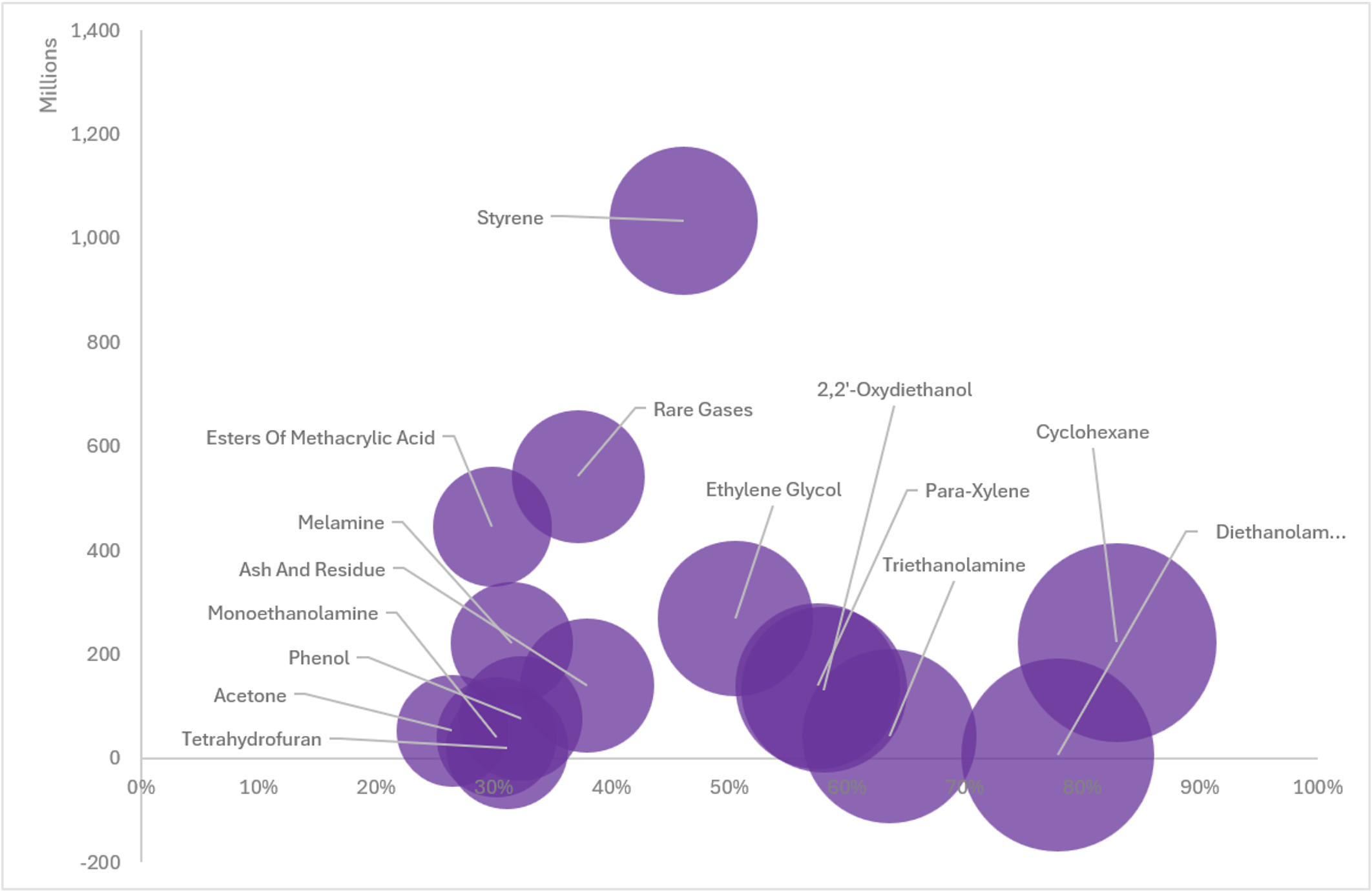
A significant majority of chemicals used in high-tech industries are derived from oil and its associated products. Large scale facilities in the GCC region, owned and operated by global commodity verticals, are operationally designed to convert oil and gas into petchems and their derivatives. These downstream goods highlighted in Chart 1 are the most dependent chemicals that the EU imports from the GCC. Chemicals such as Cyclohexane, Diethanolamine and Triethanolamine have absolute EU import values in excess of 70%. These chemicals have a variety of uses in European industry, including agricultural products, industrial solvents, concrete mixtures and plastic components. The associated industries using these chemical products sourced from the GCC are the automotive, technology and semiconductor sectors. German manufacturing and its partner firms in Poland and Hungary are most at risk of all the EU member states.
Chart 1 – Petrochemical EU imports from GCC countries as a percentage of EU imports from the world overall (2025). The size of the bubble corresponds to the absolute import value. (Source: United Nations Comtrade)
An adequate export of petchems and other goods to German and European industry could be further disrupted in the coming months, depending on how the Strait of Hormuz is opened and any potential issues with the Iran-US Memorandum of Understanding (MOU).
Other Sources of Supply
Sourcing commodities and products from other countries and regions is possible, although supply chain shocks are global and have affected the physical ability of other countries to import and export critical goods. Alternative sources of supply for many commodities and products from West Asia including petchems do exist. Important petrochemicals and rare gases can be shipped to some extent via the Arab ports on the Red Sea but at a reduced scale. Furthermore, alternatives from the Far East will likely be constrained in the coming months. Japan and South Korea are the world’s major exporters of Cyclohexane and Para-Xylene (Dimethylbenzene), both used in plastics, fibre and pharmaceutical processing. In the current circumstances it is unlikely these two countries could pick up any slack, as constraints in Hormuz are affecting both Japanese and Korean oil imports. Japan’s significant drawdown on its strategic petroleum reserves since the US/Israel attack on Iran in late February underlines overall capacity constraints. These will impact indirectly EU industries, especially automotive, plastics and the chemical sector. The longer Hormuz remains closed or severely constrained, the higher likelihood that stockpiles in Asia run even lower and EU industry loses multiple sources of critical goods.
Asian Petrochemical Weaknesses
Petrochemicals have an equal importance to the major Asian economies. As Chart 2 shows, a few petrochemical items, such as styrene, rare gas, diethanolamine and ethylene glycol used in cosmetics, fertilisers and textile manufacturing are significant to Asian economies in terms of value and share, as much as they are in Europe. Rare gas imports also demonstrate significance due to its usage in the semiconductor and wider electronics industries across Japan, Korea and Taiwan. The share of GCC supply in each countries total import ranges from 33.1% for Japan to 86% for Australia, with the percentage for China, South Korea and India all above or near 50%. Further differences between Asian and European markets for GCC chemical imports are found in Asia’s strong reliance on urea and diammonium phosphate (DAP) as fertilisers in the agriculture sector.
Chart 2 – Petrochemical Asia and Oceania major economies (Australia, Mainland China, Japan, India, South Korea) import from GCC countries as a percentage of their imports from the world overall (2025). The size of the bubble corresponds to the absolute import value. (Source: United Nations Comtrade)
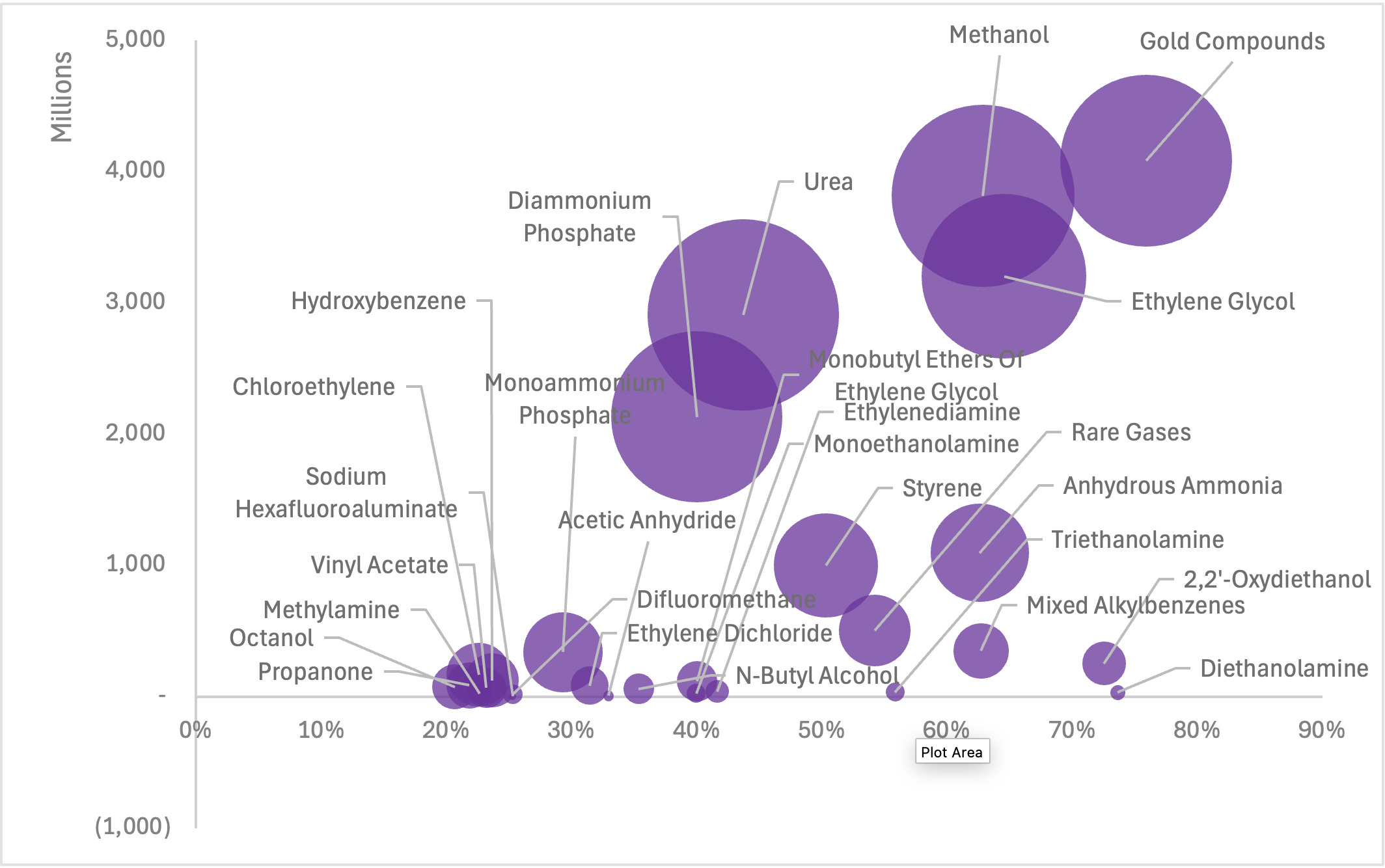
There are certain petrochemical items appearing in the EU’s top GCC dependency list which are not on Asia’s register. Cyclohexane for example, topped the EU’s GCC import list with a market dependency of 82%, but this same chemical has almost no import significance in Asian economies. However, while Japan has been an exporter of Cyclohexane, its monthly outflows since March have dropped by over 80% compared to pre-Hormuz loadings as the country shifted from export to storage. Equally, the United States export of petrochemicals to the EU in April 2026 quadrupled month-on-month to nearly US$ 17million as Europe looked to manage a GCC supply crunch. Ethylene glycol is imported heavily from the GCC by Asian countries, but when observed at the country level there appears to be a recent rebalance happening. China is one of the key exporters of ethylene glycol and has been increasing its supply since March 2026 after the war broke out, bringing the export in the first five months to a level almost equivalent to its overall total in 2025, at around US$ 34 million.
Import Dependency Extends Further
There are other items outside the petroleum sector which the GCC supplies to EU member states and Asia. Aluminium under its broader ‘metal product’ category is one of them. In Asia, import from the GCC-6 accounts for 15.5% and 14.8% for Japan and India’s total aluminium imports respectively. Plastics also highlights a minor but noticeable exposure to GCC supply for the EU, China and India. The wide applications of such metals and plastics, are more pronounced in the automotive manufacturing sector for body parts and interior fittings.
Conclusion
The Hormuz impact across upstream resources (raw energy commodities), intermediaries (chemicals) and materials (aluminium and plastics) are widely spread across different continents. A ‘single point of failure’ to even a few key items can quickly lead to supply chain imbalances. For downstream, industrial material items, a structural supply imbalance is more likely rather than total supply shock, as alternative sources are still possible for now. Interconnected supply chains though can still put distribution routes however established under pressure. In examples where no stock holding or concentrated source can be utilised as an alternative by firms, a stranglehold is likely to bring disruption to supply with costly price increases.
About the Authors

Yingzhi Zhang is a specialist in trade and shipping at S&P Global, supporting organisations in commodity trade and shipping with data and insights into freight market and trade flows. She has continual contribution to data-driven insight generation covering topics including supply chain management, international trade and digitisation.

Byron McKinney is a senior director for global risk at Dow Jones, where he focuses on assisting international firms managing their geopolitical and sanctions risk. He has authored papers on maritime sanctions evasion, strategic goods risk management, country specific export control policy and contributed to articles in Politico, Global Trade Review, The Telegraph and TradeWinds on these topics.