Home Blog Page 1076

The Lessons of Terrorism in Mindanao

By Dan Steinbock

The Ramawi terror did not come out of the blue. It is a result of decades of economic polarisation, political exclusion, neglect of terrorism by the Aquino administration, and ISIL’s collapse in Syria and Iraq. If the stabilisation fails now, terror will spread beyond Mindanao. – This is the second commentary about the Philippines from an international viewpoint.


On May 23, 2017, the ongoing armed conflict started in Marawi, the capital of Lanao del Sur in Mindanao. Philippine government forces were surprised by affiliated militants of the Islamic State of Iraq and Levant (ISIL), including the Maute and Abu Sayyaf Salafi jihadists groups.

Initially, President Duterte declared a 2-month martial law in Mindanao hoping to suppress the terrorist insurgency immediately. In July, government extended martial law in Mindanao to the year-end. By August, after Duterte informed the leaders of the Senate and House about “new terror plots in Mindanao,” he asked for 30,000 more troops to crack down on ISIL and other emerging threats.

Despite some criticism, the simple fact is that, without Duterte’s decisive action and martial law, Jihadists would have gained a foothold in Mindanao and terror would already be spreading in the Philippines and regionally.

To the old entrenched interests, the Marawi story is inconvenient domestically and internationally.


Domestic Neglect, International Geopolitics

In March 2016, after years of gross neglect of emerging terrorist threats and the 2015 Mamasapano massacre, then-President Aquino stated that the Islamic State had no presence in the Philippines, despite ISIL’s recovered insignias and documents, a foothold, training and jihadist loyalists in the country. Moreover, the number of ISIL sympathisers had been on the rise since 2014; perhaps since US military interventions in the Middle East in the early 2000s.

Without Duterte’s decisive action and martial law, Jihadists would have gained a foothold in Mindanao and terror would already be spreading in the Philippines and regionally.

Domestically, it was this neglect that led to the rise of the ISIL-led coalition under Isnilon Hapilon, who had fought in the Moro National Liberation Front and the Abu Sayyaf group, and the Maute brothers; scions of a political family clan, who used to head a private militia that engaged in extortion and pledged alliance to ISIL a year before President Aquino still denied its presence in the country.

It was this fatal neglect that allowed ISIL to infiltrate Mindanao, but also to escalate the regionalisation of Jihadist terror. Today, the “East Asia Wilayah” comprises jihadists from several Southeast Asian nations (Philippines, Indonesia, Malaysia, Myanmar), and potentially others from the Middle East, North Africa and Chinese Uyghurs. Indonesia alone has the largest Muslim population in the world and there are ISIL cells in most provinces.

International media has contributed to the neglect by “geopoliticising” the roots of terror in Mindanao. Last June, New York Times released a story by Richard C. Paddock which claimed that “Duterte, focussed on drug users in Philippines, ignored rise of ISIS.” In reality, Duterte has for years warned about the emerging terrorist threat in the country, even when others ignored such calls.

A month earlier Paddock had released another story, “Mysterious Blast in Philippines Fuels Rodrigo Duterte’s “Hatred” of US”, in which he used amateur psychology to explain away the infamous Meiring case in Davao in the early 2000s. Reportedly, the latter case was a CIA effort to cooperate with Jihadists to foster destabilisation through Mindanao in the Southeast Asia, which would then be used to legitimise greater US presence in the region (US collaboration with “moderate jihadists” in Syria in the 2010s suggests similar footprints).

But how did the impoverished Mindanao morph into a terror foothold?


Mindanao as Islamic State Destination

When the Aquino administration opted for its pivot to the US, re-established old military ties with the Pentagon, and invited American troops back to Philippines, it – unintendedly and yet by design – virtually ensured that the Philippines would morph into a major target for jihadists.

In June 2012, months after the Obama administration’s pivot to Asia, the Khilafah, a major jihadist website, argued that since “the US will keep six aircraft carriers in the Asia-Pacific and will shift 60% of its warships to the region, over the coming years until 2020”, it obligated the Jihadists to bring Islamic power in the region.

When the ISIL began terror in Iraq and Syria in 2014, I warned that the first ISIL-affiliated attacks in world capitals and Asia were only a matter of time, no longer a matter of principle. Historical and geographic forces fuelled the coming upsurge.

In March 2016, Wikileaks released a massive load of US diplomatic cables dating back to 1979. According to Julian Assange, the evidence indicated that the decision by the CIA and Saudi Arabia to plough billions of dollars into arming the Mujahideen fighters in Afghanistan against the Soviet Union paved the way to the creation of al-Qaeda and, eventually, to the ISIL. US counter-terrorist studies support the claim.

Historically, Jihadism originates from the Mujahedin – the guerrilla-type Islamist Afghan warriors in the Soviet-Afghan War – which Washington exploited in the 1980s. Yet, preferences for destinations have changed over time. Until 2001, Afghanistan, where volunteers went to join al Qaeda or the Taliban (or the Mujahedin in the 1980s), was the key destination. After US overthrow of the Taliban government, Pakistan became the preferred destination. Events in Somalia made it the preferred destination in 2007-8, while the civil war in Syria began to attract foreign fighters, with the number increasing in 2013-14 (Figure 1).


Figure 1: Intended Destinations of Would-Be Jihadists Over Time

Source: RAND, 2014

In each case, US interventions paved the way to massive destabilisation, which in turn supported the spread of terror. Nevertheless, the footholds of devastation – Afghanistan, Pakistan, Somalia, and Yemen – that preceded the ISIL were largely regional and had few spillovers internationally.

Iraq and Syria changed the old status quo. Now Middle East battlefields became sites of international interventions, which had worldwide consequences and frequent spillovers, especially when the fighters would return home; often with battle-weary resentment but knowledge about fire-arms, explosives and insurgency. 

At the same time, the role of Asia and the Philippines have become central to the Jihadi world. The most recent issue of Rumiyah, the ISIL online magazine used for propaganda and recruitment, features a cover story about “The Jihad in East Asia” (in Caliphate parlance that connotes Southeast, South and East Asia). Typically, it portrays the Marawi fight as a struggle between good (ISIL) and evil (“Filipino crusaders”), which derives from decade-old efforts of the Abu Sayyaf Islamic movement “to open a jihad front there”.

Clearly, the strategic objective of the Rumiyah is to recruit new cadres of militants to launch multiple terror fronts in Asia. But why have the ISIL and its precursors pushed Mindanao as the key destination? 


Mindanao’s Economic Suffering

Geographically, Mindanao is often seen as the Philippines’ “food basket”. Historically, it has witnessed colonial violence by Spain, America and Japan; several communist insurgencies; armed Moro separatist movements, and now terrorist attacks.

Along with Palawan, the Autonomous Region of Muslim Mindanao (ARMM) is the only area in the Philippines with significant Muslim presence. In 2012, the struggle for greater autonomy in the ARMM deteriorated with President Aquino’s failure to establish the Bangsamoro.

ARMM is a distinct territory, with its own culture and identity and has served as home to Muslim Filipinos since the 15th century. The Moros share a 400 year resistance of Bangsamoro (Moro nation) against Spanish, American, and Japanese rule. Historians remind us that the US surveillance state and torture, including waterboarding, was first used in Mindanao more than a century ago.

According a decade-old US intelligence assessment, the Mindanao may have “untapped minerals worth between $840 billion to $1 trillion”, which explains the great domestic and foreign interest in the region. Yet, today the ARRM remains one of the most impoverished areas in the country.

Income polarisation is alarming. While real per capita income in Philippine capital region is almost three times the national average, it is 17 times higher than average per capita income in the ARMM. In international comparison, metro Manila’s capita incomes are about the same as the average in Mexico, Brazil or China. But in Muslim Mindanao, per capita incomes are more comparable with those in Mozambique and Congo. Among Jihadist locations, ARMM is behind Syria, Pakistan and Yemen but at par with Afghanistan – which makes it an ideal target (Figure 2).


Figure 2: Per Capita Incomes in International Comparison, 2016

Sources: IMF, World Bank, CIA

Despite their struggle against economic, political and military odds, the majority of Muslims in Mindanao continue to have great hope in peace and the Duterte administration. Before the jihadist fighting, criminal and narcotic activities actually declined in the area. But now the future of Muslim Mindanao’s ailing and decent population is threatened.


Four Steps Toward Progress

Due to legacies of insurgencies, ethnic and religious disparities and huge income polarisation, Muslim Mindanao could serve as an ideal target for Jihadist footholds, training, recruitment, and propaganda. Such nightmare scenarios can be avoided, but only by decisive actions.

1. Restoring peace and stability in the near-term. In the short-term, Duterte administration’s effort to pacify terror in ARMM is vital, including the extension of the martial law. The threat must be neutralised now when it is still marginal, soft and fragmented and the majority of the ARMM supports government’s efforts to restore peace and stability in the region.

2. Acceleration of economic development across ARMM. In the medium-term, it is critical to escalate all viable efforts at economic development, through the stabilisation of key cities and host regions, by prioritising the Mindanao Development Corridors to intensify development.

3. Initiation of medium- and long-term regional integration. This is vital to ensure regional integration in parallel with other regional corridors. Stabilisation is not possible without cooperation with neighbouring countries that share similar threats, especially Indonesia, Malaysia and Singapore, even Australia and Japan.

4. Cooperation with major Asian and Pacific powers. This is critical in economic development (foreign investment, trade, aid), China-led pan-regional globalisation (OBOR) and regional counter-intelligence. The joint patrols in the Sulu Sea are a good start, but only a beginning. The long-term objective is predicated on greater collaboration with not just China and the US, but Russia, Japan and Australia, as well as Saudi Arabia and Iran – that is, nations that have a significant presence in Asia and that are central to stabilisation in the Middle East.

True development requires peace and stabilisation in Mindanao, while national integration in the Philippines supports regional integration in Southeast Asia. Major powers have a supportive role in conflict resolution, if they can offer support.Failure is not an option because it would mean the spread of terror first into major Philippine cities, and then across Southeast Asia.

The original version was published by The Manila Times on August 7, 2017

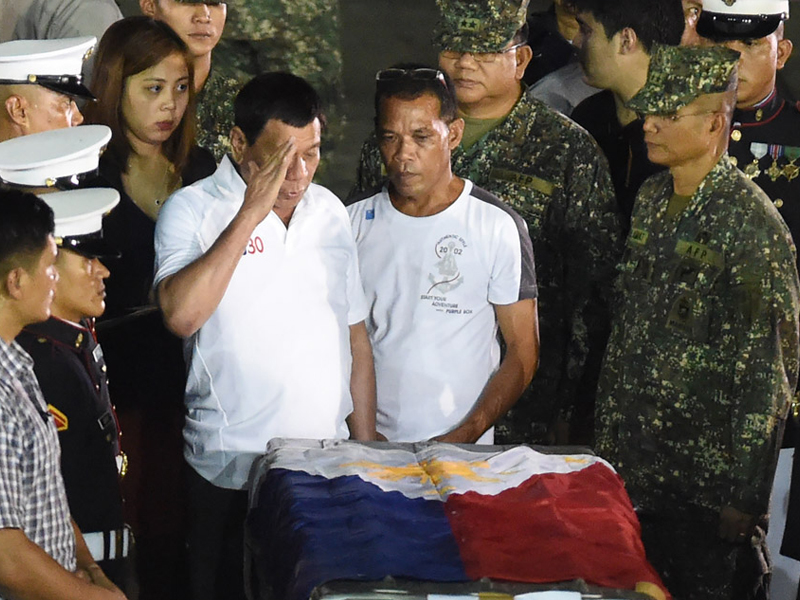
Featured Image: President Duterte salutes in front of the flag-draped casket containing one of the Marines killed in the fighting in Marawi © ABS-CBN


About the Author

Dan Steinbock is the Founder of Difference Group and has served as Research Director of International Business at the India China and America Institute (US) and a Visiting Fellow at the Shanghai Institutes for International Studies (China) and the EU Centre (Singapore). For more, see http://www.differencegroup.net

Venezuela – The National Constituent Assembly is in Place – But the Fight for Sovereignty Isn’t Over

By Peter Koenig

Venezuela is set to have a National Constituent Assembly, but the struggle to regain its sovereignty is still facing powerful foes. In this article, Peter Koenig explores Valenzuela’s past and current political realities and its connections to the real dictators of the western world.

Venezuela has voted on 30 July for a National Constituent Assembly (ANC – Asamblea Nacional Constituyente) with a resounding close to 8.1 million votes, or over 41% of the total eligible electorate. The figure was confirmed by the president of the National Electoral Council, Tibisay Lucena. The Chavistas battle cry before the elections was Venceremos! – Ché Guevaras favoured revolutionary slogan. And the day after, 31 July, the victorious Ganamos! Accompanied by dancing in the streets.

To counter the mainstream presstitute mass media slandering of Venezuela, calling the legitimate democratically elected President a dictator, and that the vote was illegitimate and against the present Venezuelan Constitution – lets explain upfront what the Constitution says:

Article 347 of Venezuela’s constitution:

“The original constituent power rests with the people of Venezuela. This power may be exercised by calling a National Constituent Assembly for the purpose of transforming the State, creating a new juridical order and drawing up a new Constitution.”

Article 348 states

“(t)he initiative for calling a National Constituent Assembly may emanate from the President of the Republic sitting with the Cabinet of Ministers; from the National Assembly by a two-thirds vote of its members; from the Municipal Councils in open session, by a two-thirds vote of their members; and from 15% of the voters registered with the Civil and Electoral Registry.”

Article 349 states

“(t)he President of the Republic shall not have the power to object to the new Constitution. The existing constituted authorities shall not be permitted to obstruct the Constituent Assembly in any way.”

The process to vote for the ANC is complex but highly democratic. The 30 July election chose 545 members to the National Constituent Assembly, of which two thirds (364) were elected on a regional or territorial basis, and one third (181) by sectors of professions or activities, i.e. students, farmers, unions of different labour forces, employees, business owners – and so on. This cross-section of people’s representation is the most solid basis for democracy. See also http://www.globalresearch.ca/why-is-venezuela-in-the-white-houses-crosshairs/5594240.

The process to vote for the ANC is complex but highly democratic.

The 8.1million pro-ANC vote may, at first sight, with 41% of total eligible voters, not constitute an absolute majority, but they are a legitimate majority analysed from different perspectives. The only historic data we currently have on Venezuela is the one from the 1999 Constitution (still valid today), which President Hugo Chavez Frias, elected in 1998, initiated after asking the people whether they agreed to the drafting of a new Constitution. He received an overwhelming 80% support.

Assuming that on average about 20% to 25% of the electorate do not vote (based on the past 19 elections since the Bolivarian Revolutionary Government took over in 1998), of the 20 million eligible electorate, about 15 million could be expected to vote. With 8.1million ANC supporters, the National Constituent Assembly resulting from the 30 July elections is a clear majority, about 54%.

The election result is another resounding victory, when compared to the opposition’s plebiscite, illegally held a week earlier. The opposition claims having received 7.2 million votes against the ANC. However, by all observers, including internationals, this is a highly questionable and probably vastly inflated figure, based on their election boots which were a fraction of those of the ANC election process countrywide. Plus, the announced result cannot be checked, as the voter’s bulletins were burned by the opposition, as soon as they informed the public of the plebiscite’s result. However, even assuming this figure was correct – which it most likely isn’t – the total alleged votes cast between the official ANC process and the illegitimate referendum would amount to 15.3 million, of which 8.1 million represents about 53%, or an absolute majority of the votes cast.

For analysis sake, let’s just look at the curious composition of votes the oppositions claims having received. In their referendum people had to respond with yes, or no to three questions, with each one being a leading question against the ANC. Each one of the three answers counted for one vote, thus, there were up to three votes per person. The same people also were allowed to vote in several districts. During the press conference held by the opposition, a journalist asked whether it was correct that one voter could cast his/her vote 17 times. The answer of one of the directors was yes, but it may be discovered at the final count. There were also stories of 10-year old kids and other minors voting. Also, there are 101,000 eligible voters abroad – but according to the opposition, the votes received from Venezuelans living outside Venezuela were almost 700,000. 

The illegitimate – yes, illegitimate – opposition vote is pure farce. Though it can never be checked, since the votes were burned and given the above details, the promulgated results of 7.2 million votes against the ANC would have to be discounted by at least 30% to 50%. Yes, illegitimate, as the Constitution does not allow interference from anybody, once the ANC process has been launched.

Curiously though, the opposition, having the majority in the National Assembly could have initiated themselves an National Constituent Assembly. They didn’t. They could have actively participated in President Maduro’s ANC vote and presented their own candidates as they would have, had they respected the principles of democracy. They didn’t do that either. It is clear, they are not interested in a democratic process. They are not interested even in dialogue, one of Mr. Maduro’s priorities for conflict resolution. They want a violent “regime change” – that’s what their Washington masters want and pay them for.

The most vociferous critics of the process came from the usual villains, CNN, BBC, Washington Post, NYT, even The Guardian, but so far relatively few from the EU and her members. One of the countries that sticks out most with her unsolicited comment is “neutral” Switzerland, where the Ministry of Foreign Affairs called on President Maduro, to cancel the elections for the new National Constitutional Assembly in “respect of democracy”. It further declared through the Swiss state-run radio-TV station, SRG, that the elections were illegal, as they are against the Constitution – which is a blatant lie, the Swiss Executive is aware of, but it pleases for sure Washington.

The Trump Administration also said it would not recognise the vote and slammed more heavy sanctions on Venezuela, among them, blocking President Maduro’s alleged “assets held in the US”. This in itself is a massive and ridiculous propaganda falsehood. It must be clear to any dimwit, that President Maduro does not have assets in the US. Washington forced “sanctions” will probably also follow from its European vassals.

The right-wing puppet leaders (sic) in Latin America have of course also immediately played to the tune of their northern masters. The first one to do so was Peru’s President Pablo Kuczynski, saying that his government would not recognise the result of the elections. But who cares what Peru thinks about sovereign democratic Venezuela? – His arrogance went as far as calling upon the Peruvian Prime Minister to form a committee that should look into possible actions Peru could and should take against Venezuela. If one knows the level of corruption that literally runs Peru – one of the worst, if not the worst of all Latin America – and the way Kuczynski was “elected”, or rather shoed in by his Washington Masters, one can just chuckle in disbelief. If there was any un-bought, uncorrupted functioning legal system in Peru – the last five consecutive Presidents would now be in jail for corruption and crimes against humanity, including the present one.

Of course, Colombia and Mexico, among the staunchest vassals of the northern empire were also accusing Venezuela’s ANC initiative as being illegitimate, anti-democratic, for the sole purpose of allowing President Maduro to become a dictator and to bend the new Constitution so that he may stay President for life. None of this is of course intended or in the cards, or indeed allowed under the Constitution and the National Assembly still in place. In fact, according to the Constitution, neither the President or the National Assembly which is not being resolved or replaced by the new National Constituent Assembly, have a right to interfere in ANC’s process of drafting a new Constitution.

On a recent visit to Mexico, the ultra-right-wing (Tea Party) CIA chief, Mr. Pompeo, pledged for both Mexico and Colombia to help assure that the situation in Venezuela is being corrected. Let’s not forget, Colombia’s President Santos (the latest Peace Nobel Laureate!) has already several months ago asked Brussels to send NATO troops to Colombia. They may already be there. With a 2,200 km porous border between Colombia and Venezuela, infiltration of Colombian and NATO troops into Venezuela would not be complicated.1

Among the few but strong supporters of the ANC and which called for the world to respect this legitimate and democratic process, were Nicaragua, Bolivia, Ecuador, Cuba, Iran, China and Russia. Others may follow. So far Brussels has only been mumbling. What remains to be seen is how these countries, notably Russia and China, would react, when it comes down to the wire with a possible CIA/US/NATO instigated coup à la Maidan, in Kiev, Ukraine, in 2014.

The purpose of a new or reality adjusted Constitution has precisely to do with foreign interference to the detriment of Venezuela’s economy.

Why did President Maduro call now for a National Constituent Assembly to modify or redraft the current Constitution? – The answer is simple. Dictators around the world, like France under Macron, the UK under Mme. May, and probably soon Germany under Mme. Merkel, would call for Martial Law to clamp down “legitimately” on the peoples’ rights and carry through their atrocious militarisation and austerity programmes, as well as to “selectively curtail foreign influence”. 

President Maduro, instead, follows democratic principles to the core. The purpose of a new or reality adjusted Constitution has precisely to do with foreign interference to the detriment of Venezuela’s economy. They include outside orchestrated food and medical supply shortages; from Miami manipulated black-market vs. official exchange rates, ruining local purchasing power, thereby causing inflation and a sagging economy; foreign news networks deadly propaganda; and infiltration of foreign trained, armed and funded violent terror groups to help organising the relatively small Venezuelan elitist opposition to cause havoc and civil unrest – as we have seen over  the last several months in the runup to these ANC elections. The US State Department funded NED – National Endowment for Democracy – is a key sponsor of violent opposition in Venezuela, as well as elsewhere in the world. The new or adjusted Constitution is expected to allow the government to sovereignly control its borders and its economy with whatever means it has to take to keep the criminals out and regain full sovereignty.

These vicious foreign supported groups have cost the life of some 110 people during the last few months leading up to the ANC vote, through the most horrendous acts of terror, including lynching, burning alive, shooting, looting of shops, attacking and destroying schools, public infrastructure, police headquarters and more. There is no end to the list of heinous crimes committed by the so-called opposition – which is nothing else as a tool for the Washington tyrant-in-chief, who will not let go until he has achieved “regime change”.

The presstitute doesn’t present this real picture of things. They portray the violence and dead toll as the government’s responsibility. In fact, thanks to the diligence of national police and the 200,000 military forces deployed throughout the country in the last couple of weeks to protect the population, the voters, in the leadup to the elections, violence and dead tolls were kept in check. Violent outbreak would have most likely been even more atrocious without the military deployment.

The overwhelming people’s support for the ANC has further cemented the solidarity within the Bolivarian Republic – and given the revolution new energy. Venezuela will prevail.

A new puppet government would return Venezuela to the pre-Chavez years – or most likely much worse – giving away Venezuelans world’s largest hydrocarbon deposit is to US petrol giants and torturing Chavistas and anybody who had in the past opposed and still opposes the violent undemocratic, oppressive servile-to-Washington elite.

What’s next for Venezuela? – Well, it’s not over. The National Constituent Assembly is just the first step. The rabid bulldog will not let go. He keeps attacking and biting relentlessly and without mercy sovereign democratic and un-obedient Venezuela. The steady internal foreign instigated economic and social decay, the build-up to what prompted President Maduro to initiate the ANC vote, was very reminiscent of the fascist 9/11/1973 CIA instigated military coup in Chile.

The Chile coup was also preceded by artificially and outside instrumented shortages of food and medical supplies – paying people to protest in the streets. The only difference there is that the Chilean army was split and high ranks defected President Allende. This doesn’t seem to be the case in Venezuela. – The overwhelming people’s support for the ANC has further cemented the solidarity within the Bolivarian Republic – and given the revolution new energy. Venezuela will prevail. Venceremos!

Featured Image: Venezuela President Nicolas Maduro called for a National Constituent Assembly © AP


About the Author

koenig-webPeter Koenig is an economist and geopolitical analyst. He is also a former World Bank staff and worked extensively around the world in the fields of environment and water resources. He lectures at universities in the US, Europe and South America. He writes regularly for Global Research, ICH, RT, Sputnik, PressTV, The 4th Media, TeleSUR, TruePublica, The Vineyard of The Saker Blog, and other internet sites. He is the author of Implosion – An Economic Thriller about War, Environmental Destruction and Corporate Greed – fiction based on facts and on 30 years of World Bank experience around the globe. He is also a co-author of The World Order and Revolution! – Essays from the Resistance.

Reference

1. http://www.globalresearch.ca/venezuela-washingtons-latest-defamation-to-bring-nato-to-south-america/5575480


The Myths and Realities of Duterte’s Infrastructure Initiative

By Dan Steinbock

A huge upgrade of infrastructure is vital for Philippines economic future. That’s why it is contested by entrenched interests, including foreign powers. This is the first in a series of occasional commentaries about the Philippines transformation from an international viewpoint.


In the past year, President Duterte has initiated a series of economic reforms to accelerate economic development. Despite much “political noise”, the government seeks sustained growth around 6.5- 7% in 2017, by banking on multiple initiatives, especially higher infrastructure spending.

According to Ernesto Pernia, Director General of the National Economic and Development Authority (NEDA), investment spending must be ramped up to 30% of GDP for Philippines to become an upper middle-income economy by the end of Duterte’s term in 2022, and to pave the way for a high-income economy by 2040.

Yet, the huge infrastructure investment effort has been often misreported internationally. Infrastructure investment is a case in point.


The Allegation: Infrastructure as “Debt Slavery”

In early May, Secretary of Budget and Management Benjamin Diokno estimated that some $167 billion would be spent on infrastructure during President Duterte’s six-year term. Only a day later, US business magazine Forbes released a commentary, which headlined that this debt “could balloon to $452 billion: China will benefit”.

According to the author, Dr. Anders Corr, the current Philippine government debt of $123 billion is about to soar to $290 billion because China, the “most likely lender”, would impose high interest rates on the debt: “Over 10 years, that could balloon Philippines’ debt-to-GDP ratio as high as 296%, the highest in the world.”

These figures assume absence of transparency by the Duterte government and China on the interest rate, conditionality and repayment terms of $167 billion of new debt for the Philippines. Due to accrued interest, “Dutertenomics, fuelled by expensive loans from China, will put the Philippines into virtual debt bondage if allowed to proceed.” He assumes China’s interest rate would amount to 10%-15%.

But why would the Philippines accept such a nightmare scenario? Because, as Corr puts it, “Duterte and his influential friends and business associates could each benefit with hundreds of millions of dollars in finders fees, of 27%, for such deals.”

He offers no facts or evidence to substantiate the assertions, however.

The Official Story:  Debt Decline, Despite Infrastructure Investment

Recently, the Department of Budget and Management (DBM) anticipated the Philippine debt position to remain sustainable, despite deficit spending for infrastructure. Between 2017 and 2022, the Duterte government plans to spend about $160 billion to $180 billion to fund the “Golden Age of Infrastructure”. An expansionary fiscal policy shall increase the planned deficit to 2-3% of GDP.

To finance the deficit, the government will borrow money following an 80-20 borrowing mix in favour of domestic sources, to alleviate foreign exchange risks – which would seem to undermine the story of China as the Big Bad Wolf.

Between 2017 and 2022, the Duterte government plans to spend about $160 billion to $180 billion to fund the “Golden Age of Infrastructure.”

The fiscal strategy is manageable because the economy, despite increasing deficit, will outgrow its debt burden as economic expansion outpaces the growth in the rate of borrowing. So what is the expected impact on the debt-to-GDP ratio?

Given deficit spending of 3% of GDP, the DBM assumes growth will be 6.5%-7.5% this year and 7%-8% from 2018 to 2022 (plus inflation of 2%-4%). As a result, it projects the debt-to GDP ratio to decline from 41% in 2016 to 38% in 2022.


The Realities:  Growth Over Deficit Financing

The current Philippine debt-to-GDP ratio compares well with its regional peers. It is half of that of Singapore and less than that of Vietnam, Malaysia, Laos and Thailand (Figure 1). The starting point for a huge infrastructure upgrade is favourable. True, in a downscale risk analysis, Philippine growth performance might not reach the target, but would be likely to stay close to it – which would still translate to a manageable increase in the debt-to-GDP ratio.


Figure 1: ASEAN: Debt-to-GDP Ratio, 2016 (%)


Yet, Corr claims that Philippine debt ratio will soar seven-fold in the Duterte era, whereas the DBM estimate offers evidence the debt could slightly decline. The difference between the two is almost 260%.

Today, Japan’s debt-to-GDP ratio exceeds 250% of its GDP. However, at the turn of the 1980s, the ratio was still closer to 40%, or where the Philippine level is today. Yet, Corr claims Duterte government would need barely 4 years to achieve not only Japan’s debt ratio today but a level that would be another 50% higher!

The realities are very different, however. The contemporary Philippines enjoys sound macroeconomic fundamentals, not Marcos-era vulnerability. Moreover, Corr’s tacit association of Duterte’s infrastructure goals with former President Marcos’s public investment program (and the associated debt crisis in the 1980s) proves hollow. Duterte is focussed on infrastructure (his infrastructure budget as percentage of GDP is 2-3 times higher in relative terms).

Today, borrowing conditions are also more favourable (365-day Treasury bill rates are 3-4 times lower than in the Marcos era).  Furthermore, the Philippine gross international reserves, which amount to 9 months, are relatively highest among ASEAN economies and 3-4 times higher than in the Marcos era (Figure 2).


Figure 2: Gross International Reserves, 2015-16 (months)


In addition to realities, Corr’s analysis ignores the dynamics of debt. Any country’s debt position is not just the nominal amount of the debt, but its value relative to the size of the economy. An economy that is barely growing and suffers from dollar-denominated debt lacks capacity to pay off its liabilities, as evidenced by Greece. In contrast, with its strong growth record, the Philippines has the capacity to grow while paying off its liabilities.


Geopolitical Agendas, Economic Needs

Corr could have challenged DBM’s assumptions about Philippines future growth, potential increases in infrastructure budget, contingent adverse shifts in the international environment and so on, but his purposes may be political.

He is close to US Pentagon and intelligence communities, which strongly oppose Duterte’s recalibration of Philippines foreign policy between the US and China. According to US Naval Institute, he has visited all South China Sea claimant countries and undertaken “field research” in Vietnam, the Philippines, Taiwan, and Brunei. He has been an associate for Booz Allen Hamilton (as once was Edward Snowden). Though he has ties with international multilateral banks, he is less of an “economic hit man” and has more interest in U.S. security matters.

In any real assessment, simple realism should prevail: When the rate of economic expansion exceeds that of debt growth, low-cost financing for public projects can make a vital contribution to the Philippines’ economic long-term future.

Corr led the US Army social science research already in Afghanistan and conducted analysis at US Pacific Command (USPACOM) and U.S. Special Operations Command Pacific (SOCPAC) for U.S. national security in Asia, including in the Philippines, Nepal, and Bangladesh. Currently, he is researching Russia and Ukraine for the Pentagon. He has urged President Trump to use stronger military presence in the South China Sea, bullied Pakistan with sanctions, and supported independentistas in Hong Kong and Taiwan, labelled Chinese students abroad as Beijing’s informants, while exploring US nuclear options against North Korea.

Such objectives are far from neutral economic observation, but they do reflect political partisanship that is typical to Washington’s neoconservative and liberal imperial dreams – but not the views of most Americans, according to major polls.

In the Philippines, Duterte’s supporters see Chinese debt as a business deal that will ultimately support the country’s future. After Forbes, the Duterte government’s critics were quick to report the story, but without appropriate examination of its economic assertions and possible strategic motives. Overall, while liberals tend to oppose the debt plans for geopolitical reasons, their economists are more sympathetic.

In any real assessment, simple realism should prevail: When the rate of economic expansion exceeds that of debt growth, low-cost financing for public projects can make a vital contribution to the Philippines’ economic long-term future.

The original commentary was released by The Manila Times on July 31, 2017

Featured Image: 2018 proposed national budget presented to Duterte. Source: http://www.gmanetwork.com/


About the Author

Dan Steinbock is the Founder of Difference Group and has served as Research Director of International Business at the India China and America Institute (US) and a Visiting Fellow at the Shanghai Institutes for International Studies (China) and the EU Centre (Singapore). For more, see http://www.differencegroup.net

Germany – is Madame Merkel up for a Ruse?

By Peter Koenig

It’s not surprising that the US Congress has new sanctions against Russia, but what’s interesting is Madame Merkel’s objection on the sanctions. In this article, Peter Koenig elaborates on how the German Chancellor seems to be up for a ruse, the deep state’s manipulation, and why we should all wake up and stop being deceived.


Everybody with a clear mind is up in arms about the US Congress’ latest sanctions against Russia – and as usual – sanctions for naught – zilch, zero – since Russia hasn’t done any of the things Washington and the servile west accuses her of, like interference in US elections (US secret services have repeatedly said there is no evidence whatsoever), interference in Ukraine (Washington/NATO/EU have instigated and paid for the bloody Maidan coup in February 2014); annexing Crimea (an overwhelming (97%) vote by the people of Crimea for reincorporation into the Russian Federation – their given right, according to the UN Charter). Even if Russia wanted to, she couldn’t correct any of her “mistakes”. They are all invented.

None of the accusations have any substance. But the western presstitute keeps hammering them into the dimwitted brains of the populace. We can only repeat with Joseph Goebbels, Hitler’s Propaganda Minister: “Let me control the media, and I will turn any Nation into a herd of Pigs”. Well, the western Anglo-Zionist propaganda machine has successfully turned western civilisations (sic) into a herd of pigs.

Even if Russia wanted to, she couldn’t correct any of her “mistakes”. They are all invented.

Is every member of the US Congress really that stupid to believe, for example, in Russian interference in US presidential elections? – Or do they simply believe “We, the US of A and Masters of the Universe, do it all the time, so Russia must be doing it too”?

Although President Trump appears to utterly dislike that the Senate – his Senate – has followed the direction of the House and overwhelmingly approved the new “sanctions” – El Donald has eventually signed them after all. Was his dislike just another scam?

Madame Merkel too appears to be “up-in-arms” about the new set of sanctions – which by the way won’t do anything to Russia. Russia is way beyond being affected by economic sanctions, as her economy is largely detached from that of the west. Russia as well as China, and the entire Shanghai Cooperation Organisation (SCO) have learned fast.


President Putin, while making a straight face in view of more stupid sanctions, must be chuckling about western ignorance still believing in the Master of the Universe’s right in handing out punishments to his “underlings” when they don’t behave – even when chastising is based on total lies. In fact, these anti-Russia sanctions would penalise Europe for being stupid vassals. Hilariously, they would, for example, fine European companies participating in joint Russian-European pipeline projects.

So, why do the “sanctions” continue? – Propaganda, stupid! – The rest of the world must believe America is the greatest, most powerful and can police the world at their whim. That’s Washington’s ultimate tool for survival – a web of lies clad in massive propaganda – exactly following the edict of Goebbels.

Which brings our western system to the point – total lawlessness, no morals no ethics – an everything-goes neoliberalism, turned neo-fascism. Make no mistake – open your eyes – in case you haven’t noticed, that is what we are living today. Destruction of ancient civilisations; Greece, as well as the cradle of today’s western culture mercilessly devastated; Syria, Iraq and almost the entire Middle East and North Africa up in flames – and nobody says peep. It’s become the new normal. The sick western society just gulps beer and watches football. A full-blown, careless, selfish “redneckization” of the West.

The entire Hamburg G20 Conference was an orchestrated farce, a trial run for worse, much worse to come.

But Madame Merkel doesn’t belong into the category of “stupid” – she just wants by all means to be elected. Or better said, she is ordered to be re-elected for the 4th time on 24 September 2017 by the Deep Dark State. Therefore, she has to do what makes her popular at home, even to the seeming detriment of her relationship with Washington. Trump, by the way, too, is just a minion of the Deep Dark State and has to do their bidding. He knows it, she knows it. A little make-believe spat between the two doesn’t matter. It’s just a game to further dupe the populace into confusion and into believing that finally Europe may become a sovereign continent again, thanks to the apparent leadership of Madame Merkel, turning away from the Atlantists, taking back responsibility and sovereignty. Of course, not to forget her siblings in crime, the other two “Ms” – Macron and May – will follow her lead. Therefore, every lil’ thing is gonna be alright.

Madame Merkel has joined the chorus of those condemning the “sanctions” – saying enough is enough. Same tone she used at the recent G20 Summit in Hamburg – “we have to take responsibilities in our own hands” – basically admitting that she and the other EU vassals had left the responsibility in the bloody claws of Washington.

The entire Hamburg G20 Conference was an orchestrated farce, a trial run for worse, much worse to come. It was a training ground for police and bought violent protesters. It’s part of urban warfare drill – as is more quietly being prepared in Saxony-Althaus, where the Bundeswehr and NATO are building an entire ghost town in one of Europe’s most modern army camps to train military and police for repressing people’s resistance against coming neofascist tyranny and austerity.

These are the signs for what’s to come in the near future, as the Deep Dark State thinks it’s close to the NWO – Full Spectrum Dominance. Wake up, people. It’s never too late – before they militarise every street of your town and strip you of what’s left of the meager remnants of your civil rights. Martial Law will soon be inscribed in EU members Constitutions, beginning with France. That’s certainly in the plan and in the cards. The three “Ms” (Merkel, Macron, May) are cooperating hard to make it happen. And if the three Big Ones do it, the NWO clan believes the other EU vassals will follow in lockstep. And they may – as the criminal propaganda machine is sending deadly salvoes of lies into the western public.

Madame Merkel’s “taking back responsibilities” and her outcry against new US sanctions for Russia should make her popular again – should make her electable – again, in less than two months-time. This is what the German people want, the vast majority of them anyway, an independent and sovereign Germany and Europe, one without the Brussels-NATO-Washington dictatorship.

People and even more so businesses, are sick and tired of the anti-Russia discourse. They want peace and normal relations with Russia; natural relations of neighbours, as they have been existing for centuries before the new Anglo-empire across the Atlantic came to the fore. Mind you, the new Anglo-empire is made up from European defectors – and ruthless warriors, who felt much safer between two shiny seas, than tethering close to the conflict-ridden old despotic continent. In the meantime, the new empire has been infested by the Deep Dark invisible state.

One thing is for sure – the big nasty bulldog won’t let go until he has achieved its objective, in this case, the PNAC objective – Full Spectrum Dominance.

Back to Madame Merkel. What if her grievance with the latest sanctions is just a ruse, a manipulation of public opinion to be reelected? And when she is reelected, will she turn her back again on Putin and shake hands with Trump? All is possible. It’s a blueprint of typical neoliberal chaos and confusion. Put people in delirium and you can do whatever you want with them. One thing is for sure – the big nasty bulldog won’t let go until he has achieved its objective, in this case, the PNAC objective – Full Spectrum Dominance. This means subjugating Russia and China, an alliance made of steel.

However, against this alliance of steel, the bulldog may succumb for lack of oxygen and faltering energy. This new alliance, also called SCO, for Shanghai Cooperation Organisation, is offering a new and real economic perspective, the New Silk Road, also called the One Road One Belt (OBOR), or One Belt Initiative. President Xi’s OBI is rapidly gaining new momentum and allies, more strength and more attraction for all those western nations which always wanted to defect from the nefarious western dictate, but were afraid to dare.

And yes, it can’t be said often enough – the Future is in the East. The West is slowly but surely drowning itself in its blood-drenched violence and propaganda of lies. Madame Merkel, better take note of it.

Photo Courtesy: REUTERS | John MacDougall


About the Author

koenig-webPeter Koenig is an economist and geopolitical analyst. He is also a former World Bank staff and worked extensively around the world in the fields of environment and water resources. He lectures at universities in the US, Europe and South America. He writes regularly for Global Research, ICH, RT, Sputnik, PressTV, The 4th Media, TeleSUR, TruePublica, The Vineyard of The Saker Blog, and other internet sites. He is the author of Implosion – An Economic Thriller about War, Environmental Destruction and Corporate Greed – fiction based on facts and on 30 years of World Bank experience around the globe. He is also a co-author of The World Order and Revolution! – Essays from the Resistance.

Food – Wars and Pharma – Trailblazing the Way to Human Demise

By Peter Koenig

In this article, Peter Koenig connects the dots and sheds light on how food, drugs, and bombs all play together in the grand plan of the masters of the western world. Read on as the author calls out, “Be aware and stop falling into the trap.”


“ “What the Health” – is the groundbreaking follow-up film from the creators of the award-winning documentary Cowspiracy. The film follows intrepid filmmaker Kip Andersen as he uncovers the secret to preventing and even reversing chronic diseases – and investigates why the nation’s leading health organisations don’t want us to know about it. With heart disease and cancer, the leading causes of death in America, and diabetes at an all-time high, the film reveals possibly the largest health cover-up of our time.”

This is the introduction to the trailer of one of two new documentary, “What the Health”, and “Food Matters”, purportedly showing how the food and pharma industries are conspiring to keep us lingering along sick and unhappy, drug and pharma addicts, consuming more and more unhealthy food saturated with sugar and fat, to lead to increasing pharma- and drug consumption – a spiral ending at the graveyard.

“What the Health” – trailer (2 min)   https://vimeo.com/ondemand/whatthehealth
“Food Matters” – trailer (3 min)  https://www.youtube.com/watch?v=r4DOQ6Xhqss  

What do these food-war documentaries have in common with the holocaust-type wars and destruction in Iraq and Syria; the devastation of Libya, Afghanistan, Ukraine, the chaos in Sudan, Somalia, all of Central Africa, the destabilisation and attempted destabilisation of Pakistan, Venezuela, Iran, Ecuador, Bolivia, all of Central America, the Philippines and countless other countries that could make up an entire United Nations by themselves?

Russia and China, are of course, also in the crosshairs of the evil empire. To achieve Full Spectrum Dominance as per the neocons bible, the PNAC (Plan for a New American Century), all opposition to the New World Order has to be tamed, come hell or high water – or even a nuclear holocaust.

These wars have everything in common. Everything. They go all hand-in-hand. They want humanity subjugated, suffering from diabetes, cancer and heart diseases, and dying at an increasing pace to have a real impact on population reduction.

Are we blind? Why are we still jumping up and down in front of our TV, in our comfortable armchairs, watching the evening news – watching how countries are destroyed – in far-away places, gobbling up the lies of the commentators – cursing about Venezuela, Russia, Iran and even China, because that’s what the news commentators teaches us to do – why?

They want humanity subjugated, suffering from diabetes, cancer and heart diseases, and dying at an increasing pace to have a real impact on population reduction.

Well, this killing is not for us, we are safe, we are protected by our democratic governments military and police, they take good care of us – so we keep swallowing heaps of fat-dripping cheeseburgers, French fries, ice creams, and mega-litres of sugar-loaded sodas.


The food war like the pharmaceutical war fit perfectly the pattern of the Dark State that masterminds Washington. They are joining the war of bombs, canons and guns. These wars show clearly that there are deeper and darker forces at play than we realise. The world population needs to be reduced drastically that the elite can live happily with the limited resources our planet will leave behind. Kissinger and the Rockefeller sponsored Bilderbergers have been advocating this for a long time. We pay no attention. They eat well. Look how old they become? That’s not by accident. Not only that, a smaller population is easier managed, enslaved than a large one.

Remember Kissinger’s infamous saying in the early seventies: “Who controls food, controls the people, who controls energy controls entire continents, and who controls money controls the world”. Kissinger is just a spokesman for the Deep Dark State. A patsy. A convinced patsy and a well remunerated patsy. He has conveniently stayed in the background for decades, since Laos, Vietnam and Chile. But, lately he is coming to the fore again. As a chief Zionist, he is a welcome advisor for the neocons, especially as they are strategising for their last blow.


Why Are We Blinded?

None of the people in the two trailers, the people who spoke up, scientists, who seem to be so awake – none of them mentioned the end-goal of the elite as responsible for our unhealthy, outright killer food and equally killer medication intake, what we eat, drink, swallow as palliatives for our pains – poisoned by toxins, by GMOs, by fat… you name it.

Do they not know? – Do they not know what could in a very immediate future be implanted in GMOs as long-term debilitating diseases, that will reduce the function of our brains, our vital organs, liver, kidneys, pancreas, and finally our heart – but not before we have tried hard with medication and drugs – and our hard-earned money – to stay alive, albeit miserable, but alive – until the stoppage of the heart does us part. Literally and figuratively. Do they really not know? Or do they not dare to tell?

Tsipras knows, he could stop it all by just stepping out of this criminal organisation called EU with their fraudulent currency, called euro. He doesn’t dare.

The fear factor. It always reminds of Greece. Everybody on this planet who has a half-wit brain, knows that the destruction of Greece is purposeful, and not recoverable, never as part of the EU and the Euro. Everybody knows that. Tsipras and his entourage stooges know that they are complicit in not only destroying their country, but also the lives of their countrymen.

Yet, nobody says anything. Tsipras knows, he could stop it all by just stepping out of this criminal organisation called EU with their fraudulent currency, called euro. He doesn’t dare. Fear. Because he may have been told by the dark masters of the universe what may happen to him, his family, if he doesn’t behave – or worse, if he talks? – Yes, we know what happened to many of those who haven’t heeded the warnings of the dark manipulators.

The same about the food and pharma industry.

Do these scientists who warn us really believe it’s the fast-food and pharma lobby alone behind it all? Do they not suspect more sinister forces behind this human calamity? Do they not see the connection between bombs, food and pharma? – Have they not read Orwell’s1984 – which is being played out in our full sight?

The food and pharma lobby are semi-gods, accompanying the war god, and closely modelled according to the deep dark great god of Satan. They follow his dictum. They are agreed patsies who cash in huge profits on the way to the human graveyard. Population control by government repression, transiting to population reduction by food, wars, drugs, by implanted diseases, genetic diseases… and since lately, by forcefully imposed mass vaccinations.

The Macrons and Gentilonis of this world are the French and Italian “trailblazers” to show the rest of the western world how to deal with a resisting population. It’s already happening in Italy. In France, the law is already prepared, waiting to be approved by Macron’s parliamentary majority after the summer vacation. To most awakened people it’s clear – you can put anything into a vaccine – as well as into a genetically modified food crop – long-drawn-out diseases, genetic diseases that will be difficult to trace back to vaccines or GMOs generations from now. And if – it will be too late.

And we keep having no clue. And if we had a clue, we have lost the sense of solidarity. Without solidarity, without joining hands with other resisters, friends and comrades, against this miserable neocon NWO lot, we are lost. And they know it. That’s why they keep dividing us, with markets and with greed. Be aware and stop falling into the trap. Reach out in solidarity, to others who want to resist.
People have always been lied to by the masters, but the extent of deceit planted upon us day after day, hour after hour, has never been as strong and as intense and Machiavellian as today – when we are, as I said in an earlier article – probably in the “final phase”.1 The recent G20 summit in Hamburg was just a trial balloon – taking the temperature of the resisters, a benign beginning of the horrors that may come.2


About the Author

koenig-webPeter Koenig is an economist and geopolitical analyst. He is also a former World Bank staff and worked extensively around the world in the fields of environment and water resources. He lectures at universities in the US, Europe and South America. He writes regularly for Global Research, ICH, RT, Sputnik, PressTV, The 4th Media, TeleSUR, TruePublica, The Vineyard of The Saker Blog, and other internet sites. He is the author of Implosion – An Economic Thriller about War, Environmental Destruction and Corporate Greed – fiction based on facts and on 30 years of World Bank experience around the globe. He is also a co-author of The World Order and Revolution! – Essays from the Resistance.

References
1. http://thesaker.is/are-we-in-the-final-phase/
2. http://www.globalresearch.ca/the-g20-is-the-west-governed-by-psychopaths/5598160

The Crisis of Trust in Democracy and Globalisation

By Graham Vanbergen

Crimes of the rich and powerful elite have led to a global crisis of trust. In this article, the author elaborates on how societies have now lost their confidence and faith to established authorities and governments. But in a globalised world where there’s no trust and only fear, how can we expect the future to be bright?


Trust is in crisis all around the world. The four key institutions of trust in business, government, NGOs, and media have been in decline for years. So much so that the majority of respondents to the Edelman Trust Barometer1 now believe that the overall system is simply no longer functional and does not work for them.

The consequence to such an environment of suspicion and cynicism is that people’s concerns over globalisation,2 the pace of innovation, employment prospects, immigration and eroding social values are turned into fear. And fear-factor politics has become endemic. The consequence is evidenced in the rise of political figures such as Donald Trump, the rise of extreme political parties across Europe, the collapse of establishment politics in France, the failure of the Italian referendum, Brexit and then the Theresa May election debacle. All these events are inextricably linked because they were all decisions that were fundamentally driven by a lack of trust. According to reports, Theresa May was warned not to proceed with a snap election by her campagin guru Lynton Crosby CEO of the CT Group elections consultancy.

All these events are inextricably linked because they were all decisions that were fundamentally driven by a lack of trust.

The Barometer revealed nothing less than a malignancy sweeping across democratic nations in particular. Trust in the media is now at an all-time low. Government is now the least trusted institution in half of all 28 nations in the survey. Even trust in business leaders has collapsed globally, plummeting in every country studied – whilst right at the very bottom of the survey results, government leaders retain the title of least credible.

This should really come as no surprise. In the last ten years the scandals rocking democracy have been epic. The global financial crisis that emanated in America, swept around Europe like an uncontrollable fire – austerity its only strategy of resurrecting the lifeless corpse of what was once a vibrant economy. Bailing out the banking behemoths on Wall Street and the City of London, Paris, Rome and Athens, all paid for by the less well off is cited in so much anger.

Financial crimes, mass money laundering tax havens, ponzi schemes, privatisation of state assets, cover-ups and the looting entire countries, the list goes on and on. But in truth, these are the crimes of the rich and powerful and people know it.


The survey found that 53 percent believe the system is rigged, unfair and has failed them. Worse, only 15 percent believe the system is working at all and another third aren’t sure. Just think about that for a moment. Of 28 democracies, only 15 percent of the population believe that their lot is OK.

Tellingly, the survey actually asks the financially well off, the elite, what they think of the very system they are exploiting and even they agree the system has failed. In addition, 48 percent of the top quartile in income, 49 percent of the college/university-educated and a majority of the well informed (51 percent) also agree that the system has actually failed.

To recap, less than one in five of the mass population and only half of the elite think democracy and the institutions that supports it is now functional. And yet, the gap between the trust held by the informed public and that of the mass population has widened to 15 points, with the biggest disparities in the US (21 points), UK (19 points) and France (18 points). The mass population in 20 countries distrusts their institutions, compared to only six for the informed public. It’s interesting that the establishment have been seriously challenged in all three of those countries with the biggest disparities.

Search engines are now providing more news delivery than human editors from the traditional sources of news.

As you read the 66-page report and survey findings, it becomes apparent what the real state of “the system” really is in. Dire and critical are the words that come to mind.

Fear of destabilisation is driving sentiment. Corruption tops the list,3 but immigration, globalisation and eroding social values along with the pace of innovation all follow close behind. These fears are well founded and manifest themselves in the most sudden of political change, hence the failed Italian referendum, Trump, Brexit and even new French president Emmanuel Macron.

The highly publicised emergence of “fake news” has not helped of course. The dramatic rise of social media and huge use by billionaires and corporations to push their message with micro-ads to manipulate elections and referendums is feeding the fear. Search engines are now providing more news delivery than human editors from the traditional sources of news.

People are now trapped in their own “echo chambers” that only makes matters worse and they are now known to reject any notion that they don’t believe in, reinforcing the lack of trust.


Figure 1: Credibility of Leadership Crisis

Source: The 2017 Edelman Trust Barometer

Proof of this can be seen in one part of the report that confirms that a person like yourself is now just as credible a source of information as is a technical (60 percent) or academic (60 percent) expert, and far more credible than a CEO (37 percent) and government official (29 percent).

“People now view media as part of the elite”, said Richard Edelman, president and CEO of Edelman. “The result is a proclivity for self-referential media and reliance on peers. The lack of trust in media has also given rise to the fake news phenomenon and politicians speaking directly to the masses. Media outlets must take a more local and social approach.”

One should not forget that the mass population make up nearly 90 percent of the global population and half of them live on less than $2.50 a day. Globalisation has not rescued them from poverty,4 and the Eurozone has been described as a “poverty machine” as its economy continues in stagnation mode.5

The mass population mistrust of government is prevalent in Italy, Spain, Germany, France, UK, Sweden and Poland. All of these European countries now present systemic political risk to the establishment. The US and Australia are included and surprisingly, so is Canada.

Trust in the British media has fallen 4 places in just one year to seventh from bottom, only just behind, Turkey, Poland and Russia. Trust in NGOs has fallen in 21 of 28 – Britain again falls four places to seventh. In all these findings there was the real sense of injustice. Then there was a lack of hope; a lack of confidence and a desire for change and it was the government who is predominantly the cause of all this anxiety. In 2017, 50 percent of the countries in the barometer have reported a complete loss of faith in “the system”. The US ranks 13th from last, the UK 10th last, Germany 9th, Italy 2nd and France last. In contrast, Russia, China and the UAE rank the top countries for faith in their systems.


Figure 2: Fears Further Erode Belief in the System

Source: The 2017 Edelman Trust Barometer

Corruption is now feared by 77 percent of respondents. And 79 percent are fearful about globalisation, 83 percent are concerned about social erosion and 72 percent about immigration. The pace of innovation concerns 68 percent – no doubt this will increase over time with continual reports of the rise of robotics and technology such as artificial intelligence.

As for the UK’s decision to leave the European Union; 54 percent said that the system had failed them and that they were fearful for the future. That fear dropped to 27 percent for those that voted to remain in the EU.

Traditional news and broadcast media are now showing the steepest declines in audience of all mediums. 53 percent of people do not listen at all to people or organisations that they do not agree with, with 59 percent finding the information they want from search engines. Contrary to what the government’s say, 64 percent believe in leakers and whistle-blowers, but only 36 percent believe in corporate press releases and company statements.

Globalisation is notable as 50 percent agree it is taking them in the wrong direction with 60 percent fearing; loss of jobs to foreign competitors (60%), immigration (58%), jobs moving to cheaper markets (55%) and automation (54%).

53 percent of people do not listen at all to people or organisations that they do not agree with, with 59 percent finding the information they want from search engines.

Here we can see how protectionism is now dominating the political arena. 72 percent in the survey say the government should protect their jobs, 69 percent the government should prioritise their own country needs and 50 percent say we should no longer sign trade agreements.

All of the survey findings are leading towards the understanding that there is a fundamental shift going on right now. Influence and authority that came from the traditional elite supported by experts and their institutions has fully inverted as people start to reject established authority.

“The implications of the global trust crisis are deep and wide-ranging”, said Edelman. “It began with the Great Recession of 2008, but like the second and third waves of a tsunami, globalisation and technological change have further weakened people’s trust in global institutions. The consequence is virulent populism and nationalism as the mass population has taken control away from the elites.”

As Edelman eludes, change is coming from the people because change was made for them without their consent.

Featured Image: Thousands of people gathered in central London to demonstrate against the UK government’s economic policies. (source: http://www.bbc.com/news/uk-40468881)

About the Author

graham-webGraham Vanbergen’s business career culminated in a Board position in one of Britain’s largest property portfolio’s owned by one of the world’s largest financial institutions of its type. Today, he writes for a number of renowned news and political outlets, is the contributing editor of TruePublica.org.uk and Director of NewsPublica.com.

References

1. 2017 Edelman Trust Barometer: http://www.edelman.com/trust2017/
2. The Grim Realities of Globalisation: http://www.europeanfinancialreview.com/?p=9975
3. Corruption I the European Union: http://truepublica.org.uk/eu/corruption-european-union/
4. Poverty – global facts and stats: http://www.globalissues.org/article/26/poverty-facts-and-stats
5. Eurozone is a turning into a poverty machine: http://www.telegraph.co.uk/business/2016/10/24/the-eurozone-is-turning-into-a-poverty-machine/

Be Truly informed. Breathtakingly Inspired

The readers of The World Financial Review are salvaged from the pretences of orthodoxy. Because we don’t tell our readers what to think. We only show what some of the world’s smartest people are thinking about.

Are We on the Verge of Becoming Western Money Slaves?

By Peter Koenig

Masked by economic “innovations”, the New World Order continues work its way to total world manipulation. In this article, Peter Koenig elaborates on the Order’s intricate and imprisoning strategies in its attempt to enslave all of us through its financial systems.


Electronic money, a cashless society, is perhaps the ultimate and most direct means of the New World Order (NWO), also called One World Order (OWO), to control us all via its financial system. A system that the NWO would like to maintain as the world’s financial system, albeit, it has already been reduced to the western world’s financial system.

Why reduced to the Occident? – Because the Orient, China, Russia and the other countries belonging to the Shanghai Cooperation Organisation (SCO) and to the Eurasia Economic Union (EEU) have already largely delinked themselves from the western dollar-based system of fraud. They are saved from slavehood.

This reminds of one of the oldest and world’s worst criminal agent against humanity – still alive and kicking – Henry Kissinger: “Who controls food, controls the people; who controls energy controls entire continents; and who controls money controls the world.” He is, of course, right on all fronts, and has given us this clue already more than 40 years ago. But nobody has really seriously taken it to heart and acted upon these edicts.

Many, including me, have written about freeing the world from the NWO money control.1 Deglobalising would be a first step towards freeing us all from the bloody claws of the Washington implemented, and Dark State directed NWO.

Critics often talk of an overhaul and reform of the system. This monetary system cannot be reformed. It is privately owned and rotten to the core. None of the private owners, the Rothschild, Rockefeller clans et all, would allow interfering with their wealth, usurped off the back of the world’s workers and populace at large. Former attempts to bring the FED under national reign, have resulted, for example, in JFK’s early death.

They don’t want to kill Europe altogether, good old Lady Europe, because they need her as a stepping stone for subjugating the rest of the world, for vital trade that helps justifying and generating the unlimited dollar machine – and, as a cushion to the East.

Compare the dollar-based monetary system to the European Union – which cannot be reformed either. Any “reform” is just fiddling at the margins – as is inherent in the term “reform”. And that’s not good enough. As we know by now, the EU was not the construct of Europeans, per se, but an idea behind the “deep state”, already at the onset of Phase II of the Great Hundred Year War (WWII – September 1939 to September 1945). Phase I (WWI – 1914-1918), as well as Phase II were induced to weaken Europe, to make her ready for full domination.

Imagine a “Picador” of a Spanish bullfight, whose job it is to weaken the bull to the point where the torero and matador have a relatively easy task subduing and killing the bull. Well, Europe is the bull. They don’t want to kill Europe altogether, good old Lady Europe, because they need her as a stepping stone for subjugating the rest of the world, for vital trade that helps justifying and generating the unlimited dollar machine – and, as a cushion to the East, where massive military troops and weapons can be stationed in the name of NATO, to eventually launch, what they would like to think, is the final blow on the East, starting with Russia.

For all this the European (non)-Union was created, her Brussels hub, dominated by the non-elected European Commission (EC) which also dictates most of the rules imposed on her 28-member states – and which are all not-so-coincidentally run by neoliberal, some close to neofascist governments. Of course, by adhering to the Brussels dictate, they have become devoid of national sovereignty. That is a must. A sovereign country would not submit to the horrors of police state and militarisation that are in the coming. The euro with the Wall Street (Goldman Sachs – GS) run European Central Bank (ECB) is just a logical add-on to the fake EU. By now, many serious scholars have concluded that neither the EU or the euro are sustainable, but are doomed to collapse sooner or later.

The EU and the euro are a complex construct, largely manipulated and carried forward by the Dark State’s main secret services, CIA, NSA, Mosad, MI6 with close collaboration of Europe’s national secret services. Hence, the creation of a complete political and monetary vassal, the European Union and her currency, equally fraudulent as its master currency, the US-dollar.

The euro with the Wall Street (Goldman Sachs – GS) run European Central Bank (ECB) is just a logical add-on to the fake EU.

It is not by chance that today’s western US-dollar based monetary system, with its centre, the Federal Reserve (FED), has been created just at the onset of Phase I of the Hundred Year war, i.e. WWI. In 1910, Rhode Island Senator, Nelson Aldrich, with his heart close to the world of bankers, organised a “hunting trip” for five top Wall Street (WS) bankers to travel in disguise by train to Jekyll Island, off the coast of Georgia, where they concocted in a few days the concept of the modern FED – which was to become the “mother” of the new dollar-based world monetary system, now reduced to the western monetary system. The Federal Reserve Act was signed into law in December 1913 by President Woodrow Wilson.

On his death bed, in 1924 Wilson apparently declared, “I am a most unhappy man. I have unwittingly ruined my country. A great industrial nation is controlled by its system of credit. Our system of credit is concentrated. The growth of the nation, therefore, and all our activities are in the hands of a few men. We have come to be one of the worst ruled, one of the most completely controlled and dominated Governments in the civilised world no longer a Government by free opinion, no longer a Government by conviction and the vote of the majority, but a Government by the opinion and duress of a small group of dominant men.”

The FED, the Bank for International Settlements (BIS – also called the central bank of all central banks, manipulating gold prices and currency exchanges), as well as the related dollar-machine are totally privately owned. On top of the owner pyramid are the Rothschild and Rockefeller clans. Henceforth, all international monetary transactions had to transit through a WS bank, be it in New York or London. This is the only reason why the US government, i.e. Washington and its dark handlers, are able to hand out economic and financial “sanctions” as they please, to control those, who do not want to bend to their dictate.

“Sanctions” in terms of blocking trade with a Washington-destined country and punishing everyone who does not observe the sanctions, plus, confiscating a country’s foreign assets – are totally illegal before any international court. But there is no international court that is not bought by this sham monetary system. By the same token, this same deceitful banking-monetary scheme induced the last artificial economic “crisis” 2007/2008 – and counting, allowing WS to launch a worldwide globalisation of banking which de facto, puts worldwide private banking under the oppressive wings of the FED and WS. This, all the more as the World Trade Organization (WTO) a few years earlier made banking deregulation mandatory for any new WTO wannabe member.

How to get out of this slavery before we are totally locked into a system from where to escape may be nearly impossible? The solution sounds simple enough in theory, but of course is much more complex, as it confronts politics, which is controlled by the “dark deep state” of the NWO, or the One World Order which more appropriately describes what we are faced with.

Nations and societies that want to get out of the killer-claws of those who control the NWO, have to start thinking out of the matrix – “deglobalising and de-dollarising”.

The first step is thinking in a new paradigm. Greece would have had an excellent opportunity to show the world how to become free of those abusive financial vultures, and regain her sovereignty. Hélas, Greece didn’t. She may have not been “allowed” to do so. A huge dark killer sledgehammer was and still is hanging over the country.

“Local production, for local markets, with local money, and local public banking for the promotion of the local economy” is the name of the “simple game”.

Beyond this approach, trading between regional friends, culturally similar countries, “think-alike” peoples’ nations, respecting each other’s comparative advantages, would be a normal next step. Trading would become again what the original meaning of the word says: An exchange of goods among equals, where, contrary to the current system, each trading partner is a winner. A good example, still in its infant steps, but progressing, is ALBA (Spanish acronym for Bolivarian Alliance for the People of Our America; “alba” also means appropriately “dawn” in Spanish). This alliance was launched by Venezuela and Cuba and today comprises some 11 Latin American countries, including Bolivia, Ecuador, Nicaragua and a number of small Caribbean nations.

The US-creation of the expression “win-win situation” is certainly correct for any trade between a western industrialised country and a developing country following the rules of WTO. The “win-winner” is always the west.

The concept of ALBA could be replicated in many parts of the world. ALBA in many ways is a modern barter system which uses a virtual currency, the Sucre. The currency’s value is the weighted average of each member country’s economic output – plus the US-dollar. – Why the US dollar? I was told by one of the member country’s Minister of Finance that keeping the dollar in, would help avoid a massive boycott of the nascent system by Washington. We can only hope he is right. ALBA needs to gain more strength and new members.

Only half a century ago, this type of trading “within neighbours” was common, and it was OK. It was certainly more equal than today’s WTO-led and globalised trading system, where the “small” – i.e. developing countries, always lose out, for the benefit of the domineering west. The US-creation of the expression “win-win situation” is certainly correct for any trade between a western industrialised country and a developing country following the rules of WTO. The “win-winner” is always the west. And yet, most developing countries are eager to join the “club”, lest, they fear, they may become isolated trade-wise. Well, I am not sure. There are alternatives à la ALBA. Unfortunately, many of their “leaders” (sic), are buyable.

Stepping forward into the old system, may be unthinkable for today’s generation, as they have not known – and have been brainwashed to think that “Globalisation is the best”.

With GREXT, local money and a new public banking system – detached from Wall Street and European BCE-linked banks, Greece would be already on a fast-track to recovery, regaining their strength as a sovereign proud economy, whose philosophers have, after all, offered the world the concept of “democracy” some 2,500 years ago.

Local public banking is key. Just look at the Bank of North Dakota, a state owned public banking institutions which had kept North Dakota out of the 2007/2008 crisis. Except for Ellen Brown, President of the American Public Banking Institute, hardly anybody talks about this success story.

Why? – Because it runs counter what the FED-WS dominated private banking system is doing.  This private banking system is NOT working for the people, or for a country’s economy. It is working for private banking profit – and for the wealth of a few – and for eventually dominating the world’s financial system, so as to enslave the population, by totally controlling their financial resources, their livelihood. Case in point is that Germany’s private banks have made a profit of 1.34 billion euros on the Greek misery, just recently admitted by the German Minister of Finance.

That’s the deadlock we have to break. – How? With an ever more propaganda and lie-infested media that ever more controls the populace? – Imagine, the blood-dripping fangs that keep us hostage are not going to loosen their grip, come hell or high water. We, the People, have to break loose, peacefully, non-violently, by thoughtful actions. The deglobalisation concept is akin to the concept of “Resistance Economy”.

We have to promote the concept of Resistance Economy by all means we have available; talking and writing about it to as wide an audience as possible; by having alternative media, like RT, Sputnik, TeleSur and others, promoting the idea; and by strongly and firmly always-always thinking that a drastic change is possible, that darkness doesn’t rule the world – that light can and will shine, if we, The People want it – we eventually may make a difference. What We, the People, are still missing is organisation and solidarity. Against the dark state’s constant effort to divide to rule, an initiative in solidarity may move mountains, by steering the vessel from the shade into the sun. All is possible. Never give up.

And Light is Peace.


About the Author

koenig-webPeter Koenig is an economist and geopolitical analyst. He is also a former World Bank staff and worked extensively around the world in the fields of environment and water resources. He lectures at universities in the US, Europe and South America. He writes regularly for Global Research, ICH, RT, Sputnik, PressTV, The 4th Media, TeleSUR, TruePublica, The Vineyard of The Saker Blog, and other internet sites. He is the author of Implosion – An Economic Thriller about War, Environmental Destruction and Corporate Greed – fiction based on facts and on 30 years of World Bank experience around the globe. He is also a co-author of The World Order and Revolution! – Essays from the Resistance.

Reference

1. http://www.globalresearch.ca/globalization-is-the-demise-of-humanity-towards-an-economy-of-peace-with-an-alternative-monetary-system/5545014

Why Jobs Growth No Longer Induces Wage Growth in America

Or The Eclipse of the Phillips Curve in America

By Dan Steinbock

While the Fed’s continued tightening may suppress growth in emerging economies, US labor market may not be as strong as recent reports suggest.


US experienced strong job growth in June, when the economy created 222,000 net new jobs, which exceeded analyst expectations. At the Federal Reserve, the jobs report boosted confidence US economy is on the track for new rate hikes in the fall.

As the unemployment rate is barely 4.4%, the Fed expects that the US economy can cope with further tightening. Yet, despite the solid performance, not everything is in place for sustained job growth.


Temporal and Structural Constraints

In June, some jobs were fuelled by temporary drivers. The June gain of 35,000 jobs in state and local government was preceded by a loss of 8,000 jobs in the sector in May. Other June gains reflect school districts’ new hires for the fall. Moreover, the retail sector added over 8,000 net new jobs; but only after losing almost 80,000 jobs between February and May, as a result of the ongoing shift to online retailing.

Much job growth was due to hiring in healthcare, social assistance and local governments, which are coping with America’s aging and ailing population.

Usually, when unemployment is low, employers tend to increase wages to attract new workers and keep existing ones. That’s not the case today. Instead, some of the biggest job gains are taking place in lower-wage sectors, such as healthcare and temporary workers, which keeps wage growth down.

US recovery also suffers from structural constraints. The unemployment rate is relatively lowest among whites (3.8%) and Asians (3.6%), higher among Hispanics (4.8%), twice as high for blacks (7.1%) and far higher for youths (13.3%).

Usually, when unemployment is low, employers tend to increase wages to attract new workers and keep existing ones.

Moreover, the labor force participation rate – the number of people who are employed or actively looking for work – peaked at 67% in the early 2000s, but is less than 63% today; where it used to be in the mid-1970s.

Unlike labor force participation rate, the employment-population ratio is not as affected by seasonal variations or short-term fluctuation. In the US, it used to be almost 75% in the early 2000s; but today it is barely 60% as fewer young Americans are looking for work and baby boomers are retiring.

End of Phillips Curve – and Yellen

The current Fed believes in the so-called Phillips curve; a historically inverse relationship between rates of unemployment and corresponding rates of inflation. In this view, decreased unemployment goes hand in hand with higher rates of inflation.

In the past three decades, the rates have shrunk to zero. Yet, even though job growth is no longer accompanied with wage growth, Yellen continues to rely on the Phillips curve to guide monetary policy.

Consequently, as US unemployment rate is now only 4.4%, that should correlate with progressively rising inflation. And yet, the reality seems to be precisely the reverse. Until early 2017, unemployment rate did steadily decrease, while hourly earnings climbed close to 2.9%. But in the past few months, unemployment rate has remained around 4.4%, whereas hourly earnings have decreased to 2.4%.

Historically, a short-run tradeoff between unemployment and inflation reflected the postwar Keynesian era when the rates climbed from 2% in the 1950s peaking at 20% in early 80s. In the past three decades, the rates have shrunk to zero. Yet, even though job growth is no longer accompanied with wage growth, Yellen continues to rely on the Phillips curve to guide monetary policy.

Instead of new hikes in the fall, the Fed would need a rethink. If the theory associated with the current policy path is untenable, it cannot provide appropriate guidance. In fact, new data is likely to reflect soft inflation and lingering wage growth. As a result, spring 2018 is likely to witness not just the removal of the Phillips curve from its protruding seat at the Fed, but the replacement of Yellen and Fischer at top.

In international view, a rethink is also vital. A single-minded focus on rate hikes that are likely to result in much collateral damage in emerging markets is dangerous when those emerging economies account for most of global growth prospects.

The original version was published by Shanghai Daily on July 17, 2017.

Featured Image: US Federal Reserve Chairperson Janet Yellen image courtesy of SRC Stock Charts


About the Author

Dan Steinbock is the Founder of Difference Group and has served as Research Director of International Business at the India China and America Institute (US) and a Visiting Fellow at the Shanghai Institutes for International Studies (China) and the EU Centre (Singapore). For more, see http://www.differencegroup.net

Limitless Vision Infinite Possibilities: The Story of Allied Wallet CEO Andy Khawaja and his Multi-Billion Dollar Company

“Keep on climbing, the sky is the limit and believe me you will never reach the top because it’s endless.” In this interview, CEO Andy Khawaja of Allied Wallet shares to us the story behind the most successful payment processing company across the globe. Read on and witness the power of vision, courage, and integrity.


The name Allied Wallet has been known in the industry for quite some time now, how does it feel to be one of the most successful CEOs in the global arena and can you give us some background on how your journey began?

It feels great to be the most successful CEO in the e-commerce and the fintech arena, but a lot of work has to be done. It’s very important for a CEO to be hands on, to know what’s going on internally and to work along with the team members of the company, with the employees – work with them, not work above them. Of course you have to monitor daily operations, you have to know what’s going on but you also need to step in and help and make sure that your sleeves are rolled up and that you’re working, trying to help out and trying to make them understand and trying to add to their knowledge rather than just being one of those CEOs who’s on the go, if you know what I mean.


Tell us how did you gain interest in a payment processing company?

At that time, when I started Allied Wallet there wasn’t much going on electronically online and I wanted to build something that can secure online payment. I wanted to be able to make sure that people can sell their products online. I found myself always thinking about it, it was just eight or nine years when the Internet had begun before I started Allied Wallet.

I wanted to be able to create independent careers. I wanted to help others conduct electronic business and help them expose their products to the world and be a part of something big.

Was it in 1991?

Correct, we’re talking about 24 years ago when the Internet began and some years after that there was pretty much nothing online. If you have a store on the street you’d just put an ad on the Internet for the website, “This is where we are located”. But as I was saying, you can’t buy any product, there were no web developers to add products online, no one to give you an option to do online transactions and sell your products online. So I thought about all that and I wanted to do something.


I wanted to be able to create independent careers and I wanted to bring entrepreneurs out there and let them start their online business be independent, let them have their own businesses, be their own bosses. And that’s part of the reason why I created the company, to help others conduct electronic business and help them expose their products to the world and be a part of something big. I wanted to be part of it, I wanted to be one of the starters who build this engine; to enable people to connect electronically across the globe and that’s the reason why I wanted to start an online payment company.


What does Allied Wallet do exactly?

Thirteen years ago I built the platform which is a virtual gateway. It is able to take credit card from the consumer, encrypt the cards and pass it to MasterCard for approval or decline. The most important thing here was security, that’s the whole engine of Allied Wallet from the start, to secure credit card data and credit card numbers and make sure there will be no fraud taking place and that consumer identity is 110% protected, that was my goal.


How do you maintain such a level of security?

Security is very important because before I went online I spent about ten years in the retail business and we used to have a lot of people come in and they had physical plastic cards that were counterfeit, they were just copies. You know, they were even able to redo the magnet on the back of the card so when you swiped, it read the card but actually they were all fabricated cards, and I dealt with a lot of that and there were a lot of people across the world that were becoming victims of credit card fraud.

And that got me to be concerned. I thought, “What is it going to be in 10, 20, 30 years?” It was 13 years ago and I said I need to build an engine to protect these consumers. And then we started to build the Allied Wallet gateway and we saw this potential way to generate profit by adding merchant processing to it at the same time, and that’s how the company started – from one merchant to two merchants and so on. Before we had a few customers, and now we serve millions of consumers worldwide, 116 million from 58 countries around the world.

Was there any significant obstacle or blockage that you and the company encountered when you first started?

Yes, from the start, absolutely. This is the only company in the world in technology or fintech that didn’t want investors – the only company. And when I mentioned that, the boys at Goldman Sachs, Merrill Lynch, JP Morgan all started dancing and saying, “Are you kidding me? I’ve never heard of that before”. We are the only company in the world that started from a no dollar investor, we never took a penny from any third party investor. Look at Stripe, PayPal, and Square, massive investments and the tens of millions of dollars invested into the platform and we never had an investor because I don’t want investors, I had investors lined up knocking at my door to give a cheque; sorry, not interested, I’d like to keep the company for myself.


Did you really just tell investors that you weren’t interested? Why?

Absolutely yes, not interested. We had investors with $400 million, $500 million cheques at the start but I just don’t want it because my whole strategy wasn’t to grow with the speed of light. I wanted to grow gradually, slowly, and I wanted to learn myself and I wanted to educate my team. The whole concept of Allied Wallet is not just to make fast money, we’re not just a bank that wants to make fast money to show the investors, “Hey, there you go, look how much fast money we’re making!” We don’t want that because we’re not greedy, we’re not into being a fast money making machine to please the investors.

Because that’s what happens when you take investors’ money, you have to give returns back, you constantly have to take short cuts to make fast money to show your investors, “Look, we’re growing.” But that’s not the interest of Allied Wallet, the interest of Allied Wallet is to serve the community, the interest of Allied Wallet is to gradually grow and make sure consumers are benefitting, make sure our merchants are benefitting, make sure that whoever works on our platform are benefitting and they’re growing with us. We’re not just out there to get their money and charge them high fees and to show phenomenal growth, that’s not the direction I wanted to take. And because I took the right direction, to be frankly honest with you, interestingly, we grew pretty quick just by word of mouth, we are the best processing out there and the best CEO in the business today.


Which challenges do you consider as the company’s biggest?

A big challenge is that you have to constantly be in compliance. You have to obey the rules and regulations in each country. Each one has local jurisdiction, say if you were in the UK or in Germany or in Spain and you conduct business, there’s a lot of compliance and regulations on how you can do business. Like, what sort of businesses you can take, what types of businesses are you allowed to accept based on the rules and regulations of the country. And your hands will be full just trying to be compliant in one jurisdiction.

So imagine us, we’re doing 58 countries around the world, so 58 different jurisdictions. We are pretty much the bible of compliance and risk and AML, anti-money laundering.

We earned the respect of government agencies all around the world because we can see the bad things, and we report these. There are things which they can’t figure out themselves because some law enforcement agencies don’t have the manpower to be able to go after it. But all these go through our system, we track it down and we just give it to them on a gold plate. So we built that reputation and pretty much the door into any jurisdiction we want to get into because governments respect what we do and they respect the company’s profile, and that’s an important part.

If you ask me the question is China a good market for e-commerce I’d say it is today and the next five years. I would probably say that they will dominate the world of electronic payments, absolutely.

You’re one of the people who anticipated profitability in China’s economy, do you have any future plans concerning China or Asia or do you plan on ventures to other business sites or innovations?

We’ve been working with China for the past nine years, China is very interesting, it’s a growing market and I think it’s going to grow bigger and bigger. The dominator of China isn’t MasterCard, it’s CUP, China Union Pay, it’s the dominating card over there, so they have 2.5 billion cards and in fact when I first started to work with China Union Pay nine years ago people were looking at it and thinking why would you want to work with a Chinese card, who cares? And I said, “You watch out what’s going to come out of China.” Some call it a hunch but we’ve always predicted that and now we have a great relationship with them, we do a lot of consumer transactions in China and outside China. If you ask me the question is China a good market for e-commerce I’d say it is today and the next five years. I would probably say that they will dominate the world of electronic payments, absolutely.


They’ve got the population and the consumer demands. What do you see in Allied Wallet’s future, how will it continue to thrive in the coming years and what are your strategies?

The way I see the company, we’re just constantly growing. I want to be in more jurisdictions, and more regions around the world. Right now I’m looking at the African market, I’m interested in entering Africa, I know there’s a lot of products and banks which don’t want to enter Africa – from North America, from Latin America and from Europe because they’re very concerned about fraud. So first of all I want to implement my system in Africa to eliminate these fraudulent transactions and make it more safe and secure for non-Africans to transact. So my next step in 2017 will be to enter the African market, no particular country, just the whole continent.


What about all the rapid and radical technological changes today, how do you yourself as CEO keep updated? Do you have business habits you can share with us?

I’ve got 20 brains and developers, I have five PhD dot net coders which are constantly ahead of the game. We are the ones that invented the organisation about nine years ago, an organisation that’s been out there six years and a lot of people are catching up to it but we invented it nine years ago, so we’re pretty much at least two to three years ahead of the game in front of everybody else in the market today.

The reason why I do a lot of travel myself and I visit a lot of tech companies and fintech companies across the board in Japan, Hong Kong, China, Germany, the UK, and many in America, I go to a lot of conventions and I see the future of the technology and I try to combine that together and I put a map and I pretty much bring it back to my senior PhD dot net coders, Microsoft developers. I’ll be like, “this is what’s out there, this is the combination of six or seven countries, that’s what they’re going to be working on in the next two years, what can we do to beat it, we’ll come up with a better plan and we’ll code it.” We do a lot of analysis on the market and how the market is going to be looking like and we always improve it and we’re pushing two or three years ahead of its time.


In terms of company culture what is it like to be part of Allied Wallet, how do you keep excellence and innovation in your team’s spirit?

It’s amazing, people love it here, 80% of the company’s employees have been here for more than ten years, 20% are the youth, some of them want to work hard, some of them want to work and play. This is not a place to not grow, so we give you the opportunity to grow but you have to put your share in it. So if you work hard and you produce we give you stock options, you get increase in payroll, we even have free lunches.

Keep on climbing, the sky is the limit and believe me you will never reach the top because it’s endless.

How do you decide who gets stock options?

We do evaluations based on performance. Each team has its leader and the leader evaluates and we always see what you’re producing, what you’re adding to the company. These things are very important; we do evaluations once every six months and once a year we do the money evaluation – if your pay deserves to be increased and if you’re eligible for stock options.

So we do a lot of these things which are very important. Hardworking people always deserve to be rewarded and people who don’t want to work hard, don’t deserve to be rewarded. In every company in the world you have the good and the bad, it’s just the way it is, you just have to monitor the data to make sure that everybody is producing somehow.


Would you like to leave a message to other up and coming CEOs and business leaders?

Absolutely, I would say my message to them is to keep on climbing, the sky is the limit and believe me you will never reach the top because it’s endless.

For more information about Allied Wallet, please visit their website: https://www.alliedwallet.com/

EDITOR'S PICK OF THE WEEK

China economic growth

China’s Challenging Search for a New Model of Economic Growth

By Danny Leipziger China cannot continue to rely on exports to drive its growth, but what are the alternatives? China ran a $1.2 trillion trade surplus last year, and despite admonitions from the IMF to rely...

WISE DECISION MAKER GUIDE

POWER INFLUENCERS

Emerging Trends

The Future of Global Trade