By Dan Steinbock
The share of U.S. dollar in international payments is disproportionate relative to America’s eroding global position and depends on international goodwill that Washington is shunning. U.S. dollar is changing from a safe haven to a safe house that’s costly and vulnerable. The end of America’s “exorbitant privilege” looms in the horizon.
The privileged position of the U.S. dollar relies on international multilateralism, which shuns unilateralism but which is being undermined by the Trump administration’s “America First” doctrine and the polarized U.S. economy.
Washington’s contested sanctions and tariff hikes are putting U.S. dollar at risk as a global currency reserve. You can’t have your cake and eat it, too.
Anomalies herald a paradigm shift.
The Euro Anomaly
Not only does the U.S. dollar undermine the interests of major advanced economies. It also penalises the future of emerging and developing economies.
In early fall, as trade tensions once again escalated between the Trump White House and Brussels, the outgoing European Commission President Claude Juncker gave an exceptional speech that raised the eyebrows across the Atlantic: “It is absurd that Europe pays for 80 percent of its energy import bill – worth 300 billion euros a year – in U.S. dollars when only roughly 2 percent of our energy imports come from the United States… The euro must become the face and the instrument of a new, more sovereign Europe.”
Juncker is not just any politician. The Luxembourgian was the longest-serving head of any national government in the European Union (EU). From 2005 to 2013, he served as the first permanent President of the Eurogroup, the elite of finance ministers. In Brussels, his tenure encompassed the climax of the global financial crisis and the European sovereign debt crisis. That’s when Europeans had to come up with real collateral for lost assets, whereas in the U.S., the Bureau of Engraving and Printing needed just a few cents to produce a $100 bill. Decades ago, alternatives were few. But that’s no longer the case.
Not only does the U.S. dollar undermine the interests of major advanced economies. It also penalises the future of emerging and developing economies.
The Emerging Market Anomaly
Recently, foreign exchange rates in emerging economies – particularly Argentina, Turkey, Brazil, and Russia – have suffered significant damage, due to the strengthening U.S. dollar. In each case, geopolitics has played a vital role, from Argentina’s economic destabilisation and Brazil’s soft coup to Turkey’s currency pressures and rounds of U.S. sanctions against Russia. Internationally, the dollar has been fueled by the Fed’s rate hikes, oil price increases, and Trump’s trade wars.
While some of these conditions also apply to Asia’s rapidly-growing emerging economies – including India, Indonesia, and Philippines – their strong fundamentals would not seem to warrant so severe penalties. Indeed, as Modi’s India, Widodo’s Indonesia and Duterte’s Philippines are well-positioned for the future, why are their exchange markets chastised?
In each case, there are some internal pressures (e.g., rising inflation, current account deficit, delayed infrastructure projects, etc), but these explain only part of the story. Intriguingly, in the late summer, emerging markets’ currency sell-off was focussed against the U.S.bilaterally. Among each other, these currencies canceled out most of the adjustment in terms of trade-weighted real effective exchange rate (REER), which generated more moderate outcomes.
In brief, a large advanced economy, in which fundamentals are deteriorating, is causing collateral damage in the world’s most rapidly-growing economies, which have lower relative debt, budget deficit and current account than the U.S.
U.S. Dollar – Minus American Century
When the Bretton Woods system was established in 1944, Europe and Japan were devastated. After two decades of recovery and reconstruction, Western Europe and Japan were not only back on their feet but competing with the United States. For two decades, U.S. dollar had enjoyed an “exorbitant privilege”, as the then French finance minister, Valéry Giscard d’Estaing, put it. The term refers to the benefit – economic rent, really – that the United States enjoys, thanks to U.S. dollar being the international reserve currency. Despite having far more liabilities than assets, the U.S. doesn’t have to face a balance of payments crisis.
As gold no longer offered a yardstick for value, the perception of value replaced value itself. In geopolitics, the U.S. continued to lean on major Western economies and Japan, but in international economy it refused to renounce the exorbitant privilege.
In the mid-1960s, President Charles de Gaulle, who shared his finance minister’s views, said he would exchange French U.S. dollar reserves for gold at the official exchange rate. Paris had no intention to subsidise U.S. living standards and U.S. multinationals in perpetuity. As other countries followed the suite, U.S. gold stock decreased, and so did America’s economic influence.
By 1971, President Nixon ended unilaterally the convertibility of the dollar to gold. That resulted in a price shock that reverberated across the world. It was initially portrayed as a temporary measure, yet it made U.S. dollar a permanently floating fiat money. As gold no longer offered a yardstick for value, the perception of value replaced value itself. In geopolitics, the U.S. continued to lean on major Western economies and Japan, but in international economy it refused to renounce the exorbitant privilege.
After the 2008–2009 global crisis, U.S. Dollar Index (DXY), which measures the currency against a basket of half a dozen major currencies, lingered at barely 80 until the rate hikes began. Indeed, since the late 1960s and the eclipse of the gold standard in the early ‘70s, three periods of dollar surges have been followed by periods of decline that have caused much international collateral damage (see sidebar, U.S Dollar Index: Structural Trend, 1970 – 1980*).
U.S. Dollar Index: Structural Trend, 1970 – 2018
 * Trend line in black color.
In the ‘70s, the eclipse of the Bretton Woods agreement, the Nixon price shock and the twin oil crises resulted in high inflation, which Fed chief Volcker subdued with 20% rate hikes causing the U.S. dollar to soar to 160 that paved way to huge twin deficits and a lost decade in Latin America. The second surge ensued at the turn of the 2000s, when the dotcom bubble pushed the Index to 120. This time collateral damage included Asia’s financial crisis and Russia’s debt default followed by the rise of anti-globalisation movements and Jihad terrorism. Today, after the burst of the housing bubble and the severe global recession, we are still amid the third surge, but late in the cycle. With the Trump election triumph, the Index surged again to 105, fueled by the rising government bond yields, the Fed’s anticipated hikes and expected acceleration in privatisation, liberalisation and deregulation. But as the Trump administration began the reversal of U.S. postwar globalisation, tariff wars against the world’s largest trading economies, the nullification of nuclear deals with Iran and Russia, the Index began to fluctuate amid new pressures of decline.
Despite the continued strength of the U.S. dollar, each of these surges reflects the progressive relative erosion of the dollar (the black trend line in the US Dollar Index). What we call a strengthening dollar today is barely 60% of the 1960s greenback.
American Century may be gone, yet U.S. dollar prevails – but not without alternatives.
Expanding Euro, Eroding Dollar
According to data by the broad-based SWIFT (Society for Worldwide Interbank Financial Telecommunication), the share of the U.S. dollar as an international payments currency continues to account for more than two-fifths of the total (42%). In historical view, the share of U.S. dollar in the world economy has suffered a massive shrinkage. However, today, the world economy is not controlled by the U.S. dollar monopoly, but a dollar/euro duopoly. The share of euro (37%) is almost at par with the dollar in international payments.
Other major currencies feature the Japanese yen and British pound (4% each). The historical precursor of the U.S. dollar, the pound dominated the world economy through the 19th century until its position was undermined by the British overstretch in two world wars. The postwar yen’s glory peaked in the 1980s until Tokyo agreed to the terms of Washington’s Plaza Accord in 1986, which paved the way for the Japanese asset bubble and its burst in the early 1990s, and the subsequent three lost decades. The pound and the yen are followed by Canadian dollar, Swiss franc, Australian dollar and Chinese yuan (see Figure 1).
Figure 1. Shares of International Payments Currencies (%)
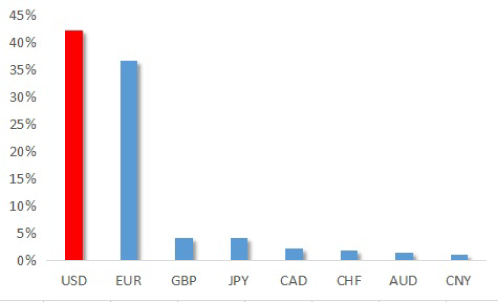 * International Payment Currencies: Share as an international payments currency Customer initiated and institutional payments. Excluding payments within Eurozone. Messages exchanged on SWIFT. Based on value.
Source: SWIFT, Sept 2018
Since there is a correlation between rate hikes and the strength of the U.S. dollar, the expectation was that as the Fed begins tightening, the dollar would strengthen. Yet, between mid-2015 and today, the share of U.S. dollar as an international payment currency has moderately fallen, along with Chinese yuan, whereas British pound has plunged by 5 percentage points. While Japanese yen has expanded more than a percentage point, euro has soared by a whopping 8 percentage points (see Figure 2).
Figure 2. Changing Shares of International Payments Currencies,
2015 – 2018
 * International Payment Currencies: Share as an international payments currency Customer initiated and institutional payments. Excluding payments within Eurozone. Messages exchanged on SWIFT. Based on value.
Source: SWIFT, Sept 2015 – Sept 2018
In the past half a decade, currencies of countries that support global cooperation through trade and investment have been strengthening (euro, yen). In contrast, the currencies of those countries that have turned inward have been stagnating in relative terms (U.S. dollar) or under-performing (pound).
Today, America’s sovereign debt is almost $22 trillion, and there is no credible, bipartisan, medium-term debt-cutting plan. Moreover, America’s role in the global economy has shrunk to about a fourth of the total and it has suffered from trade deficits since the early ‘70s. This dramatic decline has not been registered by vital international indicators, such as the Special Drawing Right (SDR) basket by the International Monetary Fund (IMF). The share of the U.S. dollar in the IMF basket remains 42% of the world economy, as it was in 1981, even though the Dollar Index has plunged by 40% and the relative share of the U.S. in the global economy has halved. Meanwhile, China’s GDP (PPP) already exceeded those of the U.S. and the EU in 2016.
Today, America’s sovereign debt is almost $22 trillion, and there is no credible, bipartisan, medium-term debt-cutting plan. Moreover, America’s role in the global economy has shrunk to about a fourth of the total and it has suffered from trade deficits since the early ‘70s.
Furthermore, while SWIFT data indicates that Chinese yuan is stagnating, it may no longer reflect rapidly-changing realities.
Eclipse of Petrodollar, Rise of Petroyuan
After the 1945 Yalta Conference, which effectively divided Europe, the ailing President, Franklin D. Roosevelt, met Saudi Arabia’s King Ibn Saud. Bypassing the Brits, FDR and Saud agreed to a secret deal, which required Washington to provide Saudi Arabia military security in exchange for secure access to supplies of oil. Despite periodic pressures, the pact survived until the 1971 “Nixon Shock” and U.S. dollar was decoupled from gold.
To deter the marginalisation of U.S. dollar, Nixon negotiated another deal, which ensured that Saudi Arabia would denominate all future oil sales in dollars, in exchange for U.S. arms and protection. Led by Riyadh, other OPEC countries agreed to similar deals and global demand for U.S. petrodollars soared. Thereafter, the US-Saudi strategic partnership weathered another four decades of multiple regional wars. To seal the old alliance, President Trump signed a historical $110 billion arms deal with King Salman in 2017.
Nevertheless, the structural conditions that supported the alliance between Washington and Riyadh are softening, as evidenced by increasing bilateral PR nightmares from the 9/11 terrorist attack to the Khashoggi affair. By the same token, if those structural conditions melt, U.S. dollar will soften accordingly. Petrodollar is no longer the only alternative in the town.
In the past few years, the internationalisation of the Chinese yuan has accelerated significantly. In addition to its inclusion in the IMF international reserve assets basket, China has established a payment-versus-payment system for transactions involving Chinese yuan and Russian ruble. The China Foreign Exchange Trade System (CFETS) hopes to launch similar systems with other currencies based on China’s huge multi-decade, multi-trillion One Belt One Road (OBOR) initiatives. As the OBOR expands links between major economies in Asia, Africa, Europe and Latin America, member countries are candidates for RMB-denominated payments. However, the diffusion venues of Chinese renminbi differ significantly from those of U.S. dollar since the postwar era.
Recently, China has also become the largest global oil consumer. Last year, its oil imports exceeded those of the United States (see Figure 3). With major oil exporters like Russia, Venezuela, Iraq, Iran, and Saudi Arabia, China’s market means leverage, and many of these suppliers have either already agreed to price their sales to China in RMB, or are actively considering it. In turn, major commodity exporters, such as Indonesia, have joined in non-dollar trades.
Figure 3. U.S. & China Crude Oil Imports, 1980 – 2017
 Source: BP Statistical Review of World Energy 2017 (1,000 Barrels Per Day)
As an increasing share of China’s oil imports will be priced in renminbi, that will result in large yuan reserves in oil exporting countries, which will be spent on Chinese exports, or recycled into China’s financial markets. And as demand for yuan assets will increase, the role of U.S. dollar for trading purposes will lessen. In secular terms, the petroyuan will mean a paradigm shift in global asset allocations to China’s financial markets, as long as China will continue to remove or significantly reduce capital controls for yuan-priced oil trading. Between 2014 and 2017, global institutional investors already tripled their China holdings of onshore bonds.
In the 1944 Bretton Woods, the dramatic rise of the U.S. dollar was a top-down, multilateral event. In contrast, Chinese yuan is a bottom-up process that mainly relies on transacting parties’ arrangements, which may be bilateral, multilateral, or transnational. That’s why the SWIFT data about international currency payments may today be less valid than only a decade ago. It lacks data on non-SWIFT venues.
After the Cold War, Washington has also increasingly used SWIFT mechanisms to penalise countries that it perceives as “threats,” such as the U.S. unilateral withdrawal from the multilateral Iran nuclear deal (JCPOA). The backlash includes Russian Central Bank’s alternative to U.S.-dominated SWIFT (System for Transfer of Financial Messages), which Moscow started after the 2014 post-Crimea sanctions following threats that it could be cut off from SWIFT. The latter is based in Belgium, but is effectively controlled by the U.S. Treasury.
More recently, Russia and China have reduced reliance on the dollar by increasing the amount of bilateral trade conducted in rubles and yuan. Similarly, the U.S. withdrawal from the Iran deal prompted Germany’s foreign minster to call for the EU to free itself from dependence on the U.S. and adopt its own international payments channel. Brussels has developed a parallel system to SWIFT that will allow Iran to interface with EU-centered financial, clearing and banking systems. After months of pressure by Washington’s EU allies, the Trump administration signaled acceptance of Iran remaining in SWIFT. That, however, prompted neoconservative lawmakers and hawks to pressure Trump and to complain that Iran sanctions are “too soft.”
U.S. Dollar as a “Fear Index”
Ironically, strengthening secular forces are driving rising U.S. dollar risks. In 2016, the Bank for International Settlements (BIS) released an intriguing report, which argued that U.S. dollar has replaced the volatility index as the “new fear index”. The mantle of the barometer of risk appetite and leverage used to belong to the VIX (i.e., Chicago Board Options Exchange volatility index). Before the 2008–2009 financial crisis, there was a close correlation between leverage and the index. When the VIX was low, the appetite for borrowing went up, and vice versa. As a result, the VIX soared to its record 80.9 at the eve of the global financial crisis. With the EU sovereign debt crisis and the US debt limit crisis up, it still peaked at 47. While there have been minor crises thereafter, most have remained significantly lower.
After a decade of ultra-low interest rates and negative levels, and multiple rounds of quantitative easing that remain in effect in Europe and Japan, one would expect the VIX to be elevated. And yet, it is currently less than 20. Monetary easing by the world’s leading central banks in advanced economies has suppressed volatility for stocks, while compressing credit spreads. In the process, the VIX’s predictive power has diminished, while U.S. dollar has become the indicator of risk appetite and leverage. This dynamic has distressing implications as it has pushed international borrowers and investors toward the dollar, with dollar appreciation exposing borrowers and lenders to valuation changes. In this view, recent dollar rallies may not precipitate market confidence, but new risks. Market skeptics have highlighted dollar illiquidity issues for years. If they are right, then the Fed rate hikes will boost the price of the U.S. dollar as a kind of a global Fed funds rate, with the rising dollar tightening economic conditions worldwide.
According to October data, the Trump White House’s offensive international policies have led several countries – not just China but Japan – to reduce their Treasury holdings, even dump their Treasuries (as Russia did last spring when it divested some 90% of its holdings), while many countries have sought to expand their gold holdings, perhaps preparing for a return for a gold standard of some sort. As a result, the reserve status of the U.S. dollar has plunged to a half-a-decade low.
In the past, the Fed’s rate hikes and the collateral international damage was legitimised by the argument that the emerging markets adjustment reflects the strength of U.S. economy and U.S. dollar as safe haven. It was not a bad explanation in the postwar era. But the secular trend erosion of the U.S. dollar is unsustainable and morphing into a global risk. The U.S. debt burden is already at the level where that of Italy was prior to the EU debt crisis. The difference is that Italian lira does not dominate two-fifth of SWIFT data and international currency reserves.
Three Future Scenarios
In the 21st century, the world economy needs a multipolar mix of major reserve currencies by both major advanced and large emerging economies. This change is looming in the horizon, but the question of how and when it will materialise can be illustrated by three generic scenarios.
• Phased Transition. The change may occur through the Phased Transition scenario over time, which would be least costly and most cooperative. In economic view, it would be the preferable trajectory. However, it would require international consensus that is largely missing.
• Disruptive Crisis. Conversely, it may materialise through the Disruptive Crisis scenario, which shuns international consensus, but which would prove most costly and highly frictional. In this case, Washington would increasingly resort to its military superiority and exploit geopolitics to force preferred economic ends.
• Bumbling Through. Or it may happen through a Bumbling Through scenario, which would combine both offensive and accommodative trial-and-error efforts with the best and worst of the first two scenarios. At times, it would seem ideal; at other times, adverse; at all times, inherently erratic and uncertain.
In the long term, a gradual, phased transition toward greater diversification in international payments and reserve currencies is vital to the U.S. dollar, which will otherwise be unable to avoid a severe structural correction.
Until recently, Bumbling Through seemed to be the primary trajectory, but as secular stagnation has spread in the U.S., Europe and Japan causing increasing growth deceleration in the large emerging economies, Washington’s new insular policies suggest that Disruptive Crisis could morph into the primary trajectory.
Last spring, Standard & Poor’s published a report on currency manipulation that gave China the lowest manipulation score in Asia-Pacific. In October U.S. Treasury released its bi-annual currency report, which did not label China for manipulation but did include it in its “Watch list”. Reportedly, President Trump publicly and privately had tried to pressure the Treasury to declare China a currency manipulator. While the staff finding averted a severe escalation of the US-China trade war, the latter was precisely what the Trump White House sought. The latter seeks to deter any major currency that could threaten U.S. dollar’s exorbitant privilege – by any means necessary.
In the long term, a gradual, phased transition toward greater diversification in international payments and reserve currencies is vital to the U.S. dollar, which will otherwise be unable to avoid a severe structural correction.
Moreover, persistent efforts to foster dollar supremacy risk not only recovery in advanced economies, but the future of many emerging and developing countries. Since the 2000s, China and Chinese yuan have been central to poor- and middle-income countries whose growth has become strongly associated with China’s growth. Thus, any effort to push China into the kind of precipitous, deflationary currency appreciation as Japan in the early 1990s would drastically undermine the future of emerging and developing countries. And since the latter fuel global growth prospects, such efforts would also derail global growth for years to come.
The presumed strength of the U.S. dollar no longer relies on America’s economic fundamentals, but on a perception that such fundamentals will prevail, despite drastic shifts in the world economy. That’s the contemporary version about the old fairy tale of the Emperor’s new clothes.
U.S. dollar is no longer a sustained safe haven, just a temporary safe house. That’s why the day of reckoning is no longer a matter of principle, just a matter of time.
About the Author
 Dr Dan Steinbock is an internationally recognised expert of the multipolar world focussing on international business, international relations, investment and risk among the major advanced economies and large emerging economies. In addition to his global consultancy, Difference Group Ltd, he has served in India China and America Institute (U.S.), Shanghai Institutes for International Studies (China) and the EU Center (Singapore) while cooperating with leading universities and think-tanks in the U.S. and all world regions.



 Peter Koenig is an economist and geopolitical analyst. He is also a water resources and environmental specialist. He worked for over 30 years with the World Bank and the World Health Organization around the world in the fields of environment and water. He lectures at universities in the US, Europe and South America. He writes regularly for Global Research; ICH; RT; Sputnik; PressTV; The 21st Century; TeleSUR; The Vineyard of The Saker Blog, the New Eastern Outlook (NEO); and other internet sites. He is the author of Implosion – An Economic Thriller about War, Environmental Destruction and Corporate Greed – fiction based on facts and on 30 years of World Bank experience around the globe. He is also a co-author of The World Order and Revolution! – Essays from the Resistance.

















































Brazil – Bolsonaro Towards a Military Dictatorship – Worse than 80 Years Ago
By Peter Koenig
One week before the second round of voting in Brazil, Jair Bolsonaro, the extreme right-wing candidate from the Social Liberal Party (PSL), against Fernando Haddad from the Worker’s Party (PT), Lula’s Party, for Brazil’s Presidential run-off elections – Bolsonaro leads to polls by double digits, about 58 against 42. And the gap is growing, despite the fact that as recent as end of September 2018, Brazilian women campaigned massively against Bolsonaro with the hashtag #EleNao (Not Him). His misogynist record left him with only 27% of women supporters only a couple of weeks ago. Massive cheat-and lie-propaganda increased that ratio by now to 42%. – Does anybody seriously believe that Bolsonaro has changed his racist character and his women-degrading attitude? – It is mind-boggling how people fall for propaganda lies and manipulations.
The usual propaganda of deceit from the right has infiltrated every election in the last 5-10 years, starting with the sophisticated internet and propaganda fraud invented by Oxford Analytica (OA), which is largely believed having brought Trump to the White House, Macri to the Casa Rosada in Buenos Aires, Macron to the Elysée in Paris and Mme. Merkel for the fourth time to the German Federal Chanceller’s office in Berlin – among others. OA is also said having helped the BREXIT supporters. In the meantime, OA’s dirty election manipulation methods have been mainstreamed to the mainstream media – with lots and lots of corporate and banking money.
In fact, the frontrunner Bolsonaro is currently being accused by his opponent Fernando Haddad, of a ‘fraud and fake news’ campaign, and that just a few days before the run-off. The charge is that Bolsonaro is running a multi-million-dollar defamation campaign against Haddad, via whatsapp and other social media. This means sending out literally millions of tailor-made messages to potential groups of voters. That’s the way of the of OA’s algorithms.
According to RT, Haddad told a media conference in Rio, “We have identified a campaign of slander and defamation via WhatsApp and, given the mass of messages, we know that there was dirty money behind it, because it wasn’t registered with the Supreme Electoral Tribunal.” This, after the Folha de S.Paulo newspaper uncovered a suspected election fraud. The publication alleges that a group of entrepreneurs are backing a multi-million-dollar slander campaign that would use several popular social media apps to reach out to Haddad supporters and smear his name with ‘fake news’.
We can only hope that the discovery of this slander and fraud may not be too late to stop Bolsonaro’s end run – and to inform voters. Leading to an indictment of Bolsonaro is hardly a realistic chance, as he is supported by the current corrupt and fascist-type Temer Government and all the high judges who have impeded Lula’s legitimate request for running for Presidency. Only voters’ consciousness may make a difference.
Imagine what happens, if Bolsonaro is elected? – It is hardly fathomable. Bolsonaro has already declared that if elected he will render full power to the military. “When I’m elected, those who will command are the (military) captains”. His word – in Portuguese.
He is a fascist no doubt. There were other fascist military governments in Brazil, like Getúlio Vargas, who reigned from 1930-1945 as a military dictator mostly by decree. He abrogated the 1891 Constitution and introduced a new one in 1934 which was overturned, when finally, in 1945 Vargas was deposed and a new democratization process began with a new Constitution being introduced in 1946. But that was not all for fascism and military dictatorship in Brazil. There was more to come in the decades preceding Lula.
Another brutal military government came to power in 1964 by a coup d’état by the Armed Forces. It ruled Brazil from 1 April 1964 to 15 March 1985 by President Joao Goulart. It came to an end when José Sarney took office on 15 March 1985. What’s important to know is that both the Vargas coup of 1930, as well as the 1964 military coup were supported by the US Embassy in Brazil and the State Department in Washington. Mr. Bolsonaro has already today – after the first election round – the full support of Washington. He was immediately congratulated by the Trump government after the October 7 election result were known.
If no miracle happens within the coming week, Brazil may be slanted to go back some 90 years, into a fierce military dictatorship. Worse, today with the neoliberal doctrine being the overarching last word on economic policies, also for the military. We are looking at full privatization of everything, of social services, water and health privatization has already begun; basic and profitable infrastructure, natural resources – and the IMF, World Bank, FED-Wall Street indebtment is already well under way and its future programmed, including a devastating austerity program which under unelected Mr. Corrupt Temer has already started.
In fact, economic disaster in terms of dependence on IMF, WB and the FED, may also loom under Haddad, who has already said he would work with the financial fiefdom of Washington. As Luiz Inacio Lula did, when he was elected in 2002. He was the “golden example boy” for the IMF, following strictly the rules he was taught would bring progress to his country. Later he realized what was actually going on within the financial sector of Brazil. He corrected some of the aberrations, but many stayed in place throughout Dilma Rousseff’s Presidency.
Brazil could become South America’s Greece – just multiplied by a factor of 100.
Just imagine the political and economic impact this would have on the Latin American region. Brazil is by far the largest economy of Latin America with a GDP of about 2.1 trillion US-dollars in 2017, a population of 210 million and a landmass 8.516 million km2 – and with the world’s largest known fresh water reserves. Trade without Brazil is unthinkable for Latin America and the world. Plus, a Bolsonaro regime would have full ideological and military support from Washington. In fact – Brazil may soon become the second South American NATO country after Colombia.
How would Venezuela feel, surrounded by two fierce militarized NATO countries? – Washington could just smile and watch, while Colombia and Brazil – and their NATO command – would do the rest. Or would they? – Venezuela is on the best way to detach herself from the dollar hegemony and ally with the East. And that not only in trade, but also in huge investments from China and Russia. Invading Venezuela would not be easy, despite NATO from the east and from the west and with the empire just across the Caribbean.
Back to Bolsonaro. It will not be as easy to thrash this fascist military doctrine, of a President, hitherto hardly known to the outside world, down the average Brazilians’ throats. Their vote and mind may be manipulated, but once they wake up – the election may be past, and the Temer policies implemented by factors of ten – social suffering will increase, à la Greece – people may simply not take it.It was clear that politically Brazil would and could no longer adhere to the principles that was behind the BRICS association, namely economic independence from the debt masters IMF, World Bank and FED.
They will realize that this entire propaganda farce serves only a few Brazilian oligarchs, but mostly the transnational corporations and banks. – Will they take to the streets? Demand another government, fight for their rights? Brazilians are not (yet) the kind to double up and shut up, as the Greeks had to do, weakened by a Government of treason, by an absence of medical and other social services and by a low-low moral that is reflected in an exponentially rising suicide rate, according to the British Lancet. Brazilians may have learned a lesson.
Brazil and the BRICS. Already under Temer, Brazil’s role in the BRICS was merely anecdotal. It was clear that politically Brazil would and could no longer adhere to the principles that was behind the BRICS association, namely economic independence from the debt masters IMF, World Bank and FED. – What with Bolsonaro? – It would behoove the BRICS expulsing Brazil; sending Brazilians a warning now, before the run-off elections, that no fascist government could be admitted within the ranks of the BRICS. Fascism is the absolute antidote to the new alliances of SCO, BRICS, EEU, and newly the Caspian Sea Alliance (Azerbaijan, Iran, Kazakhstan, Russia and Turkmenistan).
But – and this is highly important – let’s not let it get out of hand. Let not Bolsonaro being elected this coming Sunday. Make the right choice now. Regardless what you are being manipulated to believe. Stand up Brazilians, Women and men – say #NAO Bolsonaro!
Featured Image: Jair Bolsonaro shown after casting his vote during general elections in Rio de Janeiro, Brazil, Oct. 28, 2018. He won the presidential election by about 10 points. (Buda Mendes/Getty Images)
About the Author
Peter Koenig is a Research Associate of the Centre for Research on Globalization.