We all knew this day was coming, and now it’s finally arrived, it feels a little like an anti-climax. Donald J. Trump has become just the third American President in history to be impeached, and the story already seems stale. We’ve sat through hour after hour of news coverage and testimony to get here, and yet we all knew that his impeachment was inevitable. That was all down to a simple matter of mathematics in the House of Representatives. The same simple matter of mathematics may also explain why it feels like an anti-climax – we all know how this is going to end.
In order for Trump to be convicted in a trial held in the Senate – a trial that will possibly happen as early as next February – two-thirds of all the members of the Senate have to vote in favor of removing him. That simply isn’t going to happen. The vote to impeach him was split down party lines, with two Democrats refusing to go along with the motion. If Nancy Pelosi, Adam Schiff, and the other major players can’t persuade everyone in their own party to back them, what hope do they have of persuading Republican senators to vote their way when it really matters? The answer, as everybody surely already knows, is none.
Pelosi and Schiff knew they were gambling when they moved to impeach the President, but there are times when it makes sense to gamble, and there are times when it makes none. If the odds are in your favor, gamble. Even if the odds are unforeseeable, as they would be in an online slots game, it might still make sense to gamble if you believe you have a chance. Anyone who’s ever bet money on an online slots website like Dove Casino has stood a chance of coming away with a win. The odds of coming away with a win in online slots might be slim, but they’re better than the odds of the Democrats seeing Trump removed from power via this route. Short of a miracle occurring, Trump will be cleared of the charges against him when the time comes. What happens next will then be all-important, and it might be the biggest self-own in American political history.
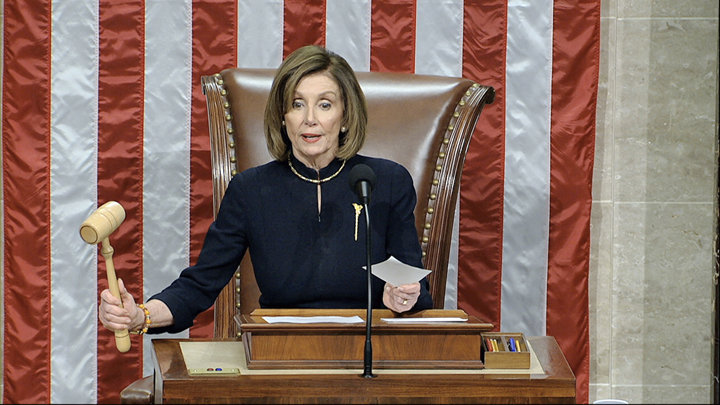
House Speaker Nancy Pelosi of Calif., announces the passage of the first article of impeachment, abuse of power, against President Donald Trump by the House of Representatives at the Capitol in Washington, Wednesday, Dec. 18, 2019. (House Television via AP)
We’ll never know if Trump stood a chance of being re-elected if the Democrats had simply left him to do his job, and got on with theirs. They’ve never, for a single second, accepted the result of the last election. They were hoping the Mueller report might bring him down, and they’ve jumped on the Ukraine scandal with every inch of their might. 2020 is an election year, and the Democrats should be focused on that, but it feels like they’re still contesting the 2016 election. For every move they make against Trump, they give him the chance to portray himself as being persecuted and victimized, and that stance plays well with his base. Every time the Democrats try to tighten the net with a move like this, they make it more and more certain that Trump’s supporters will vote him back in. What they risk doing at the same time is alienating people who may otherwise have voted for them.
Voters don’t like being told that they’ve got something wrong, and the hard fact of the matter is that Trump won the 2016 election. The smart thing for the Democrats to do would have been to lick their wounds, regroup, and focus on 2020. Instead, they’ve invested almost all the time since then trying to overturn that election result. In other words, their actions are showing the voters that they believe that the voters got it wrong. If Trump is impeached and removed, the 2016 election result is effectively null and void. That won’t play well with floating voters.
If you’d like to see evidence of that fact in action, look what just happened in the United Kingdom. Opposition parties have spent the past three years trying to protest or overturn the result of the 2016 referendum on membership of the European Union. When the country went to the polls, they heavily voted in favor of Boris Johnson, the Conservative Party, and their pledge to ‘Get Brexit done.’ People who wouldn’t usually vote for the Conservatives did so because they felt that the referendum result hadn’t been respected, and they wanted to teach the opposition parties a lesson. If the Democrats aren’t paying attention to this, they run the risk of the same thing happening to them.
With no realistic prospect of Trump being removed from office as a result of this impeachment, the Democrats may even have increased his chances of being re-elected. When the Senate clears him of all charges, he’ll be able to declare that he’s been vindicated and that the Democratic Party has wasted the nation’s time and money in pursuing a course of action that was never going to go anywhere. Trump will be portrayed as a great leader who has overcome injustice and adversity. The Democrats will be portrayed as desperate, grasping, and most importantly of all, failing and lacking in judgment. It’s not a good look to start an election year with, and it’s a position that’s likely to be almost impossible to recover from.
Whether or not Trump has actually done the things he’s accused of isn’t for us to say. We’ll have a chance to assess the evidence just as everybody else will when the matter proceeds to trial. We strongly suspect, though, that no matter what comes up at the witness box or in the paperwork, the Democrats will call it a smoking gun, and the Republican will call it immaterial. Everything is now so partisan that facts and evidence no longer seem to matter at all. These are dangerous political times, and care and nuance have never been more important when making big moves Unfortunately for the Democrats – and for reasons we may never fully understand due to the obvious futility of their impeachment efforts – the most significant move they’ve made in the past twelve months has been to shoot themselves in the foot before they’ve even started running.
Some banks are so established that, as customers, we think of them as part of the fabric of our lives; as immovable institutions. Maybe that was once the case. But the rise of a new, modern business environment is undermining that position. Apple pay and Facebook’s Libra are good examples of the market fracturing as big technology companies make strategic encroaches into finance. Similarly, digital-first challenger fintechs are driving consumer expectations to new heights. There is no room for complacency as incumbent businesses across the board are faced with the neo-reality that they must digitise or lose market share.
In some cases, banks are responding and innovating themselves, recognising that the landscape is shifting and they must shift with it. Others, though, have fallen for their own image, and remain convinced that they are in fact immovable institutions. They rely on shaky assumptions that the regulators will prove a block to the neobanks encroaching too far, and that inertia will keep customers sitting tight with their current providers.
Banks are responding and innovating themselves, recognising that the landscape is shifting and they must shift with it.
In other words, these banks see bars – bars keeping the neobanks out, and bars keeping customers in – a prison paradigm. They may find themselves in for a surprise when trends such as open banking and digital-first customer expectations will see customers move more willingly and freely than in the past. They may find that they are stuck with an outdated business model and mindset that no longer serves the market and sees them haemorrhage customers. They may, in fact, find that those bars were a more effective trap for the bank than the customer.
So – why is the prison paradigm so flawed – and what can banks do about it?
Reading the Regulators
Banking is a highly regulated sector. Incumbent banks employ vast teams and invest in various technologies to keep compliance in check. So, we can understand why they might not believe that neobanks – with young, lean teams learning as they go – will clear all the regulatory hurdles.
And in a sense, they’ve been right so far. Most of the neobanks that have made headlines have revolutionised payments but not developed the ability to take deposits and arbitrage those funds, nor to offer a broad suite of financial products – hallmarks of a true bank. There is much more compliance work to come. Slip-ups such as Monzo’s pin number storage fiasco also undermine the idea that neobanks are grown-up enough to really rival the incumbents.
But, will it stay that way? In many countries, regulators see their role as encouraging innovation in the banking sector, rather than acting as a block on it. The UK FCA’s regulatory sandbox is a good example. Don’t expect regulators to give challengers a free pass by any means, but don’t assume they’ll act to supress the new competition either.
Banks which don’t adapt will find their own resistance to change more powerful than their customers’. For traditional banks, creating a digital platform which is driven by consumer preferences must be the priority in this neo-reality.
Customers Untethered
Inertia can be a powerful thing – but it’s important to realise it cuts both ways. Yes, a certain number of customers may be quite sticky: perhaps they’re older and mistrust new techie brands, perhaps they just have other priorities. This can be an advantage for incumbent banks as they go through their own digital transformation.
However, it shouldn’t be taken for granted. Over time, digital-first banks will only become more sophisticated and switching will only get easier. That sticky segment will be whittled away. Banks which don’t adapt will find their own resistance to change more powerful than their customers’. For traditional banks, creating a digital platform which is driven by consumer preferences must be the priority in this neo-reality.
The Cost of Inertia
What happens if these banks fail to adapt and innovate? Look at what is already happening. There are a growing number of people who use a traditional bank as their primary account to receive their salary, but then immediately transfer an amount to a neobank for their monthly spending, giving them the benefits of instant alerts and rich features. For now, that is still profitable for the incumbent, but they are losing grip on the customer’s relationship with their money.
Some neobanks, like Starling, are already starting to build an ecosystem of financial partners, offering services like loans and pensions. They have realised that the future will be a digital hub, which provides the customer with the primary relationship with their finances, connecting them to other service providers.
For banks, the choice is whether to try and capture that position as the digital hub themselves, or else be relegated to a second-tier service provider. Even worse, it is feasible that banks are pushed into a utility role, providing the pipework for other companies who capture the higher value businesses.
Escaping the Prison Paradigm: More Than Tech
What is a bank to do? In short, it must become digital-first.
Many interpret that as an investment in technology, which is important but only one part of the process. Think of all the banks that have built an app and stopped there. That is an investment in technology, but no one mistakes them for neobanks.
Investing in technology means making everything digital-first, and untethering it from cumbersome legacy systems. It’s not feasible to rip everything apart and start again, so think about how to build the new without entangling it with the old. Moving the business model towards an API ecosystem internally is one way to do this. Not only does this help move towards the digital hub future, it allows different development teams to work in parallel on different projects without hindering one another or the day-to-day operations of the bank.
Just as important as technology though, is a digital-first culture. Culture permeates the organisation and affects all decisions. If leaders are of the view that: “the bank is making money and has an app, so why rock the boat?” then innovation will be stifled. The app will persist, but stuck in a treacle-slow traditional development cycle, falling farther and farther behind the neobanks’ rapid development.
A bank led according to a digital-first culture however, will operate at a speed that resembles the start-ups. Approaches such as Lean, Agile and DevOps will be implemented. ‘Innovation’ and ‘digital’ won’t be siloed teams working in offshoot offices, but embedded throughout the bank.
For banks, becoming digital-first in their technology, culture and business model is easier said than done, and it requires major overhaul of teams, leadership and processes – but the time to do it is now.
Incumbent banks have trust, credibility, healthy balance sheets and customer relationships – for now. Neobanks will eat away at each of those advantages if banks let them, not to mention the influx of competition from the likes of Apple Pay and Google Wallet. Incumbent banks still have the edge today – just about – but those that don’t escape the prison paradigm will suffer for it.
As the founder and CEO of Backbase, Jouk Pleiter has always stood on the forefront of digital innovation – growing Backbase into a globally recognised Digital-First Banking provider, improving the digital customer interactions of more than 120 financial institutions around the globe, including ABN AMRO, Barclays, RBC, Metro Bank, Discovery, Chebanca!, Keybank, Citizens, and many more.
As the founder and CEO of Backbase, Jouk Pleiter has always stood on the forefront of digital innovation – growing Backbase into a globally recognised Digital-First Banking provider, improving the digital customer interactions of more than 120 financial institutions around the globe, including ABN AMRO, Barclays, RBC, Metro Bank, Discovery, Chebanca!, Keybank, Citizens, and many more.
Have you ever thought about what will happen to you and your family if you can no longer work due to bad health or any other issue? A good present doesn’t necessarily guarantee a good future. You can work hard today, but how long can you do it. Even if everything goes great, we will inevitably get old. No matter how good you are doing today, you will have trouble maintaining your lifestyle in the future if you don’t plan it today. Here are a few things you need to do today to ensure a secure future for yourself and your family.
Identify What Needs Planning
Most people worry about three issues they might face in the future.
Bad health
Low quality of life
Financial security
Though all three are somewhat dependent on financial integrity, you have to plan all three from the days of your prime. Think if there are any other issues you might have to face in the future and start planning how they can be tackled.
Consider All Types of Insurances
There is insurance for everything, and its sole purpose is to provide help in difficult times. You can get life insurance to secure the future of your family in case of your departure. Some insurances bear your medical expenses and even pay if you are unable to work. Take time to thoroughly study all types of coverages and consider subscribing for ones that best meet your requirements.
Plan After Retirement Income
Most people don’t understand this, but we have to work today for tomorrow. You won’t have this energy you have today when you’re old. That’s why many people start saving money that they can spend after retirement without having to work. If you have a 401(k), that’s great; but if you don’t, consider opening an Individual Retirement Account (IRA). Saving is, without a doubt, a great idea, but you can do even better by working smart. It is suggested to study a physical gold IRA, so you can also earn profits from your savings.
Maintain a Good Credit Score
Don’t spend more than you can afford. If you got yourself in debt, it will have a bad impact on your credit score. Today you can compromise on many little things like a small house, cheap car, old furniture etc. When you’re old, however, most of those little things become a necessity. If you have a bad credit score, you can say goodbye to any loan or investment you might need in the future. That’s not all, insurance companies charge you higher premiums if you have a bad credit history. Don’t spoil it for little things that aren’t a necessity.
Find Your Passion
What would you want to do when you’re old? You may not have the energy to do the job you’re doing now. On the other hand, many people don’t want to sit at home waiting for death even if they have a good source of income. That’s why you need to find your passion that can not only earn you a living but you also enjoy doing it. If it’s a new skill, start learning it. Make sure it is something you can do at an old age.
Generation VIP online casino is a fresh gaming platform founded in 2019. It has come up with new advancements and creativity in the gambling sector to fulfill the required needs to play better. Generation VIP is registered with the strongest license provider Malta Gaming Authority and get their games revised for better performance by iTech Labs.
Generation VIP is prospering well due to its capability of serving the players with a good selection of games, VIP rewarding schemes, promising returns of their investments and much more to suit players’ taste of gaming. Not only this the casino offers an extensive range of payment methods and accepts multiple currency exchange option that makes the experience so convenient, flexible and enjoyable.
The gaming library is wrapping up all departments of playing and is offering more than 450 video slots games like Divine Fortune, Cosmic Fortune, and Redeem the Dream and many more tabletop games such as the popular one roulette, blackjack, and baccarat. Most Reputed gaming providers are powering the system as mentioned in the list below:
NetEnt
Pragmatic Play
GameArt Studios
Red Tiger
Playson
Scientific Games (SG)
Booongo Games
Nolimit City
Just for the Win (JFTW)
Synot Games
iSoftBet
Booming Games
Triple Edge Studios
The Generation VIP online casino is supporting the most innovative and modern live dealer games backed by Evolution Gaming and never let the player lose interest while gaming. The options that you get in the live dealer games are:
Roulette (Immersive, Lightning)
Blackjack
Baccarat (Baccarat Squeeze)
Dream Catcher
The VIP programs are the biggest attraction for any player slots in the field of gambling. Generation VIP casino has got a lot to offer to its players as they progress their way up to variant levels. The gamers start receiving offers and rewards soon after their sign-ups. There are seven levels initiating from Beginner, Bronze, Silver VIP, Gold, Platinum VIP, and the last two Premium and Prestige levels are activated through invite-only option. Every progressing level has its own rewards that keep the player consistent and encourage like improved perks, better exchange rates for your points, free spins, express cashouts, monthly cashback and more.
The most demanding feature by any player is to have the mobile casino because it provides the flexibility to enter the gaming session any time anywhere as per their availability. VIP Generation lets you play just by signing in through any device and you have the pleasure of playing anywhere anytime just by a click of a button, no hassle of downloading any app.
The payment method at Generation VIP is most diverse since they offer a varied range of deposit and withdrawal options. Not only this the casino lets you choose from multiple currencies like NZD, EUR, GBP, NOK, SEK, USD, and CAD.
The customer care representatives are available around the clock to serve best to their customers via email, live chat, and phone. The operators are reachable between 06:00 to 23:00 GMT.
The Goods and Services Tax system has marked a sea change in the way Indirect taxation is handled in the country. The pre-GST regime can be characterized by a bureaucratic and complex system that required a lot of effort on behalf of businesses to navigate successfully.
The pre-GST tax structure included many taxes and cesses like Octroi, VAT, and local taxes including entry taxes at the city level. The taxes were also in the offline format and controlled by multiple Government departments which made keeping track of changes difficult.
This changed with the introduction of the GST. The effect of GST on Indian Economy has been massive as it has been an all-encompassing change. GST is administered by the GST Council, which is a unified body that has the authority to control the GST system.
Almost all taxable persons are required to register for the GST system with some exceptions. One of the major gripes people had with the previous tax system was the burden which it placed on small businesses. This was kept in mind when the GST was introduced and there were exceptions for small businesses.
Besides small business, there are some exceptions for certain sectors in the economy due to the sectors being sensitive and important to the economy. There are many reasons why a business can be exempt from the GST. Some of the reasons are listed below:
1. Exemption Based On Aggregate Turnover
As mentioned earlier, the GST system was designed with ease of business in mind. In that respect, the GST has many exceptions for small businesses. Businesses that have an aggregated turnover of less than INR 40 lakhs are exempt from registering for the GST. Businesses that are based in the hilly regions like Uttarakhand, Arunachal Pradesh, Manipur, Mizoram, Himachal Pradesh, etc, the total aggregate turnover for GST exemption is lower at INR 20 lakhs. For businesses that are selling services, the aggregate turnover for being exempt for GST registration is INR 20 lakhs for non-hilly states and INR 10 lakhs for hilly regions. With respect to aggregated turnover, it includes the value of all taxable supplies as well as exempt goods and goods and services which were exported. Certain things are excluded from the calculation of aggregate turnover as well. The value of inward supplies of goods and services as well as the value of non-taxable supplies of goods and services.
2. Exemption On A Products Basis
The Government, when introducing the GST system had to keep in mind the social implications of such a tax. The implication of GST on Indian economy had to be analyzed carefully to make sure there were no adverse effects in the country, particularly to the poorer sections of society.
Keeping this in mind, the Government kept some goods and services outside the purview of the Goods and Services Tax altogether. Fresh produce like Potatoes, Onions, Lettuce, Cabbage, Tomatoes, etc was intentionally kept GST free so that food inflation did not get out of hand. Unprocessed foods, in general, have been kept outside the purview of the tax. Other products that are GST exempt are Fish, Meat, Eggs, Fruits and Dry fruits, etc. Certain supplies have also been kept outside GST for now, services which a charitable organization supplies, certain government services, labor services for the construction of the residential property, etc. the GST is a dynamic tax system and that needs to be kept in mind. The GST Council changes the tax rates and slabs from time to time in response to financial and economic news, so it is imperative to keep an eye on the GST circulars issued whenever there are any changes.
3. Sectoral Exemption
As mentioned earlier, certain sectors have been intentionally left outside the purview of the GST system due to them being sensitive sectors or they have a large impact on the economy. Sectors like the Petroleum sector which includes petroleum crude, high speed diesel, petrol or motor spirit, aviation turbine fuel and natural gas are very important for the economy and therefore does not attract any GST at all, it has its own set of taxation rules.
Another sector which is exempt from GST is Alcohol for human consumption. The individual states are charged with creating taxation policies for alcoholic beverages. The electricity similarly does not attract GST and has its own set of rules and regulations.
Conclusion:
GST in Indian economy is a very important topic and had created quite a lot of controversy when it was first introduced. Although there were some hiccups when the GST was introduced, over time, many of the issues were ironed out and the policies are still being fine-tuned every now and then in response to events in the economy.
We can see that the Government has tried to keep in mind the average person when the tax was designed. The sectors which have been kept outside the purview of the GST might be included in the GST Act in the future, so it is very important to keep up to date with the changes being made.
Penny Stock trading is often promoted as a smart way for small traders to participate in the financial markets. Penny Stocks are stocks of small companies and they typically trade under $5 per share. Timothy Sykes is a well-known figure in the penny trading industry. He lives a glamorous lifestyle complete with an Instagram feed of exotic cars, global travel, posh mansions, and wads of cash. Interestingly, he also teaches people how to become successful penny stock traders and he supposedly has several millionaire students.
However, I asked some friends about him and the discussion was polarized on whether he is a successful penny stock trader or a charlatan making his money by selling a dream of financial prosperity.
After countless hours of research and not being any wiser, I decided that the best way to find out was to sign up and see for myself the quality of the penny stock trading education that he provides. This piece is a no-holds-barred, unbiased Timothy Sykes review detailing the good, bad, and ugly side gleaned from my first-hand experience of his training program.
Timothy Sykes Review: Who is this guy?
Timothy Sykes is reportedly a self-made multimillionaire who made his fortune trading penny stocks. According to his testimony, it all started when his parents gave him his $12,415 Bar Mitzvah gift money in what was supposed to be a learning experience for him. His parents figured that he will blow the money frivolously, but they were hoping that the experience will teach him about the finite nature of resources and the need to make intelligent financial decisions.
However, instead of spending the money on the latest fashion trends and gadgets, Tim first tried to trade the big stocks on Wall Street. And then he observed that his $12, 415 account was a tiny drop in Wall Street’s ocean. His portfolio was small and the results he was getting didn’t quite measure up to the energy and time he was expending.
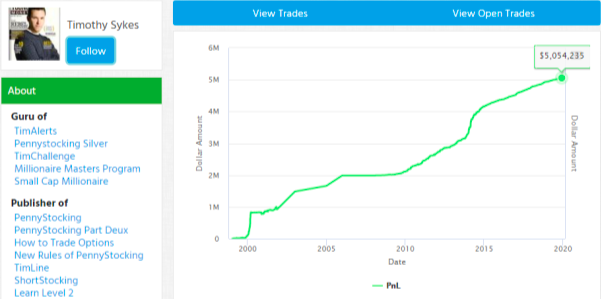
He then started trading penny stocks and he discovered that he had a much better performance by riding the momentum of trending stocks. So, he devoted time to finding the most effective and efficient ways to trade penny stocks and he ended up turning that $12,415 into $1.65 million by the time he was a freshman. As at today, his lifetime trading profit is more than $5 million as seen in his PnL chart below.
Being a natural extrovert, Tim was always talking about his success with penny stocks and it wasn’t long before friends and family members started requesting that he teach them how to make money trading penny stocks. He eventually standardized his training program to provide penny stock trading education to people all over the world.
Timothy Sykes Review: What is his trading strategy
Timothy Sykes’s trading strategy is surprising in its simplicity, but it requires a great deal of self-discipline in its execution. Tim tends to build his strategy around technical analysis, but he is not oblivious to how fundamentals such as news events could move stocks in response to human nature.
I dare to say that Tim isn’t usually interested in the underlying business of his target stocks. If you are approaching penny stocks with an investor mindset, Tim will disappoint you. However, Tim has expertise in identifying penny stocks that are already on the move, buying them just when the momentum kicks off, and then selling them just before the momentum drops. Hence, Tim typically holds his positions for a few hours, and he rarely holds a stock for more than two days.
While this sounds incredibly simple, many people tend to fall in love with their winning stocks and they hold on to winners until the market snatches back all the gains they’ve made. On a personal note, Tim’s brash tough love teaching style has made me better at managing the emotions of fear and greed. If that’s the only thing you gain from Tim, it’s more than enough to make you a better trader.
Also, Tim has mastered the art of shorting penny stocks even though many traders and brokers make it seem as if it is impossible to short penny stocks.
Timothy Sykes Review: Training Programs and Packages
When I came across Timothy Sykes’ online courses, my first response was sceptical as I recalled the old saying: “in a gold rush, it is better to sell picks and shovels”. I was wondering if his training programs weren’t a cleverly disguised way to sell picks and shovels to people looking for metaphorical gold in the stock market.
However, after digging deeper, I came to realize that Tim is passionate about trading education, he sincerely wants other people to achieve financial freedom, and he is going out of the way to make the knowledge accessible to all. Of course, many of his content is gated and you’ll need to pay to access them, but he has hundreds of videos on his YouTube channel available for free if you’d rather not pay.
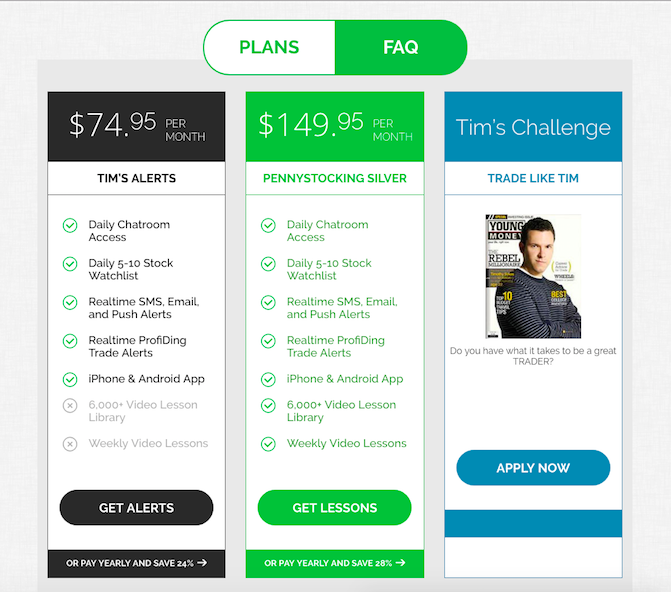
However, if you want a structured learning experience, Timothy Sykes offers three levels of trading education; namely, Tim’s Alerts, PennyStocking Silver, and Tim’s Challenge.
Tim’s Alert costs $74.95 per month but you can get a 24% discount if you sign up for the annual plan. You’ll have access to the chatroom, get up to 10 stocks on your watch list, and you’ll get real-time Email, SMS, and Push trade Alerts to enter or exit trades. From personal experience, the alerts are only useful if you got them and respond in the near-instant that they were sent. The market is constantly moving, and an hour-old alert may not be of much use to you if the trading price has moved up/down from the price suggested in the alert.
The Pennystocking Silver plan is much a better deal because it gives you access to a 6,000+ video library and weekly video lessons in addition to all the benefits available with Tim’s Alerts. PennyStocking Silver costs $149.95 per month but you can get a 28% discount with the annual plan.
The video lessons help you to understand the fundamental ideas behind each of Tim’s trades. Hence, even if you didn’t get the trade alerts immediately, you can still leverage the knowledge that you have gained to find better entry and exit points. Tim’s goal is to equip people with the knowledge to make independent trading decisions and he strongly discourages people from attempting to copy his trades blindly.
If you have more time to commit to trading and have a bit more money to spend on your trading education, you should consider applying to Tim’s Challenge. If you apply to Tim’s Challenge and scale through the interview process, you’ll be privy to a more immersive mentorship relationship with Tim.
You’ll have access to watch 16 premium DVDs such as PennyStocking, PennyStocking Part Deux, ShortStocking and Learn Level 2 among others. I sat down to do the maths and I discovered that the DVDs available in Tim’s Challenge have a total runtime of more than 180 hours. Apart from the DVDs, you’ll also get access to curated 60 Video Intro Course, chat and chat archives, webinars, and trade Commentary among others.
However, I must warn you that Tim’s Challenge is very demanding, I doubt that you can combine it will a full-time job because it requires you to put in serious time and efforts. However, if you can go through the program, you’ll potentially be on the path to joining the alumni list of Tim’s successful students.
Trading Tips for Beginners
Day trading tips for beginners can come in all shapes and sizes, which can cause a significant impact in one’s wealth. Each individual trader may want something very different—from free stock picks to stock tips for newbies. We’ve tried to collate a number of useful tips for those just starting out in the market, ranging from the top 10 ways to make money, to more advanced methods for building wealth through day trading, like the concept of leveraging and leverage trading, and the concept of momentum trading.
In the beginning, it can be difficult to find profitable strategies. A great starting point is simply to follow the news. Be it a news story regarding economic activity in the United States or European countries, or any other news, you’re bound to hear about stocks that are likely to rise or fall. This is a good place to start and a good place to get started.
A great strategy is simply to purchase a stock when there’s good news going on and sell when there’s bad news going on. However, this method can be risky and if you follow it religiously, you run the risk of losing everything. Therefore, a great place to start is to simply study up on the trends of the past, look at how the trends were affected by a number of variables, and try to discover how one particular trend was affected by a number of other factors.
Each trader is different, so it really depends on what you think is important to your own personal method of making a profit. In most cases, day trading for beginners’ tips include a number of different strategies. The most popular among these strategies is the use of leverage. Leverage is a means of borrowing stock from a company and selling it for a higher price. As the name suggests, it’s the ability to buy at a lower price than you can sell it for.
Of course, you do risk losing the whole sum if you sell the stock at a lower price than you bought it for, but it’s a great way to supplement your income through day trading with a little bit of extra cash every week.
Final Verdict: Is Timothy Sykes a scam or real?
The subject of whether Timothy Sykes is a scam or not is a regular fixture in penny stock trading circles. Based on my personal experience and the information available on Profitly, my verdict is that Tim is very much the real deal.
However, I dare to say that Timothy Sykes’ training is not meant for everybody. If you are looking for someone to tell you what stocks to buy/sell or if you want to be spoon-fed on when to buy/sell and at what prices, Tim Sykes won’t meet your needs. Also, I don’t think that Tim’s Alert plan is particularly worth the expense; Tim is rarely in the chatroom and you might be lost in the “noisy” chatroom if you don’t have some previous trading experience.
However, if you are ready to learn and willing to put in the hard work, Tim could set you on the path to taking responsibility for your trading journey and eventual success. Nonetheless, you should note that you aren’t likely to become an overnight millionaire by trading penny stocks. Some of Tim’s students have crossed the million-dollar mark but many more are stuck in the six-figure range. Success is attainable, but it won’t be handed to you on a platter of gold.
Luxembourg takes advantageofits small size by being light on its feet when it comes to attracting investment and innovation to the country. Luxinnovation CEO Sasha Baillie recounts how her agency’s multi-facetedcampaign plan spans industries, technologies and public and private sectors in pursuit of the government’s ambitious economic objectives.
Thank you so much for taking the time to meet with us today. To start with, can you please give us an insight into how top-level business leaders like yourself kick-start a day? What are your tips for optimising daily productivity?
The most important thing is to be well surrounded. The accumulation of requests and the need to respond favourably to them very often mean that you have to rely on your employees to be able to gather all the key information relating to each of the files under review.
Based on a good briefing and relevant guidelines, it is easy to be able to make the right decisions at the right time. It also requires, of course, great flexibility and agility to be able to cope with any last-minute changes, as well as a clear mindset to be able to deal with dossiers that sometimes contain a very different content.
You became the CEO of Luxinnovation in 2018. How has it been so far? What are some of the important highlights or milestones of the agency under your leadership until now?
First of all, I had to immerse myself completely in the structure, which was facilitated by the fact that I can count on a very dynamic organisation of some 70 people with different professional and cultural skills and experience, with whom it is very stimulating to work.
We are a small country and one of our great advantages is the real accessibility to decision-makers.
It was then necessary to articulate the government’s approach, its economic development priorities and the diversification of the sectors of our economy, with the notions of innovation for which Luxinnovation lends its full support.
It was therefore first imperative to clarify what Luxinnovation is and what the agency is tasked to do. This could only be achieved by constantly listening – and still listening today – to understand the expectations that the country’s various economic players have of Luxinnovation, whether they be companies, from the smallest to the largest multinational groups, or public players, particularly in the field of research.
We must constantly understand their needs in order to understand what they expect, knowing that there is really a great diversity in these expectations.
This has led to a reorganisation of our services, with a resolutely customer-centric approach, which allows us to be even more responsive and efficient.
Maison de l’Innovation Building
Luxembourg is strategically located at the heart of Europe and is referred to as “the gateway to the European market”. What are the unique advantages and business opportunities in the Grand Duchy? What industries are most likely to be attracted to what Luxembourg has to offer?
We are a small country and one of our great advantages is the real accessibility to decision-makers. Combined with great agility, this allows us to make things happen quickly and pragmatically. This is an approach that is highly appreciated by companies from abroad.
We are attentive to the needs of companies and we know how to adapt and find solutions that meet these needs. Moreover, interactions between the private and public sectors are notably direct and are always part of a joint desire for efficiency.
In particular, we have identified three priority sectors on which we focus our efforts: automotive, cleantech and ICT. However, more broadly, we are also very committed to the development of initiatives around Industry 4.0. We know that this requires significant investments to integrate new technologies, artificial intelligence, the use of massive real-time data, the sustainable use of resources and, in this context, the development of new materials. This is also one of our priorities, in order to improve productivity and competitiveness.
Luxinnovation is a key and trusted partner for those who areinterested in – and committed to – launching successful innovative activities in Luxembourg, from entrepreneurs, managers of start-up companies and researchers to foreign enterprises and investors.
Luxinnovation is a key and trusted partner for those who are interested in – and committed to – launching successful innovative activities in Luxembourg. Can you describe Luxembourg’s innovative start-up ecosystem today?
Historically, this ecosystem has developed under the impetus of the public sector, with the establishment of the first incubators (Technoport, Ecostart) and support initiatives (via Luxinnovation, the Chamber of Commerce or through state subsidies).
However, in recent years, the private sector has also positioned itself strongly, with many investments and initiatives that have enabled the development of a complete ecosystem dedicated to the creation and acceleration of innovative start-ups. This ecosystem is now emerging on an international scale and we can see this with the high attendance at our pavilions at events such as VivaTech or the Web Summit in Lisbon.
The strength of this Luxembourg start-up ecosystem is based on the ability of public and private players to work together in the interests of entrepreneurs. The greater the proximity, the more efficient this ecosystem will be, as the emerging “seeds” will be quickly identified and efforts pooled to make them the success stories of tomorrow.
Luxinnovation offers a range of performance programmes (like Fit 4 Start, Fit 4 Innovation, etc.) that aim to support SMEs in developing their innovation activities. Can you tell us more about these programmes and share with us some of the best feedback that you have received from the programme participants?
These performance programmes are one of the pillars of our business. We undertake, with eligible companies, a 360° analysis of their situation, to fully understand their business and guide them towards appropriate solutions to improve their performance and, by the same token, their competitiveness. It is also about strengthening their capacity to innovate, develop and ensure their sustainability while sustainably increasing their activity.
We undertake, with eligible companies, a 360° analysis of their situation, to fully understand their business and guide them towards appropriate solutions to improve their performance and, by the same token, their competitiveness.
As I said earlier, our approach is customer- centric and is applied through these different programmes, whether it is for digitalisation (Fit 4 Digital), innovation capacity (Fit 4 Innovation), business model improvement (Fit 4 Growth), implementation of circular economy principles (Fit 4 Circularity) or improved customer services (Fit 4 Service).
These programmes are both unique and complementary; with the help of consultants, a diagnosis is established within the company and an action plan is then put in place to improve performance, with precise KPIs that guarantee the success of the programme.
These programmes are co-financed by the Ministry of the Economy and the Ministry for Small and Medium Sized enterprises, which provides considerable government support for our companies.
Fit 4 Start is a little bit different; it is an acceleration programme for innovative start-ups. Twice a year, a 16-week coaching session is organised. For the edition that just started this autumn, more than 300 start-ups from all over the world applied and we selected 20 companies in the ICT, healthtech and space sectors.
The feedback we have is very positive, without going into detail.
“Thanks to Luxinnovation, research and development and innovation have evolved in an unparalleled way in Luxembourg and probably even in international comparison over the past three decades”, said Deputy Prime Minister and Minister of the Economy Étienne Schneider, in his opening speech to celebrate the 35th anniversary of Luxinnovation 14th November.
Long established as a world leader in the twin sectors of fund administration and private banking, Luxembourg is the eurozone’s leading financial centre and number 12 in the world. How does the agency help in fostering solutions to shape the future of financial services?
This more-specific component is provided by another national agency, Luxembourg for Finance (LFF), which is specifically dedicated to the development of the financial centre’s activities. It goes without saying that we work closely with LFF, as well as with the Luxembourg House of Financial Technology (LHoFT), housed in the House of Startups. We are in regular contact with entrepreneurs who have created solutions or applications for the financial sector and we obviously ensure the link with our various partners.
How will the rapidly developing financial technology start-ups in the country be likely to transform the current financial landscape of Luxembourg and globally?
The challenge for so-called “traditional” financial institutions is enormous. If they do not adapt and radically transform the way they operate by offering their customers the fluidity they can find in most of the other services they use today, they will very quickly be overtaken by other players.
However, since, at the same time, these banks have had to face a sharp increase in the costs associated with all the new regulations and legislation that have come into force, this has given the scope for fintech to develop and offer digital solutions for the entire financial sector. In particular, there is a special enthusiasm for regtechs, which work to facilitate the implementation of all these new regulations.
The creation of the LHoFT in 2016, which welcomes start-ups from all over the world and benefits from partnerships with prestigious international organisations, contributes to the dynamism of this ecosystem.
Green technology is one of the emerging industries nowadays. Can you share with us what are the inimitable advantages and features of Luxembourg’s green tech platforms? What are Luxinnovation’s initiatives to develop and encourage sustainability in Luxembourg’s business and financial sectors?
Promoting clean technologies and the transition to a circular economy is a priority in Luxembourg. The country is a strong advocate of sustainable development, in economic, ecological and social terms, with the implementation of policies to facilitate the adoption of clean technologies and products. We benefit here from an attractive economic environment for entrepreneurs who seek to create value while reducing pollution, waste and energy consumption.
Business opportunities are quite wide for companies in the cleantech sector in Luxembourg, knowing that facilitating the transition to a circular economy is a national priority.
Innovation and research in the fields of renewable energies, energy efficiency and smart cities, districts and buildings are among the areas in which we are involved, both with companies and with the University of Luxembourg or the Luxembourg Institute of Science and Technology (LIST). The government’s programme also includes the upcoming creation of a centre of excellence around green technologies and the promotion of an ecosystem conducive to spin-offs/start-ups.
There is already an incubator dedicated to ecotechnologies, which opened a year ago in the south of the country, and for which we are partners.
Business opportunities are quite wide for companies in the cleantech sector in Luxembourg, knowing that facilitating the transition to a circular economy is a national priority. The demand for innovative solutions is, for example, stimulated by cradle-to-cradle construction projects and by the continuous conversion of former brownfield sites into ecological districts. There is also a clear focus on developing smart mobility and supporting developments in areas such as clean transport, shared mobility and intelligent transport systems.
Luxembourg also plays a pioneering role in the use of finance to achieve sustainable objectives. The Luxembourg Green Exchange is the first global platform exclusively dedicated to sustainable securities, with nearly half of the world’s green bond volume and an estimated one-third of sustainable and social bonds. The Luxembourg Finance Labelling Agency (LuxFLAG), an independent and international Luxembourg financial labelling agency, awards a responsible investment label to investment vehicles.
In the latest edition of the Global Green Finance Index, Luxembourg ranks fourth (after Amsterdam, London and Zurich, out of 64 financial centres) and more specifically second only to Amsterdam in terms of green finance “penetration”.
It is also for all these reasons that our country has been chosen to host the Cleantech Forum Europe in 2020 (on 18-20 May 2020), an international event that will bring together for three days the best of the best in Europe in this sector.
Luxembourg’s forward-thinking regulators and partnership with other countries for the exploration of space resources make the country a hub for technological advancement. Recently, Luxembourg joined Russia in the field of space innovation, extending its expertise and a global network of partners in scientific cooperation and research. How do these developments help Luxembourg position itself as the global leader and the centre of space business?
It is not only with Russia that we have signed partnerships. This was the case with China and the United States. Wilbur Ross, the US Secretary of Commerce even came to Luxembourg in person to sign such an agreement.
In the coming years, Luxinnovation will have to inspire our companies to innovate, to grow in an intelligent way and to prepare themselves well for the challenges of the future, with new and partly also disruptive technologies.
It would be pretentious to position ourselves as a world leader and centre of the space industry, but we are clearly positioning ourselves as a major player in this “New Space” industry. We want to attract companies active in this field to Luxembourg and by this means create a hub of experts. We have already set up a chair and university training in this area. The “New Space” sector will undergo profound disruption in the coming years and Luxembourg is already playing a role in these changes.
The Director of the European Space Agency perceives Luxembourg as a pioneer in this field and this autumn we also just signed agreements with NASA and the ESA.
Fit 4 Start participants benefit from the support of specialised coaches as well as from the mentorship of the experienced entrepreneurs and venture capitalists that make up the selection jury.
What are the agency’s short-term and long-term plans for the country’s economic development and innovation capabilities? Where do you see the agency in the next five to ten years?
More than ever, we want to be recognised by companies and entrepreneurs as a trusted partner for them, enabling them to find pragmatic solutions for their innovative development projects.
We have formidable diverse and complementary skills. If we can communicate well with each other, if we can dialogue, if we can bring out these skills, we will make exceptional progress.
Luxembourg promotes networking, confidence-building and the implementation of joint projects. This is an advantage we have over other countries. In addition, Luxinnovation must be an essential link in this collaborative approach.
In the coming years, Luxinnovation will have to inspire our companies to innovate, to grow in an intelligent way and to prepare themselves well for the challenges of the future, with new and partly also disruptive technologies.
We would like to be the aggregator of all the players of economic development so that they all join forces to advance the country in a sustainable way.
Our ambition is to be a facilitator of synergies and to bring added value to the country’s economy, whether at the national level or by promoting the country internationally, by enhancing the strengths of our economy and by encouraging companies around the world to carry out projects with us here.
What are the key messages you would like to get across to industries and businesses that are wondering about the status quo of Luxembourg’s investment and business opportunities in today’s global environment of political and economic uncertainty and volatility?
First of all, I would like to tell them that, as far as stability is concerned, Luxembourg is positioned comparatively at the forefront, whether in political, social or fiscal terms. This is obviously a highly valued asset for foreign investors – not to mention that the country is also among the safest in the world.
As far as stability is concerned, Luxembourg is positioned comparatively at the forefront, whether in political, social or fiscal terms. This is obviously a highly valued asset for foreign investors – not to mention that the country is also among the safest in the world.
Many international benchmarks also show the country’s attractiveness in terms of the business climate: the country has the second highest level of productivity in the world behind Norway, according to a study by the Conference Board Productivity Brief and is also considered by U.S. News & World Report’s 2019 “Best Countries” study as the most open country for business, due to its favourable tax environment, the government’s transparent and business-friendly approach and the low level of corruption.
Throughout its history, Luxembourg has always held a strategic position as a crossroads of nations. Over the centuries, the country has encountered many influences and struggles of occupation and to survive, it has had to endure, observe and understand. We have maintained this habit and we are trying to foresee the challenges ahead and are working to adapt to them.
Luxembourg comes out on top in a recent study of cities in the world that offer employees the best working conditions. As the president of the agency, how do you keep yourself happy and motivated whilst looking after your employees’ well-being?
You have to listen to your employees, give them the opportunity to express themselves, to evolve, to contribute to the company’s results. I am convinced that a participatory approach is not only rewarding and stimulating for employees, but is also an essential vehicle for innovation and progress.
On a lighter note, we are interested to know what the top things or activities are that a high-calibre business leader like yourself does to recharge her batteries during a day off from work.
It is always very difficult to disconnect completely from work, but family time spent with my children is naturally a very valuable breath of fresh air. I really appreciate these special moments, whether at home or while travelling, in surroundings that help one revitalise, and also in the company of good friends.
To end this interview, would you share with us your views about the important business and technology trends to watch out for in the coming years?
I am convinced that the economy will be fundamentally transformed by access to data and opportunities to develop new business models. Countries that can ensure through the establishment of reliable and secure data-exchange platforms that public and private data can be shared and valued while ensuring that privacy and individual freedoms are maintained are those that will enjoy a favourable economic development in the future.
Thank you very much Ms Baillie. It’s a pleasure speaking with you. We learned a lot.
Luxinnovation offers a wide portfolio of services to companies and public research organisations in order to foster innovation, thus supporting the Government’s economic development objectives. The agency also ensures that Luxembourg continues to attract international investment, companies and skills that are a perfect fit for the country
Sasha Baillie is also a member of the Coordination Committee of the Ministry of the Economy, which she joined in 2014 as Deputy Chief of Staff and Diplomatic Advisor of the Deputy Prime Minister, following her 20-year career as a Luxembourg diplomat. Within the Ministry of the Economy, Sasha Baillie ran the initiative to reform Luxembourg’s economic promotion that led to the creation in June 2016 of the Luxembourg Trade and Investment Board. She also chaired the Luxembourg Nation Branding Committee until 2019 and steered the work that led to the creation in 2015 of LuxGovSat (a joint venture between the Luxembourg Government and SES) where she serves as Chair of the Board.
Eighteen years have passed since China joined the World Trade Organization, a period largely defined by overseas firms trying and failing to crack its complex market. The Chinese dairy industry in particular, despite its vast size and rapid growth (c.12% a year), has remained untouched from foreign influence with internal competition exceptionally stiff.
However recent years have seen signs of breakthrough, a push led by a global dairy producing and distributing group with roots in the Baltic States. Food Union entered the Chinese market in 2015 showcasing a serious long-term commitment by building modern plants from scratch on Chinese soil. The brand’s core elements of health and wellbeing were inspired from the Chinese government’s recent focus on the health benefits of dairy and its promotion amongst parents and, crucially, their children.
Having identified a gap in the market for infant food, Food Union pursued a striking means of marketing their line of children’s dairy product, ‘Lakto’. Utilising their Baltic roots, a partnership emerged with leading Russian animation house Riki Group to form the Hong Kong based joint venture Fun Union. Branded animation characters, such as those from the ‘edutainment’ show Babyriki, immediately captured the imagination of Chinese children. The marketing tool’s instant impact should come as no surprise. Babyriki has gained more than two billion views since it was launched on mainland Chinese digital platforms in 2017 and themed toys in available in over 500 stores throughout the nation.
Crucial for Food Union’s acceleration and growth beyond the borders of the Baltics has been the international investment group Meridian Capital Limited. Askar Alshinbayev, founding principal of Meridian Capital, explains that “Working in partnership with leading Russian animation house Riki Group has enabled us to seize the marketing initiative in China – one of the largest, fastest-growing and fiercely competitive consumer markets in the world. Our innovative animation characters have ensured that Food Union’s healthy dairy brands for children have become an integral part of families’ daily lives and help drive the company’s impressive growth”.
Global superpowers Russia and China have a long and convoluted past. The latest chapter appears to be one of harmony, linked in part by the most unlikely of industries. Supported by Fun Union, the first Russian-Chinese co-production in animation was agreed during Chinese President Xi Jinping’s state visit to Moscow in 2017. Food Union’s impact in China has successfully outgrown the dairy industry, proving perhaps that to stand out in a highly competitive field, an innovative, counter-intuitive marketing technique is the way forward.
Nearly every start-up business entrepreneur requires financing at some stage of their business growth. They look outside their company for loans or fundings because growth requires capital that can only be raised through outside sources in order to fulfill financing operations.
In order to run any organization, the need for cash is paramount. Maintaining proper cash-flow and profit margins is essential for any business but even in these instances, businesses may seek outside funding. Suitable fundings such as a merchant cash advance loans help fill up these gaps of cash-flow and keep the business rolling.
Merchant Cash Advance Loan
A merchant cash advance is offered as advance finance for future sales for the establishment of any company or business. This financing procedure is typically available for merchants that require a steady amount of credit card sales that includes their retail store needs, medical offices, rent, inventory charges, etc.
The amount that merchants and business owners get through this type of cash advance loan ranges from a couple of thousand dollars to two thousand dollars and sometimes more. It is important to keep in mind that the repayment period of the merchant loan is usually short for about one and a half years and the loan also charges interest.
The lender takes up a percentage of sales and profit from the merchant on a regular basis. The repayments are supposed to be done through the connected merchant account that is based on the profit and sales of the company along with being processed through debit or credit card. The system of cash and cheque is not counted as a repayment procedure in this regard.
If you are an entrepreneur and you need money now for the growth and establishment of your business, then there are so many small business lending options for you. We understand the confusion as to which option is the best for your company or which one you should choose. Various lenders and funders provide the required capital to merchants as funding options for them.
In this article, we will share why merchants require cash advances along with defining types of categories between merchants. Also, we will mention various requirements for financing a business primarily. Let’s see whether obtaining a merchant cash advance loan is a good choice for you or not.
As we have talked about the merchant loan, it’s time to know what is a merchant and what are their requirements.
Merchants And Their Requirements:
Merchants are considered to be business owners that own a company or organization which requires the assets of trade and commerce. Moreover, the commodities include sales, revenue, cash flow, and profit not only for commercial uses but also for industrial ones.
Merchants have existed since the pre-modern age where businesses used to run on other terms. However, in a legal aspect, merchants are held to a higher degree as they are called to be the experts of the products they provide and resell. These merchants usually are of two categories.
Retailers
Wholesalers
Categories Defined:
Retailer Merchants are the ones that sale good to consumers along with providing their merchandise directly to the consumers. They use the method of retail forefront or business platforms. Other methods include getting in contact with business websites, e-commerce stores, seller networks, etc. For that reason, start-up companies focus on selling those products in smaller quantities rather than in bulk.
Wholesaler Merchants are the ones that run a small business or wholesale also known as the middleman linking manufacturers. They are the ones that buy products or merchandise from manufacturers in bulk and then resale them. They also focus on reselling the products in smaller quantities than in larges ones.
Requirements of Merchants For Financing
The start-up companies and businesses are required to have sufficient capital because they need to operate the necessary functions of the company. In addition to that, they also need to make sure that the company is able to take care of all the opportunities that may come in their way for the business’s better growth and better establishment.
Furthermore, arisen opportunities make visible differences in profit. To obtain that mark in business, merchants require the following conditions to be fulfilled in one way or another. These include:
Requirements And Methods:
Inventory: This is important to make sure that the merchant has all the required goods and products in their warehouse for their sales. Enough inventory for strategic sale plans will be a good way to start off the business and pay off the debt.
Expansion: Every business owner dreams of expanding their company to a big extent. For this purpose, merchants require fundings and facilities.
Assets: To make sure that there is a particular and acquired space for business to store its assets is a must. Taking care of all the assets, goods and products is another key that helps in the development of business.
Business Property: Other than a merchant cash advance loan, a business owner can obtain a commercial loan. These loans are for the purchase and refinance of the property of business such as an office, building, etc.
Business Loan: This loan is specifically intended for the requirements of a business. Just like any other loan, a business loan is a debt that comes with an interest rate. This is considered to be an affordable one in order to fulfill the requirements of a business.
Working Capital: Every business requires to have working capital on a regular basis along with a bookkeeper to manage tasks. Merchants need a sufficient amount of cash to handle daily operations.
Debt Consolidation: This is a process that merchants use to combine all their unsecured debts into one single monthly payment. They use this loan to pay off their debts and then pay the consolidation loan in a single payment after profit.
Payroll Strategy: Having a payroll strategy for your employees is very important. The strategy includes paying the employees on time, increasing their pay annually. Moreover, it includes whether they want to get paid weekly, bi-weekly or monthly. However, this also depends on the company’s policy and terms.
Nobody wants to feel like just a number — rather than an individual — when receiving healthcare services. The last thing patients should sense when seeking treatment is they’re moving down an assembly line, accumulating bits and pieces of disjointed care as they go.
The healthcare industry as a whole is working to address these challenges and improve the continuity of care for patients, while also aiming to optimize the cost of that care. It’s no easy feat, but these efforts could go a long way toward prioritizing care quality over quantity.
Here’s more on the emergence of value-based healthcare and its benefits.
What Is Value-Based Healthcare?
Under a value-based healthcare model, providers receive compensation based on patient outcomes rather than patient volumes. According to the New England Journal of Medicine Catalyst, providers are rewarded for the following:
Helping patients improve their health
Reducing the occurrence and consequences of chronic illness
Living healthier lives in a measurable way
The value-based care model measures success — and therefore payment — based on patient outcomes rather than the number of services provided. This is an improvement over volume-based healthcare of yesteryear in which providers got paid per service they provided, regardless of patient outcomes over time.
Value-Based Healthcare in Action
The Hospital Readmissions Reduction Program (HRRP), established in 2012, is one example of value-based healthcare in action. Under this purchasing program, hospitals with excessive readmissions for certain conditions receive lower payments from Medicare. As the Centers for Medicare & Medicaid Services writes, it incentivizes hospitals to “improve communication and care coordination so patients and caregivers are more involved in post-discharge planning.”
When hospitals face penalties in the form of reduced funding if their readmission rates are too high, they have major motivation to evaluate the treatment they’re providing to patients. It’s no longer just about billing a patient for a certain procedure or medication; it’s about providing care and information that’ll help the patient thrive after they leave the hospital.
Programs like the HRRP incentivize healthcare providers to closely gauge readmission rates as a key performance indicator, critically evaluate risk factors and implement best practices to minimize the chance a patient will make an unplanned visit within a given time period after discharge. To do this successfully, healthcare providers need ready access to advanced healthcare data analytics tools to gauge performance and make data-driven decisions.
As Deloitte notes, physicians and administrators can only manage what they can measure. Healthcare professionals need access to insights they can use to make care decisions that improve patient outcomes while also optimizing for cost. Organizations serious about succeeding under the value-based care model need to put accessible data analytics into the hands of administrators and clinicians making these decisions.
Benefits of Value-Based Healthcare
This care model has the potential to benefit everyone involved.
Patients can benefit from better continuity of care and a proactive approach that aims to minimize illness and injury rather than react to it after the fact. Opening lines of communication between healthcare providers and patients as part of value-based care also helps cut down on confusion — ultimately boosting patient satisfaction and encouraging them to engage.
Value-based care also aims to keep larger populations healthy rather than focusing on individual patients and appointments.
Since value-based healthcare ties in compensation with outcomes, it also incentivizes providers to operate more efficiently — helping to lower costs for patients, providers and taxpayers alike.
The “fee-per-service” model of healthcare falls woefully short because it prioritizes cost and volume over quality of care. The solution? Value-based healthcare.
By Terence Tse
CFOs are evolving into AI-driven transformation orchestrators, balancing finance, technology, and strategy while upskilling teams, managing risks, and driving measurable business value.
A key insight from this year’s AI for CFOs event, organized...
The World Financial Review uses cookies to improve site functionality, provide you with a better browsing experience, and to enable our partners to advertise to you. Detailed information on the use of cookies on this Site, and how you can decline them, is provided in our Privacy Policy and Terms and Conditions. By clicking on the accept button and using this Site, you consent to our Privacy Policy and Terms and Conditions. ACCEPT
Privacy & Cookies Policy
Privacy Overview
This website uses cookies to improve your experience while you navigate through the website. Out of these cookies, the cookies that are categorized as necessary are stored on your browser as they are essential for the working of basic functionalities of the website. We also use third-party cookies that help us analyze and understand how you use this website. These cookies will be stored in your browser only with your consent. You also have the option to opt-out of these cookies. But opting out of some of these cookies may have an effect on your browsing experience.
Necessary cookies are absolutely essential for the website to function properly. This category only includes cookies that ensures basic functionalities and security features of the website. These cookies do not store any personal information.
Any cookies that may not be particularly necessary for the website to function and is used specifically to collect user personal data via analytics, ads, other embedded contents are termed as non-necessary cookies. It is mandatory to procure user consent prior to running these cookies on your website.