More and more people are now becoming financially literate, which means that they are constantly looking for avenues to grow their money and eventually gain financial freedom. One of the investment avenues that they usually consider is the real estate industry wherein some opt to buy land properties because these don’t depreciate in value. Others prefer to invest in rental properties because these are often self-liquidating, making them a viable source of income. If you are interested in the latter,
Here are some of the things you need to reflect on to know whether you should be getting your own rental property:
Financial Sources
The first thing you need to think about in line with getting your own rental property is your financial sources. If you have ample funds to purchase a property in cash, then owning a rental property is a good decision for you. This is because the rent that tenants pay you afterwards, less the maintenance expenses, are all considered as your revenue from the property. Nevertheless, you also have the option of getting a mortgage and you can be profitable once the value of your property increases. This is because the initial payments you get from the rent that your tenants pay may largely be allocated to mortgage payments, as well as maintenance expenses.
Management Skills
You automatically become a landlord when you get your own rental property, and to be a successful landlord, great management skills are necessary. Just keep in mind that being a landlord is not for the faint of heart, even if you deem that you have the capability to manage the property yourself. Nevertheless, you always have the option of enlisting the services or property managers. According to a BricksandAgent maintenance manager, it is actually more beneficial to hire a maintenance manager for your property because they are the ones who will be able to handle time consuming tasks seamlessly. In addition to this, a professional maintenance manager will be able to ensure that the concerns of your tenants are addressed promptly.
Social Skills
If you like dealing with people, then you have a great chance of becoming a successful landlord. You can use your social skills to your advantage, particularly in the screening of tenants. Nevertheless, even if you deem that you have carefully screened the people that will stay in your property, you may still find it a challenge to deal with people of different personalities and values. This is where exceptional social skills is again necessary to ensure that your landlord and tenant relationship is not strained.
Owning a rental property poses several benefits, but it cannot be denied that there are a few drawbacks too. Nevertheless, the advantages outweigh the downsides significantly, which can prompt you to get your own rental property. In terms of investing your money, you can never go wrong with getting your own rental property, but just keep in mind that in doing so, you should also be prepared for the responsibilities that go along with its management.
Many people spend most of their time in their offices at work. That is why being in a comfortable work environment is particularly essential in getting morale higher and keeping all employers energetic. The design of an office can have a huge impact on the productivity of the employers and the overall vibe they get from the place. If your office is looking and feeling dull, then it might be time for you to consider giving it a lift and changing up the overall design with a professional yet vibrant design makeover. If your office is only just taking its first steps into existence, then you should consider some design ideas to give your office a great professional look. And if you are considering to go with a virtual office instead, that has many benefits as well.
Present Your Mission And Credentials
The key design element in making an office look as professional as it could is by making it obvious what this office is used for. This can be done by simply hanging the Mission of the Office on the first wall people see when they walk in. You can invest in a large banner displaying the company’s name and mission, and play around with the font design and color so that it matches the space. You can also purchase a few professional-looking frames and hang your credentials and what makes you unique, and shows yours and your workers’ experience and professionalism by hanging diplomas and certificates and maybe even installing a shelf or two for awards. This will allow visitors to the office instantly see how professional the place is and the workers in it.
Invest In Practical Furniture
NPS Townsville Office Furniture reminds us that one of the main things that can change the way the office looks completely is how it is furnished. Investing in quality furniture that is also practical can make the place look way more professional and help the employers, as well as visitors to the office, feel more comfortable. According to Modern Digs, pieces of furniture like sideboards could be perfect in the professional workspace as it offers elegant designs as well as practicality. Sideboards come in different shapes and sizes and you can choose the design which looks most professional for your office and fitting for its needs. Different pieces of furniture can also be placed around the office according to where they would be needed by choosing designs that offer elegance and comfort to the workers and the visitors.
Add Vibrant Colours
Professional office space doesn’t always have to be boring. Adding catchy vibrant colors can still be professional as well as lively and it can completely transform the design of the office. Bold colors can look both professional and catchy if matched with the right designs in furniture and lighting. You can hire a professional to paint the walls and even customize some drawings on the walls for your office that are personalized with the theme of the place and make it look professional and fun at the same time.
Renovate Your Restrooms
When it comes to office design many will ignore one of the most important spaces, the restrooms. It’s very important that your restrooms always look new and clean as they will be used on a daily basis by your employees and potential business partners. There should be enough light, but avoid using bright neon lights, and instead use led lights with CRI 80 and above. This way the colors will appear as they are in natural sunlight. As it’s an office, definitely install partitions so that a couple of people can use the restroom at the same time. To make sure your restroom is designed perfectly consult with experts from https://onepointpartitions.com/.
Create Different Spaces
In order for an office to look and feel professional, there needs to be a variety of spaces in it that cater to different needs and purposes. You can get creative with the designs and try to create different spaces in the same office for different purposes. Try to have a space for visitors with a reception area or room where they can direct their queries and wait for them to be answered in a waiting area. You should also try to have space for employers to hang around during breaks or to have informal meetings like a lunch break room equipped with kitchen equipment.
Install Good Lighting
Some people may not be aware of this but lighting plays a huge part in impacting the design of an office and making it look professional. The light itself can help make the office more vibrant and energetic if bright lights are installed in certain areas where employers work and softer lights can be installed in areas where visitors sit so that they feel more comfortable and relaxed. You can also play around with the shapes of the light bulbs themselves to add a creative design element that would fit with each of the spaces in the office.
Designing a professional workspace takes some work but it is a great chance to get creative and personalize the office with some of yours and your employers’ ideas. You can try and take inspiration from different office designs by doing some research to choose the right colors and lighting for your space. Remember to invest in quality products that would last longer and give the office a professional outlook as well as practicality.
Isn’t it convenient that most of the errands today can be run and achieved online? Even applying for a loan can already be instantly achieved through the internet. If you need quick cash in advance, you can check these top companies you can rely on for online title loans. They have joined the internet hub and they are ready to assist you in your needs.
To have fast advance cash can be achieved by loaning your valuables’ title in exchange for a loan, with only some requirements and terms. You get to pay this on a staggered monthly basis plus the interest, which is different for every company. In looking for companies to transact online, you have to take into consideration the best ones out there. To help you, here is a list of the best companies for online title loans:
Max Cash
This company is reputed as the best in the title loan industry. They have fast processing that promises same-day results, they operate 24 hours a day, and they have the best customer service based on customer satisfaction and an online app that is accessible too. You can find their stores in numerous states across the country. What makes them the best aside from their remarkable reputation is that their services are free.
Because of their large range of scope, they work with a number of lenders you can choose from. They can help you get the best deal which includes the lowest interest rate and loan terms which work in your favor. All you need to do is secure the documents for your fully-paid car which should be relatively new and you can get the title loan you need as soon as possible.
Loan Center
Upon checking their website, you may find this company claiming to be a trusted lender for quick cash. True enough, you will be instantly greeted by a form that asks the details to assess the worth of your car and you could get this for free. Other lenders do this plus they make sure that your credit score, financial background and status, debts and your employment records are checked before getting into further business. Once all of these check out and you get approved, only then will you be loaned the money you need.
Car title loans are a bit simpler and easier to understand. It does not have a long process of assessment and you would only need to submit documents pertaining to your car. Once the value is assessed, you could get the money which is the equivalent of your car’s worth. This is faster and easier for you because it doesn’t look into your other statuses and assets. You can still use your car while you are paying your monthly due.
123FundMe
This online lender is claiming to give the lowest interest out there. This could be what you are searching for. The same with most companies, they are offering car title loans without a credit check.
They also have an easy process to get your cash right away. If you are confused with how to apply for an online title loan, you can easily check their website because they have 4 steps that could get you that advance fast.
The first thing you need, as with everything, is to apply by calling their office or filling in the form found on their website. After that, you just have to wait to get approved. It doesn’t take that long. Once approved, you have to submit the requirements and stamp your signature then you are done. Your cash is available at your disposal.
Finova Financial
Just because it’s a newbie does not mean it’s not as competitive and reliable. Finova Financial is making waves in the industry despite being new to the game because of its offer of lower rates as well. They offer a one year payback time which is plenty of time considering they also process fast and require no penalty for prepayment. Because it is relatively new compared to other companies, they only provide loans in a few states. If your state has them, you better take advantage of their services.
You can now apply even for title loans using just your gadgets. Additionally, it is a convenient way to shop around and look for the best offers. With a lot of options to try, you don’t have to delay. You can address your problems by making title loans instantly. You do not need to leave the house in order to look for the money that you need.
Exploring the Online Title Loan Process
If you’ve ever applied for a loan from a bank or other consumer lending agency, you’ve likely made an appointment to meet with the lender at their office. You bring the requested paperwork, and if they approve your loan, you leave with a check in-hand.
The online title loan process generally, looks like this:
Borrower submits loan application online.
Borrower sends requested documents, such as photo I.D. and proof of income.
Lender evaluates the borrower’s financial situation, including credit history and employment.
Lender approves the title loan.
Borrower receives loan money.
While each lender uses their own process and loan criteria, all online title loan lenders require the borrower to provide the vehicle’s original, clean title. It’s your collateral!
Even if you still owe on your vehicle, don’t let that discourage you. You may still qualify for a title loan. While it’s difficult to get a new title loan while you have another title loan which is not paid off, it’s still possible. In such cases,first, you would have to meet the basic requirements of the lending company which may include your current credit score, your ability to pay back your previous creditor, and your income.
How Long Do Online Title Loans Take?
Earlier, we mentioned the advantage of the process of online title loans. Another attractive benefit of this type of loan is the speed at which you can get approved and receive your funds.
Since everything takes place online, you usually won’t need a special appointment. You can fax, email, and often, even text your documents—another timesaver.
How does same-day cash sound? In most cases, you can access your cash within hours of applying! Fast access to your money is one of the most significant reasons online title loans are so popular.
Despite places like Las Vegas in the United States and Macau in China being hailed as the gambling hubs of the world, neither jurisdictions have had a strong or even an existent iGaming scene.
In fact, in the home of roulette, it is Europe which has enabled this modern form of gambling to establish itself and thrive across the continent. With governing nations like the UK and Malta keeping everything in check, people have been able to gamble safely, have trust in the online offering, and help the iGaming industry to grow.
With its roots embedded in Europe, iGaming has started to branch out, with countries adapting what are now archaic internet rules to apply to the modern online space. With the United States getting on board piece by piece as well as other nations exploring the industry, the global online gambling market is projected to grow by 8.77 percent in CAGR through to 2024, according to Mordor Intelligence.
While the US is gradually coming around to iGaming, other countries and continents around the world are moving forward at a much more progressive rate.
New Zealand’s established market
New Zealand’s iGaming market continues to go from strength-to-strength, with more and more residents going online via their laptops and phones to play mobile games. According to SkyCity Online Casino, the one platform has hundreds of games from several top-class developers, including Red Tiger Gaming, Play’n Go, NetEnt, and Yggdrasil.
It speaks volumes to the quality available to players in New Zealand despite there still being discussions as to whether or not the country needs to self-regulate iGaming. The industry is already thriving, but if an official regulatory body was to be established, the vast number of players already enjoying the new-age entertainment medium would count towards the global market numbers, increasing them further.
Peru wants to be the Malta of LatAm
Peru has been looking to establish itself as a leading jurisdiction of the iGaming industry in Latin America. For a couple of years now, the nation’s government has been tinkering with a bill that would, by all accounts, make Peru the Malta of Latin America. This will, if all goes to plan, see Peru taking only a 12 percent tax on winnings, which is a very appealing rate to iGaming brands.
The tax rate will undoubtedly act as the gateway to immediately entice big-name brands to set-up shop in Peru. So, once the regulated space launches, players will immediately be able to enjoy some of the best games and platforms that the global industry has to offer. In turn, iGaming’s popularity will grow in the nation.
Rapid mobile adoption puts Africa in the market
Regardless of how gambling-savvy a population is, iGaming can’t grow an audience or even offer its services if the people don’t have means of accessing the content. For a long time, the cost of computers and high broadband rates have held back most countries in Africa, but now, cheap mobile phones have opened the gates to the world of online gaming.
Smartphone ownership across Africa is sharply on the rise, with Android phones that cost less than US$50 granting access to the internet, and therefore also to iGaming platforms. A study by GSMA expects Africa’s internet user-base to increase by 300 million within just five years. With more people online, the continent will undoubtedly grow its iGaming audience.
The gradual growth of iGaming may be catching the headlines, but the markets in Peru, New Zealand, and the developments in Africa could also have a significant impact on the global industry.
A large number of people who live in Finland enjoy gambling. Statistics have shown that most Finns have either gambled by playing games of chance such as the lottery or gambled playing cash games. The gambling industry in Finland is more of an oligopoly than a monopoly. There are only three main companies. Each of these companies has a monopoly in their specific area. These include RAY, Fintoto, and Veikkaus. RAY is the ruling body for slot machines, Fintoto runs the country’s horse racing sector, and Veikkaus runs the lottery.
Although there are three main regulators, there are still a number of different platforms on which Finnish people can enjoy gambling. One of the most popular is Nopeampi. Nopeampi is an online casino that offers sports, baccarat, live dealer games, lottery, betting and much more. This site is the perfect choice for newbies and established gamblers alike.
Finland is Home to Some Bizarre Sports
Finland is home to some of the weirdest sports you’ve ever heard of. Anything from phone throwing to swamp soccer can be participated in. One of the weirdest of these has to be the wife carrying championships. The aim of this race is to carry your wife along an obstacle course in the quickest time possible. The winner will be given beer that is equivalent to his wife’s weight.
It seems that Finnish people enjoy betting as much as they enjoy throwing their phones. A recent study showed that they were in 4th place for the amount of gambling losses per person. These stats show that Finland loses approximately £2.5 billion per year. The biggest losers on this list are Australia, who lose a whopping £20 billion.
Finnish baseball (Pesapollo) is one of the favourite sports in Finland. The Pesapollo world cup is played every three years in Finland. Online poker is another favourite gambling choice with revenues increasing year on year.
The Facts and Figures
On average, each year, Finns spend:
£350 on domestic gambling
£160 on games operated by RAY
£180 on games operated by Veikkaus
£11 on games operated by Fintoto
In 2012, £130 million was recorded as the profit of the gaming operators in Finland. The gambling industry in Finland has continued to grow at a rate of approximately 10% ever since 2016. The exact amount of money spent on gambling in Finland is unknown as some of the population choose to gamble on foreign websites – this information cannot be collected.
Gambling Laws in the EU
The gambling industry has become a huge part of the leisure industry in almost all EU countries. Not only does it play its role in boosting the economy, but it’s also a huge pastime for thousands of people around the world. The EU has tried for a number of years to put into place some legislation and regulations that would standardise gambling and betting in Europe. However, so far, they have not been successful with this. Most countries in the EU want to be able to control their own laws around gambling.
Licensees and the Official Licensing Body in Finland
The official licensing body in Finland is the Ministry of Interior. There are only three licensees existing before January 2017:
RAY
Fintoto
Veikkaus
Gambling Laws in Finland
Owned by the government, the gambling industry was separated into three parts. Each of these parts was looked after by a different company. On 1 January 2017, these three entities joined together to become a larger state monopoly called Veikkaus. This betting agency looks after online and land-based casinos in Finland.
There are two main land-based casinos in Finland. They are both located in Helsinki. Another casino is also under construction in Tampere.
Gambling websites that are recognised by the Finnish government are run by RAY and PAF, with the former looking after the Finnish mainland and the latter controlling gambling in the Aland Province. The government works with these companies to help make sure players’ data is protected.
In Finland, you must be over the age of 18 to gamble and you must have registered before you start. You must also have a bank account that is open in Finland, a Finnish security number and a permanent home address. All gamblers in Finland are also expected to set an amount that they are happy to lose. The maximum this amount can be is £460 for both table games and slot games.
Good to Know
The biggest ever win in the history of online casinos was paid out by a gambling site in Finland. The winner was a resident of Helsinki who was new to the world of online gambling. After playing online for just 30 minutes, he managed to win over £16.5 million!
Gambling is growing in popularity every year. We expect to see the gambling industry in Finland grow by approximately 10% over the next year. There is no way of telling how much money is actually spent on gambling in Finland every year, but we do know that it’s a lot.
While the Corona Virus effect is forcing many countries’ economies to dive globally, Iraq is not safe as well. The oil prices fell to $26 per barrel, which is the worst and lowest since 2003. The sharp fall is a result of a hit to global oil demand from the pandemic and price war involving major oil players, Russia and Saudi Arabia. The new development is not good news to Iraq, as the country heavily relies on oil revenues, which surpasses 90%.
According to the International Energy Agency head Mr. Fatih Birol, the economic pressure is expected to get worse in the coming weeks. The discouraging news is coming when the company owned by Barzani (Korek) top officials is accused of misappropriating funds and awaiting the outcome of the claim filed by France’s Orange and logistics firm Agility from Kuwait.
Prices of energy and gas going low may favor the consumer as the spending rate sounds friendly, but no clear whether they will go out to spend that money soon as a result of minimal movements.
Economic Impact
For this crisis to end, it will depend on the efforts put to control the outbreak effectively. The negative economic effects of the Corona pandemic, although weighty, will be temporary. The worst thing to happen is the closure of small businesses such as shops, restaurants, salons and others for lack of customer flow. If people do not go to the city, it means these businesses will either make no money or very little, which may severely affect them for the long-term experience.
While other countries are putting measures to boost the most affected businesses, the Iraq economy is already struggling. The oil prices experiencing a huge cut mean the country’s net income would drop 65% when compared to the previous year, incurring a monthly deficit of $4 billion just to cover the salaries alone and keep the government function running. The country is in crisis and not sure whether it is easy to break beyond $2.5 billion per month, according to Birol, when speaking to Iraqi officials during a moment to seek urgent solutions.
The Iraq government had hoped the oil price to hit $30 per barrel, but according to the current sharp dive, the situation is bullish. The country is moving from one problem to another, as the government was in a few weeks was dealing with ways to calm the constant protests. As a way to alleviate the situation, the government had to increase salaries from $36 billion to $47 billion after absorbing half a million new employees. So, the government is spending 75% of the money to take care of salaries, capital investments and other costs.
Normally, the Iraq government employs about 4 million people, pensions going to 3 million while social welfare is given to 1 million.
Government Plan
According to Iraq’s central bank governor Mr. Allaq, the country will be able to deal with salaries and external debt while focusing on how to trim services that economically inefficient and subsidies.
Also, the other option the government has is to recapture trillions of dinars stashed for years of surplus funds in state-owned bank accounts. They plan to issue bonds to the public and reschedule any internal debt. There is also ongoing consultation with the International Monetary Fund (IMF) though things may not be positive as no passed budget yet plus any formation of a new government.
After Corona is gone and oil prices stabilize, it will take time for Iraq to get back to normalcy.
Did someone mention to you that it is beneficial to get health insurance? You are thinking to yourself; I need anything but health insurance. You are not alone! The majority of millennials think the same way. It is the time of your life when you are too busy paying off the student loan, running a house, getting a car, etc. and health is your last priority. But, let us change your preferences a little because your health is the most important thing for you.
If you are healthy, all other things will matter; otherwise, no matter how wealthy you are, nothing in this world will fascinate you. We are sure, at this point, you are thinking “I am young, active and fit, what on earth could happen to me”? We all have been through the same situation, but when we say the measures you take for your health at this point in your life will yield productive results for you in the years to come.
When we talk about making healthy lifestyle choices, most people only mention healthy eating, exercise, and a healthy routine, but hardly anyone says buying Health insurance at this age is one of the most vital elements of a healthy lifestyle. It is better to opt for Health insurance companies such as Cigna Health insurance, which has a specific plan to address such issues.
We are going to give you a list of 10 reasons why Millennials need health insurance.
1. Affordable Monthly Plans
Many Millennials think that adding the cost of the premium to their monthly expenditure is a bad idea; however, if you choose a plan wisely, it will save you from more significant expenses that may arise in case of any injury or accident and give you peace of mind. It suggested we take a look at some good plans available in the market.
2. Stay Protected From Viral Infections
We all fell prey to viral infections such as cold, cough, flu at our workplace, college while traveling on the bus, or visiting social gatherings/public places such as malls, libraries, etc. To save our money and time, we often go for self-medication, which can be harmful and make the problem much more severe if the condition does not treat properly. From doctor visits to prescribed medicines, from tests to x-rays, everything will be covered under the health insurance plan. With already so many expenses on your plate, you wouldn’t have to worry about medical bills. Especially the east coast is prone to flu season, like Jersey or the NY area. So if you don’t have a health plan yet, check out NY health insurance and get yourself sorted out.
3. Dealing With Different Diseases
To cope up with the fast-paced world these days, sometimes it seems impossible to balance work, relationships, and health. People hardly find time to prepare proper meals and end up grabbing fast-food for lunch and dinner. Job markets have become so competitive, and everyone is dealing with the constant struggle to upgrade his skill set. All these factors have increased the ratio of depression, obesity, and anxiety in society, especially Millennials.
Those individuals whose employers provide health insurance take mental health seriously and reach out to professionals. While those who are not entitled to these benefits. Tend to ignore their mental health and bear severe consequences.
Health insurance provides you easy and cheap access to mental health professionals and saves you from dreadful consequences. If you did not face any of these symptoms at this point doesn’t mean you can’t meet them later. So, it’s better to prepare beforehand because, with increasing responsibilities and pressures as you age, at that time, a point comes when you need the help of a professional. Therefore, we advise millennials to purchase health insurance timely to ensure better physical and mental health in the long run.
4. Welcoming A New-Born
Planning a baby is a significant milestone in our lives. While having a baby is very exciting, it can cause depression in some women. Pregnancy comes with all sorts of tests, ultrasounds, medicines, pre and postnatal care for mom and baby. Having a baby can cost you more in the form of medical bills, and we never want you to compromise on your or baby’s health before and after birth; therefore, we recommend buying health insurance to ensure a smooth pregnancy and postnatal care.
5. Injuries Associated To Sports And Gym
With changing trends in lifestyle, millennials like to take care of their health through regular exercise, and approximately 76% work out if not more, at least once a week. When you go to a gym or get involved in sports activities, you have a chance of injury. Health insurance plans will cover related damages and save you a lot of bucks in case of any misfortune.
6. Accidents
Accidents are inevitable. No matter how much care you exercise in your daily life, you are not invincible. Even if you drive carefully on the road or practice particular caution while working out, accidents can happen. In today’s world, when the cost of hospitalization is sky-rocketing, buying a health insurance plan will save you from spending hefty amounts on hospital expenses in case of any emergency or accident.
7. Eye Care
Our lives revolve around gadgets, and the importance of eye care in today’s world cannot neglect. Health insurance will guarantee you exceptional coverage for eye care in case you require a check-up or new pair of glasses. You can choose a different range of plans as per your requirements to be care-free when it comes to superior quality eye care.
8. Some Most Common Fatal Diseases
Today one can face different diseases like diabetes, alcoholism, and addiction to other drugs, high blood pressure, mental disorders, breast cancer, heart problem, etc. These diseases are common in this era, and it is essential to purchase a health insurance plan and get yourself assessed frequently for any symptoms. In case you already have a condition, the health insurance plan will save you from high medical bills.
9. Avoid Loans
From student loans to mortgage, credit card bills, car financing, we are all under so much debt that the addition of medical bills debt can be overwhelming for anyone. To save you from the hassle of significant expenses on the medical bills, recommended buying a health insurance plan, so you opt for the best medical services in your area without worrying about the bills, because like one says, “Health comes first.”
10. More Privacy
Many Millenials still registered at their parent’s insurance plan until the age of 26, but we all need some privacy. If you want to keep things like contraceptive method and any other tests for Sexually transmitted diseases which you might need, private from your parents, it is time to explore personal health insurance plan.
Conclusion
The millennial generation is very young and robust, and even they do not feel they need an insurance plan, it recommends that they should take this a vital part of their monthly or annual financial plan to save them from any disaster in the future.
SaleSource company is a team of enthusiasts who make it possible for people all over the globe to launch and manage their successful dropshipping businesses. Our solution, SaleSource plugin, helps you turn a typical WordPress website into a fully functional dropshipping store where you can import products, accept incoming orders and process payments from the buyers.
In this article I’d like to discuss an important part of a dropshipping store that you can create with our help. I’m talking about a store theme. It defines the layout of your website, its appearance, and its technical features (check out the “is dropshipping legal?” article)
How can your store theme help your business?
In dropshipping, your business success largely depends on your clients’ emotions. Your goal here is to try and generate impulse purchases. In other words, you need to motivate your store visitors to place their orders without a second thought, right after they open your amazing website and see your wonderful products.
But how can you be sure that nothing stops your store visitors from buying? Look through this list – your website should meet these criteria! A perfect dropshipping store should be:
Simple and pleasant to navigate
Easy to use on any device
Optimized for conversions
In perfect working order
To help you achieve this, our team is developing, launching and upgrading more and more dropshipping themes that work for the benefit of your store. Let’s take a closer look at them!
There is a diverse range of themes you can choose from. There are paid and free options. Here, we display the themes we created for SaleSource original plugin, and the themes supported by SaleSource-Woo plugin. Some of the Woo themes are provided by external developers, but all of them are carefully tested to make sure they are fully compatible with SaleSource solutions.
There are themes that work best for impulse purchase generation, and others that are perfect for creating an exquisite and luxurious brand image. To help you pick the most appealing theme for your store, we give a detailed presentation of every theme, and even show how it looks on a website.
So, what can you find on a theme page? First, you see the theme’s short presentation, and get the opportunity to download it or view its live demo. In the newly opened tab, you’ll see an example of a dropshipping store based on this specific theme. You can freely browse any page you like and see how the store looks from a visitor’s point of view.
Do you want your store to look just like the above example? Great! Then, go back to the page with the theme presentation to learn more details. There, you can see the theme documentation
and the data on its updates, as well as the core elements that make this theme unique and different from our other projects. Also, there are visuals that show how a store based on this theme will look on various devices.
And finally, there is a list of the elements and features that are universally included in every theme offered by SaleSource. As you can see, there is more than enough info to evaluate each of our themes and pick the one that seems the most appealing to you.
Still, there is one more question we’d like to cover. How can I customize my SaleSource store?
Currently, we offer:
8 themes compatible with SaleSource original plugin
1 self-developed theme suitable for SaleSource Woo plugin
4 Woo themes made by external developers.
And sometimes, it makes our clients wonder: how can they create a truly unique store if the range of layouts is limited? Here’s the short answer. There are dozens of visual elements you can create and upload on your website. Their color, appearance and placement give your store a unique look and contribute a lot to its brand. Plus, there are countless settings that you can modify on the home page, product pages, and other pages across your store to create a memorable shopping destination. Each of them describes a certain theme in detail and shows the specific benefits it can bring your business. Take a moment to look through them! And of course, remember that our enthusiastic team of designers and developers produces exciting new themes every few months! We are open to your suggestions and recommendations, so if you’d like to see some specific features and elements in our next themes, feel free to write your ideas in the comments!
If you want to be first to learn about the newest themes launches, simply subscribe to our blog and stay updated on the progress we make with our solutions.
One more thing you should know. If you want to start dropshipping but don’t want to spend your time on setting up your site from scratch, you can order a ready-made custom store at alidropship.com. This way you will choose a niche and a name for your store and our expert team will create designs according to your wishes. You will also get from 50 to 200 ready-to-sell products in your store. Go to our official site to learn more!
There is no denying how challenging and daunting it can be to run a small business in a competitive industry. When there are so many other different services clamoring for the attention of your potential customers and clients, it can feel overwhelming to work on brand exposure while simultaneously making the best business decisions for your company.
It is a somewhat ironic situation, as most business owners who helm small and startup businesses are likely to be inexperienced, but it takes a tremendous amount of experience to weather the storm when it comes to small business management. Fortunately, it does not have to be a troubling process from start to finish. Here are just a few money-saving tips that can help you keep your small business afloat.
Take advantage of modern technology as much as you can
While running a small business in a competitive industry is a challenge, there are still advantages your company has compared to older businesses when they first set up shop. There was a time when gaining exposure was a matter of luck and word of mouth, and most businesses had to deal with paperwork using traditional methods. A few advantages include:
Social media. Nowadays, a small business can make use of a social media platform to gain exposure without necessarily having to take any risk. After all, social media accounts are free, making it the perfect platform to host marketing campaigns.
Business software. Another advantage that most older businesses wish they had when they were starting out is none other than business software. There is plenty of software out there tailor-made to streamline the most tedious of tasks in your company.
Make use of loans that best fit your company
While traditional loans are always available for most businesses, going for just any loan is more likely to harm your company than to provide any advantages or benefits. After all, if you take on a loan for much more than you need, you have to deal with a bloated interest rate and a potentially bleak future.
Fortunately, there are loans available for smaller businesses that are made to suit a startup’s needs. For example, SBA loans from Become provide plenty of flexible rates, ensuring that your company only makes use of what it needs.
Make use of employee incentives as soon as you can
While it might seem strange to talk about money-saving tips when employee incentives will undoubtedly use up resources to accomplish. However, what you get in return are loyal employees – something more valuable to small businesses than most. Having loyal employees willing to work hard significantly increases your odds of success.
While it might be problematic to run a small business in a competitive industry, it does not always have to be a process of trial and error. Instead, you can utilize the tips above and give your company the best chance of succeeding in any business landscape.
Despite China’s success in containment, the novel coronavirus is exploding outside China, due to complacency and inadequate preparedness. The contraction will compound human risks and economic damage. It will shake economies, politics and governments worldwide.
Although the epicenter of the outbreak is now Europe, only a few major economies have launched effective battles against the virus.
Since complacency and inadequate preparedness prevailed outside China until recently, the consequent global pandemic casts a dark shadow over the global economy. It, too, shall pass, but only with effective global cooperation.
Worldwide infection rates
With the novel coronavirus (Covid-19), the number of accumulated confirmed cases worldwide continues to soar toward 300,000 and beyond. In the absence of adequate testing, even these official figures are just the tip of the iceberg. Most likely, 15% to 25% of the real figure.
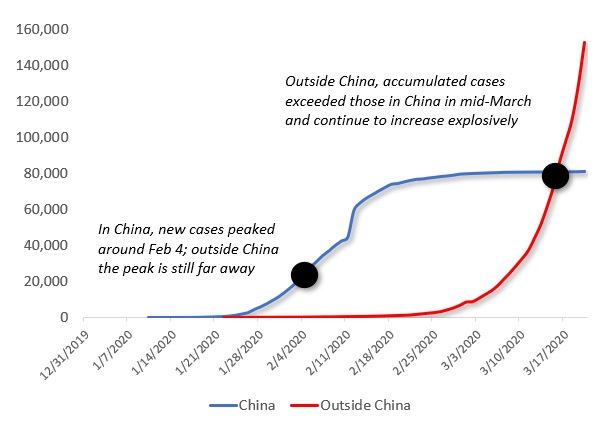
In China, the turnaround came a month after the first novel coronavirus cases were diagnosed, thanks to strong containment measures. Outside China, the first cases were reported after mid-January. Two months later, they soared beyond those in China and continue to accelerate (Figure 1).
Figure 1 Accumulated confirmed cases in and outside China (until March 18)
Source: WHO, China National Health Commission, Difference Group
In China, the impact of the coronavirus is already easing, though complacency is no option. Outside China, epidemiologists currently anticipate a peak around June. If that’s the case, economic damage in China would be largely limited to the first quarter, but international economic damage would endure well into the second quarter, and in the most affected countries well beyond.
Due to the uncertainty of current data in Europe and particularly the United States, one plausible scenario is that the battle against the coronavirus may last through the ongoing year and possibly through 2021.
After mid-January, I projected three probable virus impact scenarios, which can now be reassessed. In the “SARS-like impact” scenario, a sharp quarterly effect, accounting for much of the damage, would be followed by a rebound. The broader impact would be relatively low and regional. Although China has been successful in containment, advanced economies in Europe and North America failed to respond in time. So, this scenario is no longer in the cards.
In the “extended impact” scenario, the adverse impact would last two quarters. The broader impact would be more serious and have a significant impact on global prospects. That’s where the world economy is now heading to, rapidly.
In the “accelerated impact” scenario, the damage would be steeper and broader with severe consequences on the global economy. If the containment measures continue to fail outside China, this risky scenario can no longer be excluded.
In early March, the International Monetary Fund (IMF) projected global growth to fall 0.1 percentage points from the expected 3.3%. The estimate was too optimistic. Even the OECD expects global GDP growth to drop to 2.4% in 2020, with possibly negative growth in the first quarter. But that was a month ago. Now a global contraction could cause economic growth prospects to plunge closer to 2%.
China toward rebound
Thanks to China’s draconian measures, reported cases peaked and plateaued between January 23 and 27, and have largely declined since then (Figure 2).
Figure 2 Epidemic curves for confirmed COVID-19 cases in China
* By symptom onset and date of report (February 20, 2020) for laboratory confirmed cases in China. Source: WHO China Joint Mission, Feb 29, 2020
Before the crisis, Chinese economy was benefiting from a mild recovery, which was expected to result in GDP growth of 5.8% to 6.1%. In early March, IMF projected China’s growth to fall to 5.6% in 2020. Now some estimates in the West anticipate baseline growth of less than 5%, with significant downside risk of less than 3%.
In January, factory activity did contract at the fastest pace on record as the Purchasing Managers’ Index (PMI) fell to a record low of 35.7 from 50.0. The same goes for the services activity. While the anxiously awaited initial data was significantly worse than anticipated, both plunges were only to be expected. Economic shocks translate to contractions.
The real question involves the strength of the post-shock rebound between mid-March and April, given the low starting-point. It is these assumptions of the first scenario that fueled the bold projections by J.P. Morgan that the Chinese first quarter could go down to -4%, but second quarter would go up to +15%.
The rebound story is possible, if fiscal and monetary support is adequate and if small- and mid-size firms, which account for more than four-fifths of nationwide employment and over half of the GDP, can jumpstart production.
In China, economic development is seen as critical to the country’s future. But ultimately, Chinese leaders are not accountable to GDP. People come first. It is thanks to that mindset that China is now busy getting back to business, working to bolster the economy with accommodative monetary and fiscal policies, reopening schools and trying to contain the remaining chains of transmission.
As the populous country is moving from containment to the mitigation stage, the challenge will be to contain new imported cases in the borders, while quickly extinguishing potential new virus clusters at home.
In economic terms, China must prepare for the negative feedback effect from the world economy starting in the second quarter.
Contraction, stagnation, debt in US…
Despite elevated warnings since mid-January, uncertainty began to grip the rest of the world only at the end of February. Instead of mobilizing against the virus, complacency in advanced economies led to a series of missteps, including faulty and belated local testing, failures in evacuations and quarantines, lax enforcement of self-quarantines. Hence the consequent multi-trillion-dollar market corrections.
In the US, the S&P 500 equity market has plunged more than 20% since January 1, as evidenced by Shiller’s cyclically adjusted PE ratio. Volatility spiked as it last did in fall 2008. Liquidity stress has spread rapidly across firms and households. Oil prices almost halved to less than $30 per barrel, which could be further penalized by a misguided and ill-timed price war.
Prior to the virus outbreak, the IMF expected US growth to moderate from 2.3% in 2019 to 2% in 2020 and 1.7% in 2021, due to waning support of fiscal and financial conditions. Those estimates are now history and the same goes for IMF projections in early March. In the second quarter, the US could face a significant contraction before the expected recovery, which may prove more challenging than expected.
Recently, the IMF projected US growth to suffer a slowdown from 2.0% to 1.6%. But the estimate is too optimistic. If the second quarter carnage proves limited, U.S. growth could still stay close to 0.2%-5%. But the risks are on the downside and, after a series of policy mistakes, the margin of error is slim.
After the White House’s delays of outbreak management, the Fed cut interest rates close to zero, coupled with a new round of $700 billion for quantitative easing. In the short-term, the move is understandable. But in the long-term, it compounds new risks. Moreover, the Fed’s rate cut will be coupled with fiscal stimulus, which is not likely to suffice.
Yet central banks in Europe, the UK and Japan will follow US footprints into more monetary and fiscal accommodation. But that may fail to quell virus fears, if infection rates continue to soar.
… Eurozone and Japan
In the Eurozone, recessionary pressures come in a particularly bad time. Before the virus, quarterly growth was 0.1%; the weakest in seven years. Now things will get a lot worse. German GDP will stall further, France and Italy will remain in contraction. In the UK, annualized growth is likely to fall fast from 1% closer to contraction territory. With tourism in shambles, soaring infection rates will reverse Spain’s growth pickup. Italy, the Eurozone’s most indebted major economy is struggling with infections and deaths that are soaring faster than in any other major economy
If the virus cases continue to increase in the Eurozone, regional growth prospects are likely to end near contraction territory. In the most affected countries, the failure of timely containment is likely to foster a recession through the first half of the year. And if the virus cases continue to climb in the second quarter, the contraction will prove steeper. A potential protracted appreciation of the euro – a déjà vu of the sovereign debt crisis in the early 2010s – could penalize growth even into 2021.
In both the United States and the Eurozone/UK, the first quarter damage will only be the prelude to the second quarter carnage. And if the virus is not managed appropriately, the consequent hit will cast a shadow over the hoped-for rebound in the second half of 2020 as well, possibly into 2021.
Prior to the coronavirus, Japanese growth contracted 0.7% in the fourth quarter of 2019. After last fall’s consumption tax and the consequent economic turmoil, contraction prevailed in January, while great uncertainty overshadows the 2020 Olympics. Many major Japanese companies must cope with heavy damage in the first half of 2020; in the second half, they face Olympic repercussions, with or without the Olympics. Both scenarios will further weaken the world’s most rapidly aging major economy that’s been in secular stagnation for several decades.
With some 9,000 confirmed cases, South Korea has been worst hit by the coronavirus in non-China Asia. As the decline in exports will be coupled by the decline of domestic demand, South Korea may contract in the first quarter, despite rate cuts and efforts at fiscal support.
Additionally, Australia and the regional financial hubs Singapore and Hong Kong are on their way or in contraction. Since these countries are significant investors in Southeast Asia, their challenges will reverberate across emerging Asia.
Early damage limited in emerging economies, but risks rising
In December, the Asian Development Bank (ADB) still maintained 4.7% for ASEAN economies in 2020, mainly based on mild recovery in China and the US. Now even countries that have strong structural growth potential, including Indonesia, Vietnam and the Philippines, are not immune to indirect short-term hits as their trade, investment, migration and remittance flows depend on the international environment.
The same goes for South Asia, particularly India, Pakistan and Bangladesh. In India, the growth rate decelerated from 7.7% to 4.7% in January and 5.3% in 2020. That was before the global pandemic, which will compound such threats. While virus cases have so far been low in Russia, it will be penalized by oil prices, just as Brazil’s growth has been harmed by the fall of commodities.
Until recently, the Middle East and Latin America had not witnessed sustained case growth. Now, local transmissions have begun, and cases are rising in the Gulf, Egypt and Northern Africa’s Maghreb economies. Iran has suffered a dramatic rise in infections and deaths. Prior to the pandemic, US withdrawal from the nuclear deal, drone assassinations and intensified efforts at regime change caused growth to decrease to close to 1%, while the virus will significantly deepen economic erosion.
Sub-Saharan Africa is already struggling with a lingering Ebola crisis in the West and locust plagues in the East. Official virus cases are still low (South Africa, Nigeria, Senegal), but tests have only begun. In simulations, the highest importation risk involves countries (South Africa) that have moderate to high capacity to respond to outbreaks, whereas countries at moderate risk (Nigeria, Ethiopia, Sudan, Angola, Tanzania, Ghana, and Kenya) have variable capacity and high vulnerability.
While struggling to restore their potential output level, emerging economies will have to absorb the economic tsunami from the West. That will cause new pressures in countries that depend on capital inflows and commodity reliance (Indonesia, Mexico and South Africa) or carry excessive debt (Turkey).
While oil exporters from Gulf to Russia will suffer from collateral damage and price wars, lower prices will benefit emerging Asia in the short term.
Inadequate preparedness
Unlike markets, the novel coronavirus cannot be “talked down” as the Trump administration has tried. Eager to disguise its utter failure in containment and local testing, it is appealing to the worst racial instincts by calling the virus “Chinese”, even against the reprimand of the WHO, thereby contributing to hate speech, stigmatization, as well as anti-Chinese and anti-Asian incidents in America.
On March 16, the New York Times released a balanced investigative report about the Trump administration’s mishandled virus response. A day later, the administration shared with the Times its pandemic report. Ostensibly, the White House hoped to show it was in control. But timelines revealed tell a different story.
Even though the government’s leading health executives had been monitoring the crisis since early January and the first COVID-19 case was confirmed in the state of Washington on January 20, followed by WHO alerts, White House failed to act upon pressing evidence. Until recently, Trump’s has said publicly that any danger would pass by April 1. When he finally understood the risks, he botched his error-ridden Oval Office virus address and the subsequent mistake-ridden Rose Garden address. Until mid-March, the infection enjoyed a relatively free ride in America.
The pandemic report was clear about the consequences: “A pandemic will last 18 months or longer and could include multiple waves of illness… Increasing COVID-19 suspected or confirmed cases in the U.S. will result in increased hospitalizations among at-risk individuals, straining the health care system.” Shortages would ensue.
In the UK, comparable stumbling has caused a similar debacle, which Prime Minister Boris Johnson has tried hard to express in optimistic terms: “We can turn the tide within the next 12 weeks.” Yet, that cannot be achieved without restrictive measures, which could have been launched weeks ago. In contrast, German Chancellor Angela Merkel has been blunt: “Not since World War II has our country faced a challenge that has required such a high degree of common and united action. We can succeed as long as everyone truly understands what’s needed.”
Unfortunately, the US, the Eurozone, and the UK are mobilizing with an unwarranted delay of 4 to 8 weeks. Today, accumulated confirmed cases worldwide exceed 250,000. But that’s only a prelude to more.
Let’s assume that cases in China will remain low and imported cases can be quarantined. So, cases in China would remain less than 85,000 even in late April. Let’s also assume that other countries and regions – not just US and Europe but those in the Middle East, Latin America and Africa that will suffer collateral damage, due to complacency in the West – will still increase. Let’s also be conservative and use polynomial rather than exponential trendlines. Even then, cases outside China could more than triple in the period, even in a benign scenario.
Obviously, the early economic defense has been by the major central banks to cut down the rates, inject liquidity and re-start major asset purchases. But as the post-2008 decade has shown, monetary responses cannot resolve fiscal challenges.
The early damage has focused on a set of key sectors, such as healthcare, transportation, retail, tourism, among others. In turn, ultra-low rates, liquidity injections and asset purchases will be coupled with targeted fiscal stimuli in affected economies. Yet, current measures to restrict the infection and economic damage will contribute to further debt erosion in many major advanced and emerging economies.
As the US national debt now exceeds $23.5 trillion (107% of GDP), Washington’s debt burden is at par with Italy just before its 2010 European Union (EU) sovereign debt crisis. In Italy, that level is now significantly higher (135%) and in Japan alarming (240%). In Europe, the Maastricht Treaty deems that member states should not have excessive government debt (60%+ of GDP). Today, no major European economy fulfills that criteria.
In advanced economies, the coronavirus contraction has potential to wipe out much of the recovery. Meanwhile, as a result of the US tariff wars, developing countries, which have weaker healthcare systems, already suffer from financial and debt vulnerabilities and may not be able to withstand still another external shock.
Furthermore, old supply-side measures cannot resolve pandemic challenges. If containment measures fail, or subsequent mitigation proves inadequate, or new virus clusters emerge after containment and mitigation, markets will remain volatile and economies will suffer further damage, particularly with multiple waves of secondary infections after the current restrictive measures.
The way to the normality requires the defeat of the virus. Following China’s response, most countries do seek to contain the virus, then mitigate it and finally to deter secondary infection crises. China had to develop its stance almost overnight in mid-January. Other major economies had weeks to mobilize, yet many missed the opportunity, due to complacency and inadequate preparedness. Containment will be only partial in these countries, which will compound their mitigation challenges.
So, when restrictive measures are phased out in major economies, some countries are likely to record odd spikes in death rates, particularly in the virus risk groups. It is a discrete modern-day version of the old eugenics, which permits certain policymakers in the West to bury their mistakes, literally. At home, virus carriers may or may not gain adequate immunity. As poorly-enforced quarantines are phased out, flows of people, many of which may be infected or carriers, will show up in the borders of countries that have successfully managed the crisis – as already evidenced by the spikes of imported cases in China, Singapore and Hong Kong.
What is desperately needed to avoid further nightmare scenarios is multipolar cooperation among major economies and across political differences. In this quest, China, where containment measures have been successful, can show the way, along with major advanced and emerging powers.
Dr. Dan Steinbock is an internationally recognized strategist of the multipolar world and the founder of Difference Group. He has served at the India, China and America Institute (USA), Shanghai Institutes for International Studies (China) and the EU Center (Singapore). For more, see https://www.differencegroup.net
After mid-January, Dr Steinbock argued that China had adopted pioneering standard-setting measures to contain the novel coronavirus outbreak.
In late January, he said that the COVID-19 politicization, the associated “infodemic” and battle against the WHO and its chief were misguided and would undermine the international crisis response.
In the first week of February, he predicted the virus cases would decelerate in China as Beijing was containing the outbreak, but were accelerating outside China.
In late February, he predicted that delays and mistakes in the US and Europe would prove costly in terms of infection rates, human lives and economic damage.
At the turn of March, he projected a shift toward global economic contraction, due to containment failures in the West. In the longer-term, the spillovers could prove costly in the developing world.
By Terence Tse
CFOs are evolving into AI-driven transformation orchestrators, balancing finance, technology, and strategy while upskilling teams, managing risks, and driving measurable business value.
A key insight from this year’s AI for CFOs event, organized...
The World Financial Review uses cookies to improve site functionality, provide you with a better browsing experience, and to enable our partners to advertise to you. Detailed information on the use of cookies on this Site, and how you can decline them, is provided in our Privacy Policy and Terms and Conditions. By clicking on the accept button and using this Site, you consent to our Privacy Policy and Terms and Conditions. ACCEPT
Privacy & Cookies Policy
Privacy Overview
This website uses cookies to improve your experience while you navigate through the website. Out of these cookies, the cookies that are categorized as necessary are stored on your browser as they are essential for the working of basic functionalities of the website. We also use third-party cookies that help us analyze and understand how you use this website. These cookies will be stored in your browser only with your consent. You also have the option to opt-out of these cookies. But opting out of some of these cookies may have an effect on your browsing experience.
Necessary cookies are absolutely essential for the website to function properly. This category only includes cookies that ensures basic functionalities and security features of the website. These cookies do not store any personal information.
Any cookies that may not be particularly necessary for the website to function and is used specifically to collect user personal data via analytics, ads, other embedded contents are termed as non-necessary cookies. It is mandatory to procure user consent prior to running these cookies on your website.