Home Blog Page 714

How We Should Talk about Racial Disparities 

Unity in diversity

By Natalie Spievack

Many 2020 Democratic presidential candidates have emphasized the role of historical and contemporary discrimination in creating and perpetuating disparities between Black and white Americans. This discourse underscores the critical responsibility of all public voices—including researchers, policymakers, practitioners, and journalists—to consistently use their platforms to call out the root causes of racial disparities. 

When we name the historical and contemporary policies and practices that create and maintain racial disparities, we can challenge harmful stereotypes and narratives that shape the way people of color are perceived and treated. 

Making this consistent practice can help produce effective solutions by rightfully shifting responsibility for disparate outcomes from people of color to systems of oppression. 

Contextualizing disparities challenges harmful narratives 

America’s dominant cultural lens and narrative center on white people and portray the country’s past primarily as a story of social innovation and progress

Within this narrative, modern problems like poverty and crime are individual and communal failings, and, by extension, racial disparities are indicative of poor choices or behavioral patterns, not historical and continued discrimination. This narrative minimizes or erases the impact of the human trafficking and bondage of people of African descent and the subsequent terrorizing and humiliation of Black people through violence, the Black Codes, and Jim Crow. And it implicitly perpetuates the belief that white people are doing better because they are inherently better or are working harder, laying the bedrock for white supremacy. 

“We know that the generational theft of the descendants of slaves is a part of why everything from housing to education to health to employment basically puts us in two different countries.”  —Mayor Pete Buttigieg 

The historical context of racial disparities in every domain—health, homeownership, education, and beyond—reveals a more accurate national narrative in which government-sanctioned policies and practices have facilitated the upward mobility of white Americans and created barriers to mobility for Black Americans. 

Policies—more than choices, culture, or genes—explain disparate outcomes because race has no biological basis and was created solely to justify and facilitate systemic oppression

By consistently providing context, we can help shape a new narrative that indicts the systems that created injustices, rather than the people oppressed by them. 

Robust narratives can help challenge biases 

Narratives are reinforced through popular culture, the news media, and political rhetoric, which subtly confirm or challenge our biases (PDF) about people of color. 

We all hold biases, and whether or not we consciously subscribe to them, they influence how we perceive and treat others. Research shows that negative racial biases may be expressed as outright racism or lead to discriminatory treatment of people of color in hiring (PDF), education (PDF), and the criminal justice system

Placing disparities in their rightful context can help challenge these biases by shifting blame away from individual people and communities of color. For example, researchers may report higher arrest rates among Black men than among white men. Taken at face value, these statistics may confirm racist stereotypes of Black men as violent and prone to criminality. 

But if we discuss the role of punitive policing (PDF) (such as stop and frisk and racially discriminatory drug laws) and policies that have concentrated Black men in poor neighborhoods where the risk for offending and arrest is higher (such as redlining and the construction of segregated public housing) in creating these disparities, we can probe people to question the stereotypes they hold. 

Robust narratives facilitate effective solutions 

[Racism] is not just an issue that started yesterday.… We have systemic racism that’s eroding our nation from health care to the criminal justice system. —Senator Cory Booker (D-NJ) 

When faced with any racialized problem— such as gentrification, disenfranchisement (PDF), police brutality, or job discrimination—identifying effective solutions depends on properly diagnosing root causes. Without context, however, we may fail to portray the breadth of factors that drive the disparity or preclude ourselves and our audiences from learning from past mistakes. This can lead to the introduction of ineffective—or even harmful—policy solutions. 

Using the example on racial disparities in arrests, without the context discussed above, one could conclude that Black neighborhoods and Black people need more surveillance and tougher responses to crime

But within the context of structural racism, we can consider systemic reforms that acknowledge and remedy the historical and contemporary roots of crime, such as decriminalizing marijuana, investing in communities of color, and increasing local economic development (PDF), which show promise in breaking the cycle of criminalization, poverty, and crime. 

By consistently placing racial disparities in their historical context, we can push ourselves and our audiences to learn about the specific racist policies, practices, and systems that must be dismantled and replaced in order to close these gaps.           

Why isn’t this already common practice? 

Too often we present racial disparities as bare statistics and at best, give a vague nod to “structural racism” or “structural barriers” as sufficient explanations for racial gaps. To change our practices, we must acknowledge the reasons why we tend to avoid including this discussion in our work in the first place. 

Talking honestly about racism carries risks for public-facing individuals and organizations, whose status and finances depend on the perceptions of funders, audiences, and current and prospective employees. 

Naming the structural causes of racial disparities can make some uncomfortable and drive them away. Unfortunately, many people refuse to grapple with the racialized history of the United States, especially if they benefit from white supremacy

People may misconstrue calls to name white supremacy and oppression as threats to their personal identity, history, or economic standing. Facing America’s racist past also runs contrary to American exceptionalism and oft-professed values of liberty and justice. 

Naming the policies and systems responsible for racial disparities can pose an economic risk for organizations, especially if they draw funding from organizations created to build white power and wealth. 

Well-intentioned public voices may also shy from discussing the structural roots of disparities to avoid appearing biased or out of fear of lacking necessary knowledge to properly discuss these issues, opting instead to leave the discourse to “experts.” 

Some may fear backlash from misrepresenting the history and experiences of people of color. It’s important that we approach these issues with informed thoughtfulness, but abandoning the discussion altogether creates a void that perpetuates harmful narratives and prevents finding solutions. 

What does this look like in practice? 

Making it standard practice to contextualize racial disparities is critical to addressing the root causes of inequity. 

The federal government helped create the racial divide in this country through decades of active, state-sponsored discrimination, and that means the federal government has a responsibility to fix it. —Senator Elizabeth Warren (D-MA) 

Public voices have perpetuated harmful narratives, so we have a responsibility to actively deconstruct them. This requires careful consideration not only of the intergenerational effects of racial discrimination but also of how a person’s race intersects with other aspects of their identity, such as class, gender, and sexual orientation.  

Many racial justice organizations—such as Advancement Project, Race Forward, and Color of Change—have rooted their work to close disparities in its historical context for decades, and their approach should serve as beacon for all who share the same goal.* 

Given the complexity of the subject matter, exemplary discussions of this topic can be useful: 

  • Ta-Nehisi Coates’s acclaimed article on reparations 
  • a recent New York Timesarticle on Black homelessness in Los Angeles 
  • an Urban Institute brief on African American economic security and a report on increasing economic opportunity for young men of color 

Research that documents connections between modern-day disparities and discriminatory policies, like The Color of Wealth and The Color of Law, can serve as excellent references for our own work. Toolkitscan help researchers incorporate a racial and ethnic equity lens into their work. Organizations in other fields should provide similar guidance. 

Addressing persistent equity gaps will require more than changing the way public voices contextualize disparities. It requires reconsidering our values, turning them into action, and investing in the assets and leadership of communities of color. But this is an important step in the right direction.

*This sentence was added to better reflect the work of racial justice organizations in this space (updated 3/6/20). 

This blog post was originally published on Urban Wire, the blog of the Urban Institute

About the Authors 

natalieNatalie Spievack is a research analyst in the Income and Benefits Policy Center at the Urban Institute. Her work focuses on advancing equity for low-income youth and youth of color from birth through higher education and careers. She has studied efforts to increase economic opportunity for young men of color, child care and early childhood education, youth employment, and postsecondary education and training programs. She has experience in qualitative and quantitative data collection and analysis, large-scale program evaluation, and providing technical assistance to programs. Spievack graduated with honors from the University of Wisconsin–Madison, where she earned a BA in political science and economics. 

cameryn okekeCameryn Okeke Cameryn is a senior program associate who loves space—not the type that astronauts live in; but the everyday spaces and loving connections that liberate them. Being the child of an immigrant and the inheritor of the legacy of U.S. chattel slavery, Cameryn is obsessed with what it takes to make public space safe, nurturing, and inclusive. At Vera, Cameryn builds projects centered around community flourishing, participatory design, and nurturing accountability. Their current project focuses on disrupting punitive narratives, building community-rooted safety plans, and advocating for deep investment in community nurturers. Prior to coming to Vera, Cameryn was a research associate at the Urban Institute, leading research on various projects on racial justice, community safety, and creative placemaking. Cameryn sees their life’s work as dismantling oppressive structures and designing brave inclusive spaces while building power with the intentionally silenced: Black queer women, nonbinary people, and trans people. Cameryn earned their master’s in bioethics with a concentration in public policy and safety from the Johns Hopkins School of Public Health and a holds a BA from the University of Chicago. 

How COVID is Helping Higher Ed Find Technology’s Goldilocks Scenario 

higher ed

By Dr. Tyra Gross and Gangaram Singh

Over the past twenty months, higher education faculty and students have gotten used to the ubiquitous nature of technology in learning. Now, colleges and universities begin the slow return to a new normal as they face a more complicated question of when they should return to pre-pandemic norms and when is using technology still the best decision for students and faculty. 

At the EDUCAUSE conference this past fall, the two of us explored the role of technology in building more human learning experiences, and discussed the ways in which emerging tools can both help and hinder learning. Our respective experiences at two very different institutions—a large, predominantly online institution in California and a Historically Black College & University (HBCU) in Louisiana—have taught us that an effective recovery from the pandemic may require drawing bright lines around what works, and what doesn’t, when it comes to technology in the learning experience. For us, understanding that distinction took the form of a specific question: was it possible to use technology to create an enriching and connected class environment, without causing burnout or stretching instructors and students too thin?  

Here’s how we worked to answer that question over the past two years. At Xavier University of Louisiana it quickly became clear that one of technology’s greatest assets was also a weakness. In the age of Zoom, video lectures and discussions seemed like a godsend at first, but constantly being in synchronous meetings became overwhelming for students. It seemed like every moment was taken up by a video meeting, an online classroom, or even a video-proctored exam. That level of connectivity can of course be critical, but it can also be exhausting! And as a public health professional teaching students at an HBCU, Dr. Gross was particularly driven by the need to support student well-being and mental health through our use of technology — which sometimes meant knowing when it was time to unplug. 

For its part is navigating similar questions about the appropriate level of technology usage in the wake of the pandemic. A growing body of research suggests that technology can in fact improve learning experiences when implemented appropriately and designed to reflect what we know about how students learn. The trouble is that too often, we embrace the latest gadgets without working to develop a full understanding of how they actually support the learning experience. The past eighteen months gave us more technology than we know what to do with. How can we best reflect on that time and separate the necessary stopgaps from the tools that were actually helpful?  

Simply put, we both faced the challenge of finding EdTech’s “Goldilocks” scenario: what kind of technology usage, and how much, was “just right” to make a rewarding classroom experience? And while we certainly haven’t found the final answer yet, we’ve both experienced specific examples of the way that technology facilitated better learning during the pandemic — in ways we should be keeping in mind moving forward. 

During the pandemic, National University experimented with an AI-enabled discussion platform designed to help faculty apply rigorous, assessment-led instruction at greater scale. What we found is that the tool didn’t just improve the quality of students’ writing — it also helped build a sense of community even in a remote setting, as students engaged with each other on substantive and challenging topics. That level of connection gave National’s faculty more confidence that they could use technology to serve more students more effectively, without sacrificing the deep engagement that is a hallmark of effective learning experiences. 

At Xavier University of Louisiana (XULA), technology helped maintain the small group discussions that were a hallmark of our course experience before the pandemic. Tapping into a similar discussion platform at XULA helped to inspire more critical thinking and writing—and also fostered a more connected classroom climate even during the months of remote learning, without students feeling forced to stay online. 

Critically, at both of our institutions, using technology meant knowing when it was actually helping instructors teach and students learn. At its best, tech can automate some of the simpler or more rote tasks and enable faculty to do what they’re good at: building the sort of deeper, one-on-one connections that translate to academic outcomes and overall student success. That’s the sort of bright line we’re learning to draw: identify the tools that actually facilitate better teaching and learning, and that limit stress and exhaustion among faculty and students alike. For us, online discussion was a great example of that work in practice: the right platform can create the context for the deep and engaging experience of sharing ideas with peers, but without the always-on nature of video meetings that can so often drain students’ (and instructors’) energy and motivation. 

As we navigate the complex road back from the pandemic, we shouldn’t lose sight of the unexpected lessons the past eighteen months have taught us. Rather than being a stopgap between identical eras of in-person instruction, the Covid era is ushering in a more fundamental shift by teaching us how technology can, and should, play a role in keeping institutions and students connected. These discussions are even more important at a time when disruptions to the “normal” way of doing things are likely to continue (whether due to future global health issues or climate change-related challenges), and we will need to continue serving students in times of crisis. In the months to come, we have an opportunity to build a different kind of university: one that still keeps the interaction between instructor and student front and center, but with the support of tools that can make that interaction even more effective and meaningful. 

Ultimately, a more hybrid world is here to stay, and technology that enables human connection will be critical to driving student success in this new world. The real opportunity as we emerge from the pandemic isn’t to use technology to replicate or replace what we’ve done in the past; it’s about using technology to expand the definition of what’s possible. 
 
This article was originally published in Fierce Education on 29 December 2021. It can be accessed here: https://www.fierceeducation.com/technology/how-covid-helping-higher-ed-find-technologys-goldilocks-scenario 

About the Author

Dr. TyraDr. Tyra Gross is Assistant Professor at Xavier University of Louisiana. Dr. Gangaram Singh is Executive Vice President and Provost of National University.

Dr. SinghGangaram Singh, Ph.D., is an award-winning educator and administrator with a background in leading strategic growth initiatives. He is the former dean of the business school at San Diego State University.  

Singh has been published in over 70 academic and practitioner journals and holds a doctorate and master’s degree in industrial relations, as well as an MBA from the University of Toronto. He received his Bachelor of Commerce from the University of Windsor.  

Adapting Education Innovations And Their ‘Knock-On Effects’ In The Time Of COVID 

education innovation

By Brady Olsen

In biology, adaptation is the process by which organisms fit themselves to a changing environment (think Darwin). In global development, it can refer to people adjusting to shocking change in ways that highlight political inequities (consider a population facing extreme drought). In education, it can describe teachers tailoring curriculum to students’ learning styles (as in universal design for learning). In each domain, adaptation is a process of facing the unexpected, finding a new way of acting, and oftentimes altering the status quo in the process. 
 
Eighteen months (and counting) of humans responding to the COVID-19 pandemic fits all three definitions. 

Within the community of policymakers, implementers, and researchers working to scale education innovations, it has become axiomatic to be mindful of incorporating adaptations into initial design and ongoing, continuous improvement loops. It’s stressed that adaptation should be a mindset as much as a technical approach. And recent work at the Center for Universal Education has led to a practical guide for tracking adaptations in scaling. 

Through learning alongside education implementers and researchers in our current Research on Scaling the Impact of Innovations in Education (or ROSIE), we’ve been investigating not only how COVID-19 prompted adaptations in scaling education innovations that set new practices in motion but how these new practices themselves have initiated new effects and other practices. If a scaling environment is a complex adaptive system, then any one change will set in motion other, second- and third-order changes that ripple out to cause still more changes… and so on. 

For example, when schools closed in Kenya, the ABRA/READS initiative faced a challenge: How could children access its digital literacy program when the computers were located in the schools? The initiative adapted an existing 20-week noninformation, communications, and technology version of the ABRA program and printed weekly ABRA/READS literacy materials for the home. Using WhatsApp, the initiative supported teachers to visit homes, deliver weekly bundles of instructional materials and books, and check on students. Not only did this keep the program running, but positive effects spilled over, too. Teachers got to know students’ families and see students in the home environment. This strengthened family engagement and provided teachers with broader views of their students. Additionally, during the visits, teachers noticed older siblings reading the READS early-literacy materials with their younger brothers and sisters—literacy had become a family event. Capitalizing on this, ABRA/READS began printing and delivering higher-level readings for the older children, too (though that wasn’t part of the initial project). And, finally, ABRA/READS incorporated life skills and socioemotional themes into the readings to help children cope with the emotional upheaval of a pandemic. 

A second example not only showcases the benefits but highlights a challenge. Due to extra caution around COVID-19, the Improving Literacy of Children through Support from Community Networks project restricted travel in Nicaragua for the program’s literacy specialists. Because the national specialists couldn’t move from region to region to support the community literacy partners running the afterschool reading camps, the program moved its training online and asked community volunteers to take on increased responsibility for the camps. Furthermore, although Nicaragua never closed its public schools, attendance dropped off significantly, and the community volunteers maintained engagement with the out-of-school students, too. All this meant that these community volunteers stepped up their work and increased local ownership of the project—a holy grail for many innovations at scale. Yet, the adaptation also revealed a challenge of relying on community volunteers. Because the pandemic impaired the Nicaraguan economy, community partners faced financial hardships and many had to exit the project in search of paid work. When the volunteers left, they not only took their hard work with them but their training and institutional memory, as well. 
 
We found other examples: From governments endorsing ed tech when physical travel was impossible to local churches and community centers emerging as new settings for learning. From the sudden priority of teaching local educators how to maintain hardware for online learning to policymakers getting creative with slashed education budgets. No change is an isolated event: It will always trigger other changes and effects that alter the larger system. 

Alert innovation scalers and researchers faced COVID-19’s pandemic by adapting their projects in creative ways. Those adaptations not only addressed the direct challenges but set in motion accompanying effects and indirect changes, too, which can be missed if folks aren’t looking for them. Many of these indirect effects are positive, some are negative, and all will continue to evolve and initiate still other effects over time. These “knock-on effects” may be unavoidable, but we encourage scalers and researchers to identify—and if necessary, mitigate them—just the same. Their potency can often be harnessed in service of scaling for impact. 

Of course, a global pandemic is a dramatic unpredictability, but it’s effective in starkly underscoring the scaling axiom. Building an adaptative strategy into scaling is key, but participants must also be primed to recognize and nimbly respond to the potential second- and third-level effects of the changes they’re initiating. Additionally, the accompanying research must be flexible enough to readjust in ways to investigate the new effects. 

If we can incorporate these lessons into our scaling work, maybe this will be one positive outcome of the otherwise heartbreaking COVID-19 pandemic: an evolution in which scaling for impact moves to its next, more advanced iteration. Please let us know if you have your own examples of this phenomenon in practice; we’d love to hear from you. 

Note: This project is supported by the Global Partnership for Education Knowledge and Innovation Exchange (KIX), a joint partnership between the Global Partnership for Education (GPE) and the International Development Research Centre (IDRC). The views expressed herein do not necessarily represent those of GPE, IDRC or its Board of Governors. 

Brookings is committed to quality, independence, and impact in all of its work. Activities supported by its donors reflect this commitment and the analysis and recommendations are solely determined by the scholar. 

This article was originally published in The Brookings Institution on 8 November 2021. It can be accessed here: https://www.brookings.edu/blog/education-plus-development/2021/11/08/adapting-education-innovations-and-their-knock-on-effects-in-the-time-of-covid/

About the Author

brad olsenBrad Olsen is a senior fellow with the Center for Universal Education at the Brookings Institution. Prior to this, Dr. Olsen was professor of education at the University of California, Santa Cruz. His work focuses on teachers and teacher development, global comparative education, school reform, sociolinguistics, and qualitative research methods.   


Why People are Shifting Towards Cryptocurrency

Cryptocurrency

Cryptocurrency, both as a word and as a concept, is becoming more and more popular in this day and age. Bitcoin is, by far, the most popular virtual currency and it is giving a helping hand to countries with limited resources. The entire crypto market is managed by advanced blockchain technology, and these private currencies do not involve tangible or non-tangible assets.

Cryptocurrency is being used in all sorts of industries from travel, finance, retail, business investments, buying and selling of real estate properties, online gambling and sports betting such as on cricket betting prediction, and more. Recently, nearly 35% of businesses have shifted to Bitcoin and other digital coins as their main mode of payment. So, what does cryptocurrency offer to the ordinary individual? Let’s find out more in this article.

Easier transactions

Businesses and daily transactions are manageable with cryptocurrency. In fact, there are many mobile applications today in which you can trade the currency and even invest in it. Apps like Coinswitch give users excellent liquidity where they can transfer their investment that they have made into their back account and cash out real money.

Ethereum and other virtual coins have even started their own ATMs. For these reasons, crypto has moved away from trading and has now become something that can fulfil your daily needs.

Speed is also another crucial advantage when comparing it to our banking systems. It only takes a few minutes to complete a transaction while the bank takes a minimum of two working days to process payments.

Top-notch security

The blockchain industry is controlled by cryptography in which private keys are given to each exchange. These keys act like a two-factor authentication since you need to enter your e-wallet password first. Then, the network will scan your private key and give it a green chit. These security layers make it nearly impossible for a security breach and immune to cybercrimes like fraud and counterfeiting.

A better return on investment

The coins’ face value is skyrocketing. Bitcoin is worth more than gold and it is also known as the digital gold. The decentralised network’s market value is constantly on the rise. Due to this, one can trade and invest if he is dealing with cryptocurrency.

You are the owner

The biggest advantage about cryptocurrency is that you are the owner of your own funds. If you compare it to PayPal, for example, then the information is shared with the third party. With cryptocurrency you own both the public key and private key which means that you are the sole owner of all the information. This makes it free from any unnecessary sharing.

Less revelation of confidential information

Data leak and theft is a burning issue all around the world, as companies transfer data to other firms to analyse consumer behaviour. In the blockchain industry, you will trade anonymously as there is no outsider who will be able to view your details and the content of your transactions.

You can buy and/or sell freely without revealing your identity. Transactions will only show in your e-wallet, and this is an effective security protocol.

International payments

Cryptocurrency makes it easier for you as there is no control of any foreign exchange. You can send or receive freely without paying an extra dime. This does not apply to countries where crypto regulations are banned, like China.

Digital coins are now also regulating their e-wallet and you will receive updates about your investments. You can also buy virtual tender on interest.

Cryptocurrency provides a lot of benefits to both companies and the common individual. People are shifting towards crypto more and more and this will only keep on rising. While it is true that there are some factors that are questionable when it comes to cryptocurrency, the perspectives still look positive from where we’re standing. With the right approach and new cryptocurrencies constantly emerging, crypto is definitely here to stay. Many nations are working on creating new frameworks to streamline the process of transactions and make them easier and more efficient. Their mission is for cryptocurrencies to become part of mainstream economy which is they way that cryptocurrency is heading.

The Socioeconomic Effects Of COVID-19 On Women 

woman in mask

By Maria Demertzis and Mia Hoffmann

The pandemic has disproportionately affected women both professionally and at home. Although the gender gap in labour force participation since the onset of the pandemic hasn’t worsened, the policy still needs to tackle existing gender gaps, which for some EU countries are very substantive. 

Following widespread vaccination campaigns, European economies are beginning to emerge from the depths of the recession caused by the COVID-19 pandemic. And as billions are spent to accelerate the recovery and stabilize economic growth, it is important to understand that not all members of society emerge from this crisis in the same way. The COVID-19 pandemic affected women significantly differently from men along many dimensions. Long-time existing gender inequalities have been exacerbated, so much so, that it has been called a backward step for gender equality.  

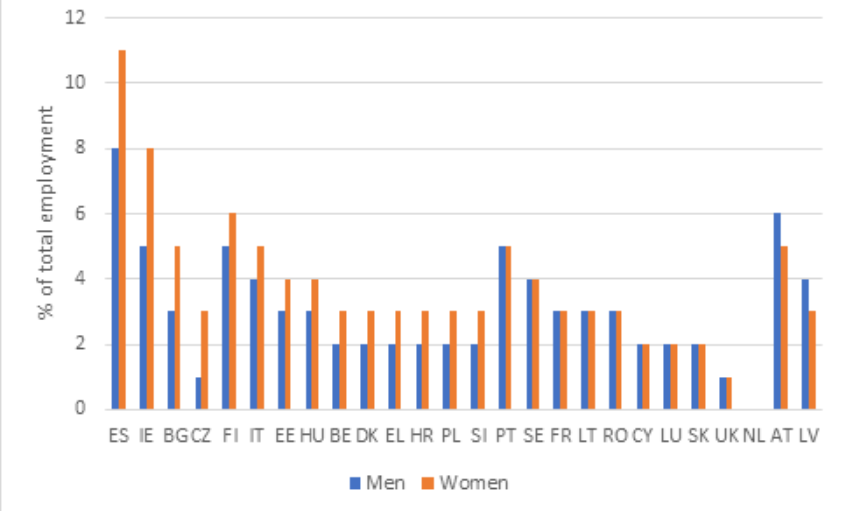
The COVID-19 pandemic was different insofar as it affected another part of the workforce than regular recessions. In cyclical economic downturns, male workers tend to be more strongly affected, because men work predominantly in sectors that are more dependent on the business cycle, such as manufacturing and construction. The pandemic crisis, in contrast, affected a different set of industries than usual, and in particular those in which women represent a larger share of the workforce. Women represent the majority of workers in frontline services such as health, long-term care or education, which exposed them to high infection risks with the virus. Women make up the majority of employees in industries hit hardest by lockdown and containment measures, including retail, food services, accommodation and personal services like hairdressers (Figure 1). This in turn, placed them at an increased risk of job loss and precarious employment situation.   

Figure 1: Employment shares by gender in frontline and close contact sectors, EU28 figure1

Note: Sectors at 2-digit NACE Rev. 2 level, data for 2019Q4. Source: Eurostat LFSQ_EGAN22D 

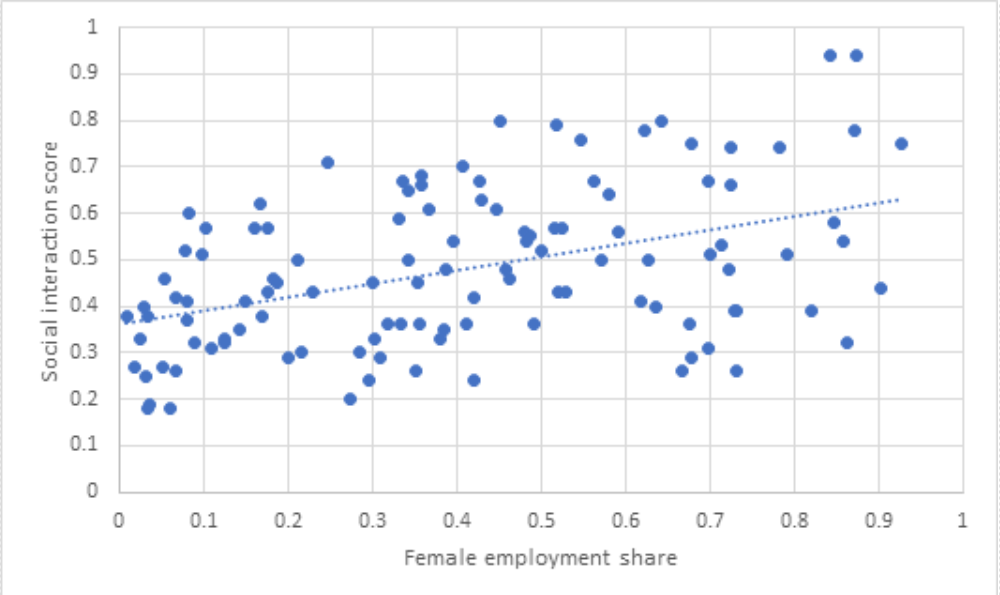
Figure 2 plots the correlation between female employment shares in occupations and an occupational social interaction score. Women in the EU are disproportionately employed in occupations that require a lot of social interaction. They represent 82% of health professionals, and 80% of teaching professionals. Over two thirds of personal services workers are women, as are almost three in four sales workers.  

Figure 2: Female employment share and the social intensity of occupations figure2

Note: Occupations at 3-digit ISCO level. Source: Bruegel based on social interaction score for occupations from Sostero et al. (2020) and employment data for 2019Q4 from the Labor Force Survey, Eurostat.  

At the EU level, the female unemployment rate increased slightly more heavily than men’s unemployment during the first wave of the pandemic, rising from 6.9% to 7.9% from the first to the third quarter of 2020, while men’s unemployment increased from 6.4% to 7% during the same period1. Following another peak in the first quarter of 2021, female and male unemployment rates recovered to 7.3% and 6.6%, respectively. The loss of jobs was particularly pronounced among women with low levels of education, who even before the onset of the crisis faced higher levels of unemployment than men with the same level of educational attainment. The same pattern, albeit smaller in magnitude, applies for women with upper secondary education (Figure 3). 

Figure 3: Unemployment rate by gender and educational attainment figure3

Note: Educational attainment levels based on ISCED2011. Low educated means primary or lower secondary education, intermediate education means upper secondary or post-secondary non-tertiary education, highly educated means tertiary education and higher. Source: Eurostat lfsq_urgaed.  

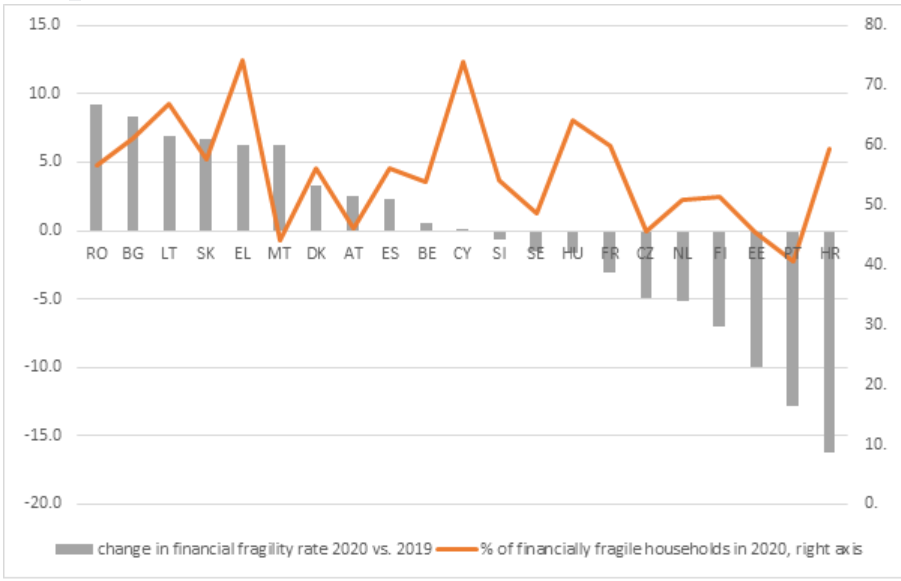
Women, who on average earn less than men and have accumulated less wealth than men are more likely to face financial difficulties following a sudden loss of income. The financial resilience of European households was already worrisome before the onset of the pandemic, with one in three EU households unable to face an unexpected financial shock. That number rises to 57% when considering single parent households, the majority of which are women. Levels of financial fragility, defined as the inability to finance an unexpected expense such as a funeral or the replacement of a washing machine, among single parent-households remained high during the pandemic but changes at the country level relative to pre-pandemic levels are mixed (Figure 4). While the rate grew significantly in Romania, Bulgaria, Lithuania, Slovakia, Greece and Malta, it also declined strongly in the Czech Republic, the Netherlands and Finland, and even more so in Estonia, Portugal and Croatia. Changes in other countries were moderate.  

It is highly unusual for such significant improvements to materialize from one year to another. We believe, instead, that these improvements in the financial situation of single parents are likely due to the outstanding policy response to the pandemic, in which many countries provided financial support to particularly affected groups. While this is an encouraging development, in this context it will be crucial to monitor how financial fragility levels develop when this support is withdrawn.  

Figure 4: Financial fragility among single parent households  figure4

Note: Financially fragile households are defined as those that answer No to the question “Can your household afford an unexpected required expense (amount to be filled) and pay through its own resources?”. The amount is calculated as 1/12 of the at-risk-of-poverty-threshold, which is set as 60% of the national median disposable income after social transfers. Based on this, in 2019 the amount to be filled ranged from 367€ in Romania to 1447€ in Luxembourg, with an EU average of 871€. Source: Eurostat SILC.  

Demertzis et al. (2020) document a significantly higher level of financial fragility among single women than among single men in all EU member states except for Finland before the pandemic. Figure 5 shows the different financial fragility rates for single female and male households during the pandemic in 2020 for all member states for which data is available. The data confirms that women are still disproportionally affected by financial risks in the EU. Women remain more financially fragile than men in all but two countries, Denmark and the Netherlands. Sweden, Belgium and France also appear to offer an almost equal playing field. In contrast a worryingly sizable gender gap is present in eight EU member states: financial fragility affects over 10 percentage points more women than men in Bulgaria, Hungary, Slovenia, Portugal, Greece, Slovakia, Cyprus and the Czech Republic.  

Figure 6 depicts how the pandemic affected this gender gap, by comparing the gender gap from 2020 with that of 2019. Inequality deteriorated during the pandemic in 11 out of the 21 reporting countries, in particular in Croatia, Bulgaria and Portugal, where the financial fragility gender gap widened by 6%, 4.9% and 3.8% respectively. Conversely, the gender gap diminished in 10 countries, in particular in France and Slovenia.  

Figure 5: Financial fragility rate of households, 2020 figure5

Source: EU SILC 

Figure 6: Financial fragility gender gap, 2020 vs. 2019 figure6

Note: the gender gap is derived by subtracting the financial fragility rate of single male households from financial fragility rate of single female households. A positive (negative) change therefore indicates a widening (narrowing) of the gender gap between 2019 and 2020. Source: Bruegel based on EU SILC.  

Job leavers statistics indicate that women left their jobs at higher rates than men during the pandemic. Job leavers are all people who left their jobs in the previous three months, be it due to dismissals, retirement or voluntary quitting. In the two years before the pandemic, women and men left their jobs at the same rate of around 2% of total employment at EU level. This rate increased more strongly and persistently for women than for men in 2020, peaking in 2020Q2, with significant variation across member states.  

Figure 7: Recent job leavers by sex in 2020Q2 figure7

Source: Eurostat lfsi_lea_q. 

High female employment shares in close contact sectors and the ensuing rise in female unemployment are certainly drivers of this development. At the same time, owing to the closing of schools and childcare centres working parents had to balance (remote) work with caretaking responsibilities. Emerging evidence suggests that women bore the brunt of this additional load which led to a reduction of female labour supply at the extensive and intensive margin.  

A US survey by McKinsey found that a quarter of surveyed women considered leaving the workforce or downshifting their careers during the pandemic, compared to one fifth of men. When considering only parents of young children (<10 years), 23% of surveyed women considered leaving the workforce, 10 percentage points more than men.  

A number of studies has investigated the time-use patterns of heterosexual couples with children during the first wave of the pandemic in the US, the UK, Germany, Italy and Spain. While both fathers and mothers increased their engagement in unpaid work at home, all studies found a manifestation of traditional gender roles, with women taking over the majority of additional housework and caretaking responsibilities. Importantly, these results could not simply be explained by gender differences in work status or remote work opportunities. Mothers were found to reduce their paid work hours more strongly than fathers to accommodate increased childcare demands and spent more time simultaneously working and looking after their children. Women also interrupted their paid work more frequently to handle housework demands, as a result of which fathers had around twice as many uninterrupted work hours than mothers in the UK. Finally, studies show that the additional burden of caretaking and housework, and the unequal allocation of those tasks led to a deterioration of the subjective well-being of women.  

It is not unlikely that these situations affected the quality of work time and caused a reduction in productivity for workers, and much more so for women than for men. Task juggling and work interruptions have been found to lower productivity and potentially even negatively affect earnings. First evidence from gender shares of authorship of academic publications during the pandemic suggests this may indeed have occurred. In biomedicine, women’s share in academic research output fell significantly since the onset of the pandemic. This effect was particularly pronounced in emerging research relating to the pandemic. The same was found in economics, where female publication shares remained constant for non-Covid related output, but dropped significantly for research on pandemic-related topics. This effect was particularly pronounced among early- and mid-career economists. Such productivity slumps may have implications for women’s future career prospects, by reducing their chances of promotion or pay raises, contributing to a growing gender wage gap and general worsening of work outcomes for women.  

The implications of additional care and household burdens had on women’s productivity, work hours and wellbeing as a result of the pandemic need to be addressed in order to prevent an exacerbation of gender inequalities in the labour market. Even though caretaking responsibilities have returned to near-normal levels, as schools and childcare facilities reopened, the long-term consequences of the pandemic on labour markets are only beginning to materialize. One example is the growing importance of remote work or hybrid work models.  

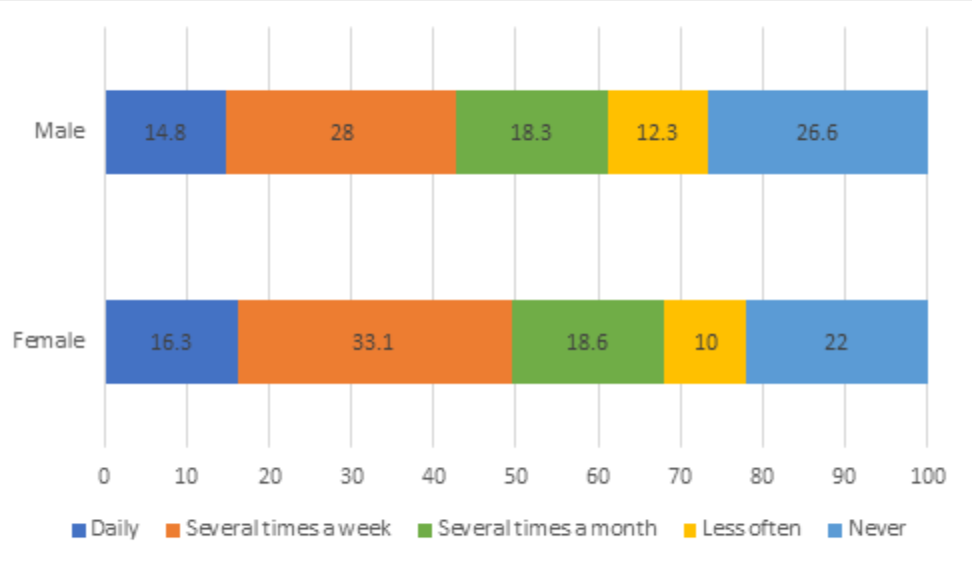
A recent Eurofound survey found that women would prefer to work remotely more frequently than men, and this gap increased over the course of the pandemic. While in the summer of 2020, 43.6% of men said they would prefer to telework daily or several times a week, compared to 45.1% of women, the results from early in 2021 (Figure 8) show that this share increased for women to 49.1%, while it decreased slightly among men to 42.8%.  

Figure 8: Remote work preferences by gender figure8

Note: Data from survey round 3 (Feb/Mar 2021). Respondents were asked:” If you had the choice, how often would you like to work from home if there were no restrictions due to COVID-19?”. Source: Eurofound (2020), Living, working and COVID-19 dataset 

Evidence from before the pandemic suggests that teleworking can deteriorate career advancement opportunities, which may be a result of one’s performance being less visible compared to that of colleagues that are working in the location. Working from home can also exclude employees from informal networking opportunities with colleagues and supervisors, and eliminate the potential for spontaneous involvement in decision-making and project assignments. When these disadvantages disproportionately affect women, they could perpetuate existing difficulties of female workers to build relationships with their often-male superiors. As argued in Grzegorczyk et al. (2021), unless the disadvantages created by selective teleworking are addressed, we will see gender inequalities deteriorate.  

Policy recommendations 

There is a significant risk of increasing divergences and persistence in the effects that we identify. Policymakers should monitor socioeconomic gender effects carefully as we recover from the crisis. This includes looking out for adverse consequences of the conclusion of pandemic support programs such as inequal increases in financial fragility or poverty rates. Policymakers should invest in financial literacy programs to improve people’s ability to manage their budgets before and during economic recessions. Financial literacy has been found to be an important element in reducing financial fragility, and financial literacy is lower among women then among men.  

In addition, policymakers should shift their attention to unpaid care work. Investments in long-term and elderly care and expanding childcare availability for parents of young children will support especially women and allow them to allocate more time to effective, paid work. Reforming current parental leave legislation to establish paid paternity leave beyond two weeks throughout the EU would furthermore contribute to a more equitable sharing of care responsibilities between mothers and fathers. 

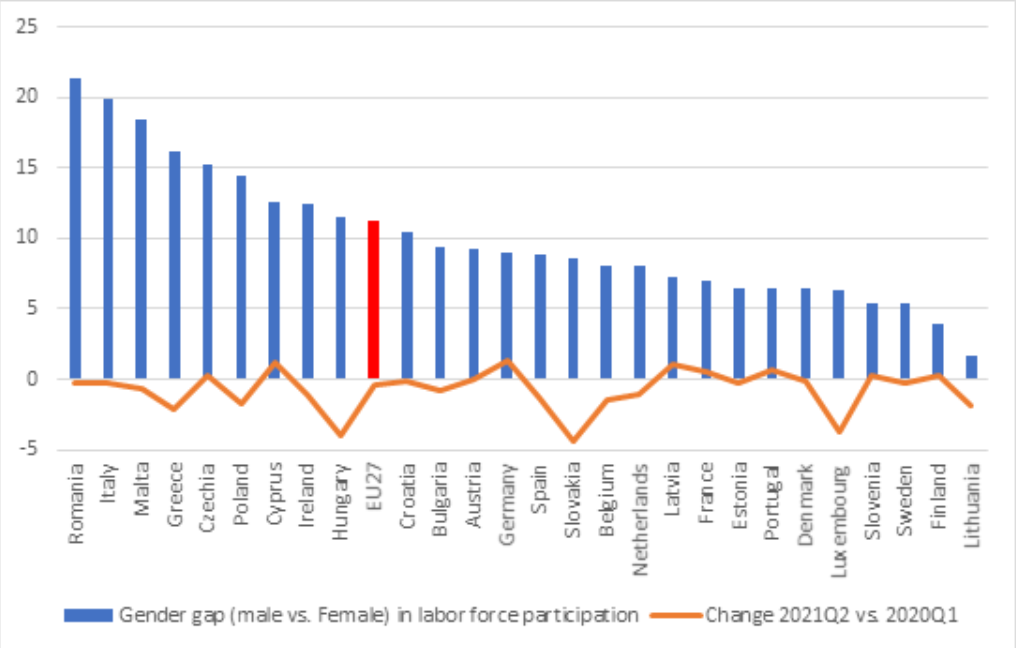
More women lost their jobs during the pandemic. In particular women with low levels of education have not yet recovered fully from the unemployment shock of the crisis, and there is a risk that this larger gender unemployment gap will persist. At the same time, the crisis does not seem to have driven women out of the labor force at higher rates than men (Figure 9). According to the latest data, the gender gap in labor force participation has not worsened since the onset of the pandemic and even improved in a number of countries, which is good news for the economic recovery. Nonetheless, the gap remains substantial in many countries, and low female labor force participation is a structural problem worth addressing.  

Figure 9: The gender gap in labor force participation, 2021Q2 figure9

Bruegel based on Eurostat (lfsi_emp_q). Note: We calculate the gap by subtracting the share of women in the labor force from the share of men in the labor force. A positive bar therefore indicates lower female labor force participation. The change over time is calculated so that a positive (negative) value indicates a widening (narrowing) of the gap.  

In the future, there will be a permanent shift towards more remote working, which will be taken up at higher rates by women than men. Knowing that remote work can have adverse consequences for career opportunities and wages, policymakers should address the potential risks of deepening disadvantages for women in the workforce. This includes raising awareness for biased assessments of teleworking employees and carefully monitoring emerging trends and gender dimensions in labor market outcomes.  

The policy response so far to address the gendered impact of the pandemic has been limited. For example, only three countries dedicate any funds from their allotment of the Recovery and Resilience Facility (RRF) to initiatives specifically addressing gender inequalities. Austria, Belgium and Italy together will invest 878€ million on women’s issues in the areas of health, social infrastructure and labour markets. Extending the filter to include funding dedicated to the support of working parents, such as on childcare and nurseries, the amount climbs to 6.8€ billion which still only amounts to less than 1% of the RRF2.  

Next generation EU is not purely a tool to stimulate economic recovery, but has the explicit purpose to set the EU economies on a more sustainable, digital, future-proof growth trajectory. This structural orientation makes it the right tool to use to prevent a perpetuation of existing obstacles to female labor market participation, advancement and outcomes. Although the explicit spending on gender equality measures is small, the impact of the remaining 99% of investment on women is yet unknown, and we encourage the EU and its member states to conduct gender impact assessments of all initiatives to ensure investments contribute to a more equitable future for women and men.  
 
This article was originally published in Bruegel on 3 November 2021. It can be accessed here: https://www.bruegel.org/2021/11/the-socioeconomic-effects-of-covid-19-on-women/ 

About the Authors

Maria DemertzisMaria Demertzis is Deputy Director at Bruegel. She has previously worked at the European Commission and the research department of the Dutch Central Bank. She has also held academic positions at the Harvard Kennedy School of Government in the USA and the University of Strathclyde in the UK, from where she holds a PhD in economics. She has published extensively in international academic journals and contributed regular policy inputs to both the European Commission’s and the Dutch Central Bank’s policy outlets. 
 
Mia HoffmannMia Hoffmann works at Bruegel as a Research Assistant. She studied International Economics (BSc) at the University of Tuebingen, including one semester at the Università di Torino, and holds a Master’s degree in Economics from Lund University. Her previous research focused on the impact of migration on economic growth and analyzed the effects of childcare policy on household bargaining. Her current research interests involve issues related to trade, labor markets and inequality. 

Learning The Benefits Of Podcasts For Your Business Marketing

Podcast

In recent years, the popularity of podcasts has skyrocketed so much that even Spotify, a music streaming company, has signed a deal with Joe Reagan to host his podcast on the platform exclusively. Podcasts were once thought to be an outdated trend but the outbreak of COVID-19, WFH (Work From Home) and lock-downs have changed that. Nowadays, even various internet influencers and 3Patti celebrities are starting their podcast sessions on multiple topics – be it technology, business, marketing or any other.

Since, more people are jumping on the podcast bandwagon, companies & businesses are considering the use of podcasts as one of their digital marketing strategies. Hence, it’s essential to learn more about podcasts and how you can use them for marketing your business – which is why we’re going to discuss the same in this comprehensive guide.

What Do You Mean By A Podcast?

A podcast can be defined by a series of different episodes, which are digitally formatted and programmed, focusing on a specific topic or theme such as start-ups, technology, Money Earning Games like poker, celebrity gossip, sports or any other. In other words, a podcast can be defined as radio, except in digital form.

Usually, podcasts are free to listen to and can be obtained on a variety of platforms. All you need is a compatible device along with an internet connection.

The origin of podcasting was in the year 2004 by a software developer known as Dave Winner and his buddy Adam Curry (who was an MTV VJ) and the term ‘podcast’ was first coined by Ben Hammersley. As of the year 2022, more than 900K podcasts are streaming and more than one million people are listening to them each month. Hence, the potential is huge.

The Rise In Popularity Of Podcasts

In the year 2009, it was reported that more than 9 per cent of adults aged between 18-49, were listening to podcasts. The percentage grew to 20 per cent in 2016. Then in the year 2014, BBC reported that their podcasts have been downloaded over 1.1 billion times in the UK itself.

Research says that more than 55 per cent of internet users know what podcasts are, which is indeed a massive benefit. Furthermore, the intimacy & convenience shown by pod casters is also one of the major reasons why podcasts have become so much popular.

Benefits Of Utilising Podcasts For Your Business Marketing

1. Podcasts Are Great For Audiences On The Go

If you’ve been in the marketing business for some time, then you probably have seen your clients utter the words – ‘didn’t have the time’ – multiple moments. To deal with such audiences, podcasts should be implemented because they can be consumed on the go. Since a podcast is an audio medium, your audience can listen whenever, wherever they want – whether they’re riding in a train or taking their pets out for a walk.

2. Podcasts Help In Company Promotion

Similar to other marketing assets, podcasts can also help you in building brand recognition & awareness. Since the podcast is from your company house, you can dictate the content as per your needs. For instance, if you have a product or service launch coming up, you can advertise the same with your audience.

3. Podcasts Help In Performing Deep Dive Into Various Topics

Even though marketing nowadays depends on short audio & video content, podcasts still provide the niche ability to create long-form content. It can be possible that you need more time to discuss something important with your audience and Youtube Shorts or TikTok will not be enough for the same. Times like these are when you need to utilise the benefits of podcasts because using podcasts you can create product reviews, interviews and even discuss important company affairs.

For more business-related inquiries, contact us today.

Safety and Security Tips for Your Supplement Business

Supplement Business

If you’re an entrepreneur with a passion for health and wellness, the nutritional supplement industry is the perfect business opportunity for you. It’s an industry worth over $70 billion and is growing steadily at a rate of over 8 percent annually. Furthermore, people in the United States are more health-conscious than ever before, making this a great time to get into the nutritional supplements industry. However, it’s a tough business, and you need all the right resources to protect it from the many pitfalls that lie in wait.

Safety is one of the top concerns for brands in the supplement industry, as their customers expect them to deliver products that are both effective and safe to use. Furthermore, you must also invest in physical security to keep your business and team members safe from potential threats. There are a lot of supplement makers to look out for, which is why we’ve put together this brief guide to help you cover all the potential security threats. Continue reading to get some safety and security tips for your supplement company.

Do your due diligence when looking for a supplement manufacturer

As we mentioned in the introduction, customer safety is one of the most important concerns for supplement companies. Indeed, customer safety starts during the formulation process, which is why it’s important to work with the right supplement manufacturers to ensure the safety and efficacy of your products. Makers Nutrition is a supplement maker with years of experience in the nutritional supplement industry, and they provide private label services to supplement companies in need of top-notch labs and superior supplement manufacturing processes. Makers Nutrition has an FDA-approved lab, and they work closely with their clients to provide formulation and testing to ensure the effectiveness and safety of their nutritional supplements.

Use access control solutions to secure the premises

You should never underestimate the importance of physical security to your business operations. After all, the safer your team members feel, the better they’ll perform on the job. Swiftlane is one of the nation’s leading providers of access control systems. Their access control solutions enable users to lock and unlock doors and arm their alarm systems using a mobile app. Check out this SwiftLane review to get insights into how their mobile access systems can improve your building security.

Print all the necessary nutrition information on your labels

Another way to promote safety in your business is to go the extra mile to provide potential customers with all the information they need to make wise decisions about your products. Your labels should list all the active and inactive ingredients in your dietary supplements. Of course, FDA regulations dictate that you must list all the ingredients in your supplements on the fact sheets for your products. However, it’s a good idea to go the extra mile to provide consumers with any additional information that will tell them how the product works.

Invest in the right insurance products for your business

Another way to protect your business is to get the right insurance coverage for your company. As a supplement company, you’ll need general liability insurance and product liability insurance. Hopefully, you’ll never need to make claims on those policies, but it’s better to have them and not need them than the opposite.

Ultimately, making dietary supplements is all about helping people to achieve wellness and happiness, meaning safety should be a core tenant of your business model. The most important step to promoting safety in your business is working with the right supplement manufacturer. Makers Nutrition has years of experience in the industry, and they have a well-deserved reputation for making high-quality nutritional supplements. Working with a company like Makers Nutrition makes your job of keeping your company and customers safe much easier.

6 Smart Cookware Options For Healthy Cooking

Cookware

It is not just the food that you eat, but also the cookware influences your overall health. All cookware is not built the same. Some of them are expensive while the others are pocket friendly. Some retain heat better than others. And some cooking materials may pose health risks that others don’t. Before you purchase a sparkly new set to cook meals for yourself and your family, it’s certainly important to know whether it’s safe.

In this blog, we are going to list the healthiest and safest cookwares for your kitchen.

Cast Iron

Out of all alternative options out there, cast iron is incredibly versatile, very durable, and relatively inexpensive – so, it’s no surprise that it’s one of the most popular cooking materials out there.

Molded  from a single piece of metal, an alloy of carbon and iron, cast iron uses no other additives or toxic substances. Cast iron is naturally non-stick, allowing anyone to replace non-stick pans and use this healthier alternative which consumes less cooking fat in the process.

Stainless Steel

A staple in many kitchens, stainless steel is made using steel forgings which guarantees strength and durability. But if you’re wondering whether stainless steel cookware is safe, well, it also comes with a couple of health concerns you should be aware of before purchasing.

The steel itself is not the problem. It’s completely non-toxic, the same as cast iron. The issue is the substance that coats it.

Usually, you’ll get one of the two options. It’s going to be either chromium or nickel. Chromium is essential for the human body, but only in small amounts, and can be derived from food. Nickel, on the other hand, is considered harmful to the human body as some of the residue is likely to get ingested with food overtime.

Aluminum

Aluminum is a terrific heat conductor, and aluminum cookware is really inexpensive. However, aluminum itself has a few problems: it reacts with acidic foods and leeches pretty badly. Aluminum consumption is linked to Alzheimer’s disease, as well as some other conditions.

But not to worry. There are two commonly-used options to treat aluminum cookware and avoid this problem. It’s either a non-stick layer or anodization.

Ceramic

Ceramic cookware has a reputation for posing a very low risk to your health. We have to agree. After all, at its core, ceramic is nothing but clay, baked at super high temperatures. It’s eco-friendly, entirely non-toxic, and non-reactive, making it a solid option for most cooks. However, a lot of it isn’t suitable for cooking on a stovetop, especially if it’s an induction one. Another problem with ceramic is the glaze and paint on the ceramic dishes (especially older ones), can potentially include lead – a highly toxic substance.

Granite

Modern graniteware cookware does not contain any widely-known harmful substances. It is oven and stove-ready. Although a drawback is that it’s not really non-stick and will require a big glug of fat for cooking pretty much anything. Also, modern graniteware utensils simply tend to be on the lighter side, meaning they won’t hold heat as well and won’t be suitable for all kinds of cooking.

Copper

Copper is less commonly found in a regular kitchen. The most expensive out of the options on this list, it’s valued for both the aesthetics and supreme heat conduction – it conducts the heat up to 5x better than regular iron, and up to 20x better, when compared to stainless steel! Copper cookware is usually lined with another metal, such as tin, which is not reactive, and won’t leach into your food. The drawback is that tin is also very soft and has a low melting point of around 450°F. This means that leaving the pan unattended over high heat and scrubbing hard while cleaning will remove the tin, and expose the copper.

Bottomline

Making healthier choices is an option while purchasing these cookwares. Know what works best with your lifestyle and choose accordingly.

The Different Tax Implications of a Lottery Jackpot Win

balls-g9d5ec8011_1920

A syndicate recently celebrated winning the €19,060,800 jackpot in the Irish National Lottery, defying odds of 1 in 10,737,573 in the process, but what are the tax implications of winning a lottery jackpot?

This is a topic worthy of discussion as lottery players now have the opportunity to take part in international lottery draws worldwide.

Tax considerations for lottery players in the UK and Ireland

The good news for the Irish syndicate is that lottery winnings are not taxable on the Emerald Isle. But it is important to be aware that some taxes, such as deposit interest retention tax, gift tax and inheritance tax can apply at a later date.

Similarly, in the United Kingdom, there is no tax payable on lottery winnings, but again, players should note that income tax on deposit interest is payable and there are also potential gift tax and inheritance tax implications.

Tax implications for lottery players in the United States

These examples are in contrast to the situation in the United States, where US lotteries such as Powerball and MegaMillions are subject to federal tax and in some cases, state tax deductions.

For example, CNBC reported that in 2021, a single ticket won a $699.8M jackpot on the Powerball. As is customary, the winner has the choice of accepting their winnings as a lump sum or paid as an annuity over a period of 30 years. If the winner decides to elect for the lump sum, as the majority of lottery winners do, they will receive a sum of $496 million which would be subject to a 24% federal tax charge. So, after tax deductions, they would be left with approximately $377 million. However, the winners of a lottery jackpot would be likely to face additional tax payments to the IRS at tax time.

Nevertheless, some variations do exist in the USA. In California, there are generally no state tax deductions on lottery prize winnings but federal taxes still apply. In New York City, winnings are subject to a state income tax (10.9%) and a local tax (3.876%).

It is important to note that there are implications for non-US citizens when playing US lotteries such as Powerball and MegaMillions. Lottery winnings in the US are subject to tax, which means tax is deducted from the winnings of lotto players from abroad.  

players from abroad

Source: Lottoland

Winnings from the MegaSena lottery in Brazil are also subject to income tax at a rate of 13.8 percent and there are also some European countries that charge tax on lottery winnings. While the Spanish Christmas El Gordo lottery offers the best odds of winning the jackpot at 1 in 100,000, there is a 20% tax on winnings over €2,500.

Therefore, while tax is not payable on lottery winnings in the United Kingdom and Ireland, it is important to remember that some taxes, such as gift tax and inheritance tax can apply. In other countries such as Spain and Brazil, tax is payable on lottery winnings. As the example of the Powerball winner in the United States demonstrates, the tax charges can reduce the jackpot by a hefty amount, but the winners of mega jackpots will still be left with a large sum of money.

Vanguard Group Has Suspended Purchases Of Russian Securities

Stock market chart. Russian market collapses because of invasion of Ukraine and the global sanctions against russia.

Regardless of your feelings towards Russia and Ukraine, the invasion is having an impact on just about everyone. In the US, sanctions on Russian fuel imports have already sent the gas price to historic highs. In the UK, Russian oligarch Roman Abramovic’s ownership of Chelsea Football Club is making it impossible for fans to buy tickets to matches. Around the world, it is impacting financial vehicles like mutual funds.

This last has become evident as Vanguard Group, the second-largest investment firm in the world, has announced that it will be suspending purchases of Russian securities for the foreseeable future.

It may not seem like such a big deal. After all, less than 0.01% of current clients’ assets will be impacted by the decision. Vanguard Group simply does not generally invest in Russian securities. However, considering the type of company Vanguard Group is, this decision has interesting implications.

What is Vanguard Group?

As mentioned, Vanguard Group is an investment firm and the largest provider of mutual funds and the second-largest provider of exchange-traded funds (ETFs) in the world. However, unlike many other investment firms, Vanguard Group’s ownership structure is entirely made up of its funds which are owned by shareholders. Shareholders are therefore the only true owners of Vanguard Group.

Any firm that is owned by its shareholders is somewhat restricted in its decision making. While the individuals running various parts of the firm make the majority of decisions without direct shareholder input, big decisions like these are generally controversial. There will be many shareholders who are happy to take a stance against the Russian invasion of Ukraine, but others may not be so eager to do so.

This decision is therefore a strong statement by the fund managers that they are ready to take on any backlash. It certainly helps that the wealth of their shareholders will likely not be particularly impacted by this decision. Still, it is a bold step to take for such a big investment firm with so many stakeholders.

Other Factors Dominate

Individuals with money at stake may be more consumed with other factors which will impact their money. The suspension of purchases of Russian securities will not have nearly as big an impact as the sanctions placed on Russia by the US and other countries. With the US now banning all fuel imports from Russia, there is serious risk of major economic implications to come.

The gas price has already risen to its highest ever value. This is likely to increase the prices of all consumer goods in the immediate future. Inflation has already been at record highs. Now there is the risk of so-called stagflation. Stagflation refers to a scenario where rising inflation does not coincide with economic growth.

Recession could be imminent, with many markets at risk of crashing after months of recovery. Individuals with wealth tied up in mutual funds could see their finances taking a major hit. It is unclear what the best course of action is, but it seems that, whatever happens, upheaval is guaranteed.

Russia’s Role

The question many shareholders might ask is whether Russia is really impacted by decisions like that of Vanguard Group. The reality is that a decision that will hardly impact shareholders is not going to have much of an impact on Russia. However, in scenarios like this one, it is a scale that these things make a difference. The more firms that implement restrictions on Russia, the harder it will be for this invasion to continue indefinitely.

There is also the matter of reputation. A firm like Vanguard Group cannot afford to take an ambivalent position on Russia’s invasion of Ukraine. Before their suspension of purchases of Russian securities, people were already asking questions of their intentions. This is not just happening to investment firms, but to whole industries and even governments around the world. Neutrality is simply not an option.

Fund managers at Vanguard Group are unlikely to face too much opposition or backlash from shareholders. There will always be those who do not like unilateral decisions being taken, even if they agree with them. But most people will recognize the fact that a failure to act would have been unsustainable.

It remains to be seen where the Russian invasion of Ukraine will take the world economy. For now, we can only hedge our positions and continue to monitor the situation.

EDITOR'S PICK OF THE WEEK

CFO's new mandate. CFO explaining the presentation

The Performance and Transformation Orchestrator: The CFO’s New Mandate in the Age of AI

By Terence Tse CFOs are evolving into AI-driven transformation orchestrators, balancing finance, technology, and strategy while upskilling teams, managing risks, and driving measurable business value. A key insight from this year’s AI for CFOs event, organized...

WISE DECISION MAKER GUIDE

POWER INFLUENCERS

Emerging Trends

The Future of Global Trade