Home Blog Page 715

How to Grow Your Retail Business

retail business

These are interesting times. Starting a retail business has never been simpler; all you need is an idea, a product and an online storefront. E-commerce has effectively lowered the barrier to entry for a rush of hungry entrepreneurs.

But growing a retail business? That’s another matter entirely. Because e-commerce has levelled the playing field for new businesses to sell various products (white-label, private label, etc.), expanding a retail business requires overcoming stiff competition. The same goes for brick-and-mortar retailers, who find themselves in the unenviable position of competing against physical and digital storefronts. A retail consulting company like https://www.heliotech.ca/ would be able to help identify areas to start improvement.      

Still, it’s possible to expand your retail store. Below, let’s explore how to grow your business by using retail data science, adopting a global mindset, shoring up your logistics and fulfillment solutions and crafting an omnichannel user experience.

Think Globally

At its most basic, growth requires expansion – expansion into new markets, new countries, and among new customers. It seems obvious, right?

But expanding into foreign markets requires research, scoping, preparation, and a renewed focus on shipping and logistics. In the sections below, we’ll cover how a creative logistics plan and strategic partnerships can aid in the foreign expansion process, but let’s tackle some first steps.

You can start by researching and calculating product demand (using competitor analysis tools, SEO tools and Google Trends) to determine where you should expand. Next, outline the scope of your expansion so you can create a workable roadmap toward your business goals. Price your products according to local competitors and local conventions (i.e., avoid the number “4” in China). Finally, prepare a customer service plan that addresses international customers.

Solve the Last-Mile Problem with a Smart Partnership

Whether you plan to grow locally, nationally or globally, you’ll need to address “the last-mile problem.”

A critical competitive differentiator in modern retail is how quickly you can get your product to a consumer. Customers have come to expect on-demand, same-day delivery. The “problem” is that this last leg of the supply chain process is often the most costly and time-consuming.

Therefore, one of the best pieces of advice for how to grow your business is to forge a partnership that deals with the last-mile problem. Look for a global network of micro-fulfillment centres, like REEF, that can position your product close to consumers. By situating your fulfillment solutions in dense, urban areas, you can turn a last-mile problem into a last-block solution, leveraging faster delivery – 30 minutes in some cases. Plus, you can advertise your products in their digital storefront, reaching a host of potential new customers.

Create an Intuitive, Omnichannel UX

Seamless user experience across channels is at the heart of contemporary retail growth. As McKinsey points out, while omnichannel used to be “the bleeding edge of retail,” it is now “a requirement for survival,” as most young consumers value seamlessness over traditional channel boundaries.

Creating an intuitive, omnichannel UX requires mapping the customer journey across your physical, web, social and mobile presences.You need to deliver cohesive, cross-channel touchpoints. If you aren’t sure what proactive steps to take toward the omnichannel experience, don’t worry; it takes some time to understand. To start, read through this list of omnichannel experience examples, which also includes advice for building an omnichannel marketing campaign.

Payday Loans: Financial Lifesavers, Not Predators

payday loans

The Canadian economy has started to regain its footing. But, many households are still struggling to achieve financial stability. Given the drastic changes before, it may be hard to return to pre-pandemic life. Loans are still high, although the percentage of defaults decreased in 2020.

But these events have taught us the value of financial literacy. It is even more apparent now that interest rate hikes may happen soon. Payday loans are taking the spotlight today as bank loan approvals remain stringent. Hence, we will look at tips to avoid getting stuck with interest and borrowing fees.

The Financial Well-Being of Canadians in the Pandemic

In the last year, Canada has taken the path to recovery and post-pandemic growth. Along with it is the increased awareness of the importance of building and maintaining financial resilience. The unexpected events that transpired stimulated every household’s urge to create a financial safety net. The surge in hospitalization, borrowing, and bankruptcy revealed income and wealth disparity. As such, people became desperate to cover all constant and emergency expenses.

However, the lower-income employees and small businesses felt the most impact. The fiscal and monetary support was not enough to bridge the financial gap in the country. Financial vulnerability remains a concern for many individuals, especially the unemployed. In a survey conducted by Statistics Canada, 22 percent of Canadians had difficulty meeting their basic needs in 2Q 2020. The efforts were almost futile as the rate remained high at 21.7 percent in December 2020.

Even so, the financial literacy of many Canadians increased. The default loans became lower than their pre-pandemic level. In 2021, the recovery began as more businesses and jobs reopened. The percentage of difficulty covering basic needs went down to 19.3 percent at the end of the first half. In the same survey, the number of households below the poverty threshold also decreased.

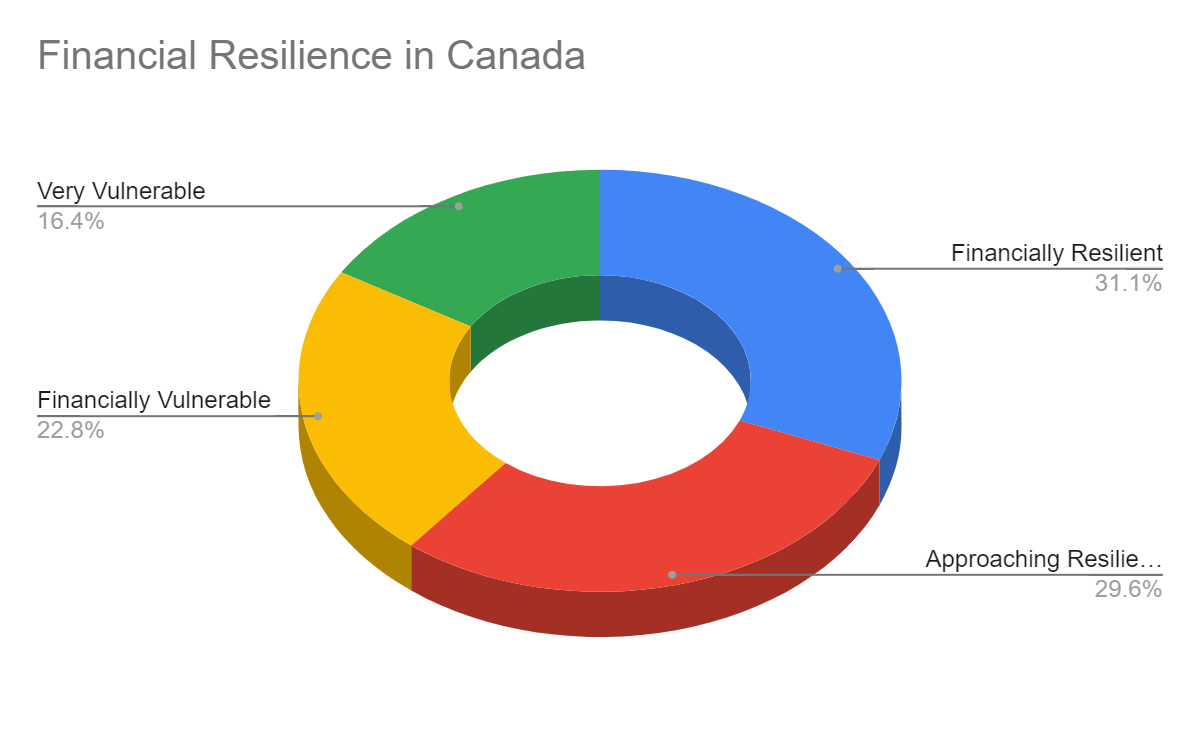
These are the primary aspects that point toward improving financial resilience. The financial resilience score rose from February 2020 to February 2021 from 50 to 56. The demographics showed that 31.1 percent or 8.03 million people in Canada were financially resilient. Over seven million people, or 29.6 percent, were approaching financial resilience. But, the remaining 39.3 percent were still financially vulnerable.

But, the study showed an improvement in the behaviors of many households. For example, 62.1 percent of households reduced their non-essential spending. Another 23.9 percent said they have started to establish an emergency fund. It was higher than the previous year at only 18 percent, proving the increased financial literacy. So, more households today are geared towards recovery and resilience amidst their different paces.statistics canada

The Role of Payday Loans in Financial Stability Amidst the Pandemic

The restrictions led to limited operations, net losses, and massive layoffs. A recession lowered interest rates to encourage borrowings and spending. But, banks became more stringent, making it harder for the jobless and underemployed. The increased transmission and hospitalization further aggravated the situation. It was more felt by those within the poverty line.

Thankfully, payday lenders were more than willing to accommodate those who needed instant cash. They helped many lower-income households meet urgent expenses. They were prevalent among those earning less than the average salary.

Payday loans are non-discriminatory as everyone is welcome regardless of salary. The processing only takes a day, helping you get access to what you need immediately. The maximum amount you can borrow is $1,500, depending on your financial capacity.

In Alberta alone, 35 percent borrowed $150-500 per lender in 2020. It proves that most of them were either jobless or had lower earnings. The remaining 65 percent borrowed at least $500. And since the default loans were only 8.8 percent, it is safe to assume that the fees were still reasonable. As such, payday loans became a lifesaver, not a financial predator.alberta government

Tips to Avoid Getting Stuck With Payday Loans

Payday loans are more lenient than banks. The application and approval process is faster and more convenient. But, the interest rates can shock you. Here are the things you must remember before applying for a payday loan.

Make Sure that the Payday Lender is Regulated

Knowing whether a payday lender is regulated or not will help you avoid problems in the future. It assures you that you are protected by law. Many borrowers experienced harassment from unregistered payday lenders.

Read the Payment Information

Both payday and installment loans have fixed payment schedules and interest rates. Note that payday loans interest rates are not the same in all provinces. If possible, try to compute the accumulated interest and assess whether it is worth applying for or not. In Toronto, a borrower of $1,965 for a couch and other purchases ended up paying $5,850 in three years.

Borrow What You Need

Payday and installment loans are meant for emergencies and not for impulsive buying. Borrow the amount that will cover your essential purchases to avoid overspending or paying a higher amount.

Live Within Your Means

The first step to avoid borrowing is not spending more than you earn. If possible, set aside an amount for your savings and investments.

Always Pay on Time

Always pay on time to avoid paying higher interests and extra fees. Practicing it may help you finish your payment sooner than you expect.

Bottom Line

The financial capacity of many individuals is improving, although their struggles remain evident. Payday loans will help cover urgent expenses and stabilize finances. Their interest rates may be higher than usual, but their leniency is vital during unexpected events. And as long as you keep track of your finances, payday loans will not be a problem for you.

How can Human Resource Management Help Your Business Grow?

business grow

Human resource management (HRM) is the process of managing people in organizations in a structured and thorough manner. Using AI for recruitment software, human resources can improve their ability to find and hire the best-fit candidate from a pool of applicants in a smarter, faster manner, and without bias.

Human resources management involves all management decisions and actions that affect the relationship between the organization and its employees. The success of an organization lies on the shoulder of its human resource management.

Importance of Human Resource Management

HRM is an important aspect of sustaining and increasing the health of a business because a company is only as good as its employees. HR managers, often known as talent recruiters, watch the state of the job market to help the company stay competitive.

This could entail ensuring that salary and benefits are fair, that events are organized to keep employees from becoming burnt out, and those job duties are tailored to market conditions.

HR managers help recruit new professionals with the capabilities needed to advance the company’s goals. As well as assist with the trainings, HR courses, and development of current employees to meet objectives.

 Objectives Of Human Resource Management

The objectives of HRM are:

  • Maximize the productivity of an organization by increasing the effectiveness of its employees, part of which can be achieved through hr courses online. These courses can help hone the skills and abilities of each employee, providing the company with well-informed and proficient individuals.
  •  Provide and maintain productive employees by helping the organization achieve its goals.
  •  Make effective use of each of the employee’s skills and abilities
  •  Ensure employees receive the necessary training
  •  Communicate company policies, procedures, rules and regulations to employees.
  •  Maintain ethical, legal and responsible workplace policies and behaviors. 
  •  Manage external influences that may have an impact on people within the organization. 

HRM staff members are responsible for ensuring that the organization goals, visions, and values are shared and give an overarching reason for employees to want to work for their organization. These elements can be motivating and make employees feel as if they are part of something bigger than them.

They are mentors and members of employee teams that address philanthropic giving, employee engagement initiatives, and employee family gatherings.

Employees who work in HRM must also assist in protecting their employer and company from lawsuits and the resulting workplace disruption.

For a company to meet its goals, it must have employees who will help them meet them.

Ways HR Can Help Grow Your Business

1. Hire The Right People  

A well-running and successful business means that there are even more excellent people behind it. In order to build an outstanding team, you need to identify and hire the best candidates for the job. 

You can identify suitable personnel with the help of a talent acquisition management system. This software makes use of artificial technology (AI) to effectively filter employees with the greatest potentials. As such, it decreases the time spent on scouting new talents. 

The use of AI in recruitment does not only hire the best candidates, it also reduces the perennial problem of employment bias. Using a talent acquisition software eradicates human bias as it doesn’t consider anything else other than the applicant’s credentials. It’s a win for both the employer and applicant. 

2. Build Your Brand And Culture

The values, expectations, and practices that guide how your team collaborates are known as organizational culture. Every successful firm relies on its brand and culture, people’s perceptions of your company will be influenced by the organizational culture. HR has the time and resources to devote to developing a brand and culture that works for you and your team.

3. Plan For Growth 

You’ll need to hire more people as your company grows. Outsourced small business HR services plays an important role in growth planning since it is aware of the positions that need to be filled.

HR gives invaluable information about potential challenges and the time it will take to fill these roles, both of which are crucial to success. HR can assist you in developing a strategy to get top personnel on time by anticipating your future growth.

4. Employee Turnover

Planning management, training, and benefits help decrease poor retention rates and increase recruiting expenses. Employees who resign or are fired can have a negative impact on the organization in a variety of ways, including project delays, decrease in productivity, increased recruiting costs, training obligations, and a negative impact on team morale.  

HR planning can help you improve your ability to keep staff with the correct initiatives in place.  By conducting employee satisfaction surveys, putting in place policies and procedures to avoid confusion, developing morale-building programs, creating benefits packages, and instituting effective management-to-staff communication 

5. Invite Feedback

It’s important to request feedback from employees if you want to track employee satisfaction. Employee feedback is one of the most valuable data sets you can collect about how your company functions. And whether it is living up to the company culture you want to establish. 

Your HR team is in the ideal position to elicit employee feedback and analyze data to discover solutions to common concerns because they have access to everyone in your company. Employees are also more willing to provide feedback to HR since they know their problems will be addressed and their personal information will be kept secure.

6. Training New Talent

To welcome your new hire, your HR staff will need to develop an employee onboarding procedure. This will help them with the necessary skills and organizational knowledge. The sooner you teach your new staff the values of teamwork, transparency, and continual improvement, the better. Putting in place systems, processes, and policies that foster a positive employee experience. 

Every employee will be required to master the skills and procedures that are unique to their position. HR should standardize employee training, provide informational manuals, choose individuals to manage new hires, and so on. Having such a procedure in place will help new employees spend less time learning and more time delivering to their full ability in their new capacity.

7. Employee Growth & Performance Management

Employee development and performance management are two of the most crucial parts of an HR strategy for corporate growth. Monitoring staff development requires a robust performance management system. Tracking an employee’s performance, comparing it to particular key performance indicators, and identifying their strengths and areas for improvement are all part of how you keep track of their progress. 

Your HR department should be in charge of putting the performance management system in place. A performance management system’s data is a rich source of information about an employee’s goals and future career moves.

8. Perks and Benefits

Perks and benefits are important to employees, and HR understands this. Creating incentive and recognition programs that make employees feel valued and, as a result, increase their retention movement. 

9. Promote Leaders

People in positions of power must have the team’s respect. You’ll build a team that works together by working in conjunction with leaders and recognizing and promoting leaders. assisting people managers in enhancing their leadership and development skills.

Conclusion

A functional  HRM system enables an organization’s staff to contribute to the fulfillment of the organization’s objectives. Allow your human resources staff to assist you in growing your company. Give them the authority to build a workplace that attracts the finest and brightest. When you put the right people in the appropriate positions, you’ll be unstoppable. And that’s how you’ll be able to grow your company. Decades of research show that effective human resource management practices lead to higher business growth rates.

Filipino Bride Price—How Much Are Filipina Brides?

filipins bride price

Fame about Filipino ladies for marriage has gone worldwide since these women have most qualities a perfect wife should have. It encourages foreign men to find a Filipina wife, and they start their search using a variety of different ways. Some guys decide to take advantage of the most popular and efficient approach of Filipina wife finder. They join popular platforms, see a range of paid services offered, and wonder, can you buy a Filipino bride indeed? Fortunately for all single men, it’s a popular tendency for Philippine women for marriage to become members of mail order bride platforms, like Eastern Honeys or Orchid Romance, and look for foreign husbands there. Excited to learn how it works and what an average Filipino mail order brides cost is? Follow this article to discover it!

Filipina mail order bride price on top sites in 2022

All you should know about Philippines brides prices is collected here. Take a quick look at how much it costs to find a Filipina wife on top mail order bride sites.

Site Membership Cost/Credits
Eastern Honeys Credits $44.99 (125), $149.99 (750)
CuteAsianWoman Credits $96 (16), $399 (100)
DateNiceAsian Credits $96 (16), $399 (100)
Orchid Romance Credits $44.99 (125), $149.99 (750)
AsiaMe Credits $96 (16), $399 (100)
AsianMelodies Credits $44.99 (125), $149.99 (750)


Though each of these sites offers to meet women from Philippines by paying a certain price, it has nothing to do with human trafficking. Users pay money for Asian online dating services that help to connect Filipino brides for marriage with western men looking for soulmates. Therefore, the opportunity to ‘buy a Filipina wife‘ shouldn’t be perceived directly—it’s rather an investment into the development of romantic relationships. 

What’s so special about Philippines ladies for marriage?

Lots of males are attracted to single Filipino women since they have a number of unmatched benefits over women from other countries. They’ve combined many positive features of a good wife, including the following ones:

  • Excellent moral characteristics and sincerity;
  • Good discipline, manners, and obedience;
  • Loyalty and traditional family values;
  • Conservative views and upbringing;
  • Endless patience and perfect listening skills;
  • Awesome housewives and inborn chefs.

How much does it cost to get a Filipino mail order bride?

The fastest and most success-oriented way to meet Filipino women for marriage is naturally mail order bride platforms. But they aren’t the only point included in the general Philippines bride price. Let’s see 4 major types of expenditures included in the final sum.

Philipino mail order brides online dating services

There are hundreds of Filipino wives online, and most platforms don’t charge money for searching them. But communication and additional services there are usually not free. Men should get a premium membership or buy a paid plan for a certain period of time to get access to a wider range of features and achieve their goal. The amount differs from site to site, but the average sum spent by men on online interaction with mail order brides from the Philippines is $200 – $250.

✅ Meet Philippines women for marriage NOW

Philippino brides courtship

An important part of the Filipina mail order bride budget is wooing. Though local women aren’t used to being spoiled with expensive presents and luxurious dates, they still want attention and care from the men’s side. Overseas guys can pamper them with flowers, lovely gifts, and compliments, but these surprises are usually reasonably priced and won’t cost more than $1,000 on average. If you prefer to impress women in your taste, this amount can get even higher.fillipino woman with foreign husband

Trip to the Philippines

A step forward in every relationship with a Philippines girl for marriage is a real-life meeting, so men interested in serious romances need to visit the Philippines. It turns out to be one of the most significant parts of the Filipino mail order brides cost. Let’s find out why it’s so!

  • Flight tickets: a cross-Atlantic flight is around $6,500 – $11,000, while a one-way airplane ticket to European countries is a little cheaper and ranges between $4,500 and $9,000.
  • Accommodation: hotels and apartments aren’t expensive on these Isles, so spending a night there may cost from $30-$40 to $180-$200.
  • Food, transportation, and entertainment: a simple meal in the local cafe is only $4-$5 per person, but if you plan to have dinner in a good restaurant, prepare around $25-$30. A premium-class vehicle to rent is estimated at $45 – $60 per day, while the most popular sights of Manila and other large cities are quite affordable. For example, two tickets to Manila Ocean Park are $22, while a buzzing night for two in a popular club called Republiq is around $23.

✅ Click Here To Meet Single Philippines Women NOW

Moving a Philippino wife to man’s native country

One more costly part of the total Filipina mail order bride price is her relocation to another country. When a man manages to find Phillipina wife and marry her, he should prepare a certain list of documents and buy tickets to bring her home. People from the majority of states can enter the Philippines without a visa, but a local woman may need this document to arrive in the country of her husband’s citizenship. The cost of the visa and possible translation services are evaluated at $250.

Naturally, the price for a ticket to another country starts from $5,000, so if a man plans to travel with his new life partner, the one-way flight may be over $10,000.

The average price of Filipino bride

If you calculate the total sum of all expenditures mentioned above, you can see that the average price of Filipino wife may reach $20,000 and more. It’s clear that every situation and couple is unique, so this amount is only approximate and may either be increased or eliminated at will. It’s worth mentioning that the cost of dating services offered by sites like CuteAsianWoman or Eastern Honeys may reduce this budget by almost 10%.

Filipino bride price on the most popular sites

Since every platform with pretty Filipino women has its own price on services, it’s worth considering how much communication on each of them may cost. The following table provides detailed price lists of top sites.

 

Site Cost in detail A week of interaction cost


Eastern Honeys 20 credits (first order) – $2.99

20 credits – $9.99

50 credits – $19.99

125 credits – $44.99

250 credits – $69.99

750 credits – $149.99

10 minutes of chat – 20 credits

1 mail – 10 credits

Chat video – 50 credits

CuteAsianWoman 2 credits (first order) – $3.99

2 credits – $15.99

16 credits – $96

100 credits – $399

10 minutes of chat – 1 credit

Chat video – 2.5 credits

1 mail – 1 credit to send and 1 credit to read


DateNiceAsian 2 credits (first order) – $3.99

2 credits – $15.99

16 credits – $96

100 credits – $399

10 minutes of chat – 1 credit

Chat video – 2.5 credits

1 mail – 1 credit to send and 1 credit to read

Orchid Romance 20 credits (first order) – $2.99

20 credits – $9.99

50 credits – $19.99

125 credits – $44.99

250 credits – $69.99

750 credits – $149.99

10 minutes of chat – 20 credits

1 mail – 10 credits

Chat video – 50 credits

AsiaMe 2 credits (first order) – $3.99

2 credits – $15.99

16 credits – $96

100 credits – $399

10 minutes of chat – 1 credit

Chat video – 2.5 credits

1 mail – 1 credit to send and 1 credit to read

AsianMelodies 20 credits (first order) – $2.99

20 credits – $9.99

50 credits – $19.99

125 credits – $44.99

250 credits – $69.99

10 minutes of chat – 20 credits

1 mail – 10 credits

Chat video – 50 credits


Calculations prepared by Asianwomenonline.org

As you can see, the prices on these websites are quite reasonable. They depend on the activity on the platform, so members can choose those plans that meet their needs the most.

Difference in Filipina brides cost: offline vs online

No matter whether you’ve chosen to meet Filipino girls on dating site like Eastern Honeys or you want to try a traditional way of making acquaintances, you should remember that the cost won’t differ greatly.

An average American spends around $250 per date in real life, and this amount is enough to communicate for a month or more on a mail order bride platform. If you plan to have at least 10 dates, give your girlfriend gifts and lovely surprises, and make a voyage to her country, you can expect to spend almost the same amount (around $20,000) or even more!filipinowomanformarriage

How much does it cost to marry a Filipina?

If you manage to meet your Filipina soulmate in real life or online on Orchid Romance, an inevitable step will be to marry her. If you decide to do it in her motherland, it’s necessary to prepare a certain amount of money for the wedding. There are several key points to consider:

  • Marriage license: both a groom and an Asian bride should apply for a marriage license before marriage and pay $2 for it. However, the cost of documentary requirements needed for this application is estimated at $60-$80.
  • Church fee: to hold a wedding ceremony in the church, get ready to pay around $14-$80.
  • Civil ceremony: a cozy civil format is around $500, but the price can grow depending on your desires;
  • Wedding reception: an average dress may cost from $500 to $4,000 depending on the style, while a celebration for 150 people can be as much as $10,000 and more. Other paid services of a photographer, makeup professional, wedding planner are charged additionally.

Is it legal to buy a Philippines wife?

Undoubtedly, Filipino mail order wives for sale are a fully lawful approach to finding life partners. Since it has nothing to do with direct sales of people and it’s just a process of providing matchmaking services online, this method can be referred to as international dating, which is legal in almost all countries on the globe.

Therefore, there’s no sense to doubt that you should meet single Filipino girls online. It’s also one of the safest and fastest ways to find a Filipina bride, so it’s a good idea to try it!

Final thoughts

Though it may seem that mail order Filipino brides cost a fortune, the experience of numerous men who tried this service confirms that it can be even cheaper than traditional dating. It’s enough to make the first step and register an account on such popular sites as CuteAsianWoman, DateNiceAsian, or Orchid Romance, and you’ll see that meeting Asian girls can be even cheaper than going on traditional dates. Naturally, the most expensive stage of all mail order bride relationships is a trip to the Philippines and moving your bride home, but you can combine business with pleasure and enjoy beautiful marine sceneries together with your beloved Filipina mail order bride being there!

Advancements in Big Data Security Techniques

Big Data

The rapid advancements in technology have led to a resource that has made the world’s companies richer than in the oil boom era. Big Data is the oil of the 21st century, and it’s making waves on the global scene, helping giant corporations make informed business decisions. Moreover, the amount of data being collected just keeps growing as we deal with all aspects of our lives, from healthcare to social and professional. 


For example, healthcare experts are using big data to create personalized treatment plans for individuals, while manufacturing companies use it to monitor and even predict failures in their systems. The gaming world is also using Big Data to learn user patterns and introduce new and immersive classic casino slots to cater to the tastes of different audiences. Gameplay aside, Big Data is also a vital tool that is used to secure the most reliable gaming platforms such as Vulkan Vegas online casino because of the amount of money involved. If you’ve been having questions about how Big Data assists with providing such solutions, we shall cover all the strides that this lucrative resource has helped us make in our world today. But first, let us look at the origins of this data.

Where Did Big Data Come From?

Research shows that 90% of the data that has been produced in human history to date was created after 2010. Therefore, it means that data has grown to become ‘big data’ in just over a decade. It’s projected that by 2025, the world will be generating 120 billion gigabytes of data every day. The power that large companies have with access to most of this data has made billionaires and, very soon, trillionaires. But with great power comes great responsibility, and that is where big data security and privacy issues come into play. 

Since it’s an essential resource in our world today, data security techniques need to be applied to protect big data from cybercriminals looking to use it for their gain. This means that changes have had to be made to ensure that there is not just efficient data mining but also data handling and protection. We are talking about avoiding data breaches like the 2019 Facebook data breach that left more than 500 million accounts from 106 countries exposed. Yahoo has also had several breaches, with the biggest being the 2013 attack that affected over 3 billion accounts. The aftermath of these breaches is still being felt to date.

Big Data Security Approaches

The need to guarantee big data privacy and security has never been more critical for businesses. Consumers are already aware of the risks, but they also know that there are numerous benefits. Companies collecting data have had to quickly develop solutions that transcend the basic cybersecurity techniques, including data encryption, tokenization, anonymization & masking, data security analytics and data governance & compliance. The expansion of the big data market majorly relies on the ability of organizations to keep up with the rapid growth. 

AI/Machine Learning has become an integral part of big data and is the driving force that provides the theories and methods used in big data. However, that is not the only role AI plays in big data; it is also being used to analyze cyber incidents and detect potential weaknesses and threats in the systems and new malware types. While it’s possible for AI to be exploited for malicious use, companies that work with big data security vendors have seen much success in protecting their big data.

GDPR Legislation

Even before the Facebook breach, customers became more and more conscious of sharing their personal data, fearing that governments and businesses would misuse their personal data. While the data collected can provide better services and personalized solutions to consumer problems, storing it for too long may open it up to data breaches by malicious third parties. 

That is why the General Data Protection Regulation came into place in 2018 to make companies accountable for their use of collected data. While it is an EU regulation, its scope filters into companies outside of the EU, affecting how they deal with any data that can identify an individual. Users also have the right to request that their data be deleted. The fine for non-compliance is up to €20 million or 4% annual revenue (whichever is higher) for companies. 

Although it benefits individuals specifically living in the EU, companies have had to rethink their approach to the handling of personal data. With GDPR and similar regulations being put in place, we foresee a future where individuals have ownership of their data and businesses simply manage it.

What The Future Holds

Big data collection is exploding due to the increase in sources, including the ever-increasing IoT devices, social media, e-commerce sites, and many more. This poses challenges that need to be addressed from the root, especially when factors such as the 3 V’s (volume, velocity and variety), management environments and people are considered. 

Considering the security threats big data companies find themselves in daily, the question on everyone’s mind is ‘Will big data eventually blow up or will it blast us off to an even brighter future?’. Well, we can only hope that the advancements in ways to secure big data will be enough to protect the critical information that it holds. But then again, the rate of technological advancements in our day provides some glimpse of hope.

Digital Transformation in Education of Today

Digital Transformation

Almost every part of our lives have been influenced by digitalization to a degree. Today, 5.16 billion people have internet access. The connectivity that we can experience today allows people to communicate, receive news and explore other parts of the world, other cultures and other countries. 

The education industry has also been impacted by the digital transformation, and from elementary schools through high schools and university education, classrooms, teachers and students can enjoy the help of technology. So what is digital transformation and how exactly is it influencing education? 

What is digital transformation?

According to experts, digitalization has three stages: digital competence, digital usage and digital transformation. The first stage includes the first contact with technology as well as the time that’s necessary to build skills and confidence when handling digital devices (in education, this mostly concerns educational platforms). 

The “digital usage” stage involves the period when users know the digital tools they have at their disposal and can handle them with ease and confidence—digital tools feel like a normal part of education. 

The stage that we focus on in this text is the “digital transformation” stage or the stage of true digitization. In this stage, users use their digital tools and employ them in innovative ways and experiment with the options and ways they can be used in education in order to enrich the learning environment. 

Personalized learning

Education revolution cannot exist without the personalization of learning.

Instead of trying to fit all students into the same box (or a few different boxes), teachers and programs in modern schools like Townsville catholic schools are switching to offering personalized learning solutions, even choosing online education. These solutions are based on students’ individual strengths, weaknesses and preferences. With personalized learning, students and schools can reap many benefits, mostly when it comes to absorbing knowledge. When allowed to learn in a way they prefer, students can absorb and retain more information and skills, as well as move quickly in education. This also allows students who have the interest to try something out but never had the courage to do it before because the approach didn’t fit their abilities. 

Accessibility 

Probably the most inspiring trend that’s brought to us by digital transformation in education is better accessibility to lessons, programs and knowledge in general. There are students who can’t physically access certain information (no matter the reason) but using technology, they can remove many of the physical barriers. For instance, students with speech or vision impairments can use text-to-speech or transcribed dictation programs to access their needed information and attend school without issues. And there’s also the fact that students from Europe can gain access to NTU projects all the way in Singapore thanks to technology that allows remote learning and access to notes and materials. These different tools and technology advancements can allow people with visual or audio challenges, as well as mobility issues, to enjoy learning, take exams and earn degrees. 

VR

Virtual reality used to be simply a form of entertainment for video game enthusiasts, but today, it has many uses, educational ones included. VR is especially useful for learning sequences, which is something many students struggle with. 

In education, VR can give students a chance to experience (at least in the virtual world) what they are learning about before they meet the subject in real life. For instance, future doctors can try out different procedures and experience what it’s like to be in a trauma room. Students in the hospitality industry can experience different work environments, learn how to serve customers and gain first-hand experiences without leaving the classroom. Once they are ready to receive real-world practical knowledge, students can feel much more comfortable and confident because they already have some preparation. People with more comfort and confidence will more likely exhibit these traits in real life as well, and make a smooth transition from the classroom to their real-life role. 

Internet of Things

There are many ways IoT can improve education, mainly when it comes to school security and comfort (without boosting expenses). With smart devices that are all connected to each other, officials can understand student patterns so they can boost security features when and where it’s necessary. Smart devices can also monitor and manage the classroom environment and boost comfort for all students. With IoT, the school can also maintain a better connection with students by providing them with assignment tracking, degree monitoring programs and attendance. In the case of younger students, this information can be useful to parents as well as police in case a child didn’t arrive at school, etc. 

Security

Technology is a crucial part of our everyday lives and education, so it’s important to improve security that will keep our information safe. Since modern schools have all sorts of information on students and teachers (personal information, home information, grades, attendance, etc.) it’s important to keep that intelligence safe from theft. 

With smart security protocols that allow the recording, storing and sharing of sensitive information, it’s possible to keep this system alive in the world of digital transformation. Schools also need a way to provide students with secure ways of submitting assignments and doing tests, all of which require verification of users. Digital exams and assessments are very popular today, but it’s critical to keep them fair to maintain the integrity of education. In case of a security breach, the lives of individuals and institutions can be changed completely, and not in a good way. 

Conclusions

Since we all have shifted towards a digital future, it’s easy to see how digitalization has affected education. Finding new ways to incorporate technology into education will be the goal of many experts, teachers and students of the future.

8 Ways to Delight Your Attendees Through an Exceptional Event Experience

Event

All things considered, a dedicated regular is inseparable from a full house, regardless of whether by its own essence or sign to colleagues. This implies achievement and a decent standing on the lookout, which additionally implies benefit.

Nonetheless, this is an undertaking that requires a decent arrangement of exertion and devotion. As such, to make the crowd return, you really want to fascinate them. This requires activities like knowing their qualities and inclinations top to bottom, making a passionate association, and having a productive correspondence procedure. All things considered; a decent encounter begins well before the occasions occur.

Instructions to guarantee the participant and expectational experience: 7 techniques for progress

On the off chance that you’ve made it this far, it’s likely on the grounds that you need to be more effective at your occasions and along these lines fortify your image with clients and project workers. If so, look at our suggestions for extraordinary market execution:

1. Make a detailed analysis of your audience

As we said, to offer a significant encounter to the people who go to occasions, you want to know what they are searching for. That is, make a total review that shows the profile and attributes in like manner among the general population. To try the activity, it’s feasible to complete exploration, examination, and meetings.

2. Put resources into excellent limited-time material

That famous saying “the initial feeling is the last impression” applies well with regards to guaranteeing the faithfulness of occasion participants. This is on the grounds that, in view of value special material that meets the profile and inclinations of individuals, your crowd naturally recognizes itself.

For instance, Eco sacks, keychains, pens, and glasses can be made. In any event, contingent upon the kind of crowd, there might be an interest in more refined and customized gifts.

3. Train representatives

To hold the crowd of the occasion, it is vital to train the groups that will work in the various regions. This incorporates the standard strategies to be performed, yet in addition significant conduct viewpoints. Among them are sympathy, warmth, and supportiveness, with the goal that the members feel esteemed and have good encounters.

4. Depend on qualified accomplices

Typically, occasion makers need to lease constructions, hardware, and frameworks to make the conditions. Consequently, it is important to focus on every provider, which includes their experience and validity on the lookout.

This activity guarantees the wellbeing of the visitors, limits the gamble of mishaps, and jelly the picture of the coordinators on the lookout.

5. Use innovation

Advances are incredible partners in all areas, including amusement. There are assets that can assist with guaranteeing the steadfastness of occasional participants since they offer an alternate and imaginative experience.

A model is a computer-generated experience, which permits visitors to associate with the advanced climate and have the sensation of being in an unexpected space in comparison to what they are. This carries acknowledgment and great recollections to the general population, who will have an expanding interest in taking part in the activities done by the advertisers.

6. Offer an extraordinary encounter

Each occasion is comprised of incalculable subtleties. Assuming that the coordinators direct their endeavors to affect the visitors through every one of them, the outcome can be astounding. This is on the grounds that the current shopper looks for connecting with and essential encounters, that is to say, that has an effect.

In this manner, attempt to offer remarkable sensations at every one of the occasions you are putting together. Thus, your work will be seen contrastingly by clients, supporters, and accomplices, which significantly expands your odds of coming out on top.

7. Keep up with the relationship after the occasion

Guaranteeing the reliability of occasion participants likewise incorporates keeping up with the relationship even after it closes. This implies putting resources into correspondence and promoting activities to get to know the members’ insights, announce forthcoming occasions, among different types of collaboration.

The technique implies that individuals remember the experience they have had and need to rehash it on the following event.

As may be obvious, there are a few practices that can assist with guaranteeing the steadfastness of occasion participants. Make a move to carry out them straight away.

8. Translation technology

While getting sorted out a gathering or meeting that requires concurrent interpreters, you might have to acquire an interpreting booth (or a few!). Be that as it may, assuming you’ve never worked with an interpreting booth before, you may not know what to search for or which type best suits your necessities.

There are fundamentally two distinct kinds of interpreting booth you can use for your gathering: tabletop interpreting booth and standard size interpreting booth. The usefulness and arrangement for each contrast and which one will be best for your occasion rely upon the requirements of your crowd, the size of your setting, and your accessible assets.

Promoting your event 

With so many different ways to promote an event, you’re bound to find one that fits your budget and goals. Don’t let the complexities of online marketing stop you from hosting a successful campaign! For instance, intent data is very useful and well worth the investment by B2B companies because it gives accurate information on ways to increase the marketing pipeline. 

Conclusion

Participant experience isn’t the main thing that guarantees a fruitful occasions program, however, it’s a significant piece of the general riddle. Participants make an occasion what it is. Focus on them. Finally, utilize the right apparatuses. Occasion innovation makes personalization and commitment simpler than any time in recent memory. Assuming that you’re actually spreading out identifications on tables, you’re out of date. Ponder the occasion according to the participant’s point of view. All things considered, without participants, there would be no occasion. An incredible participant experience will take your occasions program to a higher level. Need to know how to make an extraordinary occasions program?

Why Aren’t Cryptocurrencies As Good As Gold?

Bitcoin-gold

Cryptocurrency has long acquired the reputation of an asset that might act as a safe haven in hard times. It has long been hailed by crypto enthusiasts as “digital gold” that, unlike fiat currency, cannot be diluted. Supporters of digital moneys have also often said that investing in cryptocurrencies helps diversify one’s portfolio when the financial markets are beset with volatility.

But the question is, “Do cryptocurrencies truly act as gold when the markets are shaken by geopolitical or economic events?” Do people who equate crypto with gold understand how digital money works? Can they correctly answer the questions: what is a cryptocurrency and why, as the recent events have shown, digital money does not bloom in the face of adversities?   

The soil has indeed been fertile for Bitcoin and other altcoins to blossom. The world has lately been shaken by various unpleasant political events: in the US, inflation is rising at the fastest pace in decades and the VIX has jumped more than 80% in last six months. There is chaos in Canada, with anti-vaccine truckers protesting and the Canadian government threatening, undemocratically, to freeze their bank accounts.

The war is raging in Ukraine, to which the world responds with sanctions meant to enfeeble the Russian economy. As many American companies have stopped operating businesses in Russia, Russians cannot access their bank accounts, pay with credit cards, or use social media channels. All these events have conspired to create favorable conditions for cryptocurrencies to move higher.

The problem is that, despite these propitious conditions, neither Bitcoin nor any other digital coin has soared. In the past month, Bitcoin has shed 10%; its price is still stuck in a downtrend to $32,649 at the moment of writing. Ethereum has dropped 15%. And since December 2021, XRP price is under siege of the technical death cross.

Nor have people flocked to cryptocurrencies when they started to feel uncertain about their future. Although the trading volume of Bitcoin increased after Russia had crossed the Ukrainian borders, it has since experienced no price spike. Despite expectations, people do not trade their falling fiat money for cryptocurrencies, and the rich in Russia do not purchase crypto to avoid sanctions. In short, when hard times came, cryptocurrencies failed to act as “digital gold” offering a safe haven.

There are several reasons why cryptocurrencies have not lived up to their supporters’ expectations. The majority of people are still confused about cryptocurrencies. They keep a wary eye on them, unsure whether they want to invest in Bitcoin or its peers. And although local currencies have been steeply dropping in Russia and Ukraine, the war is not conducive to crypto exchanges. Internet access is not always available in war-torn Ukraine, and even the rich cannot easily convert their money into digital coins.  

Bitcoin has failed to gain in popularity during these difficult times also because it is still extremely volatile and cannot serve as protection against economic and political troubles. Another explanation for Bitcoin’s poor performance is that hard times, supposed to be auspicious for the growth of cryptocurrencies, are a double-edged sword. Bitcoin might indeed be boosted by inflation, geopolitical conflicts, war, and sanctions in the short run. In the long run, however, these events might backfire against cryptocurrencies and bring them down.

The latest difficult events occurring in the world have amply demonstrated that the ability of cryptocurrencies to act as “digital gold” protecting investors is a myth propagated by crypto enthusiasts. It well maybe that in the future, cryptocurrencies will indeed serve as a safe haven. But meanwhile, people need to find another asset to cushion themselves from disasters and adversities. Cryptocurrencies are not ready yet to play this crucial role in their lives.

Why Cashless Economy Tends to Restrict Freedoms and Widen Inequalities

Economy

In the latest chapter in the seemingly never-ending pandemic-fuelled global drama, the introduction of vaccine passports in Europe has alarmed many who fear yet another governmental invasion of the private sphere, another attack on our civil liberties and basic freedoms, with some feeling sufficiently outraged to take to the streets in London, Paris and other cities.

Although the ethical debate on such passes during a global health crisis is certainly nuanced, the deeper-rooted issues regarding civil liberties are becoming ever-more prevalent in a global economy in constant motion, evolving exponentially as technological advances create pathways to an ostensibly utopian future.

The cashless debate has often focused on related issues. How can we really be ‘free’ in a cashless society where our entire economic life can be accessed at the behest of the big banks… Our data at their fingertips? How could we ever hope to appear ‘off-grid’ in a society lacking the most basic asset of an unfettered day-to-day economy, namely, cash? Many see cashless as yet another opportunity for governments, the FinTech industry and big banks to assert more control over our daily lives. And you can’t blame them…

Furthermore, concerns about widening economic disparities and financial inclusion have been a constant thorn-in-the-side of the pro-cashless lobby, niggling away at the rollout of their quixotically grandiose digital economic system. With approximately 1.7 billion ‘unbanked’ people around the globe, the advent of cashless economies would surely leave a substantial section of the world’s population ostracised from new, ‘modern’ societies.

Civil Liberties In Peril?

Modern governments already have the technological ability to track our every movement and monitor our electronic communications, a phenomenon seen by many as a slippery slope towards a totalitarian dystopia. Indeed, the dense network of governmental agencies, central banks and financial institutions is considered by many to be deceitful and untrustworthy, not least since the 2008 financial crash.

The European Union’s report on mass surveillance following the Snowden affair in 2013 highlighted this widespread anxiety that unregulated governments and financial institutions were running a free-for-all with regards to people’s personal data, posing a ‘fundamental threat to human rights’.

According to Der Spiegel, “The NSA monitors banks and credit card transactions — sometimes in apparent violation of national laws and global regulations. The European SWIFT financial transaction network is being tapped on different levels, internal documents from the US spy agency show.”

So where does the ‘cashless economy’ fit into all this? Advocates of cashless economies would argue that the decentralization and dematerialization of digital payments systems run by private banks and FinTech companies would remove the risk of overt government interference and the inherent corruption that undermines the current system.

Of course, the reality is that the cashless push is in many cases coming from governments themselves. In China, for example, the ruling party has been pushing hard for the introduction of a centralized digital currency, a digital token issued by the People’s Bank of China that would allow officials to monitor the financial activity of its 1.4 billion citizens. The introduction of this payment system “represents a significant risk to the long-held standards of financial privacy upheld in free societies,” according to a report by the Center for a New American Security.

Such concerns are prevalent across many countries moving towards cashless, such as India, which lacks robust cyber security laws for the FinTech industry, and Venezuela, where the Maduro regime decided to abolish all forms of cash, facilitating the surveillance carried out by its secret police.

The truth is, without cash as a symbol of economic autonomy, we will always be subject to, or at least exposed to, intrusive forays into our personal data from the government-agency-big-bank network. A simple fact unpalatable to many people. As put by Brett Scott in the Guardian, “the desire not to be watched does not mean you have something to hide – just that you like to be alone. So it is with money. Sometimes we like to feel like our transactions belong to us alone.”

An Unequal System?

Unease at government and central bank overreach is just one of many facets of the arguments put forward by the pro-cash lobby. Serious concerns equally exist regarding social inclusion in a cashless economy. From the United Kingdom to India, the rollout of digital payment systems and the slow removal of ATMs have proved highly problematic for certain vulnerable sections of society, namely the poor, the old and the unbanked, or underbanked.

A study by Which? concluded that around 300 cash machines are being closed every month in the UK, with rural communities and the elderly the worst affected. Removing access to cash in effect can be devastating for the most vulnerable members of society, such as refugees, the homeless, or low-income households, who rely heavily on cash for effective monthly budgeting.

Sociologist Dr. Dana Kornberg, who has written extensively on the Indian economic reforms and their effect on the working classes, put it neatly: “India’s working poor rely almost exclusively on cash, with about 97 % of all transactions involving an exchange of rupees. With 93% of the country working in informal off-the-books jobs, most transactions entail personalized relationships rather than standardized forms of legal contract or corporate institutions.”

Furthermore, the poor and the elderly in many case suffer from a lack of digital literacy, access to smartphones and other appliances vital for access to a digital economy. The absence of cash would therefore force these groups to the periphery of society, unable to access basic financial services and once again finding themselves at the mercy of the central banks.

Kornberg concludes: “My work in India leads me to believe that cash plays an important role in our modern economy, particularly among the poor, and those urging a cashless future should do so with great caution.”

These concerns should be enough for proponents of cashless economies to rethink their model, with such a utilitarian approach sure leaving behind vast swathes of the most vulnerable among us. Is that the kind of society we aim to be?

How Companies Can Make Money With Cryptocurrency

Crypto-Money

We can see the growth of cryptocurrency over the years, there is no wonder in saying that it is becoming people’s favourite investment day by day. We have also observed that the majority of people are interested in investing in the crypto market, rather than the traditional financial market. Because let’s face it, buying cryptos is much more profitable than buying stocks. With those cryptos you can further buy various of things but with stocks you cannot  

And due to this reason, various companies are also involving themselves in, but the question is how they are earning money. If you too have the question then read out blog post. Here we have provided an in-depth explanation regarding this.

How to make money with cryptocurrency

In this section we have explained how companies can make money with their crypto investment. The very first thing that you need to understand is that at present bitcoin price is at a stable position, a few months back the price was sky high, it had almost reached the 50k dollar mark. From this, we can understand that people who have invested a few years back on bitcoin have earned some amazing profit. If you are an entrepreneur and want to earn money then you can make an investment in bitcoin, according to various crypto professionals the graph is in an upward direction and that means you have a good chance of earning some amazing profits.

Therefore, to invest in  bitcoin or any other cryptocurrencies you will need to have a Demat account on crypto exchange and that is why we would like to recommend to you one of the leading crypto exchanges named 1k daily profit platform. In this crypto exchange you will find a wide variety of cryptocurrencies.  

Besides trading and investment you can opt for Initial Coin Offerings (ICOs). ICOs have similar features just like IPOs. If you operate in the stock market you will know about IPOs, but if you are not familiar with this term, then let us explain, IPOs (initial public offering) are the stock that are launched for public offering. In those stocks, the shares of a company are sold to institutional investors and usually also retail investors.

Therefore, if you are an entrepreneur and have a business then you can launch ICOs in the crypto market to earn some profit. The ICOs are great at earning profit and at the present time, various  startups, and companies are using this strategy to raise funds from the public. Do you know some companies have raised millions of dollars by using this strategy? Yes, they have, thus if you also want to raise money from the crypto market you can use this strategy for sure. 

If your company has any software developer tell them to do mining, it is another great way of earning money from the crypto market. You can earn a hefty amount of profit if you use a mining strategy. But before you start doing that you need to understand one thing, mining requires great coding and technical analysis skills. 

The bottom line

You should also know the strategy we have discussed in our blog post are some of the common strategies that are used by other companies. If you want you can also look out for other strategies as well.

EDITOR'S PICK OF THE WEEK

CFO's new mandate. CFO explaining the presentation

The Performance and Transformation Orchestrator: The CFO’s New Mandate in the Age of AI

By Terence Tse CFOs are evolving into AI-driven transformation orchestrators, balancing finance, technology, and strategy while upskilling teams, managing risks, and driving measurable business value. A key insight from this year’s AI for CFOs event, organized...

WISE DECISION MAKER GUIDE

POWER INFLUENCERS

Emerging Trends

The Future of Global Trade