In fact, if we talk about real politics rather than politicking, the personalities of the two candidates matter little, as both are “products of the system” and in this sense one could argue that there is no real difference between them. Yet, there is a crucial difference between these two candidates, which was not present in previous post war candidates, who were simply ‘products of the system’ distinguished only by their differences as regards usually minor aspects of economic policies, i.e. more liberal/neoliberal or, alternatively, more state interventionist measures.
Yet, none of these candidates ever questioned the very fundamentals of a system, which eventually – helped by the post war US hegemony – led to the emergence of a new phenomenon: the multinational corporations. This marked the rise of the New World Order (NWO) of neoliberal globalisation, as well as the emergence of a Transnational Elite that informally runs it, with the help of the transnational economic and political-military institutions that the same elites created, such as the IMF, WB, WTO and NATO). These fundamentals may well be summarised by what is called euphemistically ‘the four “freedoms”’, i.e. the free movement of goods and services, as well as of capital and labour. This is what the US elections (and the Brexit referendum before that) is all about.
The Real Differences Between Clinton and Trump
Hillary Clinton is in fact a typical ‘product of the system’, who was systematically promoted by it, exactly in order to carry out faithfully the demands of the elites in the implementation of these “freedoms” and what they imply both at the domestic but also the foreign and geopolitical levels. She is well known for her criminal role in the massacre of the Libyan people and her infamous exclamation “we came, we saw, he died”, referring to the brutal lynching of Muammar Gaddafi, the Nasserite leader of the Libyan national liberation movement, at the hands of the Libyan ‘“revolutionaries”. That is, at the hands of the barbaric terrorists, who were funded by the Transnational Elite and supported by the State Department, which she headed at the time. It is the same kind of “revolutionaries” who today are employed in Syria (some of them moved from Libya to Syria immediately they finished the ‘job’ there), with the same aim for regime change.
On the other hand, Donald Trump, although a product of the same system himself, he is a self-made product of it, who managed to become a candidate for the highest post of the Transnational Elite without any direct or indirect assistance by it and its institutions (mass media, economic, political, academic, and cultural institutions). No wonder he has been the target of an unprecedented attack by all of these elites and institutions. In other words, he was savagely attacked by them, not because he is a revolutionary of some kind, but simply because he is not as controllable by the elites, as all previous US presidents – not to mention the Clintons (husband and wife) who have been executive assistants of the elites, par excellence. Hillary is therefore the perfect candidate to carry out their criminal plans (the first woman candidate and a perfectly controllable ambitious politician), exactly as Obama was before a similar perfect candidate (the first black candidate – a privileged black of course – and a perfectly controllable ambitious politician).
So the main problem for the elites with Trump is that he is an “unknown quantity” – the biggest, for the elites, crime. Particularly so as his professed policies firmly put him within the rising world movement against globalisation, which already gave us Brexit, that is, a genuine revolution of the victims of globalisation in the UK, and the consequent counter revolution.
This, despite the fact that Trump had drawn mass support and won elections and public opinion not just because he is a “populist demagogue” (as they claim) but because, as even a prominent member of the globalist “Left” admitted,1 he rejected the free trade agreements which allowed multinationals to exploit labour all over the world. Furthermore, domestically, he questioned the uncontrolled importation of cheap immigrant labour, called for large-scale public investment, opposed the new cold war with Russia and China, and rejected US support for NATO’s military build-up in Europe and intervention in Syria, North Africa and Afghanistan. Similarly, as even a columnist of the flagship of the globalist “Left” recently stressed – after expressing first his dislike for Trump and Farage – the assumptions that globalists (he calls them ‘free traders’) make about the beneficial effects of free trade are wrong and as the latest transatlantic deal (CETA, the deal between Canada and EU) shows, globalisation is all about protecting big business – from the public. And then, he went on:
For decades, presidents and prime ministers, policymakers and pundits have told voters there is only one direction of travel: free trade. Now comes Brexit and Donald Trump – and the horrible suspicion that the public won’t buy it any more. And the elites don’t know what to do, apart from keep insisting the public listen.2
Globalisation : The Class Issue of our Era
As I am going to show here briefly, globalisation is a class issue. In fact, the class issue of the globalisation era. It is common knowledge nowadays that the globalization process has already led to an unprecedented concentration of income and wealth, which several studies have confirmed. Thus, as regards, first, the US concentration of income, according to Nobel laureate in economics Joseph Stiglitz:
Large segments of the population in advanced countries have not been doing well: in the US, the bottom 90% has endured income stagnation for a third of a century. Median income for full-time male workers is actually lower in real (inflation-adjusted) terms than it was 42 years ago. At the bottom, real wages are comparable to their level 60 years ago.3
Also, as regards the concentration of wealth as a result of globalisation, a recent study has shown that in the last five years or so, the wealth of a circle of billionaires consisting of 388 people has risen by 44 per cent, (or half a trillion dollars), while the wealth of the poorest fell by 41 per cent, (more than a trillion), the result being that the richest 62 people in the world are worth the same as half the world population! 4
Thus, a very recent study published in the Journal of the American Medical Association implicitly showed that the more a country is integrated into the NWO the greater the negative impact on health and life expectancy. The result is that, as average life expectancy in developing nations continues to rise, life spans in parts of America are getting shorter. This has reached the point where the poorest American men, at the age of 40, have a life expectancy comparable to the average 40-year-old man in Pakistan and Sudan! Rightly, therefore, Dr Deaton, a professor of economics at Stanford University, noted that the “infamous 1 per cent is not only richer” they have also “ten to 15 more years to enjoy their richly funded lives,” with their life expectancy being better than the average for any nation on earth.5
No wonder that, following the victory of Brexit and the fact that one of the two presidential candidates in the forthcoming US elections has adopted many of the demands of the victims of globalisation, the Transnational elites have been terrified by this rapid rise of the anti-globalisation movement. Particularly so as it is not anymore just the neo-nationalist movements in East Europe (such as those in Hungary and Poland) which challenge globalisation. Thus, following Brexit, the Eurosceptic Alternative for Germany party (AFD) came second, ahead of Chancellor Angela Merkel’s CDU, in regional elections held in September, while similar parties and movements in Italy, France, Austria and the Netherlands have also seen a huge rise in their popularity.
This could explain the recent concerted attack against the rising new anti-globalisation movement by some of the prominent members of the Transnational elite, such as the head of the IMF, the president of the European Central Bank and the president of the European Council.6 All of them suddenly discovered the gross inequality in the distribution of income and wealth as a result of globalisation and blamed the political elites for not taking enough measures on boosting support for low income workers and reducing inequality. Yet, they are fully aware of the fact that any such measures are impossible, in an environment of open and liberalised markets. This is because any such measures, if they are designed to be as effective as present circumstances demand, they are bound to affect negatively competitiveness – the foundation of globalisation itself. Not surprisingly, the arch-gatekeeper of globalisation, the EU Commission President, immediately came out to ‘restore order’ and declare that the recipe for combating growing discontent in Europe was “more union” including a military headquarters “to co-ordinate efforts towards creating a common military force”. No wonder Le Pen, the leader of the French neonationalist movement, was prompted to ask, in an obvious insinuation that the new EU army will in effect be used to smash any popular revolts against globalisation and the EU: “What is the EU protecting us from – are you protecting us against prosperity?”7
It is therefore clear that this binary strategy (i.e. the “good cop” strategy of improving the image of globalisation and the “bad cop” strategy of force to impose “law and order”) are going to define the response of the Transnational Elite in the future to the emerging revolt of the victims of globalisation. Yet, the disquiet of globalists cannot anymore be hidden, as it happened in their latest big family reunion in New York.8 Therefore, neo-nationalism is basically a movement that arose out of the effects of globalisation, particularly the liberalisation of labor markets, so that labour could become more competitive.
However, the globalisation process has already had not only devastating economic and social consequences on the majority of the world population, but has also resulted in tremendous changes at the political and the cultural levels, in the past three decades or so. Furthermore, it has led to a series of major wars by the Transnational Elite in its attempt to integrate any country resisting integration into the New World Order (NWO) defined by neoliberal globalisation (Yugoslavia, Iraq, Afghanistan, Libya and Syria). In fact, an election victory for Hillary, the blindly obedient organ of the Transnational Elite, could well lead to a new and potentially more serious crisis than the 1962 missile crisis, given her support for the most dangerous policies on Syria, advocated by the same criminal elements of the same elite that led to the present catastrophe in the Middle East.
The Bankruptcy of the Globalist “Left” and The Rise of Neo-nationalism
In view of the above, It was almost farcical to see that a prominent role in the present front against the victims of globalisation in the USA is played by its globalist “Left”, that is the Left which is integrated into the NWO and does not question globalisation and its institutions. This, on top of course of the entire political establishment (from Obama to George W. Bush) and also the whole economic establishment, the press corps, and the social media,9 (let alone the CIA!)10 – all playing a vital role in this reactionary front. Thus, from Bernie Sanders, the ‘socialist’ candidate and Nation to the self-declared “anarchist” Noam Chomsky and Michael Albert’s Znet, as well as many others, all declared their (“reluctant”) support for the criminal candidate of the Trasnational Elite. No wonder that even Slavoj Žižek, one of the protagonists of the world globalist “Left”, seemed worried about this “Stalinist” image of the “Left”, presenting a total consensus in favour of Clinton: “from Bernie Sanders supporters, to what remains of the Occupy movement, from big business to trade unions, from army veterans to LGBT+ and ecologists… something that even the worst kind of one-party systems have never achieved.11 Clearly, for this politically and theoretically bankrupt American “Left”, the fact that the working class (for which supposedly they fight) fully supports Trump is irrelevant. Alternatively, for these “libertarians”, workers are ignorant enough, so that they have to be “educated” by these enlightened people about whom to vote for! In fact, however, the blue collar ex workers of the American motor industry, for instance, who are determined to vote for Trump12, know better than the Left intellectuals, academics and others who, mostly are beneficiaries of globalisation.
Yet, there is little doubt anymore that it was the intellectual failure of the Left to grasp the real significance of a new systemic phenomenon, (i.e. the rise of the Transnational Corporation that has led to the emergence of the globalisation era) and its consequent political bankruptcy, which were the ultimate causes of the rise of a neo-nationalist movement in Europe.
It is a movement that is embraced by most of the victims of globalisation all over the world, but particularly in Europe, mainly by the working class that used to support the Left, whilst the latter has effectively embraced not just economic globalisation but also political, ideological and cultural globalisation and has therefore been fully integrated into the New World Order. In fact, today, following the successful emasculation of the anti-systemic movement against globalisation, thanks mainly to the activities of the globalist “Left”, as well as of the World Social Forum13 and the various Foundations funding it, the neo-nationalist movement is the only political force left to fight against globalisation in general and the EU in particular.
It is therefore clear that the neo-nationalist parties, which are all under attack by the Transnational Elite, constitute cases of movements that simply filled the huge gap left by the globalist “Left”, which, instead of placing itself in the front line of all those peoples fighting globalisation and the phasing out of their economic and national sovereignty,14 indirectly promoted globalisation itself, using arguments based on an anachronistic internationalism, developed a hundred years ago or so. As a result, the neo-nationalist parties are embraced today by most of the victims of globalisation all over Europe, particularly the working class which used to support the Left,15 whilst the latter has effectively embraced all aspects of globalisation (economic, political, ideological and cultural) and has been fully integrated into the NWO – a defining moment in its present intellectual and political bankruptcy. Similarly, in the USA, where it is Donald Trump’s campaign which expresses these neo-nationalist trends, we may see a new revolution similar to the Brexit revolution, albeit much more important given the hegemonic role that USA still plays in the world.
The Brexit Revolution and Trump
Despite the obvious differences between the Brexit revolution and the movement for Trump, which arise also from the fact that the former was a referendum whereas the latter is an election, what matters most are the similarities between them, as both reflect different instances of the same world revolutionary phenomenon.
Thus, the Brexit revolution, far from being an isolated incident, related – as some globalists argued in order to defame it – to the ideological paraphernalia of old British imperialism, reflects, in fact, a world revolutionary phenomenon. In fact, it was the IMF itself that lately came out in recognising the revolutionary character of Brexit – of course, in order to express the Transnational Elite’s panic about it and draw the appropriate conclusions. Thus, as The Times described the statement by Maurice Obstfeld, the IMF’s chief economist on recent world economic developments:
Persistently weak growth is unleashing “negative economic and political forces” that are fuelling protectionism in Britain, the rest of Europe and the US, according to the IMF, and governments need to respond before the problem gets worse.16
Furthermore, as I will try to show briefly here, Brexit was very much a popular “revolution”, as the entire movement was a movement “from below”, i.e. from the victims of globalisation themselves. The main factor which created a movement ‘from below’ for Brexit was the growing realisation by the British people that its national and economic sovereignty has been decisively eroded within the EU, forcing the elites, albeit reluctantly, to accept the demand for a referendum. This realization was inevitable if one takes into account that Britons, who used to live in one of the strongest nation-states in the world, have now been reduced to spectators, forced to watch, powerless, the effective destruction of their industrial base, in the very place where industrialization was born. In fact, this was a referendum in which an unprecedented number of voters took part, and in which well over a million more people voted for change than for the status quo on UK’s membership of the EU.
Two important characteristics of the referendum were usually minimised by the Transnational Elite’s media: first, the geographical pattern of the vote, which is particularly revealing as regards the class nature of Brexit and, second, the age pattern of the vote, which is very much related to the ideological and cultural aspects of globalisation.
As regards first, the geographical pattern of the vote, the way in which people voted was a clear indication of the fact that this was a ‘revolution from below’ of the victims of globalisation. Thus, the only region in England to vote for Remain was London, while the Brexit victory was overwhelming in the deprived areas of England, where the victims of globalisation live, i.e. the victims of the criminal de-industrialisation process imposed by the multinational corporations, which they moved en masse to the Chinese and Indian labor “paradises” – exactly as they have been doing in the USA in the last three decades or so. That is, to the places offering multinationals not only a very disciplined work force that is paid survival wages, but also all the tax concessions possible, in order to induce them to invest and create a pseudo kind of development.
Also, as far as the age distribution of the Brexit vote was concerned, the most significant exception to the voting pattern described above was among those under the age of 24, where the Remain vote was 75 percent in favour.17 In fact, Bremain was supported by an apolitical youth – the perfect subject for manipulation by the elites and its media (including social media) – who are brainwashed by ideological and cultural globalisation. Thus, it has been estimated that while there was a turnout of 82% among those aged 55 and over, barely a third of the 18-24 age group managed to cast their vote. But those youngsters who did bother to vote were fanatical opponents of Brexit, who as soon as the referendum result was announced, began demonstrating against it with the direct or indirect support of the local elites, as well as of the Transnational Elite (George Soros, the well-known “master of ceremonies” of pink revolutions of every kind, played a leading role on this).18 Yet, when these youngsters were asked to explain their fanatical support for the EU, they were usually at a loss to justify their stand!19 No wonder the Hillary camp has been very keen to persuade (usually a-political) youngsters to vote.
The Counter Revolution in Britain and the USA
As one could expect, the Brexit revolution has led to a fierce counter revolution in Britain by the globalist establishment (which now includes the Labor Party), that I described in The New World Order in Action.
At the economic level, the Transnational economic elite and its institutions (IMF, OECD, the Bank of England etc.), as well as various think tanks, economists, academics, Nobelists and so on, came out before the referendum with a ‘Project Fear’ aiming to portray the doomsday that supposedly was going to follow a Brexit decision. Yet, the latest news give a very different economic picture than the doomsday predicted by the prophets of doom. Data from the Office for National Statistics for the third quarter, the first full quarter since the referendum in June, showed that the Treasury was wrong to suggest that the economy would collapse into recession after a vote to leave. Instead, Britain’s economy has defied expectations of an immediate post-Brexit crash, by growing 0.5 per cent in the three months to September, a stronger rate than the start of the year.20 The only significant economic impact of Brexit so far was on the value of sterling – something that was to be expected given the role that speculators such as George Soros had played in the past, when he became multimillionaire by simply speculating against the British currency. Today, Soros’s role is to try to reverse at all cost Brexit. Thus, as soon as the result of the referendum was announced Soros declared: “Britain eventually may or may not be relatively better off than other countries by leaving the EU, but its economy and people stand to suffer significantly in the short-to medium term.”21
At the political level, the globalist establishment in Britain had used every possible means so far either to revert the result of the referendum, which politically is extremely difficult, given the massive participation and support for Brexit by the victims of globalisation, or at least to water down the meaning of it to render it meaningless – what they call euphemistically, a “soft Brexit”. This counter revolution culminated today with the British High Court decision aiming, in effect, to water down any future Brexit decision, according to the elites’ wishes. So, Britain, the famous “mother of parliamentarianism” has been reduced in the globalisation era to the level where a few High Court Judges, with the help of parliamentarians under the control of the economic elites, are able to challenge the popular will which was expressed directly and massively.
Finally, one common characteristic of the British and US counter revolutions is the exploitation of the immigration issue in order to smear Brexiteers, as well as supporters of Trump, as anti-immigrants, if not racists. Although of course such elements may well exist within the neo-nationalist anti-globalisation movement in Britain, Europe and the USA, yet the vast numbers of the victims of globalisation who support this huge movement mostly consist of workers and ex-workers, who used to be supporters of the Left, before the latter was integrated into the NWO. It is therefore hard to believe that all these people have suddenly abandoned the ideals of the Left and moved to the Right. In fact it can be shown that it was the Left that moved to the Right, as far as the issue of entry into the EU clearly showed (see New World Order in Action).
The exploitation of the immigration issue was intensified particularly in the last few years when the ideology of open borders was massively promoted by the media of the Transnational Elite, accompanied by a mass, supposedly humanist, campaign to save the refugees. That is, the mass of dislocated people who were of course created in the first place by the Transnational Elite itself, through its wars in the Middle East! Needless to add that “open borders” – the policy promoted by Soros, the Transnational Elite, Varoufakis and the likes – in fact exploits an old libertarian ideal, completely distorting its essence in the process.
Open borders is meaningful only in a democratic world order where the peoples of the world are really self-determined, controlling themselves the productive resources at their disposal, including human resources. That is, a world with no exploitation and no inequality, where it is peoples themselves that determine how best to meet the needs they decide to satisfy, through social control of some sort (e.g. through an economic democracy as I described it elsewhere)22 rather than through the anarchy of the markets. Clearly, the world we live in today is exactly the opposite of this kind of ideal world and those fighting for open borders are in fact the elites and their associates aiming to maximise their profits through the free movement between countries, not only of capital and commodities, but of cheap labor as well. The inevitable effect is the equalisation “to the bottom” of the real value of wages and salaries (their “cost of production”) all over the world.
This is therefore the essence of the economic side of immigration and not the pseudo-humanist black propaganda about helping the masses of refugees and the victims of globalisation. Particularly so, when both the former and the latter are simply the byproducts of political and economic globalisation respectively. Clearly, it was the unprecedented economic violence of the NWO (initiated by the opening and liberalisation of markets) as well as the military violence (unleashed by the wars of the Transnational Elite in the globalisation era) that created the billions of the victims of globalisation and the millions of refugees respectively. In other words, the successful attempt by the Transnational Elite to convert an economic consequence of globalisation, and the economic and military violence it implies, into a (supposedly) humanitarian refugee problem and an issue of satisfying the libertarian principle of “open borders”, is perhaps its greatest deception of humanity today and one of the great deceptions of all times. What is even worse is the general acceptability of this deception by almost every country in the world which has been integrated into the NWO.
It is the same deception which is used extensively by the elites, with the full support of the globalist “Left”, in order to smear the new anti-globalisation movement (which at present is expressed almost solely by the neonationalist movement) as anti-immigrant, if not racist. Therefore, the need for the creation of a radical anti-globalisation movement, which would unite the growing millions of the victims of globalisation, irrespective of Left and Right labels, with the aim to fight for economic and national sovereignty, – as the necessary (though not the sufficient) condition for a real systemic change – is more imperative today than ever.
This article is based on the author’s new book under the title The New World Order in Action: Globalization, The Brexit Revolution and the “Left”, (Progressive Press, November 2016)
This was first published in the Global Research Post on 14 November 2016
About the Author
Takis Fotopoulos is a political philosopher and economist who founded the inclusive democracy movement. He is noted for his synthesis of the classical democracy with the libertarian socialism and the radical currents in the new social movements. He is the editor of The International Journal of Inclusive Democracy (which succeeded Democracy & Nature). He was previously (1969 1989) Senior Lecturer in Economics at the University of North London. In his seminal work Towards An Inclusive Democracy (London & New York: Cassell, 1997), which has been translated into French, German, Spanish, Italian, Greek and Chinese, the foundations of the inclusive democracy project were set. He is also the author of over 2,000 articles in British, American and Greek books, journals, magazines and newspapers, several of which have been translated into over twenty languages
References
1. See James Petras, “Obama versus Trump, Putin and Erdogan: Can Coups Defeat Elected Governments?”, Global Research,10/8/2016 http://www.globalresearch.ca/obama-versus-trump-putin-and-erdogan-can-coups-defeat-elected-governments/5540500
2. Aditya Chakrabortty, “I hate Trump, but on the issue of free trade he has a point”, The Guardian, 19/10/2016
3. Joseph E. Stiglitz, “Globalization and its New Discontents”,Project Syndicate, 5/8/2016 https://www.project-syndicate.org/commentary/globalization-new-discontents-by-joseph-e–stiglitz-2016-08
4. Sam Joiner, “Richest 62 in world worth the same as poorest 3.5 billion”, The Times, 18/1/2016
5. Will Pavia, “Poor Americans have same life expectancy as Sudanese”, The Times, 13/4/2016
6. Claire Jones & Alec Barker, “Do more to help globalization’s losers, say champions of liberalism”, Financial Times, 13/9/2016
7. David Charter, Juncker calls for more union to beat ‘galloping populism’, The Times, 14/9/2016
8. Anand Giridharadas, “Besieged Globalists Ponder What Went Wrong”, New York Times, 26/9/2016
9. Robert Epstein, “Google has power to control elections, can shift millions of votes to Clinton”, RT, 1/11/2016 https://www.rt.com/op-edge/364910-robert-epstein-google-hillary-clinton/
10. Patrick Martin, “Why the CIA is for Hillary Clinton”, Global Research, 6/8/2016 http://www.globalresearch.ca/why-the-cia-is-for-hillary-clinton/5539997
11. Slavoj Žižek, “The Hillary Clinton Consensus Is Damaging Democracy”, Newsweek, 12/8/2016 http://europe.newsweek.com/slavoj-zizek-hillary-clinton-donald-trump-us-presidential-election-bernie-489993?rm=eu
12. see e.g. Sam Fleming and Patti Waldmeir, “Donald Trump’s trade message resonates in car country”, Financial Times, 8/8/2016
13. Prof. Michel Chossudovsky,” Rockefeller, Ford Foundations Behind World Social Forum (WSF). The Corporate Funding of Social Activism
Global Research, 11/8/2016 http://www.globalresearch.ca/rockefeller-ford-foundations-behind-world-social-forum-wsf-the-corporate-funding-of-social-activism/5540552
14. See e.g. “Globalization is barbarous, multinationals rule world – Marine Le Pen”, RT, 8/12/2014 http://rt.com/news/212435-france-pen-globalization-barbarity/
15. Francis Elliott et al. ‘Working class prefers Ukip to Labour”, The Times, 25/11/2014|
16. Philip Aldrick, “Brexit was just the start of a global revolt, IMF warns”, The Times, 5/10/2016
17. Chris Marsden & Julie Hyland, ““Seismic Shock”: UK Vote to Leave the EU Triggers Economic and Political Crisis, Global Research, 24/6/2016 http://www.globalresearch.ca/seismic-shock-uk-vote-to-leave-the-eu-triggers-economic-and-political-crisis/5532656?print=1
18. G. Soros, “The promise of Regrexit”, Project Syndicate, 8/7/2016 https://www.project-syndicate.org/commentary/the-promise-of-regrexit-by-george-soros-2016-07
19. Dominic Lawson, “OK, you’re angry. But ignore the vote and tanks could be on the streets”, Sunday Times, 3/7/2016
20. Philip Aldrick, “Economy defies Brexit slowdown fears”, The Times, 27/0/2016
21. “Soros warns of EU disintegration”, BBC News, 25/6/2016 http://www.bbc.com/news/business-36630468
22. See Towards An Inclusive Democracy, op.cit. ch. 6





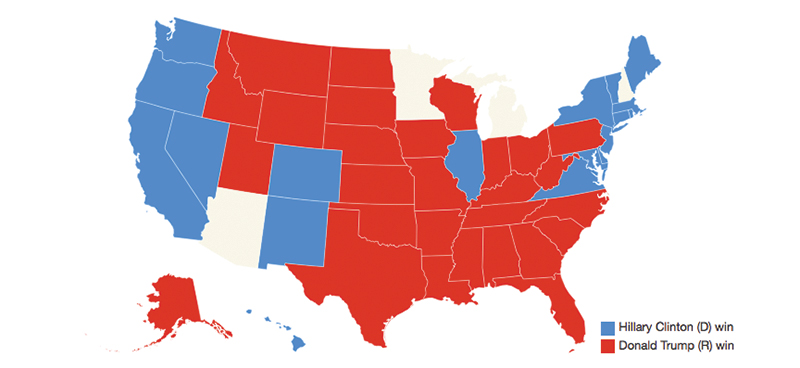
 Trump’s remarkably decisive win stunned most