Asia Pacific US Election Dr. Dan Steinbock’s interview on the Trump triumph: Changes in foreign and trade policy, new cabinet names, markets, protests, Clinton investigations and much more Five Things that Explain Donald Trump’s Stunning Presidential Election Victory US Electoral Politics and the Illusion of Control Youth and US Elections: About Way More than Just the Horserace Brexit Cyber Security Myanmar Brazil Philippines The South China Sea and Philippine National Interest and Security Japan Japan and the Monetary Policy Magical Mystery Tour South Africa International Law Development Inequality
The New Trade Future in Asia Pacific
Dan Steinbock
The Rise and Crash of Hillary Clinton
Tunde Olupitan
Interview with Dan Steinbock
Anthony Gaughan
William Hawes
Peter Levine and Abby Kiesa
Headaches of Empire: Brexit and the United States
Binoy Kampmark
World War 3.0 is Here
Burma/Myanmar – Towards Peace? Elections, Civil War, and Inter-Faith Conflicts
Mikael Gravers
Rio 2016: Human Rights and Sustainability After the Olympics Party
Jorge Knijnik
“Anti-Americanism” in the Philippines. President Duterte’s Subaltern Counter-Hegemony
E. San Juan Jr.
Roland Simbulan
Abe’s Political Restoration Belies Economic and Geostrategic Challenges
Craig Mark
Richard Westra
How the Rand Exchange Rate Volatility Affects the South African Economy?
Matthew Kofi Ocran
No Way Out: Mandatory Trade Secret Protection Laws in International Arbitration
Charles Camp, Anna Margolis and Camellia Mokri
The Tropical Oil Crops Revolution – A More Sustainable Future?
Derek Byerlee, Walter Falcon and Rosamond Naylor
Keeping Inequality on a Short Leash: Whose Task?
István György Tóth
November – December 2016

Japan and the Monetary Policy Magical Mystery Tour
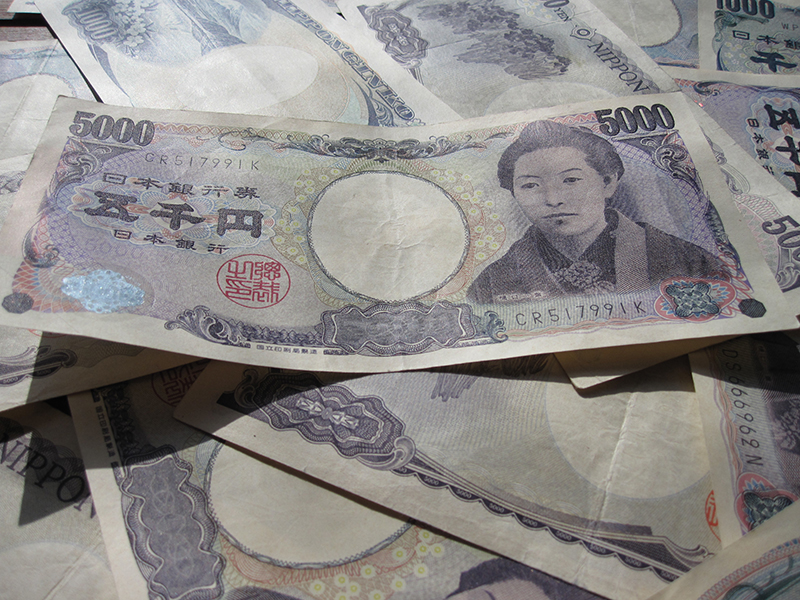
With 1970s galloping inflation threatening to bring down the US economy and with it the US dollar based global trading order, Milton Friedman proved correct in his policy advice that rapidly curtailing the money supply and restricting credit creation would halt the rot. But as Japan is painfully discovering, monetarist faith that following the opposite course will raise price levels to resuscitate growth is a fool’s errand.
When Milton Friedman acolyte Ben Bernanke was a Professor at Princeton University, he had lectured Japan during a 2000 visit on the role of monetary policy in combating deflation. Bernanke, weighing in on what was then Japan’s first so-called “lost decade”, opined: “monetary authorities can issue as much money as they like…money issuance must ultimately raise the price level, even if nominal interest rates are bounded at zero”.1 Bernanke, like Friedman, however, holds two problematic assumptions about “money issuance” which, in the end, serve to vitiate this simple story. Firstly, there is the important question of the difference between “commodity money” of 19th century financial systems and current state “fiat money”. Secondly, Friedman and Bernanke never imagined structural impediments materialising to thwart “supplied” money from being “activated” in the “real” economy. Let us treat these as a prelude to exploring the predicament Japan faces in the global economy today.
Global finance under the commodity money gold standard engendered a seamless integration of international, national and local monetary relations of states connected to its trading order with central banks superintending unrestricted import and export of gold, which national currencies were fixed to. The state had no policy role in regulating the money supply. The gold reserve of each country, secured in respective central bank vaults, constituted the foundation for both credit creation by commercial banks and the “legal tender” or banknotes issued by the central bank. Money issuance, whether for discounting bills of exchange or to meet cash payment needs, occurred “automatically” in response to ebbs and flows in buying and selling of goods. If defaults hit an economy, gold reserves were drained from central banks besetting economies with deflation and austerity until gold stocks were replenished.
Under fiat money regimes marking economies from the 1950s, and the global economy with the 1971 demise of Bretton Woods, state debt security IOUs serve as monetary reserves. It is the holding of these government securities or bonds between the central bank and commercial banks connected to it that determines the level of the “monetary base” and extent of credit creation in the economy. Crucially, the role central banks play in fiat money regimes’ buying and selling securities to grow or shrink the monetary base conjures up the notion of central bank “independence” with the illusion that money issuance is solely a matter for “monetary authorities”. However, unlike the gold standard, the arrival at an “optimal” supply of money in fiat money regimes can only be achieved through state policy. It is simply the case that states delegate to central banks the power to determine the level of the monetary base – which is itself a state policy decision. It is precisely the need for maintaining policy flexibility which moved major economies in the post World War II (WWII) period to abandon the gold standard.2
Our second question, of money pooling “idly” in the financial system, and not being “activated” in real economic activity, is something Friedman and Bernanke along with the whole mainstream economics profession never countenanced. As has been strongly emphasised of late, neoclassical macroeconomic theory blithely assumes saved funds will always be borrowed and spent, and never problematises the financial system in its models.3 From the perspective of Marxian economics, however, the very efficiency of capitalist economies required banking systems play a “capitalist social” role. That is, in capitalist economies, the banking system holds funds rendered temporarily “idle” by businesses during the course of business cycles. Idle money deposited by a particular business is then made available to any business to realise profitable investment opportunities or to commercial capital which purchases goods wholesale, clearing inventories and enabling rapid reinvestment of profits.
Larger pools of idle money begin to accumulate in capitalist economies during the post WWII period of corporate capitalist production of consumer durables. On the one hand, the sheer extent of corporate profits, which allowed corporations to finance expansion with minimal bank borrowing, left ample funds in banking systems to finance welfare states and, in the case of the United States (US) in the 1950s and 60s, covet global assets. On the other hand, exigencies of financing the consumer durable production edifice with its long term expensive investments in fixed capital, required corporations to become “money managers”, to adopt Hyman Minsky’s term. Central banks then necessarily put their policy apparatus on alert to provide liquidity injections in the face of potential shocks exacerbating this system’s inherent “fragility”.4
Japan’s Miracle Economy Saves the World
What is often referred to as the post WWII “golden age”, which commenced in the US in the 1950s and spread to Western Europe and Japan in the subsequent decades, fell into crisis during the course of the 1970s. Large pools of idle money soon morphed into bloating oceans of funds with no possibility of ever being converted into real capital to be invested in production centred activity. The obverse to the foregoing, the disintegration of full-scale integrated industrial production systems and their disarticulation across the globe to low wage locales, also commences in the US economy. Japan, however, though confronted by the same global crisis malaise, rapidly reinvented itself. Four keys to its reinvention were: a) Japan’s mode of corporate financing of plant and equipment where bank allegiance to business groups cocooned companies from pitfalls of excessive long-term debt obligations; b) Japan’s penchant for Keynesian deficit spending long after it fell out of favour in the US; c) Japan’s rapid increase in labour productivity through early introduction of microelectronic information and computer technologies; and d) Japan’s expansion of exports under conditions of continued growth in international trade.5
Riding a wave of export prowess, Japan generated its own ocean of idle money, significantly exceeding domestic investment needs of its consumer durable economy, leading to its rise as the world’s foremost creditor nation, eclipsing the US by 1986. In the several years following the demise of the US golden age economy, the coveting of foreign assets by Japan outpaced by 20 percent the earlier US spree of over two decades. To be sure, Japanese companies also engaged in shifting components of their production and assembly operations overseas, particularly to Southeast Asia. But this occurred under conditions where Japan continued to build up domestic manufacturing capacity, thus industrial employment in Japan experienced no decline until 1994.
For its part, the US adopted an entirely new orientation that parlayed the role of the dollar as world money into a position in the global driver seat akin to when it was a global creditor and manufacturing workshop. Wall Street developed into the command centre for managing global finance in the increasingly liberalised, deregulated world the US compelled.
Notwithstanding parlaying the role of the dollar as world money into global suzerainty, US policy makers looked askance at Japan’s industrial might. Their ploy to address it was a negotiation among major economies to strengthen the yen. Japan dutifully acceded to the Plaza Accord in 1985, yet what amounted to one of the great currency revaluations in history had no effect on the US trade deficit. What it did impact was global confidence in the US dollar and its Treasury backing at a time of global financial market opening and where the US depended upon world savings in dollar denominated instruments to ensure its global predominance. However, as Black Monday, October 1987 crisis shook the world, with the US suffering its then greatest stock market crash, Japan was persuaded to leap in and gobble up US Treasury IOUs even as they were being dumped across the globe.
To incentivise its flush institutional investors into streaming savings to US dollar instruments, Japan slashed domestic interest rates. The domestic economic ramifications of inordinately low interest rates were cataclysmic. This was particularly the case given Japan’s unique mode of corporate finance. Hence a spending bonanza spread like wildfire through the economy drawing in even small savers and landowners as every imaginable asset class value inflated into a monstrous bubble as legendary as the government bailout, which followed.6
Internationally, with US and Wall Street compelled deregulation and liberalisation prying open remaining “dirigiste” East Asian economies like South Korea, low interest rates on the yen set off a “carry trade” in which yen borrowing fuelled speculative excesses that fomented the Asian Crisis of 1997-98. With financial villains of that piece bailed out by US taxpayers, funds flooded back into Wall Street coffers just in time to feed the borrowing frenzy of the dot com bubble.7
Japan did save the world from Black Monday. However it was a world being increasingly remade in the image of the US economy or “financialised”. Bank for International Settlements economist Claudio Borio shows, for example, that Black Monday 1987 began a trend in which pronounced financial cycles of speculative bubbles and bursts supersede real economy business cycles in the US economy.8 The US dollar as international money and Wall Street constituted as the vortex through which the world’s idle funds are dispatched on speculative endeavours is the transmission mechanism for this trend into the global economy.
Japan and the Enchanted World of Quantitative Easing
The US originated global meltdown of 2008-2009 along with subsequent global tremors sent the US government and Federal Reserve (FED) into overdrive bailing out major financial institutions to avert outright economic collapse. This time it was not Japan but China which saved the world. It is estimated that global demand generated by China’s massive spate of state sponsored infrastructure spending drove 40 percent of global growth between 2008 and 2010.9 However, that China’s economy had this impact due to vast dollar accumulations from its role as a global assembly hub for consumer goods is in many ways symptomatic of all that is wrong with the global economy. After all, the disintegration of global production systems and the outsourcing of manufacturing operations to low wage locales lower investment costs for corporations leaving them with more idle funds to play money games or disburse as “shareholder value”.10
Japan, to be sure, played a major part here. Its large foreign investment presence in China and Southeast Asia places it at the centre of a network of disarticulated production systems which reconfigure global trade in manufactures toward “intermediate goods”. Where Japan reinvented itself once again in the early 21st century resides not with its internationally recognised brand champions (with the exception of Toyota), but with a new breed of high tech manufacturers such as Keyence and Fanuc that produce indispensable components for everything from robotics to Dreamliner jets and iPhones along with the capital goods for their production.11
However, the world’s problems, and Japan’s, run deeper. Persisting recession (or in Orwell speak, “the recovery”) in major economies in the second decade of the 21st century unleashed the peculiar monetary policy known as quantitative easing (QE). Perversely, what QE is responding to is the fact that oceans of idle funds outstripping investment needs of real economies have been sloshing across major economies and the globe for decades engaging in leveraged, debt fuelled money games. The US and Wall Street battened upon the wealth effects of this excrescence in rising stock market and other asset values with other major economies feeding at the trough. When financial bubbles burst governments saddled publics with bills for distressed assets and refurbished banking systems by stocking their monetary base through QE.
From 2008 to 2014 the FED, European Central Bank, Bank of England and Bank of Japan (BOJ) expanded their collective monetary base by $6 trillion.12 Today, if we add in to the foregoing liquidity injections of the Swiss National Bank and Peoples Bank of China, central bank balance sheets hold around $18 trillion equal to almost 40 percent of the combined GDP of these economies.13 Japan’s QE, ubiquitously referred to as QE on steroids, has seen BOJ balance sheet leap to a staggering 80.6 percent of Japan’s GDP.14 Ostensibly, the purpose of QE, when paired with government manipulation of interest rates to near zero, is to promote confidence among commercial banks to lend to businesses under circumstances where deleveraging continues to write down earlier debts. But commercial banks see no opportunities for profitable credit creation and have parked their reserves with the central bank prompting central banks to turn to the device of “negative interest rates” to force commercial banks to lend. A full $5.6 trillion of Japan’s government debt now trades at below zero.15
Economist Richard Koo has famously dubbed the condition where only governments are left to borrow and spend a “balance sheet recession”.16 He rightly maintains that QE will not spark growth but simply contribute to the swelling of idle balances as per this article. Koo thus advocates more government fiscal spending while the private sector rejuvenates. The problem with this is not, as commonly claimed, the ponderous size of Japan’s debt reaching 250 percent of GDP. Japan continues to be the world’s major creditor economy with a net international investment position of well over $3 trillion and the Japanese government owns extensive financial assets which place Japan’s real debt around 130 percent of GDP. As well, Japan’s net interest payments on its debt as a percent of GDP are the lowest among G7 economies.17 The problem is where to spend!
Bloating oceans of idle money streaming into bubble fomenting casino play rather than real economy investment which generates incomes or “active” money has been the harbinger for decades now of the exhaustion of the post WWII consumer durable economy with its petroleum energy matrix. Disintegration and disarticulation of domestic integrated production systems euphemised as “globalisation” offered temporary economic respite.Government spending of 38 percent of GDP in the US and 42.1 percent in Japan in 2014 has maintained this world on life support.18 The belief that a weakened yen to help overseas sales of Japanese cars and flat screen TVs while spending on roads and bridges at home to cajole private companies to borrow and spend the Himalayan idle balance is misguided.
Currently, if state spending is to have any lasting impact it must partner with businesses it has saved to substantively remake the Japanese economy around new technologies and power sources. Remember, fiat money regimes were brought into being precisely to operate social democratically with such policy flexibility as opposed to the gold standard the only policy outcome of which was austerity. The inventiveness and social cohesiveness of Japan is there. But missed opportunities abound as the follow up to the Fukushima Daiichi nuclear disaster demonstrates.
About the Author
 Richard Westra received his PhD from Queen’s University, Canada in 2001. He is author or editor of 14 books. His work has been published in numerous international peer reviewed journals. He is co-editor of Journal of Contemporary Asia. His most recent single authored book is Unleashing Usury: How Finance Opened the Door to Capitalism Then Swallowed It Whole (Clarity Press, 2016).
References
1. Bernanke, B., “Japanese Monetary Policy: A Case of Self-Induced Paralysis?” in Mikitani R., and Posen A. (eds.), 2000 Japan’s Financial Crisis and Its Parallels to the U.S. Experience, Institute for International Economics, , p.158.
2. Sekine T., “Fiat Money and How to Combat Debt Deflation”, in Yagi K., et al. (eds.) 2012, Crises of Global Economies and the Future of Capitalism, Routledge.
3. Koo R. C., 2016, “The Other Half of Macroeconomics and the Three Stages of Economic Development”,http://www.paecon.net/ PAEReview/issue75/Koo75.pdf.
4. Sekine, “Fiat Money and How to Combat Debt Deflation”.
5. See on this and what follows, Westra R., 2012, The Evil Axis of Finance: The US-Japan-China Stranglehold on the Global Future, Clarity, Chapters 2, 4 and 5.
6. Murphy R. T., 2014, Japan and the Shackles of the Past,Oxford University Press, pp.183ff.
7. Wincoop E. van and K-M Yi, “Asia Crisis Postmortem: Where Did the Money Go and Did the United States Benefit?” https://www.newyorkfed.org/medialibrary/media/research/epr/00v06n3/0009vanw.pdf.
8. Sauga M. and Seith A. “Out of Ammo? The Eroding Power of Central Banks”, http://www.spiegel.de/international/business/central-banks-ability-to-influence-markets-waning-a-964757.html.
9. Bloomberg View, “China’s Fall, Not Rise, Is the RealGlobal Threat”,http://www.bloomberg.com/news/2011-10-04/china-s-fall-not-its-rise-is-the-real-threat-to-the-global-economy-view.html.
10. Milberg W. and Winkler D., 2013, Outsourcing Economics: Global Value Chains in Capitalist Development, Cambridge University Press, pp. 210ff.
11. Murphy, Japan, pp. 205-8.
12. Economist Intelligence Unit, “The end isn’t nigh: Central Bank Challenges as the Era of Cheap Money Enters a New Phase”, 2013, http://www.eiuresources.com/EndOfCheapMoney/.
13. Durden T., “How Central Banks Are LBOing The World In One Stunning Chart”, http://www.zerohedge.com/news/2016-09-05how-central-banks-are-lboing-world-one-stunning-chart.
14. Bloomberg, “What’s Wrong With Japan’s Economy?” http://www.bloomberg.com/graphics/2016-japan-economy/.
15. Wall Street Journal, “Japan’s Negative-Rate Experiment isFloundering”,http://www.wsj.com/articles/japans-negative-rate-experiment-is-floundering-1460644639.
16. Koo, “The Other Half of Macroeconomics and the Three Stages of Economic Development”.
17. Economist, “Japan’s economy: Three-Piece Dream Suit”, http://www.economist.com/news/finance-and-economics/21702756-abenomics-may-have-failed-live-up-hype-it-has-not-failed-and
18. https://data.oecd.org/gga/general-government-spending.htm.
World War 3.0 is Here

A new world of opportunity and convenience has opened up. But that said, so has the need for security over that greatly expanded surface. With Clavister underpinning their operations as the security choice, they feel confident that they’re helping their customers understand how critical it is to have great cyber security.
The new battlefield – be that business or governments – isn’t physical but a cyber one. As attacks to our critical infrastructure with real life consequences fill the global news daily, it’s imperative that leaders take action…
To many, the world has become a more chaotic and dangerous place, filled with state conflict, terrorism, climate issues and economic uncertainty. And while that is undoubtedly true, there is a threat that we’re just coming to terms with, that we’re just coming to realise is one of the greatest threats we face as a society. John Clapper, the director of the CIA, puts the topic at the top of the threat list – above terrorism, espionage and weapons of mass destruction. IBM Corp.’s Chairman, CEO and President, Ginni Rometty calls it the greattest global danger to commerce and companies. The World Economic Forum puts it squarely on its top ten list of global calamities after WMD and before water crisis as the planet’s most important issue to address. Cyber security and protection – with attacks against critical infrastructure, be that the electrical grid, causing a nuclear plant to meltdown or a hydropower station to open gates and flood towns and cities the most serious. But as well commercial cyber crimes of ransomware being as debilitating – is on every decision makters and business owner’s mind. Consider: the cost of cyber extortion and data loss is estimated at $445 billion per year, a full 1% of global income; half a million cyber attacks a minute; state sponsored cyber battalions engage in cold war in cyberspace. Protecting their infrastructure has become a critical mission for so many stakeholders.
Proactive, Not Reactive
John Vestberg, CTO and Product Manager of Clavister AB, and Sam Coleman, Content Manager and in-house editor of DeCrypted News, are at the front line of this challenge in a society that is slowly beginning to wake up to this virtual threat. “The first thing a company needs to do is to have someone from management who really cares about security. The issue is much larger than simply prohibiting employees from clicking on links and banned surfing during working hours. It’s enough that a company goes offline for a few hours; the reputation and revenue lost are a compelling enough case for real attention to the issue,” Vestberg states, a co-founder of the company and one who’s sat across the table from CEOs and ministers to explain the case for protecting their data and their customers. “But we take it further as we believe that – especially after what came to light with Snowden – having no back doors in the operating code as Clavister products do – is a fundamental feature as well as all the necessary performance features. But the understanding of how serious the threats can be, especially to critical infrastructure, that’s what we really want to communicate forcefully and that having robust protection is absolutely necessary,” Vestberg says with Coleman concurring. “Cyber security is a burning hot and important issue for everyone, it’s starting to get more and more news coverage as it should,” says Coleman. “The latest Dyn attack, a nuclear power plant hacked in Germany, almost a billion personal details stolen from Yahoo for identity fraud and countless attacks on business be it ransomware, DDoS or data theft is just the headlines we see and live through. Increasingly, we see a major shift occurring…and often it’s in the palm of our hands.”
The Threat Surface Explodes
We all know that the Internet and the web have become a major part of our lives be that personally, socially and professionally. We bank online, book our flights, access government services and engage with friends. Our work life is dominated by the cyber: most of us work on laptops and terminals, through company networks. Not just daily, but by the minute.
But increasingly, all of that activity has moved to the mobile realm; people are using devices and phones for their daily work and lifestyle needs. Cisco VNI forecast states the following: “By 2020, wired devices will account for 34 percent of IP traffic, and Wi-Fi and mobile devices will account for 66 percent of IP traffic. In 2015, wired devices accounted for the majority of IP traffic, at 52 percent.” In other words, mobile computing is outstripping desktop computing at an incredible rate. Add to this equation that IoT devices are exploding – smart refrigerators, TVs, cars, cameras, homes – and expected to grow from 4.8 – 6.5 billion devices to 20 – 38 billion – and it’s clear that a new world of opportunity and convenience has opened up. But that said, so has the need for security over that greatly expanded surface. “The recent Dyn attack that basically used IoT devices to launch DDoS attacks, the proliferation of BYOD into business environments, which create a whole plethora of intrusion points into business environments, have created an incredible demand to A) have telecom solutions to network security and B) of the need to use Identity Access Management and specifically multi-factor authentication to guard against identity theft and network intrusion,” says Clavister CEO and VP of Sales Jim Carlsson. “We’re very excited about this challenge because we’ve got some incredibly strong solutions for the telecom industry that we’ve been working on for several years as well as our IAM company that’s been brought into the Clavister family, PhenixID, which we feel will protect our customers and in turn their users,” he explains optimistically. “With Clavister underpinning their operations as the security choice, we feel confident that we’re helping our customers understand how critical it is to have great cybersecurity, be they enterprise or our new telecom partners, and how that’s a fundamental business choice.”
The New Trade Future in Asia Pacific
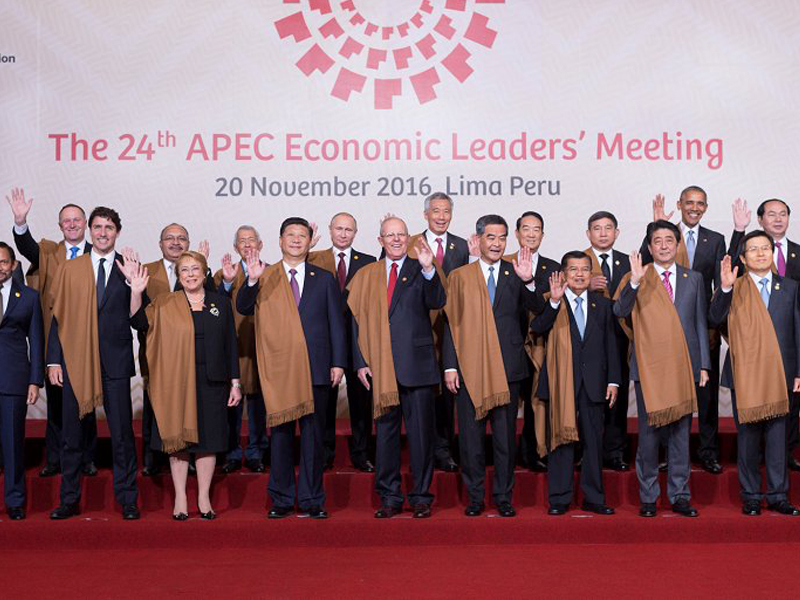
During the weekend, the Asian-Pacific nations embraced the dream of free trade. Today, President-elect Trump buried it.
Last weekend, Asia-Pacific Economic Cooperation (APEC) summit made it clear that it would move forward with trade pacts; with or without the US.
Right after the Lima summit, President-elect Donald Trump unveiled his plans for the first 100 days in office, which focus on campaign promises that will not require congressional approval. Among his first actions, Trump said he would “issue our notification of intent to withdraw from the Transpacific Partnership” and replace it with negotiating “fair bilateral trade deals”.1
Trump campaigned on a promise to halt the progress of the TPP trade deal. The world is different after his triumph – including world trade.
From Berlin Wall to Trump Wall
In the late 1980s, as the Cold War eclipsed in Europe and regional trade blocks surfaced around the world, Australia called for more effective economic cooperation across Asia Pacific, which led to the first APEC talks.
In Washington, neither Asia nor APEC was yet a priority. Rather, the focus was on the North American Free Trade Agreement (NAFTA), which would tie together the economies of the US, Canada and Mexico. “We have got to stop sending jobs overseas,” warned presidential candidate H. Ross Perot in 1992. “There will be a giant sucking sound going south.” But unlike Trump, he appealed to only one tenth of Americans.
Sure, there was free-trade skeptics among Republicans and Democrats, but the bipartisan majority still believed in free trade. While negotiated and signed by President George H.W. Bush, NAFTA became effective under President Bill Clinton in 1994.
By the early 2000s, President George W. Bush sought to extend the NAFTA. However, critics argued that the Free Trade Agreement of the Americas (FTAA) could split South America. So the initiative crumbled against opposition by Brazil and its progressive President Lula.
In the Obama era, Washington began to tout the Trans-Pacific Partnership (TPP). This initiative originated from a 2005 free trade agreement among just Brunei, Chile, New Zealand and Singapore. After 2010, Washington began talks for a significantly expanded, “high-standard” free trade agreement, which would reflect US alliances in Asia and Latin America but exclude China.
While the original TPP was small but open, inclusive and had room for both US and China, the Obama plan sought to attract a dozen nations but grew secretive, exclusive and shunned China. Yet, it was an integral part of Obama’s “pivot to Asia”, which was intellectually formulated by former Secretary of State Hillary Clinton. That vision is now history.
If the regional free trade agreements drafted by advanced economies were energised by the fall of the Berlin Wall in the late 1980s, their demise today is characterised by the Trump dream of a Wall against Mexico. Along with the TPP, Trump will seek to re-define the NAFTA and the proposed Transatlantic Trade and Investment Partnership (TTIP) pact with Europe.
Meanwhile, free trade initiatives will shift to emerging economies.
China Energises Free Trade Vacuum in Asia Pacific
After the US presidential election, some of Obama’s TPP partners – including Japan and Mexico – pushed for a modified TPP agreement before Trump could tear up the agreement. Prime Minister Abe hoped to hedge between a revised TPP, a bilateral free trade deal with the US, and China-led talks at a Regional Comprehensive Economic Partnership (RCEP).
But the RCEP is no alternative to either US- or China-led broad trade pacts. It reflects the interests of emerging ASEAN economies (and their trade partners in advanced economies), but has a slower implementation schedule and humbler goals.
Ever since the Trump triumph, apprehension has also spread across Latin America, which is struggling to prepare for the Fed’s impending rate hikes. In the past week or two, Mexican peso, Brazilian real and other Latin American currencies have already suffered heavy hits, which have been mirrored across the Pacific by the sell-off of Asian currencies.
Until recently, the US pivot in the Asia Pacific has relied mainly on increasing security cooperation, whereas China’s focus is on economic development. Since 2013, President Xi Jinping has proactively pushed for broader economic ties with both emerging Asia and Latin America.
In Lima, Peruvian President Pedro Pablo Kuczynski said that, if the US pulls out, he would support an Asia-Pacific trade accord that includes China and Russia. Like Peru, even Australia is now moving behind the China-led Free Trade Area of the Asia Pacific (FTAAP). Ironically, China’s initiative builds on a US plan.
Chinese Efforts, US Plan
In 2006, C. Fred Bergsten, then chief of an influential Washington think-tank, made a forceful statement in favor of the FTAAP, which he thought would represent the largest single liberalisation in history. This initiative would be relatively open, inclusive and have room for both US and China. Indeed, Beijing’s push for an Asia-Pacific free trade area has been more active since fall 2014 when I predicted that, as a more inclusive and open plan, it had potential to achieve reflect real free trade in the region.
Oddly enough, the Obama Administration rejected the free-trade FTAAP for the geopolitical TPP, which China argued would have imposed a Cold-War like Iron Curtain on Asia Pacific by splitting the region between a US-dominated block and China’s allies.
Today, APEC’s membership has almost doubled to 21 countries, which account for almost 60% of the world economy, and nearly 50% of world trade. Beijing’s logic is persuasive: if you can make it in APEC, you can make it everywhere.
While the dream of free trade was born in the prosperous West, it will be completed in the emerging East.
About the Author
 Dan Steinbock is the founder of the Difference Group and has served as the research director at the India, China, and America Institute (USA) and a visiting fellow at the Shanghai Institutes for International Studies (China) and the EU Center (Singapore). For more information, see http://www.differencegroup.net/
Reference
Rodrigo Duterte’s Rivot Ro Asia Is A Rational Move

The Pax Americana is outdated and it is time for regional powers to realign.
In the past 30 years, a succession of Southeast Asian leaders was supposed to represent a new direction for regional geopolitics. First there was Malaysia’s Mahathir Mohamad. Then came Thailand’s Thaksin Shinawatra and Susilo Bambang Yudhoyono of Indonesia.
In the end, none were able to revamp the region and its relationship with the world. But Rodrigo Duterte, the Philippines’ new president, may be the first Asian leader to ask the right questions about the future of the region.
He made headlines during a trip to Beijing last month by announcing his country’s “separation” from the US and a coming embrace with China. Then he went to Japan, where he called for American troops to leave the Philippines within two years and assured the Japanese that he was not pursuing a military alliance with China.
Those outside the region have expressed shock at Mr Duterte’s words, and have deemed him naive at best, dangerous at worst. But this reveals an unwillingness to look beyond the western-led order, spearheaded by the US, as the “natural” state of things.
Mr Duterte is raising questions about who has power, how it is wielded and what self-determination would look like for smaller nations.
Despite his penchant for blunt language, his different tack has already had results. Take the territorial dispute in the South China Sea. The administration of Benigno Aquino, Mr Duterte’s predecessor, rejected any compromise, arguing instead that history and legal precedent meant that it owned islands such as the Scarborough Shoal. China, unsurprisingly, claimed that history and legal precedent supported its own claims.
As tensions increased, there was no evidence that Manila’s strategy was working, especially as the country aligned itself with the US, a prospect that is anathema to China.
By making his trip to Beijing, and eliciting a reciprocal great show of respect, Mr Duterte has done everyone a favour by cooling things down in the South China Sea. He also returned with billions of dollars in development aid and investment promises. Last week, China quietly stopped blocking Filipino fishermen from accessing the Scarborough Shoal.
If all it took was a few polite words and some common sense to defuse the situation, one wonders why no one thought to do it earlier. Perhaps we can call this “Asian-style” diplomacy.
China and the Philippines have a relationship far older than the Philippines’ relationship with the US, and one free of histories of colonialism. China is also re-emerging as the economic and cultural centre of East Asia.
We can even understand Mr Duterte’s attitude to China using the Asian concept of “face”. By heralding Beijing as the focal point for a different economic, political and cultural order, Mr Duterte accorded it a lot of prestige. And, in return, China is willing to support the new Filipino president, perhaps by receding from the issues that divide them. Many in the west – with their focus on credibility, “rational” interests and power as a zero-sum game – will always miss relationships based on prestige and mutual benefit.
The larger point is that the concept of Pax Americana is outdated. The world is increasingly abandoning the view of the US as the sole (and self-appointed) protector of global peace and prosperity. In fact, the idea that America should not be a world policeman resonates with large numbers of people in the US. The world may want other countries to share that responsibility with the US or, perhaps, to replace it. Mr Duterte is the first in Asia to do something about it.
Just because the Philippines is turning away from an American-led order does not mean it is rejecting the west or the US. Mr Duterte himself said that he is calling for a “separation of foreign policy” rather than “a severance of ties”.
Those who worry about Mr Duterte betray a belief that the Philippines and other Asian countries must choose between an affinity for the US and an affinity for China – and not, as perhaps would be best, express their self-determination by finding some affinity with both.
Since Mr Duterte’s visit to Beijing, one must assume that other Asian leaders are watching closely to see where he takes his country and the region. His views on self-determination are shared by many who are resentful of being subservient in the hegemonic geopolitical system but have believed until now that they are helpless.
The world order will change further as more leaders make the same choices as Mr Duterte. Those used to the status quo should get used to it.
This article was first published on the Financial Times on 18 November 2016
About the Author
 Chandran Nair is founder and chief executive of The Global Institute for Tomorrow.
A Brexit-Style Revolution in the USA? The Real Differences between Clinton and Trump

In fact, if we talk about real politics rather than politicking, the personalities of the two candidates matter little, as both are “products of the system” and in this sense one could argue that there is no real difference between them. Yet, there is a crucial difference between these two candidates, which was not present in previous post war candidates, who were simply ‘products of the system’ distinguished only by their differences as regards usually minor aspects of economic policies, i.e. more liberal/neoliberal or, alternatively, more state interventionist measures.
Yet, none of these candidates ever questioned the very fundamentals of a system, which eventually – helped by the post war US hegemony – led to the emergence of a new phenomenon: the multinational corporations. This marked the rise of the New World Order (NWO) of neoliberal globalisation, as well as the emergence of a Transnational Elite that informally runs it, with the help of the transnational economic and political-military institutions that the same elites created, such as the IMF, WB, WTO and NATO). These fundamentals may well be summarised by what is called euphemistically ‘the four “freedoms”’, i.e. the free movement of goods and services, as well as of capital and labour. This is what the US elections (and the Brexit referendum before that) is all about.
The Real Differences Between Clinton and Trump
Hillary Clinton is in fact a typical ‘product of the system’, who was systematically promoted by it, exactly in order to carry out faithfully the demands of the elites in the implementation of these “freedoms” and what they imply both at the domestic but also the foreign and geopolitical levels. She is well known for her criminal role in the massacre of the Libyan people and her infamous exclamation “we came, we saw, he died”, referring to the brutal lynching of Muammar Gaddafi, the Nasserite leader of the Libyan national liberation movement, at the hands of the Libyan ‘“revolutionaries”. That is, at the hands of the barbaric terrorists, who were funded by the Transnational Elite and supported by the State Department, which she headed at the time. It is the same kind of “revolutionaries” who today are employed in Syria (some of them moved from Libya to Syria immediately they finished the ‘job’ there), with the same aim for regime change.
On the other hand, Donald Trump, although a product of the same system himself, he is a self-made product of it, who managed to become a candidate for the highest post of the Transnational Elite without any direct or indirect assistance by it and its institutions (mass media, economic, political, academic, and cultural institutions). No wonder he has been the target of an unprecedented attack by all of these elites and institutions. In other words, he was savagely attacked by them, not because he is a revolutionary of some kind, but simply because he is not as controllable by the elites, as all previous US presidents – not to mention the Clintons (husband and wife) who have been executive assistants of the elites, par excellence. Hillary is therefore the perfect candidate to carry out their criminal plans (the first woman candidate and a perfectly controllable ambitious politician), exactly as Obama was before a similar perfect candidate (the first black candidate – a privileged black of course – and a perfectly controllable ambitious politician).
So the main problem for the elites with Trump is that he is an “unknown quantity” – the biggest, for the elites, crime. Particularly so as his professed policies firmly put him within the rising world movement against globalisation, which already gave us Brexit, that is, a genuine revolution of the victims of globalisation in the UK, and the consequent counter revolution.
This, despite the fact that Trump had drawn mass support and won elections and public opinion not just because he is a “populist demagogue” (as they claim) but because, as even a prominent member of the globalist “Left” admitted,1 he rejected the free trade agreements which allowed multinationals to exploit labour all over the world. Furthermore, domestically, he questioned the uncontrolled importation of cheap immigrant labour, called for large-scale public investment, opposed the new cold war with Russia and China, and rejected US support for NATO’s military build-up in Europe and intervention in Syria, North Africa and Afghanistan. Similarly, as even a columnist of the flagship of the globalist “Left” recently stressed – after expressing first his dislike for Trump and Farage – the assumptions that globalists (he calls them ‘free traders’) make about the beneficial effects of free trade are wrong and as the latest transatlantic deal (CETA, the deal between Canada and EU) shows, globalisation is all about protecting big business – from the public. And then, he went on:
For decades, presidents and prime ministers, policymakers and pundits have told voters there is only one direction of travel: free trade. Now comes Brexit and Donald Trump – and the horrible suspicion that the public won’t buy it any more. And the elites don’t know what to do, apart from keep insisting the public listen.2
Globalisation : The Class Issue of our Era
As I am going to show here briefly, globalisation is a class issue. In fact, the class issue of the globalisation era. It is common knowledge nowadays that the globalization process has already led to an unprecedented concentration of income and wealth, which several studies have confirmed. Thus, as regards, first, the US concentration of income, according to Nobel laureate in economics Joseph Stiglitz:
Large segments of the population in advanced countries have not been doing well: in the US, the bottom 90% has endured income stagnation for a third of a century. Median income for full-time male workers is actually lower in real (inflation-adjusted) terms than it was 42 years ago. At the bottom, real wages are comparable to their level 60 years ago.3
Also, as regards the concentration of wealth as a result of globalisation, a recent study has shown that in the last five years or so, the wealth of a circle of billionaires consisting of 388 people has risen by 44 per cent, (or half a trillion dollars), while the wealth of the poorest fell by 41 per cent, (more than a trillion), the result being that the richest 62 people in the world are worth the same as half the world population! 4
Thus, a very recent study published in the Journal of the American Medical Association implicitly showed that the more a country is integrated into the NWO the greater the negative impact on health and life expectancy. The result is that, as average life expectancy in developing nations continues to rise, life spans in parts of America are getting shorter. This has reached the point where the poorest American men, at the age of 40, have a life expectancy comparable to the average 40-year-old man in Pakistan and Sudan! Rightly, therefore, Dr Deaton, a professor of economics at Stanford University, noted that the “infamous 1 per cent is not only richer” they have also “ten to 15 more years to enjoy their richly funded lives,” with their life expectancy being better than the average for any nation on earth.5
No wonder that, following the victory of Brexit and the fact that one of the two presidential candidates in the forthcoming US elections has adopted many of the demands of the victims of globalisation, the Transnational elites have been terrified by this rapid rise of the anti-globalisation movement. Particularly so as it is not anymore just the neo-nationalist movements in East Europe (such as those in Hungary and Poland) which challenge globalisation. Thus, following Brexit, the Eurosceptic Alternative for Germany party (AFD) came second, ahead of Chancellor Angela Merkel’s CDU, in regional elections held in September, while similar parties and movements in Italy, France, Austria and the Netherlands have also seen a huge rise in their popularity.
This could explain the recent concerted attack against the rising new anti-globalisation movement by some of the prominent members of the Transnational elite, such as the head of the IMF, the president of the European Central Bank and the president of the European Council.6 All of them suddenly discovered the gross inequality in the distribution of income and wealth as a result of globalisation and blamed the political elites for not taking enough measures on boosting support for low income workers and reducing inequality. Yet, they are fully aware of the fact that any such measures are impossible, in an environment of open and liberalised markets. This is because any such measures, if they are designed to be as effective as present circumstances demand, they are bound to affect negatively competitiveness – the foundation of globalisation itself. Not surprisingly, the arch-gatekeeper of globalisation, the EU Commission President, immediately came out to ‘restore order’ and declare that the recipe for combating growing discontent in Europe was “more union” including a military headquarters “to co-ordinate efforts towards creating a common military force”. No wonder Le Pen, the leader of the French neonationalist movement, was prompted to ask, in an obvious insinuation that the new EU army will in effect be used to smash any popular revolts against globalisation and the EU: “What is the EU protecting us from – are you protecting us against prosperity?”7
It is therefore clear that this binary strategy (i.e. the “good cop” strategy of improving the image of globalisation and the “bad cop” strategy of force to impose “law and order”) are going to define the response of the Transnational Elite in the future to the emerging revolt of the victims of globalisation. Yet, the disquiet of globalists cannot anymore be hidden, as it happened in their latest big family reunion in New York.8 Therefore, neo-nationalism is basically a movement that arose out of the effects of globalisation, particularly the liberalisation of labor markets, so that labour could become more competitive.
However, the globalisation process has already had not only devastating economic and social consequences on the majority of the world population, but has also resulted in tremendous changes at the political and the cultural levels, in the past three decades or so. Furthermore, it has led to a series of major wars by the Transnational Elite in its attempt to integrate any country resisting integration into the New World Order (NWO) defined by neoliberal globalisation (Yugoslavia, Iraq, Afghanistan, Libya and Syria). In fact, an election victory for Hillary, the blindly obedient organ of the Transnational Elite, could well lead to a new and potentially more serious crisis than the 1962 missile crisis, given her support for the most dangerous policies on Syria, advocated by the same criminal elements of the same elite that led to the present catastrophe in the Middle East.
The Bankruptcy of the Globalist “Left” and The Rise of Neo-nationalism
In view of the above, It was almost farcical to see that a prominent role in the present front against the victims of globalisation in the USA is played by its globalist “Left”, that is the Left which is integrated into the NWO and does not question globalisation and its institutions. This, on top of course of the entire political establishment (from Obama to George W. Bush) and also the whole economic establishment, the press corps, and the social media,9 (let alone the CIA!)10 – all playing a vital role in this reactionary front. Thus, from Bernie Sanders, the ‘socialist’ candidate and Nation to the self-declared “anarchist” Noam Chomsky and Michael Albert’s Znet, as well as many others, all declared their (“reluctant”) support for the criminal candidate of the Trasnational Elite. No wonder that even Slavoj Žižek, one of the protagonists of the world globalist “Left”, seemed worried about this “Stalinist” image of the “Left”, presenting a total consensus in favour of Clinton: “from Bernie Sanders supporters, to what remains of the Occupy movement, from big business to trade unions, from army veterans to LGBT+ and ecologists… something that even the worst kind of one-party systems have never achieved.11 Clearly, for this politically and theoretically bankrupt American “Left”, the fact that the working class (for which supposedly they fight) fully supports Trump is irrelevant. Alternatively, for these “libertarians”, workers are ignorant enough, so that they have to be “educated” by these enlightened people about whom to vote for! In fact, however, the blue collar ex workers of the American motor industry, for instance, who are determined to vote for Trump12, know better than the Left intellectuals, academics and others who, mostly are beneficiaries of globalisation.
Yet, there is little doubt anymore that it was the intellectual failure of the Left to grasp the real significance of a new systemic phenomenon, (i.e. the rise of the Transnational Corporation that has led to the emergence of the globalisation era) and its consequent political bankruptcy, which were the ultimate causes of the rise of a neo-nationalist movement in Europe.
It is a movement that is embraced by most of the victims of globalisation all over the world, but particularly in Europe, mainly by the working class that used to support the Left, whilst the latter has effectively embraced not just economic globalisation but also political, ideological and cultural globalisation and has therefore been fully integrated into the New World Order. In fact, today, following the successful emasculation of the anti-systemic movement against globalisation, thanks mainly to the activities of the globalist “Left”, as well as of the World Social Forum13 and the various Foundations funding it, the neo-nationalist movement is the only political force left to fight against globalisation in general and the EU in particular.
It is therefore clear that the neo-nationalist parties, which are all under attack by the Transnational Elite, constitute cases of movements that simply filled the huge gap left by the globalist “Left”, which, instead of placing itself in the front line of all those peoples fighting globalisation and the phasing out of their economic and national sovereignty,14 indirectly promoted globalisation itself, using arguments based on an anachronistic internationalism, developed a hundred years ago or so. As a result, the neo-nationalist parties are embraced today by most of the victims of globalisation all over Europe, particularly the working class which used to support the Left,15 whilst the latter has effectively embraced all aspects of globalisation (economic, political, ideological and cultural) and has been fully integrated into the NWO – a defining moment in its present intellectual and political bankruptcy. Similarly, in the USA, where it is Donald Trump’s campaign which expresses these neo-nationalist trends, we may see a new revolution similar to the Brexit revolution, albeit much more important given the hegemonic role that USA still plays in the world.
The Brexit Revolution and Trump
Despite the obvious differences between the Brexit revolution and the movement for Trump, which arise also from the fact that the former was a referendum whereas the latter is an election, what matters most are the similarities between them, as both reflect different instances of the same world revolutionary phenomenon.
Thus, the Brexit revolution, far from being an isolated incident, related – as some globalists argued in order to defame it – to the ideological paraphernalia of old British imperialism, reflects, in fact, a world revolutionary phenomenon. In fact, it was the IMF itself that lately came out in recognising the revolutionary character of Brexit – of course, in order to express the Transnational Elite’s panic about it and draw the appropriate conclusions. Thus, as The Times described the statement by Maurice Obstfeld, the IMF’s chief economist on recent world economic developments:
Persistently weak growth is unleashing “negative economic and political forces” that are fuelling protectionism in Britain, the rest of Europe and the US, according to the IMF, and governments need to respond before the problem gets worse.16
Furthermore, as I will try to show briefly here, Brexit was very much a popular “revolution”, as the entire movement was a movement “from below”, i.e. from the victims of globalisation themselves. The main factor which created a movement ‘from below’ for Brexit was the growing realisation by the British people that its national and economic sovereignty has been decisively eroded within the EU, forcing the elites, albeit reluctantly, to accept the demand for a referendum. This realization was inevitable if one takes into account that Britons, who used to live in one of the strongest nation-states in the world, have now been reduced to spectators, forced to watch, powerless, the effective destruction of their industrial base, in the very place where industrialization was born. In fact, this was a referendum in which an unprecedented number of voters took part, and in which well over a million more people voted for change than for the status quo on UK’s membership of the EU.
Two important characteristics of the referendum were usually minimised by the Transnational Elite’s media: first, the geographical pattern of the vote, which is particularly revealing as regards the class nature of Brexit and, second, the age pattern of the vote, which is very much related to the ideological and cultural aspects of globalisation.
As regards first, the geographical pattern of the vote, the way in which people voted was a clear indication of the fact that this was a ‘revolution from below’ of the victims of globalisation. Thus, the only region in England to vote for Remain was London, while the Brexit victory was overwhelming in the deprived areas of England, where the victims of globalisation live, i.e. the victims of the criminal de-industrialisation process imposed by the multinational corporations, which they moved en masse to the Chinese and Indian labor “paradises” – exactly as they have been doing in the USA in the last three decades or so. That is, to the places offering multinationals not only a very disciplined work force that is paid survival wages, but also all the tax concessions possible, in order to induce them to invest and create a pseudo kind of development.
Also, as far as the age distribution of the Brexit vote was concerned, the most significant exception to the voting pattern described above was among those under the age of 24, where the Remain vote was 75 percent in favour.17 In fact, Bremain was supported by an apolitical youth – the perfect subject for manipulation by the elites and its media (including social media) – who are brainwashed by ideological and cultural globalisation. Thus, it has been estimated that while there was a turnout of 82% among those aged 55 and over, barely a third of the 18-24 age group managed to cast their vote. But those youngsters who did bother to vote were fanatical opponents of Brexit, who as soon as the referendum result was announced, began demonstrating against it with the direct or indirect support of the local elites, as well as of the Transnational Elite (George Soros, the well-known “master of ceremonies” of pink revolutions of every kind, played a leading role on this).18 Yet, when these youngsters were asked to explain their fanatical support for the EU, they were usually at a loss to justify their stand!19 No wonder the Hillary camp has been very keen to persuade (usually a-political) youngsters to vote.
The Counter Revolution in Britain and the USA
As one could expect, the Brexit revolution has led to a fierce counter revolution in Britain by the globalist establishment (which now includes the Labor Party), that I described in The New World Order in Action.
At the economic level, the Transnational economic elite and its institutions (IMF, OECD, the Bank of England etc.), as well as various think tanks, economists, academics, Nobelists and so on, came out before the referendum with a ‘Project Fear’ aiming to portray the doomsday that supposedly was going to follow a Brexit decision. Yet, the latest news give a very different economic picture than the doomsday predicted by the prophets of doom. Data from the Office for National Statistics for the third quarter, the first full quarter since the referendum in June, showed that the Treasury was wrong to suggest that the economy would collapse into recession after a vote to leave. Instead, Britain’s economy has defied expectations of an immediate post-Brexit crash, by growing 0.5 per cent in the three months to September, a stronger rate than the start of the year.20 The only significant economic impact of Brexit so far was on the value of sterling – something that was to be expected given the role that speculators such as George Soros had played in the past, when he became multimillionaire by simply speculating against the British currency. Today, Soros’s role is to try to reverse at all cost Brexit. Thus, as soon as the result of the referendum was announced Soros declared: “Britain eventually may or may not be relatively better off than other countries by leaving the EU, but its economy and people stand to suffer significantly in the short-to medium term.”21
At the political level, the globalist establishment in Britain had used every possible means so far either to revert the result of the referendum, which politically is extremely difficult, given the massive participation and support for Brexit by the victims of globalisation, or at least to water down the meaning of it to render it meaningless – what they call euphemistically, a “soft Brexit”. This counter revolution culminated today with the British High Court decision aiming, in effect, to water down any future Brexit decision, according to the elites’ wishes. So, Britain, the famous “mother of parliamentarianism” has been reduced in the globalisation era to the level where a few High Court Judges, with the help of parliamentarians under the control of the economic elites, are able to challenge the popular will which was expressed directly and massively.
Finally, one common characteristic of the British and US counter revolutions is the exploitation of the immigration issue in order to smear Brexiteers, as well as supporters of Trump, as anti-immigrants, if not racists. Although of course such elements may well exist within the neo-nationalist anti-globalisation movement in Britain, Europe and the USA, yet the vast numbers of the victims of globalisation who support this huge movement mostly consist of workers and ex-workers, who used to be supporters of the Left, before the latter was integrated into the NWO. It is therefore hard to believe that all these people have suddenly abandoned the ideals of the Left and moved to the Right. In fact it can be shown that it was the Left that moved to the Right, as far as the issue of entry into the EU clearly showed (see New World Order in Action).
The exploitation of the immigration issue was intensified particularly in the last few years when the ideology of open borders was massively promoted by the media of the Transnational Elite, accompanied by a mass, supposedly humanist, campaign to save the refugees. That is, the mass of dislocated people who were of course created in the first place by the Transnational Elite itself, through its wars in the Middle East! Needless to add that “open borders” – the policy promoted by Soros, the Transnational Elite, Varoufakis and the likes – in fact exploits an old libertarian ideal, completely distorting its essence in the process.
Open borders is meaningful only in a democratic world order where the peoples of the world are really self-determined, controlling themselves the productive resources at their disposal, including human resources. That is, a world with no exploitation and no inequality, where it is peoples themselves that determine how best to meet the needs they decide to satisfy, through social control of some sort (e.g. through an economic democracy as I described it elsewhere)22 rather than through the anarchy of the markets. Clearly, the world we live in today is exactly the opposite of this kind of ideal world and those fighting for open borders are in fact the elites and their associates aiming to maximise their profits through the free movement between countries, not only of capital and commodities, but of cheap labor as well. The inevitable effect is the equalisation “to the bottom” of the real value of wages and salaries (their “cost of production”) all over the world.
This is therefore the essence of the economic side of immigration and not the pseudo-humanist black propaganda about helping the masses of refugees and the victims of globalisation. Particularly so, when both the former and the latter are simply the byproducts of political and economic globalisation respectively. Clearly, it was the unprecedented economic violence of the NWO (initiated by the opening and liberalisation of markets) as well as the military violence (unleashed by the wars of the Transnational Elite in the globalisation era) that created the billions of the victims of globalisation and the millions of refugees respectively. In other words, the successful attempt by the Transnational Elite to convert an economic consequence of globalisation, and the economic and military violence it implies, into a (supposedly) humanitarian refugee problem and an issue of satisfying the libertarian principle of “open borders”, is perhaps its greatest deception of humanity today and one of the great deceptions of all times. What is even worse is the general acceptability of this deception by almost every country in the world which has been integrated into the NWO.
It is the same deception which is used extensively by the elites, with the full support of the globalist “Left”, in order to smear the new anti-globalisation movement (which at present is expressed almost solely by the neonationalist movement) as anti-immigrant, if not racist. Therefore, the need for the creation of a radical anti-globalisation movement, which would unite the growing millions of the victims of globalisation, irrespective of Left and Right labels, with the aim to fight for economic and national sovereignty, – as the necessary (though not the sufficient) condition for a real systemic change – is more imperative today than ever.
This article is based on the author’s new book under the title The New World Order in Action: Globalization, The Brexit Revolution and the “Left”, (Progressive Press, November 2016)
This was first published in the Global Research Post on 14 November 2016
About the Author
Takis Fotopoulos is a political philosopher and economist who founded the inclusive democracy movement. He is noted for his synthesis of the classical democracy with the libertarian socialism and the radical currents in the new social movements. He is the editor of The International Journal of Inclusive Democracy (which succeeded Democracy & Nature). He was previously (1969 1989) Senior Lecturer in Economics at the University of North London. In his seminal work Towards An Inclusive Democracy (London & New York: Cassell, 1997), which has been translated into French, German, Spanish, Italian, Greek and Chinese, the foundations of the inclusive democracy project were set. He is also the author of over 2,000 articles in British, American and Greek books, journals, magazines and newspapers, several of which have been translated into over twenty languages
References
1. See James Petras, “Obama versus Trump, Putin and Erdogan: Can Coups Defeat Elected Governments?”, Global Research,10/8/2016 http://www.globalresearch.ca/obama-versus-trump-putin-and-erdogan-can-coups-defeat-elected-governments/5540500
2. Aditya Chakrabortty, “I hate Trump, but on the issue of free trade he has a point”, The Guardian, 19/10/2016
3. Joseph E. Stiglitz, “Globalization and its New Discontents”,Project Syndicate, 5/8/2016 https://www.project-syndicate.org/commentary/globalization-new-discontents-by-joseph-e–stiglitz-2016-08
4. Sam Joiner, “Richest 62 in world worth the same as poorest 3.5 billion”, The Times, 18/1/2016
5. Will Pavia, “Poor Americans have same life expectancy as Sudanese”, The Times, 13/4/2016
6. Claire Jones & Alec Barker, “Do more to help globalization’s losers, say champions of liberalism”, Financial Times, 13/9/2016
7. David Charter, Juncker calls for more union to beat ‘galloping populism’, The Times, 14/9/2016
8. Anand Giridharadas, “Besieged Globalists Ponder What Went Wrong”, New York Times, 26/9/2016
9. Robert Epstein, “Google has power to control elections, can shift millions of votes to Clinton”, RT, 1/11/2016 https://www.rt.com/op-edge/364910-robert-epstein-google-hillary-clinton/
10. Patrick Martin, “Why the CIA is for Hillary Clinton”, Global Research, 6/8/2016 http://www.globalresearch.ca/why-the-cia-is-for-hillary-clinton/5539997
11. Slavoj Žižek, “The Hillary Clinton Consensus Is Damaging Democracy”, Newsweek, 12/8/2016 http://europe.newsweek.com/slavoj-zizek-hillary-clinton-donald-trump-us-presidential-election-bernie-489993?rm=eu
12. see e.g. Sam Fleming and Patti Waldmeir, “Donald Trump’s trade message resonates in car country”, Financial Times, 8/8/2016
13. Prof. Michel Chossudovsky,” Rockefeller, Ford Foundations Behind World Social Forum (WSF). The Corporate Funding of Social Activism
Global Research, 11/8/2016 http://www.globalresearch.ca/rockefeller-ford-foundations-behind-world-social-forum-wsf-the-corporate-funding-of-social-activism/5540552
14. See e.g. “Globalization is barbarous, multinationals rule world – Marine Le Pen”, RT, 8/12/2014 http://rt.com/news/212435-france-pen-globalization-barbarity/
15. Francis Elliott et al. ‘Working class prefers Ukip to Labour”, The Times, 25/11/2014|
16. Philip Aldrick, “Brexit was just the start of a global revolt, IMF warns”, The Times, 5/10/2016
17. Chris Marsden & Julie Hyland, ““Seismic Shock”: UK Vote to Leave the EU Triggers Economic and Political Crisis, Global Research, 24/6/2016 http://www.globalresearch.ca/seismic-shock-uk-vote-to-leave-the-eu-triggers-economic-and-political-crisis/5532656?print=1
18. G. Soros, “The promise of Regrexit”, Project Syndicate, 8/7/2016 https://www.project-syndicate.org/commentary/the-promise-of-regrexit-by-george-soros-2016-07
19. Dominic Lawson, “OK, you’re angry. But ignore the vote and tanks could be on the streets”, Sunday Times, 3/7/2016
20. Philip Aldrick, “Economy defies Brexit slowdown fears”, The Times, 27/0/2016
21. “Soros warns of EU disintegration”, BBC News, 25/6/2016 http://www.bbc.com/news/business-36630468
22. See Towards An Inclusive Democracy, op.cit. ch. 6
If US Voters Cannot Be Trusted To Choose An Able President, Let Tech Firms Take The Lead

The dysfunctional US political system is the place to start if American technology firms truly believe in their claims of being able to create a global, connected utopia
Even by the usually shallow standards of American politics, the 2016 election is dire. There is little policy discussion to speak of, as both sides resort to character attacks and accusations.
Many Americans have despaired about their choices this year. Donald Trump is widely viewed as unqualified for the presidency, but he still appeals to about 40 per cent of America. Hillary Clinton, on the other hand, comes with a great deal of self-inflicted baggage. Her opponents say she is the “most corrupt person” ever to contest the US elections. Many Americans do not trust her, and she is likely to be the most unpopular election victor in recent history.
 Between Hillary Clinton and Donald Trump, American voters face a difficult choice for their next president. Photo: AFP
And there is still this uncomfortable fact: assuming Clinton wins next week, four out of America’s past five presidents would have been either a Clinton or a Bush. This would be almost a quarter century of America being run by two political families. In any other democratic country, this would be seen as extremely troubling and even attract ridicule.
So here is a modest proposal to save the United States and the rest of the world. If America’s political process, parties and voters cannot be trusted to select good candidates and a capable president, maybe someone – or something – can take its place? Perhaps, given the hype surrounding technological innovation in the US, it is time for some “artificial intelligence” to inject some sanity into the process?
American tech firms never seem to need an invitation to propose how technology can solve everyone else’s problems. Innovation and disruption are the words of the day; so what about “innovation” and “disruption” in US politics and for the global good?
Google’s Eric Schmidt has stated that China needs a free internet, freedom of speech and freedom of information to escape the “middle-income trap”. Twitter used to call itself the “free speech wing of the free speech party” and has celebrated its role in fostering opposition movements around the world, while staying silent on the mayhem that often results.
Some developers have already tried to apply their technologies to (non-US) elections. In last year’s Nigerian elections, US developers wrote a programme that would autonomously sift through Nigerian social media, detailing incidents of voter intimidation. The programme would then notify election monitors on which polling stations needed more protection and which areas needed independent ballot counting. Perhaps, given America’s history of disenfranchising minorities and the rhetoric about “rigged elections” coming from the Trump campaign, these developers may want to offer their services to the US government.
 Nigerian opposition candidate Muhammadu Buhari (right) and president Goodluck Jonathan prepare to sign a renewal of their pledge to hold peaceful “free, fair, and credible” elections, at a hotel in the capital Abuja in 2015. Buhari won the election with 53 per cent of votes. Photo: AP
The dysfunctional American political system may now be the greatest threat not just to the US, but the whole world. Analysts from both the Economist Intelligence Unit and Moody’s see a Trump presidency as one of the greatest risks to the global economy. Others worry that former secretary of state Hillary Clinton will continue with outdated hawkish policies that will contribute to global tensions and worsen relations with countries like Russia, Turkey, and so on. Washington is currently incapable of tackling any long-term crisis. Key international agreements, from the Paris climate treaty to the Iran nuclear deal, hinge upon the whims of American domestic politics.
Rather than look abroad for problems to solve, perhaps US technology firms should look inwards to solve a major contemporary issue within their borders: how can they use technology to improve the American political process and truly disrupt a system past its sell-by date?
One problem with the US system is low turnout: only 53.6 per cent of the voting-age population actually voted in the 2012 US election, compared to 80.4 per cent in South Korean elections the same year. Low turnout is especially pronounced amongst minorities, the young and the poor. A tech solution that provides easy and comprehensive voter registration, reminders of electoral deadlines, and secure methods of voting digitally would help boost turnout.
 Republican presidential nominee Mitt Romney and incumbent Barack Obama spar during the second presidential debate in Hempstead, New York, in 2012. Fewer than 54 per cent of eligible US voters cast their ballots in the election that November. Photo: AP
Another problem is poor information and the tendency for people to sort themselves into communities that reinforce, rather than challenge, their existing views. Technology could play several roles here, especially in the realm of “big data” and artificial intelligence. Programmers could write code that would analyse statements made by politicians and automatically “fact-check” them for the audience. Some observers have called the 2016 election the “fact-check election”; imagine what a system super-charged by technology would look like. No participant in a debate would be able walk off a debate stage or TV interview without a global audience knowing that he or she may have stretched the truth, did not know the facts or straight-out lied.
And, why not use a robot to moderate the debate? Such a programme will be less focussed on the horse-race narrative and character attacks of regular political journalism, and could instead use data from the cloud to determine what voters actually care about, and would want to see addressed in the debate.
A programme could analyse the data of prospective voters to predict their overall policy preferences. This may sound impossible, but companies are already doing this: when they are trying to predict what someone wants to buy.
One final issue is secret money in politics. A technological solution could help with transparency: a database that could track how and whose money flows into political campaigns. A computer programme may be better able to handle this, given the sheer scale of the US system and the money involved. Legitimacy for this could be conferred by a tech company partnering with the Carter Centre or Transparency International. But solving the myriad problems of the US electoral system is probably too great a task for technology firms alone. Technology (especially social media) has in many cases exacerbated these problems, rather than alleviated them. But applying technology to something as complicated and important as the American political process may drive US developers as well as provide a much-needed incentive to overcome these issues.
 Donald Trump holds up a poster comparing funding sources for the rival camps in the early days of campaigning, at Sunrise, Florida in August this year. Photo: EPA
If technology truly is going to drive global society towards some connected, prosperous utopia, then US tech companies should urgently attend to the pressing issues of American politics. Once they solve these, the rest of the world may take more seriously their push for technology-aided solutions to promote democracy in other countries.
And what if it can’t solve the problems of American politics or makes them worse? That would tell us much about technology’s real ability to bring about global social and political change.
This was first published in the South China Morning Post on November 4 2016
 Chandran Nair is founder and CEO of the Global Institute For Tomorrow
Guerilla Incursions from the Boondocks: “Anti-Americanism” in the Philippines. President Duterte’s Subaltern Counter-Hegemony
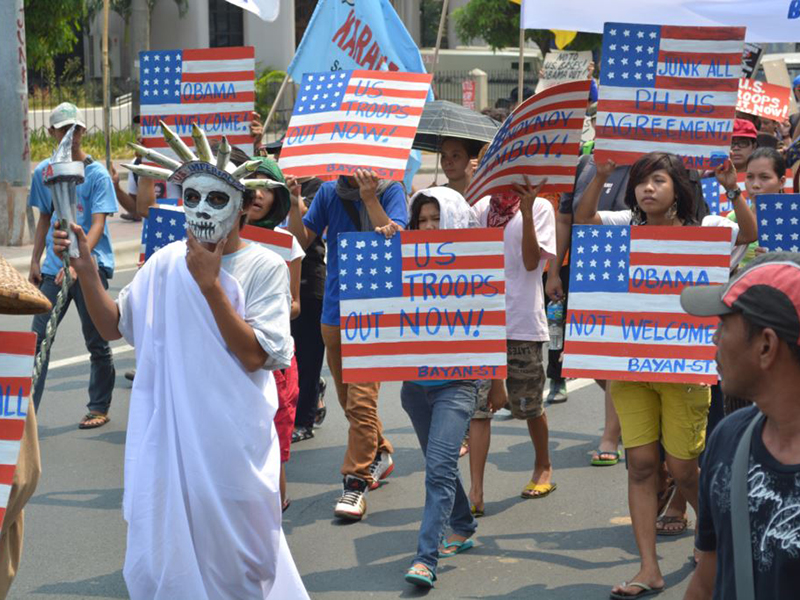
“A howling wilderness” was what General Jacob Smith ordered his troops to make of Samar, Philippines. He was taking revenge for the ambush of fifty-four soldiers by Filipino revolutionaries in September 1901.

After the invaders killed most of the island’s inhabitants, three bells from the Balangiga Church were looted as war trophies; two are still displayed at Warren Air Force Base, Cheyenne, Wyoming. Very few Americans know this. Nor would they have any clue about the 1913 massacre of thousands of Muslim women, men and children resisting General Pershing’s (image right) systematic destruction of their homes in Mindanao where President Rodrigo Duterte today resides.
Addressing this dire amnesia afflicting the public, both in the Philippines and abroad, newly-elected president Duterte began the task of evoking/invoking the accursed past. He assumed the role of oral tribune, with prophetic expletives. Like the Filipino guerillas of Generals Lukban and Malvar who retreated to the mountains (called “boondocks” by American pursuers from the Tagalog word “bundok,” mountain), Duterte seems to be coming down with the task of reclaiming the collective dignity of the heathens – eulogised by Rudyard Kipling, at the start of the war in February 1899, as “the white men’s burden”.
White Men’s Burden
The Filipino-American War of 1899-1913 occupies only a paragraph, at most, in most US texbooks, a blip in the rise of the United States as an Asian Pacific Leviathan. Hobbes’ figure is more applicable to international rivalries than to predatory neoliberal capitalism today, or to the urban jungle of Metro Manila. At least 1.4 million Filipinos (verified by historian Luzviminda Francisco) died as a result of the scorched-earth policy of President McKinley. His armed missionaries were notorious for Vietnam-style “hamletting.”
They also practised the “water-cure”, also known as “water-boarding”, a form of torture now legitimised in a genocidal war of terror (Iraq, Afghanistan) that recalls the ruthless suppression of Native American tribes and dehumanization of African slaves in the westward march of the “civilizing Krag” to the Pacific, to the Chinese market.
Today the struggle at Standing Rock and Black-Lives-Matter are timely reminders. Stuart Creighton Miller’s 1982 book, “Benevolent Assimilation”, together with asides by Gabriel Kolko and Howard Zinn, recounted the vicissitudes of that bloody passage through Philippine boondocks and countryside.

Mark Twain exposed the hypocrisy of Washington’s “Benevolent Assimilation” with searing diatribes, as though inventing the “conscience” of his generation. William James, William Dean Howells, W.E.B. DuBois and other public intellectuals denounced what turned out to be the “first Vietnam” (Bernard Fall’s rubric).
It was a learning experience for the conquerors. In Policing America’s Empire, Alfred McCoy discovered that America’s “tutelage” of the Filipino elite (involving oligarchic politicians of the Commonwealth period up to Marcos and Aquino) functioned as a laboratory for crafting methods of surveillance, ideological manipulation, propaganda, and other modes of covert and overt pacification. Censorship, mass arrests of suspected dissidents, torture and assassination of “bandits” protesting landlord abuses and bureaucratic corruption in the first three decades of colonial rule led to large-scale killing of peasants and workers in numerous Colorum and Sakdalista uprisings.
Re-Visiting the Cold War of Terror
This pattern of racialized class oppression via electoral politics and discipiinary pedagogy culminated in the Cold War apparatus devised by CIA agent Edward Lansdale and the technocrats of Magsasay to suppress the Huk rebellion in the two decades after formal granting of independence in 1946.
The Cold War Leviathan continued to operate in the savage extrajudicial killings during the Marcos dictatorship.
After Marcos’ death, the Marcos family and the despot’s cadaver were allowed by then President Ramos to return.
Given the re-installment of the feudal-comprador ellite due partly to the failure of the national-democratic forces to educate, organize and mobilize the masses, the Marcos family recovered institutional power. The current reactionary Supreme Court Justices and Duterte’s link to the Marcoses are a symptom of fierce internecine conflict within the oligarchic bloc. It fosters sectarian partisanship and opportunist fantasies. The controversy over Marcos’ burial today cannot be fully assayed without factoring in, in this conjunctural crisis, the role of patronage-clientelism syndrome in the body politic and the US-oriented State ideological-military apparatus of a decadent oligarchic elite.
Mournless Melancholia
U.S. Cold War Realpolitik defined Corazon Aquino’s “total war” against nationalists, progressive peasants, professionals, Igorots, Lumads – all touted by Washington/Pentagon as the price for enjoying individualist prerogatives, esp. the right to gamble in the capitalist casino. This constitutes the rationale for US-subsidised counterinsurgency schemes to shore up the decadent, if not moribund, status quo – a society plagued by profound and seemingly durable disparity of wealth and power – now impolitely challenged by Duterte.
This is not strange, given the long history of Filipino “miseducation” documented by Renato Constantino. Perhaps the neglect if not dismissal of the Filipino collective experience is due to the indiscriminate celebration of America’s success in making the natives speak English, imitate the American Way of Life shown in Hollywood movies, and indulge in mimicked consumerism.
What is scandalous is the complicity of the U.S. intelligentsia (with few exceptions) in regurgitating the “civilizing effect” of colonial exploitation. Every time the Filipino essence is described as violent, foolish, shrewd or cunning, the evidence displays the actions of a landlord-politician, bureaucrat, savvy merchant, US-educated professional, or rich entrepreneur. Unequal groups dissolve into these representative types: Quezon, Roxas, Magsaysay, Fidel Ramos, etc. What seems ironic if not parodic is that after a century of massive research and formulaic analysis of the colony’s underdevelopment, we arrive at Stanley Karnow’s verdict (amplified in In Our Image) that, really, the Filipinos and their character-syndromes are to blame for their poverty and backwardness, for not being smart beneficiaries of American “good works”. “F_ck you,” Duterte might uncouthly respond.
Hobbes or Machiavelli?
An avalanche of media commentaries, disingenously purporting to be objective news reports, followed Duterte’s campaign to eradicate the endemic drug addiction rampant in the country. But the media, without any judicious assaying of hearsay, concluded that Duterte’s policy – his public pronouncement that bodies will float in Manila Bay, etc. – caused the killing of innocent civilians. His method of attack impressed the academics as Hobbesian, not Machiavellian. The journalistic imperative to sensationalise and distort by selective framing (following, of course, corporate norms and biases) governs the style and content of quotidian media operations.
Is Duterte guilty of the alleged EJK (extrajudicial killings)? No doubt, druglords and their police accomplices took advantage of the policy to silence their minions. This is the fabled “collateral damage” bewailed by the bishops and moralists. But Obama, UN and local pundits associated with the defeated parties seized on the cases of innocent victims (two or three are more than enough, demonstrated by the photo of a woman allegedly cradling the body of her husband, blown up in Time (October 10) and in The Atlantic, September issue, and social media) to teach Duterte a lesson on human rights, due process, and genteel diplomatic protocols. This irked the thin-skinned town mayor whose lack of etiquette, civility, and petty-bourgeois decorum became the target of unctuous sermons.
Stigma for All Seasons: “Anti-Americanism”
What finally gave the casuistic game away, in my view, is the piece in the November issue of The Atlantic by Jon Emont entitled “Duterte’s Anti-Americanism”. What does “anti-Americanism” mean – to be against McDonald burgers, Beyonce, I-phones, Saturday Night Live, Lady Gaga, Bloomingdale fashions, Wall Street, or Washington-Pentagon imperial browbeating of inferior nations/peoples-of-colour? The article points to tell-tale symptoms: Duterte is suspending joint military exercises, separating from US government foreign policy by renewing friendly cooperation with China in the smoldering South China Sea, and”veering” toward Russia for economic ties – in short, promoting what will counter the debilitating, predatory US legacy.

Above all, Duterte (image above) is guilty of diverging from public opinion, meaning the Filipino love for Americans. He rejects US “security guarantees”, ignores the $3 billion remittances of Filipinos (presumably, relatives of middle and upper classes), the $13 million given by the US for relief of Yolanda typhoon victims in 2013. Three negative testimonies against Duterte’s “anti-American bluster” are used: 1) Asia Foundation official Steven Rood’s comment that since most Filipinos don’t care about foreign policy, “elites have considerable latitude,” that is, they can do whatever pleases them. 2) Richard Javad Heydarian, affiliated with De La Salle University, is quoted – this professor is now a celebrity of the anti-Duterte cult – that Duterte “can get away with it”; and, finally, Gen Fidel Ramos who contends that the military top brass “like US troops” – West-Point-trained Ramos has expanded on his tirade against Duterte with the usual cliches of unruly client-state leaders who turn against their masters, and seems ready to lead a farcical version of the 1968 People Power revolt, one of the symptoms of fierce internecine strife within the corrupt oligarchic bloc.
Like other anti-Duterte squibs, the article finally comes up with the psychological diagnosis of Duterte’s fixation on the case of the Davao 2002 bombing when a “supposed involvement of US officials” who spirited a CIA-affiliated American bomber confirmed the Davao mayor’s fondness for “stereotypes of superior meddling America.” The judgment seems anticllimatic. What calls attention will not be strange anymore: there is not a whisper of the tortuous history of US imperial exercise of power on the subalterns.
This polemic-cum-factoids culminates in a faux-folksy, rebarbative quip: “Washington can tolerate a thin-skinned ally who bites the hand that feeds him through crass invective.” The Washington Post (Nov 2) quickly intoned its approval by harping on Ramos’ defection as a sign of the local elite’s displeasure. With Washington halting the sale of rifles to the Philippine police because of Duterte’s human-rights abuses, the Post warns that $ 9 million military aid and $32 million funds for law-enforcement will be dropped by Congress if Duterte doesn’t stop his “anti-US rhetoric”. Trick or treat?
On this recycled issue of “anti-Americanism,” the best riposte is by Michael Parenti, from his incisive book Inventing Reality: “The media dismiss conflicts that arise between the United States and popular forces in other countries as manifestations of the latter’s “anti-Americanism”… When thousands marched in the Philippines against the abominated US-supported Marcos regime, the New York Times reported, “Anti-Marcos and anti-American slogans and banners were in abundance, with the most common being “Down with the US-Marcos Dictatorship!” A week later, the Times again described Filipino protests against US support of the Marcos dictatorship as “anti-Americanism.” The Atlantic, the New York Times,and the Washington Post share an ideological-political genealogy with the Cold War paranoia currentlygripping the U.S. ruling-class Establishment.
Predictably, the New York Times (Nov. 3 issue) confirmed the consensus that the US is not worried so much about the “authoritarian” or “murderous ways of imposing law and order” (Walden Bello’s labels; InterAksyon, Oct 29) as they are discombobulated by Duterte’s rapproachment with China. The calculus of US regional hegemony was changed when Filipino fishermen returned to fish around the Scarborough Shoal.
This pivot to China panicked Washington, belying the Time expert Carl Thayer who pontificated that Duterte “can’t really stand up to China unless the US is backing him” (Sept 15, 2016). A blowback occurred in the boondocks; the thin-skinned “Punisher” and scourge of druglords triggered a “howling wilderness” that exploded the century-long stranglehold of global finance capitalism on the islands. No need to waste time on more psychoanalysis of Duterte’s motivation.
What the next US president would surely do to restore its ascendancy in that region is undermine Duterte’s popular base, fund a strategy of destabilization via divide-and-rule (as in Chile, Yugoslavia, Ukraine), and incite its volatile pro-American constituency to beat pots and kettles in the streets of MetroManila.
This complex geopolitical situation entangling the United States and its former colony/neocolony, cries for deeper historical contextualization and empathy for the victims lacking in the Western media demonization of Duterte and his supporters, over 70% of a hundred million Filipinos in the Philippines and in the diaspora. For further elaboration, see my recent books US Imperialism and Revolution in the Philippines (Palgrave) and Between Empire and Insurgency (University of the Philippines Press).
Featured image: Anti-American military protesters head toward the U.S. embassy in Manila ahead of President Barrack Obama’s visit to the Philippines, April 23, 2014. Photo courtesy: Simone Orendain/VOA
About the Author
E. San Juan, Jr, an emeritus professor of Ethnic Studies and Comparative Literature, was a fellow of W.E.B. Du Bois Institute, Harvard University, Fulbright lecturer of American Studies at Leuven University, Belgium, is currently professorial lecturer, Polytechnic University of the Philippines, Manila
Will Improved US-Russia Relations Follow Trump’s Electoral Triumph? “Will Putin Become my New Best Friend?”
“I think I’d get along very well with Vladimir Putin. I just think so.”
The greatest risk of a Hillary electoral triumph was possible nuclear war on Russia – perhaps China and Iran to follow. Her defeat lets peace activists exhale for the first time in the campaign – but not relax.
He wants increased military spending at a time America’s only enemies are ones it invents.
How aggressive he’ll be geopolitically remains to be seen.
Hopefully his election means improved Russia/US relations after years of hostility under Obama. Here are some Trump quotes about Vladimir Putin, positive signs:
October 2007: “Look at Putin – what he’s doing with Russia – I mean, you know, what’s going on over there. I mean this guy has done – whether you like him or don’t like him – he’s doing a great job in rebuilding the image of Russia and also rebuilding Russia period.”
December 2011: Trump praised Putin’s “intelligence (and) no-nonsense way,” adding he “has big plans for Russia. He wants to edge out its neighbours so that Russia can dominate oil supplies to all of Europe.”
June 2013: Trump tweeted “(w)ill (Putin) become my new best friend?”
October 2013: “I think he’s done a really great job of outsmarting our country.”
July 2015: “I think I’d get along very well with Vladimir Putin. I just think so.”
October 2015: He and Putin “are very different,” but they’d “get along very well. I think that I would probably get along with him very well. And I don’t think you’d be having the kind of problems that you’re having right now.”

December 17, 2015: Trump called Putin a “talented person…It is always a great honour to be so nicely complimented by a man so highly respected within his own country and beyond.”
December 18, 2015: “He’s running his country and at least he’s a leader, unlike what we have in this country. I think our country does plenty of killing also.”
February 2016: I have no relationship with him other than he called me a genius. He said Donald trump is a genius and he is going to be the leader of the party and he’s going to be the leader of the world or something.”
“These characters that I’m running against said, ‘(w)e want you to disavow that statement.’ I said what, he called me a genius, I’m going to disavow it? Are you crazy? Can you believe it? How stupid are they.”
“And besides that, wouldn’t it be good if we actually got along with countries. Wouldn’t it actually be a positive thing. I think I’d have a good relationship with Putin. I mean who knows.”
April 2016: “…I’d possibly have a good relationship (with Putin). He’s been very nice to me. If we can make a great deal for our country and get along with Russia that would be a tremendous thing. I would love to try it.”
July 2016: “I would treat Vladimir Putin firmly, but there’s nothing I can think of that I’d rather do than have Russia friendly, as opposed to the way they are right now, so that we can go and knock out ISIS with other people.”
“President Trump would be so much better for US/Russian relations. It can’t be worse.”
“I don’t think he has any respect for Clinton. I think he respects me. I think it would be great to get along with him.”
If nothing else, Trump deserves credit for ending Hillary’s political career, preventing a third Clinton crime family administration. And that’s a good thing, as he might put it.
Putin welcomed his triumph, saying
“(w)e heard (him say he) would treat Vladimir Putin firmly, but there’s nothing I can think of that I’d rather do than have Russia friendly, as opposed to the way they are right now, so that we can go and knock out ISIS with other people.”
“We understand and are aware that it will be a difficult path in the light of the degradation in which, unfortunately, the relationship between Russia and the US are at the moment.”
“(I)t is not our fault that Russia/US relations are as you see them.”
Putin believes “building a constructive dialogue between Moscow and Washington, based on principles of equality, mutual respect and each other’s positions, meets the interests of the peoples of our countries and of the entire international community.”
This article was first published on Global Research on 09 November 2016.
About the Author
 Stephen Lendman lives in Chicago. He can be reached at [email protected]. His new book as editor and contributor is titled “Flashpoint in Ukraine: How the US Drive for Hegemony Risks WW III.” http://www.claritypress.com/LendmanIII.html Visit his blog site at sjlendman.blogspot.com. Listen to cutting-edge discussions with distinguished guests on the Progressive Radio News Hour on the Progressive Radio Network.
The Election: Failing Real Change, Hope Lost

The Democrats under Bill Clinton and Barack Obama were long on soaring rhetoric, and short on substance. Many Americans wanted more “change” and less “hope”. Democrats must advance candidates committed to real policy change, not just rhetorical masters on hope.
The Donald Trump fiasco was enabled by the Democrats’ rejection of their New Deal coalition. Selecting Hillary Clinton to head their presidential ticket created an opening for a Molotov/Ribbentrop Pact between the “deplorables” and those who could not stomach more establishment politics delivering ever more gains for Wall Street, with only more pain for the working and middle class.
We all know the Republicans proved obstructionist at every turn. Yet, at key moments the Democrats caved even when the opportunity opened to enact New Deal style reforms. Case in point was when President Obama held Congressional majorities his first 2 years. In his first half-year in office the GOP was cowed and Obama could have readily run the table on policy change. He could have pushed through a “public option” for healthcare reform. Instead, he and David Axelrod advanced a new politics of conciliation that would herald a new era of cooperation. This Age of Aquarius might have been realisable in the context of an acrimonious academic department or small community in need of healing. Yet, we live in a rough and tumble world of politics where egocentric, sociopathic alpha personalities representing billionaire interests position their tools in political office with the expressed purpose to turn policy in their direction by any means necessary. In short, Obama and Axelrod’s represented a combination of good intentions and vanity that could only end badly in the real world of interest-based politics. The rhetoric of hope would not “trump” interests.
Meanwhile, the Clintons bent on every point of principle. They learned from their re-election defeat after Bill’s two years in office as Governor of Arkansas. Politicians recalibrate after political losses and accommodate to either the conservative impulses of the electorate, or the demands of powerful special interests. Yet, the Clintons became too comfortable with this accommodation. They morphed into centre-right democrats and failed to pivot to progressive policies when political openings presented themselves for change: an example being Hillary’s rejection of single-payer healthcare in 1993 when the electorate briefly favoured it. They no longer merely represented the establishment. By the 1990s, they became part of it.
President Obama delivered the Republican’s healthcare reform. This kept Big Insurance well fed, but failed to control costs. This consistent accommodation to power cost Democrats the White House in 2016. The public in 2009 was ready for far-reaching economic reform. Obama’s (and the Democratic establishment’s) “evolutionary” approach to reform was doomed to fail. Having a beer in New Jersey with CounterPunch’s dear late Alexander Cockburn in September 2009, we expressed total frustration at this once in a 2 or 3 generation opportunity presented by the 2008 financial crash to introduce major policy change. We were dismayed that Obama and Axelrod had already lost their window for launching real policy change, while giving time for Republicans to re-organise and mount their counterattack.
Obama made sensible reforms of the health insurance industry (covering children to 26 years of age, not penalising women on costs for merely being women, no dropped coverage for pre-existing conditions, etc.). The thinking was that this could be followed by more reform. But, by delaying major change when there was an opening for it (e.g., the failure to cover people under a public option) meant Big Insurance could still levy big premium increases. That they did within a month of Hillary Clinton’s election bid should surprise no one. These big cost increases delivered the coup de grace to Hillary’s flagging campaign. The working and middle classes failed to benefit from Obama’s economy (and would have done no better under Republicans).
The Democratic Party lost the confidence of many in the working and middle classes. The public showed great patience over the 4 terms of Clinton and Obama, but saw few gains. Democrats to failed to advance a New Deal style agenda and finally paid the price on November 8, 2016. The hubris of Clinton/Obama/Wasserman Democratic establishment led to this electoral loss. Latinos, African-Americans and millennials failed to turn out in the numbers and margins the Democratic establishment cynically counted on.
Implications
Trump’s win is a disaster for the judiciary. With GOP control of the Senate, Trump will remake the Supreme Court and Federal Judiciary into an even more reactionary check on public power. These changes will last a generation and will most powerfully impact the powerless.
Economy: expect a behind the scenes intra-GOP debate over whether to reprise Reagan’s “sailor on shore leave” big deficit military spending to juice the economy, or to default to the austerity zealots of the party. The former would make the GOP heroes for people seeking work, but risk more war as weapons that are built, often get used. The latter (austerity) would create dissent at home as the economy fails, thus leaving the GOP looking for distractions, in short, more foreign adventures, again.
Foreign policy: while there is an opening to reduce tensions with Russia, for the reasons stated immediately above, expect the GOP to remain the war party. More weapons or austerity could both lead to more war.
Politically: Democrats have won the popular vote twice in 16 years, while losing the election. This demands Electoral College reform. Instead, expect the GOP to double down on this undemocratic institution that continues to deliver them unearned electoral victories. Moreover, failing a massive legislative wins by Democrats in 2018 and 2020, expect the GOP to further gerrymand legislative districts. This ensures victories even when they lose the vote. For example, the state of Wisconsin legislature won 60% of its legislative seats in 2012 with only 44% of the state vote. Expect more of this, along with more institutionalised voter suppression going forward.
Future: Democrats must advance candidates committed to real policy change, not just rhetorical masters on hope. Hillary’s loss may just be the event that finally discredits their leadership and creates a new politics that either takes over their party or failing that creates a new one.
The election outcome
The chance now opens for Dems to retake the House and Senate in 2 years. Will they make the necessary changes to do so? Time will tell…
This article was first published on CounterPunch on 9 November 2016
Featured image: Donald Trump, in Las Vegas. Photo courtesy: Ethan Miller/Getty
Jeffrey Sommers is Professor of Political Economy & Public and Senior Fellow, Institute of World Affairs of the University of Wisconsin-Milwaukee and Visiting Professor at the Stockholm School of Economics in Riga.
EDITOR'S PICK OF THE WEEK