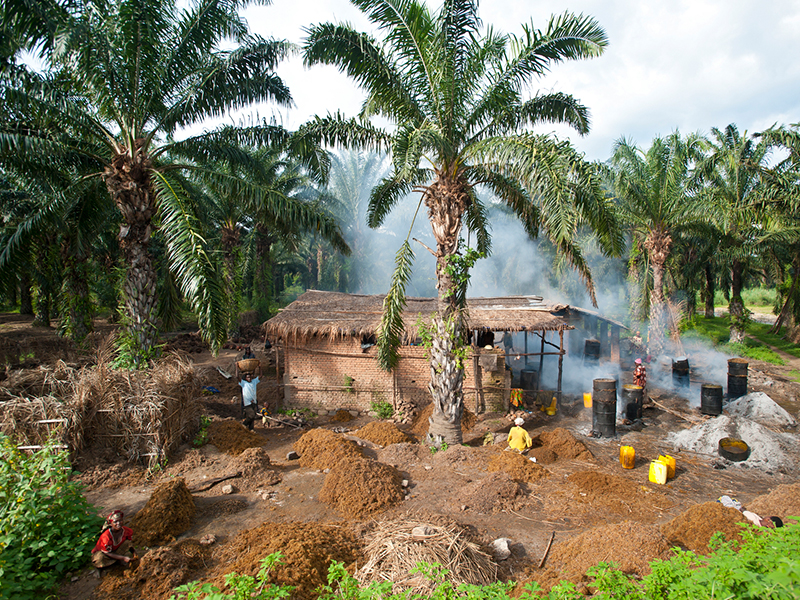
By Derek Byerlee, Walter Falcon, and Rosamond Naylor
The rise of soybeans and oil palm in the tropics has attracted massive private and state investments, offering significant opportunities for tropical regions to develop their economies but often at the cost of clearing forests and savannas. This article discusses how the tropical oil crop revolution can provide better and more sustainable development.
Agricultural revolutions that transform global food systems and agricultural landscapes occur infrequently. Yet, since 1990 global production of oil crops in the developing world has almost tripled, expanding at a faster rate than cereals during the green revolution of 1965-85. Like the green revolution, this new revolution largely involves two crops – in this case, oil palm and soybeans – expanding mostly in the tropics. In a remarkably short time frame of about two decades soybeans and oil palm have become among the most important crops in world agriculture due to their contributions to food, feed, and fuel supplies. Their rise has taken place within a globalising world where the products of one region are consumed largely in another. Oil crops and their products now rank first (soybean products) and third (palm and palm kernel oil) in world agricultural trade with wheat products occupying second place.
Oil crops have attracted massive investments of private and state capital, opening up sparsely populated regions in the tropics and creating a host of dynamic industries in emerging economies, such as oil milling, intensive livestock, biodiesel, and oleo-chemicals. Most visibly, they have been among the major drivers of change in land use in the tropics, where their production has converted huge tracts of forest, savannah, and pastures into highly productive farmland, often at the cost of increased greenhouse emissions and loss of biodiversity.


A Perfect Storm
A host of factors aligned on the demand and supply sides to produce a “perfect storm” for growth of tropical oil crops.
First and foremost, demand expanded rapidly for both protein meal and vegetable oils. As consumers in emerging economies became richer, they greatly increased their consumption of livestock products and the associated demand for protein meal for feed, as well as for vegetable oils for cooking and processed foods.
Second, the rising demand for vegetable oils was further fuelled – both literally and figuratively – when the biodiesel industry took off. This industry, driven by policies mandating the use of biodiesel as a transportation fuel in several countries, has accounted for about one-third of the increase in global vegetable oil demand since 2003.
Easy access to land and capital, along with the availability of productive technologies, made oil crops very profitable and promoted their expansion.
Such dramatic increases in demand could not have been satisfied without equivalent drivers on the supply side. In Brazil, cheap land became accessible with the construction of new highways and ports, and new technologies allowed soybeans to grow well in its tropical savannahs. In Southeast Asia, even cheaper land became available for oil palm as governments made large concessions of forested and degraded land available to private companies.
The era of market liberalisation and privatisation starting in the late 1980s brought a surge of private capital, often foreign, to develop new supply chains, especially during the commodity boom from 2007-14. State capital, often subsidised, was also available to the oil crop sector through national development banks. Easy access to land and capital, along with the availability of productive technologies, made oil crops very profitable and promoted their expansion.
The supply and demand sides were brought together by global trade liberalisation and integration. As countries joined the newly created World Trade Organization, imports of vegetable oils and soybeans were liberalised almost everywhere, and trade exploded. Producers in a handful of exporting countries were linked to distant consumers and rapidly emerging new industries by investments in roads, ports and larger ships that facilitated trade at a relatively low cost. The most dramatic changes occurred in China and India. China’s liberalisation of soybean imports made it by far the world’s largest importer of soybeans (mostly supplied by Brazil), and India’s liberalisation of vegetable oil imports made it the world’s largest importer of vegetable oils (largely supplied by Indonesia).
Finally, the extraordinary success of the two dominant commodities, palm oil and soybeans, came from massive substitution of these products for traditional sources of vegetable oil. For example, palm oil replaced virtually all of the coconut oil used in food in Indonesia and soybean meal replaced waste materials and byproducts in animal feed in China.
The Winners and Losers
As with all periods of rapid economic change, the revolution in oil crops has had its winners and losers. The availability of cheap, plentiful vegetable oil has been important for improving food security in extremely poor populations by increasing their energy and fat intake. However, for richer households, consuming more vegetable oil sometimes poses health risks that are possibly even greater for palm oil due to its high level of saturated fats.
The revolution undoubtedly produced enormous economic benefits by creating new industries and transforming sparsely settled areas into dynamic growth poles with new towns and service providers along the value chain. Smallholders sometimes participated strongly in this growth, as in Indonesia (oil palm) and India (soybeans). However, local communities without secure land tenure often lost livelihoods as outside investors usurped their land rights.
Oil crops have also created millions of new jobs in Southeast and South Asia, regions with extensive poverty. Although labour rights have received less attention than land rights, millions of labourers in oil palm cross international borders illegally and are sometimes subject to employment abuse and poor living conditions.
The massive changes in land use associated with tropical oil crops have had high environmental costs in terms of GHG emissions and biodiversity losses. These costs have been exacerbated by the use of fire to clear land, where oil crops have replaced tropical forest. Recent analyses conclude that oil palm and soybeans, together with beef, pulp, and paper are the four key commodities contributing to GHGs from land-use changes, which in turn account for about 15 percent of global GHG emissions.
The Future Will Not Be Like The Past
Alarmists predict that oil crops will consume the remaining tropical forests. For a number of reasons, our analysis sees growth in demand for tropical oil crops sharply slowing by 2050 (by as much as two thirds).
Africa missed out on the oil crop revolution but is poised to take centre stage in the coming decades.
First, growth in demand for biofuel feedstocks cannot maintain the rapid pace of the past decade. This tapering off will be most apparent in the EU, the major consumer of biodiesel today, especially as it approaches the regulated maximum of renewable transport fuels that can be provided from foodstuffs. Some tropical countries, notably Brazil and Indonesia, are likely to compensate in part for the EU slowdown, but in our view neither India and China (the two most populous countries) nor sub-Saharan Africa will become significant producers of biodiesel, given their high dependence on imported vegetable oils. Second, the use of vegetable oils for food will also grow more slowly than in the recent past – in Asia, population growth will be slower and the effects of rising incomes will diminish as consumers in middle-income countries have already reach high levels of vegetable oil consumption. Third, the use of protein meal for feed is subject to a similar slowdown as China’s meat consumption levels off.
On the supply side, the biggest wild card is land availability for expanding oil palm in Asia and Africa, especially as environmental regulations tighten and current users gain more secure rights to their land. Whether this expansion is on forested or degraded land, the transaction costs of accessing large tracts of land surely will rise. However, in our view, the area covered by oil crops does not have to expand greatly to meet future demand, which can be supplied largely through intensification of existing crop land and only a modest expansion in area. Although there will be no dramatic yield jumps, since yield gaps for oil crops in the major producers (except smallholders) are already low relative to gaps in yields of other major staples, steady progress is possible through genetic gains in yield. In addition, sufficient degraded land is available to accommodate area expansion, provided land governance and incentive systems can be developed to steer the expansion onto degraded lands and away from areas of natural vegetation with high carbon stocks and biodiversity values.
Africa as the New Frontier
Africa missed out on the oil crop revolution but is poised to take centre stage in the coming decades. With rapid population and income growth, the region’s demand for vegetable oils and protein meal is expanding rapidly. On the supply side, Africa has the land and labour to meet that demand and perhaps become a significant exporter.
Oil palm, a traditional African crop, requires a judicious combination of improvements in the local supply chains of smallholders and small-scale processors with injections of outside capital, technology, and market expertise through private investors. The current emphasis on investment in large plantations is unlikely to be sustainable, given the complexities of African land markets and land rights.
Soybeans, a new crop in much of Africa, will inevitably expand with the attendant environmental costs of converting savannah and woodland to crop agriculture. Again, the focus should be on small and medium producers through contract farming and outgrower schemes to supply domestic and regional markets.
Even so, investors are exerting considerable pressure to gain access to land for tropical oil crops in Africa. The last large tract of tropical rainforest in the Congo basin has been protected from deforestation and timber extraction by the lack of infrastructure, but the steady extension of roads throughout Africa and better links to global markets pose a significant threat to these forests.
Better Prospects for Sustainability
We aspire to win-win outcomes for sustainable development, but as pragmatists we understand that the real world entails messy trade-offs. We are cautiously optimistic that the future expansion of the oil crop sector can be managed more sustainably. The much slower projected expansion will, in itself, make such costs more manageable. Some signs also point to convergence among global consumers, private actors, civil society, and local governments in finding ways to minimise the trade-offs between economic benefits and social and environmental costs.
A big challenge will be supporting smallholders in adopting sustainable practices and certifying their production, given the high transaction costs and skill requirements required.
Brazil, the major soybean producer, has made the most progress. Brazilian soybeans have contributed little to deforestation in recent years, although expansion into savannah and woodland continues, albeit more slowly, and is possibly displacing cattle farming to the Amazon frontier. As we write, a parallel story is unfolding in Indonesia, where major global traders have made strong commitments to achieve zero deforestation, zero use of peatlands and no exploitation of local communities. However, a difficult and uncertain path lies ahead when it comes to implementing these commitments on the ground in Indonesia.
The best bet to improve sustainability in the short to medium run involve full implementation of the commitments by palm oil traders through upgraded certification systems to enforce standards to help clean up supply chains. The performance-based contracts under the UN-negotiated agreement on Reduced Emissions from Deforestation and Degradation (REDD+) also provide important incentives to governments to support such commitments. On the social side, we see major new opportunities for smallholders to take advantage of the growing infrastructure of roads, mills, and logistics, as they have already done in Sumatra, Indonesia. A big challenge will be supporting smallholders in adopting sustainable practices and certifying their production, given the high transaction costs and skill requirements required.
In the long run, private standards, trader commitments, and moratoria cannot substitute for better land and forest governance. But where there is a will, new tools allow stakeholders to monitor land users and changes in land use in real time, and they can quickly identify and expose transgressors. These tools, together with growing concern about climate change and biodiversity loss, are shining a spotlight on tropical oil crops and global trade in their products – a spotlight that companies and states alike can no longer ignore. Ultimately, however, it is the local players, including local communities, who implement policies on the ground. They are the ones who must be convinced that the sector’s sustainable development is good business for them and for the future.
About the Authors
 Derek Byerlee is a Visiting Scholar at the Center on Food Security and the Environment, Stanford University, Adjunct Professor in the Global Human Development Program, Georgetown University, and Editor-in-Chief of the Global Food Security journal.
 Walter P. Falcon is Farnsworth Professor of International Agricultural Policy (Emeritus) and Senior Fellow at Stanford University.
 Rosamond L. Naylor is the William Wrigley Professor of Earth Systems Science and the Director of the Center on Food Security and the Environment at Stanford University.
Their book, The Tropical Oil Crops Revolution: Food, feed, fuel and forests, was published by Oxford University Press in October, 2016.




 Sholto Byrnes is a senior fellow at the Institute of Strategic and International Studies, Malaysia




 Trump’s remarkably decisive win stunned most