Home Blog Page 1064

Hedge Funds: Past, Present, and Future

By H. Kent Baker and Greg Filbeck

“Hedge funds, private equity and venture capital funds have played an important role in providing liquidity to our financial system and improving the efficiency of capital markets. But as their role has grown, so have the risks they pose.” Jack Reed

During the past few decades, hedge funds have evolved from obscure investment vehicles to highly popular investments in the global market. Institutional investors including pension funds, endowments, insurance companies, private banks, and high-net-worth individuals and families are attracted to hedge funds. Not surprisingly, hedge funds have drawn considerable attention from investors, practitioners, and academics. The period after the financial crisis of 2007-2008, also called the Global Financial Crisis (GFC), was tumultuous for hedge funds and resulted in startling headlines. Today, hedge funds have become, and are likely to remain, an essential part of the financial landscape. After taking a brief historical look at hedge funds, we discuss current hedge fund debates and controversies, and take a glimpse into their future prospects.

A hedge fund is a pooled investment vehicle that uses various strategies to invest in different asset classes. Professional investment managers administer these privately offered funds. Hedge funds attempt to produce above-average investment returns using many strategies and tools ranging from traditional stock-picking to complex derivative and arbitrage plays.

Characteristics of Hedge Funds

Several key characteristics differentiate hedge funds from other types of pooled investments such as mutual funds as well as other alternative investments including private equity. First, not all investors have access to hedge funds. In the United States, for example, hedge funds are only open to “accredited” or qualified investors. Until recently, being qualified as an accredited investor simply involved having or making a sufficient amount of money. As of February 1, 2016, the US requirements changed. The Financial Services Committee and the US House of Representatives passed HR 2187, known as the Fair Investment Opportunities for Professional Experts Act. Now individuals can qualify as accredited investors based on measures of sophistication such as having a minimum amount of investments, certain professional credentials, and experience investing in exempt offerings, being knowledgeable employees of private funds, or by passing a qualifying accredited investor examination. The expanded definition of an accredited investor still continues to exclude many, if not most, investors.

Second, hedge funds have wider investment latitude than many other types of pooled investments. For example, hedge funds are highly flexible in their investment options because they can use financial instruments generally beyond the reach of mutual funds. Hence, they can engage in more aggressive strategies and positions, such as short selling, trading in derivative instruments including options, and using leverage (borrowing) to enhance the risk/reward profile of their bets.  However, a hedge fund does not necessarily use hedging techniques given that the classification scheme for hedge funds has broadened considerably over time. The only limitation to a hedge fund’s investment universe is its mandate. Thus, some hedge funds can invest in anything including stocks, derivatives, land, real estate, and currencies. By contrast, most mutual funds follow the traditional “long only” model of investing in that they mainly stick to investing in stocks or bonds. Few mutual funds short-sell stocks because they face some restrictions and the higher costs of operating a long-short portfolio.

Hedge funds are highly flexible in their investment options because they can use financial instruments generally beyond the reach of mutual funds. Hence, they can engage in more aggressive strategies and positions, such as short selling, trading in derivative instruments including options, and using leverage (borrowing) to enhance the risk/reward profile of their bets.

Third, hedge funds often use leverage. That is, they can borrow funds to potentially increase their returns. However, leverage can destroy hedge fund returns as seen during the GFC.

Fourth, the compensation or fee structure differs for hedge funds. Besides charging various fees, which are associated with more traditional pooled investments such as mutual funds, hedge funds also have a performance or incentive fee. For example, a once common fee structure called “2 and 20” enabled hedge fund managers to charge a flat 2 percent of total asset value as a management fee and an additional 20 percent of any profits earned. However, these fees have trended lower in recent years.

Finally, hedge funds are lightly regulated. Yet, as a result of the GFC, hedge funds have come under increased regulatory scrutiny. For example, as of July 2010, the Dodd-Frank Wall Street Reform Act requires hedge funds with more than $150 million in assets to register with the Securities and Exchange Commission (SEC). Further, under the “Volcker Rule”, banks are now restricted in their ability to sponsor hedge funds and are prohibited from proprietary trading of them.

Benefits and Risks

Hedge funds offer some notable benefits over traditional investment funds. For example, the investment strategies used by hedge funds can potentially generate positive returns in both rising and falling markets. Given that hedge funds may have low correlations with a traditional portfolio of stocks and bonds, including hedge funds in a portfolio offers potential diversification benefits. That is, adding hedge funds to a balanced portfolio might reduce overall portfolio risk and volatility and increase returns. The large number of strategies available to hedge fund managers can help them meet their investment objectives. Hedge funds offer a long-term investment solution that eliminates or at least reduces the need to correctly time entry to and exit from markets. Finally, hedge funds have some of the most talented investment managers. Not surprisingly, hedge fund investors have high expectations about the potential risk/return contributions that hedge funds can provide relative to more traditional portfolios.

Despite these potential benefits, hedge funds have structural disadvantages that subject investors to certain risks. For example, hedge funds are not only subject to less regulation than many other structures but also offer limited transparency. For example, hedge funds are not required to detail redemptions publicly. Consequently, managers often closely guard those numbers to avoid any trace of loss of confidence. The lack of investment constraints poses a greater risk of strategy and style drift. Some funds use investment strategies that expose investors to potentially large losses, such as using leverage. Hedge funds typically require investors to lock up money for a period of years resulting in a lack of liquidity. They often have a gate provision that gives managers the right to limit the amount of withdrawals on any withdrawal date to not more than a stated percentage of a fund’s net assets. Finally, hedge funds are subject to high fees and complex incentive structures, which can induce excessive risk-taking to exceed previous fund high water marks or attempt to generate greater performance fees. A high-water mark refers to the highest peak in value that an investment fund/account has reached. Typically, managers are eligible for performance fees if the value of their funds exceeds their previous high-water marks. Thus, hedge funds are not for everyone but they can meet the specific investment goals and needs of some investors.

Brief History of Hedge Funds

Although the origins of hedge funds can be traced to the 1920s, Alfred W. Jones introduced the term “hedged fund” and subsequently created the first hedge fund in 1949. Jones inspired a new investment model by incorporating technical analysis methods into forecasting to create the first long/short strategy. Long/short strategies incorporate both long positions in securities that are deemed to be underpriced and short positions on securities that are considered overpriced. Jones is also credited for the incentive fee structure used by hedge funds today. The incentive fee structure was initially established at 20 percent of realised profit.

By 2008, the hedge fund industry claimed almost $1.93 trillion in assets under management (AUM). Overall investments decreased in the aftermath of the GFC, but increased to a record $3.02 trillion during the fourth quarter of 2016, excluding $360.4 billion in funds of funds. According to data from Hedge Fund Research (HFR), which tracks performance and flows at global hedge funds, hedge fund liquidations in 2016 hit the highest number since the GFC. For 2016, liquidations totalled 1,057, surpassing the 1,023 liquidations from 2009, though falling well short of the record of 1,471 liquidations from 2008. The number of new launches totalled 729 in 2016, which represents a steep decline from the 968 launches in 2015 (HFR 2017). As a result of more liquidations and fewer launches, the number of hedge funds globally fell below 10,000 for the first time since 2014.

Current Issues, Debates, and Controversies

Several major debates and concerns surround hedge funds. According to a recent survey by Preqin (2017), performance (73 percent) and fees (64 percent) are the two key issues facing the industry. This debate tends to resurface especially when hedge fund performance is weak relative to other investment alternatives. Investors pay two types of fees: a management fee and an incentive or performance-based fee. Evidence suggests a slight trend for declining fees. According to HFR, at the end of 2016, average management fees had slipped to 1.48 percent, while the average performance fee dropped to 17.4 percent. For new launches in 2016, the average management fee for funds fell to 1.33 percent, declining from 1.6 percent for 2015 launches, while the average incentive fee for funds declined to 17.71 percent, down 4 basis points from 2015 fund launches. As Kenneth J. Heinz, President of HFR, notes, “The hedge fund industry fee structure continues the process of evolving to meet increased investor demands, as well as persistently low, albeit increasing, level of interest rate” (HFR 2017). Despite declining fees, hedge fund fees still remain high. Moreover, no regulatory limits exist on the fees hedge funds can charge.

According to a recent survey by Preqin (2017), performance (73 percent) and fees (64 percent) are the two key issues facing the industry.

After the GFC, high fees have not necessarily resulted in high returns. Beginning with the early 2009 bull market, hedge fund returns, on average, have lagged traditional asset returns (Martin and Copeland 2016). For example, the Barclay Hedge Fund Index shows returns of 2.88 percent, 0.04 percent, and 6.10 percent in 2014, 2015, and 2016, respectively. This index measures the average return of all hedge funds, excepting funds of funds, in the Barclay database (Barclay Hedge 2017).

Not surprisingly, performance results differ between different indexes because hedge funds are not required to report returns. For example, the HFRI Fund Weighted Composite Index® gained 5.5 percent in 2016 versus 6.10 using the Barclay Hedge Fund Index. Performance differs dramatically among hedge funds. For 2016, the top HFRI decile averaged a 32.7 percent return, while the bottom decile fell an average of – 15.5 percent. Dispersion between the top and bottom HFRI deciles was 48.2 percent in 2016 (HFR 2017). By comparison, the annual total return on the S&P 500 Index during 2014, 2015, and 2016 were 13.69 percent, 1.38 percent, and 11.96 percent, respectively (YCharts 2017).

Given high fees coupled with poor returns, frustrated hedge fund investors in 2016 continued to withdraw capital. In fact, investor dissatisfaction with hedge funds has not been this high since the GFC when they withdrew $154 billion in assets in 2008 and $131 billion in assets in 2009, according to HFR. In 2016, hedge fund liquidations increased, bringing the number of closed funds to the highest level since 2008. Nonetheless, the AUM of hedge funds increased each year since 2008.

Besides fees and performance, Preece (2017) notes other debates and controversies surround hedge funds. For example, one issue is whether reported hedge fund returns are overstated due to biases inherent in their reporting. Several factors, including serial correlation of returns, smoothed returns, survivorship bias, selection bias, and infrequent sampling, can affect reported returns. Other issues focus on the relative lack of regulatory oversight and transparency for hedge funds as well as the use of leverage and hedge fund malfeasance including accusations of fraud ranging from misstating results, engaging in bribery, and failing to disclose conflicts of interest. Finally, some question the role of hedge funds in society.

The Future of Hedge Funds

According to a survey by Ernst & Young (EY) (2016), the primary objective for the hedge fund industry going forward is the ability for it to adapt to evolving demands. EY’s analysis reveals four key metrics necessary for hedge funds to thrive going forward: (1) the need for continued asset growth (56 percent), (2) the ability to effectively manage talent (23 percent), (3) successful cost management and operational efficiency (11 percent), and (4) successful technological transformation (4 percent). To remain competitive, hedge funds must offer greater diversity in nontraditional hedge fund products as investors continue the trend of shifting assets toward investment strategies not easily replicated in the traditional space. Additionally, the average management fee rates continue to decline requiring hedge funds to seek new ways to reduce costs. Growth remains as the top strategic priority in achieving economies of scale, which are predicated on the ability to recruit and retain successful managers.

To remain competitive, hedge funds must offer greater diversity in nontraditional hedge fund products as investors continue the trend of shifting assets toward investment strategies not easily replicated in the traditional space.

In its annual survey, Preqin (2017) notes that 84 percent of investors had avoided hedge fund investments due to terms and conditions of hedge funds with two-thirds of investors indicating that hedge funds had not met their performance expectations. Yet investors plan to increase their hedge fund exposure to those using relative value, macro, event driven, and equity strategies. In total, Preqin reports that 51 percent of institutional investors allocate at least a portion of their portfolio to hedge funds and about 90 percent of these investors have a hedge fund target allocation of 5 percent or more.

Despite challenges, some experts predict that AUM for the hedge fund industry will grow faster than the market. For instance, Citi Investor Services (2014) predicts that the hedge fund industry is likely to nearly double from $2.63 trillion AUM in 2013 to $4.81 trillion AUM in 2018 with almost three fourths (74 percent) of those assets coming from institutional investors. 

Such investors as pension plans, endowments and foundations remain key investors going forward. Citi Investor Services predicts that endowments and foundations are likely to maintain a steady allocation of around 18 percent to hedge funds through 2018. Sovereign wealth funds are also likely to increase their weight in hedge funds by about 150 percent from around 8 percent in 2013 to 12 percent by 2018. According to Preqin (2017), 54 percent of institutional investors plan to maintain their current hedge fund allocation with 15 percent planning to increase allocation and 31 percent planning to decrease allocation. Hedge funds face increased competition with capital inflows into the alternative investment arena. Compared to hedge funds, Preqin reports that institutional investors are far more interested in increasing their long-term allocations in many other alternative asset classes such as private debt (62 percent), infrastructure (53 percent), private equity (48 percent), and real estate (36 percent).

Looking into the early 2020s, some subtle good and bad signs are present for market growth. On the upside, about 60 percent of hedge fund managers plan to expand their current array of investment strategies. On the downside, only 37 percent plan to broaden their global presence.

The key to sustained growth going forward appears to be in changing institutional investors’ perceptions of hedge funds. According to Preqin (2017), about 20 percent of institutional investors perceive hedge funds as a positive alternative asset class. By comparison, most of these investors have a positive view of several other alternative asset classes: private equity (about 80 percent), private debt (about 70 percent), and real estate (about 50 percent). Looking into the early 2020s, some subtle good and bad signs are present for market growth. On the upside, about 60 percent of hedge fund managers plan to expand their current array of investment strategies. On the downside, only 37 percent plan to broaden their global presence. Moreover, 17 percent plan to narrow their focus by repositioning their fund within a particular niche. Only 10 percent plan to acquire another firm, which suggests that most managers plan to grow internally with little consolidation from these activities (State Street 2014). The largest hedge fund managers are responding to current trends by moving toward multi-product asset managers (71 percent, up from 59 percent in the previous year survey) with fewer managers planning to offer only one core strategy (EY 2016).

Conclusions

Holzhauer (2017) notes that hedge funds are operating in a rapidly changing landscape. Because of lower returns generated since the GFC, the hedge fund industry faces growing pressure to lower fees while shoring up operational efficiencies. Thus, managers need to quickly adapt to new technology, especially in areas where it can decrease operating costs. In the future, managers must do a better job of convincing investors that their funds are worth the higher costs. The hedge fund industry has historically been quick to make changes. If managers can continue to find ways to meet investors’ increasing demands net of fees, the long-term future looks bright for the industry.

About the Authors

H. Kent Baker (DBA, PhD, CFA, CMA) is University Professor of Finance at American University’s Kogod School of Business in Washington, DC. He is the Author or Editor of 28 books and more than 165 refereed journal articles. The Journal of Finance Literature recognised him as among the top 1 percent of the most prolific authors in finance during the past 50 years. Professor Baker has consulting and training experience with more than 100 organisations. He has received many research, teaching and service awards including Teacher/Scholar of the Year at American University.

Greg Filbeck (DBA, CFA, FRM, CAIA, CIPM, PRM) holds the Samuel P. Black III Professor of Finance and Risk Management at Penn State Erie, the Behrend College and serves as the Interim Director for the Black School of Business. He formerly served as Senior Vice-President of Kaplan Schweser and held academic appointments at Miami University and the University of Toledo, where he served as the Associate Director of the Center for Family Business. Professor Filbeck is an author or editor of five books and has published more than 90 refereed academic journal articles.

References

1. Barclay Hedge. (2017). “Barclay Hedge Fund Index.” Available at https://www.barclayhedge.com/research/indices/ghs/Hedge_Fund_Index.html.
2. Citi Investor Services. (2014). “Opportunities and Challenges for Hedge Funds in the Coming Era of Optimization – Part 1: Changes Driven by the Investor Audience.” Citibank. Available at http://www.citibank.com/icg/global_markets/prime_finance/docs/Opportunities_and_ Challenges_for_Hedge_Funds_in_the_Coming_Era_of_Optimization.pdf.
3. Ernst & Young. (2016). “2016 Global Hedge Fund and Investor Survey.” November 15. Available at http://www.ey.com/Publication/vwLUAssets/ey-2016-globa-hf-survey/$FILE/ey-2016-globa-hf-survey.pdf.
4. HFR. (2017). “Hedge Funds Lower Fees as Fed Raises Rates.” March 17. Available at https://www.hedgefundresearch.com/news/hedge-funds-lower-fees-as-fed-raises-rates.
5. Holzhauer, Hunter. (2017). “Current Hedge Fund Debates and Controversies.” In. H. Kent Baker and Greg Filbeck (eds.), Hedge Funds: Structure, Strategies, and PerformanceNew York: Oxford University Press.
6. Martin, Timothy, and Rob Copeland. (2016). “Investors Pull Cash from Hedge Funds as Returns Lag Markets.” The Wall Street Journal, March 30. Available at http://www.wsj.com/articles/investors-message-to-hedge-funds-we-are-replacing-you-with-clones-1459348497.
7. Preece, Dianna. (2017). “Current Hedge Fund Debates and Controversies.” In. H. Kent Baker and Greg Filbeck (eds.), Hedge Funds: Structure, Strategies, and Performance. New York: Oxford University Press.
8. Preqin. (2017). “Preqin Investor Outlook: Alternative Assets – H1 2017.” Available at https://www.preqin.com/docs/reports/Preqin-Investor-Outlook-Alternative-Assets-H1-2017.pdf.
9. State Street. (2014). “The Alpha Game: Hedge Funds Step Up Operations to Capture New Growth.” Available at http://www.statestreet.com/content/dam/statestreet/documents/Articles/HedgeFunds_AltsReport_FIN.pdf.
10. YCharts. (2017). “S&P 500 Annual Total Return.” Available at https://ycharts.com/indicators/sandp_500_total_return_annual

Islamic Finance in Kazakhstan – The Future Hub of Islamic Finance in the Central Asia

By Mamunur Rashid

 According to Malaysia Islamic Finance Marketplace, Zawya Islamic and Thomson Reuters, Islamic finance has been growing at a double-digit rate since the start of the new millennium.  In this article the author discusses the potential of Islamic Finance in Kazakhstan, and its role in the success of Islamic Finance in Central Asia.

Islamic Finance is considered as an alternative financial system that is based on Islamic shari’ah promoting a superior form of ethical and social financial transformation mechanism, shared values and sustainable development. The system prohibits the use of traditional interest rates, promotes profit and loss sharing in investment and financing, and, more importantly, considers the customers as “partners” in business. Financial instruments are designed to fit the above-mentioned goals for the shorter- and longer-terms. Multiple authorities including internal and centralised shari’ah advisory boards monitor the innovation in financial instruments and their performance. Countries in the Middle East, Southeast Asia, North Africa, and South Asia are leading in development of comprehensive halal ecosystems for the users of Islamic finance. Islamic finance has received much attention after the recent global financial crisis while the system has been extraordinarily resilient to risk. Experts have given credits to Islamic finance systems for an embedded risk management system as such the Islamic financial managers have carefully screened investment based on risk adjusted benefits. More countries are gradually registering their interest towards Islamic financial system, and the system has experienced tremendous development from several fronts including banking, equities investment, Islamic bonds (sukuk), mutual funds, microfinance, and insurance (takaful).


Source: Compiled by the writer from various sources 

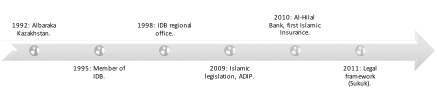
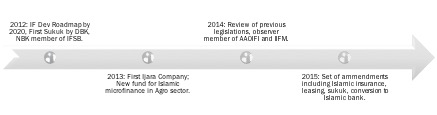
Figure 1 & 2: Timelines of Development of IF in Kazakhstan

Kazakhstan has been in the frontier leading Islamic finance development in the Central Asian region. Above timelines are self-explanatory. There has been a rapid progression since 2009, the year of the first established legislation for Islamic finance industry, to become the Islamic hub of Central Asia. By 2020, Kazakhstan wants its Islamic banking industry to reach 3-5% of its total banking assets. To achieve this vision, the country has already laid down rigorous plans combining regulatory initiatives for Islamic banking, insurance, leasing, sukuk, and microfinance, and has set-up supporting institutions to shift to the next gear of development and enhancement. Astana has given a clear signal to that direction in 2015 by bringing meaningful amendments to the existing regulations. Capital requirements for chartering a new bank has been brought down by 50%, conversion from conventional to Islamic mode of financing has been streamlined, and a centralised Shari’ah board (Council for Islamic Financing Principles) has been activated. Initiatives are taken by National Bank of Kazakhstan to develop halal ecosystems that combine prudential regulations, financial institutions, consumers, and cross-border relations. Positive outcomes have started appearing as well: Thomson Reuters investment outlook (2015) ranked the country in the 5th position out of 57 OIC member countries as a top tiered Islamic investment destination, and a similar survey was conducted in 2014 that ranked Astana 5th on the regulatory initiatives and integration. At present, the country has seen an Islamic bank, Al Hilal Bank, a Sukuk issuance, an Islamic microfinance mostly for the agricultural financing, Islamic leasing firm, and an Islamic insurance (Takaful) firm. Internationally active banks such as the Al Baraka Group and MayBank Group have shown interests to be active in Islamic finance markets in Kazakhstan. With a 17.5 million Muslim population, which is almost untapped, Astana can expect some positive changes in the coming future.


Source: Kulchmanov et al. (2016)

Figure 3: Preparation for Future (based on survey on bank managers)

Note: MY, IND – Islamic banks in Malaysia, Indonesia, IB – Islamic Bank in Kazakhstan, LCB & SCB – Large and Small Conventional Bank in Kazakhstan.

Three major challenges have been identified so far. In an interview with Thomson Reuters, the Deputy Governor of the National Bank of Kazakhstan has identified a shortage of knowledge base, lower level awareness, and limited but gradually developing legislative initiatives as the major challenges. Similar findings are reported by a recent full pledged study done on risk management of Islamic Bank in Kazakhstan by Kulchmanov et al. (2016). Their study has reported that technical and Shari’ah related know-how, limited regulatory assistance, and unavailability of markets for Islamic institutions are the key challenges. This study has found that industry wide development is more important than the firm specific development as future strategies. The study concluded that size of the overall market is a serious contingent variable, meaning that the challenges will gradually disappear with a greater number of institutions, instruments and growth in consumer base. Figure 3 shows that the Islamic Bank is better prepared than overall industry readiness since the Islamic Bank is owned by already established Islamic finance service providers.

The study concluded that size of the overall market is a serious contingent variable, meaning that the challenges will gradually disappear with a greater number of institutions, instruments and growth in consumer base.

More insights are gathered when I analyse the most recent published income statement and balance sheet information for the only Islamic bank in Kazakhstan. Al Hilal Bank’s profit has increased three times from 2014 to 2015. Around 90% of their income from Islamic finance activities is earned using Ijara and similar methods. The bank has paid only 3.5% of its income (from IF activities) as expenses for Islamic finance activities. Total assets are doubled between 2014 and 2015; however, the major portion (42% of total assets) is kept as cash and equivalents. 54% of the assets in 2015 have been invested in Islamic financial alternatives such as Islamic derivatives (7%), commodity Murabaha agreements (38%), Wakala investment deposits (7%) and Ijara (2%). Notably, Ijara and Wakala investment deposits have decreased in 2015 when compared to the value in 2014. An excessive amount of cash holding indicates that the bank is looking for profitable investment, which is unavailable at this moment.

Al Hilal Bank has reported an equally distributed capital structure in 2015 with 49% of the funds from equity and 51% in debt. This is quite a contrast to the figures in 2014 while the bank has sourced 85% of the funds from equity and only 15% from debt. Among many, consumer deposit has increased by 2.5 times from 2014 to 2015, even though in overall financing the percentage of consumer deposits is only 17% (of total assets in 2015). With a massive size of equity capital, it is expected that the bank has much higher capital adequacy than expected. The bank has not reported the portion of the bank’s owners’ Zakah, which the bank expects the shareholders to calculate on their own. Finally, there has been no reporting on profit-and-loss-sharing instruments and Qard Hasan that are more socially responsible and Shari’ah-centric.

Based on the operating outlook of the Al Hilal Bank, we can look at a larger set of challenges for Islamic finance development in Kazakhstan. Interestingly, none of these are new, as such these challenges have been common for any nation with a plan to become the Islamic finance service providers. We will, however, have a look at these challenges from a critical and market-oriented approach.


Figure 4: Islamic finance ecosystems for Kazakhstan

By 2020, Astana is planning to reach an adequate stage of Islamic financial legislative development that will help attract new investment in this area. It is easily understandable that the components of Islamic finance should be integrated in a chain to work efficiently. For instance, Islamic banking should be seamlessly supported by Islamic capital markets, insurance and other allied services. Similarly, being in a multi-racial environment, authorities should take extra care while opening opportunities for Islamic entrepreneurship, which is the largest demand side stakeholder of the Islamic financial services. The ecosystems cannot work unless the financial systems and the business environment are not equally Shari’ah compliant. Thirdly, Islamic banks would eventually compete with their conventional counterparts. Hence, it is partly their responsibility to help increase the financial literacy at the various consumption levels to achieve a superior growth of adoption. Government should tie up with financial institutions and educational institutions in reaching a higher level of financial literacy. These developments in human capital must also be supported by adequate incentives.

Thirdly, Islamic banks would eventually compete with their conventional counterparts. Hence, it is partly their responsibility to help increase the financial literacy at the various consumption levels to achieve a superior growth of adoption.

Islamic financial institutions should gradually move towards a socially responsible financial model that is more sustainable and covers a greater proportion of population. Some of the recent day socio-economic development agendas, such as the SDGs and MDGs, can be accomplished easily if Astana can target a higher level of inclusion alongside existing legislative and performance-related indicators. Moreover, Islamic financial institutions are expected to enhance their capabilities to handle profit and loss sharing contracts for an efficient socio-economic transformation. If PLS is ignored any further, Islamic banks will eventually turn to conventional institutions having no soulless efforts to maximise value of a limited number of shareholders. Finally, a successful Islamic ecosystem should uphold relationships with other likeminded institutions and authorities across border. Learning from the best practices from other Islamic financial institutions will help reaching the Astana Islamic finance vision-2020.      

About the Author

Mamunur Rashid holds a PhD in Behavioural Finance, and currently is an Assistant Professor of Finance, and the Deputy Director of the Centre for Islamic Business and Finance Research (CIBFR), at the University of Nottingham Malaysia Campus. He has been teaching International Finance, Financial Economics, Islamic Capital Markets, and Corporate Finance for the last twelve years in different countries. An active researcher, Dr Mamunur publishes widely in financial economics, Islamic economics, investor behavior, and corporate social responsibility, and has presented papers in 25 international conferences. In 2016-17, Dr Rashid has co-edited a special issue for International Journal of Mamunur has worked on several corporate and government projects. Mamunur Rashid can be contacted at: [email protected].

References:

1. Annual report of Al Hilal Bank Islamic Bank JSC (2015)
2. A new frontier of Islamic Finance – Thomson Reuters Islamic Finance country report of Kazakhstan.
3. Kulchmanov, A., Hassan, M.K. & Rashid, M. (2016). Contingency theory approach to risk management practices in Islamic banks: A case study on Kazakhstan, International Journal of Islamic Business, 1(2), 35-67.

Regime Change in the Trump White House?

By Dan Steinbock                                        

No US postwar president has managed to reset relations with Russia. Now the Trump administration must cope with a special counsel’s investigation. In the past, US efforts at regime change targetted foreign countries; today, the White House. How will it impact Trump’s stalled policy agenda?

As I argued in spring 2016 (TWFR, April 25, 2016),1 US election is a global risk and it would continue to be fought after the Trump election win. But recently, these political struggles moved to an entirely new phase.

First, the Department of Justice (DOJ) dismissed James Comey, Director of the Federal Bureau of Investigation (FBI), reportedly only days after his request for increased resources to investigate Russia’s alleged interference in the election. Barely a week later, DOJ appointed Robert Mueller, former director of the FBI (2001-13) as special counsel overseeing the investigation into alleged Russian interference in the 2016 election.

In order to assess the probable impact of the investigation on Trump’s stalled policy agenda, it is important to understand what is actually new in his trade, political and military stances.

There is little doubt about the political outcome of the Mueller investigation. Just as he loyally served under President George W. Bush, along with Defense Secretary Donald Rumsfeld and Vice President Dick Cheney’s neoconservatives, he is unlikely to treat any Russian initiative – whether planned, unintended, alleged, or misrepresented – with silk gloves. So from the White House’s perspective, the end result is known. Consequently, it is the process that has potential to undermine the effective presidency.

In order to assess the probable impact of the investigation on Trump’s stalled policy agenda, it is important to understand what is actually new in his trade, political and military stances.

Obama-Bernanke Origins of Trump’s Anti-EU Rhetoric

During a bruising series of meetings in the NATO summit in Belgium and at the G-7 gathering in Italy, President Trump was quoted as calling Germany “very, very bad” on trade, which the White House denied, however. That was followed by German Chancellor Angela Merkel’s speech, which was perceived as historical in Europe, and in which she said that “the times in which we can fully count on others are somewhat over”. 

While Merkel’s Atlanticist supporters saw the speech as signalling the end of the postwar Western consensus, it was also geared to Merkel’s domestic constituencies to pave way for victory in the German federal election in September 2017. Also, Trump’s accusations of excessive German trade deficits and Western Europe’s free-ride at NATO are hardly new. He has made them repeatedly in the past two years. And truth to be told, so did President Obama.

Trump is neither first nor unique in his criticism of Europe. Following the end of the Cold War, every US president, in one way or another, has engaged in similar criticism. The notion that Europeans are “free riders”, enjoying the benefits of an international order safeguarded by the US without contributing much to it, is an old one in Washington. Soon after he received his Nobel Peace Prize, Obama began to complain about those NATO members who do not pay their “fair share” in global affairs. In particular, he launched an “anti-free rider campaign” in which, among other things, he pushed his European allies to lead the NATO intervention in Libya in 2011 – “to prevent the Europeans and the Arab states from holding our coats while we did all the fighting”.

While Trump’s policy agenda is not entirely new, it is tougher, broader and less politically correct than its precursors in decades. However, Mueller’s investigation will cast a dark shadow over the White House’s policy agenda.

What about deficit criticism? That’s not unique to Trump either. Following the global financial crisis, both Obama and former Fed chief Ben Bernanke often argued that “Germany’s trade surplus is a problem.” Unlike China, which has been working to reduce its dependence on exports since the early 2010s, Germany has not. As a result, Obama and Bernanke often pleased Chancellor Merkel to launch Keynesian investment initiatives and promote German consumption so that European recovery could happen faster, but without success. To Obama and Bernanke, that was frustrating; to Trump, hypocrisy.

What’s new in the current Atlanticist friction, however, is Trump’s willingness to push both NATO payments and trade distortions in parallel, as well as Chancellor Merkel’s shrewd timing in using anti-Trump sentiments to foster pan-European unity. Until recently, her centre-right Christian-Democrats (CDU) were struggling against Social-Democrats (SDP) and the radical right (Alternative for Germany AfD). But when Trump began his efforts to divide Europe before election season, Merkel started her attempt to rally Germans behind CDU and united Europe, taking advantage of anti-Trump sentiments in the Old Continent. Thereafter CDU’s polls began to rise again.

While Trump’s policy agenda is not entirely new, it is tougher, broader and less politically correct than its precursors in decades. However, Mueller’s investigation will cast a dark shadow over the White House’s policy agenda.

Deferred Trade Friction

During the 2016 campaign, Trump threatened to use high import tariffs against nations that have a significant trade surplus with the US. In 2016, the deficit list was topped by China ($347 billion), Japan ($69 billion), Germany ($65 billion), Mexico ($63 billion), and Canada ($11 billion). On a per capita basis, Germany is the leading “deficit offender”.

In his campaign, President Trump promised to renegotiate America’s key free trade agreements, including the North American Free Trade Agreement (NAFTA). Right after his inauguration, he used executive order to pull out of the Trans-Pacific Partnership (TPP), which was seen as President Obama’s legacy deal. In turn, NAFTA renegotiations are set to start soon. However, according to the positive spin of US Trade Representative Robert Lighthize the Trump administration will seek to “expand” NAFTA trade rather than to “overturn” it.

As the talks are to begin after mid-August, they will be followed closely by other bilateral trade talks (South Korea, Japan, Taiwan), including allegations on “currency manipulation”. Since these negotiations are likely to endure through the fall, major trade friction may not be likely until 2018.

With reduced rates and one-time repatriation tax rate stashed, the White House hopes that US companies’ overseas profits and corporate operations would return home. In reality, such expectations are inflated.

The Trump administration’s tone about China has also softened following an internal struggle between Trump’s trade hawks (head of the National Trade Council Peter Navarro, and trade advisor and former CEO of steel giant Nuctor, Dan DiMicco), and their more moderate opponents (Treasury Secretary Steve Mnuchin, and chief of National Economic Council Gary Cohn). After the two-day summit at Mar-a-Lago, President Trump and President Xi Jinping announced a 100-day plan to improve strained trade ties and boost cooperation between two nations.

However, unless the plan can offer major breakthroughs after the summer, trade hawks may return later and deficit rhetoric may escalate toward the year-end.

Since sanctions fall under executive actions, Trump tends to have more strategic manoeuverability in these areas. Then again, both Republican neoconservatives and Democratic liberal internationalists support sanctions against North Korea, Russia and, with some qualifications, Iran.


Headwinds Against Tax Reforms

Until recently, progressive taxation has played a critical role in all advanced economies. In America, that model has been under a siege since the Reagan years. Today, US personal income tax rate is one of the lowest among the G20 economies, whereas US corporate tax rates are high internationally. As a result, US companies have parked more than $1 trillion worth of cash abroad.

Nevertheless, Mueller’s investigation is likely to overshadow Trump efforts at tax overhaul, which depends on legislative support for success.

The Trump administration hopes to simplify the number of individual income tax brackets. It would like to reduce the tax rate on capital gains, non-corporate business taxes and those in the highest bracket, repeal the alternative minimum tax and the Affordable Care Act (the “Obamacare”) surtax, and the estate tax. Critics expect the total costs of the plan to soar to $5 trillion over a decade. While Republicans are ready to move ahead with a repeal bill, it has been diluted but still divides Republicans in the Senate and House of Representatives. Senate Majority Leader Mitch McConnell suspects that the new bill will not pass through the Senate.

The Trump corporate tax plan is seen as even more controversial. In 2016, these rates were around 30-35% in major advanced economies (France, Japan, Germany), except for the UK (19%). The US rate (39%) is the highest among all G20 economies. Trump’s plan would almost halve rates to just 15 percent, which would put America ahead even of low-tax city paradises, Singapore (17%) and Hong Kong (16.5%). With reduced rates and one-time repatriation tax rate stashed, the White House hopes that US companies’ overseas profits and corporate operations would return home. In reality, such expectations are inflated.

There has been no major outflux of foreign firms from large emerging economies, which offer growth that is 3-4 times faster than in the US or Europe. Since the 1970s, US trade deficits have been a regional issue mainly with Asia. As costs are rising in China, emerging Asia will take the mantle but US trade deficits will prevail. And even when relocation offers some benefits, US and other multinationals may prove reluctant to move their core operations because an increasing number of these companies rely on emerging-economy middle classes and new innovation hubs for their profitability.

While the Trump administration will try to push its stalled policy agenda, it must now do so with the White House in shackles. Intriguingly, despite their global might, all US postwar presidents have failed to reset relations with Russia.

Four Presidents, Four Russia Resets, Four Failures

After the dissolution of the Soviet Union in 1991, relations between Russia and the US remained generally warm between the Bush and Clinton administrations, and President Boris Yeltsin until the US-inspired “shock therapy” caused Russia an economic nightmare that proved far worse than the Great Depression in the US. That is when three former Soviet satellites – Poland, Hungary and the Czech Republic – were invited to join the NATO. By mid-90s, Poland, Hungary, the Czech Republic, and the Baltic states were also ushered into NATO – against the angry but ultimately futile protests by presidents Yeltsin and Mikhail Gorbachev.

In 2001, President George W. Bush wanted to reset US Russia relations. But after the White House was swept by 9/11 and neoconservatives’ increasingly unilateral foreign policy, it began incursions into Afghanistan, withdrew from the Anti-Ballistic Missile Treaty, and invaded Iraq. As NATO began looking even further eastward to Ukraine and Georgia, Russian protests turned angrier and more aggressive. Most Russians saw the Rose Revolution in Georgia 2003, and US effort to build an anti-ballistic missile defense installation in Poland with a radar station in the Czech Republic, as intrusions into its sphere of interest, along with US efforts to gain access to Central Asian oil and natural gas.

Like Clinton and Bush initially, President Obama wanted to reset US-Russia relations and by March 2010 both countries agreed to reduce their nuclear arsenals. Yet, the reset was not supported by Obama’s Secretary of State Hillary Clinton, Secretary of Defense Robert Gates and US ambassador to Russia John Beyrle. Subsequently, rising tensions in Crimea were seized to bury the effort.

In the campaign trail, Trump lauded President Putin as a strong leader, arguing in favour of friendlier relations. Meanwhile, FBI began investigating alleged connections between Donald Trump’s former campaign manager Paul Manafort, foreign policy adviser Carter Page and pro-Russian interests. In January 2017, Trump and President Putin began phone conferences as the White House still mulled lifting economic sanctions to reset relations with Russia. But in February, Trump’s security adviser Michael Flynn was forced to resign. As the Empire stroke back, Secretary of State Rex Tillerson said only two months later that US-Russia relations were at a new low point. And by May, Mueller was appointed to head the investigation into alleged Russian interference in the 2016 US elections. The Wolfowitz doctrine had prevailed – against four US presidents.


Who’s Afraid of the Big Bad Wolf-owitz Doctrine

Historically Washington has been involved in dozens of overt and covert actions aimed at regime change in other countries. The postwar list of covert involvement alone features some two dozen overseas attempts at regime change in overseas. Ironically, the list begins and ends with Syria (See Figure 1).


Source: Creative Commons

Figure 1: Covert United States Involvement in Postwar Regime Change

Now a regime effort is targeting the White House, say the Trump supporters. That effort relies on the Wolfowitz Doctrine, a highly controversial policy blueprint developed amid the end of the Cold War by Undersecretary of Defense for Policy Paul Wolfowitz, the prophet of the Bush neoconservatives, and his deputy Scooter Libby, later an adviser to Vice President Cheney until his indictment for leaking the covert identity of a major CIA officer.

The Doctrine announced the US’s status as the world’s only remaining superpower and proclaimed its main objective to be retaining that status. Its first objective thus was “to prevent the re-emergence of a new rival, either on the territory of the former Soviet Union or elsewhere that poses a threat on the order of that posed formerly by the Soviet Union”.

In December 1989, Soviet President Gorbachev and US President George H. W. Bush declared the Cold War over at the Malta Summit. In February 1990, then-Secretary of State James Baker suggested that, in exchange for cooperation on Germany, US could make “iron-clad guarantees” that NATO would not expand “one inch eastward”. Gorbachev acceded to Germany’s Western alignment on the condition that the US would limit NATO’s expansion. But behind the façade, Baker’s own top officials and Wolfowitz at the Pentagon began to push Eastern Europe in the US orbit inspiring “a call for 21st century American imperialism that no other nation can or should accept”, as Senator Edward M. Kennedy once put it.

The Wolfowitz Doctrine announced the US’s status as the world’s only remaining superpower and proclaimed its main objective to be retaining that status. Its first objective thus was “to prevent the re-emergence of a new rival, either on the territory of the former Soviet Union or elsewhere that poses a threat on the order of that posed formerly by the Soviet Union”.

It was the same Wolfowitz Doctrine that inspired the neoconservatives to initiate multiple wars in the Middle East following September 11, 2001; and that undermined the efforts of four post-Cold War presidents to reset relations with Russia. In each case, the “military-industrial complex” – about which President Eisenhower, a five-star general, had warned already in 1961 – played a critical but low-profile role behind the scenes. President Clinton did not oppose the military interests, as long as they supported US economic interests; Bush’s inner circle comprised Pentagon’s ultimate insiders; Obama talked against the military and security complex but became its cheerleader. In contrast, Trump fought efforts to kill the reset of Russia relations – until Mueller’s appointment.

The Mueller investigation does not indicate that the role of the US as the major global risk has now faded away. These investigations can lead anywhere, as President Clinton discovered after his affair with Monica Lewinsky. In the process, they can create great collateral damage, both at home and abroad.

The role of the US as a global risk is only about to begin.

Photo courtesy: Ethan Miller/Getty Images

About the Author

Dan Steinbock is the Founder of Difference Group and has served as Research Director of International Business at the India China and America Institute (US) and a Visiting Fellow at the Shanghai Institutes for International Studies (China) and the EU Centre (Singapore). For more, see http://www.differencegroup.net

Reference

1. http://www.worldfinancialreview.com/?p=5439

When Waqf meets Banks

By Ebi Junaidi

Global economy has been leaning toward innovations focussed in achieving sustainability. Ebi Junaidi promotes the age-old Waqf “movement” established by the Muslims. The Waqf system, with its philanthropic nature, does not only motivate sustainability but more importantly promises to enable financial institutions that goes beyond corporate social responsibility.


Currently there is a new trend in Islamic Economics and Finance that is “revitalising the original institution/instruments” once practiced in early and medieval Islam. One of the very authentic institution/instrument is waqf. Waqf (plural: awqaf) is perpetual charitable trust established by Muslim. Waqf has been in the centre of attention in the latest World Bank-IRTI IDB’s Global Report in Islamic Finance 2016 by putting it in many aspects of Islamic Finance potential development in an effort to create a shared prosperity and reaching the Sustainable Development Goals (SDG).

In a national and local level, the trend has succeeded creating the new regulations, emerging some new institutions, empowering existing ones, as well as enabling cooperation among institutions once perceived to be “in different part of world”. This “movement” has been so massive, to the extent that Nagaoka of Kyoto University considered it as the New Horizon 2.0. in Islamic Economics and Finance.1

The support that has come from the Islamic Scholar, government, regulator, existing waqf institution, academics and common people (who act as the waqif, the giver of waqf and the beneficiaries of waqf) has not come without justifiable reasons. The existing dormant assets of waqf are enormous, its possible collection in the future is highly potential, as well. At the same time, religious-wise, contribution to waqf is highly recommended as it is believed that the perpetual nature of the instrument equals to continuous never-ending benefit received by the giver surpassing his life time. Modern historian, such as Hodgson affirmed that waqf is the key for the success of the Muslim world economy.2

Modern historian, Hodgson (1974) affirmed that waqf is the key for the success of the Muslim world economy.

The question now is, how to actually realise this potential? What model to be initiate to enable an efficient waqf management? Effort has been done in modelling waqf management. Some has come up with independent waqf-based charity organisations, microfinance institutions, a joint cooperation between waqf institution and (Islamic) banks creating a banking model of corporate waqf, joint cooperation between waqf institution and insurance companies,a stand-alone corporate waqf, etc.

Looking at current share of Islamic finance, which is still dominated by Islamic banks, it is easy to conclude that integrating waqf with Islamic banking institution will be one of the option that might create more impactful result. Estimate from the Islamic Financial Services Board (IFSB 2015) mentioned that almost 79% of the $1.87 trillion Islamic Finance industry belongs to Islamic Bank. This article, thus, focusses on what waqf could offer to the banking sector and how banking corporate governance will benefit from it. Other word, it aims to integrate the waqf into the mainstream of (Islamic) financial industry.

As waqf is a philanthropy in nature, the usage of the funding should have socio-economics dimension. Therefore the idea of financial inclusion looks appeal as it is now been mainstreamed in both developed and developing countries through financial institution and banking. For Islamic banking, these ideas are even more relevant as Islamic financial system stems from the main goals of Islam, those are: eradication of poverty, promotion of socio-economic justice and equitable distribution of income.

“The history of awqaf is very rich with prominent achievements in serving the poor in particular and in enhancing the welfare in general.”

In the past Waqf has played a tremendous role both as commercial and public institutions, even before the existence of bank and financial institution.3,4 During The Ottoman empire, for example, it is depicted that throughout the entire life of a citizen, waqf functions in “making his/her life possible” to the extent that it can be depicted as follow: “Thanks to the prodigious development of waqf institutions, a person could be born in a house belonging to a waqf, sleep in a cradle of that waqf and fill up on its food, receive instructions through waqf-owned books, become a teacher in a waqf schools, draw a waqf-financed salary, and at his death be placed in a waqf provided coffin for burial in waqf cemetery. In short, it was possible to meet all one’s need through goods and services immobilised as waqf.”5

Indeed, “The history of awqaf is very rich with prominent achievements in serving the poor in particular and in enhancing the welfare in general.”6

Integrating Waqf and Bank

Waqf can be created by both mobile (e.g. transportation devices, cash, etc) and immobile assets (such as land, building, etc). While integrating immobile waqf with bank is difficult in nature of banking business, cash waqf can be integrated with less problem. Historically, cash waqf has been practiced since the first century of Islamic calendar or sixteen centuries ago.7 The form of its practice can be divided into two.

Firstly, the waqf corpus is directly allocated for free lending to the beneficiaries of waqf. This requires a strong portfolio management by the bank as it is required to reserve the waqf corpus. Thus, making sure that diversification yields a “manageable risk” is essential.

Secondly, Cash is invested (in fixed assets such as properties, government’s Islamic investment instrument such as sukuk, etc.) and the net return are allocated to the waqf beneficiaries. The practice of cash waqf during the Ottoman empire can be a source of inspiration for this. Cizakca elaborated that, during that time, the investment return was distributed for three purposes that are administration costs, charity and additional funds for the endowment to keep up with inflation.8

It is important to note that financing given to the borrowers were fully protected during the Ottoman empire. This is achieved by putting the borrowers’ houses as collateral in a manner that the ownership of the housed are transferred into the bank. While the borrowers still stay in the house, they need to pay the rent that become the source of the bank’s income. This indeed overcome the adverse selection and moral hazard problems. Ahmed suggested using different reserves such as: Takaful/insurance reserves, Profit equating reserves and Reserves/Economic capital.9 Also, allocation of low risk asset should be done in a way that expected loss of risky funding activities can be covered.


Benefits for the Bank

Integrating waqf fund in the liabilities side of banks bring benefits to the bank in several ways. Firstly, As the waqf-funds are philanthropic in nature, their financing is not expected to gain any return. At the same time this will also enable Islamic banks to cover the untapped market of religiously-motivated self-exclusion individuals. These are individuals commonly found in many Organisation of Islamic Cooperation (OIC) countries. The term “waqf” is not only strong in conveying the charitable feature of its nature but more than that create a strong message of the shariah-compliant of the institution as well as allowing the usage of the fund to be return-free. It is widely known that for some, any form of additional fee charged over borrowing as well as additional return over lending are still perceived to be “un-Islamic” for this prospective market segment.

Secondly, the moral hazard problems can be solved by implementing Islamic financing mode which link the transaction to real transactions which both reduce the possibility of diversions of funds for other purposes and create collateral which can be redeem in case of defaults.

Thirdly, Islamic bank practice has been criticised by many as leaving its very profound objective of eradicating poverty, promoting equitable distribution of income or inclusive prosperity. Many of this critics were based on the fact that the nature of contracts used are not idealised contracts suggested in the early of Islamic Finance movement namely mudharabah and musyarakah. Islamic banks argue that the asymmetric information problems embedded in the contracts are not able to be mitigated within the nature of banking system. Our experimental research that we held in Durham and Jakarta found that borrowing from social-funding encourage not only higher compliance rate to contracts but also initiating giving behaviour of the borrower. Thus, integrating social-financing within the existing commercial model allows not only to embed the social expectation over the institution but also reduce the information problems of the bank.

Lastly, under current operation, providing funds for microfinance from existing channelling offices will not cause any extra fixed costs such as building rent, as well as additional banks officers in running it. Indeed, “the waqf component of the funds will significantly reduce the financial cost and improve financial viability of the institution”.10

Integrating commercial, profit-oriented business financial institutions with charitable projects beyond corporate social responsibility could be our next trend.

Sources of waqf funds can be generated from establishing waqf certificate, giving options to current customer for direct-debit the waqf on monthly basis, any late-payment penalties and non-halal operation income. This also can be achieved by introducing new products that allow current and future customer to structure its very own purpose of waqf. The example of Mudaraba cash waqf deposit by Exim Bank of Bangladesh can be a model to be adopted. This product was marketed by offering the professional attribute that the bank has in managing both the fund investment and the waqf-giver proposed charitable projects.

Integrating commercial, profit-oriented business financial institutions with charitable projects beyond corporate social responsibility could be our next trend. This is not only to achieve a more inclusive prosperity, but also enable financial institutions to realise a social role that has been heavily criticised before.

Featured Image: Courtesy of The Times of India

About the Author

Ebi Junaidi is School of Economics Lecturer at Universitas Indonesia. He is currently pursuing his PhD in Islamic Finance at Durham University Business School. His research area are Waqf, Trust, Venture Capital, Risk Attitude and Financial Decision. He is now the Chairman for Indonesia Islamic Economics Society-United Kingdom Representative. 

References

1. Nagaoka, S. (2014). Resuscitation of the Antique Economic System or Novel Sustainable System?: Revitalization of the Traditional Islamic Economic Institutions (Waqf and Zakat) in the Postmodern Era (Special Feature: Socio-Economic Role of Islamic Finance and its Potential in the Post-Capitalist Era). イスラーム世界研究, 7, 3-19.
2. Hodgson, M. G. (1974). The Venture of Islam: Conscience and History in a World Civilization (éd. 2). Chicago: University of Chicago Press.
3. Kuran, T. (2001). The Provision of Public Goods under Islamic Law:Origins, Impact, and Limitations of the Waqf Law and Society Review, 35(4), 841-898.
4. Yediyildiz, 1990:5, as cited in Kuran, 2001:815
5. Ahmed, Habib (2011). “Waqf-Based Microfinance: Realizing the Social Role of Islamic Finance” in Essential Readings in Contemporary Waqf Issues. Monzer Kahf & Siti Mashitoh Mahamood CERT, Kuala Lumpur.
6. Cizakca, M (2004). Incorporated cash waqfs and mudaraba, Islamic non-bank financial instrument from the past to the future,” MPRA Paper 25336, University Library of Munich, Germany.<
7. See Ahmed, 2014.
8. See Ahmed, 2007.

Executives on the Brink: The Taboo of Mental Health in the City of London

By Ben Laker

The World Health Organisation believes that mental health affects one in four people in their lifetime. This  article discusses how companies can help employees who work in demanding jobs take mental health well-being more seriously.


Long hours and unsupportive cultures in the City can lead to “unmanageable stress” writes Ben Laker. This is one conclusion from his latest research The Sales Persons Secret Code, which suggests more than one in five employees face stress, depression or anxiety. Why is this the case? After interviewing 1000 of the world’s most iconic salespeople from organisations including Adidas, Apple, Cisco, Deloitte, GSK, JP Morgan, Microsoft, Oracle, Steinway & Co. and Vodafone his research team began to understand why.

One executive interviewed was Justin Stone, a Vice President at JP Morgan who lead the UK Field Sales Executives in Asset Management. Justin was a highly successful operator, and yet on boxing day 2015, he decided to end his life. This is Justin’s story…

I have worked in Financial Sales for the past 20 years and this time last year I was suffering with a horrible illness which is called “depression”. The World Health Organisation believes that mental health affects one in four people in their lifetime which is quite staggering considering how little from my experience the subject is discussed at work in financial services in the City of London. The recent increased media coverage on anxiety, depression and suicide in men has given me the courage to share my story because I hope my few words can help someone avoid my dark, lonely and frightening experience.

So this time 12 months ago I knew something was very wrong as I felt like my head was being crushed, struggling to sleep and I was no longer looking forward to anything. My experience of the anxiety at the beginning of my illness is when you feel everything but your senses are amplified, then the depression is when the feelings are replaced with a new feeling of loss, desperate and alone. This had been gradually getting worse over approximately six months, but due to the stigma of mental health at my firm and in the industry trying to tell someone who would listen “I’m falling fast” was incredibly difficult. I was too scared to let my dirty dark secret out of the bag because it’s simply never discussed in a sales environment (It must just be me feeling like this, so keep quiet or look very weak). I told one or two closest colleagues that I didn’t feel great but I simply didn’t feel like I could share the full truth – I was embarrassed and also determined I would just get-over it, like I have done with many other things in my life.

The culture didn’t allow weakness so I kept silent and now my secret was even darker than ever before.

I even reached out to HR at one point at the end of the summer of 2015, but after delays in setting up a meeting I decided to cancel the meeting. I also attempted to meet with my MD who was my acting line manager at the time due to my manager leaving the business in the Autumn, but again trying to set up this meeting was slow and again I cancelled the meeting because I felt this isn’t the place to hang out my dirty washing. What is odd on reflection, is that during the months building up to my ultimate low point I pushed harder and harder at work to get results as it was my way of “pushing through” hoping it would pass like a bad cold – but it didn’t.

Eventually a few months later I did have a meeting with my acting line manager on my last day at work before the Christmas break (December is a very challenging month for depression as its the most social of months, but you feel like crying rather than wearing a party hat). This meeting was my annual appraisal and lets say that it didn’t go very well. I felt sick even thinking about this meeting beforehand because I was then very tired, anxious and desperate to tell someone I needed help but this meeting was not the place for such a display of weakness.

Four days later on boxing day at my lowest point my fuse eventually went BANG! I decided I was going to take my own life because I had calculated that I was no longer valuable to society and I couldn’t take the pain anymore. My plan that morning involved visiting some open water with a very heavy rucksack attached to me.

For whatever reason I wasn’t meant to leave the world that day, but it was a hugely traumatic event for my wife and I which has completely changed our outlook on life forever. I received professional medical treatment during the Christmas and New Year break which steadied the ship, but I still went back to work as scheduled a week later which now sounds crazy! When I returned to work in the New Year I told one of my closest colleagues that Christmas was “difficult” and I didn’t feel great, but again the culture didn’t allow weakness so I kept silent and now my secret was even darker than ever before.

With the support of my wife, one close friend and medical help, with huge determination I slowly started to feel an improvement in my mood in the coming months but I did have big blips of anxiety/depression (its not a nice straight line of recovery). On one occasion my new and much more supportive line manager commented that something seemed different with me and my performance at work and I explained that I did have a recent episode of anxiety, but no help was offered – just a “sorry” you have been feeling down was the response. So my initial views on showing any vulnerability in a sales role at a large American Bank were then reinforced even more. I was left with the choice of me accepting this or moving to an employer who might promote a better understanding of mental health by removing the stigma attached to it. With my employer’s unemotional help I chose the latter later that year.

How do I think companies can help employees who work in demanding financial services jobs take mental health well-being more seriously:

1. Make sure people are not isolated. In my case I had very little clear guidance on how I was performing “objectively” which created massive anxiety in what was a very scrutinised role in the company.

2. Test and check that your managers are conducting regular, documented and planned one to one meetings which discuss “clear objectives” and also have a permanent agenda point which is: how are you coping with the pressures of work” and “how can I help support you”.

3. Don’t keep making people feel afraid by creating a culture of uncertainty. For example telling people “one of you in this team “will not” be getting a bonus in the January”. Its a cocktail for disaster from my experience.

4. If you are a manager and feel uncomfortable in understanding how to support employees with mental health issues “ask for training” from your HR team – don’t put it off as it could save someone’s life. On reflection there were clear indications I had problems to the “trained eye” but people need to be aware of the signs of mental health.

5. HR and Senior Leaders – start creating dialogue on the subject with your people “now”! Allow informal conversations on the issue with specially trained staff. As the financial crisis clearly displayed in 2008, if you keep chasing a number without consideration of real people’s lives, nature always finds a way of re-balancing things and its normally quite dramatic.

If “you” think you are suffering with Mental Health issues remember that “you are not alone” and from my own experience you are stronger than you think! Don’t blame yourself and make sure you stand up proud and ask for help and know that getting better is a real option which can “start today”!

Only 40% of employees are “comfortable” speaking with their manager about their own mental health issues. When I asked people how often does your manager coach you towards your objectives the results were that 43% of the time meetings were “sporadic” with no clear action plan or agenda (meetings less frequent than every 12 weeks). When I asked how often does your manager “ask for feedback” the response was 46% of the time they only ask at the annual appraisals or never ask at all.

If “you” think you are suffering with Mental Health issues remember that “you are not alone” and from my own experience you are stronger than you think!

One year later I’m humble and grateful to be in a much better state of mind and now in the “light” which is a wonderful thing to “deeply” appreciate again. I hold no bad feelings towards anyone and just hope that someone “acts” upon my feedback.  I strongly believe we can attract good things in life by looking for them and believing anything is possible.

This article includes insights from The Sales Persons Secret Code (LID, 2017), a global study into how salespeople behave and driven, which reveals the secret code behind consistent and high-level success. Based on 20,000 hours of research, this book is for any sales professional, or indeed anyone involved in the sales process of their company, who wants to learn the secrets of successful selling. www.salespersons-secret-code.com

About the Author

Dr. Ben Laker is a Partner at Transform Performance International who Co-Founded The Centre of High Performance, a collaboration between Oxford and Kingston University, London Business School and Duke CE Senior Faculty. He has worked with Apple, NASA, and the New Zealand All-Blacks among others, and has published three Harvard Business Review articles on organisational improvement. His research is described as “Phenomenal” by BBC Newsnight and “Influential” by Thinkers50.

Developments in Global Tax Transparency and the Need for Effective Dialogue Part 2


By Philip Marcovici

This is Part Two of the article. Part One introduced the topic of tax transparency, and the global move towards automatic information exchange. Part One discussed some of the many abuses of bank secrecy by legacy private banks and others that has led to tax compliance properly becoming the norm, but in a way that may not be in the interests of any of relevant governments, wealth owners and the wealth management industry. Part One ended with a reference to a reality that not every country is actually ready for automatic information exchange.

Philip Marcovici explores alternatives that might be considered to address the reality that not all countries are ready for full transparency and the automatic exchange of information. This Part Two of the article highlights role of the wealth management industry and other stakeholders in encouraging effective dialogue.

Can We Have a Non-Governmental Approach to Evaluating Whether Countries are Ready for Full Automatic Exchange of Information? And Should Countries that are Not Ready for Automatic Exchange of Information Be the subject of an Alternative Tax Compliance Approach?


An approach that could address the needs of both the home country and the individual taxpayer would involve having a suitable non-governmental organisation, perhaps one like Transparency International, evaluate the tax systems of countries, measuring levels of corruption, misuse of taxpayer information and other characteristics relevant to the determination of the countries that are ready for full tax transparency.

Where countries are not ready for full transparency, financial centres and their banks and trust companies could agree to ensuring tax compliance by identifying the relevant owners of assets and income, and agreeing to withhold tax on initial capital and annual income, say at a figure of 10%. The proceeds of the withholding tax would be maintained in a fund that would be made available to the home country involved under certain conditions. Because the taxpayer would be considered tax compliant in the financial centre involved, no anti-money laundering or other reports would need to be filed. This would be very different from Switzerland’s failed “Rubik” strategy – not a complex system of withholding requiring the input of mathematicians, but a simple and transparent approach that is attractive to taxpayers and which reflects the reality of tax collections rather than headline tax rates. Should there be withholding at 40% if the effective tax collections in the relevant country are at 10%?

Most importantly, unlike the Swiss “Rubik” strategy, which initially focused on the UK and Germany, two examples of first world tax systems fully ready for automatic exchange of information, the withholding approach would be used for countries that are not ready for automatic exchange of information – countries that do not properly protect taxpayer information, where tax proceeds are corruptly converted to incorrect use or where the system is otherwise defective.

On agreeing to accept the funds held for it as settlement of tax due in relation to assets subject to withholding, the withheld amounts would be paid over to the home country. It would also be possible to have withheld amounts be the subject of disbursement with international oversight, something that may be particularly appropriate for countries where tax revenues are improperly applied. In some cases, the tax withholdings might have a role in repayments of outstanding international loans or otherwise.

The objective of the withholding arrangements implemented would be to be temporary – at such time as the country involved adapts its laws and practices such as to be considered ready for full tax transparency, automatic exchange of information would be implemented, making the withholding approach unnecessary.

Short term – immediate revenues that can be applied as they need to be given the circumstances of the country involved. Medium and long term – an influence on what the country needs to do to establish an effective and fair tax system that can operate in the interests of the country and its taxpayers.

Even better than forcing countries into withholding would be negotiated deals between the country whose taxpayers would opt for withholding and the financial centre that would facilitate the withholding and adapt its laws and procedures to provide the relevant assurances of confidentiality.

But will issues relevant to countries not ready for automatic information exchange be smoothly addressed in the years to come? Or will the industry and relevant financial centres again fail to take leadership?

Should Tax be the Driver in Asset Protection and Estate Planning?

Historically, there has been an over-emphasis on taxation in asset and succession planning, something fuelled by advisors focused more on bank secrecy than understanding the real needs of their clients. These real needs are varied, and include needs that are particular to the family involved, such as where there is a child needing special protection, as well as needs that are driven by the laws and structure of the home country and countries of investment. On the latter, issues such as forced heirship, political risk, and many others come into the mix.

The over-emphasis on taxation notwithstanding, it is critical that wealth owners and their families understand their tax position, learning from advisors and being guided by them, but not allowing them to “kidnap” the family’s wealth, keeping the family in the dark about how their own structures really work.  If the wealth owner understands the tax systems of their countries of residence, citizenship and investment, he or she is in a better position to guide advisors and make the right decisions in the succession process.  The industry generally can do more to help educate wealth owners to be better consumers of legal, tax and estate planning services.

An important overlay to how tax systems and planning work is to also understand the changing world of tax enforcement, and the reality that the luxury product offered by the private banking industry in the past – secrecy without much more – is fast falling away. This has real importance not only for families connected to countries at the forefront of tax enforcement, such as the US. In some ways the issue is of even greater importance to families connected to countries whose tax systems are just developing, and where corruption and misuse of tax information is rife. The combination of anti-money laundering rules and heightened institutional risk is driving advisors and intermediaries, such as banks, insurance companies, accountants and others to turn their clients in to the authorities. A wealth owner needs to understand these developing risks. And in a world where disparities of wealth are increasingly at the forefront of the political and social agenda, is “hiding the money” either an option or the right thing to do?

Was the older generation right in believing that they were doing the younger generation a favour by salting the money away in secret accounts and opaque structures?

I have worked with many wealth owners who are in the younger generation, and who on inheriting assets from their parents have negotiated “voluntary disclosure” arrangements with tax authorities, essentially coming clean on the past tax evasion undertaken by earlier generations. Costs for this are often higher than the costs would have been to the older generation had they paid their taxes, and undertaken legitimate and legal ways to reduce exposures. Was the older generation right in believing that they were doing the younger generation a favour by salting the money away in secret accounts and opaque structures?

The move to tax transparency also brings with it the question of privacy, and whether privacy of one’s financial affairs can be legally achieved. I am a believer that privacy is a human right, and that privacy and tax compliance can go hand-in-hand. But it is not always straight forward, and the approaches open to wealth owners very much depends on their countries of citizenship and residence. Importantly, the failures of the industry to take leadership on the issue of undeclared funds has resulted in bank secrecy, and its ability to deliver on the human right to privacy, being tied to tax evasion. While the misuse of bank secrecy needs to be addressed, bank secrecy should remain available to those who need it – but the industry and the jurisdictions involved, looking to the past, have gone pretty far towards throwing the baby out with the bathwater – allowing bank secrecy and related privacy rights to be compromised as part of growing tax transparency.

We are in times of enormous change, and in times where headline tax rates are probably much higher than they should or need to be – in a world of full tax compliance, governments would be collecting enough revenue to permit tax rates to decline substantially – but we are likely several decades away from this being able to happen. We are also decades away from all governments having tax systems that can be trusted; tax systems free of corruption and of political misuse of tax information; tax systems where information the tax authorities hold is truly kept confidential. We are also many decades away from a global tax system – despite the efforts of some countries – meaning that tax competition is alive and well. Countries compete for investment and business on the basis of their tax systems, and as the world moves to greater tax transparency, the role of mobility in tax and privacy planning becomes increasingly important. Interestingly, the world is also getting smaller, with wealth owning families becoming more and more international – with either investments in various countries or with family members living in various countries, and holding various citizenships.  Mobility therefore becomes an important element of planning – carefully choosing where to be resident and how to manage time spent between different countries. Citizenship can also be an issue here, and one that in the years to come may be more and more important.

We are also many decades away from a global tax system meaning that tax competition is alive and well.

While tax is important, and in succession and asset protection planning is a key issue to be managed and minimised, it is critical to keep tax in its place – and to not allow tax planning to drive the succession plan and to distract the family into allowing tax advisors and tax objectives to kidnap the family’s asset holding and succession structures, something that in my experience is too often the case. I have come across a remarkable number of situations where the older generation has worked hard to achieve secrecy, managing to leave their assets in a messy labyrinth of secret structures facilitating theft and abuse and leaving a legacy of mistrust and unresolved tax liabilities to their family to sort out.

Tax laws are difficult for anyone to understand. Even the most sophisticated tax advisor will not have all the answers. Today’s wealth owning families are international families. Different family members may live in different countries, the family is likely to invest in a number of places, and citizenship can sometimes play a critical role in the tax picture. Where grandchildren are born and the citizenships of sons and daughters-in-law, can all have an impact. And the only certainty in the tax world is one:  the laws will change, and constantly do. The wealth owning family does not need to become expert in the tax laws of every country that affects them and their investments. Rather, the wealth owning family needs to be able to understand the advice they receive from experts, and needs to be able to challenge that advice, and ask the right questions. Being aware of how tax systems work can help families stay in control of the succession and asset protection planning put in place for their families.


The Role of the Industry in Encouraging Dialogue with All Stakeholders  

The sometimes rough road to tax transparency can be smoothed out through dialogue and proactivity.

As governments grapple with reporting and taxpaying requirements associated with trusts, for example, an important role for industry is to help governments understand how their tax collection and enforcement objectives can be met while respecting the legitimate privacy and other reasons families may choose to use trusts. There are many countries, including Canada, the US and others, who have relatively clear tax laws regarding the taxpaying and reporting responsibilities of trustees, beneficiaries, settlers and others interested in trust structures. Over years, the relevant tax rules have developed in a way that reflects the ongoing need of governments to close loopholes, and to ensure that taxes are effectively collected. But in the case of the US and other regimes, this has been done in a way that supports the legitimate and appropriate use of trusts. Broad tax neutrality in the use of trusts is a positive, as is clarity in the tax results of using trusts.

There are other countries, such as France, that have taken a heavy-handed and destructive approach to trusts, demonstrating the consequences of a government failing to understand how trusts work, and how their legitimate use to address the needs of families can be entirely consistent with full tax compliance and transparency. But it is industry that should be showing leadership in helping onshore governments address their legitimate taxing needs – proactive dialogue designed to address the needs of all stakeholders.

The failure of offshore governments and the wealth management industry to proactively address issues in and around taxation has fuelled the relative success enjoyed by the US in its efforts to crackdown on offshore tax evasion. The provocative practices of the offshore world and the wealth management industry triggered a series of steps taken by the US that have opened the door to global changes in exchange of information and tax enforcement in relation to offshore activities. But the lack of cooperative strategies has come at a significant cost for not only the industry and the families it serves, but for the US itself, which despite much in the way of effort and noise, is still at an early stage of truly addressing the issue of offshore tax evasion by US residents and, importantly, citizens (with the latter being subject to global taxation whether or not resident in the US, meaning that there remain large numbers of US taxpayers globally whose tax affairs remain to be sorted out).


The US and Switzerland: Failed Strategies by Switzerland, but Has the US Achieved All that It Could?

The US took its first major step towards addressing offshore tax evasion when it introduced its Qualified Intermediary system in 2001. The US, through the QI system, successfully encouraged banks around the world to become their contractual partners in tax enforcement, with virtually every meaningful private bank having become a qualified intermediary, required to identify and document US interests in bank accounts, whether directly owned or through, in certain cases, structures. To avoid punitive withholding taxes on investments in US securities, even the most die-hard secrecy based private banks signed on for a complex system that required banks globally to learn the nuances of US international tax rules. Backed up by independent audits, qualified intermediaries made many promises to the US under the qualified intermediary system, and all under agreements that were written by the US, that could not be negotiated, and that could even be changed by the US without the consent of the other contracting party, the bank involved.

Interestingly, rather than entering into negotiation and dialogue over the request of the US to introduce the QI system, virtually every offshore centre and private bank took the defensive approach of simply agreeing to move forward with the QI system hoping that it would be the last step in tax enforcement. Meanwhile, had there been a clear and reasonable request by Switzerland or other countries that whatever system the US would seek to implement would have to be reciprocal, this would have delayed the QI system by years – the reality being that the US would have been unable to deliver reciprocity given the operation of its own bank secrecy rules and accompanying tax laws severely restricting information available to the US tax authorities on non-US owners of bank accounts and structures in the US.

Sadly for many, the QI system was not recognised for what it was – a first step in tax transparency…not a last step. As can now be seen from the highly successful US attacks on private banks, particularly in Switzerland,  the reaction of some banks to the QI rules was to circumvent the efforts of the US to stamp out foreign tax evasion by passively or actively working with American taxpayers to find ways to avoid reporting under the QI system. This was not a huge challenge given the clear limits under the QI reporting system in and around the question of “beneficial ownership” which was determined under US. tax principles rather than under local know-your-client or other rules.

Under US tax principles, for example, the beneficial owner of a bank account, where the account was owned by a properly established and managed offshore company, was the company itself rather than its shareholders, even if those shareholders were US persons. While this did not change any other US tax principles associated with the tax and reporting requirements of Americans owning offshore companies or rules in and around aiding and abetting tax evasion or otherwise, the limits of what the QI rules required banks to technically document were misinterpreted (or taken advantage of) by what appears to be many banks who used the QI system as a roadmap for how to perpetuate offshore tax evasion by Americans.

The abuse of the QI system became clear in and around the US attack on UBS, facilitated by the information the US was able to obtain from whistle blowers and others. After US$780 million in fines, and the turning over of thousands of US depositors, the US scored further tax collection successes with its various voluntary disclosure programs directed towards both taxpayers and banks. But were these voluntary disclosure programs real wins for all stakeholders, including banks, families and interested governments? Could dialogue amongst stakeholders have led to more effective results, and perhaps results that were less destructive of lives and businesses?

Information obtained by the US through the UBS case played a big part in the next steps taken by the US, including its successful rollout of the next step in global tax enforcement, the heavy-handed FATCA – broadly, a reaction to the abuses discovered in and around the QI rules.  FATCA was then the basis for the development of the Common Reporting Standard as the new global standard in automatic exchange of information between countries. Interestingly, as with the QI system, the US is still unable to deliver real reciprocity, despite reciprocity having now been documented in bilateral agreements that the US has entered into.

Information obtained by the US also led to further attacks on private banks, again primarily in Switzerland, leading to the destruction of Switzerland’s oldest private bank, Bank Wegelin, and significant financial, criminal and other challenges for a long list of Swiss banks, including Credit Suisse and others.

Along the road, the US Department of Justice introduced, in effect, a voluntary disclosure program for Swiss banks, and itself was surprised at the significant sign-on to this, with over 100 Swiss banks (pretty much one third of the Swiss banking community) applying for non-prosecution agreements in exchange for disclosures of activities and data in and around undeclared accounts and the payment of significant penalties based on the value of accounts not disclosed to the US on certain key dates linked to the UBS case. Penalties were reduced for clients of the relevant bank who applied for voluntary disclosure, meaning that the arrangement had the effect of banks encouraging their undeclared US clients to come clean with the tax authorities.

But with penalties of between 20% and 50% of account balances, was the Department of Justice “agreement” with Switzerland a fair one for the private banks involved?  Was the agreement ever really negotiated between the U.S. Department of Justice and the financial services community? Will some private banks fail as a result of the costs of the arrangement? And what of the precedent the arrangement has set in terms of penalty levels when countries like Germany, the Netherlands, France and others consider the figures and begin to ask themselves what their fair share should be given the volume of undeclared assets and income in Switzerland and other offshore centres?

The fact that the US is the only major country in the world that is not part of the new world order of reciprocal automatic information exchange by virtue of the US having opted out of the Common Reporting Standard is attracting many to promote the US as a new haven for undeclared money – dangerous for the taxpayers involved and for the US and the intermediaries involved, this abuse is a sad and growing reality.

Dialogue and negotiation, with a view to coming to approaches that benefit all stakeholders may have brought a different result, and maybe there remains room for approaches that recognise that undeclared money is a global problem and not a Swiss problem. There is significant undeclared money around the world, and the financial centres involved extend geographically from Europe to the Middle East, to the Carribbean to Singapore and Hong Kong,  and to the US itself, where Miami, New York and other centres provide international private banking services to clients from Latin America and around the world, and often without meaningful checks on whether the relevant earnings are declared in the home countries of beneficial owners.  The fact that the US is the only major country in the world that is not part of the new world order of reciprocal automatic information exchange by virtue of the US having opted out of the Common Reporting Standard is attracting many to promote the US as a new haven for undeclared money – dangerous for the taxpayers involved and for the US and the intermediaries involved, this abuse is a sad and growing reality. And one which the policies of President Trump seem to support.

Lack of strategy and cooperation has resulted in other lost opportunities for Switzerland and the wealth management industry as a whole. Switzerland sought to address some of its difficulties in view of growing attention to the levels of undeclared funds within the wealth management industry by introducing its “Rubik” strategy. A failure from the outset, even the name of the strategy apparently came under challenge from the owners of the rights to Rubik’s Cube.  What Switzerland attempted to do, was to introduce a very complex (and costly) withholding system designed to allow it to provide confidentiality to account holders while accommodating the tax demands of the countries of residence of the account holders involved. Among the weaknesses of this poorly thought-out strategy was Switzerland’s approach to Germany and the UK as first-takers (with Austria, a bank secrecy centre itself, an easier party to negotiate with).

At this period in history, with governments focusing on their legitimate rights to tax residents and address income inequality, it is hugely provocative to propose a solution to undeclared money that keeps secret the names of taxpayers – particularly in the case of countries, like Germany and the UK, whose tax laws are well-developed, and reflect a first world system of protections of taxpayer interests. In simple terms, while some may not like the UK and German tax systems, the reality is that both are generally free from corruption, are fair and provide significant taxpayer protections in relation to release of information and otherwise.

The deal with Germany eventually never came to pass because of resistance within the German political system, and in relation to the UK, which had gone forward with the agreement with Switzerland with a view to enjoying short-term tax revenues, Switzerland guaranteed CHF500 million in taxes to the UK. Ultimately, the ambitious tax collection estimates of the UK were not met, and even the guarantee figure was not covered by tax withholdings, meaning that the Swiss bank community, which had shared in the responsibility of meeting the guarantee, is bearing the cost. How many more mistakes can the Swiss private banking community afford?

A complex, costly and failed system, the “Rubik” approach evidences yet another lost opportunity for Switzerland to have shown global leadership on a global issue – undeclared funds. Switzerland’s provocation of the UK through its insistence on maintaining confidentiality for UK taxpayers, led to an expensive and unattractive deal for taxpayers and, ultimately, for Swiss banks.

Open, strategic dialogue between stakeholders may be a more effective way of addressing the changing world. This dialogue is urgent, but despite what some may think given the rapid move to transparency, there remain many, many issues to resolve, meaning that the opportunity for industry to take leadership remains.


The Liechtenstein – UK Example: The Possibilities of Strategy and Dialogue

An example of the positive effects of open dialogue is the Liechtenstein Disclosure Facility (“LDF”) and the accompanying Taxpayer Assistance and Compliance Program (“TACP”) put in place between the UK and Liechtenstein governments. Acting for the Liechtenstein government, I was able to initiate the LDF and TACP, with the help of the OECD, and eventually a team of advisors to Liechtenstein and the UK.

As was stated in the Liechtenstein Declaration of 2009, Liechtenstein committed itself to acting as a responsible member of the global community, contributing to the global effort to help foster long-term economic prosperity and the social well-being of everybody. As a member state of the European Economic Area and part of the European single market for financial services, Liechtenstein, with its solid and modern bank secrecy laws, was uniquely placed to go beyond current standards of exchange of information and approaches designed to address tax fraud, tax evasion and double taxation without compromising its commitment to privacy.

Liechtenstein’s ground-breaking arrangements with the United Kingdom, which came into effect in September of 2009, have proved to be a  success for clients of Liechtenstein’s financial centre, for the United Kingdom and for Liechtenstein. These arrangements, which do not in any way compromise Liechtenstein’s focus on the legitimate privacy rights of clients of its financial centre, recognise that countries whose tax and legal systems respect the human right to privacy are entitled to ensure that the integrity of their tax systems remains intact.

The United Kingdom achieved, through the LDF, tax recoveries in the region of £1.5 billion. The two countries entered into a full tax treaty, something relatively uncommon for the UK to do with a country like Liechtenstein. Most importantly, more than 6,000 United Kingdom taxpayers resolved their tax affairs favourably using the unique approach of the LDF, which then became a model for further disclosure facilities developed by the UK.


The Main Elements of the Liechtenstein Disclosure Facility and Related Arrangements

The arrangements negotiated with the UK were based on Liechtenstein’s evaluation of the UK’s approach to respecting taxpayer privacy and its commitment to putting the interests of its taxpayers at the forefront. Based on these factors, Liechtenstein agreed to full transparency in relation to UK taxpayers, and to an approach designed to respect the UK’s legitimate right to have access to the names of those taxpayers using the Liechtenstein financial centre. As Liechtenstein committed to the UK the objective of ensuring that no UK connected taxpayer would be able to use the Liechtenstein financial centre without being fully tax compliant, the arrangements ensured that any taxpayers not wishing to avail themselves of the many benefits of the arrangements would exit Liechtenstein.

Among others, the relevant arrangements provided for:

• The TACP, providing, among others, a comprehensive commitment from Liechtenstein to ensure that UK taxpayers using the Liechtenstein financial centre are compliant with their UK tax and reporting obligations. Critically, this commitment, backed by agreed review, notice and audit procedures, covered not only banks, but a wide range of service providers in Liechtenstein, including trust companies. Specifically covered by the TACP were all forms of trusts, foundations, companies and certain other vehicles, the objective of the arrangements being that “grey areas” be addressed upfront and pragmatically.

• Documentation of the arrangements with the UK included a Memorandum of Understanding, a Joint Declaration (which was then followed by supplementary Joint Declarations clarifying issues remaining to be addressed) and a Tax Information Exchange Agreement designed to facilitate the terms of the arrangements between the two countries and to encourage the use of the Liechtenstein financial centre by those considering the benefits of voluntary disclosure.

• The LDF agreed with the United Kingdom provided UK taxpayers needing to regularise their tax affairs with an attractive, simplified approach to voluntary disclosure. Among others, the LDF provided for assurance against criminal prosecution, very favourable penalty and time limitations, simplified calculations of tax payable where complex structures are in place, a “bespoke” service from HMRC, the UK tax authority, for those considering use of the LDF and for their advisors, and a number of other benefits.

• Recognising that success of the TACP and LDF would require the full cooperation of Liechtenstein’s banks, trust companies and other intermediaries, the arrangements with the UK included assurances against prosecution for past practices, as well as training and other support designed to assist Liechtenstein’s financial intermediaries to adapt and thrive in a tax transparent world while preserving and enhancing the privacy rights of clients of its financial centre.

• Recognition and clarity on the treatment of Liechtenstein vehicles, such as insurance structures, foundations, Anstalts, trusts and others, and a commitment by the UK to assist Liechtenstein in the development of new products designed to address the needs of the clients of its financial centre in a manner that provides tax transparent privacy – the full protection of privacy rights while tax compliance in the home country was assured.

• In recognition of Liechtenstein’s objective of becoming the financial centre of choice for tax compliant clients, the United Kingdom agreed to extending the benefits of the LDF to wealth owners with no previous connection to Liechtenstein, thereby allowing Liechtenstein’s financial centre to expand its client base, and the United Kingdom to ensure that the maximum number of taxpayers could regularise their tax affairs. Most importantly, the interests of UK taxpayers being at the forefront, the arrangements were designed to be inclusive of all seeking to regularise their tax affairs on the most attractive terms possible. Broadly, more than half of regularisations came from taxpayers who had no previous connection to Liechtenstein, meaning that new business and new relationships for Liechtenstein intermediaries resulted in a meaningful way.

It is interesting to contrast the approach of the LDF/TACP and its results for all stakeholders to the failed Rubik effort of Switzerland and to the approach of the US in its attacks on offshore tax evasion. For the UK, the LDF/TACP provided a full assurance against the misuse of Liechtenstein bank secrecy, with a guarantee that the Liechtenstein financial centre would not be used to shelter undeclared UK taxpayers. For the families involved, a sympathetic approach to voluntary disclosure and the choice of leaving the jurisdiction encouraged many to do the right thing and come clean. For Liechtenstein and its banks and trust companies, liabilities for past practices were dramatically reduced, and the system introduced encouragement of new relationships with UK connected families to be developed, as well as clarity on the treatment of Liechtenstein trusts, foundations and other wealth planning tools.

Despite its “win-win-win” approach, the LDF/TACP was not pursued by Liechtenstein or other offshore centres early on as a model… it was been used by the UK and its dependent territories in more recent disclosure facilities offering fewer advantages to taxpayers and the financial centres involved. Clearly, Liechtenstein and others may have missed the chance to take leadership. This reflects the continuing reality that industry players have been more focused on preserving the past than on shaping the future.


The Way Forward

What the world needs is a proactive rather than defensive approach to tax transparency designed to provide significant long-term benefits to affected families, offshore centres, the wealth management industry and to countries seeking to enforce their legitimate right to tax revenues.

There are many open issues as the world moves to tax transparency, and the challenges to rights to privacy and personal security will increasingly come to the forefront. How trusts should be reported and taxed is high on the agenda of countries worldwide, and a failure of the industry to take leadership here will result in the adoption of policies that not only discourage the use of trusts, but which may compromise the interests of the governments that are themselves seeking to address their use. An important practical area associated with the inclusion of tax crimes as a predicate offence in anti-money laundering rules relates to what happens when a bank or trust company files a suspicious transaction report relating to undeclared funds that are linked to the tax system of a country that misuses tax information or where corruption and instability otherwise puts the taxpayer at risk. Is it right that anti-money laundering rules should put individuals and their families at personal risk in terms of kidnapping, political oppression and corruption? Will transparency result in an increase in poverty and inequality as entrepreneurs flee their countries?

Is it right that anti-money laundering rules should put individuals and their families at personal risk in terms of kidnapping, political oppression and corruption? Will transparency result in an increase in poverty and inequality as entrepreneurs flee their countries?

Perhaps the right way forward is for countries deserving of full tax transparency to be given MORE than they ask for in relation to exchange of information in exchange for a number of benefits, such as was the case for the LDF/TACP. But for countries not yet ready for full transparency, full automatic exchange and other promises should really only be offered if and when legal and tax systems protect privacy and the legitimate rights and interests of taxpayers. For these countries, a simple and confidential withholding tax approach as outlined above could be the offer. As countries implement anti-money laundering rules that include tax offences, the demand for a confidential and safe way to be compliant will increase – simply put, taxpayers from countries with corrupt legal and/or tax systems will fear having their assets and structures in countries where suspicious activity reports may find their way to their home country. A simple withholding system (including the voluntary elements of this) could provide an ideal solution for many.

But are offshore centres and the wealth management industry ready to take proactive leadership? Or will we see more in the way of defensive and backward looking approaches to the global issue of undeclared funds?

This article was first published in Developing a Global Agenda, edited by Richard Pease and Published by the Society of Trust and Estate Practitioners, STEP, and Bloomsbury Professional as a companion publication to STEP’s inaugural Global Congress, which took place in Miami in November 2014. The Article was then reprinted in the December 2014 edition of The Trust Quarterly Review, a publication of STEP (www.step.org/journal ).

This updated version of the Article is published by the World Financial Review with the permission of the Society of Trust and Estate Practitioners whose support is acknowledged and appreciated

About the Author 

Philip Marcovici is retired from the practice of law and consults with governments, financial institutions and global families in relation to tax, wealth management and other matters. Philip was a partner of Baker & McKenzie, a firm he joined in 1982, and practiced in the area of international taxation throughout his legal career. Philip retired from Baker & McKenzie at the end of 2009. In 2013, Philip received a Lifetime Achievement Award from the Society of Estate and Trust Practitioners. In 2016, Philip had his latest book, The Destructive Power of Family Wealth, published by John Wiley & Sons.

North Korea’s Concern for Self-Defense

By Stephen Lendman

As world peace hangs by a thread, Stephen Lendman tackles the realities behind nuclear political drama involving Washington, its allies, and North Korea.


North Korea’s geopolitical policies and America’s are world’s apart. Pyongyang never attacked another country, threatens none now.

America wages permanent wars, raping and destroying one nation after another, threatening all sovereign independent countries with regime change. Its agenda is humanity’s greatest threat. The DPRK has just cause for concern about another US launched devastating war on the Korean peninsula. Its nuclear and ballistic missile programmes are for defense, not offense, deterrents to possible US aggression. Without them, the survival of the state is jeopardised.

If Washington recognised its government, normalised relations, and ended decades of hostility, Pyongyang would have no need for powerful weapons.

It’s unclear where Trump stands, saying one thing, then another, while delegating foreign policy to administration hawks, especially warmaking.

Instead, US policymakers since the Truman era have been confrontational with Pyongyang. Hawkish Trump administration generals risk possible nuclear war on the peninsula, madness if launched. New South Korean President Moon Jae-In is amenable to improved relations with Pyongyang, a sensible policy, the only way to defuse tensions.

Neocons infesting Washington strongly oppose the idea. It’s unclear where Trump stands, saying one thing, then another, while delegating foreign policy to administration hawks, especially warmaking. 

World peace hangs by a thread because of rogue elements Washington – in Congress and close to Trump, making him resemble a potted plant on major geopolitical issues, going in the directions he’s shoved. It’s unclear if he understands the danger his lack of strong leadership on the international stage poses. Nuclear war could be launched behind his back, neocon generals and advisors informing him after the fact.

On Sunday, South Korea’s Yonyap news agency reported another Pyongyang missile test, “believed to be a ballistic missile”, it said. According to Japan’s Kyodo news agency, “(t)he missile reached an altitude higher than 1,000 kilometers during its flight, raising the possibility that it was launched at a steep “lofted” trajectory. Deliberately firing the missile at such an angle could allow North Korea to test its capabilities without it landing closer to Japan.”

Reportedly it covered a distance of about 700 km before splashdown in the Sea of Japan. An unnamed Japanese government source believes it could be a new type longer-range ballistic missile.

US Pacific Command spokesman Rob Shuford said its flight pattern “was not consistent with an” ICBM. It was airborne for about 30 minutes.

South Korea’s Moon called the test a “reckless provocation”. Japan’s Shinzo Abe said it was “absolutely unacceptable”. When America and key NATO allies test powerful weapons, including nuclear ones and ICBMs, the deafening sound of silence follows, no criticism from Western capitals, other US allies, and media scoundrels. The double standard is self-explanatory.

On Saturday, a White House statement called the DPRK “a flagrant menace for far too long… The United States maintains our ironclad commitment to stand with our allies in the face of the serious threat posed by North Korea” – a deplorable perversion of truth.

Washington and its rogue allies alone pose a “serious threat”, the DPRK perhaps the next target of US aggression. Its KCNA news agency said America’s aim is “maximum pressure and engagement (to) stifle” Pyongyang, compelling it to “strengthen our nuclear deterrent (and ballistic missile capability) at maximum speed”.

Washington’s rage for war should give pause to all nations seeking peace and stability, unattainable as long as US belligerence continues.

Separately, Moon’s press secretary Yoon Young-chan said “while (Seoul) remains open to the possibility of dialogue with North Korea, it is only possible when (it) shows a change in attitude.”

China’s Foreign Ministry said “(t)he situation on the peninsula is complex and sensitive, and all relevant parties should exercise restraint and do nothing to further worsen regional tensions.”

Washington’s rage for war should give pause to all nations seeking peace and stability, unattainable as long as US belligerence continues.

The article was originally posted at SteveLendmanBlog on May 14, 2017 at http://sjlendman.blogspot.com/2017/05/north-koreas-concern-for-self-defense.html.

Featured Image: Missiles are paraded across Kim II Sung Square during the military parade. © AP

About the Author

Stephen Lendman received a BA from Harvard University in 1956. Two years of US Army service followed, then an MBA from the Wharton School at the University of Pennsylvania in 1960. After working seven years as a Marketing Research Analyst, he joined the Lendman Group family business in 1967. He remained there until retiring at year end 1999. Writing on major world and national issues began in summer 2005. His new book as Editor and Contributor is titled Flashpoint in Ukraine: How the US Drive for Hegemony Risks WW III.” Visit his blog site at sjlendman.blogspot.com

Manchester Bombing: The Papers, The Speculation, the Click-Baiting, “ISIS Responsible”

By Graham Vanbergen

The awful bombing at the Ariana Grande concert in Manchester was clearly an attack on girls and women – this was the demographic of the audience. Grande’s live concerts are largely populated by teenage girls and their mums. By attacking these young girls, the perpetrators, whoever they turn out to be, knew exactly what the result was going to be.


 

The incident happened exactly to the day, four years after British army soldier Fusilier Lee Rigby was murdered by two Islamic lunatics in London. Rigby was a native of Manchester – growing up just a few miles from this same arena. American officials are making much of this point by saying this was no coincidence.

US officials have stated within a few hours that the perpetrator was a suicide bomber. What evidence they have for that considering that Britain is the most heavily surveilled state in the world, one can only ponder.

One newspaper has already gone with the headline: “Masked jihadi claims ISIS responsible for Manchester terror attack” and stated with some confidence that “A WARPED masked jihadi has claimed the Manchester terror attack is “only the beginning” of ISIS attacks.”  Pure speculation of course. Click-baiting on the back of murdered teens out for some fun at a concert.

The Mail Online just about surpasses anything that can be remotely called factual. “ISIS supporters celebrate Manchester terror attack as Twitter user ‘predicts’ the blast FOUR HOURS before the explosion.” Click-baiting’s finest hour arrives where the Mail produces evidence – and here it is described as “A Twitter account – which was unverified – posted this four hours before the attack.”


Business Insider reported with some degree of worry that corporate profits might be lost – “Some capital flows are moving into safe haven trades amid reports of the bombing in Manchester.”  Oh dear!

The Daily Star thought it would be a great idea to show the badly bleeding leg of a victim at the event along with the top 12 hottest pictures of Ariana Grande – slightly less classy click-baiting one would have to say.

The Manchester Evening News pops up on search results and they thought it would be a good idea to make comparisons with the 1996 bombing in Manchester to add a positive spin on the outcome of terrorism:

The devastation it (1996 bombing) left across the city centre triggered one of the most ambitious and successful urban regeneration projects of its time

– I’m not sure this is quite the right time to tell that to Mancunians amid the blood, smoke and dust. That last bombing was huge and by some miraculous force killed no-one. This time, it was much worse.

MSNBC’s All In host Chris Hayes was speaking to NBC News foreign correspondent Kelly Cobiella when he thought that it was appropriate to more than just speculate with a possible connection between the attack and the June 8 Parliamentary election.

“We should also say the context here, which may or may not be germane, but just so folks know what’s going on, the background, of course, is an election. There’s political election coming up. We know that in France, in the run-up to the election there there was an attack. A believed-claim by ISIS on the Champs-Elysees. The timing, it seemed not coincidental to the election that’s happening there. They’re gearing up for a big election in the UK right now.”

David Leavitt, a reporter for CBS decided this was a great time to make sick jokes about the Manchester bombing. And many of his American followers thought this was funny too, looking at the ‘LIKES’ and ‘RETWEETS’. There is nothing remotely amusing about the murder of citizens at the hand of terrorists no matter where they are.


Reddit are off the blocks quickly with a load of youngsters kicking off the usual conspiracy theories.

TMZ  speculates with some certainty that “the explosive device was a nail bomb in a backpack and it might have been a suicide mission” and that “the bomber was waiting around the exit area as people were streaming out of the building.” How they know this is anyone’s guess.

Counter IED Expert Jeff Parks told CNN that explosive devices such as nail bombs first came onto the scene in the early-2000s in Iraq, claiming it was a “very common appliance in the Middle East” and “very handy to place a large amount of explosives and shrapnel”. Nothing suspicious in that comment at all is there.

“It was definitely a bomb, the whole building shook. Body parts were everywhere, a torso, an ear. It was the worst thing I have ever seen. Bodies were everywhere”, a woman in Manchester, identified only as Emma, told BBC Radio.

In the end, one should not forget some real hard facts about this awful, devastating and very sad event. Someone planted a bomb either on themselves or otherwise with intent to kill children and teenagers in an environment where there were few adults.

The response to a British government, who with Machiavellian intent has brought terrorism to our shores from afar by sowing the seeds of hatred should be a strong one. The British people have been forced to pay billions to indiscriminately kill hundreds of thousands of innocent people forcing many to flee the eventual political vacuums that spawned the likes of ISIS. Some arrive with deadly vengeance in their hearts. The disaffected, disenfranchised and frankly some plain old psychopaths use the excuse. How we stop hate filled actions such as this, one can only speculate. One thing is for sure, the politician’s have little or no idea.

Their response will be to make political capital out of it and squander many more millions upon a domestic security system such as GCHQ, continue to strip us of our freedoms and civil liberties and treat us like the enemy, whilst our own die on the streets of Britain whilst a vile media takes full advantage.

In the meantime, our public services will take the strain with heroic effort and concern for those youngsters and their families to help pick up the pieces of this carnage, the devastation of which, will never leave them.

Featured image: True Publica

Developments in Global Tax Transparency and the Need for Effective Dialogue Part 1

By Philip Marcovici

This is Part One of the article, and Part Two will be published in the next edition of the World Financial Review

Tax compliance is one of the many challenges different nations are facing. When we think of wealth owners “hiding” their wealth to evade taxation, Switzerland and the “Swiss Banks” immediately come into mind as key players, but Philip Marcovici sheds light on the fact that the issue is not a Swiss issue, but a global one.


The tax landscape for wealth owning families has been fast changing. Transparency and tax compliance are moving towards becoming the norm. This is a positive development given the financial challenges faced by governments seeking to address the needs of their populations and the growing inequality of wealth. But the road to transparency is not a smooth one.

For many years, the wealth management industry has directly or indirectly supported the misuse of bank secrecy to the detriment of both interested governments and wealth owning families who are increasingly realising that apart from being the right thing, tax compliance can be far cheaper and safer than tax evasion. There have, of course, been a number of voices pushing for transparency and compliance over the years, but the approach of too many in the industry has been to resist change and to perpetuate the ways of the past – which ways are inappropriate in today’s world.

Wealth owning families need to hear the truth, and to be guided by their advisors as to how to best navigate a fast-changing and increasingly transparent landscape.

In the case of the private banking and trust world, secrecy all too often was the basis for planning, with aggressive or outright evasive approaches being adopted on the logic that “no one would ever find out”.  Indeed, private banks and trust companies in a number of jurisdictions marketed bank secrecy and, in effect, tax evasion, as a luxury product, available to those with the wealth and contacts needed to attract them offshore. In this regard, it is easy to think of Switzerland as the dominant player, but it would be a mistake to fail to recognise that the issues of abuse of bank secrecy and tax evasion are not Swiss issues – they are and will continue to be global issues. Interestingly, the US, in a time of increased information exchange, is emerging as a hotspot of undeclared money seeking a new home.

Indeed, private banks and trust companies in a number of jurisdictions marketed bank secrecy and, in effect, tax evasion, as a luxury product, available to those with the wealth and contacts needed to attract them offshore. In this regard, it is easy to think of Switzerland as the dominant player, but it would be a mistake to fail to recognise that the issues of abuse of bank secrecy and tax evasion are not Swiss issues – they are and will continue to be global issues.

The wealth management industry has not done a good job of proactively leading on developments in and around growing transparency. To a large extent, the industry has been reactive, defending the past rather than working out how best to cooperatively address the needs of all stakeholders. This lack of strategy has resulted in the future of the industry being dictated not by the industry itself, but by others, including onshore governments, which themselves are not necessarily achieving their real objectives.

For many years, arguments on behalf of offshore centres seeking to preserve the past have focused on the notion of a “level playing field,” pointing to bank secrecy and the use of opaque structure in countries such as the US as a rationale for continuing past practices. The reality, however, is that onshore countries have every right to tax their residents (and sometimes citizens) as well as foreigners who invest in their countries. But onshore governments need help from those who really understand the world of trusts and other tools used by wealth owners to arrive at ways to balance the need for information with proper privacy protection. The industry failing to recognise this reality has led to a tsunami of over-reaction to the detriment of the industry and the families it serves.

Over-reaction by governments has ranged from punitive and overly-intrusive reporting and taxpaying requirements associated with the use of trusts to aggressive attacks on private banks and others for past practices.

Professionals and the associations that represent them have a special and important role to play in not only educating themselves and their members on global change, but to help educate onshore and offshore governments and to help smooth out the rough road to transparency ahead. To date, the industry has not done enough.

It is time to be far more proactive, to the benefit of all stakeholders.

Tax Evasion and the Misuse of Bank Secrecy is a Global Problem – Advisors Need to Look Beyond Their Own Borders

Many things have been happening to help move the world into transparency, and the Swiss landscape in particular has been changing fast and in a very public way. These changes are also happening on a global basis, but with somewhat less effect in some places over others. The reality, again, is that the issue of misuse of bank secrecy and tax evasion is a global one.

Interestingly, but not surprisingly, respect of tax laws seems to have carried greater sway when the laws involved were those of the jurisdiction or advisor involved rather than those of another country. For example, it is not unusual to see American private banks having evidenced a history of being far more careful about US tax evasion than the evasion of taxes of other countries by their clients. Similarly, UK, Dutch, French and other banks seem to have evidenced greater sensitivity to what they do with clients from their own countries as opposed to others. Typical private banking centres like Switzerland developed an attitude that the laws of other countries were simply not relevant, with Swiss bank secrecy and related rules being the only ones to pay attention to.

The adoption of varying standards of ethics on the issue of tax compliance has also extended to the community of professional advisors and others involved in the industry. In my experience, even top tax lawyers in Miami and New York tend to pay far more attention to the question of US tax compliance than the tax compliance of global families in their home countries. Today’s advisor (and, frankly, yesterday’s should have also done this) must look at tax compliance as a global issue, meaning that when a Venezuelan or Mexican invests in the US and is guided by a US tax lawyer, that lawyer must properly liaise with Venezuelan or Mexican advisors to ensure that the overall approach adopted is tax compliant – not only in the US but in all relevant jurisdictions of residence and investment.

Interestingly, but not surprisingly, respect of tax laws seems to have carried greater sway when the laws involved were those of the jurisdiction or advisor involved rather than those of another country.

Undeclared funds are a global problem, and measurement of the amounts involved is very difficult. The Tax Justice Network has reported the figures involved to be as high as over US$30 trillion. Oxfam has estimated that if taxes were properly paid by those earning the income involved, global poverty would be eliminated twice over.


The Express Train to Automatic Exchange of Information Backed Up by Effective Anti-Money Laundering Rules  – But Will it Always Work?

There is now rapid progress towards the adoption of global approaches to automatic information exchange, a dramatic departure from the methods of information exchange of the past, such as information exchange upon request. This progress is based on work of, among others, the US, the UK, the OECD and the EU.

The US has made great progress in implementing its Foreign Account Tax Compliance Act (“FATCA”) approach to tax compliance, and this has, in turn, made it easier for the OECD, with the support of the UK and others, to use FATCA as a basis for the development of a global standard (the Common Report Standard, or CRS) for automatic information exchange. The EU has been successful in moving forward with implementing automatic information exchange between its members, replacing its loophole ridden European Savings Directive. Automatic exchange of information using the CRS, which focuses on the role of banks and other financial intermediaries in documenting the ultimate beneficial ownership of vehicles such as companies and trusts, represents a sea change and the full involvement of the financial services industry in tax compliance and enforcement.

The ability of automatic information exchange to address the global issue of undeclared funds is substantial. An important, but sometimes overlooked, element of tax enforcement relates to the move to have anti-money laundering rules include tax crimes as predicate offences, something that has already been introduced in many countries, including the UK, Singapore and Hong Kong. Through changes to EU anti-money laundering rules and initiatives of the Financial Action Task Force, we increasingly close to comprehensive anti-money laundering rules in key financial centres that include tax offences as anti-money laundering offences.

Combining the impact of anti-money laundering rules that are effectively enforced (today, they are not) with bi-lateral and multi-lateral automatic information exchange arrangements, undeclared money should be significantly reduced. A bank, for example, in a traditional bank secrecy country (of which there are many, such as Switzerland, Singapore and others), will, where the anti-money laundering rules so provide, have to be comfortable that monies on deposit are tax declared in the home country, failing which anti-money laundering reports will need to be made. Connected to this will be automatic exchange of information agreements, whether or not part of comprehensive tax treaties, that require information to be automatically exchanged regarding the earnings of taxpayers connected to countries that have entered into automatic exchange agreements. Important to note is that anti-money laundering rules will apply even where there is no automatic exchange of information yet agreed with the relevant home country – but what happens in these cases is not yet clear.

Developments towards global transparency include initiatives to require the creation of public registers on beneficial ownership. While the debate continues, there are moves towards this for companies, trusts and other investment and asset holding vehicles. This links closely to automatic exchange of information, but some of the proposals are clear over-reactions to the abuses of the past that are increasingly coming to light and may carry with them many problems over and above the challenge to the human right to privacy.

Where countries have the economic and other power to be early on the list for automatic exchange of information, these countries will benefit their tax systems early on. This is already happening in relation to the U.S., with its rollout of FATCA, and will be the case for many European financial centres, and others of developed countries in particular, as part of OECD and EU initiatives.

Two realities, however, among many:

First, countries will only have capacity to negotiate and enter into a limited number of automatic information exchange agreements in the short and medium term, and the priority will clearly be to do so with countries, like the US and certain Western European countries, that are pushing this on their agenda, and who have the negotiating power to force counterparts into such arrangements, such as where a comprehensive tax treaty can be threatened if automatic exchange is not agreed to.

Second, many financial centres are adopting strategies designed to “go slow” in the sense of allowing loopholes in anti-money laundering rules (this through the requirement of “double criminality”, among others, which means that if something would not be a tax offence in both countries involved, no reporting arises) and through a selective (and sometimes conditional) approach to entering into bilateral exchange of information agreements. Broadly, the financial services industry and financial centres are focusing on the developed world and counterpart financial centres as the first countries to automatically exchange information with…low on the priority scale are countries most in need of tax revenues, those that are developing and which may have other problems with their tax systems. These countries that are most in need will be the least likely to gain in the short or medium term.


Are All Countries Ready for Automatic Exchange of Information?

While for the moment, anti-money laundering rules are generally not being overly enforced when it comes to taxpayers from many developing countries, as such rules do become better known and focused on, the risks to wealth owners from fragile countries will increase. The reality is that not all countries are actually ready for the full tax transparency that the world is working towards. What happens where a taxpayer is a resident of a developing country the tax system of which does not respect privacy, meaning that information the tax authorities have is improperly made available to journalists and others, perhaps including kidnappers interested in knowing who has what? What if there is corruption in the tax system, and tax proceeds are, in part, diverted improperly? What if information on an individual’s assets and income lead to a corrupt approach to a bribe to avoid a full tax audit? And what of countries that use tax information to attack the political enemies of the state?

The reality is that not all countries are actually ready for the full tax transparency that the world is working towards.

Taxpayers connected to countries whose tax systems are not ready for full transparency will be forced into finding ways to avoid new reporting and compliance systems, in part relying on the insufficiency of the home country tax system to fairly tax income. In some cases, taxpayers may be encouraged to abandon their residence to avoid being taxpayers, something that contributes little to the local economy. In other cases, untaxed assets might be converted into investments that do not attract the tax compliance that passive investment portfolios with banks attract – commodities in safe deposit boxes, opaque business and real estate investments and otherwise. Again, not something that encourages investment into the home country which needs it most. Sadly, it is the entrepreneurs who can hugely benefit a home economy with their knowledge and experience of the country that are encouraged to invest abroad and find ways to distance themselves economically and otherwise from the place they know best. Meeting the tax laws of many developing countries is simply not an option given the practicalities of how the tax system operates.

The wealth management industry has a key role to play in helping the world address the issue of undeclared money.  Given the abuses of the past, and the need for society to focus on the reality of income and wealth inequality, this role is actually a responsibility…not only of the wealth management industry, but of wealth owners and all who advise them.

A continuation of the industry’s historical reactive approach to change will serve both the industry and wealth owning families badly. There is a need for leadership and dialogue, with a focus on outcomes that can benefit all stakeholders.

This article was first published in Developing a Global Agenda, edited by Richard Pease and Published by the Society of Trust and Estate Practitioners, STEP, and Bloomsbury Professional as a companion publication to STEP’s inaugural Global Congress, which took place in Miami in November 2014. The Article was then reprinted in the December 2014 edition of The Trust Quarterly Review, a publication of STEP (www.step.org/journal ).

This updated version of the Article is published by the World Financial Review with the permission of the Society of Trust and Estate Practitioners whose support is acknowledged and appreciated.

In the next edition of the World Financial Review, Part Two of this article will explore alternatives that might be considered to address the reality that not all countries are ready for full transparency and the automatic exchange of information. Switzerland’s failed strategies will feature, as will the role of the wealth management industry and other stakeholders in encouraging effective dialogue.

About the Author 

Philip Marcovici is retired from the practice of law and consults with governments, financial institutions and global families in relation to tax, wealth management and other matters. Philip was a partner of Baker & McKenzie, a firm he joined in 1982, and practiced in the area of international taxation throughout his legal career. Philip retired from Baker & McKenzie at the end of 2009. In 2013, Philip received a Lifetime Achievement Award from the Society of Estate and Trust Practitioners. In 2016, Philip had his latest book, The Destructive Power of Family Wealth, published by John Wiley & Sons.

How the Belt and Road Could Change the 21st Century

By Dan Steinbock                                        

Until recently, globalisation was led by the West and benefitted only a few advanced economies. After China’s three decades of rapid growth, the Belt and Road initiatives hold potential for more inclusive globalisation.


During the weekend, the Belt and Road Forum for International Cooperation flooded Beijing with almost 30 heads of state and government leaders, 1,500 delegates from over 130 nations, and over 70 international organisations.

As the forces of globalisation are lingering in the advanced world, the Forum reflected new commitment to more inclusive globalisation, particularly by emerging and developing economies. By 2050, their contribution to global GDP growth is expected to climb from 68 percent to 80 percent.

The investment in infrastructure is likely to accelerate industrialisation and growth opportunities in nations where living standards remain low but growth potential is high.

The Forum precipitates huge investments in new roads, railways and ports while facilitating access to vital capital, goods and services, especially to those economies, that benefitted so little from the postwar globalisation. The investment in infrastructure is likely to accelerate industrialisation and growth opportunities in nations where living standards remain low but growth potential is high.


Focus on Economic Development

In the West, the One Belt One Road (OBOR) is still portrayed as a new plan. Yet, President Xi Jinping raised the initiative of jointly building the Silk Road Economic Belt and the 21st Century Maritime Silk Road already in fall 2013.

If the original belt reflected the ancient world economy until the Italian Renaissance, the OBOR includes countries on the original Silk Road through Central Asia, West Asia, the Middle East and Europe. It also features a maritime road that links China’s port facilities with African coast, through the Suez Canal into the Mediterranean. 

The OBOR has potential to redirect domestic overcapacity and capital for regional infrastructure development to improve trade and relations with Southeast Asia, Central Asia and Europe – and over time across Americas and Sub-Saharan Africa.

The OBOR has been compared with the postwar Marshall Plan, which was designed to support the European recovery and to insulate the Soviet Union. There are parallels, but also major differences.

Presumably, the Marshall Plan was created to help rebuild economies in Western Europe for four years beginning in April 1948. While there is no consensus on exact amounts, the cumulative aid may have totalled $13 billion (some $130 billion in 2016 dollar value). These efforts pale in comparison with the OBOR, which involves far greater cumulative investments, which are currently anticipated at $4 trillion to $8 trillion, depending on timeline and scenario estimates (Figure 1).


Figure 1: OBOR and Marshall Plan Expenditures ($ billions)


Unlike Marshall Plan, the OBOR does not predicate participation on membership or tacit support of military alliances. It is focussed on 21st century economic development – not on 20th century Cold War.


Huge Expenses of Geopolitics

The Marshall Plan was predicated on participation in the US-led North American Treaty Organization (NATO). Historically, almost 75 percent of the total aid went to just five countries: the UK, France, West Germany, Italy, and the Netherlands, which became the NATO’s core members over time. 

Today, the NATO still accounts for over 70 percent of all military spending in the world (US 38%, non-US NATO: 32%), although friction about NATO financing by members reflects underlying pressures among the founding members.

While much is made about the humanitarian aid by the West, particularly the US and Europe, it should be seen in context. In 2016, world military expenditure is estimated to have been $1,686 billion, according to SIPRI research. In turn, international humanitarian assistance reached a record high of $28 billion in 2015, according to most recent Global Humanitarian Assistance Report (Figure 2).


Figure 2: World Military and Humanitarian Expenditures, 2015 ($ billions)


In brief, the West-led humanitarian assistance is less than 2 percent of world military expenditures, which is led by the NATO. That’s untenable over time, especially as more than 90 percent of global humanitarian aid goes to long- and medium-term recipients.


Need for Global Cooperation

Unlike advanced economies, emerging and developing nations have neither the ability nor willingness to over-invest in military spending. In per capita terms, China ($156), India ($42), and even Russia ($481) invest a lot less than the US ($1,885), or major European economies ($500-$860) in military spending.

Moreover, China does not predicate entry to the OBOR on membership in military alliances, as the US once did. That is vital. When NATO’s rearmament replaced economic development as the West’s primary goal in the postwar era and when the Cold War divided the world, instability and economic volatility surpassed stability and economic growth in the global agenda. That benefitted mainly a few advanced economies but not the decolonising nations, which were penalised by costly conflicts that were exported to the Third World as the direct result from the Cold War.

The Belt and Road has the potential to change the 21st century – for the better.

It is these historical failures in economic development that the OBOR has potential to alleviate over time – through renewed global cooperation, the rise of more inclusive multilateral inter-governmental development banks, and new and massive infrastructure initiatives in a number of pivotal emerging and developing economies that are still amid industrialisation or the drive to industrial maturity.

The Belt and Road has the potential to change the 21st century – for the better.

Image courtesy of VOA news

About the Author

Dan Steinbock is the Founder of Difference Group and has served as Research Director of International Business at the India China and America Institute (US) and a Visiting Fellow at the Shanghai Institutes for International Studies (China) and the EU Centre (Singapore). For more, see http://www.differencegroup.net


EDITOR'S PICK OF THE WEEK

CFO's new mandate. CFO explaining the presentation

The Performance and Transformation Orchestrator: The CFO’s New Mandate in the Age of AI

By Terence Tse CFOs are evolving into AI-driven transformation orchestrators, balancing finance, technology, and strategy while upskilling teams, managing risks, and driving measurable business value. A key insight from this year’s AI for CFOs event, organized...

WISE DECISION MAKER GUIDE

POWER INFLUENCERS

Emerging Trends

The Future of Global Trade