The Goods and Services Tax system has marked a sea change in the way Indirect taxation is handled in the country. The pre-GST regime can be characterized by a bureaucratic and complex system that required a lot of effort on behalf of businesses to navigate successfully.
The pre-GST tax structure included many taxes and cesses like Octroi, VAT, and local taxes including entry taxes at the city level. The taxes were also in the offline format and controlled by multiple Government departments which made keeping track of changes difficult.
This changed with the introduction of the GST. The effect of GST on Indian Economy has been massive as it has been an all-encompassing change. GST is administered by the GST Council, which is a unified body that has the authority to control the GST system.
Almost all taxable persons are required to register for the GST system with some exceptions. One of the major gripes people had with the previous tax system was the burden which it placed on small businesses. This was kept in mind when the GST was introduced and there were exceptions for small businesses.
Besides small business, there are some exceptions for certain sectors in the economy due to the sectors being sensitive and important to the economy. There are many reasons why a business can be exempt from the GST. Some of the reasons are listed below:
1. Exemption Based On Aggregate Turnover
As mentioned earlier, the GST system was designed with ease of business in mind. In that respect, the GST has many exceptions for small businesses. Businesses that have an aggregated turnover of less than INR 40 lakhs are exempt from registering for the GST. Businesses that are based in the hilly regions like Uttarakhand, Arunachal Pradesh, Manipur, Mizoram, Himachal Pradesh, etc, the total aggregate turnover for GST exemption is lower at INR 20 lakhs. For businesses that are selling services, the aggregate turnover for being exempt for GST registration is INR 20 lakhs for non-hilly states and INR 10 lakhs for hilly regions. With respect to aggregated turnover, it includes the value of all taxable supplies as well as exempt goods and goods and services which were exported. Certain things are excluded from the calculation of aggregate turnover as well. The value of inward supplies of goods and services as well as the value of non-taxable supplies of goods and services.
2. Exemption On A Products Basis
The Government, when introducing the GST system had to keep in mind the social implications of such a tax. The implication of GST on Indian economy had to be analyzed carefully to make sure there were no adverse effects in the country, particularly to the poorer sections of society.
Keeping this in mind, the Government kept some goods and services outside the purview of the Goods and Services Tax altogether. Fresh produce like Potatoes, Onions, Lettuce, Cabbage, Tomatoes, etc was intentionally kept GST free so that food inflation did not get out of hand. Unprocessed foods, in general, have been kept outside the purview of the tax. Other products that are GST exempt are Fish, Meat, Eggs, Fruits and Dry fruits, etc. Certain supplies have also been kept outside GST for now, services which a charitable organization supplies, certain government services, labor services for the construction of the residential property, etc. the GST is a dynamic tax system and that needs to be kept in mind. The GST Council changes the tax rates and slabs from time to time in response to financial and economic news, so it is imperative to keep an eye on the GST circulars issued whenever there are any changes.
3. Sectoral Exemption
As mentioned earlier, certain sectors have been intentionally left outside the purview of the GST system due to them being sensitive sectors or they have a large impact on the economy. Sectors like the Petroleum sector which includes petroleum crude, high speed diesel, petrol or motor spirit, aviation turbine fuel and natural gas are very important for the economy and therefore does not attract any GST at all, it has its own set of taxation rules.
Another sector which is exempt from GST is Alcohol for human consumption. The individual states are charged with creating taxation policies for alcoholic beverages. The electricity similarly does not attract GST and has its own set of rules and regulations.
Conclusion:
GST in Indian economy is a very important topic and had created quite a lot of controversy when it was first introduced. Although there were some hiccups when the GST was introduced, over time, many of the issues were ironed out and the policies are still being fine-tuned every now and then in response to events in the economy.
We can see that the Government has tried to keep in mind the average person when the tax was designed. The sectors which have been kept outside the purview of the GST might be included in the GST Act in the future, so it is very important to keep up to date with the changes being made.
Penny Stock trading is often promoted as a smart way for small traders to participate in the financial markets. Penny Stocks are stocks of small companies and they typically trade under $5 per share. Timothy Sykes is a well-known figure in the penny trading industry. He lives a glamorous lifestyle complete with an Instagram feed of exotic cars, global travel, posh mansions, and wads of cash. Interestingly, he also teaches people how to become successful penny stock traders and he supposedly has several millionaire students.
However, I asked some friends about him and the discussion was polarized on whether he is a successful penny stock trader or a charlatan making his money by selling a dream of financial prosperity.
After countless hours of research and not being any wiser, I decided that the best way to find out was to sign up and see for myself the quality of the penny stock trading education that he provides. This piece is a no-holds-barred, unbiased Timothy Sykes review detailing the good, bad, and ugly side gleaned from my first-hand experience of his training program.
Timothy Sykes Review: Who is this guy?
Timothy Sykes is reportedly a self-made multimillionaire who made his fortune trading penny stocks. According to his testimony, it all started when his parents gave him his $12,415 Bar Mitzvah gift money in what was supposed to be a learning experience for him. His parents figured that he will blow the money frivolously, but they were hoping that the experience will teach him about the finite nature of resources and the need to make intelligent financial decisions.
However, instead of spending the money on the latest fashion trends and gadgets, Tim first tried to trade the big stocks on Wall Street. And then he observed that his $12, 415 account was a tiny drop in Wall Street’s ocean. His portfolio was small and the results he was getting didn’t quite measure up to the energy and time he was expending.
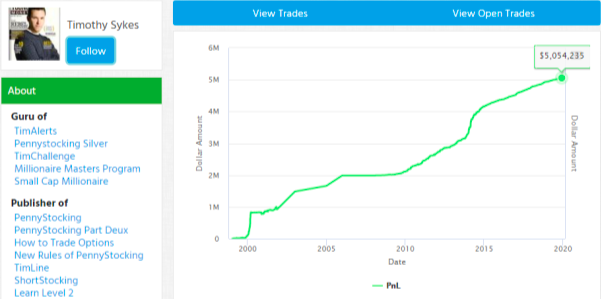
He then started trading penny stocks and he discovered that he had a much better performance by riding the momentum of trending stocks. So, he devoted time to finding the most effective and efficient ways to trade penny stocks and he ended up turning that $12,415 into $1.65 million by the time he was a freshman. As at today, his lifetime trading profit is more than $5 million as seen in his PnL chart below.
Being a natural extrovert, Tim was always talking about his success with penny stocks and it wasn’t long before friends and family members started requesting that he teach them how to make money trading penny stocks. He eventually standardized his training program to provide penny stock trading education to people all over the world.
Timothy Sykes Review: What is his trading strategy
Timothy Sykes’s trading strategy is surprising in its simplicity, but it requires a great deal of self-discipline in its execution. Tim tends to build his strategy around technical analysis, but he is not oblivious to how fundamentals such as news events could move stocks in response to human nature.
I dare to say that Tim isn’t usually interested in the underlying business of his target stocks. If you are approaching penny stocks with an investor mindset, Tim will disappoint you. However, Tim has expertise in identifying penny stocks that are already on the move, buying them just when the momentum kicks off, and then selling them just before the momentum drops. Hence, Tim typically holds his positions for a few hours, and he rarely holds a stock for more than two days.
While this sounds incredibly simple, many people tend to fall in love with their winning stocks and they hold on to winners until the market snatches back all the gains they’ve made. On a personal note, Tim’s brash tough love teaching style has made me better at managing the emotions of fear and greed. If that’s the only thing you gain from Tim, it’s more than enough to make you a better trader.
Also, Tim has mastered the art of shorting penny stocks even though many traders and brokers make it seem as if it is impossible to short penny stocks.
Timothy Sykes Review: Training Programs and Packages
When I came across Timothy Sykes’ online courses, my first response was sceptical as I recalled the old saying: “in a gold rush, it is better to sell picks and shovels”. I was wondering if his training programs weren’t a cleverly disguised way to sell picks and shovels to people looking for metaphorical gold in the stock market.
However, after digging deeper, I came to realize that Tim is passionate about trading education, he sincerely wants other people to achieve financial freedom, and he is going out of the way to make the knowledge accessible to all. Of course, many of his content is gated and you’ll need to pay to access them, but he has hundreds of videos on his YouTube channel available for free if you’d rather not pay.
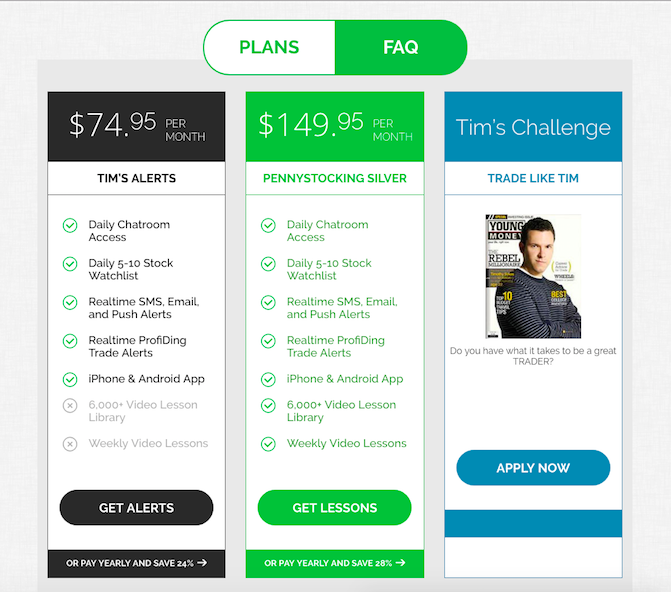
However, if you want a structured learning experience, Timothy Sykes offers three levels of trading education; namely, Tim’s Alerts, PennyStocking Silver, and Tim’s Challenge.
Tim’s Alert costs $74.95 per month but you can get a 24% discount if you sign up for the annual plan. You’ll have access to the chatroom, get up to 10 stocks on your watch list, and you’ll get real-time Email, SMS, and Push trade Alerts to enter or exit trades. From personal experience, the alerts are only useful if you got them and respond in the near-instant that they were sent. The market is constantly moving, and an hour-old alert may not be of much use to you if the trading price has moved up/down from the price suggested in the alert.
The Pennystocking Silver plan is much a better deal because it gives you access to a 6,000+ video library and weekly video lessons in addition to all the benefits available with Tim’s Alerts. PennyStocking Silver costs $149.95 per month but you can get a 28% discount with the annual plan.
The video lessons help you to understand the fundamental ideas behind each of Tim’s trades. Hence, even if you didn’t get the trade alerts immediately, you can still leverage the knowledge that you have gained to find better entry and exit points. Tim’s goal is to equip people with the knowledge to make independent trading decisions and he strongly discourages people from attempting to copy his trades blindly.
If you have more time to commit to trading and have a bit more money to spend on your trading education, you should consider applying to Tim’s Challenge. If you apply to Tim’s Challenge and scale through the interview process, you’ll be privy to a more immersive mentorship relationship with Tim.
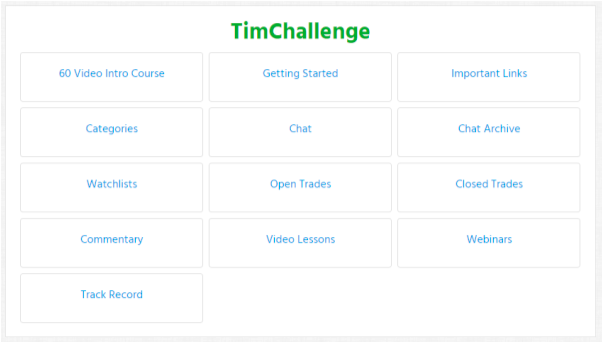
You’ll have access to watch 16 premium DVDs such as PennyStocking, PennyStocking Part Deux, ShortStocking and Learn Level 2 among others. I sat down to do the maths and I discovered that the DVDs available in Tim’s Challenge have a total runtime of more than 180 hours. Apart from the DVDs, you’ll also get access to curated 60 Video Intro Course, chat and chat archives, webinars, and trade Commentary among others.
However, I must warn you that Tim’s Challenge is very demanding, I doubt that you can combine it will a full-time job because it requires you to put in serious time and efforts. However, if you can go through the program, you’ll potentially be on the path to joining the alumni list of Tim’s successful students.
Trading Tips for Beginners
Day trading tips for beginners can come in all shapes and sizes, which can cause a significant impact in one’s wealth. Each individual trader may want something very different—from free stock picks to stock tips for newbies. We’ve tried to collate a number of useful tips for those just starting out in the market, ranging from the top 10 ways to make money, to more advanced methods for building wealth through day trading, like the concept of leveraging and leverage trading, and the concept of momentum trading.
In the beginning, it can be difficult to find profitable strategies. A great starting point is simply to follow the news. Be it a news story regarding economic activity in the United States or European countries, or any other news, you’re bound to hear about stocks that are likely to rise or fall. This is a good place to start and a good place to get started.
A great strategy is simply to purchase a stock when there’s good news going on and sell when there’s bad news going on. However, this method can be risky and if you follow it religiously, you run the risk of losing everything. Therefore, a great place to start is to simply study up on the trends of the past, look at how the trends were affected by a number of variables, and try to discover how one particular trend was affected by a number of other factors.
Each trader is different, so it really depends on what you think is important to your own personal method of making a profit. In most cases, day trading for beginners’ tips include a number of different strategies. The most popular among these strategies is the use of leverage. Leverage is a means of borrowing stock from a company and selling it for a higher price. As the name suggests, it’s the ability to buy at a lower price than you can sell it for.
Of course, you do risk losing the whole sum if you sell the stock at a lower price than you bought it for, but it’s a great way to supplement your income through day trading with a little bit of extra cash every week.
Final Verdict: Is Timothy Sykes a scam or real?
The subject of whether Timothy Sykes is a scam or not is a regular fixture in penny stock trading circles. Based on my personal experience and the information available on Profitly, my verdict is that Tim is very much the real deal.
However, I dare to say that Timothy Sykes’ training is not meant for everybody. If you are looking for someone to tell you what stocks to buy/sell or if you want to be spoon-fed on when to buy/sell and at what prices, Tim Sykes won’t meet your needs. Also, I don’t think that Tim’s Alert plan is particularly worth the expense; Tim is rarely in the chatroom and you might be lost in the “noisy” chatroom if you don’t have some previous trading experience.
However, if you are ready to learn and willing to put in the hard work, Tim could set you on the path to taking responsibility for your trading journey and eventual success. Nonetheless, you should note that you aren’t likely to become an overnight millionaire by trading penny stocks. Some of Tim’s students have crossed the million-dollar mark but many more are stuck in the six-figure range. Success is attainable, but it won’t be handed to you on a platter of gold.
Luxembourg takes advantageofits small size by being light on its feet when it comes to attracting investment and innovation to the country. Luxinnovation CEO Sasha Baillie recounts how her agency’s multi-facetedcampaign plan spans industries, technologies and public and private sectors in pursuit of the government’s ambitious economic objectives.
Thank you so much for taking the time to meet with us today. To start with, can you please give us an insight into how top-level business leaders like yourself kick-start a day? What are your tips for optimising daily productivity?
The most important thing is to be well surrounded. The accumulation of requests and the need to respond favourably to them very often mean that you have to rely on your employees to be able to gather all the key information relating to each of the files under review.
Based on a good briefing and relevant guidelines, it is easy to be able to make the right decisions at the right time. It also requires, of course, great flexibility and agility to be able to cope with any last-minute changes, as well as a clear mindset to be able to deal with dossiers that sometimes contain a very different content.
You became the CEO of Luxinnovation in 2018. How has it been so far? What are some of the important highlights or milestones of the agency under your leadership until now?
First of all, I had to immerse myself completely in the structure, which was facilitated by the fact that I can count on a very dynamic organisation of some 70 people with different professional and cultural skills and experience, with whom it is very stimulating to work.
We are a small country and one of our great advantages is the real accessibility to decision-makers.
It was then necessary to articulate the government’s approach, its economic development priorities and the diversification of the sectors of our economy, with the notions of innovation for which Luxinnovation lends its full support.
It was therefore first imperative to clarify what Luxinnovation is and what the agency is tasked to do. This could only be achieved by constantly listening – and still listening today – to understand the expectations that the country’s various economic players have of Luxinnovation, whether they be companies, from the smallest to the largest multinational groups, or public players, particularly in the field of research.
We must constantly understand their needs in order to understand what they expect, knowing that there is really a great diversity in these expectations.
This has led to a reorganisation of our services, with a resolutely customer-centric approach, which allows us to be even more responsive and efficient.
Maison de l’Innovation Building
Luxembourg is strategically located at the heart of Europe and is referred to as “the gateway to the European market”. What are the unique advantages and business opportunities in the Grand Duchy? What industries are most likely to be attracted to what Luxembourg has to offer?
We are a small country and one of our great advantages is the real accessibility to decision-makers. Combined with great agility, this allows us to make things happen quickly and pragmatically. This is an approach that is highly appreciated by companies from abroad.
We are attentive to the needs of companies and we know how to adapt and find solutions that meet these needs. Moreover, interactions between the private and public sectors are notably direct and are always part of a joint desire for efficiency.
In particular, we have identified three priority sectors on which we focus our efforts: automotive, cleantech and ICT. However, more broadly, we are also very committed to the development of initiatives around Industry 4.0. We know that this requires significant investments to integrate new technologies, artificial intelligence, the use of massive real-time data, the sustainable use of resources and, in this context, the development of new materials. This is also one of our priorities, in order to improve productivity and competitiveness.
Luxinnovation is a key and trusted partner for those who areinterested in – and committed to – launching successful innovative activities in Luxembourg, from entrepreneurs, managers of start-up companies and researchers to foreign enterprises and investors.
Luxinnovation is a key and trusted partner for those who are interested in – and committed to – launching successful innovative activities in Luxembourg. Can you describe Luxembourg’s innovative start-up ecosystem today?
Historically, this ecosystem has developed under the impetus of the public sector, with the establishment of the first incubators (Technoport, Ecostart) and support initiatives (via Luxinnovation, the Chamber of Commerce or through state subsidies).
However, in recent years, the private sector has also positioned itself strongly, with many investments and initiatives that have enabled the development of a complete ecosystem dedicated to the creation and acceleration of innovative start-ups. This ecosystem is now emerging on an international scale and we can see this with the high attendance at our pavilions at events such as VivaTech or the Web Summit in Lisbon.
The strength of this Luxembourg start-up ecosystem is based on the ability of public and private players to work together in the interests of entrepreneurs. The greater the proximity, the more efficient this ecosystem will be, as the emerging “seeds” will be quickly identified and efforts pooled to make them the success stories of tomorrow.
Luxinnovation offers a range of performance programmes (like Fit 4 Start, Fit 4 Innovation, etc.) that aim to support SMEs in developing their innovation activities. Can you tell us more about these programmes and share with us some of the best feedback that you have received from the programme participants?
These performance programmes are one of the pillars of our business. We undertake, with eligible companies, a 360° analysis of their situation, to fully understand their business and guide them towards appropriate solutions to improve their performance and, by the same token, their competitiveness. It is also about strengthening their capacity to innovate, develop and ensure their sustainability while sustainably increasing their activity.
We undertake, with eligible companies, a 360° analysis of their situation, to fully understand their business and guide them towards appropriate solutions to improve their performance and, by the same token, their competitiveness.
As I said earlier, our approach is customer- centric and is applied through these different programmes, whether it is for digitalisation (Fit 4 Digital), innovation capacity (Fit 4 Innovation), business model improvement (Fit 4 Growth), implementation of circular economy principles (Fit 4 Circularity) or improved customer services (Fit 4 Service).
These programmes are both unique and complementary; with the help of consultants, a diagnosis is established within the company and an action plan is then put in place to improve performance, with precise KPIs that guarantee the success of the programme.
These programmes are co-financed by the Ministry of the Economy and the Ministry for Small and Medium Sized enterprises, which provides considerable government support for our companies.
Fit 4 Start is a little bit different; it is an acceleration programme for innovative start-ups. Twice a year, a 16-week coaching session is organised. For the edition that just started this autumn, more than 300 start-ups from all over the world applied and we selected 20 companies in the ICT, healthtech and space sectors.
The feedback we have is very positive, without going into detail.
“Thanks to Luxinnovation, research and development and innovation have evolved in an unparalleled way in Luxembourg and probably even in international comparison over the past three decades”, said Deputy Prime Minister and Minister of the Economy Étienne Schneider, in his opening speech to celebrate the 35th anniversary of Luxinnovation 14th November.
Long established as a world leader in the twin sectors of fund administration and private banking, Luxembourg is the eurozone’s leading financial centre and number 12 in the world. How does the agency help in fostering solutions to shape the future of financial services?
This more-specific component is provided by another national agency, Luxembourg for Finance (LFF), which is specifically dedicated to the development of the financial centre’s activities. It goes without saying that we work closely with LFF, as well as with the Luxembourg House of Financial Technology (LHoFT), housed in the House of Startups. We are in regular contact with entrepreneurs who have created solutions or applications for the financial sector and we obviously ensure the link with our various partners.
How will the rapidly developing financial technology start-ups in the country be likely to transform the current financial landscape of Luxembourg and globally?
The challenge for so-called “traditional” financial institutions is enormous. If they do not adapt and radically transform the way they operate by offering their customers the fluidity they can find in most of the other services they use today, they will very quickly be overtaken by other players.
However, since, at the same time, these banks have had to face a sharp increase in the costs associated with all the new regulations and legislation that have come into force, this has given the scope for fintech to develop and offer digital solutions for the entire financial sector. In particular, there is a special enthusiasm for regtechs, which work to facilitate the implementation of all these new regulations.
The creation of the LHoFT in 2016, which welcomes start-ups from all over the world and benefits from partnerships with prestigious international organisations, contributes to the dynamism of this ecosystem.
Green technology is one of the emerging industries nowadays. Can you share with us what are the inimitable advantages and features of Luxembourg’s green tech platforms? What are Luxinnovation’s initiatives to develop and encourage sustainability in Luxembourg’s business and financial sectors?
Promoting clean technologies and the transition to a circular economy is a priority in Luxembourg. The country is a strong advocate of sustainable development, in economic, ecological and social terms, with the implementation of policies to facilitate the adoption of clean technologies and products. We benefit here from an attractive economic environment for entrepreneurs who seek to create value while reducing pollution, waste and energy consumption.
Business opportunities are quite wide for companies in the cleantech sector in Luxembourg, knowing that facilitating the transition to a circular economy is a national priority.
Innovation and research in the fields of renewable energies, energy efficiency and smart cities, districts and buildings are among the areas in which we are involved, both with companies and with the University of Luxembourg or the Luxembourg Institute of Science and Technology (LIST). The government’s programme also includes the upcoming creation of a centre of excellence around green technologies and the promotion of an ecosystem conducive to spin-offs/start-ups.
There is already an incubator dedicated to ecotechnologies, which opened a year ago in the south of the country, and for which we are partners.
Business opportunities are quite wide for companies in the cleantech sector in Luxembourg, knowing that facilitating the transition to a circular economy is a national priority. The demand for innovative solutions is, for example, stimulated by cradle-to-cradle construction projects and by the continuous conversion of former brownfield sites into ecological districts. There is also a clear focus on developing smart mobility and supporting developments in areas such as clean transport, shared mobility and intelligent transport systems.
Luxembourg also plays a pioneering role in the use of finance to achieve sustainable objectives. The Luxembourg Green Exchange is the first global platform exclusively dedicated to sustainable securities, with nearly half of the world’s green bond volume and an estimated one-third of sustainable and social bonds. The Luxembourg Finance Labelling Agency (LuxFLAG), an independent and international Luxembourg financial labelling agency, awards a responsible investment label to investment vehicles.
In the latest edition of the Global Green Finance Index, Luxembourg ranks fourth (after Amsterdam, London and Zurich, out of 64 financial centres) and more specifically second only to Amsterdam in terms of green finance “penetration”.
It is also for all these reasons that our country has been chosen to host the Cleantech Forum Europe in 2020 (on 18-20 May 2020), an international event that will bring together for three days the best of the best in Europe in this sector.
Luxembourg’s forward-thinking regulators and partnership with other countries for the exploration of space resources make the country a hub for technological advancement. Recently, Luxembourg joined Russia in the field of space innovation, extending its expertise and a global network of partners in scientific cooperation and research. How do these developments help Luxembourg position itself as the global leader and the centre of space business?
It is not only with Russia that we have signed partnerships. This was the case with China and the United States. Wilbur Ross, the US Secretary of Commerce even came to Luxembourg in person to sign such an agreement.
In the coming years, Luxinnovation will have to inspire our companies to innovate, to grow in an intelligent way and to prepare themselves well for the challenges of the future, with new and partly also disruptive technologies.
It would be pretentious to position ourselves as a world leader and centre of the space industry, but we are clearly positioning ourselves as a major player in this “New Space” industry. We want to attract companies active in this field to Luxembourg and by this means create a hub of experts. We have already set up a chair and university training in this area. The “New Space” sector will undergo profound disruption in the coming years and Luxembourg is already playing a role in these changes.
The Director of the European Space Agency perceives Luxembourg as a pioneer in this field and this autumn we also just signed agreements with NASA and the ESA.
Fit 4 Start participants benefit from the support of specialised coaches as well as from the mentorship of the experienced entrepreneurs and venture capitalists that make up the selection jury.
What are the agency’s short-term and long-term plans for the country’s economic development and innovation capabilities? Where do you see the agency in the next five to ten years?
More than ever, we want to be recognised by companies and entrepreneurs as a trusted partner for them, enabling them to find pragmatic solutions for their innovative development projects.
We have formidable diverse and complementary skills. If we can communicate well with each other, if we can dialogue, if we can bring out these skills, we will make exceptional progress.
Luxembourg promotes networking, confidence-building and the implementation of joint projects. This is an advantage we have over other countries. In addition, Luxinnovation must be an essential link in this collaborative approach.
In the coming years, Luxinnovation will have to inspire our companies to innovate, to grow in an intelligent way and to prepare themselves well for the challenges of the future, with new and partly also disruptive technologies.
We would like to be the aggregator of all the players of economic development so that they all join forces to advance the country in a sustainable way.
Our ambition is to be a facilitator of synergies and to bring added value to the country’s economy, whether at the national level or by promoting the country internationally, by enhancing the strengths of our economy and by encouraging companies around the world to carry out projects with us here.
What are the key messages you would like to get across to industries and businesses that are wondering about the status quo of Luxembourg’s investment and business opportunities in today’s global environment of political and economic uncertainty and volatility?
First of all, I would like to tell them that, as far as stability is concerned, Luxembourg is positioned comparatively at the forefront, whether in political, social or fiscal terms. This is obviously a highly valued asset for foreign investors – not to mention that the country is also among the safest in the world.
As far as stability is concerned, Luxembourg is positioned comparatively at the forefront, whether in political, social or fiscal terms. This is obviously a highly valued asset for foreign investors – not to mention that the country is also among the safest in the world.
Many international benchmarks also show the country’s attractiveness in terms of the business climate: the country has the second highest level of productivity in the world behind Norway, according to a study by the Conference Board Productivity Brief and is also considered by U.S. News & World Report’s 2019 “Best Countries” study as the most open country for business, due to its favourable tax environment, the government’s transparent and business-friendly approach and the low level of corruption.
Throughout its history, Luxembourg has always held a strategic position as a crossroads of nations. Over the centuries, the country has encountered many influences and struggles of occupation and to survive, it has had to endure, observe and understand. We have maintained this habit and we are trying to foresee the challenges ahead and are working to adapt to them.
Luxembourg comes out on top in a recent study of cities in the world that offer employees the best working conditions. As the president of the agency, how do you keep yourself happy and motivated whilst looking after your employees’ well-being?
You have to listen to your employees, give them the opportunity to express themselves, to evolve, to contribute to the company’s results. I am convinced that a participatory approach is not only rewarding and stimulating for employees, but is also an essential vehicle for innovation and progress.
On a lighter note, we are interested to know what the top things or activities are that a high-calibre business leader like yourself does to recharge her batteries during a day off from work.
It is always very difficult to disconnect completely from work, but family time spent with my children is naturally a very valuable breath of fresh air. I really appreciate these special moments, whether at home or while travelling, in surroundings that help one revitalise, and also in the company of good friends.
To end this interview, would you share with us your views about the important business and technology trends to watch out for in the coming years?
I am convinced that the economy will be fundamentally transformed by access to data and opportunities to develop new business models. Countries that can ensure through the establishment of reliable and secure data-exchange platforms that public and private data can be shared and valued while ensuring that privacy and individual freedoms are maintained are those that will enjoy a favourable economic development in the future.
Thank you very much Ms Baillie. It’s a pleasure speaking with you. We learned a lot.
Luxinnovation offers a wide portfolio of services to companies and public research organisations in order to foster innovation, thus supporting the Government’s economic development objectives. The agency also ensures that Luxembourg continues to attract international investment, companies and skills that are a perfect fit for the country
Sasha Baillie is also a member of the Coordination Committee of the Ministry of the Economy, which she joined in 2014 as Deputy Chief of Staff and Diplomatic Advisor of the Deputy Prime Minister, following her 20-year career as a Luxembourg diplomat. Within the Ministry of the Economy, Sasha Baillie ran the initiative to reform Luxembourg’s economic promotion that led to the creation in June 2016 of the Luxembourg Trade and Investment Board. She also chaired the Luxembourg Nation Branding Committee until 2019 and steered the work that led to the creation in 2015 of LuxGovSat (a joint venture between the Luxembourg Government and SES) where she serves as Chair of the Board.
Eighteen years have passed since China joined the World Trade Organization, a period largely defined by overseas firms trying and failing to crack its complex market. The Chinese dairy industry in particular, despite its vast size and rapid growth (c.12% a year), has remained untouched from foreign influence with internal competition exceptionally stiff.
However recent years have seen signs of breakthrough, a push led by a global dairy producing and distributing group with roots in the Baltic States. Food Union entered the Chinese market in 2015 showcasing a serious long-term commitment by building modern plants from scratch on Chinese soil. The brand’s core elements of health and wellbeing were inspired from the Chinese government’s recent focus on the health benefits of dairy and its promotion amongst parents and, crucially, their children.
Having identified a gap in the market for infant food, Food Union pursued a striking means of marketing their line of children’s dairy product, ‘Lakto’. Utilising their Baltic roots, a partnership emerged with leading Russian animation house Riki Group to form the Hong Kong based joint venture Fun Union. Branded animation characters, such as those from the ‘edutainment’ show Babyriki, immediately captured the imagination of Chinese children. The marketing tool’s instant impact should come as no surprise. Babyriki has gained more than two billion views since it was launched on mainland Chinese digital platforms in 2017 and themed toys in available in over 500 stores throughout the nation.
Crucial for Food Union’s acceleration and growth beyond the borders of the Baltics has been the international investment group Meridian Capital Limited. Askar Alshinbayev, founding principal of Meridian Capital, explains that “Working in partnership with leading Russian animation house Riki Group has enabled us to seize the marketing initiative in China – one of the largest, fastest-growing and fiercely competitive consumer markets in the world. Our innovative animation characters have ensured that Food Union’s healthy dairy brands for children have become an integral part of families’ daily lives and help drive the company’s impressive growth”.
Global superpowers Russia and China have a long and convoluted past. The latest chapter appears to be one of harmony, linked in part by the most unlikely of industries. Supported by Fun Union, the first Russian-Chinese co-production in animation was agreed during Chinese President Xi Jinping’s state visit to Moscow in 2017. Food Union’s impact in China has successfully outgrown the dairy industry, proving perhaps that to stand out in a highly competitive field, an innovative, counter-intuitive marketing technique is the way forward.
Nearly every start-up business entrepreneur requires financing at some stage of their business growth. They look outside their company for loans or fundings because growth requires capital that can only be raised through outside sources in order to fulfill financing operations.
In order to run any organization, the need for cash is paramount. Maintaining proper cash-flow and profit margins is essential for any business but even in these instances, businesses may seek outside funding. Suitable fundings such as a merchant cash advance loans help fill up these gaps of cash-flow and keep the business rolling.
Merchant Cash Advance Loan
A merchant cash advance is offered as advance finance for future sales for the establishment of any company or business. This financing procedure is typically available for merchants that require a steady amount of credit card sales that includes their retail store needs, medical offices, rent, inventory charges, etc.
The amount that merchants and business owners get through this type of cash advance loan ranges from a couple of thousand dollars to two thousand dollars and sometimes more. It is important to keep in mind that the repayment period of the merchant loan is usually short for about one and a half years and the loan also charges interest.
The lender takes up a percentage of sales and profit from the merchant on a regular basis. The repayments are supposed to be done through the connected merchant account that is based on the profit and sales of the company along with being processed through debit or credit card. The system of cash and cheque is not counted as a repayment procedure in this regard.
If you are an entrepreneur and you need money now for the growth and establishment of your business, then there are so many small business lending options for you. We understand the confusion as to which option is the best for your company or which one you should choose. Various lenders and funders provide the required capital to merchants as funding options for them.
In this article, we will share why merchants require cash advances along with defining types of categories between merchants. Also, we will mention various requirements for financing a business primarily. Let’s see whether obtaining a merchant cash advance loan is a good choice for you or not.
As we have talked about the merchant loan, it’s time to know what is a merchant and what are their requirements.
Merchants And Their Requirements:
Merchants are considered to be business owners that own a company or organization which requires the assets of trade and commerce. Moreover, the commodities include sales, revenue, cash flow, and profit not only for commercial uses but also for industrial ones.
Merchants have existed since the pre-modern age where businesses used to run on other terms. However, in a legal aspect, merchants are held to a higher degree as they are called to be the experts of the products they provide and resell. These merchants usually are of two categories.
Retailers
Wholesalers
Categories Defined:
Retailer Merchants are the ones that sale good to consumers along with providing their merchandise directly to the consumers. They use the method of retail forefront or business platforms. Other methods include getting in contact with business websites, e-commerce stores, seller networks, etc. For that reason, start-up companies focus on selling those products in smaller quantities rather than in bulk.
Wholesaler Merchants are the ones that run a small business or wholesale also known as the middleman linking manufacturers. They are the ones that buy products or merchandise from manufacturers in bulk and then resale them. They also focus on reselling the products in smaller quantities than in larges ones.
Requirements of Merchants For Financing
The start-up companies and businesses are required to have sufficient capital because they need to operate the necessary functions of the company. In addition to that, they also need to make sure that the company is able to take care of all the opportunities that may come in their way for the business’s better growth and better establishment.
Furthermore, arisen opportunities make visible differences in profit. To obtain that mark in business, merchants require the following conditions to be fulfilled in one way or another. These include:
Requirements And Methods:
Inventory: This is important to make sure that the merchant has all the required goods and products in their warehouse for their sales. Enough inventory for strategic sale plans will be a good way to start off the business and pay off the debt.
Expansion: Every business owner dreams of expanding their company to a big extent. For this purpose, merchants require fundings and facilities.
Assets: To make sure that there is a particular and acquired space for business to store its assets is a must. Taking care of all the assets, goods and products is another key that helps in the development of business.
Business Property: Other than a merchant cash advance loan, a business owner can obtain a commercial loan. These loans are for the purchase and refinance of the property of business such as an office, building, etc.
Business Loan: This loan is specifically intended for the requirements of a business. Just like any other loan, a business loan is a debt that comes with an interest rate. This is considered to be an affordable one in order to fulfill the requirements of a business.
Working Capital: Every business requires to have working capital on a regular basis along with a bookkeeper to manage tasks. Merchants need a sufficient amount of cash to handle daily operations.
Debt Consolidation: This is a process that merchants use to combine all their unsecured debts into one single monthly payment. They use this loan to pay off their debts and then pay the consolidation loan in a single payment after profit.
Payroll Strategy: Having a payroll strategy for your employees is very important. The strategy includes paying the employees on time, increasing their pay annually. Moreover, it includes whether they want to get paid weekly, bi-weekly or monthly. However, this also depends on the company’s policy and terms.
Nobody wants to feel like just a number — rather than an individual — when receiving healthcare services. The last thing patients should sense when seeking treatment is they’re moving down an assembly line, accumulating bits and pieces of disjointed care as they go.
The healthcare industry as a whole is working to address these challenges and improve the continuity of care for patients, while also aiming to optimize the cost of that care. It’s no easy feat, but these efforts could go a long way toward prioritizing care quality over quantity.
Here’s more on the emergence of value-based healthcare and its benefits.
What Is Value-Based Healthcare?
Under a value-based healthcare model, providers receive compensation based on patient outcomes rather than patient volumes. According to the New England Journal of Medicine Catalyst, providers are rewarded for the following:
Helping patients improve their health
Reducing the occurrence and consequences of chronic illness
Living healthier lives in a measurable way
The value-based care model measures success — and therefore payment — based on patient outcomes rather than the number of services provided. This is an improvement over volume-based healthcare of yesteryear in which providers got paid per service they provided, regardless of patient outcomes over time.
Value-Based Healthcare in Action
The Hospital Readmissions Reduction Program (HRRP), established in 2012, is one example of value-based healthcare in action. Under this purchasing program, hospitals with excessive readmissions for certain conditions receive lower payments from Medicare. As the Centers for Medicare & Medicaid Services writes, it incentivizes hospitals to “improve communication and care coordination so patients and caregivers are more involved in post-discharge planning.”
When hospitals face penalties in the form of reduced funding if their readmission rates are too high, they have major motivation to evaluate the treatment they’re providing to patients. It’s no longer just about billing a patient for a certain procedure or medication; it’s about providing care and information that’ll help the patient thrive after they leave the hospital.
Programs like the HRRP incentivize healthcare providers to closely gauge readmission rates as a key performance indicator, critically evaluate risk factors and implement best practices to minimize the chance a patient will make an unplanned visit within a given time period after discharge. To do this successfully, healthcare providers need ready access to advanced healthcare data analytics tools to gauge performance and make data-driven decisions.
As Deloitte notes, physicians and administrators can only manage what they can measure. Healthcare professionals need access to insights they can use to make care decisions that improve patient outcomes while also optimizing for cost. Organizations serious about succeeding under the value-based care model need to put accessible data analytics into the hands of administrators and clinicians making these decisions.
Benefits of Value-Based Healthcare
This care model has the potential to benefit everyone involved.
Patients can benefit from better continuity of care and a proactive approach that aims to minimize illness and injury rather than react to it after the fact. Opening lines of communication between healthcare providers and patients as part of value-based care also helps cut down on confusion — ultimately boosting patient satisfaction and encouraging them to engage.
Value-based care also aims to keep larger populations healthy rather than focusing on individual patients and appointments.
Since value-based healthcare ties in compensation with outcomes, it also incentivizes providers to operate more efficiently — helping to lower costs for patients, providers and taxpayers alike.
The “fee-per-service” model of healthcare falls woefully short because it prioritizes cost and volume over quality of care. The solution? Value-based healthcare.
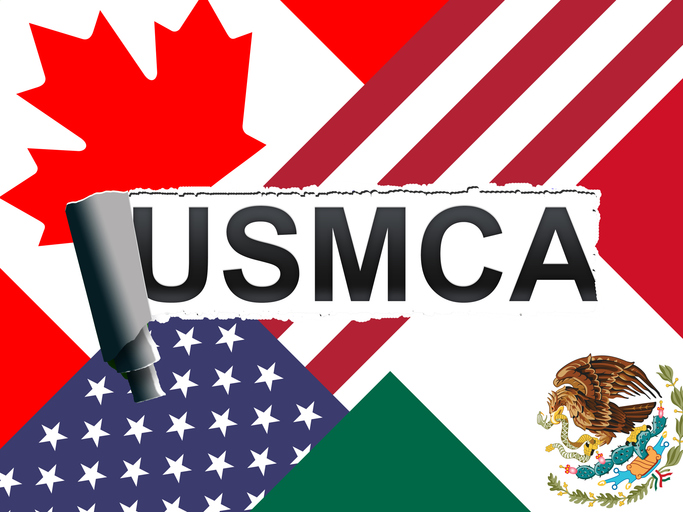
Today the Trump administration, with Democrats & AFLCIO leaders in tow, announced new final revisions and deal with Mexico on the new NAFTA 2.0 free trade agreement called the USMCA.
According to the corporate media, revisions to the USMCA demanded by Democrats since the initial agreement was reached with Mexico a year ago, have been agreed to by Trump, Pelosi, and the president of Mexico, Lopez-Obrador. The revisions reportedly mean more protections for US labor in particular. However, all we have at the moment is what’s reported in the corporate and mainstream media about the revisions. We’ll have to wait to read the final print of the actual agreement. But even the media reports are not much more than vague generalities about the terms and conditions of the revisions. The much heralded improvements to US labor interests in particular don’t appear that different from Trump’s originally negotiated deal a year ago.
The official media story line is that the new revisions provide protections for American workers now that did not exist previously during the 20+ years of NAFTA 1.0. During that period, easily 4-5 million US jobs were diverted to Mexico.
At issue during negotiations on revisions to NAFTA–now called the USMCA–was whether US inspectors would be allowed access to Mexico factories and businesses to ensure that the new labor terms of the revised USMCA trade deal were being enforced. Lopez Obrador and Mexican business have been adamantly opposed to allowing US inspectors access to Mexican factories, which suggests they had something to hide. (Mexico and AMLO both are in agreement on this issue). THey demanded that, instead of inspectors, there would be a joint US-Mexican panel to arbitrate labor disputes. But the issue is independent inspection, not a panel to rule on disputes that may never rise due to absence of inspection. What good is a panel of any kind ruling on a dispute that doesn’t get raised because there’s no independent inspection in the first place? Also important is whether the inspectors inspect unannounced, or whether they have to give a pre-notice before they inspect (that phony arrangement is how the US OSHA law has functioned with little effect for decades). Moreover, if there’s panel, how is it determined and what is its composition? If it’s equal US-Mexico representation, it might never come to a final decision.
In other words, if the final terms and conditions in print for the USMCA provide only for panels, in lieu of unannounced inspectors, then the so-called great labor protections touted by Democrats as part of a final deal are really just another fig leaf of labor protection.
While the mainstream media and Democrats talk up the labor revisions in today’s final deal, the real substance of the recent revisions–sought by Trump and US corporations and bankers–has had more to do with protecting the interests of US big pharma companies and US oil and bankers.
Big pharma has always wanted NAFTA-USMCA to include what it wanted in the Trans Pacific Partnership (TPP) deal it didn’t get in 2017: i.e. protections on pricing of its drugs in Mexico at levels closer to its price gouging levels in the US. The fine print in the USMCA will tell whether it got this, or at least got a big change from Mexico’s current rules that keep the price of drugs lower in Mexico than in the US.
Another reported big concession by Mexico in the recent revisions apparently addresses the protection of US oil and energy, telecom and banker interests. Since assuming the Mexico presidency, Lopez-Obrador (AMLO) has been moving toward re-nationalizing Mexico’s PEMEX oil company that had come increasingly under financial control in recent decades by US investors and banks. AMLO wants to restore it to its former Mexican government ownership, or at least to control by Mexican banks and capital. Legislation has been drawn up by the AMLO adminstration to enable re-nationalization. US bankers and oil interests in response have wanted changes in the NAFTA-USMCA (NAFTA 2.0) to protect them from re-nationalization. They apparently have gotten it. Reportedly language in the USMCA now exempts oil, gas, power, transport, cement, banks and telecom from any potential future Mexican re-nationalization.
Free trade treaties are always more about money capital flows (from the US into the host country) than about goods flows across borders, even though the goods flows is what’s mostly reported in the media and press. NAFTA has been no different. Free trade–whether the original NAFTA 1.0 or the current 2.0 revisions called the USMCA–is about financing the relocation of US business and manufacturing from the US to the host country.Then about allowing US companies thereafter doing business in the host country to ship their lower cost goods back into the US market without having to pay tariffs. US corporations make greater profits, not only from cheaper production costs and absence of tariffs, but from continuing to charge higher prices in the US when they ship them back, tariff free, as well. But this is all greater profits from production and goods flows.
Free trade provides even greater profits for US investors and bankers who ‘grease the wheels’, so to speak, of the money capital flows in the first place. The money flows are what make profits from production of goods flows all possible int he first place. Banks charge the interest on the loans, and big fees on mergers and acquisitions by US business in the host country, now allowed by the free trade treaty. Banks also buy up the banks in the host country and make more money from lending to host country businesses. Offshore production and lending also allow US multinational corporations to engage in what’s called ‘intra-company’ price manipulation which permit them to reduce taxes on lower reported profits in the US. The offshored, foreign subsidiary operations ‘book’ all the profits–kept offshore and reduced in the US by means of intra-company price manipulation. Profits are still further boosted as now, under Trump, US multinational corporations get to avoid virtually all taxes on their offshore operations, as a result of Trump’s 2018 multi-trillion dollar tax cuts for multinationals.
Yet Trump, the Democrats, and the US corporate media would have us think the USMCA revisions are all about protecting US workers’ interests by introducing dispute panels. The five million US workers who have lost their jobs under NAFTA gained nothing, and paid everything in lost jobs, under NAFTA 1.0. And that’s not changing one iota under NAFTA 2.0, e.g. USMCA by introducing panels–or even if actual independent inspections were allowed. Under Trump no jobs have come back to the US due to any of his trade wars; and none will after USMCA revisions are signed off either.
Free trade is about enriching bankers and investors who ‘grease the wheels’ of US corporate foreign direct investment into the host country, now permitted by the free trade deal. Free trade is about raising profits and stock prices of US multinational corporations once they set up operations or buy up companies in the host country. Free trade is about politicians in both wings of the Corporate Party of America (aka Democrats and Republicans) fooling workers that they are somehow protecting their interests.
US workers will get, as they have been getting, nothing out of the USMCA or any Trump trade deal so far, more lost jobs and higher prices on imported goods– to be exact $42 billion more in higher prices.
So why the closing of the USMCA deal and revisions now? After a year of stalemate in Congress? Likely because Democrat leaders are desperate to show their impeachment proceedings against Trump are not preventing them from passing legislation otherwise. But does anyone think that Trump, his Trumpublicans in Congress, i.e. Mitch McConnell and other Republican political sycophants, would likewise sign a deal if they were in the Democrats place? No, they’d play hardball and continue to refuse to agree to anything right up to the 2020 election.
Trump has recently softened his USMCA position as well in an attempt to close a USMCA deal with Congress and Mexico. Why now? Because Trump’s trade war with China has stumbled and stalled. It appears, per the Wall St. Journal today, that Trump will postpone his scheduled December 15 additional tariffs on China as a concession to get China to buy more of US farm goods. Trump needs to show something from his 18 months of trade wars. The US trade deficit has barely shifted at all during the period, still running near $50b a month. He desperately needs the USMCA deal–any deal–given that the China-US ‘mini’ trade deal is going nowhere and may not even get signed next year. (And it won’t if Trump does not agree in 2020 to further cut US tariffs if he wants more China farm purchases).
Trump’s recent re-imposition of tariffs on Brazil-Argentina steel should also be viewed as part of the mix of trade events in recent weeks. as the China mini-deal stalled, he had to look tough somewhere. Re-imposing steel tariffs was also a not so veiled threat to Brazil-Argentina (which hardly import any steel to the US at all) that they should think twice about increasing sales of wheat and soybeans to China. Trump’s tariffs on their steel is a shot across their trade bow. Both Trump’s concessions on USMCA and his re-imposing of steel tariffs on Brazil-Argentina are indications of his failing trade policy and his weakening bargaining position on such policy as the US 2020 election grows nearer.
Both he and the Democrats want to ‘look good’ for 2020 election purposes: Trump wants to show (and later exaggerate) what he achieved in the revisions to USMCA. Pelosi-Shumer want to argue (and will also exaggerate) the phony labor protections they achieved in the revised USMCA.
But US workers will get, as they have been getting, nothing out of the USMCA or any Trump trade deal so far, more lost jobs and higher prices on imported goods– to be exact $42 billion more in higher prices, according to the NY Fed, and $1000 per month in reduced household income due to the higher import prices, according to estimates by Chase Bank research.
Jack Rasmus is author of the just released book, ‘The Scourge of Neoliberalism: US Economic Policy from Reagan to Trump’, Clarity Press, January 2020, which is now available for purchase at 20% discount from his blog, jackrasmus.com, and website, http://kyklosproductions.com
The positive impact of art on our physical and mental health has long been understood. Florence Nightingale recognized this 160 years ago – long before the term ‘wellbeing’ had been coined – when she wrote: ‘Little as we know about the way in which we are affected by form, by colour, and light, we do know this, that they have an actual physical effect.”
However, the potential to build more creative, productive workplaces through the power of art is rarely discussed. Research has shown that the character of a workplace affects job satisfaction, motivation and mood. Art needs to become part of this conversation.
Art activates the brain’s default mode network – the area associated with internally orientated thinking – helping us to retrieve memories and think about the future, as well as engaging our pleasure and reward systems.
Some business leaders might be sceptical that art can improve the quality of their staff’s work, but the concept is supported by a solid evidential base. Dr Oshin Vartanian, from the University of Toronto, has conducted extensive research on the neuroscience of aesthetics and creativity; he found that art activates the brain’s default mode network – the area associated with internally orientated thinking – helping us to retrieve memories and think about the future, as well as engaging our pleasure and reward systems.
In 2019, a survey of 81,000 employees for the Leesman Index, a comprehensive study of workplaces, found a median satisfaction of office and office photography of just 37%. 75% of those sampled said artwork and photography provisioning in their workspace was 55% satisfactory or less.
Research by Dr Jenny Thomas, Director of Performance Consultancy, found that, whilst many organisations had installed artwork in their reception or meeting rooms, few had introduced it to the main office area. Seven out of ten workplaces had no artwork installed and 95% of people could not see any art from their workstation.
She conducted experimental studies, changing aspects of a workplace, including the temperature and air movement and providing access to a new breakout space, but the biggest impact came from introducing artwork. Staff said they were more alert in the afternoons, avoiding the traditional post-lunch dip in concentration, and the art promoted social interaction.
Research by ARTIQ suggested that people were 14.3% more productive when they were in a workplace that featured art compared to a workplace that featured no art; According to research by the British Council for Offices in 2013, 61% of employees said artwork inspired them to think and work more creatively.
We should not be surprised because art enables positive, cognitive distraction and creates spaces that are both active and connective. It engages staff and clients, helping them to think beyond the four walls that surround them.
An office art collection should tell a story; it should connect to the brand values and heritage of a business, creating a clear and authentic narrative.
Art has this impact because it is innately human, encouraging the viewer to engage and find meaning. Yet having artwork in the workplace is meaningless if no thought has been given to its relevance to the specific environment. An office art collection should tell a story; it should connect to the brand values and heritage of a business, creating a clear and authentic narrative.
Global law firm Mayer Brown recently worked with ARTIQ to develop an art collection for its London office, following an extensive modernisation and refurbishment programme. An art committee was set up, bringing together a group of partners and employees from across the office to choose works for the collection, including painting, sculpture, prints and street art. It was developed around the themes of diversity and equality to reflect Mayer Brown’s commitment to promoting a diverse workforce – 86% of the art is by female artists. Artists from outside the UK, or who have recently graduated and are trying to build a career, are also well represented.
Not only has the art collection become a talking point amongst staff, it is also a visual representation of the firm’s values, which can easily be explained to visitors and prospective clients. By supporting emerging artists, the firm is also acting as a patron, supporting the creative economy at a time when it is under increasing strain – the UK invests 40% less than the European average as a % of GDP in art – and bridging the gap between the corporate and creative worlds.
Investec, the international banking and wealth management group, wanted the art collection at two of its London offices to reflect its culture of diversity and innovation and to compliment the design by architectural and design firm tp bennett. Reflecting the business’ heritage, the collection features the work of vibrant, dynamic South African artists alongside London-based artists, telling stories of identity and diversity.
ARTIQ catalogued the collection and worked closely with Investec to design and build an online auction platform, giving employees the opportunity to purchase the artwork that has been part of their working environment for many years. The initiative worked on two levels: first, as an effective means of employee engagement, including a pop-up exhibition to mark the launch of the new collection; and secondly, as a way of supporting contemporary artists.
Investing in an office art collection might sound like the preserve of big corporates, but in fact it does not have to be unaffordable. An art rental model allows any business to host an expertly curated collection without breaking the bank – £1,600 a month might be typical for a medium-sized business. It also allows a business to refresh the collection every few months, making it a continuing talking point amongst staff and a point of interest to clients visiting the workplace.
But, above all, an art collection is a compelling way for a business to articulate its values and express its identity – both to its own staff and to the wider world.
Patrick McCrae is Chief Executive of art consultancy ARTIQ He founded ARTIQ in 2009 to bridge the gap between the art and business worlds and to promote a fair deal for artists. ARTIQ is now on of the UK’s leading art consultancies, working with businesses to embed creativity into their culture and to harness the great power of art. In 2017 he was named ‘Creative Industries Entrepreneur of the Year (London and South East)’ at the NatWest Great British Entrepreneur Awards.
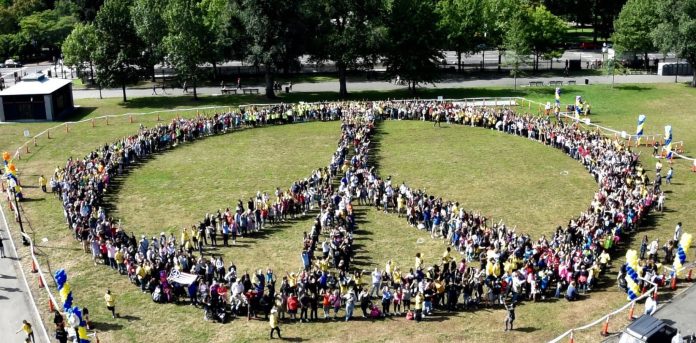
This article explores “soft leadership” to achieve global peace, prosperity, and stability. It explains the causes, effects, and remedies for global conflicts and wars, outlines a blueprint to achieve global peace and prosperity. It illustrates with inspiring examples of great global leaders including Mahatma Gandhi, Martin Luther King Jr, Mother Teresa, and Nelson Mandela.
Introduction
“An eye for an eye only ends up making the whole world blind.”– Mahatma Gandhi
Presently people across the globe are getting impatient, intolerant, and agitated on others for petty issues.It appears that there is a lack of respect for others’ religions, regions, races, languages, ethnicities, cultures, and communities. Additionally, the aspirations and expectations of all stakeholders are rising rapidly. For instance, children demand more from their parents; students demand more from educators; subordinates demand more from superiors; employees demand more from employers; followers demand more from leaders, and people demand more from nations. In fact, people are becoming more rights-oriented rather than duty-oriented.
There must be a shift in the mindset of the people. There must be a need for tolerance and respect toward others. People must be duty-oriented rather than rights-oriented. Empathy is the answer to several pressing global challenges. Empathy is the ability to step into the shoes of others and look at the issues from others’ perspectives. However, presently people rarely empathize with others.When we empathize with others most of the global challenges and conflicts can be resolved easily. Through empathy, we can put an end to intolerance, impatience, and instability. Through empathy, we can resolve several global challenges amicably. Empathy is essential for global peace, prosperity, stability, and security.
Some people resort to violence to settle their scores. Some countries wage wars to settle their long-pending issues. Violence is not the solution to several global issues. Ralph Waldo Emerson rightly remarked, “Peace cannot be achieved through violence, it can only be attained through understanding.”Hence, people must shed their violent attitude and respect others through empathy
and understanding.
Global Conflicts
People often use force to settle their scores resulting in conflicts and nations use their military force resulting in wars. They hardly understand the fact that there is always room for dialogue and discussion to resolve their vexing issues. Some nations go for a war on pride and some leaders declare war to show their strength and supremacy. Some religions declare war on others to show their supremacy. Some nations go for war to divert attention from their internal challenges. Likewise, there are many reasons for alarming conflicts and wars globally.
The present global scenario calls for a new leadership perspective emphasizing respect to all regions, religions, communities, and ethnicities. It calls for a new leadership perspective involving negotiation and persuasion with an emphasis on empathy.
Need for Soft Leadership
The present global scenario calls for a new leadership perspective emphasizing respect to all regions, religions, communities, creeds, and ethnicities. It calls for a new leadership perspective involving negotiation and persuasion with an emphasis on empathy. It calls for partnership, not followership.Hence, emphasize “soft leadership” to resolve various conflicts globally through discussion, dialogue, persuasion, and negotiation. This innovative leadership perspective can also be used to lead people assertively; to turnaround ailing global organizations; and to achieve organizational excellence and effectiveness.
What is Soft Leadership?
Leadership depends on three aspects – how you communicate with others; how you make decisions; and how you take action. When you can execute these three activities effectively you become a successful leader. However, to evolve as a soft leader, you must communicate with an emphasis on soft skills; make decisions by blending your head, heart, and gut; and take action keeping the ground realities and goals in your view without compromising people-orientation. There are 11 Cs that constitute soft leadership. They are character, charisma, conscience, conviction, courage, communication, compassion, commitment, consistency, consideration and contribution. It is highly challenging for people to cultivate these 11 characteristics. However, if people possess more than six traits they get into the fold of soft leadership.
How to Excel as a Soft Leader?
When you want to excel as a soft leader there must not be ‘character gap’, ‘communication gap’, ‘commitment gap’ and ‘courage gap’. When you stick to these four principles you can excel as a soft leader. ‘Treat the people the way you want to be treated’ is the old adage. But as a soft leader, you must treat all people with respect especially the people who are lower to you. The soft leaders possess humility and a servant attitude.They help their people grow beyond what people dream of growing. That is the hallmark of soft leadership.
Growing Intolerance Globally
There are several reasons for the current growing intolerance and conflicts globally. Here are some of them. People are very impatient. They want immediate results. They lack patience and perseverance. They fail to empathize with others. They try to prove their point right rather than looking at the points from others’ perspectives. They want to resort to short cuts, not smart cuts.They want to win their case through win-lose, not through win-win.
Causes for Global Conflicts
There are several causes of growing intolerance and global violence. The basic ones include scarcity of resources, a threat to one’s position or authority, ego, miscommunication, use of gut rather than head and heart, irrational thinking, superstitions, and supremacy. When some sections of people are oppressed for a long time, it leads to conflicts. Hence, understanding the root cause of the conflicts helps resolve issues amicably. At times, the fundamental forces create violence in the name of their religions. Remember, no religion preaches violence. All religions emphasize tolerance and brotherhood.
We must create a space to accommodate others. Let us be tolerant as intolerance has no place in the history of any religion and any part of the world. If you want to change society, you need citizens who are highly committed and dedicated. Hence, let us build a global society of citizens with universal brotherhood and fraternity to achieve our ultimate objective of global peace, prosperity, and stability.
Resolve Global Conflicts Amicably
Some leaders opine that militarization is the symbol of masculinity. It is, in fact, a myth indeed! The greatness lies in the person who is bearing the pain than the one who is inflicting the pain. It is the truth and non-violence wins, not violence. Mahatma Gandhi achieved India’s independence through truth and non-violence when the entire world believed in violence. Hence, there is a need to look at resolving global issues with peaceful means emphasizing what is just and right. Additionally, look at what is right or wrong, not who is right or wrong to achieve the desired outcomes.
Groom Global Citizens
Groom people as global citizens to enable them to become not only well-rounded personalities but also worthy citizens in the world.Here are some tools and techniques to achieve international peace: Be a humanist first. Have a positive, right and strong attitude. Cultivate the attitude of letting go and moving on with your life. Be magnanimous to forgive others. Accommodate others with a big heart. Demonstrate compassion. Look at the character in people, not color. Evolve as a global citizen with a global mindset rather than with a local mindset. Respect all people. Love your mother but don’t hate another person’s mother.
Mahatma Gandhi and Non-Violence
The person who puts up with an attack is stronger than the person who attacks. The person who has the stamina to bear pain is stronger than the person who inflicts pain. The person who pioneers non-violence is stronger than the person who practices violence as Mahatma Gandhi rightly remarked, “Nonviolence is a weapon of the strong.” Hence, it is essential to preach and practice non-violence than violence. Additionally, we must develop compassion toward others.
Mahatma Gandhi’s principles were not only confined to India’s freedom struggle but also relevant to the world. Martin Luther King Jr. once remarked, “If humanity is to progress, Gandhi is inescapable. He lived, thought, acted and inspired by the vision of humanity evolving toward a world of peace and harmony.” Currently, the world is encountering several challenges including intolerance, impatience, and terrorism. Hence, it is essential to follow the ideas and ideals of Mahatma Gandhi especially truth and non-violence to achieve international peace
and prosperity.
Replace Religion with Love
See good in others. Improve your attitude to make this world a better place to live. Grow as a global citizen with a universal mindset. Treat all religions as equal and respect them. Remember, no religion preaches violence. It is the misguided elements who spread wrong messages in the name of religion to create ill-will among the individuals. Above all, we must remember that given the choice between the sword and spirit, it is the spirit which is always stronger than the sword.Hence, develop the spirit and replace religion with love to promote world peace.
Soft Leadership is the Solution
It is essential to adopt soft leadership to achieve global peace, prosperity, stability, and security. I have coined this new leadership perspective which is gaining global recognition and attention. People are taking it seriously and applying it to achieve organizational excellence and effectiveness. It can be applied to individuals, organizations, and nations. Here is the description of this new leadership perspective in a nutshell:
Soft leadership is a blend of courageous leadership, thought leadership, servant leadership, and inspirational leadership. It characterizes 11C’s such as character, charisma, conscience, conviction, courage, communication, compassion, commitment, consistency, consideration and contribution. It suggests a soft approach rather than a hard approach. It believes in a transformational rather than transactional approach. It appreciates people-orientation rather than task-orientation. It underscores partnership rather than the so-called traditional command-and-control approach. It is the need of the hour for the new generation especially millennials who are eager to apply it to unlock their potential to contribute their best to organizations. It stresses on soft skills rather than hard skills. It emphasizes personality, attitude, and behavior rather than technical competency or domain knowledge which can be acquired when people possess the right attitude and behavior. Succinctly, soft leadership can be defined as the process of setting goals; influencing people through persuasion; building strong teams; negotiating them with a win-win attitude; respecting their failures; handholding them; motivating them constantly; aligning their energies and efforts; recognizing and appreciating their contribution in accomplishing the organizational objectives with an emphasis on soft skills. It is based on the right mindset, skillset, and toolset.
Love Your Mother but Don’t Hate another Person’s Mother
“I’m a little pencil in the hand of a writing God, who is sending a love letter to the world.” – Mother Teresa
Love your mother but don’t hate another person’s mother. As your mother is precious to you, another person’s mother is equally precious to them. As your race, religion, region, language, ethnicity, culture, and community are precious to you; they are equally precious to others.
People must learn to empathize with others to make a difference in the lives of others. We need empathetic leaders like Mahatma Gandhi, Martin Luther King, Mother Teresa, Nelson Mandela, Mikhail Gorbachev, and Dalai Lama; and religious leaders like Jesus, Buddha, and Muhammad to achieve global peace, prosperity, stability, and security. Remember, what Mother Teresa said when asked what you can do to promote world peace: “Go home and love your family.”As charity begins at home, let us promote global peace by loving our families and empathizing with others first.
Conclusion
“War does not determine who is right – only who is left.” – Bertrand Russell
Starting a war is easy but nobody knows when it ends, where it ends, and how it ends. However, we can imagine the damage and suffering that causes to the humanity. Hence, war is not the solution to all problems. Many people die and there is a loss to nations. It brings agony to the people and takes the nations backward by many years. We have seen how many years it took for Germany and Japan to recover from the Second World War. To summarize, conflicts must be resolved amicably through discussion and dialogue. So, adopt soft leadership during the dialogue and discussion to achieve global stability, peace, and prosperity.
Note: This article is an adapted excerpt from the author’s bestselling book, “Soft Leadership: An Innovative Leadership Style to Resolve Conflicts Amicably through Soft Skills and Negotiation Skills to Achieve Global Stability, Peace and Prosperity” URL: https://www.amazon.com/Soft-Leadership-Innovative-Negotiation-Prosperity/dp/1628655909
Professor M.S. Rao, Ph.D. is the Father of “Soft Leadership” and Founder of MSR Leadership Consultants, India. He is an International Leadership Guru with 38 years of experience and the author of over 45 books including the award-winning ‘21 Success Sutras for CEOs’. He is a C-Suite advisor and a sought-after keynote speaker globally. He brings a strategic eye and long-range vision given his multifaceted professional experience including military, teaching, training, research, consultancy, and philosophy. He is passionate about serving and making a difference in the lives of others. He trains a new generation of leaders through leadership education and publications. His vision is to build one million students as global leaders by 2030.He advocates gender equality globally (#HeForShe).
Insufficient consideration of the completeness of knowledge management models has been exposed and the author attempts to address this concern for the first time. This article investigates the crossover potential of scholarly research and how it can be applied in the organizational boardroom.
Strategic Management and the Knowledge-based View
Although the knowledge-based view emerged in the field of strategy, its origins and foundations stem from the resource-based view of the firm. The resource-based view highlights the role of organizational resources in achieving a higher degree of competitiveness. When executives embrace the resource-based view, organizational resources are crucial for competitiveness if they are valuable, rare, inimitable and non-substitutable. However, internal resources of companies manifest themselves in tangible (such as physical properties and machinery) and intangible (such as intellectual capital) forms. Intangible resources, in form of intellectual capital, exist primarily as knowledge in human resources and cannot be easily imitated. This, by far, is why some organizations are successful and some are not. The reason for success and failure of organizations, based on this resource-based view is that there are two capabilities – causal ambiguity and social complexity. Operational risk of large organizations is at risk if they can be easily imitated by the competition. Therefore, decreasing the imitability of an organization’s products or services also decreases the operational risk. While causal ambiguity refers to multiple interpretations of knowledge, social complexity has been regarded as “the extent to which resources are embedded in multiple organizational members and the relationships among them”.1 Thus, harder to copy or imitate.
To remain competitive, executives realise that they have to quickly create and share new ideas and knowledge to be more responsive to market changes. Organisations are “social communities that specialise in the creation and internal transfer of knowledge”.
Executives know that discontinuity exists at all levels of product and services and they do not want to find themselves caught off guard and become obsolete. To remain competitive, executives realise that they have to quickly create and share new ideas and knowledge to be more responsive to market changes. Organizations are “social communities that specialise in the creation and internal transfer of knowledge”.2Importantly, knowledge held by organizational members is the most strategic resource for competitive advantage, and also through the way it is managed by executives.
Knowledge Management Models May Shed Light on Executive Success
Executives need to at least take a look at models associated with knowledge management, which is directed at developing a better understanding of the concept of knowledge management within organizations.
Knowledge Creation Model
Hirotaka Takeuchi and Ikujiro Nonaka argue that tacit and explicit knowledge interact through four processes, including socialisation (i.e. tacit to tacit), externalisation (i.e. tacit to explicit), combination (i.e. explicit to explicit), and internalisation (i.e. explicit to tacit).3 Executives can use socialisation which is associated with coaching and mentoring activities by sharing experiences gained by imitating, observing and practicing. In the externalisation process, tacit knowledge is articulated into formal language that represents official statements, and is equivalent to explicit knowledge. Executives have their internet technology departments to create a combination which reshapes existing explicit knowledge to more systematic and complex forms by, for example, using internal databases. Most importantly, in internalisation, explicit knowledge is internalised through “learning by doing” which is more engaging.Figure 1 illustrates how knowledge can be converted to create new knowledge that executives can view and implement immediately in managerial decision making.
While executives can use this model for knowledge management, they must be aware of some criticism from other scholars. For example, René Jorna criticizes Nonaka and Takeuchi’s model, because of its failure to account for the commitment of various groups that may have special knowledge from competitors or different types of organizations.4 In addition, Baiyin Yang, Wei Zheng and Chris Viere believe that there might be differences in how to manage individual knowledge from managing knowledge at the organizational level, and they observe that this model has also failed to pay attention to this matter.5 Barring the criticisms, this model can immediately be applied to large organizations and executives can have someone on their team implement it accordingly.
Executives can use Learning with Knowledge Cycle Model
Another easy model for executives to use is Rowley’s knowledge management model. This model includes knowledge creation and construction, knowledge articulation, knowledge repository updating, knowledge access, knowledge use, and knowledge revision. Jennifer Rowley says learning in organizations is the ultimate outcome of the knowledge cycle by which implicit knowledge is created and acquired by connecting knowledge with other companies that want to share successes and failures.6 This leads to converting acquired knowledge into organizational processes and activities to improve or discontinue processes that either contribute or inhibit success.
There are other scholars that feel that “meaningful learning in social contexts requires both participation and reification to be in interplay,” and highlight the strategic role of communities of practice in enhancing a shared understanding among members.7
Implicit knowledge is incorporated into formal language and subsequently becomes available to be shared within organisations.
Etienne Wenger also sees communities of practice as social “containers” of competences, and defines them as “groups of people who share a concern or a passion for something they do and learn how to do it better as they interact regularly”.8 Executives can help followers add meaningfulness to their work in ways utilizing social contexts or social containers to enhance engagement.
Implicit knowledge is incorporated into formal language and subsequently becomes available to be shared within organizations. Moreover, organizing explicit knowledge using databases and archives can make knowledge available throughout the organization – organized knowledge can be disseminated and searched by others.
As executive trainers, I agree with Jennifer Rowley who suggests training courses as an effective way to share explicit knowledge. Most importantly, applying knowledge aimed at providing better decision-making and work related practices and creating new knowledge through innovation. Knowledge has to be measured in some way, many trainers talk about return-on-investment of training which is hard to measure, training satisfaction measurement by participants and their desire to apply it to the workplace is a an excellent barometer of learning new skills or building upon old ones. Once knowledge is accumulated, the current processes may be supplemented or even substituted. Figure 2 depicts this knowledge cycle based on Rowley’s model. The key point in the model is the knowledge use section coupled with testing and re-testing to ensure that the knowledge is actually helping the organization grow both professionally for individuals and profitably for all stakeholders.
Executives must be aware of some of the limitations of Rowley’s (2001) model. For example, Baiyin Yang, Wei Zheng and Chris Viere argue that this model is not concerned about how knowledge moves from one stage to another, and only described the activities related to each stage separately.5 Secondly, the model does not visualise the potential interactions between implicit and explicit knowledge, and fails to account for the critical role of dynamic interrelationships among followers and business units in enhancing learning processes within large organizations. The model is challenged in that the processes of use, measurement, and revision for implicit knowledge, if not impossible, are very hard. Although Rowley’s model strongly contributes to the conceptualisation of knowledge conversion from the individual level to the organizational level, this model itself suffers from several limitations. While the limitations of the model may only be at the surface level, executives may miss opportunities to fully develop knowledge management systems based upon these weaknesses. On the other hand, Baiyin Yang, Wei Zheng and Chris Viere extensively propose a holistic knowledge management model that may be more appropriate to encompass more aspects of knowledge management.
Holistic Knowledge Management Model
As executives attempt to apply the holistic knowledge management model, they incorporate perceptual (i.e. implicit), conceptual (i.e. explicit), and affective (i.e. sentiment and emotion).5 These scholars argue that their model is more appropriate for executive use because knowledge could be managed in the three epistemological areas; technical, practical, and critical, and also in six ontological dimensions; institutionalisation, indoctrination, externalisation, internalisation, inspiration, and integration. These scholars posit that the levels of knowledge are enhanced – especially at the technical level. This is strongly relevant to conceptual knowledge that is found to be at the higher echelons of large organizations. Furthermore, activities that executives perform relate to managing formal procedures and rules. The practical level can be associated with perceptual knowledge such as social norms and shared experiences which can add to cultural norms. Affective knowledge, which is reflected in moral and ethical standards and the degree of awareness about organizational visions and missions can in-turn be used in strategic decision making. Another important aspect of this model for executives is Ann Tenbrunsel, Kristina Diekmann, Kimberly Wade-Benzoni and Max Bazerman’s view.9 These scholars look at moral emotions in neuroscience that are manifested in a trichotomy of prediction, action, and recollection. This aspect can further develop executive decision making because there is significance evidence of an influence upon various cognitive functions such as problem-solving.
Executives are faced with challenging economic conditions today with global competition increasing and the need to be number one or two in an industry or fail to keep up with the market place. This new economic environment may have a negative emotionality that can seriously reduce people’s capabilities in changing and overcoming challenging situations.10 The trichotomy is described further with Ann Tenbrunsel, Kristina Diekmann, Kimberly Wade-Benzoni and Max Bazerman who posit that “people predict that they will behave more ethically than they actually do, and when evaluating past unethical behavior, they believe they behaved more ethically than they actually did”.9 Ergo, the ruination of corporate giants such as Enron and WorldCom just to name a few fiascos.
To offset the negativity associated with widening the gaps of success and failure, Baiyin Yang, Wei Zheng and Chris Viere propose nine knowledge management processes in the epistemological dimension, including socialisation (i.e. implicit to implicit ), systematisation (i.e. explicit to explicit), transformation (i.e. affectual to affectual), formalisation (i.e. implicit to explicit), routinisation (i.e. explicit to implicit), evaluation (i.e. affectual to explicit), orientation (i.e. explicit to affectual), deliberation (i.e. implicit to affectual), and realisation (i.e. affectual to implicit).5 This may be the answer executives need but may also lack the fundamental fortitude necessary to be an all-encompassing model to predict customer satisfaction, employee or follower satisfaction, and financial profitability. Figure 3 portrays these processes within organizations:
Executives can review the nine knowledge management processes in the three epistemological areas of technical, practical, and critical knowledge are described in the following table.
In Conclusion
Executives embrace the holistic knowledge management model because it takes a task-based approach by translating the management of knowledge into a complete set of processes. In fact, the holistic knowledge management model develops an integrated approach by which organizational knowledge provides a significant contribution to financial objectives through the context-dependent way it is managed.
Mostafa Sayyadi, CAHRI, AFAIM, CPMgr, works with senior business leaders to effectively develop innovation in companies, and helps companies – from start-ups to the Fortune 100 – succeed by improving the effectiveness of their leaders. He is a business book author and a long-time contributor to HR.com and Consulting Magazine and his work has been featured in these top-flight business publications.
References 1. Reus, T.H. (2004). A knowledge-based view of international acquisition performance (Doctoral Dissertation). The Florida State University, USA. 2. Kogut, B., & Zander, U. (1993). Knowledge of the firm and the evolutionary theory of the multinational corporation. Journal of International Business Studies, 24(4), 625-645. 3. Nonaka, I., & Takeuchi, H. (1995). The knowledge-creating company: how Japanese companies create the dynamics of innovation, New York: Oxford University Press. 4. Jorna, R. (1998). Managing knowledge. Semiotic Review of Books. Faculty of Arts & Science, University of Toronto. 5. Yang, B., Zheng, W., & Viere, C. (2009). Holistic Views of Knowledge Management Models. Advances in Developing Human Resources, 11(3), 273-289. 6. Rowley, J. (2001). Knowledge management in pursuit of learning: the learning with knowledge cycle. Journal of Information Science, 27(4), 227-237. 7. Wenger, E.C. (2010). Communities of practice and social learning systems: the career of a concept. In C. Blackmore (Eds.), Social Learning Systems and communities of practice. Berlin: Springer Verlag. 8. Wenger, E.C. (2009). Communities of practice a brief introduction. The University of Sydney. 9. Tenbrunsel, A.E., Diekmann, K.A., Wade-Benzoni, K.A., Bazerman, M.H. (2009). The Ethical Mirage: A Temporal Explanation as to Why We Aren’t as Ethical as We Think We Are. Harvard University. 10. Okon-Singer, H., Hendler,T., Pessoa, L., Shackman, A. (2015). The neurobiology of emotion–cognition interactions: fundamental questions and strategies for future research, Frontiers in Human Neuroscience, 9, 1-14.
By Danny Leipziger
China cannot continue to rely on exports to drive its growth, but what are the alternatives?
China ran a $1.2 trillion trade surplus last year, and despite admonitions from the IMF to rely...
The World Financial Review uses cookies to improve site functionality, provide you with a better browsing experience, and to enable our partners to advertise to you. Detailed information on the use of cookies on this Site, and how you can decline them, is provided in our Privacy Policy and Terms and Conditions. By clicking on the accept button and using this Site, you consent to our Privacy Policy and Terms and Conditions. ACCEPT
Privacy & Cookies Policy
Privacy Overview
This website uses cookies to improve your experience while you navigate through the website. Out of these cookies, the cookies that are categorized as necessary are stored on your browser as they are essential for the working of basic functionalities of the website. We also use third-party cookies that help us analyze and understand how you use this website. These cookies will be stored in your browser only with your consent. You also have the option to opt-out of these cookies. But opting out of some of these cookies may have an effect on your browsing experience.
Necessary cookies are absolutely essential for the website to function properly. This category only includes cookies that ensures basic functionalities and security features of the website. These cookies do not store any personal information.
Any cookies that may not be particularly necessary for the website to function and is used specifically to collect user personal data via analytics, ads, other embedded contents are termed as non-necessary cookies. It is mandatory to procure user consent prior to running these cookies on your website.