By some people adored, by others hated. What is the talk about? Of course, Obama Care, which is also known under the name of the Affordable Care Act. The law, proposed by the 111th United States Congress and signed by President Barack Obama, came into force on 23rd March 2010. And it changed the lives of millions of American citizens. This crucial improvement in the whole US healthcare system since the introduction of Medicare and Medicaid in 1965, led to a considerable increase of people with medical cover. Since then, health insurance has become more affordable and of better quality, offering also many premiums for business people. Thus, not only does it affect individuals but also businesses and insurance markets. The latter had to accept all the applicants regardless of their pre-existing medical conditions, which earlier disqualified them from receiving any other insurance. And all this fuss was necessary to adjust the new law.
Initially, obama care had many opponents who rebelled against it due to the still growing taxes and some technical problems at the beginning of its launch. But with time passing more and more people, finally, have come around to this act, seeing how much they can benefit from that.
Small businesses
Small businesses, included in the Affordable Care Act, can take advantage of the so-called SHOP- The Small Business Health Options Program. It’s an insurance exchange that helps small enterprises compare health plans and choose the best one fitting their employees. This option was available in every state, but after some time, employers began to withdraw from this project. It was caused by the rule change in 2016 when individual insurance markets offering coverages through HealthCare.gov were no longer supposed to propose SHOP.
But businesses with this program which have no more than 25 full-time employees reap other benefits as well. They may obtain the Small Business Health Tax Credit, which should be spent on employee’s health insurance. To be eligible for it, you have to fulfil some requirements, namely, give the number of full- and part-time workers, cover at least 50% of the health coverage, and pay average annual wage per person less than 50 000 dollars. Only after that can you fill in the IRS Form and apply for the supplement.
It’s also good to remember that small companies can purchase insurance packages through both state and federal insurance exchange.
Large businesses
When it comes to larger employers, the situation is becoming more complicated. They either have to provide their employees with health coverage or face penalties. But it depends on the number of people who work for them. The central provision of the Obama care is the Employer Shared Responsibility Mandate from 2014, which fully covers insurance in the companies where there are more than 50 full-time workers. But if their number exceeds 100, then the employer had to offer health insurance to 70% to their full-time employees in 2015, and 95% in 2016. Otherwise, they would have been imposed some tax penalties.
A few more words about Employer Mandate
Generally, the health care law doesn’t demand employers to give their workers health coverage, but since 2014 there have been some penalties on those with 50 or more full-time employees who didn’t receive any insurance package. Such a penalty will be equal to 2000 dollars per full-time worker, but the first 30 workers aren’t taken into consideration.
The Employer Mandate has been criticised by many people claiming that it will only encourage entrepreneurs to hire less than 50 workers or offer more part-time positions. But the reality was different. The number of full-time jobs, especially in the private sector, significantly increased between 2010 and 2014.
Summary of Benefits and Coverage (SBC)
Employers who benefit from Obama care also have the duty of presenting their employees with a standard “Summary of Benefits and Coverage”. It’s necessary for them to fully comprehend their health program and the different options they can choose. Not meeting this obligation by business people may result in a penalty.
Wellness programs
The Affordable Care Act also stimulates employers to promote a healthy lifestyle and different activities connected with it. Thus, they usually encourage their workers to take part in some wellness programs. Why do they do that so willingly? Because they may be rewarded for using every wellness program which can help their employees improve their health or even reduce smoking.
Taking all these aspects into consideration, you can boldly say that Obama Care wasn’t designed only to meet people’s individual needs, but also businesses’ interests. But for its extensive health insurance offer, lots of today’s people would be left without their health and lives covered. Despite critics’ negative reviews, it did a lot of good, changing the lives of all the Americans for the better.
Humans exist only on this planet earth and heavily dependent on the natural resources and ecosystems. According to some scientific estimates, humans inhabited the earth for about 300,000 years, and the human civilizations dated back to 4,000 BC (Victor, 2018). For most of human history, they have lived sustainably and pretty much in harmony with the nature. However, industrialization accelerated the pace of humans controlling nature for their lifestyle. Industrialization also catalyzed the linear economy in which take-make-use-dispose culture is accentuated. In the last hundred years, the rapidly growing as well as urbanizing human population is excessively consuming the planet’s limited resources and polluting the ecosystems. This is also contributing to the extreme weather conditions and rise in sea levels.
This calls for a transition from our current unsustainable linear economy to a more sustainable circular economy. This change is appreciated only when it comes with a promise of positive outcomes for all stakeholders. In this article, we have explained how a circular economy is beneficial to humankind for a sustainable future in the long run. The transition also requires investments in infrastructure facilitating circularity of materials, production of clean energy, and innovations to redesign the processes and services.
Circular economy and sustainability have become a burgeoning consciousness in the recent years. To standardize the concepts, the International Standards Organization (ISO) formed a new circular economy technical committee. According to the ISO, a circular economy is one where it is restorative or regenerative. Also reuse/reutilization should lead to reducing waste by careful evaluation of resources.
The ISO also defines sustainability as a state of the global system, which includes environmental, social and economic subsystems, in which the needs of the present are met without compromising the ability of future generations to meet their own needs. It’s evident from ISO’s vision that circular economy and sustainability are intricately connected and will feed on each other.
The authors defines that circular economy is a way of living in harmony with our ecological systems and restoring them. To do so, we advocate the use of Life-cycle Analysis tool, nano and digital technologies empowering Industry 4.0 with the 3Rs – Reduce, Reuse, Recycle. The authors also suggest that the change to circularity and sustainability will be better appreciated and embraced by every individual when it becomes a part of our education curriculum across the globe. This should drive inter-disciplinary innovations to foster sustainability (Murray et al., 2017).
Fig. 1. Infographic summarizing the key discussion points of this article emphasizing the subtle relationships among circular economy (CE) and sustainability concepts, influence of digital technologies via Industry 4.0, nanotechnology, life cycle assessment, bottom-up & top-down approaches, indispensable role of circular economy education, and new business opportunities.
Cities and Linear Economy
Rapid industrialization in the 20th century provided a major impetus for global urbanization. This led to the development of cities around industrial areas contributing largely to the socio-economic progress around the world (Gollin et al.,2016). Cities turned into centers of education and employment for a significant portion of the growing population. To date, people are continuously migrating from rural to urban areas in pursuit of opportunities and a better lifestyle. However, this economic growth came at a huge cost of undesirable effects on the environment as well as human health. Urban areas being densely populated and packed with industries consume more than two-thirds of the total energy consumed (mostly derived from fossil fuels) and accounts for over 75 – 80 % of global greenhouse gas emissions (Satterthwaite, 2008). The industrialization has also resulted in the exploitation of natural resources for manufacturing on a large scale to feed the ever-increasing consumer appetite. In the past 40 years, the global use of material resources has almost tripled, from 26.7 billion tonnes in 1970 to 84.4 billion tonnes in 2015, and is expected to double again to between 170 and 184 billion tonnes by 2050 (PACE, 2019). This practice of over-consuming limited natural resources without replenishing them leads to unsustainable growth. In addition to this, the current linear economy model where we procure resources from nature for manufacturing desired products and dispose of them into the environment at their end-of-life is polluting our ecosystems and affecting human health. Growing research evidence points out that man-made chemicals are causing major threat to the sustainability of human life. The low dose adverse effects include disruption of the endocrine system which in turn contributes to the sterility in humans (Balabanic et al., 2011; Poongothai et al., 2009; Tsutsumi, 2005; Massaad et al., 2002). The only way to adequately protect the human population from these effects is to move from the current materials systems and linear economy to non-toxic materials and circular economy (Murray et al., 2017).
In the past 40 years, the global use of material resources has almost tripled, from 26.7 billion tonnes in 1970 to 84.4 billion tonnes in 2015, and is expected to double again to between 170 and 184 billion tonnes by 2050
Cities occupy just 3% of the Earth’s total land area yet, they are housing more than half of the total world’s population (UNDP, 2015a). In 2018, the urbanized population was 4.2 billion people (55% of the world’s population) and by 2050, it is expected to rise to 6.5 billion people (66% of the world’s population) (UNDP, 2015a). Cities are also the centers of economic development and generate about 80% of the global Gross Domestic Product (GDP) (UNDP, 2015a). This comes with the enormous usage of material and energy resources which has put tremendous pressure on the resources’ supply chain. The current linear economy model has also led to the generation of an unmanageable amount of waste with adverse implications on the environment. According to the World Bank estimates, the total solid waste generated in the world’s cities will increase from 2.01 billion tonnes in 2016 to 3.40 billion tonnes in 2050 (Kaza et al., 2018). A major portion of the solid waste generated is either landfilled or incinerated polluting the ecosystems and adding to the carbon footprint of the cities (Chandrappa and Das, 2012). Let us consider a few examples to understand how cities are managing the resources available.
Singapore, a resource-scarce city-state depends on other countries for resources such as natural gas, food, water, and other consumer products. The city with a population of around 5.8 million, generates over 7 million tonnes of waste per year and nearly 40% of it is incinerated and disposed of (NEA-Singapore, 2019). At this rate, Singapore’s only landfill will run out of space by 2035 (MEWR-Singapore, 2019). In addition to this crisis, 95% of the total energy consumed by Singapore is currently from imported natural gas (EMA-Singapore, 2016). The city contributes around 0.11% of global carbon emissions (NCCS-Singapore, 2012).
New York City (NYC) which is almost of the same size as Singapore, is the most densely populated metropolitan in the United States with over a population of 8 million as of 2018. According to the NYC Dept. of Sanitation (NYC Mayor’s Office), NYC generates over 14 million tonnes of solid waste per year which accounts for 1.66 million metric tonnes of Greenhouse Gas (GHG) emissions with nearly 20% waste recycling rate (ICLEI-USA, 2011). The total GHG emissions of NYC is nearly 55 million metric tonnes. (MacWhinney and Klagsbald, 2017)
India is one of the fastest developing economies in the world. However, its metropolitan cities such as Delhi, Mumbai, Kolkata, Bangalore, and Chennai are becoming less sustainable by the year. Mumbai with a population of around 25 million, is generating over 2.75 million metric tonnes of solid waste per year (collated by the Central Pollution Control Board, India). Except for a small portion of biodegradable waste being composted or used as feed for biogas plants, the majority of the waste is being dumped in the landfills (Sharholy et al., 2008; Narayana, 2009). According to a study in 2014 on carbon emissions of major Indian cities, Delhi tops the list with 38.6 million metric tonnes emissions followed by Mumbai, Kolkata, Chennai, Bangalore (Ramachandra et al., 2014). Cities such as Bangalore, Chennai, Delhi, Mumbai, and Kolkata are facing scarcity of drinking water every year due to the overuse and misuse of groundwater, expansion of cities by using land where there were natural lakes, and contamination of freshwater resources (Jain, 2011).
Chinese cities such as Beijing and Shanghai are overpopulated with 21.54 million and 24.24 million as of 2018. Beijing generated over 9 million tonnes of domestic municipal solid waste in 2018 and nearly 40% of it is landfilled and the rest is either burned or biochemically treated. The situation is similar in Shanghai and other major industrial cities in China (Zhang et al., 2010; Chen et al., 2010). To add to this environmental problem, China, well known for its industrial growth and production, is the highest contributor to global carbon emissions. (Zhang and Cheng, 2009; Dhakal, 2009; Cao et al., 2006).
From the above examples, we can ascertain that the developed economies produce more waste and have a higher carbon footprint than the developing economies. This unsustainable consumption and disposal of resources needs to be replaced by a sustainable economic model starting from our cities. This will reduce the burden on the resource supply chain and consequently, save the environment.
Circular Economy Emulates Nature.
Waste does not exist in nature, because each organism contributes to the health of the whole. One organisms waste becomes food for another. Nutrients flow perpetually in a regenerative, cradle to cradle cycles of birth, decay, and rebirth. Waste equals food.
William McDonough, Architect, Co-Author of Cradle to Cradle: Remaking the Way We Make Things (2002) and Author of Something Lived, Something Dreamed (2003) and Positive Cities (Scientific American, July 2017).
A circular economy is a restorative and regenerative system of closed loops in which raw materials and products circulate eternally eliminating wastage as if mimicking the circularity of elements in a natural ecosystem such as forest as illustrated in Figure 2. It also depends on renewable energy sources such as sunlight and wind instead of fossil fuels. Such a system is the key to achieve sustainability.
Nature inspires the concept of circular economy where resources are valued the most (Korhonen et al., 2018). Every element of nature is continuously in use by turning waste into resources repeatedly, using principles such as reduction, reuse and recycle (3Rs) (Figure 2). Products and services are also evaluated for their environmental impact at all stages of life-cycle. Such an assessment is important to reduce their harmful effects on nature. This calls for innovation of new composite materials that are biodegradable and can be recycled with little or no impact on the environment. Circular economy and sustainability should inspire innovations which are necessary solutions to improve the current waste recycling rates, mine resources from the waste consuming fewer resources in the process, which consequently minimizes the damage to the environment and human health.
Fig. 2. A schematic on Circular Economy emulating nature. In the natural ecosystems, using the biological nutrients, the plants produce food which is consumed by animals for survival. The biological waste generated is decomposed into nutrients, and other resources in nature such as water are restored into the system through natural cycles. To mimic nature through the circular economy approach, products and services are designed & produced with minimum resources for judicious consumption and completely recycled for maintaining the circularity of materials thereby eliminating their adverse effects on nature.
The circular economy is not just limited to the reuse and recycling of material resources. It also emphasizes the use of renewable energy resources such as biogas, wind and solar energy. This again is inspired by nature where plants use the nutrients in the decomposing biomass, water and the sun’s energy to produce food. To emulate the natural producers, circular economy promotes production and consumption of sustainable and greener energy instead of burning non-renewable fossil fuels.
The circular economy is not just limited to the reuse and recycling of material resources. It also emphasizes the use of renewable energy resources such as biogas, wind and solar energy.
Circular Economy Facilitates UN Sustainable Development Goals.
The circular economy can be leveraged to achieve multiple Sustainable Development Goals (SDGs). It holds particular promise for achieving SDGs, including goals 6 on clean water, 7 on clean energy, 8 on economic growth, 11 on sustainable cities, 12 on sustainable consumption and production, 13 on climate change, 14 on oceans, and 15 on life on land, as shown in Figure 3.
Fig. 3. Schematic illustration of the United Nations Sustainable Development Goals (UN SDGs) that can be achieved by adopting Circular Economy principles. The circular economy vision has influenced multiple UN SDGs, particularly goals 6 on clean water, 7 on clean energy, 8 on economic growth, 11 on sustainable cities, 12 on sustainable consumption and production, 13 on climate change, 14 on oceans, and 15 on life on land.
The exploitation of freshwater resources and mismanagement of wastewater has resulted in the scarcity of drinking water on a global scale. If this trend continues, it is projected that by 2050, a quarter of the world’s population will suffer severe water shortages (UNDP, 2015e). Applying the principles of the circular economy such as reducing the usage of water and recycling the wastewater instead of allowing it to pollute our waterways will help us achieve the SDG 6.
As discussed in the previous section, using clean energy is a core idea of a circular economy. Decoupling energy derived from fossil fuels reduces carbon emissions by 60% which is the main contributor to climate change (UNDP, 2015f). Also, renewable energy sources are sustainable in the long run to cater to the needs of the growing population. A complete transition to cleaner energy sources such as solar, wind and thermal power is vital to achieve SDG 7 by 2030.
In the current economic system, economic growth has gradually slowed down in the past few decades leading to widening inequalities in wealth and unsustainable production (UNDP, 2015g). The transition to an alternative sustainable circular economic system is difficult initially but will stabilize the economic growth for generations to come. It will also provide new business and job opportunities that can lead to enhanced productivity. Hence, adopting a circular economy will contribute to fulfilling SDG 8.
In the earlier discussion on cities and linear economy, it was very clear that our cities have become unsustainable as a repercussion of the linear economic system and improper urban planning and management. Adopting a circular economy, re-designing the cities to promote circularity and changing the way we live to imitate natural ecosystems is the key to SDG 11.
Sustainable production and consumption is the core idea behind the circular economy. Creating circular material flows, minimizing the usage of natural resources and the elimination of toxic chemicals to reduce our ecological footprint which forms the basis of a circular economy will lead to the SDG 12.
Climate change is an aftereffect of human impact on the ecological systems. The exploitation of natural resources at a rate that nature cannot replenish it fast enough and emission of greenhouse gases creating an imbalance in the natural systems are causing long-lasting irreversible changes to the climate. This has resulted in geophysical disasters and economic losses (UNDP, 2015b). Reducing the human impact on the ecological systems through a circular economy will contribute to the climate action goal (SDG 13).
Oceans play a vital role in maintaining the health of our planet. Oceans act as a buffer to the impacts of global warming as they absorb ~30% of carbon dioxide produced by humans’ activities and produce ~70% of the total atmospheric oxygen. It is a major source of protein for humans and 3 billion people around the world depend on marine and coastal biodiversity for their livelihood (UNDP, 2015c). Anthropogenic debris majorly constituting plastics and industrial wastes have polluted the oceans to alarming levels, converting them into a toxic soup endangering hundreds of species of marine biota. A circular economy stemming from the zero-waste scenario can save the oceans and the dependent biodiversity (including the humans). Also, human marine activities such as fishing, aquaculture have to become more sustainable by limiting the consumption of ocean-based resources. These can contribute to fulfilling the SDG 14.
Unsustainable agricultural and industrial activities, deforestation, degradation of drylands and freshwater resources, illegal trades of animals and plant products have created an imbalance in our ecological systems. A multitude of consequences of this imbalance such as loss of natural habitats and biodiversity, climate change, global food and water security, and conflicts, need immediate action (UNDP, 2015d). Implementing circularity of materials and sustainable consumption can reduce the stress on natural resources which in turn allows natural systems to replenish the resources. Reducing carbon emissions by using cleaner energy can contribute to maintaining the ecological balance. Thus circular economy can complement SDG 15.
Circular Economy Metrics for Sustainable Cities
The circular economy metrics for cities encompass both, metrics for environmental impacts and economic growth/stability which contribute towards sustainability. However, there is no established set of CE indicators for measuring the sustainability of cities and in many cases data to analyze the indicators is not available. In a way, the rate of successful achievement of SDGs mentioned in the previous section can be considered as circularity metrics. However, there is a need for a set of measurable and comparable indicators of circularity. This set should include the measurement of material flows from input to output with wastage in different economic sectors, sources of energy and consumption statistics, domestic waste generated and recycling rates, total greenhouse gas emissions of the city, the environmental pollution estimates and also the GDP with economic stability parameters.
The Economist Intelligence Unit (EIU) in cooperation with Siemens has developed the Green City Index for comprehensively evaluating the major areas of urban environmental sustainability of cities across the world (EIU, 2012). This index measures cities with a set of 30 indicators across eight categories as shown in Figure 4. These categories include CO2 emissions, energy, buildings, land use, transport, water and sanitation, waste management, air quality, and environmental governance. The 16 quantitative indicators that use data from official public sources, and other 14 are qualitative assessments such as the city’s environmental policies. Although the Green City Index provides standard metrics to compare the environmental sustainability of different cities, their dependency on publicly available data may have compromised the accuracy of such comparisons.
Fig. 4. Schematic illustration of the Green City Index and the Global Cities index and Outlook as outlined by A.T. Kearney. The Green City Index provides a comprehensive set of factors for evaluating the urban environmental sustainability of cities across the world. Reproduced from the Green City Index report (EIU, 2009)(c 2012 by Siemens AG.). The Global Cities Index and Outlook provides guidelines for measuring the economic progress of cities. The Green City Index and the Global Cities Index and Outlook together can serve as circular economy metrics for the design and development of sustainable cities.
The A.T. Kearney Global Cities Index and Outlook provides a set of indicators to measure the economic progress of cities which takes into consideration the current conditions and factors contributing to future economic progress (Hales et al., 2019). The indicators measuring economic progress include business activities, human capital, information exchange, capital investments and GDP, innovations and patents, economic policies and governance as shown in Figure 4. These indicators encompass both static and dynamic dimensions of urban economic development. The information used to calculate these indices is obtained from publicly available sources.
The environmental indicators of the Green City Index together with the economic indicators of the A.T. Kearney Global Cities Index and Outlook put together can be a comprehensive set of circular economy metrics for sustainable cities. These indices have been used to define and indicate the performance of ‘smart cities’ as well.
Life Cycle Assessment (LCA) of Products and Services
Life cycle assessment is an analysis technique to assess environmental impacts associated with all the stages of a product’s (or service’s) life, from raw material extraction through materials processing, manufacturing, distribution, use to disposal or recycling (Guinee, 2002; Finnveden et al., 2009). LCA is a useful tool to evaluate true sustainability or the circularity of products. Otherwise, what may seem like a better replacement for the existing product/service is shifting or creating a new unintended problem to the ecosystem. The intention behind the LCA is to determine the full range of environmental effects assignable to products (Kloeper, 2008) and services by quantifying all inputs and outputs of material flows and assessing how these materials flow affect the environment.
Let us consider a couple of examples to understand how LCA can help us identify the products/services that have minimal impact on the environment. LCA study by the Danish Environmental Protection Agency for breaking even environmentally w.r.t. a fossil fuel-based single-use plastic bag suggests that a polypropylene bag should be used for 37 times, a paper bag should be used for 43 times and a cotton bag should be used for 7,100 times. An innovative alternative to the single-use plastic bags can be nature biomass-sourced biodegradable polymer bags (Bisinella et al., 2018).
Another LCA analysis by Singapore researchers suggests that importing fresh pork to Singapore from Brazil contributes to three times higher greenhouse gas emissions than importing from Australia. Also, 60% of the energy used in transporting food items to Singapore is used for fresh air-flown meats and fish which accounts for 3.7% of the food consumed. Perhaps importing food from neighboring countries or produced domestically will lower the carbon footprint. It has also been suggested that plant protein-based cultured meat or vegan meat has a lower carbon footprint than the animal-sourced meat.
Industry 4.0 enabling Circular Economy
The world today is witnessing the beginning of the fourth Industrial Revolution or Industry 4.0. This revolution, unlike the past three revolutions, is driven by two primary factors – automation and data. The unique but often overlooked fact is that unlike the previous industrial revolutions which generated waste, the present industrial revolution seeks to minimize or eliminate waste and greenhouse gas emissions through redesigning the production processes and enabling industrial symbiosis (waste from one industry can serve as a raw material for another). This fact links this objective of Industry 4.0 with the principles of a circular economy.
The rise of a new digital industrial technology, known as Industry 4.0, is a transformation that makes it possible to gather and analyze large amounts of data across machines, enabling faster, more flexible, and more efficient processes to produce higher-quality goods at reduced costs. This manufacturing revolution will increase productivity, shift economics, and foster industrial growth. Advanced digital technologies empowering Industry 4.0 such as advanced robotics, machine learning, internet of things, cloud services, big data, smart sensing, and smart tagging for manufacturing (Figure 5a), will transform production (PACE et al., 2019; Nascimento et al., 2019). It will lead to greater efficiencies and change traditional production relationships among suppliers, producers, and consumers as well as between humans and machines.
With the emergence of industrial internet-of-things and articial intelligence, industries are getting remodeled with cyber-physical systems for manufacturing and supply chains. These systems are smart, communicate within the local network and across networks, self-diagnose problems, procure resources at the appropriate time and can interface with humans to optimize the processes. This results in utilization of less raw materials, energy and consequently reduction in waste. Thus, Industry 4.0 facilitates circular economy principles, as illustrated in Figure 5b.
Fig. 5. Industry 4.0 for Circular Economy. a, Schematic illustration of digital technologies enabling Industry 4.0. b, Schematic illustration of Industry 4.0 enabling Circular Economy. Smart manufacturing, smart supply chain and a smart workforce facilitate the reduction in resource & energy consumption, and waste generation by optimizing the industrial processes.
For instance, Intel, a leader in microelectronics manufacturing, has implemented sustainability innovations across its expansive ecosystem of manufacturing, technology development, and global supply chain. They have improved the wet process packaging industry in SE Asia by reducing the usage of harmful chemical consumables and water with greener alternatives and a dry process respectively. Intel is also providing edge computing and AI technologies to empower leading manufacturers to realize the transformation to Industry 4.0. It is estimated that the annual size of the Digital Universe – the data we create and copy – will reach 180 zettabytes by 2025 as a result of the massive flow of every-day data. This gives rise to the need for energy-efficient computing and memory, with a lower resource footprint. Ground-breaking innovations in this domain are essential for the future of our Digital universe, and Intel is currently leading in this area.
Nanomaterials and Nanotechnology for Circular Economy
In recent years, advanced nanomaterials and nanotechnology have enabled sustainable designs for a circular economy. The continuous pursuit of high-performance materials in terms of weight, strength, flexibility, having special properties such as self-repairability and performing multiple functions to replace the materials in use/for new applications, have changed the landscape of desirable materials. The advancements in material science and technology have offered designers a wide range of greener materials (Varma, 2012; Lee et al., 2010) for a multitude of applications.
The new and green nanomaterials and nanotechnology are being employed in industrial solid waste treatment processes to enhance the materials extraction rate, wastewater treatment, greener building designs, agriculture, clean energy production & storage (Chen et al., 2012), secondary raw material extraction, and other applications to replace conventional materials with a higher ecological footprint, facilitating circular economy (Figure 6).
Fig. 6. Schematic illustration of how nanomaterials and nanotechnology are enabling the circular economy. Nanotechnology applications in environmental sensing and detection of pollution, waste treatment and materials recycling, energy-saving and greener energy production, and new nano-materials with lower ecological footprint than conventional materials play an important role in driving a circular economy.
The applications of nanotechnology in environmental management and resource conservation are more advantageous than the conventional techniques. Nanotechnology is used for monitoring and sensing environmental components such as air & water, remediation and treatment of water contaminated with heavy metals, pesticides, organic compounds (Theron et al., 2008; Qu et al., 2013), air filtration treatment, and soil treatment (Ibrahim et al., 2016). Nanomaterials have extensive applications in energy saving in several respects such as super-insulating materials for temperature control, lighter and stronger materials for automobiles, efficient lighting devices and fuel cells and also have promising potential for renewable energy production (Serrano et al., 2009; Mao and Chen, 2007) with nanostructured materials based photovoltaics (Varghese et al., 2009). Nanotechnology can propel circularity by providing better air and water quality and in maintaining the water resources in a closed loop along with energy conservation and production of renewable energy.
According to Accenture estimates, the transition towards a circular economy represents USD 4.5 trillion global growth opportunity.
Business Opportunities
Every problem/challenge is a business opportunity and entrepreneurship has a vital role in driving economic progress. According to Accenture estimates, the transition towards a circular economy represents USD 4.5 trillion global growth opportunity by 2030. The European circular economy opportunities report projects that adopting circular economy principles could not only benefit Europe environmentally and socially but could also generate a net economic benefit of 1.8 trillion by 2030. This huge leap in global economic growth as a result of adopting a circular economic model is also sustainable in the long run.
As the circular economy is based on eliminating waste and creating value for resources, it opens up new avenues for businesses such as waste recycling and resource recovery, and alternatives for products and services that have a higher ecological footprint (Figure 7). Many companies and startups are realizing the potential of these opportunities and are coming forward with new business models to suit the requirements of the future market trends. For example, MARS, M&S, Pepsi Co, The Coca-Cola Company, Unilever and Werner & Mertz have pledged to use 100% reusable, recyclable or compostable packaging by 2025 in collaboration with the New Plastics Economy Initiative. In the fashion industry, 64 companies became signatories to the 2020 Circular Fashion System Commitment, promising to accelerate the transition to a circular fashion system.
Fig. 7. Schematic illustration of the circular economy (CE)-driven business opportunities in various business sectors. These domains such as circular resource and energy supplies, resource recovery from waste, symbiosis between various industrial sectors for raw materials and maximum utilization of resources, offering products as a service, product life extension, and redesign of products with circularity in mind are currently less explored and have the potential to achieve sustainable economic growth.
Investments in new infrastructure propelling the circular economy is essential to redesign the industrial processes, supply chain and manage the waste to recover resources (Figure 7). Innovations are necessary in product/process design, materials engineering at the micro- and nanoscale, and computational modeling so that humans learn to design out waste and pollution, maintain the products and materials in use for longer periods, and allow natural systems to regenerate. The United Nations Sustainable Development Goals serve as a guideline for innovators and industries to align their interests to make this planet a better place to live.
The social and green entrepreneurs are considered as the drivers accelerating the transition to a circular economy. These new business ideas are oriented toward environmental and social values than being purely commercial. These enterprises offer products and services such as renewable energy, waste management, recycling, green building, organic food or eco-tourism to reduce the environmental impacts of economic activities through innovations and effective & efficient business models.
Acknowledgements
The authors are thankful to the National Science Foundation (NSF), USA for funding the Nano-Micromaterials for Circular Economy and Sustainability in the East Asia Pacific conference (CBET 1929899), and Dr. N. Savage, Program Director, NSF.
Rashmi Anoop Patil, (Email: [email protected]) is a circular economy enthusiast and an engineer by profession with a Bachelors in Electronic Engineering from Visveswaraiah Technological University, India. As a freelance circular economy advocate, she is currently researching on Circular Economy concepts at the National University of Singapore (NUS). With Prof. Seeram Ramakrishna (Chair, Circular Economy Task Force, NUS), she has developed research reports on Singapore’s pursuit of circular economy, worldwide e-waste management legislations, and the current trends in solutions for the ocean plastic problem. She is passionate about sustainable development and ecofriendly businesses.
Prof. Sudipta Seal, Trustee Chair, Pegasus Professor, University Distinguished Professor, is currently the Chair of Department of Materials Science & Engineering at the University of Central Florida (UCF), USA. He is the director of the UCF’s Nano Technology Center and served as Board of Trustees of American Society of Materials Intl. He is a Fellow of ASM, IoP, AAAS, AIMBE, ECS, AVS, MRS, National Academy of Inventors, and Royal Society of Chemistry. He has been recently inducted to World Academy of Ceramics, and Florida Inventors Hall of fame (71 issued patents). He won the Office of Naval Research Young Investigator award and ASM’s Albert Sauveur Achievement Award in Materials Innovation. His h-index is 89. He is an editorial board member of NATURE Scientific Reports. He is on the editorial board of Materials Circular Economy. He is a co-organizer of NSF, USA sponsored conference on materials and circular economy and sustainability (http://www.ceasiapacic.com). He received his B-Tech from IIT-Kharagpur India, MS from University of Sheffield, and PhD from University of Wisconsin (UWM), and pursued Postdoctoral fellowship at Lawrence Berkeley National Lab, University of California Berkeley.
Prof. Seeram Ramakrishna, FREng is the Chair of Circular Economy Taskforce at the National University of Singapore (NUS). He is a member of the Enterprise Singapore National Mirror Committee (NMC) on ISO/TC323 for Circular Economy. He is an advisor to the Singapore National Environmental Agency’s CESS events. He is a member of the World Economic Forum (WEF) Committee on Future of Production Sustainability. He is the Editor-in-Chief of Springer Nature Journal Materials Circular Economy. He is an editorial board member of NATURE Scientific Reports. He is a co-organizer of the NSF, USA sponsored conference on materials and circular economy and sustainability (http://www.ceasiapacic.com). He chairs the Future of Manufacturing Group, Institution of Engineers Singapore. His leadership roles include NUS University Vice-President (Research Strategy); Dean of NUS Faculty of Engineering; Director of NUS Enterprise; and Founding Chairman of Solar Energy Research Institute of Singapore, SERIS. He is an elected Fellow of UK Royal Academy of Engineering (FREng); Singapore Academy of Engineering; Indian National Academy of Engineering; and ASEAN Academy of Engineering & Technology. He received PhD from the University of Cambridge, UK and the TGMP from the Harvard University, USA. He is named among the World’s Most Influential Minds and the Top 1% Highly Cited Researchers in Materials Science by Thomson Reuters and Clarivate Analytics. A European study placed him among the only 500 researchers with H index above 144 in the history of science and technology (http://www.webometrics.info/en/node/58).
References
Balabanic D, Rupnik M, Klemencic AK (2011) Negative Impact of Endocrine-disrupting Compounds on Human Reproductive Health. Reproduction, Fertility and Development 23(3):403{416
Bisinella V, Albizzati PF, Astrup TF, Damgaard A, Life Cycle Assessment of grocery carrier bags
Cao G, Zhang X, Zheng F (2006) Inventory of Black Carbon and Organic Carbon Emissions from China. Atmospheric Environment 40(34):6516{6527
Chandrappa R, Das DB (2012) SolidWaste Management: Principles and Practice. Springer Science & Business Media
Chen X, Geng Y, Fujita T (2010) An Overview of Municipal Solid Waste Management in China. Waste management 30(4):716{724
Chen X, Li C, Grätzel M, Kostecki R, Mao SS (2012) Nanomaterials for Renewable Energy Production and Storage. Chemical Society Reviews 41(23):7909{7937
Dhakal S (2009) Urban Energy Use and Carbon Emissions from Cities in China and Policy Implications. Energy policy 37(11):4208{4219
EIU (2009) European Green City Index: Assessing the environmental impact of Europes major cities, Sponsored by Siemens
EIU (2012) The green city index. a summary of the green city index research series. URL: https://www siemens.com/entry/cc/features/greencityindex international/all/en/pdf/gci report summary pdf (accessed 24/03/2016)
EMA-Singapore, Piped Natural Gas and Liquefied Natural Gas. https://www.ema.gov.sg/Piped_Natural_Gas_and_Liquefied_Natural_Gas.aspx, [Online; accessed 25-September-2019]
Finnveden G, Hauschild MZ, Ekvall T, Guinee J, Heijungs R, Hellweg S, Koehler A, Pennington D, Suh S (2009) Recent Developments in Life Cycle Assessment. Journal of environmental management 91(1):1{21
Gollin D, Jedwab R, Vollrath D (2016) Urbanization with and without Industrialization. Journal of Economic Growth 21(1):35{70
Guinee JB (2002) Handbook on Life Cycle Assessment Operational Guide to the ISO Standards. The international journal of life cycle assessment 7(5):311{313
Hales M, Pena AM, Peterson E, Dessibourg-Freer NM, Wang J, Chen P, Zhou P (2019) A Question of Talent: How Human Capital Will Determine the Next Global Leaders; 2019 Global Cities Report by A.T.Kearney
Ibrahim RK, Hayyan M, AlSaadi MA, Hayyan A, Ibrahim S (2016) Environmental Application
of Nanotechnology: Air, Soil, and Water. Environmental Science and Pollution Research 23(14):13754{13788
ICLEI-USA, NYC Solid Waste, In association with The Mayors Oce of Long-Term Planning and Sustainability, City of New York. http://s-media.nyc.gov/agencies/planyc2030/pdf/planyc_2011_solid_waste.pdf, [Online; accessed 25-September-2019]
Jain SK (2011) Population Rise and Growing Water Scarcity in India { Revised Estimates and Required Initiatives. Curr Sci 101(3):271{276
Kaza S, Yao LC, Bhada-Tata P, Van Woerden F, What a Waste 2.0: A Global Snapshot of Solid Waste Management to 2050.Urban Development; Washington DC: World Bank. https://openknowledge.worldbank.org/handle/10986/30317, [Online; accessed 25-September-2019]
Kloeper W (2008) Life Cycle Sustainability Assessment of Products. The International Journal of Life Cycle Assessment 13(2):89
Korhonen J, Honkasalo A, Seppälä J (2018) Circular Economy: The Concept and its Limitations. Ecological economics 143:37{46
Lee J, Mahendra S, Alvarez PJ (2010) Nanomaterials in the Construction Industry: A Review of their Applications and Environmental Health and Safety Considerations. ACS nano 4(7):3580{3590
MacWhinney R, Klagsbald O, Inventory of New York City Greenhouse Gas Emissions in 2015, New York City Mayors Oce of Sustainability. https://www.dec.ny.gov/docs/administration_pdf/nycghg.pdf, [Online; accessed 25-September-2019]
Mao SS, Chen X (2007) Selected Nanotechnologies for Renewable Energy Applications. International journal of energy research 31(6-7):619{636
Massaad C, Entezami F, Massade L, Benahmed M, Olivennes F, Barouki R, Hamamah S (2002) How Can Chemical Compounds Alter Human Fertility? European Journal of Obstetrics & Gynecology and Reproductive Biology 100(2):127{137
MEWR-Singapore, Semakau Landfill: Limited Waste for Our Growing Amount of Waste. https://www.mewr.gov.sg/topic/landfill, [Online; accessed 25-September-2019]
Murray A, Skene K, Haynes K (2017) The Circular Economy: An Interdisciplinary Exploration of the Concept and Application in a Global Context. Journal of Business Ethics 140(3):369{380
Narayana T (2009) Municipal Solid Waste Management in India: From Waste Disposal to Recovery of Resources? Waste management 29(3):1163{1166
Nascimento DLM, Alencastro V, Quelhas OLG, Caiado RGG, Garza-Reyes JA, Rocha-Lona L, Tortorella G (2019) Exploring Industry 4.0 technologies to enable circular economy practices in a manufacturing context: A business model proposal. Journal of Manufacturing Technology Management 30(3):607{627
PACE, WEF, Strategy A, Harnessing the Fourth Industrial Revolution for the Circular Economy Consumer Electronics and Plastics Packaging
Poongothai J, Gopenath T, Manonayaki S (2009) Genetics of Human Male Infertility. Singapore Med J 50(4):336{347
Qu X, Alvarez PJ, Li Q (2013) Applications of Nanotechnology in Water and Wastewater Treatment. Water Research 47(12):3931{3946
Ramachandra T, Sreejith K, Bharath H (2014) Sector-wise Assessment of Carbon-footprint Across Major Cities in India. In: Assessment of Carbon Footprint in Different Industrial Sectors, Volume 2, Springer, pp 207{267
Satterthwaite D (2008) Cities’ Contribution to Global Warming: Notes on the Allocation of Greenhouse Gas Emissions. Environment and urbanization 20(2):539{549
Serrano E, Rus G, Garcia-Martinez J (2009) Nanotechnology for Sustainable Energy. Renewable and Sustainable Energy Reviews 13(9):2373{2384
Sharholy M, Ahmad K, Mahmood G, Trivedi R (2008) Municipal SolidWaste Management in Indian Cities { A Review. Waste management 28(2):459{467
Theron J, Walker J, Cloete T (2008) Nanotechnology and Water Treatment: Applications and Emerging Opportunities. Critical reviews in microbiology 34(1):43{69
Tsutsumi O (2005) Assessment of Human Contamination of Estrogenic Endocrine-disrupting Chemicals and their Risk for Human Reproduction. The Journal of steroid biochemistry and molecular biology 93(2-5):325{330
UNDP, Goal 11: Sustainable cities and communities. https://www.undp.org/content/undp/en/home/sustainable-development-goals/goal-11-sustainable-cities-and-communities.html, [Online; accessed25-September-2019]
UNDP, Goal 14: Life Below Water. https://www.undp.org/content/undp/en/home/sustainable-development-goals/goal-14-life-below-water.html, [Online; accessed 25-September-2019]
UNDP, Goal 15: Life on Land. https://www.undp.org/content/undp/en/home/sustainable-development-goals/goal-15-life-on-land.html, [Online; accessed 25-September-2019]
UNDP, Goal 6: Clean Water and Sanitation. https://www.undp.org/content/undp/en/home/sustainable-development-goals/goal-6-clean-water-and-sanitation.html, [Online; accessed 25-September-2019]
UNDP, Goal 8: Decent Work and economic Growth. https://www.undp.org/content/undp/en/home/sustainable-development-goals/goal-8-decent-work-and-economic-growth.html, [Online; accessed 25-September-2019]
Varghese OK, PauloseM, Grimes CA (2009) Long Vertically Aligned Titania Nanotubes on Transparent Conducting Oxide for Highly Efficient Solar Cells. Nature nanotechnology 4(9):592
Varma RS (2012) Greener approach to nanomaterials and their sustainable applications. Current Opinion in Chemical Engineering 1(2):123{128
Victor K (2018) How Long Have Humans Been On Earth?, World Atlas [Online; accessed 25-September-2019]
Zhang DQ, Tan SK, Gersberg RM (2010) Municipal Solid Waste Management in China: Status, Problems and Challenges. Journal of environmental management 91(8):1623{1633
Zhang XP, Cheng XM (2009) Energy Consumption, Carbon Emissions, and Economic Growth in China. Ecological Economics 68(10):2706{2712
The Trump assassination of major general Qasem Soleimani reflects regime change efforts – withdrawal from Iran nuclear deal, new sanctions, covert operations, undermined de-escalation, plunging oil production and diminished economic prospects – that have taken a perilous turn.
On January 3, 2020, the plane of Qasem Soleimani, major general of the Islamic Revolutionary Guard Corps (IRGC) and commander of its elite Quds Force, arrived at Baghdad International Airport. At the same time, the US MQ-9 Reaper, a prime assassination drone, was loitering in the area with other military aircraft.
At the Airport, Soleimani left with Abu Mahdi al-Muhandis, the deputy head of the Iran-backed Iraqi Popular Mobilization Forces. As they entered two vehicles, the convoy headed toward downtown Baghdad. At 1 am local time, the Reaper launched several missiles on Baghdad Airport Road. The two cars exploded in flames killing some 10 people, including Soleimani and al-Muhandis.
After the devastation, whatever was left of Soleimani could be identified only by his ring. Ironically, several perished Iranian and pro-Iranian commanders had been instrumental in the defeat of Islamic State.
Secretary of State Mike Pompeo said Washington had made an “intelligence-based assessment” that Soleimani was “actively planning in the region” to attack US interests. In turn, President Donald Trump declared Soleimani was behind “imminent attacks” on US diplomatic facilities and personnel across the Middle East.
That’s the official story.
Undermining de-escalation
Afterwards, Trump’s team got caught offering mixed messages about Iran’s “imminent” attacks as a justification for Soleimani assassination. National security adviser Robert O’Brien says Trump authorized eliminating Soleimani who cooperated with his allies “to kill American diplomats and soldiers in significant numbers.” Defense Secretary Mark T. Esper claims there was “exquisite intelligence” indicating Soleimani was “conducting preparing military operations” akin to “terrorist activities” against the US. In turn, Pompeo seized Iran’s past behavior as justification.
None of these reasons, which stress attributed intentions rather than hard evidence, seem credible in the light of Iran’s efforts at multilateral diplomacy, its challenging economic conditions and the behind-the-façade attempt at de-escalation with Saudi Arabia. However, the mixed messages do reflect a longstanding US effort to justify “permanent war” in the Middle East and certain other hot spots. The House resolution to limit Trump’s war powers against Iran is a move in the right direction but it can neither reverse the past policy mistakes nor halt the current escalation.
In the subsequent TV address, Trump delivered his Orwellian soundbite. “We took action last night to stop a war… We did not take action to start a war.” And yet, several US planes were taking off from bases in the eastern United States toward the Middle East as Pentagon sent 3,500 members of the 82nd Airborne Division, one of the largest deployments in decades.
Amid mega rallies for Soleimani and Iraqi parliament calling for the expulsion of US troops from the country, Iran’s Supreme Leader Ali Khamenei spoke about the impending “retaliation.” Trump warned Tehran that any retaliation would result in US targeting 52 Iranian significant sites, including cultural sites. The allusion was to the number of American hostages during the Iran hostage crisis some 40 years ago.
Then came the bomb shell. Two days after the assassination, Iraq’s Prime Minister Adil Abdul-Mahdi addressed his country’s parliament suggesting that Soleimani was on a peace mission. According to Abdul-Mahdi, he had planned to meet Soleimani on the morning the general was killed to discuss a diplomatic rapprochement that Iraq was brokering between Iran and Saudi Arabia. Abdul-Mahdi said Trump personally thanked him for the efforts creating the impression that Soleimani could safely travel to Baghdad, even as the White House was busy planning a hit.
Subsequently, Pompeo rushed to defend the assassination, again. “We know that [the report about Soleimani’s peace mission] wasn’t true,” he said. “We got it right.” Once again, he presented no hard evidence.
In reality, the US assassination appears to have been the latest effort to preempt de-escalation plans in the region, to reinforce Iran’s destabilization. It follows years of misguided covert operations. Here’s how it happened.
From Trump’s U-turn to new Iran sanctions
Only a few years ago, there was still great hope in Iran. After years of diplomacy, the comprehensive nuclear accord (JCPOA, July 2015) was achieved between Tehran and the so-called P5+1 nations; that is, the five permanent members of the UN Security Council – China, France, Russia, UK, and the US, plus Germany together with the European Union (EU). Under the deal, Iran agreed to eliminate its stockpile of medium-enriched uranium, while the International Atomic Energy Agency (IAEA) gained access to all Iranian nuclear facilities.
To Iran, the deal offered relief from US, UN and multilateral sanctions on energy, financial, shipping, automotive and other sectors. These primary sanctions were lifted after the International Atomic Energy Agency’s (IAEA) certification in January 2016 that Iran had complied with the agreement. Yet, secondary sanctions on firms remained in place, along with sanctions applying to US companies, including banks.
After the 2016 US election, the Congress with its Democratic majority – not president-elect Trump – paved the way for a U-turn. Following the House of Representatives, the Senate in late 2016 unanimously extended the Iran Sanctions Act (ISA) for a decade. Stunningly, the deal that President Obama had portrayed as his legacy in the region was shot down surprisingly fast. Intriguingly, most Democrats reversed their positions regarding the nuclear deal.
As Trump arrived in the White House, he began developing a far more muscular policy against Iran to benefit from Saudi economic and geopolitical support. In May 2017, Trump and Saudi Arabia’s then-king Salman bin Abdulaziz Al Saud signed a historical arms deal, which totaled $110 billion immediately and $350 billion over a decade. Widely perceived as a “counterbalance” against the Iranian influence in the region, it cemented the ties between Saudi Arabia and the US. However, Crown Prince Mohammed bin Salman’s reform efforts have been tarnished by harsh measures against members of his family and opposition, the Khashoggi murder and dismemberment, and the devastating war and famine in Yemen.
In return for the Saudi deal, the White House began a concerted push to counter Iran’s regional and strategic weapons programs, which had been excluded from the Iran deal. In May 2018, Trump signed National Security Presidential Memorandum 11, “ceasing U.S. participation in the [Iran nuclear deal]” and taking additional action to counter Iran’s “influence and deny Iran all paths to a nuclear weapon.”
That’s when the US effectively nullified a decade-long unified, multilateral approach to Iran’s activities, while setting in motion unilateral economic sanctions, which have affected not just U.S. businesses but targeted commerce from other major economies, particularly China, France, Russia, UK, Germany and the EU.
Even after Iran’s missile attacks against two bases of American troops, which seem to have purposefully shunned human targets, Trump promised further ratcheting up of economic sanctions against Iran. The use of sanctions is predicated on a purposeful effort to overthrow the Iranian government.
From Bolton’s “Shah scenario” to regime change
The Trump administration has greenlighted clandestine efforts to weaken Iran’s “moderates” hoping to incite “hawks” into strategic moves that could be used as a pretext for regime change. In April 2018, Trump hired the neoconservative uber-hawk John Bolton as US National Security Advisor (he was booted less than a year and half later). A relic of the Bush era, Bolton had engaged in the “weapons of mass destruction” pretense that led to the Iraq War. Now he advocated regime change in Iran and other countries.
By November 2017, Bolton urged the US to have a contingency plan for a “Shah of Iran scenario” and regime change before February 2019; the 50th anniversary of the Iranian revolution. His change agent was Mojahedin-e Khalq (MEK), an Iranian opposition group which advocates a violent coup in Iran. In the early 2010s, the UK, EU and the US considered MEK a terrorist organization until then-State Secretary Hillary Clinton de-listed the group, to exploit it in US-led destabilization.
To support his economic sanctions with clandestine operations, Trump named Michael D’Andrea as the head of CIA’s Iran operations. Nicknamed “Ayatollah Mike,” he inspired the character of The Wolf in the Oscar-awarded movie Zero Dark Thirty (2012). Although D’Andrea failed to track Nawaf al-Hazmi, one of the hijackers who crashed American Airlines flight 77 into the Pentagon on September 11, 2001, he was made head of the CIA’s Counterterrorism Center few years later. With President Obama’s blessing, he also presided over hundreds of US drone strikes in Pakistan and Yemen. His operatives oversaw several interrogations, which a US Senate report has described as torture. And he has been blamed for the Camp Chapman attack in Afghanistan in which seven CIA operatives were killed.
When the then-CIA chief Mike Pompeo became Secretary of the State, his deputy Gina Haspel took charge of CIA. Following 9/11, Haspel oversaw a secret CIA prison in Thailand, which housed suspected Al-Qaeda operatives. Relying on “enhanced interrogation techniques,” she, like D’Andrea, was deeply involved in the detention and interrogation program condemned by the 2014 Senate report.
Worse, Haspel played a key role in the destruction of 92 interrogation videotapes that showed the torture of detainees in black sites. While the Bush and Obama era CIA leaders supported her CIA nomination, more than 100 retired US generals and admirals expressed “profound concern,” due to her record.
Plunging oil production
D’Andrea and Pompeo favor regime change in Iran and some observers see their covert-operation influence in the 2019-20 Iranian protests in many cities. As Iranians have greatly suffered from US efforts at domestic destabilization and international insulation, some demonstrators are obviously motivated by economic woes. But it also seems that Bolton’s Shah scenario and its variations remain on the table, as evidenced by the role of the US-sponsored Pahlavi loyalists among some protesters.
In contrast, Iranians see oil as the main reason to US interest in the Middle East. Iran and Iraq hold some of the world’s largest deposits of proved oil and natural gas reserves. Combined, their reserves exceed those of Venezuela, which has the world’s largest proved reserves.
Between 2010 and 2013, the sanctions hurt Iran’s economy contributing to the fall of crude oil exports from 2.5 million barrels per day to 1.1 million by mid-2013. That, in turn, was compounded by the plunge in oil prices since early 2014. Following the nuclear deal, Iran’s production soared back to 4 million barrels. With Trump’s efforts at regime change, the capacity steadily decreased to 3.7 million barrels per day (Figure 1). Recent OPEC estimates suggest it has plunged to 2.8 million barrels.
Figure 1 Iran’s Petroleum Production and Consumption, 2011-2018
Source: EIA; Difference Group.
If Iran’s production capacity takes a further hit, that will penalize particularly its biggest importers China, India, South Korea and Turkey.
Diminished Prospects
Since Russia and China were expected to stay behind the Iran nuclear deal, the real question was whether the European powers – Germany, France, the UK, and the EU itself – would defend it. Unsurprisingly, the Trump administration targeted European businesses that did business in and with Iran after the nuclear deal. In June 2019, the EU created a mechanism (INSTEX) that allows European countries to trade with Iran despite US sanctions. But it was too little, too late. Brussels failed to sustain the Iran nuclear deal against Trump’s unilateral moves.
Before 2015, Iran’s economy shrank by 9% two years, due to sanctions. After stabilization, sanctions relief enabled Iran’s oil exports to return to nearly pre-sanctions levels, permitted Tehran to regain access to funds held abroad, boosting 7% overall economic growth in 2016. Foreign energy firms made new investments in the energy sector and major aircraft manufacturers sold Iran’s commercial airlines new passenger aircraft. The relief contributed to the victory of Iran’s President Hassan Rouhani in the 2017 presidential election. Growth broadened to the non-oil sector. Real GDP growth was projected to rise toward 4.5% over the medium-term as financial sector reform was anticipated to take hold.
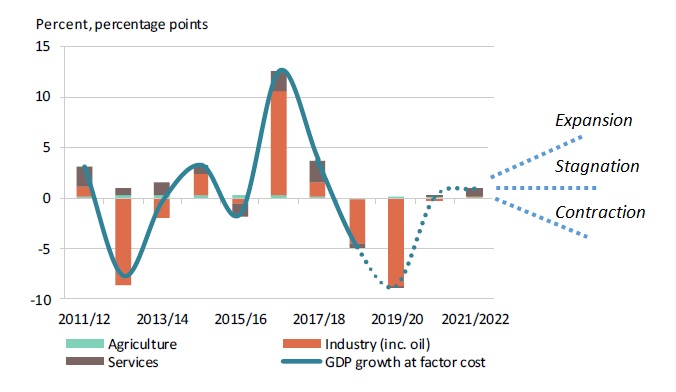
But then came the Trump U-turn. In May 2018, he had the U.S. withdraw from the nuclear deal, while secondary sanctions drove Iran’s economy into mild recession as major companies exited the country rather than risk being penalized by the US. The value of Iran’s currency declined sharply. Even before the US escalation, Iran’s economy was expected to undergo a second consecutive year of recession and contract by 8.7% in 2019/20. Inflation was estimated to reach 38% annually with mounting fiscal pressures. Economic expansion, which began after the nuclear deal, has been undermined. Neither is stagnation enough for the Trump administration. What the White House is fostering is progressive contraction (Figure 2).
Figure 2 Iran: GDP Growth and Supply Side Components, 2011-22
Source: World Bank; Difference Group
Following the drastic re-escalation, Iran’s economy will have to cope with even more challenging downward risks. And if oil exports were to be curtailed further, the economy could enter into a steeper recession and suffer from high inflation rates. In such a status quo, the challenge of protecting the vulnerable households would put additional pressure on the government finances and potentially the rial. Unfortunately, that may be precisely the White House’s objective.
“The challenges highlight the crucial role of further economic diversification by focusing on non-oil sources of growth and government revenues,” the World Bank stated in a recent update. In reality, economic diversification can only be built on peaceful conditions and political stability, which allow governments to proceed with a medium-term diversification. Such preconditions predate Trump’s Iran policy that has undermined years of international, multilateral diplomacy.
The net effect is the most dangerous escalation in the Middle East in decades and possibly the last nail in the fragile global economic prospects that could cause a synchronized global contraction in the course of 2020.
Dr. Dan Steinbock is an internationally recognized strategist of the multipolar world and the founder of Difference Group. He has served at the India, China and America Institute (USA), Shanghai Institutes for International Studies (China) and the EU Center (Singapore). For more, see https://www.differencegroup.net
Despite the woes of Brexit, we need to try and remember that it’s not all doom and gloom. Here, we will look at post-Brexit business opportunities, before touching on an industry which presents more positives than initially meets the eye…
Freelancing Opportunities
In 2018, it was reported that there were 2 million freelancers in the UK, contributing to 46% of the total self-employed business contribution in the UK.
Regardless of the UK’s relationship with the EU, it’s likely that there will be a short-term spike in demand for freelancers. Freelancers should take advantage of this opportunity by making sure they can network and meet potential clients in order to improve their retail performance.
Perhaps this is because understandably, many businesses don’t want to run the risk of committing to full-time employees at an unpredictable time. The demand for talent may decline across different industries as spending is reduced. It is likely that employers will look to outsource independent workers to complete work.
What does this mean for businesses?
When the UK leaves the EU, there’ll be more freedom for freelancers and businesses to work closely with emerging economies like Japan, India, and the United Arab Emirates.
If new trade agreements are made with other countries like Australia and Canada, stronger political relationships could mean more business opportunities. This of course completely relies on if new trade deals are made. Due to the skyrocketing rates of e-commerce, small and medium-sized enterprises who were regulated by EU membership will be free to trade overseas.
The weakened pound is likely to increase export sales because it will be cheaper to produce these goods in the UK rather than somewhere with a stronger currency, making your business more competitive.
Pick up competitors’ clients
It is expected that businesses could leave the UK and head elsewhere. If a direct competitor in your industry leaves the UK, look to see if there are any clients you can gain. This could range from buying their client list to marketing your business to their main audience. Whether you’re out on the waters fishing or a financial consultant, if competitors retreat, there’s a gap to be filled. Try to make it your business that fills it.
As Brexit has been viewed as an opportunity to become independent, there has been rising support in buying domestic products rather than imports. This combined with concerns over climate change, more people are thinking ‘local’ opposed to ‘global’. And it’s cheaper. Local production, local supply, and local services can all take advantage of this growing trend.
Several banks have stated that they will be reconsidering their UK investments. A huge employer of Bournemouth, JP Morgan, said Brexit could result in slashing a quarter of its 16,000 staff.
The UK’s Automotive Industry
Considerable doubt has been placed over the future of the automotive industry post Brexit over the last three years. Of course, it would be naïve to shun the sceptics concern over what lies ahead, as the industry is worth more than £82bn.
That said, very few have looked to the positives which an exit from the EU presents.
The aforementioned free trade is certainly one aspect worth taking into account. According to Investopedia, seven of the world’s top ten countries by GDP are outside of the EU — one of the remaining three is the UK.
When considering this, broken trade links hardly seems like much of a disaster when we can further develop the relationships we already have with countries outside of the union.
Take India for example. UK exports to India face a tariff of 14.8 per cent, while reverse imports are subject to 8.4 per cent. Despite the pre-existing £4.2bn worth of exports to India, the EU has failed to establish a solid deal. It has been proposed that the current export tally could be boosted by a further £2bn, abject of the considerable tariffs.
These opportunities don’t just lie with India either. Countries in Africa, Asia, and South America are growing at a rapid pace, so much so 90 per cent of the world’s growth over the next 10 years will occur outside of the EU.
‘Incessant red tape’ is a phrase which has been thrown about regularly since the result of the referendum was announced on 23rd June 2016. Although you might be rather sick of hearing it, it is of major significance. No longer do the UK have to depend on 28 EU member states to pass legislation.
Furthermore, one of the two countries with the strongest world economies which are in the EU is Germany. Approximately one in seven German cars are sold in the UK — it seems highly unlikely manufacturers such as the Volkswagen Group and BMW are going to be willing to let that link breakdown.
For British workers in the automotive industry, the prospect of less skilled workers from the EU being in the employment sector does actually provide a greater opportunity for the younger generation.
Although, in the short term, it might present issues for dealerships and manufacturers across the country, having less of a talent pool to choose from, it opens another door — moulding the employees you want. A younger generation of workers, who would’ve potentially been facing unemployment can now be utilised as skilled engineers.
Lookers Motoring Group, who train apprentices on Ford Servicing, are just one example of a company who are offering nationwide roles.
Some opportunities are short-term, while there are others which will be beneficial in the long run. For both employees and employers, taking a step back and analysing the entire situation is crucial before making rash decisions.
Many people avail of a personal loan these days as the capital can be used for any purpose without any restrictions from the lender’s side. However, people have many valid questions in their minds. A person can always put these questions in front of the executives of the lender organization.
When it comes to a personal loan, you must choose an organization that offers you repayment flexibilities as a convenience apart from providing you with a decent capital. Here, you can go through the leading FAQs that might commonly arise in your mind while planning to avail a personal loan.
Leading FAQs concerning personal loans
The following questions and answers can help you know more about personal loan and their management. The answers are given in a factual manner that will help you to know more about personal loan.
Are personal loans available in fixed and floating rates?
In India, personal loans are available in both fixed and floating rates. However, this feature might not be present in all the banks that provide personal loans. You must primarily know the difference between the fixed rate and the floating rate of personal loans. In the case of fixed-rate personal loan, the interest rate remains the same throughout the tenure of repayment. However, with changes in the MCLR rules, the interest rate of the floating rate personal loan can fluctuate. In case any changes are brought in the repo rate, the rate of interest can change in case of a floating rate personal loan.
What are the vital documents that you need for a personal loan application?
There are some vital documents that you will need to provide to the lender organization. Your lender will verify these documents before they grant you a capital. Always ensure keeping the photocopies of the following documents while expecting to get a personal loan.
Any address proof with your photograph
Financial documents like PAN card and payslips supporting the authenticity of your monthly income
Business-related documents like the trade license and bills (for the self-employed borrowers)
What are the steps concerned with the sanctioning process of a personal loan?
There are different steps in which a personal loan is sanctioned for a borrower. Here a brief note regarding the main steps is given.
Approach for a personal loan
Approval of getting a personal loan
Application form fill up
Document verification process
Loan capital disbursal
Always remember that the lender entity will finalize the capital of your personal loan after judging the reason for your need, financial condition, and creditworthiness.
How to choose the most reliable personal loan lender?
When it comes to choosing the best personal loan lender, you should keep two things in mind. Try selecting a lender organization that allows you to enjoy conveniences on repayment. Moreover, you must check that the interest rate is low than other entities in the market.
What is the way to compare personal loan plans?
Earlier, it was a tough job to compare the personal loan plans offered by different banks and financial entities. Nowadays, you can directly visit the site of any organization that delivers personal loan plans and check the percentage of interest of the personal loan. You can also get all the useful information regarding the eligibility and the repayment structure of the personal loan. Many websites have a personal loan interest calculator that can help you to check the exact amount of the monthly EMI.
How much money can a person borrow as a personal loan capital?
There are different considerations that lending companies make while providing you with personal loans. Mainly, they check your monthly income of the borrower. If you are a salaried person, you can get up to 30% of your total income. In case you are a self-employed person, the loan capital will depend upon the average profit of your business. Remember, that the lender organization will not exceed the 30% bar as personal loans are unsecured in nature.
Why is the interest percentage high for a personal loan?
The interest percentage of a personal loan is higher than any other loan as it is unsecured. You should always know about the EMI amount that you have to clear against the loan capital before taking it. The EMI that you need to pay will be determined by the interest rate of the loan. It is always advisable to take a personal loan only if the borrower is able to deliver the repayments on time. Defaulting the repayments might result in strict legal actions against the borrower.
So, these are some most commonly asked questions when it comes to a personal loan. You will find a lot of banks and NBFCs giving personal loans. Although, you can get the loan capital easily, make sure you clear the repayments within tenure. With proper management and strategies, you can easily avoid the debt trap.
According to a 2016 Pew Research Center Report, Millennials between the ages of 20 and 34 make up 35 percent of the labor force in the United States. This group of young adults is now the largest generation in the workforce.
Millennials are also the most coveted audience for retailers and advertisers, including direct sales marketers. And while many people view direct sales as old school, in reality, direct sales carry natural advantages that perceptive salespeople can leverage to turn skeptical Millennials into brand loyalists. The five strategies below are especially well suited for direct sales marketers seeking to reach the Millennial market.
Be Social Media Savvy
Unlike previous generations who have adapted to the internet, Millennials are digital natives who grew up “liking”, swiping and posting selfies. Social media is also a natural environment for direct sales, where merchandisers can promote their products and service providers can post blog entries and social media updates.
Not only is social media much cheaper than conventional advertising — it’s also a more effective way of reaching a Millennial audience. In fact, according to Forbes, 62 percent of Millennials are more likely to become loyal to brands that engage them through social media.
Keep It Legit
Direct sales hasn’t always had the best reputation among the general population, including Millennials. However, one way to overcome misleading rumors like Amway did when accused of being a scam is to emphasize the fact that direct sales representatives are real people. Millennials respond to authentic stories about overcoming adversity or devoting time and effort to building a business. Direct sales companies should encourage their representatives to tell their individual stories along with describing great their products or services are.
Take a Personal Approach
Millennials value face-to-face interactions. This may seem contradictory in light of how much time they spend with digital devices, but this generation is all about making personal connections. The fact that direct sales are so dependent on face-to-face interactions is a definite advantage in reaching Millennials and turning them from prospects to paying customers.
Concentrate on Word of Mouth Marketing
Back in the day, TV, radio and newspaper ads represented the lion’s share of marketing and advertising. While those forms of advertising are still important, they don’t represent the primary way to reach the Millennial market. According to a Forbes article, 50 percent of Millennials are influenced by word-of-mouth recommendations. That’s good news for direct sales, which depends so much on customers telling their friends and family members about the outstanding service or product that they bought from a particular company.
Believe in Your Product
Millennials have a laser sense about whether someone is keeping it real or putting up a front. The best direct sales representatives are those who believe in their products, use those products and let their customers know about it. After all, if a company’s representatives aren’t sold on the products or services they are selling, why should potential customers purchase them?
Turning Millennials into Loyal Customers
Reaching the desirable Millennial market requires companies to rethink their marketing and advertising approaches. Authenticity, a personal approach and social media savvy are all essential elements to selling to Millennials. The direct sales industry has a natural advantage in these areas, which smart companies and representatives should leverage. That’s how to turn skeptical Millennial prospects into loyal customers that recommend a company’s products and services to their family and friends.
Saving money can be a long process, and sometimes, we need to get it done fast. Luckily, there are a lot of ways to do this! Most of them are very simple, and you may have heard before, but in case you haven’t, this list is for you.
Having a good savings account or emergency fund will save you from any unforeseen expenses that will put you in a financial crunch. One of the biggest problems that come with saving is those surprise moments. Needing a part for your car, medical bills, necessities, and other costs can put a dent in our efforts, but hopefully, no longer.
Here’s how you can start saving money quickly and reach financial independence quicker:
1. Sell unwanted things
Purging your home can be a big relief for your living space and your bank account. Go through all of your belongings and figure out what you don’t need. Not only will you be decluttering, but you can also potentially add some serious money to your savings.
There’s an outstanding amount of stuff we own that we never use that someone else will use. Go through it all and figure out what you don’t need or use, and sell it online or at a yard sale and pocket that cash for your savings or emergency fund.
2. Go on a spending freeze
One good way to start building your savings is to go on a spending freeze. We love the idea of a spending spree, but we don’t usually consider a spending freeze. There are so many times when you spend unnecessary money that eats into your bank account.
Consider how your spending habits are restricting you from creating a good emergency fund and correct this. You can even go literal and freeze your credit card in water and leave it untouched until you feel comfortable with your spending habits. The main goal is to build good spending habits. Stop spending money on junk that will make you happy now, and start saving so you can be happy for longer and later.
3. Tax refunds
Your tax refund is a small chunk of money you can stash away to help build up your savings. Many people don’t realize how easy it is to get and use this refund. Don’t see it as some extra spending money, but a good way to reinvest in yourself.
Getting your tax refund quickly electronically, through services at taxfyle, is a great way to quickly stash away some funds to beef up that savings. You may even get a significant amount, depending on how much of a refund you qualify for. Cooper parry offer tax services which you may also find helpful.
4. Team up with a Partner
Reach your saving goals quicker by working with a partner. If you are in a couple, this obviously makes it a lot easier. “One tactic we used to save enough money to travel all over Europe when we were 18 was to set a budget for expenses each week – say $500 – and everything over would go straight into a savings account”, say Nadia and Mike from Couple Travel the World.
Conclusion
Building a sizable savings fund for emergencies or for personal use is no longer a stressful and tough task. Small changes to your lifestyle, like selling unwanted or needed possessions, can free up space in your home and add extra cash for savings. Similarly, try cutting down on unneeded spending. Lastly, consider using your tax refunds as a way to add significant money to your savings.
Some of us may treat watches as a means only to learn the time and a fashion statement. Other people make a personal connection with their timepieces. Others can’t leave the house without their watches. It’s the same feeling we get at times that we left our phone at home.
But in the world of finance and business, a watch is their ultimate status symbol. For these men, it symbolizes their achievement. You can see a Junior Banker with Omega and an Executive with a Rolex. But you know, you can’t justbuy Rolex online. These luxury watches should be seen as keenly in person.
As we go crazy over these luxury watches, let’s see who are these most prominent and influential central bankers, financiers, CEOs that own and wear these top luxury watches in the market today.
1. Patek Philippe Calatrava 5119G
The most expensive on our list. Top of Patek Philippe’s classic model lists, Patek Philippe Calatrava 5119G. Supremely charming, plain and elegant. The CEO of Toyota, Akio Toyoda, was caught in the paparazzi several times wearing this timepiece. Calatrava 5119G retails around $21000 and above.
2. Jaeger LeCoultre Master Perpetual Calendar
The CEO of Citigroup, one of the largest banks in the world, Michael Corbat, was seen wearing one of thetop luxury watches, Jaeger LeCoultre Master Perpetual Calendar. You can buy this for only $19,500 and up.
3. Audemars Piguet Royal Oak
One of their famous models that have been giving masculine take for decades, Audemars Piguet Royal Oak. Royal Oak was also the choice of the CEO of LinkedIn, Jeff Weiner. This one costs more than $18,000.
4. Rolex Datejust
When you hear Rolex, it’s like the symbolism of class and respect in the watch industry, the Classic Watch. Every time people talk about all these luxury watches, Rolex is always the first to mention. To validate these statements, the Co-CEO of Oracle, Mark Hurd, owns and wears this classic timepiece, Rolex Datejust.
5. Rolex Submariner 116610
Rolex’s another legendary piece, Submariner. Submariner 116610 retails at around $8500. Worn by the chairman, president, and McKesson Corp CEO, John Hammergren.Rolex Submariners come in different models and colors.
6. Ulysse Nardin Dual Time 233-88-7
The CEO of Amazon, Jeff Bezos, one of the richest men in the world, owns this timepiece. This watch is a combination of stylish marine and silver. Ulysse Nardin Dual Time costs around $8000.
7. Omega Planet Ocean
Combining a modern touch and a classic look, stepping forward in timepiece excellence, Omega Planet Ocean. This water-resistant, elegant, and new piece, retails at around $7500 and up. The President of Solera Holdings, Tony Aquila, was wearing this piece.
8. Breitling Colt Automatic
One of the Swiss-made timepieces that are known for its uniqueness, Breitling Colt Automatic. Depending on the condition and mechanism, this timepiece cost starts for as low as $3000. Breitling Colt Automatic is the timepiece that Satya Nadella wears, CEO of Microsoft.
9. Chopard Mille Miglia 16/8997
This classic Swiss timepiece, Chopard Mille Miglia, was worn by the CEO of Uber, Dara Khosrowshahi. This was named after a vintage car rally in Italy to pay tribute, Mille Miglia. This piece costs around $3,400 and up.
Takeaway
These luxury pieces are not only loved by the CEOs; almost everyone does. While these pieces are not for ordinary buyers given their prices, they are great investments, a worthy one. Over time, their values appreciate so it will never be a waste of money.
If you want to own these kinds of luxury watches, you can consider buying pre-owned items. It costs lower and more affordable, but it still possesses the same value, elegance, and charm.
One problem that many new businesses face when they enter the online world is poor online rankings. Ensuring that your business has a high ranking on search engine results is a very important factor in getting viewers to your website. Having a low ranking can be detrimental to your business because you may have the best product or service available, but if no one can find your site, then no one will buy from your company.
If your business is having trouble ranking high on search result pages there may be some things you are doing wrong. There are many misconceptions when it comes to ranking high in search engine results, and many of the things website owners do can actually hurt their website ranking. Knowing what will increase your online ranking can be hard, but here are some tips that can help you rank a little higher on search engines.
Writing Quality Content
Is your business struggling to rank well on search engine result pages? Well, you may need to consider writing quality content. The algorithm that search engines use to help rank websites has changed drastically over the last few years and ranking high on Google has become extremely competitive. If you want to make sure your website ranks high, you will need to make sure that the content on your website makes sense, is engaging, and provides value to your readers. If the content on your website is poorly written, or considered spam, your website will not be able to rank high. The content on your blog should be related to your business. Make sure you write about topics that are frequently searched by your customers. For example, if you sell bicycles you may want to write blog posts about changing a bike tire, nice biking paths, or what the best new bikes are this year. It is important to deliver high-quality content that your readers will enjoy and this can be done by making sure you have high-quality content creators for your blog. Also, make sure you proofread your posts before posting them to your blog to make sure they are grammatically correct.
Build Social Proof
Another good way to help you rank online is by building social proof via backlinks. This is achieved when other reputable websites link to your website. A good way to help build backlinks is by reaching out to similar blogs and asking if you can write a featured post of their blog. This may seem counterintuitive, but it is actually more common than you think. For example, if you sell bicycles you may want to write a featured post on a biking blog or donate a bicycle for a raffle on a biking website in exchange for having a link posted on their website. Doing this will increase your brand’s social proof, help you build meaningful business relationships and will also help your website rank higher on search engine results.
Use an SEO Provider
If you are still having trouble with your website’s ranking does not worry. It often takes a long time to rank and develop a good website ranking. There are some companies that can help you rank higher if you are willing to reach out to them. A high-quality SEO provider will be able to help you rank better by implementing various strategies and they will also be able to help mentor you so that you can learn how to maintain a good website ranking once you have achieved it. Some SEO providers like SEO Gold Coast suggest building your SEO strategies across multiple platforms to get the best results. If you are interested click here to learn more, but basically what they tell you is that it is important to develop entire brand strategies for your business to get the best results. When you implement strategies across your business website, YouTube channel, Facebook page, and Twitter you will be able to exponentially grow your backlinks and increase awareness for your brand.
Whether you are a new business entering the online world or a business that has been online for 10 years, it can be difficult to know what is required to get a high ranking online. Thankfully, there are some ways you can increase your website ranking, such as writing quality content that is relevant to your business and building your social proof with backlinks. If you are still having trouble with your website after reading this, you should consider consulting a reputable SEO company that will be able to help with your website’s online ranking.
The business world has changed drastically over the past years, thanks to technology. Unlike in the past, when businesses were solely operated on a physical level, the internet has made it possible for business owners to run their businesses virtually and to target particularly any market in the world.
In business, competition is inevitable. Safari SEO Company Sydney suggests that online marketing needs to be viewed as a competitive pursuit. So long as your competitors are working day and night to improve their online marketing efforts, you also need to be optimising and improving your online marketing strategy or risk being left behind. Good thing you can use the internet to your advantage, limit your competitors, and save your business.
Online marketing, popularly known as e-marketing, is the process of advertising your product or service over the internet to both already existing customers and prospective customers with the aim of making sales.
Whether it’s on your business website or on popular social media networks, e-marketing has proven to be one of the most effective marketing techniques. If this were not the case, the numerous businesses that are operated entirely online would not exist.
Benefits of E-Marketing to Your Business
In pursuit of maintaining your customers’ loyalty to your business, here are a few tips you can use to ensure all their attention remains constant on your product:
1. Social media marketing
Today, the leading social media networks have not hundreds, not thousands, not even millions, but billions of active users that you can connect with. I will list down a few of the major social media platforms in the order of popularity:
Facebook.
Instagram.
Twitter.
LinkedIn.
Whatsapp.
Does your business have a presence on any of these platforms? If your answer was no, please consider doing that immediately, after you finish reading this of course.
If your answer was yes, just how engaged are you keeping your customers? You need to regularly update your business social media pages and create content that will interest your customers and keep them interacting with your product.
2. Email marketing
You need to create a targeted email list of your existing customers and your potential customers to send them email alerts from time to time concerning your product and company news.
Whether it is a new product arrival or you have discount offers, email marketing has over the years proven to be effective and is being utilized by both small and large firms. But make sure you scrub your email lists using any of the leading bulk email verification services.
3. Online support
Whichever the online platform you have created for your business, be sure to provide customer support to your clients round the clock. This is important, especially if your business is entirely internet-based or if you have a busy business website and social media.
Guaranteed customer support ensures customer satisfaction and loyalty.
Do Not Let Anything Hinder Your Business
If you have a business and you are studying at the same time, sometimes it’s not easy to balance between the two, especially when it comes to assignments.
SpeedyPaper is the leading online essay writing service with professional writers ready to work on your paper at all times. Be sure to check out Speedy Paper reviews on their website or other review services and see the endless positive feedback examples clients have of the writing service.
If I were in business and I needed to pay someone to do my math homework or any other subject for that matter, I would definitely hire SpeedyPaper. Moreover, they use e-marketing so that you’ll be informed about all the current discounts.
By Terence Tse
CFOs are evolving into AI-driven transformation orchestrators, balancing finance, technology, and strategy while upskilling teams, managing risks, and driving measurable business value.
A key insight from this year’s AI for CFOs event, organized...
The World Financial Review uses cookies to improve site functionality, provide you with a better browsing experience, and to enable our partners to advertise to you. Detailed information on the use of cookies on this Site, and how you can decline them, is provided in our Privacy Policy and Terms and Conditions. By clicking on the accept button and using this Site, you consent to our Privacy Policy and Terms and Conditions. ACCEPT
Privacy & Cookies Policy
Privacy Overview
This website uses cookies to improve your experience while you navigate through the website. Out of these cookies, the cookies that are categorized as necessary are stored on your browser as they are essential for the working of basic functionalities of the website. We also use third-party cookies that help us analyze and understand how you use this website. These cookies will be stored in your browser only with your consent. You also have the option to opt-out of these cookies. But opting out of some of these cookies may have an effect on your browsing experience.
Necessary cookies are absolutely essential for the website to function properly. This category only includes cookies that ensures basic functionalities and security features of the website. These cookies do not store any personal information.
Any cookies that may not be particularly necessary for the website to function and is used specifically to collect user personal data via analytics, ads, other embedded contents are termed as non-necessary cookies. It is mandatory to procure user consent prior to running these cookies on your website.