Playing on your smartphone is the best way to play the latest new slot games. Forget having to go to your local pub or even an actual land based casino. Forget having to start up your computer, wait for a loading screen and put in all your details just to log on and start playing. Smart phones allow players to skip all the fuss, just by opening an app and start spinning quicker than you can shout jackpot! There are plenty of reasons why smartphones are great for playing new slot games and it’s why hundreds of millions of people all over the world only play slots using their mobile device. But if you’re not one of them and you still need a little convincing then keep reading to find out exactly why smartphones are great for new slot games and how pay by mobile works.
Unlimited Choice
Our favourite thing about playing new slot games on smart phones is the endless choice. With so many to choose from it can be a little difficult deciding on one, but really as far as problems go, that’s not a bad issue to have. There are millions of smartphone casino apps with each one providing hundreds, if not thousands of various new slot games. With all these games to choose from, players are guaranteed to find a game that suits them.
Better Graphics
Slot game developers like NetEnt, Microgaming and Yggdrasil are all scrambling in the race to be the number one online slot game provider. They don’t have to worry about the mechanics of the traditional machines and can instead focus on making them accessible to anyone in the world all from the comfort of their own home. It’s why there is a fast increase in the rate that slot games are designed to be played on mobile devices or online only. So in playing on your smartphone, you’re guaranteed to have greater access to the most modern and advanced of all slot games.
Accessibility
The most obvious reason why smart phones are the best way of playing new slot games is because of the fact they’re unparalleled in terms of convenience. The technological revolution that allowed slot games to be played online opened up a whole new era of gaming, letting punters spin the reels from their own living room. Yet players were still restricted to either a local pub, casino or their home. Smart phones have pushed the boundaries even further and now players can play literally absolutely anywhere. As long as you have a compatible device and can open up the slot app, players can try their luck whenever. So whether you’re trying to kill some time on your evening commute, trying not to look awkward waiting for a mate, or sitting on your own at a restaurant waiting for your date, smart phone slot games help pass the time. You just cannot argue with that now can you?
One of the three basic needs of man is shelter. Regardless of an individual’s situation, having a roof over one’s head is paramount. Be it a studio apartment, condominium, single-family home, townhouse, multi-family residential, or duplex, there is a need to have a place you can call home. However, getting an apartment of your choice with a mortgage is dependent on the credibility of your credit.
If you have bad credit, it can be difficult getting an apartment, especially in a competitive environment. However, getting your next apartment should not be affected by your low credit score. All you need is to have the right documents and enlarge your search. Here are the steps to take to secure an apartment with a low credit score.
Find Out Details Of What Your Credit Report Contains
You do not need to be in a hurry to get an apartment. To start with, you need to work on your personal finance. It is important to note that many property owners screen your credit as part of the application process. Hence, run through your credits before applying for an apartment and ensure that all your details on your credit report are accurate. It is also ideal to check for negative items on your credit report.
Another area you need to focus on is your credit score. Not all landlords may go through your credit history for previous outcomes, but most of them will check your credit score. Whereby you have a low credit score, you may end up not getting the best deal.
What Is Your Budget?
The size of your budget determines what type of apartment you will end up with. Get an apartment that can easily be covered by your budget. Remember, you have other needs to sort out such as groceries, utility bills, entertainment, and other important bills.
In as much as you have all these bills to cover, your rent to income ratio should be about 35% or less. A higher-income ratio would place your landlord on edge. You can find out what your monthly rent would be by multiplying your annual salary by 0.35 and dividing the result by 12. The answer derived should be your maximum monthly rent.
For example, if your annual income is $65,000, then your rent per month should not be more than $1,890. If your credit is bad, then consider spending less than that so as to make your house application more appealing. It shows you have the capacity to take care of your rent.
Register For A Rent Payment Reporting Service
You can build a strong credit history by registering for a rent payment reporting service for a monthly fee. Whatever prompt monthly payments are made would be reported to TransUnion. That way, a record is being kept containing your current and past rents. Although this is not your credit score, it helps build your credit reputation.
Even with a low credit score, you still have access to various mortgage opportunities due to your high performance on rent payments. Some reporting services require that you pay via a percentage of your rent, while others come with a monthly fee.
If you would like to know more about renting a new home even with poor credit, please visit this link: CreditRepairCompanies.
Pocket Option was founded in the year 2017 and is currently owned and managed by Gembell Limited. It has earned itself a good reputation in the binary trading scene for being one of the most reliable traders in the market. Its strength is based on versatility; it has over 100 assets that are available for new as well as experienced traders.
Additionally, people who use it to trade can use several payment methods that are especially beneficial to international investors from various parts of the world. To determine if this is the right broker for you, you need to learn more about it. Hence, we have come up with this in-depthPocket Option review about what this binary options trading platform offers. It can help you decide whether it is viable to use this platform to trade.
Trade types
Pocket Option offers one trade type, although it is one of the best with regards to making profitable payouts quickly. The high/low options are a straightforward type which is also simple because all that the trader needs to do is predict the outcome of a trade that you made correctly over a preset period of time. If you predicted that an asset is going to trade at a lower price and it turns out to be so at stoppage time, that averages between 80 and 100 percent for each high/low prediction. The shortest period of time that you can preset while making a prediction is 60 seconds and up to four hours for traders who like to take their time.
On their website, Pocket Option states that you can get up to 218% in payouts for successful high/low predictions. Although this is too high to be practical, you can make a lot of money in a matter of minutes if you possess the experience to predict correctly. You should, however, be careful with high/low options because the consequence of too many incorrect predictions is a loss that you might not recover from.
A demo account
Pocket Option has a demo account for people who are wary of losing their money with a live account. The core benefit of this feature is that you do not even need to sign up so that you gain access to the demo account. All you need to do is navigate to their website and click on the demo account button. The admin will assign $10,000 in virtual funds that you can use to make high/low predictions. Note that the demo account benefits both experienced and inexperienced traders.
Experienced traders can use it to determine whether all the positives about high payouts from this platform is true. If such a trader is not impressed with this platform, they can simply pull off, which is easier than having to withdraw funds from a live account and then shut it down. An inexperienced trader can use the platform to practice the art of trading. Those who like the experience they get from the free demo can move on to signing up for a live account.
Bonuses
Pocket Option gives you a 50% deposit bonus of the initial invested amount that you make upon opening a live account. The purpose of this deposit is to encourage new traders to make hefty deposits when they sign up. Remember that the minimum amount that one can make as the initial deposit is $50 and $1 for each trade. This means that you will get $75 to begin making trades after depositing the minimum account. However, you won’t be allowed to withdraw your bonus until you have made a specified number of trades using the system. The condition deters users who intend to fool the system by signing in and then withdrawing their initial investment plus the bonus that comes with it.
Mobile Trading
In this age where more people prefer using mobile applications to desktop applications, most people like to know beforehand whether an application they have used on the web is available on their mobile devices. Pocket Options have a platform on the web and additional mobile apps that are available for iOS and Android devices. These could be helpful for people who would like to trade while on the go.
Deposits and withdrawals
Pocket Options has an intuitive interface that makes it easy to deposit and withdraw funds. Deposits are acceptable from more than 50 methods of payment that include popular ones like Mastercard, Visa, Bitcoin, Litecoin, Netteler, and debit cards. The minimum amount that you can withdraw in a single transaction is $10. Note that this broker does not charge a commission for these transactions which gives it a competitive edge over other providers in the same niche.
Customer support
The customer care on the website is always available. A potential trader can email various departments, starting a live chat, or calling the toll-free phone number provided. You can also use the contact form to send a message directly.
The response time is fast, and the customer care team can satisfy their customer’s concerns. The site also provides social media links to Twitter, Facebook, and other popular social networks.
Pocket Option is the ideal broker for those looking for an easy and quick way to make demo trades. The site offers excellent features to its traders. The lowest minimum deposit and the trading fees make it an ideal starting point for beginners. Pocket Option has a simple account layout and it provides binary options traders with a level playing field.
There are new and wonderful ways that business with the right kind of mindset can give back to the communities that they chose to live and thrive in. Yes, the point of a business is to grow. Sure, there are people making money, but that money can and does get put into the places that matter the most to the people involved. Here are some innovative ways that businesses are giving back to their communities.
Direct Everyday Cost Towards Aid
It matters where a business entity puts its money. It’s a sign of what kind of moral compass the company has. There are a bunch of ways one can minimize overhead in that manner, but the more creative ones try as much as possible to have their everyday setup and cost help the people at large. Experts at https://cooleraid.co.uk/water-coolers/ that specialize in giving low-cost solutions for drinking water, do so while at the same time helping those in need on the back end. These kinds of initiatives are largely set for the client to simply take part in. That’s a godsend if you’re trying to have limited personal responsibility in these initiatives while still maintaining strong support.
Education and Mentoring
One of the best ways of business can give back to the community, is through education initiatives. Giving guidance for free enriches the lives of those that really want to learn. Having it as a volunteer basis, instead of a school subject, allows for the people coming in to give their full attention because it involves their free will in doing so. Better yet, if the education given pertains directly to your line of business, then you can directly translate to a potential internship or scholarship program if you see the potential. Oftentimes, human resources are in the look for strangers with the right objective qualifications. If you give out free education courses to those who want to be a part of your organization, you don’t need to spend as much money on the weeding out process. These individuals are already vetted and know your process. Education truly is a win-win innovative contribution to the community.
Help Other Small Businesses
If your businesses have a large enough platform, given the opportunity for smaller businesses in the community to thrive is another innovative way to help out. No, it’s up to you to drum up support for the businesses that you believe are the most deserving. But showing the community that you care, by directly promoting the enrichment of their citizens, speaks to the better angels and morals of all business owners.
Not only is it a show of good faith and good vision, but it also shows the right kind of leadership. Having initiatives to help other people will always benefit a company. It’s never a waste of time. In the end, the people that you influence and the people that you touch will go on to do their own great things. That will be directly linked to how you ran your business.
This morning, Monday, March 9, financial asset markets continue to implode: US stocks are further collapsing -6% (Dow down 1650, Nasdaq >500 mid-day). Ditto Asian and Europe stock markets -6%. They were already declining sharply last week due to coronavirus induced supply chain shocks (reducing production) and expanding demand shocks (consumer spending contraction in select industries like travel, hotels, entertainment)–all of which are being forecast by investors to whack corporate earnings in 2Q20 big time. But imposed on the equities market crash of the past 2 weeks now is the acceleration of the global oil price deflation that erupted yesterday as the Saudis deal with Russia last year to cut production and prop up prices fell apart. Collapsing oil & commodities futures prices are now feeding back up equities and other financial asset prices. Financial price deflation spreading, including to currency exchange rates. Money capital fleeing everywhere into ‘safe havens’ (gold, Treasuries, Yen). Historic decline of US Treasuries now below 1% (30 yr.) and .5% (10 yr).
Will the financial asset markets deflation soon spill over to the credit system (especially corporate bonds) and accelerate the decline of real economies worldwide in turn? Are traditional monetary & fiscal policy tools now less effective compared to 2008-09? If so, why? Is the global economy on the precipice of another ‘great recession’?
Financial Asset Markets Imploding
So we have oil futures market prices–i.e. another financial asset market–collapsing now and impacting the stock markets. In other words, a feedback contagion underway on stocks market prices in turn. Feedback is occurring as well on other industrial commodity futures prices that are following oil futures prices downward in tandem. But that’s not all the financial contagion and deflation underway.
The freefall in financial assets (stocks, oil, commodities) is also translating into currency exchange price deflation in turn, especially in emerging market economies in Latin America, Africa, Asia highly dependent on commodity sales with which to earn needed foreign exchange with which to finance their past debt (e.g. case of Argentina whose egotiations with IMF on how to restructure their debt will now break down, I predict).
Currency exchange rates are in sharp decline everywhere as a result. For emerging market economies that means money capital is more rapidly flowing out of their economy, toward safe havens globally like the US dollar, US Treasury bonds, gold, and the Japanese Yen currency.
In short, stocks, oil-commodity futures, and forex currency markets are all imploding and increasingly feeding back on each other in a general deflating downward spiral. This is a classic ‘cross-contagion effect’ that occurs in financial asset market crashes. And crashing financial markets eventually have the effect of contracting the real economy in turn, by freezing up what’s called the credit markets. Businesses can’t roll over their loans and refi their corporate bonds. Banks stop lending. The rest of the real economy then contracts sharply. It starts in the financial markets, spreads to credit markets (corporate junk bonds, BBB corporate bonds, then top grade bonds).
Coronavirus Effect as Precipitating Cause
But it even earlier begins in a slowing real US and global economy that precedes the markets crash. The global economy was already weakening seriously in 2019. The US economy at year end 2019 was also weak, held up only by household consumption. Business investment had already contracted nine months in a row in 2019 and inventories built up too much. And, of course, the Trump trade war took its toll throughout 2018-19.
Then came the Coronavirus which shut down supply chains in China, and then in So. Korea and Japan in turn. That then began impacting Europe, already weakened by the trade war (especially Germany) and Brexit concerns. The supply chain economic impact of the virus developed into a consumer demand economic impact as well, as travel spending was reduced (airlines, cruise ships, hotels, resorts, etc.) and now, in latest development, other areas of consumer spending too. Both supply chain (production cutbacks) and demand (consumption cutbacks) are interpreted by investors as leading soon to a big fall in corporate earnings–which translates in turn into stock price collapse we see now underway. Investors have decided the 11 year growth cycle is over. They’re cashing in and taking their money and running to the sidelines, moving it from stocks to cash or Treasuries or gold or other near liquid financial assets.
So the Coronavirus event is really a ‘precipitating cause’ of the current markets crash. The real economy weakness was already there. The virus just accelerated and exacerbated the process big time. (see my 2010 book, ‘Epic Recession’ for explanation how financial causation comes in different forms as precipitating causes, enabling causes, and fundamental causes. Book reviews are on my website). Again, worth repeating: global and US economies were weakening noticeably in late 2019. The virus further impacted supply chains (production) and demand (consumption), reduced corporate earnings in the near term and thereby simply pushed stock markets over the cliff.
Mutual Feedback Effects: Real & Financial Economies
But financial crashes have the effect of feeding back into the real economy as well, causing it to contract further in turn. What starts as a weakening of the real economy that translates into financial markets crashing, in turn feeds back into a further weakening of the real economy. Mainstream economists don’t understand this ‘mutual feedback effect’; don’t understand the various causal relationships between financial asset cycles and real investment cycles. (For my explanation of this relationship there’s my 2016 book, ‘Systemic Fragility in the Global Economy’ and specifically chapters on the need to distinguish between financial asset investing and real investing and how late capitalism’s financial structure has changed such that the inter-causal effects of financial-real investment have deepened and intensified.) Financial crashes accelerate and deepen the contraction of the real economy. Recessions turn into ‘Great Recessions’ as in 2008-09. They may even turn into bona fide ‘Depressions’ as in the 1930s should the banking system not get bailed out quickly.
Corporate Bonds & Credit Markets Next?
The feedback effect of the current financial asset price deflation–now underway in stocks, commodity futures, forex, (and derivatives)–on the real economy will soon emerge as the financial markets deflation affects the various credit markets. The key credit market is the corporate bond market. Bond markets are far more important to capitalism than equity-stock markets. The credit markets to watch now are the corporate junk bonds (sometimes called high yield corporates). Junk bonds are debt issued to companies that have been performing poorly for years. They are kept alive by banks helping them issue their bonds at high interest rates. Investors demand a high rate because the companies may not survive. In good times they do. But when markets and economies turn down, companies over loaded with junk financing typically default–i.e. can’t pay the interest or principal on their bonds. They go under. The investors that bought their risky bonds are then left holding their debt that becomes near worthless. The US junk bond market today is ‘worth’ more than $2 trillion. At least a third of that is oil & energy (fracking) companies. A large part of their bonds must be rolled over, refinanced, in 2021. But many of them will not be able to refinance. Why? Because global oil prices have just collapsed to $30 a barrel, perhaps falling further to $20 a barrel. At that price, the oil-energy junk bond laden companies will not be able to refinance. They will default. That will spread fear and contagion to other sectors of the $2 trillion junk bond sector–especially big box and other retail companies (e.g. JC Penneys, etc.) that also loaded up on junk financing in recent years. Investors will disgorge themselves of junk bonds in general.
The fear of a crash in junk bonds will almost certainly spread to other corporate bonds, first to what’s called BBB grade corporates. That’s another $3 trillion market. But most of BBBs are really also junk that’s been improperly reclassified as BBB, the lowest (unsafe) level of corporate Investment grade bonds (the safest). So at least $5 trillion in corporate credit is at risk for potential default. If even a part defaults, it will send shock waves throughout the corporate economy that will have very serious implications–for both the financial and real economies, US and global, which are increasingly fragile.
Is Another ‘Great Recession’ on the Horizon?
For example, Japan is already in recession as of late last year. Now it’s contracting, reportedly, by 7% more. Europe was stagnant at best, with Italy and Germany slipping into recession before the virus hit. So. Korea and Australia are in recession now, as other economies in Asia and Latin America are now contracting as well. China economy reportedly will come to a halt in terms of GDP this quarter, or even contract, according to some sources. Meanwhile, Goldman Sachs forecasts the US economy growth will stall to 0% in the second quarter 2020.
So a collapse in risky corporate bonds will occur overlaid on this already weak real economic scenario. Should that happen, then the recession could easily morph into another ‘great recession’ as in 2008-09; maybe even worse if the banking system freezes up and central banks cannot bail them out quickly enough. Or if banks in a major economy elsewhere experience a crash–as in India or even Europe or Japan where more than $10 trillion in non-performing bank loans exist–and the contagion spreads rapidly to banking systems elsewhere.
Failed Monetary & Fiscal Policies, 2009-2019
Which leads to the question can central banks now do so? After the 2008-09 crash, the Fed bailed out the US banks by 2010. But it kept interest rates near zero under Obama for six more years. Banks could still get free money from the Fed at 0.15% interest. (The Fed then paid them 0.25% if they left the money with the Fed). The Fed bailed out other financial companies to the tune of $5 trillion more as it bought up bad loans and Treasuries from investors at above then market rates. That is, it subsidized them. And did so for six more years. All this free money flowed, mostly into financial markets in the US and worldwide, creating the stock bubbles that are now imploding. So the Fed and other central banks went on a binge subsidizing banks for years, and in the process broke their own interest rate tool needed for instances like the present crisis. The Fed tried desperately to raise interest rates in 2017-18 so it could have a cushion for times like this. But it then capitulated to Trump and began reducing interest rates again in 2019–as it had under Obama for six years.
The free money from the Fed artificially boosted stock prices. On top of this Trump added a further subsidization of banks and non-bank corporations, businesses, and investors with his $4.5 trillion 10 year tax cuts passed January 2018. Most of that went as a windfall to corporate-business bottom lines. 23% of the 27% rise in corporate profits in 2018 is attributable to the windfall tax cuts. And where did that go? It too was redirected to stock and other financial markets,further inflating the bubbles. Here’s the channel and proof: Fortune 500 corporations in the US alone spent $1.2 trillion in both 2018 and 2019 in stock buybacks and dividend payouts to their shareholders. The stock buybacks inflated the stock markets, and most of the dividend payouts did as well. (Buybacks+dividends under Obama were nearly as generous, averaging more than $800 billion a year for six years).
In other words, the 25% run up in US stock markets in 2017-19 under Trump was totally artificial, driven by the tax cuts and by the Fed capitulating to Trump and lowering rates again in 2019. Very little of the annual $1.2 trillion went into the real US economy. For the past year real investment in structures, plant, equipment, etc. actually contracted for nine months in 2019, and is now contracting even faster in 2020.
Just as the Fed has busted its own interest rate monetary tool as it continually subsidized banks and businesses with low interest rates for years, the chronic corporate-investor tax cutting has busted fiscal policy responses to recession as well. Since 2001 the US has provided $15 trillion in tax cuts, the vast majority of which have gone to corporations, banks, and wealthy investors. That has led to government deficits averaging more than $1 trillion a year since 2008. And accelerated the US federal debt to more than $22 trillion. Fiscal policy is now seriously constrained by the deficits and debt–just as monetary policy as interest rates is now constrained by virtually all Treasury bond rates below 1% in the US and negative rates in Europe and Japan.
Interest rate policy responses to today’s emerging crisis is thus dead in the water. (As this writer predicted it would become in 2016 in the book, ‘Central Bankers at the End of Their Rope: Monetary Policy and the Coming Depression’). After years of monetary policy used as a tool to subsidize banks, it is now ineffective as a tool to stabilize the economy. Ditto for fiscal policy as tax policy. Used by Obama and even more so by Trump to subsidize corporations, stock buybacks, and financial markets, it is confronted by massive annual US budget deficits and accelerating national debt.
The likely responses by politicians and policy makers to the current emerging financial crisis and recessions in the real economy will be to cut taxes even further for businesses. It will have little effect, however. But will exacerbate levels of deficit and debt. That means the follow up will be to attack and reduce government spending, especially targeting social security, medicare, healthcare and education in 2021. Trump has already publicly indicated his intent to do so. On the Fed side, expect more injection of money directly into the economy and failing businesses by means of another major round of ‘quantitative easing’ (QE). That’s coming soon. Ditto for Europe and Japan where negative rates already exist. Watch China too should its economy contract for the first time in 30 years. And watch India, where it’s banking system is already fracturing due to causes totally separate from the virus effect. A banking crash in India is on the agenda. It could result in yet another financial blow to the global economy, adding to the current Saudi-produced oil price shock and the virus effect on supply chains and demand.
Summary and Conclusions
In summary, the global capitalist economy is unraveling financially, and soon further in real terms. Massive job layoffs in coming months in the US are a growing possibility. That will drive the US economy deep in contraction as household consumption, the only area holding up the US economy in 2019, now joins the contraction. It remains to be seen how US monetary and fiscal policy can restore economic stability given its self-destruction by US politicians since 2008. Trump policies have been no different than Obama’s-just more generous to corporate America and investors. Trump’s policies are best described as ‘Neoliberalism 2.0’ or ‘Neoliberal on steroids’. (see my just published 2020 book, ‘The Scourge of Neoliberalism: US Economic Policy from Reagan to Trump’).
The US and global economies are well on their way to a repeat of the ‘great recession’ (or worse) of 2008-09. Only this time traditional monetary-fiscal policy is much less effective. More radical policy responses will likely be developed to try to stabilize the capitalist economies both in USA and elsewhere (where problems are even more severe). Watch closely as the crisis on the financial side moves on from equity (stock), commodities, and forex financial markets into derivatives markets and credit markets–especially junk bond and other corporate bond markets. Watch as the Fed tries desperately to provide liquidity to business and markets via its Repo channel and QE since its traditional rate channels are now ineffective. And watch as US and global capitalist advanced economies try to coordinate new fiscal policy responses to the general dual crisis in financial and real economic sectors of global capital.
Dr. Rasmusis author of the just published book, ‘The Scourge of Neoliberalism: US Economic Policy from Reagan to Trump’, Clarity Press, January 2020. His website is http://kyklosproductions.com. He blogs at jackrasmus.com and tweets @drjackrasmus. Dr. Rasmus hosts the weekly radio show, Alternative Visions, on the Progressive Radio Network, fridays, at 2 pm eastern.
The Standard Chartered bank offers personal loan to meet all your requirements, be it for travel, wedding, purchase of a car or funding travel. It is better to know about personal loan by SC beforehand so that you can apply and get quick approval when in need. The Standard Chartered serves all your purposes in highly efficient interest rates. The bank provides personal loans in the range between 1 lakh to 30 lakhs depending on the factors such as eligibility, your repayment capacity, your income etc. The loan tenure offered is generally of 1-5 years with the reducing balance interest rate of 11% to 19 and 20%. So if you are looking for a personal loan apply at Standard Chartered.
Features Of Standard Chartered Personal Loan
As a bank, Standard Chartered offers many benefits to its customers. Some of them are:
The Standard Chartered personal loan offers its services to both salaried and non-salaried individuals. As long as you have a regular source of income to pay off the debts, you will not be deterred from opting for the SC loan.
The process of getting a personal loan approved is instant. You can apply online on the Standard Chartered website to get an instant approval for the loan. It will take no more than a week to get your loan processed after the verification of your application.
The other benefit of applying online is that you will get an instant 50% discount on the processing fee. This means that both in terms of convenience and expenses, the online platform of the Standard Chartered is the best option for you to avail a loan.
To get your personal loan approved, you will not be required of any guarantor or any other form of security.
To the salaried employees, the bank offers a personal loan amount of up to a whopping 30 lakh rupees. Whereas for the entrepreneurs, the maximum sum that can be approved is 10 lakh rupees.
The Standard Chartered bank also offers waivers on your last EMI for a personal loan with period or tenure of either 36, 48 or 60 months.
The documentation process of the Standard Chartered Bank is also simple and easy. For identity proof, you can use the aadhaar Card. passport, photo pan card, driving license, voter ID card or a photo ration card. For address proof, you can use the passport, telephone bill, ration card, electricity bill, driving license, life / medical insurance policy, rental agreement or an apartment allotment letter.
The bank also offers a 24×7 customer care service for personal loan takers. If you find yourself in any confusion or find any problem regarding your loan, you can contact the SC customer care executives. The customer service executive will do his or her best to offer you the optimum solution.
Standard Chartered offers a great range of attractive offers for those who are looking for a personal loan. SOURCE: youtube.com
With these attractive schemes, long payment duration, smooth loan approval processing and competitive interest rates with no need of any guarantor, Standard Chartered has become the most preferred option for a personal loan apply.
CIBIL Score For A Personal Loan
CIBIL (Credit Information Bureau India Limited) is a credit information company responsible for maintaining records of credit or debt-related activities of companies as well as individuals. When you go to the Standard Chartered for the approval of a personal loan, the bank checks your credit history. If the score is above 750, the bank will take your loan request into consideration and look further into your credit report.
The bank will look at how effectively you had paid off your previous loans if any, along with the entire payment history of that loan. If you have not or only very rarely defaulted in making payment, you are great to go for the loan approval.
With your credit report, the bank will also decide the type of loan which will be best for you and what amount at what interest rate you are eligible for.
Tips For Better Chances Of Approval
Getting a personal loan with the Standard Chartered is quite easy and simple. However, if you still want to be double sure about it, you can take the following tips into consideration.
Try maintaining a good credit history. Making your previous loan payments in time without default will make you a desirable candidate for the SC loan.
If you have a meagre amount to pay for the previous loan, pay it off at once and close that loan. Doing this will help you to get a higher amount of loan.
Do not keep a large number of credit cards as it affects your credit report in a negative way. It does not matter whether you are using all the cards or not, having a number of cards is considered as poor financial management.
With these things in consideration, your chances of getting a personal loan from the Standard Chartered at amazing rates are high. You can even compare a personal loan with credit cards and find what is best for you. Nonetheless, if you are opting for a personal loan, Standard Chartered is an ideal place for your financial needs.
Believe it or not, your credit score can completely raise or downgrade your financial status. Having a good credit score is essential in managing everyday banking and finances easier which also provides a lot of perks like applying for loans, for example. There are many occasions when people’s credit scores fall behind, and they might feel that it is unrepairable. Luckily, your credit score, no matter how low it is, can be easily repaired by following a number of steps. Once you repair your credit score, it can make your life and your finances much easier to deal with.
Check out your credit file reports
The first step in repairing your credit score is knowing exactly what went wrong in the beginning. The only way you could know all your financial details from beginning to end is by obtaining a copy of your credit file. Inside this file, there will be reports of all your financial and credit dealings starting from credit card bills to any loans or mortgages. It is not too hard to obtain that file. If you click here, you can understand more about how it is an essential step in repairing your credit score. The key thing is that once you receive this file, you should use it to analyze your financial behavior and learn from your mistakes. In addition, you can use it to check for any problems that can be fixed. This will help you to avoid any mistakes that were made in the past and give you a knowledge of what you can do in the future to repair your credit score.
Dispute any errors
Sometimes, a low credit score isn’t really your fault, to begin with. One of the main reasons why credit scores can reverse is the faults or errors in reports, which could indicate that certain payments were handled after their designated deadline or not handled at all. Once you find any of these errors, it is important that you take immediate action and dispute such mistakes with the creditor. Many times, the issue can be resolved quickly and without difficulty. In other circumstances where your creditor is hard to deal with, simply try to ask nicely, and the issue could be resolved out of goodwill in the end.
Pay everything on time
The key element in maintaining or repairing any credit score is to pay all your bills at their exact due date. However, you can simply forget to handle certain payments on time. To avoid such issues, try to set certain alarms or reminders that would help you manage all your payments without any delay. Another trick that could save you the hassle, is to set up a direct debit account for all your regular monthly payments. Thus, they will directly reach the creditor out of your monthly income, and ensure that you are not paying any late bills or missing them altogether.
Get rid of any outstanding debt
Among the most important steps in repairing any damages with your credit score, it is trying to eliminate any bleeding from outstanding debt. This can come in the form of unexecuted payments -old bills or loans- that are overdue. Make sure to check for any debts that need to be paid, and pay them off as soon as you can to start your repairing process without any burden. You can even try to make a few extra payments on your credit card balance to prove goodwill and keep additional safe cash in the bank in case of an emergency.
Only borrow what you can afford
When trying to repair your credit scores, it is important to understand that the key to having a good one is borrowing what you are certain you can pay back at some point. Make sure you review your payment history and your balance so that you can analyze your own finances, and what you can and cannot afford. Thus, you can ensure you pay everything you owe on time, and your credit will improve drastically.
Having a bad credit score can be a thing of the past if you follow the right steps. All that you need to do is to review your own finances and check for your payment history so that you can learn about past mistakes and the way to improve in the future. Do not allow for any errors to be mentioned in your credit reports, and prove goodwill by paying everything on time from now on. In doing so you will enjoy a healthy credit score and easy banking and credit experiences.
In 2008/2009 the whole planet had experienced a significant downturn and the standing fact is that even after 10 years, the effects are still lingering. Therefore these results can still affect the user confidence and the general economic growth. However, knowing this little information, what does the future bode for business in general? We are also wondering about the entertainment sector of iGaming. Charl Geyser of DRGT shares his views on the future about the new decade and how the user experience will be when it comes to gaming.
The Player Experience Is Paramount
Char Geyser is very sure that there is and will be an increased shift in the way of iGaming display, in particular in Europe with an extent of Africa. The effort to remain relevant is important for growth towards the player experience. The business growth will be driven by changes in the market share, which is opposed to the actual increase in contributing towards driving growth. However, one thing is certain, whoever is operating across Europe or Africa, the player experience is paramount and it has to be exceptional. Char Geyser strongly believes that this is where DRGT (DR Gaming Technology) has a key role to play, by providing operators with the necessary tools and technology in order to deliver that exceptional user experience.
There has been a study done by PwC on user experience and the most 5 important things that humans value in respect of their users is: Efficiency, Convenience, Knowledgeable and Friendly Staff, Easy Support and Up-to-date Technology. This list is the starting point to the standing ever-evolving products that are placed on the casino floor.
The operators have access to it and they need it now, more than ever to be able to easily measure and manage the product contribution. After that they need to allocate that intelligence to specific players and use that intelligence to tailor that contribution towards those players and announce the casino staff and the players about these products. Once this entire process is done, it can be started again and in order to remain relevant, it must never stop.
The Newest Tools
Char Geyser believes that DRGT is able to stand-out in the marketplace, because they are able to provide operators with the needed tools to tackle 2020 head-on. For example, at ICE London 2020 in February, people who visited the DRGT booth saw a vast array of management tools which are all aimed solely at empowering slots, tables and personnel. The technology is easy-to-use which will help them understand, measure, service and engage their players better. This will help in creating the best possible user experience.
The management system tool will offer Tables Managers the same functionality and insights which in the past were exclusive for Slots Managers. For example, DRGT’s newest platforms of Poker21 and BlackJack 11 are easy-to-configure and personalise the games, because it also has a player-friendly interface and a communication software for the player. This new software would help a lot with the player communication over known games like Book of Ra 10. For Char Geyser, he really believes that DRGT is able to provide operators a formidable array of tools that allows them to enter the new decade. They can be confident that they will be able to deliver the best possible user experience which was used before to one type of player segment.
In January, China began a pioneering standard-setting battle against a deadly virus outbreak. Despite successful containment in China, international response has been lagging, which will compound human risks and economic damage globally.
With the novel coronavirus – the 2019 novel coronavirus acute respiratory disease – the dark milestone of 100,000 confirmed cases will soon be broken, while the number of deaths exceeded 3,000 already at the turn of March. The good news is that the number of the recovered will soon soar to more than 50,000 as well.
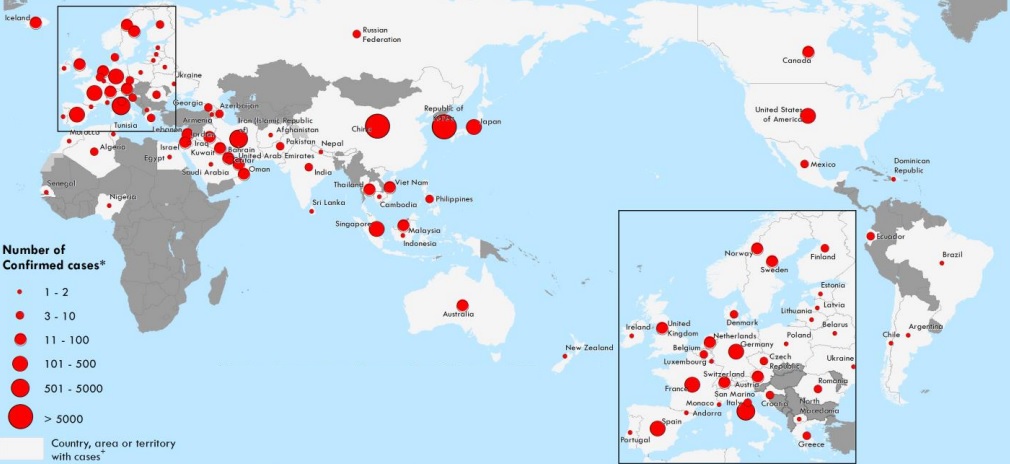
The bad news is that, even though virus challenges should continue to ease toward April, the acceleration of new cases outside China is only beginning and likely grossly under-reported. Consequently, the number of confirmed cases worldwide, including the distribution of those cases (Figure 1), is likely to climb in the future.
Figure 1 Distribution of COVID-19 Cases*
Source: World Health Organization, National Health Commission of the People’s Republic of China. Map Production: WHO Health Emergencies Program * As of March 4, 2020. Simplified
What makes it challenging to project the global future of the new coronavirus is that even though the epidemic has already touched more than 60 countries, it is showing some signs, however fragile, that it could be contained over time.
Containing the spread in China
The novel coronavirus was first detected on December 30, 2019 (hence the technical name 2019-nCoV ARD), when three bronchoalveolar lavage samples were collected from a patient with pneumonia of unknown etiology. In the process, Wuhan Jinyintan Hospital followed a surveillance definition established after the SARS outbreak of 2002-2003. The “mystery pneumonia,” as it was then called, had a close relationship with a bat SARS-like coronavirus strain.
According to the World Health Organization (WHO), the prevention and control measures in China were implemented rapidly, from the early stages in Wuhan and key areas of Hubei, to the national epidemic. Here’s how it happened.
On January 1, the Huanan seafood wholesale market in which the virus may have originated or which amplified the spread or both, was closed. On January 3, gene sequencing was completed by China’s Center for Disease and Control (CDC); four days later, CDC isolated the novel coronavirus. On January 10, it publicly shared the gene sequence of the virus. And by mid-month, China’s National Health Laboratory (NHC) issued diagnosis and control technical protocols.
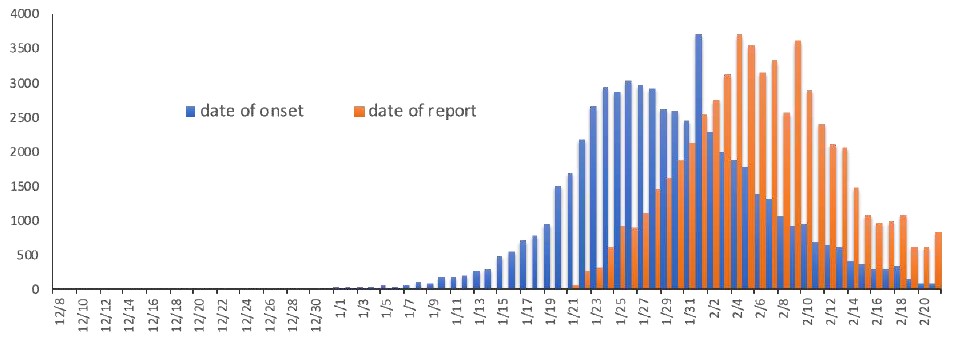
After the detection of the cluster of pneumonia cases in Wuhan, the Chinese Communist Party Central Committee and State Council launched the national emergency response, led by General Secretary Xi Jinping, Prime Minister Li Keqiang and Vice Premier Sun Chunlan. As documented by the recent WHO China Joint Mission, the epidemic grew dramatically around January 10 to 22. Thanks to China’s draconian measures, reported cases peaked and plateaued between January 23 and 27, and have steadily declined since then, apart from one spike (Figure 2).
Figure 2 Epidemic Curves for Confirmed COVID-19 Cases in China
* By symptom onset and date of report (February 20, 2020) for laboratory confirmed cases in China. Source: WHO China Joint Mission, Feb 29, 2020
In the early 2000s, China’s efforts to control SARS were criticized as the disease spread internationally before the global outbreak was subdued. Only a decade later, Chinese response to the Avian influenza (H7N9) was significantly faster, broadly praised and the disease did not spread widely. With COVID-19, WHO’s chief Dr. Tedros Adhanom Ghebreyesus has stated that China should be credited with identifying the virus in “record time,” sharing its genetic sequence quickly, and flagging potential international spread.
This is how it happened: In the most agile and aggressive disease containment effort in history, China first promoted universal temperature monitoring, masking, and hand washing. As the outbreak evolved and knowledge was gained, it adopted a science and risk-based approach to tailor implementation. In the final phase, specific containment measures were adjusted to the provincial, county and even community context, the setting, and the transmission there.
Nevertheless, when China’s central government imposed the cordon sanitaire around Wuhan and neighboring municipalities on January 23, 2020, it was criticized as a sign of “Beijing’s autocratic measures” that would not help but could make the crisis a lot worse. In reality, these measures effectively prevented further exportation of infected individuals to the rest of the country. That’s why the Chinese blueprint is now used around the world as foreign governments seek to use the lessons to tailor their own containment measures.
It was this massive quarantine of tens of millions of people that delayed the export of the outbreak not just to the rest of China but abroad. Unfortunately, much of that advantage was missed in slow international mobilization.
International delays and challenges
At the end of January, the WHO declared the ongoing virus outbreak a “public health emergency of international concern” (PHEIC). The WHO was concerned about the possible effects of the virus, if it would spread to countries with weaker healthcare systems. On February 4, Dr. Tedros dropped a news bomb by stating publicly that it was not China, but countries outside China that had proved slow in sharing information about cases. After a month of international crisis and global alert, three of five member countries had failed to provide adequate information to WHO. Those reports were vital to assess the international scope of the outbreak and to contain it.
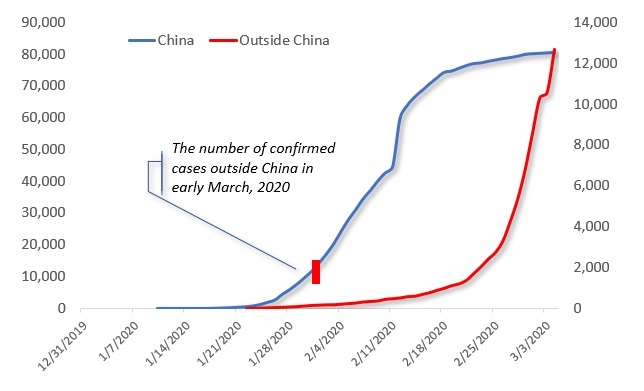
As the timeline suggests, the number of cases outside China soared after February 4 and the missed opportunities for greater international cooperation (Figure 3).
Figure 3 COVID-19 international risks have soared since early February*
* Epidemic curve of confirmed COVID-19 cases outside of China through March 2, 2020 Source: WHO, Difference Group.
Moreover, in the past, the US has often boosted international collaboration against common threats but that wasn’t the case now. The Trump cabinet’s efforts to exploit the crisis in the trade war were exemplified by Commerce Secretary Wilbur Ross. On January 30, after the ‘Phase 1’ trade deal, Ross declared the virus in China would benefit the US. The politicized attacks were reflected by Secretary of State Mike Pompeo and Health and Human Services (HHS) Secretary Alex Azar who blame Beijing for the crisis.
Risk of botched quarantines. On February 3, more than 3,700 passengers and crew of Diamond Princess were quarantined by the Japanese Ministry of Health after one passenger on the ship tested positive for COVID-19. Just two and half weeks later, some 635 passengers had tested positive for the virus, while two passengers has died after contracting the virus.
Risk of “super-spreaders.” With rapidly-expanding deadly viruses, super-spreaders who endanger others are a great concern. On February 10, a 61-year old woman, who worships at the Daegu cult church, developed fever but twice refused to be tested for the virus claiming she had not recently travelled abroad. Today, the number of confirmed cases in South Korea exceeds 5,000 with almost 40 deaths.
Risks of poorly-managed evacuations. As countries seek to rescue citizens from infected territories, failed evacuations can pose new risks. With Diamond Princess, the US Centers for Disease Control (CDC) urged to keep 14 infected US citizens in Japan, yet the State Department put the infected on a plane with healthy people claiming that a plastic-aligned enclosure would mitigate infection risks.
Risks of poorly-monitored self-quarantines. After mid-February, California health officials said that 7,600 people who had returned after visiting China during the virus outbreak had been asked to quarantine themselves at home. Instead of tracking by CDC, local health departments have discretion in how to carry out the quarantines.
Lack of or medical equipment. When the virus went global at the turn of March, most countries began to mobilize for supplies only belatedly. Around mid-February – the CDC found that some coronavirus test kits delivered to state laboratories were faulty. Now the plan is to start tests in US states by mid-March, although the idea of local tests was to expedite the diagnosis process.
Risks of weaker healthcare systems. Virus clusters have already emerged in every world region. The real question is how forcefully the virus will arrive in the rest of Americas and particularly Africa. Nor are developed economies immune to risks that center on inner-cities and rural margins, large prison populations and nursing homes.
Risks of untraceable virus clusters and local transmissions. As it is becoming harder to trace where the clusters started, the virus may be spreading too broadly for traditional public-health steps to contain it. Local transmission has occurred in many countries after case importation. Amid their battles against the Ebola virus and the unprecedented locust plague, many countries in Africa are struggling to step up preparedness to detect and cope with COVID-19 virus importations.
China toward rebound
After mid-January, I projected three probable virus impact scenarios in China, which can now be reassessed in light of new evidence and internationalized outbreaks. In the “SARS-like impact” scenario, a sharp quarterly effect, accounting for much of the damage, would be followed by a rebound. The broader impact would be relatively low and regional. In the “extended impact” scenario, the adverse impact would last at least two quarters. The broader impact would be more severe and have an effect on global prospects. In the “accelerated impact” scenario, adverse damage would be steeper with dire consequences in the global economy.
Recently, IMF projected global growth to fall 0.1 percentage points from the expected 3.3%. The estimate is optimistic. Even the OECD expects global GDP growth to drop to 2.4% in 2020, with possibly negative growth in the first quarter.
The big question is whether other major affected economies – US, EU/UK, Japan and large emerging countries – can achieve China-like fast containment. With the already-seen adverse impact on confidence, financial markets, travel, transportation and tourism, coupled with disruption to supply chains, multilateral development banks will soon release significant downward revisions in major economies.
The first and most benign “SARS-like impact” scenario is no longer likely. But nor is a comprehensive “extended impact” scenario inevitable if China gets back to business in March. Despite elevated warnings since mid-January, uncertainty began to grip the rest of the world only at the end of February, as evidenced by the recent multi-trillion-dollar market corrections in US and elsewhere.
While China still continues to report up to several hundred cases daily and must now guard against imported cases, economic recovery in the mainland has gained momentum since late February and is likely to intensify in the course of March.
IMF projects China’s growth to fall to 5.6% in 2020. Factory activity in China did contract at the fastest pace on record as the Purchasing Managers’ Index (PMI) fell to a record low of 35.7 from 50.0 in January. The same goes for the services activity.
Yet, both plunges were expected. Economic shocks translate to contractions. The real question involves the strength of the post-shock rebound in March.
In China, the expectation in January was that the first quarter would be penalized by a reduction of 1.2 percentage points to 5% or less, while the second quarter rebound would offset much (but not all) of the losses. March data could still prove high, given the low starting-point.
It is these assumptions of the first scenario that fuel the bold projections by J.P. Morgan that the Chinese first quarter could go down to -4%, but second quarter would go up to +15%. The rebound story is possible, if fiscal and monetary support is adequate. And if the small- and mid-size firms, which account for more than four-fifths of nationwide employment and over half of the GDP, can jumpstart production.
International damage in the 1st and 2nd quarters
Internationally, belated mobilization translates to economic uncertainty and market volatility. By early March, the number of confirmed international cases exceeded 15,000. But that’s only a prelude. In early March, the number of confirmed cases outside China is about the same as in China about a month ago. In other words, international infection rates may barely have started to climb (Figure 4).
Figure 4 Cases in China and Outside China (until March 4)
Source: WHO, China National Health Commission, Difference Group
The rest of Asia could see continued case growth until early second quarter. Despite dramatic increases of new cases initially, Japan and South Korea will use economic measures and stronger containment to halt the crisis. In Southeast Asia, the cases have so far been fewer, except for Singapore, Malaysia and Thailand.
ASEAN growth engines, such as the Philippines, Indonesia and Vietnam, have strong structural growth potential. Yet, containment in emerging Asia depends dramatically on the capabilities of these countries to subdue the few existing cases and contain imported cases in the future. The same goes for South Asia, particularly India, Pakistan and Bangladesh.
Due to extensive and interconnected flows of trade and investment, significant reliance on Chinese and Asian tourism, and deep multinational supply chains, case growth in Europe will continue early second quarter, which could drive several countries and localities under lockdown to halt or slow down the spread.
Recessionary pressures come in a very bad time, with German GDP stalling, while France and Italy are contracting, and the UK is preparing for its post-Brexit economic hangover. In the fourth quarter of 2019, the Eurozone grew only 0.1%; the weakest since the contraction in early 2013. Italy is a particularly intriguing case. As the only European country to have barred flights to and from China, Hong Kong, Macau and Taiwan, it has still seen a dramatic increase of cases, centered in the regional towns of Lombardi, near Milan; the country’s business hub.
In Europe, there is much worse ahead in the coming months, if these pressures are not offset with appropriate fiscal and monetary policies.
Until recently, the Middle East and the Americas had not witnessed sustained case growth. Now, local transmissions have begun. In Iran, the dramatic rise of the infections and even faster increase of deaths– particularly those of leading government members – reflect higher-than-recorded rate of contagion, the presence of undetected virus clusters, or external synthetic efforts to exploit the virus outbreak.
In North America, local transmissions are now on rapid rise, though from a low starting-point. Despite greater awareness of COVID-19 and ample additional time to prepare, politization replaced mobilization in the US, which resulted in a series of containment mistakes. If the White House can manage the crisis, collateral damage would be limited to the early second quarter. The IMF projects US growth to suffer a 0.4% slowdown in the annualized growth; that is, from 2.0% to 1.6%. But that would require rapid success in containment – and early signs are not promising.
In Africa, outbreaks have already begun in the northern Maghreb (Algeria) and sub-Saharan countries (Nigeria, Senegal). Starting from the low-point, the cases are still few. Yet, most countries became able to test for the virus only in late February. In modeling simulations, the highest importation risk involves countries – such as Egypt, Algeria, and South Africa – that have moderate to high capacity to respond to outbreaks. Countries at moderate risk – including Nigeria, Ethiopia, Sudan, Angola, Tanzania, Ghana, and Kenya – have variable capacity and high vulnerability.
If cases escape detection, weak healthcare systems, coupled with endemic poverty and social instability, could result in a secondary epidemic with potential global impact.
Distressing realities
If the extended impact scenario will take hold and economic damage outside China will broaden well into the second quarter or even beyond, the downgrades that will follow in March and April will be replaced with a series of new ones in early summer.
In major economies, few sectors, particularly consumer goods, will rebound relatively quickly, but others are already likely to see lower demand for a far longer duration than initially anticipated – particularly aviation, tourism, hospitality, transportation – and if the damage spreads, still other sectors will follow in the footprints.
In an adverse scenario, the consequent impact on global economy would prove more significant thereby dragging global growth prospects from the expected 2.5 to 3% at the beginning of 2020 to around 1.8 to 2.2%, possibly even more. In Europe, new virus clusters would sustain economic uncertainty and market volatility. In the polarized United States, the belated response would be compounded by the divisive fall election. Around the world, transmissions would climb with new virus clusters, while global pandemic would fuel an international recession that would prevail until 2021, in the absence of US-Sino Phase 2 deal or temporary trade truce.
Since efforts to limit the virus to China have failed, many countries will soon shift focus toward mitigation rather than containment, hoping to slow the spread to stop hospitals all being overwhelmed at once. In the mitigation phase, quarantines are likely to be replaced by “social distancing” measures, such as closing schools as most recently in Italy. Since two-thirds of the infected traveling internationally are undetected, economic recovery could compound multiple cycles ofundetected human-to-human local transmissions globally.
Whether it is called epidemic or pandemic, the outbreak could eventually fade away, especially if countries manage to limit super-spreader events. As of yet, that has proved wishful thinking. In light of the current infection volumes, exponential increases in some countries and new virus clusters in others, the COVID-19 pandemic could infect two of three people globally. In the near future, early signs to that effect outside China would feature “unexplainable” new virus clusters with severe pneumonia in older people.
In the past, some viruses have eventually fizzled out, while others have morphed into global pandemic, like the Spanish flu a century ago. And that’s why what happens in March will precipitate what’s ahead in the rest of 2020 or beyond – in good and bad.
Dr. Dan Steinbock is an internationally recognized strategist of the multipolar world and the founder of Difference Group. He has served at the India, China and America Institute (USA), Shanghai Institutes for International Studies (China) and the EU Center (Singapore). For more, see https://www.differencegroup.net
In late January, Dr Steinbock argued that China was pioneering standard-setting containment measures that would prove valuable internationally. A week later, he predicted that there was a turnaround of confirmed cases in China. Though based on widely-available data, these projections went against the grain in international media at the time.
It seems as though it is a hallmark of various facets of the gambling industry to make the jump online in the 21st Century, and there should really be no surprise that this is the case either. Indeed, it would make the worst business sense in the world to ignore the chance to attract a huge number of new players to your industry, whilst also enabling past players to engage in the activity far more frequently.
Oh yes, online Bingo is so good because you can literally play it from anywhere in the world provided you have an adequate Internet connection, and at any time too. This fact has led to the market swelling at an incredibly fast rate, meaning that there are now millions of online Bingo players around. Want to know some online Bingo guide, tips and tricks? Read on for a lowdown.
Buy as many scorecards as possible
In pretty much every single gambling game the main way that strategists try and up their chances of winning is simply doing anything they can to make the odds swing further in their favour. With Bingo this fact mainly rests on how many scorecards you are in possession of, as someone with 10 is going to have a much bigger chance of hitting Bingo than somebody with just 1.
It is therefore a good idea to buy as many scorecards as possible before engaging in an online Bingo game, as this will give you the biggest chances of success.
Play at the least busy times
Another key strategy that experienced online Bingo players are always aware of is making sure you are playing at the least busy times. Obviously it can be tempting to play when there is a full house of people, as this usually makes the excitement levels much higher, however doing this could also be shooting yourself in the foot.
Think about it: the more people playing at any one time, the more chance that somebody else is going to get to Bingo before you. Try and play during off peak times when most people won’t be playing, it could dramatically increase your chances of winning.
Make use of any online Bingo offers
If there are any online slot fanatics here they will have definitely heard of the outrageous extent of online casino deposit offers these days, and the same kind of thing can also be found in the online Bingo world too.
It is absolutely crucial that you make use of any online Bingo offer that you can, as this will certainly help you on your way to a win. It could be buy one get one free on scorecards, for example, and we all know how that would help.
Budget intelligently
It may sound slightly boring, but budgeting is also a crucial component of being good at online Bingo, because if you do not do it properly you could easily be faced with the loss of all your money in just one session.
By Danny Leipziger
China cannot continue to rely on exports to drive its growth, but what are the alternatives?
China ran a $1.2 trillion trade surplus last year, and despite admonitions from the IMF to rely...
The World Financial Review uses cookies to improve site functionality, provide you with a better browsing experience, and to enable our partners to advertise to you. Detailed information on the use of cookies on this Site, and how you can decline them, is provided in our Privacy Policy and Terms and Conditions. By clicking on the accept button and using this Site, you consent to our Privacy Policy and Terms and Conditions. ACCEPT
Privacy & Cookies Policy
Privacy Overview
This website uses cookies to improve your experience while you navigate through the website. Out of these cookies, the cookies that are categorized as necessary are stored on your browser as they are essential for the working of basic functionalities of the website. We also use third-party cookies that help us analyze and understand how you use this website. These cookies will be stored in your browser only with your consent. You also have the option to opt-out of these cookies. But opting out of some of these cookies may have an effect on your browsing experience.
Necessary cookies are absolutely essential for the website to function properly. This category only includes cookies that ensures basic functionalities and security features of the website. These cookies do not store any personal information.
Any cookies that may not be particularly necessary for the website to function and is used specifically to collect user personal data via analytics, ads, other embedded contents are termed as non-necessary cookies. It is mandatory to procure user consent prior to running these cookies on your website.



























































Global Financial Asset Deflation: Prelude to Next ‘Great Recession’?
By Dr. Jack Rasmus
This morning, Monday, March 9, financial asset markets continue to implode: US stocks are further collapsing -6% (Dow down 1650, Nasdaq >500 mid-day). Ditto Asian and Europe stock markets -6%. They were already declining sharply last week due to coronavirus induced supply chain shocks (reducing production) and expanding demand shocks (consumer spending contraction in select industries like travel, hotels, entertainment)–all of which are being forecast by investors to whack corporate earnings in 2Q20 big time. But imposed on the equities market crash of the past 2 weeks now is the acceleration of the global oil price deflation that erupted yesterday as the Saudis deal with Russia last year to cut production and prop up prices fell apart. Collapsing oil & commodities futures prices are now feeding back up equities and other financial asset prices. Financial price deflation spreading, including to currency exchange rates. Money capital fleeing everywhere into ‘safe havens’ (gold, Treasuries, Yen). Historic decline of US Treasuries now below 1% (30 yr.) and .5% (10 yr).
Will the financial asset markets deflation soon spill over to the credit system (especially corporate bonds) and accelerate the decline of real economies worldwide in turn? Are traditional monetary & fiscal policy tools now less effective compared to 2008-09? If so, why? Is the global economy on the precipice of another ‘great recession’?
Financial Asset Markets Imploding
So we have oil futures market prices–i.e. another financial asset market–collapsing now and impacting the stock markets. In other words, a feedback contagion underway on stocks market prices in turn. Feedback is occurring as well on other industrial commodity futures prices that are following oil futures prices downward in tandem. But that’s not all the financial contagion and deflation underway.
The freefall in financial assets (stocks, oil, commodities) is also translating into currency exchange price deflation in turn, especially in emerging market economies in Latin America, Africa, Asia highly dependent on commodity sales with which to earn needed foreign exchange with which to finance their past debt (e.g. case of Argentina whose egotiations with IMF on how to restructure their debt will now break down, I predict).
Currency exchange rates are in sharp decline everywhere as a result. For emerging market economies that means money capital is more rapidly flowing out of their economy, toward safe havens globally like the US dollar, US Treasury bonds, gold, and the Japanese Yen currency.
In short, stocks, oil-commodity futures, and forex currency markets are all imploding and increasingly feeding back on each other in a general deflating downward spiral. This is a classic ‘cross-contagion effect’ that occurs in financial asset market crashes. And crashing financial markets eventually have the effect of contracting the real economy in turn, by freezing up what’s called the credit markets. Businesses can’t roll over their loans and refi their corporate bonds. Banks stop lending. The rest of the real economy then contracts sharply. It starts in the financial markets, spreads to credit markets (corporate junk bonds, BBB corporate bonds, then top grade bonds).
Coronavirus Effect as Precipitating Cause
But it even earlier begins in a slowing real US and global economy that precedes the markets crash. The global economy was already weakening seriously in 2019. The US economy at year end 2019 was also weak, held up only by household consumption. Business investment had already contracted nine months in a row in 2019 and inventories built up too much. And, of course, the Trump trade war took its toll throughout 2018-19.
Then came the Coronavirus which shut down supply chains in China, and then in So. Korea and Japan in turn. That then began impacting Europe, already weakened by the trade war (especially Germany) and Brexit concerns. The supply chain economic impact of the virus developed into a consumer demand economic impact as well, as travel spending was reduced (airlines, cruise ships, hotels, resorts, etc.) and now, in latest development, other areas of consumer spending too. Both supply chain (production cutbacks) and demand (consumption cutbacks) are interpreted by investors as leading soon to a big fall in corporate earnings–which translates in turn into stock price collapse we see now underway. Investors have decided the 11 year growth cycle is over. They’re cashing in and taking their money and running to the sidelines, moving it from stocks to cash or Treasuries or gold or other near liquid financial assets.
So the Coronavirus event is really a ‘precipitating cause’ of the current markets crash. The real economy weakness was already there. The virus just accelerated and exacerbated the process big time. (see my 2010 book, ‘Epic Recession’ for explanation how financial causation comes in different forms as precipitating causes, enabling causes, and fundamental causes. Book reviews are on my website). Again, worth repeating: global and US economies were weakening noticeably in late 2019. The virus further impacted supply chains (production) and demand (consumption), reduced corporate earnings in the near term and thereby simply pushed stock markets over the cliff.
Mutual Feedback Effects: Real & Financial Economies
But financial crashes have the effect of feeding back into the real economy as well, causing it to contract further in turn. What starts as a weakening of the real economy that translates into financial markets crashing, in turn feeds back into a further weakening of the real economy. Mainstream economists don’t understand this ‘mutual feedback effect’; don’t understand the various causal relationships between financial asset cycles and real investment cycles. (For my explanation of this relationship there’s my 2016 book, ‘Systemic Fragility in the Global Economy’ and specifically chapters on the need to distinguish between financial asset investing and real investing and how late capitalism’s financial structure has changed such that the inter-causal effects of financial-real investment have deepened and intensified.) Financial crashes accelerate and deepen the contraction of the real economy. Recessions turn into ‘Great Recessions’ as in 2008-09. They may even turn into bona fide ‘Depressions’ as in the 1930s should the banking system not get bailed out quickly.
Corporate Bonds & Credit Markets Next?
The feedback effect of the current financial asset price deflation–now underway in stocks, commodity futures, forex, (and derivatives)–on the real economy will soon emerge as the financial markets deflation affects the various credit markets. The key credit market is the corporate bond market. Bond markets are far more important to capitalism than equity-stock markets. The credit markets to watch now are the corporate junk bonds (sometimes called high yield corporates). Junk bonds are debt issued to companies that have been performing poorly for years. They are kept alive by banks helping them issue their bonds at high interest rates. Investors demand a high rate because the companies may not survive. In good times they do. But when markets and economies turn down, companies over loaded with junk financing typically default–i.e. can’t pay the interest or principal on their bonds. They go under. The investors that bought their risky bonds are then left holding their debt that becomes near worthless. The US junk bond market today is ‘worth’ more than $2 trillion. At least a third of that is oil & energy (fracking) companies. A large part of their bonds must be rolled over, refinanced, in 2021. But many of them will not be able to refinance. Why? Because global oil prices have just collapsed to $30 a barrel, perhaps falling further to $20 a barrel. At that price, the oil-energy junk bond laden companies will not be able to refinance. They will default. That will spread fear and contagion to other sectors of the $2 trillion junk bond sector–especially big box and other retail companies (e.g. JC Penneys, etc.) that also loaded up on junk financing in recent years. Investors will disgorge themselves of junk bonds in general.
The fear of a crash in junk bonds will almost certainly spread to other corporate bonds, first to what’s called BBB grade corporates. That’s another $3 trillion market. But most of BBBs are really also junk that’s been improperly reclassified as BBB, the lowest (unsafe) level of corporate Investment grade bonds (the safest). So at least $5 trillion in corporate credit is at risk for potential default. If even a part defaults, it will send shock waves throughout the corporate economy that will have very serious implications–for both the financial and real economies, US and global, which are increasingly fragile.
Is Another ‘Great Recession’ on the Horizon?
For example, Japan is already in recession as of late last year. Now it’s contracting, reportedly, by 7% more. Europe was stagnant at best, with Italy and Germany slipping into recession before the virus hit. So. Korea and Australia are in recession now, as other economies in Asia and Latin America are now contracting as well. China economy reportedly will come to a halt in terms of GDP this quarter, or even contract, according to some sources. Meanwhile, Goldman Sachs forecasts the US economy growth will stall to 0% in the second quarter 2020.
So a collapse in risky corporate bonds will occur overlaid on this already weak real economic scenario. Should that happen, then the recession could easily morph into another ‘great recession’ as in 2008-09; maybe even worse if the banking system freezes up and central banks cannot bail them out quickly enough. Or if banks in a major economy elsewhere experience a crash–as in India or even Europe or Japan where more than $10 trillion in non-performing bank loans exist–and the contagion spreads rapidly to banking systems elsewhere.
Failed Monetary & Fiscal Policies, 2009-2019
Which leads to the question can central banks now do so? After the 2008-09 crash, the Fed bailed out the US banks by 2010. But it kept interest rates near zero under Obama for six more years. Banks could still get free money from the Fed at 0.15% interest. (The Fed then paid them 0.25% if they left the money with the Fed). The Fed bailed out other financial companies to the tune of $5 trillion more as it bought up bad loans and Treasuries from investors at above then market rates. That is, it subsidized them. And did so for six more years. All this free money flowed, mostly into financial markets in the US and worldwide, creating the stock bubbles that are now imploding. So the Fed and other central banks went on a binge subsidizing banks for years, and in the process broke their own interest rate tool needed for instances like the present crisis. The Fed tried desperately to raise interest rates in 2017-18 so it could have a cushion for times like this. But it then capitulated to Trump and began reducing interest rates again in 2019–as it had under Obama for six years.
The free money from the Fed artificially boosted stock prices. On top of this Trump added a further subsidization of banks and non-bank corporations, businesses, and investors with his $4.5 trillion 10 year tax cuts passed January 2018. Most of that went as a windfall to corporate-business bottom lines. 23% of the 27% rise in corporate profits in 2018 is attributable to the windfall tax cuts. And where did that go? It too was redirected to stock and other financial markets,further inflating the bubbles. Here’s the channel and proof: Fortune 500 corporations in the US alone spent $1.2 trillion in both 2018 and 2019 in stock buybacks and dividend payouts to their shareholders. The stock buybacks inflated the stock markets, and most of the dividend payouts did as well. (Buybacks+dividends under Obama were nearly as generous, averaging more than $800 billion a year for six years).
In other words, the 25% run up in US stock markets in 2017-19 under Trump was totally artificial, driven by the tax cuts and by the Fed capitulating to Trump and lowering rates again in 2019. Very little of the annual $1.2 trillion went into the real US economy. For the past year real investment in structures, plant, equipment, etc. actually contracted for nine months in 2019, and is now contracting even faster in 2020.
Just as the Fed has busted its own interest rate monetary tool as it continually subsidized banks and businesses with low interest rates for years, the chronic corporate-investor tax cutting has busted fiscal policy responses to recession as well. Since 2001 the US has provided $15 trillion in tax cuts, the vast majority of which have gone to corporations, banks, and wealthy investors. That has led to government deficits averaging more than $1 trillion a year since 2008. And accelerated the US federal debt to more than $22 trillion. Fiscal policy is now seriously constrained by the deficits and debt–just as monetary policy as interest rates is now constrained by virtually all Treasury bond rates below 1% in the US and negative rates in Europe and Japan.
Interest rate policy responses to today’s emerging crisis is thus dead in the water. (As this writer predicted it would become in 2016 in the book, ‘Central Bankers at the End of Their Rope: Monetary Policy and the Coming Depression’). After years of monetary policy used as a tool to subsidize banks, it is now ineffective as a tool to stabilize the economy. Ditto for fiscal policy as tax policy. Used by Obama and even more so by Trump to subsidize corporations, stock buybacks, and financial markets, it is confronted by massive annual US budget deficits and accelerating national debt.
The likely responses by politicians and policy makers to the current emerging financial crisis and recessions in the real economy will be to cut taxes even further for businesses. It will have little effect, however. But will exacerbate levels of deficit and debt. That means the follow up will be to attack and reduce government spending, especially targeting social security, medicare, healthcare and education in 2021. Trump has already publicly indicated his intent to do so. On the Fed side, expect more injection of money directly into the economy and failing businesses by means of another major round of ‘quantitative easing’ (QE). That’s coming soon. Ditto for Europe and Japan where negative rates already exist. Watch China too should its economy contract for the first time in 30 years. And watch India, where it’s banking system is already fracturing due to causes totally separate from the virus effect. A banking crash in India is on the agenda. It could result in yet another financial blow to the global economy, adding to the current Saudi-produced oil price shock and the virus effect on supply chains and demand.
Summary and Conclusions
In summary, the global capitalist economy is unraveling financially, and soon further in real terms. Massive job layoffs in coming months in the US are a growing possibility. That will drive the US economy deep in contraction as household consumption, the only area holding up the US economy in 2019, now joins the contraction. It remains to be seen how US monetary and fiscal policy can restore economic stability given its self-destruction by US politicians since 2008. Trump policies have been no different than Obama’s-just more generous to corporate America and investors. Trump’s policies are best described as ‘Neoliberalism 2.0’ or ‘Neoliberal on steroids’. (see my just published 2020 book, ‘The Scourge of Neoliberalism: US Economic Policy from Reagan to Trump’).
The US and global economies are well on their way to a repeat of the ‘great recession’ (or worse) of 2008-09. Only this time traditional monetary-fiscal policy is much less effective. More radical policy responses will likely be developed to try to stabilize the capitalist economies both in USA and elsewhere (where problems are even more severe). Watch closely as the crisis on the financial side moves on from equity (stock), commodities, and forex financial markets into derivatives markets and credit markets–especially junk bond and other corporate bond markets. Watch as the Fed tries desperately to provide liquidity to business and markets via its Repo channel and QE since its traditional rate channels are now ineffective. And watch as US and global capitalist advanced economies try to coordinate new fiscal policy responses to the general dual crisis in financial and real economic sectors of global capital.
Related articles:
About the Author