
Britain’s deindustrialisation was politically mediated, not inevitable. Dr Kalim Siddiqui argues that in the 1980s the miners’ defeat, City deregulation, and financialisation dismantled manufacturing and concentrated growth in London, producing regional inequality and political backlash. Yet manufacturing still contributes £220 billion and 2.6 million jobs, proving decline was a policy choice with lasting consequences for class, region, and democracy.
I. Introduction
Over the last four decades, Britain has undergone a profound transformation in the structure of its economy, commonly described as deindustrialisation. The term broadly refers to the contraction of the manufacturing sector and to the declining relative importance of industrial production, employment and incomes within the national economy. This pattern is characteristic of other advanced capitalist economies, with comparable trends in employment, incomes, trade and revenue generation, and with similarly uneven social and geographical consequences.
The concept of deindustrialisation nevertheless raises several important conceptual questions. First, why should the decline of manufacturing be regarded as a particularly significant economic phenomenon? Britain had also experienced a substantial long-term decline in agricultural employment, yet considerably less attention was devoted to that process. Second, deindustrialisation may represent a long-term structural tendency within advanced industrial economies. Third, and more importantly, deindustrialisation in an open economy cannot be understood independently of changing domestic and international market conditions (Kitson, and Michie, 2014).
Globalisation, together with neoliberal economic policy and austerity in the United Kingdom (UK), has reshaped the domestic economy, patterns of investment, and levels of employment and income (Siddiqui, 2017). Changes in international trade, technological development, productivity, consumer demand and the geographical organisation of production, as well as lower wage costs and higher profit opportunities overseas, have all contributed to the contraction or relocation of manufacturing employment.
British deindustrialisation must be seen as more than a process of sectoral economic change. It involved a restructuring that transformed the relationship between capital, labour and the state. A political-economy approach makes it possible to study how changes in patterns of capital accumulation interacted with government policy, industrial relations, international economic pressures and class struggle (Siddiqui, 2026a).
This study examines British deindustrialisation through a political economy framework. Rather than treating the decline of manufacturing as an exclusively technological or market-driven phenomenon, it investigates the interaction between capital accumulation, class relations, state policy and the changing balance between productive and financial capital. It seeks to explain why Britain underwent such extensive industrial restructuring, and how that process was shaped by political and economic policies.
From a radical political economy perspective, British deindustrialisation should not be understood simply as an inevitable transition from an ‘industrial’ to a ‘post-industrial’ society. Rather, it should be understood as a restructuring of British capitalism and as a response to the contradictions of capital accumulation. The decline of manufacturing was shaped not only by technological and market changes but also by struggles over the organisation of production, the allocation of investment, the distribution of economic power and the relationship between productive and financial capital.
British deindustrialisation should be understood not simply as an inevitable stage in the development of an advanced economy, but as a contested process of capitalist restructuring whose trajectory was shaped by political decisions, changing patterns of capital accumulation and class interests. I do not mean to ignore the importance of technological change, international competition or changing consumer demand. Rather, my argument situates these factors within the wider dynamics of British capitalism and asks how economic transformation was mediated through relations of power, class and the state (Siddiqui, 2026a).
Today, manufacturing accounts for less than 8% of Britain’s GDP, and Britain ranks as the world’s twelfth-largest manufacturing nation. Some economists saw this as the inevitable logic of economic maturity. Yet it was political decisions, financial deregulation, cultural shifts and deliberate policy choices that dismantled the world’s first industrial nation. From the rise of steam power to the miners’ defeat, from the “Big Bang” of 1986 to the empty promises of “levelling up,” this is the story of Britain’s industrial decline.
This article deploys Marxian tools of analysis to develop a theoretical account of deindustrialisation while also discussing heterodox perspectives. Marx’s analysis of capitalism offers a deeper account of deindustrialisation than approaches that treat sectors as the primary analytical categories—or, at least, as the economic categories of foremost relevance.
This article therefore seeks to contribute both to the existing literature on deindustrialisation and to Marxian economics by applying Marxian tools to a contemporary economic phenomenon. An influential early statement of concern about deindustrialisation came from Kaldor (1978), who argued that manufacturing possesses distinctive characteristics and plays a special role as an engine of growth, and that a relative decline in manufacturing is likely to depress long-term growth.
II. Theoretical Analysis of Deindustrialisation
The literature on deindustrialisation has been concerned mainly with its causes and its adverse effects on growth. A prominent early contribution was that of Singh (1977), who conceptualised deindustrialisation in terms of an ‘efficient’ manufacturing sector—one ‘able to provide (currently and potentially) sufficient net exports to meet the country’s overall import requirements at socially acceptable levels of output, employment and exchange rate’ (Singh, 1977, p. 134). On this basis, Singh identified a structural disequilibrium in the UK: the competitive position of manufacturing was deteriorating despite rising productivity and improving cost and price competitiveness (Singh, 1977).
Deindustrialisation might better be defined as a sustained decline in both the share of manufacturing in total employment and the share of manufacturing in GDP, rather than in the former alone. Several more recent studies have empirically analysed its causes. Bazen and Thirlwall (1986) further developed the analysis of the negative effects of deindustrialisation on growth in the UK. They attribute deindustrialisation in the UK especially to falling demand for UK manufactured exports and emphasise the effects of the resulting balance-of-payments constraint on growth.
Rowthorn and Coutts (2004) study introduces an important distinction between positive and negative deindustrialisation. Positive deindustrialisation is defined as the normal result of sustained economic growth in a fully employed and already highly developed economy. It occurs because productivity growth in manufacturing is so rapid that, despite increasing output, employment in the sector is reduced—either in absolute terms or as a share of total employment. They further argue that the pattern of net exports shifts away from manufactures towards other goods and services, with the result that labour and other resources are shifted away from manufacturing towards other sectors of the economy.
Saeger (1997) finds evidence that imports from emerging economies contributed to lower manufacturing employment in 23 OECD countries between 1970 and 1990. It argues that by systematically higher productivity growth in manufacturing than in services. On this basis, it is said that deindustrialisation is a natural result of industrial dynamism in advanced economies.
These debates have been led largely by heterodox economists, especially those working within the structuralist and Kaldorian traditions. Kaldor’s (1978) view is based on a conception of sectoral specificity and the special role of manufacturing in growth. He emphasised that faster growth in manufacturing output directly drives a higher rate of overall economic growth, regarding manufacturing as possessing special properties and playing a special role as an engine of growth. Such a view implies that deindustrialisation is likely to have a negative effect on economic growth. This perspective stands in contrast to neoclassical accounts, which tend to treat deindustrialisation as a relatively benign reallocation of resources in response to changing comparative advantage and consumer preferences. For Kaldorians, by contrast, manufacturing is distinctive because it is subject to increasing returns to scale, generates technological spillovers (Kaldor, 1978).
Karl Marx himself did not deal with deindustrialisation as such, but he engaged extensively with the economic, social and political aspects of industrialisation. Deindustrialisation has nevertheless been a concern mainly within heterodox economics, where it is analysed as a sectoral phenomenon—the decline of the manufacturing sector within the wider economy (Siddiqui, 2023).
Marx viewed capitalism as a system that drives relentless mechanisation in pursuit of higher productivity and profits. However, replacing living labour—the ultimate source of surplus value—with machines tends to depress the overall rate of profit over time. To restore profitability, capital is subsequently relocated globally to regions with cheaper labour and weaker labour regulations (Tregenna, 2014).
Marxist analysis of this phenomenon centres on the pursuit of higher profit and the role of financialisation. Capitalists constantly seek the highest rate of return, and from the 1970s and 1980s onward, the dominant City of London found it far more profitable to extract wealth through finance, property speculation and global investment than to reinvest in domestic industry. This created a “rentier” economy, in which the industrial base was deliberately sacrificed for short-term financial gains (Siddiqui, 2026b). This was actively facilitated by political decisions—the deregulation of finance, the liberalisation of capital controls, the privatisation of public assets and the abandonment of full employment policy, restructuring the relationship between the state, capital and labour in favour of financial interests.
From a Marxian perspective, deindustrialisation is therefore not a neutral or inevitable stage of economic development. It is a particular resolution to a crisis of profitability, achieved through the spatial relocation of production, the disciplining of labour and the ascendancy of finance over industry. It reflects the underlying dynamics of capital accumulation, the balance of class forces and the strategic choices of the state. Understanding it in these terms allows us to see deindustrialisation not merely as a decline in manufacturing employment or output, but as a reorganisation of capitalism itself (Tregenna, 2014).
The economic process with which Marx is centrally concerned is the production and appropriation of surplus value. From a Marxian perspective, the fundamental question in classifying an activity is its relationship to the production, realisation, appropriation and distribution of surplus value.
Labour is therefore defined as productive or unproductive according to whether or not it produces surplus value. While surplus value is generated only through productive labour, both productive and unproductive labour may well be engaged in surplus-value-producing activities. Whether labour is productive or otherwise depends on the particular relationship of that specific labour to the production and appropriation of surplus value.
During the 1980s, the rise of neoliberalism has reshaped industrial policy in the UK and constrained state intervention across most advanced economies (Siddiqui, 2025). At the same time, the industrial sector is increasingly perceived as a potential source of economic growth and employment in the face of widespread stagnation. This shift is reflected in the European Commission’s aim of raising the industrial sector’s share of GDP in the European Union (EU) from 15% to 20% by 2030.
The neglect of manufacturing by policymakers has produced an unbalanced economy, in which manufacturing balance-of-payments deficits emerged and then persisted from the early 1980s onwards. Following the 2007–08 credit crunch and the global recession of 2009, a political consensus emerged around the need to rebalance the economy, with a stronger manufacturing sector. Yet the impact of austerity and free-market policy on manufacturing was largely neglected (Siddiqui, 2017).
At the same time, growing world market competition from China, South Korea, India and other emerging economies has prompted a reconsideration of the industrial sector’s importance (Siddiqui, 2021a). Industrial strategies should aim to address economic asymmetries and uneven development in Europe. Over the last four decades, the global industrial landscape has been dramatically transformed. The relocation of industrial production to low-cost countries has created both challenges and opportunities for services as well as manufacturing in the advanced economies (Siddiqui, 2024a).
Britain does still have pockets of competitive manufacturing, in sectors such as aerospace and pharmaceuticals. But the consensus around the need for rebalancing was not translated into any significant growth of investment, output or employment in manufacturing, nor did it result in the emergence of new industrial capacity.
III. The Phenomenon of Deindustrialisation
The UK was the first country to industrialise and during the 19th century was regarded as the ‘workshop of the world’. Since the Second World War, however, Britain has experienced deindustrialisation: a long-term decline in the relative importance of manufacturing and heavy industry. It is usually measured by falling shares of manufacturing employment, manufacturing output, or manufacturing’s share of GDP.
The process had earlier roots, but it became especially pronounced from the 1970s and was intensified under Margret Thatcher. During the Thatcher era, deindustrialisation served as a potent weapon against the organised working class. By shutting down traditional heavy industries—coal, shipbuilding and steel – the state and capital effectively crushed some of the strongest bastions of trade union power.
British deindustrialisation was therefore not simply an inevitable stage of economic maturity. It was a contested process of capitalist restructuring, shaped by political decisions, changing patterns of capital accumulation and class interests. Its causes and consequences have been subject to much debate (Tregenna, 2014).
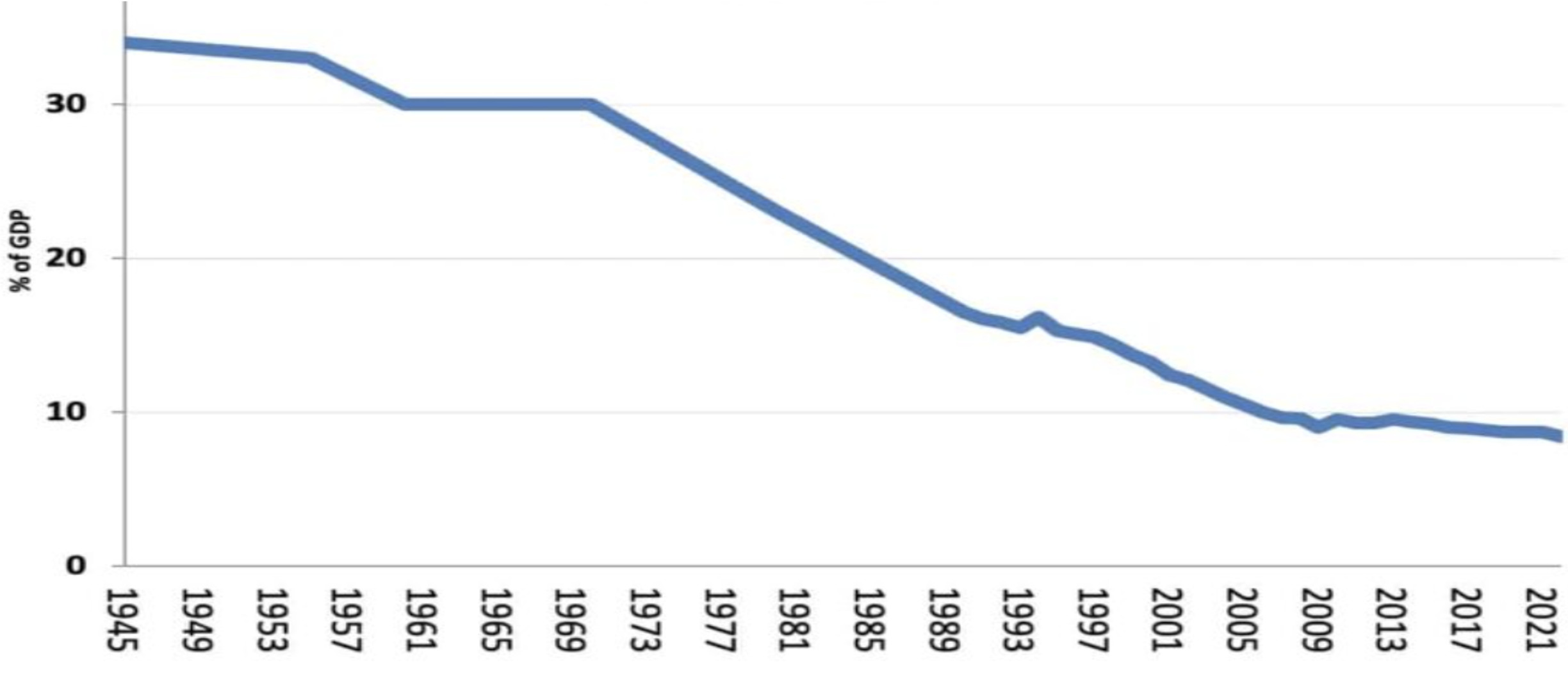
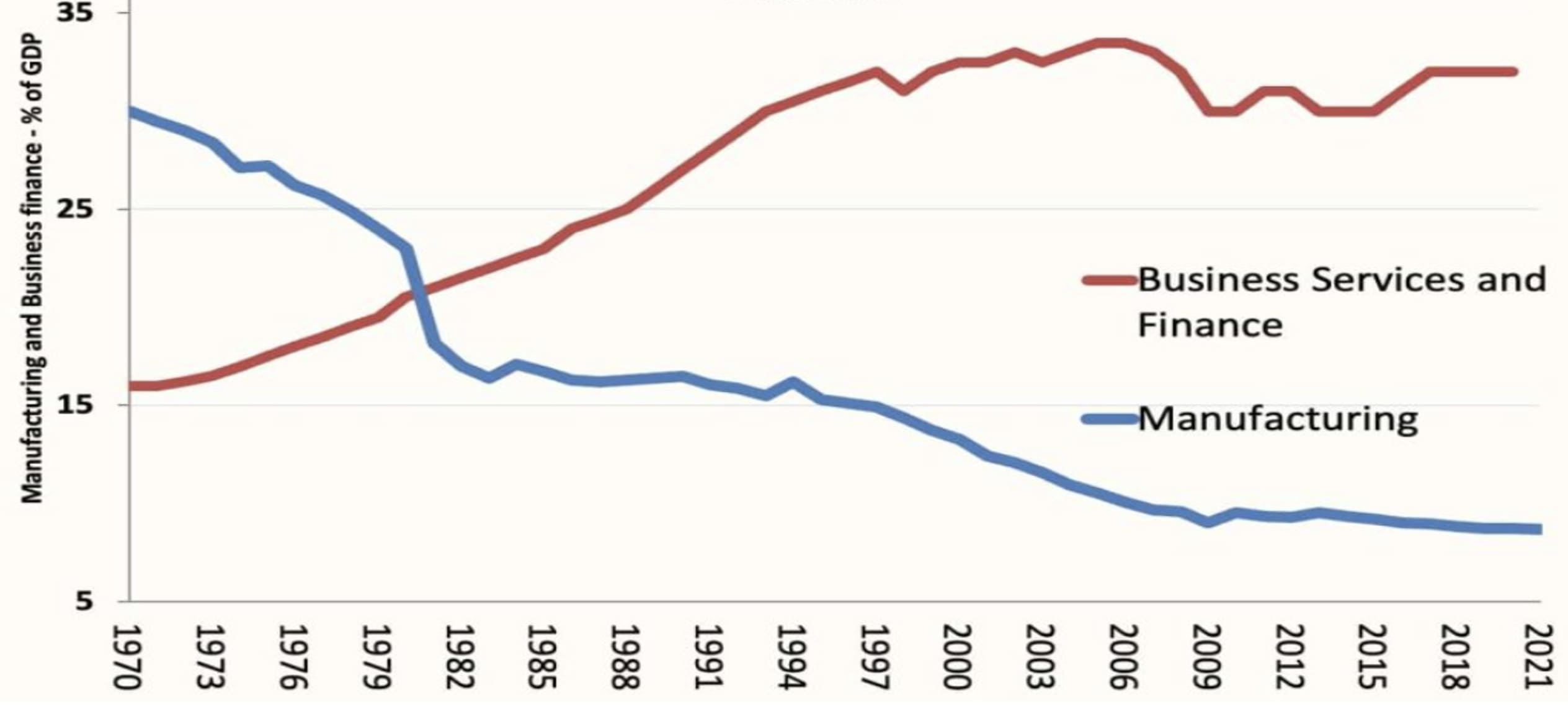
Figure 1 shows a marked decline in the contribution of manufacturing to Britain’s GDP, particularly from the 1980s onwards. Although this downward trend continued, the rate of decline appears to have slowed after 2010. At the same time, the financial sector grew more rapidly relative to other sectors, with increasing levels of investment and income generated within the sector from the 1980s onwards, as shown in Figure 2.
Figure 1: UK’s Decline in Manufacturing as a Share of GDP, 1945-2021.
Source: https://www.economicshelp.org/blog/219307/economics/deindustrialisation-in-the-uk/
Figure 2: Finance Replacing Manufacturing as a Percentage of GDP, 1970-2021.
Source: Office of National Statistics (ONS), https://www.economicshelp.org/blog/219307/economics/deindustrialisation-in-the-uk/
From 1970 to 2022, the UK often experienced the highest rate of inflation in the developed world, so UK exports gradually became less competitive. Meanwhile, productivity was rising faster in countries such as Germany and Japan, whose manufacturers invested more heavily in new technology and production methods. The reasons for this decline in competitiveness are multiple: a lack of investment, a slow rate of technological adoption, high spending on defence, financialisation and globalisation. Together, these forces eroded the UK’s manufacturing base.
In the early 1980s, North Sea oil revenues and tight monetary policy pushed sterling to a high value, making exports expensive and uncompetitive. This imposed severe pressure on manufacturing exporters and accelerated closures across industrial regions. Sterling’s appreciation was dramatic: from 1977 to 1980, the pound rose from 1.65 to 2.45 against the dollar. This episode illustrates how exchange-rate policy, rather than simply “natural” economic decline, actively reshaped the fortunes of British manufacturing.
It is important to stress that these causes did not operate in isolation, nor were they purely economic. They were mediated through political decisions—about monetary policy, exchange rates, defence spending and the deregulation of finance—and through class interests. Deindustrialisation was therefore not simply the inevitable result of technological change or shifting consumer demand, but a contested process of capitalist restructuring whose trajectory was shaped by power, politics and the state.
UK manufacturing employment fell especially steeply in the early 1980s, during a recession triggered by a high exchange rate and high interest rates. Rowthorn and Coutts (2004) discussed these job losses as part of the broader process of deindustrialisation. The early 1990s recession brought further major job losses. The recession triggered by the 2008 financial crisis reduced UK manufacturing employment still further, and during the subsequent recovery manufacturing employment did not return to its pre-crisis level.
For instance, employment in the coal industry fell sharply between 1980 and 1990. When UK coal production peaked in 1913, 1.1 million miners were employed in over 3,000 mines. For much of the rest of the twentieth century, employment in the UK coal industry declined, although 450,000 miners were still working in 1966. Further heavy job losses followed in 1984–85, when the miners’ strike failed to stop pit closures; the final colliery closed in 2015.
The shift from industrial to service sector employment is not unique to the UK. All advanced economies have witnessed structural changes, but at different rates, reflecting differential growth in labour productivity: it is generally easier to replace workers with machines in manufacturing than in most service activities, and this process has been accentuated by globalisation. This occurred as US and EU firms began to move to China, Malaysia, India and other emerging economies in search of low wages and higher returns on their investments.
The UK’s industrial job losses have been concentrated in specific parts of the country. This partly reflects the distribution of manufacturing, which was always more important in some regions than others, and partly the location of industries—such as coal, steel, shipbuilding, heavy engineering, and textiles and clothing—that experienced the biggest reduction in employment.
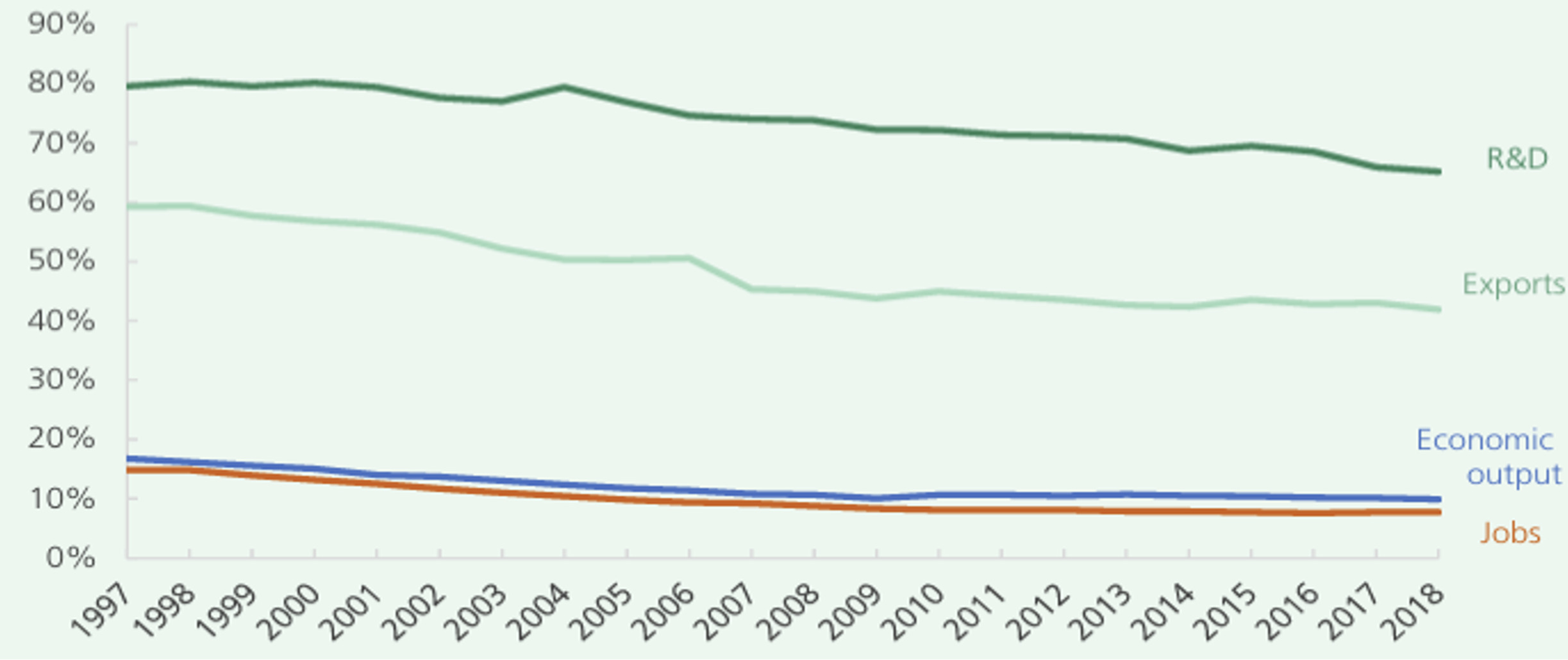
In 2018, manufacturing in the UK accounted for 8% of employment (2.7 million people) and £191 billion in economic output, or 10% of the UK total. It also accounted for 42% of UK exports, worth £275 billion, and 65% (£16 billion) of UK research and development spending (See Figure 3).
Figure 3: Manufacturing as a Percentage of UK total Output, Employment, R&D and Exports, 1997-2018.
Source: https://researchbriefings.files.parliament.uk/documents/SN01942/SN01942.pdf
Manufacturing’s share of UK economic output—measured in terms of Gross Value Added (GVA)—has declined steadily over several decades, falling from 27% in 1970 to 10% in 2018. Over the past four decades, this declining share has been driven primarily by faster growth in other sectors, especially services, rather than by an absolute fall in manufacturing output. In real terms, UK manufacturing output in 2018 was actually 7% higher than in 1990. Over the same period, however, service sector output rose by 106%. By 2018, services accounted for 80% of the economy, up from 69% in 1990.
The relative decline of manufacturing is often attributed to intensifying international competition. UK manufacturers have faced lower-cost producers in other countries—notably China and India—where lower labour costs, proximity to raw materials, economies of scale and active state support can reduce production costs. As global supply chains have expanded, many US and EU firms have relocated production to emerging economies in search of lower wages and higher returns, further reducing the UK’s manufacturing base. This process has not been purely market-driven, however; it has also been shaped by domestic policy choices, including financial deregulation, exchange-rate policy and the prioritisation of the service and financial sectors.
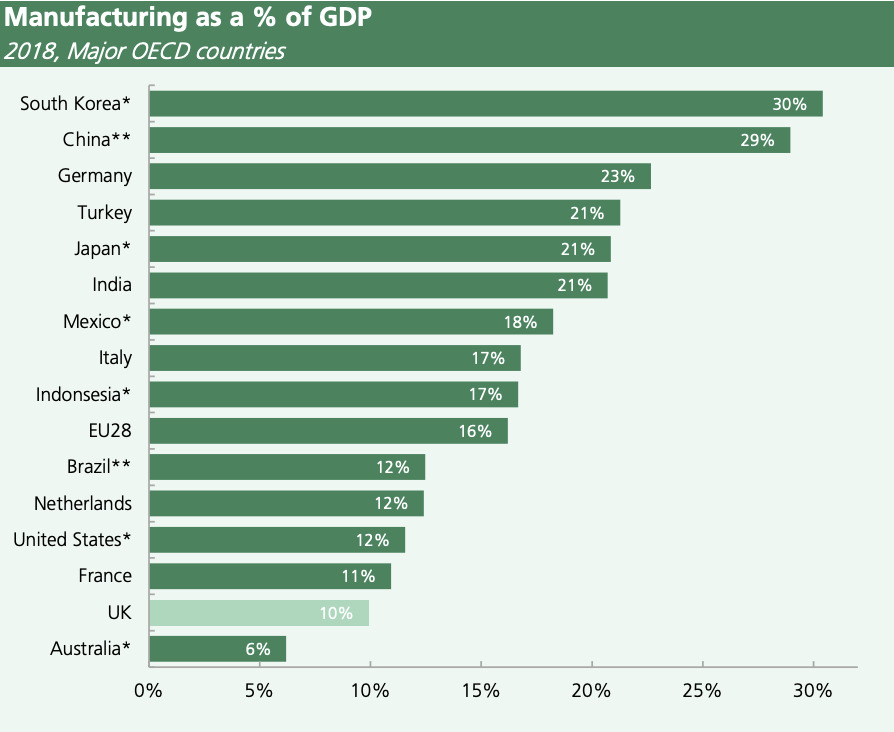
International comparisons highlight the extent of UK deindustrialisation. In 2018, UK manufacturing value added was equivalent to 10% of GDP, a smaller share than in most other major economies (See Figure 4a). Germany’s manufacturing share was 23%—unusually high among major Western economies—while France’s was 11%, the United States’ 12% and Italy’s 17% (Siddiqui, 2024b). China and South Korea had significantly larger manufacturing sectors, equivalent to 30% and 29% of their GDP respectively.
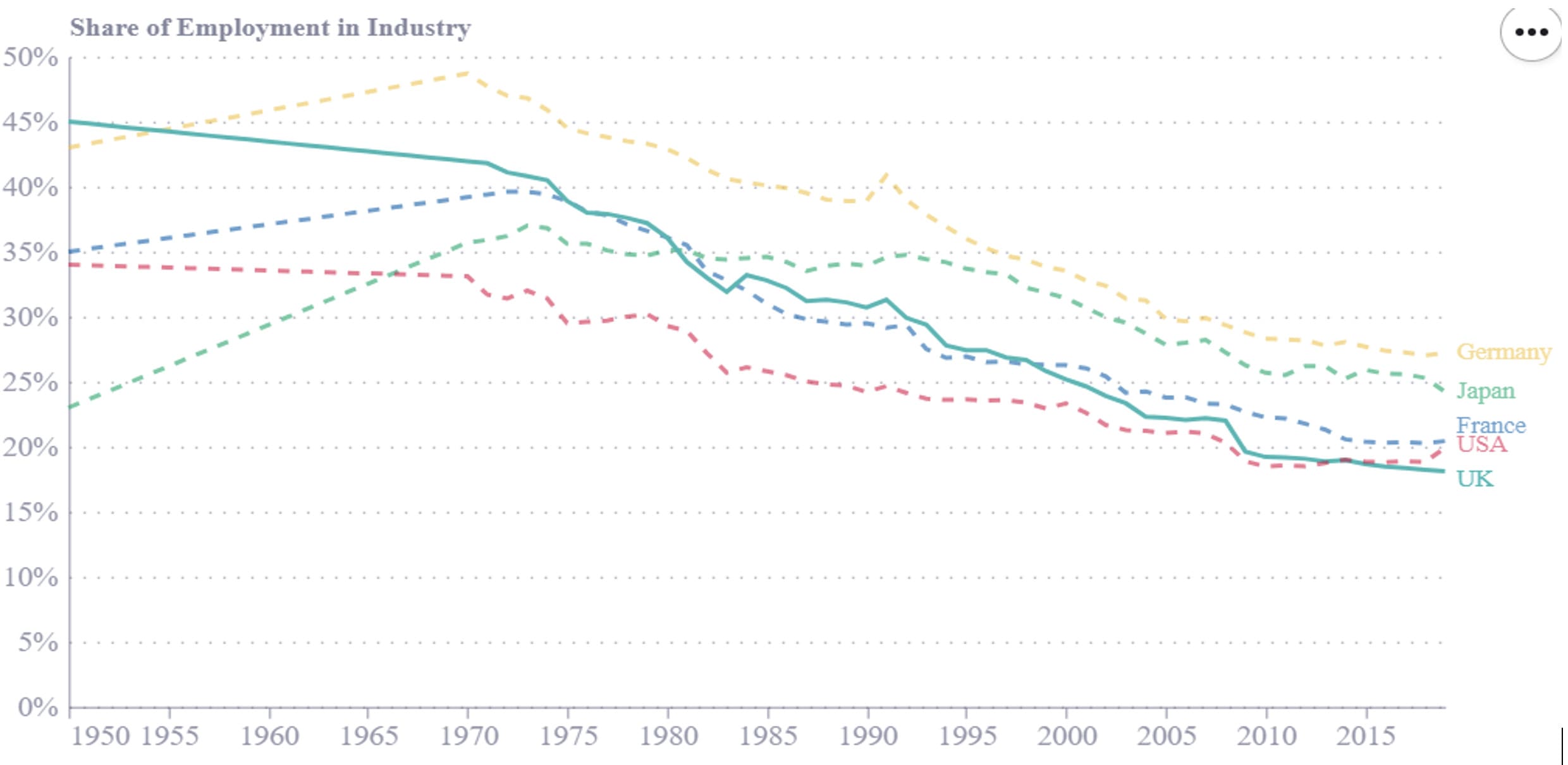
These figures suggest that the UK’s trajectory has been comparatively deep, not merely a universal consequence of advanced-economy development. They also underline that manufacturing remains strategically important despite its smaller share of GDP: it continues to account disproportionately for exports, research and development, and productivity growth. Figure 4b compares the share of employment in industry in the UK with that of other industrial economies. It shows that the decline in manufacturing employment in the UK was more pronounced than in other industrialised countries.
Figure 4a: International Comparison of Manufacturing’s Share of GDP in 2018 (%).
Source: https://researchbriefings.files.parliament.uk/documents/SN01942/SN01942.pdf
Figure 4b: Share of Employment in Industry, UK versus other Advanced Economies, 1950-2020 (%).
Source: https://www.economicsobservatory.com/how-has-deindustrialisation-affected-living-standards-in-the-uk
In 1985, manufacturing accounted for 84% of total R&D investment. By 2018, that share had fallen to 65%, when manufacturing R&D spending totalled £16.3 billion. The combined R&D spending of all service sectors totalled £7.9 billion, or 32% of the total, despite services accounting for 80% of UK economic output. The proportion of R&D spending accounted for by service industries rose correspondingly over the same period, from 11% to 32%.
Historically, the interaction between science and technology has been closer in manufacturing than in the service industries. This has resulted in more R&D investment by manufacturing firms, a greater readiness to adopt new technology, and consequently larger productivity gains. Service industries—particularly IT services, but also financial and management services—have invested more heavily in R&D, reflecting the growing importance of digital technology, software development and knowledge-intensive services to the UK economy. Nevertheless, the fact that services generate 80% of economic output but only 32% of R&D spending suggests that the innovation system has not shifted as rapidly as the structure of the economy itself, with implications for long-term productivity growth.
IV. Business Investment, Brexit and UK Manufacturing
Business investment in UK manufacturing has fallen as a proportion of all investment over the last decade. In 1997, investment in manufacturing was worth £26.1 billion, or 19% of total business investment. By 2009, it had fallen to £16.9 billion, or 13% of the total. It has since risen in absolute terms, reaching £31.0 billion in 2018, but its share remained below its earlier level at 15% of the total. The declining share of investment flowing into manufacturing is significant because manufacturing is typically more capital-intensive than services, and lower investment can translate into weaker productivity growth, slower technological upgrading and reduced international competitiveness over time.
The UK’s decision to leave the EU has already had an impact on the manufacturing industry, and the nature of the new trade deal between the UK and the EU will continue to shape the fortunes of manufacturing firms for years to come. Manufacturing trade associations welcomed the Withdrawal Agreement agreed in October 2019, largely because it provided a degree of certainty after several years of political turbulence.
These concerns are especially acute because UK manufacturing is deeply integrated into EU and global supply chains. Many firms rely on just-in-time production systems, in which components cross borders multiple times before a finished product is assembled. Tariffs, customs checks, regulatory divergence and rules-of-origin requirements all threaten to raise costs, cause delays and disrupt these finely tuned networks. Small and medium-sized manufacturers, which often lack the resources to absorb additional administrative burdens, are particularly vulnerable. Access to skilled labour is a further concern: manufacturing depends heavily on engineers, technicians and specialist workers, and restrictions on immigration may exacerbate existing skills shortages.
The Brexit process thus exemplifies the central argument of this analysis: deindustrialisation is not simply the inevitable outcome of economic maturity or technological change, but a contested process shaped by political decisions, changing patterns of capital accumulation and class interests. The decision to leave the EU, the form of the withdrawal agreement and the nature of the future trading relationship are all political choices that will mediate the trajectory of UK manufacturing. They will shape which firms survive, which regions prosper, and which workers bear the costs of adjustment.
The government’s industrial strategy, published in November 2017, includes a number of policies designed to support manufacturing, including sector deals and Grand Challenges for industry. These measures seek to raise productivity, encourage innovation and strengthen the UK’s industrial base. However, critics argue that the strategy lacks the scale, coherence and long-term commitment needed to reverse decades of relative decline, and that it sits uneasily alongside other policy priorities—such as the pursuit of a hard Brexit—that may work against manufacturing interests. The effectiveness of industrial strategy therefore depends not only on the measures themselves, but on the wider political and economic framework in which they are embedded.
V. The IT Industry and Service Economy
The UK’s IT industry is worth around £58 billion a year, and roughly 100,000 software companies operate in the country, including multinationals such as Microsoft and IBM. The UK also has the largest mobile device market in Europe, with around 80 million mobile subscriptions, worth an estimated £14 billion annually. Cloud-based storage systems are a fast-growing part of the economy, as many UK companies seek to locate data centres closer to home. Cyber security has likewise expanded in response to increased threats, and the UK market is now worth about £2.8 billion a year. Taken together, these developments illustrate the growing weight of digital, knowledge-intensive services within the UK economy.
The service sector accounts for roughly three-quarters of the UK economy—around 80% on some measures—and covers a wide range of activities: healthcare, IT support, entertainment, finance, retail, hospitality, professional services and education. The UK is also a major exporter of services, with tourism and education among the most visible examples, and it is the world’s second-largest exporter of services globally.
This service-led orientation is central to debates about deindustrialisation. It shows that economic restructuring has not simply been a story of decline: new sectors have grown, created employment and generated exports. At the same time, the service sector is highly heterogeneous. Some parts—finance, IT, professional services and higher education—are high-productivity, high-wage and internationally traded. Others—retail, hospitality, care and parts of the gig economy—are low-productivity, low-wage and largely domestic. Aggregate growth in services therefore masks deep inequalities between sectors, regions and workers, and it does not automatically compensate for the loss of manufacturing employment. Many services also depend indirectly on manufacturing demand, while Brexit poses particular risks to services trade because barriers often operate through regulatory divergence, mobility restrictions and the loss of mutual recognition rather than tariffs alone.
Industrial decline has had profound consequences for regional inequality and health in the UK. Britain’s stark geographical disparities are deep-rooted: they became entrenched during the second half of the twentieth century, accelerated in the 1980s, and were compounded by the global financial crisis of 2007–09. The loss of industrial jobs—which were neither replaced by new employment nor offset by improved access to other opportunities—has adversely affected health outcomes. In former industrial communities, joblessness and economic marginalisation have been associated with poorer mental health, higher rates of substance misuse and lower life expectancy.
As Tregenna notes (2014: 1373-1374) “Deindustrialisation is likely to have a range of economic and broader ramifications for the future of capitalism. It could be expected to affect the rates and sustainability of growth, although these effects would to some extent depend on the nature of the deindustrialisation. Deindustrialisation would also alter the structure and character of the working class, with the shift away from factories…. towards more dispersed service workplaces in which atypical work is more common. This shift would also affect the nature of the work process as well as levels of benefits and job security. The structure of the capitalist class would also be affected, with concomitant changes in the interests of the dominant fractions of the capitalist class concerning issues such as monetary policy.”
VI. Why Deindustrialisation Matters
The question of why deindustrialisation matters depend, in the first instance, on whether the relative decline of manufacturing has adverse consequences for employment or for the overall level of economic activity. If it does not, then there may be no problem to address. But there has long been interest in what causes and creates the wealth of nations, and in the role that industry and manufacturing play in that process. Its importance was highlighted by Adam Smith in 1776, and the debates continue, with many key issues remaining unresolved or at least still disputed (for a recent contribution, see Acemoglu and Robinson, 2012). The relative decline of manufacturing, as a share of both output and employment, has been apparent in all advanced economies, particularly since the 1960s (Kitson and Michie, 2014) – but the decline has been more rapid in the UK than in other advanced countries. This has led some to argue that it reflects a process of historical evolution, in which advanced economies are characterised by a large services sector and a small manufacturing sector (see Rostow, 1960; Kuznets, 1966). On this view, deindustrialisation is simply the natural companion of economic maturity.
Yet this interpretation is contested. Technical change also played a critical role in triggering deindustrialisation, but it did not operate in a political vacuum. In the UK and other advanced economies, deindustrialisation was driven not only by technological change but also by a lack of private investment and the absence of a targeted industrial policy. The increasing financialisation of the economy has been associated with rising income inequalities, while the contraction of domestic demand—worsened by the income distribution effects of the 2008 global financial crisis—further weakened the manufacturing base. These developments were not inevitable. They were shaped by political decisions, changing patterns of capital accumulation and class interests, which together determined whether manufacturing was supported, neglected or actively dismantled (Siddiqui, 2021b).
Understanding deindustrialisation is therefore important for at least three reasons. First, it bears directly on questions of employment, productivity and the balance of payments, since manufacturing has historically played a disproportionate role in exports, innovation and productivity growth. Second, it illuminates the relationship between economic restructuring and regional inequality: deindustrialisation has not affected all places equally, and its costs have been concentrated in particular regions and communities. Third, it raises fundamental questions about the state, class and power: whether governments choose to support industry, and on what terms, is a political question, not simply an economic one. Deindustrialisation is thus not merely a description of sectoral change; it is a window onto the wider dynamics of capitalist restructuring.
VII. Industrial Policy and the Ecological Crisis
Industrial policy has also been a key element in the growth of the Japanese economy since the 1950s. Japan adopted a policy of targeting key industries (‘picking winners’) such as electronics and automotive manufacturing, providing finance for long-term investment, and adopting protectionist measures. These policies underpinned Japan’s rapid growth, particularly from 1950 to 1973. The strong economic growth in Japan ended abruptly in the early 1990s, but this reflected a financial crisis following an asset price bubble rather than fundamental flaws in Japanese industrial policy (Siddiqui, 2009).
An active industrial policy has also been a feature of the German economy, particularly since the end of the Second World War. The German model has focused on support for long-term finance, investment in education and training, and a regulated labour market. Furthermore, since the 1970s there has been an increasing focus on public support for innovation, achieved through the creation of networks and institutions that facilitate the commercialisation and exchange of knowledge—such as intermediate technology organisations like the Fraunhofer Institutes.
Britain, by contrast, has been distinctive in its systematic failure to pursue any sort of long-term industrial policy. The lessons of other advanced countries show that industrial policy can promote both the manufacturing sector and overall economic growth. The details of successful industrial policies vary between countries depending on the stage of economic development and the characteristics of each national economy. But common features include finance for long-term investment, a focus on training and education, and support for technology, R&D and innovation (Siddiqui, 2023).
The comparison is instructive. Japan and Germany both maintained sustained commitments to industrial development, albeit through different institutional arrangements: Japan through targeted promotion and protection (Siddiqui, 2009), Germany through long-term finance, vocational training and innovation networks. Britain, by contrast, oscillated between intervention and laissez-faire, with no enduring institutional framework to support manufacturing. This contrast reinforces the central argument of this analysis: deindustrialisation was not an inevitable consequence of economic maturity, but the product of political choices, changing patterns of capital accumulation and class interests. Where the state actively supported industry—as in Japan and Germany—manufacturing retained a stronger position. Where it did not, as in the UK, industrial decline was far more pronounced.
In May 1979, Margaret Thatcher won the general election and Geoffrey Howe became Chancellor of the Exchequer. In October 1979, exchange controls were abolished. For the first time in decades, capital could leave Britain freely. The monetarist programme was straightforward in its aims: control the money supply, cut the public sector borrowing requirement, and let market forces decide which industries survived. Inflation was the stated enemy number one.
On 27 October 1986 came the “Big Bang”: the deregulation of the City of London’s financial markets. Fixed commissions were abolished. Foreign banks were admitted. Electronic trading was introduced. The exchange controls scrapped in 1979 had made this expansion possible; the Big Bang made it deliberate policy. By then, manufacturing’s share of the economy had already fallen from around 30% in 1970 to roughly 20% by mid-1980s. British Telecom was privatised in 1984, British Gas in 1986. British Leyland was broken up and sold. Rover Group passed to British Aerospace in 1988, and then to BMW in 1994. The Longbridge plant that had built the Austin A40 was still standing, still building cars, and no longer British—no longer answerable to any consideration of British industrial strategy.
After 1997, Blair’s Labour government did not continue the strategy in any meaningful form, and manufacturing’s share of the economy went on falling regardless. What most people do not realise—and I certainly did not before I began this research—is that of all advanced economies tracked between 1960 and 2015, the UK saw a steeper drop in manufacturing employment than any country except Switzerland. Germany, France and Sweden all held on to substantially more of their industrial base. The British experience was not the inevitable direction of travel.
Manufacturing employed around 6 million people in 1979. By 2024, that figure had fallen to 2.6 million. As a share of the economy, manufacturing declined from around 30% in 1970 to 17% by 1990 and to less than 9% by the early 2020s. Germany’s manufacturing sector accounted for around 19% of its economy in 2024, more than twice Britain’s share. Germany achieved this through deliberate policy choices that remained broadly consistent across governments of different political parties.
British economy away from the industries that had made the country an industrial power in the first place. The consequences of those choices are still being felt today—not only in Britain, but around the world. The first major shocks came with the two world wars. Both conflicts drained Britain of wealth, manpower, and imperial resources. Britain entered the First World War as the world’s largest creditor nation and emerged from the Second World War as one of its largest debtors.
Britain also continued to spend enormous sums on defence during the post-war period, committing a far larger share of its economy to defence than some of its major economic competitors, particularly Germany and Japan. This left Germany and Japan with greater scope to channel capital into rebuilding and modernising their industrial bases.
The miners’ strike of 1984–85 was the most dramatic confrontation. When it began, the nationalised coal industry employed around 171,000 miners. By the time the industry was privatised in 1994, only 16 pits remained. Ten years after the strike ended, nearly 90% of the workforce had gone. In 1980, the National Coal Board operated 219 coal mines and employed a quarter of a million miners. Today, not a single deep coal mine remains in operation in Britain. The British steel industry, once one of Europe’s largest steel producers, shed tens of thousands of workers throughout the 1980s.
In October 1986, the London Stock Exchange was deregulated. The old rules that had governed the City of London for centuries were swept away. Foreign banks were allowed to compete. Computerised trading replaced face-to-face transactions. And the volume of money flowing through the City of London exploded. It changed the entire character of the British economy. London became one of the world’s three principal financial centres, alongside New York and Tokyo.
Britain officially chose finance over industry and short-term returns over long-term investment. In 1990, manufacturing still accounted for about 16.6% of Britain’s GDP. By 2000, it had fallen to 14.8%. By 2010, it was down to about 9.5%. And by 2024, it stood at just under 8%. Meanwhile, services, dominated by financial services, now account for over 72% of the economy. Britain did not just stop making things; it actively replaced making things with moving money. And then came globalisation.
Through the 1990s and 2000s, the acceleration of global trade opened up a flood of manufactured goods from countries with far lower labour costs. China’s entry into the World Trade Organization in 2001 was a watershed moment. British manufacturers were not just competing against Germany or Japan; they were competing against a country with over a billion workers and low wages. Products that once would have been made in Birmingham or Glasgow were now being made in Shenzhen or Guangzhou for a fraction of the price.
British consumers benefited from cheaper goods, but British workers paid the price. Many of those devastated communities—communities that had voted Labour for generations—swung to Brexit in 2016 and then to the Conservatives in 2019, driven by a feeling that the ruling elites had abandoned them.
Industrial policy must now take into account the ecological, environmental and climate crisis. Public policy should promote a structural transformation of the manufacturing sector towards sustainable production—for example, through investment in renewable energy, green technologies, energy efficiency and circular production methods. Industrial policy must also improve social infrastructure: the healthcare sector and public transport need greater public funding, and the availability of social services in general must be improved. These objectives are interconnected. A just transition requires not only decarbonising industry but also ensuring that the workers and communities affected by industrial change are supported through retraining, investment and expanded public services. In this sense, industrial policy is not simply about reviving manufacturing; it is about reshaping the relationship between the economy, the state and society in ways that are socially just and ecologically sustainable. (Siddiqui, 2021b).
VIII. Conclusion
Despite decline of manufacturing sector, yet it still remains important to the UK economy. It contributes around £220 billion in output, employs 2.6 million people, and accounts for 42% of exports and 48% of business R&D. Aerospace alone supports over 100,000 jobs and generates £34 billion in annual turnover. Automotive employs more than 180,000 people in manufacturing and nearly 800,000 across the wider industry, while pharmaceuticals, advanced materials and defence technology remain significant. Britain is still the world’s twelfth-largest manufacturing nation, though it trails countries such as China, India, Japan, South Korea, Mexico, France, Italy, and Germany. Yet manufacturing now accounts for less than a tenth of economic output – a striking reversal for the sector that once made Britain the world’s leading industrial power.
The study concludes that this deindustrialisation was politically mediated, not natural or inevitable. Policy choices from the 1980s onward—the defeat of the miners’ strike, City deregulation, and the neoliberal privileging of finance over manufacturing—restructured the economy around services and global trade. The costs fell unevenly. Industrial regions suffered job losses, declining incomes and community breakdown, while London and finance flourished. That spatial inequality reshaped politics, contributing to Brexit and the 2019 Conservative swing in former Labour heartlands.
Yet manufacturing’s persistence shows that its decline was not inevitable. Deindustrialisation in the UK was therefore a political outcome—and reversing it would be a political choice, too. Raising defence spending in the name of industrialisation—while cutting public spending on welfare, health and education and ignoring rising inequality—will deepen the socio-economic crisis and undermine democracy.
Deindustrialisation was therefore a distributional project with lasting consequences for class, region, and democracy. Whether it can be reversed depends on political will. Reversal would require state intervention: the UK’s industrial policy must favour industry; the government must direct the financial sector to provide cheap credit to manufacturing – as Japan did in the 1960s and 1970s to support its industrial sector and compete globally – and the state must take the lead in raising funds for R&D investment in new technology to drive industrial renewal and long-term competitiveness.
About the Author
 Dr. Kalim Siddiqui is an economist specializing in International Political Economy, Development Economics, Trade and Economic Policy. Since 1989, he has been teaching economics at various universities in Norway and the UK. Dr. Siddiqui’s research interests encompass a wide range of topics, including political economy, international trade, and economic history, South Asia, and emerging economies. He has presented papers at international conferences across numerous countries, reflecting his global engagement in the field. His scholarly pursuits span six broad domains: Political Economy, Development Economics, Economic History, Economic Policy, Globalization, and International Trade. Dr. Siddiqui has made significant contributions to research in areas such as trade policy, globalization, and political economy. His work has been published in chapters of edited books and articles published in peer-reviewed journals. For inquiries, Dr. Siddiqui can be reached at: [email protected]
References
- Kaldor, N. (1978) Further Essays on Economic Theory, London, Duckworth.
- Kitson, M. and Michie, J. (2014) “The Industrial Revolution: The Rise and Fall of the UK Manufacturing, 1870-2010” Centre for Business Research, University of Cambridge, Working Paper No. 459, University of Cambridge.
- Rowthorn, R. and Coutts, K. (2004) Commentary: Deindustrialisation and the balance of payments in advanced economies, Cambridge Journal of Economics, 28(5): 767–90.
- Saeger, S. (1997) “Globalization and Deindustrialization: myth and reality in the OECD” Review of World Economics 133(4): 579–608.
- Siddiqui, K. (2026a) “The British Growth Model: Political Economy, Governance, and Stagnation” World Financial Review, August.
- Siddiqui, K. (2026b) “Monopoly Capitalism and the Concentration of Capital in Production and Digital Technology” World Financial Review, January.
- Siddiqui, K. (2025) “Neoliberalism and the Performance of the UK’s Economy: A Critical Review” World Review of Political Economy, 16(2): 224-252, Summer.
- Siddiqui, K. (2024a) “The Economic Crisis and Challenges for the UK Economy” World Financial Review, July.
- Siddiqui, K. (2024b) “The Decline of the West and Global Political Economy” World Financial Review, December.
- Siddiqui, K. (2023) “Marxian Analysis of Capitalism and Crises” International Critical Thought 13(4): 525-545.
- Siddiqui, K. (2021a). “Can the 21st Century be an Asian Century?” Asian Profile, 49(1):1-19, March.
- Siddiqui, K. (2021b). “The Political Economy of Industrial Policy” World Financial Review, May/June.
- Siddiqui, K. (2017). “Austerity as a Tool of Fiscal Consolidation: Theoretical and Empirical Perspective” (Edi) S. Owsiak, Public Finance, and the New Economic Governance in the European Union, 116 – 166, Warsaw: Wydawnictwo Naukowe.
- Siddiqui, K. (2009). “Japan’s Economic Crisis” Research in Applied Economics 1(1):1-25.
- Singh, A. (1977) “UK industry and the world economy: a case of de-industrialisation?” Cambridge Journal of Economics 1(2): 113–136.
- Tregenna, F. (2014) “A new theoretical analysis of deindustrialisation” Cambridge Journal of Economics 38(5): 1373–1390.