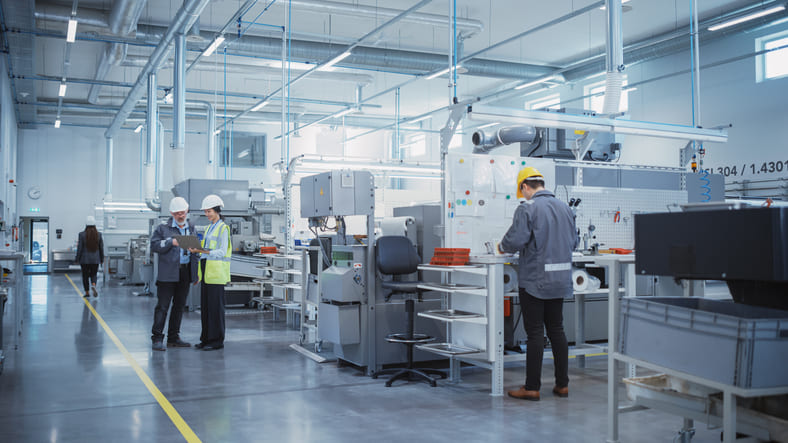
De-risking is diversifying today’s production. The bigger question is where tomorrow’s productive capabilities are accumulating—and where leaders should cultivate their own.
For decades, globalization encouraged companies to move production across borders in search of lower costs and greater efficiency. Today, de-risking is redirecting production away from China toward economies such as Vietnam, Mexico and India.
But the deeper transformation may not be where production moves today. It is what capabilities those movements help create tomorrow.
Production relocation can bring skills, supplier relationships, tacit knowledge and opportunities for technological learning. The strategic challenge for business leaders is therefore not simply deciding where to produce. It is anticipating where new productive capabilities may accumulate—and deciding which capabilities they must continue to cultivate themselves.
Is De-Risking Really Reducing Dependence on China?
On the surface, the answer appears straightforward. U.S. goods imports from China fell by roughly 30 percent in 2025, while economies including Vietnam, Mexico and Taiwan continued to gain importance in U.S. sourcing. The bilateral numbers look like decoupling.
Look beneath those numbers, however, and a more complicated transformation appears. Some of this shift reflects Chinese firms moving production into third countries, and it cannot be understood simply as trade being rerouted to circumvent U.S. restrictions. Production itself is moving, bringing investment, skills, supplier relationships and opportunities for technological learning into economies such as Vietnam, Mexico and India.
Yet this does not necessarily make these new production hubs economically independent of China. Their factories may still rely on Chinese components, materials, machinery and supplier networks. The result is paradoxical: productive capabilities can accumulate outside China even as important upstream dependencies on China persist.
Diversification of production is not necessarily diversification of strategic dependence.
This is why the emerging global economy is better understood as being rewired rather than simply deglobalized. Diversification is real. Capability accumulation is real. Interdependence is also real.
What Moves With Production?
What happens to an economy when production arrives?
The answer depends on the type of production, local institutions and investment. Assembly alone does not create technological leadership. But manufacturing participation can create opportunities for workers to acquire skills, suppliers to develop, infrastructure to expand and firms to enter increasingly sophisticated value chains.
China provides the most consequential example. Its technological rise cannot be explained by offshoring alone: industrial policy, infrastructure, research and development, human capital, technology acquisition and the scale of its domestic market all mattered. Yet China also demonstrates that a country need not remain merely a low-cost location for products developed elsewhere. Over time, manufacturing participation can coexist with the accumulation of deeper capabilities, supplier ecosystems and technological knowledge.
Those same factors offer leaders a practical lens for judging where tomorrow’s capabilities may accumulate. Production relocation matters most when it is accompanied by investment in human capital, research, infrastructure, supplier development and institutions that allow firms to learn and move into more sophisticated activities. The question is not simply where factories are moving, but whether the surrounding ecosystem is becoming capable of learning.
The lesson is not that every country receiving offshore production will follow China’s trajectory. It is that today’s production geography can help shape tomorrow’s capability geography.
Why Is Today’s Supply-Chain Map Not Enough?
This changes how leaders should think about diversification. Conventional supply-chain strategy asks where production should be located, how many suppliers are needed and which geopolitical exposures should be reduced. Those questions remain essential, but they describe today’s production system.
A longer-term strategy must also ask what today’s decisions are doing to tomorrow’s capability landscape. When a company moves production, what knowledge travels with it? What supplier ecosystems may develop around it? What tacit knowledge might the company lose? Which learning loops remain essential to creating its next generation of technology?
The strategic problem is therefore not simply protecting today’s core competencies. It is identifying which capabilities generate future capabilities.
For example, a particular semiconductor fabrication process may become obsolete, while the materials science, process-engineering knowledge, experimental capacity and feedback loops connecting design with manufacturing can help create whatever comes next. These are generative capabilities: capabilities that preserve the ability to learn, adapt and build the next capability.
What If Tomorrow’s Frontier Is Not Today’s?
Consider two deliberately hypothetical possibilities. What if the semiconductor architecture that matters most twenty years from now relies substantially on carbon-based materials rather than today’s silicon-centered technologies? What if the dominant form of artificial intelligence no longer depends on the large language model architectures attracting today’s enormous investment?
Neither possibility is a prediction. That is precisely the point.
A company—or a country—could successfully secure today’s semiconductor fabrication capacity, today’s AI infrastructure or today’s critical supply chains and still be poorly positioned for the next technological frontier. The deeper question is where the scientists, engineering knowledge, experimental facilities, supplier relationships and learning ecosystems from which future capabilities could emerge are being cultivated now.
Strategic advantage may therefore depend less on possessing every capability that is critical today than on preserving the ability to create, absorb and participate in capabilities that do not yet exist.
Where Will Tomorrow’s Productive Capabilities Accumulate?
Today’s apparent dependence can also be misleading when viewed over a longer time horizon. A new manufacturing center may initially depend heavily on imported machinery, materials and know-how. But if participation in global production enables local firms, workers and institutions to learn, the structure of that dependence can change.
For leaders, this creates two connected strategic tasks: looking outward to understand where new capabilities are emerging, and looking inward to decide what their own organizations must remain capable of learning and creating.
| Looking outward | Looking inward |
| Where are new capabilities accumulating? | Which capabilities must we cultivate ourselves? |
| Which production hubs are upgrading? | What must we remain capable of learning? |
| Where are new technological ecosystems emerging? | Which learning loops and tacit knowledge must we protect? |
| What plausible frontiers could displace today’s technologies? | How do we preserve the option to participate in them? |
Why Does Prospection Become a Strategic Capability?
This is where prospection becomes useful. Martin Seligman and his colleagues use the term for the human capacity to imagine possible futures and orient present action toward them. Gabriella Rosen Kellerman and Seligman later brought the concept into the changing world of work in Tomorrowmind.
Prospection is not another forecasting technique. It is the capacity to imagine multiple possible futures and use them to inform choices in the present. Its value lies not in predicting whether carbon-based semiconductors, a post-LLM AI architecture or some technology not yet visible will win, but in avoiding decisions that unnecessarily close off the ability to participate in whatever frontier emerges.
Prospection therefore connects two time horizons: where tomorrow’s capabilities may be emerging, and what we must cultivate today to remain capable of creating tomorrow.
The Real Question Beyond De-Risking
De-risking is changing where today’s products are manufactured. Its longer-term significance, however, may lie in how those shifts alter the distribution of productive capability.
As production moves, learning can move with it. New manufacturing centers can become new learning centers. New supplier ecosystems can become new sources of innovation. Today’s dependencies may persist, but they need not remain tomorrow’s dependencies.
For business leaders, the strategic question is therefore no longer simply:
Where should we locate today’s production?
It is:
Where are tomorrow’s productive capabilities emerging—and what must we cultivate today so that we can create, absorb or participate in capabilities that do not yet exist?
The winners of the next era may not be those who optimize today’s production most efficiently, but those who preserve the capacity to recognize, learn from and help create tomorrow’s technological frontier.
About the Author
 Akihiko Morita, PhD, is an executive coach and founder of the Global Leadership Education Center. His work explores leadership, human development, geopolitics and human-AI relationships. He has delivered more than 3,000 coaching sessions across cultures and contributes to international discussions on leadership and AI.