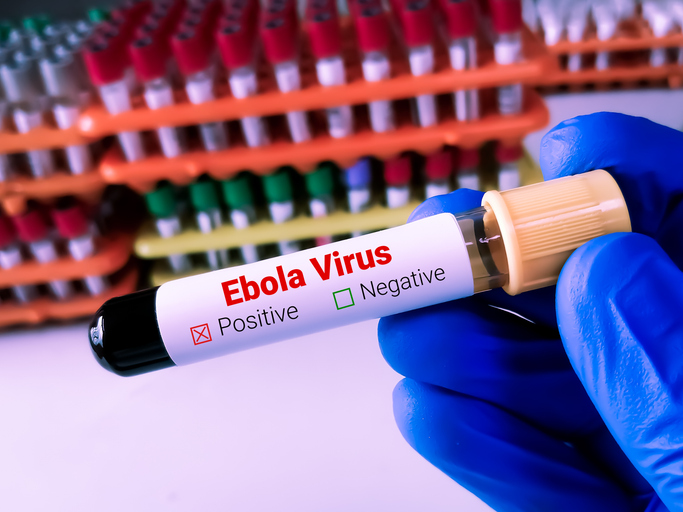
After three months, the Ebola crisis in Central Africa has crossed a critical regional threshold. Concurrently, it reflects the emerging US/China division—and possible complementarity—of global health power.
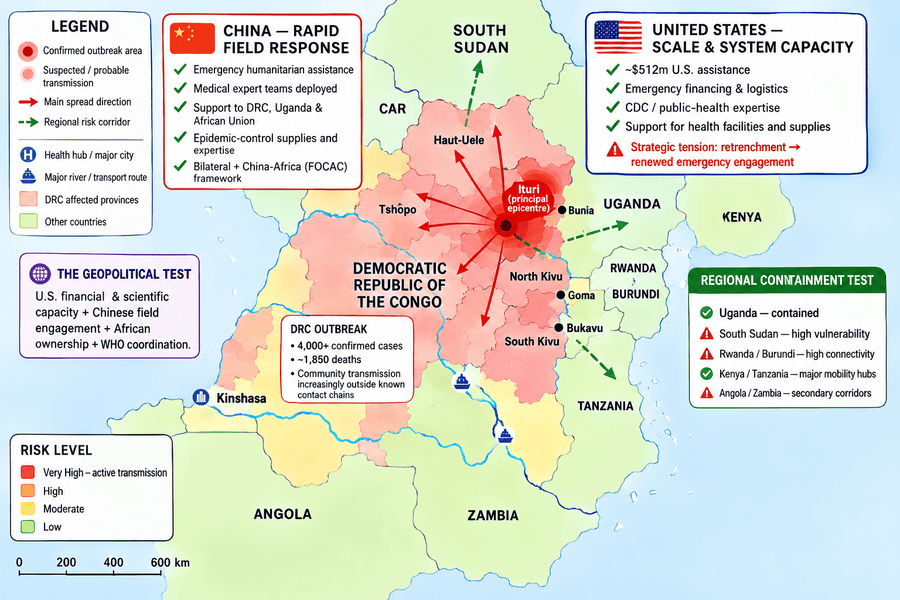
In late May, the principal question was whether the newly declared outbreak in eastern Democratic Republic of the Congo (DRC), with spillover into Uganda, could still be contained. Today, the DRC epidemic has become the second-largest Ebola outbreak on record and the fastest-spreading yet recorded, with more than 4,000 confirmed cases and nearly 1,900 deaths. Transmission has expanded across five DRC provinces.
This is no longer a test of DRC’s public-health system. It is a test of Africa’s ability to manage a major epidemic amid conflict and displacement—and of whether the United States and China can cooperate, compete or simply coexist in providing the global public goods required to contain it.
Uganda offers an important counterexample. After receiving an imported infection from DRC, it stopped transmission and declared the outbreak over in July. Ebola can still be contained when surveillance, political authority and health capacity function together. Unfortunately, the reverse is true as well.
What has changed since May?
Then, the objective was still to contain the outbreak before it escapes. In August, it is to manage an epidemic that has already escaped its original containment zone.
In May, there were 125 confirmed cases in DRC and nine in Uganda. The outbreak was concentrated primarily in Ituri, with concern about its movement into North and South Kivu and across the Ugandan border. WHO had already declared a Public Health Emergency of International Concern.
Today, reported infections exceed 4,000. Ituri remains the epicenter, but Haut-Uele and Tshopo have joined North and South Kivu as affected provinces. Community transmission is driving a large share of new cases, while contact tracing is increasingly unable to reconstruct transmission chains.
The crucial transition is not just quantitative. It is operational. The epidemic has moved faster than the machinery designed to stop it.
American health power
The crisis exposes two very different—but increasingly overlapping—forms of international health power.
The American model has historically rested on scale: financing, epidemiological surveillance, laboratories, scientific research, emergency logistics, NGOs and institutional support for WHO and partner governments.
After much initial hesitation and reluctance, the U.S. response to Ebola has become substantial. Washington’s additional $242 million commitment announced in August brings total U.S. assistance to approximately $512 million, making America the largest contributor to the current response.
But the credibility of that role has been weakened by the disruption and retrenchment of U.S. international health programs.
The contradiction is striking: Washington is now spending heavily to fight an epidemic after the response has deteriorated, while earlier cuts weakened some of the preventative infrastructure designed to stop such crises earlier.
That is the economics of epidemic neglect: prevention is cheap, whereas emergency response is expensive.
Chinese model
China’s model is different. Beijing has emphasized rapid bilateral assistance, emergency supplies, medical expert teams and cooperation with African institutions.
In June, China announced emergency assistance to DRC and the African Union and dispatched medical experts. A second Chinese team followed in July, while another team was sent to Uganda.
China has explicitly linked the response to its broader China-Africa health partnership and the Forum on China-Africa Cooperation.
China’s approach is less dependent on the large donor architecture habitually associated with Western development assistance. It is state-to-state, operational and visibly bilateral, while simultaneously reflecting South-South cooperation.
Aid as strategic infrastructure
The U.S. financial contribution, technical capacity and long-established public-health infrastructure remain indispensable. China’s growing operational presence does not replace that capacity. But it can augment it. That’s the real issue – whether the two systems can complement one another.
What the world need is not geopolitical friction but the combination of unique strengths: that is, American capital and scientific infrastructure, Chinese field capacity and bilateral networks, African institutional ownership, and the WHO coordination.
Yet, the danger remains the reverse. That global health becomes another arena of strategic rivalry in which Washington is both withdrawing yet competing for influence, while Beijing’s activities are being targeted, even as fragmented institutions struggle to contain disease.
For African governments, the practical question is simple: Who arrives, who brings supplies, who trains personnel, who strengthens laboratories, who helps keep hospitals functioning—and who stays after the cameras leave?
China has been particularly effective as a reliable long-term partner. Beijing’s official response explicitly emphasizes solidarity with Africa and a “community with a shared future.”
The United States brings enormous financial resources, scientific networks and accumulated epidemic-response experience. But the Trump administration has little interest in long-term aid structures, which the Democratic administrations have been reducing as well.
Three scenarios
In a recent scare, a riverboat heading toward Kinshasa was feared to include a suspected case. Though not confirmed, the episode demonstrated how rapidly an eastern DRC epidemic could become a national and potentially international concern.
In the foreseeable future, three scenarios matter.
- Contained but costly (most likely scenario). International, Chinese, American, African and WHO resources eventually bring transmission under control. DRC suffers thousands of additional infections and major humanitarian damage, but neighboring states largely prevent sustained secondary transmission. Unfortunately, this is increasingly a management scenario rather than a victory scenario.
- Protracted Central African epidemic (increasingly plausible). Transmission continues for many months, repeatedly appearing in new communities and health zones. Uganda remains contained, but DRC becomes trapped in recurrent outbreaks. The long-term consequences would include weakened health infrastructure, disrupted vaccination and maternal care, deeper displacement and substantial economic losses.
- Regionalization (the dangerous tail). Repeated exportations establish sustained transmission in another neighboring country or several countries. The Great Lakes and Central African transport networks become part of the epidemic rather than merely potential escape routes.
Currently, a COVID-style global pandemic remains unlikely: Ebola is not an airborne respiratory virus and there is no evidence of such a transformation. The more realistic nightmare is a multi-country African epidemic requiring recurrent international intervention.
The real geopolitical lesson
The Ebola crisis is becoming a test of something larger than epidemic control. The post-Cold War health order was heavily dependent on American resources, Western institutions and multilateral organizations.
China is now providing an alternative source of capital, personnel and state-to-state engagement.
But setting aside the Cold War ideologues, the question is not whether China will replace America. It is whether the two can still cooperate when cooperation is most valuable.
The epidemic has already demonstrated the cost of delay. It is also demonstrating the limits of geopolitical fragmentation.
For Washington, the lesson is that retreat from global health does not eliminate global health risks. If anything, it is likely to make the eventual management of those risks more expensive.
For Beijing, the lesson is that visibility and bilateral assistance create influence, which is ultimately judged by sustained outcomes.
For Africa, the lesson is more fundamental: health security is national security. You can’t build prosperity without peace, stability – and healthy human capital.
For the international system, the inconvenient truth remains the same as in May, but now on a vastly larger scale: Epidemics are cheapest to stop at the periphery. Once they become entrenched in fragile states and connected to regional mobility networks, containment becomes exponentially harder and geopolitics becomes part of the disease itself.
This is not a theoretical issue. Nor is it any longer a matter of principle. It is a matter of time – and that time is running out.
Written on August 11, the commentary was first released by China-US Focus (US/Hong Kong), Aug. 19, 2026
About the Author
 Dr. Dan Steinbock is an internationally recognized strategist of the multipolar world and the founder of Difference Group. He has served at the India, China and America Institute (USA), Shanghai Institutes for International Studies (China) and the EU Center (Singapore). For more, see https://www.differencegroup.net