Home Blog Page 857

Smart contracts: the future of digital transactions?

Smart contracts

Smart contracts work via a decentralized application that allows digital business exchanges under the protection of regulations set by each party. These contracts ensure the protection of each parties privacy by enforcing only specific private data to be released upon request. 

These are not run by a specific user rather run as they are programmed to the parties specifications. The executory functions are set and defined by the parties in the smart contract, much like any normal contract. The rules are all pre-defined and are enforced according to the terms. Parties can do transactions over the balance they record in their smart contracts. 

Linking smart contracts and blockchains

Smart contract development begins via a computer code that runs on a blockchain network or any other distributed ledger technology. The payment mechanisms that evolve through smart contracts are increasingly used by Bitcoin and other cryptocurrencies.  

Blockchains are deemed the most suitable technology to store smart contracts, mostly because of the security and transparency that comes from blockchains. Once the information in a smart contract is stored on a blockchain via the ‘blocks’ it also gets encrypted into a ledger shared between parties. 

Blockchain is considered to be a flexible technology for smart contracts because one can virtually store and transact any type of data by giving a lot of options to do transactions. These are more cost effective for both parties that save significant time and don’t have to worry about the safety of their transactions either. 

The most well known smart contracts are made via Ethereum, a popular cryptocurrency platform. Ethereum software has single handedly created the solidity language that writes smart contracts on the Ethereum Virtual Machine. The ethereum blockchain stores the data and the collection of codes that help run a smart contract. 

An expansion of smart contract development over Ethereum has been via Hyperledger smart contract. The Hyperledger Fabric has added Solidity and Vyper as other languages to code smart contracts in. Furthermore there has even been an increase in the runtime of smart contracts for parties. The additional programming via the hyperledger allows for development of more decentralized applications. This is enabling developers to create more and more permissioned platforms for cryptocurrency trading. 

Seeing as Bitcoin is the first cryptocurrency, it has not fallen behind in developing its smart contracts for users. Bitcoin smart contracts can be used on the core protocol layer and the Lighting Network. This is their version of the most instantaneous payment platform for Bitcoin users. These in effect are more time and cost-friendly that increases user interface in the long run.

Benefitting from smart contracts

As with almost all aspects of the cryptocurrency business, there are many plus points to having a smart contract. Smart contracts come with the assurance that you don’t need to monitor the workings or progress of any ongoing business activity. Automating your business comes with cost and time effectiveness that can save your resources for the future.

The time you would otherwise spend managing a number of different transactions all at once is saved, as well as the independence that comes with smart contracts. You do not need third party involvement making decisions for you rather all transactions are held automatically. 

The greatest advantage of the blockchain is perhaps the protection from fraud. Complete anonymity is your biggest reliability. All your record is kept safe and once one transaction is done it cannot be reversed. This protects transactions as well as the lack of human involvement leaves little room for error. 

Drawbacks of smart contracts

Even though most cryptocurrency platforms pride themselves on their guarantee to protect your data and identity, the increasing cybercrimes are a genuine fear. The involvement of multiple parties at once leaves room for any kind of criminal activity. This is largely because if your identity can be kept safe, anyone elses can be as well. 

Hackers keep coming up with new attacks to compromise the integrity of such business transactions. Even smart contracts can fall prey to any hacker with sound knowledge of the language the parties encrypted the contract in. 

These same hackers have been coming up with trigger attacks in the market that draw the parties to executing their contract before need be. This loophole in smart contracts has been problematic since the inaccurate turn of events has caused users a lot. 

The non-reversal of contracts can be a good thing to protect the integrity of the deal, stopping either party from backing out. However there can be instances where the parties interests are not completely aligned and they do not realize that till it is too late. In such instances the manageability of such contracts comes under question.

The ever-increasing use in cryptocurrency has given rise to different avenues of dealing in this digital currency. Different technologies are coming up with ways to regulate, protect and enhance the abilities of cryptocurrency, smart contracts being one of them. 

The importance of data and technology within the CFO function

data and technology

By Tarek Meliti

Traditionally, the Chief Financial Officer (CFO) has always been tightly confined. Typically a qualified accountant, the CFO’s primary duties were to oversee an organisation’s finance function, maintain records, produce management information, generate reports, oversee the treasury operation, and ensure statutory compliance – these functions defined the limits of the function. 

While these tasks are still central to the role, today’s CFOs are assuming new responsibilities. Issues such as technology transformation, talent oversight and outsourcing arrangements, which allow their organisation to be highly efficient and scalable, have diversified the position.

The modern CFO must be comfortable with data interpretation as the Chief Executive Officer (CEO) often demands them to possess strong analytical skills and a clear outlook for the future of their organisation. Technology can link all data sources throughout the organisation and produce a dashboard of actionable insights and KPIs. This allows them to create be-spoke business solutions to help the organisation navigate through any fast growth stages, mergers, acquisitions, expansion, or digital transformation. 

There are five central ways the role is evolving to manage the transforming enterprise, and utilise technology to overcome the challenges of change – from surviving to thriving:

Increased productivity 

As the improvement in technology has increased, productivity has typically improved as well. Traditionally, finance organisations spend most their working day compiling data and generating reports. Improvements in technology have enhanced industry best practices, increased organisational productivity by streamlining core financial procedures, and allowed finance departments to harness newly afforded time on key job functions such as analysis, insights, and stakeholder management.

Increase productivity

Given how the role has evolved, it is now the ideal C-suite spot to collaborate with other business functions such as IT, sales, and marketing. That is, implementing sweeping organisational transformation and change that brings business value. The operating paradigm is radical with new technology when it comes to productivity and has also brought about numerous challenges and opened up gaps in the CFO skillset. 

Expand into new markets 

Improved technologies have created a stronger control of core business processes and allowed the CFO to spend more time focusing on analysis and business development, rather than administrative tasks. Modern technology developments have afforded the opportunity to concentrate on finding and pursuing new ways to innovate and grow the business. The CFO now needs to assist in finding growth opportunities, and data and technology ensure this can be pursued efficiently, profitably and with minimal risk.

Increased Security 

As the global pandemic has introduced the trend of working from home as the “new normal” – or at the very least a hybrid model that sees employees balancing on a tightrope of home and office work – the modern CFO needs to work with the IT department to ensure the company is protected and staff are trained to be security aware. By leveraging technology, measures can be implemented which detect potential security risks before they become a threat to the organisation. 

Increased automation

Big data and analytics will drive machine learning to continually provide invaluable organisational insight. One of the key benefits of recent digital transformations is the acceleration in automation of transactions. This has allowed the CFO to accrue information at an extraordinary scale, enabling finance and other key professionals within the organisation to operate more efficiently and effectively, improving the overall organisational performance.

increase automation

The challenge is no longer gathering data, but what to do with the vast amount of information flowing into the business 24/7. Technology can now help turn real-time data into insights that drive process improvements, which in turn ensures compliance and boosts employee and customer satisfaction.

Outsourcing potential 

It is imperative that the CFO is championed by a team that is equipped and experienced. The CFO faces numerous challenges, as they take responsibility for the company’s financial performance, supervise the organisation’s financial actions, and deliver financial stability and scalability that will result in continual business evolution. The software is now available to help tackle these challenges, but it is critical that they find the perfect balance. For example, by focusing solely on technology, they are likely to adopt a blinkered approach that neglects three other crucial elements of effective change: people, process, and data. Aided by automation, the CFO  is now afforded the luxury of looking for outsourced partners to take this headache away by supporting them in implementing a framework focused on people, processes and data, which is critical for success. 

Placing technology at business’ core

As a CFO, you’re in pole position to supervise the technology needed to support and cultivate your business and drive digital transformation. Of course, technology alone doesn’t guarantee success; therefore, it is essential to set clear goals and ensure the tools are being utilised in the correct manner.

Technology provides business leaders like the CFO with the power to improve the overall business function like never before. Through data with analytics, CFOs can support the CEO in delivering effective strategies and investing in the right places. In these challenging times, that’s more important than ever.

About the Author

Tarek Meliti

As co-founder and CEO of TDM Group – a global Managed Business IT Service provider – Tarek Meliti is passionate about helping companies recognise technology’s potential to drive their business forward by looking beyond the IT department.

Over a period spanning three decades, Tarek has gathered a wealth of technical experience and developed a strong business acumen working with partners of all sizes within the IT industry. This diverse skill set has enabled him to establish a unique strategy for achieving innovation and success, called M-BiTS: Managed Business IT Service – a holistic approach to managing IT and implementing innovative change that’s shifting the model towards a more business-focused mindset, by considering the impact technology has on the entire organisation.

His personal experience of working within the sector and growing TDM Group as a business, has led to a firm belief that people are an organisation’s most important asset. M-BiTS considers the interactions of people with the other key elements of successful innovation: data, process, technology. This business-focused mindset recognises that each element is underpinned by people, and a good relationship must be maintained between them to harness the power of technology to act as a business enabler.

How To Handle The Financial Stress After Being In A Car Accident

Stressed Businessman

Everyone dread ever experiencing road carnage. This is why we all try our best to follow the set road safety rules and regulations. You will also find many car owners adopting the culture of ensuring regular car maintenance and repair. It is unfortunate that after all this, there are instances when accidents are inevitable. This happens mostly when a particular road user compromises with a specific road safety rule, such as through overspeeding.

When you find yourself in an accident, grave consequences come about, such as physical injuries. Seeking medical assistance makes you incur much expense, which impacts one’s financial strength significantly. The other negative effect is on the disruption of the daily income-generation activities as you will need to rest for a while. This is why knowing the right ways to handle financial stress after an accident is relevant. What are the common approaches in making this happen?

Find a Therapist

PTSD (Post-Traumatic Stress Disorder) is something likely to occur after an accident. It is responsible for one’s inability to make sound decisions since the terrific incident. Your first step in dealing with financial stress is in dealing with your mindset. Having the right psychological strength is enough to make you perfect in deciding on the way forward.

A therapist will break down some pointers on what matters in the next coming days and months as victims of an accident. For instance, there will be guidance on dealing with the distress which is making you hardly sleep. You also find a person with whom you can open and share all your fears whenever you remember what happened. Sometimes, phobia comes automatically to some people when they enter any vehicle after an accident. These professional therapists can walk you through the recovery process from the traumatic experience.

Seek Legal Assistance

If you are not the driver at fault, it means that you need to seek justice. This requires the intervention of a car accident lawyer. Such law experts offer guidance in what to follow in seeking compensation. This puts your mind to rest, knowing that all the expenses you incur as you seek medical treatment will be compensated.

If you are in Long Island, NY, professional car accident lawyers are skillful in taking you through the relevant procedures through the insurance companies. Find the law firms which have been operational for long as they understand the Islands personal injury law well. If you want to find a car accident lawyer in Long Island, online research will help you. Sometimes, this is necessary for saving you time as compared to doing a physical search. These advocates may guide on the specific insurance claim procedure for the compensation.

Fasten the Filing for Compensation

After an accident, things need to be rushed for justice to take place. In the field of law, justice delayed is equivalent to justice denied. When the issue is hot, there are high chances of you succeeding in your lawsuit hence compensation. At times, a quick filing process is preferable since the point of evidence gathering will be accurate. In the same line, your witnesses for the case are likely to be active and easy to reach out to.

This gives you peace of mind as a plaintiff as you are sure of receiving the funds fast. Probably, they will arrive at the time when you need them the most. Insurance companies are always conscious and will look for weaknesses that they can capitalize on to reduce the claims. Acting swiftly hardly gives them time to scheme for anything.

Filing for Compensation

Find a Financial Advisor

The other crucial thing is looking for an expert in matters to do with finance. Such professionals can help you in adjusting your financial needs. This allows you to maximize every coin you have. An advisor will focus on your daily expenses and income flow before anything else. From here, they will devise a proper approach in making the costs at the lowest.

It does not mean necessarily making your life more complicated but relatively economic use of what you have. This will see the funds you have serving you for a longer time. They may guide you on the right budget development process.

Being involved in an accident causes a lot of financial problems. This comes in the form of medical expenses and the inability to work temporarily or permanently. There is a need to look for professional help from car accident lawyers as they guide one through the relevant compensation procedure. This helps in making you get refunds which restores your financial strength in some way. There are other ways to deal with financial stress, such as seeking guidance from therapists and financial advisors.

Perhaps It’s Time To Move

Moving Houses

You bought a house with the intention of living there until you’re old and gray. Yet your family grows or your lifestyle changes, and you have to consider moving. Whether your decision to relocate is for positive or negative reasons, it’s not a simple process. You have to get your finances in order, find the right neighborhood, evaluate the job market and school system, and find a place. Not to mention packing up your belongings and getting settled in your new home.

If you’ve concluded that you need to move, there are ways you can make the experience less stressful. Consider some of these suggestions listed below.

Financial Advisors

Trying to figure out how much you can afford, what lenders are looking for, and where you stand financially is a lot. Even if you’re good with money management, it can’t hurt to talk to a financial advisor. They can evaluate your finances, credit history, and mortgage requirements to help you make an informed decision about moving. If you’re not quite prepared to move, a financial advisor can also advise on improving your finances and reaching your goals like paying down debt faster or using loans to build credit.

Hire A Realtor

Why hire a realtor? It’s essential that moving is a two-part process. Unless you plan on paying two mortgages or own your current property outright, you’re going to need to sell your home while searching for a new one. If you’re going to get the best offer for your old home and secure a new place that’s right for your lifestyle, you’ll need a real estate expert on your side. They are knowledgeable about the real estate market, have access to thousands of available properties, and will go to work to ensure you get through the process with ease.

Movers Are A Must 

The first time you bought a house, chances are you packed up what few belongings you had, threw them in a rented moving van, and unpacked them in your new place. Moving won’t be that simple this time. You have more belongings, meaning there’s more to purge, pack, load, and unpack. Although doing it yourself might save you a few bucks, hiring movers keeps you sane (which hopefully, is worth the investment. They can do all the heavy lifting and driving for you, ensuring that your belongings are safe.

Checklists Keep You Organized

 There’s a lot to do and remember when preparing to move. Instead of trying to memorize everything, it’s best to rely on checklists. There are templates for everything from organizing your finances to last-minute steps to take on moving day. They give you a detailed list of everything you need to handle and a recommended timeframe to complete each task, so you’re not overwhelmed.

Rely On Your Family

While your dog, cat, or toddler may not be of much assistance with planning a move, you have a family you can rely on. Your spouse, older children, and extended relatives can help with everything from looking at available properties to boxing and labeling items for the movers. The less you put on yourself, the easier it is to get through this process and into your new space.

Give Yourself Time

The last bit of advice if you’re preparing to move is to give yourself time. Although certain circumstances might call for you to relocate immediately, adding pressure with a short deadline is the worst thing you could do. When you space your tasks out over several months, you don’t feel so overwhelmed. You can take your time, make informed decisions, and find a home you’ll be happy with.

You may have had every intention of living out the rest of your life in your current home. However, sometimes things change. If you’ve reached the point that it’s time to move, don’t get stressed. Instead, use the suggestions listed above to make the process more manageable. You’ll save yourself a lot of time, money, and headaches and increase your chances of locating your new home.

Maximize Compensation in Your Personal Injury Case: The How-To Guide

justice

When you have had an accident and you are looking to claim there are some things you will want to do, to ensure that you get the amount of compensation you are owed and that you get what you deserve. Maximizing compensation is not about falsifying what has happened, and it is now about adding bits here and there to beef up your account. It is in fact about going through the correct channels at the correct time to ensure that your claim gets handled promptly and that you get a fair settlement.

Get Witness Statements

If you have been involved in an accident whereby there were witnesses around you will want to get as many statements as you can. Having any form of evidence to back up your claim is essential, and having the written word to use is even more beneficial. If for some reason you are unable to get a written statement from anyone who may have witnessed the accident, you should try and get their contact details where possible, as they still might be of use, and help.

Getting Photographic Evidence

If you can, and if it is safe and legal to do so, you would be wise to get photographic evidence if possible. Any photos of the injuries sustained, of the accident scene, of the damage done in the process, can be more than useful in a compensation claim. Photographic evidence is always best if it has a time and date stamp on it, so, where you can get and keep as much photographic evidence as you can, and ensure you make a copy of everything you have

Having an Injury and Incident Log

You will want to create a log, or a timeline of what has happened to you, when and where. A log can help document what you are going through, and what you have been through. Within your log, you should always make a note of hospital or other medical appointments and you should always write down how you are recovering from the accident. When you come to recount your experiences it can be difficult to remember just how you are feeling, and what you are thinking, but if you have a log to refer to you can go back to those thoughts and feelings with relative ease.

Use a Specialist Injury Lawyer

When all is said and done you will want to use a specialist lawyer. A lawyer will help you get the compensation you deserve. Of course, when you are choosing a lawyer you want to ensure that you go for one who is highly experienced and an expert in their field. Claiming compensation can be extremely tiring and tedious, and as such, it is not a job you will want to undertake yourself. When you are looking for a law firm you will want to consider one that is local to your area such as those Douglasville personal injury lawyers who have come highly recommended to you. Ideally, you would use a dedicated and specialist injury lawyer who lived close by to you, just to save on communication, and to ensure that all communication can be handled in both a timely and efficient manner.

Getting Checked over by a Doctor

After an accident and throughout your recovery period it is essential to get checked over by a doctor or other medical professional. If you have any injuries or not, getting checked over is a must. You could be suffering from an internal injury, and what you think is a minor injury could turn out to be a major injury, so never hesitate to get seen and checked over by a doctor. Whenever you see a medical professional, either after the accident has occurred, or throughout your period of recovery or treatment, you must get some sort of documentation to prove what you have attended where and when. Written documentation may be used in your case, and it could help you get more compensation, especially if you have been having to make several trips to the doctor, so always keep evidence, even if it is an appointment card, as it will all come in handy.

Getting a claim handled is a time-sensitive process, and as time is of the essence you really cannot afford to waste any time you have. From when an accident happens time is against you, so ensure that everything you do after this is handled efficiently and effectively. Communication is essential when dealing with a claim, so ensure that you are easily contactable by phone and email as a minimum.

From vaccine inequality to economic apartheid

From vaccine inequality to economic apartheid

By Dr. Dan Steinbock

Thanks to the containment failures of Covid-19 and the resultant new variants, coupled with vaccine inequality, global prospects are overshadowed by economic apartheid – the polarization between the West and poorer countries.

Today, sub-Saharan Africa is in the grip of a third wave, parts of Latin America continue to see high levels of new deaths, and concerns remain about the Covid-19 situation in parts of South and Southeast Asia.

In Africa, the highly infectious Delta variant of coronavirus is spreading like a wildfire. Infection numbers have soared for 1.5 months with 224,000 new cases being recorded every week. Due to the low degree of testing, detection and vaccination, real numbers are much higher than official estimates.

In the past decade, the economic prospects of Africa have been touted as the “next big thing.” While development is unbalanced across the region, many countries have great secular growth potential. But Delta and other variants could derail that promise.

We are witnessing a disruptive shift from vaccine inequality to economic apartheid.

From Asia to UK and Delta variant

In early February, when the official narrative was that “the worst is over,” there were more than 110 million (confirmed, cumulative) Covid-19 cases and over 2.5 million deaths. Today, barely half a year later, the number of cases has almost doubled exceeding 200 million, while deaths have soared to 4.3 million. In both cases, real numbers could be two to three, in some cases even four times higher.

How did the international community end up in this dire status quo? The simple answer: In three phases.

Until summer 2020, the daily confirmed cases remained below 100,000 worldwide, thanks to stringent measures against COVID-19 in China and several other Asian countries. The dominant virus (Clade 19A, 19B) and its successors (20A, 20B, 20C etc.) were more manageable than contemporary variants.

If the Trump administration and the EU had abided by the WHO’s warnings in January 2021 and launched aggressive containment measures, much of the global catastrophe might have been preempted. But such measures were initiated only in late spring 2020.

As the net effect, the mushrooming cases in the UK resulted in a variant (20l, Alpha V1) that proved far more transmissible by fall 2020. Prime minister Boris Johnson promised herd immunity and early exit from lockdowns. Yet, the reverse ensued. The spread of the UK variant was further reinforced by continued mismanagement in the US and Brazil. So, the daily new cases peaked at 840,000 in January.

The third phase followed in late spring, when the complacency of Modi’s government caused a massive spread in India, unleashing the Delta variant (21A). In May, daily new cases climaxed at almost 900,000.

In early April, Delta still accounted for less than 5% of total cases worldwide; today, that figure is almost 75% of all cases worldwide (Figure 1).

Figure 1: The great covid-19 divergence

figure 1
Note. Frequencies of viral clades of SARS-CoV-2, Aug 2020-Aug 2021
Source: NextStrain; DifferenceGroup.

Vaccine inequality

By late November 2020, Canada and the US had already pre-ordered up to 8-9 doses of vaccines per person. The UK, Australia and the EU followed in the footprints with 5-6 doses per person.

In January 2021, WHO chief Dr Tedros warned that, due to the unequal COVID-19 vaccine policies, “the world is on the brink of a catastrophic moral failure and the price of this failure will be paid with lives and livelihoods in the world’s poorest countries.”

By then, 40 million vaccine doses had been given in 50 rich-income economies. By contrast, 9 out of 10 people in poor countries were set to miss out on COVID-19 vaccine in 2021, according to Oxfam.

Hence, the drastic vaccination gap between the rich and the poor around the world. The new World Economic Outlook (IMF) estimates that close to 40 percent of the population in advanced economies has been fully vaccinated, compared with less than half that number in emerging economies, mainly due to China, but only a tiny fraction in low-income countries (Figure 2).

Figure 2: The great vaccine divergence

figure 2
Note. Vaccine courses (% of population)
Source: WEO, IMF, July 2021.

And things are about to get a lot more challenging. Not so long ago, the EU pledged great vaccine support to poorer economies, particularly in Africa. That was manna from heaven to the region since only 1.2 percent of the entire African population are fully vaccinated today, according to the WHO.

Yet, the realities of vaccine support have proved very different. Last week, the African Union special envoy tasked with leading efforts to procure Covid-19 vaccines for the continent blasted Europe, saying that “not one dose, not one vial, has left a European factory for Africa.”

Economic apartheid

Thanks in part to the UK and Delta variants, forecasts for advanced economies have been recently revised up, whereas prospects for emerging and developing economies have been marked down for 2021, particularly for emerging Asia.

Yet, the real challenge is that these changes may not precipitate just cyclical fluctuations, but longer-term secular shifts. In August 2020, a year ago, my COVID-19 report projected years of lost progress and plunging living standards in all economies. In particular, lost decades in poorest countries, increasing divisions, and famines and conflicts in fragile states.

Last February, nearly half a year ago, I warned that vaccine nationalism by developed economies and the consequent vaccine inequality between developed and developing economies was likely to reinforce the projected consequences. Vaccine access would become critical for sustained economic recovery, while splitting the world in two.

That’s now the new normal; one that even the IMF has acknowledged. Vaccine access has emerged as the principal fault line for the global recovery. Where the IMF and other multilateral development banks may still be too optimistic is the assumption that these initial conditions have mainly short-term consequences.

In reality, the consequent effects are likely to have longer-term impact, due to continued mismanagement and premature exits in advanced economies, vaccine inequality around the world and the resultant new variants. The recovery is not assured even in countries where infections are currently very low so long as the virus circulates elsewhere.

Apartheid is defined as a policy or system of segregation or discrimination on grounds of race, or segregation on grounds other than race. The mismanagement of the pandemic, the rise of the UK and Delta variants (and new variants to come), coupled with vaccine inequality, are resulting in economic apartheid.

Composite PMIs (purchasing managers index) reflect the divergence between developed and emerging economies. While those of the former have surged, those in the latter have retreated over the past few months. In the short run, this is likely to mean an increasingly lopsided global recovery (Figure 3). 

Figure 3: The great economic divergence

figure 3
Source: DBS, DifferenceGroup

One planet, two worlds

Accordingly, near-term global recovery and longer-term economic prospects are splitting. In one bloc, advanced economies will look forward to further normalization later this year, thanks to aggressive fiscal stimulus packages, increasing debt-taking and accommodative monetary policies.

In the other bloc, developing economies – many emerging economies and most low-income economies – will face resurgent infections and rising COVID death tolls; but with limited fiscal resources, and not-so-accommodative monetary policies.

After four decades of misguided neoliberal policies, inequality is record-high within the high-income West. The stakes are reflected by the US where 7.4 million people are about to face eviction as the Biden administration refused to extend the federal eviction moratorium – while boosting military allocations. What’s far worse, however, is the increasing income polarization between the prosperous West and the poorer global South.

The ongoing economic apartheid between the high-income economies and poorer countries will foster increasing global economic uncertainty, extraordinary social turmoil, political volatility and extremist radicalization – which, in turn, the new protectionism and xenophobia in the West are likely to further inflame.

The worst is yet to come.

Based on Dr Steinbock’s global briefing of Jul 30, 2021

About the Author

Dr. Dan Steinbock

Dr. Dan Steinbock is an internationally recognized strategist of the multipolar world and the founder of Difference Group. He has served at the India, China and America Institute (USA), Shanghai Institutes for International Studies (China) and the EU Center (Singapore). For more, see https://www.differencegroup.net

How To Ensure That Everything Is Working Smoothly In Your Workplace

Business employees

Whether you have a large workforce or a small workforce, your workforce and workplace need managing as effectively and efficiently as possible. If you do not manage everything that is going on within your workplace then you will struggle to achieve maximum productivity and efficiency. So, just where do you start, and what do you do first? Well to begin with you need to look at your workforce.

Regular Performance Reviews

How well your workforce performs matters. If you have employees or team members that do not want to work, or that do not work as efficiently as you like then you have problems, and you have problems that will likely escalate in the future. Managing employees’ performance will allow you to spot errors and problems before they become unmanageable.

Of course, using employee monitoring software will make your life a lot easier, and make the whole process a lot smoother. So, do not hesitate to invest in software that helps or assists you to monitor just what your employees are doing well, and perhaps wheat areas they need support or guidance in.

Monitoring And Reviewing The Processes In Place

As time moves on, how well have your work processes and systems faired up? Are they keeping up to date with what is going on? As time passes you must keep up to date with the latest processes and systems for your relevant industry. Keeping up to date, or even ahead of what is happening will ensure that you are staying competitive and that you are staying relevant. If you fall behind with new and up-to-date systems then you will eventually fall behind, and even potentially become obsolete within your industry.

Have a Staff Calendar

When you employ more than a couple of people your workplace can become very hectic. Appointments, reviews, birthdays, time off, you mention it, it comes up, and it catches you off guard. Knowing who is in the office and when is crucial. If you do not know when people are in then you cannot work out a work schedule, and you cannot possibly organize workloads. Also, a calendar in place will help all employees feel valued and part of a team, especially if their birthday or other social events are accommodated and appreciated. Having a calendar that everyone can look at, refer to and add to will make employees feel valued and included within any size workplace.

Manage How The Workplace Feels And Looks

As employees spend a lot of time in the workplace it would be nice if it was a calm, comfortable and enjoyable environment to be in and to work in. Making employees feel comfortable and relaxed will increase their efficiency and productivity. When it comes to managing how the workplace looks and feels, focus on comfortable and usable furniture. So, go for stylish items, but remember they must be functional too. When you are designing your workspace it should flow well, and this may mean removing some furniture, or desks, or relocating them completely. When it comes to laying out your workplace you need to keep your employees at the forefront of what you do. Ask their opinions, get their advice and use their input to create an environment that is productive for everyone.

Delegation is Key

You cannot have lots of bosses in the office and this is why delegation is key. If people within the workplace know their responsibilities, and they know where they stand in the rankings, then you will find the workplace is a more harmonious place. If no delegation or hierarchy is established then you will struggle to have an efficient and productive workforce. Of course, leadership is a sensitive issue, and so the sooner you establish a leadership structure the easier the whole process will be.

Employees

Don’t’ Be Afraid of Change

Improving how things work and changing what you do is important in business. You do not have time to stand still in business, and it is essential that you keep pushing forwards, and keep embracing change. When you are open to change and development new processes will present themselves, which will help to make your workplace run even more smoothly than it is now.

You need to take decisive action to make and keep your workplace happy, effective, and efficient. If there are small problems, work quickly to rectify them. A happy, content, and fulfilled workplace is a workplace that is productive for the business, and this is what you want to achieve at all times.

Save on Crucial Meds With These Tips

Medicine

It’s no secret that the cost of healthcare in the United States has been on the rise for years. Many people today can’t afford to go to the doctor when they need or get their prescription medications filled. More often, people are looking for alternative options to help them afford the healthcare services and medications that they need. Some people even choose to forego medical treatment because the costs are too high. This is incredibly dangerous, and not how people should have to live.

Thankfully, the internet has tons of helpful resources for finding affordable healthcare options. Whether you’re looking to switch pharmacies or find exclusive discounts, looking online is your best bet. If you’re in need of some healthcare savings, the following guide is for you. These tips can help you find the exact drug you need at the exact price for your budget.

Research Online Pharmacies for Coupons

Online pharmacies have become increasingly popular in recent years. Especially since the beginning of the COVID-19 pandemic. Not only have people been unable to afford their medications in some cases, but oftentimes people were unable to visit their local pharmacy because they were considered high risk. These factors combined have made online pharmacies the best option for a large majority of Americans. Online pharmacies aren’t just convenient, they’re also a great way to easily compare the costs of different medications and even find coupons.

USARx is one of the top providers of pharmacy discounts in the United States. On their website, you can find in-depth reviews of different medicine brands as well as insights on how to get a discount price. Not only does their site allow you to compare options to find a lower price, but they also have a wide variety of coupons for select prescription medications. Their reviews of erectile dysfunction drugs include Cialis coupons, which can be incredibly helpful considering the brand names Cialis and Viagra are often very expensive. Rather than spend full-price on your Cialis prescription, USARx can get you the discount price that you need. One of the best examples would be the campaign in Sweden where Swedish customers can buy potency meds with a 15% discount at online pharmacies recommended by Viagra Stockholm guide.

Look For Generic Options

Because when it comes to your medications, you don’t want to be paying a premium price for logos, it’s a great idea to look for generic versions of your brand-name medications. As we previously discussed, the brands Viagra and Cialis have set their prescription prices incredibly high just because they are the market leaders. This is true for drug brands across the board, which is why generic versions of prescription products are now a lifeline for many people.

Just because your medication isn’t brand-name doesn’t mean it’s less effective. Generic drugs contain the same chemical makeup as brand-name products, but they are able to be sold at a lower price because they don’t have to worry about marketing or keeping a brand afloat. Your health is more important than a brand’s bottom line, which is why it’s smart to ask your doctor or pharmacist about the generic versions of the drugs that you need.

Ask Your Doctor

If you can afford to go to your doctor, it’s important that you discuss your options with them. Your doctor will be able to give you medical advice and help you navigate your options when it comes to your medications. Foregoing medical attention or treatment isn’t safe, and your doctor can help you come up with a plan for affording your medication.

Whether it’s buying your prescriptions in bulk, using pharmacy coupons, or finding the right generic options, your doctor is here to help. You should never have to worry about a missed dose just because of the cost of your prescription, and your doctor can help you to avoid this scenario entirely.

The ESG Opportunity

ESG Opportunity

By Nish Kotecha

One of my favourite movies of all time is Oliver Stone’s 1987 Wall Street. I believe I know all the lines off by heart but the one the that stands out most is Gordon Gekko’s insightful speech “Greed, for lack of a better word, is good. Greed is right. Greed works. Greed clarifies, cuts through and captures the essence of the evolutionary spirit.” It seemed that the corporate purpose was clear before ESG muddied the waters.

Unfortunately, a lot of ills were hidden behind the profit motive. Choosing short term returns over longer term sustainability was acceptable, however, the current modus operandi has shifted in the opposite direction. The challenge is how corporate leaders navigate these new waters that makes them both profitable and futureproof.

ESG is not a tickbox exercise but a new paradigm. But not all businesses see it that way – many still believe it’s a checklist or worse a form that needs to be filled in. While more forward-thinking leaders are starting to recognise the value of ESG in giving them a competitive advantage.


Either way, ESG is here to stay and those seizing the opportunity will derive long term economic benefit of being part of the new paradigm.

Environmental concerns are now one of the most important considerations for all businesses. I do hope we are beyond questioning climate change and instead continually considering how we may adapt to neutralise the effects and reduce our environmental footprint.

The business risk of climate change can be akin to the experience of the Pandemic. The Pandemic has put a huge spanner in the works on how we do business, particularly when most of our operations were designed to be quick, efficient, and low cost. These efficiencies were put under severe strain, and once relied upon links were found wanting.

The business risk of climate change can be akin to the experience of the Pandemic. The Pandemic has put a huge spanner in the works on how we do business, particularly when most of our operations were designed to be quick, efficient, and low cost.

Adding resilience usually means adding redundancy which is likely to increase, rather than reduce, our environmental footprint, unless one can manage operations differently – for example by exploiting synergies and minimising duplication. This requires the use of digital tools right from the start of designing a new supply chain fit for the future. This will not be the last pandemic or disruption to the business world as we know it (e.g., trade barriers, sanctions and the popular politics of nationalism). These hurdles will remain long after we have all been vaccinated.

We have seen two years of digitalisation in two months in the words of Satya Nadella, Microsoft’s CEO and the trend is accelerating. This is no surprise because when one entity invests in a new digital platform, the ecosystem then has little choice but to do the same.

Trusted data is the key, and potentially a competitive differentiator. Enterprises need to throw away their reliance on spreadsheets and phone calls and move to a platform of trusted data. This brings synergies and synergies across stakeholders, which if implemented effectively, can reduce their environmental footprint. If we cannot trust the data that we use, how can we make claims about our ESG standing?

Imagine if we were all found to be exaggerating our decarbonisaton claims? The damage would be irreversible. Remember the Volkswagen emissions scandal? Consumers are being asked to submit their compensation claims… I wonder how much Mother Nature stands to claim?

The rebuilding of our supply chains will help bring about widespread acceptance of blockchain as a technology that enables cross-enterprise transformation and digitalisation.

Blockchain technology offers transparency and creates the supply chain agility required in the new normal. For companies, blockchain can be used as a private permissioned framework for a group of stakeholders, such as suppliers, customers and regulators, to manage the sourcing, production and movement of goods dynamically throughout the supply chain. Unlike, public blockchain networks, private ones could be more efficient than current legacy systems when you consider the amount of processing, time and money spent checking the data.

Data need not be only outward facing. In fact, updating internal data architectures are arguably the best place to start. Trust in data can be called under question within large enterprises where duplication and doubt leads to delays, cost and inefficiencies as data is checked.

Trust in data can be called under question within large enterprises where duplication and doubt leads to delays, cost and inefficiencies as data is checked.

Moving to a common data platform that transcends internal and external data flows seems the way forward. Blockchain can hold the answer. If your workforce trust what you are saying and understand how you are evidencing your public claims, this can be a foundation in achieving your social goals which considers labour relations, diversity and inclusion and the community in which you operate.

Turning to Governance: establishing how companies are managed, their controls and procedures and if they are operating within the law can also be done by blockchain. Reducing the risk that claims are made without evidence or accountability or where issues arise, they can be audited.

The ESG triangle needs to be optimised through the common thread of data quality and trust. This can only happen by rebuilding our operations using blockchain technology to act as a trusted database which evidence claims and ultimately holds companies to account.

Those who take the pandemic as an opportunity to reengineer their business processes will find themselves with a competitive advantage against those remain focused on short term survival. Regulators, consumers and mother nature are demanding that sustainability replaces short term profit as the objective while you rebuild the organization from bottom up, one digital brick at a time.

Think about the Titanic – the boat was simply too big, too bulky and too slow to make the turn once they saw the iceberg. Sitting on the deck, oblivious to the pending disaster may sound like scaremongering but if we continue to move at our current pace, the window to avoid disaster is narrowing fast.

Adapting for ESG will deliver survival as well as a competitive advantage: both are intertwined. Enterprises need to become agile, adaptive and capable of reinvention at a rate never seen before. This starts by rethinking the tools and resources that you have to support a flexible approach to everything you do – from working location, to sourcing to communication (internally to your workforce, externally to your suppliers, customers, regulators and so forth). Most importantly, replacing damaging operational processes to ones which put Mother Nature at the centre of businesses.

Fellow Wall Street fans will remember that Gekko was unable to change his short termism approach with Blue Star airlines contrary to his presentation to the workforce. It was curtains for Gekko when he was found out, much as it will be for corporates who fail to see ESG as an opportunity that also gives them a competitive advantage that will ultimately determine their survival and secure their future.

About the Author

Nish Kotecha

Nish Kotecha is a Co-founder of Finboot – a technology company that gives its customers a competitive edge through accelerating their digital transformation, realising value and building trust through blockchain. Finboot has developed MARCO, an ecosystem which brings together blockchain technologies in one place, connecting multiple ledgers simultaneously. It enables companies to incorporate blockchain within their value and supply chains, bring traceability, transparency and compliance which, in turn, helps them meet sustainability and ESG requirements while also increasing operational efficiency. Finboot is headquartered in the UK with a base in Spain.

5 Operational Advantages of Legal Funding

Legal Funding

Legal funding — or an advance against future receivables from a pending lawsuit — has come to the rescue for both cash-starved clients to resolve and for attorneys who are seeking to grow their businesses. 

Although many attorneys and law firms already use legal funding to help cover cash flow while waiting for a lawsuit to resolve, the field is fairly new and not well-known yet. Both clients and attorneys can benefit from legal funding.

Legal funding companies evaluate the likelihood of success in a pending lawsuit, and calculate the sum the plaintiff can be expected to receive in damages. They then advance a portion of that future expected compensation, allowing both the plaintiff and their attorneys to receive money now, rather than being forced to wait months — or sometimes years — for the lawsuit to be settled.

Of course, this service comes at a price: legal funding companies take a cut of the lawsuit proceeds (plus fees) at the back end for the benefit of providing money to the client and their attorney upfront. The good news for clients, though, is that the legal funding company accepts the risk of the lawsuit outcome:  the litigant is not liable to pay the legal funding companies if they lose the case. 

Given that the legal funding company accepts high levels of risk and has to wait a long time to be repaid, the fees they charge can be quite high. The benefits of getting cash now, however, can outweigh the costs, especially if you are cash-strapped and cannot wait for the proceedings to complete.

Let’s now investigate five advantages of legal funding so you can determine if it is right for you.

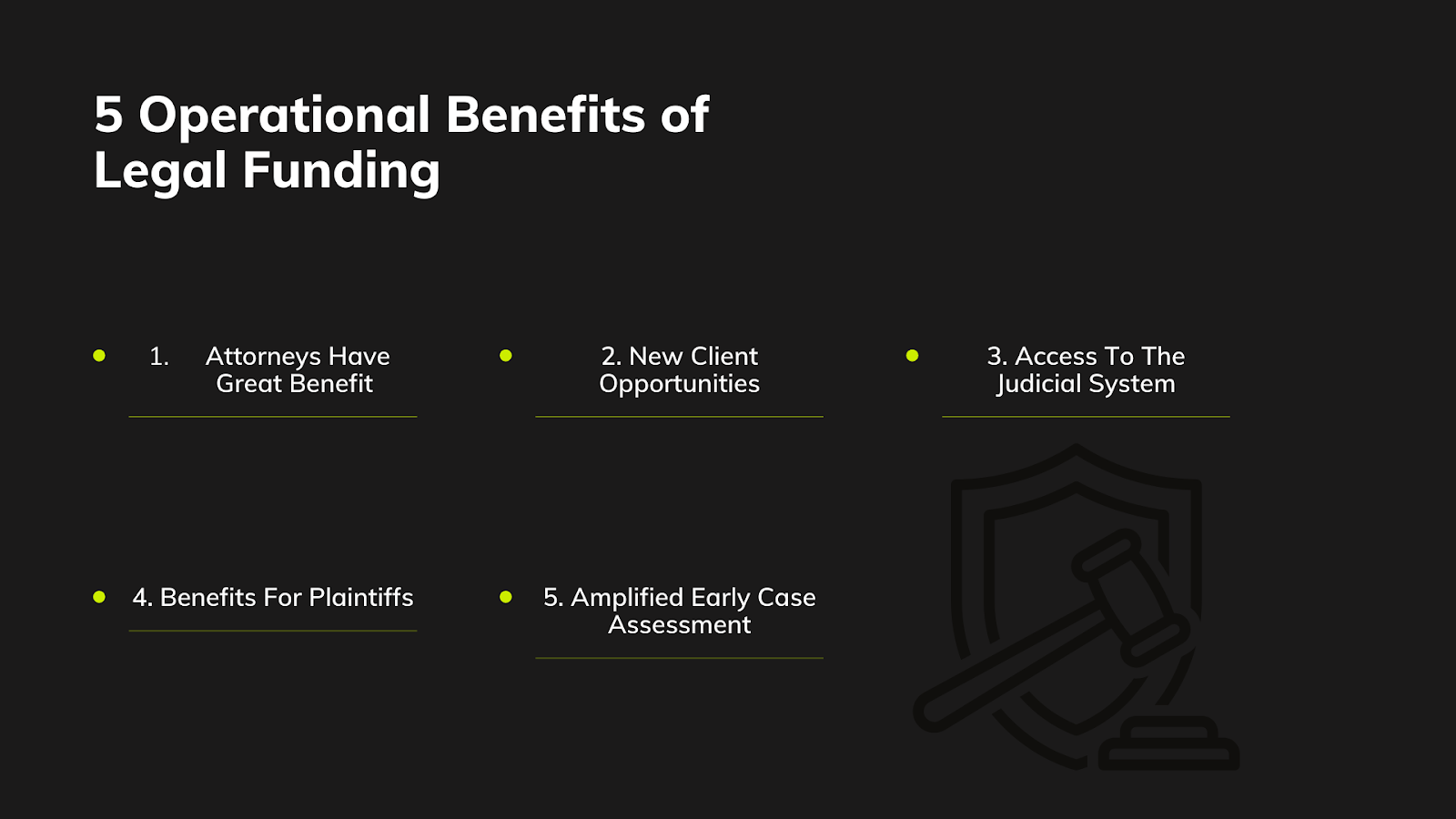
5 Advantages of Legal Funding

1. Attorneys Have Great Benefit

Attorneys take cases on contingency because they want to help a client get compensation for the suffering they’ve received from someone else’s negligence. But litigation is a time-consuming process that takes months or even years to settle or go to trial. Neither the attorney nor the client gets paid until the suit is resolved, and during that time, both client and attorney need funds to continue.

From the attorney’s point of view, lawsuit funding helps clients overcome financial hurdles during the proceedings.  While the client waits for their case to resolve, they can become financially weak and find it difficult to manage expenses like food, healthcare, housing, and transportation, especially if they are unable to work as a result of their injuries. 

Attorneys are usually prohibited from providing financial assistance to clients, but the proceeds from legal funding are not from the attorney so they can be dispersed to the client for immediate assistance.

The longer the litigation drags on, the greater the client’s financial obligations increase, which can become an enormous burden. Mounting expenses can encourage a client to exit the case with an early settlement because they can’t hold on through the complete legal process.

By steering clients toward legal funding, the client benefits with earlier access to a payout and the attorney benefits as some of their contingency fees are paid earlier, versus when the lawsuit resolves. 

2. New Client Opportunities

There is an excellent opportunity to find new clients by using legal funding, as long as they can afford the rates and it makes sense for their case. New client opportunities primarily arise when a potential client has complex legal proceedings in the pipeline and needs legal funding to sort out the pending issues in the current case. 

One of the obstacles a client can have when deciding whether to litigate is how long it can be between filing suit and receiving any proceeds. Legal funding shortens that timeline and can help convince a potential client to sign on and pursue litigation. 

To generate more client opportunities, the concerned attorney needs to build a strong network among their peers to earn referrals and pitch to potential clients regularly to obtain new cases. 

3. Access To The Judicial System

Legal funding can increase the number of people who are able to access the judicial system and get compensation when they have been wronged. 

With the help of legal funding financiers, attorneys are better able to take up the cases of less wealthy clients without sacrificing cash flow. And clients don’t have to wait as long to get some of the funds they deserve and need to survive during the litigation process and beyond. 

4. Benefits For Plaintiffs

Plaintiffs usually benefit when they receive cash from legal funding. They typically use the money for living expenses such as food, transportation, medical expenses, and to avoid eviction. The financial problems faced by plaintiffs are solved with the help of legal funding and a significant settlement in the case.

With everyday expenses covered from the legal funding cash influx, plaintiffs do not feel as much pressure to accept an early settlement offer. Due to legal funding proceeds, plaintiffs are able to wait out the litigation procedure and often obtain a higher settlement.

Plaintiffs also benefit from having their interests protected in accordance with laws regulating the legal funding industry. 

5. More Accurate Case Costs 

When legal funding is used, the case is evaluated with legal software tools to get a complete understanding of the risk exposure and determine the best strategy to succeed. Litigation teams working on the case benefit as everything can be managed with the legal software tools.

Using the early assessment software as part of legal funding review, the case can be wholly visualized and allow for greater control in managing legal tasks and risks. Since legal funding review is used to determine the likelihood of the plaintiff prevailing in the case and the size of a probable payout, both parties in a suit can benefit from understanding their exposure and making decisions about settlement offers going forward. 

The early case assessment can also help corporate counsel find evidence that enhances the transparency, standards, and consistency of the case.

Final Thoughts

Who benefits when legal funding is used? Typically the client, their attorney, the lender, and investors. Investors earn massive returns with legal funding, which is why institutional financiers like investment banks prefer this field. Strong industry regulation helps ensure that legal funding transactions are above board and within the law.

Another benefit of legal funding is that corporations can hire a legal team for regulatory and legal compliance in their organization. Employing a competent legal team is essential to handle complex cases and do them successfully, favoring the clients.

Legal funding is very flexible for clients to manage their financial obligations without worrying about domestic expenses. Also, the interest rate is pretty low in most organization’s legal funding, which again favors the clients.

Reference

[1] Legal funding is a loan in Missouri and Illinois.

EDITOR'S PICK OF THE WEEK

CFO's new mandate. CFO explaining the presentation

The Performance and Transformation Orchestrator: The CFO’s New Mandate in the Age of AI

By Terence Tse CFOs are evolving into AI-driven transformation orchestrators, balancing finance, technology, and strategy while upskilling teams, managing risks, and driving measurable business value. A key insight from this year’s AI for CFOs event, organized...

WISE DECISION MAKER GUIDE

POWER INFLUENCERS

Emerging Trends

The Future of Global Trade