Home Blog Page 746

Omicron Reveals the Fundamental Lack of Vision About the Future of Work

Omicron

By Dr. Gleb Tsipursky

We are sticking our heads into the sand of reality on Omicron, and the results may be catastrophic.

Omicron is over 4 times more infectious than Delta. The Pfizer two-shot vaccine offers only 33% protection from infection. A Pfizer booster vaccine does raises protection to about 75%. Still, surveys show that Omicron has had very little impact on the willingness of Americans to get a booster, or even get a first vaccine dose.

The only silver lining is that Omicron, so far, appears to cause a milder illness than Delta. Yet the World Health Organization has warned about the “mildness” narrative.

That’s because the much faster disease transmission and vaccine escape undercut the less severe overall nature of Omicron. That’s why hospitals have a large probability of being overwhelmed, as the Center for Disease Control warned, in a major Omicron wave this winter.

Yet despite this very serious threat, we see the lack of real action. The federal government tightened international travel guidelines, which might have helped if Omicron wasn’t already detected in over half of all states. But it’s not taking the steps that would be the real game-changes.

Pfizer’s anti-viral drug Paxlovid decreases the risk of hospitalization and death from COVID by 89%. Due to this effectiveness, the FDA approved Pfizer ending the trial early, because it would be unethical to withhold the drug from people in the control group. Yet the FDA is not choosing to hasten the approval process.

Widespread at-home testing would enable people to test themselves quickly, slowing the spread of Omicron. Yet the federal government has not prioritized making these tests widely available.

Neither do we see meaningful leadership at the level of employers. Some are bringing out the tired old “delay the office reopening” play: for example, Google, Uber, and Ford. Companies that have already returned are calling for stricter pandemic measures, such as more masks and social distancing, but not changing their work arrangements.

Despite plenty of warnings from risk management and cognitive bias experts, leaders are repeating the same mistakes we fell into with Delta.

What explains this puzzling leadership behavior? Leaders – and all of us – are prone to falling for dangerous judgment errors called cognitive biases. Rooted in wishful thinking, these mental blindspots lead to poor strategic and financial decisions when evaluating choices.

One of the biggest challenges relevant to Omicron is the cognitive bias known as the ostrich effect. Named after the myth that ostriches stick their heads into the sand when they fear danger, the ostrich effect refers to people denying negative reality. Delta illustrated the high likelihood of additional dangerous variants, yet business and political leaders denied the reality of this risk.

When we learn one way of functioning in any area, we tend to stick to that way of functioning. You might have heard of this as the hammer-nail syndrome: when you have a hammer, everything looks like a nail. That syndrome is called functional fixedness. This cognitive bias causes leaders used to their old ways of action to reject any alternatives, whether in drug approval or work arrangements.

The way forward is to defeat cognitive biases and avoid denying reality by rethinking our approach to the future. In short, instead of trying to turn back the clock to the lost world of January 2020, consider how we might adapt to our new normal. COVID will never go away: we need to learn to live with it. That means reacting appropriately and thoughtfully to new variants and being intentional about our trade-offs.

About the Author

Dr. Gleb TsipurskyDr. Gleb Tsipursky is the CEO of the future-proofing consultancy Disaster Avoidance Experts, and is the author of Returning to the Office and Leading Hybrid and Remote Teams: A Manual on Benchmarking to Best Practices for Competitive Advantage.

China-Laos Railway: Strengthening Access to Opportunities 

China Laos

By Alexander Ayertey Odonkor 

Since time immemorial, the movement of people and goods from one place to the other has been a part and parcel of human activity. By travelling from one region to the other, people have discovered new cultures, new markets, and new social and economic opportunities that have brought together distant countries, created allies and contributed immensely in establishing diplomatic relations around the world. To further strengthen access to the invaluable social, economic and environmental gains that are related to transport, faster and efficient modes of transportation are being built to integrate cities, towns and villages across different regions in an attempt to truncate travel time of people and goods – as the old adage goes ‘‘time is money’’, a clear indication that the relevance of time transcends every sphere of life.  

However, prevailing transportation infrastructure gap, a major snag that impedes inclusive growth and shared prosperity is evident across every region of the world – a challenge that China is effectively addressing via the Belt and Road Initiative (BRI), a collaboration between China and other countries across the regions of the world to fill the global transportation infrastructure gap. While the construction of the BRI is ongoing in several regions, the latest episode of this massive project is the 1,035 kilometre-stretch railway that connects Laos to the BRI network which commenced operation on Friday, 3 December, 2021.  

With an electrified passenger and freight railway that connects Vientiane, the capital of Lao Peoples Democratic Republic (PDR) to Kunming, the capital city of China’s Yunnan province, the landlocked Southeast Asian country can now access new markets and opportunities that were non-existent in the past at a fast pace, particularly as travel time between these two locations has been minimized by the new railway to 10hrs, far below the 30hrs spent travelling on road.  

Apart from the railway reducing time and cost of travel for people and goods, it is worth noting that, the construction process of the China-Laos railway has been accompanied with indirect notable socio-economic gains such as the creation of 110,000 local jobs and the protection of the environment as the project has a total of 3.07 metres square of green area along the line together with an all-important feature that protects elephants around the railway.  

Without delay, the first trip on the China-Laos railway has began fostering the next phase of social and economic gains which unlike the previous merits are direct benefits – on board the first train that travelled the China-Laos route were potash products that have been manufactured by the Sino-Agri International Potash Company, a china-Laos joint venture that is located in Laos that produces Muriate of Potash (MOP) fertilizer for agriculture.  

With the China-Laos railway set to generate significant economic and social gains through the establishment of similar joint enterprises, and concurrently promote trade, serve as a launch pad for entrepreneurial ventures to access new markets and facilitate other economic activities across diverse industries in participating countries as the region becomes more attractive to investors around the world, the World Bank in a recent report (2020) has indicated that the China-Laos railway which is part of the BRI has the potential to spur aggregate income in Laos by as much as 21 percent in the long-run.  

While the China-Laos railway has filled a major transportation infrastructure gap, this panacea has also presented Laos with an opportunity to become a land-linked country as it connects to the BRI, a move that will open huge doors to attract new investors, startups and other multinational companies which will create jobs, accelerate economic growth, promote shared prosperity and reduce inequality.  

Certainly, the China-Laos railway is not limited to achieving economic outcomes in participating countries. In truth, the colossal transport infrastructure has a potential of augmenting access to social services such as education and healthcare in Laos. Admittedly, strengthening access to these resources is essential for alleviating extreme poverty, mitigating inequality and improving living standards. However, in addition to all these benefits, Laos also stands the chance of improving the quality of the country’s human capital through this railway infrastructure which will significantly improve access to higher education in China. In fact, with the China-Laos railway projected to have considerable long-term benefits, especially in the case of Laos, where the country is expected to create an enabling environment that connects the railway facility to key production and consumption centres, in order to reap maximum benefits from the project in the future.  

To be fair, this goal cannot be realized without policymakers in Laos building a strong capacity to complement current efforts. To effectively manage the railway facility and other related economic activities, the country is presented with a window of opportunity now to tap into China’s vast experience in human capital development and capacity building via academic exchange programmes. A classic example of this arrangement is the cooperation framework agreement that was signed in 2017 between Shanghai Institute of Technology and the Souphanouvong University in Laos which allowed two batches of undergraduate and postgraduate students to be granted admission to study in Shanghai during the 2018 and 2019 academic years. This agreement between the two parties has been influential in building human capital and scaling up the facility management capacity of Laos – at the end of 2020, the first batch of the students from Laos who graduated with a major in railway engineering from Shanghai were assigned to the China-Laos railway construction site.  

Even though the China-Laos railway has the potential to yield significant socioeconomic impact today, it is important programmes such as this one that could contribute substantially in augmenting the human capital and capacity in Laos to effectively manage the railway infrastructure and all related social and economic gains in the future.   

About the Author

Alexander Ayertey OdonkorAlexander Ayertey Odonkor is an economic consultant, chartered economist and a chartered financial analyst with a master’s degree in finance and a bachelor’s degree in economics and finance – together with a stellar experience from the International Monetary Fund (IMF), Alexander holds postgraduate certificates from Harvard University, New York Institute of Finance, Massachusetts Institute of Technology (MIT), University of Adelaide, Curtin University and Delft University of Technology. Alexander is also an author and columnist for the China Global Television Network (CGTN), The Brussels Times, The World Financial Review, China Daily, The Diplomat, The Business Standard (Bangladesh), Pakistan Today, The People’s Daily, Daily News (Sri Lanka) and the Business and Financial Times (B&FT). Some of his articles have appeared in NTS Bulletin (Nanyang Technological University), NextBillion (University of Michigan), and several other top-notch publications. 

Is Thailand Ready for More Foreign Direct Investment?  

Thailand FDI

By Sirirasi Gobpradit, Keerati Saneewong Na Ayudthaya, and Panya Sittisakonsin


Thailand is recognized as a top destination among the countries in Asia for foreign direct investment (FDI) and is usually chosen as a regional hub for multinational companies. According to the 2021 Best Countries Ranking by the US News & World Report, Thailand was ranked as the 17th best country for doing business out of 78 countries worldwide and the third best country in Asia. The scoring factors include: cheap manufacturing costs, favorable tax environment and transparent government practices.
 

Thailand’s current corporate income tax (CIT) rate of 20% is lower than the worldwide average corporate income tax rate of 23.85% as measured across 177 jurisdictions by The Tax Foundation in 2020. Also, the current VAT rate of 7% is lower than the average VAT rate in Asia of 12.61% as measured across 39 jurisdictions.

The Thai government has supported FDI through various vehicles. For example, businesses granted an investment promotion by the Board of Investment (BOI) or granted the status of an International Business Center (IBC) may qualify for tax and non-tax incentives. In addition, the fact that Thailand has concluded double tax treaties with more than 60 countries makes it even more attractive for cross-border transactions.

Currently, there are various tax incentives available to foreign investors. Two main schemes are the investment promotion granted by the BOI and the IBC status approved by the Revenue Department.

1. BOI incentives

To encourage the industrial development for projects that are deemed to be highly beneficial to Thailand and have high value-added benefits, the BOI is empowered to approve an investment promotion and grant both tax and non-tax incentives under the Investment Promotion Act. Industry groups that are eligible for tax incentives include: agricultural, bio and medical industries, advanced manufacturing industries, basic and supporting industries, digital, creative industries and high-value services.

Tax incentives for the BOI-promoted businesses vary depending on the activity, industry and project, which include:

  • Import duty exemptions or reductions on imported machinery, imported raw materials and components
  • A corporate income tax exemption on net profits for three to eight years from the date on which income is first earned, with permission to carry forward losses and deduct them as expenses for up to five years
  • A corporate income tax reduction of 50% on net profits for up to five years after the corporate income tax exemption period
  • Double deduction from the costs of transportation, electricity and water supply for corporate income tax purposes
  • Exemptions from withholding tax on dividends derived from promoted projects during the corporate income tax exemption period or within six months from the date on which the corporate income tax exemption period expires

Additional corporate income tax incentives may be granted, depending on the types and ratios of eligible investment or expenditure for the promoted company. The corporate income tax exemption cap may be increased and the exemption period may also be extended for certain types of eligible investment or expenditures, such as research and development, advance technology training as well as product and packaging design.

All types of activities in the industry groups are eligible for non-tax privileges, such as the right to own land, the right to bring in foreign experts to work, and the right to make an outward remittance in foreign currency.

2. International Business Center (IBC)

An IBC is defined as a company established under the laws of Thailand carrying on the business of providing management services, technical services, support services or financial management services (under a treasury center licence granted by the Bank of Thailand) to affiliates or an operating business of an International Trading Center (ITC).

Key qualifications for obtaining tax privileges under the IBC scheme are as follows:

  • The amount of paid-up capital on the last day of each accounting period shall be at least THB 10 million
  • At least 10 employees, who possess knowledge and skills necessary for IBC business or at least five employees if the IBC operates financial management services only
  • Minimum expenditure of IBC business paid to recipients in Thailand of at least THB 60 million in each accounting period
  • Providing management services, technical services, support services or financial management services to the associated enterprises
  • Other criteria can be prescribed by the Director General of the Revenue Department

Examples of tax incentives for IBCs include:

  • Reduced CIT rates to 8, 5 or 3% of net profits, depending on the amount of expenditure in Thailand (THB 60 million, 300 million or 600 million, respectively)
  • Exemption on CIT for dividend received from an affiliate
  • Reduced personal income tax rate to 15% for expatriates working for an IBC
  • Exemption on SBT for income from provision of financial management services to an affiliate
  • Exemption on withholding tax for offshore affiliates receiving dividend or interest paid from an IBC

Please note that an IBC is also categorized as part of high-value services and is eligible to apply for non-tax benefits under the BOI scheme.

3. Incentives under the Laws and Regulations on Customs

The Customs Act, the Customs Tariff Decree and other related laws and regulations on customs provide a variety of customs privileges for importers and exporters, including:

  • Duty drawback — enabling the refund of the customs duty paid on the imports of goods used in the production, mixture, assembly, packaging or any operation by any other method for the products being exported out of Thailand
  • Tax compensation — providing tax compensation for goods as specifically indicated by the Committee which are manufactured in and exported out of Thailand
  • Customs bonded warehouse — duty and tax deferral for goods imported and stored in the customs bonded warehouse until such goods will be brought out of the customs bonded warehouse for domestic consumption
  • Customs free zone — duty and tax exemption for goods imported and stored in the customs free zone until such goods will be brought out of the customs free zone for domestic consumption
  • Free trade zone under the Industrial Estate Authority of Thailand — providing non-tax privileges, e.g. right to bring in foreign skilled workers and experts with visa and work permit facilitation and right to own land in the industrial estate, in addition to the incentives of duty and tax exemption like the customs free zone

Furthermore, the Thai Customs Department also introduced the Special Economic Zone (SEZ) for granting special tax incentives and financial measures for 23 industry groups in the specific area of Thailand, and the Eastern Economic Corridor (EEC). The targeted industries are in the business of next-generation automotive, intelligent electronics, advanced agriculture and biotechnology, food for the future, high-value and medical tourism, automation and robotics, aviation and logistics, medical and comprehensive healthcare, biofuel and biomedical, digital, defense, and education and human resources development. The  promoted zones of Chachoensao, Chonburi, and Rayong provinces enjoy a corporate income tax exemption on net profits for one to 10 years or reduced CIT rates, special personal income tax rate for foreign staff and foreign executives, special tax deduction rate, duty exemption on machinery, and raw materials for production and R&D, exemption of law on foreign currency exchange control, right to own land and properties for their business operation, visa and work permit facilitation, and simplified customs formalities for certain transactions.

4. Preferential Tariff Treatment Schemes

Thailand is one of the most active users of free trade agreements (FTAs) and, as of now, Thailand is a party of the following FTAs:

  • ASEAN Trade in Goods (ATIGA)
  • ASEAN – China
  • ASEAN – Japan
  • ASEAN – India
  • ASEAN – South Korea
  • ASEAN – Australia – New-Zealand
  • ASEAN – Hong Kong
  • Thailand – Australia
  • Thailand – New-Zealand
  • Thailand – Japan
  • Thailand – Peru
  • Thailand – Chile
  • Thailand – India

With this, the imports of goods originating from a party to the FTAs aforementioned under the rules origin criteria of the FTAs will be entitled to preferential duty treatment in Thailand when fully complying with requirements under the related laws and regulations.

In addition, Thailand is also a member country to the Regional Comprehensive Economic Partnership (RCEP), which is the world’s largest trade pact comprised of 10 members of the Association of Southeast Asian Nations (ASEAN) and five of their largest trading partners, which are China, Japan, South Korea, Australia and New Zealand. The RCEP will be in force on January 1, 2022 and marks the first economic partnership among China, Japan, and South Korea. Thailand will strengthen its position of competitiveness as the global supply chain hub, manufacturing hub and distribution center of Asia Pacific and, particularly for the auto parts and automotive industry, plastics products, chemical products, and electronics. In the meantime, Thailand will benefit from cheaper products from trading partners, which may include raw materials for manufacturing purposes.

It should be highlighted that Thailand is also in the negotiation process with Pakistan, Turkey, Sri Lanka, and the Bay of Bengal Initiative for Multi-Sectoral Technical and Economic Cooperation (BIMSTEC) on free trade agreements. Likewise, Thailand is expected to resume the negotiation process of an economic partnership with the European Union (EU). This Thai-EU FTA would benefit Thailand in various aspects considering that in 2020 the EU was the fifth-largest trade partner of Thailand and the second-largest foreign investor in Thailand.

In Conclusion

Despite successive waves of COVID-19 outbreak in Thailand in 2021, resulting in strict containment measures and reduced economic activity, the Thai government remains focused on maintaining foreign investor confidence and actively attracting more FDI. For example, in September 2021, the Cabinet approved various measures to boost the economy by attracting high potential foreign investment to Thailand, which include measures relating to work permit, work visa and personal income tax for expatriates. The authorities will proceed to issue relevant legislations accordingly.

About the Authors

Gobpradit_Sirirasi_Bangkok_44005_600x750Sirirasi Gobpradit is an associate in the Tax Practice Group at Baker McKenzie’s Bangkok Office. Her practice includes advising on general tax considerations for investments in Thailand, M&A transactions, business integration and restructuring, debt restructuring, EPC structure, real estate projects, project finance, and representing clients at all stages of tax disputes.

Saneewongnaayudthaya_Keerati_Bangkok_44259_600x750Keerati Saneewong Na Ayudthaya joined Baker McKenzie’s Tax Practice Group in 2013 and is in the International Commercial & Trade Practice Group. His practice in tax, customs and trade controversies ranges the full gamut including: audits, negotiation, settlements with relevant authorities, appeals and litigation.

Panya SittisakonsinPanya Sittisakonsin is a partner in the Tax Practice Group at Baker McKenzie’s Bangkok Office. He advises clients on highly complex tax structures, wealth management, family business planning and restructuring. He is also active in the International Commercial Trade Practice Group, and practices in the customs and supply chain areas.

Closing the Gap: What Will it Take for the UK to be a “Double X” Economy After the Pandemic?

UK Economy

By Christina Palmou

The pandemic has brought into sharper focus the unequal opportunities at work for men and women. Policy, management practices and a structural under-provision of affordable care are key drivers of gender pay and participation gaps. These gaps have long term consequences for living standards and are out of pace with contemporary British values.

The pandemic was not good news for gender equality at work in the UK. While the suspension of economic activity resulted in economy wide losses in hours and earnings, the beginning of the pandemic saw women four percentage points more likely to have lost their jobs than men[i], a gap left unexplained by differences in education and type of work[ii], widening to 10 percentage points for women with young children[iii].

Mothers’ employment was hit particularly hard. As lockdown was dismantling informal care provisions and shutting down schools and care providers, women spent substantially longer doing additional childcare and housework than their partners. During the first lockdown women took on more than 60% of additional care and domestic work[iv], enjoying less uninterrupted working time, irrespective of whether they were the better paid part of the couple[v]. The Women’s Budget Group found that 46% of mothers who were made redundant during the pandemic cited lack of adequate childcare provisions as the cause[vi].

Policy in response to the pandemic, management practices and the chronic unavailability and unaffordability of care services are at the heart of these imbalances. While the pandemic has brought these into sharper focus, the struggle to balance family and a healthy working life for women, pre-date the pandemic. The 1942 Beveridge Report, the foundation of the British welfare state, assumed that care would be unpaid, domestic women’s work[vii]. The consequences of this chronic gap in childcare infrastructure has long been apparent. In the UK, the average employment and hours of men barely changed after they became fathers, while the employment of women fell sharply from above 90% to below 75%, even for women that had higher wages than their male partners[viii]. Amongst the women who remained in paid work after childbirth, hours fell from around 40 to less than 30[ix].

The choices of women at work are constrained by care in other, less obvious ways. Following childbirth, women tend to switch to less productive, lower paying firms than men[x] prioritising working closer to home to attend to care responsibilities over pay. Women’s commuting times fall significantly after the birth of their first child. If women take work according to proximity they are less likely to work in jobs that match as well their skills or for high productivity employers[xi]. As a result, the gender wage gap widens by two percentage points every year following childbirth, plateauing at 30% after 15 years[xii]. On average, across the UK economy, women are paid nearly 20 percent less per hour[xiii]. This is the fourth largest gender pay gap in Europe[xiv] and has changed little in the last decade[xv]”.

The pay gap is costing women and the economy dearly. Estimates suggest the cost and unavailability of childcare prevents 1.7 million women from taking on more hours of paid work resulting in £28.2 billion economic output lost every year[xvi]. Differences in hours and earnings become inequalities in wealth and pension income[xvii] affecting living standards in later life. The gap in hours, earnings and years of tenure as well as the design of the UK pensions system mean that at the brink of retirement “the median pension wealth of women is half that of their male counterparts[xviii] [xix]”.

Management practices and office norms have a lot to answer for too. Even when flexibility is allowed for working life to flex around care, in appraisals, the perfect employee is still someone delivering as if “unencumbered by any other problem other than their job”[xx]. This amplifies at work these gendered biases in sharing of labour at home. The impassiveness of office norms to the interplay between gender, work and care played its role in the gendered effects of the pandemic too. 70% of women with caring responsibilities who requested furlough following school closures in 2021 had their requests denied. Half report being worried about negative treatment from an employer because of childcare responsibilities[xxi].

These inequalities are not only a testament to an unfair plane field that does not afford the same choices for women, it is also out of pace with contemporary values. 72% of Brits disagree with the view that a man’s job is to be the main breadwinner and a woman’s to look after the home and family. Views on how parental paid leave should be shared are shifting: in 2018 34% of individuals said leave should be shared equally, 12 percentage points higher than 2012[xxii]. The shift in preferences is driven largely by younger generations, who would be the primary beneficiaries of changes in policy. 42% of 18-34s believe the mother and father should each take half of the paid parental leave compared to only 27% of the over 55s[xxiii].

So what can be done? Childcare and leave policy and management practices are going to be key to move forward and reduce these inequalities. Management practices need to go further than flexibility. In a world where flexibility at work is a core part of the new normal, management should be accountable for the impact new ways of working have on the progress and wellbeing of parents. and women.

Childcare should be treated as essential economic infrastructure. In the US, the Biden administration is treating childcare as essential for getting to work as roads, telecommunications and energy. In the UK, by contrast, there has been no attempt to increase spending on childcare more than the current 0.1% of GDP[xxiv]. Now is the time for the Treasury to go big on early years investments. Evidence on the responsiveness of maternal labour supply suggests universal preschool provision is likely to be more effective when maternal employment is low, there is sufficient labour demand for women and the cost and availability of formal and informal childcare is a binding constraint[xxv].  Faster growth in female employment relative to what was expected at the beginning of the pandemic (driven by an increase in employment in public administration, education and health and social work)[xxvi] suggests there is sufficient labour demand. And there is still scope for female employment rates to increase further. In March 2021 women who were in work before the crisis were more likely to be out of work, furloughed or on reduced hours than men. In March mothers and fathers were still working about 7% fewer hours than pre-pandemic, but mothers had also experienced a larger hit in their hours throughout the last 12 months compared to other groups[xxvii].

Even more, childcare in the UK is both unaffordable and at risk of not matching post pandemic demand. Childcare costs about a third of median incomes[xxviii], amongst the most expensive in the OECD[xxix] and growing fast: for parents with a one-year old child, the cost of the child’s nursery grew four times faster than their wages (seven times faster in London) between 2008 and 2017[xxx]. The pandemic has put into question not only affordability but availability as well. Due to long-term underfunding only half (56%) of local authorities in England reported they had enough childcare for the children of parents who work full-time even before the pandemic and less than a fifth (18%) for parents who work atypical hours[xxxi]. A temporary reduction in demand during the pandemic has limited the ability of providers to cross-subsidise the underfunded free hours entitlement[xxxii] meaning 41% of the nurseries have gone into deficit, 26% have taken on debt and others have used reserves to compensate for losses[xxxiii]. By July 2021 more than 11,000 childcare places were lost due to nursery closures.[xxxiv]

For parental leave and care to be shared eligibility for childcare and leave should reflect the flexibility of the future of work. In the UK narrow definitions of what consist of “eligible” forms of employment for the receipt of family benefits, that do not include self-employment, are locking many out of the support that is available[xxxv]. The design of leave is also important . Even though sharing of leave is related to better outcomes for women and children, the UK has one of the least generous paternity leave policies in the OECD[xxxvi]. Even in countries where paternity leave is better paid and can be flexibly shared between parents, take up by fathers is often low. The UK should learn from the “use it or lose it” scheme in Nordic countries or policies in Western Europe allocating bonus payments to households with more equal leave take-up which are known to reduce gender wage gaps[xxxvii].

Policies that we know work did make their way to public debates in the last election but closing gender inequalities in the UK is going to take much greater political momentum. Recovering from a global pandemic may create just the fertile ground needed.


About the Author

Christina PalmouChristina Palmou is a Senior Economist at the Renewing the Centre team at the Tony Blair Institute focusing on issues around work, income, the welfare state and inequality. She was previously a Senior Econometrician at Oxford Economics and holds an MPhil in Economics from the University of Oxford.

References:

[i] “Women bear brunt of coronavirus economic shutdown in the UK and the US” , Cambridge INET institute, April 2020 https://www.cam.ac.uk/research/news/women-bear-brunt-of-coronavirus-economic-shutdown-in-uk-and-us

[ii] “Women bear brunt of coronavirus economic shutdown in the UK and the US” , Cambridge INET institute, April 2020 https://www.cam.ac.uk/research/news/women-bear-brunt-of-coronavirus-economic-shutdown-in-uk-and-us

[iii] “How has coronavirus affected the division of domestic labour?”, Economic Observatory, June 2020, https://www.economicsobservatory.com/how-has-coronavirus-affected-division-domestic-labour

[iv] Sevilla A., Smith S., Baby steps: The gender division of childcare during the COVID19 pandemic, University of Bristol Discussion Paper 20/723, http://www.bristol.ac.uk/efm/media/workingpapers/working_papers/pdffiles/dp20723.pdf

[v] Andrew et. al, “The gendered division of paid and domestic work under lockdown”, IFS Working paper W21/17, https://ifs.org.uk/publications/15497

[vi] https://wbg.org.uk/wp-content/uploads/2021/10/Employment-Autumn-2021-PBB-1.pdf

[vii] Cottam H., Radical Help: How we can remake the relationships between us and revolutionize the welfare state, Virago, February 2019

[viii] Andrew et al, “The career and time use of mothers and fathers”, The IFS Deaton Review, March 2021, https://ifs.org.uk/inequality/the-careers-and-time-use-of-mothers-and-fathers/

[ix] Andrew et al, “Women much more likely than men to give up paid work or cut hours after childbirth even when they earn more”, IFS March 2021, https://ifs.org.uk/publications/15359

[x] Joyce R, Xu X, “The gender pay gap: women work for lower-paying firms than men”, IFS April 2019, https://ifs.org.uk/publications/14032

[xi] Joyce R. Norris Keiller A., “The “gender commuting gap” widens considerably in the first decade after childbirth”, IFS November 2018, https://ifs.org.uk/publications/13673

[xii] Costa Dias M., et al, “The gender pay gap in the UKL children and experience in work”, IFS Working Paper 18/02 https://ifs.org.uk/uploads/publications/wps/MCD_RJ_FP_GenderPayGap.pdf

[xiii] Joyce R, Xu X, “The gender pay gap: women work for lower-paying firms than men”, IFS April 2019, https://ifs.org.uk/publications/14032

[xiv] Europa, Gender pay gap statistics, https://ec.europa.eu/eurostat/statistics-explained/index.php?title=Gender_pay_gap_statistics

[xv] Costa Dias M., et al, “The gender pay gap in the UK children and experience in work”, IFS Working Paper 18/02 https://ifs.org.uk/uploads/publications/wps/MCD_RJ_FP_GenderPayGap.pdf

[xvi] https://www.progressive-policy.net/publications/women-in-the-labour-market-2

[xvii] D’Arcy C., Gardiner L., “The Generation of Wealth: asset accumulation across and within cohorts”, June 2017, https://www.resolutionfoundation.org/app/uploads/2017/06/Wealth.pdf

[xviii] Lowe J, “Pensions and Gender Equality: policy paper for the commission on a Gender-Equal Economy”, January 2020, https://wbg.org.uk/commission/inputs-to-the-commission/policy-papers-social-security-and-taxation/

[xix] ONS Pensions wealth: wealth in Great Britain, December 2019, https://www.ons.gov.uk/peoplepopulationandcommunity/personalandhouseholdfinances/incomeandwealth/datasets/pensionwealthwealthingreatbritain

[xx] North A., “The problem is work”, March 2021, https://www.vox.com/22321909/covid-19-pandemic-school-work-parents-remote 

[xxi] Women’s Budget Group, Women and employment in the recovery from COVID-19, Autumn 2021, https://wbg.org.uk/wp-content/uploads/2021/10/Employment-Autumn-2021-PBB-1.pdf

[xxii]  https://natcen.ac.uk/news-media/press-releases/2018/july/more-brits-disagree-that-a-woman%E2%80%99s-job-is-in-the-home,-but-no-increase-in-support-for-mothers-of-young-children-to-work/ 

[xxiii] Women and work: Do attitudes reflect policy shifts? (natcen.ac.uk)

[xxiv]Franklin B., Hochlaf D., “Women in the labour market, Boosting mothers’ employment and earnings through accessible childcare”, Centre for progressive policy, October 2021, https://www.progressive-policy.net/publications/women-in-the-labour-market-2

[xxv] Cattan S. “Can universal preschool increase the labor supply of mothers?”, IZA World of Labor, https://wol.iza.org/articles/can-universal-preschool-increase-labor-supply-of-mothers/long

[xxvi] Slaughter H., Labour Market Outlook Q2, The Resolution Foundation, June 2021, https://www.resolutionfoundation.org/publications/labour-market-outlook-q2-2021/

[xxvii] Slaughter H., Labour Market Outlook Q2, The Resolution Foundation, June 2021, https://www.resolutionfoundation.org/publications/labour-market-outlook-q2-2021/

[xxviii] Coram Family and Childcare, Childcare Survey 2021, https://www.familyandchildcaretrust.org/childcare-survey-2021-0

New Parent Support, Average childcare costs, https://www.nct.org.uk/life-parent/work-and-childcare/childcare/average-childcare-costs  

DayNursuries, “Childcare costs: How much do you pay in the UK” : https://www.daynurseries.co.uk/advice/childcare-costs-how-much-do-you-pay-in-the-uk

ONS, Average household income, UK: financial year 2020, https://www.ons.gov.uk/peoplepopulationandcommunity/personalandhouseholdfinances/incomeandwealth/bulletins/householddisposableincomeandinequality/financialyear2020

OECD data, Net childcare costs, https://data.oecd.org/benwage/net-childcare-costs.htm

[xxix] OECD data, Net childcare costs, https://data.oecd.org/benwage/net-childcare-costs.htm

[xxx]“Cost of childcare has risen four times faster than wages since 2008”, TUC, October 2017, https://www.tuc.org.uk/news/cost-childcare-has-risen-four-times-faster-wages-2008-says-tuc

[xxxi]Coleman L et al, Childcare Survey 2020, Coram Family and Childcare  https://www.familyandchildcaretrust.org/sites/default/files/Resource%20Library/Coram%20Childcare%20Survey%202020_240220.pdf

[xxxii] Bladen et al, “Challenges for the childcare market: the implications of COVID-19 for childcare providers in England”, IFS September 2020, https://ifs.org.uk/publications/14990

[xxxiii] “Childcare, Gender and Covid-19”, Women’s Budget Group, Autumn 2021, https://wbg.org.uk/wp-content/uploads/2021/10/Childcare_-Autumn-2021-pre-Budget-Briefing.pdf

[xxxiv] Gaunt C, Morton K., “More than 11,000 childcare places lost through nursery closures”, July 2021 https://www.nurseryworld.co.uk/news/article/more-than-11-000-childcare-places-lost-through-nursery-closures-research

[xxxv] Gender Equality Index 2019, Work-life balance, https://eige.europa.eu/publications/gender-equality-index-2019-report/parental-leave-policies

[xxxvi] OECD family database, Parental leave systems, https://www.oecd.org/els/soc/PF2_1_Parental_leave_systems.pdf

[xxxvii] Andersen H.. “Paternity Leave and the Motherhood Penalty: New Causal Evidence”, Journal of Marriage and Family, Vol 80, Issue 5, July 2018, https://onlinelibrary.wiley.com/doi/full/10.1111/jomf.12507

The Automotive Industry: A Paradigm Change

Automotive Industry

By Annamaria Simonazzi

The automotive industry is going through a paradigm change.  The paper describes the challenges facing the industry and the main directions of change. It argues that the automotive transformation will affect the entire supply chain and have the potential to redraw the boundaries of the sector, redefine the key players and sourcing practices, and affect the relative advantage of countries and regions, reshaping existing industrial geographies.

The automotive industry is going through a paradigm change that will affect the entire supply chain and have the potential to redraw the boundaries of the sector, redefine the key players and sourcing practices, and affect the relative advantage of countries and regions, reshaping existing industrial geographies.

The legacy European and US carmakers have been slow in responding to the challenges posed by electric (EV) and autonomous driving (AV) vehicles. Conversely, the People’s Republic of China rose to become the world’s largest electric car market and the first world producer, hugely profiting from first-mover advantage. Moreover, the new technologies require skills that have not, so far, been among the core competences of automotive engineering. Competition from new players, more adroit in the new technologies related to connectivity, autonomy, sharing and electrification, is threatening the established structure of the automotive industry. To comply with ever-stricter emissions regulation, take advantage of the new market opened by government EV subsidies and, above all, catch up with new, challenging competitors in their own markets, car makers have finally taken up the challenge, speeding up the production of electric and hybrid vehicles1.

New players: partners or competitors?

The race to electric and autonomous vehicles calls for huge investments, while the speed in innovating and the urge to bring new ideas to market entail big risks. Prospects of profit are attracting new investors from the most diverse sectors outside the industry – such as tech companies, venture capital and private equity players, and indeed battery producers. These players came to dominate investment in automotive and mobility start-ups, dwarfing the investment that the OEMs could afford2. Irrational exuberance – the combination of EV mania and the profusion of funds ensured by Spacs3 – rewarded start-ups that had not yet produced profits, while neglecting legacy carmakers producing millions of vehicles.  Tesla stands out as the most aggressive and successful entrant, contending with the Chinese company BYD Auto ranking as the world’s largest producer of battery electric vehicles (BEVs). Its market capitalisation, greater than the sum of the market values of the main legacy carmakers, gives it a huge advantage in terms of investment capacity, which enhances its undeniable innovative ingenuity.

Prospects of profit are attracting new investors from the most diverse sectors outside the industry – such as tech companies, venture capital and private equity players, and indeed battery producers.

In the mature oligopoly that preceded the era of e-vehicles, carmakers (OEMs) opted for M&A to control competition and consolidate market shares in a saturated industry. Nowadays, the speed of disruption, the need to make bets on multiple products, services, sectors and technologies, the sheer size of the investments involved, and the uncertainty of the outcomes mean that strategic alliances to share R&D, resources and projects have become a must. Thus, we have seen a shift in alliance archetypes away from familiar horizontal alliances towards cross-sector strategic alliances, joint ventures, and acquisitions of innovative technology start-ups, a trend that has gathered momentum subsequent to Covid-19. Consolidation and partnership deals take place on an almost daily basis in autonomous driving, electric vehicles, batteries, hydrogen fuel cells, sharing and mobility. All these different sectors are simultaneously involved in this paradigm change. As the automotive product changes, software and batteries are taking on an increasingly important role in the competitiveness and value of the vehicle. Fully connected vehicle platforms, which allow for over-the-air software updates, may enable carmakers to generate recurring revenue streams from new services.  Yet, the increasing relevance of big data and IT devices is threatening to undermine carmakers’ leadership, shifting the power from OEMs to Big Tech, increasingly enticed to enter the EV market, directly or, more often, in collaboration with a start-up: Amazon, Google,  Apple, Huaway, Xiaomi – and the list is bound to go on growing.

At the heart of electric mobility

Batteries are at the heart of the electric transition. With all major manufacturers rushing to launch BEV models, batteries have proved to be a major bottleneck.

Battery manufacturing is currently dominated by East-Asian companies. China’s decision, a decade ago, to develop a full-fledged industrial value chain for EV batteries has endowed it with strategic power. Chinese battery makers have gained control over the key strategic resources of the Li-ion battery industry, structured the industry, and defined and controlled its competition rules. The Chinese industry’s current competitive dynamics are articulated around three core principles: industrial segmentation based on different battery chemistries, in-house development and production of strategic technologies, and the bargaining power of suppliers following customization and diversification of transactions (Heim et al 2021) – a strategy described by  Wang and Wei (2021) as “specialized vertical integration”4.

electric mobility

The EU and the US are trying to catch up. Since its May 2018 Strategic Action Plan for Batteries the EU has stepped up efforts and financial support to encourage risk-taking and investment in research and innovation in the field, bringing together a set of measures to support national, regional and industrial efforts to build a battery value chain in Europe, from raw materials to reuse and recycling, in derogation of the European state aid rules.

When it comes to clean/renewable energy technologies, the game is still wide open. The competition is being played out between batteries, fuel cells and different, more ecological forms of fuels for traditional engines, as well as between different kinds of batteries – lithium-ion vs solid state. The technologies are still relatively new and the costs of production high, as indeed is the uncertainty over future developments. Given the current state of technology, hydrogen has yet to become competitive for passenger cars, but fuel cells can be used for trucks, buses, and industrial use: as production goes up, the cost of electrolysis goes down, making it competitive with electric cars. The battery industry itself is still in its early stages of development, and the flow of news of major or incremental innovations is unceasing. OEMs and battery producers are jointly guiding the research into new, more efficient batteries. Cost, time efficiency and the availability of raw materials are crucial concerns in the choices made for batteries. The Li-ion battery industry for EVs faces the competition of solid batteries, which promise higher energy density, lower recharging times, and, above all, do not need cobalt.

Competition between technologies makes for an uncertain scenario, leaving room for a role for the state in coordinating and governing change. While massively subsidising the demand for electric vehicles and the production of batteries, all the governments have singled out clean hydrogen as an essential area to address in the context of the energy transition. The EC estimates that Europe is highly competitive in clean hydrogen technology manufacturing, which offers a unique opportunity to bridge the gap accumulated in battery technology vis-à-vis the Asian countries5. France and Germany have already earmarked billions of euros for investment in fuel cell technology, and the Next Generation EU plan can help other member countries to finance the green transition. Last but not least, the US has finally joined in the game, combining regulation with incentives. While bestowing subsidies and incentives to attract new investments, Biden’s $1.2 trillion infrastructure bill introduced the country’s first national Local Content Requirements (LCR) policy for renewables, essentially barring access to federal infrastructure financing unless the project uses US-produced materials6. All the major legacy carmakers have announced plans to build massive battery factories in North America.

The carbon emissions from the production of batteries (including pollution from extracting the metals used in the batteries) and hydrogen are also beginning to attract attention, as well as investments in plants to recycle used EV batteries.

As battery fab plans mushroom, the issues of building the battery value chain and ensuring the supply of scarce raw materials remain in the shade. It took ten years for China to build its battery value chain. Its companies control much of the supply of the metals that go into batteries (nickel, cobalt, manganese). In 2018, Chinese companies owned half of the largest cobalt mines in the Democratic Republic of Congo, the source of most of the world’s supply of the metal – known as the “blood diamond of batteries” for the often inhumane conditions associated with its extraction. The carbon emissions from the production of batteries (including pollution from extracting the metals used in the batteries) and hydrogen are also beginning to attract attention, as well as investments in plants to recycle used EV batteries. 

Countries’ competition, companies’ collusion?

There is a huge market to exploit out there, and it is getting crowded.  Market dynamics and competition patterns are in constant flux. OEMs are striking back, making enormous efforts to pre-empt the market; start-ups which took advantage of the speculative bubble in the EV market, reaching astronomical valuations, are cashing in through fusions and M&A; battery producers are undertaking vertical integration; oil producers are (slowly) diversifying into renewables. Alliances cross borders. Old and new western players are establishing or strengthening their ties with China, to benefit from its huge market and skilful supply chains. As with electronics in the 1990s and 2000s, this strategy can backfire, with China outperforming its competitors in electric and autonomous driving. Several Chinese companies are announcing ambitious expansion plans across the EV value chain in the US and in Europe, alone or in partnership with local companies.  With the car market regrouping, and old and new players repositioning themselves in the three macro-areas, the first movers’ advantage is increasingly being challenged: Tesla’s BEV share of the US market is expected to drop from 79% in 2020 to 56% by the end of 2021 (though it rose to no. 1 in Europe in 2021).

Increasingly, location is defined by governments’ policies, in their attempts to reduce dislocations and attract new investment through subsidies, tariffs or political pressures. All engage in different shades of protectionism. Although welcoming US and Asian producers, European governments tend to favour their “national champions”, on the assumption that they will be more responsive to the domestic interests. The US seems to rely more on its huge market, and LCRs, to attract foreign companies. Finally, China is still keeping a tight control on FDI, allowed only in partnership with a local producer, except when helping the technological catch up, as in the case of Tesla. Despite tight restrictions, US and EU carmakers have flooded the Chinese market, attracted by its size and the pre-eminence of its EV technology. Everywhere, states and regions are vying – with land, subsidies, cheap and skilled workforce, and infrastructure – to lure new plants, in an effort to reduce the impact of the ongoing transformations on the quantity and quality of employment.

Towards a new paradigm

The question of employment is key. Digitalization and electrification define a completely new product, requiring new components and new skills: less engineering and more software. Moreover, the EV requires far fewer components, as alternative powertrains are less labour intensive than conventional combustion engines. According to some estimates, the industry could shed 30 percent of jobs, with other jobs lost and new skills demanded downstream, in services and repairing. Tier-1 suppliers and their value chains are at the forefront of technology changes. While they struggle to incorporate the new skills, a large segment of the supply chain connected with the internal combustion engine is expected to disappear.

The loss of jobs may be disastrous for the integrated peripheries and semi-peripheries, mostly specialised in the ICE engines, though it will not spare the core countries7. The impact on the integrated peripheries could be even worse if concerns about the resilience of the value chain or the core countries’ defence of employment lead to policies that favour re-shoring.

Technologies in renewable energy and autonomous driving are still in their infancy. The automotive industry’s old core, which based its supremacy on engineering excellence, is now committing large sums in the new technologies, forging alliances upstream and downstream in the new value chains, and exploiting the advantages accruing from its command over production technologies. Governments are trying to shield domestic production and employment from the effects of the transition by subsidizing investments in new plants and technologies. Still, if the car follows the destiny of the computer, where the value is increasingly in the software, a redistribution of profits across sectors is very likely. Eventually, not only the car, but the whole car industry, will be completely transformed.

About the Author

Annamaria Simonazzi

Annamaria Simonazzi is Professor of Economics, retired from Sapienza University of Rome, Italy. She is Expert Councellor of CNEL (National Council of Economy and Labor) and President of the G. Brodolini Foundation, editor of Economia & Lavoro and member of the editorial board of the web magazine www.inGenere.it. She has published widely on European macroeconomic issues, industrial policy, employment, welfare and gender economics. Among her latest papers on the automotive sector are: “The Future of the Automotive Industry: Dangerous Challenges or New Life for a Saturated Market?” Inet WP no. 141, November 2020 and “Mexico’s Automotive Industry: A Success Story?” WP no. 166, October 2021 (both with Carreto Sanginés, J. and Russo, M).

References

  1. See A. Simonazzi, J. Carreto Sangnés and M. Russo, “The world to come. Key challenges for the automotive industry, Economia & Lavoro, no. 1, 2022 (forthcoming) for an in-depth analysis of the ongoing transformation.
  2. McKinsey reports that since 2010 more than EUR 100 billion have been invested in mobility start-ups, 94 percent of which originated from players outside the automotive industry. See: MacKinsey, Race 2050 – A Vision for the European Automotive Industry, January 2019. https://www.mckinsey.com
  3. The SPAC (special purpose acquisition company) is a blank-cheque company that enables businesses to list without the usual scrutiny of a traditional initial public offering.
  4. S. Heim, K. Kakitani, J. Lee, H. Shioji, The competition patterns and dynamics of the Chinese Li-ion battery industry, Gerpisa November 2021; Xieshu Wang, Zhao Wei, Specialized Vertical Integration: Value Chain Strategy of Power Lithium-ion Battery Firms in China, Gerpisa, November 2021. https://gerpisa.org/en/node/6573
  5. According to representatives of Germany’s mechanical engineering sector, the German industry already has the necessary expertise for electrolysis and hydrogen storage, but needs solid commitments from the government to attract the necessary investment.
  6. Biden’s plan provides that by 2030 50% of the new vehicles sold in the US must be EV or hybrid plug-in and offers 7500$ tax credits for e-vehicles made in the US and 4500$ for cars made with union labour.
  7. Simonazzi, A., Carreto Sanginés, J. and Russo, M. “The Future of the Automotive Industry: Dangerous Challenges or New Life for a Saturated Market?” Inet WP no. 141, November 2020.

COVID-19: Are Emerging Markets Recovering?

COVID-19: Are Emerging Markets Recovering?

By Dr. Ronald Leven

There is compelling evidence that the severity of COVID has had significant impact on equity performance in the Emerging Markets. But other factors have also influenced equity markets, in particular, relative monetary ease and the severity of shut downs pursued in different regions. There is reason for optimism for Emerging Market relative performance in the year ahead.

The COVID-19 pandemic has wreaked havoc this past year on economic activity across the globe and, as a consequence, financial market volatility has been thrown into turmoil over the past two. The impact of COVID while widespread has varied both because the spread of the virus varied and, perhaps more importantly, government response to the emergence of the virus also varied. Some countries were quick to adopt draconian lockdowns to deter the spread of the virus. Other countries were slower to control public behaviour either due to a differing philosophy on COVID response or the lack of infrastructure to enforce a lockdown. This paper assesses whether the variations of US and emerging market (EM) equity performance in the era of COVID can be explained by the path of disease and/or government policy measures.

table 1

For the purpose of this paper, the Exchange Traded Fund (ETF) of the Morgan Stanley Emerging Market Equity Index (EEM) will be used as a proxy for Emerging Market (EM) stock market performance. Table 1 to the right shows the regional breakdown of the exposure of the stocks in the EEM. Only the top ten markets were considered for comparison with the US Market so for the purpose of indexing EM events, the weight of “other” was reallocated to the top ten marketss as is shown in the Table. For consistency, an ETF of the S&P 500 index (SPY) is used as an indicator of performance of the US stock market.

Chart 1

Chart 1 clearly suggests COVID was a dominant factor for overall equity market performance since its onset in March of last year. The vertical access shows the local stock market performance using standard benchmarks for each market converted into US dollars from the end of March 2020 to the middle of December in 2021 for the United States and the 10 markets in the table in the EEM index. (Note that the chart is not significantly different if the returns are not adjusted for exchange rates.) The horizontal axis shows the cumulative number of COVID cases during this period per million population for each of these markets. It is clear there is a downward slope to the scatter diagram suggesting that a higher incidence of COVID has translated into weaker market performance.

While Chart 1 shows compelling evidence of a strong link between COVID and market performance, it does not indicate whether this relationship has consistently held over the course of the pandemic nor to what degree this might have been influenced by government policy. In addition the US market is a modest anomaly as it is stronger than the relationship would indicate given that the US has the highest incidence of COVID for the markets shown.

chart 2

Chart 2 compares the inter-temporal relative performance of stock markets with the incidence of COVID. The orange line in the chart shows the relative performance of EEM and SPY from the end of March 2020 when the threat of the COVID pandemic became generally apparent, and the relationship over time is clearly not stable. There are two phases; the orange line declines in the early months of the pandemic indicating underperformance of SPY vs EEM but the trend inverted and the SPY has outperformed since early this year. The blue line in the chart compares the cumulative EM case load weighted by the adjusted share in the EEM index vs the cumulative case load in the United States. Based on the relationship established in Chart 1, a relatively high EM case load – i.e. a rising blue line – should be reflected in underperforming EM markets – i.e. rising orange line. This relationship does hold from October of last year into the summer of this year. However, the EM markets outperformed early last year despite a much higher gain in case load and has underperformed in recent months despite a growth in case load that is slower than the United States.

Differing responses for markets to the pace of COVID case accumulation could be explained by differing policy responses both in terms of direct restrictions on economic activity – e.g., requirements on isolation – or general support of the economy via monetary stimulus. According to the website Our World in Data (https://ourworldindata.org), the economic policy “stringency” index for the United States rose 67 points from the start of 2020 to mid-March 2020 as initial attempts to slow the spread of COVID were implemented. By contrast, the weighted stringency index for the EEM regions was up only 48 points. The more proactive US response is reflected in Chart 3 on the following page in the more severe dip in US GDP growth. The underperformance of the SPY hence may be reflective of this poor economic performance overwhelming the more modest gain in infections. Another factor that may have helped EEM performance is the perception in the early months of the pandemic that COVID mortality rates were lower than in the industrial world (see: https://www.lgimblog.com/).

chart 3

While relative policy stringency provides an explanation of the underperformance of the US market in the early stages of the pandemic it does not help explain the more recent outperformance of the US market. Stringency has broadly declined across all regions over the course of the pandemic reflecting both progress in distributing vaccinations and better understanding of the transmission process. But the weighted stringency of the EEM area has declined 39 points since May of last year while the US policy remains relatively stringent with only a 19 point decline. Moreover, US GDP growth has lagged weighted EM growth for much of this period but more recently they are roughly aligned.

chart 4

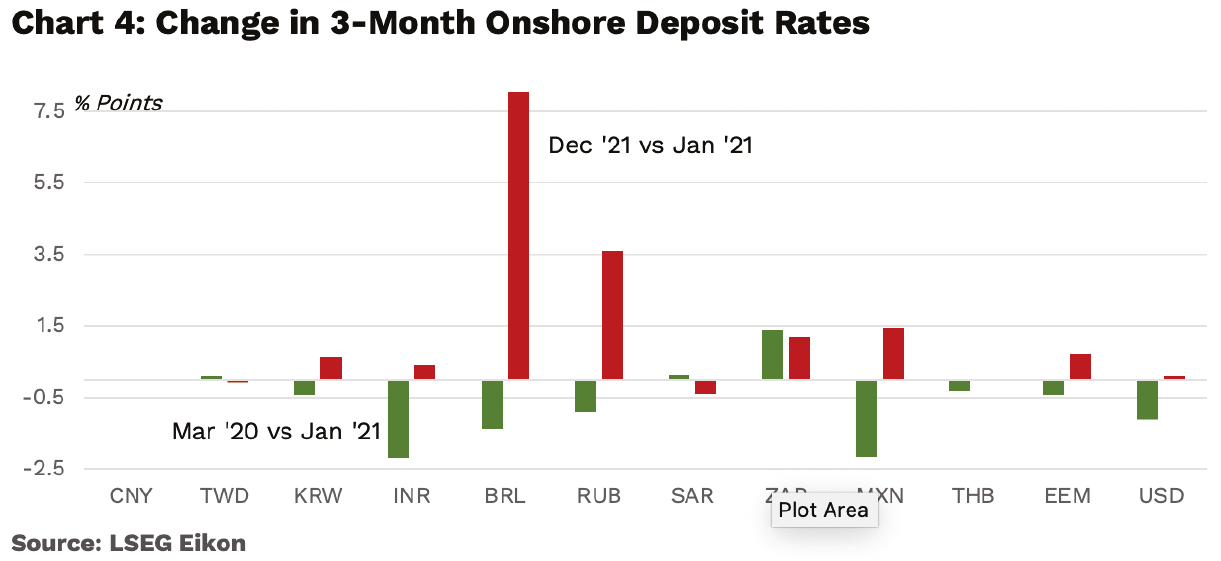
Chart 4 compares central bank policy – as reflected in changes in 3-month local deposit rates – for the United States and each market included in EEM as well as the weighted average interest rate change. The blue bars shows the change in rates during the first phase into the beginning of this year when EM markets were outperforming. The orange bars show how rates have changed since then. During the first phase, US rates actually dropped more than the weighted EM average – though some individual EM markets saw substantial rate cuts – so relative monetary policy does not seem to be a factor behind US market underperformance during phase I.

The US Federal Reserve Bank until recently has blamed most of the inflation surge on supply disruptions due to COVID that would self-correct so they felt there was little need for tighter monetary policy.

One well reported by-product of the disruption of COVID has been surging inflation across almost all world markets. The United States, in particular, saw CPI inflation hit a near 30-year high 6.8% last month. The US Federal Reserve Bank until recently has blamed most of the inflation surge on supply disruptions due to COVID that would self-correct so they felt there was little need for tighter monetary policy. Although recent comments from Fed Chairman Powell indicate growing recognition that inflationary pressures may not be purely transitional, the Fed has yet to take any specific actions to tighten policy. Plans for cutting back on bond purchases and higher policy rates while now part of the discussion there is still no intent to take action until sometime in the next year and only if US inflation does not show signs of abating.

EM central banks have not been able to share the Fed’s patience on reacting to inflationary pressures. In general, a more recent history of inflation problems in many EM markets leaves them with less institutional credibility than the Fed. Also, many EM market currencies are vulnerable to investor sentiment forcing interest rate hikes as a way to head off weakening exchange rates. The consequence is that while the Fed’s policy rate – Fed Funds – has remained flat and the 3-month deposit rate is only marginally higher, the weighted average EM 3M deposit rate is up almost a full percentage point and several markets – especially, Brazil and Russia – have seen hikes that are far bigger than the average. Relatively tighter monetary policy in EM markets is likely the primary source of SPY outperformance in recent months.

Will EM markets outperform in 2022?

Uncertainties on how the spread of the omicron variant and potential for yet more COVID mutations makes it difficult to assess market prospects for the year ahead with great confidence. That said, it looks probable that EEM stocks have potential to outperform the SPY. Based on the Our World Data site cited above, the implementation of vaccines in the markets included in the EEM while highly varied, on average, are roughly equivalent to the United States. Recent research from Oxford (see: https://www.reuters.com/business/healthcare-pharmaceuticals/astrazeneca-shot-third-dose-works-against-omicron-study-2021-12-23/) suggests that the AstraZeneca vaccine which has been more widely used in the EEM region is effective against omicron (although its effectiveness, as with Pfizer and Moderna, is contingent on a booster). Thus it seems the projected case load in the US and EM markets should not vary substantially. This leaves the biggest potential factor the potential for the Fed to play catch up on rate hikes in 2022 which could significantly weigh on US equities.

About the Author

Dr. Ronald Leven

Dr. Ronald Leven joined the economics faculty at Duke University in 2018, a capstone to his 35-year career serving as a strategist at top tier banks like JP Morgan and Morgan Stanley. He has also worked as an Economist at several major corporations and managed his own hedge fund. Dr Leven started his career researching Emerging Market default risk at the Federal Reserve Bank of New York.

References

Leveraging Islamic Finance to Support Indonesian MSMEs Through the Covid Pandemic

Leveraging Islamic Finance to Support Indonesian MSMEs Through the Covid Pandemic

By George Vamos, Ebi Junaidi and Azhar Syahida

In a recent statement, Perry Warjiyo, the governor of Indonesia’s central bank, highlighted both the importance of MSME’s to the Indonesian economy, as well as a need to support them through the coronavirus pandemic.1 When combined with global best-practice, Indonesia’s unique Islamic financial ecosystem represents an invaluable toolkit for supporting these businesses through the pandemic.

Indonesian law No.20 of 2008 specifies that an MSME is any business that holds less than 10 billion IDR (roughly $700,000 US) in assets or has annual revenue of less than 50 billion IDR ($3,500,000 US). In more illustrative terms, the label of MSME applies to everything from an owner-operated market stall to a medium sized construction firm.

According to World Bank data, the Indonesian poverty rate sits just below 10%, and marginal poverty reduction has become more difficult the lower that rate falls. With the most recent data from Indonesia’s Ministry of MSMEs suggesting that MSMEs provide just under 97% of national employment, these businesses are critical to any long-term poverty reduction strategy.

Despite their value to the Indonesian economy, MSMEs have taken a hit from the recent pandemic. Public health issues have placed constraints on demand for their services, particularly for MSMEs in sectors such as tourism or hospitality. Over 60% of micro- and small enterprises surveyed by Indonesia’s national development agency (BAPPENAS) reported a need to change the way in which they sell goods. Additionally, MSMEs in Indonesia are disproportionately reliant on domestic demand. Despite accounting for over 60% of GDP in 2019, they provided only 14% of non-oil export revenue, according to data from the ministry of MSMEs. These factors mean that Indonesian MSMEs will likely need support for as long as Covid negatively affects domestic Indonesian markets. It is therefore unsurprising that 25% of micro- , and over 30% of small and medium enterprises surveyed indicated the need for additional financing to survive the pandemic, according to BAPPENAS.

Indonesia’s Islamic finance ecosystem

The proposals for supporting MSMEs in the next section will rely on implementing institutions with a regulatory climate largely unique to Indonesia. Below is a brief overview of the two categories of implementing institutions that are critical to these proposals: rural Islamic banks (BPRS), and Baitul Maal wat Tamwil (BMT).

Despite their value to the Indonesian economy, MSMEs have taken a hit from the recent pandemic. Public health issues have placed constraints on demand for their services, particularly for MSMEs in sectors such as tourism or hospitality.

FjakartIslamic banks in Indonesia function similarly to their secular counterparts but are constrained to the use of non-sharia compliance instruments ( that include non-interest-bearing contracts), and investment in halal sectors. Moreover, a new law is being introduced requiring all banks in Indonesia to commit a ratio of their portfolio to providing microfinance, or financing MSMEs. These lending requirements, known as the macroprudential inclusivity ratio, are set to increase from 20% in June 2022 to 30% in June 2024. It is important to note, for the next section, that funds channeled through a microlending institution count towards a bank’s obligation under the ratio.

Compared to banks, the regulation of BMTs is far less clear. This is a result of the BMT’s dual function of community banking and social finance. A BMT is responsible for both providing Islamic microfinance products to a surrounding community, as well as the collection and disbursement of obligatory (zakat) and non-obligatory (infaq, shadaqah and waqf) Islamic charitable donations. Aside from donating zakat as a gift, a BMT can use zakat donations to provide charitable loans (qard-al-hasan) to MSMEs, provided the loans are non-interest bearing and collateral-free, the business is in a halal sector, and the owner of the enterprise falls into one of eight categories of eligible zakat recipients (asnaf). Whilst it is true that Islamic banks also provide zakat collection and disbursement services, they have far less latitude in zakat disbursement than BMTs. Under Islamic Jurisprudence it is also permitted for the administrative costs of zakat disbursement to be covered by donations.

Reviving MSMEs through digitalization

In a forum hosted by the Islamic Development Bank, Malaysia, one of Indonesia’s largest neighbors, has provided replicable policies for supporting MSMEs through digitalization. Learning from this example, an Indonesian digitalization program that focusses on MSMEs and utilizes Islamic banking institutions would have three components: a subsidized e-commerce platform, training for transition to online business, and support for online marketplaces for microfinance.

Currently Indonesia hosts several privately run e-commerce platforms for MSMEs, including: Tokopedia, Shoppee, Lazada and Bukalapak. Whilst these platforms provide alternate avenues for MSMEs to market their goods (a service greatly demanded, as seen above), they charge a fee for their use. This squeezes the profit margins of MSMEs in a period where rising unemployment and reduced economic growth are already suppressing demand. A subsidized government platform, without fees, can be justified on two grounds. Firstly, it will advantage micro- and small-enterprise owners, a group disproportionately found in low-income regions.2 Additionally, by moving to e-commerce, MSMEs are reducing negative health externalities, a public benefit which should be rewarded by the government.

One of Indonesia’s largest neighbors, Malaysia, has found success in sustaining MSMEs during the pandemic through efforts to shift pre-existing MSMEs onto e-commerce platforms. This required a significant training component for entrepreneurs, one that was carried out largely online, by the Malaysia digital economy corporation (MDEC). According to MDEC, feedback from the program suggested that this mode of delivery was still successful in transferring key skills to participants.3 Given the benefits that online teaching brings to scalability, not to mention public health, this program provides a blueprint for Indonesian policy makers.

Indonesia

However, the question remains, how does this relate to Islamic finance? The BPRS and BMT in a community have significant social and economic ties to the entrepreneurial sector in their area. By leveraging these connections, it will be possible to advertise these services to a greater number of people and support this process by providing financing to MSMEs. For instance, a BPRS or BMT could over the cost of online training, in exchange for a share of the business future profits. This instrument is known as a al-mudarabah al-muqoyyadah in Islamic finance.

Finally, online financing marketplaces will provide an avenue through which BMTs and BPRS’ are able to continue lending operations through public health restrictions. There are two ways in which this would occur. Firstly, institutions holding an excess of loanable funds (due to disruptions in lending operations) would benefit from an online platform that will allow them to connect with MSMEs who need additional financing. Secondly, it is also the opportunity for the use of zakat in this area, as, under certain circumstances, the use of zakat in refinancing loans for those in arrears is permitted under Islamic jurisprudence. It should be noted that for zakat to be used in commercial refinancing, the loan must be collateral-free and non-interest bearing, and the recipient of the loan must be personally in arrears. This suggests this source of financing is mostly available to micro-enterprises.

Improved temporary financing for MSMEs

As highlighted above, between 25% and 35% of MSMEs require additional financing to support themselves through the pandemic. In addition, according to the same survey conducted by BAPPENAS, over 30% of small and medium enterprises have had to reduce salaries to survive the pandemic. These results suggest that additional financing is required if the Indonesian economy wishes to retain the wealth and employment that this sector brings.

There is a possible supply of loanable funds, especially in larger urban Islamic banks, but it is difficult for these banks to assess loans to MSMEs, especially micro-enterprises and MSMEs operating in rural areas. One reason for this is that many rural loans are assessed with reference to the character of the borrower and require significant local knowledges. For instance, at one regional bank visited by the authors, many of the loan officers also work as teachers at local schools, and many of the borrowers are local parents. A key institutional advantage of BMTs and BPRS is that they engage directly with rural communities, and that their lending officers often are personally and socially connected to prospective borrowers.

Below is a proposed financing model that combines the relatively large supply of loanable funds from private Islamic banks and state-run commercial banks, and the reach and lending expertise of BPRS and BMTs.

financial model

This proposal is a way for the larger urban Islamic banks, and state-run commercial banks, to channel funding through the BMTs and BPRS to MSMEs. The first channel for funding is the use of a two-leg Islamic debt instrument. Firstly, the state run commercial banks, and Islamic retail banks enter into a conditional profit and loss sharing agreement (al-mudarabah al-muqoyyadah) with an intermediary institution (in this case a BPRS/BMT). This contract specifies that the money put in by the larger bank will only be used in lending to a specified group of MSMEs. For example, MSMEs in particularly affected sectors such as tourism, or MSMEs below a certain amount of revenue. The intermediary then identifies prospective MSMEs for new loans, and enters either a cost-plus-financing (murabaha) or a profit and loss sharing (mudaraba) agreement with the MSME. Finally, the profits from the loans made by the intermediary are split at a prearranged ratio with the financing institution. This can get a little confusing, but fundamentally, the intermediary is engaged to lend on behalf of the larger institution, and is rewarded with a share of loan profits in exchange for their lending expertise.

The second funding channel, where zakat and shodaqah collections are used to provide charitable loans (qardhul hasan) as refinancing for MSMEs in arrears, is more direct. However, this financing method is much more tightly regulated than the first, and, it bears repeating, the legitimacy of the loans is predicated on the personal financial situation of the business owner. Despite this, the use of qardhul hasan as a method of zakat disbursement (as opposed to the use of transfers) has one key advantage: by having zakat recipients repay the principles of their loans, a zakat fund based on charitable loans is theoretically self-replenishing.4

This is in essence a developmental policy, which necessarily begs the question, what’s in it for commercial banks? In answering this question, it is perhaps helpful to divide fully private Islamic banks, and state-run commercial banks into two separate cases. State-run banks present an easier case, as they remain a key policy instrument for state governments that have little discretion over their expenditure. As for privately-run Islamic banks, this financing structure presents an attractive opportunity for them to meet their new obligations under the macroprudential inclusivity ratio. Whilst there are no publicly available data on their current progress towards achieving the ratio, recent lobbying to delay or relax new regulation would suggest that meeting these new requirements will require a significant adjustment to banks’ loan books.

Conclusion – hurdles and opportunities

As we’ve heard countless times, the coronavirus pandemic brings unprecedented economic challenges. This is certainly the case for MSMEs, who have had to deal with suppressed demand, restricted supply chains, and the need to innovate in the way they do business. Nevertheless, MSMEs remain critical to achieving Indonesia’s goal of long-term, equitable growth. The measures to support MSMEs that have been proposed in this article fall loosely into two categories.

The first is a push towards the digitalization of MSMEs, involving a subsidized ecommerce platform, training for digitalization, and an online funding platform. By using BMTs and BPRS as a one stop shop for implementation, this policy will be able to reach a larger number of MSMEs, particularly in rural areas. It is unclear if these smaller institutions have the human resources to help administer these programs, but if they can overcome this challenge, it provides a significant chance for Indonesia to continue its push for poverty alleviation.

The second arm of the proposal, temporary financing, functions much more within the standard operations of the Islamic financial institutions. There is a concern that it will lead to too much money in the hands of smaller institutions, and a resultant decrease in loan quality and performance. We believe this to be overstated, and the risks will be far outweighed by the benefits it will have on rural incomes.

Although they can be implemented separately, these proposals are by no means mutually exclusive. Through the parallel implementations of strategies proposed above, MSMEs will be better equipped, financially and operationally, to deal with whatever challenges may arise from the pandemic.

About the Authors

George Vamos

George Vamos is a final-year student at the Australian National University, studying Politics, Philosophy and Economics. He is working as an intern with CORE Indonesia.

Ebi Junaidi

Ebi Junaidi is currently Director of Islamic Economics and Finance for Center of Reform on Economics (CORE) Indonesia. He is a lecturer at Faculty of Economics and Business, University of Indonesia. His research interest is on Islamic social finance, Waqf, Risk and Time Preference and Financial Decision.

Azhar Syahida

Azhar Syahida is a resercher at CORE Indonesia, Jakarta, Indonesia. He is interested on economic history, SMEs, and regional economics.


References

  1. See; Bhwana 2020, source: https://en.tempo.co/read /1383266/making-msmes-the-new-backbone-of-national-economy-during-pandemic
  2. 2 Tambunan, T. Recent evidence of the development of micro, small and medium enterprises in Indonesia. J Glob Entrepr Res 9, 18 (2019). https://doi.org/10.1186/s40497-018-0140-4
  3. 3 IsDB 2020, Showcasing Malaysia’s Replicable Solutions on Supporting MSMEs through COVID 19 Crisis and Beyond, available: https://www.youtube.com/watch?v=tUFeBNpXr24&t=4196s
  4. 4 Febianto, I., & Ashany, A.M. (2007). The Impact of Qardhul Hasan Financing Using Zakah Funds on Economic Empowerment ( Case Study of Dompet Dhuafa , West Java , Indonesia ).

3 Proven Tips for Securing a Small Business Loan in Australia

business loan

You have an innovative idea, a perfect plan, and a hardworking team prepared to help you achieve your objectives. However, entrepreneurial goals are nothing but dreams if you don’t have the capital.

Research shows that one of the most common challenges encountered by startup businesses is securing a small business loan.

Don’t lose hope just yet! 

Follow these tips to increase your chances of getting business funding:

1. Find A Suitable Lender

It is important to know that different types of lenders cater to different kinds of clients. Applying to a suitable lender increases your chances of getting approved.

Some of the choices include when applying for a business loan in Australia:

National banks and other financial institutions. Consider applying to your current financial institution because you already have a relationship. 

Alternative lenders. These lenders connect large individuals who have moderate requirements. Most often, they assist niche businesses in securing business loans fast because they are more focused on growth rather than credit scores.

Credit unions and community lenders. Locally-owned lenders with a commitment to help the economic growth of smaller towns and cities welcome loan applications for local startups.

2. Conduct A Thorough Research

When it comes to small business loans, preparation is also vital. Find out the requirements of your target lender so that you can prepare well for the application process. 

“You have to keep updated financial and tax records. Have a discussion with a professional financial advisor about your risk factors and figure out how to mitigate each,” advised startup business lender Shane Perry of Max Funding.

You must also avoid late payments, foreclosures, bankruptcies, or any other form of issue with another financial institution. Lenders usually check the credit history, credit score, and tax records, and proof of identification.

But just because you’ve had foreclosures or delayed credit card payments doesn’t mean you’ll never qualify for a loan ever again. Fortunately, there are financial institutions that are very much willing to give people with bad credit history a second chance. Many businesses fail in the first attempt. What if they are a lot better the second time around? We can help economic growth by funding those with brilliant ideas.

3. Present Your Business Plan Clearly

business plan

The clearer you present the business plan to a potential lender, the higher chances for loan approval. Keep in mind that clarity and transparency are key. Providing sufficient details allows the lender to understand your plan and trust you. 

Business experts advise that you communicate these details during the application process:

  • The specific things into which the money will be spent and why are they important. Explain why these expenses are crucial for business growth. 
  • A detailed plan on how the loan will be expended. Present cash flow projection, price estimation, and estimated rate of return. These details must be accurate, so it is suggested to hire an expert to conduct the research.
  • The list of suppliers, affiliates, and partners with whom you’ll be working with while spending the business loan. If the lender can see that other organisations trust you, the tendency is they’ll trust you too.

Get That Small Business Loan Approved Today!

Securing a business loan can be definitely challenging for startups, especially amid a pandemic. You must exhibit a strong sense of entrepreneurial spirit together with a clear business plan, minimal risk, and good credit history. Thankfully, there are financial institutions that are driven to helping stimulate the Australian economy by giving startups a chance.

How to Keep Remote Employees Happy

Remote Working

Recently, the trend and concept of remote work have emerged and become the norm. It is due to the spread of the COVID-19 pandemic. This approach compels an individual to give up on on-site practice and experience. It implies that they have to stay confined to their homes and perform the same monotonous cycle and style of work every day. It can result in an individual becoming burnt out and unhappy. 

An unhappy employee can never work to their best capabilities, be it via an online or an offline mode. It stands especially true for the former case. In general cases, a sad state of mind can decrease the work productivity of remote employees and can lead to them burning out. In addition, it can result in them becoming less engaged and focused in their projects and tasks. This manner of working can affect the performance and results of the entire department or team. That is why it is essential to guarantee and make sure that a remote employee remains satisfied and happy.

In this article, let us find out a few ways how remote employees can stay happy. 

Establishing an Effectual Communication Platform

Communication serves as the only way of acquiring and sustaining the achieved and desired results. It is the case especially when an individual works in a group or a team. Thus, remote employees also need an effective way and method of communication. However, remote work possesses an issue with this. It may be because it is arduous and almost impossible to meet face-to-face when each person works from home. On top of that, they cannot convey and understand the full extent of what they wish to say via a virtual platform. It can get owed to the lack of observation of the other party’s body language and facial expressions. 

For this very reason, it is essential to establish and utilize a constructive communication platform. It creates an opportunity for the social creatures named humans to express their points and deliver their thought conveniently and effectively. In addition, it allows an individual to remain informed about their work progress. They also get to know the tasks due in the future. It permits them to feel like they are an active portion or element of their organization as an added benefit.  

An effectual communication platform allows a person to know and understand more. It informs them that their organization remains involved and interested in all they do. Overall, it can make remote employees happy by giving them the sense and idea that they do not get neglected. Moreover, it lets them understand that their employing company acknowledges and appreciates their hard work and years of effort. 

Playing Virtual Games

A remote employee may drift apart from the rest of their team, department, or organization the longer they spend time away from them. It can result in them becoming awkward with others and unhappy. Thus, remote employees must maintain the connection they have with others. They must even create new bonds virtually. It can get done with the help of Virtual Happy Hour Games

Virtual icebreakers are games that allow a group of people to get to know each other. They can be acquaintances or strangers. Overall, it permits a person to share their likes, work style, weaknesses, dislikes, strengths, and specialization comfortably and conveniently. A team can connect to others in an engaging and fun manner when playing virtual icebreakers. It permits them to feel relaxed with others and happy overall. 

Virtual icebreakers also come with the ability and capability of increasing a remote employee’s dedication, focus, and motivation. 

Rewarding Superior Standard and Quality of Work

An individual feels happy whenever their work and efforts get recognized and acknowledged. It gives them a sense of victory and an added motivation to work more. In the case of remote employees, it lets them know that their organization cares for them and appreciates them and their dedication. In other words, the mere recognition of a remote employee’s efforts can make them immensely happy. 

This feeling of joy and satisfaction can increase even more by rewarding a remote employee for a well-done job. The scale and degree of the rewards can vary. It can range from a mere “great work” or a “thank you” to medals, incentives, and certificates. Irrespective of how remote employee gets rewarded, they feel appreciated and happy. It can lead to an increase and improvement in their work output, productivity, and efficiency. 

Permitting Work Flexibility

Remote work compels an employee to manage their personal and professional lives together. It can become demanding and arduous for them to do so in most circumstances. That is why each employee must implement flexibility in their task progress and work timing. It allows them to complete their work and projects on time if they use a schedule according to their needs. 

Generally, all remote employees prefer to finish their work on a comfortable and agreeable schedule. In addition, it lets them manage their responsibilities effectively and without leaving out anyone. Overall, the emphasis and highlight on the “what” is necessary. It is even more so than the “when.” It permits a remote employee to work in a relaxed style or manner with no unnecessary pressure. A stress-free work environment can keep a remote employee happy. 

Removing Superfluous and Excessive Restrictions

Unnecessary and excessive limitations in the work style of remote employees can make them unhappy. It can impose several restrictions on what they can do, leaving only a single path of action for them to follow. These restraints probe into the free time and personal space of remote employees. It can leave them feeling uncomfortable and displeased. 

Excessive restrictions can create a stiff and monotonous work environment for a remote employee. It can result in a severe drop in their work efficiency and output. Such a situation can prove detrimental to the entire organization to which the remote employee belongs. For that reason, it is essential to remove all excessive limitations that can make a remote employee stressed and unhappy.

A Buyer’s Guide To Purchasing The Moissanite Jewelry In Toronto

Jewelry

Would you like to purchase jewelry that shines brighter than diamonds but is an inexpensive option? If yes, then moissanite is the right choice for you. Moissanite resembles diamonds closely with a few differences like the shine. Moissanite jewelry shines better than diamond jewelry; in fact, it shines better than most stones available out there. That is why this stone is used as an alternative option, especially when diamonds are going out of the budget. One significant difference is the price, moissanite being cheaper than diamond. So, you will never regret ditching diamonds for moissanite jewelry in Toronto. If you want to know more about moissanite jewelry, in this guide, you will find the basic difference between the lab-created diamonds and moissanite, along with the top qualities of this stone. Let’s begin. 

Difference between lab-created diamonds and moissanite 

  • Unlike the lab-created diamonds that are purely created in labs, moissanite stone is found naturally. The stone, which was unearthed in the 1800s, is extremely rare. Don’t worry; gem scientists have figured out how to make moissanite, so everyone may purchase one. 
  • Despite being created in labs, Moissanite stone differs substantially from lab-made diamond in terms of appearance and hardness. 
  • Moissanite sparkles significantly differently than a lab-created diamond due to the variation in chemical composition (it shines more.) The difference can be spotted in the sunlight. This stone is ideal for couples that like to keep their expenses to a minimum. 
  • Choose from a variety of cuts that are available in the moissanite jewelry. The oval cut is the most popular one that people often choose for their moissanite engagement rings

Top qualities of moissanite

Lasting Durability and Resilience

Everyone wants their jewelry to last a long time, especially unique ones. Moissanite in Toronto is a stone that offers long-term durability and resilience. The durability of your jewelry assures that it will retain its luster and brilliance for a more extended amount of time. On the Mohs Scale of Hardness, Moissanite is only second to diamond (which has a rating of 10) and is harder than sapphire and ruby, making it one of the strongest substances on the planet. So, buying jewelry made with moissanite will stay in good condition forever.

Stunning clarity

Moissanite gemstones are known to have a stunning clarity that is difficult to find in any other gemstone. Well, since this gemstone is most often compared with diamonds, it has to have a remarkable shining quality. A moissanite’s clarity grade is frequently equivalent to or even higher than that of a diamond; nevertheless, it is less likely to be sold if it is less than that. People who purchase moissanite make sure that they get top-notch clarity. This also means that you can hardly spot any difference between the two with your naked eyes. 

Ethically superior

Though moissanite is naturally available, it is now being created in labs in a very controlled environment. No longer does it require the process of mining to dig out from the surface. They use advanced machinery to grow this gemstone. So, it removes the potential conflicting mining process, and provinces that can be dug are hard to find. The mining process has been in conflict as lots of underage kids are involved. Also, digging land after the land is not suitable for nature. Lab-created gemstones like moissanite eliminate all these negative factors. 

These are some amazing qualities of a moissanite gemstone. We have tried to cover all the important information related to moissanite in this guide. If you want to wear your jewelry every day, buy pieces made from this durable gemstone.

EDITOR'S PICK OF THE WEEK

CFO's new mandate. CFO explaining the presentation

The Performance and Transformation Orchestrator: The CFO’s New Mandate in the Age of AI

By Terence Tse CFOs are evolving into AI-driven transformation orchestrators, balancing finance, technology, and strategy while upskilling teams, managing risks, and driving measurable business value. A key insight from this year’s AI for CFOs event, organized...

WISE DECISION MAKER GUIDE

POWER INFLUENCERS

Emerging Trends

The Future of Global Trade