Home Blog Page 745

Asian Melodies Review: Complete Guide with Subtlenesses, Links, Numbers

Asian Melodies - Review

Reviewed by gobrides.net

Asian Melodies—one of the most popular dating sites with Asian women from 20 countries. It is supposed that a new user will be impressed by women, the brightness of conversations, friendly usability, but how about services and price from the first second; let’s see if it is actually true. You will find answers to all your questions in this AsianMelodies review. 

There is the primary AsianMelodies review: 

? Visitors 450,000
♀ / ♂  Around 70% of women

30% of men

Good For
  • Casual dating
  • Serious relationship
  • Marriage
Age Distribution 20-40 for women

30-60 for men

? Mobile Friendly Yes
? Site AsianMelodies

AsianMelodies review in 10 seconds

✔️ Asian Melodies is a website for single men from all countries determined for connection with Asian girls.

✔️ The monthly audience of the Asian dating site is 470,000 visitors. 

✔️ As with many dating websites, registration is free 

✔️ You can find your mail order bride with simple research, advanced research, with the Faces game 

✔️ Most of the girls on the site have verified user profiles

✔️ There is no Asian Melodies app, but the site offers a mobile-friendly version

✔️ Paid services include: sending emails, live chat, sending video, requesting contact details, and other

✔️ You can try the website with 20 free welcome Asian Melodies credits

✔️ For registration, you need only a working email

✔️At the start, you can pay just $2.99 for 20 Credits.

➤ Register at AsianMelodies and get 20 Free Credits

Why can you trust us?

  • Our specialists have been reviewing online dating services for over 7 years
  • We always provide facts, avoiding our personal opinion
  • We describe dating services for all points, considering user’s ration
  • We have our own algorithm of reviewing dating sites that shows real results

Who is Asian Melodies for and not for?

Is good for men … Is not good for men …
Who dreams about an Asian woman Who wants to find a European woman
Who wants to start a romance or have a fun time interacting with Asian singles Who wants to find a woman to marry
Who are interested in communication with traditional women Who prefer career-oriented ladies 

Latest Experiences

Asian-Melody---Review

Can you try Asian Melodies for free?

Registration on the Asian dating site is free. You also can use these free based features:

  • Creating of profile
  • Visiting profiles 
  • Sending winks and likes
  • Paying the Faces game
  • Opening first mail

In other words, you can make a deep acquaintance with the website for free, but communication is accessible only for money. 

How much does Asian Melodies cost?

Asian Melodies adheres to a credit system: users buy this virtual currency and spend on fee based services.

Number of credits Cost
20  $2.99 (first payment)
20  $9.99 (for the second and next 
50 $19.99
125 $44.99

Who is really signed up here?

? Members activity High activity

471,000 users per month

? Gender proportion — 70%

♂ — 30%

? Nationality proportion 43% — USA

37% — Canada

9% — Australia

1% — Other countries

AsianMelodies sign up

  • The registration process takes just 5 minutes
  • Only basic information is requested
  • You should have just a working email for verification
  • Little questionnaire after signing up

Asian-Melodies---Site

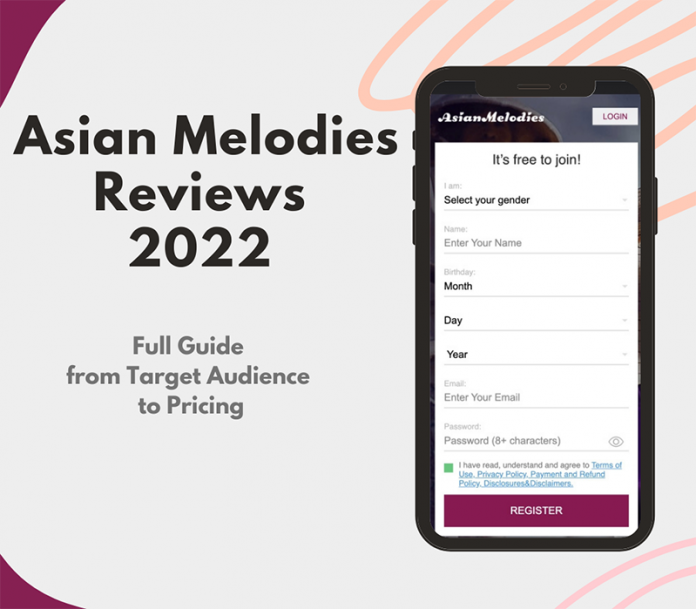
As people write in detailed reviews, signing up at Asian Melodies is a fast and easy process, and we can agree with it. At the first stage, you need to answer a few of the most fundamental questions: your gender, date of birth, email, and password.

After that, you need to fill out a short questionnaire with a main focus on questions about you and your woman. We recommend answering these questions: it will save you time later, during creating a profile.

Questions about your woman include her appearance, status, habits. You can also indicate if your ideal partner has children.

The website will ask 13 questions about you, too. You will be asked to describe your marital status, education level, religion, and occupation. You will also be able to immediately upload your photo and a brief description of your personality.

You will then receive an email to confirm your registration. Just click this link to go to the AsianMelodies website and complete the registration. Completing this step will allow you to start using the dating service.

The site has a good rating for fast, but at the same time, complete registration that will allow you to start interacting with singles immediately after it with a 100% filled profile.

➤ Register and get 20 Free Credits

How to avoid fake profiles and bots

  1. Ask for profile videos. To be more sure that it’s not fake accounts, ask for a special gesture on the video.
  2. Watch for natural descriptions. It’s good if you can feel a real person from the description.
  3. Use Google image search. If you see suspicious accounts, you can google photos from them.

Asian-Women

Important tips for profile pictures

  • Selfie is not a perfect choice. Better to place a portrait with a clear background on your profile page. It helps a lot to make a good first impression. A good alternative is a photo in a cafe or park. Also nice to place the picture depicting your hobbies. 
  • Upload 3-5 photos. We advise you to add to your member’s profile a few pictures from different places. You should also use profile photos at full height. 
  • Use photos from vacation. You can show that you have an active way of life and can propose one exciting life to a girl. 

Making contact on Asian Melodies

  • Letters and live chatting at the dating service
  • There is no video chat, but a user can send videos
  • Members can show their first sympathy with winks and likes services
  • Profile video is accessible to paid members
  • Man can open the first letter from a woman for free
  • Likes and winks are not special features, and they are free services
  • You can send messages to a girl. 1 minute of chat service costs 2 credits
  • Writing an email costs 10 credits for the first and 30 credits for others.

Asian dating suggests that a man always takes the initiative. The great advantage of AsianMelodies is that it provides many opportunities for this. We advise you to use different methods depending on the situation. You can start with a wink and end with a ransom of contact information if you feel the moment is right.

Asian-Melodies---Feature

Now let’s consider all the ways of interaction with singles on the AM website in detail:

  1. Faces. This paid feature allows you to view photos of Asian Melodies dating site members without going to their profiles. You can like the girl you like or skip the image.
  2. Like. You can send a like in Faces or go to the girl’s profile. Your Asian beauty will get a notification about this.
  3. Send a wink. This service is also available in both the girl’s profile and Faces. It is a free service. Check with her how the girls react to your sympathy.
  4. My favorites. This handy service allows you to save attractive profiles and return to them later when you finish reviewing girls.
  5. Live chat. You can use this service if the girl you like is online. Chat allows you to send photos and videos.
  6. Mail. One another feature from paid services. Email is a bit old-fashioned but effective way of communicating. With the help of a letter, you can tell a lot of details about yourself and get them from a girl.
  7. Send gifts of flowers. The paid services for brave men. This little gesture will impress almost all Asian ladies. It’s not a cute virtual gift. The gift will be delivered directly to her door, and you can choose it from the catalog on the website.
  8. Contact requests. One day there will come a moment when you want to leave the site and continue to communicate on an independent site. Depending on the situation, you can access the service for free or for credits.
  9. Meeting request. If you are ready for a meeting in real life, you need to act. You can use the help of the site in organizing a meeting.

Asian Melodies profile quality and features

  • Upload and view public and private photos
  • Create your bio with 4-6 sentences to attract but not be too boring
  • Public photos can see all beautiful Asian women at the site
  • Video uploading and viewing are paid features

Asian-Melodies---Profile

Expert tips on what to write on your bio 

  • Tell about your work. If you do not want to mention the position, indicate the industry. It will help the girl to start a conversation more straightforwardly.
  • Use humor. Be careful—avoid too vulgar jokes and those that have an ambiguous interpretation.
  • Don’t cheat. Even if this is a small thing, the girl may think that you can deceive for various reasons.
  • Tell about your hobby. Ideally, mention something not very common. It will help your girl to highlight and remember your profile.

Example 1:

Example 2:

Asian-Melody---Description

How can I delete my AsianMelodies account?

Open your profile settings and click the ‘Deactivate profile’ button. If you have a problem, write to customer support AsianMelodies.com and ask to solve this problem. The support team gives answers in 1-2 hours on average. 

Editor’s conclusion: Is Asian melodies worth it?

“Asian Melodies is a site that deserves the attention of men who are looking for Asian women. Many communication skills, girls from 20 Asian countries, and friendly usability create an excellent background for building relationships. ”


David-Wygant
David Wygant

I’ve helped millions of men and women around the globe achieve success in their dating, social and personal lives.

General questions

Is Asian Melodies available worldwide?

Yes, the dating site is available worldwide. You can find Asian women despite your location.

How can I register on Asian Melodies?

The registration is simple and free. Follow the main page, ask a few questions and confirm your email. The last stage-filling a small questionnaire about you and your women’s preferences.

Is your phone number required for signing up at Asian Melodies?

No, working email is enough to make a profile on the site.

How do I verify my email?

In registration, you will get an email with a link. For verification of your address, you should click on the link.

Do your Asian Melodies profile pictures and/or profile information show up in Google search results?

Is Asian melodies safe? Yes, it is. Google does not contain index information from profiles posted on the dating site.

Who can view your pictures on Asian Melodies?

Your public photos are available for all other users at the dating website. You can see all the profiles too. Private pictures can see members if you give them access to. 

How can I message someone?

Just click on the text field in the woman’s profile, type your message and send it. Remember that this is a paid feature.

Can you try Asian Melodies for free?

You can use the free services of the dating site constantly. Also, the website provided 20 welcome free credits. For instance, you can spend it on emails or for a chat.

Can you erase your personal data on Asian Melodies?

Yes, you can.

Alternative best dating sites in other regions

# Site Region
1 EasternHoneys Asia
BravoDate Europe
3 AmourFeel Europe
4 AmourFactory Europe
5 UkraineBride4you Europe


Effective Strategies to Increase Client Satisfaction

Client-satisfaction

Have you ever wondered why some brands can keep their clients happy while others struggle? In all probability, we’ve all had the experience of working with a client who is unhappy with our work, something that can be truly damaging to your brand and can also significantly impact your company’s revenue.

For example, if your customer satisfaction levels are low, chances are, your retention rates will be low as well. For that reason, customer satisfaction is a corporate aim and represents a solid fundamental to success for every thriving company.

Although only one out of every 26 unsatisfied customers actually complains to the company’s customer service department, a staggering 91% of disgruntled non-complaining consumers leave the business and never come back, which is worse.

Having that in mind, you probably won’t want to lose 91% of your consumers, which is why you need to learn to identify disgruntled customers, raise their satisfaction levels, and improve their customer experience. So, let’s plunge into the strategies you might need to employ in order to achieve all that.

Consider Incorporating Corporate Gifting

Corporate-gifting

When you’re dealing with a certain number of customers, such as in the case of a corporation, you can’t just go out and find new customers every time you run low on business. So, rather than constantly looking for new clients, a corporation should look at ways to retain their current clients, and one of the best ways to do that is through corporate gifting.

Corporate gifting is a beautiful way to thank your clients and allows you to show that you appreciate the business your company has received from these valued individuals. It also provides the opportunity for you to get new leads, referrals, and reorders. Aside from being able to influence your client’s purchasing decisions by providing them gifts, other advantages come with this type of marketing campaign.

In addition to these effective strategies, consider incorporating unique branded merchandise, such as custom socks from Custom Sock Lab, as a thoughtful gesture to enhance client satisfaction and deepen brand loyalty.

It’s Cost-Effective

When you provide your clients with corporate gifts, it doesn’t necessarily mean that you’ll spend more money on them than if you hadn’t gifted them with anything at all. In fact, it might prove to be a cheap marketing technique that will increase their client satisfaction, as the gift, whatever that is, may lead to making additional sales. 

For example, if one of your clients receives a gift from you and likes what they receive, they will surely recommend you to other potential clients who may also become loyal customers along the way.

It Increases Your Brand Recognition

Having your brand’s name associated with particular items will create a positive image for your brand and gain the attention of even more potential customers. This can be achieved by supplying your company name, logo, or slogan on promotional merchandise, as well as imprinting your company’s name on a variety of items such as tote bags, mugs, pens, etc.

Regularly Gather Customer Feedback and Use It to Your Advantage

Listening to and regularly analyzing your customers’ feedback will help you better grasp their wants and needs. This way, you’ll be aware of what your clients desire and what they think about your company, modify your products or services in a way that will gauge customer happiness, and ultimately increase customer satisfaction.  

As a matter of fact, shopper-centric businesses are 60% more lucrative and profitable than non-customer-centric businesses, which comes as no surprise, so your brand must learn how to measure customer satisfaction regularly and then curve that feedback into action—reply to comments and messages, share it across all your company crews, and actively ask your clients for more feedback on all touchpoints of your service and product.

Pitch Into Social Media to Increase Satisfaction Levels

Social media has been one of the most potent marketing tools over the last decade, and it is easy to see why. While the internet and related technologies have been helpful to businesses in general, social media platforms are the ones that have made business more accessible to the average consumer than ever before.

As a result, there are more opportunities for brands to connect with customers and cultivate client relationships which will eventually translate to increased customer satisfaction with the company. For instance, a simple tweet such as “We are running a special menu this week, and we would like to hear your opinion about it” will get your message out to thousands of people who have shown interest in your restaurant and give them a platform where they can share their honest opinion about your latest menu and engage with your company. 

Additionally, you can use social media to engage your clients through quizzes, contests, giveaways, and other activities, provide them with consumer assistance regularly, and keep a close eye on how they react to your posts.

Final Thoughts

Ultimately, happy customers are the best way to ensure clients return for repeat business, and client satisfaction is essential for building a solid brand and potent word-of-mouth marketing. So whether you prioritize client satisfaction to improve your brand’s quality or your marketplace standing, it’s an essential factor that should never be ignored. Remember, happy customers are a brand’s best form of advertising, so the key to success is always to satisfy the customer in the best way imaginable.

Approaching Risk Management With Your Head in the Cloud

Olga Orekhvo

Interview with Olga Orekhvo, Chief Operating Officer of CompatibL

CompatibL is a leading provider of custom software development services and trading and risk management software solutions. At a time when many companies are turning to the cloud as the foundation of their IT strategies, Chief Operating Officer Olga Orekhvo explains how the cloud is just one – albeit an extremely potent – shot in the company’s software solutions locker.

Thank you for gracing us with your time, Ms Orekhvo! To begin with, can you give us a few words on why you chose to pursue a career in IT?

Thank you for having me at the World Financial Review!

I had always felt drawn to and predisposed toward working with technology (hardware and software in general). From the very moment I unboxed my first Atari 8-bit personal computer and wrote my first code in BASIC, I knew that this passion was here to stay. 

There is a long list of advantages to pursuing a career in IT, and I would emphasise three of them: a dynamic environment that promotes innovation and creativity; working in a team of smart, strategically oriented and talented people; and ample opportunities for professional and personal development.

Since its launch in 2003, CompatibL has become an industry leader and technology-oriented partner for many successful organisations today. What would you say have been the principal factors in the company’s success? 

At a time of fierce global competition, proficient and devoted people have always been our moving force in gaining a competitive advantage in the industry. The vision and the leadership team headed by the company founder, Alexander Sokol, were instrumental in CompatibL’s success.

Being able to bring the most talented people with both programming and math backgrounds together is one of CompatibL’s core strengths. We pride ourselves on being a rare quant- and engineer-minded company. Our forte is our unrivalled ability to apply quantitative analysis and engineering know-how to problems in order to create efficient and scalable solutions. We were deliberate in building this culture and believe it sets us apart from the competition.

In very simple terms, what are the components of a software solution? Can such a system be assembled today from “off the shelf” components, or is it necessary to do bespoke development in each case? 

We pride ourselves on being a rare quant- and engineer-minded company. Our forte is our unrivalled ability to apply quantitative analysis and engineering know-how to problems in order to create efficient and scalable solutions.

There are many different components of a software solution, but the most basic are: the database, the back end, the user interface (UI), and the business logic. The database is the heart of every software solution, providing the underlying structure for storing and managing your data. The back end can cover different things in each case, such as API design, database architecture, server configuration and deployment, etc. The UI is how users interact with the application. The business logic is where all of your data is managed and how it’s organised. Together, these parts provide a fully functional program that can solve a particular problem.

Think of it like a car. The UI is the steering wheel, brakes, and gears; it’s how you interact with the application. Business logic and data structures are like the engine, transmission, and chassis; they make sure everything runs like it should.

It’s possible to build such a system today, but bespoke development or at least some modifications or extensions to the already-built software will likely be necessary in many cases. It makes sense from a security perspective, but also from a functionality perspective. An off-the-shelf solution will get you an initial offering, but it won’t be tailored to your very specific needs.

There is a saying that goes, “Most quants can’t code, and most engineers can’t do math.” One look at your varied portfolio of services quickly debunks this theory. How important was it for the company to be the exception to this rule?

From day one, CompatibL’s most challenging thing was to become an exception to the “most quants can’t code, and most engineers can’t do math” rule, and to bring together people who can do both. We’ve hired and trained quants who know a lot about software engineering, and we’ve hired and trained software engineers who also have in-depth knowledge of math and quant models. Combining both quant and engineering expertise in one team is what helped us to get through this challenging episode, and it’s what still makes CompatibL so effective in developing software and services specific to the financial industry.

developing software

For 17 years and counting, CompatibL has remained independent and free of the pressures that come with venture capital and outside shareholders. What do you think have been the primary reasons for this autonomy?

Fundamentally, CompatibL is structured to dream very big. We have always faced uncertainty with a plan and considered any turbulence, which is a normal part of each company’s evolution, as a wide range of possibilities. Innovation is no longer a luxury, and to achieve progress, be better prepared, we incorporate the lessons we have learned into decision-making processes and challenge the status quo. Our resilience strategy helped CompatibL withstand several global crises, including the global financial crisis, which shaped the industry significantly. Clear goals and resilience – these are the vital ingredients of our autonomy.

Your company prides itself on building software models from the ground up and making sure that that they integrate seamlessly with other models. Could you give us a general overview of how it all works?

CompatibL makes seamless integration possible by using our flexible microservices architecture, which permits individual cloud deployments for each service. These microservices communicate via REST semantics and can be hosted in Docker and deployed on any cloud/cluster infrastructure supporting Docker or similar container technologies. Or they can be self-hosted on a dedicated server. This allows us to combine microservices written in Python, Java, C++, and C# within an integrated workflow, including user-implemented extension modules. Clients are able to add new microservices and have them executed as part of CompatibL’s software workflows.

We also implement the analytics and business logic using a set of open APIs called CompatibL Runtime, with open-source adapters available in Python, Java, and C#. This is why CompatibL’s software can easily run on a wide variety of cloud, storage, messaging, and in-memory cache technologies selected by the client, instead of forcing the client to adopt the set of technologies and software versions required by the vendor.

The unique feature of CompatibL Runtime is its ability to run the same code on a broad range of relational and NoSQL database types without deterioration in performance. Thanks to its unique architecture, CompatibL Risk can run on relational databases such as Postgres, document databases such as MongoDB and DocumentDB, wide table databases such as Cassandra, and key-value databases, such as Dynamo and HBase.

Can you describe your customers’ involvement in the process of developing services for them?

We’re constantly gathering feedback from our customers and listening to their ideas, wishes, and suggestions for improvement.

We take a human-centred approach to product research and design. We spend time with customers to understand the problems they face. We’re constantly gathering feedback from our customers and listening to their ideas, wishes, and suggestions for improvement. We want to create the product that’s just right for them, and we’ve learned that this means taking time to listen and understand their needs and concerns before we develop a product.

We really value the customer experience and offer 24/7 support. When starting a new project, having round-the-clock support is crucial to keeping our customers happy. 

Most of our projects have ongoing requirements rather than being a one-off opportunity. Our agile software development delivery model offers agile project management specifically for that, which helps satisfy customers’ expectations and deliver a flawless product on time.

What are your clients’ typical reactions when you describe the approach to developing a software solution? Might they have concerns because they perceive the technology to be not yet mature enough or the process not sufficiently clear?

It’s not unusual for software developers to be asked about their approach to building a new feature or developing a new software solution, and you’ll typically hear one of two things: it’s like baking a cake or it’s like building a house. In the case of CompatibL, it’s more like building a megapolis, with layers and layers of levels built upon each other.

We normally see reactions that vary from very enthusiastic to rather reserved. The more cutting-edge the client is, the more enthusiastic they are about exploring modern agile ways of developing a software solution, such as extreme programming or feature-driven development. It’s also not uncommon for us to encounter concerns about whether we can deliver on time, whether we can deliver a reliable solution, and what guarantees we can provide if the outcome is not satisfactory.

Most of our clients understand the complexity of the technology and processes involved in creating a software application. They realise that we’re doing due diligence and taking all of the variables and unknowns into account to make sure we build a solution that truly meets their needs and solves their business problem. The steps we outline make the development process transparent and very easy to understand, and our business development team is always available to help our customers through any questions or concerns.

What do you think are the primary benefits that software solution services can offer in a post-pandemic setting?

The software solution services industry is heavily cloud-driven, from simple data storage to advanced automation and collaboration tools. Most companies today are using cloud technologies, whether they realise it or not. With the cloud being so obvious a choice for businesses today, it’s amazing to see that some companies have been so slow to react. But now that they realise the need for a proper IT infrastructure and a company-wide approach, they’re ready to start focusing on their technology assets.

Cloud-native solutions can take full advantage of cloud services’ “pay per use” billing model, which helps optimise the cost of variable application loads. Financial services firms run many compute-intensive processes as part of their end-of-day workflows as well as intra-day – for example, during portfolio optimisation or when executing a new trade. Using legacy architecture on-premises or in the cloud for variable loads results in ineffective resource use, as either the physical or virtualised instance cannot be ramped up or down seamlessly when the application is running, while the ability to ramp up or down a cloud-native service is readily available.

CloudTo unlock the full potential of the cloud, the software must be re-engineered around services and deployment pipelines. It must use modern cloud-native technologies, such as serverless computing, distributed NoSQL databases, and cloud object storage. Only by fully embracing cloud-native architecture, using services-based technologies and tools, and demanding the same of the firm’s vendors can a financial services firm realise the full benefits of the cloud. 

Another benefit of the cloud is its high degree of redundancy, even when running in a single geographic region. Even-higher redundancy can be achieved by using a different geographic region as a hot standby. This leads to significant cost savings compared with deploying an on-premises application at a disaster recovery site.

In one of our case studies, by implementing serverless cloud-native technologies, we were able to reduce the infrastructure cost of CompatibL Risk Cloud deployment on AWS by an average of 62 per cent, and on Azure by an average of 72 per cent compared with deploying the same application in an on-premises data centre. This three-to-four-fold cost advantage was made possible by leveraging true serverless cloud-native technologies, rather than running the existing application on virtualised servers.

However, when faced with a complex project with tough deadlines and budget limitations, project leadership often takes the path of least resistance and simply transplants existing software architecture to the cloud by relying on the infrastructure-as-a-service (IaaS) offering of their cloud provider. This option results in migrating the application by merely creating its mirror image in the cloud, with each on-premises server migrated to its virtualised cloud counterpart. While this approach requires few changes in the software itself, in the long run it deprives organisations of the tremendous value and potential of cloud-native technologies.

CompatibL also works in the area of security and compliance, apart from its already rich archive of delivered technology-powered solutions. Can you tell us a little bit about this part of your work?

Security and compliance have always been important pillars of the financial sector. Today, we’re building on that foundation to meet the emerging need for cloud transformation. Our customers primarily focus on moving out of their data centres, but adopting the cloud is not just about technology transfer. There is a lot more to cloud transformation than the actual transfer of assets. CompatibL helps to identify and evaluate IT risks and develop custom security strategies to cover any gaps. Our team of experts is focused on advising financial organisations on security compliance, risk control, and governance. Whether it’s in the cloud, on the network, or at the endpoint, we offer our expertise to help safeguard and improve the existing security governance of our clients. This includes data privacy, third-party risk, and IT regulatory compliance following their specific business challenges, goals, and requirements.

Given that most of your projects reside in the cloud, how do you think the current hybrid and fast-paced work situation will affect the digital climate? 

The cloud presents a lot of opportunities, but also a lot of challenges. We’re working to make sure our customers can easily realise their ideas with our risk cloud software and are able to work without limitations. In the cloud, you have freedom, which enables fast-paced work and eliminates the traditional boundaries of on-premises systems.

The advent of remote work during the pandemic has significantly reduced management’s resistance to having applications in the cloud rather than in-house. The most important change has not been technological but psychological, as, during the pandemic period of remote work, both management and the employees have grown comfortable with not having their systems hosted in their physical proximity.

 Engineering FacilityRemote work is making steady inroads in the industry through more tolerant attitudes toward telecommuting on some days of the week, but its expansion has been slow. COVID-19 is having a tremendous impact by normalising remote work and, in a matter of months, has brought about transition that would otherwise take years or perhaps even decades. Without a doubt, this rapid shift accelerated the digital transformation and the adoption of new technologies for working remotely. The lasting impact long after the pandemic ends will be the ability of organisations to successfully manage a geographically distributed workforce with a reduced need for in-person contact, providing new opportunities for expansion and recruiting. And this can only be achieved by leveraging the cloud.

Other than being an invaluable tool in transition to remote work, the impact of the cloud on software development has been critical for adapting to rapidly changing market conditions during the pandemic. Faced with the need to make rapid changes to their software systems, financial institutions have seen first-hand how the cloud provides a faster and more effective way to rapidly evolve their software and IT infrastructure compared with the traditional on-premises model.

The business outlook on the security of cloud infrastructure compared with hosting sensitive data locally is also changing. With remote and new hybrid working models expected to be the norm for employees, on-premises-based access to data is now seen not as an advantage but as a liability.

Speaking of disruptors, cybersecurity continues to be one of the primary concerns and is an area of growing regulatory focus. How do you assure clients that this is not an issue?

Cybersecurity is one of our top priorities. When developing CompatibL Platform, we focused on four key principles to ensure that the platform withstood cyberthreats: privacy, security, resiliency, and agility. We introduced a list of policies and procedures to ensure effective cybersecurity based on a number of foundational elements, including a risk-based approach, a strong leadership programme, and a culture of respect for our clients’ security. We also have a dedicated internal cyber-team that utilises leading security technologies to protect our customer data, and we have formed strong partnerships with best-in-class providers in this space.

Cybersecurity is one of our top priorities. When developing CompatibL Platform, we focused on four key principles to ensure that the platform withstood cyberthreats: privacy, security, resiliency, and agility.

 Security risks are often cited as the reason some firms have not transitioned to the cloud. Previously, financial services executives believed that just because a server is local and housed at a site owned by the company, it is more secure than the cloud. However, this is a false sense of security. A security breach will likely be not from someone breaking into a data centre and physically accessing the local server, but through a cyberattack. If you look at some of the most significant security incidents, most of them happened when an on-premises or data centre network was compromised through a cyberattack, rather than through a breach of physical security. In the modern world, you cannot operate while disconnected from the internet. No matter how good your internal network security is, just the fact that you are using a non-standard network already makes it less secure than the highly standardised networks of AWS, Azure, IBM, or any of the other major cloud providers. Like Azure access management provides a secure and compliant environment for controlling user access and can be integrated with other Azure services. It also includes features such as multi-factor authentication, single sign-on, and self-service password reset.

Cloud infrastructure providers have whole teams and divisions staffed by extremely competent people who work on cybersecurity. Over time, and especially during the pandemic-era remote work, banks have learned to trust their cloud providers with protecting their data and systems, and their trust has not been misplaced. Cloud providers can do things that an individual organisation cannot do without a massive budget, and they can be your trusted partner in securing your network from cyberattacks.

Among the many advantages of running cloud-native systems is enhanced cybersecurity. A cloud-native application reduces cybersecurity risks by using a standard set of cloud services and technologies, which presents less penetration risk than non-standard on-premises or hybrid networks. 

Like many other sectors, information technology and financial services have traditionally been male-dominated arenas. How would you characterise the current situation in the industry in terms of progress towards achieving an equitable gender balance?

The reality is that male-dominated arenas are losing out to the competition and becoming outdated in many different professional contexts. Leading IT and financial services companies don’t want to create a disadvantage and strive to reap the benefits of gender diversity. However, while the industry has come a long way in becoming less male-dominated over the past 10 years, there is still room for improvement.

What do you see as the main challenges faced by women today embarking on careers in financial services? What advice would you give them?

No one has it easy at the beginning. It’s hard individually to resist the statistics that suggest an act of discrimination may target the members of a particular group whose productivity goes unobserved, and this group is perceived to have a lower average productivity or a different mindset. My advice is to be adaptive and agile, set objectives, and adjust as you move forward. Sometimes you need to twist, turn, make a small change, and carry on walking toward your ultimate goal.

What can we expect to see from CompatibL in the coming months?

Machine learning is rapidly becoming a must-have in financial trading and risk applications. At CompatibL, we’re at the forefront of this change. CompatibL is conducting cutting-edge research on machine learning models for portfolio valuation and risk management, and was the first vendor to bring a machine learning credit limit model into production. As part of the next release of our platform planned for Q1 of 2022, we plan to release a full suite of machine learning models for valuation and risk across all asset classes. 

Executive Profile

Olga Orekhvo

Olga Orekhvo has joined CompatibL in 2014 and serves as Chief Operating Officer. She is responsible for overseeing day-to-day company operations and contracting matters. Also, Olga manages compliance department at CompatibL, ensuring full compliance with laws, regulatory requirements, policies, and procedures.

Benefits of Online Education for Students

online education

Online education is a term that defines the method of teaching using computers and the Internet. It allows studying without leaving own home. The effectiveness of online learning, more than other forms of education, depends on providing learning materials, monitoring work, and contact the teacher. Therefore, the development of this form of education was due to the introduction of the latest information technologies and means of communication. 

The idea of ​​online education is not new. Its practical application took place almost 100 years ago. Initially, it was implemented through the mail by sending didactic materials, exercises, and tasks to pupils and students. This method of organizing the educational process, later enhanced by audio and videotapes of training sessions, is still used in some countries today. “Educational Radio” appeared in the 1920s, and in 1945, “Educational Television” was launched at the initiative of Iowa State University. However, the intensive development of online education began only in the 90s of the last century due to the discovery and spread of the Internet. This information environment has provided online learning with a steady positive dynamic.

As many students note, it is fascinating and beneficial to study online. It is possible to access any educational material, contact a teacher, and get help from professional writers without any problems. AffordablePapers is the best company where students can find an experienced cheap online essay writer. This website is distinguished by its reliability, quality of services, and flexible pricing policy. Everyone can hire a smart helper and buy a unique paper, regardless of residence and study.

Advantages of Online Learning Compared to Traditional Learning

Online learning is characterized by a number of positive features that are not inherent in traditional education, in particular:

  • Online education forms a global (national, regional, urban, local), fundamentally new educational space;
  • The ability to study independently choosing the time and place;
  • Gaining access to various sources of educational information (knowledge bases, databanks, electronic libraries, etc.);
  • Fast communication via social networks, instant messengers, email, etc.;
  • Increasing learning efficiency through a concentrated presentation of educational information and easy access to it;
  • In online learning, each student has the opportunity to spend more effort and time on complex and important topics for in-depth study;
  • Application of the newest achievements of information and communication technologies in the educational process, which also allows learning to work with them;
  • Providing students, having different health conditions, place of residence, and financial security, with equal opportunities for education;
  • Online learning helps to overcome psychological barriers associated with human communication skills such as shyness, fear of public speaking, etc.;
  • Fast export and import of the achievements of world scientists in the educational services market;
  • Online education expands and updates the role of the tutor, who must manage the cognitive process, expand courses, increase creative activity, various knowledge and skills under modern innovations;
  • Online education has a positive effect on the student, growing intellectual potential through self-organization, the ability to master useful computer technologies and make respective decisions;
  • Online education is not inferior to the quality of full-time education. Still, it improves by attracting professors of the highest qualification and using the best educational publications and control tests in disciplines.

So, the fundamental difference between online education and traditional types is that it is based on learning, that is, the student’s independent cognitive activity. Hence, a flexible system for organizing online education is needed. It allows acquiring knowledge where and when it is convenient for the student. A young person must master a certain amount of knowledge and learn to accept it independently, work with information, master the methods of cognitive activity, which in the future can be used in conditions of continuous self-education.

What Benefits Does Online Education Provide for Students?

The main advantage of online education for students is an open learning system that involves active communication between teacher and student through modern technology and multimedia. This form of learning gives the freedom to choose the place, time, and pace of learning, thanks to the Internet, which covers a wide range of society and becomes an essential factor in its development. Moreover, online learning is not antagonistic to full-time and part-time education. On the contrary, it naturally integrates into these systems, complementing and developing them, contributing to creating a mobile learning environment.

Here are some other benefits received by a student who chooses online learning:

  • Modularity – the ability to form a curriculum that meets the needs of the student;
  • Parallelism – the ability to combine the main professional activity with training;
  • Remoteness – the distance of the student to the educational institution does not affect the efficiency of the educational process;
  • Asynchrony – an opportunity for students and teachers to work on a schedule convenient for everyone;
  • Coverage – the number of students, is not a critical parameter;
  • Profitability – economic efficiency for all participants in the learning process;
  • Innovation – the ability to quickly access the newest educational and information technologies;
  • Sociality – ensuring equal opportunities for education regardless of the place of residence and financial capabilities of students;
  • Internationality – providing a convenient opportunity to export and import educational services worldwide.

The key benefits of online learning from the above are a flexible learning schedule, the possibility of combining work and study, the opportunity to master additional competencies, courses, hobbies, the increase of motivation for self-study, etc.

Therefore, the successful implementation of online education contributes to improving the quality and level of accessibility of higher education and integrating the education system into the scientific, industrial, social and cultural information infrastructure of the world community.

However, the peculiarity of the online form of education is that almost 100% of the educational process consists of independent student work. Educational material is prepared in advance and then provided to the student by the higher education institution. Thus, the main requirement for the student is the availability of independent work skills.

UK Betting Firms Have Big Plans for the US Market in 2022

Betting

Sports betting is legal in 26 states in the USA and this number is expected to increase to nearly 40 states in the next three years. The growth in the market has caught the attention of many UK gambling operators who are eager to gain a foothold in the US market. In return, many American gambling companies are eager to partner with these UK operators to benefit from their technology and long-time industry expertise.

A number of big deals in 2021 occurred between UK and American-based gambling giants, and it’s likely that additional partnerships, mergers, and acquisitions will happen this year as more of Britain’s major gambling operators consider expanding their presence overseas.

Big Deals Have Been Made

Well known UK and Irish gambling firms have been involved in major US deals over the past few years, which have led to several acquisitions and a surge in profits.

For instance, Flutter Entertainment (then Paddy Power Betfair) acquired American gambling company FanDuel in 2018. Following the merger, it opened its first FanDuel brand sportsbook in New Jersey followed by another in Pennsylvania, with FanDuel also offering online sports betting in the states of New Jersey, Pennsylvania, Indiana, Illinois, West Virginia, and New York. Currently, Flutter holds a 95% stake in FanDuel. FanDuel offers sportsbook, daily fantasy sports, online casino and horse racing products and is a leader in the US online sports betting industry, with market shares of 35%.

Another one of the biggest betting companies in the UK involved in a huge deal was William Hill. Except, unlike other acquisitions that saw UK companies buying US companies, it was American hotel and entertainment company Caesars Entertainment that purchased William Hill in a £2.9 billion takeover, which completed in 2021. Likewise, in September 2021, American company Endeavour Group Holdings purchased OpenBet, Scientific Games sports betting division, for $1.2 billion (£891.1 million). Then, in October 2021, US casino operator Bally’s Corporation acquired Gamesys in a £2 billion takeover.

Also in 2021, Entain PLC, the company behind Ladbrokes and Coral, acquired Unikrn, a US-based eSports betting company for £50 million. That same year, MGM Resorts (Entan’s joint venture partner) made an offer to buy Entain for $11 billion (£8.1 billion), but this offer was rejected.

Profits Likely to Increase

In spite of the pandemic, many UK betting companies enjoyed profits in 2020. Entain reported £175 million profit on revenues flat at £3.6 billion, a 28% increase in income. Meanwhile, BetMGM, owned by Entain’s joint venture partner MGM Resorts, became one of the key players in the US betting industry, with 18% market share in the 12 states where it operates. The venture more than doubled its revenues to £128 million during 2020.

Flutter’s 2019 merger with Canada’s the Stars Group, created the world’s largest online gambling company in terms of revenue and also helped Flutter to expand even further in the US market. This, in addition to Flutter’s ownership of FanDuel, has given the company leadership in online betting with 40% of the US market share in sports during Q4 2020 and 20% of gaming. Based on its predictions of more American states legalizing gambling over the next couple of years, Flutter expects to exceed £14 billion by 2025 due to an increase in estimated sportsbook value.

The Expansion Overseas Expected to Continue

UK betting and gambling firms are likely to continue expanding their presence in the US in 2022 and the coming years. This isn’t only because of the lucrative US market opening up after the 2018 Supreme Court decision to overturn a ban on online betting. It’s also not only because UK betting and gaming firms are seizing their opportunity as valuable business partners or takeover targets for US companies. Another driving force behind the decision to head overseas is that UK gambling regulations continue to tighten.

The UK government has been seeking to lower the risk of potential exploitation of children and vulnerable members of society as well as reduce the risk of other gambling-related harm, such as addiction. This has led to changes in gambling laws, including lowering the maximum stake on FOBTs from £100 to £2. There has also been talk of curbing advertising, such as banning football shirt sponsorship.

Though it’s very likely that stricter gambling laws will eventually popup in the US as well, for now, the growth prospects the country currently offers are too good for many UK betting firms to pass up.

Artificial Intelligence in Financial Services: Applications & Benefits

Artificial Intelligence in Financial Services

Since Artificial Intelligence was first introduced, it’s been increasing value across different industries, and banking and finance are among them. The hospitality industry is, of course, always changing, but following the digital transformation for hotels of the last few years and the adaptations required across all sectors, 2023 is looking likely to be one of significant shifts. Partnering with a reliable custom software development company, financial organizations have already been implementing AI-driven solutions to automate processes, mitigate financial risks, customize the user experience, etc.

The innovative technology has been revolutionizing how organizations in the finance industry handle key operations and interact with customers. The benefits of implementing AI chatbot in the sector are monumental. The financial institutions that will employ AI will be able to:

  • enable 24/7 interactions with customers;
  • reduce the number of repetitive tasks;
  • eliminate human errors;
  • reduce operational costs;
  • prevent risks in the finance industry;
  • improve customer experience;
  • enhance financial decision-making based on data analytics insights.

How Is AI Applied in Finance?

Process Automation

Finance automation implies the use of AI-based software to automate repetitive, labor-intensive tasks. In finance, such processes as journal entries, bank reconciliation expense management, credit control, and financial reporting are typically automated.

Robotic Process Automation (RPA) plays a crucial role in finance automation as it boosts efficiency, compliance, and productivity. According to Gartner around 80% of finance leaders have implemented or are planning to implement RPA.

Financial Management

The use of AI and ML technologies can streamline bookkeeping, accounting, and other financial processes within an organization. AI makes these processes more accurate by eliminating human errors through completing simple yet routine tasks. For example, the automation of the financial tasks related to data entry and invoice processing results in greater accuracy.

By taking over time-consuming financial tasks, AI can free up more time for financial experts to focus on more strategic tasks like financial analysis, financial reporting, etc. Another great impact of AI on financial management is the ability to rapidly identify financial insights based on the organization’s financial records. Thanks to the technology, business leaders get access to real-time insights that help them in taking data-driven financial decisions.

Fraud Detection

Frauds are the biggest challenge in the financial sector. 2021 Half Year Fraud Update shows the scale of the problem: in the first half of 2021, criminals stole a total of £753.9 million through fraud, an increase of over a quarter compared to H1 2020. The finance industry applies AI technologies to detect these frauds as early as possible and prevent them. Below are the key examples of how AI is used for fraud detection.

  • Fraudulent transactions. Bank account and credit card details are often stolen by cybercriminals to steal money from customers’ accounts. To prevent this type of fraud, banks now implement ML models that detect suspicious activities and transactions to stop them and alert customers and authorities.
  • Phishing scams. Cybercriminals often send fake emails that look like the ones from banks and other financial organizations and contain malicious links. As per one of the latest reports by a cybersecurity company ProofPoint, there were 9.2 million suspicious emails in 2020. Though banks aren’t involved in scamming prevention, email companies apply ML models to detect phishing emails and alert users so that they don’t click any links in such emails.
  • Surveillance and security of ATMs. Cameras integrated with ATMs are now smart enough to detect suspicious activities and alert authorities about them. Some banks also integrate biometric security features, including facial recognition and fingerprint to prevent fraudulent access even if the mobile device is stolen or lost.

Personalized Banking

Financial organizations have to operate in an extremely competitive environment, so they have to understand their customers better to be able to engage and retain them. The effective application of Artificial Intelligence in finance allows banks to offer enhanced products and services tailored to customer preferences.

Based on customers’ behavior, banks can recognize their needs and offer personalized suggestions of services. For example, AI models can use transactional data to help banks to understand how to improve customer experience and at the same time encourage them to use their credit cards again. If a customer uses a credit card to book a hotel or purchase specific goods, AI can help suggest personalized offers relevant to customers’ needs and linked to their credit cards.

AI also brings efficiency in providing personalized consultative, advisory services. AI-based chatbots are implemented to handle calls with basic and common questions, while customer service specialists can spend more time answering more complex questions by providing customized advice about services.

Risk Management

Financial institutions are vulnerable to fraud due to the information they deal with. AI can significantly streamline the management of such risks. Banks and other financial organizations apply AI in different functional areas.

AI helps manage risk associated with money loaned to banks’ clients. They can fail to repay a loan, and AI can predict these risks. Machine learning algorithms are trained to assess customers’ credit histories to identify their paying capacity. The insights help to reveal vulnerabilities or patterns that can be missed by humans.

Another common example of AI-based risk management is market trading. ML algorithms can analyze huge amounts of money, which will take days if humans perform it. By AI-powered analysis, traders receive insights into optimal price rates, which allows them to achieve high precision with market price forecasting.

What Is the Future of AI in Finance?

The implementation of AI in fintech software development continues to grow, so experts believe AI will spread across different sectors. Juniper Research states that chatbots are the future of financial services as they deal with multiple customers’ requests with the help of AI, allowing human workers to focus on more complicated requests. According to the latest predictions, 47% of organizations will use chatbots for customer services.

The pandemic has accelerated the shift from in-person to digital service delivery. Still, the speed of AI adaptation will significantly depend on how much organizations are ready to invest in its implementation and upskilling of their workforces. Moreover, banks will need employees with skills to apply AI technologies. The research states that 29% of banks report that the lack of skills has been a barrier to transformation, so 37% of banks and credit unions are beginning to invest more heavily in their people.

Finally, AI and big data require powerful data storage capacities, so banks are increasingly turning to the cloud, which allows them to scale easily and at reasonable costs. According to recent reports, global spending on cloud services will surpass $1.3 trillion by 2025, growing at a CAGR of 16.9%.

Therefore, AI will have a profound impact on financial services, helping companies to adapt to growing market demands and customer expectations, while the success of AI implementation will depend on the approach companies will choose.

Best Trading Platforms to Choose For 2022

Trading Platform

Global financial trading today is moving fast, faster than ever. And online trading platforms are just the top of the tops for those interested to be a part of it.

This relatively new tool of investment became a world-phenomenon thanks to the impact of the internet on society and the growing financial awareness in common people. As of today, more than 280,000 traders are using trading platforms in the United Kingdom only. To put things into perspective: if you think that there are approximately 46 million British citizens using the internet, 1 out of every 165 internet users is an online trader. If you’re an online trader looking to take advantage of the latest trading technologies, you might consider hiring a NinjaTrader freelancer who can help you customize and optimize your trading strategy using advanced trading tools and automated systems.Although gaining with trading may be a difficult and highly-risk process which requires extended study of markets and their financial instruments, there are still plenty of people trying to achieve success through it.

And if you want to be one of them, you must choose the best trading platforms offered in 2022.

The List

The following list is the product of an extended research of what internet brokers have to offer us when speaking about trading platforms. Specifically, we wanted to find the best trading platforms in terms of:

  • Low/Free trading fees
  • Free demos
  • Low/Free minimum deposit
  • Charting tools
  • Research Data

We must also stress the fact that every trading platform present in this list is regulated by a financial authority. In our specific case, the following platforms are regulated by the Financial Conduct Authority (FCA), the highest financial authority in the United Kingdom.

1. PowerDesk (FinecoBank)

Probably the best option of the new year, PowerDesk is a pluri-awarded trading platform empowered by FinecoBank.

FinecoBank is an Italian bank specialised in online brokerage since 1999. Especially focused on retail trading since their start, FinecoBank is a constituent of FTSE MIB since 2016, which makes it the equivalent of a blue-chip company for the Italian Borsa di Milano.

The result of their work is the PowerDesk, a powerful trading platform designed for top performance on the market which enables the customer to:

  • Use a Multicurrency-account with 20+ currencies to choose
  • Watch live-prices and market data
  • Use advanced charting tools
  • Use an ISA account
  • Customise your trading experience

On top of it, PowerDesk does not require you to cover any activation cost or monthly fee, which makes it a perfect choice for beginners.

2. DEGIRO

Established in the Netherlands and active since 2013, DEGIRO is a low-cost and efficient trading platform if you are interested in trading in stocks.

Their trading platform is pretty basic, but their low commission on stocks and other trading instruments made their platform one of the most used worldwide and it is active in 18 countries across the world.

DEGIRO’s platform strongest points are:

  • No minimum deposit required
  • Low-cost stock trade fees
  • Low-cost/free ETF fees
  • User-friendly desktop platform and mobile app

Alas, they have an average charting package which may be not useful to expert traders but enough for newcomers.

3. Capital.com

With no hidden charges and an (almost) zero commissions policy, Capital.com took a place of honour in our chart.

Launched in 2016, Capital.com is a global CFD broker which has offices located worldwide in the United Kingdom, Australia, Belarus and Cyprus. Therefore, it is regulated not only by the FCA, but also by the European CySEC, the Australian ASIC and the Nation Bank of the Republic of Belarus.

Among their strongest points we remember:

  • Fast and fully digital account opening
  • Low minimum deposit
  • Low fee for forex CFDs
  • Excellent customer service
  • Credit/debit card deposit available
  • No withdrawal fees
  • No inactivity fees

Capital.com is therefore a great choice if you want to start investing in forex CFDs, but their stock index CFDs fees are quite high compared to the competition.

5 Golden Rules Stock Market Investors Should Always Follow

Stock Market Investors

The worst of the pandemic is over, and finances are on track for most people. It means you will probably have extra funds to invest. Stocks make an excellent investment because they have good growth potential. While some risk is involved, wise decisions can keep you on the safe side. Everything boils down to knowing how to navigate the market, and you make it big down the line. Whether you are a beginner or a seasoned investor, you must know some rules of investment in stocks. Here are the ones every stock market investor should follow now and forever. Start investing; even if you have poor credit, PaydayMint will let you borrow a significant quantity of money for your investment needs.

Start with a goal and strategy

Moving ahead without a goal can land you in deep trouble, and you may end up losing everything sooner or later. Understand where you want to reach, which road you want to take, and how you want to get there. There are many types of stocks and methods of investments, so you must have your basics clear before picking them. Besides goals and strategies, you must also define your timelines.

Play only with extra money

Stock market investments are alluring because you have a chance of making it big. But it is crucial to play wisely, only with extra money. Start by assessing your personal finances and getting them in order. Make sure you do not get too deep into the market if you have loads of bills and loan payments to pay every month. The last thing you want to encounter is missed payments because you put everything in the market. The best piece of advice is to play with the spare money after clearing your bills and debts.

Find a trustworthy broker

If you are a newbie, you must not navigate the market alone. Find a reliable broker you can trust to execute transactions on your behalf. They may also have some valuable advice and tips for you. Their services are worthwhile, but you may feel the pinch of their fees. Luckily, you can find a commission free trading broker online to save money yet get the guidance and service you require. Just open your trading account and get started with your investment journey!

Research before buying

You may not be an expert, but research can keep you on the right track. Equity research provides you with a detailed financial analysis as well as recommendations on whether you should buy, hold, or sell a specific investment. With equity research you will also be able to gain deeper insights intoa a companies finances and helps you determine the future outlook of an industry. 

Make sure you dig deep about the company before buying its stocks. It may take some time and effort, but they are worthwhile. Luckily, you can find loads of information on the internet. If there isn’t much about the company, skip the investment. You can seek advice from experts to assess the viability of the decision. Basic education on company financials takes you a long way, and you can easily become a pro at studying them down the line.

Diversify your portfolio

Nothing matters more than diversifying your portfolio if you want to sustain yourself in the stock market for the long haul. Picking different options sounds tricky, but it can work as a safety net. If you lose at one place, you can cover up at another. Build a balanced portfolio with a little bit of everything. Reviewing your holdings periodically is a good idea as it lets you rework your investment plan for safety and profitability.

The final piece of advice is to be patient and cautious with your investments. Avoid the quick-rich mindset, and move ahead sensibly. You will surely grow over time!

Everything You Need To Do Following A Car Accident

Car accident

Being involved in a car accident can be extremely scary indeed.

It will be incredibly traumatic for everyone involved, especially any small children who have been traveling with you. However, there will be no time to panic, though, as you will have to be level-headed in the immediate aftermath to ensure that you do everything that you can to keep everyone safe and out of harm’s way. If you have a car accident then your car needs to be repaired. For damaged car repair, choose auto body repair to save money and get it fixed quickly if you have an eligible claim with MPI. Find facts, statistics and research on car accidents in the latest report produced by Newstrail.

There are also a few important jobs that you will need to take care of in the immediate days that follow as well. When you have been in an accident and your car needs to be replaced, the first thing you will want to do is to get a not at fault accident rental car.

To make sure that you don’t end up panicking if you are ever in a car crash, we’ve written up this quick checklist of all the things that you will need to take care of.

Get Everyone Away From The Scene

First of all, straight after the accident has taken place, it’s important to get everyone out of the car and away from the scene of the crash if possible.

If people can walk away from the crash, then you should direct them to a safe space away from the road so that they aren’t the way of any oncoming traffic. If there is someone trapped in a vehicle then you will need to call the emergency services to help free them.

Don’t try and free them yourself as you could end up getting injured or causing some potentially dangerous damage to the car. For example, you could start an oil leak. Be sure to see any other vehicles involved in the crash and make sure all of the passengers in them are able to get out of harm’s way.

See If Anyone Is Injured

Next, you will need to make sure that everyone who is injured is being seen.

It’s a good idea to check all of your family to see if there are any obvious cuts and bruises. If so, they will need to be seen by a paramedic to make sure that these injuries aren’t also internal. If someone seems to be confused, then there’s a good chance that they are suffering from a concussion.

In this situation, get them to sit down but make sure that they don’t fall asleep before medical help arrives. When paramedics arrive on the scene, they will want to examine everyone, even people who seem to have got away unscathed, as they might be in shock or have some internal injuries that you haven’t noticed yet.

After ensuring everyone’s immediate medical needs are taken care of, you might want to consider seeking legal advice. It’s often wise to consult with law firms with experience in automobile accidents, as they can help you navigate the complex legal landscape that might follow such an incident. This kind of professional guidance can be crucial in understanding your rights and responsibilities and ensuring that all legal aspects are properly handled.

Let Your Insurance Provider Know

You will need to let your car insurance provider know about the car accident a day or two after it has taken place. If the accident was caused by your teenager, do expect your rates to go up!

Unfortunately teenage driver car insurance rates are already high to begin with. But some cars are way cheaper to insure for a teen. Hopefully you already drive on!

They will then see whether or not you are eligible for a financial payout to cover the cost of car maintenance and fixtures.

Don’t Admit Responsibility

If you ever speak to the driver of the other vehicle, it’s important that you don’t say anything that could make you look responsible for the accident.

This is the case even if you know that it was your fault. Lawyers who deal with car accidents and personal injuries, always advise their clients to never admit responsibility as it could really damage their chances of claiming compensation in the court.

So, make sure you watch what you say!

Take A Photo Of The Crash

I’m sure that you or one of your passengers will have a camera phone on you, and you can use this to take a photo of the crash scene.

This can be used in court as evidence, as lawyers and the judge will use it to try to establish who was at fault. It’s also worth taking a quick picture of any tire or skid marks that are on the roads. These can usually be used to see if one of the cars was going faster than what it should have been.

Contact Emergency Services

It’s also paramount that you call the emergency services as soon as you can after the crash.

Then the paramedics can come to check everyone out and take anyone to hospital who needs further medical attention. The fire brigade will come and help rescue anyone who is trapped in a vehicle. The police can also take statements from everyone and see if anyone needs to be apprehended for speeding or drink driving.

Not only that, though, but the police will help control traffic around the crash scene if the crashed cars are still in the middle of the road.

Use your emergency fund wisely!

Most of us have some sort of emergency savings account.

A car accident, especially if you are at fault or the other driver doesn’t have insurance is the perfect time to dip into that for all the large and unplanned expenses.

If you don’t have one, now is the time to start one so you’re better prepared next time!

Final thoughts

Today, we walked through the scary and uncertain world following a bad fender bender.

Many of us will never experience a serious or life-threatening car accident. But if you do, these steps are crucial for making sure you and your family are both safe and financially protected.

Let’s hope you never have to use this checklist!

Regulating Crypto-Assets: Overview of the Upcoming European Regime

Cryptocurrency EU

By Anna Carrier, Legal Consultant Norton Rose Fulbright | Brussels 

This article discusses the upcoming regulatory changes in the EU concerning crypto-assets, including proposed regulation on markets in crypto-assets (MiCA) and other relevant legislative proposals. It outlines key changes that persons active in the European crypto-asset markets should be aware of, including estimated timelines for their implementation.  

Introduction

On 25 September 2020 the European Commission published its long-awaited draft legislation on markets in crypto-assets – commonly known as the “Markets in Crypto-Assets Act” or MiCA.[1] The proposal is part of the broader Digital Finance Strategy package, the intention of which is to “make Europe fit for the digital age and to build a future-ready economy that works for the people”. To this end, MiCA is the first European-level legislative initiative aiming to introduce a harmonised and comprehensive regulatory framework for crypto-assets, including rules concerning issuance of crypto-assets, as well as provision of services in crypto-assets. As such MiCA is designed to fill a regulatory gap as to date regulating crypto-assets in the European Union (EU) has effectively been subject to fragmented and diversified national regimes, which range from very little regulation in some Member States to a relatively strict set of requirements in others (e.g. Germany). By way of background, currently the only European-level requirements concerning crypto-assets are set out in the Anti-Money Laundering and Counter-Terrorism Financing Directive (MLD), which captures “providers engaged in exchange services between virtual currencies and fiat currencies” and “custodian wallet providers”. This includes an obligation for Member States to ensure that operators of crypto-exchanges and custodian wallet providers are registered and comply with standard customer due diligence requirements. That said, with MLD requiring transposition to national legal systems, even those minimal requirements are subject to diversified implementation.

This article provides an overview of the MiCA proposal and its key provisions, as well as some other legislative initiatives that are relevant for persons active in crypto-asset markets. It also provides an overview of the relevant timelines and estimates regarding formal adoption, entry into force and application of MiCA, and seeks to provide some suggestions regarding practical considerations for in-scope persons.

1. Overview of key provisions

Scope, subject matter, and definitions

Starting with the basics, once formally approved MiCA will set out harmonised EU-level definitions of all key terms relating to activities undertaken in crypto-asset markets. This includes definitions of crypto-assets, various types of tokens (asset-referenced, significant asset-referenced, electronic money, utility), crypto-asset service and service-providers, the operation of a trading platform in crypto-assets, the custody and administration of crypto-assets. It will apply to persons involved in the issuance of crypto-assets, as well as services related to crypto-assets in the EU, which are not regulated by other pieces of European law. That said, MiCA is not intended to apply to “crypto-assets that are unique and not fungible with other crypto-assets”, such as non-fungible tokens. MiCA sets out rules on transparency and disclosure requirements for the issuance and admission to trading of crypto-assets, the authorisation and supervision of crypto-asset services providers and issuers, the operation, organisation and governance of issuers of asset-referenced tokens and electronic money tokens and crypto-asset service providers, consumer protection rules as well as measures to prevent market abuse and to ensure the integrity of markets in crypto-assets.

Regulating offerings of crypto-assets in the EU

Offering crypto-assets to the public in the EU and/or requesting an admission for such crypto-assets to trading on a trading platform for crypto-assets will become subject to a prescribed set of requirements. This includes an obligation to publish a white paper containing a detailed description of the planned crypto-asset offering or admission to trading. MiCA will also set out requirements applicable to marketing communications relating to the offering of crypto-assets or admission of such crypto-assets to trading. It will also set out some conduct rules for crypto-asset issuers, such as an obligation to act honestly, fairly and professionally, coupled with provisions on liability of issuers of crypto-assets.

Stablecoins and e-money tokens

A separate set of MiCA requirements will be applicable to the issuance of asset-referenced tokens (commonly known as “stablecoins”) and e-money tokens or their admission to trading on a trading platform. In respect of asset-referenced tokens, this includes an obligation for the issuer to obtain a prior authorisation by a National Competent Authority (NCA) and an obligation to publish a white paper approved by an NCA. Authorised European credit institutions will not have to obtain additional authorisation to issue asset-referenced tokens. Issuers authorised in accordance with MiCA will also have to comply with bespoke own funds requirements, governance arrangements, disclosure requirements, conflict of interest and complaints handling mechanisms, an obligation to hold reserves of assets, as well as having in place policies and procedures governing custody of the reserve assets, investment of the reserve assets and planning on orderly wind-down. Even more stringent provisions will be applicable to issuers of asset-referenced tokens that will be designated as “significant”. Regarding e-money tokens and subject to some exemptions, MiCA foresees an obligation for the issuer to be authorised as a credit institution or an electronic money institution, and comply with the applicable legislation, as well as publishing a white paper and notifying it to the relevant NCA. Similar as with respect to asset-referenced tokens, MiCA will set out rules for categorisation of certain e-money tokens as “significant”, that will be subject to additional requirements and supervision. Perhaps one of practical points for potential issuers of asset-referenced tokens is whether they should already be thinking about structuring their business as a credit institution, i.e. in an anticipation of the MiCA rules application.

Provision of services in crypto-assets in the EU

Probably one of the biggest impacts of MiCA will be its requirement that the provision of services in crypto-assets can only be performed by legal persons that have a registered office in the EU and which have been duly authorised as crypto-asset service providers in accordance with MiCA. The actual scope of services in crypto-assets will include custody services, operating trading platforms for crypto assets, exchanging services between crypto-assets and fiat currency or other crypto-assets, executing orders for crypto-assets on behalf of third-parties, as well as providing placement services, reception and transmission of orders in crypto-assets and advice on crypto-assets. In order to avoid overlap with an existing regulatory framework, MiCA authorisation requirements will not be applicable to the provision of crypto-asset services by European authorised credit institutions, investment firms, market operators, e-money institutions, management companies of UCITS and alternative investment fund managers.

Authorised crypto-asset service providers will be able to provide their services cross-border in all EU jurisdictions, which is akin to “passport” rights known from other pieces of European financial services legislation. Authorised crypto-asset service providers will be subject to a range of requirements, both general as well as specific ones depending on the type of service provided. The general requirements will cover prescriptive organisational and disclosure rules, rules regarding safekeeping of client’s funds and outsourcing, conduct rules and an obligation to act honestly, fairly and professionally in the best interest of clients, as well as prudential requirements such as an obligation to maintain own funds and an insurance policy.

Finally, it is important to flag that contrary to other pieces of European financial services legislation, MiCA will not include a separate regime for third-country crypto-asset service providers. Instead, persons based in the EU will be able to receive services offered by crypto-asset service providers established in a third-country only on their exclusive initiative, i.e. on a so called “reverse solicitation” basis. If such a third-country firm wants to actively solicit clients based in the EU and/or to promote or advertise its services in the EU, it will need to obtain authorisation as an EU crypto-asset service provider. As mentioned elsewhere in this article, while the authorisations regime is likely to take some time to kick-in, and in practice the process will take time, there are wider structural issues that firms might start considering now, both in terms of opportunities that MiCA offers and prospective challenges.

Prevention of market abuse in crypto-assets

Finally, recognising the need to “ensure confidence in crypto-asset markets and market integrity” and in order to deter market abuse, MiCA will set out a set of rules applicable to  crypto-assets that are admitted to trading on a trading platform for crypto-assets, or for which a request for admission to trading on such a trading platform has been made. Not dissimilar from the relevant rules applicable in securities markets, MiCA requirements include provisions concerning disclosure of inside information and prohibitions on insider dealing, unlawful disclosure of inside information and market manipulation.

Interaction with other legislative initiatives

As mentioned earlier in this article, the MiCA proposal was part of a broader Digital Finance Package. It included, among other initiatives, a proposed regulation on digital operational resilience for the EU financial services sector – commonly known as the “Digital Operational Resilience Act” or DORA.[2] DORA is a first European-level legislative initiative aiming to introduce a harmonised and comprehensive framework on digital operational resilience for European financial institutions, including crypto-asset service providers that will have to become authorised in accordance with the MiCA requirements. While we cannot discuss the relevant DORA provisions in any detail this this article, it is important to flag that DORA will set out a very prescriptive set of requirements concerning management of Information and Communication Technologies (ICT) risks, including internal governance and control frameworks, incident management processes, testing as well as management of ICT third-party risks. With DORA’s legislative review process nearing to its end, it is currently expected that it will become binding law in mid-2024.

In addition, on 20 July 2021 the European Commission published a proposed regulation on the transfer of funds and certain crypto-assets.[3] This proposed legislation intends to implement in European law the controversial recommendation of the Financial Action Task Force (FATF) to accompany the transfer of crypto-assets with information on the originator and the beneficiary (the so called “travel rule”). It will introduce an obligation for crypto-asset service providers to collect and make accessible data concerning the originators and beneficiaries of the transfers of crypto-assets they undertake. As such, it sets out details regarding the type of information that the crypto-asset service provider of the originator will have to obtain and verify prior to executing the transfer of crypto-assets. It also obliges the crypto-asset service provider of the beneficiary to have in place effective procedures to detect missing information. While legislative review of the proposal is still ongoing and the final application date is yet to become confirmed, it is currently expected that the application of the “travel rule” requirements will be correlated with the application of MiCA. That said, the complexity and prospective technical challenges that firms are likely to face in adopting suitable compliance measures, as demonstrated by similar experiences in other jurisdictions that implemented the “travel rule”, suggest that they should start preparing well in advance.

2. Formal adoption and application

As mentioned earlier, at the time of writing this article, the legislative review of MiCA is still ongoing and the co-legislators are yet to finalise their negotiations. While Member States, under leadership of the Slovenian Presidency, agreed their negotiating positions (known as a “general approach”), the formal position of the European Parliament’s ECON committee is still pending. Once its adopted, both co-legislators and the European Commission will have to enter into the so-called “trilogue” negotiations, aimed at brokering a final agreement on the content of MiCA. Only then the European Parliament and the Council will be able to formally approve the legislation, which will pave the way for the publication of MiCA in the EU Official Journal, and its subsequent entry into force and application.

Assuming therefore that legislative work will run until Q1/Q2 2022, we might expect MiCA to be published in the EU Official Journal in late Q2 2022. According to the Commission’s proposal, the majority of the provisions should become applicable 18 months following MiCA entry into force, and the provisions concerning asset-referenced tokens and e-money tokens should become applicable with no transition period. That said, the co-legislators are expected to amend the application dates – the Council proposed to extend both dates to 24 months (for the majority of provisions) and 12 months (for provisions regarding asset-referenced tokens and e-money tokens). While the exact dates remain to be confirmed, we can estimate that MiCA will become a binding law in mid-2023/2024. Although this may sound like a long while away, in practice complex strategic and tactical decisions about how to best adapt to the new regime usually take time to consider.

3. Practical considerations for crypto-asset market participants

The upcoming adoption and application of MiCA will mark the beginning of a harmonised European approach to regulating crypto-assets. Ensuring compliance with MiCA and other legislative requirements as discussed above will require significant efforts in a relatively short timeframe. As mentioned above, while the MiCA application may not be immediate, both EU and non-EU firms are well advised to start considering how to adapt to the new regime, given the complexity of issues at stake. This means considering both the opportunities and potential threats stemming from the new regime. First and foremost, compliance with authorisation conditions for those currently non-authorised providers of services in crypto-assets will require many such persons to review and significantly ramp up their internal governance arrangements, policies and procedures. While it might be too early to start putting together authorisation applications, it is arguably the right time to start considering broader strategic structural issues at the firm’s level. It is also important to bear in mind that while MiCA will bring crypto-asset service providers within the European regulatory perimeter, it will ultimately require their compliance with other rules and regulations. As mentioned earlier, DORA is expected to have a significant impact on the in-scope firms’ governance structures and processes. While some of the biggest and most sophisticated crypto-asset service providers are likely to have complex ICT systems and procedures already in place, conducting their review and adaptation to the DORA standards is likely to be a complex task. On the other hand, for particular smaller and less sophisticated crypto-asset service providers, compliance with the DORA requirements might prove to be a challenge. Similarly, ensuring compliance with the “travel rule” requirements will require significant technological and operational adaptions by crypto-asset service providers. To conclude, crypto-asset service providers, as well as those seeking to issue crypto-assets in the EU, should start preparing for the upcoming legislative changes as soon as practicable.



About the Author

Anna CarrierAnna Carrier is a lawyer in Norton Rose Fulbright’s financial services regulatory and government relations practices, based in the firm’s Brussels office. She advises clients on a range of European legislative, regulatory and policy matters, with a particular focus on securities and derivatives markets, benchmarks, crypto and prudential regulation, sustainable finance and Fintech. 

References:

[1] Proposal for a Regulation of the European Parliament and of the Council on Markets in Crypto-assets, and amending Directive (EU) 2019/1937 (COM/2020/593 final), 24 September 2020.

[2] Proposal for a Regulation of the European Parliament and of the Council on on digital operational resilience for the financial sector and amending Regulations (EC) No 1060/2009, (EU) No 648/2012, (EU) No 600/2014 and (EU) No 909/2014 (COM(2020) 595 final) (2020/0266 (COD)), 24 September 2020.

[3] Proposal for a Regulation of the European Parliament and of the Council on information accompanying transfers of funds and certain crypto-assets (recast) (COM(2021) 422 final) (2021/0241(COD)), 20 July 2021.

EDITOR'S PICK OF THE WEEK

CFO's new mandate. CFO explaining the presentation

The Performance and Transformation Orchestrator: The CFO’s New Mandate in the Age of AI

By Terence Tse CFOs are evolving into AI-driven transformation orchestrators, balancing finance, technology, and strategy while upskilling teams, managing risks, and driving measurable business value. A key insight from this year’s AI for CFOs event, organized...

WISE DECISION MAKER GUIDE

POWER INFLUENCERS

Emerging Trends

The Future of Global Trade