Home Blog Page 1075

Becoming Better Positioned to Lead the Africa Growth Story

By Zipho Sikhakhane

Africa remains an attractive investment region for the global investor. The businesses that will reap the most benefit from the “Africa rising era” are the ones who can localise effectively and can capitalise on intra-Africa trade.


The opportunity

The African continent continues to be an attractive region for the global investor. A couple of decades ago, there were high levels of uncertainty and disbelief on the growth potential of African economies – especially because for a long time the region was labelled as the “dark continent”. This resulted in many risk averse investors missing out on the good returns that were realised by the early movers during that period.

Over the last fifteen years, significant volumes of research have gone into validating these opportunities and how best to capitalise on them – especially in sectors such as agriculture, resources, consumer goods and infrastructure. Going forward, the continent will be going through what is often labelled as the “Africa rising era”. This is due to key drivers of growth that are expected to help the region sustain good growth levels for decades to come.

According to the United Nation’s World Urbanization Prospects report, the percentage of Africans already living in cities is expected to grow to 56% by 2050, up from 40% currently.

As an example, one major driver is the increasing size of the working age population. In Africa, it projected to be the world’s largest and youngest over the next couple of decades – surpassing all other regions. The African Development Bank predicts that in 2060 Africa’s population will be as large as 1.87 billion – of which 74% is expected to be of working age.1 While other regions face increasingly aging populations, Africa is experiencing the opposite – which presents a potential source of competitive advantage.

Another example of a major growth driver is the rising levels of urbanisation. According to the United Nation’s World Urbanization Prospects report, the percentage of Africans already living in cities is expected to grow to 56% by 2050, up from 40% currently.2 This presents tremendous opportunity for businesses as customers’ needs expand into unexplored markets. A good example of this shift has been seen in the telecommunications sector where Africa is experiencing the fastest mobile subscriber growth in the world.3

These are merely a few examples. In order to benefit from these opportunities, it is important for global investors to evaluate the opportunities in the region for their own merits – independent of the current noise in the global markets. When China surprised the global markets last year with an economic growth slowdown, investors reacted with withdrawals of hundreds of billions of capital from emerging markets,4 even though the fundamentals within some emerging economies remained valid. During that the same time period, Africa has remained the second fastest growing region in the world.5


Shift in behaviour

Currently the African region is heavily exposed to the movements in the global markets, mainly because the majority of African imports and exports are with countries outside of the region. There is a need to start focusing on boosting trade within the region as doing so is likely to make the region far less exposed to the volatility of global markets.

The topic of intra-Africa trade has recently become a key discussion topic among African leaders because intra-Africa trade is an opportunity that was previously overlooked. In 2014, intra-Africa trade was between 10% and 12% of Africa’s total trade. In comparison to other regions, this percentage was 40% in North America and estimated at 60% in Western Europe.6

In the same way that other regions grew and stabilised through intra-regional trade, Africa needs to do the same. Fortunately there are some early signs of this as more and more African countries begin to see the value of trading with and investing in neighbouring countries, instead of primarily with Europe, Asia and the Americas. Ernst and Young reported that in 2014 intra-African investment was the second largest source of foreign direct investment in Africa. The intra-Africa investment into new projects by 32.5 percent since 2007 – four times faster than investment flows from developed economies.7 As of this year, African leaders have agreed to pilot the introduction of an African Union passport in the hopes of making it easier to trade within the region.

It is common knowledge that the success of any business in an emerging market relies on the company’s ability to adapt their business model and team to the local environment.

This shift of African business leaders and politicians towards supporting more openness to collaborating with other African countries is quite important. It is a signal that the region is finally recovering from the impacts of the continent’s complicated history. A history that resulted in some business leaders in Africa – both local and international – unfairly perceiving African trade partners as being inferior to non-African ones. As these inferiority complexes become invalidated, more leaders are shifting their paradigms towards accepting the role that intra-Africa growth can play in boosting growth.

The eradication of these inferiority complexes resulted in Africans appreciating the skills and experience of locals, instead of constantly choosing to place people from the developed world into key positions of leadership. In the same vein, there is much more local support being provided for local and international businesses in Africa that are led by Africans. This is important for ensuring the sustainability of the growth within the region. After all, in any region in the world, locals are far better positioned to lead within their own region than anyone else because of their understanding of the local environment.

When one does business in most regions outside of Africa, businesses led by non-locals are more the exception than the norm – which is a complete contrast to what one sees in some African countries. It is common knowledge that the success of any business in an emerging market relies on the company’s ability to adapt their business model and team to the local environment. Using that as a premise, it would be illogical to invest in businesses in Africa that are not focused on achieving this effectively. The lack of sufficient local skills is not a justification for not localising. Lack of skills can be solved through training and upskiling – not through complete replacement of the locals.

South African born businesses such as MTN in telecommunications and Shoprite in food retail are often cited as the notable success stories because they proved that good returns can be achieved by growing within Africa instead of solely internationally. They continue to reap the benefits of localisation. Coca Cola is also a good example of an international company that succeeded in Africa through localisation.


South Africa’s Black Industrialists

The South African government has recently taken steps towards boosting localisation in the hopes using this as a means to increase growth driven by intra-Africa trade. South Africa’s young 22 year old democracy is still battling with redressing the effect of the inequalities from the Apartheid era. The majority black population remains underrepresented in the leadership and ownership of businesses – which could be preventing the country from benefiting from localisation. Currently only 3% of South Africa’s economy is black owned, even though the black population represents more than 80% of the population.8

The success of a business, in any market, relies on its ability to be successfully entrenched into the local environment.

There are a number of interventions that have been introduced over the years to address this. One of the most recent ones is the black industrialist programme which was launched earlier this year by the Department of Trade and Industry.9 This programme equips previously disadvantaged business leaders and entrepreneurs with the financial support and market access that they need to capitalise on localisation, initially within South Africa and eventually to the rest of the African region. The programme is primarily focused on developing production and manufacturing businesses because the industrial sector has shrunk significantly in South Africa over the last decades. The contribution to GDP of the manufacturing sector has declined from 20% in 1994 to only 12% in 2013.10 If the country does not find ways to revive the level of industrialisation within the country, it faces the risk of not being well positioned to gain from the large African workforce expected in the future. The biggest economy in Africa cannot afford to miss out on this growth opportunity.

South Africa already suffers from being ranked as having the worst unemployment rates in the world – estimated at 27% earlier this year.11 At the same time, the country faces low levels of entrepreneurship. The country is in dire need for more individuals to build businesses that can drive job creation.

If initiatives as the Black Industrialists Programme succeed, they will create a new era of black South African leaders – ones who are able to succeed as employers, creators of job opportunities, instead of perpetuating the limiting “employee only” mentality from the Apartheid era. Already a number of private and public institutions have come forward to support this initiative and hopefully global investors will follow suit – not just in supporting African led businesses in South Africa but also in the rest of the continent.


Conclusion

Going forward, global investors looking for opportunities in Africa should incorporate the level of localisation of a business into the investment selection criteria. This is because the success of a business, in any market, relies on its ability to be successfully entrenched into the local environment. In other regions of the world, this is typically not a factor because the businesses are already operating in localised manner. In Africa, it could be the deciding factor on whether the business will be able to capitalise on the Africa rising narrative.


Featured image courtesy of: timeslive.co.za


About the Author

zipho-sikhakhane-wfr-picture-300-dpiZipho Sikhakhane writes and speaks on leadership, entrepreneurship and doing business in Africa. She invests in African businesses and is a Business Columnist for the Sunday Times in South Africa. She has a Masters in Business Administration from Stanford’s Graduate School of Business, United States. Email: [email protected]


References

1. Africa in 50 year’s time, September 2011. http://www.afdb.org/fileadmin/uploads/afdb/Documents/Publications/Africa%20in%2050%20Years%20Time.pdf
2. United Nations World Urbanization Prospects, 2014. https://esa.un.org/unpd/wup/Publications/Files/WUP2014-Highlights.pdf
3. The future of Telecoms in Africa The “blueprint for the brave, 2014. https://www2.deloitte.com/content/dam/Deloitte/fpc/Documents/secteurs/technologies-medias-et-telecommunications/deloitte_the-future-of-telecoms-in-africa_2014.pdf
4. Money Leaving Emerging Markets Faster Than Ever Amid China Slump, 14 January 2016. http://www.bloomberg.com
5. Despite headwinds, Africa’s economy is still strong, 8 August 2016. http://www.howwemadeitinafrica.com
6. Intra-Africa trade: Going beyond political commitments, August 2014. http://www.un.org/africarenewal/magazine/august-2014
7. Greatest Source Of Investment In African Economies Is Africans, 14 August 2016. http://afkinsider.com/131213/opinion-greatest-source-of-investment-in-african-economies-is-africans/#sthash.5ZBSGpaq.dpuf
8. Only three percent of SA economy black-owned, 03 September 2015 https://www.enca.com/money
9. Black Industrialist Programme. https://www.thedti.gov.za/economic_empowerment/Black_Industrialist.jsp
10. Rise of black industrialists is opportunity for ‘Africans to solve African challenges,’ 28 January 2016. http://www.howwemadeitinafrica.com
11. South Africa’s unemployment rate vs the world, 31 May 2016. http://businesstech.co.za/news/general/125145


The Strategy for Korea’s Economic Success

By Hwy-Chang Moon

This article offers thought-provoking perspectives on South Korea’s economic development and introduces a new innovative model, through which any actors (especially in developing countries) can gain a competitive advantage. The new model details four factors, agility, benchmarking, convergence, and dedication, or namely, the ABCDs.


A New Framework for Explaining Korea’s Economic Success

In the 1960s, Korea was one of the world’s poorest countries that heavily depended on foreign aid. Over the span of 50 years, however, Korea rapidly upgraded its industrial structure, transforming itself from a poor agricultural nation into a global leader in multiple advanced industries, including electronics, automobiles, steel, machinery, and petrochemicals. Today, Korea is one of the G20 countries leading the global economy. Along with economic development, Korea has been one of the few Asian countries to achieve democratisation and expand its cultural influence (e.g., Korean Wave) around the globe.

While scholars have attempted to single out the factors of Korea’s success based on existing theories, they have not been able to holistically explain Korea’s “miraculous” growth. In analysing competitiveness, Western theories, in particular, place an emphasis on factors such as advanced technologies as the source of growth for developed countries and cheap labour for developing countries. For example, they attribute the leading position of the United States to its advanced technologies and the initial economic success of Korea to its cheap labour. However, what existing theories cannot explain is why certain countries experience greater or faster growth compared to their counterparts that have similar factor conditions. The ABCD model that is introduced in this article provides a clear analytical framework that answers this fundamental question.

Adopting the proven best practices (i.e., benchmarking) was a time-efficient approach for Korean firms to catch up and compete with other international rivals.

Western economics also emphasises the importance of innovation, based on raw intelligence and brainpower, to gain competitiveness among similar advanced countries. This article will show that raw intelligence and innovation are not “requirements” for creating sustainable competitiveness. In fact, many of today’s most successful firms are neither the “first movers” nor the retainers of “state-of-the-art technologies” in their industries. Through the analysis of the Korean case, this article reveals that economic success is not attributed to a mysterious, genetically engineered recipe of innovation or a naturally inherited resource.

The ABCD factors – agility, benchmarking, convergence, and dedication – are the main pillars that weaved Korea’s present competitiveness. While the ABCD model was originally created to identify the factors that have contributed to Korea’s economic success, I have come to realise that the model can also be applied to other countries at various levels of analysis (e.g., government, firms, and people). It can serve as a playbook to successful growth for developing countries and as a strategic framework for developed countries that are losing competitiveness.


The ABCD Model

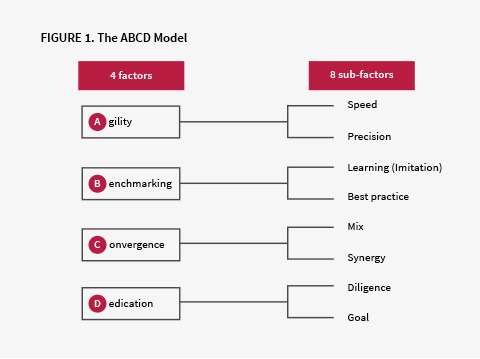
People often misunderstand the fundamental factors that have contributed to Korea’s economic growth. Popularly mentioned factors are cheap labour, export promotion policies, perspiration with strong government guidance, and Confucian ethics, and yet these are not entirely correct because not all countries that had such factors achieved economic growth. Factors such as cheap labour were not unique to Korea, but were actually more abundantly present in other areas of Asia, Africa, and Latin America during the time of Korea’s economic take-off. Moreover, many developing countries have employed export promotion policies, and large parts of Asia share strong governments and the Confucian legacies. Yet, few of the developing countries despite those commonalities have achieved significant economic success to parallel Korea’s, showing that major factors for economic growth are to be found somewhere else. The following section unveils Korea’s strategy for its economic success, using the newly constructed ABCD model, composed of four main factors, agility, benchmarking, convergence, and dedication, which can be further divided into two sub-factors(see Figure 1).


korea_infograph


Agility: speed combined with precision for increasing productivity. First, complementing the cheap labour – or rather what the cheap labour was complementing – was the high productivity, or agility involving a good balance between speed and precision. Korean workers were speedier and yet more precise in comparison to other competitors (i.e., agility). The reason why Korean construction firms were able to win large scale business projects in the Middle East over other firms from more advanced countries during the 1970s and 1980s was not just cheap labour (other countries such as Egypt, Ethiopia, and Sri Lanka had cheaper labour and the Western multinational firms hired workers from these countries), but their ability to complete projects the fastest while maintaining a good level of quality (i.e., precision). As the Middle East countries desired to develop their infrastructure and economies quickly, they were attracted to the agile Korean firms.

Benchmarking: learning the best practices for efficient catch-up. Second, while facilitating the country’s exports to expand market, Korea focused on learning the best practices by global standards and achieving economies of scale. Adopting the proven best practices (i.e., benchmarking) was a time-efficient approach for Korean firms to catch up and compete with other international rivals. Benchmarking the global best practices is an important and positive aspect of an export-promotion policy compared to an import-substitution policy. Firms may lose competitiveness under an import-substitution policy that only focuses on domestic demand while neglecting international markets and global standards. In addition, firms will not be able to achieve economies of scale when they only serve the domestic market.

Convergence: mixing synergistically for creating new advantages. Third, Koreans undoubtedly had perspiration with strong government guidance, but more importantly, it was combined with inspiration and other productive practices (i.e., convergence). Korean workers were adept at combining the best practices of the West and Japan with their own strengths, which generated high synergies. Perspiration is crucial and it is a common characteristic of people in a growing economy. However, as a country’s economy advances it often adds its own inspiration and other practices, which enhances competitiveness. The Korean chaebol (the Korean conglomerates) are good examples that originally started with a “me too” strategy, producing low-cost products, but gradually developed into competent global players selling innovative, differentiated products.

Dedication: diligence with goal orientation for a strong commitment. Lastly, Koreans worked hard, but more importantly with a strong desire for a better life. This factor is not entirely related to the Confucian ethics, which is often misunderstood. Confucianism can either set back or promote economic development. One characteristic of Confucianism is its preference of maintaining the status quo instead of active reforms and development. The passivity and unprogressive nature can hinder fast and steady development especially at the early phases of economic development. On the other hand, Confucianism places the responsibility and reliability of leaders on the top of its value system, as well as diligence and strong goal orientation towards success. The strong emphasis placed on dedication has helped Korea strengthen and expedite the process of economic development.


Overcoming Difficulties and Creating New Advantages

Korea came to develop its ABCDs as it overcame one challenge after another. While some Asian countries, such as the four tigers (e.g., Taiwan, Hong Kong, and Singapore), experienced hardships after World War II, Korea faced even more challenges due to the subsequent outbreak of the Korean War. Koreans needed to be faster and had to work harder in order to survive their dire circumstances. Eventually, the hardships that Koreans faced were a blessing in disguise on its path for a successful, long-term economic development.

The Korean chaebol (the Korean conglomerates) are good examples that originally started with a “me too” strategy, producing low-cost products, but gradually developed into competent global players selling innovative, differentiated products.

Under the continued threat from the North, South Koreans worked even harder to overcome difficulties, and this helped enhance the competitiveness of Korea’s workforce. President Park Chung-hee further improved the Korean economy with well-constructed policies. Unfortunately, there are two common misunderstandings regarding President Park’s economic policy. The first is that the intense government intervention reduced market efficiencies. However, in reality, President Park created globally competitive firms. The other misunderstanding is that he only favoured a few big chaebol, but in fact, President Park supported only the most competitive firms in order to maximise the utility of the country’s scarce resources. His criteria (e.g., export performance) were clear and fair, which is strikingly different from cronyism frequently shown in other authoritarian countries.

It is important that policymakers correctly understand the market and firms. The market is often more efficient than policymakers or scholars think, and firms do more good than harm to society. The effectiveness of the market and firms varies at different levels and situations of the economy. Other Korean presidents, who followed President Park, have also contributed to the country’s economic achievements, although some policies have been controversial. As Korea becomes a more advanced economy and needs more sophisticated solutions to intricate problems, the ABCD model may serve as a useful tool in guiding the appropriate path forward.


Challenges in the Future

Some say that Korea should change its “speedy” culture to a “precise” one in order to advance its current level of economic development. However, there is no need to sacrifice speed for precision; it is possible to have both. The Korean chaebol – for example, Samsung, Hyundai, and POSCO – continued to create sustainable competitiveness because they were fast (despite being large) and precise (despite operating in a broad industry spectrum). Speed, as the core competence of the Korean economy and business, should not be sacrificed, but complemented with enhanced precision.

Likewise, Korea should not give up its practice of “imitation” or learning by prioritising innovation. Even one of the most innovative places in the world, Silicon Valley, is not all about creating original breakthrough technologies. Silicon Valley was founded upon an entrepreneurial culture that “efficiently” promoted innovation. The region provides a collaborative environment for all people to share the best practices across different fields. This environment allows anyone to learn the global standard and add incremental “alphas (i.e., innovation)” to existing best practices. Competitiveness can be efficiently enhanced from benchmarking, which is an important message to all firms. If they continue to seek and learn the best practices across relevant industries, the incremental alpha will come naturally.

Sustainable success requires continuous learning and hard work, and at the most advanced stage of success, people work hard because they enjoy their work.

The third misconception is that Korean firms should concentrate on their specialised business areas rather than broadening their business scope. In practice, however, it is difficult to maintain competitiveness if a firm is competent in only one or very limited areas because its competitors have similar competencies. In this situation, the firm can compete more effectively if it has other strengths that its competitors do not have. Otherwise, latecomers will be able to surpass first movers by adding their own alpha to the ongoing best practices and overturn the status quo. Therefore, rather than narrowly focusing on extreme specialisation, Korean firms should continuously pursue the strategy of “mixing” the current best practices in related fields with their own unique strengths to generate higher “synergies”.

Finally, some argue that Koreans work too hard and should therefore work less and enjoy more leisure time. However, if this happens, Korea will face the risk of experiencing a similar situation of the lost decades of Japan. Sustainable success requires continuous learning and hard work, and at the most advanced stage of success, people work hard because they enjoy their work. A love for what they do is a common trait among all successful people across various areas of business, sports, and arts. While this is not easy for all individuals to achieve, if Korean firms create an enjoyable work environment and support employees to work in fields that they most enjoy, people will work harder with greater satisfaction.

This article outlines a new analytical framework that comprehensively identifies the factors behind Korea’s rapid economic growth. However, despite such growth, Korea is not without new challenging problems (e.g., aging, sociopolitical setbacks, service sector). The good news is that Korea will be able to achieve continuous growth by re-embracing the model that has brought the country to where it is today – again, the ABCDs. Korea was one of the world’s poorest countries about half a century ago, and its rapid development would not have been possible without the help of advanced nations. Now, as a country capable of helping those who are undergoing developmental challenges, Korea has a duty to pass on its experience and knowhow to other developing countries. I hope that they will find the ABCD model as an effective guideline for attaining advancement and prosperity.


This article is based on the author’s recently published book, The Strategy for Korea’s Economic Success, Oxford University Press, 2016.

About the Author

hwy-chang-moonHwy-Chang Moon is currently a professor in the Graduate School of International Studies at Seoul National University, where he also served as the Dean. He has delivered special lectures at various institutions, including Helsinki School of Economics, Keio University, and Stanford University. Dr. Moon has also consulted several multinational companies, international organisations (e.g., United Nations), and governments (e.g., Malaysia, Dubai, Azerbaijan, and the Guangdong Province of China).

Decline of Parties, Rise of Hucksterism (and Trump)

By Timothy Braatz

 The influx of hundreds of millions of dollars into US presidential elections has undermined the influence of Democratic and Republican leaders in choosing their party’s nominee. This power shift has enabled the campaign of party outsider Donald Trump, as billionaire donors and television executives can now make or break a candidacy before a vote is cast.


Media coverage of the current US presidential election extravaganza – begun in March 2015 and ending, hopefully, mercifully, in November 2016 – has focussed on the pathology of Republican candidate Donald Trump, who, unlike more traditional candidates, takes no pains to disguise his bigotry and cruelty. Overshadowed by the freak show, a significant development has gone relatively unexamined. Both Trump’s victory in the Republican primary process and the surprising success of Bernie Sanders on the Democratic side signal a remarkable decline in the strength of at least one aspect of US political parties. A presidential candidate no longer need be a party insider, or even enjoy the strong support of party power brokers, to claim a party’s nomination.

To understand this shift, one must look to history. The US Constitution, an 18th century document, instituted a presidential system, with the chief executive answering to state-based electors rather than to the US Congress. State lawmakers then codified plurality voting, making US presidential and congressional elections into a series of “horse races” between individuals. This constitutional structure – single-member district plurality, allows for what has been, effectively, duopoly control (Republican and Democratic) of the electoral process, as voting for a candidate from a third, weaker party can be tantamount to wasting your vote.

Both Trump’s victory in the Republican primary process and the surprising success of Bernie Sanders on the Democratic side signal a remarkable decline in the strength of at least one aspect of US political parties.

In the late 19th century, the national power brokers within each party essentially chose their presidential candidates from amongst themselves. Party apparatchiks organised the campaigns and mobilised the voters, often through a system of favours and bribery; the candidates usually stayed home. This was the high point of party power, back when parties were “machines” capable of arranging 75 percent turnout of eligible citizens nationwide on election day (compared to under 60 percent today). Voter loyalty was strong, in part due to ethnic and religious ties, in part because elected officials rewarded constituents with tangible benefits – jobs, cash, government contracts – not simply lip service. In some states, the Democratic Party functioned as a benevolent society and employment agency for the urban, immigrant poor.

In the early 20th century, a movement to reform this “old-boys” system – root out corruption, weaken immigrant political power – led to the adoption of secret ballots and primary elections, wherein primary candidates could appeal directly to voters, ostensibly without approval from party leaders. However, voter discipline made an outsider candidacy unlikely.

Jump forward to the era of television. Beginning in the 1960s, political advertising was increasingly televised, making federal campaigns more expensive; airtime is not sold cheap. In the 1970s, Congress began passing laws to limit campaign contributions and expenditures, but, over the decades that followed, federal judges and political operatives found ways to keep the money flowing, often through political action committees (PACs). Federal governing was increasingly “pay-to-play”. If you wanted favourable action from a president or member of Congress, you wrote checks to a campaign fund. Despite caps on donations, the sums kept rising.

In the 1990s, the chase for capitalist donors pushed candidates from both parties rightward. Needing big money to compete against Republican fundraising, “new” Democrats, like Bill Clinton, made a calculation: abandon the traditional Democratic voter base and appeal to Wall Street bankers and brokers. Elected president, in 1992, Clinton followed the neoliberal script previously made popular by President Ronald Reagan, a Republican, and signed laws reducing banking regulations while undermining social welfare programs. This was politically possible because Democratic stalwarts – unionised labour, minority groups – had no other decent option in the duopoly. Democratic candidates could take those voters for granted.

By 2000, then, the two parties were, more than ever, competing factions, one moderate, the other extremist, of a single business party – differing on social issues, like abortion rights, but basically agreed on corporate welfare at home and imperialism overseas. Legislative agendas reflected the interests of wealthy donors rather than the voting masses, and younger voters did not develop the party loyalty of older generations. Thus, no surprise that today the number of voters registered as “unaffiliated” is larger than the number of members claimed by either party.

Considering all the money provided by well-heeled donors, you might think that party dictates would be more forceful than ever. You would be wrong. In autumn 1999, long before the 2000 party conventions, even before a single primary vote had been cast, the commercial media declared that the two nominees for president would be George W. Bush (R) and Al Gore (D). Scions of oil and politics families, the two had amassed far more campaign money than any other aspirants; they were now “inevitable”. This pronouncement, of course, brought more donations their way – wealthy corporate PACs often wrote checks to both candidates – allowing Bush and Gore to build large campaign organisations and buy up network airtime. The new reality was that any candidate with the name recognition and political connections necessary to attraction tens of millions of dollars could force himself upon the party.

Television (and now internet) messaging, purchased by massive campaign coffers or provided free by network programming, has undermined the preeminence of party connections.

The race for the Democratic nomination in 2008 further revealed the relative weakness of the party structure. The media’s designated Democratic frontrunner – again, before receiving a single vote – was Hillary Clinton. She had the name recognition and the political ties. She was also the favourite of the party power brokers. Indeed, she was one of them. But along came Barack Obama, a far more eloquent and charming candidate, who used a massive, internet-based fundraising operation to pay for perhaps the best canvassing enterprise since the era of “machine” parties. Essentially running against the Democratic Party leadership – raising his own money, securing his own volunteers, mobilising his own voters – Obama defeated Clinton.

Then, promising “Hope and Change” to voters, Obama rode his personal network to victory in the general election – but not before assuring Wall Street donors that he wasn’t serious about “Change.” For the entire 2008 cycle, the candidates, parties, and PACs combined spent $5 billion on federal elections. As the first duopoly nominee to reject taxpayer funding for the general election, Obama faced no caps on donations. He ultimately raised $750 million.

Enter the Great American Huckster. With major donors more important than party bigwigs, a handful of con artists have made running for president a full-time and lucrative job. The two most obvious examples are named, appropriately, Newt and Huckabee. Newt Gingrich resigned from Congress in 1999, after an ethics violation cost him the House speakership. Despite that walk of shame, he declared himself a candidate for the 2012 Republican presidential nomination and again for 2016. His nominal candidacy brings campaign donations, book sales, speaking fees, and invitations to televised talk shows; he stays relevant in corporate media-land. Former Arkansas governor Mike Huckabee has behaved similarly, standing for the 2008 and 2016 Republican presidential nominations and pretending he would in 2012. He has scant chance of winning, but running boosts his brand.


newt-webPhoto courtesy: Gage Skidmore


The permanent campaigns of Gingrich and Huckabee are largely a product of the Supreme Court’s Citizens United (2010) ruling, which allows for unlimited donations to “independent-expenditure only committees” (Super PACs), so long as they operate independently of parties, individual candidates, and campaigns. In other words, a single person can give millions to a Super PAC to fund advertising to convince you to vote for Candidate A, so long as that Super PAC does not (wink, wink) communicate and coordinate with Candidate A. Put another way, Gingrich can ride billionaire Sheldon Adelson’s gravy train, spouting Adelson-approved messages, through the early primary season.

And Gingrich is not the only freeloader. PAC operators beg for contributions from special-interest voters, but often spend more on their own salaries and luxuries than on promoting candidates and causes. They use donations to troll for more donations, and build donor lists that they rent out to other campaigns. For some PACs, fundraising – fleecing donors – is the end not the means. The sophistry of Citizens United, as written by Justice Anthony Kennedy, is on full display: “We now conclude that independent expenditures, including those made by corporations, do not give rise to corruption or the appearance of corruption.”

How could Donald Trump – real estate con man turned television “reality show” host – stay away? His 2016 presidential campaign began as a shameless brand promotion and money-laundering operation. Donations to the Trump campaign, much of it from billionaire Trump himself, ended up paying for rent on Trump-owned properties and purchasing Trump-labeled products and services. He had little interest in organising an Obama-style campaign to canvass voters in far-flung states, probably had little interest in the daily grind of being chief executive. Hucksters don’t toil – that’s the point.

But a curious thing happened: television executives adopted Trump’s political reality show as their own. His racist, misogynistic, idiotic sound bites were the viewing equivalent of a fifteen-car pileup – if it bleeds, it leads – and viewers tuned in. “It may not be good for America, but it’s damn good for CBS,” enthused the television network’s CEO (estimated personal net worth: $300 million). “The money’s rolling in and this is fun.” Certainly, it was fun for Trump. A few months into his campaign, he observed, “When you look at cable television, a lot of the programs are 100% Trump, so why would you need more Trump during the commercial breaks?”


donald-trumponfallon-webJimmy Fallon hosted Donald Trump this Jan. 11 episode of The Tonight Show Photo courtesy: Douglas Gorenstein/Getty Images


An estimated $2-3 billion worth of free media for Trump, a Republican field overcrowded with money-grubbing, look-a-like pretenders, and voters sick of politics-as-usual added up to Trump securing the Republican nomination. The party leadership, who likely wanted docile Jeb Bush, were stuck with the megalomaniac. Daily phone calls from the Republican National Committee chairperson, and the threat of decreased party support, have failed to keep the nominee “on message”.

The Democratic race was also startling. Party insider Hillary Clinton, once again the presumptive nominee, was beneficiary of over $1 billion worth of free advertising from television coverage. But she found an unexpected challenge in Bernie Sanders, who boldly called himself a socialist – a label which, in the USA, evokes communist totalitarianism more than it does Nordic democracy. While Clinton seemed to offer the usual neoliberalism, Sanders promoted a progressive agenda of regulation and reform. His stand against corporate power – he rejected Wall Street and Super PAC donations – attracted a record number of small, individual contributions. In the end, though, he couldn’t overcome corporate media’s initial disdain, Clinton’s support among black voters, and a weighted primary process – the latter perhaps the last remaining advantage of party insiders.

To summarise, television (and now internet) messaging, purchased by massive campaign coffers or provided free by network programming, has undermined the preeminence of party connections. As a result, big donors and television executives – who owe nothing to voters – have more influence on presidential elections than party leaders. Following the neoliberal model, capitalist greed and deregulation (of equal-time broadcasting and campaign financing) have hollowed out political institutions which, however flawed, once provided some service to the masses. Regarding presidential elections, the parties still function as nominating structures, but control of that process goes on auction every four years. The media conglomerates sell advertising space, the big donors buy candidates, the money’s rolling in and this is fun. The major issues of the day – war, poverty, climate change – go mostly undiscussed. The fun, of course, relies on the complaisance, alienation, and ignorance of US citizens, their vulnerability to superficial rhetoric, their failure to organise a popular nonviolent movement, their acceptance of electoral authority. As an entity of influence in presidential elections, the party – Democratic or Republican – exists mostly in the minds of voters.


Featured image courtesy of: AP Photo/LM Otero


About the Author

Timothy Braatz is a professor of history and nonviolence at Saddleback College, in Mission Viejo, California. He is also a playwright and novelist. His book, Peace Lessons, is, according to one reviewer, “the best introduction to peace studies.” His recent essays, including “Presidential Elections Need Not Matter So Much,” can be found at transcend.org/tms.


Duterte and the Multipolar Strategy That Shakes Washington

By Federico Pieraccini


On May 30, 2016 Manila’s parliament appointed Rodrigo Roa Duterte as the sixteenth president of the Philippines following his election victory over rival Mar Roxas with over seven million votes. Born in Maasin 71 years ago, Duterte has had a long career in public administration, having served as mayor of Davao city for more than 22 years with seven mandates. Duterte’s electoral marathon was a real triumph resulting from the anti-establishment sentiment increasingly widespread among the world’s population. The sharp contrast Duterte represented from the ruling political class in Manila secured him the unexpected victory.

A fundamental aspect, linked to the success that has accompanied the new president, regards the election program. Its four main pillars are simple and effective:

– Fighting drug dealers and petty crime (a plague that is devouring the nation);

– Independent and advantageous foreign policy for Manila (not putting Washington’s interests first);

– Fostering conditions necessary for a rapid and sustainable economic recovery;

– Eradication of the terrorist organisation Abu Sayyaf.

Following Duterte’s victory, we have witnessed growing tension between Manila and Washington. Predictably, Duterte’s four points openly go against Washington’s strategic objectives in the region. The United States would like to contain growing Chinese influence; but without valuable traditional allies in the region, in particular Japan and the Philippines, this already difficult task seems impossible. In this sense, Manila’s attitude should not be too surprising, anxious as it is to put aside historical differences and recent tensions with Beijing.


Economics as Means for a Multipolar Transition

The step aiming towards the economic restructuring of the Philippines is not possible without the full cooperation with the Republic of China. With that in mind, even before he was elected, Duterte proposed to cease joint patrols with the US Navy in the South China Sea in exchange for the construction of high-speed rail in the country. For Beijing, the Philippine proposal is fully in line with the win-win strategy that the Chinese constantly promote in their diplomatic action, which preaches for the reduction of regional frictions powered by an external actor (the US) in order to increase industrial cooperation that produces economic prosperity. The project to build high-speed rail fully corresponds with this plan of action, and could represent a new set of political balances in the region.

One of the most common tools employed by Washington to threaten and destabilise strategically significant countries like the Philippines is to resort to the use of terrorism.

The ideal platform to activate Manila’s request is the Asian Infrastructure Investment Bank (AIIB), which recently came into being after years of discussions between founding countries. The special feature of this economic organisation covers the investment-approval mechanisms. A very specific clause signed by all members prevents political exploitation of funded projects, a key element aimed to prevent external intrusions that seek to affect the infrastructure development process, a central pivot of the AIIB.

The major stumbling block remains the final ratification in Manila’s senate of the participation of the Philippines in the AIIB. Specifically, the senate must vote with a two-thirds majority in order to be able to implement domestic policies decided in international agreements like the ones that are going to be signed with the AIIB.


Terrorism as a Means of Pressure and Influence

As is evident in geopolitical and strategic terms, Obama’s famous Asian pivot creates more of a problem for Manila seeking to pursue an independent foreign policy that is beneficial and based on cooperation with Beijing.

One of the most common tools employed by Washington to threaten and destabilise strategically significant countries like the Philippines is to resort to the use of terrorism. From the 1980s to today, radical Islam has gone from being confined to very specific areas to manifesting itself in almost every corner of the planet, including the Philippines. It could be said without fear of contradiction that the expansion of Islamic terrorism has coincided with the Washington’s growing aspirations for global dominance. The example of the Abu Sayyaf organisation is pertinent and illuminating.

Entrenched in the Southern Philippines, it is an Islamist group founded by members of the Afghani Freedom Fighters (Taliban) of Reagan memory and later trained by Al Qaeda in the 2000s. It has been operating in the region for more than two decades and seeks territorial independence from Manila, a typical and renowned American ploy to put pressure on foreign governments.


Duterte Messes Up the American Plans

Duterte recently announced an upcoming anti-terrorism operation against the Abu Sayyaf militant radical islamic group. The special feature of the solution arrived at by the new president sent Washington into a rage. American troops will be forced to temporarily abandon their military bases in the south of the country. When they will be allowed to return will also be part of a negotiation that should redefine the strategic partnership between Washington and Manila.

If Washington refuses to accept the multipolar shift Manila is pursuing, this will end up completely alienating a mainstay of US strategy in Asia.

In a recent meeting held at the Center for Strategic and International Studies (CSIS), the Philippine foreign minister, Perfecto Yasay Jr, explained that it will be difficult to provide protection and security for American soldiers during the proposed military operations. Of course this is only a diplomatic excuse, the real reason being much deeper and intrinsically tied to the US strategy of using terrorism to achieve its geostrategic objectives. Manila is aware that the effort against Abu Sayyaf would be more effective without the awkward presence of American personnel. In other words, Duterte does not trust Washington and is aware that the terrorists would benefit from the American presence.


An Unstoppable Revolution

In the space of a few months the Philippines transitioned from being a historical foothold of Washington in the Pacific (the US has five military bases in the country), to one of the countries most eager to mend relations with Beijing. It is yet another step in the transformation that is slowly reshaping the global scene, that is to say, from the unipolar domination of the United States to a fully multipolar environment where regional interests are not outweighed by the need to impose global hegemony. Based on the words and promises of Duterte, we know that the Philippines does not have any intention of breaking away from Washington and joining the countries openly opposed to the US. Instead, there is a stated desire to mend relations with the China, an essential key element for the nation’s economic recovery.

If Washington refuses to accept the multipolar shift Manila is pursuing, this will end up completely alienating a mainstay of US strategy in Asia. It is a sequence of events that we see repeated more and more to the detriment of the US. Duterte has already amply hinted that his number one priority concerns the absolute sovereignty of the Philippines and its national interests, two priorities that the US tends to reject. A confrontation will inevitably end in the worsening of relations between the two countries, signifying a major setback for US strategy in Asia by pushing Manila and Beijing closer together.


This article was first published on strategic-culture.org on September 25, 2016.

About the Author

s237Federico Pieraccini is an independent freelance writer specialised in international affairs, conflicts, politics and strategies.

The 2nd US Presidential Debate: A Political Telenovela in Real Time

By Jack Rasmus

In the second US presidential debate held last October 9 in St. Louis, Trump’s strategy was clearly to shore up his conservative base by returning to the extreme anti-Hillary rhetoric that got him the nomination.


The two most disliked candidates in modern US election history did not disappoint US voters’ low expectations of their performance in the second presidential debate held October 9 in St. Louis.

Both candidates spent most of their time attacking each other as either “morally unfit” to be president, chronically prone to “bad judgement”, and habitual liars. Issues of real importance to voters were again, as in the first debate, altogether absent or, at best, were briefly and superficially addressed.

The continued mudslinging was fuelled by the release of videos this past week, taken a decade or more ago, showing Trump bragging about his ability to sexually dominate women and making other generally extreme misogynist comments.

The videos set off a firestorm among the Republican elite over the week. Some began calling for Trump to drop from the race. Others talked of “pulling the plug” on Republican Party financial assistance to Trump’s campaign. How Trump performed in this second debate would no doubt determine whether such talk translated into action, as the Republican camp showed signs of splitting down the middle even further and the party’s elite abandoning their candidate.

This potential “hard split” among Republicans in the United States, the party elite vs. a majority of its members, is not unlike similar party developments in Europe, where the British Labour party elites have been attacking their public leader, Jeremy Corbin, for abandoning their neoliberal policy regime; or in Spain where the Socialist Party leader was recently dumped; or in France where presidential Holland will soon be. The economic recovery since 2009 that has benefited only the economic elites – in the United States 95 percent of all the net income gains since 2009 have accrued to the wealthiest 1 percent households – has been translating into a grass roots disaffection from political parties. As one of the press commentators put it after the second US debate, “This election is about the American people vs. the Political Class.” But it’s not just an American phenomenon. The trend is becoming generalised across many of the advanced economies.

Trump fielded the damning video evidence of his misogynist bragging by saying it was only “locker room” talk. Only words. He then went on the offensive against Hillary Clinton, saying that while his were only “words”, Hillary’s husband, past president Bill Clinton, engaged in actual sexual abuse and was impeached for it. The Trump camp had brought three women to the debate who were involved in Bill Clinton’s impeachment charges or were subjects of Clinton’s sexual misconduct. Trump further accused Hillary of laughing when, as a prosecuting attorney, she got her client saved from jail time in a rape case involving a 12 year old. Both candidates thus showed they would go to whatever lengths to dredge up decades old evidence to prove their opponent as “morally unfit”.

As one of the press commentators put it after the second US debate, “This election is about the American people vs. the Political Class.”

An interesting, related detail to the “morality telenovela in real time” that has become the US presidential election, is that the videos of Trump were released more or less simultaneous with the Wikileaks’ release last week showing Clinton’s plans to run her campaign with one set of proposals and promises communicated to private big banker-corporate donors, while planning to say the opposite to voters. When challenged by Trump to explain the leak and her implied “two-faced” approach to US voters, Hillary hid behind the example of Abraham Lincoln, saying he did the same and the practice was therefore legitimate.

This ascerbic exchange was preceded by Hillary’s reference to Russia and its president, Vladimir Putin, accusing them of hacking the Democratic Party and the US election in order to aid Trump. The US media in recent weeks has picked up this idea, for which there is no evidence to date, and has been promoting it widely. It is yet another dimension of the growing shift in US elite toward confronting Russia. Hillary’s implicit suggestion in the debate was the Wikileaks release reflects Putin-Russian interference in the US election to aid Trump. The timing of the release of the Trump videos and the Wikileaks material raises the question whether in coming weeks voters can expect more of the same – i.e. more damaging Trump videos being released, perhaps not coincidentally, as more promised Wikileaks releases appear damning Clinton.

The second debate revealed yet another, even more ominous anti-Russia theme worth noting. In a reply to a question about what would the candidates do about Syria and Aleppo, Hillary declared the Russian air force in Syria is determined to destroy Aleppo. Russia has “gone all in” in terms of ambition and aggressiveness in Syria, she added. Russia’s war crimes should therefore be investigated. Furthermore, a “no fly zone” should be imposed in Syria. What she didn’t explain is if Russian planes ignored the US “no fly zone”, would the United States try to shoot them down? And what if US planes were shot down, as Russians retaliated? Clinton’s exchange revealed the US “war hawk” faction’s increasing desperation concerning the Syria conflict, in which the United States has been increasingly sidelined and Russia has become more influential.

The debate moderator, Martha Radditz, then asked Trump what he would do in Syria, since Trump’s vice-presidential running mate, Pence, had just days before declared, agreeing with Clinton, “the US should be prepared to strike military targets of the Assad regime”, presumably including airfields with Russian planes. Trump replied “I disagree”, and that the focus should be on dealing with ISIS. Trump’s disassociating from his VP, Hillary, and the war hawk faction created some stir and commentary in the post-debate discussion by pundits and talking heads.

Another notable exchange during the debate occurred when Trump attacked Clinton for deleting her emails after receiving a subpoena, when Secretary of State. He then dropped yet another debate bombshell by saying when he’s president he would appoint a special prosecutor to investigate Hillary’s action. When she rejected the notion as an example of Trump’s “imperial presidency” view, Trump retorted it didn’t matter “because you’ll be in jail”.

The unfavourability ratings for both candidates were virtually unchanged: Clinton with 45 percent unfavourable rating before the debate and 44 percent after; Trump with 64 percent unfavourable both before and after.

Hillary clearly scored points in the debate, however, when the discussion turned, on occasion briefly, to actual policy. Trump noted costs of Obamacare had risen 68 percent, and that voters were drowning under rising costs of premiums, deductibles and copays. He advocated repeal and a total restart. Clinton, however, argued to fix it, and keep the good elements, whereas Trump would return health care to insurance and pharmaceutical companies’ price gouging and coverage denial, as in the past.

Clinton scored points in the exchange on taxes as well, noting that Trump’s plan to reduce taxes from 35 percent to 15 percent would benefit the rich twice as much as had George W. Bush’s tax cuts. She proposed no tax hikes on anyone earning less than US$250,000 a year, with taxation raised only on the wealthy.

The second presidential debate changed little in terms of voter preference, according to post debate polls. The unfavourability ratings for both candidates were virtually unchanged: Clinton with 45 percent unfavourable rating before the debate and 44 percent after; Trump with 64 percent unfavourable both before and after. In national polls Clinton enjoyed a wide margin of support among women before the debate, which has grown further after events of the past week. This margin may prove significant in the election outcome, providing it carries over to the 8 or 9 swing states where the election will be determined by voter turnout – perhaps even before November since 30 percent vote by mail before and that voting has already begun.

In the second debate, Trump’s strategy was clearly to shore up his conservative base by returning to the extreme anti-Hillary rhetoric that got him the nomination. Themes of Clinton as “liar”, “devil”, and “put her in jail”, were resurrected. He may have restored his base after the events of the past week, and by performing relatively better in the second debate (a very low bar), but that may not prove sufficient to win in November. Clinton has used the events of the past week and the debate to deepen her support among women voters. However, an expected “knock out” debate, where Trump was decisively defeated, did not happen.

But debates and national polls are almost irrelevant at this stage. The outcome will be determined in the eight to nine swing states. With 87 percent of voters decided and neither candidate able to “move the needle” in debates, it’s about whether Trump turns out more of his base in the swings states and whether Hillary can change the minds of millennials, Latinos, and others to turn out to support her after they have felt betrayed by Obama’s second term and its failure to deliver on promises made in 2012.

In the meantime, audiences can just “enjoy” (and weep) the morality telenovela that is the current US presidential election.

This article was first published on teleSUR on 10 October 2016.

Featured Image: Donald Trump listens as Hillary Clinton answers a question from the audience. Photo courtesy: Reuter

About the Author

jack_rasmus-webJack Rasmus is the author of the just-released book, Looting Greece: A New Financial Imperialism Emerges, and the previous, Systemic Fragility in the Global Economy, both published by Clarity Press, 2016. He blogs at jackrasmus.com.


The Business of People: Effective Strategies to Drive Success in Global Business

By Sharon Schweitzer

In this article, Sharon M. Schweitzer delves into the intricacies of the global marketplace. She shares an eight-point introduction in cultivating communication skills and developing self-awareness to gain the cultural intelligence to make the “business of people” successful.


International business travel and globalisation increase with each passing moment, yet global negotiations and assignments can be challenging. For example, successful companies in the West, such as Ebay, Amazon and Google, have struggled in the Chinese marketplace. Creating a global mindset and developing cross-cultural communication skills are critical for business professionals.

Skills such as self-awareness, collaboration and cross-cultural perspectives are invaluable. To better communicate internally and externally, and achieve success in the global market, cross-cultural business strategies must be executed and integrated.


Developing Cross-Cultural Awareness Is Key

“The most interesting thing about cultures may not be in the observable things they do – the rituals, eating preferences, codes of behaviour, and the like – but in the way they mold our most fundamental conscious and unconscious thinking and perception.”

– Ethan Watters, “We Aren’t the World”1


Thinking is Not Universal

There are a multitude of erroneous assumptions surrounding the existence of culture. Many believe that there are universal ways of functioning as humans, humanity-wide avenues of thought, emotion and behaviour. However, extensive anthropological, business and psychological studies have proven this to be untrue. For example, one cultural dimension that must be accounted for in business revolves around the issue of uncertainty avoidance by measuring the extent to which people across 76 countries and regions “feel uncomfortable with uncertainty, ambiguity, the new, unknown and surprising”.2 The higher the score, the more the culture is uncomfortable with uncertainty. Scores on the uncertainty avoidance dimension range from cultures like Greece and Portugal, which scored 112 and 104 respectively, to Singapore and Jamaica, which scored 8 and 13 respectively. As this illustrates, there are considerable variations of tolerance of uncertainty and ambiguity worldwide. To assert that there are universal ways of handling risk and uncertainty is misleading.

To succeed in the global marketplace, all employees, from entry-level to business executives, must understand the importance of culture in navigating the “business of people”. Succeeding in the eastern hemisphere creates the opportunity to observe cultural cues, bridge gaps between cultures, implement appropriate strategies, and value the underlying industry of all business – the cultural microcosm of individuals.


Global Business Strategies for Success

To bridge cultures and succeed in the global business of people, it is imperative to establish concrete business strategies that provide structure. By creating a documented plan for your organisation, unified perspectives and actions in an unfamiliar territory can help employees conduct business smoothly. The following strategies revolve around the notion that research, respect and relationships are inescapable properties of global business strategy, particularly in Asia.

To succeed in the global marketplace, all employees, from entry-level to business executives, must understand the importance of culture in navigating the “business of people”.

Cultural education is key when engaging with Asian and/or global business counterparts. From leadership to sales representatives, ensure all employees interacting internationally are cross-culturally trained, and have a self-awareness profile, as well as country-specific briefings. Depending on your industry, financial situation and accessibility to training, education can range from reading a cross-cultural guide, such as Access to Asia: Your Multicultural Business Guide, hiring a cross-cultural consultant for an organisation-wide training, or receiving mentoring from international professionals working in your targeted region.

When developing cross-cultural business strategies for Asian cultures, consider the following eight-question framework:


1. Is the Culture Individualistic or Collectivist?

During the process of creating a cross-cultural communication/education strategy, observe and highlight the team’s approach to identity. For example, is the emphasis on the individual or on the community? The key differences observed between individualistic and collectivist cultures create ripple effects throughout business, social interaction and more. When moving from a Western individualistic culture to an Eastern collectivist culture, as seen in business operations in Asia, be aware of a shift in specific people and communication skills. As Richard Brislin, University of Hawaii at Manoa management and industrial relations professor notes:

“To transcend the distance between self and others, people in individualistic societies have to develop a certain set of social skills. These include public speaking, meeting others quickly and putting them at ease…making a good impression… These skills are not necessary for collectivists. When it comes time for a person to meet unknown others in a larger society, members of the collective act as go-betweens and make introductions, describe the person’s accomplishments and abilities, and so forth. In short, individualists have to rely on themselves… Collectivists have a supportive group that assists in this same goal.”3

Culture Tip:

• Have a mutual connection make introductions and accompany your team to the first meeting.

• Show consensus and harmony as a team by not interrupting each other.

• Use the phrase “our team” instead of “my team” during meetings.


2. How are Power and Authority Viewed?

Consider the view of power and authority for each culture. In ascriptive cultures, class, age, sex, and religion are considered most important; and include the US, UK, and Canada. In achievement-oriented cultures, such as India, Japan, and South Korea, accomplishments such as degrees, special training, and marathon and sporting awards are most important.

Culture Tip:

• Be ready in achievement-oriented societies to be asked, “What did you study?”

• Be ready in ascriptive-oriented societies to be asked, “Where did you study?”

• As a business leader, decipher whether you are culturally expected to share power in a participative dynamic or hold power over those below you.


3. How Does the Culture Compare Rules and Relationships?

Riding the Waves of Culture, by Fons Trompenaars and Charles Hampden-Turner, makes the notable distinction between universalist and particularist cultures in relation to rules and relationships. Many global communities and cultures, known as universalist cultures, place a greater emphasis on rules compared to relationships. The opposing view, which reveres relationships above all, is known as particularist. Eastern perspectives are much more relationship oriented, both personally and professionally, especially when compared to the Western viewpoints of the US, UK and Canada.

Culture Tip:

• The contract will be seen as definitive by the Western world, but may only be seen as a rough guideline or approximation by the Eastern or Asian world.

• Be aware of your culture of origin and destination country. The perspective towards rules and relationships will immensely sway business strategy, goal-setting and overall regulations.


4. How is the Concept of Time Viewed?

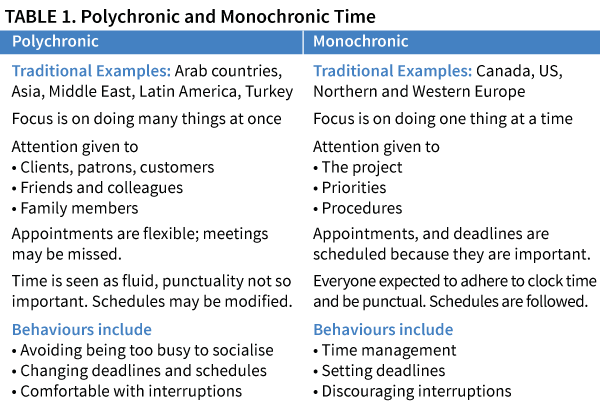
A key to success in a new culture is observing how time is valued – as monochronic or polychronic. In Western time perspectives, known as monochronic, we expect an executive stopped by another colleague en route to a meeting to say that he or she cannot stop to chat. In polychronic cultures, such as those in Asia, where several things often happen at once, punctuality is not as essential, and the executive may stop to chat for 30 minutes.

“It is impossible to know how many millions of dollars have been lost in international business because monochronic and polychronic people do not understand each other or even realise that two such different time systems exist.”4 (see table 1 below)

Culture Tip:

• Be on time, even if your business counterparts are not.

• Bring reading material and be patient.

• If signs of impatience are observed waiting time may increase.

• Avoid arriving early.


businessofpeople-table1


5. How Does the Culture Communicate?

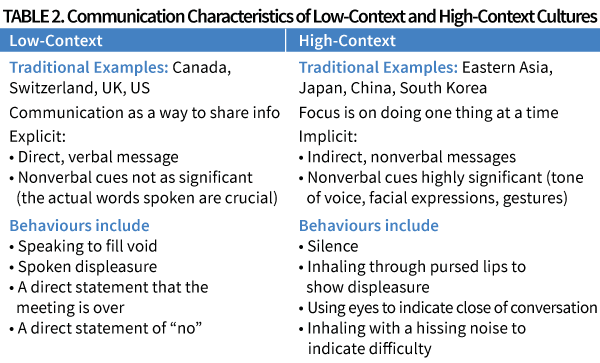
Low-context vs. high-context cultures differ in communication styles dramatically. For example, the US and UK are regarded as relatively low-context cultures. Direct communication is desirable and emphasis is placed explicitly on words. Alternatively, Asian cultures are high-context, thus communication is more indirect and must be stated in context for understandability. (see table 2 below)

Culture Tip:

• Be comfortable in your own skin, but try to mirror and match your business counterpart to the extent that you are comfortable.

• Develop communication protocol and processes for your employees to help create a unified strategy for communication that may be out of their comfort zone.


business-table2


6. How Formal or Informal Is the Culture?

University of Maryland Psychology Professor Michele Gelfand has made the distinction between tight cultures, those with strong social norms and a low tolerance for outside behaviours, and loose cultures, those with weak social norms and high tolerance. Loose cultures, such as the US and Australia, are often more comfortable with informalities.

Culture Tip:

• Learn the international protocol and global business etiquette for the destination country.

• When cultivating company culture within your organisation, ensure that your international staff, consisting of loose and tight cultural perspectives can both feel comfortable.


7. What Is the Alignment Between Social and Business Lives?

Researchers from the University of Delaware asked workers what percentage of working hours were spent on focused work-related tasks compared to more social activities (informal chatting, celebrating coworker’s birthday, anniversaries, enjoying coffee, etc.). US respondents working in major cities answered about 80% focused working and 20% socialising. The answer from Asian respondents in India, Indonesia and Malaysia was vastly different with a 50/50 working and socialising combination.

Asian business often revolves around developing and maintaining business relationships. This is a stark difference compared to westernised business perspectives where business and personal lives are separate.

This same study revealed that a decent amount of international business travelers believed that socialising on the job was an inefficient way to spend time in today’s competitive marketplace, although this answer is the quintessential example of a Western bias.

Asian business often revolves around developing and maintaining business relationships. This is a stark difference compared to westernised business perspectives where business and personal lives are separate.

Culture Tip:

• Find a local contact for advice regarding native social dynamics within business.

• Accept invitations to lunch, dinner, and tea.

• Reciprocate invitations to social events while in the destination country.

• Respect cultural values before ordering beef or pork or consuming alcohol.

• Be aware of cultural cues in dining.


8. How Is the Concept of Women in Business Handled?

The concept of women in business holds some surprises across the Asian continent. According to the Hurun Richest Self-Made Women in the World 2015 Report, China is home to the most female billionaires of any country on earth, at 49 women. The US holds the second place position with 15 female billionaires.5

Grant Thornton’s International Business Report 2016 ranks four Asian countries in the top ten global leaders for the number of women in senior management roles: the Philippines (39%), Thailand (37%), Indonesia (36%) and China (30%).

As a businessperson traveling to Asia, or interacting with women in Asian offices, be culturally aware of Asian women’s history, as well as do’s and taboos. For example, in Myanmar, a male initiating a handshake with a female business professional is inappropriate. However, in China, strong emphasis has been placed on equality between the sexes since the establishment of the People’s Republic of China in 1949.6

Culture Tip:

• As a woman in business, consider the following steps prior to your arrival to improve chances of success:

• Have a mutual contact, share your CV and qualifications with potential connections.

• Research the history of the nation, as well as the history of women in business.

• Research the current status of women in local business and general culture.

• Garner respect and cultivate business connections in your target host city.

• Ask local connections to accompany and assist you in meetings.

• Master a few phrases in the local language.


Unleash the Keys to Success

Understand that people think and view the world differently according to culture. Therefore, adjustments of mindset and behaviours are key across the international marketplace.

The most important aspect of global business strategy is self-awareness. My award-winning book, Access to Asia: Your Multicultural Business Guide, includes an eight-question framework based on leading cultural findings. At the end of each chapter, the Self-Awareness Profile exercises prompt you to self-identify where you currently stand on topics related to the eight questions, including: time, power distribution, rules, communication, formality, socialisation, and gender. This provides a visual comparison for discovering your current mindset and potentially developing more robust business relationships in a destination country.

Consider the creation of a system of cultural respect from the top down within your organisation. Lead by example to celebrate and respect international counterparts. Create a system/network of communication within your organisation. Encourage discussions of culture and business, so questions can be answered efficiently.

Relationships are king in Asia. Treat them as such internally and externally by designing a country-specific protocol for relationship building, providing step-by-step materials if needed. From business dinners to gift giving, inform professionals of the importance and consequences of relationship building activities, including accepting dinner invitations, and incorporating culture into conversations.

Remember, strategies for success revolve around the framework of three R’s: Research, Respect and Relationships. In Asia, cultural awareness will set you apart from the pack in a matter of seconds. From the way you hold your chopsticks to the way you use silence during a negotiation, your actions serve as a representation of your willingness to master a global mindset.

About the Author

schweitzer-webSharon M. Schweitzer is an award-winning entrepreneur, cross-cultural consultant and international business etiquette expert. Her best-selling multicultural business guide Access to Asia, named to Kirkus Reviews’ Best Books of 2015, provides insight on culture and global business protocols around the world, in the US and 10 Asian countries. As a corporate trainer for Fortune 500 companies and media resource for NPR, CBS, and BBC, Sharon’s cross-cultural insights reach and train audiences worldwide. Sharon can be reached at www.protocolww.com


References
1.
Ethan Watters, “We Aren’t the World,” Pacific Standard, February 25, 2013, https://psmag.com/we-aren-t-the-world-535ec03f2d45#.w7aat8z1e (accessed August 8, 2016).
2.
“Dimensions,” The Hofstede Center, http://geert-hofstede.com/cultural-dimensions.html (accessed August 16, 2016)
3.
Richard Brislin, Cross-Cultural Encounters: Face-to-Face Interaction (New York: Pergamon Press, 1981), pp 21-22.
4.
Edward T. Hall, The Dance of Life: The Other Dimension of Time (New York: Anchor Books, 1984).
5.
“Hurun Richest Self-Made Women in the World 2015,” The Hurun Research Institute, http://www.hurun.net/en/ArticleShow.aspx?nid=14680 (accessed August 16, 2016).
6.
China Internet Information Center, “China Publishes Gender Equality White Paper,” August 24, 2005, www.china.org/cn/english/2005/Aug/139404.htm (accessed August 15, 2016).


Reaping the Whirlwind: Kerry, al-Nusra, Russia and Syria

By Gary Leupp

On 2017, the UNSC will convene for the resolution of the Syrian conflict with the aim of saving Syria and its people from the prolonged war. This article offers an interesting analysis of the US’ “humanitarian mission” in Syria.


“I think you’re looking at three people, four people in the administration. I lost the argument. I’ve argued for the use of force. I’m the guy who stood up [in August 2013] and announced that we’re going to attack Assad for the use of weapons.”

US Secretary of State John Kerry, talking informally with Syrian “opposition” members, on the sidelines of the UN General Assembly Oct. 3, 2016


The Libya UNSC Resolution of 2011: Template for the Syria Resolution of 2017?

I’ve been re-reading UNSC Resolution 1973, which provided a legal fig leaf for the regime-change assault on Libya from March to October 2011.

That catastrophe was initially urged by French president Nicolas Sarkozy and Britain’s prime minister David Cameron and endorsed by then US Secretary of State Hillary Clinton, who persuaded President Obama to ignore the Pentagon’s opposition and lead NATO in bombing what was North Africa’s most prosperous country.

Recall how Clinton confidant and former State Department official Anne-Marie Slaughter emailed her on March 19, the day the bombing started, with subject line “Bravo!” expressing high praise for her central role. Having earlier assured Clinton that US action against Libya would “change the image of the United States overnight,” she now declared, “I cannot imagine how exhausted you must be after this week, but I have NEVER been prouder of having worked for you. Turning POTUS [Obama] around on this is a major win for everything we have worked for.”

Everything we have worked for! To what broader insider concept does this allude? Towards what grander purpose had Slaughter laboured, as a Clinton adviser from 2009 to February 2011 – those golden years of the Afghan surge, the Honduras coup, the relentless NATO expansion, plans for Ukrainian regime change? Total global mayhem, gleefully unleashed by glass ceiling-breaking strong women?

Everyone with a brain realises that that bombardment led to bloody regime change and subsequent ongoing chaos and regional destabilisation. The GDP has dropped from $ 75 billion in 2010 to $ 29 billion last year. ISIL was for a time in control of Gaddafi’s hometown of Sirte, and al-Qaeda has expanded its presence. Much of Gaddafi’s arsenal has fallen into the hands of terrorists or tribal militias, including some in surrounding countries struggling to contain the ramifications for themselves of the US/NATO destruction of their neighbour.

Clinton’s decisive championing of this crime is the ugliest thing on her record as a public official (which is saying a lot). It’s amazing that it has hardly been a campaign issue. Sanders was criminally negligent in avoiding criticism of the Secretary’s foreign policy (which is to say, war mongering) record. His ads ought to have played this grotesque cinéma vérité again and again.¹


A Lie Exposed, as Libya was Destroyed

Resolution 1973 could, with just slight rewording, be submitted to the UNSC in January, as now-President Hillary follows up on her vow to make Syria her foreign policy priority, just substituting “Syria” for “Libya” (or “the Libyan Arab Jamahiriya”).

Having described a myriad of human rights violations that might apply to most regimes in the region, that template text specifically established a “No-fly zone” and “Decides to establish a ban on all flights in the airspace of the Libyan Arab Jamahiriya in order to help protect civilians…” There was no reference to bombing government buildings and troops fighting Islamist militias, or to targeting Gaddafi personally. This was to be a humanitarian mission.

Resolution 1973 could, with just slight rewording, be submitted to the UNSC in January, as now-President Hillary follows up on her vow to make Syria her foreign policy priority, just substituting “Syria” for “Libya” (or “the Libyan Arab Jamahiriya”).

Proposed formally by the UK, France and Lebanon, the resolution was approved March 17, 2011 by a vote of 10 to 5. Alongside the sponsors, the US, South Africa, Nigeria, Portugal, Colombia, Boznia-Herzegovina and Gabon voted in favour. Russia, China, India, Brazil and Germany abstained. (The combined populations of the latter constitute 40% of the world’s total, by the way, while the “pro” votes represented – to the extent that UN votes ever represent anybody – about 10%.)

Soon everyone realised they’d been tricked. This was no humanitarian mission to prevent genocide. It was a precision-missile strike on a newfound western ally who (the imperialists suddenly thought) would surely fall in this fated “Arab Spring”. They thought they’d do the honours, take him out first, grab credit, and win the gratitude of whatever group of clients sat there at the end of the day on all that petroleum and gold intended for minting as African dinars challenging the control of western banks over the continent’s economy.

But things went very wrong. Now the world is torn between horror at the results (such as the beheadings of Coptic Christians on the beach at Tripoli by ISIL) and Schadenfreude as the westerners having sown the wind once again (post-Afghanistan, post-Iraq) reap the whirlwind.

If there is any silver lining to seeing the US and its allies destroy a country like Libya, it’s seeing the reputation of the US and its allies appropriately tank in world public opinion afterwards. It will be harder now for Hillary to rally public opinion for the “no-fly” zone that Marine Gen. Joseph Dunford, the chairman of the Joint Chiefs of Staff and top US uniformed commander, told the Senate Armed Services Committee last week would surely mean war with Syria and Russia.


War with Russia

Generally speaking, people in this country do not want more wars based on lies in distant countries that neither they nor their leaders understand. So if and when a huffy Hillary sends her new ambassador to the UN to procure a Security Council resolution (to “help protect civilians”), and the effort fails, faced by veto threats, they will feel relieved.

But what does she do then? Having made Syria her priority, but thwarted in her bid to produce immediate change, and having likely generated some antiwar protests from the burnt Bernie people (among others), and having met with unexpected mass revulsion after her inauguration amidst new Wikileaks revealing more mendacity, Hillary will snap.

In her illness she will unilaterally order a no-fly zone. The Russians may say, “No, this has to stop. You cannot order a sovereign government to stop bombing its foes, or the armed forced of any allied state to do so. The era of US imperialist impunity in the Middle East is over.” The world will generally agree.

Generally speaking, people in this country do not want more wars based on lies in distant countries that neither they nor their leaders understand.

You push and you push and you push and you push. You expand NATO, an anti-Russian military alliance, to the very borders of Russia. You reconfigure the once-proud state of Yugoslavia, creating dysfunctional states and pronouncing the Serbian province of Kosovo an independent state, in defiance of international law. You establish a huge army base there. You declare your intention to include Georgia and Ukraine in NATO and meddle ceaselessly in the politics of those countries to promote this goal. You systematically distort recent history; your press, linked at the hip to your State Department, represents reality precisely backwards.

Thus, following a clear succession of events, in which marked progress towards a peaceful resolution of the Syrian conflict was abruptly shattered by the United States, the US has announced that not only has it suspended talks with Russia on Syria but blames the whole conflict on Moscow.

More specifically, following these events – a US-Russia deal on a Syrian ceasefire, which was to be followed by coordinated US-Russian strikes on ISIL and al-Nusra or Fateh al-Sham; the US-Coalition assault on a Syrian army base, killing at least 62 Syrian soldiers and leading to the immediate seizure of the position by ISIL; the Syrian and Russian protests and the US’ grudging apology for an ostensible “mistake”; the bombing of the Aleppo aid convoy, killing about 20, which the US without evidence blamed on Syrian or Russian aircraft; and predictions in both Washington and Moscow that the US-Russia talks would soon break down – the US press wedded to the State Department concludes that Russia is responsible for the whole mess, because it continues to support Assad.

(But was this not the case for many years before the overt US campaign to oust him beginning in 2011? Was it not the case during the long months of US-Russian negotiations? Had not Kerry concurred that the most urgent issue to deal with was ISIL and al-Nusra, and that Assad’s future could be held on the back burner for the time being?)

The US press has largely ignored the fact that, after months of detailed negotiations between the US and Russia for a ceasefire and renewal of political talks between Syrian parties in Geneva, and after nearly a week of substantial success in observing the plan, the US and its allies – present in Syria illegally – attacked and killed dozens of Syrian soldiers engaged in resistance to the vicious menace of ISIL, which immediately seized the position, provoking the breakdown of the entire plan, and sabotaging the plan for humanitarian assistance to al-Nusra-held east Aleppo, Washington blames the entire crisis on Moscow.

Why? Because (we are suddenly reminded, by Kerry in Brussels some hours ago) Russia has been “intervening” in Syria “on behalf of the regime” since last fall – a regime that the Secretary of State, in what were obviously carefully rehearsed lines, is guilty of the “deplorable use of chlorine gas and barrel bombs against his people” and which (with Russia) chooses “to continue their pursuit of a military victory over the broken bodies, bombed-out hospitals and traumatised children of a long-suffering land”.

In other words, forget everything that’s happened since Hillary Clinton, Barack Obama and Recep Tayyip Erdogan announced from their thrones in 2011 that the Syrian government had lost legitimacy and must step down. (That was when the deaths from mass protests were in the low thousands, before the US and its allies poured billions of dollars of aid into factions of the armed opposition, whom have since killed over 100,000 Syrian government soldiers alongside al-Nusra and ISIL.)

Forget the well-documented bombing by US forces of hospitals in Afghanistan and Iraq (or those of the Saudis in Yemen, or the Israelis in Gaza). Forget the bodies broken by US bombs in Korea, Vietnam, Iraq. Blame the Russians for aiding the horrible Assad (of whom your average US resident knows and cares almost nothing) in trying to maintain power rather than fleeing and leaving the future of Syria in the hands of those who’ve done such a great job handling state-building in Afghanistan, Iraq, and Libya.

And insist that the whole mess that so shocks and offends humanity can only be resolved when, by hook or by crook, Assad is toppled.

That is, to repeat, only when Assad (disliked not due to his human rights record – not at all, since he cooperated in the US “special renditions” program of torture after 9/11 – but due to his hostility towards Israel based in part on the fact that Israel has, in the judgement of the entire world, illegally occupied over 500 square miles of Syrian territory since 1967; disliked because Damascus has supported Lebanon’s Hezbollah and Amal parties and Hamas among other Palestinian organisations that Israel and the US in their wisdom deem “terrorist”; disliked because Syria for complex reasons rooted in its religious and political history has been led by members of a Muslim religious minority – an offshoot of Shi’ism, in a 70% Sunni country – who have promoted secularism and especially sought Christian and other minority support, which they retain now among those with a rational fear of a brutal Sunni Islamist regime) is toppled.

And toppled by people not only abjectly ignorant of the Middle East, but incapable of even staring recent history in the face and drawing the obvious lesson that US exercises in regime change have been, not just mistakes or (even worse) failures, but hideous crimes generating massive, rational, justified hatred for those responsible!

US officials, in the employ of this Exceptional Nation, rule out any prospect of US soldiers ever submitting to trial before an international tribunal. That would be unfair, they say, given all the prejudice against Americans. To this the sophisticated mind responds: Well duh.

This “Exceptionalism” (is it not bizarre, by the way, that this so Nazi-like a concept, entailing a notion of the US from its beginning to the present as the world’s eternal saviour and beloved, made exceptional by something [God?] can ignore the rules applicable to non-exceptional nations and do whatever it wants?) has in recent history just, in the world at large, produced outrage.

Germans and French people outraged by the NSA monitoring of their communications have not been saying, “It’s ok, they’re exceptional.” Europeans dismayed by the massive refugee influx from countries destroyed by the US, and noting the US’ own lack of hospitality towards Middle East immigrants, have not been saying, “It’s okay, we’ll take them in, since the US is exceptional.”

You’d think policy makers in the US that the Libya episode is seen globally as a hideous disaster, based – once again – on lies. (There never was any evidence that Gaddafi planned anything like “genocide” in Benghazi.) But no, they’re lusting for more blood.

A tsunami is building in the State Department, which Hillary insured would remain a bastion of neocon and “liberal” advocates of ongoing imperialist aggression. There is a perhaps irresistible tidal wave swelling, splashing up around the Russian naval base at Tartus, while another advances towards Sevastopol on the Crimean Peninsula. War looms, while the anchors on cable TV dwell on political trivia, today’s police murder, Putin’s supposed efforts to influence the US election, and Angelina’s shocking split with Brad.

A tsunami is building in the State Department, which Hillary insured would remain a bastion of neocon and “liberal” advocates of ongoing imperialist aggression.

But think Libya, Part II. Only much, much worse. Because this time Russia will not accept a US-inflicted regime change. China and India and the world in general will oppose it, while NATO will likely be split (as it was on Iraq, and even in fact on Libya in 2011). The US will be left with the worst rights-abusers in the world (including Saudi Arabia, Qatar and Bahrain) to support al-Qaeda spin-offs in a war against a secular regime.

And that all-too-familiar harsh, hollow, dishonest voice will be out there, howling about barrel-bombs, used against his own people as multiple powers (including the traditional Middle Eastern three – Arabs, Iranians, Turks – plus the Ottomans’ long-term adversaries the Russians, and the colonial British and French, and since their invasion of Iraq in 2003 the US forces as well) hover in the Syrian skies, pursuing cross-purposes, collectively bombing all forces on the ground.


The US’ Silent Christians

You’d think the Christian community in this country would be up in arms against US policy in Syria. You’d think Christians would realise that their coreligionists in Syria have historically supported the Ba’ath Party (co-founded as it was by the Christian Michel Aflaq) given its secularism and tolerance in the face of powerful, anti-Christian Islamist forces in the country.

You’d think that they’d feel horror at the destruction of what Christians consider part of the Holy Land. St. Paul after all is supposed to have experienced his conversion of the “road to Damascus”; you can still visit the “Road called Straight” where Paul met Ananias, who baptised him. There’s a church there that tour guides tell you occupies the location of Ananias’ cellar.

Christians were first called by that name in Antioch (then part of Syria). Jesus’ disciple Thomas supposedly did missionary work here. The Great Mosque of Damascus was built on a Christian basilica that claimed to house the head of John the Baptist. The shrine remains within the mosque as a pilgrimage site for all.

Syria has historically had a large Christian minority. After the seventh century Muslim conquests many Christians and Jews in what is now Syria converted to the new faith. (After all, Muslims were tax-exempt.) But as of the 1940s about one-third of Syrians were Christians of various denominations, and about 10% of the population remained so in 2011. But now many thousands are fleeing the chaos and bloodshed of their homeland, meeting with suspicion, prejudice and exploitation at every turn.

The Russian Orthodox Church (which yes, let us note, is pro-Putin) repeatedly draws attention to the plight of Syrian Christians, many of whom share its theological tenets. A Russian Orthodox bishop addressed the UN in 2012 appealing for help in ending the persecution of Christians in Syria. This persecution is obviously not coming from the regime.

Is it not clear that, just as regime change and US occupation produced no good for the Christians of Iraq – whose numbers have dropped from 1.5 million in 2003 to between 400,000 and 200,000 today – it will produce nothing good for the people of Syria?

It is one thing to accept joint US-Russian bombing of people who burn and bury people alive, crucify and behead children, enslave and rape women, blow up priceless historical monuments, use chemical weapons, terrorise whole communities into flight, dispatch operatives to western cities to inflict random terror and effectively use social media to motivate lone wolves globally to seek Paradise (or some sort of final endorphin rush, as the brain dies and paradise within it).

It’s another thing for the US (cynically and sickeningly pleading humanitarian motivations after all its obvious crimes) to bomb Syria to prevent the defeat of ISIL, al-Nusra, and al-Nusra bosom buddies such as Ahrar al-Sham, Jaysh al-Islam, Nour al-Din Zenki etc. by the Damascus government.

It’s outrageous that the latter militia, which receives US support and is not included on the US’ terror list, can decapitate the 12-year-old Palestinian boy Abdullah Issa on a train in Syria three months ago, cameras rolling; apologise once the event becomes known, issuing a press release attributing the child-murder as resulting from “individual errors that represent neither our typical practices nor our general policies; and retain US support. They are still classified as “moderates” in the US taxonomy of anti-Assad forces.

It’s unforgivable that the US – ultimately, through its criminal invasion of Iraq – generated these hideous forces. The US is not best placed to handle the repercussions of its actions, and has in the recent past both bombed and aided them as it sought to coordinate with its allies, who have their own competing agendas. And Russia is no historic role model as a respecter of national sovereignty. But the prospect of the two cooperating – in the destruction of the forces most threatening basic norms of civilisation in Syria – was good news to me a couple weeks ago.

But things changed.


Kerry, the Guy Who Stood Up

Breaking news! Kerry boasts to Syrian “opposition leaders” behind closed doors in New York that he had been “the guy” arguing “for the use of force” against Assad all along,

“I think you’re looking at three people, four people in the administration. I lost the argument. I’ve argued for the use of force. I’m the guy who stood up and announced that we’re going to attack Assad for the use of weapons.”

The likely collapse of cooperation means an end to good news. Kerry refers to a plan to assault Syria in 2013 that had been cancelled by Obama.

As he continues to champion that cause; as the State Department and servile media incredibly downplay the destruction of a Syrian Arab Army base by the US and three allies Sept. 17, just five days after the cease-fire painstakingly negotiated between Kerry and Lavrov had gone into effect, complaining that critics are making too much of the deaths of a mere 62 Syrian soldiers fighting ISIL; as they in contrast play up the attack on a UN aid convoy on Sept. 19 that killed 12 in Aleppo, blaming it on Russia without evidence; as State Department hawks salivate at the prospect of a Hillary victory; as the top brass brand Russia an “existential threat” (the main threat, indeed, more worrisome than ISIL or al-Qaeda); as the Russian Foreign Ministry intimates – plausibly – that the US’ “Plan B” (following the collapse of negotiations with Russia towards Syrian peace) is an alliance with the relabeled al-Nusra/Fateh al-Sham towards the common goal of toppling Assad; as we hear reports of Israelis (as well as Turks, Saudis, and Qataris) providing training and advice to al-Nusra-aligned forces in Aleppo, in their common desire to smash the secular, anti-Zionist Syrian state; as we witness a myriad of clueless, naïve Sally Struthers types appealing to “our” government to “do something”; as the propaganda gets ever more shameless, and its popularisers immune from scrutiny and fact-checking, it’s fair to conclude that Clinton will go to war.

The topic for discussion on RT (Russia Today) a couple days ago was something like: “Do the Americans really believe that if they announce a no-fly zone, illegally, in a country where Russia military aircraft fly at official invitation, Russia will just accept it, in its desire to avoid war?”

Hillary is likely to say, “We sure do!” Even though her top military advisers are already telling her that a no-fly-zone means war with Russia, she’ll be likely to risk it.

She’s the FIRST WOMAN US PRESIDENT! Who has more right to do that? Who has the experience to order the downing of some Sukhoi fighter jets over Aleppo, Palmyra or Deir al-Zour, to show the Russians and the world who’s boss in a country 600 miles south of the Russian border? Who has the judgement to build on years of abject failure in identifying, much less organising, Syrians willing to work with the US against the Syrian government, bad as it is – years in which her 2011 command to Assad to step down has met with dogged disobedience, and its ability to preserve control in areas where 80% of the people live become annoyingly obvious – and to produce out of thin air the “moderates” who will rise to power after Assad meets the fate of Saddam Hussein and Muammar Gaddafi?

Who better to drive the Russians out of Latakia and Tartus – and then move on to re-take the Crimean Peninsula for Ukraine!

In her initial war moves soon after her inauguration, Clinton will not “change the image of the US overnight”, as Anne-Marie Slaughter praised her for doing in arranging the ruin of Libya. The image had indeed been hideous for a long time, as of 2011. This will not change anytime soon, before the revolution.

But the US image in the minds of (say) Germans – thinking, “Why do these people, while stationing 50,000 troops in my country, taking our support for granted, keep attacking countries unprovoked, producing disaster (including the flight of two million refugees overrunning Europe while the US an ocean away bears no consequences), virtually encouraging terrorism by their actions?” – might steadily deteriorate.

I mention Germans because they are, next to the UK, the key ally to the US within NATO. And both the German people and the Foreign Ministry seem inclined to discourage Washington’s relentless provocations of Russia. They understand Russia’s concerns about any further expansion of the NATO alliance, which any student of history knows was created by the US in 1949 (when it had half the world’s GDP and the ability to whip its dependents and war-weakened allies into submission) as an anti-Soviet, anti-communist military pact. Many think it outdated, unnecessary, dangerous.

A second Libya in Syria would change the image of the US (in Europe, and surely, in China and India which support the Syrian regime) from that of a state that merely destroys weak opponents to one that risks World War III with a resistant state’s nuclear-armed ally, the country that defeated Hitler, to achieve its “national interests” (of controlling oil flow, challenging Russia everywhere, and serving Israel’s supposed security needs).


Monday (10/3)

Okay, time to get more anxious. AFP reports:

“The United States on Monday suspended negotiations with Russia on efforts to revive a failed ceasefire in Syria and set up a joint military cell to target jihadists.
“’This is not a decision that was taken lightly,’ State Department spokesman John Kirby said, accusing Russia and its Syrian ally of stepping up attacks on civilian areas.
“White House spokesman Josh Earnest added: ‘Everybody’s patience with Russia has run out.’

Hillary is likely to say, “We sure do!” Even though her top military advisers are already telling her that a no-fly-zone means war with Russia, she’ll be likely to risk it.

(I’m not surprised that the patience of John Kirby – an arrogant clown who can’t think on his feet – has run out as RT reporters keep asking him very embarrassing questions.)²

The AFP report also states: “…the United States is calling back home personnel who had been sent to Geneva in order to set up a ‘Joint Implementation Center’ with Russian officers to plan coordinated strikes. And US diplomats will suspend discussions with Russia on reviving a September 9 deal reached between US Secretary of State John Kerry and Russia’s Foreign Minister Sergei Lavrov.”

There you have it. The full ruin of a peace process that might have restrained Hillary’s imperial ambitions. Following the rigged election, and the masses’ perception of its rigging, which will be blamed on Russian “interference”, the Wall Street and DNC-crowned first Queen in US history who demands the “exceptional” nation’s God-given right to rig elections from Honduras to Ukraine will give her speech outlining her intentions in relation to Syria, her top foreign-policy priority.

She will likely sneer at Russia, as the entire US power structure has done, particularly since Russia so indignantly responded to the US’ cavalier murder of Syrian conscript boys by actually calling a UNSC meeting to embarrass poor Samantha. She will draw upon a lingering Cold War mentality that still resonates in some Neanderthal circles. She will take contempt for the United Nations and international law to new heights as she assumes for herself the task of “saving” Syria. As she did Libya.

But the world has changed since 2011. There will be no UN fig leaf. The peoples of Europe, forced into austerity by the big banks, challenged by mass migration and unhappy with US-forced sanctions on Russia, will listen to Clinton unmoved as she announces plans to liberate another people.

Occupation Wall Street started in 2011. Black Lives Matter followed, and then came the Sanders campaign. There is much more knowledge and experience to be deployed this time, out in the streets of this country and others, against another imperialist, racist war.

The article was first published on Counterpunch, 6 October 2016.


About the Author

leuppGary Leupp is Professor of History at Tufts University and holds a secondary appointment in the Department of Religion. He is the author of Servants, Shophands and Laborers in the Cities of Tokugawa Japan, Male Colors: The Construction of Homosexuality in Tokugawa Japan, and Interracial Intimacy in Japan: Western Men and Japanese Women, 1543-1900.


References
1. https://www.youtube.com/watch?v=Fgcd1ghag5Y
2. https://www.youtube.com/watch?v=IIXEfpH-Hyg

Rodrigo Duterte interview Part 2

Rodrigo Duterte Interview Part 1

Calling Both Clinton and Trump Unpopular and Untrustworthy is Seriously Misleading

By Neil H. Buchanan

Polling results do not demonstrate that Clinton and Trump are nearly equally reviled, notwithstanding the ubiquitous media narrative. To say that voters distrust both candidates confuses two possibilities: that people are uncertain of Clinton’s policy commitments, and that they are certain that Trump is committed to dangerous policies.


One of the most widely accepted media storylines of the 2016 US presidential election is that both of the major-party candidates are widely disliked. While it is easy to find evidence seeming to support the idea that many people are unhappy with a choice between Hillary Clinton and Donald Trump, however, the conclusions drawn from such evidence can be highly misleading.

In June, for example, The New York Times published, “Clinton and Trump Have Terrible Approval Ratings. Does It Matter?” That article provided a welter of data showing that Clinton and Trump had historically low “net favourably ratings”. Such ratings reflect the number of “favourable” responses reduced by the number of “unfavourable” responses for each candidate.

As the Times article pointed out, however, Clinton’s and Trump’s low net favourability ratings might have nothing to do with any unique rejection of those two candidates by the public at large. In an increasingly partisan political environment, more voters in 2016 view the other party’s nominee as truly bad, not merely as the less qualified of the two available candidates. For example, whereas people in 1976 were evenly split between Jimmy Carter and Gerald Ford, few thought that the other party’s candidate was dangerous. Today, when people are more politically polarised and thus hold harsher views of their opponents, the resulting negative ratings will pull down the net favourability numbers for both candidates.

Similarly, the Gallup polling organisation in July published “One in Four Americans Dislike Both Presidential Candidates”. That press release led with a contrast of the number of people who have unfavourable views of both candidates in the 2012 and 2016 elections. Whereas only 11 percent of people rated both Barack Obama and Mitt Romney negatively four years ago, today the same poll shows 25 percent of the respondents disliking both Clinton and Trump.

In another sign of voter discontent, large numbers of the supporters of both Trump and Clinton view their choice as more of a vote against the opposing candidate than an expression of support for their candidate.

Everyone should know, however, that a person who says “I have an unfavourable view of this candidate” is actually providing very little information to a pollster. For example, we know nothing about the intensity with which a person dislikes that candidate.


To its credit, Gallup has tried to elicit more than a mere up/down response by asking questions that attempt to measure intensity. Their “scalometre” uses a ten-point scale to try to measure respondents’ feelings along a continuum from very positive responses (+5) to very negative responses (-5). Gallup deems scores of -4 and -5 to be “very negative,” and it found that “only 4% of the country has a very unfavourable view of both candidates, indicating that even among those who dislike both candidates, one candidate is more strongly disliked than the other.”

Gallup, therefore, did publish polling results that cut against the established media narrative. Even so, the US press continues to focus almost exclusively on favourability ratings, not on Gallup’s intensity ratings or similar results. Indeed, Gallup’s report itself led with the simplistic approach and casually mentioned that the scalometre results would be discussed much later in the press release. Who knows how many people bother to read that far? The evidence strongly suggests that most journalists and headline writers do not.

A similarly misleading analytical approach shows up in a polling analysis that the Pew Research Center released in July, “2016 Campaign: Strong Interest, Widespread Dissatisfaction.Pew notes: “In another sign of voter discontent, large numbers of the supporters of both Trump and Clinton view their choice as more of a vote against the opposing candidate than an expression of support for their candidate.”

This is apparently meant to lend some support to the idea that voters are generally unhappy with both candidates, that is, that they are choosing the lesser of two evils – and that voters view both evils as especially super-evil this year.


clintontrump_infog2


That could be true, but there is no way to know, at least based on Pew’s report. After all, consider a person who thinks that Clinton is a very good candidate and that Trump is a very bad candidate. This person receives a call from Pew and agrees to be interviewed. Asked if he is voting more “for” Clinton or “against” Trump, this person concludes that what makes Trump a scary candidate – his appeals to bigotry, his misogyny, his unpreparedness for office, his serial lies – are more than enough reason to vote against Trump.

In that case, the voter might indeed have been willing to vote for someone whom he truly dislikes – say, Senator Marco Rubio – if the other choice was Donald Trump. But with Hillary Clinton on the ballot, this voter is fortunately able both to vote against a candidate he fears and in favour of a candidate he genuinely admires.

Where, then, is the logic behind the claim that voting against one candidate is proof that votes for the other candidate are cast reluctantly? This is not to say that it is impossible for a person to view this year’s choices as both being terrible, but it is simply a fact that the polling questions do not tell us enough to know whether that is true.

Both Gallup and Pew are high quality polling organisations, and they are deservedly viewed with respect. The problem is that they present their results in ways that feed established media narratives, whereas the evidence on which those conclusions are based is at best ambiguous.

More importantly, what matters most is why voters hold positive or negative views, even intensely held views. Understanding the difference between the negative poll ratings of Clinton and Trump is critical, because what people dislike about the candidates differs. These differences, in turn, provide insights into the candidates’ possible performance as president.

In June of this year, in an analysis of the media’s narrative about both candidates having “high negatives”, I wrote that “Hillary Clinton on her worst day is better than Donald Trump on his best.” I went beyond the positive/negative dichotomy and explored what it means when people use words like “distrust” or “dishonest” to describe the candidates. Even though poll results show that many people are willing to call Clinton “dishonest” or to say that they do not trust her, while a not-that-much-higher percent say the same things about Trump, this simply misses the ambiguous and changing ways in which people use those words.

Voters are generally unhappy with both candidates, that is, that they are choosing the lesser of two evils – and that voters view both evils as especially super-evil this year.

People who say that they do not trust Clinton have expressed worries that she might change her position on one or another issue. For example, supporters of Bernie Sanders could point to her speeches to Goldman Sachs and say, “When push comes to shove, I can all too easily believe that she’ll go soft on Wall Street.” In other words, some people on the left do not trust Clinton to hold to a position that she currently claims to hold. When asked, therefore, they might say that they think she is being dishonest.

And it is fair to wonder what any candidate will do after being elected. Although I have come to believe that Clinton’s changes in policy views over time are based on her understanding that times have changed, and that she has assessed a growing body of evidence on which to base her new views, I could be wrong. She has certainly been pushed by political considerations to change her substantive policy commitments, with an intensifying turn against neoliberalism in the US and the UK making voters unwilling to accept more of the trickle-down policies that Republicans and (Bill) Clinton Democrats championed.

Hillary Clinton, therefore, could either be a genuine convert or a political opportunist. But if she were merely co-opting Sanders’ positions with the intention of abandoning them later, why would she have taken consistent political heat during the primaries by continuing to differ from Sanders? Why, for example, would she have bothered to take a position that fell short of Sanders’ support for a no-exceptions $15-per-hour minimum wage?

To be extremely clear, I strongly support the movement to increase the minimum wage to $15 per hour, and I was thus disappointed by Clinton’s decision not to support that higher level. The point, however, is that she did not act like someone who simply says whatever is necessary to win, all the while secretly holding different views and intending to betray her gullible supporters.

On the other hand, when Clinton is president, there will be times when she will compromise, and the “Clinton cannot be trusted” people will flood the internet with criticisms and gloating. They might be right, or they might simply misinterpret the need for President Clinton to make compromises with a rigid opposition party as proof that she was never really committed to her professed views.

When Barack Obama came into office, a lot of people thought that he was much more liberal than he has turned out to be. I was one of the people who frequently complained that Obama did not drive a hard enough bargain, and it was important to distinguish rightward moves that Obama made under duress from those that he took seemingly of his own volition (such as his surprise announcement that he was freezing the pay of federal workers, for which he received nothing in return from Republicans). Especially on economic issues, it took a lot of liberals quite a long time to accept the fact that Obama was not the progressive that they had hoped he would be.

So, if “trust” is an issue, one version of distrusting someone is suspecting that he or she will disappoint you at times in the future. But another version of distrust is not believing that a person intends to do the right thing – or that he even knows what the right thing is.

[Note that I am not dealing here with the supposed scandals that people attribute to Clinton, because none of those much-hyped feeding frenzies have turned out to have any meaningful content. Interested readers might in particular want to read this summary of the FBI’s recent exoneration of Clinton regarding her use of a private email server.]

When most people say that they distrust Donald Trump, they cannot possibly be expressing concern that he is taking one position now but will betray them later. After all, Trump is obviously making things up as he goes along, and he changes his policy statements from moment to moment. Trump makes suckers out of people who believe him every day, as his wild back-and-forth on immigration policy in late August and early September – seeming to soften his views, then hardening them, then carving out ad hoc exceptions at a national defence forum in New York – vividly demonstrates.

Even though poll results show that many people are willing to call Clinton “dishonest” or to say that they do not trust her, while a not-that-much-higher percent say the same things about Trump, this simply misses the ambiguous and changing ways in which people use those words.

Those are certainly reasons to distrust Trump, but they are very different from expressing worry that Clinton might not carry through on, for example, her promises to provide free higher education to most American students. “I don’t trust Clinton” can mean that a person has a nagging feeling that she might not fight hard enough on progressive issues. “I don’t trust Trump” most likely means that a person cannot even figure out what Trump means from one minute to the next, which makes it nearly impossible to know what he would do if elected.

More importantly, a person who applies the word “distrust” to Trump might also be expressing fear of what Trump actually will do as president. After all, despite the farce of Trump’s ever-changing policy statements and self-contradictions, there do seem to be some things that he wants to do, even if he is not sure how he would do them. He might or might not create a “deportation force” to evict millions of families from the United States, for example, but Trump certainly seems intent on making their lives miserable.

Similarly, while Trump might or might not try to build his ridiculous wall on the US-Mexican border, he would definitely continue to stoke bigotry and divisiveness in the country. In fact, we can be sure that he will do that even after he loses the election.

In short, polls tell us nothing about why people trust or distrust candidates, because the concept of trust is so complex. Does it really matter whether a voter says, “I distrust Trump because I know he’ll do the wrong thing,” or “I trust that Trump will always make the wrong choice”?

All of which means that there are reasons why people might look at Clinton and say, “You know, I’m not sure what she’ll do as president”, using the word “distrust” as a shorthand. I do not think that there is any reason to emphasise those doubts about Clinton more than we would for any other politician who lives in the real world, but I certainly respect people who feel less confident than I do about where she will spend her political capital and where she will draw lines in the sand. On the other hand, even though I am not sure what Trump would do, I trust that it would be terrible.

But the larger narrative, in which people are supposedly equally disgusted with the presidential choices offered up by both parties, is simply a leap beyond the evidence. Repeating that narrative makes two very different candidates look unjustifiably similar.

About the Author

buchanan-webNeil H. Buchanan is an economist and legal scholar, a professor of law at The George Washington University and a senior fellow at the Taxation Law and Policy Research Institute, Monash University, Melbourne, Australia. His research addresses budget deficits, the national debt, health care costs, and the future of Social Security.


EDITOR'S PICK OF THE WEEK

CFO's new mandate. CFO explaining the presentation

The Performance and Transformation Orchestrator: The CFO’s New Mandate in the Age of AI

By Terence Tse CFOs are evolving into AI-driven transformation orchestrators, balancing finance, technology, and strategy while upskilling teams, managing risks, and driving measurable business value. A key insight from this year’s AI for CFOs event, organized...

WISE DECISION MAKER GUIDE

POWER INFLUENCERS

Emerging Trends

The Future of Global Trade