Home Blog Page 9

WHO Warns Ebola Crisis In DR Congo Worsens Amid Conflict

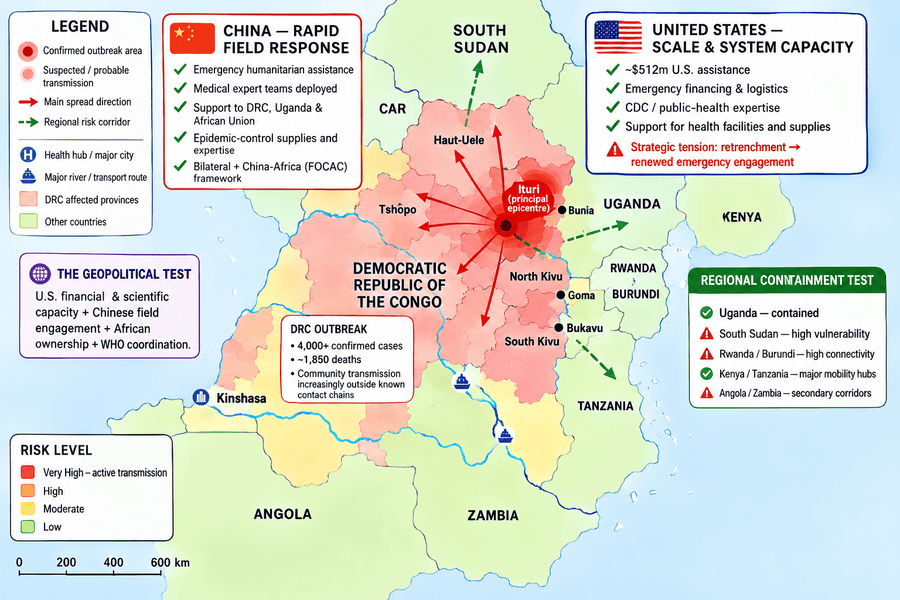
The World Health Organization has warned that ongoing fighting in the eastern Democratic Republic of Congo is severely disrupting efforts to contain an Ebola outbreak, creating what it called a “catastrophic collision” of disease and conflict.

WHO Director-General Tedros Adhanom Ghebreyesus said health teams cannot build trust or isolate patients while violence continues in Ituri province, where most cases have been reported. He urged an immediate ceasefire to allow humanitarian workers safe access.

Authorities say the outbreak has led to around 220 suspected deaths, with only a small number confirmed through laboratory tests. Aid organizations, including Médecins Sans Frontières, say they are facing serious difficulties responding because of insecurity in affected areas, poor road access, and large-scale displacement that is pushing already vulnerable people into overcrowded camps.

As concerns grow about the risk of cross-border spread, several countries including Uganda, Canada, the Bahamas, and the United States have introduced travel restrictions. Health officials are racing to trace thousands of contacts as quickly as possible, while also warning that this outbreak is caused by a rare strain of Ebola for which there is currently no approved vaccine or treatment.

Related Readings:

US Exits WHO

Spain’s Health Services

What to Look for When Checking Your Parents’ Health and Comfort During Holidays

Holidays offer a chance to spend unhurried, quality time with your parents. Beyond the usual conversations, they also give you a chance to quietly notice how they are managing their daily life, including any changes in routine, health, or comfort.

These moments can give you a clearer sense of whether everything is on track or if something may need a closer look.

Check If There are Any Changes in Their Daily Routine?

Start by observing how their day usually unfolds, like:

  • Are meals being skipped or eaten at irregular times?
  • Has their sleep pattern changed recently?
  • Do everyday tasks seem to take more time than before?

These shifts may seem minor, but they can point to something that needs to be looked into.

How is Their Physical Health and Mobility?

Notice how comfortably your parents move around, like walking, standing up, or using the stairs. This can give you a sense of how they are feeling physically.

Pay attention if they seem uneasy while walking, require more effort to stand up, or hesitate before certain movements. Any changes in balance or strength can affect how easily they handle daily activities.

Is Their Living Environment Safe and Comfortable?

The condition of the home can give you useful clues about how things are being managed. A space that feels organised and easy to move around in usually reflects comfort and control over daily tasks.

Look out for:

  • Clutter that could lead to trips or falls
  • Poor lighting, especially in walkways
  • Items placed in hard-to-reach areas

Are They Managing Medicines and Appointments Well?

Managing medicines and doctor visits is an important part of staying healthy. During your visit, try to understand if this routine is being followed properly. Check:

  • Are medicines being taken regularly?
  • Are prescriptions current?
  • Are follow-up visits happening as advised?

If anything seems off track, it may need attention.

How is Their Emotional Well-Being?

Spending time together can also give you a sense of their emotional state. Sometimes, changes here are easy to miss over phone calls.

Notice if they seem less interested in conversations, low on energy, or not as engaged in things they usually enjoy. These signs can indicate that they may need more interaction or support.

Do They Have Adequate Financial and Medical Support?

It is crucial to understand how prepared they are for medical needs. As health requirements change with age, having the right support in place becomes important.

When you look at the best health insurance, it helps to understand what kind of situations are covered. Some policies may include hospitalisation and related expenses, depending on the terms.

Have You Reviewed Their Insurance Coverage Recently?

Check if their current coverage still fits their needs, as health conditions and requirements can change over time.

When considering health insurance for parents, look at what the policy includes and whether it aligns with their present situation. Coverage, limits, and conditions can differ across policies.

Conclusion

A holiday visit can offer more than just spending time together. It gives you a chance to see how your parents are managing their daily life, from their health and mobility to their surroundings. Noticing small details during this time can help you understand if any changes are needed and support them in a way that fits their needs.

Global Regulation Challenges for Digital Psychic Service Platforms

Online psychic services are encountering heightened regulatory scrutiny as this sector expands internationally. Differences in legal frameworks, consumer protections, and data security requirements add complexity for providers and users. Financial and reputational risks can increase as digital psychic platforms work to maintain compliance across multiple jurisdictions.

The online psychic sector has evolved rapidly, driven by demand for remote advice and convenient access to entertainment services. Online psychics are subject to legal requirements that often differ by country and region. For both providers and users, these rules affect everything from service classification to the types of claims that can be made in public communications.

Legal definitions and their role in compliance

One significant challenge for online psychic services is legal classification, which shapes the obligations platforms must meet. Some jurisdictions treat digital psychic offerings as entertainment, while others define them as spiritual advice or consumer services.

This distinction impacts requirements for licensing, consumer disclosures, and what marketing claims may be permitted. Platforms operating in multiple legal environments must tailor policies and documentation for each jurisdiction. Not doing so can result in disputes or penalties.

Advertising, disclosure, and consumer risk protection

Operators are expected to prevent misleading advertising and manage users’ expectations regarding possible outcomes. Regulators may review whether guarantee language or implied promises could be considered exploitative to vulnerable users.

Transparency around pricing and billing practices is under regulatory scrutiny to reduce disputes and chargebacks. Standards for clear communication, such as those affecting Online Psychics, as well as effective complaint and refund management, are crucial to regulatory compliance for these platforms.

Managing privacy, payments, and operational responsibility

Online psychic services frequently process sensitive personal data through chat, voice, and video interactions. Regulations concerning cross-border data transfers, user consent, and secure data storage differ significantly, making ongoing compliance complex.

Payments also present challenges, with the sector sometimes classified as high risk for chargebacks. Know-your-customer (KYC) procedures, anti-fraud measures, and accurate record-keeping are important operational components, as regulators may require evidence that platforms address financial risks and abuse.

Governance practices and business outlook for providers

Provider vetting, complaint resolution, and effective platform moderation underpin compliance for digital psychic firms. Maintaining proper records and offering audit trails supports dispute resolution and regulatory examinations.

As the sector matures, both compliance costs and barriers to entry may increase; however, strong governance practices can reduce reputational risk. Sound operational procedures are expected to become more critical as regulatory pressures grow in the digital services industry.

AI Skills are Quietly Becoming the New Office Rent

By Dr. Gleb Tsipursky 

The new office divide is no longer remote versus in person or manager versus individual contributor. It is between people who treat AI as part of the job and people who still think it is optional. A recent WRITER and Workplace Intelligence survey captured the mood with unusual bluntness: many employers now say workers who resist AI risk stalled advancement or worse. Out of 2,400 employees and C-suite leaders, 60% of companies say they plan to lay off employees who will not adopt AI, 77% of executives say AI resisters will be passed over for promotions, and 92% say they are actively cultivating an “AI elite” class of workers. Even more telling, 87% of executives say those employees are at least five times more productive than their peers.

AI is being recast as the new minimum standard for relevance. That sounds harsh because it is. But it also reflects a deeper shift. AI is moving from novelty to baseline, and careers are being repriced around that reality.

The New Baseline

AI is spreading through work as a mix of augmentation and automation, not as a clean handoff from person to machine.

This is not happening because every company has cracked the code. Far from it. The World Economic Forum’s Future of Jobs Report 2025 says 39% of core job skills are expected to change by 2030, with technological change as the biggest driver. At the same time, McKinsey’s workplace AI research found that almost all companies are investing in AI while only 1% describe themselves as mature in how they use it.

That gap matters. Employers are demanding AI fluency before they have built stable systems, clear norms, or convincing workflows. So “use AI” becomes a vague command that often means “be faster, cheaper, and more adaptable.” Yet genuine AI fluency is not prompt theater. It is knowing when to automate, when to verify, when to keep humans in the loop, and when sensitive data should never touch a model in the first place. The Anthropic Economic Index points to the real pattern: AI is spreading through work as a mix of augmentation and automation, not as a clean handoff from person to machine.

The Productivity Premium Is Real but Uneven

There is a reason executives sound impatient. In a widely cited National Bureau of Economic Research paper on generative AI in customer support, access to an AI assistant raised productivity by 14% on average and delivered even larger gains for less experienced workers. Those numbers are catnip for leadership teams under pressure to grow without hiring.

But that same evidence should make companies more careful, not more reckless. AI produces gains where tasks are structured, feedback is quick, and performance is measurable. It does not magically fix bad management, muddled processes, or poor judgment. A recent Harvard Business Review analysis of AI-linked layoffs argues that many firms are cutting staff based on anticipated value rather than proven results. In other words, some companies are reorganizing around a promise they have not yet earned.

That is how an “AI elite” narrative turns corrosive. Workers get the message that they must use AI, but not the training, guardrails, or incentives to use it well. The result is speed without discipline: sloppy outputs, hidden errors, and shadow adoption that quietly expands risk.

The Smart Employers Are Redesigning Work

The more serious organizations are choosing a harder path. KPMG has offered cash rewards for employee AI innovation, signaling that experimentation should create enterprise value, not just personal efficiency. And Marriott’s technology leadership has emphasized a limited set of high-value AI use cases instead of spraying tools across the company and hoping culture catches up.

They will win by creating workplaces where human judgment gets more valuable as machine output gets cheaper.

That is the better model. Train people in AI adoption. Pick workflows that matter. Measure outcomes that executives actually care about. Build governance before a security incident builds it for you. Most of all, stop pretending that adoption is the same thing as transformation. It is not.

The employee most at risk now is not necessarily the one who has never touched an AI tool. It is the one who believes the old definition of competence will survive unchanged. But leaders should be careful too. Companies will not win by turning AI into a fear test. They will win by creating workplaces where human judgment gets more valuable as machine output gets cheaper. That is the real career insurance in the AI era, and the real competitive advantage.

About the Author

Dr. Gleb TsipurskyDr. Gleb Tsipursky was named “Office Whisperer” by The New York Times for helping leaders overcome frustrations with Generative AI. He serves as the CEO of the future-of-work consultancy Disaster Avoidance Experts. Dr. Gleb wrote seven best-selling books, and his two most recent ones are Returning to the Office and Leading Hybrid and Remote Teams and ChatGPT for Leaders and Content Creators: Unlocking the Potential of Generative AI. His cutting-edge thought leadership was featured in over 650 articles and 550 interviews in Harvard Business ReviewInc. MagazineUSA TodayCBS NewsFox NewsTimeBusiness InsiderFortuneThe New York Times, and elsewhere. His writing was translated into Chinese, Spanish, Russian, Polish, Korean, French, Vietnamese, German, and other languages. His expertise comes from over 20 years of consultingcoaching, and speaking and training for Fortune 500 companies from Aflac to Xerox. It also comes from over 15 years in academia as a behavioral scientist, with 8 years as a lecturer at UNC-Chapel Hill and 7 years as a professor at Ohio State. A proud Ukrainian American, Dr. Gleb lives in Columbus, Ohio.

The Quiet Industry That Could Replace Wall Street’s Research Floor

How Foresight Collective is turning crowd-sourced market intelligence into a global earning opportunity — and why prediction markets like Polymarket and Kalshi may be on the wrong side of the trade

There is a peculiar fact about the financial markets that has held true for decades: the people who reliably make money in them are concentrated in a handful of expensive postal codes. Hedge funds in Greenwich and Mayfair. Trading desks in lower Manhattan and Canary Wharf. Quantitative shops in Chicago, Singapore, and Hong Kong. The capacity to read markets accurately is treated as a scarce and credentialed skill, available only to those who can be hired into firms that pay seven-figure salaries to find them.

Foresight Collective, Inc., a New York-based company that launched its SafeBets platform on April 23, 2026, is built on a contrarian thesis: the talent is not scarce. The infrastructure to find it and deploy it productively has simply not existed before.

A different kind of prediction platform

The platform looks superficially similar to prediction markets like Polymarket and Kalshi, which have collectively attracted billions of dollars in trading volume by allowing users to bet on the outcomes of real-world events. The user experience involves opening an account, depositing money, and placing wagers on which outcomes will occur.

That model is now under sustained regulatory pressure. In May 2026, Minnesota became the first state to criminalize the operation of prediction markets, making it a felony to run such a platform within its borders. The federal Commodity Futures Trading Commission immediately sued to block the law, but the political signal was unmistakable. The reason is that prediction markets, by the legal definition every U.S. state uses, are gambling: users place wagers on uncertain outcomes, and most lose money over time.

The SafeBets platform is built around a single architectural decision that distinguishes it categorically from these competitors: users place no wager. No deposit. No stake. No capital at risk of loss. Participants make predictions on cryptocurrency prices, commodity movements, equities, foreign exchange, and other tradable markets, but their own money never moves. The Minnesota statute, which defines a prediction market as “any system that allows consumers to place a wager,” does not reach SafeBets. The same is true of essentially every state gambling law on the books.

The economic model is what makes the structure work. SafeBets does not generate revenue from user losses, because there are no user losses. Instead, the platform aggregates the predictions of its top performers into a real-time intelligence signal, which Foresight Collective’s affiliated trading entities deploy into actual financial markets — crypto exchanges, commodity futures, equity indices, FX pairs. The trading profits become the source of prize pools awarded to the most accurate forecasters.

In effect, Foresight Collective is operating a hedge fund whose research desk consists of thousands of independent forecasters, each compensated for being right.

The model prediction markets cannot replicate

A prediction market makes money in two ways: by taking a fee on each transaction, or by holding the float and benefiting from users who lose money to those who win. In either case, the underlying value created is the betting activity itself. The prediction data is a byproduct, not the product.

Foresight Collective inverts this. The predictions are the product. The platform exists to identify accurate forecasters, aggregate their intelligence, and deploy it into markets where being right has direct monetary value. The user experience is a contest for skilled participants, not a casino for speculative bettors. The economic engine is trading returns generated against external counterparties, not transaction fees extracted from a closed user base.

A platform whose business model depends on users losing money to other users has a structural limit: it can only grow as fast as it can attract new losing participants. A platform whose business model depends on aggregating skilled predictions has a different scaling curve entirely. More participants mean more signal. Better signal means better trading returns. Better returns mean larger prize pools. Larger prize pools attract more skilled participants. The flywheel runs on accuracy, not on churn.

A new earning opportunity for a global pool of analysts

The most consequential implication of the model is not its competitive position against existing prediction markets. It is the opportunity it creates for a class of workers who have never before had direct access to financial markets as a source of income: skilled forecasters located anywhere in the world, including in regions where local economies offer few professional opportunities.

To be paid for understanding markets today, you generally need to be hired by a financial firm, which generally means living in or near one of perhaps a dozen global financial centers. The university degree, the regulatory licensing, the personal network, the visa status, the rent in Manhattan or London — every step of the pipeline is structured around physical and credential gatekeeping that excludes the vast majority of people who might be genuinely skilled at the work.

The SafeBets platform removes this gatekeeping entirely. To participate, a forecaster needs an internet connection and a track record of accuracy. The platform ranks participants by their actual predictive performance over time, not by their resume or location. A 25-year-old in Lagos with insight into African commodity markets can build a verifiable track record. A retired analyst in Manila with three decades of regional currency experience can compete on equal terms with a Stanford MBA in Palo Alto. The platform pays the same dollar amount for the same accuracy regardless of where the forecaster lives.

The Uber and Airbnb parallel

The closest analogies for the economic dislocation this could produce are Uber and Airbnb, both of which created earning opportunities for people whose previous options were considerably narrower.

Before Uber, a person who owned a car and had time to drive had no straightforward way to convert that into income. Uber’s contribution was not the car or the driving — both already existed — but the infrastructure that connected supply to demand at scale. Today, millions earn meaningful income through Uber and similar platforms worldwide, with the highest impact concentrated in markets where alternative employment is scarce.

Before Airbnb, a person who owned a spare room had no marketplace to monetize it. Airbnb’s contribution was the infrastructure that turned latent housing capacity into income, with particular impact in regions where tourism is the primary economic activity.

The Foresight Collective model points toward the same kind of unlock, applied to financial analysis. The latent supply — skilled forecasters whose insights have never had a marketplace — already exists. What has been missing is the infrastructure to identify them, verify their accuracy, and pay them for being right.

A forecaster in Vietnam may have insights into regional supply chains that no Manhattan analyst can match. A forecaster in Nigeria may understand local energy markets in ways that no London commodities desk could replicate. A forecaster in Argentina may have lived experience of currency instability that no Chicago quant could acquire from data alone. The platform’s structure rewards exactly this kind of distributed, local expertise — and pays for it in real money.


What this could become

The history of internet platforms suggests the most consequential ones are not necessarily those that look most disruptive at launch. Uber initially looked like a slightly better taxi app. Airbnb initially looked like a slightly better classified ad. The transformative effect — the creation of entirely new categories of work — became apparent only as the platforms matured and network effects compounded.

The SafeBets platform launched on April 23 with similar surface modesty. But the underlying architecture — separation of forecaster compensation from user wagering, monetization through external market trading rather than internal user losses, global open access without credential gatekeeping — points toward something more substantial: the early infrastructure of a decentralized industry of market analysts, distributed across the world, compensated directly for the value of their insights.

The capacity to read markets — historically one of the most credentialed and geographically concentrated skills in the modern economy — would become accessible as a source of income to anyone with internet access and the discipline to develop genuine accuracy over time. The prediction markets that came before it monetizes losers. The platform Foresight Collective is building monetizes accuracy — and pays for it globally.

The photo in the article is provided by the company(s) mentioned in the article and used with permission.

Trump Says Iran Deal Is Close as Strait Talks Advance

Donald Trump said a framework for a possible peace agreement with Iran is now “largely negotiated,” raising hopes that tensions in the Middle East could ease after months of conflict. Trump said discussions are focused on reopening the Strait of Hormuz, a key global shipping route that has disrupted oil markets since fighting began earlier this year.

According to reports from Pakistan and Iran, negotiators made progress over the weekend through mediation efforts led by Pakistani officials. Sources familiar with the talks said the proposed agreement could unfold in stages, starting with a formal end to the war, followed by steps to stabilize shipping in the Strait of Hormuz and launch wider negotiations. Iran, however, pushed back against claims that a final agreement is close, calling some reports inaccurate.

Trump also spoke with leaders from Saudi Arabia, Qatar, United Arab Emirates and Pakistan as pressure grows to avoid another surge in global energy prices. U.S. officials continue to insist that Iran must not develop nuclear weapons and that shipping routes must remain open without restrictions.

Iran says it wants an end to sanctions and the U.S. naval blockade before any broader agreement can move forward. While both sides signaled cautious progress, major disagreements remain unresolved. Officials on both sides expect the next few days to determine whether negotiations continue or tensions rise again.

Related Readings:

Senate Pushes to Limit Trump Action in Iran

Hormuz Clash Raises US Iran

Hormuz Tensions Ease

Autonomous AI Trust is Becoming The Next Business Moat

By Dr. Gleb Tsipursky

The age of passive AI is ending faster than many leaders expected. Consumers are no longer merely asking chatbots for recipes, travel ideas, or customer-service answers. They are beginning to let software act for them.

That makes autonomous AI trust the next serious business moat because the companies that earn permission to act on a customer’s behalf will sit much closer to decisions, wallets, schedules, and daily routines.

Consumers are delegating at the edge of daily life while companies are experimenting inside workflows

EY’s 2026 AI Sentiment Report found that 84% of respondents across 23 markets used AI in the previous six months, while 16% had already used AI systems that act without human intervention. Those figures should end any comfortable fiction that autonomous AI is a distant boardroom topic.

The delegation economy has already begun. The open question is whether leaders will treat autonomy as a feature to ship or a relationship to earn.

Delegation Is Becoming Everyday Behavior

The most important AI adoption story is not dramatic — it is ordinary. People are growing comfortable with AI through low-stakes interactions such as route planning, recommendations, travel planning, and customer support. That familiarity is quietly preparing them to hand over more consequential tasks. EY reported that 10% of respondents had used AI agents to purchase products on their behalf and 11% allowed AI to refill shopping carts or manage banking tasks.

That is why agentic AI adoption matters beyond the technology sector. McKinsey’s 2025 global survey found that 88% of organizations were regularly using AI in at least one business function, while 23% were scaling an agentic AI system somewhere in the enterprise.

Consumers are delegating at the edge of daily life while companies are experimenting inside workflows. The two trends are converging.

The strongest early markets also reveal where the curve may go next. EY identified India, the Chinese mainland, Brazil, Mexico, Saudi Arabia, the UAE, Hong Kong SAR, and South Korea as “Pioneer” markets, where 94% of respondents reported using AI and nearly one in four had already used autonomous AI. That pattern suggests autonomy will not spread evenly. It will accelerate first where digital habits, mobile commerce, and comfort with platform-mediated services are already high.

For executives, the lesson is blunt. Customers may say they worry about AI, yet still use it when it saves time, reduces friction, or solves a tedious problem. Adoption does not wait for full confidence. It advances through usefulness.

Trust Is Lagging Behind Use

The paradox is that people are delegating before they fully trust the systems receiving that authority. EY found that 66% of respondents worry about AI systems being hacked or breached, 66% say human oversight remains essential, and 73% fear they will no longer be able to distinguish what is real from what is AI-generated. That is a warning about how autonomy must be introduced.

The public mood points in the same direction. Consumer AI trust remains fragile, with Pew Research Center finding that across 25 countries, a median of 34% of adults were more concerned than excited about AI’s increased use — compared with 16% who were more excited than concerned. Stanford’s 2025 AI Index likewise found that global confidence in whether AI companies protect personal data fell from 50% in 2023 to 47% in 2024.

The trust problem grows sharper when AI moves from advice to action. A chatbot that gives a bad dinner suggestion is annoying. An agent that buys the wrong product, mishandles personal data, or follows malicious instructions is a different category of risk.

OpenAI’s release of ChatGPT agent captured both sides of the new era: the promise of tools that can navigate websites, create spreadsheets, and complete multistep work, and the risk that agents handling live data can be manipulated through prompt injection or other adversarial tactics.

That makes AI security risk a board-level issue. IBM’s 2025 Cost of a Data Breach Report warns that AI is outpacing security and governance, with 63% of organizations lacking AI governance policies to manage AI or prevent shadow AI. Autonomy expands the attack surface because agents can connect, click, retrieve, decide, and sometimes transact.

Governance Must Become A Product Feature

The businesses that win the autonomous AI race will not be the ones that shout “fully automated” the loudest. They will be the ones that make control visible, understandable, and reversible. Human oversight AI is part of the user experience. NIST’s AI Risk Management Framework and its Generative AI Profile give organizations a practical language for mapping, measuring, managing, and governing AI risks before they become brand failures.

The same shift is visible in regulation and standards. The AI Governance Strategy conversation has moved from voluntary principles to enforceable expectations, with the European Union’s AI Act entering into force in 2024 to promote responsible AI development and deployment. ISO/IEC 42001 similarly gives organizations a management-system standard for establishing, maintaining, and improving responsible AI practices.

But governance cannot live only in legal, risk, or compliance departments. Autonomous systems require product-level design choices: when the agent asks permission, what it is allowed to do alone, how it explains actions, how users revoke access, how sensitive data is protected, and how failures are corrected. These choices determine whether customers experience autonomy as convenience or loss of control.

That is why responsible AI leadership now belongs in strategy discussions about growth. McKinsey found that AI high performers are more likely to redesign workflows, define when model outputs need human validation, and show senior leadership commitment. In other words, value comes not from sprinkling AI onto existing processes, but from rebuilding work around clear accountability.

Conclusion

The emerging AI trust gap is therefore not a reason to slow down indefinitely, but is a reason to build better.

Autonomous AI is crossing the line from novelty to infrastructure. It will impact how people shop, bank, schedule, travel, learn, and work. Yet the permission to act on someone’s behalf is more intimate than the permission to answer a question. It demands a higher standard.

The emerging AI trust gap is therefore not a reason to slow down indefinitely, but is a reason to build better. Companies should assume customers will adopt useful autonomous tools before they fully trust them, then design every delegated action to earn more confidence than the last.

Trust will not arrive through grand promises about the future of AI. It will accumulate through secure, transparent, well-governed moments when the machine does the right thing, the human remains in control, and the value is obvious.

About the Author

Dr. Gleb TsipurskyDr. Gleb Tsipursky was named “Office Whisperer” by The New York Times for helping leaders overcome frustrations with Generative AI. He serves as the CEO of the future-of-work consultancy Disaster Avoidance Experts. Dr. Gleb wrote seven best-selling books, and his two most recent ones are Returning to the Office and Leading Hybrid and Remote Teams and ChatGPT for Leaders and Content Creators: Unlocking the Potential of Generative AI. His cutting-edge thought leadership was featured in over 650 articles and 550 interviews in Harvard Business ReviewInc. MagazineUSA TodayCBS NewsFox NewsTimeBusiness InsiderFortuneThe New York Times, and elsewhere. His writing was translated into Chinese, Spanish, Russian, Polish, Korean, French, Vietnamese, German, and other languages. His expertise comes from over 20 years of consultingcoaching, and speaking and training for Fortune 500 companies from Aflac to Xerox. It also comes from over 15 years in academia as a behavioral scientist, with 8 years as a lecturer at UNC-Chapel Hill and 7 years as a professor at Ohio State. A proud Ukrainian American, Dr. Gleb lives in Columbus, Ohio.

US Treasury Yield Surge Hits 5.2% Amid Inflation Fears and Bond Selloff

A sharp selloff in the US bond market intensified this week as inflation concerns, geopolitical tensions, and rising government debt pressures pushed long-term Treasury yields to levels not seen in nearly two decades.

The 30-year US Treasury yield climbed to 5.2%, its highest point since 2007, as investors reacted to fears that inflation could remain elevated for longer than expected. The move reflects growing unease over fiscal stability, persistent deficits, and the economic fallout from the ongoing conflict involving Iran.

The war has triggered a global energy shock, driving oil and gas prices to four-year highs while disruptions in key shipping routes, including the Strait of Hormuz, continue to strain supply chains. Rising energy costs have begun feeding into broader inflation, including higher food prices and airfares.

“The forces driving the sell-off – fiscal deterioration, defense spending, sticky inflation, central bank paralysis – are not resolving in the next week. They are getting worse,” said Ajay Rajadhyaksha.

Investors have responded by demanding higher returns on government debt, pushing yields higher and bond prices lower. The benchmark 10-year Treasury yield, which influences mortgage and consumer borrowing rates, rose to around 4.67%, its highest level in more than a year.

Nigel Green, chief executive of deVere Group, said bond markets are signaling that inflation may prove more persistent than many investors anticipated. He added that investors are increasingly seeking compensation for inflation risk and geopolitical uncertainty.

Higher yields are reverberating across global financial markets. The US Treasury market plays a central role in setting borrowing costs, meaning increases in yields often translate into higher mortgage rates, auto loans, and corporate financing expenses. Stock markets have also come under pressure as investors reassess valuations in a higher rate environment.

Equity markets in the United States weakened on Tuesday, extending a recent losing streak. The Dow Jones Industrial Average fell 322 points, or 0.65%, while the S&P 500 dropped 0.67% and the Nasdaq Composite declined 0.84%. The S&P and Nasdaq each posted a third consecutive day of losses as rising yields weighed on sentiment.

The pressure is not confined to the United States. Global bond markets have also sold off as investors reassess long-term inflation risks and government borrowing needs. The United Kingdom’s 30-year gilt yield reached its highest level since 1998, while Japan’s 30-year government bond yield hit a record high.

In the US, two-year Treasury yields also climbed to their highest level in over a year, signaling expectations that the Federal Reserve may keep interest rates elevated or potentially consider further tightening if inflation persists.

The rise in yields contrasts with President Donald Trump’s push for lower interest rates to support economic growth. It also comes as markets prepare for a leadership transition at the Federal Reserve, with Kevin Warsh set to assume the role of chair.

For investors, the 10-year yield level of 4.8% is being closely watched as a key technical threshold, a level rarely sustained since 2007.

Thomas Tzitzouris, head of fixed income research at Strategas Research Partners, said inflation remains the primary driver of the selloff. He added that widening fiscal deficits across major economies are compounding pressure on long-term debt markets, reinforcing expectations of higher yields for longer.

Related Readings:

Major oil-producing countries reliant on the Strait of Hormuz for exports


AITX Is Building the AI Infrastructure the Security Industry Needs

By Andrea Joy Dizon

Physical security has always been a people business. Guards at doors, operators staring at screens, supervisors managing shift schedules with rotating staff that burn out, call in sick, or simply stop paying attention at 3 a.m. For decades, that model held — not because it worked well, but because nothing existed to replace it. That calculus is now changing, and the company doing the changing is smaller than you might expect.

Artificial Intelligence Technology Solutions, Inc. (AITX), a Detroit-based public company trading under the ticker $AITX (OTCID: AITX), has built a commercially deployed agentic AI platform called SARA — Speaking Autonomous Responsive Agent. With over 200 clients, more than 1,000 solutions currently active across sites, and a sales pipeline populated with Fortune 500 names, AITX is punching well above its weight class in a market worth nearly $50 billion annually in the United States alone. Revenue is approaching $10 million, growing at 300 percent. Most people have never heard of them.

The Problem That Human Attention Can’t Solve

The traditional security operations center model carries a structural flaw that no amount of overtime can fix. Human attention fades. It fragments. During extended overnight shifts, the consistency of decision-making deteriorates in ways that no supervisor wants to acknowledge, but every operator quietly knows is true. Staffing shortages compound the problem. Turnover rates in the security sector rank among the highest of any industry, and wages are climbing as organizations compete to fill roles that are physically demanding, repetitive, and difficult to retain people in.

“Security operations don’t fail because people aren’t committed — they fail because human attention simply cannot scale indefinitely,” said Steve Reinharz, CEO, CTO, and founder of AITX. “SARA was designed to operate in environments where thousands of decisions must be made every day with the same discipline and consistency. When scale becomes the challenge, fatigue cannot be part of the equation.” The math behind that statement is more serious than it sounds. 

A monitoring center handling hundreds of sites across multiple time zones faces not dozens of security events per shift, but potentially thousands. A human operator working a queue processes them one by one, sequentially, with attention that wanes across hours. SARA processes events in parallel — no queue, no degradation, no variance between decision number one and decision number ten thousand. Each detection is evaluated using the same predefined logic and criteria, regardless of whether it occurs at noon or 4 a.m.

Deployed, Verified, and Already Running Inside the Industry’s Core Infrastructure

The distinction between what AI can theoretically do and what it actually does in live environments matters enormously in physical security, where the consequences of failure are tangible. SARA is not a prototype. It is not a pilot program awaiting broader rollout. It is active across client sites right now, making autonomous decisions at scale every single day. That operational reality received formal validation in March 2026, when AITX and Immix announced the introduction of SARA Alive Operating Inside Immix.

It enables SARA to execute monitoring workflows in real time directly within the Immix platform. Immix is not a peripheral player in this space. Founded in 2003, its workflow software is deployed across central stations, enterprise security operations centers, and critical infrastructure environments in more than 50 countries, managing millions of events daily. It holds UL certification in the United States and BS8418 compliance in Europe. Getting SARA to run natively inside Immix is equivalent to earning a seat at the table that the entire professional monitoring industry already eats from.

“SARA Alive Operating Inside Immix demonstrates that this is no longer theoretical,” said Reinharz. “It handles real monitoring workflows with speed and consistency, executing tasks directly within the platform. This is a meaningful step toward a more scalable and efficient operating model for monitoring centers.”

The technical architecture behind the Immix integration is deliberately frictionless. SARA enters existing monitoring environments the way a new operator would be onboarded — without infrastructure changes, without disrupting current workflows, and without requiring separate operational processes. Mark Kenna, CTO of Immix, noted that the API-less model makes adoption practical and controlled. For monitoring centers that have spent years resisting automation because the costs of change felt too high, accessibility removes one of the last remaining excuses.

Recognition, Reach, and What Comes Next

The SIA New Products and Solutions Awards are among the most credible signals of genuine advancement in the security industry. In 2025, SARA earned two honors at the Security Industry Association’s NPS Awards at ISC West — recognized both for autonomous detection and response capabilities and as a Judges’ Choice winner. Judges’ Choice distinctions are not awarded for promise. They reflect practical impact on real-world operations. 

Then at ISC West 2026, SARA Alive Operating Inside Immix won again in the Commercial Monitoring Solutions category, making SARA a two-year consecutive presence on the industry’s most-watched stage. Awards carry weight in a sector that has historically been slow to adopt new technology. They signal to procurement officers, enterprise security directors, and board-level risk managers that a platform has been vetted by people who understand what the work actually demands. 

Combined with a completed SOC 2 Type 2 audit, the independent standard that enterprise and government clients require before trusting any system with sensitive operational data, SARA now carries the kind of documented credibility that accelerates sales cycles. The company currently serves clients across the United States and Canada, with expansion into the United Kingdom and the Middle East planned within the next twelve months. The logic behind that expansion arc mirrors how SARA itself operates: prove the model thoroughly in one environment, then extend it outward with confidence. 

AITX is also watching what happens when the autonomous decisioning capabilities built for security begin finding application in adjacent commercial and operational settings — logistics monitoring, property management, and any environment where continuous, consistent observation at scale carries economic value. Security was the proving ground. The question the industry is starting to ask is: where does SARA go from here?

When Workplace Misconduct Allegations Create Overlapping Criminal, Regulatory and Legal Risk

By Rachel Cook

Crispin Odey’s settlement of civil claims alleging sexual misconduct and his challenge to the FCA’s fine and ban, illustrate a broader issue facing regulated firms. 

The case of Crispin Odey highlights how allegations of misconduct can rapidly extend beyond a single issue into overlapping legal, regulatory and reputational arenas. Whatever the outcome in any individual case, the lesson is clear: allegations of workplace or non-workplace sexual misconduct rarely remain confined to a single process. In FCA regulated environments they may trigger internal investigations, employment disputes, regulatory scrutiny, civil litigation and, in some cases, criminal investigation. 

A changing risk landscape

The challenge is not simply multiple proceedings, but their differing objectives, timelines and disclosure expectations. Decisions taken early in one forum can have unintended consequences in another.

In the financial services sector, the FCA has increasingly signalled that serious non-financial misconduct is not simply a private employment matter, but may raise questions of integrity, fitness and propriety, culture and governance. Conduct which may once have been treated as an internal HR issue can now raise wider regulatory concerns, particularly where senior individuals or firm culture are involved. Recent enforcement trends also suggest a regulator willing to act more quickly and assertively, increasing pressure on firms to make early strategic decision where allegations may engage regulatory expectations.

When the response becomes part of the risk

Recent regulatory scrutiny has also highlighted that the response to allegations may itself become part of the risk landscape. In regulated environments, the central regulatory question may not be confined to the underlying allegation itself. Governance decisions, disciplinary independence, internal escalation, organisational culture and the integrity of decision-making processes may all attract scrutiny in their own right.  

Employers are under increasing pressure to take complaints seriously, investigate thoroughly and demonstrate that concerns have been addressed appropriately. As legal expectations around workplace sexual harassment and organisational risk management evolve, allegations are increasingly likely to be formally documented, escalated and scrutinised. At the same time, particularly in regulated environments, firms must ensure that efforts to manage risk remain proportionate and do not create poorly scoped or unnecessarily intrusive scrutiny.

There is also a reputational dimension. In sectors built on trust, allegations can create immediate commercial, public relations and media pressures, often creating an instinct to act quickly. However, urgency does not always align neatly with broader legal strategy.

Those raising concerns, and their advisers, are increasingly aware of the multiple avenues available to them. Depending on the facts, issues may be raised internally, pursued through employment claims, brought to the attention of regulators, litigated civilly or, in some cases, reported to law enforcement. Not every allegation will engage every route, but the overlapping processes are increasingly part of the legal landscape.

The challenge of parallel proceedings

Multiple processes are not the primary difficulty. The greater challenge lies in the interaction between them.

Employment, regulatory, civil and criminal processes each operate according to different rules, objectives and timetables. Employers may focus on responding swiftly, demonstrating appropriate governance and protecting staff welfare. Regulators may be concerned with culture, systems and the conduct of senior individuals. Civil proceedings may prioritise disclosure and compensation. Criminal processes raise different considerations again.

The difficulty is that steps taken for entirely understandable reasons in one context can create unintended consequences in another. Internal investigations, for example, may involve taking witness accounts at an early stage, requiring responses to allegations, or generating substantial documentary records. That may be understandable from an employment or governance perspective. However, where criminal issues may arise, those same steps can create evidential complications, including where early accounts are later tested against a fuller evidential picture, or generate material that later becomes relevant in other proceedings.

Timing can create tension. Reputational, regulatory or commercial pressures may create an understandable desire for swift action. Yet where allegations potentially engage criminal law, speed does not always align neatly with strategic legal decision-making. Questions around interviews, document preservation and communications can have wider implications than first appear.

Disclosure and privilege can present further complications. Questions on legal privilege may require careful consideration from the outset, particularly where both corporate and individual interests are engaged and separate legal representation may be involved. Assumptions about what material will remain protected, or whether documents created for one purpose may later become relevant elsewhere, can create strategic difficulties if not addressed early.

Confidentiality assumptions may also require careful scrutiny. Participants in internal investigations may assume that complaints, witness accounts or investigative findings will remain contained within a private employment process. In reality, where regulatory scrutiny, civil litigation or other legal proceedings follow, the practical limits of confidentiality may be significantly narrower than participants anticipate.

Overlapping processes may also affect participant engagement. Concerns about future disclosure, repeated participation across multiple proceedings or loss of confidentiality may influence whether individuals feel able to engage fully with internal processes, with potential implications for evidential quality.

This is not an argument against taking allegations seriously or acting decisively. It is an argument for recognising that parallel proceedings require coordinated strategy from the outset. What may appear to be a straightforward response in one forum can, if approached in isolation, create avoidable legal complications in another.

Criminal crossover: strategic complications for firms and individuals

Not every allegation of workplace misconduct will engage criminal law. However, some may. Depending on the facts, allegations involving sexual assault, stalking, coercive or controlling behaviour, certain communications, and in some circumstances criminal harassment, may engage criminal law.

Where that occurs, the strategic complexity increases significantly. Internal employment or regulatory processes are typically designed to address governance or welfare concerns, rather than criminal evidential considerations. Yet decisions taken at an early stage may have implications far beyond the immediate process.

For individuals facing allegations, the interaction between these processes can be particularly difficult to navigate. A response that appears appropriate in one context may carry different risks in another. Firms may face competing obligations between responding appropriately to complaints, protecting staff welfare, meeting regulatory expectations and managing legal exposure.

The point is not that employment or regulatory action should be delayed whenever criminal issues may arise. Where criminal risk exists, overlapping legal processes require coordination. Treating each process in isolation can create avoidable complications.

Early strategy matters

For FCA regulated firms, allegations of sexual misconduct can no longer be viewed simply as internal employment issues. They may raise questions of governance, regulatory scrutiny, reputational risk and civil exposure, while individuals involved may, depending on the facts, also face potential criminal implications.

The complexity lies in the interaction between those processes. A well-intentioned response in one forum may create unintended consequences in another if broader implications are not considered from the outset.

As legal and regulatory expectations continue to evolve, firms and individuals alike will increasingly need to navigate allegations in an environment where employment, regulatory, civil and, in some cases, criminal issues may overlap simultaneously. In that context, coordinated early legal strategy, including careful consideration of any criminal implications and broader procedural consequences, is not simply desirable; it may be critical to preventing complications later.

About the Author

Rachel CookRachel Cook is a senior solicitor specialising in corporate and financial crime, regulatory enforcement, and complex internal investigation, with particular expertise in fraud, international corruption, tax enforcement and money laundering. She advises corporates, senior executives, and private individuals facing high-stakes allegations, with extensive experience manging reputational, legal, and regulatory risk arising from sensitive misconduct investigations.

EDITOR'S PICK OF THE WEEK

CFO's new mandate. CFO explaining the presentation

The Performance and Transformation Orchestrator: The CFO’s New Mandate in the Age of AI

By Terence Tse CFOs are evolving into AI-driven transformation orchestrators, balancing finance, technology, and strategy while upskilling teams, managing risks, and driving measurable business value. A key insight from this year’s AI for CFOs event, organized...

WISE DECISION MAKER GUIDE

POWER INFLUENCERS

Emerging Trends

The Future of Global Trade