Home Blog Page 839

Tips for Saving Money on Common Expenses

Close up of woman puts euro coin into piggy bank

When it comes to spending less money, the human race tends to opt for consumerist ways. For those who prefer to keep their expenses low but don’t know where to start, here are some tips to help you save money on common expenses.

Invest in Refurbished Phones

If you only use your iPhone or smartphone to play games and message your friends and family, then you can most definitely buy refurbished phones from The Store instead. The Store offers refurbished phones that have been thoroughly inspected and sanitized to have 100 percent of their working capacity and aesthetics. In addition, they have a 12-month warranty in which you can return the refurbished phone and have it fixed at no cost. They also refurbish other electronic devices such as laptops, tablets, and TVs. So instead of buying a new phone for a fortune, get a refurbished one at a discount.

Try Some Supplements

Herbal supplements can be a cost-effective way to alleviate common symptoms and side effects. For example, if you suffer from that constant ringing in your ear called tinnitus, then you should invest in Tinnitus911. Created by Phytage Labs, Tinnitus 911 works with natural ingredients like hawthorn berry, olive leaf extract, and hibiscus to help your brain function in the best way possible. It can also help free you from symptoms like buzzing, nausea, and headaches caused by tinnitus and support you with better memory retention, focus, and hearing, all without wasting money.

Cancel Any Unnecessary Subscriptions

As you may know already, you may have some subscriptions that are draining your hard-earned money. If you want to save a couple of twenty-dollar bills every month, you should stay on top of your unused subscriptions and cancel them. You will be amazed at how much money you can save by unsubbing from these services.

Consider Cheaper Housing and Cars

Your rent or mortgage is a typical expense as you invest in a monthly payment to keep your home. The same is true for your car, whether you lease or financed a purchase. However, you can opt for refinancing your home and your car lease or find cheaper solutions that will not make so big a hole in your wallet.

Work Out at Home

Additionally, you will want to knock out your gym membership by working out at home. You can invest in gym equipment and find online sessions for yoga or any cardio activity you enjoy to follow a routine. The one or two hundred dollars you spend now on equipment will make up for the thousands you’re spending on the gym’s membership otherwise.

Cook All Your Meals

We all fall into the loop of buying our lunches from restaurants or drive-throughs, but that also is a big waste of money and health. Instead, you can cook meals for you and your family to enjoy daily. If you think you can’t, you have all the means to learn—if you can read this article, you can surely read a recipe.

Maintain Your Appliances

Keeping your appliances clean and in top shape will help their longevity and reduce your utility bills in the long run. For example, clean your AC filters and vents as well as your dryer’s lint filter regularly to prevent them from working extra hard. You can hire a contractor to clean all your appliances, saving you hundreds of dollars in the long run.

Use Coupons and Deals

Additionally, you can use coupons to save money on your groceries and clothes. Most stores offer savings either on paper or on their online portal, but if that’s not the case, you can check out services that provide you with coupons for all your online shopping needs.

Start working on the items on this list so you can start seeing your savings grow today.

A Quick Guide to CTV Ad Monetization

CTV Ad Monetization

Connected TV (CTV) is one of the fastest-growing and most financially lucrative industries in the world, with the vast majority of homes in the US and across the globe equipped with a smart streaming device to watch an on-demand video. 

This surge in video streaming has been led by household names such as Netflix, Amazon Prime and Disney+, with users able to view their extensive libraries via their smart TV, smartphone, tablet or a CTV device such as a Roku Stick or AppleTV.

But how do publishers implement Ad monetization to generate revenue?

What is an Ad Monetization Platform?

Ad Monetization Platforms for publishers offer a programmatic solution so they can generate revenue from their content without using the services of a third-party intermediary. Removing TPIs from the equation can sometimes result in a 30% increase in revenue, ensuring a quick return on investment. 

These platforms grant full control to publishers and allow them to easily manage their ad inventory, so only relevant and suitable ad content is allowed on their platform. Not only can media sellers tap into a wide network of prospective advertisers but Ad monetization can be fully automated by the platform, allowing publishers to manage their core business operations instead.

Real-time insights and analytics are also available, so amendments can be made to make sure your ad inventory is working to its full potential.

An Ad Monetization platform simplifies the entire process, resulting in increased revenue, higher levels of control, real-time optimizations and advanced tracking. 

Who Can Use Ad Monetization Platforms?

Ad monetization platforms can be used by content publishers for CTV devices, meaning ads can be placed before or during video playback, or on the interface itself in many different formats. 

This is the best option to generate income from your content if you do not wish to charge a monthly subscription fee.

How does Ad Monetization Work?

Hopeful advertisers place bids on a publisher’s available ad inventory, and the highest bid is selected by the platform. The Ad is then displayed on their chosen medium, providing their product matches the criteria set by the publisher. 

For example, a toy company may wish to advertise via a video interruption during a popular children’s TV show. They will insert their highest possible bid into their Ad Exchange and if successful, their ad will be shown, as the product would be relevant to the audience.

This ‘auction’ process is extremely quick and efficient and is largely managed by complex algorithms which can process information in milliseconds and handle a countless number of requests.

What is a Private Ad Exchange?

A Private Ad Exchange allows a publisher to manage their own personal, online marketplace for their ad inventory. Removing the need for any third parties and only dealing with preferred advertisers.

Once set up, this marketplace can be fully automated by the monetization platform, resulting in a functional and flawless system to sell Ad space. 

This differs from a traditional Ad network which requires a middleman who will take a cut of the profits. These networks also require additional liaising, the presence of a Supply-Side Platform and much less control over your inventory. As such, there is no clear benefit of sticking to a traditional Ad network and these platforms are quickly becoming outdated. 

Ad Monetization by Using an Ad Exchange Platform

  1. An Ad Exchange Platform grants you full control over your ad space, meaning only relevant ads are shown on your content. This also extends to the format and styling of the ad to limit the level of intrusiveness. 
  2. A Private Ad Exchange can result in a 30% increase in revenue when compared to using a traditional Ad network. 
  3. The platform creates a personal marketplace for your Ad inventory which can be fully automated, meaning the algorithm does all the work once your preferences have been determined. This frees up a significant amount of time that can be reinvested in building and marketing your product. 
  4. Publishers can explore a range of insights and analytics via the platform which enables them to make informed decisions and maximize revenue. This data can show which Ad types and formats are being well received and which aren’t, so optimizations can be made.

We hope this quick guide has been useful to you and has answered any questions you may have had about CTV Ad monetization.

Start Trading Right Now: Discover the Possibilities of Crypto with Bitcoin Loophole

Bitcoin Loophole trader

Many businesses are going through difficult times nowadays. No wonder if you want to stay afloat or, even better, your financial situation, you have to look for innovative and more lucrative ways to make money. Crypto trading seems to be an ideal solution. Digital assets are steadily replacing traditional fiats. It’s possible to use crypto coins when shopping online, ordering services, and buying products. It’s one of the most popular currencies on entertainment platforms.

Thanks to the Bitcoin Loophole, you can even make money on crypto. Trading or speculating on the rates of different coins allows you to get some profit if you choose a fair deal. The problem is to find a reliable crypto trader who offers excellent deals. It’s the primary function the Bitcoin Loophole performs. Your task is to place a deposit and start trading.

You may wonder why you can’t trade without the Bitcoin Loophole. You can. Yet, it will take more time, money, and effort. It’s necessary not only to find a suitable exchange service and understand how it works. The next step is waiting for the most profitable deal. You may spend several hours a day surfing the Net in the search for reasonable rates. The Bitcoin Loophole robots do it for you.

At the same time, you have to realize that you can’t trade on the same Bitcoin Loophole platform. It features other functions. It has to provide users with a list of reliable and trustworthy brokers. Then, you choose the most appropriate variant and start trading. The service is simple. Even beginners experience no difficulties when working with it.

Moreover, Bitcoin Loophole possesses some essential pluses you’d appreciate. They are the following:

  • The use of the platform is free.

You aim to earn money with the help of crypto trading but not to lose them. Some commissions are charged only from your earnings. Yet, Bitcoin Loophole charges no fees every time you use the robots.

  • You can always count on support and assistance.

Crypto trading is not an easy thing. There are lots of details and aspects you should consider. No wonder only a few users have no problems. If you are not one of them, you can count on competent assistance from the specialists of the Bitcoin Loophole service.  

  • The interface is simple and intuitive.

Even if it is the first time you visit the Bitcoin Loophole website, you do not need to spend some hours finding all the required buttons. The interface is simple and clear. You would hardly experience difficulties when using the platform.

Mistakes You Should Avoid When Trading

It should be noted that crypto trading is always connected with the risks of losing your money.

You can hardly find a crypto investor who has never lost the funds or has never made mistakes. Yet, their experience can teach you and help you to avoid several mistakes. Thus, you should not:

  • Concentrate only on one cryptocurrency.

Many newbies start trading with Bitcoin. It happens only because they do not know the opportunities other altcoins may propose. Bitcoin Loophole allows you to work with a wide range of digital assets. You can experiment and get awesome profit!  

  • Place large deposits.

The minimal deposit you should place is only $250. It’s enough to complete your first deals. It’s a good idea to start with small sums. After you feel more confident and know how to work with the service, you can increase the deposits. Moreover, it’s so easy to deposit your account via your credit card. It takes only a few minutes.

  • Leave money on your account for an extended time.

Bitcoin Loophole allows you to withdraw earnings fast and easily. Experienced traders do not recommend storing your money on your account while the temptation to complete as many deals as possible is relatively high. The problem is the more significant part of such deals will hardly bring you some profit.

To conclude, it should be highlighted that the best time for crypto trading is now. The thing is, the market is stable. The more significant part of changes and alterations is predictable. With the help of the powerful Bitcoin Loophole, you have all chances to become one of the most successful crypto investors.

How to Gamble Online Safely

Gamble Online

It is impossible to ignore the meteoric rise of internet gambling over the past decade, with some estimates suggesting that around 20% of the global population now participate in some form of gambling on a semi-regular basis. In Canada, the majority of so-called gambling relates to scratch cards and lottery, but many citizens also use casino sites to play slot machines and other chance-based games.

The legality of online gambling in Canada is somewhat opaque, which can raise some security concerns for participants. Canadians have a choice between using a state-sanctioned site, if they live in a province where this is an option, or accessing offshore providers who operate in a legal grey area. It is very important that players use only a trusted online casino Canada, which also includes many of the foreign sites – find listings for the most trusted online casino Canada here.

Safety and legality of online gambling in Canada

Canadians who choose to gamble offshore take on a certain amount of risk, but none of it relates to legality. No citizen has ever been prosecuted for using an overseas site, and these operators are free to offer their services to anyone of age who wishes to play. The numbers speak for themselves – Canadians spend around $14 billion every year gambling and betting at private online casino sites based in other countries.

Despite the legal grey area, many of these casinos are in fact completely safe. Most of the sites that target the Canadian market also operate in other regulated jurisdictions, and are required to comply with high standards imposed by various licensing bodies. These standards relate to everything from digital security through to fair play and responsible gambling.

So, why not just use a state-sanctioned casino site? For some Canadians, this is still not an option. Many others prefer the overseas sites because they offer a wider choice of games with better payouts and promotions. Whatever the reason for choosing an offshore casino, it becomes the responsibility of the player to make sure that they are protected.

How to choose a safe online gambling site

If something goes wrong playing at a site based overseas, then the laws of the land cannot help. This situation can be avoided by choosing a safe site. The easiest way to do this is to check the licensing, which is always clearly displayed in the footer of any legitimate online casino or sportsbook.

Find a site with a license from a trusted jurisdiction, for example the Malta Gaming Authority, and it acts as a guarantee of player protection. Users can be sure that these casinos provide fair games that are not rigged, that all personal and financial data is safe and encrypted, and that the operator will honour payouts in a timely manner. If a casino site does not have a valid license, it must be avoided at all costs.

Responsible gambling and addiction

Despite the rise in the number of online casino users, studies show that problem gambling in Canada has actually decreased since 2002. Some observers suggest that this is due in part to a general adaptation to the increased access to casino sites, but the operators and regulators have also played their part.

Responsible gambling measures have been strengthened considerably in recent years, and all good casinos have them in place. This includes on-site tools to help players moderate their gambling habits, as well as access to support organizations. Casinos must also be transparent, meaning that game payout rates are easily available and promotional offers are not misleading.

How To Deal With Your Expensive Medical Bills After An Accident

Expensive Medical Bills After An Accident

The first thing you should do after an accident is to seek medical attention for your injuries. It’s critical for your health and injury claim that you go to a medical facility and get the treatment you need. The sooner you seek medical treatment; the less likely your illness will deteriorate.

You don’t want to argue with your insurance company on who was to blame for your injuries. Medical bills, on the other hand, are frequently costly. Even minor injuries can cost thousands of dollars to treat. If you’ve never been in an accident before, you might be wondering who is responsible for paying the bills. 

What Are Your Options?

You have a few options, such as filing a personal injury lawsuit or using medical liens. In this post, you’ll learn how to deal with your increasing debt and find solutions to pay for your injuries and medical bills. Here are some options:

Consider Moving Forward With a Claim 

You may prefer to “grin and bear” the agony after an accident rather than speak with an attorney and file a claim. The amount of money collected from a claim frequently outweighs the costs of dealing with the accident on your own. You could submit a claim for the following under a Tennessee liability policy:

  • Pain and suffering
  • Medical expenses, both past, and future
  • Mental anguish
  • Lost wages from time off work
  • Property damage
  • The cost of lost job opportunities
  • The cost of a disability, including medical equipment and changes to your home

While most victims are primarily concerned with paying their medical expenses, your claim may be worth far more than you realize. That is why it is critical to have your case assessed by an experienced lawyer in Pigeon Forge TN, who can assist you following an accident and then assist you in making the best decision for your circumstances. 

Personal Injury Protection (PIP) Coverage

All drivers are required by law to have $50,000 in no-fault insurance or personal injury protection (PIP) coverage. Medical bills and other damages are covered by PIP insurance, regardless of who caused the car accident. Your personal injury protection (PIP) insurance covers you and your passengers in your vehicle.

As a result, regardless of who caused the car accident, you submit a medical bill claim with your automobile insurance company. According to the policy limits, your insurance company pays for reasonable and necessary medical expenditures related to the car accident under general PIP coverage.

However, if you were inebriated or under the influence of drugs at the time of the accident, your PIP coverage may be void. In addition, other exclusions for PIP coverage may apply, such as causing an automobile accident on purpose or committing a felony at the time of the accident. 

Submit Your Bills To Your Health Insurance Company 

According to their contract with you, health insurance companies, like most third parties who make payments on your behalf when you are wounded, have a right of subrogation. That implies they will receive their money after your case.

Health Insurance Company 

They are, nevertheless, legally required to take a reduced sum depending on your legal fees and litigation costs. Furthermore, because the big health insurance companies have negotiated excellent rates for payments on medical charges, your health insurance company will pay the least amount to each of your medical care providers in the first place.  

What If The “At Fault” Party Doesn’t Have Insurance? 

Unfortunately, some drivers do not have automobile insurance, even though it is needed by law. As a result, many drivers opt to add uninsured or underinsured motorist coverage to their policies. 

This is an excellent alternative because, in circumstances where an uninsured or underinsured driver is at fault, your insurance company will step in and pay the difference in amounts you are entitled to. However, these coverage alternatives, like personal injury protection, are not legally required by Tennessee law.

You have the option of immediately suing the driver. However, even if you win, there’s no assurance that the person who caused the accident will be able to pay for your medical bills. They are known as “judgment proof” in this scenario, which can make collecting extremely difficult.

Because of the millions of people that call Tennessee home, accidents are common in Pigeon Forge. Every accident is different and poses its own set of difficulties. It may be in your best interests to hire a personal injury lawyer. An automobile accident and the resulting medical bills are far more complicated than they appear. A series of events may occur due to one mishap, and they may drastically impact your life.


Reasons Why You Should Invest In A CDP To Improve Your Business

Invest In A CDP

When considering improving your business, it is important to invest in the latest technology and trends, as well as keep up with new ideas that will help your business grow. If you are looking for a way to improve your business today, then there are many reasons why investing in a CDP (Customer Data Platform) may be the right choice for you.

Investment in a CDP can help your business grow by capitalizing on market opportunities as they arise. It will also allow you the ability to stay ahead of competitors who are also trying to expand their business. When you invest in a CDP, you avoid spending valuable time searching for critical data which would otherwise be spent running your business. Here are some of the top reasons that you should invest in a CDP today.

1. Affordable 

A CDP provides you with all relevant information about customers and industry trends so that you can focus on what your customers want and need. In this way, it helps you avoid wasting resources managing multiple data platforms and consolidates the information in one place. When you think of spending a significant amount of money on a CDP, it may seem like an overwhelming investment. However, most companies that have already implemented a CDP report finding cost-saving opportunities within the first few months. This is because they were able to reduce labor costs by automating processes and eliminating redundancies in their business. 

2. Accurate Data 

A CDP builds a single customer view from data coming from various sources, including social media. Unlike the customer relationship strategy, the data in a CDP is continuously updated and accurate because it is integrated into a single system. It is really important that this data is accurate so that you are not wasting resources and time on bad information. What helps with this is good customer data platform architecture. A single customer view also provides the most up-to-date behavior of your customers, which allows you to be very agile in responding to their needs.

3. Actionable Data 

A CDP provides you with tools that allow you to fully exploit all of your data to gain valuable insights about your customers. When combined with predictive analytics tools, this information can be used to target new customers and create product/service offerings. Actionable data helps you to generate new revenue streams and increase customer loyalty.

4. Fast Data 

A CDP is created to process large volumes of data quickly so that you can access all the information you need in real-time. This allows for faster decision-making and an overall better business experience. And if time means money then investing in a CDP is money well spent.

5. User-friendly Interface 

When your business invests in a CDP, it is important to choose one that provides an easy-to-use interface. This allows all employees access to critical customer data so that they can make informed decisions without relying on IT staff. If an interface is too complicated, a CDP will be used less frequently, and the benefits it offers will go unrealized. So, be sure to look for one with a user-friendly interface before you invest.

6. Get a 360° view of the customer  

Get a 360° view of the customer

A well-built CDP is able to consolidate data from various sources and provides you with a complete picture of your customers. This includes not only their personal information but also their media consumption habits. Knowing your customers can help you understand their wants and needs which leads to better business decisions. Also, it will allow you to provide better customer service and increase your sales.

7. Improve decision making 

Customer Data Platforms not only collect data but also transform it into actionable insights that drive effective business decisions. A CDP is able to combine all the information about prospects, customers, and partners into one consolidated repository of knowledge. This will lead to better business decisions and an overall more efficient workflow.

8. Get ahead of the competition 

Many companies today are using Customer Data Platforms to gain an advantage over their competition. A CDP can provide you with the customer data you need in real-time to stay ahead of your competition. While many companies are still using outdated systems and accessing their contact databases manually, a CDP can give you the competitive edge that you need by providing you with valuable insights on customers, all in real-time.

CDP is a powerful platform that uncovers a deep understanding of your customers. The insights garnered from a CDP can help you understand your customers better, which in return helps you improve customer satisfaction, and develop long-lasting relationships with them. After you read all the reasons why you should invest in a CDP, you will realize how beneficial it is to your business.

The Unbanked: A Look At The Solutions

mobile payment

Smartphones are the missing link for financial inclusion

If you are living in a developed first world country, we might forgive you for thinking such things as contributing to a savings account or making contactless payments are the order of the day everywhere across the globe. Unfortunately, that is not the case for everyone. The reality of things is that millions of people globally are unbanked. They do not have access to a bank account.

While this might be difficult to fathom or even process, it is the reality on the ground. World Bank says that approximately 1.7 billion people across the globe are unbanked. The situation in sub-Saharan Africa is worse. An unbelievable 80% of people dwelling in sub-Saharan Africa do not have any access to semi-formal or formal financial services.

This, of course, brings to the fore one fundamental question: How do the unbanked in such areas get access to financial services? Believe it or not, a whopping two-thirds of them own a smartphone. This immensely bridges the gap and provides an avenue through which they can achieve financial inclusion using their mobile devices.

Smartphone ownership is on an upward trajectory

You guessed it right. The number of people without smartphones and expected to own at least one smartphone is on an upward trajectory. In fact, the number of people who use/own smartphones globally has surpassed 3 billion. What’s more? That number is forecasted to grow by a couple of hundred million in the next few years.

In Africa alone, ownership of smartphones is in the hundreds of millions. This has made it possible for the millions of the unbanked (even those living in the remotest areas) on the continent to leverage online shopping using their smartphones.

Wonder how? The digital wallets are linked to their mobile phones and with the help of mobile money, they can top up cash to their digital wallets and shop effortlessly using their phones from the comfort of their homes.

people holding smart phones

Smartphone penetration is on a steady growth

The increased demand for smartphones across the globe means one thing: financial inclusion is a realizable dream. With more and more people taking up smartphones in the remotest parts of the world, delivering banking services is easy.

Financial inclusion for these groups of people means an opportunity for them to improve their lives drastically. Of course, there are still major challenges, such as illiteracy and high levels of unemployment, but such hiccups can be overcome with time.

What we can all agree on is that there is a huge potential to bring all these unbanked people on board. The prospects are promising and smartphones will indeed play a significant role in achieving financial inclusion.

At hi, we believe that financial inclusion is a possibility through a smartphone revolution. With a smartphone in hand, free membership, top-notch industry leading security, no mark-ups, zero fees, and proper management of customers’ money, the future is already here.

Our members from across the globe can use their smartphones to buy, transfer, and exchange money in real time from the comfort of their homes using social messengers. I mean, who wouldn’t love convenience?

Our core aim remains financial inclusion for all, irrespective of where they are in the world!

3 Reasons To Pursue a Finance and Insurance Manager Career

Finance and Insurance Manager Career

Finance and insurance managers work in car dealerships, supervising salespersons, and assisting customers in choosing the best financing options. As such, these professionals should be an expert in the financing process and the internal auto dealership systems.

Auto finance managers, as they’re also called, must also possess an analytical mind, have problem-solving, and good communication skills among other traits. If this job position interests you, read the rest of this article to find out why you should take the first step in becoming one. 

What Does A Finance And Insurance Manager Do?

Before rushing to get a recognized accreditation as a finance and insurance (F&I) practitioner, one must understand what an auto finance manager does. 

Here are a few of the core responsibilities of an F&I manager: 

  • Supports car salespersons and customers to find the best financing options.
  • Explains all about car financing, insurance, and warranty options clearly and addressing all clients’ queries about these subjects.
  • Acts as the channel between dealerships and financing institutions.
  • Maintains good relations with lending institutions to secure the best and most attractive loan options.     
  • Processes financing and leasing agreements properly.
  • Familiar with all the legislation applicable to new and used vehicles and ensure these are implemented in the dealership.  
  • Training and informing the sales team of the financing and lease programs, as well as other dealership-specific methods relative to warranties and other promotions.    

Needless to say, an auto finance manager has a lot of things on his or her plate—from car industry legislations to financing schemes and the car industry market.      

Why Become A Finance And Insurance Manager? 

As the auto dealership industry becomes highly competitive due to decreasing inventory amid continuing vehicle purchases, the F&I manager holds the important role that separates a dealership store from the rest of its competitors.

Finance And Insurance Manager

Aware of the financing and insurance schemes and promotions, the auto finance manager can craft an attractive financial package for prospective car buyers. This career can be lucrative for the following reasons:

1. It Involves Minimal Risks   

Like the rest of the workforce, the majority of finance and insurance managers work 40 hours a week. Because they’re often in the dealership store and work during office hours, they face lesser occupational risks compared to employees who work in the field or in construction sites. 

Since F&I managers don’t necessarily have strict sales quotas, there’s also less pressure and stress to hit high targets. In some cases, overtime may be required for document processing that needs to be expedited. 

It doesn’t mean that it’s an uninteresting job, though. Financing and insurance managers need to have problem-solving skills to find solutions to complex financing problems. For instance, an auto finance manager could help a borrower find ways to get a car loan approval even with a bad credit score.

2. It’s A Stable Career 

Apart from a vast array of career paths to choose from, snagging a position in the automotive, finance, and insurance industries is a stable option. Wherever you may be in the world, you can always find a job as a finance and insurance manager in any car dealership.   

A certificate in finance and insurance management can further land you jobs outside of the automotive sector. Finance managers are in demand in the banking, investment, and insurance industries, as well as in all offices.      

Because of the vast range of sectors available for financial managers, the Bureau of Labor Statistics (BLS) projects a 15% job growth in the sector from 2019 to 2029—higher than the rest of the industries.  

3. It’s A Dynamic Role With Room For Growth 

Working as an F&I manager, you need to be well-versed with the auto industry and the laws that govern it. At the same time, you need to understand the key components and dynamics of the financing sector, including the workings of the insurance industry.

Because these sectors are never static, it can keep you busy being updated with the recent developments in the market, as well as new laws that may impact the automotive, sales, financing, and insurance industries.    

So, whether you’ll end up as a finance and insurance manager, a credit manager, a bank, or an insurance executive, there’s always an opportunity for you. And if you want to stay in the automotive industry, you can eventually get promoted as a controller, finance director, sales manager, or auto dealership manager. 

Final Thoughts 

With a career as a finance and insurance manager, you’ll never go wrong. This job position involves familiarity in highly stable sectors. Thus, a trained professional in these industries is highly employable. 

As a finance and insurance manager, gaining proper education and training, as well as adequate experience is essential for career advancement. And if you want to switch to another financial sector, you may end up working in retail banking, lending institutions, investment, insurance, and similar institutions.

As The Fed Preps For Tapering, Expect More Volatility In Asia

Fed tapering

By Dr. Dan Steinbock

Economic recovery has proved elusive in Asia, thanks to the West’s pandemic mismanagement and vaccine inequality. The Fed’s impending tapering will add to the woes.

On Friday, Jay Powell suggested that the US central bank had met one of the two goals it had sought to achieve before reducing its monthly $120 billion asset purchase program.

In the closely-watched speech at the Jackson Hole conference, the Fed chair said that ‘substantial further progress’ test has been met for inflation. There has also been clear progress toward maximum employment.”

The majority of the Fed officials believe it is appropriate to start “tapering” the bond-buying program in the fall.

In effect, the Fed cannot avoid tapering.

Why the Fed needs to taper

Instead of responding to the WHO’s coronavirus warnings in January 2020, the Fed, like the Trump White House, took its time. It awoke only after the WHO’s declaration of the global pandemic two months later.

On March 20, 2020, the Fed slashed its short-term benchmark interest rate to near zero. To provide additional stimulus, it began purchasing $120 billion monthly in Treasury and mortgage securities.

While US headline and core inflation are currently above 5%, significantly higher than the Fed’s 2% inflation target, recent jobs report suggests the recovery is broadening. Yet, the big picture is mixed.

While Powell was speaking, the White House more than doubled its forecast for annual inflation in new projections, as supply-chain disruptions continue to put upward pressure on prices, due to the pandemic and the Delta variant.

The consumer-price index is now expected to steady at 2.5% in fall 2022. Yet, critics believe the Fed is stoking still another real estate price bubble that threatens to wipe out home equity.

The cold reality is that the longer the Fed maintains its excessively loose monetary policy, the more it is generating excess liquidity, which is fostering inflation. That is likely to prove costly in the future. Over a decade of ultra-loose fiscal and monetary policies have put the global economy on track for a slow-motion train wreck.

Officially, the Fed’s dual mandate is to focus on price stability and full employment. International implications remain a secondary consideration.

PBOC cautious, BOJ limited, BOK hiking

What is the strategy of the People’s Bank of China (PBOC) toward the Fed’s tapering? The simple answer: In the short-term, cautiously accommodative. In the medium-term, cautiously neutral. If warranted, PBOC is likely to inject liquidity to avoid tightening of monetary conditions.

Unlike the major economies in the West, China has largely contained the novel coronavirus and is rebounding ahead of other major economies.

In contrast, Japan faces extraordinary challenges. Ex-premier Shinzo Abe’s structural reforms proved inadequate, despite huge fiscal stimulus packages, ultra-low rates and rounds of quantitative easing. Secular challenges have been coupled with the COVID-19 surge.

Amid the rising political discontent, Premier Suga is battling for his political future. Inflation remains close to 0%, with interest rate at -0.1%. The maneuverability of the Bank of Japan’s is limited. Sovereign debt is close to 270% of GDP and rising.

Two days before Powell’s speech, the Bank of Korea raised its interest to 0.75%, as the first developed economy to do so in the pandemic era. It was necessitated by financial risks pressuring the economy, including heated house prices and rising household debt.

The move is not likely to be followed by Asia’s other central banks.

Central banks uneasy in Southeast Asia

Instead of the much-anticipated recovery, Southeast Asia is struggling with the Delta variant and vaccine inequality, which have resulted in slower vaccination rollouts. Hence, the lowered GDP forecasts across the region.

With policy rates at a historical low, Southeast Asia will soon have to cope with the Fed’s impending rate hikes. Since early spring 2020, all regional economies have been busy cutting their rates.

While the rates have almost halved in both Vietnam (interest rate 4.00) and Indonesia (3.50), their central banks continue to have adequate policy space. In turn, the central banks of the Philippines (2.00) and Malaysia (1.75) still have significant space available. By contrast, Thailand’s (0.25) options are now more limited.

Foreign-exchange fluctuations reflect the new realities. Before the pandemic, the Thai baht was still the strongest-performing regional currency. But it has plunged more than -10 against the US dollar.

Malaysian ringgit and the Philippine peso (about -4%) remain somewhat exposed, whereas Singapore dollar and Indonesian rupiah (about -2%) are better positioned. Vietnamese dong has actually appreciated (+1%) relative to the US dollar, thanks to foreign-exchange truce with Washington.

The coming economic storm

Even today, the US economy, central bank and dollar serve as the yardsticks for international performance. Yet, the Biden administration’s multi-trillion-dollar infrastructure investment initiatives ignore the country’s dire fundamentals.

US sovereign debt is close to 135% of GDP and climbing ever faster. Persistent budget deficits will cause the federal debt to double in size over the next three decades.

In the past four decades, the strength of the greenback, as measured by the US dollar index (DXY) has progressively weakened, despite the Fed’s hikes. After Paul Volcker’s massive rate hikes in the early 1980s, the index peaked at 160. In the early 2000s, it was barely 120. In the past year, it has lingered around 89 to 95 (Figure).

Figure: US Dollar and US Rates, 1970-2020

US Dollar and US Rates, 1970-2020

Unsurprisingly, Powell’s comments on Friday penalized the dollar index by 0.4%. It was down 0.9% for the week; the sharpest decline since early May. As global growth prospects are fueled by large emerging economies, the global economy is being held hostage by a graying, excessively indebted single currency.

For some time, data by the International Monetary Fund (IMF) has suggested that the dollar may be losing its draw as a reserve currency. The longstanding debate on the US dollar as the world’s reserve currency will intensify in the coming months. Perhaps it made sense in 1945, when the US economy still accounted for half of the global economy. But today those days of wine and roses are way gone.

We are navigating in unchartered waters with few life boats, all of which are leaking.

Based on global briefing of August 27, 2021

About the Author

Dr. Dan Steinbock

Dr. Dan Steinbock is an internationally recognized strategist of the multipolar world and the founder of Difference Group. He has served at the India, China and America Institute (USA), Shanghai Institutes for International Studies (China) and the EU Center (Singapore). For more, see https://www.differencegroup.net

Central bank digital currency: The battle for the soul of the financial system

Central Banking Digital Currency

By Stephen G. Cecchetti and Kim Schoenholtz

While the conflict is largely quiet and out of public view, we are in the midst of an epic battle for the soul of the financial system. Central banks are thinking about whether they should substitute publicly issued digital currency for the bank-issued digital money that people use every day. How this plays out can profoundly reshape the financial system and make it less stable.

The forces driving government decisions are unusual because there is a widespread fear of losing an emerging arms race. No one wants to face plunging demand for their currency or surging outflows from their financial institutions should another central bank introduce an attractive new means of exchange. But that pressure to prepare for the financial version of military mobilization can lead to a very unstable global system that thwarts monetary control.

Central bank digital currency (CBDC) can take many forms. While some may be benign, the most radical version—one that is universally available, elastically supplied, and interest bearing—has the potential to trigger destabilizing financial shifts, weaken the supply of credit, and undermine privacy.

To explain our concerns, we start with the goals of central banks in society. Very briefly, these are: 1) control the quantity of money and credit to ensure economic stability; 2) protect the payments system, the supply of credit, and the functioning of financial markets; 3) ensure access to the means of exchange; 4) encourage innovation that promotes financial efficiency and inclusion; and 5) support the government.

Over the past century, central banks’ pursuit of these objectives gave rise to the financial structure we see around us. First, through a combination of punitive taxes and outright bans, officials hinder the issuance of private paper money. Second, governments license private intermediaries (normally commercial banks) to issue liabilities that are convertible at par into central bank liabilities. Finally, the central bank runs a wholesale payments system for banks, while the private sector runs the retail payments system for the rest of us.

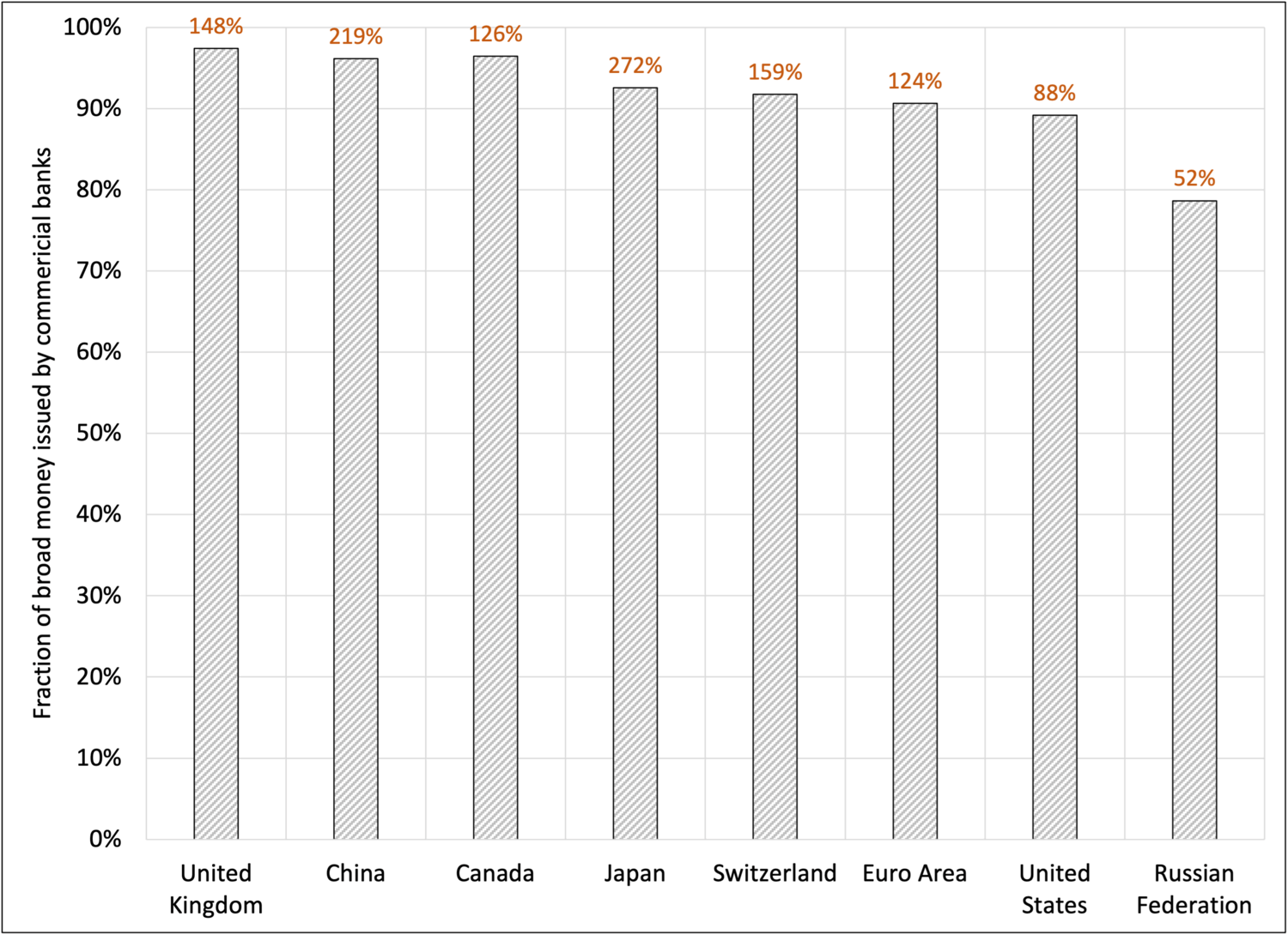
In combination, this means that we are living in a world in which nearly all of what people think of as money is the digital liability of a commercial bank. The following chart shows how dramatic this is. For example, in the United Kingdom, where the total quantity of M3 is 148% of GDP, demand and time deposits—digital entries on the ledgers of banks—account for 97% of the total (or 144% of GDP). For the euro area, 91% of M3 is digital. And, in China, where broad money exceeds 200% of GDP, 96% of it is digital.

Fraction of broad money issued by commercial banks and the ratio of broad money to GDP (percent, year-end), 2020.

Digital Money
Note: Numbers above the bars are the ratio of total broad money to GDP. Sources: Bank of England (M3), People’s Bank of China (Money + Quasi Money), Bank of Canada (M3), Bank of Japan (M3), Swiss National Bank (M3), Eurostat (M3), Bank of Russia (M2), Federal Reserve (M2), and FRED.

As Jon Cunliffe states in the opening quote, most people do not know this. They are unaware that when they pay for groceries, purchase a new phone, or renew a software subscription, they are using bank-created digital money. Importantly, it is the central bank that provides the foundation that enables us to rely on this system. To do so, authorities credibly promise to convert certain bank liabilities into the means of exchange—the safe, liquid instrument known as reserves—under as many states of the world as possible. Experience teaches us that this is something central banks committed to price stability can do under more states of the world than private actors. As Cunliffe puts it, we rely on this framework to “tether private money to the public money issued by the state.”

Where does the system fall short? We see two principal shortcomings. Some payments are expensive and slow, and too many people lack full access to the financial system. Advocates see CBDC as the solution to both problems. In our view, we do not need CBDC and its attendant risks either to improve efficiency or to expand access.

Nevertheless, central banks are plowing ahead. According to a BIS survey last year, a majority of central banks already are working on CBDC, spurred by motives that include monetary policy implementation (which may include the ability to set interest rates well below zero), payments safety and efficiency (both domestic and cross border), and financial inclusion.

We see two other important drivers. First, there is a desire to supplant cryptocurrencies like Bitcoin and head off the issuance of private monetary instruments like Libra (now Diem). But governments know from long experience how to handle such private currencies when they become salient—either impose punitive taxes or an outright ban. Indeed, the current financial system is one where only licensed intermediaries can issue liabilities that are convertible at par into the medium of exchange because they are backstopped by the central bank. Second, there is the fear of missing out: central bankers want to make sure that, if others issue CBDC, they can, too—and without delay. In our view, this creates instability: in theory, an unanticipated event could trigger many central banks to mobilize their digital currencies within a short period, so as not to be left behind.

This brings us to a few details about CBDC. Before issuing retail digital currency, a central bank will need to make a series of design decisions. Is it an anonymous bearer instrument, or will it be registered with a named owner? Will there be quantity restrictions on an individual’s holdings, or will it be supplied elastically? Are only residents of the issuing jurisdiction eligible to hold it, or can anyone? And, like paper currency, will it have a zero interest rate, or will it be interest bearing? (We ignore certain technical issues, such as whether it is account-based or token-based. See the BIS General Manager Agustín Carstens’ recent speech.)

For paper currency, we all know the answers to these questions. It is an anonymous bearer instrument (facilitating illegal use: see here). It is supplied elastically to allow the conversion of certain bank liabilities at par into the medium of exchange without limit in as many circumstances as possible. Anyone can hold paper currency. And, it bears zero interest.

In an earlier post, we argue that the characteristics of CBDC are equally clear. To avoid facilitating criminal activity, CBDC cannot be anonymous. To truly substitute for paper currency, it will have to be supplied elastically. Individuals will be allowed to hold unlimited quantities: otherwise, there would be circumstances when bank liabilities will not be convertible into CBDC at par. Restricting holdings to residents is a version of capital controls, which are both impractical and unwise. Finally, we see two reasons that CBDC would have to bear interest. First, in our view, it is politically unsustainable for a central bank to pay interest on commercial bank reserve deposits but not on the deposits of individuals. Second, without it, policymakers who wish to lower nominal interest rates below the effective lower bound could not do so.

The issuance of such CBDC creates four critical problems: disintermediation, currency substitution, lack of privacy, and the inability to ensure compliance. On the first, while inertia (combined with interest rate increases and service improvements) might keep funds in the banking system for a while, financial strains eventually would prompt uninsured deposits to flee private banks for the central bank. And, for highly trusted central banks that operate in relatively stable political and financial jurisdictions, these inflows will come from abroad as well. Given the current high foreign demand for U.S. paper currency, imagine what would happen if the Fed offered universal, unlimited accounts? The consequences of this could be catastrophic for emerging market and developing economies.

The fact that CBDC is not anonymous leads to the final, related, challenges: privacy and compliance. On the first, everything we do becomes traceable. While we are neither libertarians nor advocates of free banking, in this case we agree with L.H. White: there are enormous risks in allowing governments to have this level of detailed information about our activities. As a result, it is difficult to see why democratic countries would allow such a concentration of power.

Turning to compliance, someone will have to do the work to ensure that the users of CBDC are law abiding. Such know-your-customer and anti-money laundering efforts are costly. We currently outsource these tasks to commercial banks. Banks also provide a host of other services. Who will do this, and who will bear the cost?

One way to manage the privacy and compliance challenges is through the creation of intermediated CBDC (see here). In this framework, brokers (or banks) provide individual account services, guarding privacy, monitoring compliance and aggregating balances into accounts at the central bank (which would presumably bear interest). However, this approach does not eliminate the risks of domestic disintermediation or currency substitution. Funds would still flow into the central bank, just indirectly through what are narrow banks in all but name. And, in the absence of subsidies, narrow-bank services would not be costless to users, limiting the hoped-for impact on access.

Against this background, it is easy to see why the People’s Bank of China is moving ahead of other central banks in creating a digital renminbi (currently as a pilot program for domestic use). China does not face any of the problems that we outline. Its large banks are typically state owned, so there is little risk of disintermediation—even in a financial crisis. With stringent capital controls in place, there currently are effective limits on inflows into the currency. There already is little expectation of personal privacy. Finally, if the government wishes, state-owned banks can easily subsidize access.

Could China’s CBDC become a problem elsewhere? Perhaps. The most obvious example would a be a meaningful expansion of RMB convertibility that makes the digital yuan more attractive to foreign users. Short of that, one could imagine China offering small countries access to their CBDC, backed by the PBOC’s massive foreign reserve holdings. Such a subsidized extension of the Belt and Road Initiative could have geopolitical ramifications.

Returning to the question at hand: Where is the current monetary system falling short? Our answer is that there is plenty of scope to improve the payments system and broaden financial access without turning to new digital currencies, either from central banks or private issuers.

We already see public and private sectors moving to provide cheaper, faster, more reliable, and more accessible systems that operate both within and across borders. The euro area has the TIPS system, with a processing time of 10 seconds at a cost of €0.002 per transaction. Over the next few years, the ECB will extend this to other currencies. The United Kingdom has Faster Payments, which can take up to 2 hours with a maximum value of £250,000. A group of commercial banks is working to create a pan-Nordic cross-currency real-time system called P27 that will instantly clear both domestic and cross-border payments. Canada is testing Real-Time Rail (RTR) to settle payments in less than a minute. In the United States, the Clearing House has a Real-Time Payments (RTP) system, and the central bank is set to launch its FedNow retail payments service in 2023. None of these requires CBDC.

As for financial access, this is a more complex problem to solve. That said, the case of India is instructive. As we describe in an earlier post, started in 2014, the Pradhan Mantri Jan Dhan Yojana (PMJDY) provides no-frills bank accounts without charge, using the country’s universal biometric personal identification to lower costs. To date, over 420 million people have been brought into the system, with account balances averaging nearly US $50. Again, India’s success did not require the issuance of CBDC.

Putting all of this together, we conclude that it is a bad idea for a central bank to issue elastically supplied, interest-bearing CBDC with universal access. Domestically, it risks disintermediation. And, unless it is a privately intermediated instrument, inflows of deposits directly into the central bank would make the temptation to steer credit directly very difficult to resist. Even if the central bank were to re-circulate the funds to potential lenders through an auction process, the need for an extensive collateral and haircut system would vastly expand officials’ influence on credit allocation. Internationally, there may be a tidal wave of funds fleeing places perceived as less stable and into those thought to be safe, adding to inequality and to the influence of the rich recipients. Finally, there is privacy. While this problem can be addressed (possibly through technical means), CBDC would surely tempt authoritarian governments by providing access to everything we do.

This all leads us to be very concerned. To be clear, we are strong proponents of innovations that reduce costs and improve welfare. But the most important innovations—those that improve the payments system and the supply of credit, do not require universal CBDC and its inherent risks. So, why are central banks so intent on preparing? What is the purpose of such contingency planning?

The problem, as we see it, is that central banks fear being left behind in a way that damages the interests of their jurisdiction. Their solution is to create a form of shovel-ready CBDC programs. But, the resulting framework is unstable. The situation is analogous to the pre-World War I mobilization problem: countries mobilize for fear that delay means losing a war. In the early 20th century, in the absence of trust, an obscure event in a far-off land helped tip this fragile balance into war. In the current financial circumstances, the bad equilibrium would be a world of multiple CBDCs in advanced economies that threaten financial stability domestically and pose a severe threat to monetary control in developing economies.

We see no easy steps to prevent this poor outcome. As in a classic prisoner’s dilemma, there is little way to enforce the cooperative equilibrium in which no one introduces CBDC. First, central banks cannot credibly commit to never issue CBDC. Second, with China already headed down the CBDC road, others now view it as too late to resist: even with full knowledge of the risks, they feel compelled to prepare.

Perhaps the best hope is that they all proceed very slowly and try to “get the design right.” In our view, that will mean stopping well short of universal, elastically supplied, interest bearing CBDC.

The article was first published on Money and Banking.

About the Authors

Stephen G. CecchettiStephen G. Cecchetti is the Rosen Family Chair in International Finance at the Brandeis International Business School, Vice-Chair of the Advisory Scientific Committee of the European Systemic Risk Board,  Research Associate of National Bureau of Economic Research, and Research Fellow of the Centre for Economic Policy Research. In addition to his other appointments, Cecchetti served as Director of Research at the Federal Reserve Bank of New York; Editor of the Journal of Money, Credit, and Banking. Cecchetti has published widely in academic and policy journals, and is the author of a leading textbook in money and banking. Together with Kim Schoenholtz, he blogs at www.moneyandbanking.com.


Kim SchoenholtzKim Schoenholtz is the Henry Kaufman Professor of the History of Financial Institutions and Markets in the Economics Department of NYU Stern School of Business. He also is a panel member of the U.S. Monetary Policy Forum and a member of the Council on Foreign Relations. Previously, he served on the CEPR Executive Committee. He also directs the Stern Center for Global Economy and Business.Schoenholtz is co-author of a popular textbook on money, banking and financial markets and of a blog on the same topic at www.moneyandbanking.com.

EDITOR'S PICK OF THE WEEK

CFO's new mandate. CFO explaining the presentation

The Performance and Transformation Orchestrator: The CFO’s New Mandate in the Age of AI

By Terence Tse CFOs are evolving into AI-driven transformation orchestrators, balancing finance, technology, and strategy while upskilling teams, managing risks, and driving measurable business value. A key insight from this year’s AI for CFOs event, organized...

WISE DECISION MAKER GUIDE

POWER INFLUENCERS

Emerging Trends

The Future of Global Trade