Home Blog Page 827

Top 7 Most Perspective Crypto Coins for Students

Cryptocurrency

By Thomas Jackson

When bitcoin was first introduced in 2009 as a response to the financial crisis, everyone thought all we were getting was a digital currency. Not many people could predict that we were getting a novel asset in hand. Now 12 years later, thousands of cryptocurrencies have been created with different degrees of utility, specialties, promise, and adoption.

The cryptocurrency market is now a vast market and is worth more than $1.3 trillion. But, unfortunately, it’s difficult for willing investors to determine the best cryptocurrency to invest their money in in such a market. 

Bitcoin is currently the most prominent cryptocurrency in the market and continues to pave the way for others. However, you may be looking to invest in other coins apart from bitcoin, mainly because it is costly and you are a student. Given the level of volatility in the crypto market, it is crucial to choose the right coin. In addition, cryptocurrency investment can be overwhelming without the required knowledge. So, this article discusses seven of the best crypto coins to invest in for students. 

1. Litecoin (LTC)

This is one of the first coins in bitcoin’s footsteps. It was built on a global payment network that is open-source and is not controlled by a central authority. It also uses “scrypt” for proof of work, and it can be decoded using consumer-grade CPUs. 

Litecoin is similar to bitcoin in some ways, but the block generation rate is faster, so the confirmation time for a transaction is faster.

Apart from developers, several merchants are accepting Litecoin. It currently has a $4 billion market capitalization and is worth $190 per token.

2. Bitcoin Cash (BCH)

For all its uses, there was an aspect of bitcoin that the developers and users became frustrated with at some point; that’s the small data blocks on the blockchain, which has a 1-megabyte cap. The limit started to slow down transaction times and led to increasing fees. 

This problem developers sought to address during the hard fork that birthed Bitcoin Cash in 2017, with a larger block size reaching 8 MBs. Although this coin does not have as much popularity as bitcoin and is not as stable, it has a massive potential to scale. It is also one of the most valuable coins in the world. 

3. Etheruem (ETH)

This is the second most popular cryptocurrency globally and has been the second fiddle to BTC for many years. It has a $276 billion market capitalization and currently takes up 18% of the overall crypto market shares – which is still far from bitcoin’s 47% but over times more than the closest coin. 

Ethereum is currently the best platform for Defi (decentralized finance), and users can create smart contracts that execute automatically after some conditions are met. In addition, this platform cuts off third parties like brokerages, banks, and clearinghouses, so it is an exciting platform to save money. As the usage of Defi continues to rise, we expect that the use of this platform will increase as well. 

4. Cardano (ADA)

This digital currency was created using a research-based approach by mathematicians, cryptography experts, and engineers. Charles Hoskinson co-founded this project after falling out with other founding members of Ethereum. He left the ethereum project to create Cardano. 

The Cardano team created this blockchain through peer-reviewed research and extensive experimentation. The rigorous process put into making this platform is one of the reasons why Cardano stands out among other proof-of-stake peers. Many people already dub it the “ethereum killer” because of the capability of its blockchain. 

It currently has a $71 billion market capitalization, the third-largest in the market, and one ADA worth around $2.50. 

5. Dogecoin (DOGE)

The origin of this coin was a lighthearted joke about blockchain. However, it has grown massively with about a 4000% price increase this year – which means it is currently the eighth largest coin by market cap. The unlimited capacity for mining and more extensive circulation of this coin is why this coin remains lesser than a dollar. 

Although bitcoin has a 21 million coins cap, Dogecoin already has 130 billion coins in circulation, and there are new blocks to be mined every year. Moreover, as stated in a term paper help, the mining rate of Dogecoin is faster than bitcoin. So it has this advantage over bitcoin. 

6. Polkadot (DOT)

Cryptocurrencies have subjective and debatable measures of fundamentals, unlike stocks. This means that some other credentials must be considered with crypto. One of these is the person that started the project. 

For Polkadot, Gavin Wood, who is very credible, is one of the co-founders of Ethereum, and he has helped drive DOT into the list of the most valuable cryptocurrencies in the crypto market. A benefit of this coin is that it can serve as the bridge between networks. This means that it is possible to build applications on this platform that works on the Bitcoin and Ethereum networks. DOT was built after the industry pioneers and had features that make it faster and scalable than its predecessors. 

7. Binance Coin (BNB)

An advantage of this coin is that there are strict limits to the total token number in circulation, similar to Bitcoin. It has a 200 million limit and is one of the reasons why BNB is currently one of the most valuable coins in the world. 

This coin is the native coin for the famous Binance exchange and has grown over 700% this year. This coin’s model is different from others in the market, burning most of the coin every quarter – and doing it with one-fifth of the profit. It currently has a $50 billion market capitalization. 

Conclusion

These are some of the best and most prospective crypto coins for students to invest in. While there are thousands of other cryptocurrencies in the market, these are the most prospective ones. 

About the Author

Thomas Jackson is a professional freelance content writer providing cheap essay writing service for essaymama and buy research papers, and also an active member of several writing clubs in New York. He has written several songs since he was a child. He gets inspiration from the live concerts he does in front of close friends and family members. 

Best Funding Options for Your New Small Business

Funds

By Eric T.

Starting a small business requires capital, and running it requires reliable cash flow.  According to an Intuit survey, 64 percent of small businesses start with $ 10,000 or less. You can also start a micro business with as little as $ 3000. 

However, we don’t always have that kind of money at hand. 

And if you have financial issues such as a bad credit score or lack of collateral, some institutions are unlikely to offer your startup capital. 

Many people shy away from starting small businesses due to the hurdles associated with accessing capital. 

But there are many sources of funds for small businesses you can try. 

Here are 9 funding options for new small businesses.

1. Savings

Your first source of funding for your small business venture should be yourself. You must have at least some money put aside to start your dream enterprise. 

The biggest advantage of funding your business is that it entitles you to all the profits and gives you full ownership of your enterprise.

However, if you choose to fund your business with savings, avoid pouring everything into your venture. It’s always advisable to keep something for a rainy day. 

You could take a portion of your savings for capital and borrow the rest from your 401K. 

401K loans can get you up to $ 50,000 or half of what is in your account, depending on which amount is less. 

If you get the loan, you will be expected to pay it back with interest within five years, which is enough time to get your business off the ground and make it profitable.

2. Family and friends

If your savings are not enough to start a business, family or friends are another option. 

You never know; they may have some money put aside and are willing to fund or invest in a viable business idea. 

However, if you do get into such an arrangement, it’s best to have a written agreement to ensure no one is taken advantage of. 

A written business agreement will govern how you deal with losses, profits, and equity distribution, should your friend or family member decide to take part or full ownership of your business.

3. Partner financing

TeamYou can access funding from another player in your industry in exchange for partnership status.

A partner can contribute funds, skills, and products or services, to boost the growth of your business. 

In many cases, accessing funding through a partner means sharing the running of your business and giving them part of your profits. 

But if you choose a partnership, find someone with a similar outlook and vision to reduce conflict.

For example, if you want funds for a restaurant, you can do it with a chef or experienced restaurateur.

Additionally, ensure you have a business partnership agreement to help you solve or prevent arguments that may arise in the course of operations.

4. Low-interest credit cards

Yes! You can fund your small business with a credit card. 

Although we often use credit card funds for living expenses, they can also help us fund a business enterprise. 

Most people don’t take this route because the credit card interest rates are pretty high. But you can do it with a low-interest credit card if you borrow the amount you need in small amounts, to avoid exorbitant interest rates. 

If you do decide to fund your business with credit card funds, you’ll benefit from the flexible paying plans and the fact that, unlike some credit sources, you are not required to justify what you’ll spend the money on when borrowing it.

5. Invoice financing

Your business invoices can also help you to access funding for your business. 

Invoice financing, also known as invoice factoring, involves accessing money against your invoices that you can use to pay suppliers and employees or reinvest in other business needs. Here is how it works. 

  • You sell goods or services to customers and, in turn, sell the invoices to a financier who will give you a loan against them.
  • Once the invoices are paid up, the financer gets their money back, including any fees they charge you. 

Invoice financing works for business people who give their customers long periods to pay for goods or services, such as 120 days.

This gives them a chance to unlock cash held up in unpaid invoices to keep the business running without having to wait until they get paid for their goods or services. 

Invoice financing doesn’t require collateral or lots of paperwork, and it gives you cash to grow your business and even get new projects running as you wait for old ones to pay off.

6. Bank loan

Although more time-consuming and challenging than credit card funds, bank loans can get you more funding than most options. 

However, you can expect the bank to scrutinize your finances, ask for collateral, a business plan, and bank statements, before they give you any funds. 

Therefore, expect some challenges such as a lengthy application process and a stringent eligibility criteria. 

However, bank loans are the best funding option if you want to keep control of your business, as long as you make prompt payments. And if you choose the right institution, you can get funds under favorable interest rates.

Some business loans you can apply for are Small Business Administration (SBA) loans, start-up loans, equipment loans, microloans, and commercial mortgage loans.

7. Venture capitalistBusiness Partners

If you don’t mind other people having a share of your business and profits; and your idea is profitable, venture capitalists are a funding option. 

Venture capitalists are a good fit for anyone with no collateral to back a loan but who has a business idea that will generate enough income to pay any funding accessed through investors. 

It works for people with competitive business ideas, such as inventors.

The primary motive for contacting investors is to obtain funding. However, investors might provide more than just cash. They may be able to assist you in obtaining transactions with other businesses with whom they have links. After all, your market success is in their best interests as well.

Business startup funding helps them by initiating their journey, hiring a team, buying equipment, marketing, and promoting their brand. Despite the fact that there are several examples of how a lack of cash may contribute to brand disasters, some businesses fail to recognize the necessity of funds.

Venture capitalists are often people with an interest or knowledge in the field you want to start a business in. Therefore, access to their funds, as well as their other  resources, can boost your business growth significantly.

However, you can expect them to play a significant role in the running of your business by offering money and skills, equipment, and connections.

8. Grants

Grants are funds offered to certain businesses by governments and other institutions to ease their start-up process. 

These businesses get funds for their ideas because they are likely to help local communities or ease specific problems in society. 

Therefore, if your business offers scientific solutions such as research, you can apply for a grant. 

However, keep in mind that the organizations offering grants expect you to show what you do with their funds, and if it is government-funded, you should meet federal developmental and research goals to qualify.

An example of an organization that offers grants is the Small Business Administration, which offers funds to eligible businesses through initiatives like the Small Business Technology Transfer program.

9. Community development financial institutions

There are non-profit community development organizations in your area ready to provide capital to small businesses like yours.

They help start-ups and growing businesses in low-income areas to get off the ground or expand.

These CDFIs are in almost all US states and they receive funds from the private sector and government.

They are better than most institutions when it comes to offering business funding because they don’t ask for things like credit scores and collateral.

If you’ve been dealing with issues such as COVID -19 challenges that have interfered with the running of your business resulting in low credit scores, you can apply for a commercial loan for your business from a community development financial institution in your area

Conclusion

These are a few funding options for your small business. Before you approach any of them, prepare yourself with the documents that can improve your chances of getting a loan, such as a business plan, good credit score ratings, financial statements, and collateral, where possible.

If you lack any of these documents, don’t be discouraged, as there are institutions on the list that will give you funding if you have a sound business idea.

However, before you pick a funding option, think of factors such as your current financial status, whether you want complete control of your business,  and, how you plan to pay back your loan, to ensure you make the right choice.

At the end of the day, it’s up to you and what you want for your business. But these options will give you an idea of where to start if you are looking for funds to start your business.

About the Author

Eric T. is a content specialist at Thor Capital Group, a direct lending firm that offers uncommonly flexible options for working capital to small and mid-sized businesses in need of financing to improve or grow their well-earned place on the street. When not hunched over his computer thinking loudly, you can find him playing pop music with his band, reading horror novels, or traveling.

Tips for Small Businesses: How to Handle Transactions Better

Business Owner

Small businesses have a lot on their plate, from finances to marketing. Those who do not know how to handle financial transactions properly may end up losing money which could lead to the collapse of the business. Here are ten tips to help you improve your skills when it comes to handling money:

Use an Online Bill Payment System

Using an online bill payment system is another way to help improve your skills when it comes to handling money. The system will allow you to pay bills at any time, even if the office is closed for the day. This option also helps keep track of information and makes it easier to manage your finances. 

Keep Track of Your Receipts

Receipts are very important when it comes to dealing with finances; however, most people let them pile up and lose track of which ones they have already filed away. As a result, the receipts get mixed up or misplaced altogether. To prevent this from happening, always take the time to file away receipts as soon as they are received.

Use a Financial Professional for Additional Help

It’s a good idea to get outside help from professionals in the financial sector for some areas. For example, if you want to set up an online store, you should hire someone who is knowledgeable about e-commerce and how it operates. Using a professional, such as Accredited Interchange to help you with these tasks will make them much easier and provide the necessary financial information that you require. These financial professionals offer comprehensive business solutions that allow you to process transactions effectively.  You can also find experts on your own, ask your accountant, or even do research online.

Use a Computer Program to Manage Your Finances

A computer program can help you with your finances by providing financial information, creating reports, and producing graphs based on the data that has been entered into the system. You can use advanced software to create budgets or compare your revenues from last year to this year to determine how well you are doing. These programs are very beneficial and can help you to get organized.

Create Multiple Accounts for Your Business

One of the most important things that you can do in order to manage your finances better is to create different accounts for your business. These accounts will allow you to keep track of where money is coming from, how it is being spent, and what the overall financial situation is. By using different accounts, you’ll be able to monitor your business more effectively and determine ways that can help improve it as time progresses.

Training  Your Staff

One of the reasons small businesses are not able to handle financial transactions properly is because their staff isn’t trained well enough. These staff members may be part-time workers who have other responsibilities in the company, or employees with little experience. You should take time to train them thoroughly so that they know how things work within your business and how they can improve. Training your staff regularly will also help them grow within the company. They’ll become more knowledgeable and competent, which is always a good thing for any business.

Handling Transactions Securely 

Small businesses are required to follow certain procedures when it comes to financial transactions. For example, all credit card purchases need to have a signature on the receipt. This is to make it easier for your business to track any abuse later on. Your staff members should know how to process transactions properly, but all employees should be trained in this area. You must also invest in good security software so you can monitor their activities within the financial system and see if anything unusual occurs periodically.

Monitoring  Financial Transactions

You can’t just delegate financial transactions to anyone; you should know what your employees are doing in this area. Set aside time each day for personal review, or hire someone who can do it on your behalf. If you don’t like the idea of monitoring others, at least make sure you’re aware of certain transactions. For instance, you should know how much in sales revenue is processed daily. Your employees may not like the idea of having someone always looking over their shoulder when they go about their work (which can lead to them leaving your business), but working around this is important. You must make sure that nothing suspicious occurs within your financial system; otherwise, you could be liable for serious tax violations.

Make Sure To Get Cash 

Despite all the electronic transactions we make today, cash still has its place. Don’t forget to deal with this form of payment; it can help increase your revenue and business growth. When customers pay by cash (or check), ask them if they want a receipt. This will help you generate more sales and give your business a better reputation with customers. SME Transactions

It’s easy to lose track of financial transactions when you’re busy running a business. You can’t afford to just ignore anything that looks suspicious, either; otherwise, you could be dealing with serious monetary issues later. Financial transactions are no laughing matter; if you don’t handle them properly, you could end up losing money. Fortunately, there are many tips you can follow to make the process easier. Using them will allow your business to grow without any problems related to financial transactions.

China’s Innovation Approach to Growth

China’s Innovation Approach to Growth

By Yixiao Zhou, Jian Ding, Sudyumna Dahal and Junling Huang

China’s per capita income reached US$10,000 in 2019 – an important milestone in measuring the significant improvement in wellbeing for 1.4 billion Chinese people resulting from the decades-long program of reform and development. In the same year, China’s total gross domestic product (GDP) reached US$14.3 trillion, accounting for 16.4 per cent of global GDP according to World Bank estimates, which matches closely to China’s share of about 18 per cent of global population. Along with the rise in per capita income and total GDP, the Chinese economy witnessed some fundamental changes in the pattern of industrialization, continuing to move towards high value-added production, trade, investment, and progress on innovation and technological change.

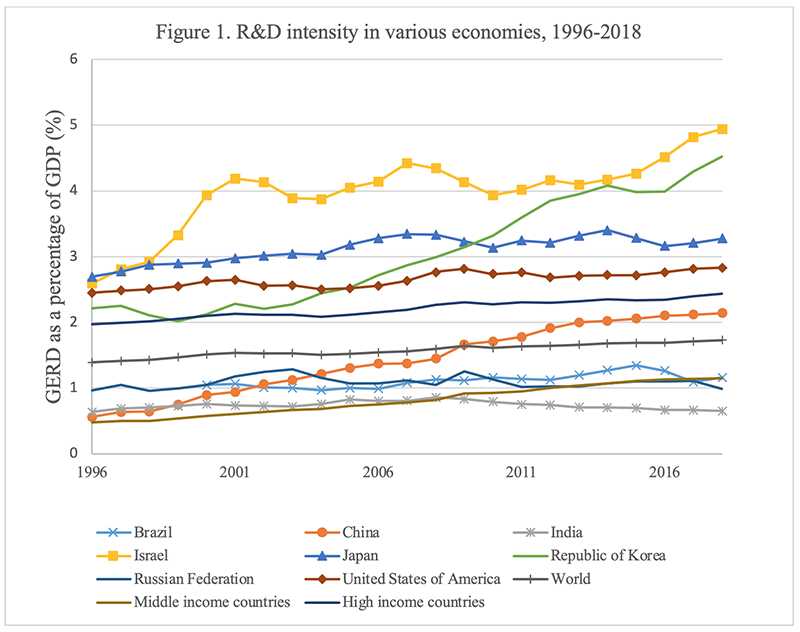
The catch-up phase of China’s economic development saw significant progress in innovation and technological change, underpinned by its human capital and increased capacity for innovative activities. China’s spending on R&D climbed 10.3 per cent to US$378 billion in 2020, as reported by China’s National Bureau of Statistics (NBS). According to the NBS, R&D spending accounted for 2.4 per cent of China’s GDP in 2020 (Figure 1). The report shows that, by the end of 2020, China had 522 ‘national key laboratories’ and 350 ‘national engineering research centres’ in operation; some 457,000 projects had been funded by the National Natural Science Foundation of China in 2020 and 3.6 million patents had been granted – up by 40 per cent from 2019. These developments have allowed China to leapfrog its technological capabilities in several key areas such as artificial intelligence, space, medicine and digital technologies, as well as compelling it to pay more attention to the protection of intellectual property rights in the transition from technological imitation to innovation.

figure 1
Source: OECD Data

According to the Global Innovation Index, which provides detailed metrics about the innovation performance of 131 countries and economies around the world, China was ranked first in innovation performance for middle-income countries and fourteenth globally. The World Intellectual Property Organization (WIPO) reported that its China office received a record total of 1.54 million patent applications in 2018, ahead of the United States, Japan, South Korea and the European Patent Office (EPO). China accounted for more than 40 per cent of the world total.

The country has experimented different approaches of innovation over the years. Earlier approach was mostly technology absorption but now there is more attention placed on domestic innovation. As many Chinese high-tech companies such as Huawei, Tencent, Dajiang and ZTE start to emerge in international markets, technology competition between China and other technologically advanced economies has escalated, and international willingness to allow technology diffusion to China has significantly declined. As technology diffusion opportunities wane, China will need to rely more on domestic innovation to sustain its technological progress. Even without a deliberate slowdown in technology diffusion by advanced countries, China would need to boost domestic innovation because room for technological catch-up shrinks as it moves closer towards the global technology frontier


As technology diffusion opportunities wane, China will need to rely more on domestic innovation to sustain its technological progress.

Since the 18th National Congress of the Communist Party of China (CPC), the CPC Central Committee and the State Council have placed scientific and technological innovation at the core of the overall national development plan and made a series of major arrangements around the implementation of the innovation-driven development strategies. One of the strategies is to implement technological innovation projects performed mainly by enterprises, and this strategy started from the “Ninth Five-Year” National Technological Innovation Program in 1996. The experience of the city of Shenzhen provides some valuable insights on innovation led by Chinese firms. This Southern city is where the headquarters of Huawei, ZTE, Dajiang and Tencent are located and is a leader in innovation outputs (Table 1). One unique characteristics of Shenzhen is that private firms are responsible for the majority of R&D investment. The comparative advantage of Shenzhen in innovation activities comes from two main sources. The first advantage is its unique economic geography. As one of the financial centers in China, Shenzhen possesses the venture capitals that are crucial to high-tech businesses, especially in the start-up period. In addition, the manufacturing industry in Guangdong province is leading in China, which facilitates the transformation of knowledge to products. The second advantage is the business environment in Shenzhen. As Shenzhen is as a newly developed city, there are fewer policy interventions and economic distortions in Shenzhen compared with another city like Shanghai, which has similar geographical advantages. Thus, firms in Shenzhen operate in markets that are more freely competitive and the core competence of Shenzhen lies in its business environment.   

table 1
Source: China Statistical Yearbook on Science and Technology.

Besides private firms, as an important pillar supporting China’s economic development, state-owned enterprises (SOEs) are the national team to implement the deployment of major national scientific and technological innovation. By the end of 2016, SOEs had 1.566 million scientific and technological research staff and 226 academicians of the Chinese Academy of Science and the Chinese Academy of Engineering. During the 13th Five Year Plan period, the cumulative R&D investment of SOEs exceeded 3.4 trillion-yuan, accounting for a quarter of the national R&D. Promoting SOEs to improve their scientific and technological innovation ability is an inevitable requirement for China to keep in touch with the world’s scientific and technological frontier, to compete in the global market, and to serve China’s major national needs. During the 14th Five Year Plan period, SASAC took scientific and technological innovation as the “number one task”, concentrated resources and forces, accelerated the building of a number of leading enterprises in scientific and technological innovation, and resolutely built SOEs into national strategic scientific and technological forces.

While R&D spending is important for creating innovation, it is not necessarily sufficient for improving productivity and growth. One key puzzle has been the declining trend of productivity growth in China since early 2000s despite massive investment in R&D. Hence, policy makers need to think hard about this. For R&D to have positive impact on productivity and growth, there is a growing evidence that various factors including ‘innovation ecosystem’ will be extremely important rather than just expenditure on R&D or patent registration. Institutions, infrastructure, human capital, business sophistication, civil service, intellectual property rights, transparency, creative outputs, civil liberty and political rights all play crucial role in enhancing impact of R&D on growth and productivity.

About the Authors

Yixiao Zhou

Yixiao Zhou is a Senior Lecturer at the Arndt-Corden Department of Economics and Deputy Director of China Economy Program, Crawford School of Public Policy. Her research focuses on international macroeconomics and policies, the economics of innovation and industrial upgrading, and issues and policies for development and growth.

Jian Ding

Jian Ding, PhD graduate from Australian National University. Research interests include law and economics, labor economics, trasanction cost, contract theory, innovation, business model. Jian is currently working as a researcher in Institute of Advanced Science Facilities (IASF), Shenzhen.

Sudyumna Dahal

Sudyumna Dahal is a PhD candidate in economics at the Centre for Applied Macroeconomic Analysis (CAMA), Australian National University. Previously, he worked at the World Bank in Washington DC, Africa and South Asia. His research interests are at the intersection of macroeconomics, growth and development with a focus on the public policy of developing countries.

Junling Huang

Junling Huang is Director of the International Clean Energy Research Office at the China Three Gorges Corporation (CTG), a state-owned enterprise that focuses on large-scale hydropower and renewable energy development and operation. His current research interests include power market, carbon market, renewable energy policy and energy technology innovation policy.

Scaling-Up Access to Finance for SMEs in Bangladesh: Pathway to Inclusive Growth

SMEs in Bangladesh

By Alexander Ayertey Odonkor

In both developed and developing economies, small and medium-sized enterprises (SMEs) play an essential role in driving economic growth and accelerating inclusive growth. In Asia, SMEs are instrumental in creating jobs and propelling economic development. Highlights of a report (2018) from the Asian Development Bank (ADB) suggest that SMEs account for 96% of all Asian businesses, contributing two out of three private-sector jobs on the continent. Just as in other countries in Asia, the socio-economic impact of SMEs in Bangladesh is immense. According to the SME Policy 2019, from the Ministry of Industries, the SME sector in Bangladesh is made up of about 7.8 million enterprises that contribute close to 25% of the country’s gross domestic product (GDP).

Data from the Ministry of Planning (Planning Division) reveals that between 2009 and June 2014, the SME sector contributed 1.5 million jobs in the country; accounting for 80% of industrial employment and almost 25% of the country’s entire labour force. These enterprises serve as a major source of livelihood for a large proportion of the country’s population, particularly for new entrants in the job market. With about 2 million young people joining the country’s labour force every year, it is not surprising to find out that a large share of the youth population are interested in working in the SME sector.

According to the International Labour Organization (ILO), the findings of the School-to-work transition survey (SWTS) indicates that while one-fifth of students in Bangladesh would want to work in the public sector or government, about 48.7% prefer working in family businesses. This reality presents a daunting task for policymakers and development organizations in Bangladesh, as the country’s SMEs sector is plagued with several snags that are constraining growth in the sector; notable among these challenges is limited access to affordable finance for SMEs. In spite of the many attempts to improve access to finance for SMEs in Bangladesh, these efforts have yielded minimal results.

Fruit vendor (SME) in Bangladesh

This is largely attributed to the fact that the relationship between suppliers and demanders of funds in the SME sector is characterized by asymmetric information problems and high transaction costs; these factors escalate collateral requirements and cost of borrowing for SMEs, which eventually constrains growth in the SME sector. According to the World Bank the SME sector in Bangladesh has a financing gap of $2.8 billion; about 60% of women-owned SMEs are denied access to finance because they do not have collateral. This has been the state of the SME sector for many years.

In 2013, a study indicated that more than 40% of SMEs do not have access to formal credit. The study further suggests that there is a substantial credit gap and an unmet demand for formal credit even for SMEs that have access to finance. To provide a sustainable panacea to the credit gap situation in the SME sector, policymakers should address the asymmetric information problem that defines the relationship between borrowers and lenders in the SME sector. A study (2018) conducted by the Asian Development Bank (ADB), that collected data from manufacturing enterprises, local financial development and subdistricts in Bangladesh shows that the expansion of the branches (network) of banks mitigates the probability of default risk as it reduces the asymmetry of information between SMEs and banks; this enhances access to loans for credit worthy SMEs at relatively lower costs. The study also indicates that bank density in Bangladesh has a positive and a significant impact on the performance of a firm, thus an increase in the branches of a bank scales-up a firm’s output, gross value added and to some extent labour productivity.

For a country that is expecting to graduate from the United Nations list of Least Developed Countries (LDC) by 2026, it is imperative for Bangladesh to build a resilient SME sector that could revitalize local economies, create jobs and promote shared prosperity. One way this could be achieved is to expand the branches (network) of banks at the subdistrict level. This initiative will spur the growth of the SME sector and also reduce cost of monitoring for financial institutions; with this model SMEs in Bangladesh can access affordable credit that will be essential to the growth of the sector, economic growth and inclusive growth.

SME sector

Although there are commendable efforts that provide financial assistance to SMEs at the subdistrict level, there is still room for improvement. For instance, the SME Foundation has an agreement with 11 banks and non-bank financial institutions to disburse loans to entrepreneurs and cottage, micro, small and medium enterprises (CMSMEs) across most of the districts in Bangladesh. This initiative is laudable, as it focuses on entrepreneurs and owners of SMEs in rural areas that were not able to access the financial package last year. The objective for implementing this initiative is to facilitate the country’s economic recovery amid the Covid-19 pandemic. The impact of Covid-19 pandemic on the economy of Bangladesh has been profound. All sectors of the economy, including the SME sector have been affected. This has led to a slowdown of economic activity and deceleration of economic growth. According to a World Bank report (2021), the country’s GDP growth declined sharply, down to 2.4% in FY20. This has caused losses in employment and labour earning, which has disrupted about two decades of progress made by poverty alleviation programmes in the country.

To accelerate growth and build back a better economy that could provide decent jobs to the youth and promote inclusive growth and reduce poverty; policymakers, development organizations and relevant stakeholders should focus on developing a robust financial sector that could facilitate access to affordable finance for the SME sector. When this is achieved, SMEs in Bangladesh can easily access the required financial services at a lower cost. This will stimulate growth in the SME sector and eventually boost economic growth, foster inclusive growth, shared prosperity and reduce poverty.

About the Author

Alexander Ayertey Odonkor

Alexander Ayertey Odonkor is an economic consultant, chartered economist and a chartered financial analyst with a keen interest in the economic landscape of countries in Asia and Africa. Alexander is also an author and columnist for The Brussels Times, China Global Television Network (CGTN), The World Financial Review, China Daily, The Diplomat, The Business Standard, The People’s Daily and the Business and Financial Times. His articles have been published by NextBillion (University of Michigan), NTS Bulletin (Nanyang Technological University) and several other research institutions. Some of his research works include Stock Returns and Long-range Dependence, which was published by the Global Business Review (SAGE).

Why Cryptocurrency Is Not Real Money… And Won’t Ever Be

Cryptocurrency

By Dr. John Lee

The rise of digitisation has led to increased speculation that cryptocurrencies are emerging as a genuine alternative to sovereign backed hard and digital currencies. This would certainly have immense and revolutionary ramifications for not just traditional monetary systems but the role of government in formulating and implementing broader national policies for their populations. However, there is little prospect that cryptocurrencies can challenge sovereign-backed money and the former will continue to serve as speculative assets held by the few rather than as real money for the economy.

Introduction

The growing interest in cryptocurrencies is unsurprising given that the trend towards digitization in all areas has been a long established and unending one. There is significant polarization regarding the issue of these types of monies and whether they will replace traditional hard or physical currencies in the future. For example, Mark Carney, then the Governor of the Bank of England, recently argued that national digital currencies could pose a threat to the U.S.’s dollar’s outsized role in global financial markets.  In contrast, Randall K. Quarles, the Vice Chair for Supervision at the U.S. Federal Reserve recently dismissed digital currencies as both ‘dangerous’ and a ‘fad’.  More prominently, Elon Musk has generated much attention and instability in certain cryptocurrencies by affirming and also questioning the usefulness and future of cryptocurrencies such as dogecoin.

For starters, it is important to resist conflating distinct products and concepts. Digital currencies are a balance or record of monies stored digitally rather than in the form of paper money. Referring to the form of the currency (rather than source of legitimisation), digital currencies include cryptocurrencies, virtual currencies (issued and overseen by Central Banks) and e-cash (which might be issued by any entity including private firms and businesses.)

Cryptocurrencies refer to a digital currency where the record of ownership and transactions are stored in a decentralized and computerized ledger that uses cryptology to secure transaction records. That computerized ledger can generally be accessed by all users of that cryptocurrency.

Much of the confusion and hype can be put in better perspective if these broad definitions are maintained. We are seeing the constant advance of the digital world in all things, including currency and money, but the evidence for an merging cryptocurrency revolution is weak.   

Digital Currencies vs. Cash

Cryptocurrencies refer to a digital currency where the record of ownership and transactions are stored in a decentralized and computerized ledger that uses cryptology to secure transaction records.

Given continued advances in digital devices, platforms, software, and security features, it is highly likely that digital currencies will increasingly be preferred to cash.  But while the imminent end of physical currency has been predicted since the 1960s,  it is likely cash will remain with us for quite some time. Cash allow users to remain anonymous and prevents authorities or other entities tracking our personal spending habits and movements. This is an issue of growing importance given the determination of authoritarian governments such as the one in China seeking to acquire ever more data on the behaviours of its citizens.

Cash is also insurance against financial cybercrime which is a far greater systemic and personal risk than the physical theft of cash. Moreover, the rise of state-based cyber offensive capabilities mean hostile states are increasingly able to penetrate the networks of other countries. For this reason, governments will remain reluctant to rely too heavily on a digital system of currency given the potential for hostile state-based hackers to disrupt or degrade the national digital ledger and create financial and economic catastrophe for that targeted country. In this sense, the preservation of a physical cash economy will be seen to be offering national economic systems a degree of resilience against such attacks.

Digital vs. Cryptocurrencies

In any event, whether physical currency loses dominance is the less interesting and important question. The genuine disruptive game-changer will occur if cryptocurrencies begin to genuinely challenge fiat currencies or currencies backed by a national Central Bank or financial system (whether they be in analogue or digital forms.) This brings one back to a fundamental discussion of what money ‘is’ or what ‘purpose’ it fulfils.

Here, there are three answers. First, and according to the textbook definition which still holds, money is a ‘store of value’. Second, it is a ‘medium of exchange’. These first two answers mean that money serves as an asset or commodity which can be saved, retrieved, and exchanged in the future and at the time of choosing for the holder of that asset. One cannot ‘save for the future’ or accumulate wealth without being able to hold assets which are trusted, widely recognised and accepted, and does not deteriorate dramatically in condition or value over time.     

Third, and in the words of famed academic and former president of the Federal Reserve Bank of Minneapolis, Narayana Kocherlakota, ‘money is memory’.  By this, he meant that “money is a substitute for a “publicly available and freely accessible device that records who owes what to whom.”  This enables and allows fair and equitable transactions to take place amongst an unlimited number of people, almost all of whom are not known or even proximate to each other. 

If cryptocurrencies become dominant, the reliance on central banks as the trusted authority to ensure the integrity, function and finality of payments and transfers of wealth from one entity to another will proportionately diminish. Instead, integrity, function and finality will depend on agreement between the community of cryptocurrency users. This would be a true revolutionary event disrupting, if not destroying, existing monetary regimes.

The case for cryptocurrencies replacing sovereign-backed currencies is that cryptocurrencies such as Bitcoin might well fulfil the second and third functions mentioned above.

It would also fundamentally change and diminish the ability of national governments to determine monetary, economic, financial, and even social policy given that national government’s loss of relevance and agency when it comes to supervising and legitimising transactions. The rise of cryptocurrencies also diminishes the capacity for governments to use coercive or punitive measures against its citizens or those of other countries.   

The case for cryptocurrencies replacing sovereign-backed currencies is that cryptocurrencies such as Bitcoin might well fulfil the second and third functions mentioned above. In other words, cryptocurrencies can do the job that fiat-backed monies have done for centuries. 

However, unlike sovereign-backed currencies which are guaranteed to be legal tender in that particular jurisdiction and can be exchanged for other sovereign-backed currencies in other jurisdictions, cryptocurrencies are only of use and value within a specific crypto-community. The problem is that the use of a cryptocurrency must become universal for it to become a truly universal medium of exchange and store of memory and value.

Can crypto currencies become universally valued and exchangeable assets? There is an enormous mountain to climb for cryptocurrencies for that to occur. Because we exist in an international system or order defined by the primacy of sovereign nation-states as the primary actors, sovereign backed currencies issued by these nation-states have inbuilt legitimacy and the ability to be exchanged universally. From the beginning, the situation is rigged in favour of fiat backed currencies remaining dominant.

Moreover, it is difficult to see any major government reducing their own agency in setting and enforcing national economic and non-economic policies over its citizens by fundamentally allowing non-sovereign backed currencies to replace the dominance of sovereign-backed currencies. National governments can easily do this by banning the exchange of cryptocurrencies for their national currency and vice versa. It might be argued that the community of cryptocurrencies would still hold cryptocurrencies to transact amongst themselves. Even if that were still legal, the non-convertibility between crypto-currencies and sovereign-currencies would relegate the transacting of cryptocurrencies to the periphery, meaning that cryptocurrencies cannot meet the universality of exchange condition. It will also mean cryptocurrencies will only become a ‘store of value’ amongst the limited community of cryptocurrency users rather than the broader economy.

In short, there are compelling reasons for governments to prevent cryptocurrencies from challenging the dominance of fiat-backed currencies and governments will have decisive policy and coercive tools to prevent that from occurring. This is not just about authoritarian governments such as China seeking to extend their supervision over the actions of citizens to protect political power and punish dissent. Liberal democratic governments will want to maintain their ability to set and implement national policies and must retain control and influence over financial systems to do that. This means that the likelihood they will replace sovereign backed currencies and upend existing monetary systems is low.

Conclusion

Cryptocurrencies continue to exist primarily as speculative assets with wildly fluctuating valuations. That a tweet by Elon Musk can cause the value of dogecoin or bitcoin to skyrocket or else plummet speaks to the lack of suitability of cryptocurrencies to serve as genuine money. There is a question mark as to whether they can offer the relative stability in value that one has with well governed and regulated sovereign-backed currency under competent central bank supervision.

As Milton Friedman argued, “a moderately stable monetary framework seems an essential prerequisite for the effective operation of a private market economy.” With respect to sovereign-backed currencies, there is the expectation that governments of major currencies will intervene in financial and currency markets to provide some degree of security and stability as loss of these monetary virtues have broader economic impacts on the entire country, and therefore the standing and even legitimacy of that government. In contrast, the private market economy of cryptocurrencies untethered to sovereign-back monetary systems is unlikely to be able to provide that assurance or stability.

About the Author

Dr. John Lee

Dr. John Lee is a non-resident senior fellow at the Hudson Institute in Washington DC and the United States Studies Centre at the University of Sydney where he is an adjunct professor. From 2016-2018, he served as senior national security adviser to the Australian Foreign Minister. He obtained his Masters and Doctorate degrees from the University of Oxford.

Space Travel, Spacs and Risks to Investors

Space Travel

By Syed Rahman

When US authorities, space travel, fraud allegations and potential Russian-related security risks are the key elements in a situation, it is hardly surprising that it is considered newsworthy.

So, when the US securities regulator fined a space transportation start-up company and national security concerns were voiced about its Russian founder, it was to be expected that there would be at least some media coverage. And that turned out to be the case.

The US Securities and Exchange Commission (SEC) charged Momentus and its former chief executive Mikhail Kokorich for misleading investors. Stable Road Acquisition, the special purpose acquisition company (SPAC) that agreed a deal in 2020 to take Momentus public, was also charged; as was its sponsor company, SRC-NI Holdings, and its chief executive Brian Kabot.

And when all the parties involved, apart from Kokorich, settled the civil charges and agreed to pay penalties totalling more than $8 million, the story then had a large amount money as yet another newsworthy element. Former CEO Kokorich is being sued personally in the US district court for the District of Columbia, having been accused of being engaged in fraud. He is alleged to have misrepresented both the capabilities of Momentus’ technology and his own status as a national security threat.

But while all this is very eye-catching, the real significance of this case is, I would argue, what it means for SPACs.  A SPAC can be created and then used to acquire another business and can provide quicker returns for investors than a typical company acquisition. As a result, many investors are now convinced that SPACs are the best way to conduct a company acquisition. This has been reflected in the rapid rise of SPACs in recent years.

Risk

The Momentus case is a clear indicator of the aggressive strategy now being taken by the SEC, as it looks to crack down on SPACs. But the case can also be viewed as the SEC’s high-profile way of drawing attention to the risks that can be associated with SPACs. Strong action against those believed to be using SPACs for wrongdoing sends out a message that such wrongdoing will not be tolerated. It also highlights the possible hazards that can accompany investment in a SPAC.

The increasing popularity of SPACs has emphasised their appeal, yet those who find them appealing have to be aware of the potential pitfalls.

The increasing popularity of SPACs has emphasised their appeal, yet those who find them appealing have to be aware of the potential pitfalls. Those who may be set to make the biggest gains from an acquisition that uses a SPAC may not always carry out adequate due diligence on the acquisition target. Momentus and Stable Road announced their proposed $1.2 billion merger in October 2020, calling it the first publicly-traded space infrastructure company. Yet the SEC alleged that Kokorich and Momentus told investors that they had successfully tested the company’s technology in space, when the truth was that the tests that had been carried out had been far from successful.

The case proves the point that there are no guaranteed gains with SPACs – and that investors are not given huge amounts of information before making a financial commitment. Those who do become involved in a SPAC transaction need to be thinking about its disclosure obligations at all stages of its promotion and any subsequent company acquisition – due diligence is critical when it comes to assessing and minimising the investment risks.

The UK and SPACs

SPACs

This is a point that has been emphasised in the UK. The Financial Conduct Authority (FCA) highlighted the importance of due diligence in its consultation paper. It has made it clear that if and when SPACs take off in the UK – which is dependent on an FCA-led review of the UK company listing rules – there would be a requirement to disclose information at all appropriate stages in the SPAC’s development, from listing through to either an acquisition or its dissolution. This disclosure obligation would cover the SPAC’s structure, its strategy, the initial public offering arrangements and relevant information when the announcement of an initial acquisition is made; including updates on any new information that arises before the shareholder vote.

It is yet to be seen whether the FCA will take an aggressive approach to SPACs, as US regulators now appear to be doing. But regardless of this, while Mikhail Kokorich’s battles with the US regulators look set to generate more news coverage that focuses on such media-friendly topics as big money, space, business crime and security, it is important not to miss the real story behind the headlines. Momentus and Stable Road Acquisition’s legal problems would not have been creating news – and probably would not exist – if there was no risk associated with SPACs. But there is – as this case has shown. Those who find SPACs appealing should pay close attention to the issues raised in the case – and pay even closer attention if and when they decide to invest in a SPAC.

About the Author

Syed Rahman

Syed Rahman of financial crime specialists Rahman Ravelli explains why a high-profile US case involving a space transportation company highlights the investment risks associated with special purpose acquisition companies (SPACs).

How Professional Employer Organizations have Enabled Business Expansion During the Global Pandemic

Business during Pandemic

By Craig Dempsey

The social and economic turmoil of the global pandemic has decelerated the expansion of many businesses, with travel restrictions, changes in consumer behaviour, and increased uncertainty all contributing factors. In the face of such challenges, some businesses have effectively sought to outsource their international expansion – hiring staff in a foreign country via a professional employer organization Dubai (PEO) or employer of record (EOR) services – thus avoiding the need to establish a legal entity in that jurisdiction.

While using a PEO is seen as a favourable option because it involves a much more limited financial and operational commitment to a new market, it is also increasingly seen as a way of getting to know a market before making a deeper investment. In such cases, a business will look to initially enter a market by hiring through a PEO, before registering a legal entity once their commercial operations have grown to warrant it.

The benefits of hiring through a PEO – which can be known as an employer of record (EOR) – are described below, however first a bit more detail is first given about what exactly a PEO is and what services it can offer.

What is a PEO?

A PEO is a company that will hire staff on your behalf in a given jurisdiction, facilitating international expansion into that location by providing a local workforce without the need to establish a local legal entity.

In many cases, this can be done without a representative of the PEO client even visiting the country where they will be developing operations, making it an accessible option to businesses that may have otherwise thought they had not reached a scale that would accommodate international expansion.

The services a PEO can offer will depend on the firm you hire. Because while some PEO firms are focused entirely on that service, others are able to offer a more comprehensive portfolio of business support services. Meanwhile, a PEO with an international presence will be able to advise you on alternative options for your business expansion, or facilitate further similar expansions into other jurisdictions in the future.

A complete PEO service will involve recruiting, hiring, onboarding, firing, offboarding, contract and other document production (ideally in both English and the local language), management of payroll and other statutory benefits, and ongoing advice on all aspects of local labor and employment law.

PEO

In being the official employer of your staff, the legal status of the PEO will vary depending on the country where you are hiring. Because while in some cases, the PEO will assume all legal responsibility related to those employees, in other cases some of that responsibility will fall upon the PEO client. Throughout Latin America and the Caribbean, the legal status of a PEO firm and a PEO client can vary considerably, and it is certainly worth taking this into consideration if you are considering different locations for your expansion.

A PEO firm with an international presence will not only be able to advise you on your status as a client in a given jurisdiction, but will also be able to advise you on possible alternative destinations to expand into.

Key benefits of hiring staff through a PEO

Hiring through a well-regarded PEO offers a wide range of benefits, including rapid market entry and exit, trustworthy market insight and guaranteed compliance, externalised remote working, and reduced financial commitment.

Rapid market entry and exit

Hiring through a PEO effectively means hiring staff in the time it takes to find the right candidates. Because once a PEO has been contracted and instructed to seek out the team members you need, the only limit will be the how long it takes to find candidates that meet the profile you have provided.

In the case of manual labor or an entry-level office role, that could be just days. If you are hiring a highly-qualified candidate or someone with specialist knowledge, that could be weeks. But in each case, it will be much faster than the process of establishing a legal entity through which to hire those staff.

On top of that, if you are only looking to develop commercial operations for a short period of time, or if your operational demands change at short notice, departing a market that you entered with PEO support is also much easier. Because rather than a complex and sometimes costly process of liquidating a legal entity, your market departure will be completed as quickly as the statutory notice period for your local staff is over.

Risk mitigation via guaranteed compliance

Each country has its own regulatory requirements and administrative quirks, and may have a number of legislative peculiarities enshrined within labor or employment law. All such aspects of the local regulatory regime can be difficult to understand, and especially if the local official language is different to your own.

In the context of the global pandemic, this knowledge will be invaluable, with many countries modifying their legislation to better deal with the crisis.

An established PEO will have deep knowledge of and well established connections within the local market, as well as a sound understanding of the regulatory regime based on extensive experience working within it. In the context of the global pandemic, this knowledge will be invaluable, with many countries modifying their legislation to better deal with the crisis.

Hiring a reliable PEO means staying abreast of these changes as they emerge, receiving timely consultation regarding upcoming legislative changes, and guaranteeing that you remain fully compliant with all legislation, and therefore in good standing with local authorities.

Externalized remote working

The COVID-19 pandemic has changed working life drastically, and arguably forever. Because while the horror of the pandemic will come to an end, new patterns of working that have emerged to confront it are never going to recede back to what they once were.

Despite the social and economic upheaval, in many cases the pandemic has also forced businesses to accelerate modernization processes, such as digitization and technological adoption. Meanwhile, many businesses have managed to adapt to accommodate remote working, with a lot reporting their intention to continue with it even after the pandemic ends.

Under these circumstances, many businesses have also realised that if their workforce is going to remain remote even when the pandemic is over, there is less need for that workforce to be local. As such, as companies have expanded, or as they have entered a recruitment cycle, the pandemic has switched many onto the savings they can make by taking on workers in
other jurisdictions.

Reduced financial commitment

While hiring staff through a PEO carries fees from the PEO firm, the costs involved with acquiring and maintaining staff this way are far outweighed by the savings related to not establishing a local legal entity.

Because not only can company formation or branch registration take months, depending on the country in which you are incorporating, but it can also be a costly process, not only in terms of paying official administrative fees, but also in terms of gathering and authenticating all necessary documents.

It also means that exit from the market is not costly, in the event of a shift in operational focus, and will effectively be completed by paying up outgoing staff and settling up with the PEO firm.

At a time of great upheaval and uncertainty, it is not difficult to understand how an option that so radically reduces the financial and operational burden associated with hiring new staff overseas appears increasingly popular among our clients at Biz Latin Hub.

About the Author

Craig Dempsey

Craig Dempsey is the co-founder and chief executive officer of Biz Latin Hub Group, an organization dedicated to assisting investors in Latin America and the Caribbean, including through recruitment and payroll outsourcing. Craig holds a degree in mechanical engineering, a master’s degree in project management, and other certifications covering logistics, personal management and government administration. Craig is an Australian military veteran and has been deployed overseas on numerous occasions. He is also a former mining executive with experience in Australia, Canada, Colombia and Peru.

Future Trade with China will Require Digital Integration with China’s Belt and Road Initiative

China’s Belt and Road Initiative

By Andre Wheeler

With all the talk of supply chain dependency on China needing to be “decoupled” because of the COVID-19 pandemic, very little attention has been given to a more important global trade mega-trend. This mega-trend is, of course, China’s Digital Silk Road (DSR). The intent of the DSR is to cover participants in the Belt and Road Initiative (BRI) by creating a single digital platform that seamlessly integrates all trade in the BRI.

At first glance, this looks relatively benign, as all supply chain and logistics providers are working towards this goal. There are significant and obvious benefits to this level of integration, particularly the seamless integration of data transfer. This would speed up trade across regional borders, as a central database reduces reliance on the current manually driven documentation, such as bills of lading, letters of credit, and customs clearance documentation.

Initiatives in Europe, such as found in the Port of Rotterdam network, have made significant advances towards creating smart digital ecosystems beyond the current focus on smart ports and shipping within the maritime sector. The systems are building a level of integration into smart city and smart supply chain networks such that there will be seamless live data exchanges along the whole supply chain, improving the utilisation of equipment  and enhancing efficiency in the transportation of goods to and from markets.

This trade nirvana still has a long way to go. Most countries are still demanding that original certificates of origin be couriered to them when these consist of a printed document from the local Chamber. Biosecurity phytos are also original, with shipments around the world being held at ports due to a “lost document” or a “delayed satchel” or even the local clerk forgetting to send it. This lack of a whole government-to-government acceptance of a scanned document needs to be addressed, but current cybersecurity concerns are becoming an increasing stumbling block in developing appropriate APIs that would allow seamless and protected data interchange.

Biosecurity phytos are also original, with shipments around the world being held at ports due to a “lost document” or a “delayed satchel” or even the local clerk forgetting to send it.

Within the loosely defined Western digital approach, this has been made more problematic with the proliferation of independent data silos in an open digital network. It is anticipated, with the adoption of common data / digital standards, that the current move from EDI data exchange to API exchanges will address cybersecurity concerns by incorporating effective cybersecurity protocols trusted by all parties.

When analysing the geopolitically charged China BRI-based trading mechanism, it is apparent that the DSR platform is charged with coordinating and facilitating digital integration of all service providers that conduct trade along the BRI regional ecosystem.  In simple terms, it takes the discussion away from the idea of smart ports and/or cities and looks instead towards a digital regional trade ecosystem which sits within a global trade ecosystem.

One of the key differences between China’s DSR and the West is that the DSR is a closed software platform constructed along a single digital spine and skeleton, essentially owned and controlled by the state. This would have key data centrally stored, disseminated and controlled by a state instrument in Beijing, rather than in neutrally accessible data warehouses or cloud-based data storage.

China has been able to get a significant head-start with creating a closed digital trade ecosystem, not because of a centrally controlled development programme, but because their domestic market is the most digitally connected of all populations and this large digitally connected domestic market has allowed scalability in software and IT infrastructure development. This scalability makes it cost-effective for BRI-participating countries to buy into the network.

This development has significant consequences for global trade, particularly logistics and supply chain providers. It will disrupt the current digital developments being undertaken by the maritime sector, particularly the current trend that has created data silos within the port ecosystem. This is especially important when one considers that the merge points of the Silk Road Economic Belt and the 21st-century maritime Silk Road are largely ports, both maritime and inland dry ports.

The core component of the strategy for the merge points is not just the development of a physical infrastructure; it also includes a digital framework. This IT infrastructure will allow China to digitally connect with countries with whom they trade, but with a requirement that this should result in seamless and integrated trade through improved information and communications.

The centrality of cyberspace and digitalisation to the country’s overall development goals was highlighted by Xi Jinping’s announcement at the first BRI summit in 2017, where he stated that Big Data would be integrated into the BRI through the development of a 21st-century Digital Silk Road”.

The DSR will not only bring advanced IT infrastructure to BRI countries, such as broadband, e-commerce hubs and smart cities, but will also highlight the need for a communication interface to be established between maritime and land-based digital platforms along the BRI to create digital integration.

One of the many initiatives within the DSR that merit close monitoring is the emergence of the “digital yuan”.

Strategically, China’s external geopolitical arrangements will realign as it continues its own growth, but in a manner that enforces participants’ compliance with China’s IT standards. The DSR is increasingly playing a central role in the development of a comprehensive package that includes policy dialogue, financial support, unimpeded trade and people-to-people exchange. This team China” approach is to have all end-user devices/services interfacing along a central/common digital infrastructure corridor that includes cloud-based platforms.

One of the many initiatives within the DSR that merit close monitoring is the emergence of the “digital yuan”. Whilst current trade is predominantly tied to the US dollar, recent trends have seen the emergence of digital currencies, such as Bitcoin, to facilitate the financial transactions of global trade by enabling financial instruments to be digitally held in an accessible central location.

This Western approach has been challenged by China through their Digital Currency Economic Plan. By banning the use and growth of digital currencies within China and its digital trade platform, there is a move to fundamentally change the US-dollar-based global economic system. The net result is to introduce a new global financial system based on the Chinese yuan. More importantly, the digital yuan / renminbi will be the currency of choice along the BRI, as it would be more easily integrated with other processes, such as blockchain, for payment, customs clearance and good ownership transfer. Those in supply chain sourcing, not just with China, but with other nations along the BRI, need to understand and appreciate that the digital yuan is not merely a currency but a network that will have to be managed. There is increasing evidence that this “digital currency” is not solely geared to China’s domestic market, particularly as foreign exchange using blockchain’s distributed-ledger technology has been discussed with the likes of the Central Bank of the UAE and the Bank of Thailand.

supply chain

Further to the digital yuan, we see that China is currently rewriting its need for technological advancement with semi-processors and conductors. At present, a potential weakness in the DSR is China’s reliance on Taiwan and the West for semiconductor and integrated circuitry (IC) development. These technological developments brought about significant cost reductions, as each new generation of microchip integrated a larger number of transistors into the chip, improving bandwidth, latency and data volume. This gave the West a strategic advantage in that China was playing catch-up. However, this rate of technological development has slowed considerably, with analysts suggesting that new IC development would move from a two-year cycle to a five-year cycle. This gives China an opportunity to change the focus to chip agility from that of technology. This new focus takes the current ICT / digital strategic advantage away from the West.   

The two examples indicate that the DSR, as a central coordination mechanism, is addressing the rising geopolitical tensions with the West by directing and giving substance to the commercial intent of cross-border projects and trade.

Remember, the BRI is a strategic pairing of ports with rail, and the technology and digital developments within the DSR will shape and direct the way there is seamless trade integration along the BRI.  Take, for example, China–EU trade. The current rail market is a niche market and accounts for approximately four percent of current trade, with an average of eight to 14 trains per day through the two borders for transloading at China/Kazakhstan and Belarus/Poland.  This does not allow more than 12 trains per day. Whilst digital interventions, such as electronic bill of lading and customs clearance, have reduced bottlenecks at these crossings, the disorganised maritime sector has created the situation that empty containers and ships are not in the places where the market needs them. The consequences have seen prices of sea containers escalating by a factor of two to four, and a shortage of empty containers and places on ships.

The disruption caused by COVID-19 led to increased planning requirements for maritime logistics, particularly with regard to access to freight trains that would enable short sea routes. There is a need for processes to integrate freight movements using ocean carriage. Digitalisation is seen as an answer to the challenges associated with the growing requirements for transparency and visibility in cargo movement.

The disruption caused by COVID-19 led to increased planning requirements for maritime logistics, particularly with regard to access to freight trains that would enable short sea routes.

However, the development of the DSR puts additional pressure on the supply chain to design, develop and implement a sustainable digital system that not only increases port/shipping operational efficiency, but also seamlessly integrates into country-to-country trade. Whilst logistics and supply chain management has shifted towards the digital fourth revolution” by enabling greater cargo visibility and transparency, it comes up short when considering last- and first-mile logistics through multi-modal transport systems.

With China moving increasingly to a gateway port structure, the DSR has moved its maritime digital systems away from dealing with trans-shipment ports to focus more on gateway ports. These strategic merge points connect with multi-modal transport options that move smart port development beyond the traditional port to more of a port delivery optimisation approach.

The size of e-commerce within China has seen a shift from FCL (full container load) to LCL (less than container load) freight movements, which requires a greater level of cargo visibility, traceability and monitoring than before. In the main, the DSR is addressing the data and information gaps between participants along the supply and logistics chain.

With the increasing geopolitical tension between China and much of Europe and the West, a crucial trade infection point has been arrived at. The digital trade platforms are crystalising around cybersecurity and the concomitant issue of achieving digital integration. Initially focused on data standards and open vs closed systems, it has moved to how we trade in an environment in which two digital trading ecosystems are emerging.

There are strategic questions that have a cost implication for those wanting to be truly global businesses. Will there be a choice between trading within a single digital platform, or a multitude of platforms that have application programming interface (API) and electronic data interchange (EDI) standards that would allow different operating data systems to communicate with each other? Can an open trading system based in the West achieve seamless interoperability with the closed DSR network without compromising cybersecurity? What are the cost implications for doing business with two digital trading ecosystems that have limited capacity in communicating with each other?

Creating digital twins may be an answer to these questions, but this comes at a cost. In the short to medium term, it is becoming increasingly evident that trade with China will require incorporation into the DSR, making China the regional hegemon of the ASEAN region.

About the Author

Andre Wheeler

Based in Perth, Western Australia, Andre Wheeler  runs the Asia Pacific Connex consultancy. With more than 20 years’ experience in international business, he maintains a diverse network of personal contacts throughout the USA, Asia, SE Asia , Africa and the United Kingdom.

Holding a B.Science (Hons) degree and an MBA, he is currently researching the Impact of the China’s One Belt One and Digital Silk Road initiative on infrastructure, logistics and trade in the ASEAN Region. This is the topic of his next book. 

“China’s Belt Road Initiative

Author of the book : “China’s Belt Road Initiative: The Challenge For The Middle Kingdom Through A New Logistics Paradigm”.

The Digital Transformation of Logistics: Demystifying Impacts of the Fourth Industrial Revolution.

The Digital Transformation of Logistics

He has also published and presented a number of papers concerning China’s Belt Road Initiative and the changing Eurasian trade paradigm.

Recognised for his contribution and participation in the development of the Western Australian government’s Asian Engagement Strategy 2019 -2030.

Andre has expertise in business development, joint venture negotiations, supply chain management, logistics, marketing and strategic planning. He can be contacted at: [email protected] 

Top Ways to Increase Your Income During Retirement

Retirement Plan

Many Americans start planning for retirement as soon as they enter the workforce. You spend decades accruing investments and assets to see you through your golden age, and then you retire comfortably. But what if you need a little more money to live on? The cost of living has skyrocketed since the 1960’s. Economic turbulence has also had a serious impact on people’s retirement savings. Maybe you need more money to make ends meet with your bills. Maybe you’d just like to save some cash in a rainy-day jar so you can take a nice vacation. Regardless of your reasons, these are some solid ways to increase your cash during retirement.

Sell Your Life Insurance Policy

If you’re looking for some extra spending money for your retirement, you might consider selling your life insurance policy. Life insurance can’t benefit you while you’re still alive, and your beneficiaries might not need the payout as much as they once did. But if you sell the policy, you can get a lump sum of spending money. Policies can be sold through a life settlement. This will allow a company to be responsible for your policy and to reap the benefits after you pass away. They’ll take care of your premium payments and give you money for the policy that you can use right away.

Because the policies only benefit the company after you pass on, you usually have to be at least 65 to sell. If you’re significantly younger, you’ll be looking at a lower payout. You might be concerned about how that money would affect your taxation and retirement benefits. This guide has information with everything you should know about life settlement taxation, including how it can affect your retirement.

The Bucket Strategy

The bucket strategy is one that’s commonly touted by investment experts. With this system, you’ll put your savings into three buckets. Each bucket is based on how soon you need the money. Your first bucket encompasses your emergency money and the money you need to spend on your living expenses. Use a high yield savings account so you can easily access this cash when you need it.

Your second bucket is for money you’ll be spending in three to ten years. You don’t need immediate access to this, but it does need to be there later. So, you can invest in safe bonds to grow the assets without risking them. The last bucket is all the money you plan to spend more than a decade from now. You can put this into higher risk, high reward ventures. That way, when the time comes, your assets have grown without you losing your money.

Consider Systematic Withdrawals

Systematic withdrawals involve taking out part of your retirement savings each year, and then living on that money for the year. You could take out roughly 4 percent of your existing nest egg every year. Then you can have the rest tied up in investments. As the assets grow over time, you’ll have enough to get through decades of retirement.

EDITOR'S PICK OF THE WEEK

CFO's new mandate. CFO explaining the presentation

The Performance and Transformation Orchestrator: The CFO’s New Mandate in the Age of AI

By Terence Tse CFOs are evolving into AI-driven transformation orchestrators, balancing finance, technology, and strategy while upskilling teams, managing risks, and driving measurable business value. A key insight from this year’s AI for CFOs event, organized...

WISE DECISION MAKER GUIDE

POWER INFLUENCERS

Emerging Trends

The Future of Global Trade