Home Blog Page 757

US Stagflation: The Global Risk of 2022

US Stagflation

By Dr. Dan Steinbock

Until recently, the US Fed ignored America’s soaring inflation. Due to its belated response, the consequent risks will penalize the ailing global recovery.

In November, U.S. inflation surged to near 40-year high, at 6.8%. Only days later, the Fed indicated it would end its pandemic-era bond purchases in March, thus paving the way for interest rate hikes by the end of 2022.

It had been one of the worst inflation calls in the Fed’s history. One that will contribute to new uncertainty in the United States. Nor will it spare the rest of the world, including the world’s most dynamic region – Asia. 

The pandemic effects

For months, I, along with some observers, have been warning that what the US Federal Reserve have called “transitionary” inflation will prove not-so-transitionary and that it signals stagflation.

Through much of 2021, Jerome Powell, the chair of the Fed and his colleagues, characterized rising prices as transitionary. The rising prices would not leave “a permanent mark in the form of higher inflation.” But that was wishful thinking.

Since the early days of the pandemic, the Fed has made two mistakes. First, it began to cut rates belatedly only in March 2020. It ignored the WHO warnings and the drastic economic impact of the disruptive spread of Covid-19 in America. The mistake was amplified by the Trump administration that sought to protect US equity market, at the expense of American people.

The second mistake ensued after mid-year 2021, when inflation began to climb rapidly. Instead of a timely response, the Fed signaled: This is not real inflation. It will go away. In reality, inflation soared (Figure 1).

Figure 1: 10-year perspective: The Pandemic Effect

Figure 1

By November 30, Powell ditched the term ‘transitionary.’ But the Fed was months late.

Fed’s double-whammy surprise

The galloping inflation only worsened in December when inflation rose 7% from a year ago. Inflation was climbing at its fastest pace in almost four decades. Worse, it marked the fastest increase since June 1982, when inflation amounted to 7.1%.

President Biden’s approval rating had been falling ever since the rise of the inflation. Now widespread price increases fueled consumer concerns about the economy. As the net effect, Biden’s rating was tumbling.

In the US, inflation rate and funds rate had moved fairly synchronously since the 1970s, when the Great Inflation had been stirred by two energy crises and price increases unmatched by productivity gains. As it morphed into persistent stagflation, then-Fed chief Paul Volcker resorted to record-high interest rates (20%+) causing a major recession in America, a lost decade in Latin America and extraordinary economic pain elsewhere.

Through fall 2021, the new stagflation – the combination of low interest rates and high inflation – has been untenable (Figure 2).

Figure 2: 50-year perspective: Two Untenable Trajectories
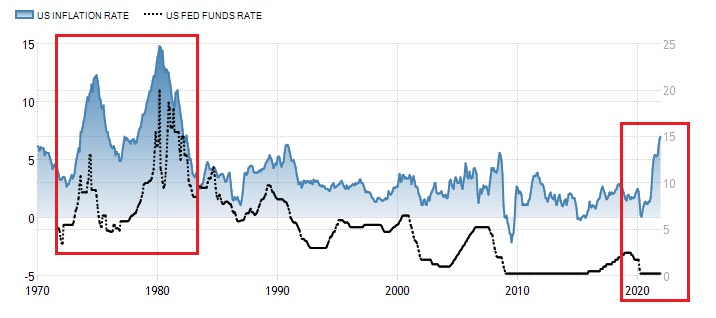
figure 2

The belated response will make things worse. The market had digested the Fed’s signaling it would hike short-term rates, starting perhaps as early as March. However, the bond market was hit on January 5, with the release of the minutes of the Fed’s Committee (FOMC) meeting in December 2021.

The unexpected surprise was that the Fed was also considering quantitative tightening; that is, shrinking its balance sheet. In addition to hiking the rates, it was planning quantitative tightening (as opposed to the past quantitative easing). That’s the double-whammy strategy that caught the market by surprise.

The challenges

Since the Fed awoke too late, it will have to hike rates faster and tighten already uncertain monetary conditions more than it did in the mid-2010s, in the aftermath of the 2008 crisis. And that will penalize the nascent recovery in America and contribute to still new delays in global recovery.

Second, a sustained rejuvenation of global economic prospects is predicated on growth, trade and investment. The Fed’s disruptive measures will weaken growth prospects, while the misguided US trade wars will further derail those prospects.

Furthermore, rate hikes and protectionism will add to global uncertainty, which will penalize foreign direct investment, while boosting “hot money”– speculative capital flows – that will add to market volatility.

Fourth, the combined effect could foster the return of the Republicans in the 2022 mid-term election and Trump’s comeback in 2024; neither of which is good news in view of the hoped-for global recovery.

Fifth, after the pandemic and the associated depression, U.S. sovereign debt is 131% of its GDP; not far from that of Italy amid the onset of the European debt crisis in 2010. The difference is that Italy, unlike the US, does not account for a fifth of the world economy, just as the old lira is not the major global reserve currency. US monetary policy has global repercussions.

Sixth, like Trump, the Biden administration calculated that debt-taking is fine since rates will remain low and interest payments manageable. They calculated wrong. As a result, Washington will continue to take more debt to (presumably) fight debt.

Finally, due to the impending rate hikes and quantitative tightening, the Fed impact will be felt throughout Asia where central banks are likely to signal more hawkish stances in the coming weeks.

While China may prove more resistant to the Fed impact, most of Asia won’t. While analysts expect China, Indonesia and South Korea bonds to outperform, Thailand and Malaysia bonds are likely to prove less successful. Recently, the Philippine peso plunged beyond 51 per dollar for the first time since April 2020 as the country’s trade deficit is expect to widen.

The Fed impact will cause further weakening in Southeast Asia in 2022.

Two black swans

There are two to black swans in play as well. The first may cushion the Fed impact worldwide; the second would magnify it.

Until recently, the optimists – foolishly – though that the Delta variant would be the last breadth of the global pandemic. Omicron proved them wrong. It will contribute to unanticipated challenges in the labor markets and new supply disruptions worldwide – and thus further sustain inflation.

Furthermore, due to the pandemic mismanagement and huge infection surges in the West, the pandemic effects may linger for months, perhaps even longer, thanks to inadequate global cooperation, politicized responses and vaccine inequality,

The other black swan is the Fed itself. The current stagflation has been fueled by the Fed’s policies and the Trump-Biden trade war.

With ultra-low rates and rounds of QE, the Fed took a risky path. That’s the message of Thomas Hoenig, former member of the Fed’s top policy committee (FOMC). This path, Hoenig says in the just-released The Lords of Easy Money will deepen America’s income inequality, stoke dangerous asset bubbles and enrich the biggest banks over everyone else. And if the Fed fails to exit its own money-printing quagmire, it could destabilize the financial system.

Unsurprisingly perhaps, when economic policies are misguided, threats of war and rearmament drives – from Ukraine to South China Sea – conveniently deflect and distract from the real economic challenges.

This article was originally published in eurasiareview on 17 January 2022. It can be accessed here: https://www.eurasiareview.com/17012022-us-stagflation-the-global-risk-of-2022-oped/

About the Author

Dr. Dan Steinbock

Dr. Dan Steinbock is an internationally recognized strategist of the multipolar world and the founder of Difference Group. He has served at India, China and America Institute (US), Shanghai Institutes for International Studies (China) and the EU Center (Singapore). For more, see https://www.differencegroup.net/


A Comprehensive Guide to Investing in the Coffee Market

investing

Coffee is one of the most popular soft trade commodities, with over 2.25 billion cups sipped every day. The coffee market is currently worth more than $100 billion a year. Coffee demand is steadily increasing, and the market is both exciting and volatile.

The risk of investment is certainly present, but the prospect of future growth always draws investors’ attention to the market. Frequently, investors build their portfolios by researching typical coffee features and resources. However, some investors use generic conjecture to forecast the growth tendency.

Coffee Markets and Trade Around the World

Coffee is effectively planted and grown in tropical and subtropical weather, and is produced in over 50 countries throughout the world. Brazil produces 35 percent of the entire amount of coffee produced worldwide and has held the leading position for a long time. Following that, Colombia and Vietnam take the top two spots.

The European Union, South Korea, Canada, the United States, and Japan are the top coffee importers. The consumption of coffee beans is increasing at a two percent yearly rate, and aristocratic coffee shops will continue to contribute more and more to this growth in the future years.

Coffee bean consumption is growing in popularity because it may be used as a refreshing drink as well as a dietary substitute for common foods.

Coffee cultivation is crucial to the economy and GDP growth of several countries throughout the world. For example, in the United States, coffee accounts for a significant portion of economic growth and creates scope for job opportunities for many.

Raw coffee and products containing coffee essence have a variety of effects on the global economy.

Unlike other investing strategies, however, coffee does not promise a higher return on investment. Coffee stocks have piqued the interest of traders and investors who like well-diversified portfolios. This commodity contributes to the portfolio’s solid growth and extension.

There are plenty of reasons to put money into the coffee industry. They include:

Heterogeneity

Coffee is a one-of-a-kind substance that can only be replaced by tea. This attribute reduces the commodity’s volatility in a portfolio.

Secure Investment Alternative

During a global economic crisis and market volatility, commodities like coffee might become a secure trading alternative. Coffee is one of those commodities that can protect you from the depreciation of your currency during a global crisis.

Hypothesis about the Price Rate

Many other perishable commodities’ prices may fall as a result of price volatility. Coffee merchants, on the other hand, can earn even when prices fluctuate dramatically, such as during a global pandemic or a sharp price drop.

Coffee trading is a business for those who are likely to trade technically and tactically evaluate the entire market picture. Some derivatives, such as market possibilities and future demand, are critical for the market and must be predicted properly.

It is critical to plan the expansion of existing businesses that have been in operation for a long period.

Leading Coffee Market Companies

It is wise to invest in a company that is already established in the coffee market if one wishes to engage in it. The price of coffee and products created with coffee extracts has a significant impact on the stock market for other commodities.

When compared to other items, coffee can offer reasonable prices. Aside from the well-known brands, there are several opportunities to invest in the coffee industry. So do not just look for huge brands in the coffee industry to invest in.

Another key piece of advice for new traders is to not put all of their money into one coffee business. If that particular company suffers a loss for any reason, you will lose your entire investment all at once.

An additional suggestion for the investors is to try to invest in a firm that sells other commodities in addition to coffee. If the corporation loses money on coffee sales for any reason, there is a possibility that it will be able to make up the difference with other items.

Rules which Should Be Followed to Invest in a Coffee Market

Create an Account

The first stage in the registration process is to create a real machine-generated automated live account. This account will provide you access to a free sample account where you can practice safely.

Select Your Product

After you have created your account, you will need to choose a product to trade for. Different market derivatives will enable the traders with different options to choose from. The trade can also be made for a forward contract, which has more common features as “futures.”

Track the Growth According to the Growth in Global Market

Coffee traders must be up to date on the current situation of the coffee market on a global scale. Pandemics, mass collisions, declarations of war, large natural disasters, and severe economic decisions by different countries can all have a big impact on the price rate.

Such incidents can have an impact on the economic situation of several countries throughout the world, as well as the price of various commodity goods.

Risk Management Factors

Coffee traders must always be cautious of the factors that will effectively control the risks that exist in the market. The main element that could pose a risk is that various types of coffee are grown and imported from various countries.

As a result, if any economic, environmental, or other coffee-related indicator changes, the overall price rate, and supply flow may vary as well.

If traders can establish a stop-loss option, it will help to halt existing traders from losing money and reduce the risk of capital loss.

Spread Betting Method in Coffee Market

Spread betting is a generally accepted and simple financial derivative for short-term trading. This strategy is best suited for trading with a short time frame. This strategy enables a trader to forecast the price movement of an asset in the coffee market without having physical possession of the beans.

This derivative allows the traders to speculate on both rising and falling market price rates of coffee beans. Except in the United Kingdom, this approach will cost the trader a fixed amount of tax fee.

CFD in Coffee Market

Coffee traders use a trading mechanism known as a contract the difference, or CFD, to conduct their business. This contracting mechanism is the most flexible and straightforward method of trading between coffee traders. This is an agreement between a broker and a trader to profit from the difference between the closing and opening trades.

With CFDs, you have more flexibility with the purchase process because you are not entitled to the asset. You are solely the owner of the primary contract in this case. This contract guarantees physical ownership of the commodity while excluding the owner from the purchasing hassle of any tangible product.

You will be able to trade coffee in both supportive and opposite directions with the help of CFDs. This feature will allow the trader to profit in both positive and negative scenarios, as well as from both downgoing and uphill subsequent price fluctuations.

Any trader may only assume one scenario: either a rise in the market price or a decrease in the price. Because CFDs are only available for a brief time, this speculation is seen as a time-limited investment strategy.

Factors that Impact the Price of the Coffee

Coffee trading is connected with different types of volatility. However, some factors influence every type of coffee bean, such as:

Climate Changes

As coffee is grown in tropical and subtropical weather, any extreme drastic change in weather during the transportation period can impact the actual condition of the coffee. Such adverse scenarios include freeze, frost, and extremely hot weather for a long period.

Extreme heat in the air can melt the particles in the coffee beans, and it can bind the beans together. Another price fall can take place when the flow of supply decreases due to ruined crops as an unfortunate occurrence of natural disaster.

Price of Oil

Even though Vietnam and Brazil are the world’s two largest exporters and producers of coffee beans, they are geographically far apart.

The price of oil, on the other hand, has an impact on the cost of coffee in both countries. When the price of oil rises, so does the price of coffee beans. One of the elements that have a direct impact on the price of coffee beans is the price of oil.

Native Politics

Because both the countries that produce the most coffee are developing countries, the price and production rate can fluctuate at any time owing to political changes.

Because both countries are still developing, any change in political decision or power might have an impact on all of the variables related to coffee’s price, production cost, and supply rate.

Final Thought

You can invest in the coffee market by employing various market derivatives such as coffee futures or already existent coffee market stocks. Because of changes in manufacturing variables and demand, the price of the beans can fluctuate without warning.

However, before investing in the coffee business, do some study into the other potential possibilities in the commodity market.

Professionals With a Mission: The Importance of Cultural Assessment

Cultural Assessment

A positive workplace culture boosts productivity, collaboration, and employee satisfaction. Despite these benefits, many leaders overlook the importance of culture within their own organization. Company culture isn’t inconsequential; it’s affecting every aspect of your business.

What is a Cultural Assessment?

A cultural assessment is an internal process that helps organizations evaluate their workplace culture. These assessments analyze the implicit and explicit beliefs and attitudes held by the company’s leaders, its associates, and employees. Assessments are taken anonymously.

It’s common for the company’s higher-ups and its employees to view its culture differently. In fact, job postings often lie or exaggerate about their own company culture to attract hires.

Websites like JobSage recognize the importance of company culture and its effect on your employees’ work performance. Every company’s career page says they’re diverse, inclusive, and offer a superb work-life balance. However, many employees come to find this isn’t the case.

Why a Cultural Assessment is Necessary

A cultural assessment can determine why your business is seeing high turnover rates, burnout, and diminishing margins. The following information is backed by statistics from Netsuite.

Poor Organizational Culture Leads to High Turnover

Neither organizations nor employees benefit when the wrong people are hired, but it happens frequently. Whether the employer doesn’t know or care about its own company culture, a poor organizational culture is blamed 50% of the time when an employee quits their job.

Poor Company Culture Leads to Higher Rates of Burnout

Toxic cultures lead to higher rates of burnout. 74% of employees reported job burnout for this reason, while 40% of workers blame it on long work hours and lack of work-life balance. Flight risk is especially high for new employees, Millennials, and Generation Z.

Poor Company Culture Leads to Inaccurate Job Descriptions

Although turnover rates can be improved through better hiring practices, hiring managers aren’t as accurate with job descriptions as they think. 72% of hiring managers feel they provide clear job descriptions, while 36% of candidates report receiving a precise depiction of the job.

For this reason, 66% of workers have accepted a job, realized it was a bad fit, and quit in six months or less. A bad hire costs employers $14,900 on average in productivity and onboarding.

Poor Company Culture Leads to High Costs

Employee turnover is notoriously expensive. The cost of replacing an employee is one-half to two times the employee’s salary. With an average employee turnover rate of 18%, most businesses fork out thousands, even millions of dollars each year replacing and hiring.

How a Cultural Assessment Improves Company Culture

When leaders understand what problems exist in their organization, they can solve them. It’s essential to listen to your employees when they’re discussing your business because they’re providing valuable information on how to make your company more profitable.

By doing a cultural assessment and using it to improve your organization, you’ll benefit from:

  • A strong brand identity.
  • Increases productivity.
  • Decreased turnover.
  • Employee engagement.
  • Attracting top performers.
  • Growing your business.
  • Effective onboarding.
  • A healthier team environment.

Business owners need to learn to communicate well for their company culture to thrive. Be as straightforward as possible with your employees and encourage them to ask questions. If your message isn’t producing the right results, try to be clearer in the future. 

To ensure your employees stay motivated, celebrate their achievements, and listen to their concerns or ideas. Encourage feedback from your employees and offer positive solutions.

Above all, be consistent. Not only will consistency help your employees feel a sense of stability, but it also helps them trust you. Once an organizational structure is in place, maintain its processes at all times. Stay professional and avoid giving preferential treatment. 

How To Do An Industry Analysis?

analysis

At times, conducting a thorough industry analysis can be time-consuming and tedious. However, an industry analysis can help identify what important problems need to be addressed by your company. This is especially important since the business world and technology is constantly evolving and a company must evolve with it.

Industry analysis is a tool that gives you insight into how your company or industry stacks up against its competition in terms of performance, capacity and growth. You should conduct industry analysis to identify strengths and weaknesses and develop strategies to improve your company’s standing within the industry. Planning by performing these types of analyses makes it more likely that your business will reach its goals. 

This article is a quick guide on how to conduct industry analysis so you may apply it to your business or in the company you work at.

1. Conducting background research

Do some research on your industry and competitors to get a better understanding of the market. Decide whether you want to research the whole industry as a whole or a specific subsection of it. Consider what questions you want to be answered by your analysis, such as how your competitors are positioning themselves or where the market is heading. Survey your competition and take a look at what information is available about them. You can also draw up a list of those companies that would be willing to share information about their businesses with you. This will allow you to learn almost everything about your business from the format of delivery challan to creating business plans.

2. Collecting the data

Stay up to date on what your competitors are doing and collect information about the market as a whole. Put out a call to your network or check the latest available industry reports from your company or others to understand trends and developments in the market. You might also glance at your competitors’ advertisements, product placement in stores and public financial data to discover their target audiences. You may choose to collect additional information by using secondary sources, such as government statistics and journal articles. Additionally you should also be aware of macroeconomic factors that may affect your business. Hence, pondering over GST members list and knowing the recent announcements of GST council is a good idea.  If you’re looking for frequent updates on all of these from one place then you should take a look at Khatabook’s website.

3. Analyze the data

You’ll need to analyze the data you collected using at least one type of industry analysis model. Using the model you select compare your products and marketing strategies to those of a competitor. You may also want to consider how your strengths are comparable to those of other companies and evaluate how they stack up.

When you are analysing the data following, the factors can have an effect on your final results:

  • Preference of the consumers
  • Projected market growth
  • Preference of the consumers
  • Regulatory conditions
  • New technological innovations.

4. Final Report

You should share your analysis in a written report to make this information accessible to a broader audience. A template of your report should include the following:

  • Introduction
  • Aim
  • Data
  • Analysis
  • Future
  • Summary

5. Final evaluation

Your report should help you decide on the current state of the company and how to improve in the focus area. After you complete your analysis, if you have remaining questions, you can focus on another industry factor in a second analysis.

Benefits Of Taking Stem Cell Therapy In San Diego

Stem Cell Therapy

Researchers are now investigating adapting this therapy method to prevalent chronic ailments like diabetes, heart disease, and neurodegenerative disorders.

If you can’t bear the thought of enduring reconstructive surgery to alleviate your persistent ailment, searching for “stem cell therapy San Diego” may give you some hope.

You might be wary if you’re new to this therapy method. Fortunately, the advantages of stem cell treatment have grown significantly in recent decades, including:

Promoting quicker healing process

The body’s natural capacity to mend itself is aided by stem cells, which may replace damaged joints and tissues in a matter of days.

With minor supplementary treatments like physical therapy and recovery time, you may begin to see a dramatic change over time, even if it takes several weeks.

Stem cell treatment is also faster than many other choices; the operation and recovery periods are often much shorter than surgery.

In fact, patients routinely walk out of the clinic independently in as little as two hours, returning to their hotels or homes for one to two days of recovery.

There is no need for severe activity limitations, hospital stay, time away from work, or a long post-surgery physical conditioning routine.

Furthermore, pain is often managed with medication for just a few days (rather than months), allowing patients to return to their regular lifestyles far sooner than those who choose the surgical intervention.

Lending a hand in immune rejection cases

Immune rejection is the phrase used to describe the destruction of cells and healthy tissue in people suffering from inflammatory conditions and other autoimmune illnesses.

In type 1 diabetes, for example, the pancreatic cells that usually create insulin are killed by the patient’s immune system; in thyroid problems, the thyroid gland is attacked and damaged.

Research reveals that some adult stem cells are capable of creating and maturing required cells, such as insulin-producing cells, which might one day be utilized to treat diabetic individuals.

On another note, this technique is currently under intensive investigation.

Unfortunately, it’s not yet generally accessible, as scientists continue to experiment with dependable methods for creating new tissues/cells that won’t be damaged or reject the patient’s body once implanted.

Being a minimally invasive procedure

Adult stem cells are found in the skin and blood. However, since adult stem cells are plentiful in the fat and bone marrow, many clinics only harvest them from those sources.

This is done with liposuction and needle extraction. A concentrated solution of the extracted stem cells is then injected back into the patient under ultrasound guidance or a live x-ray.

Using stem cells in this manner may help them grow new cells to replace those lost due to sickness, injury, degradation, or abuse. Patients are spared the possible complications of surgery incisions, the often associated loss of mobility, and general anesthesia.

Stem cell therapy makes patients healthier while reducing risks compared to surgery and frequently provides significantly improved results!

Conclusion

Although stem cell therapy is thought to be relatively safe, there are still some potential adverse effects.

Find a trained practitioner and inform them if your experience after treatment doesn’t sound like the usual one mentioned above.

Keep in mind that a few moderate side effects following injections are expected, like with other forms of prolotherapy approaches and non-invasive therapies.

Kenya’s Tourism Industry – a Haven for Investors and Visitors Alike

Elephants
Figure 1 Source: https://pixabay.com/photos/elephants-masai-mara-safari-kenya-5133792/

In 2019, the number of tourist arrivals in Kenya was at an all-time high, totalling well over two million. Although that number dipped considerably following the ravages of the Covid-19 pandemic, it is steadily picking up once again.

Notably, in December 2021, the country was declared a world-leading safari destination by the prestigious World Travel Awards (WTA). It was the seventh time it was receiving this high accolade.

It is a long standing tradition dating back to colonial times, when the East African country was dotted on as a popular safari hotspot. Since then, international tourists continue to make repeat visits due to its numerous captivating attractions.

Recently, Kenya has attracted celebrities such as the Obamas, Queen Elizabeth, Prince William, and Kate Middleton in the recent past. Equally enthralled by the country were Demi Lovato, talk show host Ellen DeGeneres, Fernando Alonso, to mention a few.

To ramp things up even further, its tourism industry has introduced mid-luxury and budget safaris specifically curated to cater to modest-income travellers. But the diversity doesn’t stop there. Travellers can opt to use open sides safari vehicles (mostly Jeep Grand Cherokee) 4×4 safari land-cruisers, or the pocket friendly safari vans. 

These innovative travel products have led to substantial growth in international tourist arrivals and an upsurge in domestic tourism.

This write-up looks at the country’s unique features that make it a favourite destination with investors and travellers. 

We also highlight how its tourism sector continues to stimulate such interest.

1. Robust GDP

Besides being the 4th largest economy in sub-Saharan Africa, Kenya is also the dominant economy in the East Africa Community (EAC), boasting a GDP of $60 Million. So far, its GDP accounts for 50% of EAC’s cumulative total. 

Consequently, the country is burgeoning with economic promise, which has caught the attention of big international investors in recent years.

Among them is British magnate Sir Richard Branson, whose flourishing Mahali Mzuri luxury camp was named the best hotel in the world in 2021 by the World’s Best Awards.

The 12-tent luxury safari camp is located at the heart of the phenomenal Maasai Mara Game Reserve.

Other top celebrity investors include Formula one’s icon Flavio Briatore, whose billion-dollar investments include two 5-star accommodations in the seaside town of Malindi. 

Beach
Figure 2 Malindi Source: https://unsplash.com/photos/mIDfo78z-OA

The accommodations, known as Billionaire’s Resort and the Lion in the Sun Resort, have hosted numerous A-list celebrities over the years, including British Supermodel Naomi Campbell.

Speaking of Naomi Campbell, did you know that she too was so enamoured with Kenya that she even undertook to market the country for free? 

So what other factors compel these international moguls to invest in or visit Kenya?

2. Infrastructure

For starters, besides its high GDP, the country also comes with a well-developed infrastructure. 

These include a good road network, with all the major towns and cities having paved roads. 

Canvassing the country is thus reasonably straightforward, and over 80% of domestic transport is via road. Even visitors travelling to off-road locales are assured of smooth trips, courtesy of dependable safari vehicles and navigable roads.

Safari Vehicles
Figure 3 Safari vehicles Photo: courtesy of AjKenyasafaris Limited

Apart from the dependable road network, the country also enjoys a fast railway system, part of which meanders through the Tsavo National Park, one of the top tourist attractions. 

Kenya’s power grid and telecommunications network are also among the best on the continent. 

Presently, the country’s internet coverage stands at 72% (approximately catering to 32 million people); and is considered the highest in Africa.

Investors and visitors also benefit significantly from the country’s highly knowledgeable and skilled workforce. 

Not only are most Kenyans highly innovative and adaptable, but they are also fluent English speakers, which eases communication with foreign arrivals.

3. Attractions

The country has a bevy of tourist attractions that appeal to different categories of visitors. 

It is a world leader in wildlife tourism, boasting over 40 game reserves and parks. 

Key among these is the Maasai Mara Game Reserve, which has incredible wildlife diversity, including dense populations of the Big Five (lion, leopard, rhino, buffalo, and elephant).

It is a country teeming with many large mammals, ranging from the most dangerous ferocious predators to relatively harmless giants.  

With more than 25,000 animal species, over 7,000 plant species and more than 1000 bird species, it is easy to see why Kenya’s diversity piques international interest. 

Still, on the issue of global attractions, the country has a collection of splendid beaches scattered along its 1420Km long coastline. 

Among these is the multi-award winning Diani beach, whose clear turquoise waters and alabaster sands is the epitome of a perfect coastal getaway.

Diani Beach
Figure 4 Diani Beach 
Source: https://www.istockphoto.com/photo/camels-at-diani-beach-gm1312154733-401048632?utm_source=unsplash&utm_medium=affiliate&utm_campaign=srp_photos_top&utm_content=https%3A%2F%2Funsplash.com%2Fs%2Fphotos%2Fdiani&utm_term=diani%3A%3A%3A

Thanks to the multi-faceted richness of Kenya’s history, cultural and heritage tours are yet another attraction that draws in visitors. 

From the oldest town of Lamu- a UNESCO World Heritage site, to other ancient cities such as Mombasa and the remnants of an old abandoned village at Gede ruins, the country is rich in historical tales.

4. Security

Compared to her northern neighbours, Kenya has a stable socio-political climate and is a steadily improving destination for foreign direct investment (FDI). That is as per the 2021 World Bank Doing Business Rankings.

The country also has favourable investment policies designed to attract foreign investors and visitors to create jobs for its locals.

5. Market access

Urbanisation has been on a steady rise across most parts of Kenya. As a result, there is a growing middle-class and high demand for upmarket consumer goods and luxury items, including travel products.

Consequently, there has been growth in domestic tourism, with a corresponding increase in investments in this sector.

Of note is the rising demand for boutique travel products, such as affordable tours and getaways. 

While some travel companies have begun providing innovative travel products aimed at the mid-luxury consumer market, demand for affordable tourism products continues to be felt.

The Main Financial Benefits Of Forex Trading And How To Start

Forex Trading

Forex trading has become a popular and lucrative venture for many people today. There are many reasons why this form of trading is so popular, from the high risk/high reward potential to the potential for quick riches. If you’re thinking about getting into this high-pressure field, knowing what you’re getting into is the first step to reaching your goals! Some people will say that Forex trading is not an easy way to make money but if done correctly it can be very profitable. Trading currencies requires users have some knowledge on how their currency exchange rates fluctuate over time with other national currencies, giving them options and helping them understand which pairings are more likely to trade at parity with each other, etc. However, there are plenty of online resources available which provide information on these topics in detail. It is wise to take advantage of these resources before starting so you don’t have any surprises along the way.

1. The Main Financial Benefits of Forex Trading

You Can Trade From Anywhere in The World

One of the biggest benefits for customers wanting to get into Forex trading is that it can be done from anywhere with an internet connection regardless of factors such as weather, time, or location. If you are self-employed there are no formal work hours. This gives you the opportunity to trade financial markets at any time during the day or night. When looking at the pros & cons of Plus500 fx trading you can see that anyone in any country can trade with this provider. They also offer excellent tools which allow you to track current market movements and analyze previous trading sessions.

The Potential for Big Gains

Forex traders using plus500 also have the opportunity to experience the thrill of the “big win” that can come with the potential for much higher payoffs than other types of trading. This is due in part to the fact that the global currency market is the largest financial market in the world and unlike more regulated markets like ETFs, including bonds and commodities, Forex is not bound by a single, central market, just like cryptocurrency. The currency market never closes, which means that it is constantly operating and fluctuating according to market dynamics. This means that you need to focus carefully on what you buy and when you are buying it. Also, pay attention to CFDs on this front. A CFD enables investors to easily take a long or short position when it comes to buying and selling, so make sure that you understand these concepts in order to gain big because there is always the potential to lose out.

You Can Start with Minimal Capital Investment

Forex trading does not require a large capital investment to get started. This is because the market is not controlled by any one central entity and therefore there are no specific trading hours, rules, or fees. Forex traders do not require large cash reserves like many other types of investors because they are able to enter and exit trades with much smaller amounts of money.

Economic and Political Uncertainties Can Be Your Friend

In addition to the fact that Forex traders have 24 hours a day in which they can trade, there are also certain factors that offer the potential to provide even more opportunities. Forecasting economic and political events are a mixed bag – it can be useful because you will know what could happen in the market before it actually does happen. However, there is a level of uncertainty that makes knowing what will occur impossible. Nevertheless, these uncertainties can be market opportunities if you are skilled in predicting them.

Leverage Can Exceed 200:1 on Currency Pairs

Another advantage of Forex trading is that it can be done using very little money. While the amount of money required for opening an account with a broker or other trading platform can vary, it is possible to trade Forex pairs with leverage up to 200:1. The use of leverage means that a small deposit can control much larger stakes in the market. Leverage comes in many different forms and can be used to increase profits or manage losses.

You Can Trade When You Are Ready

If you are a bit spread then, forex trading is not something that requires users to be available at specific times. This allows forex traders the luxury of not having to sell when they are not ready or available. The market never closes, which means that it is constantly operating and fluctuating according to market dynamics.

2. How To Start Forex Trading

If you have a credit card and have been contemplating the idea of starting to trade the forex market but are still unsure whether this is right for you, there are some things to take into consideration before you get started. One of the most important things to remember is that this is a high-risk business with the potential for very large rewards. Because of this, it is important to find a knowledgeable and trustworthy broker. You can find the best forex broker that can meet your trading needs and ensures the safety of your investments, and maximizes your profitability.

Once you establish a good relationship with your broker, they can help you get started by setting up a demo trading account to help you become familiar with the process and allow you to practice. There is no cost associated with using a demo account, which means it does not put any money at risk and allows traders to learn without spending their own funds.

Money

If you are looking to invest in something that is high risk but with the potential for large rewards, Forex trading may be the right venture for you. There are many benefits of this type of investment and business, including no set hours or rules when it comes to trading. However, if you don’t have a balanced life outside of Forex trading then it can quickly become an obsession that will take away from your personal time with family and friends. If you make sure not to trade when unprepared or at times where there’s stress on your mind (i.e., work deadlines), forex trading can provide amazing opportunities without any financial limits!

7 Ways To Start Saving Money Fast & Living Better

Saving Money

With the economy still in recovery, many Americans find themselves in a troubling situation. Their income is not what it used to be, and expenses are higher than ever. With a record level of inflation, saving money is more important now than it has ever been.

If you find yourself in a situation where you need to save money fast, here are some simple ways to do just that.

1. Refinance Your Credit Cards

If you are like many people, you have been leaning on your credit cards over the last few years. While originally a saving grace, they are likely now an anchor around your neck. Reduce those monthly payments by consolidating your credit cards and reducing your total monthly payments can bring you relief.

The only problem with refinancing your credit card debt is that people with charged up credit cards often have lower credit scores.  Credit utilization is a big part of your credit score, making up nearly a third of it. When you carry high balances, your score will suffer.

High credit utilization might make it harder to find a refinance loan, but you do have options in the form of a third party websites that may be able to get you access to financing. In any case, refinancing your credit cards can potentially put one or two hundred dollars back in your pocket every month.

2. Start Meal Planning

How much food are you throwing in the trash each month? It is likely a lot more than you think. Meal planning can solve this problem and leave you with more money to pay for your other expenses.

Simply put, meal planning is writing down all the meals that you want to serve in a week. You do that and then take your menu and use it to make an exact grocery list. That allows you to buy just what you need without any wasteful spending. Less waste means more money in your pocket.

3. Cut Utility Costs

Gas, water and electricity are a huge expense for families, but just like your food budget, there are ways to reduce your spending. Small steps you can take that in total can produce some substantial energy savings.

Take shorter showers, use cold water on your wash cycles and turn your thermostat down a few degrees in the winter and up a few degrees in the summer. These are the top tips that come to mind, but there are literally dozens of ways to save money. If you find yourself short on ideas, call your local utility companies. Many will offer you free energy audits to help you conserve.

4. Buy Used First

When you buy new, you are paying a premium and will also suffer the greatest depreciation. Instead of buying new, shop the used market first and save.

Used cars, used electronics and even used clothing can save you hundreds of dollars over the cost of new. Don’t like the idea of buying used? Consider the fact that everything you buy will be considered used in just a few weeks anyway. Is it worth paying a premium to have something that is new for such a short time? Not if you need to save money fast.

5. Shop Your Auto Insurance

Insurance companies are tricky. They like to offer new clients discounts and then raise the rates upon renewal. Over time, you could easily be paying 20 percent or more over what new customers are paying. Is that fair?

Take the time to get quotes for auto insurance every time your policy comes up for renewal. Even if this means switching carriers ever six months, it may very well be worth your time. The insurance companies thrive on your complacency, so put in the effort.

6. Skip The Drive Thru

For the sake of convenience, drive thru lunches are the norm for many people. This is not only costly, but also time consuming and unhealthy. Skip the drive thru, brown bag it and profit in many ways, not just financially.

Obviously, you need to save money, and this will be the key benefit to skipping the fast-food lane. With average meals approaching 10 dollars these days, that could mean up to 200 dollars a month back in your pocket. Besides this savings, you also benefit from saved time since you will no longer have to drive to get your lunch. Additionally, you may just lose a few pounds and lower your cholesterol.

7. Do It Yourself

Last on the list is learning to do more things yourself. Many services that you are accustomed to paying for can easily be done by the average DIY enthusiast. This is especially true these days with the help of YouTube and the internet.

If you are currently paying for oil changes, basic pest control, house cleaning or lawn care, you should step up to the plate. Save money each month and become more self-sufficient by doing these things yourself. Not sure how? Just do an online search. It really is that simple.

Save More Money By Hiring A Financial Advisor  

Saving money today can help you improve your quality of life when you retire. This best practice can help you set aside money for your retirement fund. If you’re unsure how to manage your finances and always have money issues, it’s time to consult a professional.  

A financial advisor isn’t just for rich people. Financial advisors help people with different financial statuses. Moreover, they can help you determine your strengths and weaknesses in financial management.  

In addition, a financial advisor can excellently explain your financial options for a new business venture and to avoid bankruptcy. They can give you expert advice about retirement planning and keeping up with your city’s cost of living. You can learn more about the cost of living and retirement planning from an expert, such as Runey & Associates, or other trusted financial advisors. 

Conclusion 

Saving money fast and living a better life in the future are possible. Besides, while you want to treat yourself with a luxury item or a grand vacation, saving must be your priority because of inflation and economic uncertainties. Therefore, don’t hesitate to consult a professional to provide personal finance, retirement planning, and investment advice. With this, you can strike a good balance between wise spending and saving.

An Essential Guide for Merchants: How to Manage Chargebacks

Merchant

The Commerce business has experienced a lot of adaptations since its beginnings, and its digital transformation to e-commerce is the latest. More and more stores are transferring their business operations online, especially after the pandemic changed our lives. Even the business with no internet presence had to adapt and accept the transformation sooner than they expected it to happen. But, the companies that jumped into the change and those forced to it experienced the same benefits. No longer restricted by their location, they could finally reach customers from all around the world. It even made the difference for some shops between staying in business and closing their business altogether.

Even though digital transformation might be a new concept for some shops, chargebacks are not. While they have been present for decades already, the unexpected growth of eCommerce has also seen an increase in the number of chargeback cases. These can cause various problems for merchants, from financial to reputational ones. According to SEON’s guide on chargeback management, you need to keep your chargeback rate under 1% of all processed transactions. If the rate goes higher than that, you could be classified as high risk, your card transaction fee could increase, your account closed, or you could end up blacklisted by card networks. It is time for all merchants to start taking active steps in managing chargebacks and protecting their business.

How can you protect your business from chargebacks?

Chargebacks can happen for various reasons, from customers not recognizing the transaction on their bank statements to their card being stolen and used for fraudulent purchases. Regardless of the reasoning, the result is always damage to the merchant. It is up to them to start being proactive and take active measures in preventing chargeback from affecting them.

1. Be accurate and specific

Many chargebacks happen because the product didn’t meet customers’ expectations or they misunderstood the return policy. Merchants can prevent that by being more accurate and specific in all aspects of interaction with customers.

Product description: It can’t be misleading as customers need to know what you offer. Make sure your product description is accurate, clear, and easy to understand to ensure it will meet their expectations. For best results, you should include dimensions and photos showing items from different angles if possible.

Return policy: You need to clearly indicate the requirements for the customers when they are returning the product. Try to keep it simple but as detailed as possible to avoid misunderstandings. Details of the return policy should always be available on the checkout page and included in the package with the item sent to the customer.

Merchant descriptor: Sometimes, customers will request chargeback because they haven’t recognized the transaction on their bank statement. This happens because the merchants haven’t ensured their descriptor matches the name of their business. Luckily, you can remedy this quickly.

2. Ask for a CVV number

This needs to be utilized during every transaction to prevent various types of fraud like an account takeover, identity theft, or card-not-present fraud that result in a chargeback. It will increase your chances of dealing with a legitimate card owner with a physical card present in front of them.

3. Implement cybersecurity tools

By utilizing cybersecurity tools like antivirus programs or data enrichment and device fingerprinting, you can stop fraud attempts before they can do any severe damage.

4. Be accessible to your customers

By being there for your customers, you can prevent various chargeback requests. According Forbes, if your customers can contact you as soon as the problem arises, you can fix it before it escalates into a chargeback request. Your contact details need to be visible and easy to find.

Chargeback will always be present in the eCommerce world, but by following these steps you can effectively manage them.

6 Personal Finance Management Tips for Young Adults

Personal Finance

Now, most millennials are in their mid-20s and early 30s, making major life decisions. Some are thinking of getting married and starting a family, whereas others are making big career moves. However, most young adults still lag in one aspect – money management.

Many people have drowned themselves into loans – all thanks to overdependence on credit cards. Likewise, some individuals have a habit of spending lavishly. None of us were born knowing how to handle finances, and unfortunately, we didn’t learn it in school either. Finance management is more of a skill that we learn over time, often through mistakes.

However, today’s generation must learn all financial lessons the hard way. After all, the world is becoming competitive, and without financial know-how, you will keep lagging. So, why not take the time to learn a few financial rules to build a healthy financial future? You can learn to file taxes, maintain a credit score, and invest money to earn profitable returns.

If you are eager to get started, let us help you with this. Here we are listing six personal finance management tips for young adults.

1. Manage Your Financial Future Smartly

Truthfully, if you don’t learn to manage your money, other people will find ways to mismanage it for you. Some have wrong intentions, whereas others charge a hefty commission for providing standard services. Instead of relying on others, take charge and manage your financial future. For starters, you can read a few books on personal finance. Once you have sufficient knowledge, start making decisions related to savings, retirement, education, etc.

If you believe you’ll need a loan for higher studies or starting a venture, explore your options. We’d advise you to check out https://nectar.co.nz/ to have a straightforward approval procedure. Similarly, if you plan to save for retirement, open your pension fund now and allocate your budget wisely. Remember not to let anyone catch you off guard and keep your financial future secure.

2. Create a Rainy-Day Fund

Unfortunately, one can’t predict a job loss, house repairs, illness, or another emergency. These unexpected expenses exhaust savings and put all finances into disarray. Thus, having an emergency fund in such a situation helps. For that, you have to put 10% of your monthly income into a savings account. It might lead to temporary financial hardship but later saves you from a lot of trouble.

Moreover, emergency savings can fund major expenditures. Perhaps, you can use that money to purchase a television if the old one breaks down or withdraw a few bucks to travel. But remember, the fund should have enough money to cover a medical emergency.

3. Get a Grip on Taxes

Most people rely on their employers for tax filing, but that’s not how things work today. Now, young adults must understand how income taxes work even before getting their first paycheck. Before settling for a job, you should know whether it will meet your financial obligations after tax deductions. Similarly, calculate the overall tax to determine your disposable income.

Luckily, many online applications can calculate tax returns for you. The calculator will show the gross salary, the amount that goes to taxes, and your total disposable income. Moreover, you have to become familiar with the concept of marginal taxation. Often, people switch jobs for higher pay, but the increase in marginal tax rate doesn’t bring real-time gains. Learning to do your taxes will ensure you are entirely in charge of your financial situation.

4. Build Your Credit Score

Young adults usually believe in living in the moment. Whether that is at the cost of swiping credit cards or exhausting savings – they don’t mind splurging tons of money every weekend. It might seem like a spontaneous decision but has long-term consequences on your credit score. Let us explain what is that and how you can improve it?

In the real world, a credit score is one of the most crucial measures of your wealth. It shows financial institutions how responsible you are with credit. Hence, the better your score, the easier it will be to acquire loans and new credit lines. In addition, lenders also offer a low-interest rate for people with a high credit score since it reflects credibility.

If you wish to improve this score, review your credit reports, make timely payments, and pay your revolving credit. Most importantly, don’t utilize your credit limit by more than 30%, which is considered ideal for improving your credit score.

5. Control Your Spending

Believe it or not, millennials have a habit of overspending. Therefore, having a budget is a must for every young adult. In addition to controlling spending, it can assist in achieving financial objectives. So, how can you create a budget?

Firstly, you have to calculate your monthly income and expenses. Besides salaries, list all external sources that generate inflows in your bank account. After that, take a look at your outflows. Perhaps, you can categorize fixed and variable expenses to see where it is possible to scale down. However, ensure you create room for discretionary spending such as traveling, eating out, etc. Such expenses can add to your budget, so make sure you don’t have to overspend.

6. Start Saving Today

The universal truth – the sooner you start saving, the more money you will have once you retire. After all, compound interest has this kind of strength. Hence, consider setting some money aside for retirement. You can open up a pension fund or save a few bucks in your deposit account. However, explore a few investment options if you wish to earn returns now.

As a beginner, you can even invest in the stock market with the help of a broker. Long-term investment in shares will allow you to earn substantial dividends by year-end. Otherwise, you can get your hands on a few financial instruments such as bonds, treasury bills, certificates of deposits. They get sold at a premium and offer lucrative returns, allowing you to save and earn. This generation is known to be tech-savvy, but now, it is time for them to become smart investors.

Final Words

Most young adults face trouble when it comes to finding their way around numbers. They usually have a short-term view and are unfamiliar with the concept of savings. As we step into more uncertain times, it is time for millennials to think about the long run. They have to get on top of financial management and adopt the best money management practices to have secure financial futures.

EDITOR'S PICK OF THE WEEK

CFO's new mandate. CFO explaining the presentation

The Performance and Transformation Orchestrator: The CFO’s New Mandate in the Age of AI

By Terence Tse CFOs are evolving into AI-driven transformation orchestrators, balancing finance, technology, and strategy while upskilling teams, managing risks, and driving measurable business value. A key insight from this year’s AI for CFOs event, organized...

WISE DECISION MAKER GUIDE

POWER INFLUENCERS

Emerging Trends

The Future of Global Trade