Home Blog Page 749

How do you Analyze a Company Before Investing?

Investing

Are you thinking about buying the stocks of a company? If you are, you have mostly thought about the company. It’s a given, and it is also the first thing you have to think about. But being the analyst and the investor all by yourself is a hard job. Sometimes it might also seem overwhelming. But, long-term wealth creation demands this topic, and it comes to your duty to complete this with 100% focus and effort. While you look at it now, it might seem like a long and hard road, but while you actually do it, it wouldn’t feel this way.

First things first, let us look at how to analyze a company before investing in its stocks.

1. Identify the Company and its Characteristics

This is the very first step you need to take in the process of your analysis. There are several ways to do this, and the very first one would be through the company’s own website itself. It is best to hear from them first, then go to the other sources, right? You can look at the website, their about section, their management, and for the way they manage, you can look at the social media. After you look at all of this, you can look at it economically through reports and news. This will give you an in-depth understanding of how they perform.

2. Their Products and Services

How can you forget the treasure of the treasure hunt? Their products play a role in the whole situation. When coca-cola came out, everyone had a hint it would reach heights, just not sure what kind of heights. When you Analyze the products and services of the company, you understand the company itself. How is the product performing in the market? How are they improvising? Are they just sticking to one product and service, or are they growing and expanding over time? What is the demand for their products? How are people reacting to it? What are their special features when kept against their peers? What are their channels of distribution? Are they change-friendly? Once you have answers to all of these questions in terms of the product and the service, you are set to go to the next step.

3. Understanding the Company’s Risks

Risks are a part and parcel of every firm, given big or small. Whether it is a small firm or a big corporation, the risks involved are the same – just the size of it differs. Every company is bound to face risks of its own, though how they deal with it is a big consideration, the potential drops are a given. These risks are also the cause of stock top losers of companies. Well, if you can see the companies potential lists and what can bring them down, it can be a good indicator of your investment journey.

4. The Financial Statements

This is also one of the most crucial factors to the analysis of a company. A company’s financial statements can show you how the company stands financially. At the end of the day, everything goes according to these statements. When you know the company’s debts and expenditure, cash flow, and much more, it’s easier for you to make your final decision about the company. There is no better way of finding the company’s current state than the financial statements.

5. Find More on the Chief Executive Officer

This might seem irrelevant to some, given looking at the CEO when there is a whole company to look at, but it’s worth it. Have you passed success stories in recent years without talking about Sundar Pichai? Or have we not spoken about Jeff Bezos stepping down as the CEO of Amazon. The CEO plays a crucial role in every company. How the CEO responds to successes and failures – how he tackles situations can directly impact the stocks you are about to invest in.

Why Do you Need a Company Analysis?

Some people assume it’s not completely necessary to analyze a company before they invest in its stocks. Don’t be one of those people. Be the one that analyzes the company before anything else on the adventurous ride of investing. Here is why you need to do a company analysis.

It drives your decisions: At some point, you are probably thinking about investing in the stock, given that it had a sudden high. But, once you look at the company, your thoughts mostly change. A company analysis can impact your investment decisions in big time. It could drive you towards investment when you least thought about it or drive you away from it when you were almost going to invest in it.

Is there a Drawback to Doing a Company Analysis?

Everything has two sides, so does this. Yes, there are drawbacks. Actually, it’s one Drawback. When you do a company analysis, you’ll have several questions popping in your head. It will mostly be a long series of questions that you would repeatedly have to answer until you finally invest.

Since you’d repeatedly keep looking up different factors of the company – you’ll second question everything else, since it deals with you investing in this company after the analysis.

Conclusion

You know the benefits of doing a company analysis. You also know the demerit of it. One mention though – questions are always good, and they clear your head. Now that you know how to get an analysis done, what’s the wait for?

6 Things You Need to Know About Asset Protection

Handshake

Asset protection can be used by individuals as well as business entities in order to limit outside parties from being successful when pursuing legal action. It’s a part of financial planning, and the goal is to ensure that a person’s assets are safe from different third-party claims without resorting to perjury or any other illegal activities. While the basic concept of it is pretty simple, asset protection involves a lot of different financial and legal nuances, so it’s important to get to know the 6 key things about it before you apply it to your finances.

1. Know Your Options

There are different viable asset protection strategies out there, and each of them has its pros and cons. The rule of thumb is to determine what kind of assets you have, which may include physical items, investments, cash in the bank, debts owed to you by others, intellectual property rights, or future income streams. You will need to be able to distinguish between the types so that you can better analyze your options for mitigating your risks. However, perhaps the most important distinction to make is whether you’re looking into these options as an individual or for commercial reasons. The two applications are vastly different and carry completely separate considerations that need to be addressed. For example, an offshore asset protection trust is among the safest options for individuals, since it doesn’t have to adhere to the same rules as domestic trusts. It almost completely ensures that your assets will be protected in the case of any kind of legal proceedings made against you – although where you decide to set up the trust will factor into this. On the other hand, an offshore LLC is a good bet for a business looking to get started since it’s relatively easy to set up and offers a lot of flexibility when it comes to allocating shares or managing affairs.

2. Plan In Advance

No matter what type of asset protection strategy you decide to pursue, it’s highly recommended that you do so in a timely manner. While financial planning is always important, it is especially so when it comes to asset protection since, a lot of the time, it can only provide you the protection you’re looking for if it’s put in place before a claim is made. If you only set it up after legal action is already taken, it might even fall under the so-called fraudulent transfer law. What that means basically is that it wouldn’t necessarily be regarded as regular financial planning, but as a way to abuse the law in order to avoid legal consequences, so any action you take could be completely reversible. With this in mind, if you are thinking about getting some sort of asset protection strategy, it’s best to start planning for it immediately so that you can consult with the right financial and legal advisers before making any decisions.

3. You Can’t Be 100% Protected

As much as you want to be entirely protected from third-party claims, there’s no such thing as complete protection when it comes to asset protection. There are two types of risk in financial planning: the risk of loss and the risk of litigation. The goal is not to eliminate either of these – since that’s impossible, but to reduce them as much as possible. For instance, certain asset protection strategies might not be able to protect your assets from creditors or third parties, since they can go through the court system and get a judgment against you. To explain it better, this means that even if your assets are protected under an LLC, you can still lose them to creditors through court proceedings. It’s not necessarily the best outcome for you, but it does mean that it limits their risk exposure to lawsuits and helps protect their assets in case of bankruptcy. That is why it’s so important to understand what options are available for you before choosing one. In other words – while some strategies do offer more protection than others, there’s no strategy out there that can guarantee protection in every possible situation.

4. Understand Your State’s Laws

Each U.S. state has its own set of tax statutes and laws, which includes the laws dealing with creditors’ rights and liabilities for debt collection purposes. When it comes to asset protection, you should know which assets can be protected from being levied upon by creditors and which cannot. In most cases, the following assets are exempt: your primary residence, your car(s), clothing, household appliances, tools of the trade, college tuition funds for yourself or someone else (including children or grandchildren), and retirement benefits. Also, if your spouse or dependent children live with you in your primary residence, they can claim an exemption for the value of their personal property as well. When deciding on an asset protection strategy, it’s important to get to know the exemptions for your particular state in order to properly determine which course of action works best for you.

5. Don’t Offshore Your Entire Wealth

It’s important that you understand that just because you establish an offshore entity for asset protection, it doesn’t mean that any and all of your assets should be transferred to the new entity. To put it simply – even if all of your wealth is safe offshore – you’re still here. This means that you should keep a portion of your wealth in a separate account so that if anything happens, it’s ready for you to use. Asset protection planning is about striking a balance where you have enough control over your assets, but not so much that the prosecutor could argue that the asset protection should be disregarded since you’re the one in full control of it. If legal action is taken against you, and you suddenly withdraw from your assets in order to hire the best lawyers – it could be argued that you’re simply someone who is trying to avoid creditors, which would work against you.

6. Full Disclosure

If someone does take you to court, for example, a creditor – it’s important to understand that you cannot make it seem like the only assets you have are the ones that you didn’t put in a trust – or used any other asset protection strategy for. There’s no real way to completely cover your tracks – and you’re not supposed to either. If you’ve previously claimed that it didn’t exist, you could be held liable for perjury and bankruptcy fraud. Of course, if a claim ever goes so far as to be taken to court, you need to have an attorney, and you need to be completely honest with them about your financial situation. They’ll make it work in your best interests, and they’ll know how to handle the case accordingly.

Dollar

Asset protection is an extremely important part of financial planning – both for individuals and business entities. It’s not about hiding your assets, it’s about protecting them in case anything happens. Knowing the basic asset protection strategies and their limitations is vital in order to pick the right strategy for your specific situation.

Legitimate Ukrainian Dating Sites To Date Ukraine Woman That Really Work

Close up of young couple toasting with glasses of red wine at restaurant

Eastern Europe has a rich cultural heritage, and many people are discovering how warm and family-oriented the locals can be. When using reputable platforms, you can connect with single Slavic women who are genuinely interested in meaningful communication. These sites focus on transparency and real profiles, making the process safer.

Despite the prevalence of options, it’s still difficult to find legitimate Ukrainian dating sites online. Unfortunately, not all links that promise access to Ukrainian singles are real Ukrainian dating sites. However, there’s no reason to get sad since there are enough digital spaces to meet beautiful Ukrainian women and even start serious relationships. What are they? Discover the list of the best Ukrainian dating websites below!

13 Best Ukrainian Dating Sites

  1. SofiaDate – The best Ukrainian dating site for you to finally get your success story
  2. UkrainianCharm – The highest-rated site with lots of single Ukrainian girls
  3. UkraineBride4you – Perfect for dating women in Ukraine with a video chatting feature
  4. LoveForHeart –A best dating site that lists ladies from Eastern European countries
  5. TheLuckyDate– The best for international connections with Ukrainian women
  6. BravoDate – A Ukrainian women dating site with a cheap welcome credit package
  7. MeetUkrainianGirl – The most popular Ukraine women dating destination
  8. SingleSlavic –   A dating website with Ukraine women with real gift delivery services
  9. AmourFactory – The best matchmaking online platform with Slavic girls
  10. DateUkrainianWomen – One of the best Ukrainian dating sites to spend time with pleasure
  11. DateNiceUkrainian – An example of online dating sites to meet Ukraine girls for casual dating and marriage life
  12. FindUkrainianBeauty – A leading platform among Ukrainian dating websites to chat with a lady you’re interested in
  13. CharmDate – An example of real Ukrainian dating sites with very beautiful women

Excited to learn more about these Ukrainian dating sites to meet real local singles from Ukraine? Read more detailed descriptions of each of them below.

Ukraine Dating Sites Rating Criteria & Detailed Reviews

Ukraine dating sites are getting more and more popular. User penetration is now at a rate of 11.6%, and it’s going to rise to more than 15% within 2 years. Local platforms are packed with women from Ukraine willing to find a partner from abroad. Check out Ukrainian dating sites reviews to choose the right one and enjoy chatting with girls!

1. SofiaDate

What Sets It Off:

  • New members get 20 credits for free;
  • A search engine with over a dozen filters;
  • Informative Ukrainian women profiles with lots of visuals.

sofiadate ukrainian dating site

🎉 Features: liking other profiles, saying Hello, writing letters, extended search, sending presents, getting contact details

This is one of the best international dating sites for Eastern European women. It’s a platform for users who want to build serious relationships, so it offers wide functionality and a variety of ways to do that.

A person who wishes to become a Sofiadate member should know that sign-up on this site takes less than 5 minutes. It requires only basic details and getting ready to respond to many messages since an average Ukrainian woman got used to taking the initiative too. Moreover, if you confirm your email address provided upon registration, the site will reward 10 bonus credits to you, too.

On the SofiaDate Ukraine dating website, credits aren’t taken from your balance if you view profiles or incoming messages. However, such premium options as starting a conversation with a Say Hello Wink or greeting, or texting are paid. Also, SofiaDate charges a fee for listening to audio messages and watching videos received from Ukraine women seeking men.

When you access Sofiadate for the first time, you’ll surely like its simple and clear design and diverse functionality. But the main benefit of this site is its audience–you have very high chances to meet a beautiful Ukrainian woman at the click of a mouse!

2. UkrainianCharm

What Sets It Off:

  • The Newsfeed page displaying posts of single Ukrainian women.
  • Let’s Talk feature allowing you to create icebreakers.
  • Present delivery service for a special one.

UkrainianCharm

Features: virtual gifts, a set of stickers, Say Hello conversation starter, and gift delivery.

The list of Ukraine dating sites must include such an excellent, modern platform as UkrainianCharm. To see what is going on there, you need to complete a registration form, which takes less than a minute. Then, you can start an intriguing journey full of beautiful profiles, heart-shaped stickers, and endless Live chat communication.

Once you’re about to meet Ukrainian women, you’ll have 2 top-notch features at your service to find the most interesting match. Picking an age range when searching for singles will help you make your request more specific. If you’re curious about your luck, just go to the People page, where UkrainianCharm will show you random profiles, and you may either like or skip them. In both cases, you can visit girls’ accounts for free, take a look at their pics, and discover some personal details.

UkrainianCharm prepared convenient and effective options to interact with Ukraine women online. If you enjoy texting and prefer chatting, you can use a messenger equipped with helpful icebreakers and stickers. To introduce yourself or send pics for free, just switch to mail. Also, there are virtual gifts and real delivery, so you’ll even have a chance to surprise your match.

Although UkrainianCharm has many basic features that don’t require any payments, it’s not one of the free Ukraine dating sites. The platform works on an internal currency known as credits, and a newcomer may start with 65 credits for just $9.99 instead of $20.

UkrainianCharm can meet all your needs if you’re searching for a modern-looking, fully-equipped platform with verified profiles. Here, you’ll have a chance to meet Ukrainian girl and experience all the multiple perks of convenient virtual communication!

3. UkraineBride4you

What Sets It Off: 

  • Round-the-clock customer support team with real professionals;
  • Additional services that make matchmaking easier and faster;
  • Direct focus on women from Slavic countries, including Ukraine.

UkraineBrides4You-1536x1034

🎉 Features: chatting, voice calls, video interaction, mails, virtual gift-giving, saying Hi

If you want to date a Ukraine woman, making a choice in favor of UkraineBride4you will be the right decision. You can already see how advantageous looking for love online can be on this site, but there are several more things described below that may be twice more convincing for you.

When you open its home page for online dating in Ukraine, you need only around 5 minutes to become its member and start the search for your destiny or joyful experience. This platform is suitable both for short-term flings and long-term relationships, so it’s better to indicate your true intentions in the profile description.

The anti-scam policy offered by the dating platform includes the verification of users upon their registration, so users with the Verified sign are more likely to be authentic. It’s great news for those who previously have got into dating traps and now want to avoid them on this site.

The biggest plus of UkraineBride4you is a mobile app that makes dating flexible and allows interacting with girls no matter where you are. At the same time, the website also works well in mobile browsers, so you can choose any desirable approach to access it.

4. BravoDate

  • High-quality profiles with lots of details;
  • Support for live video interaction, swiping feature, and gift-giving service;
  • The simplicity and high speed of sign-up.

BravoDate-ukraine-dating-1536x842

🎉 Features: Let’s talk feature, Winks, contact requests, instant texting, making attachments to messages

BravoDate stands out from many Ukrainian dating sites since it’s very appreciated by people. This site features over 3.5k Ukrainian girls online on average. Though it doesn’t belong to absolutely free Ukrainian dating sites, it has multiple costless features.

You can enjoy making distant acquaintances and online dating on this site, but some girls join it to find a partner for long-term relationships. Men like the opportunity to apply filters and find a beautiful Ukraine single woman much faster.

BravoDate is excellent for people who don’t know how to make online connections. It offers ready-made conversation starters, free tools to attract people’s attention, and a chance to get the personal contact information of a girl you’ve interacted with.

5. JollyRomance

What Sets It Off: 

  • Extensive database of Slavic women profiles with verified users;
  • A variety of filters in the search feature to get the most accurate results;
  • Website compatibility with all major mobile devices.

JollyRomance-1536x910

🎉 Features: chatting, emails, real and virtual gifts, lists of favorites, Winks, personal contact details requests

JollyRomance is a paradise for men attracted to Eastern European women. This almost free dating site has over 250k active members. It offers quick account creation where you can complete a personality test, partially fill your profile, and share your wishes about what kind of Ukrainian girls you want to meet.

This niche dating site is suitable for having short-term flings and starting a serious relationship. There are really different Ukrainian women, so an advanced search option will help find a perfect match.

JollyRomance profiles are rather simple. They add appearance details, hobbies, and even marital status, as well as a range of photos, making a dating game twice more exciting. There are also verified profiles to ensure that you don’t interact with scammers and badges for members who are online.

6. TheLuckyDate

What Sets It Off: 

  • The best interface, audience, prices, and safety system;
  • Selection of users with dating intentions;
  • Android mobile apps and website mobile version.

theluckydate-1

🎉 Features: instant chatting, mails, search tool, virtual gifts, liking, adding favorites

TheLuckyDate is an example of an international dating site used all around the world. It’s also one of the Ukrainian dating apps to use on a mobile device. Launched in 2020, this website features over 1 million visitors a month. It’s dominated by women aged between 20 and 30 years who share their high-quality photos and some information about themselves.

This platform is good for dating Ukrainian women since you can indicate the ladies’ country of origin and browse only filtered profiles. The site also has a unique day and night mode, removing eye strain depending on the time of its use.

TheLuckyDate is on the list of the most popular Ukrainian dating sites in the USA due to its extensive member database. Western men like it for instant messaging and validated members.

7. AmourFactory 

What Sets It Off:

  • Huge selection of single Ukrainian women;
  • Intensive search engine for more efficient matchmaking;
  • The constant flow of new users with over 1k new profiles registered daily.

AmourFactory

🎉 Features: free access to Newsfeed with photos, stickers in chat, exclusive posts, mail with photo and video attachments

AmourFactory is a solid option when it comes to meeting Ukrainian singles. It’s a huge site with an active user base and lots of interesting features. Need more convincing? Here are some additional points.

This site offers diverse communication options. Those who favor brief messages will benefit from Live chat, which supports up to 300 characters and allows stickers and multimedia attachments. Users who prefer long-form writing will enjoy the mail feature, which allows sending more thoughtful letters with photos and videos. AmourFactory crosses the line between a Ukrainian dating site and social media by introducing a Newsfeed. Users can see content updates from others and browse it for free. Add a new dimension to their online relationships by sending virtual gifts.

Overall, AmourFactory is a wholesome dating site. It welcomes new users with a huge credit discount and suggests donating to United24—the international fundraising platform for Ukrainian people. The costs of all paid features are disclosed and explained, preventing misunderstandings and spending more than you’d like.

8. AmourFeel

What Sets It Off:

  • Availability of the unique Live stream feature;
  • A variety of communication means;
  • User-friendly interface with a quality search engine.

AmourFeel-1536x780

🎉 Features: get 150 credits for $19.99 as a welcome offer, free Likes and Winks, audio messages in chat

If you feel that these benefits aren’t enough to choose AmourFeel as the main platform to meet Ukrainian women, keep on reading a more detailed guide to get all your questions answered.

Why is AmourFeel better than other dating sites? There’s a domination of female members over male users, a simple registration process, constant control of fake profiles and their deletion, and reasonable prices.

Unlike other sites that provide a chance to meet foreign women online, this platform offers an exclusive live-streaming feature where connections can be made in real time. Clearly, this feature isn’t free like other means of communication, but the range of free solutions is quite big on AmourFeel, too. There’s a free sign-up that takes a minimum of time, and you can also view girls’ profiles and some of their photos, send Winks, add best matches to favorites, and do lots of other activities without paying a single penny.

This Ukrainian dating service has a special deal for beginners and sells 20 credits for only $2.99 instead of the average $9.99. AmourFeel also has other packages with more credits, and you can buy one whenever you want, as there’s no monthly subscription. The money can be transferred through Visa, MasterCard, Amex, and other trusted options.

One more key point to mention about AmourFeel is that it’s a responsive website. Now, the majority of users access dating sites on their mobile gadgets, and a functional and high-quality mobile version of AmourFeel works smoothly and doesn’t differ from the original version.

9. MeetUkrainianGirl

What Sets It Off:

  • A vast diversity of single Ukrainian ladies of different age groups and preferences;
  • Multiple messaging tools, including written, voice, and video interaction;
  • Amazing profile quality with lots of photos and videos.meetukrainiangirls-1536x814

🎉 Features: free chat stickers, chat games, chat backgrounds, CamShare, and instant videos

Do these features appeal to you, and you wish to learn more about MeetUkrainianGirl website? Find a bigger number of points about it below.

The incredible popularity of this dating service has been received thanks to a great activity of girls registered on the platform. Single Ukrainian ladies choose MeetUkrainianGirl due to the increased chances to build a successful relationship with foreigners. There are many success stories connected with this site, so testing this platform is a really good idea!

The average number of online accounts there is smaller than on other Ukrainian dating sites. It happens because people come to meet a Ukrainian girl on this site, and when it happens, they tend to continue to socialize with her using other apps. However, it confirms the highest efficiency of dating on this platform and a constant flow of new users to it!

The number of communication tools is another strength of the MeetUkrainianGirl site. In addition to traditional mails and instant messages in the chat, members can arrange voice calls and even see each other via CamShare! It allows you to develop relationships with enormous speed and get acquainted with a bigger number of girls to choose the best one!

10. SingleSlavic 

What Sets It Off:

  • Lots of ways and tools to make new acquaintances;
  • Like-minded community of Slavic women looking for male friends and partners;
  • Smart search feature for more accurate matches.

singleslavic-1536x650

🎉 Features: EMF mail, instant chatting, call service, CamShare, contact lists

You can see that SingleSlavic dating site is the number-one platform with online chatting services. It’ll help you to save time on meeting girls from Eastern Europe, but it isn’t the only thing that makes it outstanding.

SingleSlavic is an ad-free online destination with quite simple yet informative female profiles that display their stunning beauty in lots of captivating photographs. There are single ladies from Ukraine and other countries who look for a new relationship or just want to let their hair down with funny foreign guys.

The process of finding girls on SingleSlavic is as simple as ABC. You can browse top-rated profiles manually or use a quick search feature with a minimum of filters to sort out ladies according to your taste. Naturally, if you have more requirements for your potential girlfriend, it’s better to use the extended search feature and specify the girl’s marital status, religion, education, appearance, and lots of other details to receive respective search results and choose a perfect match among them.

Premium features of the site offer lots of interesting options like mails, text and video chat, gifts, requesting contact details, and many others. But the most appreciated features among users are absolutely free: you can Say Hi to ladies, add them to favorites, receive messages, and view both profile descriptions and girls’ photos even if you have no credits.

11. DateUkrainianWomen

What Sets It Off: 

  • Over 3k females online;
  • Free gifts upon sign-up, including 2 chat vouchers and 2 Say Hi a day;
  • Various communication tools.

dateukrainianwomen-1536x773


🎉 Features: messaging, calling, running a two-way video, sending presents, advanced search

With a quick registration procedure that takes only a couple of minutes and a user-friendly interface, DateUkrainianWomen is a popular platform with girls from Slavic countries and Ukraine who want to meet international partners. It offers a powerful search engine and a mobile app for endless conversations with men from around the world. You can send text messages, call Slavic brides, and even see them in real life through video chat. The service also supports the delivery of flowers and gifts as well as real date arrangements.

12. DateNiceUkrainian 

What Sets It Off:

  • Automatic match suggestions;
  • A combination of free and paid features;
  • A downloadable mobile application.

🎉 Features: texting, emails, video chatting, Admirer mail, flowers and gifts

When you discover its name, it becomes quite evident that DateNiceUkrainian isn’t just any dating site but rather a part of the world’s famous dating network, making it one of the best Ukrainian dating sites. There’s a really large user base, and a careful check of every member made regularly. The site accepts reports on scam suspects and deletes empty profiles, too.

The audience of this dating platform exceeds 1.2 million users, but you can easily find a woman to your taste, thanks to a search tool. There’s even a member ID to find the person you’ve already met previously.

It’s great that you can see who’s online on DateNiceUkrainian and top up your premium account balance only when you really want that. The credit system of this site makes it possible to take paid features under full control!

13. FindUkrainianBeauty

What Sets It Off:

  • Lots of stunning Slavic women;
  • High success rate;
  • Great security and safety measures.

findukrainianbeauty-1536x685

🎉 Features: virtual and real gifts, animated emoticons, free credits for profile completion

No matter whether you just want to flirt or your goal is to find one of the Ukrainian brides, FindUkrainianBeauty can meet your utmost expectations. It’s free to join and discover new personalities, attract their attention, and look for perfect matches. Of course, the website also offers premium options such as communication tools and presents for beautiful wooing too. It’s dominated by women who actively respond to men’s messages as well as initiate conversations. The male audience appreciates affordable prices for premium features and lots of search filters for effective connections.

14. CharmDate

What Sets It Off:

  • A wide array of communication and additional features to attract any beautiful woman online;
  • Over a million registered members with an amazing number of real Ukrainian women for marriage;
  • A functional mobile app to let users swipe and enjoy chatting at any time.

🎉 Features: two types of video chat, games with other users, regular and premium stickers

Charmdate is one of the best online platforms for dating Ukrainian women established in 1998. There’s a very active audience with 90% of quality matches and many stunning singles for efficient matchmaking.

If you’re new to CharmDate, you should know that this platform allows everyone to become its member absolutely free of charge. It’s enough to enter your email address, a password, and several more details, as well as respond to some questions to get a new account! It’s important to know that new users are thoroughly checked before their accounts are approved, so sometimes it’s necessary to wait for that.

When you have already become a site member and want to find a perfect partner there, free membership won’t meet all your expectations. Naturally, you can use the search feature with lots of filters and browse other users’ profiles, paying nothing, but it isn’t enough to find a soulmate. Western men who join this site admit the necessity to buy credits to access premium services. By doing so, they expand the variety of website options, making it possible to send and receive messages, call potential companions, see them in a Live video chat, send both virtual and real flowers and presents, as well as do many other things.

CharmDate has received a good reputation for years of its operation, so now it’s the number-one spot for genuinely interested daters from all around the world. It’s a secure and popular website with a high-quality application and important tips for newbies who want to find mutual friends online!

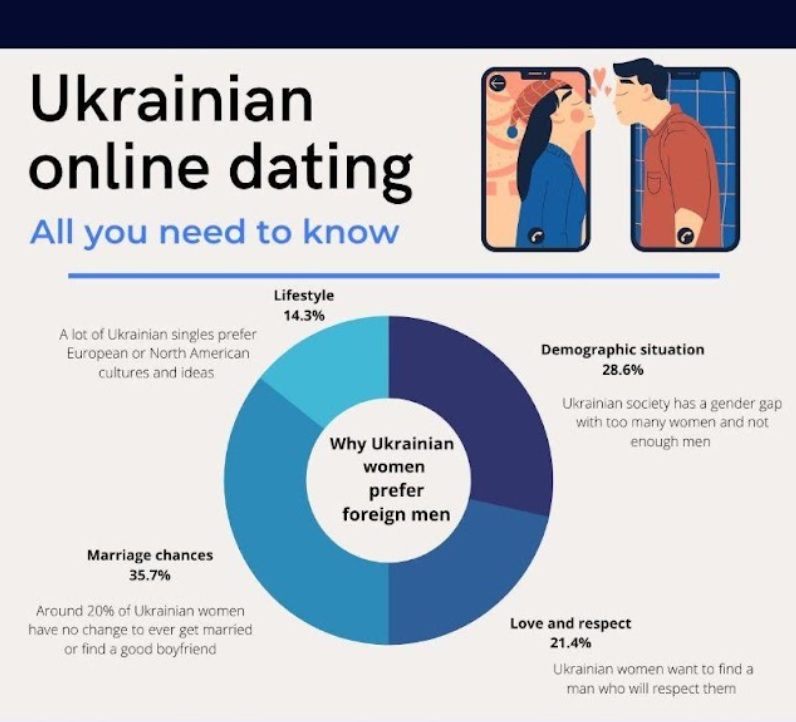
Infographics-prepared-by-ukraine-brides.org_
Infographics prepared by ukraine-brides.org

How to choose the best and safe Ukrainian dating site?

Ukraine is the best country to find a wife, and the range of online dating platforms to attract Ukrainian women is quite extensive, too. But how do you select the best and safest ones? There are 5 key things to consider:

1. Website rating and reviews

Look for the best-rated Ukraine dating sites with a large number of positive user testimonials. Moreover, you should adhere to the opinions of experts who test those services, analyze good and negative aspects, and share their verdicts on specialized platforms. Consider the feedback and date Ukrainian women picking highly praised options!

2. Cost of services

Free dating sites with Ukrainian girls aren’t a rarity, but they can be filled with fraudsters and prankers. Girls looking for real-life experience and partners would skip such sites and try to join more reliable ones, which usually have premium membership.

3. Types of communication tools

The more ways to interact with a Ukrainian woman you have on the website, the better for you. It’s not enough to get only written messages from a girl, you should see her mimics, gestures, behavior as well as hear her voice to get the right impression. Therefore, voice and video calls are a must-have feature for a dating platform.

4. Safety

The most important dating website feature is its reliability and trustworthiness. Undoubtedly, you won’t see labels indicating good and bad platforms. However, a short exploration of the website rules, terms of use, security measures, and privacy policy will hint you at platforms worth your attention.

5. Usability

Other important features of a perfect dating destination are a user-friendly interface, quick registration procedure, ease of use, and clear navigation!

If you see a site that has all these features, you’re lucky to find a decent one!

❤️Join SofiaDate & Get 20 Free Credits After Registration❤️

How to start online dating in Ukraine?

When meeting Ukrainian women in real life isn’t an option, there’s hardly anything better than online dating. It’s enough to take the following steps to become a dater.

  1. Choose one of the best Ukrainian dating sites with a large user database.
  2. Register an account on a site like SofiaDate and complete a questionnaire to get match suggestions.
  3. Fill out more profile details and add at least one photo for your profile to be more attractive and viewed.
  4. Open a search engine and tick those filters that are crucial to be possessed by your girlfriend.
  5. Browse the whole diversity of members and initiate communication with the most liked.
  6. Make interaction with ladies more active to learn them better and see if you have something in common.
  7. Narrow down your circle of communication towards a girl who steals your heart, and do your best to get her love too.

Benefits and potential pitfalls of online dating in Ukraine

There are lots of ways to meet Ukrainian women in the modern world, but the majority of men prefer online dating websites. Why does it happen? Probably because this way of making international connections has a number of unsurpassed pluses:

  • A real opportunity for those interested in dating Ukraine ladies and building a long-lasting relationship;
  • Getting acquainted with Ukrainian girls regardless of distance;
  • You can reach an audience counting thousands of women after a quick registration on Ukrainian dating websites;
  • Getting a glimpse of the girl’s personality prior to socializing with her by opening her profile;
  • Higher chances to meet ladies who correspond with your requirements and ideal image;
  • Ukrainian women online dating is fun due to numerous extra features that may include stickers, emojis, file exchange, virtual gifts, etc;
  • Platforms are equipped with useful tools, like a messenger, mail, and sometimes even video chat;
  • Cost-effectiveness due to fewer expenses than on traditional dates;
  • Full control of the dating pace and development of the relationship;
  • Putting less effort into approaching ladies, which is suitable for shy individuals.

Unfortunately, sometimes Ukrainian women dating can be associated with some drawbacks too. When a foreigner meets Ukrainian ladies online, he may face the following challenges and obstacles:

  • Not all Ukrainian dating sites have downloadable dating apps
  • There’s tough competition for the hearts of Ukrainian ladies
  • Single women from Ukraine may be demanding and make use of potential boyfriends
  • Some international dating sites operating in Ukraine have fake profiles

dating sites operating in Ukraine have fake profiles

How much does it cost to use a Ukrainian dating site?

It’s not a secret that online Ukrainian dating sites are divided into free and paid ones. Many users conclude that only premium membership can minimize these risks and decide to pay for it too. How much, you may wonder? It depends on the type of website you choose.

There are platforms with subscriptions paid regularly and prepaid sites using a pay-as-you-go approach.

The first ones offer daily, weekly, monthly, or even annual subscriptions starting from $1 a day. An average monthly subscription cost ranges from $30 to $50, but if you pay for several months upfront, it can reduce the monthly price too.

The second prepaid system usually offers members to buy credits, tokens, or any other so-called virtual currency and use it for purchases on the site. You can spend credits only when you really need to use a premium feature. Some platforms offer several free bonus tokens for new members to show them how it works, while others offer a discount on the first purchase. The minimum credit packages start from $2,99 and can reach $400 on some sites. The more tokens you buy at once, the lower per credit price you can get.

Which Ukrainian dating site is completely free?

Find Love - Ukrainian Dating Sites

It’s no secret that completely free is usually a synonym for problematic and insecure. There are probably dating sites in Ukraine where you don’t need to pay money, but experts don’t recommend them to get a positive courting experience. These platforms are often flooded with fraudsters and bots who join them intending to make a profit.

It’s important to mention that the majority of Ukrainian dating sites listed above are free to join and use basic features. This allows trying the sites’ functionality and even getting bonus credits for new members that give access to a limited range of premium features too. Therefore, they can be a good alternative to completely free websites and ones with a subscription system.

Tips on how to spot fake profiles and avoid scams

Ukrainian dating sites can’t be called a pool of scammers, but separate examples of such sneaky people manage to squeeze in there, too. Therefore, it’s important to know how you can protect yourself by recognizing fraudsters on Ukrainian women dating sites, and these ideas may be helpful:

  • A profile looks too good to be true with professional photos and very sweet descriptions, or vice versa doesn’t contain much information
  • The information provided in the profile details doesn’t coincide with the answers to the questions asked in the communication
  • You can spot a very quick love confession from a girl you hardly know
  • A woman may ask for sensitive information with unexpected reasons for that
  • You receive requests for money or some expensive gifts accompanied by moving stories
  • A person refuses or finds excuses not to run a video chat

Conclusion

Every woman wants to become a Ukrainian bride, so they treat online dating with great responsibility. Of course, it doesn’t mean that they expect every romance to end in marriage, but they love chatting and respond to most messages on Ukrainian singles dating websites if they’re interested in men. Of course, all of them dream of success stories, so they prefer platforms with Live chat, no ads, and members from around the world. If you want to join a site with more than two users from Ukraine and a quick sign-up procedure when you need only an e-mail, sign up for any platform from these top Ukrainian dating sites and enjoy.

Popular questions about online Ukrainian dating

We have done research and found 5 most popular questions about Ukraine women dating. Find out responses to them right now!

Is online dating in Ukraine safe?

Yes, it is. It’s enough to choose the right dating site that verifies users, has an anti-scam policy, and conducts regular checks of the user database to feel protected and confident.

What is the most popular dating app in Ukraine?

It’s impossible to choose one or two best platforms since there are many trustworthy platforms popular with users. This article contains a list of the most reliable and frequently visited sites with a focus on Ukrainian women. So, check them out!

How much does Ukraine date cost?

Traditional dates in Ukraine costs much cheaper than the ones in the USA or European countries. The main reason for that is lower prices for flowers, entertainment, and meals in this country.

Are there free dating sites to date a Ukraine girl?

Yes, there are. But it’s important to remember that free often means full of scammers and danger. If you don’t want to lose personal details or let someone earn money off you, it’s better to avoid them.

How to avoid scams on Ukraine dating online platforms?

There are several key points to memorize if you don’t want to become a victim of criminals: never send money to ladies, never share personal or financial details, ask direct questions and compare answers to the information in the girl’s profile to spot the lie, and be careful with early love confessions.

How to woo a Ukrainian woman?

Ukrainian women love well-mannered and generous men, so it’s important to give compliments, surprise them with love notes, prepare romantic evenings, and bathe them with attention and care. If you court a local girl on a dating platform, show your serious intentions, impress her with virtual and real gifts, as well as emphasize her benefits in messages.

British Imperialism, Religion, and the Politics of ‘Divide and Rule’ in the Indian-Subcontinent

featured image

By Dr. Kalim Siddiqui

I. Introduction

Recently India’s Prime Minister Mr Narendra Modi again brought the issues of India’s partition and tried to blame it on Muslim League’s leader Muhammad Ali Jinnah and the Indian National Congress (hereafter Congress Party), especially Jawaharlal Nehru. Therefore, it will be interesting to examine this issue based on historical facts. Modi has chosen August 14 as ‘Remembrance Day’, both countries India and Pakistan suffered loss of life. If Modi wants to remember he should remember on occasion to bind people together not blaming only Muslim and thus dividing Indian people, pointing finger about partition at Muslims. Muslim population is nearly 200 million or 15 % of the India’s population.

Some policies recently introduced by the Modi government seem to be the manifestation of a “long term project of the Hindutva movement” which rests largely on the policy of undermining the democratic rights of religious minorities, particularly Muslims, and “suppressing dissent and protest”. (Siddiqui, 2019; also, 2020a) Modi is systematically dismantling India’s plural structure. Life in India has become fearful and intimidating for minorities, as a muscular nationalism is paraded on the streets by self-appointed custodians of a shallow political morality by the semi-fascist forces known as Hindutva.

Modern India came into being and flourished because of the acceptance of the liberal policies of the politician like Jawaharlal Nehru who had a vision of a modern state resting on the principles of democracy, humanism, and pluralistic society. However, such an idea of India which had made this country great is very much at stake under the BJP/RSS government.

The aim of this article is to examine this issue based on historical facts and in the light of recent information and research. Modi had joined the RSS (Rashtriya Sevak Sangh) at a very young age and remained its member all his life. Therefore, it is useful here to briefly discuss about the RSS. The RSS is a Hindu extremist organisation and organises people based on religion. The RSS, whose leaders and members participated in building a hateful environment and during the partition its members were found to be taking part in attacks against Muslims in Delhi, Punjab, and Bengal. (Siddiqui, 2018a; also, 2018b)

I will also discuss here, that during the struggle for India’s freedom, then the question was after independence is attained, what type of country in the future, these political leaders would like to see. I mean to say whether they would like to make India a modern democratic state based on equal rights for all its citizens before the law, and with respect for diversity and pluralism, or a theocratic Hindu state i.e., ‘Hindu Rastra’.

The RSS, whose leaders and members participated in building a hateful environment and during the partition its members were found to be taking part in attacks against Muslims in Delhi, Punjab, and Bengal.

During the struggle for independence, an intense battle of visions on what ought to be the character of a future free India, and its state structure. A continuous battle between two visions emerged on what must be the political, social, economic, cultural character of the independent state of India. Recognising the Indian reality of rich plurality and diversity, the Congress Party concluded that the unity of India can be consolidated only when the threads of commonality amongst this rich diversity are strengthened and every aspect of plurality such as religious, ethnic, linguistic, and cultural is respected on the basis of equality. On the contrary, the RSS narrative is based on many distortions of history and assertions that are unhistorical and unscientific. The RSS and the Hindu Mahasabha stayed away from the freedom struggle, while focusing on engineering communal conflicts and riots.

The RSS idea of India constitutes a regression away from realizing the ‘Idea of India’ as inclusive nationalism. At present, what is being promoted under the BJP/RSS government is an exclusive Hindutva nationalism to establish their fascistic state i.e. ‘Hindu Rashtra’.

Antonio Gramsci, the Italian Marxist Philosopher, explains how the hegemony of the ruling ideas is not enforced merely by the state and its institutions. The state is only the ‘outer ditch’ behind which stands a powerful system of ‘fortresses and earthworks’ and a network of cultural institutions and values which buttress the domination of the ruling classes with their ideas. This hegemony is mediated and transmitted through a complex web of social relations and the consequent social structures. The family, the schools, the community, caste, ethnicity, religion, its places of worship and its festivals, various forms of cultural expressions like media, TV, theatres, films etc. are the modes that constantly feed the fodder to shape values and opinions. At present in India they are fostering the Hindutva hegemony of ‘ideas’. In the process, they create the ‘myth’ of a ‘common culture’. This ‘common culture’ is nothing but the selective transmission of Hindutva.

This article also explores different dimensions of the ‘divide and rule’ policy, and the use of religion and its practicality in the politics of British India. It is argued that Britain had governed India through ‘divide and rule’ policy and by creating division between Hindus and Muslims. Such policy weakened the opposition against foreign rule. And the Congress Party was unable to challenge this strategy and prevent the nourishment of communalism in the Indian Subcontinent. Here communalism means the division between Hindu and Muslim communities. This article seeks to investigate, the British colonial policy to create rift among the communities to justify their rule in the name of peace or law and order in the region under their possession.

Soon after crushing first India’s independence war in 1857, the British imperialists began to encourage division of India based on religion, and they thought by adopting such a strategy will strengthen and prolong their colonial rule in India. Communal politics was encouraged by the British as their excuse to rule colonies was coming under attack by liberals and others.

Since 1833, Britain’s imperialist policy of ‘Great Game’ always focused on the so-called ‘Russian threat to South Asia’ and denying Russia access to warm water. This policy became more important after the Bolshevik Revolution in Russia in 1917. Britain thought the division of India by creating a small state in the North-West will benefit British imperial interests to undermine communism and to control the Soviet Union. And they saw that after the independence, the small state of Pakistan would always be dependent on the West for its survival. And exactly this is what had happened in the last seven decades after independence and Pakistan became the frontline state for the West to fight against the Soviet Union after the 1979 invasion of Afghanistan.

Although Britain won World War II, its economy was weak and the country was heavily indebted to the US. The US wanted to see India as an independent nation. And prior to 1939 British ignored Muslim League but after that British used Muslim League against Congress Party.

It is argued that Britain had governed India through ‘divide and rule’ policy and by creating division between Hindus and Muslims.

In August 1947, as India gained independence in an atmosphere rife with communalism, Punjab witnessed the bloodletting of Partition on a scale never seen before. Around one million people were killed and over ten million crossed the border – Muslims from East Punjab (in India) to West Punjab (in Pakistan), and Hindus and Sikhs from Pakistan to India. Such was the level of communal savagery that there was a near-total cleansing of minorities on both sides of divided Punjab. Even the Indian army, the Baloch, Dogra, and Sikh regiments, not only provoked violence but also got actively involved in the killings and lootings. Similarly, the civil and police administration was openly divided along religious lines and failed miserably to protect millions of innocent people who were desperately seeking safety of their families. However, the situation in Punjab was more complex. As eminent historian Sugata Bose points out in his book published in 2017, The Nation as Mother and Other Visions of Nationhood, the “British colonial scheme of enumeration of religious communities in India and the privileging of religious distinction in defining majorities and minorities for political representation triggered acrid communitarian discourses among those seeking the state’s differential patronage. Punjab with competitive religious landscape was worse affected in the 19th century as it gave rise to politics of communitarian bigotry”.

I would like briefly to emphasise the detrimental effects of colonialism on the economic and social conditions of India. The development of the advanced capitalist countries was inter-linked with the underdevelopment of colonial countries, which continued even after they have nominally become independent. For instance, the Indian economy accounted for about 25 % of global manufactures in 1750, but by 1913 this declined drastically to a mere 1.3 %. During the same period, the output of developed countries went up from 26 % to 92.5 %. (Tharoor, 2017; Siddiqui, 1990b) The colonisers justified their ruthless exploitation by claiming to civilise “uncivilised” peoples and this ‘civilising’ mission was on the grounds of European racial superiority.

Colonialism provided Britain with an ideal instrument for controlling land use in India for its own benefit. For example, during the British rule, the revenue demands of the colonial government had to be met by the peasants by certain fixed dates and failing to do those peasants lost all land rights they had. As a result, they took advance money from merchants and traders to meet these demands. Then they were forced to cultivate the crops that the merchants wanted and sold to them at pre-contracted prices. These merchants in turn dictated the cultivation of specific crops, which had been demanded by the markets. For instance, we find peasants were given money in advance which was tied to cultivating opium. This is how the land use was controlled by the British colonial government to cultivate commercial crops like cotton, opium, and indigo, on lands where these crops had never been cultivated before. (Siddiqui, 2020c) The rise in commercialisation in agriculture coincided with the increase in peasants’ indebtedness, and as result, private money lending became a very profitable business. Such development contributed to falling in the land available for the production of food grains and resulted in occurrences of repeated famines during the British rule in India. (Siddiqui, 2020b)

There seems to be similarity of interpretations of Indian history between the “colonial” and “religious/communal” organisations. British colonialism viewed the Indian people as “always divided on the basis of ‘primordial identities’ of religion and caste and these identities were seen as subsuming all other identities or interests, economic, political, social or cultural”. (Siddiqui, 2017a) This view became deeply embedded in the ideology and politics of the RSS and the Hindu Mahasabha. Not surprisingly, therefore, the role of these organisations during the anti-colonial struggle showed a distinct propensity to adjust with and oblige the British colonial rulers but never to accommodate or ally with the Muslim “other”. However, in the pre-colonial period, there was no incidence of violence between Hindus and Muslims and both communities lived peacefully. (Siddiqui, 2017b)

II. Utilitarianism

After colonising Bengal in 1757, the British began to colonising people minds in India and began to downgrade its culture and history. In fact, the Britain initially justified colonies by saying that these countries needed modernisation, improving living conditions and economic development i.e., ‘white man’s burden’ as propagated by the utilitarian theorists to modernise colonies. To justify British rule in India, they initially claimed that India was a backward country and hence, their rule would modernise and establish democracy in India.
Utilitarianism

The utilitarian holds that we should give equal moral consideration to the wellbeing of all individuals, regardless of characteristics such as their gender, race, and nationality. The original and most influential version of utilitarianism is classical utilitarianism, first expressed in the writings of Jeremy Bentham and J.S. Mill. Mill worked as an administrator with the British East India Company and his justification for British rule in India is well known. According to him, India was a backward country and had unacceptable culture, as various superstitious beliefs prevailing in the country and therefore, Britain had a civilising mission in India, which will ultimately transform India into a modern and prosperous nation. To communalise Indian history, he divided Indian history into three periods – Hindu rule, Muslim rule and British rule. He identifies pre-existing ethno-religious divisions in society and then manipulates them to prevent peoples’ unified challenge to rule by outsiders. Both communal conflict and Muslim separatism are seen as being created by such a strategy.

These utilitarian theorists’ argument of modernising of India had been criticised by the Dadabhai Naoroji, and he exposed the exploitation of India by the Britain. Naoroji emphasised that the development in the colonies is not possible under colonial rule. At the same time, other major European powers also began to industrialise, and they also needed raw materials and new markets for their finished products and thus, the demand for colonies was growing.

Dadabhai Naoroji (1825-1917) was an Indian scholar and politician, who was also the founding member of the Indian National Congress (hereafter Congress Party). He put forward the ‘drain of wealth’ theory where he argued that the Britain was draining India’s wealthand as a result, the resources were not available to Indian people. He showed in detail how the British colonial rulers in India pillaged India’s resources and destroyed its traditional handicraft industries. He explained his arguments in detail in his book published in 1901 Poverty of Un-British Rule in India. Naoroji’s lasting intellectual contribution was to expound on the ‘Drain Theory’. Naoroji was the first Indian Member of Parliament in the Britain’s House of Commons from 1892-1895, represented the Finsbury constituency in London. Prior to the occupation of Bengal, for instance, the East India Company used to bring gold into India to buy Indian cotton, spices, and silk. However, after the conquest of Bengal, the British stopped getting gold into India. They began to purchase raw materials for their industries in England from the revenues (tribute) of Bengal. Thus, began the process of plundering India’s raw material, resources, and wealth to England. (Siddiqui, 2018c)

Shashi Tharoor (2017) provides us with a devastating portrait of how the British decimated the Indian economy through these two centuries. In 1707, India was the world’s richest country, accounting for some 27% of global GDP. But in 1947, when India achieved its independence, India had been reduced to one of the world’s poorest countries, with just over 3% of global GDP. American historian and philosopher, Will Durant, who visited India in 1930, wrote: “The British conquest of India was the invasion and destruction of a high civilisation by a trading company utterly without scruple or principle, careless of art and greedy of gain, over-running with fire and sword a country temporarily disordered and helpless, bribing and murdering, annexing and stealing, and beginning that career of illegal and ‘legal’ plunder which has now gone on ruthlessly for one hundred and seventy-three years.”

In addition to decimating the Indian economy, the British inflicted massive suffering on the Indian people. It is now estimated that nearly 70 million Indians died because of the British government policy of non-interference during the famines. (Siddiqui, 2020c; Davis, 2001) The Bengal famine of 1944 killed of nearly 4 million people, as Churchill ordered to ship food grains from Bengal to Britain to keep reserve stocks for British soldiers in Europe while people in Bengal province were starving to death. When apprised of the consequences of his actions, Churchill retorted: “Why hasn’t Gandhi died yet?” Tharoor notes: “in almost all respects British rule in India was profoundly damaging to the subcontinent’s population and economy […] the British state in India was […] a totally amoral, rapacious imperialist machine bent on the subjugation of Indians for the purpose of profit, not merely a neutrally efficient system indifferent to human rights. And its subjugation resulted in the expropriation of Indian wealth to Britain, draining the society of the resources that would normally have propelled its natural growth and economic development.” (Tharoor, 2017: 222)

The British East India Company exported opium to China, and in due course fought the opium wars and it seized an offshore base in Hong Kong to protect its profitable monopoly in narcotics (Siddiqui, 2020c). As Dalrymple (2015) notes: “By 1803 when the company captured the Mughal capital of Delhi, it had trained up a private a security force of around 260,000 – twice the size of the British army – and marshalled more firepower than any nation-state in Asia. …the company’s share price had doubled overnight after it acquired the wealth of the treasury of Bengal, the East India bubble burst after plunder and famine in Bengal led to massive shortfalls in expected land revenues. …The East India Company remains history’s most terrifying warning about the potential for the abuse of corporate power – and the insidious means by which the interests of shareholders become those of the state.”

The British East India Company exported opium to China, and in due course fought the opium wars and it seized an offshore base in Hong Kong to protect its profitable monopoly in narcotics (Siddiqui, 2020c).

There was a unilateral transfer of resources from India to Britain of surplus and potential investable capital by the colonial administration and foreign merchants through excess of exports over imports. It has been estimated that annually 6-7% of the total national income of India was unilaterally taken out of the country. India’s economic policies were determined in Britain and in the interest of British industries and merchants. British colonialism became a fetter on India’s agricultural and industrial development. Agriculture stagnated over the years, resulting in declining yields per acre. For example, there was a decline in per capita agricultural production, which fell by 14% between 1900 and 1945. The fall in per capita food grains was even greater i.e., over 24% during the same period. And the agrarian structure was dominated by absentee landowners, merchants, moneylenders, and landlords. As a result, India during the colonial period, witnessed underdevelopment and its industry and agriculture were denied any state support. Contrary to this, nearly all capitalist countries including Britain, France, Germany, the US, and Japan enjoyed active state support in their early stages of industrialization. The colonial administration refused to give tariff protection to Indian handicrafts and industries as Britain, the US, and other west European countries, including Japan had done. (Siddiqui, 1990b)

III. The ‘Divide and Rule’ Policy

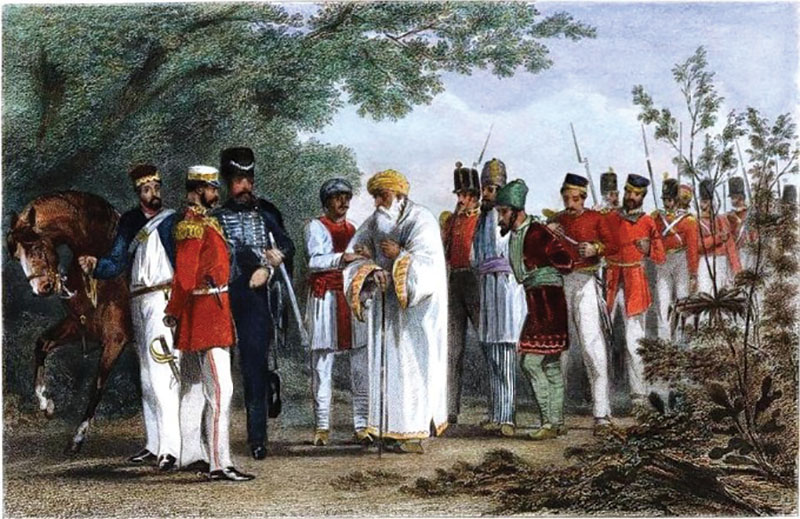
The Indian Mutiny (also known as the First War of Independence) of 1857 forced Britain to transform its policy on India. It meant greater reliance on Indian princes as the bulwark of the British interests against the growing Indian nationalism. The British ruler’s policy towards the Indian people and army meant an emphasis on differences on religion and caste in order to prevent any attack against colonisers. It was realised that as Sir John Strachey noted: “the existence side by side of the hostile creeds is one of the strongest points in our political position.” (Sir John Strachey, 1888, pp.225)

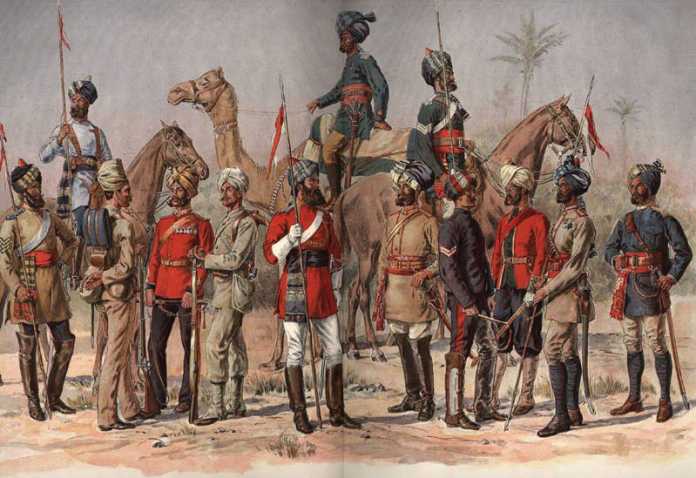
Soon after the 1857 mutiny, the Peel Commission Report (1859) on organisation of the Indian army noted that Indian army could not be abolished because it was not possible to raise such a huge army of entirely British white troops, due to the difficult tropical climate and the cost of white soldier was eight times more than the Indian one. Mixing Indian soldiers with white soldiers was seen to be difficult in regiments to maintain a strict control over the non-white soldiers (known as sepoys). As General Sir Patrick Grant noted: “My opinion is strongly averse to the permanent association in quarters of the natives with Europeans…. a close and intimate association of the natives with the European soldiery … should be avoided as much as possible; the closer the association with the lower classes of our countrymen, the less is inspired by the latter; the closer association with the officer and educated Englishmen, on the contrary, the greater is the respect received.” (Parliamentary Papers, House of Commons, 1859, Appendix, 60)

Roman Empire’s ‘Divide et impera’ was adopted by the British colonisers in India. As the Peel Commission Report advocated that the army in Punjab and other states should be composed of different religions, ethnicity, and castes. Regiments composed of one caste and religion and over the following years the “general mixture” policy was eliminated throughout the army and regiments based on castes and religion was introduced. This system was similar to the separate, communal electoral system in political life, which served the same purpose of dividing the Indian people against each other. The Indian army remained in the hands of the British officers (i.e., white), while the soldiers remained non-whites.

Indian history was rewritten by the colonial rulers. For instance, J.S. Mill divided Indian history as Hindu and Muslim period. According to his interpretations, Indian people have no class consciousness and uncivilised people. After 1857, Britain saw Muslims as a threat to their rule and began to suppress them. But as opposition to British rule increased, they changed their policy and began to woo Muslim leaders by rewarding them if they organise and demand their rights as a religious community. Special favours were extended to Hindu communalists as well. Hindu-Muslim unity was seen as a threat to British rule in India and religious tension between these two communities was seen as best policy tool to justify and prolong British rule in India. During the colonial period, these communal parties were seen strong allies, who focused their energies against each other.

In 1906 Lord Minto, the British Viceroy of India (1905-1910) invited a meeting of Indian Muslim elites and big landlords to Shimla. Afterword, Mohsin al-Mulk had convened a deputation of some 36 Muslim leaders, under the leadership of Aga Khan III, to discuss the British offer of safeguarding the interests of the Muslim community. Encouraged by the concession, the Aga Khan said during the first meeting of the Muslim League in 1906 at Dacca: “to protect and advance the political rights and interests of Muslims of India.” Other resolutions moved at the meeting expressed: “loyalty to the British government,” and support for Bengal partition. Although these elites were not elected by the people but were chosen as Muslim representatives by Lord Minto to protect the British interests in India. After the meeting, Lady Minto wrote a letter British Foreign Secretary that ‘our policy of dividing the Indian community on religious and caste basis will prolong and strengthen our rule in India’. These elites were encouraged to speak about separate electorate for the Muslims. Thereafter, Morley-Minto Reforms was enacted in 1909 and then the colonial administration was encouraged to have more contact with the people. Muslims were granted separate electorates. The Congress Party opposed the introduction of separate Muslim electorates.

Another factor in Britain is a continued failure to come to terms with its colonial history. For centuries the interests of the nation have been conflated with the interest of the rich, while the interests of the rich depended to a remarkable degree on colonial loot and the military adventures that supplied it. In Britain, supporting overseas wars, however, disastrous, became a patriotic duty.

Hindu-Muslim unity was seen as a threat to British rule in India and religious tension between these two communities was seen as best policy tool to justify and prolong British rule in India. During the colonial period, these communal parties were seen strong allies, who focused their energies against each other.

The US historian, Audrey Truschke has criticised colonial historiography and, in her book, published in 2018, Aurangzeb: The man and the myth, has given new insight on this issue. Most of the early historians on Mughal history are dominated by what is best described as the “bad Aurangzeb’’, which was promoted by British historians in the 19th century. According to this theory, Aurangzeb, who ruled India from 1658 to 1707, is seen as a fanatical Muslim who through his bigoted policies brought about the downfall of the Mughal Empire. This very simplistic understanding of Mughal politics and its decline was first put forward by the historian Jadunath Sarkar. In fact, Aurangzeb came to the throne after a bloody civil war, killing his brothers and imprisoning his father. He was a fine soldier and strategist, an expansionist who pushed the borders of the Mughal Empire in his nearly 50 years reign. Professor Habib (2016), an authority on the history of the Mughals, wrote: “We must remember the Mughal Empire attained its largest extent under Aurangzeb, the whole of pre-1947 India, except for Kerala and parts of the Northeast. This strengthened the popular consciousness of India as a country since political unity was now added to the pre-existing cultural unity – a consciousness so strongly displayed in 1857. Also, if you begin examining such things (as cruelty), who will escape? All our ancient rulers believed in the caste system. And if you look at Buddhist tradition, Ashoka is said to have murdered his brothers too”.

Professor Satish Chandra, a prominent Indian historian, wrote in Seminar magazine in 1989 titled ‘Reassessing Aurangzebʼ that the re-imposition of jiziya was both a political and an ideological move. “It was ideological in the sense that it marked out Aurangzeb as an orthodox Muslim king. It rallied the clergy to his side by providing them jobs as amins (revenue collectors) of jiziya… Politically, Aurangzeb hoped that this would help in rallying Muslim opinion behind him, not only in his conflicts with the Rajputs and Marathas, but even more in his looming conflict with the Muslim kingdoms of the Deccan.” Professor Chandra (1989) further noted: “Aurangzeb levied jiziya in 1679, a good two decades after he came to power. There is an argument that he was forced by a financial squeeze the sprawling empire was facing.” Manucci, the Italian traveller, held the view that the motive to impose jiziya was to replenish the imperial treasury. Despite the tax being very regressive in nature, there is no evidence of its imposition leading to conversions. Aurangzeb no doubt departed from the policies of preceding Mughal rulers and, regarding the imposition of the jiziya, there was a serious protest at the court led by no less than Jahan Ara, Aurangzeb’s eldest sister, and many nobles.” Emperor Aurangzeb also had the support of many Rajput nobles, and many Hindus worked for the Empire. “Major figures in the Rajput nobility aligned with Aurangzeb and not with the liberal Dara Shikoh. Mirza Raja Jai Singh and Jaswant Singh were the most trusted, highest-ranking nobles”. Professor Athar Ali’s (1966) study reveals that ‘non-Muslims in the nobility, in absolute numbers as well as in terms of proportion, instead of declining, rose from about 22 % in 1658-78 to 31.6 % during 1679-1701.’

IV. Struggle for Freedom and Independence

Jawaharlal Nehru was a Fabian socialist, educated at Trinity College, Cambridge and was drawn into the Congress Party and the non-cooperation movement by his admiration for Mahatma Gandhi. Nehru aimed to build modern India to scientific development with pluralist ethos under the framework of democracy, and respect for religious, linguistic, and cultural diversities. However, in the 1920s equal rights for all Indian citizens were challenged by the Hindu extremist parties and communal organisations. For them the idea of secular forward-looking India was anathema, which organised people based on religion and conceived Hindu and Muslim as two different communities and constituted two nations. (Habib, 2016)

However, within the Congress Party, some leaders like Pandit Madan Mohan Malviya, Govind Ballabh Pant, and others who were well known for their anti-Muslim prejudices and some of them were members of both Hindu Mahasabha (a Hindu extremist organisation) and alsothe Congress Party.

The Congress Party clearly saw then the major contradictions between British imperialism and Indian people and between big landowners and peasantry. In contrast to this, the Muslim League Party, which was led by Muhammad Ali Jinnah, saw the major contradictions between Hindus and Muslims.

There was a consensus in the Congress Party to build a progressive, secular, and modern India, which was questioned by the RSS and the Hindu Mahasabha. Soon after independence, the constitution of the Indian republic came into force on 26th January 1950, but the Republic’s constitution was rejected by the Hindu extremist leaders such as Golwalkar and Savarkar. Both organizations came out in favour of the Manusmriti (i.e., the Hindu religious holy scripts), and argued that Manusmriti must be India’s constitution. They saw it as an important holy book to maintain male and upper castes’ domination while keeping the women, and low castes under subjugation.

Mahatma Gandhi and Jawaharlal Nehru played an important role in the effort to build a modern independent and secular nation. Nehru admired science as a great force in the modern age. While at the opening of the science institute, he spoke: “most people, who talk glibly of science, including or great industrialists, think of science merely as a kind of handmaiden to make their work easier… Of course, it does make their work easier… But surely science is something more than that. The history of science shows that it does not simply better the old. It something upsets the old.” (Cited in Habib, 2016: 31) His scientific understanding began in 1906 at Harrow and soon after he took science at Trinity College, Cambridge. Bhagat Singh, an Indian revolutionary had an appreciation for Nehru’s progressive and scientific ideas and in 1928 he wrote in his famous essay, Why I am an Atheist? “Any man who stands for progress must criticise, disbelieve and challenge… mere faith and blind faith is dangerous. It dulls the brain and makes a man reactionary.” Due to Jawaharlal Nehru’s rational, democratic, and scientific vision, Bhagat Singh supported Jawaharlal Nehru in India’s independent movement and endorsed Nehru, not Bose, as a progressive leader favouring of democracy and democratic socialism.

Mahatma Gandhi and Jawaharlal Nehru played an important role in the effort to build a modern independent and secular nation. Nehru admired science as a great force in the modern age.

In 1937, Jawaharlal Nehru was given the task to lead ‘National Planning Commission’ to prepare for science and technology for national development. He wrote: “Our plan for national development must, therefore, be drawn up for a free and independent India. This does not mean that we must wait for independence before doing anything towards the development of a planned economy… All such efforts, however, must be directed towards the realisation of the plan we have drawn up for a free India.” (Cited in Habib, 2016: 31) As a historian, Jawaharlal Nehru authored three famous books namely, Glimpses of World History, Discovery of India, and Autobiography. In Nehru’s own words, religion was too “narrow and intolerant of other opinions and ideas; it is self-centred and egoistic” (An Autobiography; 1971, Allied Publishers, New Delhi). He insisted that religion “does not help, and even hinders, the moral and spiritual progress of a people” (page 378). He further wrote that, “The spectacle of what is called religion not only in India and elsewhere, has filled me with horror” (page 373). The ‘western model’ of secularism maintains an antiseptic distance from God and faith, which emerged only after several centuries of conflict between the Church and the State. In fact, it arose from its bloody wars with a terribly dominating Church that had stifled rationality, science and progress. (Nehru, 1971)

It is well known that Jawaharlal Nehru was extremely impatient with religion. However, his biographer Professor S. Gopal emphasises that Nehru was to change his mind after the communal fury that accompanied the Partition of India. He cites a letter in which Nehru expressed discomfort with the role played by religion in collective life. Nehru would have preferred to see religion vanish from the public sphere. But he had to change his attitude to the role of religion in public life in the aftermath of Partition. In a convocation address to the Aligarh Muslim University on January 24, 1948, Nehru said, “do we believe in a national state, which includes people of all religions and shades of opinion and is essentially secular as a State, or do we believe in the religious theocratic conception of a State that considers people of other faiths as something beyond the pale?…[t]he idea of religious or a theocratic State was given up by the world some centuries ago and it has no place in the mind of a modern man. And yet the question must be put in India today, for some of us, have tried to jump back to a past age”. In pursuance of these objectives, Pandit Nehru further said: “[t]he government of a country like India, with many religions that have secured great and devoted following for generations, can never function satisfactorily in the modern age except on a secular basis.”
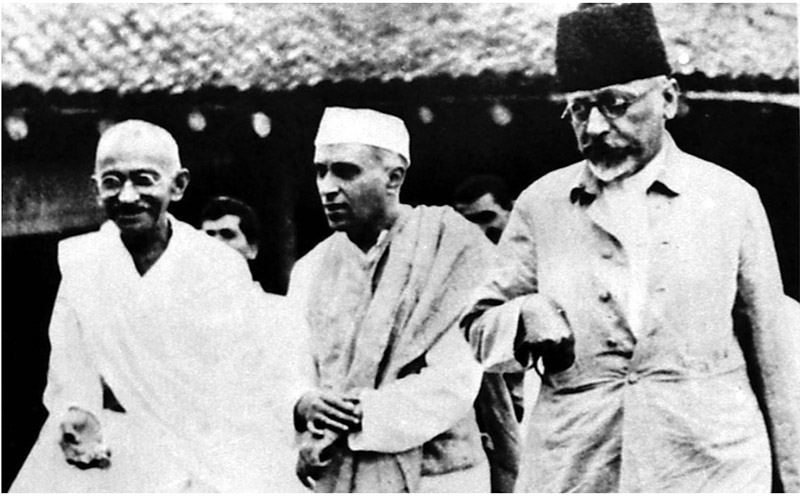
Mahatma

Jinnah and Mahatma Gandhi

In fact, Jawaharlal Nehru was not responsible for the division of India. Mahatma Gandhi choose Jawaharlal Nehru rather than Sardar Patel because Nehru soon after entering Indian freedom movements defended progressive policies, especially in the 1920s openly sided with the global struggle against colonialism and imperialism. He advocated in favour of land reforms and industrialisation and the active role of the state in building the nation. During the partition, he stood very clearly for Hindu-Muslim unity, and he mobilised people in favour of secular India and appealed to stay calm during India’s partition and communal violence, while Sardar Patel did have some prejudices against Muslims which was well known. Therefore, Gandhi decision to favour Jawaharlal Nehru was based on what type of India’s future he had in mind. During the partition communal riots began in North India and Mahatma Gandhi rather than celebrating independence, went to villages and campaigned for restoring peace and stood in support of Hindu-Muslim unity, which he saw as the soul of India. He said, ‘if India’s soul is lost no use for independence.’

However, there are widespread misunderstandings about Sardar Patel and sometime is seen as critical of Jawaharlal Nehru’s policies. There was no doubt that Patel was leader of the right wing, while Nehru was leader of the left-wing section of the Congress Party. But both fully-shared the key objectives of the national movement: commitment to secularism, democracy, equal rights to all citizens, independent economic development, and national planning. Sardar Patel stood for abolition of feudalism, and land reforms to reduce rural inequality. Patel said in 1950: “Ours [India] is a secular state…. Here every Muslim should feel that he is an Indian citizen and has equal rights as an Indian citizen. If we cannot make him feel like this, we shall not be worthy of our heritage and of our country.”

Mahatma Gandhi’s idea of nation building was a difficult and long process. It seems that Mahatma Gandhi support for Jawaharlal Nehru to become India’s first Prime Minister was a very wise decision. Gandhi favoured Nehru to lead India was a well-thought the decision, which proved crucial during the difficult period of a building nation as a modern secular and democratic nation. Jawaharlal Nehru was a firm believer in secularism and modernisation and was more broadminded on religious issues than other Indian Congress Party leaders during that period. Mahatma Gandhi and Jawaharlal Nehru strongly stood for Hindu-Muslim unity by their action and statements.

Maulana Abul Kalam Azad was very prominent Islamic scholar and began to support the freedom struggle at a quite young age and he launched an Urdu weekly newspaper in 1912 called Al-Hilal. After Al-Hilal was banned by the colonial authorities in 1915, he started another newspaper called Al-Balag. The main purpose of the newspaper was to criticize British colonial policy and extended support to the cause of Hindu-Muslim unity. The paper quickly became highly popular among the in the Muslims for its anti-British stance, notably for its criticism of those Muslim elites who were loyal to the British Empire. He devoted all his life to the struggle against colonial rule and in favour of Hindu-Muslim unity. He was bitterly opposed to the creation of any country based on religion, which he predicted would be very weak and could be controlled by the British imperialists for their own narrow interests. If created, such a state would serve the interests of feudal and elites and would be prone to ethnic conflicts. Azad wrote several books on Islam and politics.

Maulana Abul Kalam Azad was one of the prominent leaders of India’s independence movement and he was also a strong believer in diversity and unity among the people of India. Maulana Azad said that for him Hindu-Muslim unity is more important than achieving independence from the British colonial rule. According to him, British rule will end sooner or later, most importantly due to changes in the international situation, but if Hindu-Muslim unity is not achieved that would undermine the cause of humanity and peace andwould have a long-term adverse impact on the Indian sub-continent. (Azad, 1988)

Maulana Abul Kalam Azad and Mahatma Gandhi became close politically when Mahatma Gandhi extended support to Khilafat Movement (1920-24). Azad was also involved in Mahatma Gandhi’s various civil-disobedience campaigns, including the ‘Salt March’ in 1930. He was imprisoned several times between 1920 and 1945, including for his participation in the anti-British ‘Quit India’ campaign during the World War II. Maulana Azad was president of the Congress Party in 1923 and again in 1940-1946, although the Congress Party was largely inactive during much of his second term, since nearly all its leadership was in prison. He strongly opposed the partition of British India into India and Pakistan. (Azad, 1988)

Muhammad Ali Jinnah joined Indian National Congress in 1909 and was seen as an important leader of the Hindu-Muslim unity, but his approach was for a long-time constitutional struggle rather than turning independent movement into mass movements. He opposed the partition of Bengal in 1905in the name of religion by the colonial authorities. Mahatma Gandhi began a mass struggle against British rule in the early 1920s by supporting the Khilafat movement and supporting peasants’ Champaran struggle against colonial policy of indigo production. Muhammad Ali Jinnah opposed it and then briefly withdrew from politics and returned to England. While other prominent Muslim leaders such as Hasrat Mohani who participated in the struggle for Indian Independence and extended full support to Mahatma Gandhi’s mass struggle. He was the first person who demanded ‘Complete Independence’ in 1921.But at the same time the Hindu extremists within the Congress Party, although in minority, often spoke against the Muslim minority about the issues such as banning cow slaughter and against the promotion of the Urdu language.

During the first quarter of the 20thcentury, leaders like Badruddin Tayabji, Hakim Ajmal Khan, Maulana Shibli Noumani, and Rahimtulla M. Sayani helped to shape the Congress Party politics in its early days. However, when Pakistan came into existence in 1947, many people crossed over borders, but a far greater number of Muslims chose to remain in India for various reasons, including the fact that they preferred to live in a democratic and pluralistic India than a nation-state based on religious identity.

However, the Muslim League leaders envisaged that after the British leave India, the Hindu majority will undermine the interests of the Muslim minority. Jinnah joined Muslim League in 1913, and then members of the Congress Party were allowed to keep the membership of either Hindu Mahasabha or Muslim League.

The fact of the matter is that when the Muhammad Ali Jinnah-led Muslim League raised the demand for Pakistan in 1940, it met with vehement ideological opposition from Maulana Abul Kalam Azad representing the Congress Party, among others. The role of the ulema[Islamic scholars],such as Maulana Ubaidullah Sindhi and Mahmud-al-Hasan, the principal of Darul Uloom Deoband, in seeking Azadi[struggle for independence] for India from Britain by forging an international alliance in the 1910s is well documented in the Silk Letter Movement.

Mahatma Gandhi began a mass struggle against British rule in the early 1920s by supporting the Khilafat movement and supporting peasants’ Champaran struggle against colonial policy of indigo production.

Muhammad Ali Jinnah’s demand for partition of India was also opposed by another prominent leader from the Muslim majority province Sindh, namely Allah Bakhsh, who led the ‘Itihad Party’ (Unity Party), extended support to Mahatma Gandhi’s ‘Quit India’ movement of 1942. He was bitterly opposed to the Muslim League in the Muslim majority province of Sind, but tragically he was murdered on May 14, 1943, in Sind. He had huge followings among Muslim masses beyond Sindh. Moreover, Allah Bakhsh was a great secularist and his opposition to the partition of India proved to be the greatest stumbling block in the formation of Pakistan. Allah Bakhsh spent all his life countering the communal politics of the Muslim League and its two-nation theory. His great contribution was to organise poor sections of the Muslim community against partition. He organised a conference in Delhi on 27th – 30thApril 1940 to counteract Muslim League’s demand for Pakistan, which was attended by delegates from all provinces. The conference passed a resolution that the partition plan was, “impracticable and harmful to the country’s interest generally, and of Muslims in particular.” The conference called upon Muslims of India, “to own equal responsibilities with other Indians for striving and making sacrifices to achieve the country’s independence.” He was bitterly opposed by the Muslim elites and big landlords. (Ahmed, 2020)

During the concluding stage in the struggle for independence, two trends were personified by two political leaders: Muhammad Ali Jinnah, who led the Muslim League and supported the partition of India, while Abul Kalam Azad, an outstanding Islamic scholar, and leader of the Congress Party, stood for Hindu-Muslim unity. Maulana Azad was dissatisfied with the traditional interpretation of the Quran, and he looked for new ideas by reviving what he considered the original teaching. First in his newspaper’s articles and letters, and later in his translation of the Quran into Urdu and his commentaries, he also considered the social aspect of mercy and maintained that the Quran did not isolate the notion of mercy from that of justice. Maulana Azad was one of the front-ranking leaders of the freedom struggle and as an Islamic scholar and a prominent Congress Party leader; he always firmly stood for the cause of Hindu-Muslim unity.

The deep irony of Indian history is that the two leading figures of the religious nationalism, namely Muhammad Ali Jinnah and V.D. Savarkar – were socially and culturally very liberal and were non-believers. For example, Professor Ashis Nandy (2010) on Savarkar’s paradoxical relationship with religion wrote: “Savarkar’s atheism was not the philosophical atheism associated with Buddhism and Vedanta, but the anti-clerical, hard atheism of fin-de-siècle scientism, increasingly popular among sections of the European middle class and, through cultural osmosis, in parts of modern India.”

Muhammad Ali Jinnah was educated as a barrister in England and had impeccable liberal credentials in the early years of India’s independent movement. The Congress Party leader, Gokhale called Jinnah the “best ambassador of Hindu-Muslim unity”. Professor Ayesha Jalal in her book, The Sole Spokesman (1985) writes that in the wake of the Khilafat movement in 1920, Jinnah “derided the false and dangerous religious frenzy which had confused Indian politics, and the zealots, both Hindu and Muslim, who were harming the national cause”. But that did not stop him from using religion to advocate Muslim separatism. As Nandy points out, “Jinnah kept the ulema [Islamic scholars] at a distance throughout his life but was perfectly willing to use them to advance the cause of a separate homeland for South Asian Muslims. Exactly as Savarkar, despite all his anti-Muslim rhetoric and passion for united India, not only established coalitions in Sindh and Bengal with the Muslim League, fighting for Pakistan, but was proud of these alliances.” However, a year later, after Pakistan was created, Jinnah in his famous speech in the Constituent Assembly on August 11, 1947, where he spoke of a secular and inclusive Pakistan, Jinnah tried to put the religious genie back in the bottle. However, the damage had already been done.

In fact, after 1937, the demand for a separate state for Muslims began to be more forceful and Hindu-Muslim differences became more prominent in Muslim League’s meetings than land ownership, land reforms, and rural inequality or class differences. Hindu communalists, most of them were organised under the Hindu Mahasabha and the RSS, but a small minority of them were remained inside the Congress Party, especially Pandit Madan Mohan Malviya, Govind Vallabh Pant, and others. These right-wing Hindu leaders raised issues like the ‘protection of cows’ and the promotion of the Hindi language after India gains independence. This was seen as a threat by the Muslim League leaders.

Muhammad Ali Jinnah was an elitist to the core, and he was opposed to taking politics to the street. This explains in substantial parts of his disillusionment with the Congress Party once Mahatma Gandhi became the undisputed leader of the party and adopted the strategy of mass mobilization. Moreover, the refusal of the Congress Party to accept the Muslim League as a partner in the UP government after the 1937 elections, which was the turning point that led to Jinnah’s move towards the demand for a separate state for Muslims. Jinnah besides being a very successful barrister was also a great tactician. However, history shows that he had little or no long-term strategy or vision for the new state. He worked tirelessly to achieve his objective of creating Pakistan. But still, he remained deliberately ambiguous about the nature of the future of the state. (Ahmed, 2020)

The RSS leaders were involved is attacking Muslims during the partition and they saw organising people on a religious basis could increase their popularity. (Siddiqui, 2009a; also, 2009b) Karan Thapar, a prominent Indian journalist, recently wrote about the mass violence against Muslims of Jammu during Partition. According to him, attacks against Muslims in Jammu in 1947, eventually led to the mass displacement of the community from the region. “The 1947 violence against Jammu’s Muslims that unfolded over a period of three-four months in 1947 is well-documented and has been historically accounted for. It is something that no one can contest”. He further notes, “the massacre that turned Jammu from a Muslim-majority to a Hindu-majority city…” Karan Thapar (2021) wrote in his column headlined ‘Horrors of 1947 Partition: A selective remembrance?’ “At the time, Jammu was a Muslim-majority city. Yet literally in weeks communal riots, mass killings and forced migration turned it into a Hindu-majority one. Both contemporary accounts and those of historians put the numbers killed or expelled in hundreds of thousands,” Nearly a half-million Muslims were killed, and many more displaced in Jammu, in violence allegedly perpetrated by Hindus and Sikhs with tacit support from the state authorities.

Both, the Hindu Mahasabha, and the RSS opposed ‘Quit India’ movement of 1942, which was launched by Mahatma Gandhi. The RSS said our real struggle will begin after British rule ends and they wanted to make India as a ‘Hindu Rastra’, where Muslims will be treated not as equal, but as a second-class citizen. V.D. Savarkar, the leader of the Hindu Mahasabha, during the prison made a deal with the prison authority that he will not indulge in any anti-British activity and put all his energy to organise Hindus. And after being released from the prison, he fully engaged in organising Hindus against Muslims and thus undermining Gandhi’s campaign of Hindu-Muslim unity.

In contrast to Hindu communalism, Mahatma Gandhi strongly believed in the mass movement and organising people on social, economic, and political issues and he strongly disagreed with Savarkar, and he explained his ideas in his book (1909) Hind Swaraj. Here he expressed his views on Hindu-Muslim issues. Jawaharlal Nehru too has described this in his book Discovery of India, ‘India is an ancient palimpsest on which layer upon layer of thought and reverie had been inscribed, and yet no succeeding layer had completely hidden or erased what had been written previously.’ He further acknowledges that Mughal and Afghan rulers, who settled in India and greatly contributed to Indian culture and history. Mahatma Gandhi and Jawaharlal Nehru strongly opposed Hindu nationalism and defended secularism. India’s well known philosopher, Rabindranath Tagore said: ‘Aryans and non-Aryans, Dravidians and Chinese, Scythians, Huns, Pathans and Mongols, all have merged and lost themselves in one body.’ And, this body is India.

Mahatma Gandhi’s decision was well thought favouring Jawaharlal Nehru as India’s First Prime Minister. History has proved his decision was the correct one. History is to examine carefully what has happened in the past. During India’s partition through speeches, mass meetings, and writings Mahatma Gandhi and Jawaharlal Nehru stood in favour of communal harmony and Hindu-Muslim unity.

In the Indian sub-continent, Hindus and Muslims have lived for more than thousand years peacefully and developed Bhakti movement and Sufi saints, whom both religious communities revered greatly. We should not generalise few incidences of minor violence and prejudices and ignore another great positive contribution was made towards the Indian history and culture during the Khiljis, Tuglaqs, Afghans and Mughals.

In the 17th and 18th centuries, the European countries witnessed the huge rise of violence while trying forcefully nation-building based on one religion and one language. In contrast to this in India during the same period, diversity was celebrated in religion and languages. There was no forceful conversion and pluralism was tolerated and even encouraged. Even Aurangzeb (1618-1707), who was known to be personally very religious, the powerful Mughal ruler had ruled India for nearly fifty years, and most of his military generals and government officials were Hindus. During his rule, there was no incidence of Hindu-Muslim violence. Moreover, at his death in 1707, the Indian economy was one of the world’s largest economies and contributed 27% to the global economy. India was then the worlds’ largest trading nation and exported cloths and spices to Africa, China, and Europe. This would not have been possible without peace between these two communities. During the pre-colonial period, the state in India had played a very critical role in promoting Hindu-Muslim unity and supported diversity.

V. Hindutva, RSS, and Mahatma Gandhi

The term Hindutva is a far-right-wing ideology and it was first used by V.D. Savarkar, who defined it in his book Hindutva: Who is Hindu?, published in 1925. Since then it has become the core philosophy of the RSS, whose political front is India’s current ruling party the Bharatiya Janata Party (BJP). The Hindu Mahasabha, another right-wing Hindu nationalist outfit, was formed by Savarkar in 1917. A few years later in 1925, another Hindu right-wing organisation was formed called RSS. Both organisations had very similar ideas, worked together and they declared their primary objectives were to protect Hindus and only Hindus were allowed to become members of these organisations. A person could be a member of both organisations,(i.e., RSS and Hindu Mahasabha), at the same time.

The Hindu Mahasabha, another right-wing Hindu nationalist outfit, was formed by Savarkar in 1917. A few years later in 1925, another Hindu right-wing organisation was formed called RSS.

The Hindutva founder V.D. Savarkar during imprisonment in Andamans submitted six mercy petitions in 1911, 1913, 1914, 1915, 1918, and 1920 and offered for collaboration with the British authorities. Savarkar on July 6, 1911, just six months after being imprisoned at Andamans, submitted his first petition for mercy. He submitted his second mercy petition on November 14, 1913: “I am ready to serve the Government in any capacity they like. If the government in their manifold beneficence and mercy release me, I for one cannot but be the staunchest advocate of… loyalty to the English government.” In other mercy petitions in 1915 Savarkar and his brother wrote to the British authorities that: “I and my brother are perfectly willing to give a pledge of not participating in politics for a definite and reasonable period that the Government would indicate…”In another mercy petition in 1918, Savarkar stated that: “I for one cannot but be the staunchest advocate of constitutional progress and loyalty to the English government which is the foremost condition of that progress… Moreover, my conversion to the constitutional line would bring back all those misled young men in India and abroad who were once looking up to me as their guide.” In his sixth mercy petition, dated March 30, 1920, Savarkar told the British that under the threat of an invasion from the north by the “fanatic hordes of Asia…. he would heartily and loyally co-operate with the British.” (Cited in Majumdar, 1975, “Penal Settlement in Andamans”)

In September 1939, the Congress Party declared it could support Britain’s war efforts only if the colonial government recognised India’s independence, which was rejected by the colonial government. In contrast to this, Savarkar as leader of Hindu Mahasabha met the British viceroy, Lord Linlithgow. In the report about the meeting sent to the secretary of state, Lord Linlithgow wrote: “The situation, he [Savarkar] said, was that His Majesty’s government must now turn to the Hindus and work with their support….” He further described: “Our interests were now the same and we must therefore work together… Our interests are so closely bound together, the essential thing is for Hinduism and Great Britain to be friends and the old antagonism was no longer necessary.” When Second World War started in 1939 and the ‘Quit India movement’ of 1942, Savarkar stood firmly on the side of British rulers and there is documentary evidence on this matter. Savarkar said in India, not British but Muslims are the chief foe. He saw Muslims as enemies and opposed giving equal rights to the minorities.
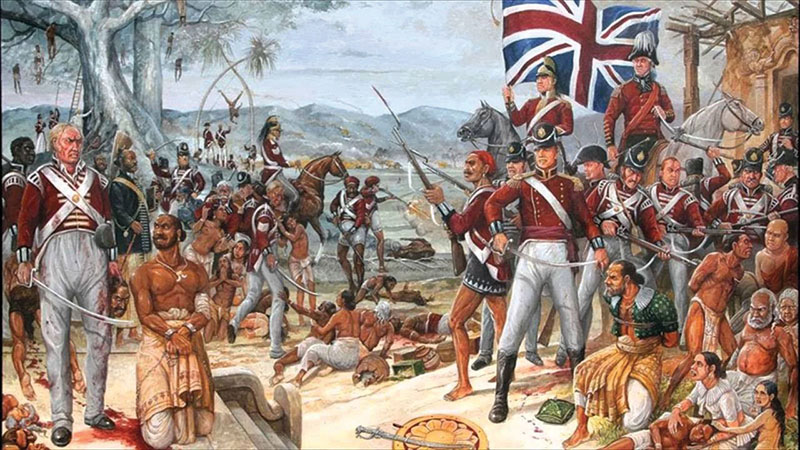
Hindutva

Moreover, V.D. Savarkar was the first to come up with the two-nation theory at a session of the Hindu Mahasabha in 1937 in Ahmedabad, and where he was elected president of the Hindu Mahasabha. While addressing the 19th session of the Hindu Mahasabha in the Ahmedabad, he said: “There are two antagonistic nations living side by side in India”, underlining, “India cannot be assumed today to be a unitarian and homogenous nation. On the contrary, there are two nations in the main: the Hindus and the Muslims, in India.”

V.D. Savarkar defined nationalism based on religion, and he said Muslims and Christians are outsiders. He identified Muslims as an internal enemy and saw it as more dangerous than the external power of British colonialism. For him and other ideologues of Hindutva (Hindu nationalism), the fight against Muslims was far more necessary than removing the British. It was this political commitment that led Savarkar to pledge loyalty to the British. (Siddiqui, 2018a; also, 2018b)

However, Mahatma Gandhi was totally opposed to such views and wanted equal rights for all Indians including Muslims. Mahatma Gandhi, spoke in a public meeting in Bombay in August 1942 where he gave the call for ‘Quit India’, declared unequivocally: “Those Hindus who, like Dr Moonje and V.D. Savarkar, believe in the doctrine of the sword may seek to keep the Muslims under Hindu domination. I do not represent that section. I represent the Congress. The Congress does not believe in the domination of any group or any community…. Millions of Muslims in this country come from Hindu stock. How can their homeland be any other than India?” Mahatma Gandhi also put his position very clearly in his very early years in his book Hind Swaraj or India Home Rule, published in 1909. In this book, he emphasized his vision for India, as a plural society and fully supported Hindu-Muslim unity. Mahatma Gandhi said in 1948 few days prior to his murder: “I see the Muslims of Delhi being killed before my very eyes. This is done while my own Vallabhbhai [Sardar Patel] is the Home Minister of the Government of India and is responsible for maintaining law and order in the Capital. Vallabhbhai [Sardar Patel] has not only failed to give protection to the Muslims, he light-heartedly dismisses any complaint made on this count. I have no option but to use my last weapon, namely to fast until the situation changes.” (Khare, 2022)

The Congress Party and its leaders, such as G.K. Gokhale, Motilal Nehru, Mahatma Gandhi, Badruddin Tayabji, Maulana Shibli Noumani, Hakim Ajmal Khan, Dr M.A. Ansari, Maulana Abul Kalam Azad, Maulana Muhammad Ali Jauhar, Maulana Mahmud-ul- Hasan, Rajendra Prasad, Subash Chandra Bose, C. Rajagopalachari (Rajaji), Sardar Patel, J.B. Kripalani, and Jawaharlal Nehru, stood in favour of ‘Secular India’ and opposed ‘Hindu Rastra’ (i.e., Hindu nationalism). For Congress Party after independence, India would be for all, not just for Hindus. The Congress Party declared that the nationalism should continue to encapsulate the identity of a people living in a territory claiming equal rights, and these rights should exclude discrimination on any ground and include the well-being of all people. The primary identity is that of being a citizen of India, over and above all other identities of religion, caste, ethnicity, and language. The Congress Party during the freedom struggle repeatedly stressed during its annual party session that nationalism does not allow the Hindus in India to claim any privilege as a citizen based on being members of a religious majority community and declared Hindus, Muslim and Christians are all equal citizens. (Thapar et al, 2016)

At the time when Subash Chandra Bose was raising his Indian National Army (INA) to confront the British in India, Savarkar helped the colonial government to recruit thousands of Indians into British armed forces against Bose’ INA. Savarkar supported Hindutva ideology, which deepened the communal divide between Hindus and Muslims at a time when a united front against colonial rule was needed. Savarkar as a young boy along with his friends attacked and vandalised a mosque in his hometown.

In the 1942, when the Congress Party leader and workers were imprisoned for launching a movement asking the British to leave India, Savarkar wrote to the British Viceroy offering his party support. He also encouraged his party leaders to join provincial ministries in coalition with the Muslim League. Shyama Prasad Mookerjee, who was a leader of the Hindu Mahasabha, became a minister in the Fazlul Haq ministry in Bengal. The Hindu Mahasabha also formed coalition governments with the Muslim League in Sind, in NWFP and in Bengal 1941. Savarkar not only refrained from participating in the freedom struggle after the British released him from prison on account of his several mercy petitions, but also actively collaborated with the British rulers. Savarkar’s dislike of Mahatma Gandhi was never concealed, and he could never accept Hindu-Muslim partnership.

On 30th January 1948, Mahatma Gandhi was killed by Nathuram Godse, who was a member of Hindu Mahasabha. Godse, as investigations after Mahatma Gandhi’s murder were to reveal, appears to have been close to Savarkar, who was then the leader of the Hindu Mahasabha. Godse was certainly a frequent visitor to Savarkar’s home and was inspired by his ideas of Hindu nationalism. He murdered Mahatma Gandhi to change the course of India’s freedom movement. Nathuram Godse told during the trial that ‘he killed Mahatma Gandhi because Gandhi favoured Muslims, and to end Gandhi’s pro-Muslim and pro-Pakistan policy, he decided to eliminate him’. (Noorani, 2002) In fact, Mahatma Gandhi never promoted his children into politics or took advantage for his family and remained committed to the cause of peace and justice and even sacrificed his life in support of Hindu-Muslim unity.

Following the assassination of Mahatma Gandhi, the then India’s Home Minister, Sardar Patel, banned the RSS activities and arrested its leaders, and said that ban could be removed with the acceptance of the National Flag. When the constitution of India was adopted in 1950, the RSS opposed it and the national flag. The RSS promised to forsake politics and keep its functioning limited to “cultural” activities. However, after the ban was lifted its agenda remained unchanged. Sardar Patel was also convinced of Savarkar’s involvement in Mahatma Gandhi’s murder and Patel in a letter to Jawaharlal Nehru on February 27, 1948, stated that Savarkar had masterminded the murder. Sardar Patel wrote: “It was a fanatical wing of the Hindu Mahasabha directly under Savarkar that [hatched] the conspiracy and saw it through.”

There is irrefutable evidence of ‘the RSS connection’ with Mahatma Gandhi’s assassination. For instance, Gopal Godse, the brother of Mahatma Gandhi’s assassin Nathuram, in his book (1993), Why I Assassinated Mahatma Gandhi, said they had both been active members of the RSS. Further, in an interview with Frontline on January 28, 1994, he said: “We grew up in the RSS rather than in our home. It was like a family to us. Nathuram had become an intellectual worker in the RSS…and he did not leave the RSS.” Moreover, in 1961 then the Jansangh Party (now called BJP) leader Deen Dayal Upadhyaya said: ‘With all respect for Mahatma Gandhi, let us cease to call him ‘Father of the Nation’. If we understand the old basis of nationalism, then it will be clear that it is nothing but Hinduism.’ He further said ‘So, Nathuram Godse represented ‘the people,’ and the murder he perpetrated was an expression of ‘the people’s wrath’. Furthermore, after denouncing the Communists, Golwalkar turned against the Congress Party. He said: ‘The other movement led by Congress Party has had more disastrous and degrading effects on the country. Most of the tragedies and evils that have overtaken our country during the last few decades and are even today corroding our national life are its direct outcome’. (Cited in Noorani, 2021)

In January 1948, when Mahatma Gandhi was assassinated, Savarkar was arrested as he was suspected of being the mastermind behind the conspiracy. Sardar Patel, as the home minister was personally convinced of Savarkar’s guilt, otherwise he would not have agreed to put him up for trial. He told the Prime Minister, Nehru, in unambiguous terms, ‘It was a fanatical wing of the Hindu Mahasabha directly under Savarkar that (hatched) the conspiracy and saw it through’. (Durga Das, Sardar Patel Correspondence, 1945–50, Vol. VI, p. 56) Patel wrote to Shyama Prasad Mookerjee, the Hindu Mahasabha leader, on May 6, 1948: “…we cannot shut our eyes to the fact that an appreciable number of the members of the Hindu Mahasabha gloated over the tragedy and distributed sweets…. Further, militant communalism, which was preached until only a few months ago by many spokesmen of the Hindu Mahasabha, including men like Mahant Digbijoy Nath, Ram Singh, and Deshpande, could not but be regarded as a danger to public security. The same would apply to the RSS, with the additional danger inherent in an organisation run in secret on military or semi-military lines.” (Sardar Patel Correspondence, Vol.VI, p. 66) Patel further wrote to Shyama Prasad Mookerjee, ‘The activities of the RSS constituted a clear threat to the existence of government and the state’. (July 18, 1948, Sardar Patel Correspondence, Vol.6, p.323)

V.D. Savarkar was eventually not convicted in the Mahatma Gandhi murder trial due to a technical point of criminal law: for lack of independent evidence to corroborate the testimony of the approver. Moreover, on February 22, 1948, Savarkar in a written statement to the Commissioner of Police, Bombay, to avert prosecution for Mahatma Gandhi’s murder stated that: “I shall refrain from taking part in any communal or political public activity for any period the Government may require.” Justice Kapur Commission Report published in 1969, which led the investigation of Mahatma Gandhi’s murder, implicated Savarkar in Mahatma Gandhi’s murder. (Noorani, 2002)

Hindu extremists believe that India should be a ‘Hindu Nation’. For example, the founder Hindutva (Hindu nationalism), V.D. Savarkar said in Calcutta in 1939, that ‘Indian Muslims as a traitorous people not to be trusted’. The RSS leader, M.S. Golwalkar also wrote in 1939 that Germany’s “purging the country of the Semitic Race – the Jews” was “a good lesson for us in Hindustan to learn and profit by”. The RSS, which serves as the chief organizer for a range of Hindu extremist groups, shapes the BJP policy, which was founded as and remains today a paramilitary organization. (Jaffrelot, 1996)

Hindu nationalism is a political ideology that advocates Hindu supremacy, specifically over Muslims. The Hindutva has a factual problem of their claims about pre-modern India, which are incorrect. Their falsehoods about history centre around an imagined Hindu golden age of scientific progress interrupted by Muslim invaders, which has largely a clear political goal of projecting a modern Hindutva identity as an ancient bulwark of Indian culture and maligning Muslims as the ultimate Other. Hindutva is the cornerstone of BJP’s ideology.

The RSS was inspired by the Nazi idea of Aryan supremacy and their leaders such as V.D. Savarkar and M.S. Golwalkar made this idea a central feature of the Hindutva ideology. And thus, incorrect history for India was written which created deep misunderstanding among Hindus and Muslims. In fact, history must be defended and protected against communal and divisive forces. The communal distortion of history by the BJP/RSS government is doing immense damage to the country and its people in the field of education and communal harmony and prospects of the building peace in India.

The RSS says very little about British colonialism, a brutal period of Indian history, because doing so does not serve their political purposes. Hindutva’s early ideologues were British sympathizers, and the Hindu extremist organisations decided to keep themselves out of India’s struggle for independence.

The RSS believes that India should be an ethnic Hindu state, rather than a secular nation. India’s ruling Bharatiya Janata Party, led by the Prime Minister, Narendra Modi, has pushed forward a Hindu extremist’s agenda, under which India’s 200 million Muslims have faced discrimination and attacks. Alarmingly, in recent years, much of this hate has been sponsored by leaders and activists that are close to the Indian government. Within India, Muslims remain the chief targets of mounting bigotry and violent assaults and they have suffered disproportionately in the riots in the past. In fact, for Indian Muslims daily abuse, physical attacks, mob lynching, hate speeches have been normalized. They have been made second-class citizens. It seems in today’s India, if you are a Muslim, you are liable to be attacked and humiliated.

Muslim polarisation is much deeper than ever in the past. Somehow the bourgeoisie propaganda and the ruling elites have created myth that Muslims have been favoured in India and Hindus are victims of the Muslim appeasement, which is false. The majority (i.e., Hindus) has led to believe that they are under siege. Despite the fact, that the official statistics are indicating the general social and economic deterioration of the Muslims in India.

The historians strive for accuracy to understand the past on its own terms, the advocate of Hindutva seeks to invent a past that justifies it. Hindutva followers have a similarly symbiotic relationship with their once colonial masters regarding history. The two centrepieces of the Hindu extremists’ view of the Indian past – the demonization of Muslim-led rule and idolization of Hindu-led rule – both stem from the colonial period, during which modern Hindu-Muslim communal conflict was born. (Thapar 2016) For the British, these ideas assisted their strategy of ‘divide and rule’. Also, demonizing India’s Muslim rulers, the direct predecessors of the British in ruling over significant portions of the subcontinent, furthered the argument that British rule was needed in India. While ignoring the British rule in India (1757-1947), the RSS blame seemingly all wrongs in Indian history on Muslim rulers. Since Hindutva ideology seeks Hindu supremacy, the enemy that serves as their foil must be constructed as equally flat and politically homogenous in its identity. Hindu nationalists avenge their imagined grievances through very real oppression of present-day Indian Muslims, who have been the victims of increasing government-led and extrajudicial violence since 2014. Muslims have been demonised by the RSS/BJP leaders and the mass media.(Filkins, 2019)

The historians strive for accuracy to understand the past on its own terms, the advocate of Hindutva seeks to invent a past that justifies it.

Since its inception, the RSS and Hindu extremists had focused on the so-called protection of ‘Hindu-interests’ and its leader spoke of Hindu nation and tried to identify religion as nationality. While Muslim League was formed by the Muslim Nawabs, feudal and big landlords in 1906 to safeguards their interests in a case if British leave India as Congress Party came out in favour of land reforms and distribution of land in order to break the monopoly of landownership. And only in the late 1930s did the salaried and educated middle-class Muslims began to join the Muslim League as they saw the separate country would provide them better progression opportunities. (Siddiqui, 2016a; and, 2016b) From the 1930s onwards Muslim League strongly advocated for the establishment of a separate Muslim-majority nation-state, Pakistan. And only in the 1940s the League began mass contact among Muslims. On March 23, 1940, Muhammad Ali Jinnah, leader of the Muslim League, formally endorsed the “Lahore Resolution,” calling for the creation of an independent state in regions where Muslims constituted a majority.

The British rulers encouraged Muslim League leaders; especially after Mahatma Gandhi launched the ‘Quit India movement’ in 1942, while the Congress Party leaders and many party workers were imprisoned. The British were desperately looking for some support within India during World War II and Congress Party refused to support the War. Therefore, they began to rely more on the Muslim League and thus, attempted to weaken the independent movement. The Hindu extremist organisations did not take part in the anti-colonial struggle and emphasized on safeguarding Hindu interests.

The idea of Pakistan was embedded in the two-nation theory that Jinnah espoused by which he viewed Hindus and Muslims as belonging to ‘two different religious philosophies, social customs and literary traditions. At present, with the drive towards globalisation, a nation-state does not have to be uniform and homogenous. However, between 1940 and 1947, Jinnah and the Muslim League leaders were able to mobilise masses that increased the support of the demand for Pakistan. By 1946, the Pakistan movement had gathered such momentum that it seemed impossible for even Mahatma Gandhi to bridge the growing mistrust between the two communities. As the British proposed to leave India, the actual process of partition and boundary making was a hurriedly done job. 

Muslims & Hindus

VI. Conclusion

In 1857, the Indian people (i.e., both Hindus and Muslims)fought against colonial rule, which was suppressed by the British. Afterward, Britain considered Indian Muslims as the main enemy of their rule. As a result, the colonial rulers made efforts to suppress the Muslim community, especially systematically removing them from government administration and undermining their educational institutions. Moreover, they tried to weaken Muslim-Hindu community relations with the help of falsifying history. For example, Lord Edward Ellenborough, the governor-general of India at the time said, “It cannot be ignored that the Muslim nation is, due to the nature of its religion, our serious enemy. So our real plan is to please the Hindus”.

The British had been horrified, during the Revolt of 1857, to see Hindus and Muslims fighting side by side and under each other’s command against the foreign oppressor. The rebellious Indian soldiers of the British army consisted of both Hindus and Muslims, approached the Mughal King Bahadur Shah Zafar to lead their fight against British rule in India. In 1857 the last of the Mughal emperors had served as a rallying symbol for the Indians opposing British colonial rule. The diverse anti-British forces participating in the joint rebellion were aligned through their shared acceptance of the formal legitimacy of the Mughal emperor as the ruler of India.

This unity posed a threat to British colonial rule in India and thus they systematically planned to break the unity among Indian people. When the restricted franchise was granted to Indians, the British created separate communal electorates so that Muslim voters could vote for Muslim candidates. The seeds of division were sown, to prevent a unified nationalist movement that could overthrow the British.

The demand for Pakistan was against the composite nationalism that, Mahatma Gandhi, Jawaharlal Nehru, Subash Chandra Bose, Abdul Ghaffar Khan, Ubaidullah Sindhi, Maulana Abul Kalam Azad, Maulana Mahmud-ul-Hasan, Hussain Ahmed Madani, and Dr Zakir Hussain vowed to protect India’s unity.

The colonial rulers projected themselves as saviours for Hindus because they said the previous rulers ,i.e., Muslims, were cruel and unjust towards Hindus. Of course, historically this is not true. British colonialists viewed the Indian people as always divided based on ‘primordial identities’ of religion and caste. This view also became deeply embedded in the ideology and politics of the RSS and the Hindu Mahasabha. That was the reason these extremists’ organisations did not take part during the anti-colonial struggle, while focused their energies on identifying the distinction between Hindus and Muslims. (Siddiqui,2020c)

In 1930, Mahatma Gandhi launched the ‘Civil Disobedience Movement’, which meant any cooperation with the British colonial authorities was discouraged and people were asked to boycott the courts and should not join the army. This was overwhelmingly supported by the Muslims. The ‘civil disobedience movement’ showed the Hindu-Muslim unity and it was realised that this unity could help the Indian people to achieve independence.

However, neither the Hindu extremist organisation extended their support to India’s struggle for freedom against British colonial rule and did not participate in the ‘Civil Disobedience’ movement of 1930 or the ‘Quit India movement’ of 1942. Under the leadership of Savarkar, the Hindu Mahasabha was opposed to Mahatma Gandhi’s gestures to Muslims and towards the Muslim League president Muhammad Ali Jinnah. (Noorani, 2002)

The demand for Pakistan was against the composite nationalism that, Mahatma Gandhi, Jawaharlal Nehru, Subash Chandra Bose, Abdul Ghaffar Khan, Ubaidullah Sindhi, Maulana Abul Kalam Azad, Maulana Mahmud-ul-Hasan, Hussain Ahmed Madani, and Dr Zakir Hussain vowed to protect India’s unity. The communal riots (religious violence) were rising in the mid-1940s, while the colonial police and administration either did not control it or wanted to prove that these two communities cannot live in peace therefore their presence and rule are important to maintain peace.

In fact, the British colonial policy of ‘divide et impera’ (divide and rule) fomented religious antagonisms in India to facilitate continued imperial rule and reached its tragic culmination in the 1947 partition of India. The very religious identities of Hindus and Muslims in the sub-continent were constructed by the British, and as such, the subsequent strife between these groups was a function of this policy.

The main problem of ‘religion as a political tool’ is that it is obsessed with power in the public domain. India had witnessed the politicisation of religion since the latter part of the 19th century. The British colonial government had begun to define Indians based on their religion in the census. In fact, in India, religion was politicised in the late 19th century by the British rulers. Every census identified Indians by their religion. The colonial government counted how many Hindus and how many Muslims formed part of the governed, and how benefits such as limited representation can be portioned between them. As religious identities hardened, they became the basis of competitive nationalism that culminated in the Partition of India.

Religious identity came to play an important role in competition for limited representation in legislative councils in India under colonial administration. Competing religious nationalism culminated in the Partition of India. Religion had been catapulted from the private into the public sphere as a form of pure politics.

The British imperialist policy of ‘divide and rule’ focusing previously indistinct Hindu-Muslim differences had its disastrous outcome in the Hindu-Muslim bloodshed and massacres of Partition. The British rulers tried to undermine the anti-colonial movement by encouraging the Indian community to be organized on the name of religion and castes and their leaders to focus on building and safeguarding their communities.

During the famines in India under the British rule, the colonial administration failed to respond adequately to the food shortage or subsequently to acknowledge responsibility for the resulting mass starvation and deaths. (Siddiqui, 1990b; also, 2020c)

Although Britain won World War II, but the war left Britain economically poor and ‘with largest external debt in history’, money owed to the United States for its help during the war was huge. As a result, Britain was in no position to maintain its empire, as it was militarily very weak. For Britain, the overseas commitments were no longer sustainable, and leaving India appeared to be the only viable option, and then the question was what they would leave behind, a weak and fragmented India. The task of dividing the two nations (i.e., India and Pakistan) was assigned to Sir Cyril Radcliffe, a lawyer who had never been to India before and knew nothing of its history, society, culture, or traditions. Radcliffe drew up his maps in less than five weeks, dividing provinces, districts, villages, homes and promptly scuttled to Britain, never to return to India again.

The study concludes that British colonialism was prime responsible for the partition of India, but of course, supported by the communal forces. As the modernization arguments were collapsing and the poverty and exploitation was increasing in India, (Siddiqui, 2021) and then by the end of the 19th century, the British rulers had to find other arguments to justify colonial rule. They found religious divide important tools to justify and prolong their rule. It was said that since Hindus constituted the majority of then India’s population, and thus Hindus would undermine and exploit the Muslim minority. It was claimed that only British rule could maintain peace between these two religious’ communities. The British saw themselves as a neutral empire and the tension between these two religious groups were important to justify their rule. They had to prove that Indian people were divided based on religion in the past.

About the Author

Dr. Kalim Siddiqui

Dr. Kalim Siddiqui is an economist, specialising in International Political Economy, Development Economics, International Trade, and International Economics. His work, which combines elements of international political economy and development economics, economic policy, economic history and international trade, often challenges prevailing orthodoxy about which policies promote overall development in less developed countries. Kalim teaches international economics at the Department of Accounting, Finance and Economics, University of Huddersfield, U.K. He has taught economics since 1989 at various universities in Norway and U.K.

References

  • Ahmed, I. (2020). Jinnah: His Successes, Failures and Role in History, Penguin.
  • Ali, M. Athar. (1966). The Mughal Nobility under Aurangzeb. New Delhi: Asia Publishing House.
  • Azad, Maulana Abul Kalam. (1988). India Wins Freedom, Orient BlackSwan: New Delhi.
  • Bose, S. (2017). The Nation as Mother and Other Visions of Nationhood, New Delhi: Penguin Random House.
  • Dalrymple, W. (2015). “The East India Company: The original corporate raiders”, Guardian, March 4, London.https://www.theguardian.com/world/2015/mar/04/east-india-company-original-corporate-raiders.
  • Davis, M. (2001). Late Victorian Holocausts: El Nino Famine and the Making of the Third World, p. 32, New York.
  • Filkins, D. (2019).“Blood and Soil in Narendra Modi’s India”, The New Yorker: New York. December 2.
  • Gandhi, M.K. (1909). Hind Swaraj or India Home Rule, Navajivan Publishing House: Ahmedabad.
  • Habib, S.I. (2016). “Legacy of Freedom Struggle: Nehru’s Scientific and Cultural Vision”, Social Scientist, 44 (3-4): 29-40.
  • Jaffrelot, C. (1996). The Hindu Nationalist Movement in India, Columbia University Press: USA.
  • Jalal, A. (1985). The Sole Spokesman: Jinnah, the Muslim League, and the Demand for Pakistan, Cambridge University Press: London.
  • Khare, H. (2022) “Why Was Mahatma Gandhi Killed?” Wire, 31/1/2022. https://thewire.in/communalism/mahatma-gandhi-assassination
  • Majumdar, R.C. (1975).Penal Settlement in Andamans, Publications Division, Govt. of India: New Delhi.
  • Nehru, Jawaharlal. (1971) An Autobiography; Allied Publishers: New Delhi.
  • Noorani, A.G. (2021). “Partition Horrors Remembrance Day: A Prime Minister determined to flout the nation’s consensus”, Frontline. October 8.
  • Noorani, A.G. (2002). Savarkar and Hindutva: The Godse Connection, New Delhi: Left Word Books.
  • Siddiqui, K. (2021). “Trade Liberalisation, Comparative Advantage, and Economic Development: A Historical Perspective”, World Financial Review, May-June, 65-73.
  • Siddiqui, K. (2020a). “The RSS, Hindutva and Rising Attacks against Muslims in India”, World Financial Review, September October, pp 66-75.
  • Siddiqui, K. (2020b). “The Political Economy of Famines under Colonial India: A Critical Analysis”, World Financial Review, July/August, pp.56-70.
  • Siddiqui, K. (2020c). “Britain’s Trade with China in the Eighteenth and Nineteenth Century: A Review of the Opium Wars”, Asian Profile, 48(3): 207-221, September.
  • Siddiqui, K. (2019). “The Economic Performance of Modi’s Government in India: The politics of Hindu right”, World Financial Review, July/August, pp. 12-26.
  • Siddiqui, K. (2018a). “Hindutva and Neoliberalism in India”, Alternatives Sud (in French) 25(1): 39-60.
  • Siddiqui, K. (2018b). “Hindu nationalism and the Consolidation of Hate Politics in India”. World Financial Review, September/October. ISSN 1756-3763.
  • Siddiqui, K. (2018c). “The Political Economy of India’s Economic Changes since the last Century” Argumenta Oeconomica Cracoviensia, 19, pp103-132.
  • Siddiqui, K. (2017a). “The Bolshevik Revolution and the Collapse of the Colonial System in India”, International Critical Thought, 7(3): 418-437. Routledge Taylor & Francis.
  • Siddiqui, K. (2017b). “Hindutva, Neoliberalism and the Reinventing of India”, Journal of Economic and Social Thought, 4(2): 142-186, June. ISSN 149-0422.
  • Siddiqui, K. (2016a). “The Economics and Politics of Hindu Nationalism in India”. Asian Profile, 44(6): 497-507.
  • Siddiqui, K. (2016b). “A Critical Study of Hindu Nationalism in India”, Journal of Business & Economic Policy, 3 (2):9-28. ISSN 2375-0766.
  • Siddiqui, K. (2016c). “Economic Performance of Modi’s Government”, The Nation, August 6.
  • Siddiqui, K. (2009a). “Globalisation, Hindu Extremists and Violence in India”, Klassekampen,(in Norwegian), February 16, p.10-11, Oslo, Norway.
  • Siddiqui, K. (2009b). “Politics and Religion in Modern India”. Z-Net, January 8.
  • Siddiqui, K. (1992). “Violation of Human Rights in India”, Bergens Tidende, (in Norwegian), April 27, Bergen, Norway.
  • Siddiqui, K. (1990a). “Rising Violence in Kashmir”, Bergens Tidende, (in Norwegian), May 31, Bergen, Norway.
  • Siddiqui, K. (1990b). “Historical Roots of Mass Poverty in India” in edited by C.A. Thayer, J. Camilleri, and K. Siddiqui. Trends and Strains. pp. 59-76, New Delhi: Peoples Publishing House. ISBN 81-85364-16-8.
  • Sir John Strachey. (1888).India: Its Administration & Progress, London: K. Paul.
  • Thapar, Karan. (2021).The Wire. https://thewire.in/media/partition-jammu-muslims-karan-thapar-asian-age.
  • Thapar, Romila, A.G. Noorani, and S. Menon. (2016).On Nationalism, Aleph Book Company: New Delhi.
  • Tharoor, S. (2017). Inglorious Empire: What the British did to India, London: Hurst.
  • Truschke, Audrey. (2018). Aurangzeb: The man and the myth, New Delhi, Penguin Random House.

5 Common Challenges Of Hybrid & Remote Work (and the Solutions)

hybrid

Hybrid and Remote working is here to stay, according to everyone from economists, business analysts, and tech vendors. For the most part businesses have been taking to remote and hybrid working very well, and many employees have cited that they enjoy the balance of independence and collaboration that remote and hybrid working. With all this said, both types of working require having a well though out strategy, and there are still significant challenges that need to be addressed by any business looking to go remote, or implement hybrid working.

Many IT support companies, such as TechQuarters, have been helping businesses set themselves up for remote and hybrid work – it is a process that involves assessing the challenges, and figuring out what types of technologies and practices will overcome those challenges. Below are 5 common challenges that businesses may face.

Management and collaboration

If not equipped for the job, managing remote employees can be difficult. To start with, managers may find it challenging to manage remote employees if interaction between the two are hindered by location. This can lead to other difficulties – for instance, managers may find that they are unconsciously favouring in-office employees, simply because they are easier to manage and give feedback to.

Hybrid and Remote work can also prove to be a challenge for employee collaboration. Again, in a hybrid environment, in-office employees may unconsciously defer to one another, because they are both in the office and it is the quickest and easiest option.

The solutions to these challenges are simple; building trust in a remote or hybrid workplace is essential. To do this, frequent communications is a must – some companies, like TechQuarters, schedule daily meetings to keep people in touch. Ensuring that all employees are equipped with the right technology to facilitate easy and consistent communication is also important – as an IT managed services company, TechQuarters recommends Microsoft Teams, which is a unified communications platform that even supports telephony.

The Company Perimeter

There are certain security challenges associated with going remote or hybrid. To start with, businesses have to address the fact that their out-of-office employees will be accessing company data via networks that were not configured to protect it in the same way that the in-office network was.

A report found that 22 per cent of all network and data breaches were caused by human error or ignorance. Users might use the easiest solution, instead of the company-approved solution, to complete tasks such as sending files to colleagues, storing things in unsanctioned cloud accounts, and even emailing documents to personal email addresses. All of these represent significant security risks for a company.

With remote and hybrid working, the responsibility for protecting data is as much on employees as it is on the company. A business needs to establish strict policies and practices around how remote workers access company data.

Onboarding New Remote Employees

The onboarding process for new employees in a remote or hybrid working company must be carefully thought out, especially within the context of the IT that they will need.

First consider whether the new hire has much, or any, experience with remote or hybrid work. If they are not, then they may find it challenging adjusting to the new arrangement. To get them acclimatized to remote and hybrid working will require training them and familiarizing them with the software and tools the company uses to enable remote work.

Then there is a social aspect. Whether the new hire has no experience going into a remote work scenario, or if they’re going into a hybrid work scenario as an in-office employee, an extra effort will need to be made to introduce them to everyone in the company, as well as maintaining regular interactions with them, as this is the way to build a good company culture.

Employee’s Broadband

Another major IT support related consideration for remote and hybrid work security is network broadband. Remote workers will more than likely be using their own home broadband to access company servers and cloud accounts. Once again, this is one of the ways in which companies cannot guarantee network security in the same way that they can with their on-site broadband setup. The other difficulty is that it is unrealistic for an employer to be able to secure every single employee’s broadband setup.

The solution is fairly simple; implementing a reliable VPN client for all employees to use for work is a good way to heighten the security of remote workers’ networks. A VPN will encrypt traffic between a user’s device and the VPN server, thus creating a secure network.

Ask a Divorce Attorney: 6 Things to Avoid During a Divorce

Law

Divorce can be a legal minefield, especially if there are children involved or you have many contested assets. It’s easy to make a mistake that could cost you thousands or prevent you from getting the best outcome possible. However, your Houston, TX divorce attorney can help you avoid a lengthy legal battle and keep your cool, even when things get difficult. Let’s have a closer look at how you can avoid problems. 

Ask a Houston, TX Divorce Attorney: 6 Things to Avoid During a Divorce

1. A Legal Battle 

The cost of a divorce in Texas varies wildly, depending on how much legal help you need and how many assets you have. On average, the total amounts to $15,600, and this rises to $23,500 if children are involved. Although this might sound high, you’re likely to spend much more during an extended legal battle, so it’s best to settle the matter as amicably as possible. 

Your lawyer will help you go through all the assets and liabilities, then determine which ones are important to you. That way, you can choose what to fight for and where to compromise with your former spouse. If both sides are able to remain fair and avoid making unreasonable demands, your divorce can be resolved quickly and without incurring high fees. What’s more, it will be less stressful for everyone involved.

2. Rash Actions 

While some people are able to remain completely amicable during the whole divorce process, this isn’t always the case. Incompatibility is the leading reason why people get divorced, so tension is almost inevitable. It can be extremely challenging to keep your cool, especially if the person you loved most betrayed you. Many people make rash decisions due to their frustration, anger, and heartbreak, but they often regret their actions later on. 

A violent outbreak, whether physical or verbal, can be used against you during your divorce proceedings, so it should be avoided at all costs. If necessary, hire a counselor who can help you work through this difficult time in your life. They will work with you to channel your energy into more positive actions and support you during the healing process.

3. Hiding Assets or Destroying Evidence 

In an effort to preserve the assets you’ve worked hard for, you might be tempted to hide them, for example by moving some of your money offshore. Some people getting ready for a divorce might also destroy some of their spouse’s possessions or important documents that could serve as evidence in court. 

Although this can be tempting, it should be avoided. If the judge finds out that you have tampered with the evidence or hidden something from your spouse, you might get an inferior outcome. 

4. Incur Unusual Debt 

Before splitting up the assets, some spouses decide to treat themselves using the joint money. They might buy an expensive vacation or more clothes than they normally would and charge them to a credit card. However, this is frowned upon, and it may cause you problems during the divorce process. In many cases, the judge will determine that this debt is not joint, so you will have to pay it off on your own. 

5. Belittle Your Spouse

If your former spouse treated you badly, it can be exceptionally difficult to remain neutral. You might be tempted to speak ill of them in front of friends, family members, and even in the courtroom. This is often a bad idea because it portrays you in a negative light. Remember that the people close to you might have to testify, and they could disclose anything you have said to them about your spouse. 

It’s especially important to avoid speaking negatively in front of your children since this can cause them long-lasting trauma. The judge is aware of how damaging such behavior is for children, so they are unlikely to grant you custody if you regularly belittle your partner.

6. Fail to Hire a Divorce Lawyer 

Most divorces are challenging and mentally exhausting, and you should get all the help you can. Although fewer people are deciding to dissolve their marriage than in the past, divorce attorneys are still very much in demand. Hiring a top divorce lawyer in Houston is crucial because they will navigate the various rules and regulations for you. What’s more, they have been through the process many times and can therefore help you avoid common mistakes. It’s important to point out divorce laws vary throughout states, Texas divorce laws will be different from Arizona divorce laws so it’s important to get a lawyer from your respective state as soon as possible.

Speaking to your former spouse with a lawyer present is always preferable. You will be less tempted to act rashly and say something you’ll regret later. That way, you’re likely to preserve more of your assets and get a better overall outcome. 

Although the number of divorces has decreased in Texas over the last few years, it is still a common issue. The best way to handle the process is to hire a highly competent Houston, TX divorce attorney, who will help you fight for your rights. They can prevent you from making common mistakes, such as hiding assets or acting rashly, and they will advise you well every step of the way.

Lawsuit Loans Offer Personal Injury Pre-Settlement Funding to Plaintiffs

Cash

By Leland D. Bengtson

All too often, plaintiffs lose out on the justice they deserve simply because they can’t afford to fight for it. Pre-settlement funding is transforming the way plaintiffs and their lawyers approach litigation by allowing victims to access their award when they need it most – now.

While the legal funding industry remained relatively unknown until recent years, it’s gaining more visibility as institutional investors move into the scene. That makes legal funding a more common topic of discussion in law offices, making it important for attorneys to understand what it offers.

What Pre-Settlement Funding Is (and Isn’t)

For anyone reading about legal funding, it is easy to get confused by the terminology used in the industry. Pre-settlement funding is commonly and mistakenly referred to as “loan.” This is not a loan in the regular sense, since if you lose the case, you don’t have to pay back the amount. However, to keep things simple, we will use the word “loan” on this page. Therefore, legal funding is known by a variety of names, including the following:

  • Lawsuit loans
  • Legal funding
  • Legal loans
  • Settlement loans 
  • Settlement funding

Despite its name, a legal loan poses no risk to the plaintiff. Their assets are never at risk, and they don’t need to repay the loan if they lose the case. Furthermore, they won’t ever owe more on the loan than their settlement is worth.

How can this be? Settlement loans are offered as nonrecourse loans, meaning the plaintiff is under no obligation to repay them with their own money. The only collateral that can be used in a settlement loan is the hypothetical value of the settlement itself. In fact, the IRS classifies lawsuit loans as a type of investment, placing all of the risk with the financial institution.

The lack of risk associated with lawsuit loans makes them an attractive alternative to other forms of financing a plaintiff might turn to, such as credit cards or personal loans. Lawsuit loans from legitimate financial institutions also feature low, simple interest rates. The total amount of interest may be capped once a certain amount of interest has been charged, further protecting borrowers.

Legal Funding Is a Growing Industry

Since its beginning with the landmark 1980 ruling in the Texas Supreme court, legal funding has gained traction as a legitimate financing alternative for plaintiffs involved in lengthy settlement negotiations. Given legal funding’s status as an investment, the lawsuit loan industry has also attracted a growing pool of institutional money in recent years. 

Legal funding offers an attractive source of uncorrelated returns for investors seeking to maximize their returns. Hedge funds, in particular, have moved into settlement funding as their interest in nontraditional assets has grown. Due to this influx of new capital, legal funding has transformed from a scattered collection of small, independent financial institutions into a national industry. 

In addition to a greater depth of resources, these new institutional funding sources provide an added impetus for transparency and fairness within this industry. This comes at a critical time, as the pre-settlement funding industry continues to grow rapidly as more lawyers and plaintiffs learn about this financing option.

How Does Legal Funding Work?

The actual process by which legal funding works is quite simple. A plaintiff who has filed a lawsuit and retained a lawyer working on contingency can apply for a lawsuit loan with a legal funding company. Plaintiffs submit documentation relating to their case along with their contact information. Typically, this process takes just a few minutes.

Once the application has been submitted, the legal funding company will review the plaintiff’s case. Often, they can approve an application within 24 hours. As lawsuit loans are nonrecourse, they don’t require a lengthy approval process. Legal funding companies will evaluate the merits of a plaintiff’s case, and they will make a lending decision based solely on that information.

How Legal Funding Can Benefit Lawyers and Plaintiffs

Legal funding offers two key benefits to lawyers and plaintiffs. For plaintiffs, they won’t need to worry about the defense’s financial pressure tactics. Plaintiffs often miss out on their settlement simply because they can’t afford to fight for it. Many others never even file a case because they assume the costs of a lawsuit will be too much for their household to bear.

For plaintiffs, lawsuit loans can cover a wide array of expenses they might face after an accident, including the following:

  • Living expenses (groceries, utilities)
  • The cost of a new vehicle
  • Childcare costs
  • Rent or mortgage payments
  • Medical expenses 
  • Paying off credit card debt

Legal funding comes with no strings attached, and plaintiffs can spend it however they want. Lawsuit loan recipients also don’t have to worry about repaying their funding, giving them much more leeway in how they spend their money. With their expenses covered, plaintiffs may be less inclined to settle for a lower amount than what they could win by seeing their case through.

With less pressure to settle, plaintiffs can take more time to resolve their case, which also gives lawyers more time to build theirs. Attorneys have more time to collect evidence and negotiate with the defense to get a better settlement offer for their clients. Should the case escalate to a trial, plaintiffs can enter with a much stronger hand than they would with less time.

How Much Legal Funding Can a Plaintiff Get?

Plaintiffs can theoretically receive legal funding to cover their entire prospective settlement. However, in most cases, lawsuit loans themselves are capped at around 20% of the expected value of a settlement or award. This protects plaintiffs from losing too much of their settlement to interest. It also protects financial institutions from exposure to excessive downside risk.

Plaintiffs aren’t limited to a set number of lawsuit loans they can take out. Legal funding companies will typically offer anywhere from 5 to 10% of a settlement’s value as an initial lawsuit loan. Should a plaintiff require more funding, they can apply for a second or third lawsuit loan. Given that legal funding accrues interest, it’s better for plaintiffs to borrow only what they need. 

When a Plaintiff Needs Legal Funding

Legal funding offers numerous benefits, but it isn’t for everyone. Lawsuit loans do come with interest, and while a reputable financial institution will keep their rates relatively low, these can still add up to large interest charges once a case is resolved. In order to determine if legal funding is an appropriate choice for a plaintiff, it’s crucial to evaluate their financial options. 

A lawsuit loan can be appropriate for a client if they have suffered extensive injuries as a result of their accident and face high medical bills. Legal funding could also be appropriate if a plaintiff suffered a loss of income from their damages. If a plaintiff is facing imminent expenses that could prevent them from seeking a higher settlement, a lawsuit loan may also be appropriate.

Prior to seeking a lawsuit loan, a plaintiff should explore other options for covering their expenses. If a client needs to take on debt to pay for their expenses, then a lawsuit loan is usually a safer choice than other recourse alternatives.

About the Author

Author - LelandLeland D. Bengtson dedicated most of his career to law reporting. He aims to draw in the public and make people more interested in the field.

How to Grow as a Chartered Financial Analyst (CFA) Charterholder

Chartered Financial Analyst

By Nikhil Vachani

Finance is one of the largest industries across the globe. It has grown bigger through the decades and has branched out into many sub-sectors like investment and wealth management.

Under this industry, accountancy and other finance-related course graduates can build their careers through a wide range of professional credentials. However, the gold standard that even C-level executives are expected to have is the chartered financial analyst (CFA) designation.

This article offers all the important facts about CFA, including how you can take the path and grow your career by being one.

What is a chartered financial analyst (CFA)?

Chartered financial analyst (CFA) is a title granted to a professional recognized by the CFA Institute.

Originally known as the Association for Investment Management and Research (AIMR), the internationally acclaimed organization uses the designation to certify a professional’s competence in wealth management and investment analysis.

CFA vs. CFP

To understand what a CFA truly is, you must first know what it isn’t, and it is definitely not the same as a CFP (certified financial planner).

Although somewhat similar at first glance, CFP and CFA are two different jobs in the wealth management field. Besides being under the same industry, the two have very different roles, scopes, and skill sets.

While financial planners work with individuals and help them achieve their financial goals, CFA charterholders focus more on large-scale corporate investment situations.

A CFP plans for people and their families, which means they need strong people skills and can translate complex financial matters into layman’s terms. They have a deep understanding of investing and personal finances, which they use to build and manage investment portfolios for their clients.

On the other hand, CFAs are more focused on high-level investment. They are trained in financial reporting, economics, corporate finance, and equity investing strategies. Unlike CFPs, they work with large organizations and handle the research and analysis of investment firms.

What are the skills needed to become a CFA?

CFA charterholders work in different positions in the global financial industry, mainly as investment management professionals. No matter what company they work for, they apply the most critical CFA skills, such as:

Analytical Skills

To become a CFA charterholder, you need to be able to visualize, conceptualize, articulate, and solve simple and complicated financial matters. Ultimately, you have the skills that allow you to make educated decisions based on the available information.

Communication Skills

Like other professionals, CFA charterholders require high-level communication skills to work better with people, including investors, clients, and stockbrokers. The job description doesn’t end with analysis; it also entails good presentation and communication to enhance the value of analysis and prevent any misinterpretations.

Excel Modeling and Computer Skills

CFA professionals will need to work a lot on Excel sheets and models, so having in-depth knowledge about the optimal use of the tool is crucial for them.

From making quantitative estimates to forecasting trends, almost everything a CFA charterholder must communicate can be showcased in an easily digestible manner through Excel template models.

Although it’s not required, having a Microsoft certification in Dubai definitely gives you an advantage when applying for jobs and practicing as a CFA charterholder.

Moreover, a CFA professional must be able to handle computer operations with ease. Having mastered basic computer and Excel operations means you have the foundations to learn new software for efficient data analysis, trend monitoring, and forecasting.

Ethics

Though technically not a skill, ethics is one of the most critical fundamental pillars of becoming a CFA charterholder, along with honesty.

CFA charterholders need to be unbiased in their work and conduct their tasks responsibly. Integrity is paramount to the quality of work expected from a CFA charterholder, so you must make sure you live by the code implemented by the CFA Institute if you choose to become one.

What career paths can you take as a CFA charterholder?

CFA charterholders are suited to take on several roles, such as:

  • Portfolio management expert.
  • Financial analyst.
  • Risk analysis and risk management expert.
  • Investment strategist.

The CFA designation is widely considered the apex of professional expertise in investment management. As such, it is often considered a major requirement for those vying for the position of chief investment officer at a public company or investment firm.

In this position, CFA charterholders engage in:

  • Credit analysis.
  • Corporate auditing and accounting.
  • Financial planning for high-net-worth individuals (HNWIs).

How much do CFA charterholders earn in the UAE?

Professionals in the investment industry see widely varying compensation. Several factors also influence salary ranges, including professional seniority, the industry sector, specialization, and broad regional differences.

In Dubai, UAE, an average chartered financial analyst has an annual gross salary of AED 301,911. This is equivalent to AED 145 hourly and is 4 percent higher (or AED 10,755 more) than the national average salary for the said profession.

Below are the estimated earnings, based on your level of experience in the field:

  • As an entry-level CFA with one to three years of experience, you can expect an average salary of AED 213,903.
  • A senior-level professional with over eight years on the job can earn an average of AED 376,259 in payroll.

CFA charterholders also earn an average annual bonus of AED 12,650.

How can I become a CFA charterholder?

You need to complete some basic requirements to become a CFA charterholder aside from completing your CFA training in Dubai. This includes:

  • Four years’ worth of work experience as a professional.
  • A bachelor’s degree or proof of being in the final year of a bachelor’s degree program.
  • A combination of education and professional work experience totaling four years.

Note that undergraduates need to complete their bachelor’s program before registering for the Level II CFA exam.

Besides the professional and educational requirements, CFA applicants must also:

  • Have a valid international passport.
  • Complete the English assessment.
  • Meet the professional conduct criteria for admission.
  • Reside in a CFA-participating country.

After meeting the enrollment requirements, you need to pass all three CFA program levels in sequential order. Since the tests are quite rigorous, you may need to study the 10 topic areas extensively within 900 hours or more.

Once you pass the exam, you must become a member of the CFA Institute, pay annual dues, and sign the organization’s code of ethics and standards of professional conduct that must always be upheld (else, you risk revocation of your CFA charter).

Grow as a Chartered Financial Analyst

A career as a CFA charterholder is a fruitful one. Make sure you learn the right skills and choose pathways that interest you to start your journey to grow as a CFA.

About the Author

Nikhil Vachani

Nikhil Vachani is Senior Tutor for Phoenix Financial Training, a leading provider of professional accountancy and finance qualifications throughout the Middle East and India as well as of bespoke finance courses to a wide and varied portfolio of corporate clients. Nikhil is a fellow member of the ACCA and UAECA and has 11 years of experience as a specialist trainer in the areas of Financial Accounting, Corporate Reporting and Taxation across all levels of ACCA.

How To Build Business Credit With Bad Personal Credit

Bad Personal Credit

By John Tejada

If you’re wondering how to get business credit without using personal credit, you’ve come to the right place. AMP ADVANCE has the insider tips to help you get it done! But we’re not going to lie, it’s a challenge that will take your focus and energy to do it right. Today, we will explain how to build business credit without personal credit.

First, there is a lot of different factors that play into scaling and growing a business. A sturdy business plan and steady cash flow play a big role but as you will learn, so does business credit history. When you go to a lender, they will evaluate your business credit to determine whether you’re eligible or not.

Additionally, it shows potential investors, business partners, and vendors how responsible you are about your business finances. For these reasons, establishing good business credit is a must!

If you want to separate your personal credit from your business, and start growing your business credit follow these first steps:

  • Get your EIN.
  • Open a business checking account at a major bank.
  • Register with Dunn & Bradstreet.
  • Apply for vendor trade lines.
  • Think about getting a secured business card.
  • Give working capital loans a try.
  • Regularly check your business credit report for inaccuracies and positive payment reports.

We will explain each of these steps in more detail later, so keep reading! First, we would like to establish the difference between business and personal credit.

The Difference Between Business Credit and Personal Credit

Both business credit and personal credit measure how you manage your financial responsibilities. However, they show this in very different ways, which means they offer different perspectives.

For instance, FICO personal credit scores consider these key factors:

  • Payment history, which is 35% of your credit score.
  • Credit usage, which is 30% of your credit score.
  • Credit history length, which is 15% of your credit score.
  • Credit mix and new credit, each of which represent 10% of your credit score.

Business credit is calculated very differently by focusing on factors such as payment history, time in business, number of employees, and public filings. Information relating to business credit is collected by 4 main reporting agencies, including FICO, Dun & Bradstreet, Experian, and Equifax.

When it comes to business credit calculations, the most important factor is payment history. They rely a lot more on this factor than personal credit. Another important factor is business longevity. The longer you’ve been in business and the more payments you’ve made on time, the better.

Not everyone can get their hands on your personal credit report, but that’s not true for business credit reports. Anyone can access them, so your lender will check it out when they’re considering your application. At the end of the day, it can make or break your chances of getting a loan. Customers can also access this info, so that’s yet another good reason for building up your business credit.

What Is Business Credit Based On?

If you want to learn how to build business credit with poor personal credit, you need to understand what it’s based on. Though business credit and personal credit are two separate things, your personal credit score can greatly impact business lending decisions. That’s particularly true if your business is brand new.

Companies that have small ownership and limited credit history may need to agree to a personal guarantee. That means that when you’re applying for a loan or business financing, you’re making yourself responsible if you happen to default on it.

In other words, you are personally liable for the debts of your business. Should you default on a credit line or loan, the related delinquency will be applied to your personal credit history. This is an alternative to collateral.

If you are the sole proprietor of your business, your business and personal credit will intertwine. That means that, for financial purposes, you and your business are a single entity. As such, potential lenders will rely more on your personal credit to determine if you’re eligible for a business loan. So, it’s best to open an entity to separate your personal credit.

How to Build Business Credit Without Personal Credit

Now, this is the big question. The truth is that having bad personal credit can make it more difficult for you to build good business credit. However, that doesn’t mean it’s impossible. Here’s how to establish business credit without using personal credit:

1. Get Your EIN

If you’re wondering how to apply for business credit without using personal credit, you’ll need an EIN. Your Employer Identification Number gives you an alternative and it’s like a Social Security number for your business. Your EIN can also be used to open business savings and checking accounts. If you’re building business credit with bad personal credit, you need it.

2. Open a business bank account 

Not only will opening a business bank account help you separate your personal finances with your business for tax purposes, but it will also establish a relationship with a major bank for your business future. More on this later.

3. Register with Dunn & Bradstreet

There are several business credit bureaus, one of the most popular is Dun & Bradstreet, so make sure to register right away. You’ll have to apply for a D-U-N-S number to create your business credit profile. Don’t worry, it’s free and you can set it all up online, click here! This is a must for getting business credit with bad personal credit.

4. Apply for Vendor Trade Lines

Setting up trade lines with vendors can be of tremendous help. Particularly if your business is just kicking off the ground and has no business credit scores. This is the best credit option for small businesses, and you’ll be able to get it even if your personal credit is bad. Just make sure you pay your invoices on time since they are reported to the business credit bureaus monthly.

Check out the best 3 starting tradelines for small businesses below:

  1. Nav.com– Monitor and build business credit at the same time with business boost for $39.99/m. Payments get reported to Experian, Equifax and Dunn & Bradstreet credit bureaus. Think of Nav like CreditKarma or similar credit monitoring apps, but for Business!
  2. Shirtsy.com– Provides all of your print on demand promotional and apparel products on net 30 day terms. Create business cards, company t-shirts or just company coffee mugs all in one place! They report to Dun & Bradstreet, Experian, Equifax, CreditSafe, SBFE, Ansonia and NACM. There is no personal credit check. Shirtsy’s Net 30 Membership comes with an annual fee of $99 to report to the bureaus.
  3. Maverick Office Supplies All of your office supply and marketing needs in one place! Buy now and pay later with net 30 terms. Reports monthly to Dun & Bradstreet, Equifax Business & Creditsafe with credit limits up to $10,000. Will soon be reporting to Experian in 1Q 2022!

5. Think About Getting a Secured Business Card

Remember that business checking account with a major bank? Major banks like Wells Fargo offer secured business credit cards to help build your business credit. This is a great choice if you can’t get a business credit card due to your poor personal credit and is a great plan B. You will have to make a cash deposit to secure your credit line though. Most business secured credit cards do report to certain bureaus, so make sure to ask which they report to before opening an account.

6. Give Working Capital Loans a Try

When it comes to building business credit, taking small working capital loans can help a lot. Of course, this is only an option if you can make the payments on time. AMP ADVANCE has a great variety of online loan options that will provide working capital even if you have bad personal credit and often times these options do report to business credit bureaus.

7. Regularly Check Your Business Credit Report

Once you establish credit, one of the most important things you need to do is regularly check your business credit report. It doesn’t matter how thin it is at the moment. You have to make sure there aren’t any inaccuracies or mistakes. Not to mention, you need to check that your credit accounts are getting reported. This is very important, otherwise, your credit rating will be affected or stall your process.

Final Words

Though it’s possible to build your business credit with bad personal credit, you should still try to improve it. That way, you’ll qualify for better loan terms and rates. If you have been declined by your bank for working capital think when banks say no, AMP Advance says YES!

About the Author 

JohnJohn Tejada is a senior contributing writer and CEO at AMP ADVANCE. John specializes in small business finance, credit and helping businesses owners navigate complicated concepts and decisions. Since earning his degree from the Florida International University, he has spent half a decade writing on small business financing.

Privacy Concerns and Data Harms in the Metaverse

By Marcus Carter and Ben Egliston

Facebook chief executive Mark Zuckerberg has recently announced the company will change its name to Meta, saying the move reflects the fact the company is now much broader than just the social media platform (which will still be called Facebook). The rebrand follows several months of intensifying discourse by Zuckerberg and the company more broadly on the metaverse – the idea of integrating real and digital worlds ever more seamlessly, using technologies such as virtual reality (VR) and augmented reality (AR).

Zuckerberg sees VR as a pathway to a new kind of “social computing platform” using the enhanced feeling of “presence” that VR affords. For Facebook, the introduction of VR-based computing will be like the leap from text-based command line interfaces to the graphical user interfaces we use today. This may well be right. VR affords a strong feeling of embodied presence that offers new possibilities for entertainment, training, learning and connecting with others at a distance.

But if the metaverse that Facebook is building functions via the company’s existing social computing platform and business model of extracting data to deliver targeted advertisements, the entire future of the internet is at stake. 

Facebook’s journey into the metaverse

The Meta rebrand is the culmination of seven years of corporate acquisitions, investments and research that kicked off with Facebook’s acquisition of VR headset company Oculus for US$2 billion in 2014. Oculus had risen to prominence with a lucrative Kickstarter campaign, and many of its backers were angry that their support for the “future of gaming” had been co-opted by Silicon Valley.

While gamers fretted that Facebook would give them VR versions of Farmville rather than the hardcore content they envisioned, cynics viewed the purchase as part of a spending spree after Facebook’s IPO, or simply Zuckerberg indulging a personal interest in gaming. Oculus has gone on to dominate the VR market with over 60% market share. That’s thanks to heavy cross-subsidisation from Facebook’s advertising business and a console-like approach with the mobile “Quest” VR headset.

Beyond Oculus, Facebook has invested heavily in VR and AR. Organised under the umbrella of Facebook Reality Labs, there are nearly 10,000 people working on these technologies – almost 20% of Facebook’s workforce. Facebook also recently announced plans to hire another 10,000 developers in the European Union to work on its metaverse computing platform.

While much of its work remains behind closed doors, Facebook Reality Labs’ publicised projects include Project Aria, which seeks to create live 3D maps of public spaces, and the recently released Ray-Ban Stories – Facebook-integrated sunglasses with 5-megapixel cameras and voice control.

All these investments and projects are steps towards the infrastructure for Zuckerbeg’s vision of the metaverse. As he said earlier in the year: “I think it really makes sense for us to invest deeply to help shape what I think is going to be the next major computing platform”

Exactly what this “next computing platform” is remains to be seen. The name ‘metaverse’ is a reference to the gaming-like virtual worlds from science fiction, where we live our lives in tightly controlled virtual environments. But the technologies and investments that Facebook are making out speaks to a technology much more tightly integrated with the real, physical world too. 

Why does Facebook want to rule the metaverse?

The metaverse may eventually come to define how we work, learn and socialise. This means VR and AR would move beyond their current niche uses and become everyday technologies on which we will all depend, much like the smartphone.. We can guess at Facebook’s vision for the metaverse by looking to its existing approach to social media. It has moulded our online lives into a gigantic revenue stream based on power, control and surveillance, fuelled by our data.

VR and AR headsets collect enormous amounts of data about the user and their environment. This is one of the key ethical issues around these emerging technologies, and presumably one of the chief attractions for Facebook in owning and developing them.

As American VR researcher Jeremy Bailenson has written:

…commercial VR systems typically track body movements 90 times per second to display the scene appropriately, and high-end systems record 18 types of movements across the head and hands. Consequently, spending 20 minutes in a VR simulation leaves just under 2 million unique recordings of body language.

What makes this particularly concerning is that the way you move your body is so unique that VR data can be used to identify you, rather like a fingerprint. That means everything you do in VR could potentially be traced back to your individual identity. For Facebook – a digital advertising empire built on tracking our data – it’s a tantalising prospect.

Facebook’s Oculus Quest headsets also use outward-facing cameras to track and map their surroundings. In late 2019 Facebook said they “don’t collect and store images or 3D maps of your environment on our servers today”. Note the word today, which tech journalist Ben Lang notes makes clear the company is not ruling out anything in the future.

Responsible Innovation?

Alongside Project Aria, Facebook launched its Responsible Innovation Principles, and recently pledged US$50 million to “build the metaverse responsibly”. But, as Catherine D’Ignazio and Lauren Klein note in their book Data Feminism, responsible innovation is often focused on individualised concepts of harm, rather than addressing the structural power imbalances baked into technologies such as social media.

In our studies of Facebook’s Oculus Imaginary (Facebook’s vision for how it will use Oculus technology) and its changes over time to Oculus’ privacy and data policies, we suggest Facebook publicly frames privacy in VR as a question of individual privacy (over which users can have control) versus surveillance and data harvesting (over which we don’t). Framing questions about VR and AR surveillance in terms of individual privacy suits companies like Facebook very well. That’s because their previous failings are actually in the (un)ethical use of data (as in the case of Cambridge Analytica) and their asymmetric platform power.

Critics have derided Facebook’s announcements as “privacy theatre” and corporate spin. Digital rights advocacy group Access Now, which participated in a Facebook AR privacy “design jam” in 2020 and urged Facebook to prioritise alerting bystanders they were being recorded by Ray-Ban Stories, says its recommendation was ignored.

Ray-Ban Stories features a small light on the side of the frame, which is illuminated when recording. But it can easily be covered over, and while this would violate Facebook’s terms of service, it’s hard to see how Facebook would realistically stop anyone doing it. As Daniel Leufer at AccessNow writes, “There are many better ways they could have made it clear recording is underway than a tiny white light. Why not a red light, which is typically associated with recording? Why not add a loud beep before recording starts? Or give them a unique design to distinguish them from normal Ray-Bans?”

In releasing their smartglasses product in partnership with Ray-Bans, as a pair fo glasses that are – from more than a few metres away at least – indisgintuishable from a normal pair of Ray-Ban smart-glasses, Facebook are exploiting an existing technology (sunglasses) to normalise wearable surveillance technology, about which people currently have deep and understandable reservations. If video Ray-Bans become mainstream, who knows what other data-intensive gadgets are lurking just around the corner?

The Metaverse doesn’t have to be Dystopian

Appropriately enough, the metaverse under Facebook is likely to resemble the term’s literary origins, coined in Neal Stephenson’s 1992 novel Snow Crash to describe an exploitative, corporatised, hierarchical virtual space.

But it doesn’t have to be this way. Tony Parisi, one of the early pioneers of VR, argues we already have a blueprint for a non-dystopian metaverse. He says we should look back to the original, pre-corporatised vision of the internet, which embodied “an open, collaborative and consensus-driven way to develop technologies and tools”.

Facebook’s rebrand, its dominance in the VR market, its seeming desire to hire every VR and AR developer in Europe, and its dozens of corporate acquisitions – all this sounds less like true collaboration and consensus, and more like an attempt to control the next frontier of computing. A 2018 internal document, recently revealed as part of the ‘Facebook Papers’, plainly lays out this ambition for control.

Many emerging technologies encounter what is known as the Collingridge problem: it is hard to predict the various impacts of a technology until it is extensively developed and widely used, but by then it is almost impossible to control or change.

We see this playing out right now, in efforts to regulate Google and Facebook’s power over news media. As David Watts argues, big tech designs its own rules of ethics to avoid scrutiny and accountability: Feelgood, high-level data ethics principles are not fit for the purpose of regulating big tech … The harms linked to big tech can only be addressed by proper regulation.

What might regulation of Facebook’s VR look like? Firstly, we immediately need stronger baseline protections for any data captured through devices like VR or AR headsets and glasses, recognising that this data can be behavioural biometric and re-identifiable. This will include much more improved measures for attaining user consent (in contrast to the currently vague license agreement that Oculus employs). 

Secondly, and perhaps more radically, we also call for a moratorium on the processing of headset data beyond that which is required for the headset to operate. As we have seen with Facebook’s other technologies, and the numerous AI related cases of algorithmic discrimination and harm, reining in technologies once widespread can be an insurmountable challenge. Our research has already identified the potentially discriminatory usages of VR data analytics in workplaces, and there is a significant potential for harm in the use of VR data for targeted digital advertisements. 

However, regulation isn’t necessarily a silver bullet. Facebook themselves, for instance, have recently been pre-emptively pushing for the regulation of the metaverse. As Andrew Bosworth, Facebook’s now-CTO and Nick Clegg, Facebook’s VP of global affairs and communications (and Cameron ministry politician) note, it will be necessary that there are sufficient regulatory mechanisms to ensure privacy and safety in the metaverse. Their attempts here are to get ahead of the wave of inevitable criticism if/when the metaverse materialises, set the agenda, and look good while doing it.

We let Facebook rule the world of social media. We shouldn’t let it rule the metaverse.

About the Authors

marcus carterDr Marcus Carter is a Senior Lecturer in Digital Cultures at The University of Sydney and director of the Sydney Games and Play Lab. With a background in Game Studies and Human-Computer Interaction research, his research is concerned with the social experience and impacts of games and emerging mixed reality technologies.


Dr Ben Egliston is a postdoctoral research fellow in the Digital Media Research Centre, at Queensland University of Technology. He researches the practices and politics of digital technology, currently focusing on videogames and mixed reality.

EDITOR'S PICK OF THE WEEK

CFO's new mandate. CFO explaining the presentation

The Performance and Transformation Orchestrator: The CFO’s New Mandate in the Age of AI

By Terence Tse CFOs are evolving into AI-driven transformation orchestrators, balancing finance, technology, and strategy while upskilling teams, managing risks, and driving measurable business value. A key insight from this year’s AI for CFOs event, organized...

WISE DECISION MAKER GUIDE

POWER INFLUENCERS

Emerging Trends

The Future of Global Trade