Home Blog Page 725

The Role of Data Analysts in the Financial Sector 

data analysist

Financial analysts develop financial reports that serve as summary information for managers. They also identify relevant insights and compile analytical reports. This makes it easy for team members to make sound decisions.

Financial data analytics is applied to an organization’s performance in different ways. It’s used in developing organizational goals and objectives. Financial data analytics is also used in building dynamic profit and loss statements. It helps in speeding up month-end close to streamlining budgeting and forecasting.

Modern financial software solutions are coming up to address the changing roles of the CFO and the financial team. This way, they can access a full data set and quickly meet the demands for financial information.

It’s crucial to have a single source of truth when preparing reports in an organization. It enables stakeholders to interact with the same database. It also makes it easy for everyone to make consistent and accurate decisions.

Data Analyst Roles in Financial Sector

The role of data analysts in the financial sector is profound and the number of data analyst jobs is growing every other year. Data analysts use tools like machine learning and data analytics to minimize risks. The tools also enable them to create more efficient and profitable decisions.

Let’s now discuss some of the roles of data analysts in financial sectors.

financial sector

1. Customer Data Management

Data has transformed how financial institutions function. The volume of data is generated through social media and a large number of transactions. Data in financial sector is available in two forms:

  • Structured data
  • Unstructured data

Whereas structured data is easy to handle, unstructured data causes a lot of challenges. NoSQL tools can be used to handle unstructured data and get it processed with the help of MapReduce.

Business intelligence is the most crucial aspect of data analytics. Organizations use machine learning to create insights about the clients and extract business intelligence. Artificial intelligence tools like Natural Language Processing and data mining help in generating meaningful insights.

Also, ML algorithms assist in analyzing financial trends and changes in market values. This gets done through an analysis of the customer data.

2. Provision of Personalized Services

Financial institutions are tasked with providing personalized services to their clients. They use techniques to analyze client information and create insights into their interactions.

Financial institutions rely on speech recognition and NLP-based software to improve interactivity with users.

With the data gathered from users, data analysts can take actionable insights into their client’s needs. This leads to increased profits. It helps the institutions to optimize strategies and offer better services.

3. Algorithmic Trading

This is the most important part of financial institutions. There are complicated mathematical formulas and lightning-speed computations in algorithmic trading. This enables data analysts to devise new trading strategies.

Data analytics has had an impact on algorithmic trading. Data science, on the other hand, has become its most important feature. The data in algorithmic trading is made up of massive data streams. It involves leveraging data science fundamentals to develop a model that measures and describes the underlying data streams.

The goal of the analytical engine is to make predictions for the future market. This is done by ensuring that there’s a better understanding of the massive datasets. 

4. Fraud Detection

Cases of fraud are a major concern for the financial sector. The high number of transactions has caused an increase in fraudulent activities. With analytical tools, financial institutions can now keep track of frauds with the help of data analysts.

Credit card fraud is one of the most practiced frauds in financial institutions. The detection of this form of fraud is thanks to the improvement in algorithms. The improvements have increased the accuracy of anomaly detection.

The detections also alert institutions about anomalies in financial purchases. This prompts the institutions to block the accounts to minimize losses. Data analysts also use ML tools to identify unusual patterns in trading data.

4. Risk Analytics

This is one of the key areas of data analytics and business intelligence in finance. Risk analytics and management enable financial institutions to make strategic decisions. They increase trustworthiness and security in the institution. Unlike the traditional structured data, the more advanced form of data can’t be accommodated in spreadsheets.

There are different kinds of risks that an institution faces. The risks come from competitors, credits, and markets. In order to manage risks, data analysts need to monitor and prioritize them.

There is the availability of data from client information and financial transactions. As such, institutions need to train on this type of data to increase risk scoring models. It will also help to optimize costs. Verifying the creditworthiness of clients also helps in risk management.

6. Real-Time Analytics

Data processing in traditional analytics was in the form of batches. That’s to say that data processing was historical, not real-time. This caused challenges for organizations that needed real-time data.

With the evolution in technology, data pipelines can be accessed with minimal latency.

With the application of data analytics in finance, institutions can be able to track transactions. They are also able to track credit scores and other financial attributes without issues of latency. 

7. Consumer Analytics

Consumer personification is a major responsibility for the financial sector. With the help of real-time analytics, data analysts can take insights from consumer behavior and make decisions. Course5’s Customer Journey Analytics improves customer experiences through an understanding of the moments that matter most to them.

Institutions like insurance companies use consumer analytics to measure the client’s lifetime value. They also use consumer analytics to increase their cross-sale and reduce the below-zero clients for optimizing losses.

Conclusion

There are many roles of data analysts in the financial sector. The use of data analysts is majorly in the field of risk management and analysis. Organizations also use data analysis for fraud detection to find anomalous transactions.

Data analysis is also used in algorithmic trading. Here, ML plays the key role in making predictions, especially about future markets.

The role of data analysts in finance is to gather analytical reports from insights. This enables these institutions to make better decisions. Additionally, analytics is important because an institution’s growth is based on the strategies made.

Tips for Beginners Amid the Stock Market Correction

Stock Market Data

Venturing into the stock market has become more attractive in the last two years. The increased capital inflows and promising returns are leading to an influx of price and dividend investors.

However, one still has to remain cautious, given the downtrend earlier this year. Although it is not as volatile as the crypto market, uncertainty is still in the air. That is why thorough checking of financials, price movements, and industry trends is necessary. 

Observe the Price Trend

Whether you are into short-term or long-term investments, prices are vital to your investment success. The buy-and-sell investors look at the trends closely, and they often use technical analysis for price valuation. Using statistical trends will help you find trading opportunities.

The simplest method you can use is the Simple Moving Average. Here, you have to add the historical prices and divide the total by the number of observations. 

Most investors employ the flag pattern to watch the price movement and decide when to buy and sell. You can also integrate it with a company’s financials. Some examples include the Price-to-Book (PB) Ratio and the Price-to-Earnings (PE) Ratio.

The Dividend Discount Model is my favorite since it can help both dividend and value investors. You can compare the price and earnings you get from your shares with these methods.  

You may consider investing in hard-hit industries like hotels since their operations are limited. When vaccinations and industry reopenings sped up, businesses started to regain their footing, and financial and stock performance improved.

Although prices are still recovering from the recent downtrend, you may consider investing in the industry. I used the Wyndham Hotels & Resorts, Inc. (NYSE: WH) and Choice Hotels International, Inc. (NYSE: CHH). According to Investopedia, they are two of the best value hotel stocks in 2022. We can confirm it using the Dividend Discount Model. 

Wyndham Hotels & Resorts, Inc. (NYSE: WH)
Current Stock Price $90.26
Average Dividend Growth 0.4580623974
Estimated Dividends Per Share $1.28
Cost of Capital Equity 0.4722436515
Derived Value $103.4978851 or $103.50


Choice Hotels International, Inc. (NYSE: CHH)
Current Stock Price $147.11
Average Dividend Growth 0.07662527658
Estimated Dividends Per Share $0.95
Cost of Capital Equity 0.07681227452
Derived Value $157.4323444 or $157.43


You can also assess banks since the industry continues to show impeccable growth even today. At the height of the pandemic, the financial sector saw increased capital inflows, which stimulated its growth.

Moreover, the recession led to a decrease in interest rates. It attracted more borrowers and improved loan repayments. As investments, The Dividend Discount Model and their PE Ratio of less than 20 showed their undervaluation amidst the stock market correction. 

Canadian Imperial Bank of Commerce (NYSE: CM) Farmers & Merchants Bancorp, Inc. (NASDAQ: FMAO) Farmers National Banc Corp. 

(NASDAQ: FMNB)

First Citizens BancShares NASDAQ: FCNCA) First Farmers Financial Corporation (OTCQX: FFMR) MetroCity Bankshares (NASDAQ: MCBS)
Current Stock Price $128.48 $33.10 $17.21 $784.73 $52.26 $25.38
Average Dividend Growth 0.05093839009 0.09268143621 0.2462759171 0.09771264368 0.1457040413 1.393181818
Estimated Dividends Per Share $6.44 $0.76 $0.56 $1.88 $1.44 $0.54
Cost of Capital Equity 0.1010629231 0.1156421613 0.2788151384 0.1001083721 0.1745040413 1.414458414
Derived Value $135.0245644 or $135.02 $36.16775554 or $36.17 $21.44840853 or $21.45 $861.4080429 or $861.40 $57.28520206 or $57.28 $48.70364318 or $48.70


Today, the stock market is moving in a bearish pattern. The price drop of stock indexes, particularly NASDAQ, appears to be the steepest since the Global Financial Crisis in 2008. It can be attributed to the economic disturbance in large markets like the US, China, and Japan caused by the new COVID-19 variant.

But the primary driver is the inflationary forces that may raise the interest rates soon. The Federal Reserve System (The Fed) anticipates an interest rate hike in March. As such, investors are enticed to save more than borrow and invest. The same trend appears in the crypto market, not to mention the political turmoil in Kazakhstan. 

Nevertheless, analysts and investors must expect a better year for the stock market. After all, many businesses have reopened and rebounded. Also, the monetary policy changes will be gradual since the US is still on its way to recovery. 

Since January 28, the stock prices have been in a slight uptrend. The NYSE and NASDAQ had a six percent and an eight percent stock price growth, respectively. Meanwhile, S&P indexes had an average growth rate of five percent. The trend can be verified using the Simple Moving Average.

Taken from MarketWatch
Stock Price
Taken from MarketWatch

Read Company Financial Reports and Press Releases

Reading financial reports can help determine whether the stock’s value is logical or purely speculative. Specific accounts and financial ratios give you precise information depending on the industry.

It is also wise to read company news. You will find potential growth catalysts, such as expansion, M&A deals, and new products. These can make any company a promising investment and may be more beneficial for bullish investors. 

Many investors look at the company’s viability through net income and Free Cash Flow. Others opt to look at its liquidity to know if it can cover its obligations within the year. Most industries, especially manufacturing companies, compute their liquidity using the Current Ratio. 

To be more precise, they only include more liquid assets using the Acid-Test Ratio. This is because they cannot convert inventories into cash as quickly as the rest of their current assets. 

But banks and other companies in the financial sector have a more unique way of assessing their liquidity. They have different ways of generating revenues and income. 

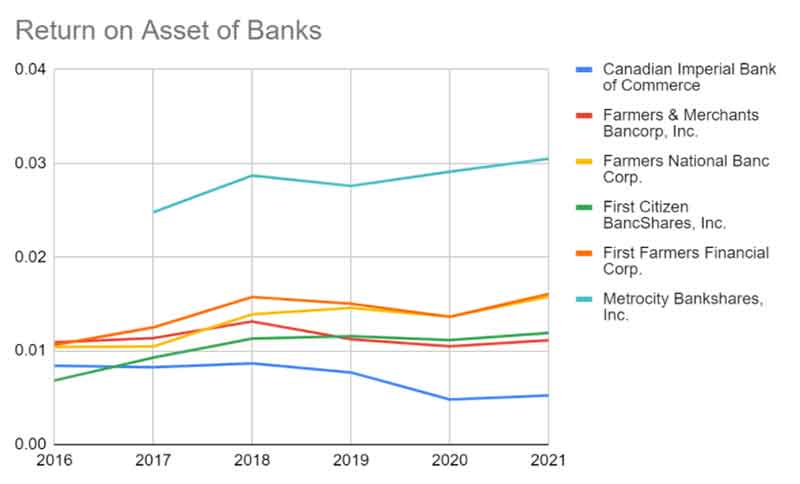
So investors must check the revenues and net income of a bank. They must also assess its size and viability through the total assets and Return on Asset ((ROA)).

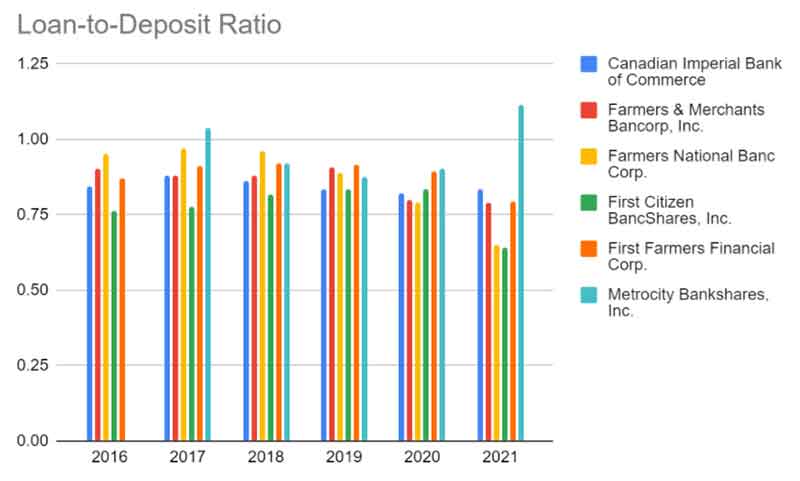
In general, banks have at least $1 billion in assets, so an ROA of one percent is acceptable. Liquidity is also a crucial aspect checked using the Loan-to-Deposit Ratio. Ideally, the ratio should be between 80% and 90%.

Return on Asset of Bank
Taken from MarketWatch
Loan to Deposit Ratio
Taken from MarketWatch

Metrocity Bankshares (NASDAQ: MCBS) has the highest ROA on the graph below. It is the most viable bank, given the income relative to its assets. Yet, its Loan-to-Deposit Ratio is more than 100%. It can be risky now that the economy is reopening and may increase interest rates soon. It may need more reserves if borrowers fail to pay loans. 

Overall, these banks have good viability and liquidity. They can sustain their operations without running out of resources.

Farmers National Banc Corp. (NASDAQ: FMNB) and First Citizen Bancshares, Inc. (NASDAQ: FCNCA) are most careful. Now, their prices remain in a bullish trend. It shows the massive impact of their fundamentals on their stock price performance. 

Watch the Economic and Industry Trends Closely

Watching the economy and industry trends provides you with a broader view of your stock market’s performance. Watch the inflation and interest rate changes since they are macroeconomic indicators. Massive changes in the industry can still affect the price trend and financial performance, so you have to be more careful.

Bitcoin or Altcoins: The Right Choice for Merchants

bitcoin

With cryptocurrencies becoming increasingly popular across the world, more and more merchants are now keen to use it for transactions. However, allowing crypto payments works in a different way than fiat currencies. As such, one of the first things that merchants need to decide is whether they should only allow bitcoins or also permit altcoins. The fact remains that there are pros and cons to both bitcoin and altcoins. So, here’s taking a look at how using either can be beneficial for the merchants. 

Bitcoin 

Bitcoin can be called the leader of the digital currencies in the sense that it has the most prominent name and the largest market cap. As a matter of fact, bitcoin remains at the front line of cryptos making headways in conventional stores. More than 15,175 businesses across the world accept bitcoin. 

It’s clear why bitcoin is the best choice for the stores accepting crypto payments. After all, as per Quantumai Official Website, bitcoin is presently the most popular digital token. It has been the same since the beginning of the crypto movement. 

Also, stores thinking about whether a larger customer pool is going to use that digital token will have their fears addressed by bitcoin. Over 21.2 million adults own and use cryptocurrency in the US. 

Moreover, it has been one of the most resilient currencies in the past months of turbulence in the realm of digital currencies. It tends to improve the perceived approachability of the currency for the merchants. Now, it is also true that bitcoin has managed to preserve its value, which many of its competitors could not. It can be an argument against the incorporation of the currency in conventional merchant payments because investors might not be okay with getting rid of bitcoins owned by them when they think its value is going to rise. 

Altcoins 

Altcoins refer to the big group of cryptos that go more or less under the radar when compared to bitcoins. There are enough reasons to adopt altcoins as well. High volatility, fees, and transaction times related to bitcoin might be a hurdle for several customers who do not want to spend more than necessary for smaller purchases. Altcoins can be the alternative for faster and cheaper transactions. 

The transaction fee of BTC is the highest among all major digital currencies. On the other hand, it is much less in the case of other cryptos. In fact, for alternatives like XRP, the transaction fee is a fraction of bitcoin. 

There are altcoins that also ensure faster confirmation time than bitcoin. For obvious reasons, this appeals to both merchants and customers. Although, on the other hand, altcoins have risks related to being less popular and smaller than bitcoins. Merchants can never completely guarantee whether an altcoin is going to remain popular or viable. 

Some merchants simply accept a wide variety of tokens and don’t even get into deciding between bitcoin and altcoins. Others try to choose between the two options. The fact is that there are pros and cons to the use of both.

Top 6 Strategies Used For Trading In Options

Trading Strategy

An integral part of trading in options is to understand the strategies involved in it. Now, most traders are aware of the puts and calls of trading in options. But there are several other nuanced strategies that can be used. Keeping all of that in mind, Tesler has outlined six strategies below that traders tend to resort to when dealing in options. There are many other complicated strategies available as well, but let that be a discussion for another day. And without further ado, let’s get started. 

  • Call option strategy: 

A call option refers to a contract made between a seller and a buyer to buy a particular stock at a specific price until a set expiration date. The buyer of a call contains the right, though not the obligation, to exercise that call and buy the stocks. 

  • Put option strategy: 

Put option gets you an alternative route by taking the bearish position on an index or security. As the trader purchases a put option, they buy the right to sell their underlying asset at the price mentioned in the option. In this case, the trader does not have any obligation to buy the commodity, stock, or other assets secured by the put. 

  • Married put strategy: 

A lot like the protective put method, the married put is about purchasing an ATM (at-the-money) put option in a specific amount to cover the present long position in the stock. In this manner, it is a lot like the call option. It is even known as a synthetic call at times. 

  • Protective collar strategy:  

With the collar, an investor holding a long position in the underlying asset purchases an out-of-the-money (downside) put option, and at the time, writes an out-of-the-money (upside) call option for that same stock. 

  • Long straddle strategy:  

Purchasing the straddle allows you to capitalize on the future volatility but without the need to take bets on whether this move is going to be on the downside or upside – both the directions are profitable. In this case, the investor takes both a put and a call option at the exact same strike prices and expiration based on the same underlying asset. As it involves buying two at-the-money options, it’s costlier than a couple of other strategies. 

  • Long strangle strategy:  

A lot like straddle, the purchaser of a strangle tends to go long on an out-of-the-money call option, along with a put option, simultaneously. It will come with the same date of expiry, but have separate strike prices: The put strike price is going to be less than the call strike price. 

It involves a lower outflow of premium than a straddle but also needs the stock to go either lower to the downside or higher to the upside to be profitable. 

The endnote 

Regardless of the way you choose to go with options, it is crucial to take your time to understand the strategies. If you do it right, options trading can be more profitable than many people think of.

Learn to Trade Forex The Fast Way – Forex Trading Education

Forex Trading

Forex trading education is vital if you want to join the 5% of forex traders that are profitable and avoid being the 95% of losing traders. 

Now if that sounds attractive to you, and it should be very honest, the question in your head is likely to be “where to learn to trade forex?” and search the answer on the internet or ask a random sample of people is not going to help you.

Why?

Because simply searching “forex trading education” or similar or asking about forex trading education will leave you with the same problem. You will simply be spoiled for choice. 

What will you do when there are way too many forex trading education programs to choose from? And the same goes for funded trader programs.

How will you determine which one is the best one to help you learn to trade forex?

Firstly, you need to vet the company teaching you. What is their plan for their students? How is their teaching structure and how do they hold you accountable? If they have a funding scheme, are they in a rush to get you funded or do they guide you there? How do they work on your trading psychology? 

These are the aspects of their forex trading education you want to vet. However, it will be easy for anyone trying to sell their forex trading education to sell you the world when you speak to them. As the seller, do not be afraid to really grill them and ask tough questions.

Second, you can ask to speak to previous students and current students, both of which can give you a unique insight into the forex trading education you are enquiring about. They already made the investment, so they can effectively act as your independent review of the forex education, not just any review, but a tailored review where you can get the specific information you require. 

With these suggestions, if the forex education provider is reluctant to answer your questions or let you speak to any students, then alarm bells should go off in your head and red flags should pop up. 

On the topic of the second point, you should be concerned if there is no community for previous and current students to keep in touch because that suggests the provider does not want students talking to each other. It makes you question why, and naturally makes you question the principles of the company and the forex trading education you will receive. 

In relation, if they do not wish for you to speak to previous students, it might also indicate that they do not keep in touch with students after they leave the course, in other words aftercare may not exist—this is not something you want when you are learn to trade forex because you continue learning well after you complete a course. 

So, for a good place to learn to trade forex you want to look for the inverse

That is, you want to find a forex trading education provider that will be willing to answer all your questions, including the tough questions. Alongside this, you will want a provider that is happy for you to talk to existing and current students about their experience. In fact, you will often find that the best providers tend to have communities where all their students – prospective, current, and previous – can interact with each other. 

You also want to see how they work on trading psychology. The companies that just want your money will barely work on trading psychology. Usually, you will get some iteration of a self help guru like Tony Robbins, or another self help guru. But that’s about it. However, with a proper forex trading education provider, you will find it is a more tailored experience. 

They will find what is wrong with your individual trading psychology that is holding your forex trading back and work on it. It is an aspect of forex education on its own that is neglected by many forex trading education providers. If you ask a provider what they do about trading psychology and the answer tends to be light or seems randomly put together because you asked (like they were unprepared for the question) then you already know where they stand in relation to that question. 

In the end, you have to assess the forex trading education provider’s talk with their “walk”, so to speak. Does their talk match the suggested checks, do they act like they have something to hide or do they proudly show off their achievements?

Keeping Businesses Afloat Amid the Changing Market Environment

Keeping Business Afloat

The COVID-19 pandemic dug potholes into the business sector’s relatively straight and smooth path. It hampered their drive for growth and put them into the gutter. Limited operations caused supply chain disruptions, massive layoffs, and temporary shutdowns. For two successive quarters, the global economy was in a deep recession. 

Fortunately, businesses are starting to regain their footing and bounce back. Recovery is already within their reach despite the economic issues in large markets. Today, the challenge is how to keep up with the fast-paced new normal trends. This article will look at some tips to stay afloat amid the changing market landscape. 

Adapt to Digital Transformation 

The pandemic coincided with the advent of digital transformation. It was a perfect opportunity for businesses to take advantage of technology. 

When the government heightened restrictions, production and demand became limited. It prompted business owners to adapt amidst their stumbling performance. Technology is fundamental to the survival and success of businesses today. 

Here are some things you can do to adjust to the changing business landscape. 

Increase Online Presence

Going online today appears to be a safer and more convenient alternative. Despite the easing of restrictions, increasing online presence is still a wise move. 

In 2021, there were over five billion internet users, leading to 40,000 searches every second. This massive change had a positive effect on many businesses, especially SMEs. 

Also, 55 percent of internet users searched for business reviews and recommendations. Forty-seven percent went directly to company websites to buy products and services. 

Even those with physical stores did online transactions, increasing store visits by 26 percent. This year, online business transactions remain popular, comprising almost 30 percent of the total. 

These observations show that going online is helpful with or without a brick-and-mortar store. The biggest challenge is how to rise above your millions of competitors. 

Online marketing is another step once you make a business website. But you must think of greater convenience by making payment methods flexible. 

Digitize Payment Methods 

Adopting cashless payment methods is a big step towards business adaptability and growth. Now that many people prefer to stay home, having their items delivered remains normal. Physical and virtual cards and e-payments continue to exceed cash transactions, showing the increased preference for online payments in the last two years. 

Many mature and emerging economies have shifted their attention to new payment methods. For instance, Japan’s cash usage dropped from 79 to 54 percent

Other parts of Asia have shown even lower values, such as Singapore and South Korea at 39 percent and 34 percent, respectively. In the Netherlands, the US, and the UK, cash transactions were only 14 percent, 22 percent, and 23 percent. 

Things will run more smoothly with cashless payment methods. With company credit cards, businesses can easily cover all business-related expenses of employees. It will help them keep track of their finances and transactions. If you adopt this method, you and your accounting staff will not have to check the piles of invoices one by one.

Optimize Workflow

Optimizing workflow helps you keep track of your transactions. Business workflows through technology may help streamline processes. That way, businesses can grow both on the production and consumer side. For the next few years, many expect companies to increase their online presence further. 

Workflow optimization may also lessen the tediousness of tasks and employee burnout. It is crucial, given the continued surge of resignation. Of course, you don’t wish to see your prized employees jump ship. Hiring new ones may be more expensive than investing in the right tools. 

Keep in Touch with Your Customers

You and your employees can identify how the business process goes. But it’s your customers or clients who can tell the quality of your products and services. They can dictate how your business will perform in the market. As such, you must get in touch with them to get their feedback and find more ways to improve. 

Whether starters or seasoned businesses, qualitative surveys are often done. For example, you can do food product surveys in supermarkets. You can also place slips or forms in every room for hotel surveys. You can also get customer feedback through online surveys and phone calls.

The problem with surveys is they can be challenging to quantify at times. Also, they may limit customer responses and overlook other aspects. Touchpoints like Quarterly Business Reviews (QBRs) will help achieve or realign goals. That way, you can determine how much your products affect your customers or their business. 

Today, QBRs are pivotal to programs by the Customer Success team. It makes communication with customers constant and comprehensive. It revolves around the assessment of the value of products and services delivered. And with proper application, this method can boost customer satisfaction and renewal. 

Often, QBR contains product performance reviews and performance assessments for the past quarter. It also discusses the gaps to fill and goals to realign and achieve. From there, you find ways to address the challenges and reach the target. There are templates available online if you want to try them. 

Be Mindful of Your Finances and Economic Changes 

You must keep track of your financial performance and check business reports. Doing this can help you measure your productivity and viability. You can also establish the optimal amount of products and services to produce. Doing so will help you sustain and grow your business. 

Also, watching the economic trends provides a broader view of your potential performance. Massive changes in the industry can affect prices and demand, and financial performance. The economy is still on its way to recovery, so you have to be more careful. Observe the inflation and interest rate movements since they are primary macroeconomic indicators.

Most Compelling Reasons to Attend Concerts in Los Angeles

Concert

People residing in Los Angeles would agree that there is so much to do in this city. You can never run out of options to enjoy life a bit more. Be it a Saturday night that you want to make boozy or want to go for a Sunday brunch with your friends, Los Angeles provides an array of both fast and slow occasions. Since there is so much to do for residents, imagine what it can offer to the tourists. Take out your pen and notepad because we will be discussing the fun things that you should catch here. You can explore the different cafes and restaurants in the city, go partying at night, explore art museums, etc. one thing that is extremely popular here is the concerts in Los Angeles. Different artists visit the city to perform, and there are various reasons why people don’t miss them. We have elaborated some common reasons below. 

Reasons to attend live concerts 

Sense of belonging

Another reason why people attend live concerts in Los Angeles is that they like belonging to a community that shares similar interests. These are generally huge groups of concert attendees who often subscribe to a series of music concerts or come to attend the concerts happening around them. We are talking about the people for whom the experience of enjoying en masse is one main reason for choosing to attend a live show. It’s not only about listening, but you also get like-minded people to discuss and critique the performances, which makes the live show experience much better than enjoying it alone at home or on the radio. 

Burn calories

Now Let’s talk about the benefits that music concerts have on your body. Live shows can directly help you burn calories. How? Well, most concerts happening in the open venue includes a lot of standing, dancing, and jumping. All this can help you burn a lot of calories that otherwise hold onto you when you are sitting on the couch eating potato chips in the name of enjoying a concert. Dancing or jumping at a concert might not be the direct form of exercising, but it is definitely something extra than your normal daily physical activity. You will literally feel your heart rate going wild when you vibe and dance to your favorite song. Well, that’s good news!

Raise your spirits

Every person is energetic and boosted during the daytime. It’s the evening when you feel drained and lost. After a hectic day at work, one can have low spirits. So, nobody minds a little extra boost in their spirits during the evening. Attending a live concert is actually a fun activity, and it can work in your favor to boost your emotions throughout the day, if not longer. People have claimed that they feel a lightness in their spirit for several days after they attended a live music in Los Angeles. The excitement begins from purchasing a ticket to preparing for a show, meeting up with your friends, finally vibing with your favorite artist; all this keeps you high-spirited. After the show is over, you savor the happy memories of the show for several weeks, which again feed your spirit. 

Planned outing

You will have to agree that when you make up plans with your friends, the hardest thing to do is decide what you want to do or where you all want to go. Then comes the part where everyone wants to go for a different activity. Attending a live concert can be an ideal proposal where you can get a “yes” from everyone in the group. Nobody minds a few hours of good music, so it is an ideal planned outing that you can enjoy with your friends or family without fighting over ideas that sometimes even lead to plan cancellation. 

Music concerts are much more than just live entertainment; it keeps your spirits up and helps you connect with like-minded people. 

Emergency Loans for the Unemployed with Bad Credit

Credit-Card

Nowadays, it’s unfortunately relatively easy to lose your job due to a variety of different factors and circumstances, but it is not so easy to find another one quickly. Unemployment also reduces your chances of obtaining a loan dramatically, but that is fortunately not true for all cases. Individuals are still able to get emergency loans without having a job to cover their main expenses while getting their finances back on track. There are various options available for each type of situation, even for those that have bad credit! Bad Credit Loans Personal is an authority resource on all types of loans for bad credit.

Is It Possible to Get an Emergency Loan If You Don’t Have a Job?

Yes, emergency loans for the unemployed are available in the market. Some lenders will consider loan applications even without an income from employment or a job. In most cases you will still be able to get a loan for the unemployed without any difficulty, providing you have an alternative source of income.

What Should I Consider Before Applying for an Emergency Loan without Having A Job?

Being unemployed may cause additional stress when you take out a personal loan. Here are some points you should consider before you get a personal loan while not being employed.

  • Evaluate the risks. It’s always a good idea to decide whether the benefits outweigh the potential danger of a personal loan. You should decide if a personal loan is your best option, and calculate the potential losses you may incur if you are not able to pay it back. We also recommend that you calculate the final payment carefully, including interest rates.
  • Analyze the loan term. It is always best if you perfectly understand any contract you’re signing, including items such as fees, payments, interest rates, and many more. If you are unsure about any of these, ask the lender to clarify them for you as soon as possible.
  • Repaying the money on time. You should carefully calculate if your budget will permit you to repay the loan with interest in the agreed upon time frame. Whether you are taking out a personal loan with a longer repayment term or an installment loan that is paid off in monthly or weekly amounts or a short-term, payday loan, the process will be much easier if you ensure that your bank account can easily handle each payment as it becomes due.

If, after analyzing the points discussed above, you decide to take out the loan, you will be making a literate and safe borrowing decision.

Requirements to be Eligible for an Emergency Loan

Traditional lenders normally evaluate your debt-to-income ratio, annual income, credit score, and payment history when deciding on whether or not to grant the loan, and don’t cater for emergency loans for the unemployed. Online loan facilities for bad credit don’t do the credit report check and require that individuals have American citizenship, be of legal age, provide proof of income, and have an active bank account. Some other criteria may apply depending on the type of loan you want.

In this case, the term “source of income” has to be specified. This may not only be a work paycheck, but many lenders see the following as trusted sources of income that will help you qualify for a loan:

  • Rental property income
  • Alimony
  • Disability payments
  • Partner income
  • Interest and dividends
  • Unemployment benefits
  • Pensions or annuities
  • Social Security income
  • Enough funds in a savings account
  • Child support
  • Inheritance

If you have an alternative source of income that matches any of the above, you’ll probably qualify for a loan. You can also easily get approval for online loans, even if your credit history is bad. Providers of loans to people that are unemployed don’t perform credit checks, so the chance of getting an emergency loan is not bad.

Can I Get a Loan without Presenting Proof of Income?

All lenders need you to present them with some proof of income. This can be from an employment paycheck, or it can be money you receive for pension, alimony, social security funds, child support, or any other income other than traditional wages or salary. If you are not able to provide any of these, you’ll have to find alternative ways of obtaining a loan. 

Secured loans normally don’t require that you provide proof of income as in those cases, you’ll put up some assets as collateral. These types of loans also typically offer lower fees and APR. You should however be aware that secured loan lenders will seize the collateral you put up in the event that you don’t make loan payments as agreed.

Traditional Personal Loan Alternatives While Not Employed

When you don’t have a steady job, traditional lenders like banks will not likely approve you for a loan. There are however various alternatives to traditional loans for the unemployed, which may be more suitable if you require cash for an emergency.

Car Title Loans

A car title loan will provide you with access to emergency funds by using your car as collateral. These loans are handy in that they have minimal criteria for approval; providing you have a vehicle that you can put up as collateral, the chances are good you’ll be approved for a loan even if you have bad credit or don’t have a job. 

The disadvantage is that lenders charge high APR and additional fees for financing these cash loans. If you don’t pay back in the time specified, your car will no longer be yours. 

Home Equity Line of Credit (HELOC)

This line of credit allows you to borrow against your home’s equity. The amount of the loan is calculated by subtracting the outstanding mortgage amount from the amount the property is worth. You will be able to access this money for a pre-determined period. Although this option does not take your income into account, your credit score does play a role as most offers specify that a credit score of at least 680 is required. If you decide to go for this option, be very careful with the repayments as the last thing you want is to end up losing your home.

Payday Loans for the Unemployed

Payday loans are short-term, unsecured loans without paperwork that can be taken quickly and have to be repaid within a month or on your next paycheck. Payday loans for the unemployed use the same terms as online cash loans, with the only difference being the type of income. These loans typically range from $100 to $1,000. Although the exact amount will vary from state to state, it’s easy to get the loan amount if you have an alternative income, and even with a bad credit score. 

Payday loans are easy to get because the whole process is online, you receive a loan decision immediately and the money is deposited into your bank account the next business day. The downsides are however a rather high APR and high fees for late payment.

Credit Card Cash Advances

Credit card cash advances are short-term loans that don’t need a steady income or credit check. This advance is available directly from a credit card as a short-term loan that doesn’t need regular income or a credit check. They are available directly from ATMs, using only your credit card and the three numbers on the back of the card. 

Although this is a very fast way to get a loan without having a job, you should consider the fixed fee for each cash advance, additional costs, and the high-interest rates that credit cards charge.

Is There An Emergency Loan for The Unemployed with a Bad Credit Score?

You can still get a loan even if your credit score is bad, providing you have an alternative income source like money from social security, unemployment benefits, alimony, etc. 

If you use an online loan product, the providers don’t typically perform credit checks, and a bad credit score won’t disqualify you from getting a loan. They usually only look at the source of income you show to verify that you are able to repay the loan on time. If you are able to prove that, you stand a high chance of getting emergency funds.

Although unemployment makes getting a loan more difficult, there are however emergency loans for the unemployed that will work for you!

How Secure is Your Money in Online Bingo?

Bingo

Online bingo is incredibly popular in the modern age, this is a great way for people to relax and spend some time watching the numbers and seeing if their luck is in.

Of course, bingo is a complete game of chance, but some people have managed some big wins on casino sites. The game is huge in some parts of the world, like the UK, but it is a growing market pretty much everywhere where it is legal.

So, how secure is your money in online bingo? If you’re playing online bingo is it safe to leave money in the account and give them your bank details?

Only Give Information When You Are Comfortable Doing So

This is a really good rule to follow whenever you are interacting with a website or service. You should only part with information when you are happy to do so, and confident that the online bingo website is considering your best interests.

The majority of bingo websites are legitimate operations but you shouldn’t assume this to be true without doing some research yourself. While your money is usually safe when playing bingo online, you can’t assume this about every single website out there.

Research the Site

There’s an old saying that “if it sounds too good to be true, it probably is”. This means that if you see an incredible promotion then there is a chance that it is not what it actually appears to be.

Diving into some research will show you if you’re joining a site that is legitimate and licensed, and allowed to operate in the area. Licensing is crucial in any form of online gambling, and if you bet with a licensed provider you can be confident that protection is in place to ensure the following:

  • That the online bingo and games on the site are fair, and not rigged in the favour of the operator.
  • There have been security protocols built in to help secure your details and money.
  • There is some form of support for customers.
  • Banking is all done securely and efficiently.
  • The site isn’t a scam.

You can check before you part with any money if you wish, simply by reaching out to a site you can see if they have a responsive team working with them. Some scam sites won’t even have an option to get in touch.

Google For Scams

We live in the age of the review. You can quickly and easily search the name of a provider or online bingo site and you should do so to get an idea of the kind of experience some other people have had. You don’t have to do too much digging to find some of the spam sites out there and scams that other people have encountered.

Check For a Security Certificate

This is when a website has https:// in front of its domain and it will show as secure in your browser, usually with a little padlock icon. This is a sign that the site has taken some steps to ensure security and has a certificate issued by a third-party. This also means it is harder for hackers to compromise the site and steal your data. If the site doesn’t have this security certificate, you should probably steer clear.

Read The Terms

Websites and apps that offer online bingo should always have published terms and conditions. This gives you an idea of your legal protection and what you are entering into when you sign up for an account. If you aren’t comfortable with them, don’t sign up.

Be Secure in Your Habits

We should really all know this by now, but being secure in your habits and online gambling is the minimum you should do if you want to keep your money safe in online bingo. The majority of trustworthy sites are very safe, but if you don’t protect your details like your username and password you might find your money wasn’t secure after all. Have a secure password that changes frequently, and don’t use the same password for everything. These are some of the basics of cybersecurity, but they are true for online bingo as well as everything else!

China on the Verge of Energy Crisis

China on the Verge of Energy Crisis

By Mr. Chan Kung and Mr. He Jun

The energy crisis, once thought to be out of reach, has recently reappeared gradually around the world, and China too is beginning to face the challenge as well.

Under the pressure of global climate change, the world’s energy sector has begun a large-scale energy transition. As conventional energy sources are becoming “obsolete” and “dirty”, financial institutions are reducing their financing to related companies. With the advent of such changes, oil companies are developing new energy sources. This in turn, has led to a pessimistic outlook for conventional energy such as oil and coal; the fall in oil prices should be a normal manifestation in line with this trend.

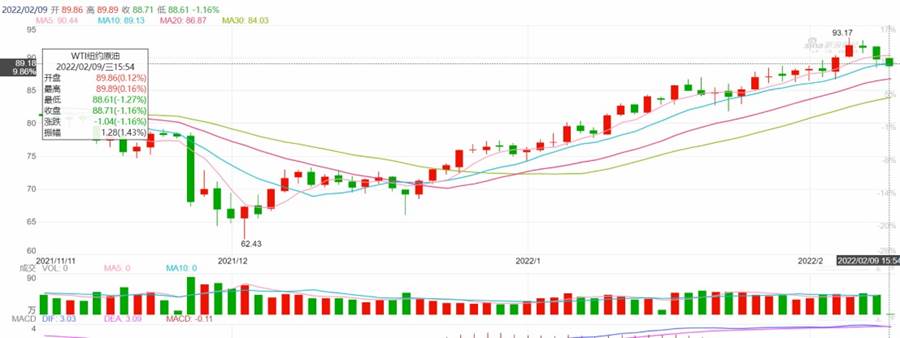
However, under a series of factors, international oil prices have instead seen a sustained rise, almost continuously since last December. WTI crude, for example, rose by as much as 33% in 2 months from USD 67/barrel on December 2, 2021 to USD 90/barrel on February 9, 2022; during the same period, Brent crude rose by 29%.

Figure: U.S. WTI crude rising for nearly two months

figure
Source: Sina Finance.

Since 2021, international natural gas prices have risen to varying degrees, among which European natural gas prices have seen the most significantly rise. As Europe’s energy crisis deepens, the imbalance between supply and demand in the market has caused prices to soar. European wholesale gas prices in February 2022 are 5-6 times higher than in early 2021; electricity prices have soared as a result, with average price in major European countries exceeding EUR 300 per megawatt hour (MWh), compared with less than EUR 50 per megawatt hour in 2019. Gas stocks across Europe are now at just 68% of full capacity, well below the 10-year average. U.S. natural gas prices are also on the rise, with households paying an average of USD 746 to heat their homes in the winter, up about 30% from last year, and those in regions such as the Midwest are likely seeing increases of about 49% year-on-year, the highest on record since the winter of 2008. In parts of Asia, natural gas prices even once jumped fivefold. 

It is important to emphasize that, in addition to the impact of COVID-19 and increased energy demand in the winter, geopolitical factors have played a great role in this round of global oil and gas price increases. In particular, the confrontation between Russia and the United States and Europe over the Ukraine issue has a great impact on the global energy market. Russia has drawn a line in the sand that Ukraine’s membership of NATO would mean war. The U.S. and NATO, on the other hand, insist that it is not up to Russia to decide whether Ukraine joins NATO. While ANBOUND has long ruled out a war between Russia and the United States and Europe over Ukraine, it is a reality for the energy market that tensions in geopolitics are exacerbating risks in the energy market. Josep Borrell, the European Union’s high representative for foreign affairs and security policy, has warned that Europe is facing its most serious security threat since the Cold War.

About 40% of Europe’s gas imports come from Russia, while Gazprom, Russia’s state-owned supplier, sells 70% of its natural gas to Western Europe. The import dependency ratio of Germany, Italy, and nuclear-rich France on Russian gas are 49% 46%, and 24%, respectively, according to data from the European Union Agency for the Cooperation of Energy Regulators (ACER). Europe’s natural gas stocks were 36% of storage capacity as of February 6. The gas shortage comes at a time of renewed tensions between Russia and Ukraine, raising the issue of energy security. The European Union has proposed new rules aimed at improving gas reserves, allowing member states to jointly purchase gas to form strategic reserves. The European Union is also increasingly interested in long-term supply deals, with officials negotiating with Azerbaijan, Qatar, and the United States to secure additional supplies. Russia’s Gazprom has also diversified its customer base with LNG terminals and pipelines to China and Turkey, and plans to undertake more projects. Europe and Russia are working to reduce their interdependence, which could benefit gas exporters in the United States and elsewhere.

The Russia-Ukraine crisis has strengthened the EU’s resolve to enhance energy security. However, changes will only happen slowly, given the time and huge investments needed to switch fuel sources, or to build new pipelines and LNG terminals. This means that a reduction in the EU’s interdependence with Russia on energy supply and demand is unlikely to be achieved in the near future. Shifting geopolitical factors will continue to hit energy markets, particularly Russia’s gas deal with the European Union. Historically, Russia has used its energy exports as a tool to exert political pressure on other countries. Russia cut off gas supplies to Ukraine over a price dispute in 2006 and again after the annexation of Crimea in 2014. In 2009, Russia again cut off supplies to Europe through Ukraine. Energy experts warned that Russia will have to pay a price if President Vladimir Putin “weaponizes” gas supplies to Europe amid rising tensions between Russia and Ukraine.

Researchers at ANBOUND would like to point out that the deterioration of global energy security caused by geopolitical factors will not only affect Russia and the EU, but also affect China due to changes in the global energy supply and demand pattern.

China is the world’s major energy importer, and its crude oil and LNG imports are also the world’s largest. According to energy production and import data released by the National Bureau of Statistics, in 2021, China imported 320 million tons of coal, 512.98 million tons of crude oil, and 121.36 million tons of natural gas, a 19.9% year-on-year jump. In terms of import dependence, China’s import dependency ratio on oil, natural gas, and coal in 2021 was 72.1% (down 1.5 percentage points year-on-year), 45.5% (up 3.3 percentage points year-on-year), and 7.3% (up 0.05 percentage points year-on-year), respectively.

China’s dependence on the international market for oil and gas is so high that it greatly exceeds the energy dependence of EU countries on Russia. China’s dependence on external energy supplies shows the energy supply chain between China and the international market and the risk channel between China and the world in terms of energy security. Once a relatively extreme geopolitical conflict occurs in the current fragile international energy market, the impact of the energy market will ripple through China, regardless of whether China is involved in the conflict.

As the “world’s factory”, China is certainly aware of the importance of energy and mineral resources to a country. China’s 14th Five-Year Plan places great emphasis on the three major areas of economic security facing China, i.e., food security, energy security, and financial security. Among these three areas of economic security, food security and financial security are mainly domestic matters, but the key to energy security lies not in the domestic market but in the international market. To this end, a considerable amount of international resources will be invested in China’s future development to ensure energy security. This also means that energy security will be a long-term “sensitive point” and risk factor for China, and one that can be easily exploited for geopolitical “leverage”.

At present, China is still trying to build a conventional energy security system. Not long ago, during Putin’s visit to China on February 4, China and Russia reached an agreement on energy purchases and sales. Enterprises of the two countries signed an agreement on the purchase and sale of natural gas, making it the second long-term gas supply contract between the two. After setting up the new pipeline, it is expected that Gazprom’s total gas supply to China will reach 48 billion cubic meters per year.

About the Authors

Mr. Chan Kung

Mr. Chan Kung, Founder of ANBOUND Think Tank (established in 1993), Mr. Chan Kung is one of China’s renowned experts in information analysis. Most of Chan Kung‘s outstanding academic research activities are in economic information analysis, particularly in the area of public policy.

Mr. He Jun

Mr. He Jun, Partner, Director of China Macro-Economic Research Team and Senior Researcher. His research field covers China’s macro-economy, energy industry and public policy.

EDITOR'S PICK OF THE WEEK

CFO's new mandate. CFO explaining the presentation

The Performance and Transformation Orchestrator: The CFO’s New Mandate in the Age of AI

By Terence Tse CFOs are evolving into AI-driven transformation orchestrators, balancing finance, technology, and strategy while upskilling teams, managing risks, and driving measurable business value. A key insight from this year’s AI for CFOs event, organized...

WISE DECISION MAKER GUIDE

POWER INFLUENCERS

Emerging Trends

The Future of Global Trade