Australia’s long standing debate over public safety and firearms regulation has returned to the political and business agenda following a deadly shooting that has shaken Sydney and reverberated across the country’s economy and institutions.
Police said the death toll from the attack at Bondi Beach has risen to 15, with 38 people still receiving treatment in hospitals. Authorities confirmed the incident has been declared a terrorist attack and said it deliberately targeted Jewish Australians who had gathered to mark the first day of Hanukkah.
Among those killed was a Holocaust survivor who died while protecting his wife from gunfire, police said, a detail that has deepened national grief and renewed scrutiny of domestic security risks.
Investigators said officers shot and killed a 50 year old man at the scene. His 24 year old son was also involved and remains hospitalized. Police said the older suspect held a recreational hunting license. As part of the investigation, officers have raided a residential property in Sydney linked to the case.
The attack has intensified pressure on the federal government to revisit firearms policy. Prime Minister Anthony Albanese said stricter gun regulations would be placed on the Cabinet agenda, including tighter conditions and time limits on licenses.
From a business and policy perspective, the incident raises broader questions about risk management, public confidence and regulatory oversight. Australia’s strict gun laws, introduced after the 1996 Port Arthur massacre, have often been cited internationally as a benchmark. However, the Bondi shooting has exposed gaps that policymakers now face growing pressure to address.
Tourism operators, retailers and event organizers are also assessing the fallout. Bondi Beach is one of Australia’s most recognized destinations, drawing millions of visitors each year. Industry groups said violent incidents at high profile locations risk undermining consumer confidence and disrupting seasonal activity, particularly during major public holidays.
Jewish community leaders have called for stronger protections around public gatherings, while business owners in surrounding areas reported heightened security concerns following the attack. Analysts note that increased policing and regulatory changes could carry cost implications for local councils and private operators, especially those responsible for large events.
Albanese said the government would act decisively, signaling that further reforms could extend beyond licensing rules. While details have yet to be finalized, the move suggests a renewed willingness to tighten controls in response to emerging threats.
Police said the investigation remains active and urged the public to cooperate as authorities continue to examine evidence and potential motivations. For Australia’s leaders, the coming weeks will test how effectively security policy can balance civil liberties, community safety and economic stability in the wake of one of the country’s deadliest attacks in recent years.
From eating, shopping to commuting, traveling, and managing money, nearly everything we do each day depends on digital platforms. And these online experiences have never felt smoother. They are intuitive, beautifully structured, and remarkably responsive. But how do these seamless digital journeys come to life? What kind of effort lies behind every button, flow, or interaction that feels intuitive the moment you use it?
Behind those platforms are User Experience (UX) designers whose efforts often stay out of view. Among them is Franky Wang, a senior UX designer at JPMorgan Chase. With over 45 million users engaging with Chase’s credit card ecosystem, Wang has helped lead the redesign of the Ultimate Rewards dashboard and other high-impact features that have quietly transformed how people interact with their money.
Born in China, Wang started studying fine art at age eight, eventually earning a degree in Interaction Design from the Central Academy of Fine Arts—one of China’s most prestigious institutions. There, he developed a rigorous foundation in visual composition and design systems. Later, at Parsons School of Design in New York, he expanded that foundation into a global, tech-forward practice, earning a Master of Fine Arts in Design and Technology.
In 2023, Wang led the end-to-end UX redesign of the Chase Ultimate Rewards redemption dashboard. His focus was on streamlining the user journey, clarifying content, and directly addressing known pain points. The results were clear: A 20% increase in click-through rates and a 14% drop in customer service calls. The redesign touched tens of millions of users and made the redemption process easier, clearer, and more trustworthy.
While the process may look simple on the surface, delivering this kind of product requires far more than just visual polish—it demands deep UX expertise, careful listening, and thoughtful execution. Wang’s approach begins with real users. He spoke directly with a wide range of customers, from retirees and recent graduates to young children visiting with their parents. Such in-depth research often uncovers the real needs of users that go beyond what data alone can reveal.
Turning those insights into effective design takes precision. Wang is known for pixel-perfect execution, meticulous documentation, and inclusive collaboration across teams. He combines empathy with craft, and reflects that in both user-facing experiences and internal workflows. That balance is what makes his design solutions consistently strong. “These moments reminded me that inclusive design isn’t about checking boxes,” Wang reflects. “It’s about truly seeing the people you design for, and expanding your sense of who they are.”
Moreover, large-scale projects like this rarely unfold smoothly. Under tight timelines and with limited resources, Wang didn’t wait for conditions to improve. Instead, he proactively explored multiple design directions and personally led rapid user testing to validate decisions. The project launched on time and met expectations—a testament to his adaptive thinking and ability to lead through ambiguity.
“I see UX design as a meaningful bridge between technology and human experience,” Wang explains. “You begin with user needs, but you don’t ignore business goals or technical constraints. I treat those as design parameters, not obstacles.”
That mindset came into play during enhancements to the cash-back redemption flow on Chase’s platform. Faced with a common tension—users wanted a quick, simple process, while the business needed to manage operational costs—he proposed a solution that was both thoughtful and effective. He introduced a pause moment just before final redemption, encouraging users to consider higher-value alternatives such as gift cards or point transfers. Many users chose these options willingly, leading to higher satisfaction and better alignment with the company’s goals. It was a clear demonstration of how thoughtful UX design can create measurable value for both users and the business.
Franky Wang’s work may not come with a spotlight, but its impact is unmistakable. Every click, pause, and interaction he touches carries his quiet intent: that the design should serve the user, not the other way around. In a world increasingly defined by digital complexity, his mission remains refreshingly simple—to make the online world feel more human, one experience at a time.
Imagine a world where your organization not only keeps pace with technological disruption but actively shapes it. A world where innovation isn’t a buzzword but a daily practice, fueled by a relentless pursuit of new ideas. This isn’t science fiction; it’s the reality achievable by cultivating a culture of experimentation, especially when it comes to harnessing the transformative power of Generative AI (Gen AI).
Simply deploying Gen AI tools is like buying a high-performance sports car and leaving it in the garage. To truly unleash its potential, you need a culture that embraces risk management, overcomes challenges, celebrates learning, and relentlessly pushes the boundaries of what’s possible.
Why Gen AI Experimentation is the Engine of Success
Gen AI, with its ability to generate text, images, code, and more, is revolutionizing industries. Yet, realizing its full potential requires more than just adopting the latest algorithms. It demands a fundamental shift in how organizations operate.
Traditional, efficiency-driven models must give way to a mindset that prioritizes learning, discovery, and constant adaptation. Experimentation becomes the engine of this new approach, enabling organizations to navigate the inherent uncertainties of Gen AI and unlock its transformative power.
This necessitates a cultural transformation where experimentation isn’t merely tolerated but actively encouraged and woven into the fabric of the organization.
This necessitates a cultural transformation where experimentation isn’t merely tolerated but actively encouraged and woven into the fabric of the organization. It requires dismantling the pervasive fear of failure and replacing it with a growth mindset that embraces calculated risks as essential stepping stones to innovation.
Leadership is the linchpin of this cultural transformation. Leaders must not only endorse experimentation but actively champion it, signaling to every employee that creativity, curiosity, and the pursuit of new ideas are not just welcomed but essential for future success. This isn’t about issuing occasional memos about the importance of innovation; it requires a sustained commitment to embedding experimentation into daily operations.
Leaders must embody this behavior themselves, taking calculated risks in strategic decisions and openly acknowledging and learning from setbacks. This sends a powerful message that experimentation is a core value, not just a mandate for designated innovation teams. Leadership behaviors, communication, and decision-making processes must consistently reinforce the importance of experimentation in driving competitiveness and uncovering new opportunities.
Conquering the Fear of Failure in Gen AI Experimentation
One of the biggest obstacles to a culture of experimentation is the ingrained fear of failure. Many organizations operate under a risk-averse paradigm, where mistakes are viewed as costly errors rather than valuable learning experiences.
This mindset stifles innovation, particularly in the dynamic realm of Gen AI, where iterative development and continuous improvement are paramount.
To overcome this, leaders must actively reframe experimentation as a necessary pathway to growth. This involves creating a psychologically safe environment where employees feel empowered to test new ideas without fear of negative consequences. It also means celebrating both successes and failures, recognizing that even unsuccessful experiments provide invaluable insights that can inform future endeavors.
This iterative approach is especially crucial for Gen AI projects. These solutions often require multiple iterations, each yielding new data and learnings that refine models, processes, and even overall business strategies. By embracing iteration and viewing each experiment as a learning opportunity, organizations can maximize their Gen AI investments.
Simply encouraging experimentation in principle is insufficient. Organizations must establish tangible systems and processes to support it. This might include:
Dedicated innovation labs or sandboxes: Providing physical or virtual spaces for employees to experiment with Gen AI tools and technologies.
Formalized idea submission platforms: Creating clear channels for employees to submit their ideas and receive timely feedback.
Cross-functional innovation teams: Assembling diverse teams from different departments to collaborate on Gen AI projects and bring diverse perspectives to the table.
Internal hackathons or innovation challenges: Organizing events that encourage rapid prototyping and experimentation with Gen AI solutions.
Knowledge-sharing platforms: Establishing repositories for documenting experiments, sharing learnings, and fostering a culture of continuous improvement.
These systems should ensure that experimentation is accessible to all employees, regardless of their role or department. A truly innovative culture is one where ideas and experimentation are democratized.
The value of experimentation in Gen AI initiatives cannot be overstated. Gen AI technologies are inherently iterative: each test or trial generates new data points that can enhance the accuracy of algorithms, improve process efficiency, or reveal unexpected insights.
This iterative learning is the cornerstone of successful Gen AI implementation, continuously improving the technology’s capabilities and aligning it more closely with business objectives.
Furthermore, experimentation enables organizations to remain agile in the face of rapidly evolving Gen AI technology. With new tools, techniques, and algorithms constantly emerging, organizations with a culture of experimentation are better equipped to adapt, test, and integrate these advancements.
Client Case Study: Revitalizing a Mid-Sized Logistics Company
I recently consulted with a regional logistics company struggling to optimize its complex delivery routes and manage its large fleet of vehicles. The company was interested in exploring Gen AI for route optimization but lacked a culture of experimentation.
The company was interested in exploring Gen AI for route optimization but lacked a culture of experimentation.
Working closely with the company’s leadership, I helped them implement a structured approach to experimentation. We established a small, cross-functional team dedicated to exploring Gen AI solutions for route optimization. This team was given the freedom to experiment with different algorithms and data sets, with clear metrics for success and a safe space to learn from failures.
Within six months, the team developed a Gen AI-powered route optimization system that resulted in a 15% reduction in fuel costs, a 10% improvement in on-time deliveries, and a 5% decrease in overall delivery time.
More importantly, the company developed a more agile and innovative culture, better prepared to embrace future technological advancements. This success cascaded into other areas, with teams adopting more data-driven and experimental approaches to other business challenges.
Embracing the Future of Gen AI Experimentation
Cultivating a culture of experimentation is not just a desirable trait for organizations in the age of Gen AI; it’s a necessity. It requires a fundamental shift in mindset, driven by visionary leadership, a focus on mitigating risk, and a commitment to iterative learning.
By building the right infrastructure and empowering employees to experiment, organizations can unlock the transformative power of Gen AI and position themselves for long-term success in an increasingly competitive landscape. This is not just about adopting new technology; it’s about building a culture that thrives on innovation and embraces the future.
Reddit has launched a legal challenge against Australia’s new under-16 social media restrictions, arguing that the policy undermines free political expression and places broad obligations on platforms with global reach. The filing, submitted to the High Court on Friday, marks the second major attempt to overturn the law since it took effect on December 10.
In its application, Reddit described the measure as “invalid on the ground that it infringes the implied freedom of political communication,” according to the court document signed by lawyers Perry Herzfeld and Jackson Wherrett. The case names the Commonwealth of Australia and Communications Minister Anika Wells as defendants.
A spokesperson for Wells said the government would “stand firm to protect young Australians from experiencing harm on social media,” but declined to comment further as the case proceeds. Canberra has previously signaled that it is prepared to defend the legislation against any challenge.
Australia became the first country to enforce a legally binding age threshold for social media access, requiring platforms to keep out users under 16 or face penalties that can reach A$49.5 million. Major companies including Instagram, YouTube, TikTok and Reddit contested the proposal for more than a year before ultimately agreeing to comply. Underage users and their guardians are not subject to fines.
Technology firms say they are relying on tools such as age inference, which assesses likely age based on online behavior, and age estimation using selfies, to meet the requirements. Yet Reddit warned in a public statement that the law “carries some serious privacy and political expression issues for everyone on the internet” and confirmed that it is seeking a full review by the High Court.
The 12 page filing argues that blocking users under 16 restricts their ability to participate in early political discussion, noting that “Australian citizens under the age of 16 will, within years if not months, become electors.” The company said those future voters need access to online forums to help shape their views before adulthood.
This action follows a separate challenge filed last month by two teenagers supported by a libertarian state lawmaker, with a hearing scheduled for February. A person familiar with Reddit’s case said the company has no plans to join other parties contesting the ban.
Short answer: it depends on your goal. If you value steady session time and predictable swings, sticking with one suitable game can help. If you’re chasing variety, features, or bonus timing, moving around can make sense. What doesn’t change is the underlying math – RTP and volatility – so pick games whose profiles match how you like to play.
At Canadian online casino sites like Zodiac Casino, Luxury Casino, Captain Cooks Casino, and Grand Mondial Casino, you’ll find both steady, low-to-medium volatility slots and high-volatility options. These fully licensed brands offer over 1000 titles, including Casino Rewards exclusives, and run the highest available RTP versions where multiple certified configurations exist.
How the math affects your choice
RTP (Return to Player): Higher RTP helps over the long run. Whether you stay or switch, the expected return is driven by each game’s RTP.
Volatility (variance): Low/medium volatility tends to deliver smaller, more frequent hits – good for longer sessions on one game. High volatility can mean long dry spells with occasional big pops – often better paired with moving around between attempts.
Streaks: Slots use certified RNGs; “hot” and “cold” streaks happen, but they aren’t predictable. Switching doesn’t reset odds; sticking doesn’t make a bonus “due.”
When staying on one slot makes sense
You like low-to-medium volatility and steady entertainment time.
You’ve learned the game’s features and bonus cadence, and you want to maximize those mechanics.
Example picks (steady, feature-forward):
Casino Rewards Hyper Star
Casino Rewards Gold Blitz Ultimate
Enchanted Oceans
Cash N’ Rewards – Megaways (feature variety with chain potential)
When moving around makes sense
You prefer high-volatility shots and want to sample different feature sets.
You’re targeting games with distinct bonus styles (hold-and-win, expanding symbols, Megaways).
Example rotation ideas (bigger swings, variety):
Mega Vault Millionaire
Casino Rewards Mega Money Wheel
Immortal Creatures
Massive Gold Rewards
A middle path: structured rotations
Set a session plan: pick one “anchor” slot for 60–70% of spins, then rotate 2–3 “satellite” games for the remainder. This gives you familiarity plus variety without constant hopping.
Sample rotation plans using Casino Rewards exclusives
Balanced session (moderate swings)
Anchor: Casino Rewards Hyper Strike
Satellites: Book of Rewards, 9 Max Rewards, Rewards City
Feature hunter (frequent bonus checks)
Anchor: Casino Rewards Gold Blitz Ultimate
Satellites: Casino Rewards Mega Money Wheel, Stellar Jewels Rewards Power Combo, Rising Casino Rewards
High-volatility chase (bigger but rarer peaks)
Anchor: Mega Vault Millionaire
Satellites: Roar of Thunder, Casino Rewards Midnight Assassin, Casino Rewards Millionaires Club
Choosing by mood and time available
Short sessions (under 20 minutes): Choose one familiar, medium-volatility game and stick with it (e.g., Hyper Star or Enchanted Oceans).
Long sessions: Start anchored on a steady title, then rotate to a high-feature slot to break up variance (e.g., Gold Blitz Ultimate → Cash N’ Rewards – Megaways).
Variety-first nights: Build a loop of four distinct mechanics (e.g., Mega Money Wheel → Immortal Creatures → Rewards City → Stellar Rewards 7’s).
Where to play
You can find these Casino Rewards exclusive titles at fully licensed Canadian brands like Zodiac Casino, Luxury Casino, Captain Cooks Casino, Grand Mondial Casino, Yukon Gold Casino, Casino Classic, and Golden Tiger Casino. These casinos run the highest available RTP versions where multiple certified configurations exist and support smooth mobile and desktop play.
Is it best to play the same slot machine or move around
Staying put is best for familiarity and steady pacing, especially on low/medium volatility titles.
Moving around suits players who want diverse features or higher-volatility shots.
A planned rotation blends both approaches and can make sessions feel more consistent without giving up variety.
Pick a style, match it to the volatility you enjoy, and favour games with strong feature sets from the list above to keep sessions engaging.
As digital transactions become increasingly embedded in global commerce, organisations are reassessing how financial systems should function in a more interconnected and technology-driven economy. Traditional payment infrastructures—built on layered intermediaries, regional limitations, and multi-day settlement cycles—are facing growing pressure to adapt. In this evolving environment, blockchain payment processing is emerging as one of the most significant technological shifts, offering an alternative model based on transparency, decentralisation, and operational efficiency.
The demand for faster, borderless, and more autonomous payment systems has accelerated across industries ranging from e-commerce to SaaS platforms and remote-first organisations. This shift has encouraged business leaders to explore how blockchain-based payment rails can provide improvements to speed, reliability, and security while aligning with long-term digital transformation strategies.
Understanding Blockchain Payment Processing
At its core, blockchain payment processing refers to the use of distributed ledger networks to send, receive, and verify payments without reliance on traditional financial intermediaries. Unlike bank-based systems, where central entities manage authentication, routing, and settlement, blockchain transactions are recorded across decentralised networks, allowing participants to transact directly.
This reduces the friction typically found in legacy systems and allows payments to be settled globally within minutes—or even seconds—at any time of day. The model appeals particularly to businesses operating internationally, where traditional cross-border transfers often introduce delays, unpredictable fees, and compliance bottlenecks.
As blockchain adoption expands, organisations increasingly recognise that on-chain payment systems offer not only technological innovation but also a structural rethinking of how financial operations can be managed in a digital economy.
Why Businesses Are Embracing Blockchain-Based Payments
Several factors are driving the rapid adoption of blockchain payment processing in corporate and institutional environments:
1. Speed and Global Reach
Traditional bank transfers may require days to settle, especially across borders. Blockchain networks process payments in near real time, enabling companies to move funds quickly and maintain operational agility.
2. Reduced Dependence on Intermediaries
Conventional payment chains involve banks, processors, and compliance layers that can delay transactions. Blockchain removes many of these intermediaries, allowing businesses to interact directly with the network.
3. Enhanced Transparency and Security
Each blockchain transaction is recorded immutably, improving auditability and reducing the risk of fraud. Cryptographic verification also strengthens transaction integrity.
4. Lower Operational Costs
With fewer intermediaries involved, organisations often see reductions in transaction fees, chargeback risks, and currency conversion losses.
5. Compatibility With Digital-First Business Models
Remote teams, online platforms, decentralised applications, and global marketplaces increasingly prioritise financial tools that operate 24/7 without institutional constraints.
Given these advantages, blockchain-based payments are not merely a convenience but a strategic asset for companies seeking resilient, borderless financial infrastructure.
Practical Applications Across Industries
Businesses are deploying blockchain payment processing in several high-impact areas:
Global payroll for distributed teams
E-commerce payments in regions with limited banking infrastructure
Subscription billing for SaaS platforms
Treasury operations using stablecoins
On-chain transactions for Web3 ecosystems
These use cases highlight the versatility of blockchain payments and their growing relevance across diverse operational models.
Navigating Challenges and Operational Considerations
Despite its advantages, blockchain-based payment infrastructure introduces considerations that organisations must manage effectively. Private key security is essential, as decentralised systems place responsibility directly on the user. Regulatory requirements may vary by jurisdiction, and companies must implement internal controls to stay compliant. AML risk assessment also remains an important operational requirement, even when platforms do not mandate traditional identity verification.
These factors underline the need for tools that combine decentralised architecture with features that support secure, compliant business operations.
BitHide as an Example of a Secure Non-Custodial Blockchain Payment Solution
One platform illustrating this new category of infrastructure is BitHide, a non-custodial, self-hosted software solution designed for blockchain payment processing.
BitHide enables businesses to manage digital assets and payment flows while maintaining full control over private keys and operational processes. The solution is installed on the client’s own infrastructure, ensuring that all funds and data remain under their control.
BitHide provides:
multi-wallet management for operational and treasury structures
automated and manual payment handling
API-based integration for business workflows
flexible configuration of payment and withdrawal processes
These capabilities demonstrate how non-custodial infrastructure can support secure, automated, and scalable blockchain-based financial operations for modern businesses.
The Future of Blockchain-Based Payments
As global financial systems continue to evolve, blockchain payment processing is poised to become a foundational component of modern business infrastructure. Its ability to support fast, secure, and borderless transactions aligns with long-term trends in digital commerce and decentralised finance.
While challenges remain, businesses increasingly view blockchain-enabled payments as a practical solution—not merely a technological experiment. With platforms such as BitHide contributing to the ecosystem, the shift toward decentralised payment rails is expected to accelerate, reshaping how organisations manage digital assets and financial operations in the years ahead.
Japanese businesses are entering 2026 with heightened anxiety over diplomatic strains with China and uncertainty surrounding U.S. trade policies, according to a Reuters survey published Thursday. Relations between Tokyo and Beijing have worsened since Prime Minister Sanae Takaichi suggested last month that a hypothetical Chinese attack on Taiwan could trigger a Japanese military response.
When asked about the most pressing issues for next year, 25 percent of survey respondents pointed to tensions with China, while 22 percent highlighted U.S. trade regulations. Both nations remain critical trading partners and suppliers of rare earth minerals, essential in sectors ranging from automobiles and electronics to defense technology.
Recent incidents have amplified these concerns. Japan reported that Chinese fighter jets targeted radar at Japanese military aircraft, an assertion China denied. Despite geopolitical worries, corporate sentiment on earnings is relatively optimistic. About 40 percent of companies expect growth in the fiscal year starting April 1, citing the ability to pass on rising costs and continued demand for semiconductors.
Roughly 33 percent of respondents forecast single-digit earnings gains, and 7 percent anticipate double-digit increases. In contrast, 14 percent expect a decline, while 46 percent predict earnings will remain largely unchanged. A transportation firm executive noted, “The cost of labour and other expenses are rising, but passing on costs through prices has enabled us to secure profit.” Electronics manufacturers credited robust chip demand for their positive outlook.
Industry analysts at World Semiconductor Trade Statistics project the global semiconductor market, driven by artificial intelligence demand, will grow over 26 percent to reach $975 billion in 2026.
The survey, conducted by Nikkei Research for Reuters between November 26 and December 5, reached 494 companies, with 236 responding under conditions of anonymity. Two-thirds of respondents supported Prime Minister Takaichi’s proposal to relax the annual primary budget balance as a fiscal consolidation target, describing the move as prudent. The adjustment aims to allow more flexible multi-year spending while easing strict commitments to fiscal tightening.
“Although we might see interest rates go up as a result, we would welcome the possibility of it creating a flow of funds to necessary investment,” said a representative from a non-ferrous metals firm. Japan’s debt exceeds twice the size of its economy, making fiscal management a longstanding challenge.
Currency expectations show further caution. About 55 percent of respondents anticipate the yen will trade between 150 and 160 per U.S. dollar in 2026, while 41 percent forecast a firmer range of 140 to 150 yen. Companies appear to be balancing optimism about domestic growth with the reality of geopolitical and financial pressures.
Last week, the Trump administration released its new national security strategy. It was quickly condemned by the neoconservatives. Perhaps because it is more realistic about multipolarity.
For months, Pentagon officials had been working on a new national security strategy (NSS) proposing the Trump administration prioritize protecting the homeland and Western Hemisphere over the neoconservatives’ “China threat.”
The more these allies and partners share the burden, the more Pentagon’s defense contracfors stand to profit.
It is a striking reversal from the military’s years-long mandate to focus on the “threat from China,” ever since the Obama-Clinton “pivot to Asia.” The new NSS, developed by the Trump loyalists, largely overturns the focus of the first Trump administration’s 2018 National Defense Strategy, which placed deterring China at the forefront of the Pentagon’s efforts.
Leading the NSS drafting, Elbridge Colby, the Pentagon’s policy chief, played a key role in writing the 2018 version during Trump’s first term. Despite his long track record as a China hawk, Colby aligned with Vice President JD Vance on the desire to disentangle the U.S. from foreign commitments.
The new NSS conflicts with the massive needs of the colossal U.S. military-industrial complex, which has fueled America’s costly, deadly and counter-productive wars since September 11, 2001, with more than $8 trillion in costs and millions of dead and wounded.
Colby with South Korean Deputy Defense Minister Cho Chang-rae in May 2025. Source: Wikimedia
Eclipse of American interventionism?
The NSS focuses on great-power competition and domestic renewal, rather than promoting democracy, global institutions, or an expansive U.S. role in nation-building.
As opposed to the Democratic administrations and most Americans who see climate change as a major strategic risk, the Trump NSS notably omits extreme climate as a national security threat. That’s its gravest mistake.
The Trump NSS also marks a significant shift from the post-Cold War consensus of both Republican and Democratic administrations. It treats alliances as transactional instruments and calls for real burden-sharing, critiquing allies for “free-riding” on U.S. defense spending.
This skepticism about neoconservative interventionism is highly objectionable to those interests that tout America’s continued entanglements in international affairs. Typically, U.S. media outlets like The Atlantic, a longtime champion of transatlantic economic and military cooperation, dismissed the document as “incoherent babble,” full of “sycophancy, lies, inconsistencies, and grotesque self-contradictions”.
Typically, too, the author, Eliot A. Cohen, is a veteran of the U.S. Department of Defense and intelligence community, worked under the neoconservative apostle Paul Wolfowitz and was the co-founder of the Project for the New American Century (PNAC), the champion of the 2003 U.S. invasion of Iraq.
The NSS implications vis-à-vis Europe, Japan
The Trump NSS explicitly criticizes European allies as facing “civilizational erasure” due to immigration and “anti-democratic restrictions.” Hence, the drastic tsunami of its rightful condemnations across Western Europe.
The NSS emphasis is on Europe becoming self-reliant for its defense, with warnings that the US might not honor collective security commitments unless allies meet specific spending targets. The strategy emphasizes “burden shifting” and a rebalancing of economic relationships.
In May, Colby told British officials that the United States wanted the British Armed Forces to focus less on the Indo-Pacific and more in the Europe. In the view of NSS, the UK’s job is to focus on Europe, not Asia.
The U.S. expects Japan to take on more of the defense burden in the Indo Pacific. Hence, the U.S.-Japan alliance is moving away from the consistent postwar pattern of U.S. leadership and security guarantees that did not always require strict reciprocity from allies. They were generous and their time is now over.
NATO as a cashcow
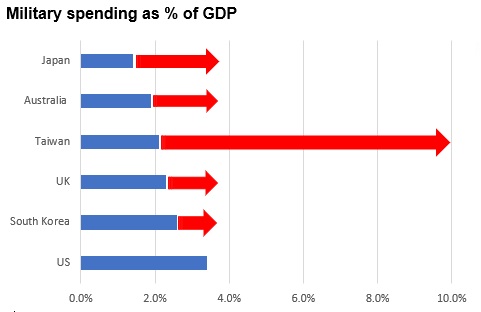
In June, Colby pushed for the Department of Defense to launch a review whether to scrap the AUKUS agreement with Australia and the UK. Colby also pushed for Japan to increase its military spending to 3.5% of its GDP, which led Tokyo to cancel a meeting between U.S. secretary of state Marco Rubio and defense secretary Pete Hegseth, and their Japanese peers.
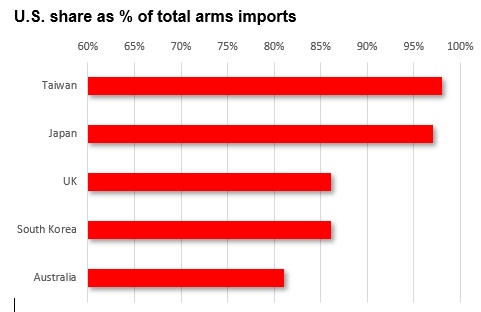
These burden-sharing objectives are consistent with the NSS that allows the Trump administration to pressure its NATO allies and non-NATO partners alike to engage in greater military spending. But the goals are also shrewd. They will profit the U.S. and weaken its allies and partners. Washington provides 98% of arms supplies to Taiwan; 97% to Japan; 86% to the UK and South Korea, respectively; and 81% to Australia.
Source: SIPRI, author
The more these allies and partners share the burden, the more Pentagon’s defense contracfors stand to profit. It is a multibillion-dollar racket. Since the U.S. is the greatest supplier of its allies and partners, the burden-sharing is very much in the interest of U.S. economic primacy and efforts to regionalize conflicts away from America.
To allies and partners, it’s a double-whammy. They pay the bill and they shoulder the risks. Consequently, the deals must be sold with misguided patriotism and inflated threats.
Views from Russia and China
Some analysts agree that the emphasis on fiscal constraints and a return to the Monroe Doctrine in the Western Hemisphere are overdue shifts.
Perhaps that’s why reactions have been somewhat different in Russia, where analysts have been highly positive about the new U.S. strategy, with Kremlin officials stating it aligns with Moscow’s own worldview.
Despite the assertive rhetoric on Taiwan, the NSS’s explicit declaration of U.S. preference for non-interference in other nations’ affairs, respect for state sovereignty and prioritization of the Western Hemisphere might indicate a shift in regional focus.
Colby advocates for the U.S. to shift its military planning and resources to prepare for a conflict over Taiwan. Last March, he confirmed his intention to increase U.S. military resources in the Indo-Pacific and called on Taiwan to nearly quintuple its defense budget to 10% of GDP.
Blue: Military spending of US NATO allies and major non-NATO partners in 2024 Red: U.S. preferences of their level of military spending Source: SIPRI, author
However, Colby has also called for the destruction of TSMC, the Taiwanese semiconductor giant and one of the world’s most valuable semiconductor conglomerates, to keep it out of Chinese control should Chinese military forces capture Taiwan.
In contrast to the neoconservatives, Colby rejects cartoonish accounts of the Chinese Communist Party and sees China as a rising power. As a nationalist realist, he supports efforts for a “genuinely mutually advantageous economic relationship” with China.
Reconciliation with multipolarity
Trump’s NSS could, in some aspects, be reconciled with a multipolar view of the world, though its ultimate goal is still American preeminence.
The NSS acknowledges the existence of powerful great power competitors like China and Russia and focuses on managing competition with them, which aligns with the multipolar reality.
The “America First” approach rejects traditional unipolar primacy. Its emphasis on strategic restraint and burden-sharing implicitly accept that U.S. resources are not limitless.
Transactional engagement that deals with nations as they are, rather than trying to change them, is more suited to a multipolar system where various powers assert influence based on their own interests.
Its emphasis on strategic restraint and burden-sharing implicitly accept that U.S. resources are not limitless.
Interestingly, some of these views could be reconciled with those of the Democratic progressives. The greatest difference between the two centers of global cooperation versus nationalism. Nonetheless, both stress the primacy of domestic and economic issues – a common denominator to many American lower-middle class and laboring poor wavering between Trump and democratic leaders in recent elections.
Most importantly, there is a partial overlap in a shared restraint against and skepticism toward interventionism, as reflected by “forever wars” and military over-extension.
Continentalism déjà vu
There is a deep affinity between the Trump NSS and progressive ideas on continentalism, as envisioned by America’s pre-eminent prewar historian Charles A. Beard, a leading proponent of non-interventionism.
Beard advocated “American Continentalism” arguing that America had no vital interests at stake in Europe.
The core affinity between Beard’s continentalism and the Trump NSS is the shared emphasis on prioritizing domestic interests while avoiding foreign entanglements and alliances.
Both doctrines promote a foreign policy rooted solely in the tangible, immediate U.S. interests, including “non-intervention in Europe.” In both, foreign policy has an inherent economic subtext and must serve the nation’s economic well-being.
There is more to the Trump NSS than meets the eye. It features longstanding strains of American thinking, including progressive ideas, that could be modified with 21st century ideas of multipolarity.
The original commentary was published by China-US Focus on December 10, 2025.
Dr Dan Steinbock, an expert of the multipolar world, is the founder of Difference Group and has served at the India, China and America Institute (US), Shanghai Institute for International Studies (China) and the EU Center (Singapore). For more, see https://www.differencegroup.net/
Growing tensions between Washington and its European allies are reshaping the geopolitical landscape, creating new strategic openings for Moscow as it seeks to weaken support for Ukraine. Statements from the White House, combined with a recently issued national security strategy, have triggered concern across European capitals and created fresh leverage for Russia in an already volatile information environment.
The latest friction stems from comments made by US President Donald Trump, who sharply criticised European governments for their immigration policies and labeled them “weak” and “decaying.” He argued that Russia holds the “upper hand” in its war on Ukraine and urged Ukrainian President Volodymyr Zelensky to “start accepting things” in negotiations. “He’s going to have to get on the ball and start accepting things, you know, when you’re losing,” Trump said in an interview.
These remarks came shortly after Washington released a national security strategy that faulted “European officials who hold unrealistic expectations for the war.” The document claims that those leaders are blocking a viable path toward a peace deal and argues that “a large European majority wants peace, yet that desire is not translated into policy, in large measure because of those governments’ subversion of democratic processes.”
Berlin responded swiftly. German Chancellor Friedrich Merz challenged the assertions, saying the strategy contained elements that were “comprehensible,” others that were “understandable,” but also parts that were “unacceptable to us from a European perspective.” He stressed that Europe does not require Washington’s guidance to “save democracy.”
While the statements have strained trans Atlantic relations, they have been welcomed in Moscow. Kremlin spokesman Dmitry Peskov praised the strategy, calling it “consistent with our vision,” and later noted that “the nuance we see in the new concept certainly appeals to us. It speaks of the need for dialogue and building constructive, good relations.”
Russian officials and figures close to the Kremlin have seized on the moment. Kirill Dmitriev, CEO of the Russian Direct Investment Fund, amplified Trump’s remarks on X and highlighted the warning that “Europe has to be very careful” and that it “is going in some bad directions … very bad for the people.” His posts echoed Trump’s comments following the European Union’s 140 million dollar fine against X for violating content rules. Elon Musk responded by calling for the abolition of the EU.
Despite Russia’s own record of suppressing opposition and blocking platforms such as Facebook and X, Moscow continues to weaponise Western debates to undermine European unity. Analysts see a deliberate strategy aimed at eroding EU support for Kyiv and raising doubts about NATO’s cohesion.
This dynamic has become familiar. Earlier in the year, European officials reacted with shock when US Vice President JD Vance criticised Europe at the Munich Security Conference. Russian state media celebrated those remarks, just as it celebrated harsh statements directed at Zelensky during his White House visit.
This week, Zelensky has been traveling across Europe to secure commitments from the United Kingdom, France and Germany, as well as key institutions in Brussels. Yet Russian messaging has intensified in parallel. Hardline political scientist Sergey Karaganov stated in a broadcast interview that Russia was “at war with Europe, not with a miserable, pitiful, misled Ukraine.” He added that the conflict would continue “until we smash Europe, morally and politically.”
Such rhetoric mirrors more formal warnings from the Kremlin. Before meeting Trump’s envoys Steve Witkoff and Jared Kushner in Moscow, President Vladimir Putin declared that Russia was prepared for confrontation if necessary. “We are not planning to go to war with Europe. I have already spoken about this a hundred times, but if Europe suddenly wants to go to war with us and starts, we are ready right now,” he said.
The combination of Washington’s harsh criticism of European policy and Russia’s aggressive posture has alarmed analysts who track trans Atlantic stability. For European business leaders and policymakers, the widening divide raises questions about future coordination on sanctions, defense spending and energy security. As diplomatic tensions escalate, the geopolitical uncertainty risks shaping investment decisions and long term economic planning across the continent.
Imagine a new technology poised to transform your organization — but its success hinges not only on the technology itself but on how effectively it’s communicated. That’s the reality for companies adopting Generative AI (Gen AI).
As organizations navigate the complexities of integrating these powerful tools, one truth becomes clear: communication is not an afterthought; it is the linchpin. Relying solely on emails or a single communication method risks leaving employees confused or disengaged. To bring everyone on board, leaders must employ a multi-channel communication strategy tailored to diverse preferences, fostering clarity, trust, and excitement.
Meeting Employees Where They Are on Gen AI Transformation
Employees process information differently. A one-size-fits-all approach won’t cut it. For some, face-to-face interactions or virtual meetings offer the best format for engaging directly with leadership. These sessions allow for real-time clarification and active participation.
Self-service portals empower employees to find answers on their own, reducing confusion while reinforcing transparency.
Picture an employee curious about how Gen AI will affect their role: an open dialogue in a meeting provides not only answers but reassurance. Leadership also benefits by gauging sentiment and adjusting messages accordingly.
On the other hand, many employees prefer digesting information on their own schedule. Written communications like emails or newsletters are invaluable here, delivering updates with precision and offering a reference point for the future.
A monthly newsletter showcasing Gen AI success stories — such as how customer service automation boosted response times — keeps employees informed and motivated.
Then there’s the company intranet. A centralized hub for Gen AI updates, training resources, FAQs, and project milestones, the intranet ensures that every employee has a reliable place to turn to for details. Self-service portals empower employees to find answers on their own, reducing confusion while reinforcing transparency.
By addressing varied preferences, organizations create a communication ecosystem that resonates with everyone.
The Power of Consistency in Gen AI Transformation
Effective communication is as much about how you say something as it is about what you say. Mixed messages or misaligned updates can quickly derail trust and engagement. Consistency is crucial, ensuring that employees hear a unified voice across all channels.
When leadership announces the successful rollout of a Gen AI-driven tool in a town hall, that message must echo in follow-up emails, intranet updates, and newsletters.
For example, consider a company implementing Gen AI tools to streamline project management. Leadership might present an overview of benefits in a video update, while the intranet hosts detailed step-by-step guides and case studies showing how the tools improve productivity.
Employees access different formats but absorb the same key information.
This cohesion builds trust. Employees see that leadership is aligned, reinforcing the credibility of the Gen AI initiative. Moreover, the messaging should be transparent.
If setbacks arise, acknowledging them openly — and explaining how they will be addressed — can strengthen, not weaken, employees’ trust in the process.
Creating Two-Way Conversations About Gen AI Transformation
Communication is about encouraging dialogue. Gen AI initiatives are complex, and employees need opportunities to ask questions, voice concerns, and share insights.
A live Q&A following a webinar allows employees to clarify uncertainties immediately, while feedback surveys after meetings or email updates create avenues for quieter voices to be heard.
Take an example of a company rolling out a Gen AI-driven customer engagement platform. After introducing the system in a department-wide meeting, leadership followed up with a survey asking for initial impressions and questions. Employees raised concerns about potential workflow disruptions, prompting leadership to schedule targeted training sessions. This back-and-forth strengthened buy-in and ensured that employees feel included in the process.
Interactive elements on the intranet, such as discussion boards, further encourage collaboration. Employees can share tips, seek guidance, discuss managing risks, or troubleshoot problems together, building a sense of community around the new technology. By prioritizing feedback loops, organizations demonstrate that they value employee input—creating an inclusive environment essential for a smooth Gen AI transition.
Client Case Study: Building a Custom Strategy for Gen AI Transformation
In my role as a consultant, I’ve seen firsthand how tailored communication strategies make or break Gen AI initiatives. One memorable project involved partnering with a healthcare organization integrating AI-driven diagnostics. Employees initially expressed skepticism, fearing job displacement and a loss of autonomy.
Poor communication risks alienating employees, jeopardizing adoption, and undermining the very goals of the technology.
The leadership team and I developed a multi-pronged communication plan. First, we held town halls to address concerns transparently, explaining how the AI tools would augment rather than replace human expertise. Second, we launched a series of videos showing real-world examples of AI improving patient outcomes, which were shared via email and hosted on the intranet. Finally, we created an anonymous feedback channel to capture employee sentiment and used the data to refine messaging.
Within six months, Gen AI engagement rates soared, with over 80% of employees reporting a better understanding of the technology and its benefits. The AI diagnostic tools ultimately reduced diagnostic errors by over 25%, while boosting diagnostic speed by 33%, a win for both employees and patients.
Conclusion
For businesses rolling out Gen AI initiatives, the stakes couldn’t be higher. Poor communication risks alienating employees, jeopardizing adoption, and undermining the very goals of the technology. By adopting a multi-channel approach, ensuring consistency in messaging, and fostering dialogue, companies can not only inform but inspire their teams.
At the heart of it all is a simple yet powerful principle: employees are more likely to embrace change when they feel informed, involved, and valued. Whether through a lively town hall, a thoughtful email, or an intuitive intranet portal, every touchpoint matters. In a world reshaped by Gen AI, the organizations that thrive will be those that communicate with purpose, clarity, and heart.
By Danny Leipziger
China cannot continue to rely on exports to drive its growth, but what are the alternatives?
China ran a $1.2 trillion trade surplus last year, and despite admonitions from the IMF to rely...
The World Financial Review uses cookies to improve site functionality, provide you with a better browsing experience, and to enable our partners to advertise to you. Detailed information on the use of cookies on this Site, and how you can decline them, is provided in our Privacy Policy and Terms and Conditions. By clicking on the accept button and using this Site, you consent to our Privacy Policy and Terms and Conditions. ACCEPT
Privacy & Cookies Policy
Privacy Overview
This website uses cookies to improve your experience while you navigate through the website. Out of these cookies, the cookies that are categorized as necessary are stored on your browser as they are essential for the working of basic functionalities of the website. We also use third-party cookies that help us analyze and understand how you use this website. These cookies will be stored in your browser only with your consent. You also have the option to opt-out of these cookies. But opting out of some of these cookies may have an effect on your browsing experience.
Necessary cookies are absolutely essential for the website to function properly. This category only includes cookies that ensures basic functionalities and security features of the website. These cookies do not store any personal information.
Any cookies that may not be particularly necessary for the website to function and is used specifically to collect user personal data via analytics, ads, other embedded contents are termed as non-necessary cookies. It is mandatory to procure user consent prior to running these cookies on your website.






 Dr. Gleb Tsipursky PhD






 Dr Dan Steinbock