Home Blog Page 568

7 Ways Automated UC Provisioning Tools Add Value to Organizations

developer

In an era of digital transformation, the pace of change is quick and accelerating. New technologies and services are emerging in a rapid manner across industries and companies at an exponential rate. 

To remain competitive, organizations must take advantage of digital technologies. These will help enhance the user experience, increase productivity and lower costs. At the same time,  they remain a trusted source for user-friendly software and services. 

The advent of software as a service (SaaS) and cloud-based technologies has accelerated the adoption of universal connected computing throughout organizations. 

SaaS and cloud computing have revolutionized how organizations leverage technology to become more cost-effective, agile, collaborative, and efficient. 

Also, they enable organizations to extend their digital footprint beyond their own data centers to access apps and services from any web browser or mobile device.

In this blog post, we’ll share seven ways automated UC provisioning tools add value to organizations

What is UC Provisioning?

UC provisioning is the process of allocating and configuring UC resources to meet the specific needs of an organization. This includes creating and deploying UC services, configuring UC devices, and assigning UC user licenses. 

UC provisioning is a critical part of deploying a UC solution, as it ensures that the system is properly configured. It also ensures that users have the necessary resources to use the system. 

Why Automated UC Provisioning?

Automated UC provisioning can help to simplify the process of deploying and managing UC services. It can help to ensure that users have the latest versions of UC services and features.

What’s more, automated UC provisioning tools are great for streamlining the process of provisioning new users and keeping track of existing ones. 

They help save time and ensure that all the necessary steps are completed in order to provision new users quickly and easily. This can help businesses to expand their UC service without having to manually provision new services.

Additionally, automated provisioning software can help keep track of changes made to existing user accounts. This aids in making it easy to stay up-to-date on the latest information.

Ways Automated UC Provisioning Tools Can Help Businesses

1. They Help Businesses Save Time

Automated UC provisioning tools can help businesses save time by simplifying the process of provisioning new users and services. 

By automating the provisioning process, businesses can avoid the need to manually configure new users and services. Imagine having to go through hundreds of files manually. This automation will help in saving considerable time and effort. 

In addition, automated user provisioning tools can help businesses ensure that new users and services are properly configured and that all required settings are applied correctly. 

This can help businesses avoid potential problems and disruptions caused by incorrect or incomplete UC configuration.

save money

2. Help Businesses Save Money

It costs money to set up and maintain a business, and companies are always looking for ways to cut costs. One way that many businesses are reducing their costs is by automating provisioning.

Automated provisioning tools can help businesses save money in a number of ways. For example, they can reduce the cost of hardware and software licenses. They can also reduce the cost of support, as they ensure that all devices are properly configured and supported.

3. Easy Tracking and Audit

Automated provisioning software can be used to track the number of VMs created, the hosts that are running them, and when they are deployed. 

This allows for better tracking, auditing, and compliance. It also makes it possible for IT pros to detect any discrepancies between what was expected to happen versus what actually happened.

This provides a level of accountability and transparency that is extremely useful in a production environment. It also allows for more accurate reporting, as well as improved overall efficiency and productivity.

4. Easily Scalable

Automated provisioning tools make it easy for organizations to scale their UC deployments. They automate the process of provisioning new VM templates, managing VMs, and updating policies. 

These tools can also be integrated with existing automation platforms, making them easy to scale up as your organization grows.

As a result, automated user provisioning tools are ideal for organizations that want to rapidly scale their UC deployments. They can be easily scaled up by adding more compute resources and more VM templates. 

And they are easy to maintain as they use common open source components and are compatible with various automation platforms.

5. Less Risk of Human Error

With the help of automated software, IT departments can more easily launch and scale up a UC environment without having to worry about human error. For example, automated systems can ensure that all of the necessary components are in place and that proper configuration is being applied across each device.

Moreover, these systems can also be used to manage complex deployments and minimize downtime at any given time. This helps to ensure that the business is able to run smoothly at all times, which reduces risk and improves overall productivity.

With automated tools, it is much easier to deploy new UC solutions because they eliminate the need for manual processes and reduce the potential for human error.

6. Enhance Data Protection and Security

Automated UC provisioning tools enhance data protection and security by automatically distributing and configuring UC components across an enterprise. This helps to ensure that only authorized users have access to UC resources, and that data is properly protected. 

security

By automating UC provisioning, enterprises can improve their overall security posture and better protect their critical data.

6. Enhance UX

Automated UC provisioning tools can help improve the user experience by simplifying the process of provisioning and configuring UC services. 

The automated provisioning process tools can help reduce the time and effort required to provision and configure UC services. This helps in making it easier and more convenient for users to access and use them. 

In addition, automated UC provisioning tools can help ensure that UC services are properly configured and updated, which can help improve the overall quality and reliability of the UC experience.

Conclusion

In conclusion, automated UC provisioning tools help businesses in more ways than one. By automating the provisioning process, businesses can save time and money, and can also improve the quality of their UC service.

Automated UC provisioning tools can help businesses save time by simplifying the process of provisioning new users and services. By automating the provisioning process, businesses can avoid the need to manually configure new users and services, which can save considerable time and effort. 

In addition, automated UC provisioning tools can help businesses ensure that new users and services are properly configured and that all required settings are applied correctly.

How to Increase Your Personal Net Worth: 7 Expert Tips

7 expert tips

Most people would agree that increasing your net worth is a worthy goal. After all, if you have more money in the bank, you’ll be able to live a better life and provide for yourself and your family. But it can be tough to figure out how to actually go about doing that.

There are many different things you can do to increase your net worth, but not all of them will work for everyone. That’s why it’s important to tailor your approach based on your specific situation and goals.

Invest in Yourself

One of the best ways to increase your net worth is to invest in yourself. This means taking the time to learn new skills and knowledge that can help you in your career. It can also mean investing in your health by eating right and exercising regularly.

When you invest in yourself, you’re increasing your ability to earn more money. And that increased earnings potential will help you boost your net worth over time. Not only that, but taking care of yourself will also help you live a longer, healthier life. So it’s really a win-win situation.

Create a Budget

If you want to increase your net worth, you need to be aware of your spending. This means tracking your income and expenses and creating a budget. This will help you figure out where your money is going and where you can cut back.

Creating a budget can seem daunting, but there are a number of helpful tools and resources available. You can use apps like Mint or You Need a Budget to help you track your spending and create a budget. This is especially true if you’re taking care of your parents.

Save More Money

This one is pretty simple: If you want to have more money, you need to save more money. Figure out ways to cut your expenses and increase your savings rate. This will help you free up more money to invest and grow your net worth over time.

One easy way to save more money is to automate your savings. This can be done by setting up a direct deposit from your paycheck into a savings account. This way, you’ll never even see the money and will be less tempted to spend it.

According to Kyle Risley, Founder & CEO at  Lift Vault If you can put away just $5 a day, you’ll have saved $1,825 at the end of the year. And if you can increase that to $10 a day, you’ll have saved $3,650. That’s a significant amount of money that can be used to boost your net worth or improve your credit.”

Pay Off Debt

Another way to increase your net worth is to pay off your debt. This will reduce the amount of money you owe and free up more cash flow each month. As a result, you’ll have more money available to save and invest.

There are a few different ways to pay off debt. You can start by focusing on your high-interest debt first. This will save you the most money in interest payments over time.

You can also try the debt snowball method, which involves paying off your debts from smallest to largest. This can be a good option if you need some quick wins to keep you motivated.

According to Jarret Austin, Owner of Bankruptcy Canada Inc., “Paying off debt is one of the most effective ways to increase your net worth because it immediately reduces the amount of money you owe. This, in turn, frees up more cash flow each month, which can be used to save and invest.”

Invest in Assets

Investing in assets is another great way to increase your net worth. When you invest in assets, you’re essentially buying something that has the potential to appreciate in value over time. This can be anything from stocks and real estate to bonds and precious metals.

Investing in assets is a great way to grow your wealth over time. And if you choose wisely, you can even generate passive income from your investments. This is money that you make without having to work for it. So it’s a great way to boost your income and grow your net worth.

According to Catherine Schwartz, Finance Editor at Crediful: “Asset investment is one of the smartest and most efficient ways to increase your net worth. By investing in assets such as stocks, real estate, and bonds, you can generate passive income and watch your net worth grow.”

Start Investing

Investing is one of the best ways to grow your wealth over time. When you invest, you’re putting your money into assets with the potential of appreciating in value. This can be anything from stocks and real estate to bonds and mutual funds.

Investing is a great way to grow your money over time. But it’s also important to invest wisely. This means diversifying your portfolio and investing in a mix of assets. This will help reduce your risk and maximize your chances of success.

According to Financer, “Investing is one of the smartest things you can do with your money. By investing in a mix of assets, you can grow your wealth over time and reach your financial goals.”

Save for Retirement

Finally, one of the best ways to increase your net worth is to save for retirement. This may seem like a long-term goal, but it’s important to start saving as early as possible. The sooner you start, the more time your money will have to grow.

There are a few different ways to save for retirement. If you have a 401(k) through your employer, you can start contributing to that. You can also open an IRA account and make regular contributions.

The key is to start small and increase your contributions over time. Even if you can only afford to save a few hundred dollars each year, that’s better than nothing.

Conclusion

These are just a few of the many ways you can increase your net worth. If you’re looking to grow your wealth, start by implementing these tips. You’ll be on your way to a stronger financial future in no time.

The Role of Economic Analysis in UK Shareholder Actions: Part One

UK-Economy

By Ronnie Barnes, Kristin M. Feitzinger, Greg Leonard, and Shaama Pandya 

This article is the first part of a two-part series. You may read the second part here.

While shareholder actions (or “securities class actions”) have been litigated in a number of jurisdictions (most actively in the US and Canada, but also in Australia) for many years, these matters are a more recent addition to the legal landscape in the UK. The passing of the Financial Services and Markets Act 2000 (“FSMA” or the “Act”) made it easier (at least in principle) to bring collective actions on behalf of a large group of investors.  

Two sections of FSMA, 90 and 90A, provide for remedies to shareholders for losses caused by untrue or misleading statements. Focusing on prospectuses and listing particulars, Section 90 of FSMA “provides a statutory remedy for shareholders who acquire securities and who suffer loss as a result of untrue or misleading statements or omissions in prospectuses or listing particulars relating to those securities.”1 Section 90A of the Act deals with a broader set of information sources and “provides a remedy for untrue or misleading statements made knowingly (or recklessly) or dishonest omissions contained in published information, or dishonest delays in publishing the relevant information, for securities traded on a regulated market.”2

While there have been only a small number of shareholder actions brought in the UK in the more than two decades since the passing of FSMA,3 to the extent that such cases do materialise in the future,4 experience from the US would suggest that economic analysis will play an important role. This article first provides a summary of certain key concepts in financial economics that may be important in the context of shareholder actions in the UK. The article then discusses how a financial economist would address issues of causation and damages,5 as well as the legal question of reliance that arises in such litigation.6

Key Economic Concepts For Shareholder Actions

Stock Prices and Market Efficiency 

A basic principle of financial economics states that the value of a security reflects the present value of the future cash flows that an investor expects to receive from owning that security.7 These expected future cash flows are typically not known in advance with certainty, i.e., they are “risky” cash flows. To value the security therefore requires the investor to formulate expectations with respect to the amount and timing of these future cash flows, as well as the likelihood of the cash flows being realised. 

Consider an investor who is assessing the value of the shares of ABC plc (“ABC”), a UK pharmaceutical company. The investor’s expectations of the future cash flows of ABC will depend on the set of information that is available to the investor at that time. Based on this information, the investor will come up with a particular price that they are willing to pay for ABC shares. To the extent that the information available to the investor changes in a manner that alters their expectations regarding ABC’s future cash flows, their assessment of ABC’s share price would also change.8

The concept of market efficiency, first addressed in an academic article by Eugene Fama in 1965,9 provides a link between the price of a company’s shares and the information available to investors under certain conditions. An “efficient market” is one in which there is sufficient liquidity and competition among sophisticated investors for security prices to “always ‘fully reflect’ available information.”10 As is the case with courts in the US, this article focuses on the semi-strong form of the efficient markets hypothesis, which states that “the market uses all publicly available information in setting prices.”11 

The concept of market efficiency has implications for the relationship between ABC’s share price and the information available to investors about the company.  

The concept of market efficiency has implications for the relationship between ABC’s share price and the information available to investors about the company.  

  • First, if ABC’s share price “fully reflects” all publicly available information, then the share price should react quickly to new, value-relevant information that becomes publicly available. If it does not, then the share price would not reflect “all publicly available information.” 
  • Second, the share price should only change in response to new, value-relevant information. If information is “old,” then it should already have been incorporated into the share price when it was first released. If information is not value-relevant, then it does not change investors’ expectations about ABC’s future cash flows, and therefore would not lead to a change in the share price. 
  • Third, the share price will react to the total mix of new, value-relevant information that is released. In other words, if multiple pieces of new, value-relevant information become publicly available, the share price will respond to reflect the totality of the information content that is released. If different pieces of information have opposite implications for investors’ expectations about ABC’s future cash flows (say, positive news and negative news are released in the same announcement), their impacts could offset each other. 

Event Studies: Approach and Potential Inferences 

Financial economists routinely use a technique known as an event study to analyse the effect on share prices12 of new information that is released publicly.13 Event studies have been widely used in academic research to measure the effects of company-specific events (such as earnings announcements or announcements of mergers and acquisitions) and regulatory changes (such as merger-related regulations).14 The event study approach used in the academic literature has also been applied in the context of securities litigation in the US.15  

Event study analysis requires the researcher to specify the event (i.e., release of information) to be analysed and to identify, with as much precision as possible, the earliest public release of that information. The researcher then measures the share price movement over the “event window,” i.e., the period when the researcher expects to observe the price response to the identified event. Often, regression analysis is used to isolate the company-specific price movement over the event window, removing the estimated effects of broader market and industry factors on the share price movement. Regression analysis also allows the researcher to assess whether the company-specific movement is “statistically significant,” i.e., whether it can be distinguished from the typical level of daily volatility or variation in the share price. 

While event study analysis is a valuable statistical tool that allows a researcher to analyse the share price effect of new information released to the market, it is important to keep in mind that the event study approach also has certain limitations which affect the inferences that may be drawn from the analysis, particularly in the litigation context.  

For example, an event study can only provide insight into how the share price reacted to the specific information released at the time the information was actually released. This means that the event study cannot measure the price response to an omission (i.e., information that is not publicly released) at the time that it allegedly should have been disclosed. Further, if the omitted information is eventually released at a later date, an event study alone cannot establish how the price would have reacted on the date that the omission occurred. Using any price reaction measured by an event study on one date to estimate a hypothetical price reaction on another requires assumptions or analysis in addition to the event study itself.  

Moreover, the typical event study cannot distinguish between or separate the price effects of multiple pieces of information released during the same event window. As noted earlier, the share price would react to the total mix of information released. Accordingly, in order to draw an inference about the share price movement associated with the specific event being studied, it is necessary to properly evaluate the totality of the information released during the event window.  

Consider the following illustrative example: 

ABC announces disappointing sales at 10:00 AM on February 1, 2022, reporting 2021 revenues of £9 million, when the market expected revenues of £10 million. The company attributes the revenue shortfall to (1) the sudden termination of a contract by an important customer, and (2) slower sales caused by now-resolved supply chain issues.  

At 2:00 PM on the same day, ABC announces a major fire at one of its plants, which is expected to lead to reduced production for an extended period of time.  

Regression analysis shows that there is a statistically significant company-specific share price decline of 12.4% on February 1, 2022—i.e., after adjusting for market and industry factors, the company-specific share price movement is -12.4%, which is statistically distinguishable from the typical daily volatility in ABC’s share price. 

Now consider a researcher who is utilising an event study analysis to evaluate ABC’s share price response to the termination of the customer contract.  

Given that the -12.4% price response reflects the total mix of information released on February 1, 2022, the researcher cannot, without further analysis, conclude that the entire amount of this decline was caused by the announcement of the contract termination. In other words, simply observing that the contract termination was announced on February 1, 2022, and that there was a statistically significant company-specific share price decline of 12.4% that day, is insufficient for the researcher to draw a causal inference from the event study analysis because multiple pieces of information were disclosed.  

The researcher has to identify and assess other new, value-relevant information (unrelated to the event of interest) that may have been released during the same event window. A range of techniques and tools used in financial economics may help address this issue. For example: 

  • An analysis of the intra-day movements in ABC’s share price can help disentangle the portion of the overall price decline on February 1, 2022, that occurred following the 10:00 AM revenue shortfall announcement (which included the contract termination) from the portion of the price decline that occurred after the 2:00 PM announcement of the plant fire.16 
  • Fundamental financial analysis can be useful to disaggregate the share price effects of different pieces of information that are released contemporaneously. This analysis may allow the researcher to disaggregate the estimated effects of the contract termination on ABC’s expected future cash flows from the estimated effects of the supply chain issues,17 and therefore estimate the price response attributable to each item. 

A review of securities analyst reports18 following the announcements may provide additional insight into whether market participants viewed the information released as new and value-relevant, as well as provide insight into the relative importance to market participants of different pieces of information about the company.

This article was originally published in Cornerstone Research on 12 September 2022. It can be accessed here: https://www.cornerstone.com/wp-content/uploads/2022/09/The-Role-of-Economic-Analysis-in-UK-Shareholder-Actions-2022.pdf

References

  1. Damien Byrne Hill et al., Class Actions in England and Wales (London,
    England: Sweet & Maxwell, 2018) (“Class Actions in England and Wales”),
    p. 386.
  2.  Class Actions in England and Wales, p. 402.
  3.  By contrast, 2020 alone saw plaintiffs file 333 new securities class actions across federal and state courts in the US. See Securities Class Action Filings—2021 Year in Review, Cornerstone Research, February 2021, p. 1, https://www.cornerstone.com/wp-content/uploads/2022/02/SecuritiesClass-Action-Filings-2021-Year-in-Review.pdf.
  4.  Among other things, the increase in third-party litigation funding and availability of “after the event” insurance suggest the potential for an increase in shareholder actions in the UK. See, e.g., “Securities Litigation Gathers Momentum in the UK,” In-House Lawyer, Autumn 2019, https://www.inhouselawyer.co.uk/legal-briefing/securities-litigationgathers-momentum-in-the-uk/. See also “New Class Action Platform Launches to Boost UK Market,” Law360, 14 July 2022, https://www.law360.com/articles/1511500/new-class-action-platformlaunches-to-boost-uk-market, which discusses the recent launch of “[a] new platform designed to connect lawyers with individuals to pursue group litigation . . . in a bid to inject new life into the group litigation sector in the U.K.”; “Guest Post: An Investor Roadmap: The Jurisdictional Differences and Impact of ESG in European Shareholder Class Actions,” D&O Diary, 18 July 2022, https://www.dandodiary.com/2022/07/articles/securitieslitigation/guest-post-an-investor-roadmap-the-jurisdictional-differencesand-impact-of-esg-in-european-shareholder-class-actions/, which, while focused on ESG issues, suggests implications for shareholder actions more generally: “While class actions in Europe may appear to in be in their infancy, especially in comparison to the United States, there have been many interesting developments in case law and legislation across Europe that will hopefully make it easier for investors to hold companies to account for failures to meet ESG-related standards. Investors are increasingly finding innovative ways to bring such claims and the courts and legislatures across Europe appear willing to find solutions to ease the burden and costs traditionally associated with these actions, making them more accessible to investors.”
  5.  Unless otherwise specified, any discussion of damages in the context of US securities litigation in this article refers to damages under Section 10(b) of the Securities Exchange Act of 1934 and SEC Rule 10b-5 promulgated thereunder.
  6.  This article will concentrate on the economic issues that are likely to arise in Section 90A cases, although in practice, many of these issues are also likely to be relevant to Section 90 matters.
  7. Aswath Damodaran, “Approaches to Valuation,” in Investment Valuation: Tools and Techniques for Determining the Value of Any Asset, 3rd ed. (Hoboken, NJ: John Wiley & Sons, 2012), pp. 11–26.
  8. It is important to note that not all information about a company is necessarily value-relevant. For example, while news that a customer cancelled an important long-term contract with a company may cause investors to revise downward their expectations regarding the company’s future cash flows, and is therefore value-relevant, an announcement that the company was changing its name might not cause investors to change their expectations regarding these future cash flows.
  9.  Eugene F. Fama, “Random Walks in Stock Market Prices,” Financial Analysts Journal 21, no. 5 (1965): 55–59.
  10. Eugene F. Fama, “Efficient Capital Markets: A Review of Theory and Empirical Work,” Journal of Finance 25, no. 2, (1970): 383–417 at 383.
  11. Stephen A. Ross et al., Corporate Finance, 11th ed. (New York, NY: McGraw-Hill/Irwin, 2015), p. 462 (emphasis added). Depending on the set of information considered, there are two other forms of the efficient markets hypothesis: weak form (“the market uses the history of share prices and is therefore efficient with respect to these past prices”) and strong form (“the market uses all of the information that anybody knows about the company, even inside information.”).
  12. The discussion of event study analysis in this article refers to price movements for common shares, but the concepts apply more broadly to other securities as well, such as bonds or preferred shares.
  13. See, e.g., Eugene F. Fama et al., “The Adjustment of Stock Prices to New Information,” International Economic Review 10, no. 1 (1969): 1–21; Stephen J. Brown and Jerold B. Warner, “Measuring Security Price Performance,” Journal of Financial Economics 8 (1980): 205–258; Stephen J. Brown and Jerold B. Warner, “Using Daily Stock Returns: The Case of Event Studies,” Journal of Financial Economics 14 (1985): 3–31; Eugene F. Fama and Kenneth R. French, “Common Risk Factors in the Returns on Stocks and Bonds,” Journal of Financial Economics 33, no. 1 (1993): 3–56.
  14. See, e.g., A. Craig MacKinlay, “Event Studies in Economics and Finance,” Journal of Economic Literature 35, no. 1 (1997): 13–39, which provides numerous examples of event studies and their use in academic research. See also John J. Binder, “The Event Study Methodology Since 1969,” Review of Quantitative Finance and Accounting 11 (1998): 111–137; Katherine Schipper and Rex Thompson, “The Impact of Merger-Related Regulations on the Shareholders of Acquiring Firms,” Journal of Accounting Research 21 (1983): 184–221.
  15. See, e.g., Mark L. Mitchell and Jeffry M. Netter, “The Role of Financial Economics in Securities Fraud Cases: Applications at the Securities and Exchange Commission,” Business Lawyer 49, no. 2 (1994): 545–590.
  16. A starting point for intra-day analysis may be to chart the share price movements and associated trading volume on an intra-day basis. This data visualisation exercise can be supplemented with other techniques, such as intra-day regression analysis, as needed. Details of such analysis are beyond the scope of this article.
  17. Even if the supply chain issues had been resolved, to the extent that the announcement led market participants to adjust their expectations of ABC’s future cash flows, that adjustment would be reflected in the company’s share price.
  18. Securities analysts typically provide share recommendations, earnings forecasts, and reports on companies in a particular industry or market sector, and they are viewed as “important information intermediaries between firms and investors.” See Kee H. Chung and Hoje Jo, “The Impact of Security Analysts’ Monitoring and Marketing Functions on the Market Value of Firms,” Journal of Financial and Quantitative Analysis 31, no. 4 (1996): 493–512. See also Boris Groysberg and Linda-Eling Lee, “The Effect of Colleague Quality on Top Performance: The Case of Security Analysts,” Journal of Organizational Behavior 29, no. 8 (2008): 1123–1144.

About the Authors

Ronnie-Barnes---AuthorRonnie Barnes is a vice president in the London office of Cornerstone Research. He has testified in a number of cases involving corporate valuation, cost of capital, and financial derivatives. In addition to his work as an expert, Dr Barnes has led teams in a range of high-profile matters involving major financial institutions, including a European Union investigation into the market for complex financial instruments, a number of cases involving structured finance products, and US securities class actions. Dr Barnes has a Ph.D. and an M.Sc., both from London Business School, where he served on the faculty for over ten years. 

Kristin-MKristin M. Feitzinger is a senior vice president in the Silicon Valley office of Cornerstone Research. She has more than two decades of experience addressing securities, valuation and governance issues arising in class, corporate and regulatory actions, and is a frequent speaker on these topics. Ms Feitzinger particularly focuses on Rule 10b-5 and Section 11 disclosure cases involving equity and debt trades, and has consulted on more than a hundred such cases, including some of the largest class actions in recent history. Her experience spans all stages of the litigation process, including pre-litigation investigations; exposure analysis and settlement estimation; class and expert discovery; and mediation, arbitration, trials and regulatory agency proceedings. 

Greg-Leonard---AuthorGreg Leonard is a senior vice president in the London office of Cornerstone Research and heads the firm’s finance practice and its European finance practice. Dr Leonard has nearly two decades of experience consulting for clients in complex litigation and regulatory proceedings. On behalf of clients, he has led regulatory investigations on both sides of the Atlantic, managing teams and simultaneously supporting experts across multiple related matters. Dr Leonard has substantial experience directing analyses of large and complex high-frequency financial data sets, from both private entities and trading exchanges. 

Shaama-Pandya---AuthorShaama Pandya is a vice president in the Washington D.C. office of Cornerstone Research. She leads teams in complex litigation and regulatory investigations related to securities, consumer finance, and valuation. In matters involving equity, debt and derivative securities issued by public companies, Ms Pandya has analysed issues of market efficiency and price impact, materiality, loss causation, inflation and damages across a range of industries. Ms Pandya has worked on matters in a variety of venues, including US federal and state courts, the Delaware Court of Chancery, and international jurisdictions, notably in Latin America and Europe.  

The views expressed herein are solely those of the authors, who are responsible for the content, and do not necessarily represent the views of Cornerstone Research. 

Vested Outsourcing: Five Rules That Transform Outsourcing

vested outsourcing

By Kate Vitasek

Outsourcing has become a key strategy for many international businesses. But today’s post-pandemic supply chain crisis has many companies finger-pointing and blaming their suppliers for their supply chain woes. While it might be easy to blame your suppliers, research at the University of Tennessee suggests many issues stem not from outsourcing – but rather from how organizations are outsourcing.

The vast majority of outsourcing deals today are structured using a conventional transactional business model with the buyer trying to get the best price/service and the supplier trying to maximize their profits. This buy-sell WIIFMe (what’s-in-it-for-me) mindset pits buyers and suppliers across the table from each other like a tug-of-war; a win for the buyer is a loss for the supplier, and vice-versa.

Take for example the very real issue of inflation. If the buyer has shifted the risk to inflation to the supplier, the supplier loses with a lower margin. And if the buyer has taken the risk on inflation, the company outsourcing suffers from higher costs.

Desired outcomes are jointly developed by the buyer and supplier and represent boundary-spanning business needs, not simply task-oriented service level measures.

But is there a better way? University of Tennessee researchers believe there is a better way – and call it Vested Outsourcing – or simply Vested for short. The Vested methodology replaces a transactional “buy-sell” relationship with a highly collaborative relational contract using an outcome-based economic model. Business partners create a genuine win-win partnership purpose-build to navigate the dynamic nature of business and drive innovation.

But how do you go beyond simply saying strategic partnership to becoming true win-win strategic partners? By architecting your outsourcing agreement based on the below five simple rules.

  1. Outcome-based (not transaction-based) Business Model
  2. Focus on the What, not the How
  3. Clearly Defined and Measurable Outcomes
  4. Pricing Model with Incentives that Optimize the Business
  5. Insight vs. Oversight Governance Structure

The Five Rules are supported by ten contractual “Elements” that address and resolve the structural flaws that can emerge in transaction-based agreements: For example:

  • A buyer wants “innovation,” – yet the contract with the supplier has an 800-page Statement of Work with exacting details on how the supplier should perform each of the activities in scope
  • The buyer wants “outcomes,” – yet the contract spells out dozens of “Service Level Agreement” metrics
  • The buyer outsourced to the expert and wanted more “insight,” – yet the buyer left an army of people on staff to provide “oversight” to manage the supplier.
  • The buyer wants the supplier to implement “efficiencies,” – yet its transactional pricing scheme inherently incentivizes the supplier to perform more transactions.

The Vested Five Rules for Outsourcing Success

The Five Rules and 10 Elements (noted in Figure 1) work together to form a win-win business model to help outsourcing partners focus on creating and sharing value. Rules 1 through 4 establish the fundamental rules of the contract by establishing the Desired Outcomes, scope, metrics and economics of the partnership. Rule 5 establishes how the parties will govern the relationship.

Figure 1

Combined, the Vested Five Rules help refocus business partnerships from a “what’s-in-it-for- Me (WIIFMe) transactional approach to a highly collaborative “what’s-in-it-for-We” (WIIFWe) Vested business model that promotes (and rewards) the parties when they collaborate. For example, instead of negotiating who will bear the risk of inflation, the parties embrace the fact that inflation is a reality of business and collaborate to identify and invest in operational efficiencies to mitigate the impact of inflation.

Rule 1 Outcome-based vs. Transaction-based Business Model

Traditionally, many outsourcing arrangements are built around a transactional model. Under this conventional method, the service provider is paid for every transaction – whether or not it is needed. The more inefficient the entire process, the more money the service provider can make. Vested, by contrast, operates under an outcome-based model; the service provider aligns its interests to what the company actually wants – success against strategic business goals.

Rule 2 Focus on the What, not the How

Adopting a Vested business model does not change the nature of the work to be performed. At the operational level, there is still a need for material to be stored, orders to be managed and fulfilled, calls to be answered and goods to be delivered. What does change is how the company purchases the outsourced services. Under the Vested model, the buyer specifies “what” they want. It is up to the service provider to figure out “how” to put the supporting pieces together to achieve the company’s goals. This gives the service provider the creative room to challenge the status quo and seek the best solutions to do the job.

desired outcomes

Rule 3 Clearly defined and measurable desired outcomes

The third rule of Vested is to clearly define and measure desired outcomes that become the beacon for success. Desired outcomes are jointly developed by the buyer and supplier and represent boundary-spanning business needs, not simply task-oriented service level measures.

EY’s Magnus Kuchler (EY Sweden’s Managing Partner and Nordics Market Leader) explains how organizations make the shift to measuring outcomes under the Vested methodology. “The conventional approach to measuring success is to have dozens – if not hundreds – of detailed service level measures. But true success is almost always defined by more than one process in a networked system. So when you break a process down into small parts, it is easy to fall into measurement minutiae. Real success comes not from ‘did the supplier get the task done’ – but from the end-to-end process succeeding. After all – who cares if your services provider processed an invoice for payment if the invoice sat in an employee’s email inbox for five days waiting for approval? The point is that the end-to-end process failed. What I like about Vested is it eliminates the blame game and uses transparent and collaborative end-to-end root cause analysis where business partners are aligned on a common understanding of success.”

Rule 4 Pricing Model with Incentives that Optimize the Business

The fourth rule centers on structuring a pricing model with incentives that reward the service provider for optimizing the business. A key goal of the pricing model is to incentivize the service provider to drive continuous improvement and to invest in innovation linked to the parties’ desired outcomes. There are two principles for establishing a pricing model. First, the model must balance risk and reward for both parties. The agreement should be structured to ensure the service provider assumes risk only for decisions within their control. For example, a transportation service provider should never be penalized (or rewarded) for the changing costs of fuel. Similarly, a property management service provider should never be penalized for an increase in energy prices. Second, the pricing model needs to link incentives to the desired outcomes. The more effective the service provider is at helping their client achieve desired outcomes, the more incentives (or profits) it can make. A well-structured pricing model creates a true win-win; a win for the supplier is a win for the buyer – and vice versa.

Rule 5 Insight vs. oversight governance structure

The Vested model shifts from a culture of oversight to one of insight. Simply put, the buying organization turns its focus to managing the business with the service provider, not just managing the service provider. Why? If you’ve done a good job of selecting the right partner and aligning their interests by using rules one to four, then the service provider will truly have a vested interest in performing because their success depends on achieving success for the
buying organization.

While many outsourcing deals rely on governance mechanisms, most do so informally. David Frydlinger – Manager Partner for Stockholm-based Cirio Law Firm – shares his experience helping companies create Vested deals. “A key part of creating a Vested agreement is recognizing that you are creating a formal relational contract. This means you must put the relationship front and center and embed formal relationship management constructs into the agreement. We recommend companies create a robust governance schedule written in plain language versus legal-eze. Formally making governance part of the contract obligates the parties to take proper governance seriously. Yet writing in plain language in the form of a contract schedule enables the parties to use the schedule more like a ‘playbook.’ Team members can look at the schedule and clearly see how to govern
their partnership.”

The Vested Business Model

The Five Rules, working in conjunction with the ten contractual Elements, address and resolve the structural flaws that can emerge in transaction-based agreements. For example:

  • Suppliers are now rewarded for driving efficiencies and delivering on innovation initiatives
  • Outcome-based metrics promote buyers and suppliers to work together to achieve real business success – not just performing tasks
  • Relational governance structures and mechanisms foster an environment of collaboration to solve problems, not simply micromanaging performance

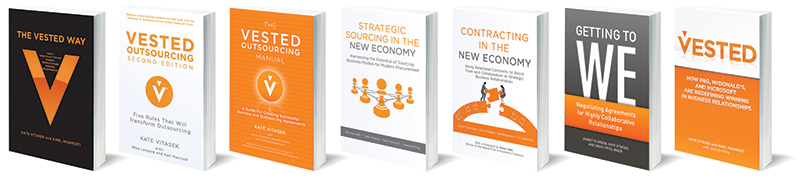
vested booksFrom Research to Relevance

Today, over 100 organizations have applied the Vested methodology in outsourcing deals as diverse as facilities management, reverse logistics, third-party logistics, environmental services, fiber optic network management and labor services. UT’s research now includes seven books, 18 white papers, and 18 public case studies that document the success stories of organizations such as Intel (third party logistics), Dell (reverse logistics), Vancouver Coastal Health (environmental services), and Island Health (labor services/union contract with doctors) and BP (real estate and facilities management).

The Vested movement has become a model for best practices in outsourcing globally. UT profiled the lessons from sixteen Europe-based Vested agreements in the white paper – From Research to Relevance (a free download from UT’s research library1). Most recently, BP’s Wendy Cuthbert (Head of Global Workplace Solutions for BP) and Ardell Bunt (Head of Client solutions EMEA for JLL) shared their success in an interview with UK-based EP Business in Hospitality2. Cuthbert’s take after making the shift to Vested? “I’d like to think the traditional way of outsourcing has had its day now, and people will start seeing the real benefits of working
alongside in a mutual relationship rather than being one-sided.”

The Bottom Line

The bottom line is the bottom line. Vested outsourcing is helping organizations transform their outsourcing efforts into powerful win-win contracts that yield results – not just for the buying organization, but also for service providers. That is the definition of a true win-win.

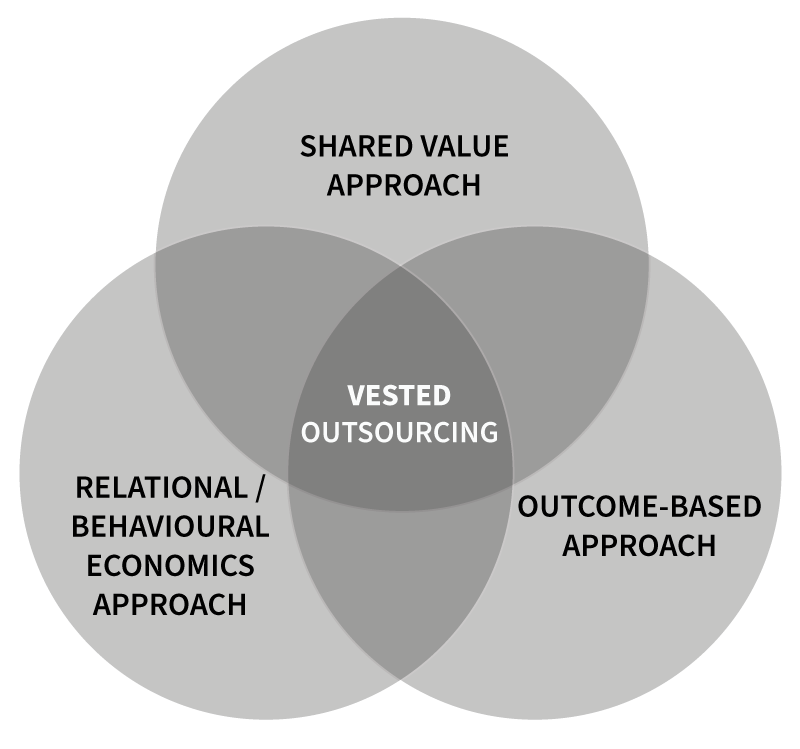
The Vested sourcing business model is based on five transformative rules designed to spur collaborative and innovative mindsets. Vested leverages components of an outcome-based business model with the Nobel Prize-winning concepts of behavioral economics and the principles of shared value.

  • Behavioral economics is the study of the quantified impact of individual behavior or the decision-makers within an organization. Behavioral economics is evolving more broadly into the concept of relational economics, which proposes that economic value can be expanded through positive relationship (I win-you win) thinking rather than adversarial relationships (I-win-you-lose).
  • Shared value principles are designed to generate economic value in a way that builds value for all parties. Entities work together to bring value that benefit all parties–with a conscious effort that the parties gain or share in the rewards. UT researchers call this a “what’s in it for we” mindset.
  • Outcome-based approaches, which have roots in the aerospace and defense industries, center on paying a supplier for achieving a defined set of business outcomes rather than paying for a transaction or activity.

These approaches combine to form the Vested business model, which stresses the importance of building highly collaborative, mutually successful relationships with suppliers while emphasizing creating and sharing value for everyone involved. 1

vested outsourcing
Footnote
1. Described in more detail in The Vested Outsourcing Manual (2011) and Strategic Sourcing in the New Economy: Harnessing the Potential of Sourcing Business Models for Modern Procurement (2016)

About the Author

author imageKate Vitasek is an international authority on the art, science and practice of highly collaborative business relationships. Kate’s award-winning research at the University of Tennessee has led to the Vested® business model for highly collaborative relationships and has been featured on CNN International, Bloomberg, NPR, and Fox Business News. She is the author of seven books and her work has been featured in over 300 articles including Harvard Business Review, Chief Executive Magazine, and Forbes.

References

  1. Vested Library, https://www.vestedway.com/vested-library/
  2. Why Vested? In Discussion with BP and JLL, Youtube, 2021 https://www.youtube.com/watch?v=ClO9cjK_D7g

How Online Casino Reviews Can Help You Choose

Online-Casino

The availability of numerous gambling websites has made it difficult to choose a reliable option. Gamblers should expose themselves to various casinos reviews to figure out the different offerings. These reviews provide information about banking options, bonuses, reliable gaming platforms, customer service, games offered, promotions available and other services. It’s smart to read different casino site reviews before making an informed decision. Gamblers from Canada should read Canadian online casino reviews in order to address their specific needs.

What is the size of their selection of сasino games?

Most gamblers follow a specific criteria when choosing casino games. These decisions normally depend on the gambler’s preferences and other predictable factors. Many gamblers prefer casinos that offer them adrenaline-pumping games and odds that boost their chances of making big money.

Gamblers also consider the casino games that suit their style, the type of gambling they enjoy and the goal they hope to achieve through gambling.

Gamers have also been known to base their decisions on social factors. For instance, a gambler might prefer a game that allows him/her to engage with real-life competitors or gamble with high stakes. It’s important that all casinos reviewed should meet all the gambler’s needs.

Some of the most beloved casino games that can be found in the biggest gambling websites include Slots, Craps, Poker, Roulette and Blackjack. Gamblers’ preferences are catered for in these best reviewed online casinos; this is because of diversity in games. 

How safe is an online casino?

Most online casinos offer real money games and this means that they have to assure their customers of the security of their money. Security can only be guaranteed if the casinos use SSL encryption and approved licenses. These measures are helpful in protecting privacy and avoiding online fraud. It’s risky to be involved with illegal casinos because they have been known to illegitimately withhold winnings. This is why it’s important to use casino online reviews to avoid illegal casinos.

Most mainstream online casinos are normally verified and approved by eCOGRA. This agency is responsible for ensuring that all players get a fair shot at winning. Their job is to protect the integrity of the random number generator.

Gambling jurisdictions also provide firewall protected servers to guarantee the safe encryption of the players’ information.

There are many licensing jurisdictions that have built a big reputation for guaranteeing safety and reliability. Some of the big names include the UK Gambling Commission, Isle of Man, Malta Gambling Authority and  UK Gambling Commission. In most cases, majority of the best reviewed online casinos are registered with these commissions.

Some operators have been forced to use multiple licenses in order to fit in with the different rules of various jurisdictions. Game providers can also use casinos reviews to identify which licenses they’ll need. These online casinos have built a reputation for guaranteeing safety of financial transactions, money and personal details.

The ideal casino will allow you to check your financial and gambling histories any time you want. This is meant to create a transparent environment that prevents any possible fraudulent activities.

What are the instructions or notes for a particular casino

Notes and recommendations adopted from casino online reviews will help guide users. It’s easy to know the best casino options in the market. 

It’s important to ensure that the website you choose offers an unbiased opinion about specific casinos. Some websites provide biased information because they are paid to market specific casinos. It’s important to note that casino site reviews shouldn’t be used as marketing gimmicks.

Gamblers should go through numerous top online casino reviews before choosing a particular casino. This is the best way to get truthful information about how a casino treats its customers. Look for detailed information about Canadian online casino reviews if you’re operating from this region.

Gamblers should focus on the fine print of the websites they review. In some cases, websites can put limitations on customers that are allowed to leave feedback. You should consider this factor when reading reviews. It is expected that Сanada online casino reviews will go into fine details like this.

The best way to end up with a well-rounded review is by paying attention to the negative and positive opinions. Did you know that the best reviewed online casinos allow negative comments that provide constructive criticism? You shouldn’t be discouraged by a few bad comments because no casino is perfect. It’s therefore important that a top online casino review represents the full picture.

A large selection of bonuses at the best online casinos

Many popular online casinos have figured out that the best way of attracting new customers is by exposing them to unlimited bonuses. Loyal customers are also maintained using these popular bonuses. In fact, the bonuses might be the biggest advantages of wagering on real money games. Learn about the best bonuses from Canadian online casino reviews that paint a market picture.

Below, we have broken down some of the common varieties of bonuses that you’re likely to come across. According to research from Canadian online casino reviews, these are the common bonuses in Canada: 

  • No Deposit Bonuses: These types of bonuses are available to new players after they complete the registration of new online accounts. You don’t need to deposit any money in order to claim your first bonuses. Most online casinos offer these bonuses as free spins or small cash bonuses. You should consider this service as a welcome offer.
  • Deposit Bonuses: You’re likely to come across these bonuses because they are the most common types of online bonuses. It is also known as the match bonus. It is calculated as the percentage of the gambler’s deposit amount. It’s important to understand how these bonuses work in order to get the most out of them. For instance, a gambler’s deposit amount can reach a limit of $100(double) if there is a 100% match bonus of up to $100. 
  • Promotional Bonuses: These are normally accessible in the form of deposit bonuses, cashback offers and free spins. These promotions are part of the special bonuses offered by online casinos.
  • Loyalty Bonuses: Your wagering activities can also be rewarded using loyalty bonuses. These goodies are meant to keep regular customers happy. Gamblers are rewarded if they accumulate a lot of loyalty points. Some of the gifts include free bonus money, shopping sprees, free spins, cashback, real money, gift cards and many more.
  • Birthday Bonuses: It is possible for some casinos to provide players with special bonuses that are meant to celebrate the customer’s birthday. It’s important to read casinos reviews because birthday bonuses are rare.
  • Refer-a-friend Bonuses: These types of bonuses target players who introduce other players into their casino. Gamblers normally receive bonuses for referring their friends.

Final Thoughts

Gamblers identify profitable casinos from casinos reviewed websites that reveal ideal options. From our research, some of the best reviewed online casino include Wild Casino, Sloto’Cash Casino, 888 Casino and Lincoln Casino. It’s important to study Canadian online casino reviews to fit into the Canadian market.

4 Tips for Searching for A New Office Space

Office

Are you on the lookout for a new office space? Moving into a new area and space can be a huge change for your business. You may be wondering what to look for and how to go about finding the perfect space. Here are some top tips to help you find the perfect office for your business.

Do your research

Start by doing background research. Many businesses end up making hasty decisions when it comes to choosing a new office space, which can lead to costly mistakes. Take the time to do thorough research into potential areas or spaces that your business may be interested in moving into. Carefully consider the current position of your business – including your costs, goals, and more. This will help you to determine the type of space that you need and ensure that you’re getting the best possible deal for your move. Below are a few of the factors you’ll want to research before you choose your new office space.

Consider your budget

It’s essential to consider your budget as you begin your search for new office space – this will greatly impact your choices, as different spaces come at different price points. And be sure to do your homework as you assess how much you can afford to spend on your new office.

Think about your current expenses – as well as any future expenses that you may incur as part of your move. This will provide you with valuable insight into your options and help you to make the most out of your budget. Once you’ve determined how much you can spend, you’ll be able to narrow down your options and find the office space that best suits your needs.

Think about the size

The size of your office should closely align with your business needs too. If you’re hoping to grow in the near future, you might want to consider a larger space than you’re currently using. This will ensure that you have the space you need to accommodate any potential growth.

You should also consider whether you’ll require a boardroom and other amenities as part of this move. Always take into account your employees…how many in your team will occupy the office – and what specific requirements will they be after? This will help you to ensure that you choose a space that’s the right size for your business.

Find the right location

This is a very important factor when choosing the perfect spot for your business. You need to consider the location of your office carefully as this can have a big impact on the success of your business. Factors such as your employees’ and stakeholders’ needs should be thought about.

Look into the safety of the area, the amenities close by, and the businesses that’ll surround your office. By being proactive and taking these steps, you can have peace of mind and reassurance that you’re choosing the best location for your office.

UK Law’s New Offence: Causing Serious Injury by Careless Driving

Driving

On June 28th, 2022, UK law introduced a new offence under the name of “Causing Serious Injury by Careless Driving.”

Instead of facing only monetary charges and getting penalty points, careless drivers all over the UK can now face up to two years of imprisonment and disqualification from driving.

This article aims to explain what the new offence brings into the UK legal system, who it impacts the most, and how the risks of serious injuries caused by careless driving can be reduced.

Let’s get right into it.

What Does the New Offence Entail?

With the introduction of a new offence, a careless or inconsiderate driver who’s caused another person a serious injury can face a sentence of up to two years in prison.

To offer a bit of clarification, a driver is considered careless or inconsiderate if their driving is below the standard expected of a careful and competent driver. 

In other words, drivers have to drive in a manner that meets the requisite standard. Going below such standards can lead to prosecution before the Crown Court or a Magistrates’ Court.

Apart from the requirement of carelessness, the injury suffered in such an accident has to be qualified as “serious.”

Injuries are considered serious if they’ve had a major impact on the injured party. This means that both a single catastrophic injury and an accumulation of multiple minor injuries could qualify as serious injuries, as long as they inflict great bodily harm on a person.

As for the reasons the new offence was introduced, there are three main ones to be considered:

  • To reduce the existing large number of careless driving cases in the UK
  • To protect cyclists and pedestrians from serious injuries
  • To increase the usage of public transport

Besides potentially facing imprisonment, a sentenced careless driver can expect to get penalty points, lose their driver’s licence, face substantial fines, and be disqualified from driving at the discretion of the court. 

Who is Impacted the Most by the New Offence?

The new offence is expected to impact all motor vehicle drivers. 

However, most of all, it is expected to impact professional commercial drivers with high mileage and their employers.

Long driving hours are linked with increased levels of exhaustion, which has been linked to more frequent lapses in concentration. That’s why PSV and HGV drivers need to stay compliant with the rules regulating their driving hours. 

As for the measures that employers can take to reduce the risks of careless driving, introducing mobile phone policies and CPC modules to ensure vehicle and personal safety are just some of the options.

How Can Careless Driving Impact Your Business?

If you’re running a business and have commercial vehicles on the road under your company name, you need to know about the ways careless driving can negatively impact your business. 

Here are the top three ways your business can suffer from having a careless driver behind the wheel.  

1. It can damage your company’s reputation

There are multiple ways in which careless driving can damage your firm’s reputation.

One of them is if you’re using a motor vehicle to transport and deliver the goods to your end customers. 

Namely, besides potentially inflicting an injury to another person, your firm’s driver’s careless driving can lead to purchased goods being damaged, delivered with delay, or not delivered at all. 

Apart from that, careless driving can result in speeding through school zones, colliding with another vehicle, and other risky behaviours that will be noticed by other road users – and sometimes the press, too!

You don’t want road accidents to be the first thing that pops up on Google when people search for your company’s name!

2. You could face a lawsuit 

Most commonly, these lawsuits are brought by either:

  • People injured in careless driving accidents; or
  • Unsatisfied customers who’ve had issues with the delivery of their purchased goods

Either way, the word about lawsuits initiated against your company spreads fast. That means that it can ultimately impact your acquisition of new customers and, again, your reputation.

Lawsuits can also lead to unnecessary costs. This is because your company may be bound by a court decision to compensate an injured party for different types of damages in personal injury cases. 

In other words, your company may need to recover a victim for their:

  • Medical expenses
  • Property damage 
  • Loss of income
  • Pain and suffering
  • Loss of quality of life, etc.

3. It can cost you a lot of money

And here, we’re not talking about money you can lose if you face a lawsuit. We’re talking about the money you’ll need to pay for vehicle repairs, maintenance, and payouts for employees’ medical bills.

Poor driving habits can leave indents in more than just your tyres, so you may want to consider investing in path-prediction software such as vehicle tracking programs. 

Apart from that, you must be aware that gas prices have been going off the charts in the past couple of months. 

Speedy driving is known to burn through more fuel, which is becoming more and more of a commodity with each passing day. Why put your business in a situation where it has to pay extra for its drivers’ careless driving? 

Lastly, as an employee, you’ll have to cover a portion of the medical bills and other expenses your employees incur in case they get injured at work due to careless driving by a company driver. 

What Can You Do as an Employer to Mitigate the Risks of Careless Driving?

Earlier in the article, we mentioned how introducing certain policies and installing vehicle tracking devices can help reduce the risks of careless driving.

Apart from that, there are plenty of other modern technologies that can keep your company’s drivers focused on the road.

Some of them are:

  • AI technologies or driving coaches that monitor driver’s behaviour and driving patterns
  • A set of real-time alerts notifying drivers about potential risks
  • Strict policies about taking frequent breaks from driving
  • Eliminating multi-tasking inside the vehicle

How to Maintain Skin Glow Through Fall and Winter

Skin Glow

During the fall and winter months, you may start noticing changes in your skin that can cause concern. When the temperatures and humidity levels change, your skin may be affected. For instance, dryness in the air and colder temperatures may cause your skin to lose some of its moisture, which can lead to skin dryness, itchiness, and roughness.

Another skin concern during these colder months is breakouts, which you may not expect since the weather is much cooler. Breakouts can happen even after summer is over. When the skin lacks moisture, it tries to compensate for the deficiency by producing excessive sebum, which can start clogging pores and breakouts. You may also notice redness on the skin’s surface when the temperature suddenly changes, which is caused by the contraction of the skin’s capillaries, making them more conspicuous on your skin. Aging skin may suffer even more during these months as skin tends to lose some of its elasticity and moisture as we age. Climate changes can aggravate the skin’s condition unless you take the necessary steps to nurture your skin more.

Fortunately, there are effective methods for maintaining your skin’s natural glow and keeping it hydrated and supple when autumn and winter come. For instance, getting a Smoothglo treatment improves skin tone and increases moisture depleted during cold weather. Additionally, it can help smoothen out fine lines and wrinkles and give the skin a healthy and more youthful glow.

Below are more tips for maintaining skin glow through the fall and winter months.

Moisturize

As earlier mentioned, one of the most significant skin issues during the fall and winter is dryness. Thus, it is vital to replenish your skin’s lost moisture to soothe and restore its glow. Applying a good moisturizer is an essential part of your daily skincare routine that you need even more when the weather is colder. Experts recommend that you regularly use moisturizer as often as possible, especially after a bath or showering, as your skin can lose some moisture when water evaporates following your bath. Also, ensure that you choose a moisturizer suitable for your skin type. And if you’ve got facial hair, it’s important to moisturise this area too – buy beard oil in NZ to ensure healthy skin underneath your beard.

Keep your humidifier on

During autumn and winter, the air becomes dryer inside your home, which can also contribute to skin dryness. To help maintain moisture inside, it would help to keep your humidifier running, especially in areas of your home where you spend most of your time. Choose a good humidifier that can effectively distribute moisture and improve your indoor air quality.

Stay active

Exercise keeps you physically and mentally fit and does wonders for your skin. Although it can be challenging to go outdoors and work your body out during cold weather, keeping yourself healthy should motivate you to stay active. You enjoy the outdoors, feel good, and provide your skin with the essential Vitamin D you get from sunlight. Of course, you need to protect your skin as well with sunscreen while performing your healthy physical activities outside.

While it is normal for your skin to have a few issues during fall and winter, it is best to take extra care of it and help maintain its healthy glow.

Guide For Finding The Right Wholesale Fertilizer Company

distributor

Choosing the right wholesale fertilizer company can be a difficult task. There are many fertilizer distributors, so how do you find the right one? In this article, we’ll explore some factors to consider when choosing a wholesale fertilizer distributor, as well as a list of some of the best wholesale fertilizer companies.

Benefits of Hiring a Wholesale Fertilizer Company?

The most obvious benefit is that you will save money by buying in bulk. Wholesale fertilizer companies have a lot of experience and knowledge about the products they sell, so they provide valuable advice about which products would be best for your specific needs. They can also help you troubleshoot any problems you might be having with your plants or garden. 

In addition, a good wholesale fertilizer company will be able to provide you with high-quality products that will help your plants and crops grow healthy and strong. 

Another advantage of working with a wholesale fertilizer company is that they can often provide you with custom blends of fertilizer that are not available at your local gardening store. This can be especially helpful if you have specific needs or requirements for your plants or garden. 

Overall, hiring a wholesale fertilizer company is a great way to get high-quality products at a discounted price. If you are serious about gardening or farming, then working with a reputable wholesale fertilizer company is definitely something you should consider.

What Services do they Provide?

When looking for a wholesale fertilizer company, it is important to consider what services they provide. Do they offer delivery? Do they have a minimum order requirement? What type of products do they carry?

Delivery is an important consideration, as you will want to make sure the company can get the fertilizer to you in a timely and efficient manner. Many companies require a minimum order, so be sure to find out what that is before making your purchase. Finally, take a look at the products they carry. Some companies specialize in organic fertilizer, while others may carry a wider variety of products. Be sure to find a company that has the products you need for your garden or farm.

How do I Find the Right One for Me?

When it comes to wholesale fertilizer companies, there are many options to choose from. With so many companies out there, how can you find the right one for your needs? Here are a few tips to help you narrow down your search and find the perfect supplier for your business.

1. Determine Your Needs

The first step in finding the right wholesale fertilizer company is to determine your needs. What type of fertilizer do you need? How much do you need? Knowing your needs will help you narrow down your search and find a company that can supply you with the products you need.

2. Compare Prices

Once you know what you need, it’s time to start comparing prices. Wholesale fertilizer companies charge different prices for their products, so it’s important to compare prices from multiple suppliers before making a decision. Be sure to compare not only the price per ton but also the shipping costs and any other fees that may be associated with the purchase.

3. Read Online Reviews

Another great way to narrow down your search for a wholesale fertilizer company is to read online reviews. Customers who have purchased fertilizer from a particular company can leave feedback about their experience.

Tips on how to choose a Wholesale Fertilizer Company

When it comes to finding a wholesale fertilizer company, there are a few things you will want to keep in mind. Here are a few tips on how to choose the right one for your needs:

  1. Make sure the company is reputable. There are a lot of fly-by-night companies out there, so you will want to make sure that you find a company that is established and has a good reputation.
  2. Make sure the company offers a good selection of products. You should be able to find a company that offers a wide variety of fertilizer products so that you can find the right one for your needs.
  3. Make sure the company offers competitive prices. You don’t want to overpay for your fertilizer, so be sure to find a company that offers competitive prices.
  4. Make sure the company has good customer service. You should be able to contact the company if you have any questions or concerns about their products or services.
  5. Make sure the company is accredited by the Better Business Bureau. This shows that the company is reputable and has a good track record when it comes to dealing with customers.

How to Get 1000 Followers on Clubhouse?

How-to-Get-1000-Followers-on-Clubhouse

The Clubhouse is a rising social media app where people communicate via audio chats and share stories and personal experiences with each other. Now, those who are already on this platform must know how important it is to get your first 1000 Clubhouse followers.

They basically dictate your position on the platform’s hierarchy and are required for building credibility, social proof, and online presence. Their sheer volume helps you rise as a community leader and establish your dominance in Clubhouse rooms.

However, securing more followers on this particular social network isn’t easy, considering the competition and the skill required to charm the audience.

So, for all the speakers aiming to leave their mark on the Clubhouse, here are some tips to gain 1000 followers and fulfill their dream.

10 Effective Ways to Get 1000 Followers on Clubhouse

1. Be Yourself

Avoid putting up a show like most content creators do, and just be yourself in the Clubhouse rooms. Show your true colors to the audience and interact with them casually, as you do in real life.

This will allow you to connect with the audience and invite people to follow your Clubhouse profile. And if you managed to charm them with your personality, they would follow you in a heartbeat.

2. Know your Audience

As a creator, you must figure out what your audience likes, what fascinates them, and what they like to talk about. Communicate with your audience, whether it comprises community leaders, experts, mentors, etc., or trivial people, and find out their preferences.

Learning these details will help you adjust the content strategy and generate appropriate content for your audience. Doing so will automatically attract them to your profile, and they will start following it.

3. Have a Great Profile Pic

Visuals matter, even on an audio platform!

Make sure that you upload an attractive and aesthetic profile picture that helps you stand out. Go through your photos and find the best one that looks perfect from all angles and reflects your personality. Optimize it for the platform by adjusting its file format, size, and dimensions.

A great profile picture will show your best side to the audience and encourage them to follow your account.

4. Optimize your Bio

Keep your bio clear, catchy, and short – orient it in a way that makes you look credible and esteemed creator. Try to include some call-to-action statements to convince the audience to follow.

However, remember that the platform allows you to write 1200 characters, almost three lines, so you can’t afford to waste them.

A thoroughly written bio helps the audience judge your credibility – nail it perfectly, and it will draw the audience’s attention and possibly turn them into your followers.

5. Join Other People’s Stages

Join-Other-People's-Stages

Make sure that you join other people’s stages, as it allows you to interact with a more knowledgeable audience and contribute to their discussions.

See, when you give expert insights into a matter and add value to the listeners’ lives, they start considering you as a mentor. As a result, they visit your account out of curiosity and end up following it eventually.

Thus, join multiple clubs and flex your knowledge there to draw more potential followers.

6. Be Consistent on Clubhouse

Staying consistently active across rooms, clubs and other stages is necessary to keep your audience immersed and attract potential followers. Basically, when you interact with people and listen to them, it proves that you are a credible influencer who is passionate about his job.

Now, that image not only keeps your current followers engaged but also serves as a hook for new ones. Therefore, participate in communities regularly to engage people and convince them to follow you with repeated exposure.

7. Host your Own Rooms

Host your own rooms frequently, as it’s a great way to attract the new audience and turn them into your followers. However, for this tactic to work, you first need to know the trends. Find the hot topics your audience might be interested in and host rooms to discuss them.

Also, make sure that their privacy is set to public and not invite-only, so anyone can join them.

Later, you can ask the people who join the Clubhouse rooms to follow your account. And if the audience really finds your rooms interesting and engaging, they won’t hesitate to follow you.

8. Join Clubs and Participate

Join clubs related to your core competence and participate there actively. Take part in discussions and debates – flex your knowledge and engage the audience with your wisdom.

Also, stay in touch with the club moderators and fellow speakers. Follow them on Clubhouse to show interest and expand your social circle. Doing all these activities will put you in the limelight, and many curious ears will start waiting to hear your voice.

Eventually, these curious people, enlightened by your words and wisdom, will follow your Clubhouse profile to learn more from you.

9. Promote it on Social Media Platforms

You must promote your Clubhouse profile across social media platforms to expand its organic reach and exposure. Simply post the link to your account on Facebook, Instagram, Discord, Twitter, and other trending social media apps.

Tag the friends in your posts and request them to follow your account to show support. Also, try embedding your profile link on websites and blogs, so the site visitors can check out your Clubhouse account.

The more you cross-promote, the more people will learn about your presence at Clubhouse. And as this reach increases, so will your chances of getting more organic followers.

10. Buy Followers from Media Mister

Buy-Followers-from-Media-Mister

Lastly, the easiest and most efficient of getting 1000 Clubhouse followers is to purchase them. Not only is this tactic fast, but it also boosts social proof, presence, and credibility quite effectively.

But that’s only possible if you buy real Clubhouse followers from a reliable service provider, like Media Mister. They offer completely safe and authentic Clubhouse followers that are real people who roam across rooms and interact with people.

You can buy them from their website in affordable packages and get 1000 followers on your profile in no time. So, test out this tactic and buy followers for your Clubhouse account to become a community leader and leave your mark on the platform.

Conclusion

Your opinion matters, and it deserves to be heard. However, on a platform like Clubhouse, that’s only possible when you have enough followers. That’s why it’s so vital for you to stay on top of things and be an exceptional speaker and influencer.

Of course, all of these traits won’t help you until you apply the tactics we shared with you. Combine your hard work with these clever tactics you’ll gain those much-needed 1000 followers within days.

We hope that you liked today’s article and found it helpful for your cause. If you need more informative content about other platforms, make sure to check our blog. Also, don’t forget to share your thoughts and suggestions in the comments section.

EDITOR'S PICK OF THE WEEK

CFO's new mandate. CFO explaining the presentation

The Performance and Transformation Orchestrator: The CFO’s New Mandate in the Age of AI

By Terence Tse CFOs are evolving into AI-driven transformation orchestrators, balancing finance, technology, and strategy while upskilling teams, managing risks, and driving measurable business value. A key insight from this year’s AI for CFOs event, organized...

WISE DECISION MAKER GUIDE

POWER INFLUENCERS

Emerging Trends

The Future of Global Trade