You expect your accounts to move together so you can focus on your strategy instead of constantly correcting differences. In practice, lag rarely shows up as one big error. It appears as small, repeated deviations. One account enters earlier, another fills later, or positions slowly drift apart.
Cloud copying tools such as TradeSyncer.com reduce manual work by automatically forwarding trades. But copying alone is not enough. What matters is understanding the gap between what was sent and what was actually executed. That visibility is what allows you to correct issues calmly and consistently.
Tradesyncer.com focuses on transparency between sent and executed
With tradesyncer.com, the emphasis is on tracking the full chain of events. Not just whether an order was copied, but whether it was accepted, filled, or delayed.
This makes it easier to answer questions like:
Was the order sent but rejected
Was it accepted but filled later
Did it never arrive at the follower account
By separating these steps, you can pinpoint exactly where lag begins instead of assuming the copier failed.
Recognizing when one account is lagging
Lagging accounts usually show clear patterns if you know what to look for:
Orders appear on one account earlier than another
One account gets partial fills while another fills instantly
Entry prices differ due to delayed execution
Position sizes drift because fills are incomplete
Profit and loss no longer move in sync
Catching these signals early allows you to act before differences compound. You can compare positions, correct sizing, or pause copying to bring accounts back into alignment.
Fail safes determine how your system behaves under stress
The most stable setups are not the fastest, but the most predictable when something goes wrong. That requires defining fail-safes in advance.
Focus on three scenarios:
Disconnects between systems or brokers
Order rejections due to rules or limits
Accounts already holding different positions
Important settings include:
Disconnect behavior such as pausing, continuing, or closing trades
Tolerance thresholds for timing and price differences
Logging that records sent, accepted, and executed orders
Tighter controls increase safety but may pause trading sooner in fast markets. Looser settings allow more trades through but increase the chance of divergence. The goal is to find a balance that fits your strategy.
Position sizing is where most divergence starts
When accounts drift apart, sizing is often the root cause. Differences in balance, leverage, or contract specifications can prevent identical execution.
Common issues include:
Orders rejected due to insufficient margin
Smaller accounts receiving reduced position sizes
Follow-up trades failing because earlier ones differed
Two main approaches:
Fixed sizing, simple but less flexible across different accounts
Proportional sizing, keeps exposure aligned but requires clear limits
Without defined limits, proportional sizing can feel inconsistent. Setting maximum position sizes or risk caps keeps behavior predictable.
Start small and monitor where differences begin
Scaling too quickly increases complexity. A controlled rollout keeps things manageable.
Best practice:
Start with one or two accounts
Use a single instrument or strategy
Monitor where differences occur: sending, acceptance, or execution
Pay special attention during conditions that stress execution:
High volatility
Fast reversals
Partial fills
Short disconnects
A system that logs and flags these events helps you understand behavior without reconstructing it afterward.
Build consistency through controlled setup and monitoring
Cloud trade copying works well when you treat it as a controlled system rather than a “set and forget” tool. Lag between accounts is not unusual, but it becomes manageable when you understand where it starts and how your setup responds.
Using platforms like tradesyncer.com with clear fail-safes, sizing rules, and monitoring allows you to keep accounts aligned and predictable, even when market conditions or broker behavior introduce small differences.
Wealthy women are stepping away from traditional banks and finding their footing in private investment circles instead. They want real peer knowledge, investments that align with their values, and a seat at the table for high-level decisions. These women are changing the way the financial world works.
As the gender wealth gap narrows, high-net-worth women are moving beyond traditional wealth management. They increasingly seek curated private investment circles that provide sophisticated deal flow, peer-to-peer education, and values-aligned investing – benefits often missing from conventional financial institutions.
Global wealth distribution is changing rapidly. By 2030, women are expected to control a much larger share of private wealth.McKinsey & Company predicted that women in the U.S. alone could control up to $30 trillion in assets by decade’s end, denoting a major shift for financial services. As their financial influence grows, many high-net-worth women find that traditional private banks no longer meet their needs, leading to the rise of curated private investment circles.
These are not simply social clubs. They are sophisticated, often invitation-only networks that offer institutional-grade deal flow, tailored financial education, and a collaborative environment. What is prompting this switch from traditional private banks to private investment circles?
The Search for a Shared Lexicon
For decades, the investment industry has had “boys’ club” culture, often using jargon and networking structures that feel exclusionary. Curated circles for women handle this by forming spaces where women are the primary demographic, reducing both subtle and overt biases found in mixed-gender financial settings.
In these circles, discussions extend beyond financial metrics. Members report greater psychological safety, enabling transparent discussions about risk, legacy, and social impact. This environment promotes collaborative due diligence, where members use their collective expertise to evaluate opportunities. Unlike classic advisory models that treat clients as passive recipients, these circles promote proactive participation and knowledge sharing.
Beyond the Traditional 60/40 Portfolio
Traditional wealth management relies on standardized models, such as the 60/40 split between equities and bonds. However, wealthy women are increasingly interested in alternative assets, including early-stage venture capital, private equity, and direct real estate. TheBCG Global Wealth Report 2025 notes that high-net-worth individuals are turning to private markets to hedge against volatility and aim for higher returns.
Curated circles focus on providing access to hard-to-reach investment opportunities. These may include pre-IPO tech startups or sustainable infrastructure projects, typically available only to family offices and institutional investors. By pooling resources and expertise, members can meet high minimum investment requirements that individuals alone would find difficult to meet.
Table 1: Evolution of Investment Priorities for HNW (High-Net-Worth) Women
Feature
Traditional Wealth Management
Curated Private Circles
Primary Driver
Relative performance vs. benchmarks
Absolute impact and long-term legacy
Asset Focus
Public equities, mutual funds, ETFs
Private equity, VC, direct investments
Relationship
Advisor-led (Transactional)
Peer-led (Collaborative)
Transparency
Standardized reporting
Direct access to founders/management
Values Alignment
Secondary (ESG as a filter)
Central (Values-first allocation)
The Power of Values-Aligned Investing
A key feature of this movement lies in its emphasis on “gender-lens” and “impact” investing. Wealthy women are statistically more likely than men to focus on the social and environmental impact of their investments. UBS Globalresearch shows that gender-lens investing has shifted from a niche interest to a core strategic asset class, with female investors leading capital allocation to businesses that advance gender equity and social sustainability.
By pooling capital, these women seek return on investment as well as a “return on values.” Their collective influence allows them to impact corporate governance and demand greater transparency from funded companies. This approach to capital allocation offers a form of activism that traditional retail banking rarely provides.
The Educational Component: Investing as a Craft
Many private circles emphasize upskilling. Rather than delegating all decisions to third-party managers, members seek to understand the details of each deal. Workshops on term sheets, cap table analysis, and industry-specific topics such as AI and Biotechnology are common.
This move toward active participation turns investors into active architects of their portfolios rather than passive recipients of reports. This sense of agency motivates high-net-worth women, many of whom have led in other sectors and expect similar mastery over their finances. A hands-on approach also helps reduce the confidence gap that has historically limited female participation in high-risk investing.
Table 2: Key Benefits of Private Investment Circles
Benefit
Description
Vetted Deal Flow
Access to institutional-grade private placements not available to the general public.
Collective Intelligence
Leveraging the diverse professional backgrounds of members for enhanced due diligence.
Discretion & Privacy
Highly secure environments that allow for sensitive financial discussions away from public view.
Strategic Networking
Connecting with high-level peers across industries, often leading to board seats or partnerships.
The Future of the Private Circle
As digitalization advances, such circles are expanding globally. A woman in London can now co-invest with a peer in Singapore on a New York-based fintech startup within a trusted, curated network. This globalization is removing the geographical barriers that once restricted direct private equity participation.
However, maintaining privacy remains essential. The value of these circles comes from their exclusivity and high barriers to entry, which ensure members are fully invested. This exclusivity helps preserve the quality of both members and opportunities. As these groups grow, the main challenge will be retaining the high-trust, boutique atmosphere that defines them.
Conclusion
The move toward curated private investment circles marks a maturation of the female wealth market. It shifts the focus from being “sold to” toward active participation. For the wealth management industry, this signals a need for change. The future of high-net-worth engagement will depend on community, transparency, and aligning financial goals with personal values. As women gain economic influence, those who support these private, high-trust networks are likely to lead the next era of private finance.
Genia Xasisis the CEO and founding partner of Berkana, a private investment consortium where ultra-high-net-worth women actively lead and deploy capital.
In a world of increasing uncertainty and AI-driven complexity, leadership is not about having all the answers. It is about knowing how to work with doubt. This article introduces Professional Doubt and Active Doubt as critical leadership capabilities that strengthen judgement, improve decision-making, and enable leaders to navigate complexity with greater clarity.
In uncertain times, we need uncertain leaders. Leaders who understand the wisdom in doubt. This may feel counterintuitive, and it runs against much of what traditional leadership models have taught us. Yet in an age of permanent swirl and AI’s increasing dominance, leadership is no longer about having all the answers. It is about having the courage to question them. And still, many leadership models continue to reward certainty, speed and decisiveness, even as these qualities become increasingly risky in complex systems. The real risk for organisations is not leaders who hesitate. It is systems that reward confidence over judgement.
And yet, we are not talking about the one quality staring us in the face: doubt. We are living in uncertain and unprecedented times, where everything can be questioned and is being questioned. This calls on us to change our leadership lens and give doubt a more prominent seat at the table. To professionalise doubt as a leadership capability. To surface it, work with it, and actively use it to inform strategy and decision-making.
At its core, leadership is about navigating change. And all change starts with a doubt. A doubt about the situation, the product, or the way things are done around here. Doubt is what creates the opening for better questions: how could this be done differently? What might we be missing? What needs to change? Doubt is a seed of growth. And to doubt is an act of hope. A belief that something better is possible.
As AI advances, the role of the leader is evolving further. Questions of ethics and responsibility are no longer theoretical; they are immediate and complex. “Are we doing the right thing?” is no longer a simple question, nor one that can be answered quickly. Unquestioned data and technology can erode both ethics and trust. It requires space for debate, challenge and reflection. The same is true for diversity and inclusion, where progress depends on a willingness to question assumptions and confront uncomfortable truths. In both cases, the skill of doubt is not a weakness. It is essential.
Professional Doubt
Doubt is already embraced as a functional discipline in many fields. In science, it drives progress and breakthroughs, most clearly through peer review, where ideas are rigorously tested, challenged and strengthened. Lawyers and risk specialists are trained to doubt, to ask, “what if?” and to interrogate assumptions. In people-focused professions such as therapy and probation, regular supervision creates space to examine thinking and practice. In all these fields, doubt has a formal role.
And yet in leadership, it is rarely treated in the same way.
When doubt does show up, it is often dismissed, hidden or pushed aside in favour of certainty. As if confidence is what makes a leader credible, and doubt is something to overcome.
But what if we have got this the wrong way round?
Professional Doubt is not the absence of confidence, but the disciplined use of doubt to strengthen judgement. Not just the presence of doubt, but how it is treated. When doubt is surfaced and worked with deliberately, it becomes a powerful leadership behaviour. It allows leaders to explore uncertainty in themselves, in others, in the situation, and in the wider system. When we name doubt, it becomes a collective source of insight rather than an individual burden.
One board executive I worked with would often say, “I am feeling some doubt about this, let’s explore it.” In doing so, they opened the door to richer, more constructive conversations rather than shutting them down.
When we treat doubt with discipline and respect, it pays back in the quality of thinking it generates, strengthening collaboration, creativity and challenge. To treat doubt with discipline and respect we need to understand it and the forms it takes, of which there are three:
Self-doubt: internal doubts which relate to ourselves, where perhaps we question our capability and legitimacy. Imposter syndrome is one example of this.
Situational doubt: is specific, tangible doubt that sits outside of us, such as questioning the context, data, relational element and/or decision.
Systemic doubt: is a more intangible doubt that arises from the wider system – its values, behaviours, power structures, and the invisible architecture that shapes what is seen, said, and done. Without systemic doubt, the organisation is at risk of institutional blindness.
Active Doubt
Understanding doubt in a leadership context takes us so far. To make it a useful capability, we need to know how to work with it. Naming doubt is not enough. Left there, it can keep an organisation, a project, or a person stuck. Doubt must be engaged with. Examined. Put to work.
This is what I call Active Doubt.
Active Doubt is the process of turning doubt into insight. Not just surfacing it, but asking: why is this here? What is it telling us? What can we learn from it?
Perhaps we are feeling doubt about ourselves in a new role, questioning whether we can do it. That doubt is often a signal of growth. When worked with, it encourages us to step forward, seek perspective, and stretch into the role rather than retreat from it. Active situational doubt calls for dialogue; a willingness to test assumptions, explore different perspectives, and move forward with greater clarity. Active systemic doubt calls for structure; creating the conditions where doubt can be surfaced, shared and worked with, rather than suppressed.
That is Active Doubt in practice.
When doubt is made active, it becomes a tool for better thinking and better decisions. It sharpens judgement, surfaces risk and opens up new possibilities. Active Doubt is the leadership capability this moment demands.
Jenny Williams, MCC, is a leading Executive and Systemic Team Coach and author of Brilliant Doubt, who has lectured at Cambridge University on leadership and entrepreneurship. She has spent thousands of hours working with exceptional leaders, helping them harness the power of doubt as a catalyst for clarity, creativity, and confidence. Her work has established her in the top 4% of coaches globally with an International Coaching Federation certification as a Master Coach.
When you renew car insurance, it is easy to continue with the same policy without reviewing your current needs. However, renewal is the right time to check whether your existing cover still suits your car and usage. A third-party policy meets the legal requirement, but it does not cover damage to your own car.
This is where comprehensive insurance can offer wider protection. In this article, you will understand when upgrading at renewal may make better sense.
Why the Renewal Stage Matters?
Renewal gives you a common point to review your risk, your car’s condition, and the kind of expenses you may be able to handle on your own.
If your vehicle still has significant value, you drive often, or repair bills would be difficult to manage, staying with basic cover may not always be the best fit.
A broader policy may be a better choice if you face more risks on the road now, but your insurance coverage is still the same as before.
What Changes When You Move to Comprehensive Cover
Understanding the difference between these two types of cover is important. Third-party insurance is designed to cover your legal liability if your car causes injury, death, or property damage to another person.
It does not pay for damage to your own car. Comprehensive insurance includes third-party liability cover but also adds protection for your own vehicle against risks covered under the policy, such as accidents, theft, fire, and certain natural events.
This wider scope is what makes comprehensive cover worth considering at renewal. It is not just about choosing more cover.
Signs That an Upgrade May be Worth Considering
Certain situations can make a wider level of cover more suitable at the time of renewal.
Your Car Still has Noticeable Market Value
If your car is still in good condition and replacing major parts would be expensive, a broader cover may feel more sensible at renewal. A basic third-party policy may meet the legal requirement, but you would still have to pay for repairs to your own car after an accident.
You Drive Regularly in Busy Conditions
Driving on busy roads makes it important to stay prepared, helping you handle everyday situations such as minor dents, collisions, and weather-related damage with greater confidence. This does not mean you will necessarily make a claim, but it does highlight the difference between basic and broader cover. If the car is part of your daily routine, comprehensive insurance can be easier to justify.
You Would Prefer One Wider Policy Instead of a Bare-Minimum Setup
A comprehensive policy includes both third-party cover and protection for damage to your own car in one plan. This can make renewal easier for many car owners. You can also buy own-damage cover separately if you already have a valid third-party policy. Even so, many people prefer comprehensive cover because it provides broader protection under a single policy.
You Want Better Protection Against Common Risks
The value of comprehensive insurance is not only in accident damage. It can also extend to theft, fire, and certain natural events, depending on the policy wording. If you park outside, travel often, or simply want a wider safety net, upgrading at renewal can be a more balanced decision than waiting until after a loss reminds you of the gap.
What to Check Before You Renew Car Insurance
Before you switch, check what the policy covers, what it does not cover, how repairs are handled, and whether it includes add-ons that suit your needs.
You should also look at the insured declared value, the available garage network, and whether a standalone own-damage policy or a comprehensive plan is a better fit for you. A lower premium may look attractive, but it may not be the better choice if the cover is too limited.
Final Thoughts
Upgrading at renewal may make sense if your car still holds value, you use it regularly, and paying for repairs yourself could put pressure on your budget. In such cases, comprehensive insurance can be worth considering when you renew your car insurance.
It offers more than just basic legal cover and provides broader financial protection against unexpected damage or loss.
Not long ago, digital wallets were treated as an add-on. Useful, but not essential. That’s harder to argue now. In many online environments, they’ve become part of the default setup, even when users don’t consciously think about them.
The scale alone hints at how far things have shifted. Estimates from Juniper Research suggest digital wallet users will pass 5.2 billion worldwide by 2026. Numbers like that tend to blur into the background, but they point to something simple: for a large portion of the global population, wallet-based payments are already routine.
In practical terms, that changes how people approach transactions. There’s less hesitation, fewer steps to consider and a growing expectation that payments should happen instantly. The idea of entering card details manually, once standard, now feels slower than it used to.
Digital Wallets as a Structural Shift in Payment Infrastructure
What’s changed isn’t just how payments look but how they move. Traditional systems still rely on several layers working together, even if that complexity stays out of sight. It’s efficient enough, but not always fast and rarely simple.
Digital wallets trim some of that friction. Payment details sit in one place, authentication is quicker and the process feels more contained. Much of this shift is supported by API-driven wallet infrastructure, which allows payment systems to integrate more efficiently across platforms while maintaining real-time processing capabilities. From the outside, it’s a small shift. Underneath, it changes how people interact with payment systems altogether.
Cross-border transactions make that difference easier to spot. Delays and added costs haven’t disappeared, but they’re less visible to users than they used to be. The interaction feels smoother, even if the infrastructure hasn’t been fully replaced.
There’s also something else going on. Control has shifted slightly. Instead of moving between separate systems, users stay within a single interface that connects outward. It’s not dramatic, but it changes expectations.
In some cases, that shift is subtle enough to go unnoticed. A transaction completes a few seconds faster or requires one less step and the improvement blends into routine behavior. Over time, those small gains add up.
Projections linked to Worldpay suggest digital wallets could account for around 65% of global e-commerce payments by 2030. That isn’t just growth. It suggests a change in how transactions are distributed across payment types.
Adoption Patterns and Behaviour Across Global Markets
Adoption hasn’t followed a clean, predictable path. In some places, digital wallets have grown quickly because they fill a gap. In others, they’ve spread because they’re simply easier to use.
The reasons differ. The outcome doesn’t, at least not over time.
Payments become quicker. Smaller transactions happen more often. The process fades into the background, which is usually when technology has settled in properly.
Projections suggest global digital wallet usage could pass 6 billion users by 2030. At that point, the distinction between “using a wallet” and simply “making a payment” starts to blur.
There’s also a generational angle that’s easy to overlook. Younger users don’t approach wallets as something new. For many of them, it’s just how payments work. Older systems feel like the alternative, not the standard.
In emerging markets, that shift can carry additional weight. Digital wallets often act as a first point of access to financial services, rather than a replacement for existing tools. That difference shapes how quickly adoption takes hold.
Sector-Level Integration and Transaction Preferences
Once adoption reaches a certain point, integration tends to follow. It doesn’t happen all at once. It spreads, usually starting with sectors where convenience matters most.
Retail and e-commerce were early examples, but that same pattern now shows up in subscription platforms, digital services and other environments where payments are frequent. The focus shifts from enabling transactions to removing anything that slows them down.
That approach carries into regulated sectors as well. In Canada, for instance, payment preferences in online services reflect the broader move toward wallet-based transactions. Resources outlining casinos that accept PayPal in Canada give a practical sense of how these systems are used. The material provided by OnlineCasino.ca explains how PayPal operates within a regulated framework, including transaction handling and verification steps.
In that context, digital wallets don’t stand out. They sit quietly in the background, doing what users expect them to do.
Regulatory and Trust Considerations in Wallet Adoption
As digital wallets become more embedded, regulation becomes harder to separate from their development. They operate across different jurisdictions, which means navigating a mix of financial rules and data requirements.
That doesn’t always align neatly. Technology moves quickly. Regulation tends to follow. That gap between innovation and oversight is becoming more visible, particularly as digital systems expand and require stronger trust frameworks to support automated and cross-border transactions.
At the same time, expectations around security haven’t just increased; they’ve shifted. What used to be seen as an added layer now feels like a basic requirement. Encryption and multi-factor authentication are no longer selling points. They’re assumed.
That changes how people react when something goes wrong. A delay, a failed transaction, or even a small inconsistency tends to stand out more than it used to.
Trust doesn’t build all at once, either. It tends to form gradually, often without users noticing it happening. Most of it comes down to repetition. If a system works the same way each time, confidence follows. When it doesn’t, that confidence can drop quickly, even if the underlying technology is sound.
There’s also been a quieter shift around transparency. People pay more attention now to how their data is handled and where transactions move behind the scenes. Not everyone looks into the details, but the awareness is there.
Over time, that awareness feeds back into how platforms design payment systems. It’s less about adding visible features and more about making sure everything works as expected, without interruption. Digital wallets have settled into that space. They’re not always something users actively think about, but they shape how transactions happen all the same. In many cases, they’ve moved past being a noticeable tool and into something closer to standard infrastructure.
Not all startups need a PR agency. Some may benefit more from alternatives such as social listening tools, press release distribution services, or media databases. FameHero offers an affordable option for securing placements on reputable news and magazine websites, along with content writing and SEO support.
In this article, you’ll discover the top PR agency alternatives for startups in 2026 and how to choose the right one for your business.
What are the Benefits of Having a PR Agency Alternative?
A reputable alternative to hiring a PR agency, whether a specialized tool or an in-house PR team, can become one of your brand’s greatest assets in executing effective digital PR campaigns.
According to a blog post by Carlos Silva, one benefit of strong digital PR is its influence on how visible and credible your business appears to your target audience.
Here’s how a PR agency alternative can further support your startup:
Creating High-Quality Content
Not every startup has the budget to hire a PR agency. That said, some brands build in-house teams to handle content creation, while others turn to tools that can support their content strategy.
For example, platforms like FameHero help startups grow their visibility through human-written content that can rank on search engines and appear in AI search.
Earning Backlinks
An article distribution service that knows the ins and outs of producing SEO-friendly content can help you improve your site’s discoverability through backlinks.
According to Chima Mmeje’s article, high-quality backlinks tell search engines that content is valuable, helping it rank higher. Earning backlinks from reputable sources also contributes to a website’s E-E-A-T (Experience, Expertise, Authoritativeness, and Trustworthiness), one of the key factors Google uses to assess content.
Building Relationships with Journalists
New solutions make journalist and blogger outreach easier. With the right tools, startups can access a database of media contacts and pitch their content more efficiently.
Positioning as an Industry Expert
Consistent media exposure and high-quality content help startups establish authority in their niche. A trustworthy content creation service that supports SEO and GEO, and can produce and distribute thought leadership content, case studies, and more, can position your startup and its founder as credible voices.
The Best PR Agency Alternatives for Startups in 2026
Some PR agency alternatives are better suited to specific types of startups. Since startups have unique PR needs, this list highlights some of the top PR alternatives this year, along with their core features.
1. FameHero
Budding businesses that care about how they appear on Google, how they are indexed by AI tools like ChatGPT, and how they receive press mentions could benefit from a platform offering a wide range of content creation services as their PR partner.
One such platform is FameHero. This tool makes it convenient for startups to produce, distribute, and publish content on reputable online news and magazine sites. It also offers a free 60-second, AI-powered brand visibility scan.
After scanning, FameHero can show brands an analysis of their:
Search presence
News coverage
Customer reviews
PR strengths and opportunities
A screenshot of FameHero’s homepage, showing the platform’s AI-powered brand visibility scan
From this step, brands can select the goals they want to focus on, plan their content based on recommendations from the FameHero platform, and set their campaign budget.
Although FameHero handles everything from content creation to publication, startups still have the final say on the write-up and in-article images. Users can approve the draft or request revisions before it is published.
2. Muck Rack
Startups wanting to build and strengthen their relationships with the media may benefit from tools like Muck Rack. This platform allows brands to access media contacts, send personalized pitches, and find journalists relevant to their industry and niche.
Muck Rack offers one of the largest media databases, with over 300,000 contacts and article tracking capabilities. It also provides real-time alerts for journalist activity or new coverage. Overall, Muck Rack is best suited for startups focused on targeted pitching.
3. Brandwatch
Social listening tools like Brandwatch may pique the interest of brands that want to learn what the audiences are saying across social media platforms and other channels. It enables teams to understand market discourse and align their PR strategy with their target audience’s conversations.
Moreover, using Brandwatch’s customer intelligence tools, startups can discover trends and issues in their industry and niche. These insights can help their teams spot risks early and respond quickly.
All in all, Brandwatch is a platform that may suit startups that need to manage a crisis or track their target audience’s online discourse on social media platforms and communities.
4. Cision
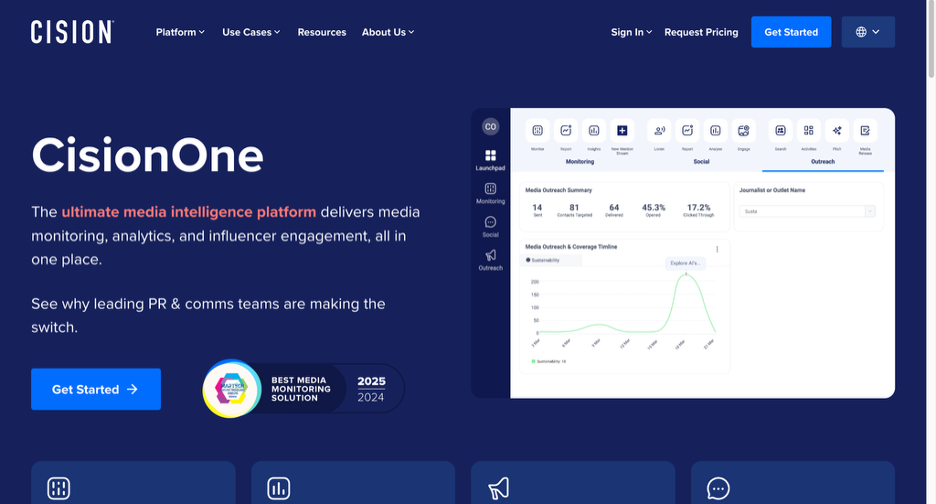
Cision is a PR platform that may fit teams with global coverage needs. It features a huge database of journalists, social media influencers, and media outlets. Brands that need engagement with journalists can benefit from the tool’s list building, outreach, and newsroom content distribution capabilities.
Screenshot of Cision’s homepage showing a brief overview of its key features
Cision is one of the few PR platforms that harnesses the power of artificial intelligence. Its AI-assisted outreach tool can help brands discover the most relevant reporter according to their industry.
However, Cision’s comprehensive features and integrated tools may feel complex for startups, small teams, or brands that focus on one simple campaign at a time.
5. Press Ranger
Press Ranger is a platform that offers a modern take on press release distribution services. It includes a media contact database for running campaigns, as well as AI-generated press releases and pitch emails.
However, Press Ranger is not a full-service PR agency, so startups still need to manage their own content strategy. Its reliance on automation can make the content feel generic compared to human-written articles or emails.
6. Prowly
Startups that prefer a CRM-based media tool may find Prowly interesting. This tool offers a user-friendly media database wherein brands can create their media lists based on beats, locations, or topics.
Prowly has an automation feature for journalist outreach, analytics for email performance, and AI assistance for writing personalized pitches or press releases.
As Prowly’s key features prioritize media outreach, this platform suits small and mid-sized businesses wanting to manage outreach rather than content creation and advanced monitoring.
7. Meltwater
Meltwater may meet the needs of brands requiring comprehensive monitoring across news and other online sources. It tracks news from hundreds of global sources, including social media platforms, podcasts, broadcast media, and print.
With its journalist relationship management tools, share-of-voice analytics, and comparative reports, teams can easily align with their strategy. However, Meltwater’s advanced features may take time to master, which is a factor to consider for startups with small teams.
8. Prezly
Tracking the performance of press releases and pitches is a top priority for some startups. With limited budgets, placements must be high-quality and perform well. Startups with this kind of PR need may find Prezly worth exploring.
Prezly helps brands track press release performance and monitor how stories are being covered. Users can also access analytics such as opens, clicks, unsubscribes, and more.
Since Prezly focuses primarily on monitoring, it may serve best as a supplementary tool for startups with a content creation or media outreach structure already in place.
9. PR Newswire
Startups that may have the budget to splurge on their PR efforts may find press release distribution networks like PR Newswire a compelling option. It provides access to thousands of media outlets and newsrooms, helping corporate announcements or regulatory disclosures gain increased visibility.
Since PR Newswire is an established distribution network, it is usually utilized by large organizations or brands that require global reach. Startups with smaller budgets or those that do not distribute press releases frequently may find PR Newswire’s features and costs less suitable for their needs.
10. Business Wire
Brands in regulated industries such as finance, banking, healthcare, aerospace, and more may prefer a press release distribution network that specializes in highly trusted channels for media, analysts, and investors. One such network is Business Wire, which offers global reach and multimedia integration.
Screenshot of Business Wire’s homepage showing an overview of its services
Business Wire allows brands to include images, videos, or graphics in their press releases to make them more engaging for their target readers. Because of its strong investor reach, Business Wire’s pricing can be costly for startups or brands that do not publish press releases frequently.
Choosing the Right PR Agency Alternative
With so many PR tools available, it’s easy to feel lost and overwhelmed. However, if you’re focused on achieving your goal, these steps can guide you to the right PR tool.
1. Identify your goals.
Define what you want to achieve. Is it brand awareness, increased sales and leads, or credibility? Clear goals make it easier to choose a platform that aligns with your priorities.
2. Define your audience.
Understanding who you want to reach will shape your PR strategy. Your chosen solution should help you connect with the right publications and channels.
3. Understand your brand’s PR needs.
PR is not just about producing press releases. You may need support for media outreach, content distribution, or even crisis management. Choose a platform that can help streamline your efforts.
4. Consider your budget.
Traditional PR agencies often come with high monthly retainers, which can be difficult for startups to sustain. PR alternatives typically offer more flexible pricing. Evaluate the cost against the potential results so you can choose an optimal solution without breaking the bank.
Is FameHero the Best PR Partner for Your Business?
Whether FameHero could be your best partner depends on your goals and other PR needs. FameHero is a new, cutting-edge platform that aims to solve a different problem.
Most PR tools today assume visibility only comes from relationships with journalists, media lists, and pitching cycles. FameHero helps businesses grow their brand visibility with high-quality, human-written content that is understood by the client’s target audience, valued by search engines like Google, and indexed by AI platforms such as ChatGPT, Gemini, Perplexity, and more.
What makes FameHero compelling is how it combines these three layers that are usually fragmented:
AI-powered diagnostics (what’s missing, weak, or underused)
Content direction (what type of articles and stories should exist about your brand)
Guaranteed editorial placements (where those stories live online)
To understand how FameHero can help you assess and grow your brand visibility, let’s walk through the steps users follow on the platform:
1. Input your brand details.
Simply paste your brand’s website or social media profile link on the FameHero website.
2. Scan your brand.
FameHero’s AI-powered brand visibility scan can diagnose your brand’s online presence in under 60 seconds, covering search presence, news coverage, customer reviews, and PR strengths and opportunities.
3. Define your content.
After familiarizing yourself with the gaps and opportunities to strengthen your brand’s online presence, you can choose a goal for your campaign. These are the three goals users can select:
Sales and Leads: Ideal for brands that want to generate more sales and qualified leads
Brand Awareness: For brands that want more people to discover their brand
Trust and Credibility: Best for brands that want to strengthen buyers’ trust in their products or services
After selecting a goal, users can choose one or both of the following options for content planning:
Expert Placements: FameHero’s experts will choose the best keywords and placements for your content
AI Content Focus: AI will select the best content focus
FameHero’s dashboard will also display examples of article types and titles so users can see the types of content they can receive once the campaign starts.
1. Choose your budget.
Users can select from the One-Time or Monthly plans, and below, there are tiers that users can toggle depending on the budget they want to allocate for the campaign. FameHero also displays the number of articles, estimated return on ad spend, and estimated qualified leads for each plan.
2. Launch your campaign.
After selecting your budget and completing payment, your campaign will start. The articles will be drafted by FameHero’s writers, and professional designers will create the in-article images and graphics. Brands can review the draft, approve the content, and request revisions before publication.
Wrapping Up
While there’s no such thing as the perfect tool, the right PR alternative won’t just help you get seen, but also shape how your brand is understood across SERPs, media, and AI platforms. Platforms like FameHero, for example, can strengthen search presence through guaranteed placements and elevate your startup’s workflow.
Iran’s Revolutionary Guard has issued threats against several major U.S. tech companies operating in the Middle East, including Nvidia, Apple, Microsoft, and Google. The group labeled 18 firms as “legitimate targets” in retaliation for recent U.S. and Israeli strikes on Iran. According to a Guard-affiliated Telegram post, attacks would begin at 8 p.m. on Wednesday, April 1, Tehran time, and employees were urged to leave workplaces immediately for safety.
Other companies on the list include Cisco, HP, Intel, Oracle, IBM, Dell, Palantir, JPMorgan, Tesla, GE, Boeing, Spire Solutions, and UAE-based AI company G42. Intel confirmed it is actively safeguarding employees and facilities in the region.
Experts say the threats mark a shift in conflict tactics, with tech assets now considered integral to the war. James Henderson, CEO of risk management firm Healix, noted that future crises may increasingly target data centers and cloud infrastructure, as Iran demonstrated in early March by striking AWS facilities in the Middle East, causing outages for digital services in the UAE.
U.S. tech companies have been building more AI infrastructure in the region because energy and land are cheaper there. The conflict started with U.S.-Israeli strikes on February 28 and has already seen over 3,000 drones and missiles used across the UAE, Saudi Arabia, Bahrain, and Kuwait. President Donald Trump mentioned that U.S. forces might leave Iran in a few weeks, and he plans to give a national update soon.
This situation highlights the rising cyber and physical dangers technology companies face as regional tensions increase.
The Strategic Importance of Quality Merchandise in Modern E-commerce
Defining Your Merchandise Strategy: Customization versus White Label
Key Criteria for Evaluating UK Merchandise Suppliers
Top Tier General Merchandise Suppliers for Rapid Scaling
Specialized Niche Suppliers: Apparel, Tech, and Lifestyle
Sustainable and Ethical Sourcing: The New Standard for UK Brands
Navigating Logistics and Lead Times in a Post-Brexit Landscape
Maximizing Profit Margins through Bulk Purchasing and Tiered Pricing
Future Proofing Your Brand with On-Demand Production Models
Mastering the Partnership for Long Term Growth
The Strategic Importance of Quality Merchandise in Modern E-commerce
In the hyper-competitive landscape of British e-commerce, the physical touchpoint of a brand has never been more critical. As digital acquisition costs continue to climb across platforms like Meta and Google, savvy brand owners are shifting their focus toward retention and lifetime value. High-quality physical merchandise serves as a tangible extension of a brand’s digital identity, transforming a standard transaction into a memorable brand experience.
Scaling an e-commerce brand requires more than just a great product; it requires a cohesive ecosystem of branded assets. Whether you are providing corporate gifts, influencer kits, or retail-ready apparel, the quality of your supplier directly dictates your brand’s perceived value. A poorly printed logo or a flimsy promotional item can do more damage to your reputation than no merchandise at all. Conversely, premium goods foster a sense of community and loyalty that digital ads simply cannot replicate.
UK brands have a unique advantage in the current market. By sourcing locally or through established British distributors, companies can ensure tighter quality control, faster shipping times, and a reduced carbon footprint. This guide explores how to identify the best partners to help you transition from a small startup to a dominant market player.
Defining Your Merchandise Strategy: Customization versus White Label
Before reaching out to suppliers, it is essential to understand which production model aligns with your growth trajectory. The two primary paths are white-labeling existing products or developing fully custom, bespoke items.
White Labeling and Overprinting: This is the most common entry point for scaling brands. You select high-quality blank products, such as Stanley bottles or Stanley/Stella hoodies, and apply your branding. This allows for lower minimum order quantities and faster turnaround times.
Bespoke Manufacturing: For brands that have reached a certain volume, custom manufacturing offers the ability to create unique products from scratch. This includes custom fabric blends, unique pantone matching, and proprietary shapes. While this offers the highest level of brand differentiation, it comes with longer lead times and higher initial investment.
Print on Demand: This model is excellent for testing new designs without holding inventory. However, as you scale, the high unit cost of print on demand usually necessitates a move toward bulk ordering to protect your profit margins.
Key Criteria for Evaluating UK Merchandise Suppliers
Selecting a partner is a long-term commitment. You are not just looking for a vendor; you are looking for a collaborator who understands your brand’s aesthetic and operational requirements. When evaluating potential Best Merchandise Suppliers UK options, consider the following metrics.
Quality of Print and Finish
The technical capability of a supplier is paramount. You should inquire about their specific printing methods, such as screen printing, direct-to-garment, embroidery, or laser engraving. Ask for a sample pack to inspect the durability of the prints and the feel of the materials. A supplier that offers high-end finishes like 3D embroidery or puff printing can help your brand stand out in a crowded market.
Scalability and Capacity
A supplier that works for you when you need fifty units might fail you when you need five thousand. Investigate their production capacity and whether they have the infrastructure to handle seasonal spikes, such as the lead-up to Black Friday or Christmas. Understanding their peak-season lead times is vital for inventory planning.
Communication and Project Management
Scaling requires agility. You need a dedicated account manager who provides proactive updates rather than someone you have to chase for information. Professionalism in communication is often an indicator of professionalism in production.
Top Tier General Merchandise Suppliers for Rapid Scaling
For brands that require a wide variety of products under one roof, generalist suppliers provide a streamlined solution. These companies act as a one-stop shop, managing everything from stationery and tech gadgets to apparel and drinkware.
One of the standout names in this sector is Totally Branded, a company that has built a reputation for helping UK businesses scale their physical presence with ease. Their extensive catalog allows e-commerce managers to source diverse product lines without the headache of managing multiple vendor relationships. When searching for the Best Merchandise Suppliers UK Totally Branded often appears at the top of the list due to their commitment to quality and their user-friendly procurement process.
By consolidating your spend with a single large-scale supplier, you often gain access to better volume discounts and more consistent branding across different product categories. This consistency is vital for maintaining a professional image as you expand into new market segments.
Specialized Niche Suppliers: Apparel, Tech, and Lifestyle
While generalists offer breadth, specialists offer depth. Depending on your brand’s core identity, you may find that a niche supplier provides a level of expertise that a generalist cannot match.
Premium Apparel Specialists: If your brand is fashion-forward, you need suppliers who specialize in high-gsm fabrics and modern silhouettes. Look for partners who work with organic cotton and recycled polyesters, as these are increasingly demanded by UK consumers.
Tech and Gadget Experts: For brands in the gaming or corporate tech space, sourcing high-quality electronics is a challenge. You need suppliers who ensure all items meet UK safety standards and offer reliable warranties on components like power banks or wireless chargers.
Luxury and Lifestyle Curators: If your brand positions itself at a premium price point, your merchandise must reflect that. Specialized suppliers in this space focus on high-end materials like genuine leather, crystal, or sustainable wood, often providing sophisticated packaging solutions to match.
Sustainable and Ethical Sourcing: The New Standard for UK Brands
The modern British consumer is more environmentally conscious than ever before. Sustainability is no longer a niche requirement; it is a baseline expectation. When scaling your e-commerce brand, your choice of merchandise supplier reflects your corporate social responsibility.
Eco-Friendly Materials
Look for suppliers that offer products made from GOTS certified organic cotton, RPET (recycled plastic), or bamboo. Using sustainable materials is not just good for the planet; it is a powerful marketing tool that can increase customer loyalty and justify premium pricing.
Ethical Supply Chains
It is crucial to verify that your suppliers adhere to fair labor practices. Many top-tier UK providers, including Totally Branded, prioritize transparency in their supply chain. This ensures that the people making your products are treated fairly and work in safe conditions. Asking for certifications such as Sedex or Fairtrade can provide peace of mind and protect your brand from future PR risks.
Reducing Carbon Footprint
Sourcing from UK-based suppliers significantly reduces the carbon emissions associated with long-distance shipping. Additionally, many modern suppliers are investing in carbon-neutral delivery options and plastic-free packaging, allowing you to offer a truly green product to your customers.
Navigating Logistics and Lead Times in a Post-Brexit Landscape
The logistical landscape for UK e-commerce has shifted significantly in recent years. Importing goods from overseas now involves more complex customs declarations, potential duties, and unpredictable delays at ports. This has made domestic suppliers even more attractive for brands looking to scale quickly.
Speed to Market: A UK-based supplier can often turn around an order in seven to ten working days, whereas overseas sourcing can take six to twelve weeks. This speed allows you to react to trends and restock bestsellers before the momentum fades.
Lower Shipping Costs: While the unit price might be higher in the UK compared to some overseas markets, the savings on international freight and import duties often balance the scales. Furthermore, domestic shipping is much more predictable.
Quality Control: It is much easier to resolve a quality issue with a supplier in the same time zone. If a batch of products arrives with a defect, a UK partner like Totally Branded can often rectify the situation and send replacements in a fraction of the time it would take an international vendor.
Maximizing Profit Margins through Bulk Purchasing and Tiered Pricing
As your volume increases, your procurement strategy must evolve to protect your margins. The transition from small-batch ordering to bulk purchasing is a significant milestone for any scaling brand.
Economies of Scale: Most suppliers offer tiered pricing. The difference between ordering 100 units and 1000 units can be substantial. By forecasting your needs six months in advance, you can place larger orders and significantly reduce your cost per unit.
Warehousing and Fulfillment: Some large-scale suppliers offer storage solutions. Instead of taking delivery of 5000 units at your small office, you can pay a nominal fee to have the supplier hold the stock and ship it to your fulfillment center in smaller increments.
Negotiation Leverage: Once you become a high-volume client, you have more room to negotiate. This might not just be on price, but also on payment terms, allowing you to keep more cash in the business for marketing and product development. Totally Branded is known for working closely with growing brands to find pricing structures that support long-term expansion rather than just one-off sales.
Future Proofing Your Brand with On-Demand Production Models
While bulk ordering is great for established lines, the future of e-commerce merchandise also involves a level of personalization and on-demand production. This hybrid approach allows brands to stay lean while offering a wide variety of designs.
Integrating your e-commerce platform directly with a supplier’s production system can automate the entire process. When a customer orders a specific t-shirt or mug, the order is sent directly to the supplier, printed, and shipped. While this has a higher unit cost, it eliminates the risk of unsold inventory.
Many scaling brands use a mix of both worlds. They bulk-buy their best-selling core items to maximize profit and use on-demand services for limited edition drops or experimental designs. This balanced approach ensures financial stability while fostering a culture of innovation and freshness that keeps customers coming back.
Mastering the Partnership for Long Term Growth
Success in the e-commerce world is rarely achieved in isolation. The relationship you build with your merchandise supplier is one of the most important pillars of your business infrastructure. To get the most out of this partnership, transparency is key. Share your growth projections with your supplier so they can prepare their capacity to meet your future needs.
A proactive partner like Totally Branded will often suggest new product innovations or branding techniques that you might not have considered. By staying at the forefront of merchandise trends, they help you keep your brand relevant and exciting.
When you reach the stage of scaling, you need a partner that can match your ambition. Look for a supplier that invests in the latest technology, maintains high ethical standards, and offers a seamless ordering experience. By choosing one of the best merchandise suppliers in the UK, you are not just buying products; you are investing in the physical manifestation of your brand’s promise to its customers.
Your journey toward becoming a household name depends on the quality of every item that leaves your warehouse. Treat your merchandise as a core component of your marketing strategy, and choose your partners with the same care you would use when hiring a senior member of your team. With the right supplier by your side, the potential for your e-commerce brand is virtually limitless.
The Evolution of Scottish Residential Architecture
Why Aluminium has Become the Material of Choice
Slim Sightlines and the Pursuit of Natural Light
Thermal Performance in the Scottish Climate
Durability and Maintenance in Coastal and Urban Environments
Colour Palettes and Aesthetic Versatility
Sustainable Building Practices and Recyclability
Integrating Smart Technology with Window Systems
The Future of Scottish Home Design
The Evolution of Scottish Residential Architecture
Scottish architecture has undergone a radical transformation over the last two decades. While the traditional sandstone tenements and white harled cottages remain iconic symbols of the past, the new builds emerging across the Central Belt, the Highlands, and the coastal regions are embracing a much more modernist aesthetic. This shift is characterized by a desire for transparency, minimalism, and a seamless connection between internal living spaces and the rugged beauty of the Scottish landscape.
The transition from timber and uPVC toward more industrial materials is not merely a fashion statement but a response to the changing demands of homeowners. Today, people want expansive glass walls that frame the view of a loch or a city skyline without the intrusion of thick, bulky frames. This demand for high performance and high style has placed aluminium at the center of the contemporary design movement. Architects are no longer restricted by the structural limitations of traditional materials, allowing for larger apertures and more creative floor plans that prioritize light above all else.
Why Aluminium has Become the Material of Choice
The rise of aluminium in the residential sector is largely due to its incredible strength to weight ratio. Unlike timber, which can warp over time, or uPVC, which requires internal steel reinforcement for larger spans, aluminium is inherently rigid. This allows for the creation of massive floor to ceiling window installations that remain stable and secure. When considering Contemporary Design: How Aluminium Windows are Shaping New Builds Across Scotland, it is clear that Wolfline Windows & Doors has become a pivotal name for developers seeking to combine this structural integrity with bespoke craftsmanship.
Furthermore, aluminium is a highly flexible material in terms of fabrication. It can be extruded into complex profiles that accommodate triple glazing and advanced weather seals while maintaining a sleek profile. This versatility means it can be used in everything from ultra modern urban apartments in Glasgow to secluded eco homes in the Cairngorms. The material does not rust or rot, making it a permanent fixture that adds significant value to any new build property.
Slim Sightlines and the Pursuit of Natural Light
One of the most defining characteristics of modern Scottish homes is the use of slim sightlines. In a country where daylight hours can be limited during the winter months, maximizing the entry of natural light is vital for both well being and energy efficiency. Aluminium frames can be significantly thinner than their counterparts, meaning the ratio of glass to frame is much higher.
Maximizing Solar Gain: Larger glass panes allow more sunlight to enter the home, naturally warming the interior spaces during the day.
Uninterrupted Views: Slimmer frames ensure that the focus remains on the scenery outside rather than the hardware of the window itself.
Minimalist Aesthetic: The clean, sharp edges of aluminium profiles complement the geometric shapes often found in contemporary architecture.
By reducing the visual bulk of the window, architects can create a sense of weightlessness in a building. This is particularly effective in open plan living areas where the boundary between the kitchen, dining room, and garden is blurred through the use of bi folding or large sliding doors.
Thermal Performance in the Scottish Climate
A common misconception from decades ago was that metal windows were cold and prone to condensation. However, modern engineering has completely eradicated this issue through the introduction of thermal breaks. A thermal break is an insulating material placed between the inner and outer sections of the aluminium profile to prevent heat transfer.
For Scottish homeowners, this is a critical feature. With the wind and rain that often batter the Atlantic coast, windows must provide a robust barrier against the elements. Wolfline Windows & Doors provides systems that utilize these advanced thermal breaks alongside high performance glazing to achieve exceptionally low U values. This ensures that even with vast expanses of glass, the home remains warm and energy bills are kept under control. Triple glazing is also becoming a standard request in new builds, providing an extra layer of insulation and soundproofing that is particularly beneficial in bustling city centers or exposed rural sites.
Durability and Maintenance in Coastal and Urban Environments
Scotland presents a unique set of challenges for building materials. From the salt spray of the Western Isles to the atmospheric pollutants in industrial areas, windows are subjected to constant environmental stress. Aluminium is naturally resistant to corrosion, but when finished with a high quality powder coating, it becomes virtually indestructible.
Salt Resistance: Marine grade finishes are available for homes located within a certain distance of the shoreline, preventing the finish from pitting or bubbling.
Low Maintenance: Unlike timber, which requires sanding and painting every few years, aluminium simply needs an occasional wipe down with soapy water to maintain its appearance.
Longevity: An aluminium window system can easily last forty years or more without losing its structural integrity or aesthetic appeal.
This long term durability makes it a cost effective choice for developers and self builders who want to invest in a product that will not require replacement or heavy maintenance for decades to come.
Colour Palettes and Aesthetic Versatility
While many people associate aluminium windows with a dark grey or black industrial look, the reality is that they are available in any RAL colour imaginable. This allows homeowners to perfectly match their windows to other elements of the building, such as the roofline, cladding, or front door.
Wolfline Windows & Doors offers a wide range of finishes, including matte, gloss, and even textured surfaces that provide a unique tactile quality to the frames. In many contemporary Scottish builds, we see a trend towards dual colour options. This allows the exterior of the window to be a bold, dark shade that stands out against stone or timber cladding, while the interior is finished in a softer white or light grey to complement the interior decor. This level of customization is one of the primary reasons why architects prefer aluminium for bespoke projects.
Sustainable Building Practices and Recyclability
As the construction industry moves towards a net zero future, the sustainability of materials has never been more important. Aluminium is often referred to as the green metal because it is one of the most recycled industrial materials on earth. Around seventy five percent of all aluminium ever produced is still in use today.
Circular Economy: At the end of its long life cycle, an aluminium window can be melted down and recycled into a new product with no loss of quality.
Energy Efficiency: By reducing the need for artificial heating and lighting through superior thermal design and light entry, these windows lower the overall carbon footprint of a home.
Responsible Sourcing: Many manufacturers now prioritize using primary aluminium produced with renewable energy sources, such as hydroelectric power.
Choosing sustainable materials is a priority for many new build projects in Scotland, especially those aiming for specific green certifications or building to Passivhaus standards.
Integrating Smart Technology with Window Systems
The modern home is increasingly connected, and window technology is no exception. Contemporary aluminium systems are now being designed to integrate seamlessly with home automation. This includes everything from automated opening vents for climate control to integrated Venetian blinds that can be controlled via a smartphone app.
Security is another area where technology and design intersect. Because aluminium is so strong, it can support heavy duty multi point locking systems that are much harder to breach than those found on uPVC windows. Many systems now include concealed sensors that can alert a homeowner if a window has been left open or if there is an attempt at forced entry. Wolfline Windows & Doors ensures that their products meet the highest security standards, providing peace of mind to residents in both urban and rural settings.
The Future of Scottish Home Design
Looking forward, the influence of aluminium on the Scottish architectural landscape is only set to grow. As building regulations become stricter regarding energy efficiency and ventilation, the precision engineering of aluminium profiles will make them the go to solution for meeting these requirements. We are likely to see even more ambitious designs, including curved glass walls and even thinner frames that push the boundaries of what is possible.
The trend of bringing the outdoors in will continue to dominate. Large scale sliding doors that disappear into wall pockets and corner to corner glass without visible support pillars are becoming more common in high end new builds. These features rely entirely on the strength and versatility of aluminium. By choosing high quality installations from providers like Wolfline Windows & Doors, Scottish homeowners are ensuring that their properties are not only beautiful and functional today but are also built to withstand the tests of time and the unpredictable Scottish weather. The marriage of form and function that aluminium provides is truly the foundation of modern residential design in the north.
Sean Bielat made a career of supporting America’s military. Now, he’s doing the same for Europe.
Sean Bielat grew up in the shadow of men who wore uniforms. His grandfathers served, his father served, his uncles served, and his brother served. So when Bielat entered the Marine Corps and became the first in his family to be commissioned as an officer, he wasn’t breaking with tradition so much as extending it. Military service, as he has described it, was the ladder his family climbed—each generation coming out with a little more opportunity in front of them than the last.
That ladder—from Shaw Air Force Base in South Carolina, where Bielat was born, to a suburb of Rochester, New York, where he grew up, to Georgetown for his undergraduate degree, then Wharton for his MBA and Harvard’s Kennedy School for a master’s in international security—has always been a path to a destination. Today, Bielat’s the Managing Partner of OMVP, an early-stage fund focused on European defense technology companies.
Before OMVP, there was Endeavor Robotics. In 2016, with private equity funding from Arlington Capital Partners, Bielat carved the company out of iRobot for roughly $25 million. Endeavor made ground robots for the military—the kind that go into buildings before soldiers do, that detonate IEDs, that venture into places where sending a human being would be unconscionable. Under Bielat’s leadership, Endeavor secured multiple Programs of Record with the DoD and became the leading provider of ground robots to the U.S. military. And in 2019, FLIR Systems acquired Endeavor for $385 million.
A fifteen-times return in three years is the kind of number that makes investors pay attention. But Bielat is more interested in talking about how the company got there than the exit. His management philosophy, as he tells it, is one of deliberate restraint. “I focus on building strong teams and 90-95% of the time, I trust my team’s decisions and recommendations,” he has said. “The other 5-10% is what I get paid for. It’s the times I have to say, ‘No, that’s not what we’re doing.’ If it fails, it’s on me. If it succeeds, it’s their success.” It’s a philosophy with roots in military command culture, where the consequences of getting the balance wrong between authority and delegation are considerably more severe than a bad quarterly report.
Between iRobot and Endeavor, Bielat ran twice for Congress in Massachusetts’s 4th congressional district, losing first to Barney Frank in 2010 and then to Joseph Kennedy III in 2012. Though those campaigns, against two of the more prominent Democratic incumbents of their era, didn’t produce a seat in the House, they weren’t a detour either. They instead reflected the same preoccupation that runs through his entire career: the relationship between American power, democratic institutions, and the security architecture that binds them all together.
That preoccupation now has a clear geographic focus. OMVP invests in early-stage European defense technology, working with startups across the continent at a moment when Europe is grappling with a question it spent decades trying to avoid: what does it actually take to defend yourself? Russia’s escalating hybrid warfare campaign has forced the issue, and for Bielat, the answer to that question carries direct implications for the United States—European security and American security, in his view, are too intertwined to treat as separate concerns.
Bielat’s board and advisory roles read much like a map of the American defense-industrial ecosystem: USBid, ASYLON, Adaptec Solutions, a NATO study chairmanship, the Massachusetts Military Asset, and Security Strategy Task Force. He’s been a Henry Crown Fellow at the Aspen Institute. The breadth of involvement reflects someone who thinks about defense as a system rather than a sector, where the policy, the capital, the technology, and the people who actually carry the weapons are all load-bearing parts of the same structure.
He splits his time now between Madrid and New Hampshire, with his wife and four children. The Madrid posting has an operational logic: if you’re building a fund focused on European defense technology, living in Europe while maintaining ties to the American market is less a lifestyle choice than a professional requirement. The New Hampshire anchor keeps the other end of the transatlantic cable connected.
Bielat doesn’t talk about his work as a reinvention or a second act. The throughline is too consistent for that framing. From the Marines to McKinsey to iRobot to Endeavor to OMVP, he has been working variations of the same problem: how do democratic societies build and sustain the capacity to defend themselves, and how do you build organizations that are good at contributing to that capacity? The dollar figures attached to the answer have gotten larger. The question hasn’t changed.
By Danny Leipziger
China cannot continue to rely on exports to drive its growth, but what are the alternatives?
China ran a $1.2 trillion trade surplus last year, and despite admonitions from the IMF to rely...
The World Financial Review uses cookies to improve site functionality, provide you with a better browsing experience, and to enable our partners to advertise to you. Detailed information on the use of cookies on this Site, and how you can decline them, is provided in our Privacy Policy and Terms and Conditions. By clicking on the accept button and using this Site, you consent to our Privacy Policy and Terms and Conditions. ACCEPT
Privacy & Cookies Policy
Privacy Overview
This website uses cookies to improve your experience while you navigate through the website. Out of these cookies, the cookies that are categorized as necessary are stored on your browser as they are essential for the working of basic functionalities of the website. We also use third-party cookies that help us analyze and understand how you use this website. These cookies will be stored in your browser only with your consent. You also have the option to opt-out of these cookies. But opting out of some of these cookies may have an effect on your browsing experience.
Necessary cookies are absolutely essential for the website to function properly. This category only includes cookies that ensures basic functionalities and security features of the website. These cookies do not store any personal information.
Any cookies that may not be particularly necessary for the website to function and is used specifically to collect user personal data via analytics, ads, other embedded contents are termed as non-necessary cookies. It is mandatory to procure user consent prior to running these cookies on your website.