The world is constantly changing. We see it all the time. Yesterday’s league leaders become today’s relegation battlers. Alternative misfits become mainstream celebrity icons. What were once rich mines of natural resources dry up, while new sources of supply emerge in unexpected or newly explored places.
Asset Price Bubbles: Lessons From The Recent Financial Crisis

By Douglas Evanoff, George Kaufman & Anastasios G. Malliaris
The successful performance of the U.S. economy during the ‘Great Moderation’ period of 1984 to 2006 appeared to have offered both the economics profession and policymakers the assurance that asset bubbles could be effectively managed with little or no real adverse economic impact. But the recent global financial crisis had a serious adverse impact on the U.S. and global economies, and has triggered a renewal of the debate about the impact of bubbles and the role of public policy in addressing them.
Writing a Manifesto for Better Management

By Rafael Andreu & Josep M. Rosanas
The current world economy crisis creates difficulties for many. Beyond “mechanical” causes, we posit that bad management in the institutions affected is a crucial one. An exaggerated emphasis on immediate financial results (always short-term) as the sole purpose of management, betrays a pessimistic conception of human beings that react only to economic stimuli, paradoxically neglecting other fundamental management dimensions. We point out some starting points for better management. After analyzing concepts and practices that contributed to the crisis, we propose the foundations of a better conception of management.
Staying Power: Managing Innovation in an Uncertain World

In December 2005, I was invited by Oxford University to deliver the 2009 Clarendon Lectures in Management Studies and then to produce a book based on those lectures. We decided that I should try to synthesize my research, consulting, and other experiences going back to 1985 with companies ranging from Toyota, Intel, and Microsoft to Google and Apple, described in nine books and nearly one hundred articles. The result is my latest book, Staying Power: Six Enduring Principles for Managing Strategy and Innovation in an Uncertain World (Oxford University Press, 2010, and 2012 paperback). This article is a summary of the key ideas.1
September – October 2012
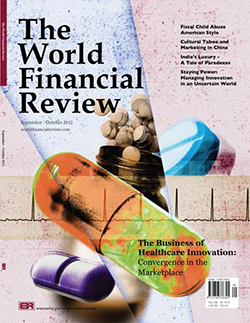
Logistics Clusters: The Feedback Loop Leading to Economic Growth and Jobs Between Heaven and the Deep Blue Sea: Kitimat’s strategic placement facilitates a growing economy The Business of Healthcare Innovation: Convergence in the Marketplace Digital Social Capital: Building, Maintaining and Leveraging Digital Networks for Innovation and Creativity Staying Power: Managing Innovation in an Uncertain World China Marketing Life Insurance in China: How Cultural Taboo Matters Asset Price Bubbles: Lessons From The Recent Financial Crisis Dividends – Everything you know is wrong! Europe Middle East
Business
Writing a Manifesto for Better Management
Rafael Andreu & Josep M. Rosanas
Yossi Sheffi
Rose Klukas
Innovation
Why Questions Matter
Phil McKinney
Lawton Robert Burns
Anabel Quan-Haa
Michael A. Cusumano
The Chinese Miracle: A Modern Day Industrial Revolution Fred Stahl
Loretta Napoleoni
Cheris Shun-ching ChanWorld Economy
Why Transfer Pricing is Key to Decision Making and Strategic Reviews
Les Secular
Douglas Evanoff, George Kaufman & Anastasios G. Malliaris
David Hogarty
America
Fiscal Child Abuse American Style
Laurence Kotlikoff & Scott Burns
India
India’s Luxury – A Tale of Paradoxes
Glyn Atwal & Soumya Jain
The Crisis in the Eurozone
Justin Yifu Lin & Volker Treichel
The Educated Middle Class, their Economic Prospects, and the Arab Spring
Filipe R. Campante & Davin Chor
Keynes, Kant and Capital Flows

By Oliver Bush
This is an abridged and altered version of Bush, O, Farrant, K and Wright, M (2011), ‘Reform of the International Monetary and Financial System’, Bank of England Financial Stability Paper no. 13.
Is Venture Capital In Crisis?

By Douglas Cumming & Sofia Johan
The recent financial crisis cannot totally be blamed for the marked drops in venture capital fundraising, reduced venture investment and the hindrance of successful exits around the world, but it may have exacerbated the existing problems. Poor returns over the past decade indicate most fund managers do not earn their fees, and investors have been increasingly wary of taking on added risk without getting the reward. Structural changes are inevitable to the venture capital marketplace to preserve an essential source of funding for nascent high-growth companies.
Can We Afford to Live Longer in Better Health?

By Frank Pellikaan & Ed Westerhout
Rising longevity, low fertility and declining disability have serious implications for public finances. Although alternative assumptions on longevity and disability may alleviate or increase the pressure on public finances, public finances will become unsustainable if policy reforms fail to occur.
Sino-Russian relations: More rhetoric than substance?

By Robert Bedeski & Niklas Swanström
Despite some re-engagement between China and Russia since Putin’s initial embrace of the West, the positive rhetoric of today often does not reflect reality. There has been significant internal competition and tension that continues to negatively affect Sino-Russian relations that is looked at more closely in the article. The vivid statements on the flourishing partnership are often clearly more declaratory than substantive.
Google versus the Law

Google’s legal adventures in Europe are constantly demonstrating that Google is pushing the boundaries of European information law to their outer limits. The conflicting interaction of Google’s business methods and of European legal norms is a major challenge both for the revision of Google’s business tactics and for the evolution of law in a way that takes into account emerging innovative technologies and practices. In this context, it is important to examine how the fundamental dogma of the free flow of information and the principle of automated neutral data-processing, which both are defended and applied by Google, have been tested before the European jurisdictions in the light of copyright law, trademark law, data protection and personality rights.
EDITOR'S PICK OF THE WEEK

China’s Challenging Search for a New Model of Economic Growth
By Danny Leipziger
China cannot continue to rely on exports to drive its growth, but what are the alternatives?
China ran a $1.2 trillion trade surplus last year, and despite admonitions from the IMF to rely...