Home Blog Page 790

What is the Best eCommerce Platform in 2021

eCommerce Platform

Which eCommerce platform to use is vitally important because it affects the way your website will function. A good eCommerce platform enables you to create a highly efficient online store with more than simply an “add-to-cart” button. A seamlessly integrated system gives a comfortable experience to both owner and  customer.

The choice of platform defines the entire eCommerce software development process. Developers prefer CMSs that feature regular updates, user-friendly documentation, various customization options, and of course, an active community.

It is easy to get lost in all the options as there are a lot of things to consider when developing an eCommerce website. To narrow down the choice, let’s start with the most popular platforms. Then we’ll look at what’s the best eCommerce platform according to the experts we interviewed. Here we go.

What are the most popular eCommerce platforms?

To begin with, let’s look at what everybody else is using…maybe they know something. What are the most popular eCommerce platforms by the number of users?

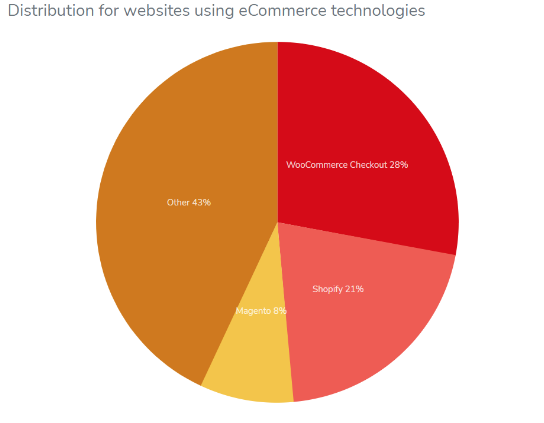
According to Builtwith, the following eCommerce technologies are used by the  top 1 million websites:

  • WooCommerce (WordPress) – 28%
  • Shopify – 21%
  • Magento – 8%
  • Squarespace add to cart
  • PrestaShop
  • OpenCart
  • Shopify Plus
  • BigCommerce

BuiltWith Chart

As you can see, WooCommerce and Shopify each have a substantial share of the eCommerce market. They are in the lead here for a reason. Let’s have a look at their strong and weak points. 

1. WooCommerce

It is the best eCommerce platform for WordPress being its dedicated plugin which allows the users to sell online. This platform is so popular because WordPress is already the most frequently used CMS for websites. It’s suitable for both small and medium-sized businesses. With WooCommerce, websites can sell both physical and digital products, and support different payment channels. 

Pros: 

  • free
  • highly customizable
  • good for email marketing
  • has an active community 

Cons: 

  • insecure and prone to attack as hackers are attracted to its user base
  • unreliable due to its fragile construction; with additional plugins, you risk crashing the whole website
  • no customer support
  • requires technical proficiency
  • not hosted

2. Shopify

It is a proprietary SaaS platform for eCommerce. It is a good choice for startup owners without a technical background, but it’s also suitable for large online shops. When just starting out, however, we do not recommend you use Shopify since it is expensive and made for larger stores with a wider variety of products. There are several pricing options depending on the functionality you need. Shopify Plus is for enterprise-level solutions.

Pros: 

  • user-friendly
  • offers a variety of tools and supports many channels
  • good customer support
  • has many built-in SEO features

Cons: 

  • free functions are limited
  • extra fees for non-Shopify payments

3. Magento

It is a powerful and customizable system for developers with advanced technical knowledge. 

Pros: 

  • offers individually-tailored solutions 
  • frequent updates 
  • great for SEO
  • allows admin to manage multiple stores from a single panel

Cons: 

  • fully hosted software is complex and pricey
  • updates must be installed manually
  • you need to add a payment processor extension

4. Squarespace add to cart

It helps startups launch their website quickly and turn it into an online store for free. 

Pros: 

  • easy drag-and-drop editor
  • great inventory tracking tool
  • add-to-cart button is free 

Cons: 

  • limited integrations 
  • extra commission for transactions
  • add-to-cart is a separate feature you need to insert into your website

5. PrestaShop

It is an open-source platform, perfect for those who have some tech background because there is no customer support to help figure everything out.

Pros: 

  • control over privacy settings
  • affordable
  • useful built-in features

Cons: 

  • might be difficult to use for inexperienced users
  • complex maintenance
  • tech support is available only with paid plans

6. OpenCart

It is an open-source platform for merchants. It is free software, which supports different add-ons to customize your solutions. It is easily integrated with  many payment services.

Pros: 

  • many integrations are available
  • multilingual system
  • offers a variety of features
  • free to use, affordable maintenance 

Cons: 

  • limited built-in features
  • difficult to customize
  • complex update process
  • difficult to add functions for new versions

7. BigCommerce

BigCommerce is a good place to start your store. It is also great for enterprise-level stores and offers good customization options including many profitable featur

Pros: 

  • offers many sales channels
  • accepts international payments
  • integrates with a lot of applications
  • 24\7 customer support

Cons: 

  • you need to register your domain elsewhere
  • limited free themes
  • complex to use

What is the best eCommerce platform according to the experts?

We asked seasoned eCommerce practitioners which platform they would recommend. Many of them agreed that Shopify is their favorite. But why is Shopify the best eCommerce platform? Here are the reasons behind people’s choices.

1. Perfect for Mobile

“Shopify’s mobile readiness is a compelling reason for using the platform. Some platforms need tweaks and changes in order to be properly optimized for mobile shoppers. Others simply don’t work well with mobile optimization. All Shopify themes are automatically mobile responsive. This is important because a large percentage of shoppers use mobile devices to shop today.” 

2. 24\7 Customer Support

“One of the major benefits of using Shopify is that you don’t need to hire any developer for maintenance or to solve any issue because you will get 24/7 support from Shopify and they will personally fix your issues.”

3. Ease of Use

“Shopify CMS is easy to use and set up on your own. If you are a larger organization, it integrates with so many other software products. Cost is affordable and they maintain the hosting so that is one less headache.”

4. Easy to Scale 

“One huge benefit to building on Shopify is it allows business owners to scale rapidly without interruptions in service, and any added cost.

When you sign up with Shopify you pay a fixed (and very reasonable) price per month, and the price isn’t affected by website traffic. If you build your own website and host it, or use a website backend like WordPress, you have to constantly manage servers which is a pain and more expensive by far.

Our site has scaled from under 3,000 monthly pageviews to 50,000 in under three months, and we have had no interruptions in service nor have we had to pay an extra dime to Shopify for managing this increased traffic.”

5. High Level of Security 

“Also, you can make sure the data of your client and store is safe, as Shopify has level 1 PCI compliance and 256-bit SSL encryption for security. When you choose an eCommerce platform, consider the platform that runs on a single, unified platform and offers a complete customer view.”

6. Easy for Dropshipping

“Shopify integrates with Oberlo to provide integrated dropshipping tools, and all plans allow you to sell an infinite number of products, making it the greatest option for dropshipping. This simple-to-use eCommerce platform includes the Shopify POS light system and a slew of features, including a live chat option and an online invoice creator.”  

7. Comprehensive Analytics and Recommendations

“Huge amounts of data and comparable data included in the standard subscriptions. Unlike other platforms like WordPress/WooCommerce you can gain valuable insights from Shopify in how your store is compared against other stores that started at a similar time, total profit levels, and performance on a number of orders. 

This can help you gauge whether you’re over, under, or sitting right as a business compared to other eCommerce ventures. This might seem small but it can help encourage and validate those doing well, or help those who may be underperforming to ask what they could do to improve their business.

Thankfully for the latter Shopify’s platform helps eCommerce businesses understand things they can do to encourage more visitors, increase conversions and optimize the overall customer experience.”

8. Easy To Sell The Store

“Shopify has an internal marketplace where you can sell your store thanks to the verified backend data. This means that buyers can see verified traffic levels, revenue, and other important metrics which will increase the potential price of your company. The value of your business is derived from profit multiplied by a number – this number increases on more accurate data, store quality, and a number of other factors.”

9. Best eCommerce Platform For SEO

“Shopify’s on-page optimization is super easy since their backend is highly intuitive. Most eCommerce owners avoid SEO and organic traffic since they largely focus on ads. But still, I feel that blogging is something that long-term eCommerce brands should hold on to.”

How to Choose The Best eCommerce Platform for Your Business?

There are many options to choose from when you are building your online store, and they are constantly changing. The perfect platform for you is the one that matches your business needs. First of all, you must decide whether you build a typical online store, or a complex marketplace with unique features. 

All the platforms mentioned in this article can accommodate stores’ basic needs. WooCommerce and Shopify are the leaders in this area. WooCommerce is the most popular platform because it’s free, and because it’s compatible with WordPress. Nevertheless, Shopify is still the choice of a not insignificant number of eCommerce experts. 

Reasons behind Shopify’s success:

  • mobile-friendly
  • 24\7 customer support
  • good for beginners
  • secure
  • fits dropshipping
  • built-in analytics
  • allows the o selling of the  your store within internal market

If you want to build a marketplace, you need custom eCommerce development. This will allow you to create a complex and well-integrated system that satisfies your every requirement. Such a multilayered solution demands technical proficiency, so find a reliable development team to bring your ideas to life.

Hopefully, this will help you make a decision.


Advantages of Live Casino Games

Advantages of Live Casino Games

Gambling at online casinos is a fascinating and entertaining method to generate money in your spare time. These online casinos also provide a diverse selection of games. You will never be bored when playing at online casinos since there are so many games to choose from. Live casinos simulate the experience of being in a genuine casino. When you play at a live casino, you may interact with a real dealer. More advantages about live casinos are available at onlinecasinopaysafecard.com, which also offers a plethora of extra information.

In general, many factors can allow a certain casino to offer a genuine and authentic live experience, such as how good their graphics are, how realistic their sounds are and in general, how good is their overall atmosphere in replicating what usually happens at a land-based casino.

Technology has allowed many platforms to offer incredible platforms with incredible games. Casinos have never been better than now when it comes to how close they can approach the experience of a land-based casino. Live games are one of the key factors behind this fact. Therefore, here will be discussed how good live games can be for punters in general.

Live casinos have excellent ways to entertain users

Online casinos like Deltin Casino have been on the rise for decades and are expected to continue to do so in the future.They let players play casino games anytime they choose, regardless of where they are or what time it is. One of the primary reasons why people like online gambling via online casinos is this. They don’t have to waste money or time traveling to a physical casino. Many online casinos provide enticing incentives and promotional deals to entice new players. This is a significant edge that a player would not have in a traditional casino. 

The majority of online casinos have licenses and follow the laws and regulations. Gamblers must verify the legitimacy of the online casino they choose to play at. If an online casino offers a live casino, this indicates that it is of high quality and hence trustworthy. Only those casinos that are serious about making a profit will invest in developing and offering a live casino. This is because creating a live casino is a costly endeavor. Best Live Casinos is the place to go if you want to play with a real dealer. 

Despite the various benefits of online casino games, it is sometimes nice to have a personal touch. The flexibility and adaptability of online casinos appeal to many gamers. However, some of them yearn for the atmosphere of a genuine casino. Most people miss having real dealers throw the dice and converse with other players at the table. The genesis of live casinos may be traced back to this reason. 

What’s the real definition of a live casino 

The game is dealt with by a genuine dealer at the Best Live Casinos. The use of current technology allows for this. The dealer is present in a studio, and video cameras are there to record the whole transaction. With the aid of these cameras, participants may both observe and participate in the game. The audio and visual quality of a professional live casino will be excellent. There will also be chat boxes to assist gamblers in communicating with the dealer. Chatting with the dealers allows players to make bets and ask questions. A player may also converse with another player. This simulates the experience of playing at a real casino while they are still at home.

In general, those who are more skeptical and have never tried the experience of gaming at an online or live casino before should not underestimate the experience. Right now all the elements that create an online casino, such as its games, graphics, and overall atmosphere, have come a long way during recent years. And now they have ways of being extremely realistic representations of what happens in land-based casinos. In the same way that, for example, football games are capable of replicating quite closely what happens in a football field, online casinos have been able to reproduce what takes place in a physical establishment. 

Consider the following facts while looking for a casino that provides live gaming. The best live casinos will provide a variety of games such as roulette, stud poker, dream catcher, and blackjack. It’s a big place where gamers can quickly locate their favorite casino games. It should, like any other online casino, offer you the money you’ve earned fairly and squarely. Withdrawing money should be simple. For understanding how this aspect works in a given establishment, it is a good idea to explore what are the banking methods offered by the platform. Also, it is key to know what are the timeframes that said methods have to finally deliver the money into the accounts of those who request said withdrawals. The site should also be mobile-friendly since many of us depend on our phones more these days. 

Live casinos are quite different from internet casinos. A random number generator is utilized in internet casinos, whereas a live dealer rolls the dice in live casinos. As a result, gambling in a live casino is solely a game of luck. The participants may see the actual deal and the outcomes in real-time, which adds to the transparency. Gamblers choose to play at Finest Live Casinos because they provide the best promotions and bonuses. Interaction with the dealer and other players will also contribute to a positive experience. 

Final conclusions

Best Live Casinos invest a significant amount of money to secure the security and convenience of its customers. The whole infrastructure means providing the gamer with a seamless and uninterrupted experience. The goal is to make virtual casinos seem like real, land-based casinos. When playing at live casinos, players will be completely involved in the gambling games. Give them a go, and you’ll be pleased with the experience while also earning money. Don’t underestimate it! 

Can You Purchase a House Using Cryptocurrency?

Cryptocurrency

Over the past few years, cryptocurrency has increased in popularity to the point that it is now a common mode of funds exchange among the general population. 

With the introduction of NFTs and far more accessible crypto investment services, hearing someone invest in Bitcoin or Ethereum is no longer a surprise.

However, as the use of cryptocurrencies, or “crypto,” grows increasingly popular, a few problems arise. What, for instance, could you spend it on? Could you use a substantial quantity of Bitcoin stored in a virtual vault to purchase an asset like a house?

Buying a home using bitcoin may be tricky, but it’s possible. Let’s look at what cryptocurrency really is and how you can use it to purchase a house.

How is Cryptocurrency Defined?

Cryptocurrency is a decentralized, digital payment system that is based on blockchain technology. Cryptocurrencies can be exchanged for products and services just like actual money, except that not every vendor accepts them as a viable mode of payment. 

Cryptocurrencies entered the global financial market way back in 2008 with the introduction of Bitcoin, which was created as a fully decentralized peer-to-peer payment method.

There are numerous varieties of cryptocurrencies available today, with Bitcoin, Ethereum, and, most recently, Dogecoin being the most widely traded. 

You may purchase cryptocurrencies using a variety of exchange apps and websites, with Coinbase and Robinhood being two of the most prominent. Numerous internet brokers now provide crypto investment opportunities as well.

What is the Mechanism?

So how do cryptocurrencies such as Bitcoin function? Once you’ve swapped your real money for its cryptocurrency counterpart online, a record of your transaction is stored in the blockchain. 

A blockchain is essentially a database that keeps data in “blocks” linked together in the order in which transactions occur. Keep in mind that the data is irreversible and public, which means that transactions are permanently exposed to anybody who wishes to examine them. 

All Bitcoin transactions are associated with a Bitcoin address. Your address functions similarly to a pseudonym in that it does not directly identify you as the receiver or sender of funds. 

As a result, using cryptocurrency to purchase real estate becomes more problematic when lenders seek to verify the source of the funds, and especially those who submitted the payment. 

Paying a mortgage using Bitcoin can be tricky too. However if you want  to learn more about cryptocurrency mortgage payments, 1st UK money discusses it here.

How to Invest in Real Estate Using Bitcoin

Given the anonymous nature of cryptocurrencies, is it then possible to purchase real estate using Bitcoin or any other crypto? 

Sure, you can buy a house with Bitcoin, but only if both the buyer and the seller agree. Additionally, you’ll need to locate title insurance and escrow providers who are comfortable with Bitcoin transactions rather than traditional fiat currencies. 

If you can locate all of the above, you’re quite likely to pay in Bitcoin or Ethereum; there haven’t been many cases of purchasers paying in other sorts of cryptocurrency yet.

Conclusion

Unlike buying a property with cash, paying using cryptocurrency can expedite the home-purchase process by eliminating the usual mortgage process’s barriers. 

If you bring sufficient cryptocurrencies to the table in order to purchase the home upfront, as you would with cash, this can help strengthen your offer and expedite the process. 

Keep in mind that all the parties involved in the process are comfortable with the cryptocurrency you are paying with. 

How Travel Will Look Like in 2022

Travel

Travel trends rarely differ year after year. People usually travel to indulge themselves or for leisure purposes (combining business and leisure). And as for airports, most of them continued to implement their design-friendly approach every passing year. 

However, these were all trends from previous years, before the world changed so drastically. The major difference between these previous trends was usually the choice of locations that people for the next big trip. On the other hand, trends from this year will be completely different from previous ones, with the main factor being purpose. Here are more predictions of what traveling will look like in 2022. 

Top Travel Predictions for 2022

Staycations Will Rise in Popularity

Most people are struggling to go on vacation due to various limitations in their life. Younger people are struggling to go because they cannot afford it, whereas older people have obligations at work. These limitations are the biggest reasons why people are not able to go on longer vacations. 

So many people have gotten around that problem by having smaller staycations. These staycations give the feel of a full vacation without spending as much time. While staycations are not a new concept, they have gained significant popularity in recent years as an alternative way to recharge and relax, especially in destinations like St. Barts that offer a wealth of enjoyable activities and experiences. So, before visiting this destination; you need to make a list of things to do in St Barts to have utmost fun.

Individuals can save on airfare or other major expenses that come with traveling. They usually plan these shorter vacations over a period of weeks and months, so they budget out their trip effectively. These shorter trips will also allow people to avoid large crowds, given that many still worry about Covid-19. 

Eco Travel Will Become Even More Popular 

The public has become more aware of the effects of global warming and how they affect it. Given these circumstances, people are considering their traveling options accordingly to see what is safer for the environment. Most people are making do with local travel and others are traveling by boat and other methods of travel. 

Furthermore, various hotels are also starting to implement a more robust eco-friendly policy. They will stop offering plastic straws, will use more sustainable detergent, and will add more recycling bins on the premises. 

Even some popular travel destinations around the world are striving to become more eco-friendly. For example, Dubai is creating a fully sustainable city, with smaller neighborhoods almost completely powered by renewable energy. 

Smaller Hotels Will Become Even More Popular

One of the biggest trends that will come in 2022 is the rise of more affordable travel options. It comes as no surprise that people were not doing very well financially during the Covid-19 pandemic. During that time, people struggled to make ends meet and were generally living a lower standard of life. 

So when traveling, people are already looking to cut costs wherever they can. And one place that they are especially considering is living expenses. People are now looking for smaller boutique hotels where they can spend their vacations. These smaller hotels offer good services for the price and are much cheaper than larger established brands. 

In fact, boutique hotels are becoming so successful that larger brands are also starting some as well. Moxy by Marriott is the most popular one right now, with its unique selling point being its lively and active spaces for meetings and functions. 

Larger Hotels Will Offer Complimentary Services 

The pandemic was a very serious blow to all businesses in general. However, larger hotels took the brunt of that initial blow, as no one was traveling. So now that travel restrictions have started to die down, and new competitors are in the field, larger hotels are looking for ways to compete. 

One of the ways that large hotels will be competing with the rest of the market is by offering complimentary services. So if people were to stay for two or three days, the hotel might let them stay for another without payment. Some larger chains offer benefits in the form of free dinners or trips to the hotel’s spa. 

Competing against the prices of smaller hotels is difficult for larger chains, so they are making up complimentary services.

Pet Travel Will Become Even Easier

Hotels and airlines have always been notoriously bad at allowing pets with their owners. Five years ago, only a handful of airlines and hotels allowed people to bring their pets with them. Now, more of them have started allowing travelers to bring pets. 

All major US airlines have started allowing pets on airplanes, and so have most hotels. In fact, if a hotel doesn’t allow eats on the premises, people think that it is outdated. 

Some businesses in the US are also making pet hotels, where each pet will get luxury service while you are on vacation. Airport terminals also include dog relief stations for people who are traveling with their dogs. Many expect the rate at which these services are growing to increase rapidly next year. 

Hotels Will Have More Minimalist Design 

The minimalist design trend has become increasingly popular in the past few years. Other than populating houses and most dorms, minimalism is also making its way to various hotel rooms. All hotel chains understand that people are coming to them for the experience. And most of their fancy furniture does not add much to said experience. 

Therefore, they are implementing more minimalist design elements into their rooms. Each room will feature more muted pallets, less flashy furniture, and less furniture in general. Window space will be larger than ever, now that the furniture will not be blocking the view to the outside. 

Final Thoughts

These were some of the travel trends that will be incredibly popular in 2022. If you know a travel PR agency, be sure to ask them about these things before going on your next trip. 

How Payroll Platforms Can Influence Your Company’s Bottom Line

Payroll

Payroll processes are a crucial component of most company structures, and yet we may not fully consider the effect that these processes can have on the health of a company’s bottom line. Below we round up how incorporating a payroll platform into your business model could make a big difference to your end-of-year balance sheet.

Accountancy Charges

Using a payroll platform (a digital platform that provides payroll solutions to help manage the entire process) can help your company to reduce accountancy charges. This is due to the fact that you will be submitting to your accountant a set of reliable figures via the platform, which the tool will have calculated. If you pay an hourly fee for your account’s services, then you can expect to see a drastic drop in these charges.

Some platforms may negate the need to employ an accountant’s services in relation to your payroll affairs entirely.

Ensures Compliance

Late or inaccurate payroll filing or filing payroll information in a form that does not officially comply with legal requirements can result in a substantial fine being levied on your business. Using a payroll platform is a useful way of avoiding these penalties; most platforms will automatically calculate the correct amount of money payable for all the relevant taxes that need to be paid. Find out more regarding how a payment platform can help your business remain compliant with all the necessary legal requirements and ensure accurate returns and payments to staff members every single time.

Staff Time

Having an efficiently running payroll can save you time in terms of workforce hours lost. For example, a manual system may necessitate a member of staff having to spend a significant time each month rooting through files and folders to locate an essential piece of information or an old salary stub. An in-house computerized system has the potential of requiring duplication of data, which also costs in terms of staff time lost to this task. If you add up the hours spent on these sorts of functions and the hourly rate you’re paying for this time, it may well become clear that a payroll platform could be financing itself within a very short space of time. The reduction in the need for data entry and the creation of reports and other documents further help in hourly time savings, and can free staff up to be engaged in more useful (and profitable) assignments.

Security Considerations

The lack of security around an in-house payroll system can leave your business open to fraud and hacking, both of which are likely to incur significant expenses and be catastrophic in terms of compromising personal staff information. A payroll platform will, in most cases, feature enhanced digital protocols that will be regularly and automatically updated to ensure that all payroll details are stored safely.

The cost to remedy a security breach, not to mention the effect such an incident can have on staff morale and the public perception of your company, is likely to be very high.

Tax Updates

Most payroll platforms will automatically update and adjust as necessary when it comes to tax. This is a compelling reason to consider installing digital payroll processes, as, should you miss an update to tax, your business will end up paying the incorrect charges from that point onwards. If you’ve underpaid, a significant bill will be lurking up ahead for you, which won’t help the health of your bottom line. Similarly, this facility means that your business won’t be at risk of ever over-paying tax, therefore committing money unnecessarily that would be better spent elsewhere. Although overpaid tax is always repaid, this can take some time.

No Training Required

The very nature of payroll platforms is that their software does all the work and calculations for you, so staff do not need to be specifically trained to use this tool. This serves to negate the cost of both initial and ongoing training. Where in-house or manual payroll practices are used, the member of staff responsible for payroll administration going off sick could cause significant problems to an office, possibly necessitating the need to employ expensive temporary payroll-trained agency staff.

Eradicates Errors

Ensuring that your employees are consistently paid correctly and that the appropriate tax rates are applied to each member of staff is vital so that you can be confident that your balance sheet is a true reflection of the financial state of your business and that errors in payroll administration and reporting aren’t skewing the figures. Inaccurate data that affects your business’s balance sheet can, down the line, result in making decisions that, due to being based on these figures, don’t work out for the best.

Automated employee time logging, which many payroll platforms offer, also totally eradicates the possibility of staff members recording inaccurate start or end times and gives you peace of mind knowing that all employee benefits are being administered accurately, saving you the money that could otherwise be lost to inaccurate entries.


What Helps a Startup Business: Copywriting or Content writing?

Content Marketing

By Joy Gomez

Startup businesses, irrespective of the genre, have begun trending all around the world. Anyone with an innovative mind and unique business plan is capable and has begun a business. Whether startups or Microsoft, every business requires words to embrace their brand and enhance their business. While both play different roles in a business, they belong to the same art; writing.

As a startup, there are a lot of decisions that await your approval and choices. If you wonder what could help with your startup business marketing and an effective tool for your online platform, let us help you make the right decision.

Writing is an important marketing scheme, and strategy requires attention and proper planning. Any form of writing, from catchphrases to blogs, highlights your business’s standard, vision, and what you stand for. Words put out on the internet can never be taken back. This is why the choice between copywriting and content writing is essential.

This blog will enlighten your mind on

  • What is copywriting?
  • What should a copywriter know?
  • What is content writing?
  • What should a content writer know?
  • What is the difference between copywriting and content writing?
  • Which is better for a startup business?
  • Conclusion

What is Copywriting?

Irrespective of whether your business runs is online or offline, one of the crucial parts of marketing is copywriting. Copywriting is the skill of delivering words with a proper strategy to invite readers and listeners to action. This skill determines the traffic of the website as well as the view of the users. Copywriting represents the business or organization in words, which is an effective form of marketing a product or brand. Copywriting also aims to convert readers into buyers. This marketing scheme presents more persuasive content that encourages the reader to read further, know more or click on the link provided. In general, it strives to make or create a difference in sales and produce results for its marketing strategy.

Examples of copywriting include advertisements, posters, email, website landing pages.

What should a copywriter know?

The significant skills of a copywriter begin with creating a catchy headline. This is the first part readers are exposed to and the driving factor of the entire article or written piece. Another vital skill is to use the correct technical terms that are focused on the target audience. The primary aim of a copywriter is to create intense conversions and promote sales through their copywriting. Always make sure that your copywriting has a strong CTA – Call To Action cause it gets the job done. Adding questions or asking suggestions or feedback from the readers can help build a connection and understand the readers better.

What is Content writing?

If you enjoy writing, challenging yourself, and having fun with words, content writing is a suitable career path for you. Content writing refers to the long form of writing that informs and educates the audience about a particular subject. Content writing requires concentration, understanding, and keen focus on the field of the topic. A well-researched content has higher chances of trending on google searches. Content writing aims to interest and inform the audience to increase network, increase website traffic, and build relationships. Quality content opens doors for users to gain interest in what you offer as an institution and an organization.

Examples of content are website blogs, articles, newsletters and reports.

What should a content writer know?

As a writer, there are various ways you can inform, but as a content writer, you would require a particular skeleton and style to help the customers and readers comprehend the content. One of the primary knowledge a content writer requires is the AP (Associated Press) style. It is also essential to understand the audience and what kind of content they prefer to read. Another critical point is to use SEO (Search Engine Optimization) words and popular keywords that attract website traffic. This helps increase the position of your website content on the google search page. A sharp and engaging title can also help with the view time of your content. Also, nowadays, with recent trends in AI, being AI seo writer became more than relevant. That involves usage of AI for content creation process to create content in a faster and more efficient way. Finally, make sure to promote your content through social media platforms with people of the same niche and community.

What are the differences between copywriting and content writing?

  • The primary difference between the two is their function. Copywriting sells your products and services to the target audience while content writing entertains and educates the readers.


  • Copywriting invites the readers to take any action, think, or respond to their content, while content writing is a one-way communication for marketing that informs the audience.
  • Copywriting is short and crisp, like in ads, slogans, or taglines. Content writing prefers more than 500 words, just like the one you’re reading. It is published in the form of blogs, articles, newsletters, reports, etc.
  • Copywriting is short-lived and is effective for the period, while content writing lasts as long as the website exists on online platforms. It is relevant irrespective of the time period.
  • Copywriting has immediate answers and direct solutions to problems and leads readers to the product or the page. Content writing provides detailed answers and complete information about the issue and does not lead you anywhere.

Which is the best for a startup business?

Although both are equally important, Copywriting is the most preferred form of marketing for a startup. This is only because copywriting is more focused on attracting the target audience with minimal effort and challenges. It can be easily created and does not take much time. It does not require much research but can increase the traffic to your website. As a startup, you aim to increase your audience and convert them into customers, and copywriting is your best option.

However, once you progress, content writing can come in handy with informing and entertaining your customers. It can provide information and solve all their doubts with detailed explanations for everything. Blogs and content are the best forms to understand the website quality and standards of your startup.

While copywriting helps in the initial stages, content writing is helpful in the long run to ensure your audience is occupied and stays connected with your brand.

In conclusion, copywriting and content writing have powers of their own. Copywriting plays a significant role in establishing a startup business in the market. It helps with inviting the readers to perform an action favorable to the business and increase sales. Content writing serves customers with information and knowledge, something relevant to anyone on the internet. They both support the business to grow, increase traffic and promote their brand effectively.

About the Author

Code is the central element that governs Joy Gomez’s universe; how he thinks, and how he lives. He is a self-taught, process-driven programmer and a first-generation immigrant from Southern India. He has completed engineering school while working full time with generous support and scholarships from employers due to his high productivity and drive. He is and has a Black belt in Lean Six Sigma. He has created Field Promax to pursue his natural-born expertise – code, streamline processes, and code more.

Corporate Insolvencies Increasing as Government Support Ebbs Away

Corporate Insolvencies

By Lucy Trott and Tim Carter

In the last 18 months, while the world shut down and COVID-19 took hold, extraordinary measures were put in place to support businesses and individuals struggling with a lack of income and ongoing bills to pay. As a (somewhat surprising) result, there has been a marked decrease in the rate of corporate insolvencies in the UK since the onset of the first lockdown. Rates have been creeping up since the end of 2020, but they are only now approaching pre-pandemic levels. Although government support has been available throughout the pandemic, those measures are now being scaled back as we settle into the ‘new normal’. Many businesses and SMEs in particular have not seen a return to the levels of profit they previously enjoyed, and are facing high amounts of historic debt which they will shortly be required to pay. Against this backdrop, we consider the latest insolvency statistics and what steps SMEs could be taking to protect their position in this difficult market.

The latest insolvency statistics

The UK’s latest quarterly company insolvency statistics covering Q3 2021 reveal a 17% increase in company insolvencies overall since the previous quarter, which is a jump of 43% from the same period in 2020.

Following the introduction of restrictions on the presentation of winding up petitions in June 2020 (under the Corporate Insolvency and Governance Act 2020), compulsory liquidations are still significantly below the levels seen even a year ago. The same is true for administrations and company voluntary arrangements (reduced 56% and 68% respectively since Q3 2020). The driving force behind the increasing levels of corporate insolvencies is the vast number of companies entering into creditors’ voluntary liquidation (CVL). So why the huge increase in CVLs in particular?

A CVL is a process instigated by company directors, who, having considered the finances of the company, have taken the decision that the company is unable to service its debts and cannot continue trading. When companies are generally struggling to pay their creditors, we might ordinarily expect an increase in creditor action and a rise in compulsory liquidations across the board to follow. While restrictions on presenting winding up petitions have eased from 1 October 2021, there has not been sufficient time for this to filter through into winding up orders being made. Commercial rent arrears remain an ‘excluded debt’ which cannot currently be pursued through winding up proceedings; however, that exclusion is due to come to an end in March 2022 when many SMEs will find themselves with huge debts, which they are simply unable to pay. Directors are therefore facing difficult decisions now as to whether their businesses will remain viable in the forthcoming months and what positive action they can take to protect their position in light of their duties.

What should businesses be doing?

First and foremost, directors should regularly review the company’s finances and carry out projections to ensure that the company is able to meet its debt obligations, both in the short and longer-term. They must hold regular board meetings, keep minutes of any discussions around company finances and document any decisions that are made. If the company does end up in an insolvency process, this will stand directors in good stead to reduce the risk of personal liability.

When dealing with problem debts, early engagement is key. As noted above, landlords cannot currently commence winding up proceedings for commercial rent arrears, but directors should consider how any arrears can be cleared and come up with a repayment plan in anticipation of the restrictions being lifted. A new rent arbitration scheme is due to be implemented from April 2022 to deal with commercial rent arrears, which is expected to assist parties in reaching a compromise in any event.

For businesses with historic tax debt, it may be possible to reach a Time to Pay arrangement with HMRC, so long as the business is otherwise viable as a going concern and able to meet its other ongoing debt obligations. HMRC has recently indicated that they do not intend to rush back to enforcement action post-pandemic, but it will take action where there is a failure to seek support or to engage with them regarding unpaid debts.

Finally, for SMEs who cannot reach agreement with their creditors and/or for those who are concerned that their business may no longer be viable, support should be sought from a licensed insolvency practitioner (“IP”) and/or insolvency lawyer, who can give advice about all the available options.

Tools at your disposal

As noted above, we await details of the widely-anticipated rent arbitration scheme, which is due to be implemented in the new year to deal with unpaid rent during the pandemic. The scheme is anticipated to include ring-fencing of “COVID arrears” accrued during periods when businesses were forced to close during lockdown, together with reductions in rent to reflect the drop in turnover for tenant businesses. The scheme is expected to strike a delicate balance based on affordability, so an early discussion with landlords is advised, where appropriate.

In terms of additional finance, the Government has just announced an extension to the recovery loans scheme (“RLS”) (until June 2022), which is specifically targeted at SMEs. From 1 January, the finance available under the extended RLS will be supported by a 70% government guarantee (rather than 80% now), and the finance available to each business under the RLS will be capped at £2m (reduced from £10m now).

For registered companies or limited partnerships in need of a short breathing space to assess their options, a Part 1A moratorium (overseen by an IP appointed as “monitor”) might be beneficial. A moratorium can be obtained through a simple court filing where the company is unable to pay its debts and the monitor certifies that the moratorium would result in rescue of the company as a going concern. A Part 1A moratorium does not prevent enforcement action by financial creditors, but could otherwise be a useful tool where the business is viable on an ongoing basis.

For any directors or businesses who are concerned about their financial position, we recommend seeking early professional advice. In some cases, rescue of the business might not be possible, in which case a CVL might be the appropriate route. However, with the number of tools and support measures still available, it may be possible to salvage the business notwithstanding the challenging financial circumstances.

About the Authors

Lucy TrottLucy Trott, PSL at Stevens & Bolton LLP, advises companies, insolvency practitioners, lenders and individuals on a wide range of financial issues, incorporating both corporate and personal insolvencies and issues of an international and cross-border nature.

Tim Carter Tim Carter, partner at Stevens & Bolton LLP, advises on all aspects of restructuring and corporate and personal insolvency, including distressed business sales. His clients range from insolvency practitioners, corporates, stakeholders and other investors to directors and individuals. He has particular expertise in matters involving insolvency litigation.

Joining Forces to Digitalize: How Collaborative Innovation Can Augment the Impact of Digital Transformation on SC Performance

Innovation

By Sara Abdalla

Digital transformation is reshaping the world of business, enabling ambidextrous supply chain performance by driving both efficiency and adaptability. Nevertheless, implementation of the most advanced technology by itself cannot yield the desired outcomes. Firms must seek collaborative innovation in order to reap the benefits of DX and sustain competitive advantage.

DX in Supply Chain Management

Driven by societal changes, the advent of new technologies, and the global COVID 19 pandemic, digital transformation is reshaping the world of business. Firms of all sizes and industries are actively using, pursing, or at least considering, the use of digital technologies to enhance their performance and capabilities. Supply chain management (SCM) is one area of the business management that is greatly affected by this digitalization movement. According to MIT Center for Transportation & Logistics, digitally transforming SCs can cut process costs by half and lead to about 20 percent increase in revenue1. SCM processes can be streamlined and optimized using technologies such as the internet of things (IoT), machine learning (ML), and artificial intelligence (AI), to name a few. Assisted with these technologies, SCs can be transformed into agile, customer-driven, and demand-sensitive networks.2

Efficiency vs Adaptability: Keeping Balls in the Air

Practitioners and academics alike emphasize the importance of firms’ ability to adapt to dynamics in the business environment. Such adaptability entails the rapid reconfiguration of resources, activities, as well as relationships and business priorities, to the changing market conditions3. However, this ability should not be at the expense of lower efficiency. The intense competition prevalent in today’s business landscape necessitates pursuing adaptability and efficiency simultaneously, a capability known as “ambidexterity”4.

The intense competition prevalent in today’s business landscape necessitates pursuing adaptability and efficiency simultaneously, a capability known as “ambidexterity”4.

The use of digital technologies in SCM has been proposed as a means by which firms can achieve ambidexterity. On the one hand, DX contributes to cost saving and the reduction of slack resources by providing enhanced visibility and optimization of SC processes, leading to increased operational efficiency. On the other hand, digital technologies allow higher customer proximity and market sensing capabilities, resulting in improved adaptability. 

Choosing the “Right” Player

Collaboration prevails in innovation projects, as individual, firm-bounded projects can produce little value. Collaboration, in its broadest definition, seeks the acquisition of resources not currently available for the focal entity by polling and / or combining own resources with other entities’ resources. In this sense, it is vital to define the nature of the needed resources. Generally, these resources can be either complementary, i.e., different in nature, or similar. Firms engage into collaborative innovation (CI) activities with firms with similar resources/challenges to benefit from their experience and to gain economies of scale. The expected outcome of such collaboration is boosted efficiency. Alternatively, firms choose to collaborate with firms with complementary resources to expand their resource base and have access to different types of resources. In this case, their adaptability is enhanced. CI projects are thus can be directed towards specific targeted outcomes.

DX and in Japanese Firms

DX is becoming an imperative for business survival. In Japan, however, the long-established corporate culture has resulted in poor commitment and support by top management to the transformation endeavors. Combined with shortages in trained human resources for DX implementation, Japanese firms are faced with an “insufficient scaling and development of digital services”5. According to their corporate transformation surveys, McKinsey & Company reported a digital transformation success rate of only 16 percent in Japanese firms, with an even lower success rate among traditional industries such as energy and infrastructure. In general, the investments in information and communication technology (ICT) in Japan are far below its peer countries; US and UK for example, and has not witnessed any growth since 20006.

Acknowledging the significance of DX and in attempts to accelerate its adoption by Japanese firms, the Ministry of Economy, Trade, and Industry (METI) in Japan has launched a study group with the mission of “researching and prioritizing current challenges involving IT systems that Japanese companies are facing in achieving digital transformations”7. One of the main challenges identified by the study group was that business owners are hesitant to engage in DX project given the associated high costs and long-term outcomes, which could entail many risks to their businesses. To promote DX, several measures were proposed by the METI including providing guidelines, developing metrics, and establish a platform for cooperative areas. 

A recent study which included a sample of Japanese manufacturing firms8 has investigated the joint impact of SC digitalization and CI with partners having similar vs different resources on SC performance. According to the results (see Figures 1), when firms engage in CI activities, the impact on their SC performance is significantly higher than when they pursue DX individually.

figure 1

More specifically, the results illustrated in Figure 1 (left) show that Japanese firms embarking DX radically improved their SC efficiency when collaborating with market and industry members (MICI), such as consultants or even competitors, compared to those who pursued it individually or with member of the SC, such as customers and suppliers. The figure also illustrates how the typical high costs associated with DX resulted in a decrease in SC efficiency for firms with lower CI levels.

Similarly, Japanese firms in the study who engaged in CI with their suppliers and customers (SCCI) were capable of achieving higher SC adaptability using the digitalization of SC processes compared to other firms which foregone such collaborations, even when they attempt to embrace DX. In Figure 1 (right), we can see clearly that combining DX with collaboration assisted the Japanese firms who initially suffered from lower SC adaptability to surpass other firms which relied only on digitalization initiatives. 

Conclusion

The business landscape is rapidly changing, placing increasing pressures on businesses to cope and adapt while maintaining a healthy bottom line. Many firms are moving towards SC digitalization as a means by which they can streamline and optimize processes, and eventually balance the efficiency-adaptability tradeoffs. Despite their tremendous advantages, however, digital technologies alone cannot sustain the competitive advantage sought by these companies.

Creating high value collaborations with SC and non-SC members can minimize some of the associated risks inherent in the DX process, ease the transition, and improve it outcomes by providing access to complementary capabilities and / or pooling similar resources. In this sense, SC leaders, especially in Japan, can use this recipe to reinforce the impact of DX and guarantee higher success outcomes.


About the Author

Sara Abdalla

Sara Abdalla is a lecturer and a researcher in business administration, with a focus on technology and innovation. She is currently finalizing her Ph.D. in business administration at Osaka University in Japan. Her research interests include SC management, analytics, and entrepreneurship.

References

  1. MIT CTL, “MIT Digital Supply Chain Transformation,” MIT Digital Supply Chain Transformation, 2021. https://digitalsc.mit.edu/ (accessed Sep. 28, 2021).
  2. G. Büyüközkan and F. Göçer, “Digital supply chain: literature review and a proposed framework for future research,” Computers in Industry, vol. 97, pp. 157–177, 2018.
  3. 3. H. L. Lee, “The Triple-A Supply Chain,” Harvard Business Review, vol. 82, no. 10, pp. 102–113, 2004.
  4. J. Birkinshaw and C. Gibson, “Building ambidexterity into an organization,” MIT Sloan Management Review, vol. 45, no. 4, pp. 47–55, 2004.
  5. M. Kurokawa et al., “Using digital transformation to thrive in Japan’s new normal: An urgent imperative,” McKinsey & Company, 2021. [Online]. Available: https://www.mckinsey.com/jp/en/our-work/digital
  6. OCED, “Information and communication technology (ICT) – ICT investment,” OECD Data, 2021. http://data.oecd.org/ict/ict-investment.htm (accessed Sep. 28, 2021).
  7. METI, “Digital Transformation: Overcoming of ‘2025 Digital Cliff’ Involving IT Systems and Full-fledged Development of Efforts for Digital Transformation,” Ministry of Economy, Trade, and Industry (METI), 2018. Accessed: Sep. 28, 2021. [Online]. Available: https://www.meti.go.jp/english/press/2018/0907_004.html
  8. S. Abdalla and K. Nakagawa, “The Interplay of Digital Transformation and Collaborative Innovation on Supply Chain Ambidexterity,” TIM Review, vol. 11, no. 3, pp. 45–56, Apr. 2021, doi: 10.22215/timreview/1428.

Text Alerts for Business: What You Need to Know

Message Notification

If you want to accelerate all business processes and simplify the work for your employees, it is time to implement an automatic SMS sending technology into your business. The technology of SMS alerts is a godsend for any business owner. 

This technology automates the process of text SMS sending to subscribers who have given permission to receive such an SMS mailing. Thus, the SMS notification service is connected to the predefined base of telephone numbers.

So, with this innovation, business owners do not need to manually send text SMS to every worker in their firm. All you need to do is to write the text of your message and click one button. It is enough to make all your employees receive an important SMS.  

How to Use Text Alerts in Your Business?

There are two ways to use the technology of SMS alerts for the business. The first one implies the use of SMS alerts technology as a method of communication with your clients. 

It is commonly known that today it is very important to keep in touch with your customers through SMS marketing and remind them of yourself from time to time. Due to the high level of competition, it is the only way to get and keep loyal customers.

Fortunately, the use of the technology of text alerts is a great possibility to advance communication with your clients. There are some examples of text alerts for customers:

  • Reminder to the client about the upcoming visit
  • Customer notification of online booking
  • Client notification about offline recording
  • Reminder to the client about a return visit
  • Client notification of record confirmation
  • Client notification of online record deletion

It is a great idea to use the text alerts technology for communication with clients because it assures that you will not miss any telephone number and every client will receive their notification.

The second way to use the technology of SMS alerts in the business is to improve the corporate communication system. It goes without saying that the connection between the employer and employees is essential.

First of all, such a connection allows business to work as a well-coordinated mechanism. In addition, it helps to correctly distribute tasks and the workload, which causes an increase in work efficiency.

The implementation of the text alerts technology into your internal communication system is a possibility to enhance this system or even to create it, if it still is not available. Such technology is especially handy for big companies, which have a large number of offices and employees spread across them. 

On-screen email notification,New email,flat cartoon design of desktop pc

However, sometimes such corporate communication is not successful because workers do not receive notifications about new SMS in time. So, there are several methods, which minimize the possibility that workers will miss your SMS:

  • Installation of a special app 
  • Alerts sent to the email 
  • Use of telephone alerts
  • Use of desktop notifications

Of course, the best option for the business owner who wants to be sure that all workers will receive and notice a text alert is to choose the installation of a special app. Such programs are also called SMS delivery services. 

Such programs are quite popular because of the simplicity of their use. What is more, they are compatible with the vast majority of gadgets and operating systems. Therefore, you do not need to check the models of your workers’ phones and select separate apps for them.

In addition, the sender can see who has already seen the sent text alert. It is even possible to define the time and the device, which displays the SMS. So, workers will not be able to pretend that they have not seen the message. 

Kleiman v Wright Day 14: Plaintiff Strategy of Painting Craig Wright as Serial Forger Backfires

Cryptocurrency law

It is Day 14 of the controversial Kleiman v Wright trial, which is centered on the real identity of the pseudonym Satoshi Nakamoto who authored the Bitcoin white paper and allegedly mined 1.1 million Bitcoin, now valued at over $63 billion.

The plaintiff, represented by Ira Kleiman, is accusing computer scientist Craig Wright of cheating David Kleiman of the credit of co-writing the Bitcoin white paper and up to half of the Satoshi coins the two allegedly mined together.

The defense is arguing that Wright solely wrote the Bitcoin white paper under the pseudonym Satoshi Nakamoto and that there is no evidence of a partnership between Wright and David Kleiman in co-authoring the historic white paper and the mining of the 1.1 million coins.

Wright Takes Stand Again

Wright has previously taken the stand as a witness for the plaintiff; and now, he takes the stand again as the last witness for his defense. It seems that many are speculating that Wright’s lawyers did not want to have him testify again, and it was only Wright himself who insisted on doing so after witnessing a heated conversation between the parties concerned during the break.

It seems that Wright had won over his defense team as he was called in again to take the stand. Wright’s testimony further solidified the claim made by the defense through other witnesses that Wright was highly immersed in Japanese culture as he was influenced greatly by his grandfather on the maternal side, who served in the Australian army during World War II.

This then led to Wright choosing the pseudonym Satoshi Nakamoto, a combination of two Japanese philosophers, when he wrote the Bitcoin white paper. After which, more about Wright’s career history was examined.

According to Wright, it was in 1998 when he was working for online casino Lasseters, that he first had the idea for Bitcoin. The token system Wright developed for the casino was the first version of what is now Bitcoin.

Minutes of a meeting Wright had with Allan Granger from the well-known accounting firm BDO was then presented as evidence of Wright proposing a P2P e-cash system. The proposal was rejected and never came to fruition. This compelling evidence shows a “precursor to Bitcoin,” and how Wright alone could have created it as Satoshi Nakamoto based on his past work experience.

The Bombshell

Previously, the plaintiff has resorted to attempting to discredit Wright and painting him as someone who has forged at least 40 emails presented as evidence. Although Wright has denied having forged even one email in his life, an expert witness for the plaintiff has alluded to Wright being the only one capable of forging said email exchanges between himself and David Kleiman.

Now, the bombshell comes from an email exchange between David Kleiman and Wright provided by Ira Kleiman, which the plaintiff has alleged was forged by Wright. The email was about Wright asking David Kleiman for help in a project called “bit cash,” and was the only email exchange between Wright and Kleiman that even made mention of anything similar to Bitcoin.

It was also discovered that the IP address where the email was sent from was actually one that allegedly Jamie Wilson, Wright’s former disgruntled CFO who also testified for the plaintiff, had access to. What seems to have shocked the plaintiff more is that it was not possible for Wright to have sent the said email in 2008 because the email address it was sent from, [email protected], was actually a family domain that represents the initials of Wright’s second wife Ramona, himself and their three children.

At the time the email was allegedly sent, Wright had not even met Ramona yet. In fact, the two met about two years later in 2010 and only became romantically involved in 2011—not to mention the fact that they did not have children until after 2011. How would their initials be used in an email sent in 2008?

With this established in court, it has now put in question who was actually the serial forger that the plaintiff had been making out to be as Wright? While Wright could not have sent those emails and did not have access to the said family domain until years after that particular email was sent, who could have forged it?

Earlier in the trial, Ira Kleiman said under oath that he still has access to his brother’s email and would even send himself a birthday email yearly from David Kleiman’s email account. Email evidence presented in court also showed that Ira Kleiman had over 30 email addresses he used to communicate with different persons or organizations.

Could Ira Kleiman have enlisted the help of Wilson, who seemed to have a grudge against Wright, to forge emails from Wright to David Kleiman in order to strengthen their case and get their hands on half of the Satoshi coins? Could using forged emails as evidence and attributing these forgeries to Wright have been the plaintiff grasping at straws in a case that lacks meaningful evidence for the plaintiff?

What could the jury have thought about this most recent information? Could it have completely tipped the case over to the defense’s side? The defense has rested their case, and closing arguments are on the schedule Wednesday. Soon, all of these questions will be answered.


EDITOR'S PICK OF THE WEEK

CFO's new mandate. CFO explaining the presentation

The Performance and Transformation Orchestrator: The CFO’s New Mandate in the Age of AI

By Terence Tse CFOs are evolving into AI-driven transformation orchestrators, balancing finance, technology, and strategy while upskilling teams, managing risks, and driving measurable business value. A key insight from this year’s AI for CFOs event, organized...

WISE DECISION MAKER GUIDE

POWER INFLUENCERS

Emerging Trends

The Future of Global Trade