Home Blog Page 671

Legal Gambling Around the World 2022

Millions of people around the world enjoy gambling, but it’s not always easy to know where you can do so safely and legally. The landscape of online gambling is constantly changing, as new countries legalize it and others crack down on it. It can be hard to keep track of what’s legal and what’s not. That’s why we’ve put together a comprehensive guide to legal online gambling around the world. Whether you’re looking for information on a specific country or just want an overview of the current situation, we’ve got you covered.

North and South America

Gambling has been a popular pastime in the Americas for centuries, dating back to the pre-Columbian era. However, the twentieth century was not the best period in US gambling history. At one point, Las Vegas was the only legal gambling location in the United States.

By the end of 2022, most US states will have legalized at least some form of gambling. One of the major breakthroughs occurred early this year, when online betting became legal in New York, the nation’s fourth-most populous state.

In Canada, the situation is very similar – each province determines its own gambling status. As a result, online gambling is legal in some parts of Canada but not in others. More provinces are expected to legalize gambling in the near future, as a result of Ontario legalizing sportsbooks and casinos. As Canada’s most populous province, trends there tend to cause changes throughout the country.

It’s a similar deal in South America as well, although the biggest country in the region, Brazil, still keeps most gambling forms illegal.In Central America, several island nations have made online gambling legal – Honduras, El Salvador, and so on.Further, some of those countries also serve as a fertile ground for gaming companies to register their online casinos. Curacao is the one that stands out the most. This is a place where literally hundreds of online casinos are licensed. Then, there’s Costa Rica, which is where some of the most successful US-focused betting sites are based, (e.g., Bovada).

Asia

Some countries like the Philippines are completely gambling-friendly, with a booming online gaming industry. Other countries, like China (mainland), Indonesia, and the UAE, completely ban all forms of gambling. All the others fall into a middle ground. 

Thailand currently prohibits casinos, but many experts believe the COVID pandemic compelled the government to consider legalizing gambling in order to rebuild the country’s tourism industry. Japan is preparing for their new integrated resorts while local online casinos remain illegal. Gambling at offshore casino operators is however not illegal as long as it’s conducted through a licensed platform located outside of Japan. What this practically means is that Japanese casino players need to make sure they bet at legit, safe, and secure online casino sites. It’s a similar situation in the Indian states of Goa and Sikkim, Kazakhstan, Azerbaijan, and so on. 

Africa

South Africa is the continent’s leader when it comes to internet gaming. This country is where the industry is not only legal but regulated as well. Only gambling and betting sites with a South African license are allowed to operate. It’s supposed to be a similar deal in many other countries around the continent, but things are going slow. As a result, in most African countries, online gambling falls into a gray area – it’s not 100% legal but is tolerated.

Australia

According to a recent study, about 50% of Australians gamble on a regular basis. Brick and mortar casinos are particularly popular in Australia, but the online space is also quite robust. With AUS 9,419 spent on online casino games on average every month, Aussies are the biggest gamblers in the world. That said, it’s no surprise that Australia’s policy toward online gambling platforms is quite liberal. It’s a similar case when it comes to New Zealand, with the only difference being that only locally licensed sites are allowed to operate as online casinos.

Europe

Looking at Europe it’s clear there is a patchwork of different regulatory frameworks and some experts say the EU has a lot to learn from the new gambling regulations in the USA. The UK and Ireland are among the most liberal countries in Europe when online gambling is concerned. There are literally dozens, if not hundreds of gambling sites operating in those countries. However, all of them are licensed by the government – sites with no license aren’t allowed to operate in those countries. Most other European countries are trying to follow the same example. The same kinds of laws are in force in Germany, France, Italy, and so on.

Malta, Cyprus, Gibraltar, and a few more countries and territories, are not just gambling-friendly but also offer great deals for businesses to launch their online casinos. Getting licensed in those places might not be as difficult as in, let’s say, Germany, while the taxes are also considerably lower. 

6 Leading Retail Tech Startups To Watch

Retailers are always looking for new ways to improve the customer experience and stay competitive. As a result, retailers are investing heavily in technology, which has led to a lot of innovation in this space. And with more and more startups entering the market, it will be exciting to see how Retailers will adapt and evolve. This article will highlight some of the most innovative retail tech startups that have entered this space recently and have made an impact on how retailers operate their businesses today.

Rapyd

Rapyd is a payments platform that inserts fintech services into any app and simplifies the complex offering of local payment methods. The Startup has been able to support lots of retailers and has built comprehensive eCommerce solutions. Rapyd lets businesses create a customized checkout flow and easily accept bank transfers, e-wallets, cards, and other forms of payment. The company recently launched virtual accounts for cross-border payout management.

Bolt

Bolt, led by outspoken Co-Founder Ryan Breslow, has been on a mission to revolutionize one-click checkouts. Bolt enables businesses and e-commerce brands to benefit from amazon like one-click checkout integration and by this smoothing out the buying and selling process. Bolt has been gaining lots of media attention lately due to their acquisition of Tipser, as well as several tweets made by Ryan Breslow. Bolt is also working on a creator integration that, according to Bolt’s website, seems to enable a direct selling experience from social feeds.

Rep

With the most advanced solutions for conversational commerce, Rep helps brands accelerate growth by enabling assisted conversational shopping and maximizing customer lifetime value across all channels.

With Rep, brands can effectively build, customize, market, and monetize conversational commerce to increase trust and sales and make better business decisions based on customer requests in real-time. The Startup is led by Co-Founders Yoav Oz and Shauli Mizrahi.

renovai

renovai is the company behind the world’s first AI-based interior designer. With the vision of creating inspiring and engaging online interactions, the company developed a complete suite of AI Design solutions addressing all visual commerce needs.

Powered by decades of design knowledge and best practices, renovai integrates with global leading retailers, giving them a competitive edge by providing real-time realistic product display options and hyper-personalized journeys, significantly increasing conversion and average order value.

Namogoo

Namogoo provides digital retailers with what they call Digital Journey Continuity which analyzes mountains of anonymous data and behavioral analytics. The company helps eCommerce brands optimize their funnels by having Namogoo’s platform autonomously adapt to each customer visit in real-time, which then helps improve online customer journeys. Namogoo recently hired two new executives to support global expansion.

Klarna

Klarna is a Swedish fintech company that provides online financial services such as payments for online storefronts and direct payments along with post-purchase payments. The company is led by Co-Founder & CEO Sebastian Siemiatkowski and has recently announced the launch of Dream Deal Days to celebrate reaching 150 million consumers.

What Games Can You Play in Michigan Online Casinos?

Online casinos offer a convenient means to make real money, have fun and play exciting games. One state in the U.S which recently legalized online gaming is Michigan. Online casino Michigan was launched in December 2019, with the official launch date coming on January 22nd, 2021. This coincided with the day sportsbooks was launched.

With the launch of online casino apps in Michigan, players now have a means to play online games and make real money. Wondering what games you can play in Michigan online casinos? Read on to find out.

Games Available in Online Casino Michigan

Michigan online casinos enable players in Michigan to play for real money by playing Blackjack, online slots, video poker, and baccarat.

The state also offers live casino options; this means the player can play Blackjack using a live dealer. Playing Blackjack with a real human on your mobile phone is a surreal experience. The state does not offer traditional poker though and this is because it requires playing against other players.

Competition is fierce in Michigan as most operators aren’t allowed to launch in a day. Most casinos navigated this path with a signup bonus of $1000 and above.

By signing up to any of the online casino Michigan, you can get access to a wide selection of games including blackjack. For example, BetRivers has up to 7 varieties of blackjack you can play. Other gaming casinos like the Golden Nugget and BetMGM have up to 6 blackjack game options including dealer games you can try out.

Many Michigan online casinos also provide video poker, 3D slot games, and classic slots such as roulette, baccarat, Vegas-style 3-reelers, and other progressive games you can find in the live casino tab and other online casinos.

Online Casinos Michigan

Some of the best Michigan online casinos include:

1. FanDuel Casino Michigan

FanDuel went live on March 12, 2020. Like DraftKings, FanDuel offers live dealer versions of baccarat, blackjack, and roulette. Users can choose between table games, slots, and lots more, and is playable for real money. The online game does not require any special skill set, just click on the spin button, and allow the slot game to run.

2. DraftKings Casino Michigan

DraftKings casino offers a safe gambling experience. It is 100% legal online gambling and fully licensed. The online game is regulated by the Michigan Gaming Control Board and can be accessed through DraftKings Casino website and DraftKings Casino app which allows you to win real money. The online casino allows players to play casino games like roulette, video poker, slots, blackjack, and many more.

3. WynnBet Casino Michigan

WynnBet is not only a leading physical casino gaming, it’s also dominating the online casino space. It is a premier online casino and sportsbook. It offers deposit match bonuses up to $1000 and provides risk-free gaming. WynnBet is an easy to play online casino offering games like blackjack, roulette, poker, real money slots, and lots more.

4. BETMGM Casino Michigan

BETMGM offers the best online gaming options with high bonuses and rewards. The online casino has greatly increased its product and services over the years in the state of Pennsylvania and New Jersey and has become the first casino app in Michigan.

BETMGM has the largest signup bonus. The online casino like the others has an online sportsbook that was recently launched. Players can sign up for as low as $25 and get up to a $1000 bonus.

5. BetRivers Casino Michigan

Rivers, a large local casino brand is one of the giant physical casinos there is. It’s operated under SugarHouse and BetRivers in other states and now operates as BetRivers in the state of Michigan.

The online casino offers lots of online slots that are connected to the Rush Rewards Program. BetRivers also has the widest number of deposit options to choose from.

Players who sign up get to enjoy a $250 deposit bonus. This is a very real bonus as players can bet with the bonus money once before being eligible to withdraw, unlike other competitors that require higher play-throughs.

6. Stars Casino Michigan

Stars Casino is powered by PokerStars and is a subsidiary of The Stars Group, an online casino that offers a shared wallet with its poker app, PokerStars, and its sports gaming app, Fox Bet.

In a bid to rebrand, Stars Casino branches its tentacles by offering other products and services and it has been successful thus far. The online casino offers a variety of online slots, table games, and an easy signup bonus. New players get as much as $50 instant cash for a $1 wager.

Conclusion

Overall, there are lots of gaming options to choose from in Michigan online casinos, but many more are yet to come on board seeing as the industry is still very new. And with the rapidly expanding industry, more games should be included soon.

US Stagflation is a Triple-whammy by the Fed, Biden White House and the Big Defense

By Dan Steinbock

Stagflation is no longer just a US recession threat, but global risk. It is the net effect of a triple-whammy that penalizes American welfare and global recovery. But it will not harm the profit margins of the defense contractors. 

Recently, President Biden admitted US inflation was stuck at “unacceptably high” levels after the annual rate in April soared to 8.3%. He blamed the Covid-19 pandemic and Russian President Putin for US price increases instead of his government spending. 

After four years of Trump devastation, the Biden administration had a historical opportunity to reset economic policies by nullifying the self-defeating trade wars, and geopolitics by redirecting military spending to welfare. Instead, the White House missed both opportunities. The net effect is the worst inflation in four decades that the Fed could turn into stagflation.

What went wrong?

The Fed’s mistakes: From inflation to stagflation

Since the onset of the pandemic, the Fed has made two mistakes. Ignoring the WHO’s warnings about the international spread of the Covid-19, it began to cut rates belatedly in March 2020. The Trump administration amplified the mistake by trying to protect US equity market at the expense of American people. 

The second mistake ensued after mid-year 2021, when inflation started to climb rapidly. Instead of a timely response, the Fed chairman Jerome Powell characterized rising prices as “transitionary.” By December, inflation soared 7% from a year ago; and in March, 8.5%; a 41-year high. In early May, the Fed lifted its benchmark interest rate to a range of 0.75%-1%, after a smaller hike in March. It was the Fed’s biggest increase in 22 years. In April, inflation slowed to 8.3%, but less than market forecasts (Figure 1). 

Figure 1 How the Fed missed the galloping inflation

Figure 1
Source: Tradingeconomics; Difference Group, May 17, 2022

The Fed is also planning quantitative tightening (QT) and will start culling assets from its $9 trillion balance sheet in June. It will do so at nearly twice the pace it did in its previous QT. Responding belatedly, it is overshooting. Hence, the concern with stagflation: rising prices coupled with economic stagnation. 

The Biden administration’s mistakes: Commodity and energy shocks      

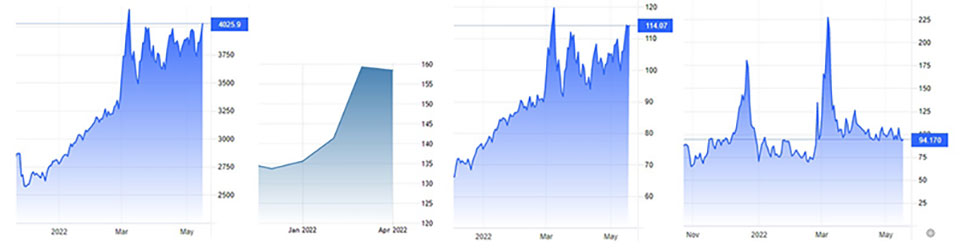
Commodity prices have soared 45 percent since the beginning of the year and remain close to the peak level. So do the food prices, which climbed to an all-time high in March, up nearly 20 percent year-on-year. UN Secretary-General Antonio Guterres called it the “hurricane of hunger and a meltdown of the global food system.” 

Crude oil prices soared to a high of $125 in early March, increasing 43 percent since January, and remain $113. In Europe, the most exposed region to Russian energy, natural gas price quintupled to a high of 230 euros and has dropped to 96 euros, as concerns over Russian supplies have dissipated somewhat, for now (Figure 2). Hence, the recession threat hanging over the Euro Area. And if the proxy war takes an adverse turn once again, so will the commodity and energy prices soar again. 

Figure 2 Energy and food shocks

Figure 2
Source: Tradingeconomics; Difference Group

Commodities Food Oil Natural Gas

Commodity Index (S&P GSCI); food prices: UN/FAO food price index; oil: Crude oil (WTI); natural gas (EU Dutch TTF), May 17, 2022 

A benign scenario in the Ukrainian crisis would have required rapid, proactive diplomacy. But that hasn’t been a priority in the proxy war. As US defense secretary Lloyd Austin acknowledged in late April: “We want to see Russia weakened.” 

Russia is the world’s 11th largest, $1.8 trillion economy, the world’s largest gas exporter and second-largest crude oil exporter. Neither the protracted Ukraine crisis nor the weaponization of sanctions will advance peace. But both will penalize global recovery.

As some US policymakers are calling for tariff reductions in order to provide relief to consumers struggling with soaring prices, the Biden administration is reviewing tariffs imposed on Chinese products ahead of their expiration in July. With the plunge of Biden’s ratings, the Democrats are struggling to avoid a Republican triumph in the fall election.

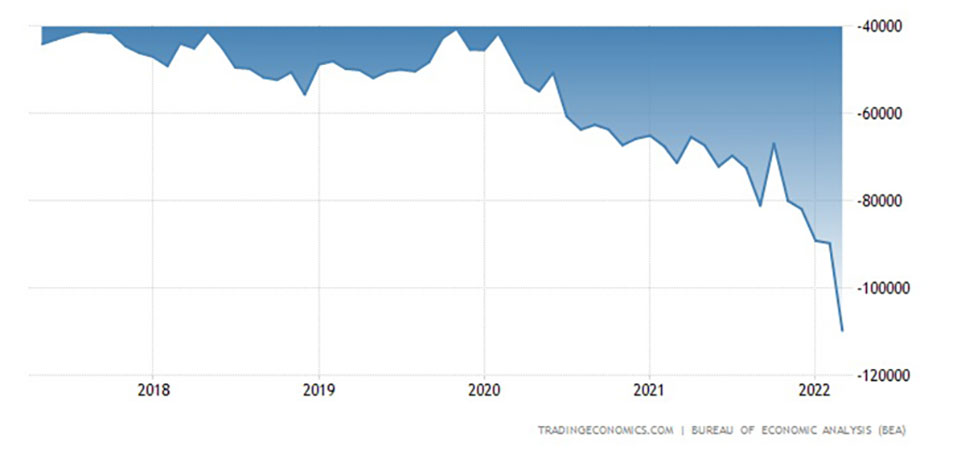
Despite the hopes of the Trump and Biden administration, the US trade tariff wars have failed to reduce the deficit. Unilateral trade actions do not resolve multilateral trade challenges. In effect, the deficit widened sharply to a record high of $110 billion in March, due to a broad-based rise in prices (Figure 3). 

Figure 3 Despite trade wars and pandemics, record-high US trade deficit

Figure 3
Source: BEA; Tradingeconomics; Difference Group, May 17, 2022

Pentagon’s mistakes: Collusion with Big Defense 

The architect of president Biden’s geopolitics in Asia is Kurt Campbell, a veteran diplomat and CEO of the Asia Group LLC. In January 2021, his appointment unleashed a public debate in the US, due to Campbell’s portfolio of ex-clients rife with potential conflicts of interests. According to his own disclosures, the key clients include leading defense contractors. As critics see it, “shadow lobbying” outfits, like Campbell’s firm, call themselves consultants to avoid restrictions associated with traditional lobbying. 

Campbell is not alone. Secretary of state Antony Blinken and national security adviser Jake Sullivan were in similar firms, which led to similar debates. And before presiding over the Pentagon, secretary of defense Lloyd Austin served on the board of Raytheon, a major defense contractor. 

What makes Campbell different is that he predominates US policy-making in Asia. 

Moreover, in November 2021, Biden nominated Fed governor Lael Brainard to serve as its vice chair. With the confirmation of her appointment, Brainard’s dovish views have shifted. Now she is pushing rapid rate hikes. Brainard is an accomplished veteran Democrat, like her husband – Kurt Campbell.

So, in addition to Campbell’s alleged conflicts of interests, the husband-wife linkage reinforces critics’ perceptions of tacit collusions in the decision-making by the executive branch, monetary chiefs, capital markets, Pentagon and the Big Defense. 

Since the Obama administration, the White House has promoted a “pivot to Asia,” a doctrine which is premised on US military might and is very much in line with the interests of the Big Defense. Its architect just happens to be Campbell as well. 

Among other collateral damage, inflation, has contributed to the excesses of US housing market, which keeps it out of reach for many ordinary Americans. By contrast, defense contractors are prime beneficiaries of inflation, due to the increased defense budgets, including the use of inflation as an excuse to price-gouge.

It is thus only prudent to wonder whether Campbell’s pivot is less motivated by American welfare and US national interest than by the Pentagon’s revolving-door practices and defense contractors’ fat margins. 

Dr. Dan Steinbock is an internationally recognized strategist of the multipolar world and the founder of Difference Group. He has served at the India, China and America Institute (USA), Shanghai Institutes for International Studies (China) and the EU Center (Singapore). For more, see https://www.differencegroup.net 

The first version of the column was published by China Daily on May 19, 2022


About the Author

Dan SteinbockDan Steinbock is the founder of the Difference Group and has served as the research director at the India, China, and America Institute (USA) and a visiting fellow at the Shanghai Institutes for International Studies (China) and the EU Center (Singapore). For more information, see http://www.differencegroup.net/


Reasons Why Criminals & Terrorists Hate Cryptocurrencies

Cryptocurrencies have become widely known and widespread amongst different categories and sects of individuals, drawing the attention of so many to the sphere. Because so many good and right individuals are attracted to the cryptocurrency market, the wrong sort always gets a way to mix up with the right ones. Cryptocurrencies benefit folks, industries, financial organizations, public sector institutions, and even governments. They do this by facilitating and aiding financial empowerment, facilitating access to financial products, and significantly reducing the risks of scams, fraud, and corruption.

One of the significant and significant dangers and risks linked with cryptocurrencies is the capacity criminals and terrorists have to utilize the new technologies available to their advantage. Due to the rate of these fraudulent acts, there are several measures to prevent and end the success of terrorists and criminals. Of course, the value of cryptocurrencies has been fluctuating very unpredictably in the years; this does not mean that it still has not attracted a lot of criminal and terrorist activities. Because of this, people who don’t have any idea about trading are scared to invest in cryptocurrency. Developers and expert traders came up with the idea of trading robots to help new traders earn while on their learning path. One of these trading bots is BitIQ. BitIQ is a legitimate auto trading robot that ensures a good ROI for its investors. BItIQ has zero-tolerance for criminals and terrorists. They indeed have a very tight security system which makes the funds of all users, traders, and investors very safe and secure. If your choice is BitIQ, you might as well know that you have chosen security as well; such that you can rest assured that your funds are safe. A detailed review has been put together to enlighten you. Are you interested in seeing this? Then visit bitconnect.co/tr/bitiq/

5 Reasons for the Cryptocurrency Hatred

Money Laundering Impossibility

One of the reasons why criminals and terrorists hate cryptocurrency is because their money laundering activities may no longer smoothly run as they used to. Money laundering is when criminals obfuscate and transfer money made through illegal means without having to draw attention to them; they strive very hard to make sure that there are no loose ends. It is becoming quite impossible, unlike before, when cryptocurrency was impossible to find. Now blockchain’s public nature has made it easier for those investigating such matters to trace the money to the criminals and terrorists.

Police Tracking

Crypto has been used in several crimes ranging from financial fraud to human trafficking to wildlife. Whenever a theft occurs, victims of these crimes would reach out to the police to report it. The officers would then gather significant shreds of evidence such as cryptocurrency addresses, IP addresses, names, and kinds of data stolen. The police also track specific cryptocurrency addresses or wallets, which could help lead them to the suspect behind the crime transactions. Criminals and terrorists indeed hate cryptocurrency for this. They do the tracking from the address to the wallet to the user.

Better Regulation

The United States government has put several regulations in place because of its anonymity. Her Majesty’s Treasury in the UK put some rules, enforcing the users of digital currency exchange to reveal their identities. By doing this, the flow of finance to criminals and terrorists is disrupted.

Miners Security

Cryptocurrency miners are also urged to be more conscious and security conscious to deny access to criminals and terrorists. Cybercriminals and terrorists hate that passionately.

Cryptocurrency Exchange Security

Due to the uproar of the actions of the criminals and terrorists, several cryptocurrency exchanges have developed a tighter level of security, preventing access to the terrorists and criminals.

Why Data Helping to Personalize Products Has Become a Major Trend

When it comes to business management, it’s not always easy to please all of your clients. The reason why some startup owners fail to experience standout success is due to a lack of focus, as most are trying too hard to please everyone instead of looking for ways to help reinforce their company as much as they possibly can.

One way to help level the playing field is to look into the most popular trends to get the attention of your target demographic. The good news is that just about every business owner can benefit from one particular trend — the use of data to personalize products.

What does it mean to personalize a product?

We live in an era where almost every industry is saturated to the point where people are unsure whom to trust. New company owners have a particularly challenging time, as they’ll have to somehow get the attention of a target audience that already has companies they trust.

To personalize a product is to show clients and customers alike that your company knows what they want. It showcases a level of skill and efficiency in business management that not every competitor can match. Using data to personalize a product means offering services that are better suited to each individual.

Building trust through telematics

Real-time data is everything a company collects as it maneuvers through a competitive industry landscape. Not every business owner knows what to do with these data, which is why they hire specialists to get the job done.

For example, with the help of telematics insurance, insurers can use real-time data to provide usage-based insurance to customers. The world of telematics is all about using data logging and various other tools to collect information that can help companies personalize products and services. It creates opportunities for real-time, personalized engagement that allows insurers to provide UBI to their clients. With so many customers demanding personalized insurance options, insurers can use these services to help broaden their horizons.

Learning to put the customer’s needs first

It’s understandable to want to strike a balance when trying to manage a business, especially when dealing with customer needs. It’s an era where people expect companies to provide convenience and efficiency in droves, which can be overwhelming for new business owners. All you have to do is focus on data that tells you precisely how to manage your business. For example, in the realm of marketing, your first campaign will tell you a lot about customer behavior, provided you know where to look.

The use of marketing professionals in such cases can help you figure out what your audience liked best about your previous campaign, and you can use that knowledge to improve retention and conversion rates.

Conclusion

As a business owner looking to make the most out of every opportunity, it’s crucial to look into personalizing products for your audience. With a bit of hard work and consistency, you can outperform your competitors with the help of telematics and real-time data.

Entrepreneur Anthony Zingarelli Explains Reverse Factoring and How Can It Benefit Your Business

Suppliers and purchasers can benefit from reverse factoring in certain situations. But, as entrepreneur Anthony Zingarelli, leader of United LLC, explains, some businesses aren’t familiar with how this financing arrangement works.

Reverse factoring helps bridge the gap between suppliers and purchasers in the supply chain, providing much-needed financing. Below is a more detailed explanation of reverse factoring and how it can benefit your business.

Reverse Factoring Definition

Reverse factoring involves a third-party lender as an intermediary between suppliers and purchasers. It is similar to invoice factoring in other industries.

The lender, also known as the factor in this arrangement, will purchase all or some of the company’s outstanding invoices and then take over the responsibility of collecting the money owed on the invoices.

The factor will advance a certain amount of money to the company based on the outstanding invoices. Typically, this amount will range anywhere from 70% to 95% of the total outstanding amount of the invoices.

After the outstanding invoices are collected, the company pays the factor and a fee for advancing the money.

Reverse Factoring Benefits

There are many potential benefits to reverse factoring to both suppliers and buyers in the supply chain. Here’s a more detailed explanation.

Buyers

Reverse factoring helps buyers improve their cash flow. By bringing in money much quicker than they might through typical collection practices, they will have the ability to reduce their DPO or days payable outstanding significantly.

This type of financing also helps curb disruptions in the supply chain. It’s no secret that the global supply chain is experiencing some significant disruptions right now, which has had massive effects on consumers and buyers. Reverse factoring can help hedge against these types of disruptions by having access to payments early.

Buyers can also offer reverse factoring to their suppliers, putting them in a better negotiating position against competitors.

Suppliers

One of the most significant benefits of reverse factoring for suppliers is accessing funding that’s lower cost than most other options. The funding suppliers can get is based on the buyer’s credit rating and not the supplier.

As such, suppliers typically are charged an interest rate lower than other available funding. This helps suppliers also improve their working capital, as they’ll be receiving payment on invoices early.

Anthony Zingarelli of United LLC says suppliers can then use that extra working capital and improved cash flow to invest in R&D (research and development) and expand the business in other ways. R&D is significant to suppliers and the overall supply chain.

Finally, reverse factoring provides stability and consistency for suppliers in cash flow, which allows them to forecast more accurately. This cash flow certainty will enable suppliers to make smarter business decisions based on when they’ll have extra cash on hand to invest in the company and when they might want to hold back from doing so.

About Anthony Zingarelli

Anthony Zingarelli is the founder of United LLC, an operations management solutions firm located in Dallas, Texas. Zingarelli relies on his expertise in operations management to help companies and startups experience tremendous growth by securing financing, building business plans (including exit strategies), and recruiting key personnel and resources.

How to Write a Resume: An Ultimate Guide for Job Applicants

Writing a resume is hard work, but it’s an important step if you want to land a job or grow professionally within a company. This process takes time and isn’t always as easy as it might seem. But the market is full of specialists of any kind, making it complicated to find your place in a new company and prove your best working qualities. 

In a company, there’s usually an HR department or a manager responsible for the recruitment process. Each business has its requirements for the applicants and sets specific criteria for the job-hiring routine. However, there’s one thing that remains the same. A well-designed resume file, either done by the resumespice reviews service or written on your own, is a must if you want to be heard and seen among the flow of other applicants for the same position. 

It’s a common fear to look for a new job both for students who are only at the beginning of their path and even for the experts who want to upscale their working experience. If you feel insecure about your resume writing skills or don’t even understand why you need to invest your time and effort in the task, this guide will help you. 

Top 3 Reasons to Put Effort in Writing a Resume 

Do you need to work on your resume, or is there an option to download a ready-to-go standardized version? If you mind your future job and want to get a demanding position, you should take care of the resume writing process. It’s important to work on your resume. And here are the 3 reasons why putting effort into your writing will pay off. 

  • If you carefully write the paper, the HR manager will easily scan the material and understand if you fit the position or not. You might be the best applicant for the role, but invalid resume writing will mess up everything. For this reason, sticking to the standard format and following the rules is a must. 
  • It’s all about the experience you have. When you decide to land a new job, you need to show the future employee what you offer to a new company. It’s best done with the help of a well-designed resume file.
  • A properly written file will give you an edge over other applicants. If you have all your skills, experiences, and practical knowledge organized in one file, you will hit the target and have more chances to get the desired job. 

Writing a resume is a critical step for the applicants. No matter what position you apply to, there must be a clear file with the details about your previous experience, skills, and bio. 

Where to Seek Help with a Successful Resume Writing 

You need to answer the main question. How to write a resume that wins the attention of the HR managers? In reality, there could be different departments that receive the requests from the job candidates. One way or another, there will be someone to scan your profile. Hence, you should work on the task and present a well-designed file with your greatest achievements. 

Where to seek help with the task? There are different ways you can ask for professional support. Some applicants decide to work on their own by researching what the Internet offers to them. Others rely on friends from the industry and try to make up a relevant file for the company they apply to. But in most cases, the best working method is to request a helpful piece of advice from a professional resume writing company. 

Do you get any perks from working with such companies? Yes, you can benefit a lot by ordering a paper from professionals. The writing expert will have your paper properly structured. There will be no missing spots if you rely on the expertise of the writer. In most cases, the chances of landing a good job are higher when you apply for a professional online service that helps you with resume writing. 

How to Write a Resume

Create a Quality Resume for a Well-Paid Job 

Are you ready to join a new team and pave your way through the career ladder? If so, you should beware of the importance of a well-built resume for your job application. You can’t send a request for the interview unless you have a properly made-up resume file. The best way to do it is by reaching a professional online service that writers resume. In this case, you will get assistance from well-trained writing experts who know how to help you with the task. 

Impact of CPRA Compliance Requirements on the Financial Sector

By Lydia Iseh

Organizations collect lots of consumer data for various reasons such as improving the customer experience, gaining a competitive advantage, meeting customer expectations, increasing the consumer base, etc. However, the collection, management, and security of this data should be carefully handled by these organizations.

Data privacy has to do with protecting personal data from those who should not have access to it. It is also the ability of individuals to determine who can access their personal data or not. Finally, data privacy is concerned with how and where businesses store the data they collect.

Data privacy laws have been laid down to guide organizations on how personal data should be collected, stored, and shared with third parties. The most common data privacy laws are GDPR, CCPA, CPRA, VPPA, etc.

CPRA is one of the most recent data privacy laws, and businesses are considering how the regulations will affect their business. So, this article will address the impact of CPRA compliance requirements on the financial sector.

All you need to know about the CPRA 

CPRA 

The California Privacy Rights Act (CPRA) is a data privacy law that goes into effect on January 1, 2023. This act was passed in November 2020 to be an amendment to the California Consumer Privacy Act (CCPA). Also, although this law goes into effect in 2023, it applies to all the personal data that businesses collect from January 1, 2022.

You should know that companies outside of California are not excused from the California Privacy Rights Act. This law applies to all organizations that do business in California and have California residents as customers. Therefore, for any financial institution to remain compliant with the CPRA, it must first understand the CPRA and how it works.

The CPRA has additional protections for consumer data, increased enforcement options, and increased fines for violations. So, institutions in the financial sector must ensure they remain compliant.

About the CCPA: the foundation of the CPRA

The California Consumer Privacy Act (CCPA) came into effect on January 1, 2020. This law made California the first United States jurisdiction to have a comprehensive data privacy law. The CCPA can be considered to be very similar to the European Union’s data privacy law, General Data Protection Regulation (GDPR).

The CCPA gave consumers the right to know what data the organization collects, when it is collected, and if the information is being shared or sold to third parties. Apart from keeping consumers in the know of how organizations handle their data, the CCPA also provided customers with a level of control over their data.

For instance, the CCPA allows consumers to find out what information the companies have collected about them, prevent the sale or sharing of these personal data, and even ask businesses to delete such data. Also, consumers cannot be discriminated against if they ask for any of the above.  

The CCPA was considered to be a ground-breaking legislative piece. However, lawmakers believed that the CCPA did not cover some areas which could lead to exploitation and violation of consumer data. This then led to the amendment of the law and the adoption of the CPRA.

Sensitive Personal Information under CPRA

Under the California Privacy Rights Act, a new category called Sensitive Personal Information (SPI) was introduced. The classification provides that businesses may only use consumers’ sensitive personal information for limited business purposes alone, such as non-personalized advertising.

If the company wants to use the SPI for any other purpose, it must notify and allow the consumer to opt out of using their SPI. The CPRA provides a list of information that falls under sensitive personal information. These include:

  • Social security number
  • Driver’s license
  • State ID card
  • Account log-in
  • Credit or debit card number
  • Password or other credentials allowing access to a financial account
  • Precise address
  • Zipcode
  • Racial or ethnic origin
  • Religious or philosophical beliefs
  • Contents of a consumer’s private communications
  • Genetic data
  • Personal information concerning a consumer’s health
  • Personal information concerning the consumer’s sex life or sexual orientation

Businesses must provide a clear and conspicuous link on their website’s homepage titled “Limit the Use of My Sensitive Personal Information.” This link should be in addition to the opt-out link required under the CCPA.

Who does the CPRA apply to?

The California Privacy Rights Act established the California Privacy Protection Agency (CPPA), which will implement and enforce the CPRA. This agency ensures businesses remain compliant with the rules of the CPRA. These are the businesses that fall under the CPRA. Any business that:

  • Has annual gross revenues of over $25 million in the preceding calendar year
  • Buys, sells or shares the personal information of 100,000 or more consumers or households
  • Gets 50% or more of its annual revenues from selling or sharing consumer’s personal information

Impact of CPRA compliance requirements on the financial sector

CPRA 

The financial sector is a part of the economy of companies and institutions that provide financial services to commercial and retail customers. The financial industry comprises many industries such as banks, investment houses, insurance firms, real estate brokers, etc.

These financial institutions are known to collect personal information from their customers for business purposes. Because of this, the establishments in the financial sector must comply with the regulations under the California Privacy Rights Act. So, below are the rights of consumers under the CPRA and how they impact the finance sector.

1. Right to correct information

Consumers have the right to have their personal data corrected or rectified. Consumers can ask for their personal data to be corrected if it is inaccurate or incomplete. Financial establishments like banks that have consumers who dispute the accuracy of their personal information should use commercially reasonable efforts to make the necessary corrections.

The CPRA requires these companies to disclose the new right to their consumers and provide a means to request a correction.

2. Right to limit the sensitive personal information

As addressed earlier in the article, the CPRA brings forth a new category called sensitive personal information. Accordingly, customers of financial organizations and other businesses have the right to limit the use of these SPIs to a narrow set of purposes that have been prescribed in the regulations.

Failure to stick to these specific purposes could be detrimental to the organization. Financial institutions that store customers’ sensitive personal information have to ensure they use the information for the stated purposes only.

3. Right to access information about and opt-out of automated decision making

Under the CPRA, there are regulations allowing consumers to make requests to seek meaningful information about the logic involved in the decision-making processes in the organization. They can also request a description of the possible outcome based on this process.

Automated decision-making is the process of deciding by automated means without any human intervention. This provision is similar to that in the GDPR. Consumers have the right to know and opt-out of automated decision-making. An example of automated decision-making is an online decision to award a loan.

4. Right to opt out of sharing

The CPRA expands on the CCPA’s right to opt out of selling or sharing consumers’ personal information. This includes shared data with a third party for cross-context behavioral advertising.

Cross-context behavioral advertising refers to the targeting of advertising to a consumer based on the PI gotten from the consumer’s activity across websites, apps, or services apart from the one the consumer intentionally interacts with.

For instance, if a consumer uses a fintech service and starts seeing targeted ads related to it, the organization could have shared the consumer’s PI with a third party. Consumers could decide to opt out of having their personal data shared or sold to these third parties or services.

5. Right to delete

A significant right that businesses in the finance sector have to note is the right of consumers to delete their personal data. Also, companies have to inform the third parties they have shared any personal data with about the consumer’s request to delete the information.

Additionally, these financial organizations must inform their customers about how long they intend to retain their personal information. Once this duration elapses, they are to dispose of the data securely.

Financial establishments that fail to adhere to the above CPRA compliance requirements will face penalties of up to $7,500 per intentional or willful violation. However, if the violation was unintentional, the fine the organization will pay is $2,500. Also, consumers may seek compensation for damages. The fee should not be less than $100 and not more than $750 per consumer per occurrence.

Other penalties include imprisonment, loss of reputation, shutting down of the business, and other punishments to the guilty organization. Having a “big name” in the finance sector facing charges of non-compliance could affect the finance sector. This is why compliance with data privacy laws like CPRA should be a priority for financial institutions.  

Conclusion

In conclusion, data privacy should be a priority for any organization that collects personal information from its customers. However, this does not exempt the companies in the finance sector. The law requires financial institutions that handle personal data to comply with data privacy laws such as CPRA. This article has addressed what CPRA is and the impact of CPRA compliance requirements on the organizations in the finance sector.

About the Author

Lydia Iseh

Lydia Iseh is a writer with years of experience in writing SEO content that provides value to the reader. As someone who believes in the power of SEO to transform businesses, she enjoys being part of the process that helps websites rank high on search engines.

Market Manipulation 101

The stock market can be tricky to master due in large part to the factors that can influence stock prices and the market as a whole. Anything from natural disasters to social unrest can impact value and leave investors sitting on significant losses. While this situation is unavoidable to a certain extent, sometimes bad actors seek to manipulate the stock market. There are a few different ways they do this, and this article will explore what these criminals do as well as the things the tell-tale signs of manipulation that investors should know.

What is stock market manipulation?

Before we look into detailed examples of manipulation, we will look at what it looks like and why people attempt to manipulate the market. Market manipulation is the result of an intentional and concerted effort to impact supply and demand in order to profit. More specifically, this change in supply and demand is artificial rather than a natural reaction to current events. This process is not always easy to spot, but there are some well-known tactics of which investors can be aware.

How does stock market manipulation take place?

There are various ways to perpetuate stock market manipulation. This section will look at two of the more common approaches so that our readers can spot potential problem behavior and steer clear.

1. Spoofing/layering the tape

Spoofing, or “layering,” the tape is a manipulation technique where someone places orders for a specific stock without intending to complete the orders. This action shows many pending orders and sometimes convinces other investors that they are coming from a “market whale,” a person or entity with the funding and power to manipulate the value of a stock (or cryptocurrency). Some investors will buy stocks at the same level as the supposed “whales,” assuming that the number of orders will raise market value.

However, before the trade is due to occur, the scammers cancel the order, the market drops, and anyone who purchased will face a loss.

2. Fake news/pump and dump

Fake news and pump and dump manipulation both revolve around pushing a false narrative. The former uses social media or other news sites to release stories that spike or drop the market accordingly. The latter uses email or physical mail to convince many people to invest in a particular stock. In both instances, the high number of orders raises the market, allowing initial investors to sell high, causing the market to crash for everyone else.

How can I spot manipulation?

The best way to be aware of potential market manipulation is to connect with professionals offering expert market analysis, such as those at LeapRate, a trusted voice in the stock market community offering broker reviews and breaking news. Investors interested in making smart investment choices based on natural market fluctuation can work with this type of professional to ensure their decisions reflect the market, not the manipulation.

Readers interested in optimizing investments should keep the information above in mind as they invest. Understanding what common forms of manipulation look like can help investors avoid making costly mistakes based on false supply and demand issues.

EDITOR'S PICK OF THE WEEK

CFO's new mandate. CFO explaining the presentation

The Performance and Transformation Orchestrator: The CFO’s New Mandate in the Age of AI

By Terence Tse CFOs are evolving into AI-driven transformation orchestrators, balancing finance, technology, and strategy while upskilling teams, managing risks, and driving measurable business value. A key insight from this year’s AI for CFOs event, organized...

WISE DECISION MAKER GUIDE

POWER INFLUENCERS

Emerging Trends

The Future of Global Trade