

Home Blog Page 429

Government Assistance Programs: What’s Available, Where to Apply 

In these challenging times, it’s not uncommon to find yourself in a situation where you need financial help. Fortunately, both federal and state governments offer a range of assistance programs for individuals, families, and businesses in need. These programs provide a variety of benefits, including income, food, housing, healthcare, and other necessities. 

In this article, we’ll provide an overview of some of the major assistance programs available, along with links to more information on each program and how to apply if you’re eligible. 

Financial Assistance Programs: A Guide to Government Support For Low Income 

In these challenging times, when financial hardships have become a common reality for many individuals and families, it is essential to be aware of the various assistance programs offered by federal and state governments. These programs aim to provide support to those in need, offering a range of benefits such as income assistance, food provisions, housing support, healthcare coverage, and other vital necessities. In this article, we will provide you with an overview of some major assistance programs available, along with valuable information on each program’s application process and eligibility criteria. 

Key Takeaways 

  • Federal and state governments extend a wide array of assistance programs catering to individuals, families, and businesses alike. 
  • These programs play a crucial role in providing essential support such as income assistance, food provisions, housing support, healthcare coverage, and more to those facing financial difficulties. 
  • Vigilance is required to protect yourself from scammers who often prey on individuals seeking assistance. 

Financial Assistance for Individuals and Families 

When making ends meet becomes a challenge, several government programs can help you cover your basic living expenses. These programs offer benefits in the form of payments, goods, or services to individuals and families who qualify due to their low wages. Let’s explore some of the key programs in detail.

Unemployment Insurance: Bridging the Gap 

Unemployment insurance (UI) is a federal and state program designed to provide temporary financial assistance to individuals who are unemployed through no fault of their own. The program primarily

relies on the federal unemployment tax (FUTA) on employers for funding, although states may also collect their own state unemployment tax (SUTA). 

To qualify for unemployment insurance, you must apply through your state’s unemployment insurance office. It’s important to note that not everyone who has lost a job will qualify, as the states administer the program. However, if eligible, you can benefit from the following: 

  • Partial wages until rehired or finding another job 
  • Time to explore new and better employment opportunities 
  • Opportunity to pursue education or training in a new career path 

While unemployment insurance offers crucial support, it’s important to consider the limitations:

  • Reduced income compared to when you were employed 
  • Regular benefits usually provided for 26 weeks unless extended by law 
  • No employer-provided healthcare benefits 

Income tax is charged on unemployment benefits.

Temporary Assistance for Needy Families (TANF): Empowering Families 

Temporary Assistance for Needy Families (TANF), formerly known as welfare, is a federal and state-run benefits program that aims to help families regain independence during times of temporary difficulty. Qualified recipients may receive assistance in various areas, including food, housing, home energy, childcare, and job training. TANF recipients must engage in some form of work activity as defined by their state. 

Each state operates its TANF program and sets eligibility criteria. To apply for benefits, you can reach out to your local county social services agency or contact your state’s TANF office for more information. Importantly, qualifying for TANF does not disqualify you from receiving other government benefits. 

Pros of TANF include: 

  • Provides necessary assistance for families in need 
  • Targets specific help for children’s well-being 
  • Can supplement income if you are already working 
  • Provides job training to encourage independence 

However, TANF also has certain considerations: 

  • The income threshold for eligibility can be quite low
  • May carry a negative social stigma 
  • Varies in coverage due to individual state rules 
  • Might discourage active job hunting 

Social Security Disability Insurance (SSDI) Benefits: Support for Those in Need 

Social Security Disability Insurance benefits are available to individuals who are unable to work for at least one year due to a medical condition or who are expected to die from that condition. To be eligible for SSDI benefits, you must have worked in a job or employment covered by Social Security and meet the Social Security Administration’s definition of disability. You must also have worked long enough and recently enough to qualify for disability benefits. 

If you believe you meet the eligibility criteria for SSDI benefits, additional information can be found in the Social Security Disability Benefits brochure. Moreover, the Social Security Disability Planner is a valuable resource that can assist you in determining your eligibility and providing guidance throughout the application process. 

Student Financial Aid: Opening Doors to Educational Opportunities 

For college students in need of financial assistance, the Free Application for Federal Student Aid (FAFSA) serves as a gateway to a variety of programs, including grants, scholarships, student loans, and work-study programs. Eligibility for student financial aid is based on factors such as financial need, U.S. citizenship or eligible noncitizen status, good standing on federal student loans, acceptance into an eligible degree program, and maintenance of adequate academic progress. Additionally, low-income college students may also qualify for assistance programs that provide resources like a tablet for low income to support their education.

It is important to note that while student financial aid can help cover college expenses and contribute to building good credit if loans are repaid on time, there are certain aspects to consider. Loan repayment is required unless forgiveness is granted, and there are lifetime limits on Pell Grants. Defaulting on student loans can have a negative impact on credit. 

Currently, payments for federally held student loans, including both principal and interest, have been temporarily suspended. This pause will continue until either 60 days after the Department of Education is permitted to implement the debt relief program proposed by the Biden administration or 60 days after June 30, 2023, depending on which date is earlier. It’s important to note that this suspension only applies to federal student loans held by the Department of Education. Furthermore, the American Rescue Plan, passed by Congress and signed by President Biden in March 2021, includes a provision that makes all student loan forgiveness between January 1, 2021, and December 31, 2025, tax-free.

Remaining Vigilant and Seeking Assistance 

In times of financial hardship, it is essential to stay vigilant and be cautious of potential scammers who may prey on individuals seeking assistance. Remember to verify the legitimacy of any programs or services and never provide personal or financial information to unauthorized sources. 

When you find yourself in a situation where you require financial assistance, federal and state government programs can provide vital support. Whether through unemployment insurance, temporary assistance for needy families, social security disability insurance, or student financial aid, these programs are designed to help individuals, families, and students navigate challenging times and regain stability. 

For more detailed information on each program mentioned and to explore other available assistance options, please refer to the resources provided by the respective government agencies. 

Affordable Connectivity Program (ACP) 

The Affordable Connectivity Program (ACP) program Has already been replaced the already existing Program called Emergency Broadband Benefit (EBB) program in early 2022. It is an extension of the EBB program and provides a monthly discount of up to $30 (or $75 for those on tribal lands) for qualifying broadband services. To be eligible for the ACP, your household income must be at or below 200% of the current Federal Poverty Level (FPL), or at least one household member must meet certain criteria, such as participating in certain assistance programs. 

To apply for the ACP, you can visit the ACPBenefit.org website to apply online or print an application to mail in. Alternatively, you can contact a participating provider of your choice to select a plan and have the discount applied to your bill. It is important to note that the ACP has limited funding ($14.2 billion) and may not last as long as the need for it exists. Furthermore, while there is a long list of participating providers, there is a possibility that you may not find a provider in your area, and if ACP funds run out, you may be responsible for payment. 

Housing Assistance for Renters and Homeowners 

Various housing assistance programs exist to provide affordable housing options for low-income families, seniors, and individuals with disabilities. These programs include privately owned subsidized housing, the Housing Choice Voucher (HCV) program (previously known as Section 8), and U.S. Department of Housing and Urban Development (HUD) public housing. 

Privately owned subsidized housing requires individuals to find housing they want to rent and then apply for it at the rental office. The Housing Choice Voucher program allows individuals to find an apartment or house they want to rent, with the government paying a portion of the rent for which they qualify, while the individual pays the remaining balance. The HUD public housing program requires individuals to rent from a local public housing authority based on their income. However, wait times for both the HCV and public housing programs can be lengthy, depending on the location. 

Eligibility for privately owned subsidized housing is based on income limits for the location and family size, along with other requirements set by the property owner. To be eligible for the HCV or HUD public housing programs, individuals must be a family, senior citizen, or have a disability, fall within program income limits, and be a U.S. citizen or eligible noncitizen. 

The application process for subsidized rental housing varies depending on the program. For privately owned housing, individuals apply at the rental office, while for the HCV and public housing programs, individuals should contact their local Public Housing Agency (PHA) and complete an application, providing necessary documentation such as income, family size, employer, and bank information. 

Pros of subsidized rental housing include below-market rental rates, government oversight, the opportunity to save for better housing, and programs that allow for choice. However, there are also cons, including the potential depletion of city resources, some existing housing being located in high-crime areas, difficulty in qualifying, and long waiting lists. 

Housing Assistance Programs for Homebuyers 

The U.S. Department of Housing and Urban Development (HUD) offers various programs to assist individuals and families in purchasing a home, subject to specific eligibility criteria. 

FHA Loans 

The Federal Housing Administration (FHA), a part of HUD, insures mortgages, making it easier for buyers to become homeowners due to less strict eligibility requirements. To be eligible for an FHA loan, individuals must have a credit score of at least 580 and provide a down payment of 3.5% of the purchase price. The home being purchased must also be priced within the loan limit for an FHA home in its location. To apply for an FHA loan, individuals need to find an approved FHA lender, as the FHA itself does not lend the money. It’s worth noting that if you have good credit and the ability to pay a 10% to 15% down payment, a conventional loan may be less expensive than an FHA-insured loan.

Homeownership Vouchers 

The HUD homeownership voucher program allows low-income families participating in the Housing Choice Voucher (HCV) program, including those in public housing, to use their vouchers to assist with monthly mortgage payments and other homeownership expenses. To determine if your local Public Housing Agency (PHA) offers this program, it is best to contact them directly. 

Programs for Active-Duty Service Members and Veterans 

The Department of Veterans Affairs (VA) provides home loan programs specifically designed for active-duty service members, surviving spouses, and veterans. VA loans are offered by private lenders, with the VA guaranteeing a significant portion of the loan. To apply for a VA loan, a certificate of eligibility (COE) is required, and you can apply for it through the Department of Veterans Affairs. 

Mortgage Lending Discrimination 

It’s important to know that mortgage lending discrimination is illegal. If you believe you have experienced discrimination based on factors such as race, religion, sex, marital status, use of public assistance, national origin, disability, or age, you have the option to file a report with the Consumer Financial Protection Bureau or with HUD. 

State Housing Programs 

State housing finance agencies and state HUD offices also offer special programs to assist individuals with home buying. These programs vary by state and can provide additional resources and support. 

HUD Counselling Agencies 

HUD funds counselling agencies across the country that provides guidance on various housing-related topics, including buying a home. 

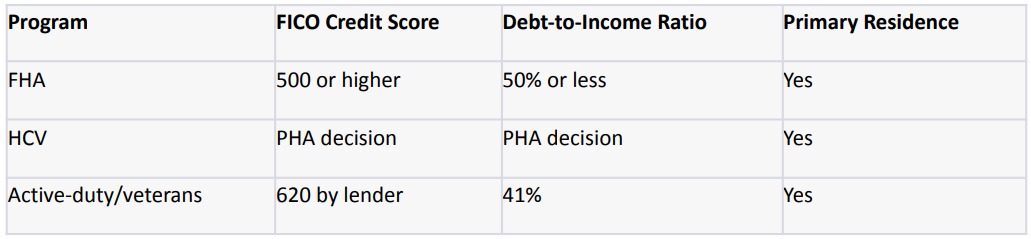
The table below compares basic eligibility requirements for different government homeownership programs, including FICO credit score and debt-to-income ratio requirements.including FICO credit score and debt-to-income ratio requirements
Food Assistance Programs 

The federal government, in collaboration with states, offers free and low-cost food programs to assist families and individuals in meeting their food needs. These programs range from emergency food support to on-going nutrition assistance. Here are some of the programs available: 

Immediate Aid: If you require food urgently, the USDA maintains the National Hunger Hotline (866-3-HUNGRY or 866-348-6479), which provides information and eligibility requirements in both English and Spanish. The hotline connects individuals with emergency food providers, government programs for low-income individuals, and social service agencies. The hotline operates from Monday to Friday, 7 a.m. to 10 p.m. Eastern Time. 

Supplemental Nutrition Assistance Program (SNAP) 

Formerly known as food stamps, SNAP helps low-income families supplement their food budget to work towards self-sufficiency. Eligibility for SNAP is determined by individual states that administer the program. To apply, individuals need to contact their state agency. Some states allow online applications, while others require an in-person visit. 

Special Supplemental Nutrition Program for Women, Infants, and Children (WIC) 

WIC provides low-income women and their young children with healthy food, nutrition counseling, and referrals to health, welfare, and social services agencies. WIC is a federal grant program administered by the government through 89 WIC agencies and approximately 47,000 authorized retailers. To be eligible for WIC, the mother must be pregnant, breastfeeding, or postpartum (up to six months after birth) with infants (up to a year old) or children (under the age of five). Additional income requirements are posted on the WIC FAQ web page. 

Food Programs for School-Age Children 

Several programs cater to school-age children, including the National School Lunch Program (NSLP), the School Breakfast Program (SBP), and the Summer Food Service Program (SFSP). The eligibility requirements for these programs are the same. If a family’s income falls below 130% of the federal poverty guidelines, their child is entitled to free meals. If the income is between 130% and 185% of the guidelines, the prices for meals are reduced.

Food Programs for seniors 

The federal government sponsors programs designed to provide food assistance to low-income seniors. The Senior Farmers’ Market Nutrition Program (SFMNP) offers coupons that can be used to purchase fresh fruits, vegetables, honey, and herbs at farmers’ markets, roadside stands, and farms. The Commodity Supplemental Food Program (CSFP) provides healthy food on a monthly basis. To be eligible, individuals must be 60 years of age or older and live in an area where either program is available. Both programs have income limits. For more information, refer to the USDA’s state contacts list. 

Pros of Government Food Programs: 

  • Access to nutritious food at no cost 
  • Improved dietary intake for vulnerable populations 
  • Reduced food insecurity for school-age children 
  • Reduced medical costs for adults, children, and seniors 

Cons of Government Food Programs: 

  • Potential social stigma for recipients 
  • Varying consistency and quality of state-run programs 
  • Limitations on the types of products that can be purchased 
  • Mandated work requirements may be challenging for adults with children The table below provides eligibility requirements for federal food programs: 

To be eligible for an FHA loan, you must have a credit score of at least 580 and be able to provide a down payment of 3.5% of the purchase price. Additionally, the home you wish to buy must be priced within the loan limit for an FHA home in its location. To apply for an FHA loan, you must find an approved FHA lender because the FHA doesn’t lend the money itself. If you have good credit and the ability to pay 10% to 15% down, you may find a conventional loan is less expensive than an FHA-insured loan. 

Homeownership Vouchers 

The HUD homeownership voucher program allows low-income families in the Housing Choice Voucher (HCV) program, including those in public housing, to use their vouchers to meet monthly mortgage payments and other expenses when buying a home for the first time. To find out if your local Public Housing Agency (PHA) offers this program, contact them directly. 

Programs for Active-Duty Service Members and Veterans 

The Department of Veterans Affairs (VA) provides home loan programs to active-duty service members, surviving spouses, and veterans. VA loans are provided by private lenders, with the VA guaranteeing a significant portion of the loan. A certificate of eligibility (COE) is required and can be applied for through the Department of Veterans Affairs. 

Mortgage Lending Discrimination 

Mortgage lending discrimination is illegal. If you believe that you’ve been discriminated against based on race, religion, sex, marital status, use of public assistance, national origin, disability, or age, you can file a report with the Consumer Financial Protection Bureau or with HUD. 

State Housing Programs 

State housing finance agencies and state HUD offices also offer special programs to assist with home buying. 

HUD also funds counseling agencies nationwide that advise on topics related to housing, including buying a home. 

The table below provides a comparison of basic eligibility requirements for various government homeownership programs, including FICO credit score and debt-to-income ratio requirements.FICO credit score and debt-to-income ratio

FICO credit score and debt-to-income ratio2

Food Assistance Programs 

The federal government, in partnership with states, offers free and low-cost food programs for families and individuals, ranging from emergency food needs to ongoing nutrition assistance. Here are some of the programs: 

Immediate Aid 

If you need food quickly, the USDA maintains a National Hunger Hotline—866-3-HUNGRY (866-348-6479)—with information and eligibility requirements available in English and Spanish. The hotline, which will connect you with emergency food providers, government programs for low incomes, and social service agencies, operates Monday through Friday from 7 a.m. to 10 p.m. Eastern Time. 

Supplemental Nutrition Assistance Program (SNAP) SNAP (previously called food stamps) helps needy families supplement their food budget to move toward self-sufficiency. Eligibility is determined by individual states that administer the program. You apply in the state where you live by contacting your state agency. Some states allow online applications, while others require your physical presence. 

Special Supplemental Nutrition Program for Women, Infants, and Children (WIC) 

WIC provides low-income women and their young children with healthy food, nutrition counselling, and referral to health, welfare, and social services agencies. WIC is a federal grant program administered by the government through 89 WIC agencies and approximately 47,000 authorized retailers. To be eligible, the mother must be pregnant, nursing, or postpartum (up to six months after birth) with infants (up to a year old) or children (under the age of five). There are additional income requirements posted on the WIC FAQ web page. 

Food Programs for School-Age Children 

Programs for school-age children include the National School Lunch Program (NSLP), the School Breakfast Program (SBP), and the Summer Food Service Program (SFSP). Eligibility requirements for all three programs are the same. If your family income falls below 130% of the federal poverty guidelines, your child is entitled to free food. If income is between 130% and 185% of guidelines, prices for meals are reduced. 

Food Programs for Seniors 

The federal government sponsors programs designed to get food to low-income seniors. The Senior Farmers’ Market Nutrition Program (SFMNP) offers coupons to purchase fresh fruits, vegetables, honey, and herbs at farmers’ markets, roadside stands, and farms. The Commodity Supplemental Food Program (CSFP) provides healthy food every month. You must be 60 years of age or older and

live in an area that offers either program to apply. Both programs have income limits. For more information, use the USDA’s state contacts list. 

Pros of Government Food Programs: 

  • Nutritious food at no cost 
  • Improved dietary intake for vulnerable populations 
  • Reduced food insecurity for schoolchildren 
  • Reduced medical costs for adults, children, and seniors 

Cons of Government Food Programs: 

  • Potential social stigma for recipients 
  • The consistency and quality of state-run programs vary 
  • Limitations on what products can be purchased 
  • Mandated work requirements difficult for adults with children 

The table below lists eligibility requirements for federal food programs. eligibility requirements for federal food programsFinancial Assistance Programs for Small Businesses 

Small businesses are the beneficiaries of several long-standing government assistance loan programs, most of which originate from the Small Business Administration (SBA). 

U.S. Department of Agriculture (USDA) 

The USDA offers several programs aimed at all sectors of the agricultural community. These programs include farm loans, housing assistance, loans and grants for rural economic development, loans for beginning farmers and ranchers, livestock insurance, and more. You can find detailed information on all USDA programs, including how to apply, on the USDA Grants and Loans program web page. 

Small Business Lending Fund 

The Small Business Lending Fund (SMLF), created as part of the Small Business Jobs Act of 2010, is a dedicated fund that provides capital to community banks and community development loan funds (CDLFs) to encourage lending to small businesses. You can find information about this fund, including the location of lending institutions near you, on the U.S. Treasury Small Business Lending Fund website.

Pros of Government Business Programs: 

  • Lower interest rates 
  • Favorable repayment terms 
  • Less collateral needed 
  • Low or no down payments 

Cons of Government Business Programs: 

  • The loan amount may be small 
  • Long approval process 
  • Personal guarantees are often required 

In addition to the programs mentioned earlier, there are other government initiatives aimed at supporting small businesses: 

Small Business Innovation Research (SBIR) and Small Business Technology Transfer (STTR) Programs 

These programs, administered by various federal agencies, provide funding opportunities for small businesses engaged in research and development. The SBIR program focuses on research leading to the development of new products or services, while the STTR program encourages collaboration between small businesses and nonprofit research institutions. Both programs offer grants and contracts to support innovative projects. 

Minority Business Development Agency (MBDA) 

The MBDA, a part of the U.S. Department of Commerce, provides resources, services, and support to minority-owned businesses. Their programs include business consulting, access to capital, and assistance with contracting opportunities. The MBDA helps minority entrepreneurs start and grow their businesses, promoting their participation in the economy. 

SCORE 

SCORE is a nonprofit organization that provides free mentoring services and educational resources to aspiring and existing small business owners. With a network of volunteer mentors who are experienced business professionals, SCORE offers guidance on various aspects of running a business, including business planning, marketing, finance, and more. 

Women’s Business Centers (WBCs) 

WBCs are a network of centers across the country that offer training, counseling, and other resources specifically tailored to women entrepreneurs. These centers provide support in areas such as

business development, access to capital, and networking opportunities. WBCs aim to empower women-owned businesses and foster their growth and success. 

These are just a few examples of the government programs and resources available to support small businesses. It’s important for entrepreneurs to explore these opportunities and determine which ones align with their specific needs and goals. 

BusinessUSA 

BusinessUSA is an online platform that serves as a one-stop resource for accessing information on government services and programs for businesses. It provides a comprehensive directory of federal, state, and local resources, including grants, loans, and assistance programs. Business owners can use this platform to find relevant programs and services based on their location and business needs. 

State and Local Economic Development Agencies 

State and local governments often have economic development agencies that provide support and incentives to attract and retain businesses in their respective regions. These agencies may offer grants, tax credits, infrastructure assistance, and workforce development programs to help businesses thrive. Entrepreneurs can reach out to their state or local economic development agencies to explore available resources. 

Disaster Assistance Programs 

During times of natural disasters or emergencies, the government offers disaster assistance programs to help businesses recover and rebuild. The Small Business Administration (SBA) provides low-interest disaster loans to businesses affected by disasters, enabling them to repair or replace damaged property, inventory, and equipment. These loans can help businesses get back on their feet after a crisis. 

Export Assistance Programs 

For businesses looking to expand into international markets, government export assistance programs can provide valuable support. The U.S. Department of Commerce offers resources and services through its International Trade Administration (ITA) to help businesses navigate the complexities of exporting, access global markets, and connect with potential buyers. These programs can provide market research, export counseling, trade missions, and financial assistance. 

Innovative Startups and Incubators 

Government initiatives often target innovative startups and provide resources to foster entrepreneurship and technology-driven businesses. Some programs offer funding, mentorship, and access to specialized facilities or incubators where startups can receive support in developing their ideas, refining their business models, and accessing networks of investors and industry experts. 

It’s important for small business owners and entrepreneurs to stay informed about these government programs and resources, as they can provide valuable assistance in various stages of

business development. Each program may have specific eligibility criteria and application processes, so entrepreneurs should carefully review the requirements and guidelines before applying. 

Employee Training Programs 

The government recognizes the importance of workforce development and offers training programs to enhance the skills and knowledge of employees. These programs aim to improve the competitiveness of businesses by investing in the continuous training and development of their workforce. The Department of Labor and state workforce agencies provide grants, apprenticeship programs, and vocational training opportunities to help businesses upskill their employees and stay ahead in a rapidly changing economy. 

Research and Development (R&D) Grants 

To promote innovation and technological advancement, the government offers research and development grants to businesses engaged in scientific research and technological development. These grants, provided by agencies such as the National Science Foundation (NSF) and the Department of Energy (DOE), support projects focused on developing new products, improving existing technologies, and conducting cutting-edge research. R&D grants can provide businesses with the necessary funding to drive innovation and create competitive advantages. 

Procurement Opportunities 

The government is a significant buyer of goods and services, and it sets aside a portion of its procurement budget specifically for small businesses. Through various procurement programs, such as the Small Business Administration’s 8(a) Business Development Program and the Historically Underutilized Business Zone (HUBZone) program, small businesses can access contracting opportunities with federal agencies. These programs aim to promote small business participation in government contracts and provide them with a competitive edge in the procurement process. 

Export-Import Bank 

The Export-Import Bank of the United States (EXIM) is a government agency that assists U.S. businesses in exporting their products and services globally. EXIM provides export financing solutions, including export credit insurance, working capital guarantees, and loan guarantees, to mitigate the risks associated with international trade. These services enable businesses to expand their export capabilities and compete in global markets. 

Tax Incentives and Credits 

The government offers various tax incentives and credits to businesses as a means of promoting specific activities or industries. These incentives can include tax credits for research and development expenditures, energy-efficient investments, hiring veterans or individuals from targeted groups, and investing in economically distressed areas. By taking advantage of these tax incentives, businesses can reduce their tax liabilities and allocate more resources toward growth and expansion.

It’s important for entrepreneurs and small business owners to explore and leverage these government programs and resources to support their business goals. These initiatives can provide financial assistance, access to markets, training opportunities, and other valuable resources that can contribute to their success. 

How to Avoid Grants Scam 

To further protect yourself from grants scams, it’s essential to be aware of the warning signs and take necessary precautions. Here are some additional tips to help you avoid falling victim to scams: 

Research Legitimate Sources: When seeking government assistance, rely on trusted sources such as official government websites, reputable nonprofit organizations, or local community resources. These sources can provide accurate information about available programs and their application processes. 

Be Skeptical of Unsolicited Offers: Be cautious of unsolicited phone calls, emails, or advertisements claiming to offer government grants or financial assistance. Legitimate government programs typically require individuals to proactively apply rather than contacting them out of the blue. 

Verify Legitimacy: If you receive an offer or communication that seems suspicious, independently verify the legitimacy of the organization or individual contacting you. Contact the relevant government agency directly to confirm the program’s existence and inquire about any offers or assistance they may provide. 

Protect Personal Information: Never provide sensitive personal information, such as your Social Security number, bank account details, or credit card information, to unknown individuals or organizations. Government agencies will not ask for such information over the phone or via email. 

Watch for Red Flags: Beware of common red flags that may indicate a scam, such as requests for upfront fees, pressure tactics to act quickly, promises of guaranteed grants, or poor grammar and spelling in communications. Genuine government programs do not require upfront payments or guarantee funding. 

Educate Yourself: Stay informed about the latest scams targeting individuals seeking government assistance. Visit websites such as the FTC’s Scam Alerts page or the Better Business Bureau’s Scam Tracker to learn about reported scams and stay updated on emerging fraud schemes. 

By following these guidelines and maintaining a healthy skepticism, you can minimize the risk of falling prey to grants scams and ensure that you seek assistance from legitimate government programs. If you have any more questions or need further assistance, feel free to ask!

Conclusion: In the United States, government assistance programs play a crucial role in providing support to individuals and families in need. From programs like TANF and SNAP that address financial hardships to initiatives such as Veterans Administration Healthcare and food program waivers that cater to specific populations, these programs aim to improve lives and offer essential aid. 

It is vital for individuals to research and explore the available programs in their area to determine their eligibility for assistance. For urgent financial needs, there are specific programs like the USDA National Hunger Hotline, Emergency Home Energy Assistance Program benefits, and Emergency Housing Voucher Program that provide immediate relief. 

While seeking government assistance, it’s important to be cautious of potential scams. Remember that the government does not award grants to individuals, and anyone claiming otherwise is likely running a scam. Take proactive measures like registering at the National Do Not Call Registry, reporting scams to the Federal Trade Commission (FTC), and never sharing sensitive information or making payments to unknown individuals. 

By staying informed, utilizing legitimate resources, and verifying the authenticity of offers, individuals can navigate the process of seeking government assistance more effectively and protect themselves from fraudulent schemes. 

If you have any more questions or need further assistance, feel free to ask! 

As for the 10 FAQs with answers, here are some commonly asked questions about government assistance programs: 

  1. What types of government assistance programs are available in the United States? 

There are various programs, including TANF, SNAP, Medicaid, Medicare, housing assistance, and education grants. 

  1. How do I know if I qualify for government assistance? 

Eligibility criteria vary depending on the specific program, but factors such as income, family size, and citizenship status are commonly considered. 

  1. How can I apply for government assistance programs? 

Applications can typically be submitted online, by mail, or in person. Each program has specific application requirements and procedures outlined on their respective websites. 

  1. Can I apply for multiple government assistance programs simultaneously? 

Yes, you can apply for multiple programs if you meet the eligibility criteria for each. It’s essential to review the requirements and documentation needed for each program. 

  1. Are government assistance programs only available to low-income individuals? 

While many programs focus on assisting low-income individuals, there are also programs that cater to specific populations, such as veterans, students, and senior citizens.

  1. What documents are usually required for the application process? 

Commonly requested documents include identification, proof of income, proof of residence, Social Security numbers, and tax information. 

  1. How long does it take to receive approval for government assistance? 

Processing times vary depending on the program and the volume of applications. Some programs may provide immediate assistance, while others may take several weeks or months for approval. 

  1. Can I appeal a decision if my application for government assistance is denied? 

Yes, most programs have an appeals process that allows applicants to challenge a denial decision. Instructions for filing an appeal are usually provided in the notification letter. 

  1. Can I receive government assistance if I’m already receiving benefits from another program? 

It depends on the specific programs and their eligibility criteria. Some programs may consider your existing benefits when determining eligibility. 

  1. Are government assistance programs permanent, or do they have time limitations? 

Program durations vary. Some programs provide temporary assistance during periods of financial hardship, while others offer long-term support based on ongoing

Secure Your Golden Years: 3 Retirement Planning Blunders To Avoid

Secure Your Golden Years 3 Retirement Planning Blunders To Avoid

Are you close to the glorious golden years? Retirement sounds glamorous only to those who have enough money for a comfortable life after leaving the workforce. Others struggle to stay afloat. According to a Vanguard report, Americans have average retirement savings of $141,542. But that’s just a statistical average because most retirees have much less.

A CNBC article states that the median 401(k) balance is only $35,345. How do you expect to live comfortably with this small amount without making a regular salary or running a business? The number is hardly adequate if you want to be independent and comfortable during your golden years. Retirement planning can be a savior as it enables you to build a robust foundation with timely measures. 

According to a report by the Federal Reserve, 40% of non-retired American adults believe their retirement savings are on the right track. But it is far from true because the country is not as financially-literate as you imagine. You may unintentionally sabotage your long-term finances by making some common financial errors.

Awareness keeps you a step ahead of these mistakes and sets you on the road to successful retirement planning. Here are a few blunders to avoid as a prospective retiree.

Mistake 1: Taking a One-Size-Fits-All Approach to Financial Planning

Not having a financial plan is a mistake, but following a cookie-cutter one is even worse. You cannot blindly imitate a colleague or friend because their plan seems good. Everyone has a different financial situation, with factors such as expected lifespan, planned retirement age, retirement destination, and lifestyle expectations. 

You must consider these factors to tailor a personalized plan to secure your golden years. Start by asking questions and digging deep into savings and investment concepts. You can begin with what’s better for you: a pension or an annuity. While both are viable options, the choice boils down to your circumstances and expectations.

Annuity Straight Talk recommends considering the differences between both choices and understanding how they work in your situation. Taking control over your money gives you an extra edge when it comes to retirement planning. You can research both options and get valuable insights and guidance to choose wisely.

Mistake 2: Not Saving Right Now

When saving for your retirement, sooner is better. Not starting at a young age means you may not have enough for a comfortable life ahead. Unfortunately, statistics indicate that only 39% of adults start saving for the golden years in their twenties. The rest wait until their thirties and forties and get into trouble.

You may feel that the twenties are too early to get on the savings ride, but it is the best age to start because you get plenty of time to consolidate. You can set a financial goal and plan a roadmap with yearly milestones. 

The best part is that the value of money you save earlier appreciates much more than what you save later. The compounding effect boosts your savings. On a practical note, it is easier to save when you are young as you don’t have family responsibilities like raising kids and paying home mortgages. You develop a saving habit and carry it to the middle age. 

Mistake 3: Poor Tax Planning

Tax planning may not be a priority when you consider life as a retiree, but it can make all the difference. Failing to plan for tax implications means you may lose a neat cut in your savings in the long run. You must understand how taxes relate to your current and future financial situation. 

The following questions can help you determine your tax plan:

  • What will be your tax bracket after retirement?
  • Should you pay taxes upfront or while withdrawing your funds?
  • What are the best investments for tax savings?

If you think you will fall into a higher tax bracket after retirement, invest in a Roth IRA as you pay all taxes upfront with this plan. It means your withdrawals will be tax-free. Those falling in a lower bracket post-retirement should opt for a traditional IRA because it lets you avoid taxes upfront and pay them on withdrawal. 

Conclusion 

You deserve the best life after retirement, but you cannot leave things to chance when it comes to savings and investments. Sound financial decisions and timely planning can help you achieve your dreams. At the same time, you must steer clear of these blunders as they can disrupt your plans. If you aren’t sure about your decisions, consider consulting a professional to seek guidance and avoid mistakes. 

Casinos in Atlantic City Will Pay Their Fair Share of Taxes

Casinos in Atlantic City Will Pay Their Fair Share of Taxes

Since 2016, casinos in Atlantic City have paid a tax on collective property. The payment-in-lieu-of-tax (PILOT) tax agreement was put in place after five casinos in the area shut down between 2014 and 2016. The remaining casinos claimed that their property value assessments were high following the collapse of the local economy. This was a tough time for the casino industry, and the sports betting industry was just starting off with the help of Raymond Lesniak, a former senator from New Jersey.

Casinos must comply with PILOT and pay a tax depending on their yearly gross gaming income (GGR).

The casinos were able to persuade state lawmakers to reduce their PILOT responsibilities in 2021, with the help of Stephen Sweeney, the departing state Senate President. Lawmakers’ agreement to exclude online gaming and sportsbook revenue from the formula used to calculate the PILOT payment resulted in the decreased tax.

The nine casinos in Atlantic City were able to save around $55 million in taxes as a consequence of the change. Visit the following link if you are looking for the best promos for the Garden State casinos and lots of other helpful information about the gambling industry.

The legitimacy of the PILOT amendment is still being contested in court. Nevertheless, Phil Murphy, the Democratic governor of New Jersey, recently pledged to ensure that the casinos need to pay their fair share.

State Supports Alteration to PILOT

The 2021 PILOT law is being legally challenged by the libertarian charity Liberty & Prosperity 1776. The group argues that a business cannot receive a tax break from the state unless it serves a public good.

Judge Michael Blee of the New Jersey Superior Court concurred in August. Throughout the course of the legal dispute, he granted a stay on the PILOT calculation adjustment. State prosecutors are contesting Blee’s decision.

Murphy said he will hold the casinos accountable for their whole, legitimate tax obligations on his “Ask Governor Murphy” radio show on WNYC earlier in February, regardless of the outcome.

Murphy said that fairness when it comes to taxes has always been a top priority. He added that if they don’t exactly get it right the first time, they’ll try again and do all in their power to do it perfectly.

The governor thinks AC is still going well in spite of recent pandemics and ongoing competition from other states.

The governor said that AC, including the casinos, is on an extremely outstanding trajectory when he considers where it was 12-15 years ago and where it is today, and when you add a pandemic in the middle of that timeframe.

The Atlantic City’s Casino Industry is “Appropriately Sized”

The idea that Atlantic City needs to downsize was a recurring theme during the city’s renaissance. Murphy and other state and municipal authorities think the industry is finally appropriately sized.

Murphy said that although they want Atlantic City casinos to flourish, they want them to be the correct size. He believes that there were too many casinos in the area before the Great Recession of 2008, which was one of the major issues that the state faced.

The governor came to the conclusion that it seems like the market is in the right place at the moment.

Step-by-Step Guide to Using Finteria

Step-by-Step Guide to Using Finteria

Finteria is a popular and the best options trading platform that allows users to trade financial instruments such as stocks, forex, and cryptocurrencies. If you’re new to Finteria, the platform offers a user-friendly interface and advanced trading tools to help you get started. In this step-by-step guide, we’ll walk you through the process of using Finteria to trade financial instruments.

Step 1: Create an Account

The first step in using Finteria is to create an account. To do this, go to the Finteria website and click on the “Sign Up” button. You’ll need to provide your name, email address, phone number, and create a password. Once you’ve filled in the required fields, click on the “Sign Up” button.

Creating an account on Finteria is simple and straightforward, and it only takes a few minutes to complete. As you’re creating your account, make sure to keep your broker selection and investing goals in mind. Finteria is a reliable broker with a wide range of financial instruments to trade, so take your time to make sure you’ve chosen the right one.

Step 2: Verify Your Account

After you’ve signed up for an account, you’ll need to verify your account by providing some additional information. This includes your address, date of birth, and a government-issued ID. Finteria takes its security seriously and uses advanced encryption technology to protect your personal information. 

Verifying your account is a crucial step in the process, as it helps to ensure that your account is secure and protected. This is especially important when you’re trading financial instruments, as you want to make sure that your personal and financial information is kept safe and secure.

Step 3: Fund Your Account

To start trading on Finteria, you’ll need to fund your account. Finteria accepts a variety of payment methods, including credit cards, debit cards, bank transfers, and e-wallets. To make a deposit, log in to your Finteria account and navigate to the “Deposit” section. Follow the on-screen instructions to complete your deposit. 

Funding your account is an essential step in the process, as it allows you to start trading financial instruments on Finteria. As you’re making your deposit, consider your investing goals and the stocks to invest in. Finteria offers a range of financial instruments to trade, so take your time to choose the ones that best fit your investing strategy. 

Step 4: Choose Your Financial Instrument 

Once you’ve funded your account, you can start trading. Finteria offers a wide range of financial instruments to trade, including stocks, forex, and cryptocurrencies. To choose your preferred financial instrument, go to the “Trade” section of the platform and select the instrument you want to trade. 

Choosing your financial instrument is a crucial step in the process, as it helps to ensure that you’re trading the financial instruments that best fit your investing strategy. If you’re new to trading, consider starting with a demo account to get a feel for the platform and the different financial instruments available.

Step 5: Analyze the Market

Before you make a trade, it’s important to analyze the market to identify potential trading opportunities. Finteria provides a range of tools and resources to help you analyze the market, including real-time market data, charts, and technical analysis tools.

Analyzing the market is an essential part of the trading process, as it helps you to identify potential trends and trading opportunities. This is where your knowledge of forex, trading, and foreign exchange comes into play. Take your time to analyze the market and use the tools available on the Finteria platform to make informed decisions about which financial instruments to trade and when to enter and exit the market. 

Once you’ve analyzed the market and identified a potential trading opportunity, it’s time to place your trade. To do this, go to the “Trade” section of the platform and select your chosen financial instrument. Enter the amount you want to invest and select the direction of your trade (buy or sell).

Placing your trade is a crucial step in the process, as it determines the amount you’ll earn or lose from your investment. As you’re placing your trade, consider your knowledge of stock trading, forex trader, and cryptocurrency exchange to make informed decisions about your investments. 

Step 6: Monitor Your Trades

After you’ve placed your trade, it’s important to monitor your trades to ensure that they’re performing as expected. Finteria provides a range of tools and resources to help you monitor your trades, including real-time market data, trade history, and order status. 

Monitoring your trades is an essential part of the trading process, as it allows you to adjust your trading strategy as needed to maximize your profits. As you’re monitoring your trades, consider your knowledge of investing, broker selection, and foreign exchange to make informed decisions about your investments.

Conclusion 

In conclusion, Finteria is an excellent platform for trading financial instruments such as stocks, forex, and cryptocurrencies. By following this step-by-step guide, you can get started on the platform and start trading in no time. Remember to keep your investing goals, broker selection, and knowledge of different financial instruments in mind as you’re trading to maximize your profits.

Why Cardboard Furniture Is the New Trend in Interior Design

Why Cardboard Furniture Is the New Trend in Interior Design

Many sustainable trends around interior design aim for the return of nature in our spaces. Whether it’s an office or a living room, experts tried blending smart buildings with natural tones and minimalist spaces to enhance natural resources, such as light, and mitigate sustainability. 

Considering that green buildings are energy-efficient and not much more expensive than building regular establishments, innovations in interior design are truly making sustainable changes to develop better solutions for the environment. 

A recent trend in interior design regarding sustainability includes using cardboard from furniture and other elements inside a building. However, it may be controversial for some to choose this type of material for furniture because it doesn’t seem to provide enough stability. 

Interestingly enough, cardboard is stable and good-looking. Here’s why. 

How is cardboard furniture possible?

Cardboard furniture is not what you think ―its composition consists of various paper-based boards, such as corrugated fibreboards, heavy paperboards or honeycomb boards. This concept is not something new in the world of design. Frank Gehry, a Canadian architect, created the iconic Wiggle chair in 1972, which is still manufactured to this day. 

Cardboard furniture is included in the RTA sector (ready-to-assemble) due to the fact that products can be flat-packed easily. However, each type of product has a special mix of cardboard and similar components. But any kind of product can be created with cardboard, from beds, custom furniture, benches and chairs to tables and stools. 

Considering that cardboard is highly recyclable, it’s easy for companies to contribute with their own cardboard products and transform them into furniture. For example, collaborating with Mil-tek for using cardboard balers helps avoid waste and convert this material into something useful. 

Pros and cons of using cardboard for furniture 

Unlike many other materials, cardboard is an easy element to bend and transform into unique shapes, which is why you see mainly unusual designs made from cardboard. Plus, cardboard is cost-efficient since cardboard boxes and similar materials required are inexpensive, and their manufacturing, delivery and installation don’t require considerable financial effort. Cardboard furniture is also better for clients since it’s easy to move around the house. And given its environmentally friendly and lack of harmful substances, it appeals to many Gen Z customers. 

However, using cardboard has a significant disadvantage: it loses its strength and characteristics if placed in a humid room. Given that cardboard furniture already lasts only for more than a year, humidity would substantially decrease the product’s lifespan. 

Care guidelines 

Being a more sensitive piece of furniture, you must ensure proper care of cardboard products to increase their chances of being reliable for longer. So, it requires several layers of varnish to avoid stains. At the same time, being composed of combustible material, cardboard-based products should be kept as far as possible from heating appliances. These pieces require daily dry cleaning with a feather panicle or a soft dry cloth. 

What can you make with cardboard?

Cardboard is one of the best materials to enhance designers’ creativity, being so easy to mold. It is flexible, pliable, and can take almost any form in the hands of someone skilled. Some pieces of furniture are effortless to create, such as the following:

  • Shelves in the shape of squares or curved;
  • A computer desk with enough strength due to multiple layers glued together;
  • An office desk is possible with adequately processed cardboard;
  • A cardboard bed can also be a lightweight and elegant choice for your framing;
  • A coffee table along with two unique chairs;
  • A shoe rack with triangular segments;

How to choose the proper cardboard material 

When building something that could last for longer, you need to research the required cardboard types and construction guidelines. There are many types of cardboard, with multiple layers and consisting of small waves, with thickness depending on the layer. Before starting such a project, begin analysing cardboard based on its front side and inside-out design to determine what’s best. Here are some tips on buying the piece that first your design vision:

  • Single-layered materials are great for creating curved subdivisions inside a bigger furniture piece;
  • Two-layered materials are perfect for designing vertical walls in cabinets or drawers;
  • Three-layered materials are best for framing the outer walls of furniture;
  • Five-layered materials are great for making walls, countertops and shelves;
  • Cellular cardboard used to be included in aircraft manufacturing, but currently, it’s the base for soundproof interior doors and insulating entrance structures; 

Strengthening cardboard materials 

Choosing the best type of cardboard is not enough; you also need to provide enough support to increase the product’s lifespan. The most common way to do it is by protecting the cardboard with parquet varnish, which should be applied to the finished product before creating it. You can make the structure long-lasting with the help of PVA construction glue. 

When designing it, choose symmetrical structures instead of irregularly shaped ones because they provide more stability and strength. At the same time, support should be included, especially in the case of making a chair or bed. And the last tip is always to opt for dark cardboard as it’s stronger than white materials. 

Why is sustainable interior design so important? 

The trend of using cardboard for interior design has deeper reasoning. Sustainability concerns are rising and are affecting the planet, for which experts, designers, and artists are looking for solid alternatives. Moreover, eco-friendly interior designs can lead to a warmer building, less humidity and more happiness. Employees and families are happier living in a bright, economical and natural environment, for which plants are introduced anywhere possible and less toxic construction materials are used more than ever. The common goal is to make the planet a better inhabitable place from both the environmental and human perspectives. 

Final thoughts 

Cardboard furniture is the latest trend in interior design materials, but it has been around for a while. With current climate change concerns, this alternative to other materials is the best way to reinvent interior design and minimise waste from companies. What is your opinion on creating furniture from cardboard? 

Business 101: Everything to Know About the Importance of Cash Flow

cash flow

Cash flow is a component of business bookkeeping that you must use to manage your company. Cash flow is important because it can present an overview of common financial conditions that can be used to plan and evaluate the financial aspects of business activities.

What is Cash Flow?

Cash flow is a type of financial report that is used to find out every income and expenditure. As stated before, cash flow is very important, especially for anyone who needs to do financial management, be it personal, household, or business. 

In business itself, cash flow is a management tool for measuring the cash coming in and going out of a business in a given period. That way, it can be seen whether or not the business cash is sufficient to support daily operational activities. In this financial report, there are also important terms that you need to understand, for example a free cash flow. 

Free cash flow is cash flow obtained by the business after deducting several costs, such as depreciation and capital investment. To conclude free cash flow is the remaining cash held in a business after financing its operational activities and investments.

When a business is having a positive cash flow, it means that the amount of cash inflows to your business will be more than the expenses. This also means that the company will have no trouble paying salaries, bills, and covering other business expenses. While on the other hand, a negative cash flow means that the amount of business money spent is greater than the income.

To keep your cash flow in a healthy condition, you need to evaluate it periodically. This is important to see whether there are problems that occur in business finance. In cash flow, there are two main elements, namely cash inflow and cash outflow.

  • Cash Inflow

Cash inflow is a cash flow stream containing all types of transactions that can provide income for the business. When there are incoming transactions, business capital will also increase so that business growth can increase over time. There are several examples of cash inflow, such as sales of goods or services, collection of receivables, obtaining loans, and other types of income.

  • Cash Outflow

In addition to incoming money, there is also a cash outflow. In the cash outflow, various transactions give rise to operating cash disbursements. This expenditure transaction aims to maintain business. When a business activity does not issue capital or money for its needs, it will certainly be difficult to maintain the business.

Therefore, a business cash disbursement plan must be made as wisely as possible so as not to suffer losses while having to spend funds. An example of cash disbursements includes expenses for raw materials, employee salaries, taxes, debt, and investment repayments.

What Are the Types of Cash Flow Activity?

Apart from having flow as its main element, you also need to understand some activities related to cash flow, such as the following. 

1. Operational Activities

Operational activity in cash flow is a financial report that has reference to cash from business operations. In this activity, the cash flow report will only see the net profit generated by the business. Meanwhile, the function of these operating activities is to maintain business development.

Some examples of cash flow operating activities are purchases of goods for production, sales taxes, employee salaries, machine maintenance, and other operating expenses.

2. Investment Activities

The next type of activity in cash flow is investing. Investing activity shows a cash flow statement that contains sales or purchases of fixed assets. Currently, almost all businesses that have developed will usually carry out investment activities. These investments will generally be made on inventory that has an estimated age of more than one year.

Included in cash flow investment activities are the sale or purchase of fixed assets, the purchase, and maintenance of business equipment, long-term investments, and others.

3. Funding Activities

Another type of activity in cash flow is for funding activities, which are obtained from additional business capital. This activity will refer to the cash flow that moves between the company and several owners, creditors, and investors. So, it can be concluded that financing activity is a net cash flow that can be used to finance several things, such as equity, dividends, and debt.

Conclusion

Cash flow will be very useful for business. Thus, even though you may have to undergo a serious and long calculation to ensure the company has a proper cash flow, this financial report will do wonders for your business i.e. your business will be more financially organized! 

If you want to make a cash flow report but have no idea how to do it yourself, you can look for accounting services that can help you to manage your business’s operational matters to practical calculations!

Useful Tips on How to Properly Maintain Vacant Commercial Buildings

Useful Tips on How to Properly Maintain Vacant Commercial Buildings

Commercial buildings that remain vacant for extended periods of time require proper maintenance to prevent damage and deterioration. These buildings are susceptible to various issues such as water damage, mold, pest infestations, and vandalism. Proper maintenance of vacant commercial buildings is essential to protect the building’s structural integrity and ensure that it remains in good condition for future use. Neglecting the maintenance of a commercial building can lead to a significant decrease in its value, making it difficult to sell or lease. So, here are a few tips on how to properly maintain vacant commercial buildings to prevent damage and preserve their value.

Conduct regular inspections

Regular inspections of the building’s exterior and interior are essential to identify potential issues and prevent damage. These inspections should be conducted by a professional, such as Evans California Leak Detection Company, who can identify any signs of damage or deterioration. Inspections should include checking the roof, windows, doors, and HVAC systems. Regular inspections can help identify issues early and prevent further damage. Any necessary repairs should be made promptly to prevent further damage.

Secure the building

Secure the building

Securing the building is important to prevent unauthorized access and protect it from vandalism and theft. This includes installing security systems such as cameras and alarms, securing windows and doors, and locking up any valuable equipment or machinery. A secure building can prevent damage and ensure that the building remains in good condition. It also helps to deter potential vandals or thieves from targeting the building.

Maintain the HVAC system

Maintaining the HVAC system is important to prevent damage from humidity and moisture. The HVAC system should be inspected and maintained regularly to ensure that it is functioning properly. Filters should be changed regularly to prevent the buildup of dust and other debris, which can lead to air quality issues and damage to the system. Proper maintenance of the HVAC system can also prevent the growth of mold and other harmful bacteria.

Keep the building clean

Keep the building clean

Keeping the building clean is important to prevent the buildup of dust and other debris, which can lead to air quality issues and damage to the building. The building should be cleaned regularly by Haro Clean commercial cleaning Miami FL, including floors, walls, and windows. This is why you might look into high rise window caulking and make sure you never forget this aspect of the process. Any debris or clutter should be removed promptly to prevent tripping hazards and damage to the building. Keeping the building clean also helps to deter potential vandals or pests from targeting the building.

Prevent water damage

Water damage can occur in vacant commercial buildings due to leaks or floods. To prevent water damage, ensure that the building’s plumbing system is shut off and drained properly. Check the roof for leaks and repair any damage as needed. Any standing water should be removed promptly to prevent mold and other issues. It is important to address any signs of water damage immediately to prevent further damage to the building.

Pest control

Pest infestations can occur in vacant buildings, especially if the building is not properly maintained. Pest control measures should be taken to prevent infestations and protect the building from damage. This includes sealing any entry points and using traps or pesticides to eliminate pests. Pests can cause significant damage to the building, including damage to the structure and electrical systems. The best way to control pests such as termites is to get termite control services from Waynes Pest Control.

Regular maintenance

Regular maintenance of the building’s systems, such as plumbing and electrical, is important to prevent damage and ensure that they are functioning properly. The building should be inspected regularly by a professional to identify any issues and address them promptly. Any necessary repairs should be made promptly to prevent further damage to the building. Regular maintenance can also help extend the life of the building’s systems and reduce the need for costly repairs.

Maintaining vacant commercial buildings is essential to prevent damage and ensure that the building remains in good condition for future use. Proper maintenance not only preserves the value of the building but also prevents potential safety hazards and environmental issues. A well-maintained building is also more attractive to potential buyers or tenants, making it easier to sell or lease. Neglecting the maintenance of a commercial building can lead to significant damage and deterioration, resulting in costly repairs and renovations.

From Bean to Cup: Unveiling the Secrets of the Craft Coffee Roastery Business

From Bean to Cup Unveiling the Secrets of the Craft Coffee Roastery Business

The World of Craft Coffee Roasteries

An enterprise specializing in roasting coffee beans is known as a coffee roaster. They buy green coffee beans and then roast them to perfection using special tools. The roasted coffee beans are packaged and sold to retail and wholesale clients. To guarantee the best possible result, a coffee roaster must possess in-depth knowledge of the many varieties of coffee and the roasting procedure. Additionally, they must satisfy client needs for flavor, fragrance, and other qualities. The company must also have a solid grasp of the industry, including trends and consumer preferences, which is why focusing on popular choices like Brazilian single origin coffee can be a key factor.

Why Invest in a Coffee Roastery?

More and more entrepreneurs become interested in launching a coffee roasting business. So, is it a profitable venture or just a trend, and many open them because they love coffee? In addition, many business owners wonder whether they can earn by roasting coffee beans as artisan coffee culture develops and specialty coffee beans become increasingly in demand. Here is a list of reasons why investing in a coffee roaster can be a rewarding entrepreneurial pursuit.

You might also like:


  1. Boost Your Income

Money is one of the primary goals of any entrepreneur. However, launching a coffee roaster can be an extremely rewarding niche, especially if you are not afraid of taking risks and be ready to compete with other successful coffee roastery businesses. For instance, it takes Vero Coffee House 1-2 years, Craft House Coffee 5 years, and just three months for Benki Brewing Tools to turn a profit (Giesen, 2021).

  1. Schedule Your Time

As soon as you are a business owner, you have a flexible lifestyle and can set your schedule. Therefore, working when and how you want is an extremely appealing opportunity. Moreover, it becomes easier to plan your other daily routines.

  1. Be Passionate about Your Business.

If you are engaged in a coffee niche, opening a coffee roastery can make you feel passionate about what you do, which is extremely important for growing a business. Tom Osborn from Craft House Coffee can say this: ‘The biggest advantage of having your own business is building and creating something you are passionate about. It is the most incredible feeling when you can start financially depending on something you’ve built! (Giesen, 2021)’

  1. Set Control and Develop Leadership Skills

Working in an office, employees used to be under the control of their directors and employers. When you open a coffee roaster, you are your director, and it is time to experience yourself as a leader. Katie from Mechanic Coffee agrees: ‘I think having control over how everything flows and operates is huge – if something isn’t working, you can change it! (Giesen, 2021)’

  1. Build a Brand and Connect with Other Coffee Enthusiasts

You are the business owner and decide who will join your team. You can create an amazing team that is passionate about your work. Tom from Craft House Coffee: ‘Working alongside some of the best, passionate, and creative people who love what they do is amazing. It inspires me daily to see how dedicated people are when they do what they love. (Giesen, 2021)’ Allen from Hsia-shr trading: ‘You get the chance to communicate with lots of companies around the world. (Giesen, 2021)’

Coffee Roasting as an Art and Growing Interest in Specialty Coffees

Like most notable artworks, coffee needs artists to develop, invent, and enhance to be considered art. The power to develop new coffee blends, roasts, recipes, and styles belongs to master roasters. Many of the most talented coffee roasters started as self-taught amateurs who did most of their home roasting while continuously experimenting with new methods to deepen their understanding of the coffee-making craft. These people gradually broadened the scope of their profession and, through trial and error, earned a reputation as experts in their industry. These people have continually developed the art of coffee roasting in unique and imaginative ways, such as the burgeoning process of honeying coffee, which, when done properly, adds natural sweetness and acidity to every mix.

Due to the rising demand for specialty coffee, more roasters roast and market their brand of coffee. Given that it enables them to provide a unique product with a high gross margin of 65% and a relatively low-profit margin of 8.79%, this trend can benefit both the store and the customer (Linda, 2023). Therefore, the margin is much larger than in a chain coffee shop, where it would normally be smaller. Additionally, the merchant can guarantee the greatest level of coffee quality since they have complete control over the roasting process. Although various devices, including packed-bed, tangential, and centrifugal roasting machines, are available, these stores most often utilize drum and hot air-type roasting equipment.

References
1 Giesen. (2021). Advantages to having your own roasting business. https://www.giesen.com/advantages-to-having-your-own-roasting-business/.
2 Linda. (2023). Is coffee roaster LLC a food service business? The pros and cons of the potential IRS classification. The Commons. https://www.thecommonscafe.com/is-coffee-roaster-llc-a-food-service-business-the-pros-and-cons-of-the-potential-irs-classification/.

7 Tips For Keeping Your Financial Information Safe

7 Tips For Keeping Your Financial Information Safe

Managing finances in today’s digital business landscape has become more convenient than ever. With just a few clicks, we can transfer cash, pay bills, and even invest in stocks from the comfort of our homes.

However, with this convenience comes great risk. It raises the danger of cyber-attacks and data breaches. Thus, it has become more imperative than ever before to protect financial information. Hackers are becoming smarter in their tactics to manipulate and steal information, which is why we must take proactive measures to safeguard our financial information.

Here are some tips you can use:

Stay up-to-date

New cyber threats frequently emerge, which is why business owners and managers should stay up-to-date on the latest trends and risks to protect the company’s and clients’ financial information. Successful organizations recognize the necessity of continual education and invest in cybersecurity training and development programs to keep employees informed. If you’re a service provider in this niche, read articles and blogs and follow the latest news to learn valuable lessons for cyber security start-ups from big companies. The more information and know-how you have, the better-equipped you’ll be to take action against cybercriminals.

Use strong passwords

Protecting your data begins with selecting a strong password. A weak password is akin to extending an invitation to troublemakers and granting them access to confidential financial information. Here are some tips to keep in mind when creating passwords:

  • Refrain from using predictable phrases or words, such as “password” or “12345”
  • Combine uppercase and lowercase letters
  • Ensure your password contains numbers and symbols
  • Avoid using your surname or date of birth
  • Create a distinct password for each account

If you have difficulty recollecting your login information, use a password manager. This tool helps you store and manage all your passwords safely and can also generate passwords for you.

Enable two-factor authentication

Consider using two-factor authentication to add more security to your financial data. 2FA is a simple and effective security measure that may make it much more challenging for hackers to access your financial information.

Using 2FA involves a second form of verification besides a password. A code is sent to you via message or email, or you can use face recognition to access stored information. This additional step makes t difficult for people to access what you’re keeping safe.

Be careful with email phishing scams

Hackers use phishing scams to deceive people into revealing personal and sensitive information like credit card numbers or login details. It is important to protect yourself and learn how to handle these scams. To steer clear of falling prey to email phishing scams, here are some tips to consider:

  • Exercise caution when receiving emails from unfamiliar senders
  • Thoroughly inspect the email address to verify its authenticity
  • Stay alert for indicators of phishing, like a message of pressing importance
  • Refrain from clicking on dubious links
  • Avoid sharing financial information via email
  • Use anti-phishing software to detect and evade phishing efforts

Use a virtual private network (VPN)

Consider using a virtual private network (VPN) to protect your financial data. A VPN is software designed to set up a secure link across your device and the web. When you use a VPN, your internet connection is channeled through a private tunnel which encrypts your data before it reaches its destination. A few of the benefits of using a VPN include the following:

  • Data encryption to prevent hackers from intercepting your information
  • Anonymity
  • Access your content from any part of the world

When selecting a VPN, use a reputable user with strong encryption and no logging policy. Plus, search for VPN that contains a kill switch feature. A feature that disables internet access whenever the VPN connection is interrupted.

Be cautious of social media

While it’s an excellent channel to connect with relatives and close friends, social media can also make your financial information vulnerable. Be wary of the following when using social media:

  • Ensure all your social media profile settings are private so that only close friends and family can see your information
  • Be mindful of what you share, especially when it involves financial information
  • Don’t share credit card numbers, banking details, or other confidential data on social media, even if you are doing so in a private exchange

Securely store your financial documents

Protecting your financial information is crucial in safeguarding yourself against identity theft and fraud. One way to do this is by storing physical copies of financial papers, such as bank statements, tax returns, and insurance policies, in a safe place. Don’t keep these documents in any drawer or filing cabinet. Instead, consider investing in a fireproof safe or locked cabinet that only you or someone you trust can access for better protection. Periodically back up your online financial documents and store them in a safe folder online. Purchase an encrypted cloud-based storage platform with two-factor authentication.



Lastly, dispose of any financial records you no longer need properly. Always shred documents before tossing them out, as burglars have been known to sift through garbage and recycling bins in search of personal information to use.

Conclusion

Data suggests that veer 2,200 cyber-attacks occur every day, which comes down to one every 39 seconds. Keeping financial data from hackers is imperative. Use the tips mentioned above to ensure this crucial information doesn’t get into the wrong hands since this might end up costing you a fortune.

Payment System POLi Payments – Online Casino Deposits

Payment System POLi Payments

Online casinos became popular more than a decade ago. Over this time, there have been several payment systems to ease the process. One notable payment system for gamblers in New Zealand is Poli. 

The platform makes depositing and withdrawing funds from legal casinos in New Zealand. If you’re considering this platform, this guide will interest you. We would also like to appreciate John Gold and his fantastic team on Betpokies for their support for this research. 

Overview of Poli Payments

Poli payments is a popular payment method that is connected to the user’s bank account. Users can conduct transactions on online casinos as it offers security and safety. The platform was founded in 2006 and majorly supports users in Australia and New Zealand. 

However, the platform stands out because no registration is required to use it. Other perks of the Poli payment system include lower transaction fees and instant deposits. 

Using Poli Payments for online casino deposits

Depositing using Poli is seamless. New Zealanders do not need to have an account with Poli to use the service. This means they won’t need a password and username. However, they need to connect it with their bank account because it acts as a middleman between the casino and the bank. 

Another benefit of this is that the user does not need to add their debit or credit card details. However, the user’s bank must be a Poli partner to use the service. If you’re in New Zealand, there’s a chance that most major banks are already part of this service.

The payments are not only instant but users get a receipt once it has been confirmed. Since the details are saved automatically, online casinos do not request the details whenever you want to make a payment. 

To use this Poli payment system, here are the steps to follow. 

  1. You need to register at a Poli enabled casino.  
  2. Create your account and visit the cashier page of the casino.
  3. Choose the Poli deposit option, which will automatically open a page to add your deposit amount.
  4. After adding the amount of deposit, select your bank from the list and add your banking details. 
  5. Verify the information on the transaction carefully and approve it. 
  6. The platform will send the funds instantly. 

Advantages of using Poli Payments for online casino deposits

The main advantage that Poli payments offers players is security. The platform has advanced security because of its proxy system. It doesn’t collect usernames or passwords and keeps deposits safe. 

  • Bank-level security: Poli Payments adheres to strict security standards and employs advanced encryption technologies to protect your financial information. It is also monitored and audited regularly by external security experts.
  • Increased control over spending: Since Poli Payments transactions are directly linked to your bank account, you have better control over your spending, and it is easier to keep track of your gambling budget.
  • No need for credit cards: Players who do not have or prefer not to use a credit card can still make deposits at online casinos using Poli payments, making it an inclusive option for a wider range of players.
  • Also, since Poli does not require banking details, it is considered a safer alternative. The processing time is faster as well because of how the service works. 
  • Lastly, it doesn’t require players to create an account. This makes it faster and easier to use. 

Disadvantages of using Poli Payments for online casino deposits

There are a lot of advantages of using Poli payment for online casino deposits. However, it is not free from its own disadvantages. 

  • Poli only operates in a limited number of countries, including New Zealand and Australia. While this may be a good option for residents of these regions, others living outside may not be able to use it. 
  • Also, the withdrawal process for Poli is more complicated than it should be. In many cases, it is not free and incurs some charges. 
  • Lastly, Poli payment method is not widely accepted by all online casinos. This may make it difficult to find a casino that accepts it for transactions. Users are also restricted in their choices of casinos for this reason. 

Comparison of Poli Payments with other payment methods

Credit and debit cards are among the most popular payment methods in online casinos. Poli has some advantages over this method. For one, you do not need to input sensitive details such as your card information with Poli. Poli is a middleman between the casino and your bank. However, card payments have more availability.

Another popular method of payment is e-wallets like PayPal, Skrill, and Neteller. All these methods offer instant payments but differ when it comes to accounting opening requirements. Poli users do not need to open an account to use the service. On Poli, no registration required for use. 

Safety and security of Poli Payments

Poli offers safety and security for users, and this is because it runs by proxy. The platform can complete a transaction safely because it uses HTTPS transport-level security. This security method is different from the norm, which is SSL certificates. 

It adds an additional layer of protection for users. Also, the platform has an ISO certification from Australia, proving that it undergoes regular audits by independent security management bodies. This also means that the system meets the required security standards. 

Also, Poli doesn’t collect and store customer data such as passwords and usernames. It also states that it doesn’t use its servers to cache requests. This also means that it doesn’t share customer data with third parties for marketing purposes. 

Other popular payment methods, such as Skrill, differ slightly. For instance, Skrill uses  Secure Socket Layer technology to encrypt user data. Poli, on the other hand, uses HTTPS transport-level security. Another common difference between both options is that Poli does not store the usernames and passwords of users as they do not need to open accounts. Skrill stores this information. 

Conclusion

Poli payments system offers instant and secure transactions for online casinos. It is great for depositing funds into your online casino account. Since it doesn’t require registration, you can use it faster than most. Also, it adds an extra layer of security since you don’t need to input sensitive financial information. However, Poli payments may not be widely available for users in countries other than Australia and New Zealand. 

Nonetheless, Poli payments may still be a good option if you live in New Zealand and want a secure deposit method. It is quick and safe. For a list of the best casinos with Poli pay for New Zealand players, go to https://betpokies.co.nz/poli-casinos  

Gambling is addictive. If you or a loved one has a gambling addiction, please contact the Gambling Helpline at 0800 654 655.

EDITOR'S PICK OF THE WEEK

China economic growth

China’s Challenging Search for a New Model of Economic Growth

By Danny Leipziger China cannot continue to rely on exports to drive its growth, but what are the alternatives? China ran a $1.2 trillion trade surplus last year, and despite admonitions from the IMF to rely...

WISE DECISION MAKER GUIDE

POWER INFLUENCERS

Emerging Trends

The Future of Global Trade