Personal finance is more personal than it is finance. Initially, this was something I discussed with advisors that drew universal, if not anecdotal agreement because of the experiences we’d had with clients. Extensive research in the field of behavioral economics and finance has proven that this maxim isn’t just a catchy one liner, but rather a scientific fact.
I bet you’ve heard of behavioral economics or behavioral finance by now. You may have even read one or more of the popular books on the topic. There are at least two problems with the way this wealth of information has been positioned and applied.
In many circles behavioral finance has been reduced to mere intellectual gymnastics – cocktail party chatter – rather than insight that can actually be understood and applied. “Oh yes, that sounds like recency bias!” or “Oh no, confirmation bias at its finest.” Maybe, “You’re anchoring again, honey.”.
Maybe, but so what? Is the mere recognition of an apparent cognitive conundrum a full understanding of its meaning?Or more importantly, true understanding that can lead to applicable wisdom? In most cases, I think not.
Perhaps more importantly the second problem is that when attempts at application are made, they are often misapplied, perhaps purposefully. The primary misapplication often sadly comes from the financial industry — that could likely best employ the lessons of behavioral finance and economics on behalf of its clients.
Too often, behavioral finance is painted as the field representing a host of financial foibles.. Words like bias, heuristic, rational, and irrational are trotted out in a universally pejorative light. They’re considered errors in human judgment, something to be feared—systemic foolishness that lies within that only the wise financial minds (and their assortment of products and services) can save you from.
Thankfully, there are those in the field like Dr. Meir Statman, the Glenn Klimek Professor of Finance at Santa Clara University that are shifting the narrative. He effectively did so in his book, available for a free download thanks to the CFA Institute, Behavioral Finance: The Second Generation.1
I asked Dr. Statman, “Is the rational/irrational dichotomy that seems to mark behavioral finance an oversimplification?”.
“Absolutely!” he answered, enthusiastically.
My hope, therefore, is to give you a quick background of the field through the lens of some of its foremost researchers, thought leaders, and translators. I’ll offer a key insight for each followed by a proposed application—not as a researcher or “expert,” myself, but as a practitioner with a couple decades of experience helping people navigate the tenuous territory at the intersection of money and life.
Kahneman and Tvorsky – Systems 1 and 2
The first body of thought we address is the center around which the remainder largely revolves because behavioral economics and finance was incepted through the research and findings of Daniel Kahneman and Amos Tvorsky. Work that Kahneman summarized in his book, Thinking, Fast and Slow.
The big revelation in their work was that the brain makes decisions in a dualistic fashion.
They’re not talking about the much-publicized hemispheric split between the left and the right, but instead a split between two different processors in our brain – Systems 1 and 2.
System 1 is fast, automatic, frequent, stereotypic and subconscious.System 2 is slow, effortful, infrequent, logical, calculating, and conscious. System 1 would be the proverbial “gut” that we use to respond immediately and impulsively, while System 2 is the slower, more deliberate thinker. Which system would we prefer to use in making financial decisions? Hmm…we’ll come back to that.
System 1 would be the proverbial “gut” that we use to respond immediately and impulsively, while System 2 is the slower, more deliberate thinker.
First, let me acknowledge that Thinking, Fast and Slow is a pretty dense read. A fantastic introduction to the lives and work of Kahneman and Tvorsky that I predict you’ll breeze right through comes from the author famous for taking seemingly lifeless, technical material and turning into a gripping narrative that reads like fiction – Michael Lewis – and the book about these two men, The Undoing Project. In fact, if you’re brand new to this field and you’d like to jump right in, you couldn’t do better than this book.
A second book, Misbehaving, by the University of Chicago economist who actually coined the term, “behavioral economics,” Richard Thaler, is also surprisingly readable.
Insight
Over 80% of our financial decisions are made with System 1.
It’s sensible that we’d enlist the help of our rational System 2 for the type of decisions for which it seems best suited. However, the life-changing realization regarding the two systems for us is that the vast majority—80% or more—of the decisions we make, including, if not especially, decisions about money, we make with our instinctive processor, our gut, System 1.
Lest you protest, insisting that you are more rational than most.A hope to which I initially laid claim as a financial advisor, the studies suggest we just do a better job using our System 2 to rationalize the decisions we’ve made with our System 1!
Practical Application
Slow down.
As we’ll soon discuss, System 1 decisions aren’t universally bad, but they are fast. Furthermore, when System 1 is engaged, it may well be that System 2 is disabled. Therefore, one of the best ways to improve our financial decisions is to layer an additional step in between impulse and purchase.
Especially for larger purchases and investments, the high-tech tool that has been well employed is the fridge magnet: When you’re about to make a major purchase, pause long enough to write down the item you want to buy. Then clip it to the fridge for a set period of time. If you still want it after a set time period that is proportionately appropriate for the size of the investment, spend away!
By the way, do you think major retailers understand Systems 1 and 2? Darn right – that’s how the “Buy Now” button came to be! Every additional step – even moving something to the cart and plugging in your address and credit card information slows the cognitive consumption process enough to meaningfully reduce the chances that we complete a purchase.
Think about it. How often do you go back and buy the stuff in your “Save for Later” list, the Amazon equivalent of the fridge magnet? By slowing the purchasing process we naturally enlist System 2 and employ the fullness of our processing power.
Haidt: The Elephant in the Room
Leave it to a couple brilliant researchers, though, to turn their field of economics on its head with groundbreaking insight regarding the brain’s dualistic processors and call it something as forgettable as System 1 and System 2! Fortunately, Jonathan Haidt has given us an excellent analogy in his book, The Happiness Hypothesis.
He referred to Systems 1 and 2 as the (emotional) Elephant and its (rational) Rider. Thank goodness for alliterative analogies! Now let me tell you something you already know:
Insight
When the Elephant and the Rider are in conflict, the Elephant wins.
No surprise, right? I’d invite you to pause for a moment and acknowledge a recent instance when this happened. Go ahead, be honest with yourself. It might’ve been a menu selection, the purchase of a new television or car.
I’m convinced that the only reason we’re able to voice command a 75-inch television to buy another tub full of peanut butter-filled pretzels to be delivered within the hour,or buy a car that can accelerate from 0-to-60 in under three seconds is the existence of System 1 (Perhaps for that, we should be thankful?).
Indeed, we have a tendency to presume the Elephant is the problem, the big dummy ruining the well-conceived frugal intentions of the rational Rider. Chip and Dan Heath, however, in their book, Switch, , invite us to consider that the Elephant may not be the enemy and could be our biggest ally.
Practical Application
Get to know the Elephant in the room – which is to say, yourself.
Our System 1 has been formed in numerous ways. Yes, nature played a role as we were forced to make snap decisions to stay alive or find food millennia ago, but nurture plays a big role tooThat’s why many of our impulses are different than those of others. Our respective System 1s are especially crafted in the first foundational 10 years of life.
In the excellent book with the funny name, The Financial Wisdom of Ebenezer Scrooge, financial planner/psychotherapist trio of Rick Kahler, Ted Klontz, and Brad Klontz introduce a helpful term: Money Scripts. It’s as though our foundational and transformative experiences in life create a subconscious script that is running in the background that guides our impulses.
How do you respond when a homeless person asks you for money – and be honest, there’s no judgement here. Do you ignore them? Do you immediately reach for your wallet? Do you keep a few bags of pre-prepared sustenance for just such an occasion? Or do you roll the window down to offer some insight into the value of hard work?
How about when Gordon Gecko defiantly declares, “Greed is good!” in the classic movie, Wall Street? Do you cringe, but acknowledge some merit? Are you repulsed? Or do you offer a hearty, “Amen!”
Regardless of how you respond instinctively, it’s likely not to your fault or credit – it’s your System 1 acting in that moment. Our “Money Scripts” aren’t good or bad; they just are. But we can do well to name them, bringing them into the open. Maybe you’ve got a “Poor people are poor because they were lazy” script running – or a “Wealthy people got that way by working hard” script, just to name a couple.
Yet here’s where things get interesting.
Chip and Dan Heath: Training the Elephant
You see, we have a tendency to presume the Elephant is the problem, the big dummy ruining the well-conceived good intentions of the rational Rider. Chip and Dan Heath, however, in their book, Switch, invite us to consider that the Elephant may not be the enemy and could be our biggest ally.
Insight
“[T]he Elephant also has enormous strengths and the rider has crippling weaknesses.”
What could be a strength of the Elephant? Well, its strength! When the Elephant is convinced, there’s no stopping it, both for worse and for better. It, not the rider, is the primary source of our resolve. Believe it or not, it’s trainable.
So, we can see the strength of the Elephant, but what could possibly be a weakness of the Rider? Yes, let’s sum it up with the term “analysis paralysis.” My father, for example, is a retired electrical engineer, and if you know any of them, you know that electrical engineer isn’t just a profession – it’s a personality type. My dad could analyze even the best opportunity, whether related to investing or ice cream, until it doesn’t look good any more.
Practical Application
Train the Elephant.
Yes, we can change our Money Scripts. Pause long enough to acknowledge and name your Money Script. At that point, you can decide if it matches with your more thoughtful intentions. If not, you can seek to change it – either through a transformative experience or simple habit, like going on a service trip to the third world or regularly serving at a homeless shelter.
Most of us, however, fall on a spectrum of risk acceptance that can tolerate some level of market volatility. That doesn’t mean when things go crazy that you don’t need a little guidance.
I’ll give you another example: How do you respond to market volatility? While I’ve worked with some people who had experienced something so traumatic with the market—typically those who were touched by the Great Depression, directly or indirectly—who simply couldn’t bring themselves to expose their portfolio to risk (And in that case, by the way, they shouldn’t.).
Most of us, however, fall on a spectrum of risk acceptance that can tolerate some level of market volatility. That doesn’t mean when things go crazy that you don’t need a little guidance. This is one of the simplest—and most beneficial roles that a financial advisor plays in the life of a client: behavioral coaching.
So by all means, when your heart starts racing, call your financial advisor. The next time it happens, call her again. And again. I’d be willing to bet you that the time will come when your impulse starts to change, when you, like your advisor, begin to respond to a market downturn with acceptance, at the least, if not an opportunistic instinct.
Conclusion
The most calming and encouraging insight I have to offer comes courtesy of our friend, Dr. Statman who counsels that we might be wise to drop the labels of “rational” and “irrational,” and simply accept that whether as investors, savers, spenders, givers, or just plain humans, we’re actually quite “normal.”
Yes, we’re wired a certain way, through our biology and our psychology, but that wiring is vastly more complex than we might expect. For too long, economics has expressed our financial decision making through the single lens of utility. Let’s look at an example of this through our choice of clothing.
Through a purely utilitarian lens, spending any more than the minimum required to cloak ourselves in seasonably appropriate garb is wasteful. Clothing is, after all, a depreciating asset. But there are two other lenses to be considered.
Beyond utility, the second is the expressive lens. Indeed, we are expressing something about who we are as a person in how we dress, whether we like it or not. The Franciscan Friar’s plain brown habit expresses that he is simple and uniform in the collective mission of his brothers, while the Army officer’s stripes express her hierarchical rank. The power suit sends a message of seriousness, but that’s almost certainly not the message you’re planning to send at the outdoor music festival. A shiny Rolex watch screams “success,” while a Timex Ironman says, “I’m fit.” Athleisure says the same if you are fit; otherwise, it expresses that you really wish we’d have another shutdown so you can wear pants with an elastic waistband 24/7.
The third and final lens is the emotional. Have you ever grabbed a particular sweatshirt because it made you feel not just comfortable, but comforted? Or because it reminded you of a vacation that brought back amazing memories? Maybe you pulled on a pair of jeans because they signaled it was time to relax after work—or because they made you feel better about your body.
The point is that all three of these lenses are real and valid, and that our human hardwiring, much of which is illuminated through the fields of behavioral economics and finance, are purposeful and surprisingly fluid. Perhaps our anchors, heuristics, and biases aren’t bugs, but features.
This article was originally published on May 16 2022
Tim Maurer, CFP®, RLP® is Head of Wealth Management for Triad Financial Advisors. A central theme drives his writing: Personal finance is more personal than it is finance. Tim’s second book, Simple Money, applies the academic findings of behavioral finance to the discipline of personal finance.He is a CNBC contributor and also writes for Forbes.
Post-colonial foreign military activity on the African continent has always been a matter of controversy. In fact, foreign political involvement is often equated with neocolonialism. When The Economist recently carried an article which argued, “widespread ethnic killings” could “break up Ethiopia” and that “outside powers should try, with a determined mix of pressure and persuasion” to prevent a catastrophe and “not abandon the country”, many online readers responded fiercely. One reader – ostensibly from Africa – stated, “[o]utside powers continually try to intervene in various country internal matters [sic],” while another saw the matter of internal conflict in Ethiopia as “a colonizers’ dream”. In another instance, a reader responded, “We don’t need your bloody hands… The era of neocolonialism and imperialism has come to an end!!”1
Yet, foreign security operations on the African continent are conducted on a daily basis – fully supported by many African governments who are lacking the institutional capacity in their armed forces to deal with security threats or the capacity to secure their regimes. In September 2020, media reports revealed that a covert Kenyan paramilitary team – trained, armed and supported by US and British intelligence functionaries – was responsible for the unconstitutional killing of terror suspects in night-time raids. It was then claimed that a covert Central Intelligence Agency (CIA) programme had been running in Kenya since 2004 without any public scrutiny, while MI6 (the British secret intelligence service) played a key role in identifying, tracking and fixing the location of targets. These reports once again sparked a debate on the reality of, and the need for, foreign security operations in Africa.2
THE CASE OF MOZAMBIQUE
One of the most striking contemporary examples of foreign military involvement on the African continent is the case of Mozambique, specifically pertaining to the emergence and prevalence of Islamism in the northern parts of Mozambique. Since the outbreak of conflict in 2017, the government of Mozambique fell short in dealing with the security challenges, as the country’s armed forces suffered from several political and institutional problems. In brief, since the end of the 16-year civil war in 1992, the Mozambican army was left without capacity and high-quality military equipment, which was either sold by political elites or stolen or abandoned. For many years, successive governments in Maputo essentially failed to invest in the armed forces and this left the government with no choice but to agree to the deployment of the controversial Wagner group, a Russian military contractor. Two months after Wagner’s deployment, in November 2019, the contractor withdrew from Mozambique, ostensibly over a disagreement with Mozambican troops concerning operational issues. Soon after the withdrawal, the Mozambican government decided to hire another foreign company when they approached Colonel Lionel Dyck, a retired Zimbabwean military leader who owns the South African-based Dyck Advisory Group, which assisted Frelimo in fighting the militant opposition movement, Renamo, during the Mozambican civil war in the 1980s. Currently, forces from no fewer than 20 countries from Africa, Europe and North America are directly involved in northern Mozambique in efforts to combat the insurgency, whether in the form of military operations or of training Mozambican military personnel.3
MAJOR WESTERN POWERS IN AFRICA
The above-mentioned operations coincide with the fact that several African governments are currently hosting foreign militaries and bases. Despite ongoing concerns of the African Union (AU) Peace and Security Council about the many foreign military bases on the continent, a host of bilateral agreements between AU member states and foreign powers underlie the spread of foreign military forces across the continent. In this regard, at least 13 foreign powers have a substantial military presence on the continent, with the United States and France at the forefront of conducting operations on African soil.4
Currently, the United States has more than 6,000 military personnel on rotational deployment in Africa, carrying out joint operations with African forces against Muslim extremists or jihadists. Publicly, the Pentagon maintains that the United States has almost no physical footprint in Africa with only a single base on the continent, namely Camp Lemonnier, in Djibouti. Yet, on any given day, several thousand US troops operate from some of the 27 outposts on the African continent, including 15 “enduring locations” and 12 less permanent “contingency locations”. The highest concentrations are in the Sahel and the Horn of Africa.5
Currently, the United States has more than 6,000 military personnel on rotational deployment in Africa, carrying out joint operations with African forces against Muslim extremists or jihadists.
Like the United States, France is one of more than 10 foreign countries that have either deployed military forces or established military bases in several African countries where they are fighting extremists. Until recently, before President Emmanuel Macron decided to reduce his country’s military presence in the Sahel, more than 5,000 French military personnel with dozens of aircraft and hundreds of armoured vehicles were deployed across Mauritania, Mali, Burkina Faso, Niger and Chad.6
OTHER MAJOR POWERS IN AFRICA
The presence of foreign military forces in Africa is not limited to Western powers. China has been particularly active with its military presence in the Horn of Africa, especially since 2008 with its involvement in the international anti-piracy mission in the Gulf of Aden. Since then, China has maintained an ongoing naval anti-piracy presence in the Horn of Africa and the Gulf of Aden. From 2008 to 2018, the Chinese navy deployed 26,000 military personnel in a variety of maritime security operations.7
In 2017, China inaugurated its first overseas military base in Djibouti. Following the establishment of Camp Lemonnier in 2003, the US expeditionary base in Djibouti, which was established alongside bases belonging to the French, Italian, Spanish, German and Japanese militaries,8 China has developed a military facility to host several thousand Chinese troops and serve as storage for fuel, weapons and equipment, as well as a maintenance facility for helicopters and both commercial and military ships. The Chinese military base in Djibouti is furthermore intended to be instrumental in supporting five mission areas pertaining to:
counter-piracy in the Gulf of Aden;
intelligence collection on other countries;
non-combat evacuation operations in East Africa where Chinese citizens might need assistance;
international peacekeeping operations where Chinese soldiers are deployed; and
counterterrorism operations.9
India is another Asian country of relevance and is especially known for an increased naval presence in the Indian Ocean, with three ongoing deployments in the western Indian Ocean.The first is an anti-piracy mission in the Gulf of Aden, the second is a Gulf mission, which patrols the northern Indian Ocean and the Strait of Hormuz, and the third is a mission focusing on the Seychelles, Madagascar, Mauritius and the southern Indian Ocean. India has sought to establish a network of military facilities across the Indian Ocean to counter China’s rising military footprint in the region, as well as to protect its commercial sea lanes from piracy. This has started with a naval monitoring base in northern Madagascar while India also plans the establishment of 32 coastal radar surveillance stations with sites in the Seychelles, Mauritius and other locations outside Africa. In view of this, India can rightly be described as a rising power in East African waters.10
Middle Eastern countries with a notable military presence in Africa are Turkey and the United Arab Emirates (UAE). Turkey joined the international counter-piracy task force off the Somali coast in 2009 and opened a military base in Mogadishu, Somalia in 2017. The purpose is to train recruits for the Somali National Army and to support the Somali navy and coastguard. The UAE has a military base in Eritrea since 2015, which comprises a military airfield with aircraft shelters and a deepwater naval port. The base was especially used in operations against opposition forces in Yemen.11
STRATEGIC MOTIVATIONS AND INTERESTS
What should be clear from the above is that the Horn of Africa is the epicentre of foreign military presence in Africa. The motivation for deploying foreign military forces is largely related to the protection of commercial interests, securing friendly regimes and projecting influence in a landscape where rising global competition among global powers is the order of the day. In addition, the countering of security threats to international peace and security, particularly posed by terrorist groups and pirates in the eastern parts of the continent, also serves as an important driver of foreign security and military activities in Africa.12
Despite the many public voices regularly going up against foreign military involvement in African states, several African governments are, in fact, keen to host foreign military forces as bilateral agreements with major powers generating income for African states. This explains why several African governments are willing to work outside the security frameworks of their regional economic communities,13 such as the Economic Community of West African States (ECOWAS) or the Economic Community of Central African States (ECCAS). On the positive side, the presence of foreign military forces has certainly played a significant role in reducing the capacity of terrorists such as al-Shabaab in eastern Africa and jihadists from northern Mali. At the same time, it is often argued that there is a downside to the presence of foreign forces. The African security landscape is overcrowded with a multiplicity of foreign security and military activities – endeavours that are often in competition to influence continental responses to challenges relating to conflict hotspots on the continent. In recent years, competition among some of the major powers has been exacerbated by the increasing presence of Asian powers and especially the expanding Chinese presence in Djibouti, something that has sparked growing fears in Japanese and Indian political and security circles about Chinese power projection.14
GOVERNANCE CHALLENGES IN AFRICA
There is a lack of continental consensus among African leaders and, at the level of the AU, on the modalities for regulating foreign security and military activities.
Lastly, foreign military involvement cannot be divorced from two major governance problems on the continent. Several home-grown insurgencies in African states underscore the disconnect between military mandates and related capacities on the one hand, and actual security threats on the other. In only a limited number of countries are there effective and well-trained militaries capable of carrying out combined (inter-military) operations and providing logistical support for a conflict. Moreover, in several – or many – African states, irregular forces are posing serious threats and are better equipped and more mobile than the armed forces of their governments. Furthermore, irregular forces often have better knowledge of the military landscapes than the official armed forces. Even in the case of Africa’s second-largest economy, Nigeria, Boko Haram and the Movement for the Emancipation of the Niger Delta (MEND) have been defying Nigerian armed forces for several years. There is no doubt that African security forces must become demonstrably more competent and professional than they are at the moment. This requires the leadership of Africa to identify clear missions for their security forces and integrate these into their strategic planning processes and resource provision, and train their forces to meet the security challenges they face.15
Another major problem is that there is a lack of continental consensus among African leaders and, at the level of the AU, on the modalities for regulating foreign security and military activities. As long as there are gaps and glaring weaknesses in Africa’s ability to respond to armed conflict and to utilise the African Standby Force (or regional components of it) effectively against terrorists, foreign militaries and intelligence services will find ways and spaces to operate on the African continent. These matters will have to be addressed before African states will – individually and collectively – heed the concerns of the AU Peace and Security Council about extensive foreign military involvement on the continent.16
Theo Neethling holds a DLitt et Phil in International Politics through the University of South Africa and is Professor in the Department of Political Studies and Governance at the University of the Free State, South Africa. His research interests concern Africa’s international relations, South Africa’s foreign relations, security and politics in the African context, and African futures.
References
1. The Economist. “If widespread killings were to start, it could break up Ethiopia”. 6 November 2021. Available at https://www.facebook.com/search/top?q=the%20economist (accessed 8 November 2021). 2. Shabibi, M. “Revealed: The CIA and MI6’s secret war in Kenya”. Daily Maverick, 28 August 2020. Available at: https://www.dailymaverick.co.za/article/2020-08-28-revealed-the-cia-and-mi6s-secret-war-in-kenya/ (accessed 6 November 2021). 3. Nhamirre, B. “Will foreign intervention end terrorism in Cabo Delgado?”. ISS Policy Brief, 5 November 2021. Available at: https://issafrica.org/research/policy-brief/will-foreign-intervention-end-terrorism-in-cabo-delgado (accessed 5 November 2021). 4. African Union. The 601th meeting of the AU Peace and Security Council on early warning and horizon scanning, 8 June 2016. Available at: http://www.peaceau.org/en/article/the-601th-meeting-of-the-au-peace-and-security-council-on-early-warning-and-horizon-scanning (accessed 7 November 2021). 5. Turse, N. “Exclusive: The US military’s plans to cement its network of African bases”. Mail & Guardian, 1 May 2020. Available at: https://mg.co.za/article/2020-05-01-exclusive-the-us-militarys-plans-to-cement-its-network-of-african-bases/ (accessed 5 November 2021). 6. Barbero, M. “France bids adieu to its military mission in West Africa”. Foreign Policy, 7 July 2021. Available at: https://foreignpolicy.com/2021/07/07/france-military-leaving-west-africa-colonialism-macron/#:~:text=Today%2C%20some%205%2C100%20French%20personnel,stopped%20being%20France’s%20exclusive%20backyard (accessed 8 November 2021). 7. DefenceWeb. “Foreign military activity increasing in the Horn of Africa”. 15 May 2019. Available at: https://www.defenceweb.co.za/featured/foreign-military-activity-increasing-in-the-horn-of-africa/#:~:text=The%20presence%20of%20foreign%20militaries,security%20environment%2C%20new%20research%20finds (accessed 9 November 2021).De Faakto Intelligence Research Observatory. Djibouti, foreign military bases on the Horn of Africa – Who is there? What are they up to? Small Wars Journal, 2 March 2019. Available at: https://smallwarsjournal.com/jrnl/art/open-source-backgrounder-djibouti-foreign-military-bases-horn-africa-who-there-what-are (accessed 10 November 2021). 8. De Faakto Intelligence Research Observatory. “Djibouti, foreign military bases on the Horn of Africa – Who is there? What are they up to?”. Small Wars Journal, 2 March 2019. Available at: https://smallwarsjournal.com/jrnl/art/open-source-backgrounder-djibouti-foreign-military-bases-horn-africa-who-there-what-are (accessed 10 November 2021). 9. Downs, E., Becker, J., deGategno, P. “China’s military support facility in Djibouti: The economic and security dimensions of China’s first overseas base”. 1 July 2017. Available at: https://apps.dtic.mil/sti/citations/AD1063680 (accessed 6 November 2021). 10. Defence Review. “Foreign military activity increasing in the Horn of Africa”. 15 May 2019. Available at: https://www.defenceweb.co.za/featured/foreign-military-activity-increasing-in-the-horn-of-africa/ (accessed 10 November 2021). 11. Atta-Asamoah, A. “Proceed with caution: Africa’s growing foreign military presence”. ISS Today, 27 August 2019. Available at: https://issafrica.org/iss-today/proceed-with-caution-africas-growing-foreign-military-presence (accessed 10 November 2021); Defence Review. op. cit. 12. Atta-Asamoah, A. op. cit. 13. Ibid. 14. AU Peace and Security Council Report. Questions over foreign military presence in Africa. 27 August 2017. Available at: https://issafrica.org/pscreport/psc-insights/questions-over-foreign-military-presence-in-africa (accessed 10 November 2021). 15 .Africa Centre for Strategic Studies. “Obstacles to military professionalism”. 26 December 2019. Available at: https://africacenter.org/publication/obstacles-military-professionalism/ (accessed 11 November 2021). 16. Atta-Asamoah, A. op. cit.
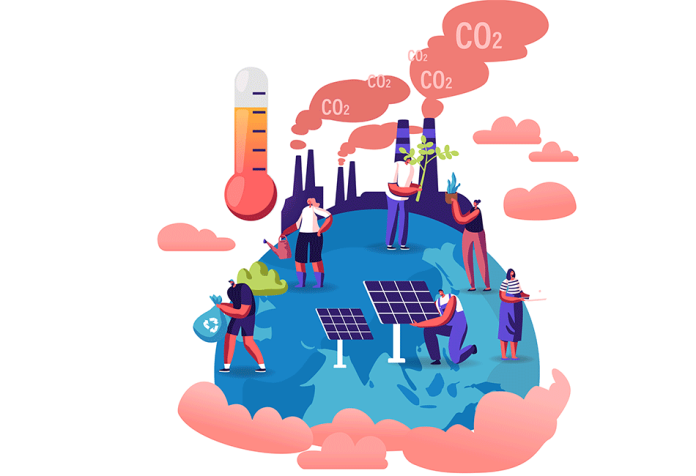
Political decisions and strategies are at the core of combatting the climate crisis. While there has been some progress in the reduction of CO2 emissions in the EU during recent decades, the emissions are still far too high. In this paper, we discuss the climate policies the EU has committed to and point to additional issues and strategies. To get a better understanding of emission reduction, we analyse the main CO2-emitting sectors in the EU.
KEY TAKEAWAYS
The EU’s ambitious climate policies are not only important for mitigating the effects of climate change, but also for creating new economic opportunities and jobs in sustainable industries.
The success of the EU’s climate policy depends on the cooperation and commitment of member states, and some countries have been more reluctant to adopt ambitious targets.
The EU’s climate policy also has implications for the rest of the world, as the EU is a major global economy and a leader in climate action, and its policies can inspire and influence other countries to take action.
Introduction
During the last three decades, the European Union has managed to reduce its CO2 emissions significantly. Nonetheless, the current path of the international community as a whole is still far from reaching its self-proclaimed goal of keeping global warming well below 2°C compared to pre-industrial levels, as agreed upon in the Paris Agreement. The global COVID-19 pandemic has had a notable effect on CO2 emissions worldwide. In 2020, global fossil CO2 emissions were 5.1 per cent lower than in 2019. This paper analyses which sectors are mainly responsible for emissions in the EU. Further, we discuss the climate policies the EU has either committed to or already implemented to reduce emissions from these sectors. Moreover, we point to further social issues linked to climate change that have suffered from lack of attention and provide additional strategies.
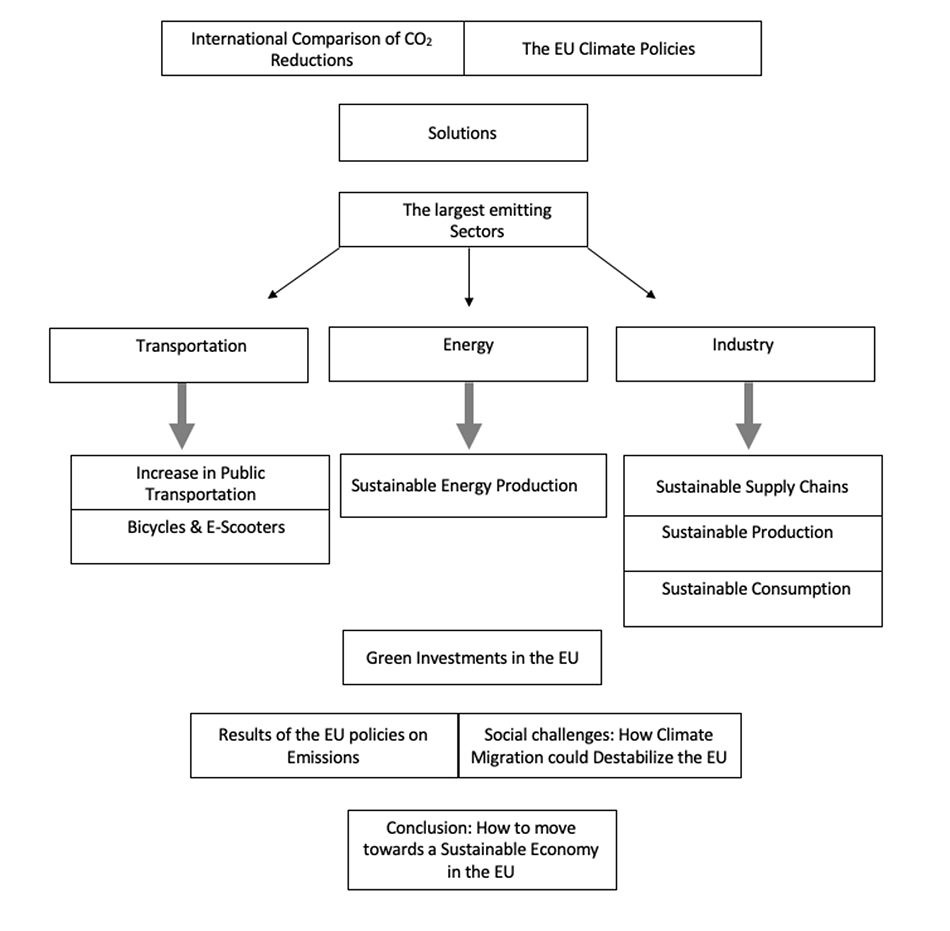
Figure 1: Schematic overview of the structure and contents of the paper
International comparison
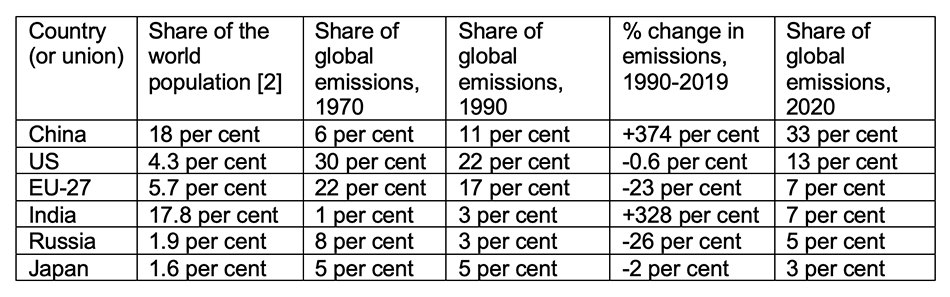
The EU is the third-largest emitter of fossil CO2 emissions in the world, after China and the United States. In 2020, the EU-27 was responsible for approximately 7 per cent of global emissions. The EU economy had managed to reduce its emissions by nearly 23 per cent, compared to 1990. By relative standards, this constitutes a rather large decrease, which was only topped by Russia (-26 per cent). The large developing economies of China and India have had massive increases in their fossil CO2 emissions, with increases of approximately 374 per cent and 328 per cent, respectively. The United States managed to reduce its share of global fossil CO2 emissions from 30 per cent in 1990 to 13 per cent in 2020. However, this was mainly due to the large increases in emissions by China and India. The total amount of US emissions is virtually unchanged, as it decreased only slightly, by 0.6 per cent. Japan has reduced its emissions by 2 per cent 1.
Table 1: Shares of fossil CO2 emissions of the largest emitters 1
The impact of the COVID-19 pandemic on global emissions
The COVID-19 pandemic had a notable impact on global fossil CO2 emissions resulting from human activity. In 2020, the global anthropogenic fossil CO2 emissions were 5.1 per cent lower than in 2019. This sudden reduction in emissions was largely caused by the effects of the pandemic, including shutdowns of many sectors of the global economy, as well as a massive decrease in tourism and thus transportation altogether. The COVID-19 pandemic interrupted the trend observed between 2015 and 2019, when global emissions grew annually by 1.1 per cent on average. China was the only country among the major CO2-emitting economies that did not manage to reduce its emissions as a result of the pandemic. The fossil CO2 emissions of China increased by 1.5 per cent in 2020, in comparison to 2019. The other major economies, the EU-27 (-10.6 per cent), the US (-9.9 per cent), Japan (-6.8 per cent), Russia (-5.8 per cent), and India (-5.9 per cent), all reduced their emissions in 2020 compared to 2019 1.
Recent international actions
In November 2021, the Glasgow Climate Pact was signed at the United Nations climate change conference (COP26). The pact was negotiated through the consensus of the representatives of the 197 attending parties. With regard to coal and fossil fuels, the agreement asks countries to “accelerate efforts towards” phasing down “unabated coal power”, referring to power plants that do not use technology to capture their CO2 emissions. While the wording has been subject to much criticism, this is the first time the subject of coal and fossil fuels has been included in a final United Nations COP decision. The agreement calls for an end to “inefficient” fossil fuel subsidies. However, no timeline is specified. Vulnerable nations are to be supported with technical assistance to help avoid and address the consequences of climate change 3.
The EU climate policies
The first legal basis of environmental policy in the EU was introduced in the Single European Act of 1987, which aimed to preserve the quality of the environment, protect human health, and ensure the rational use of natural resources. Several treaties with the aim of strengthening environmental protection and combatting climate change have followed since. For example, with the Treaty of Maastricht (1993), the environment became an official EU policy area. With the Treaty of Amsterdam (1999), the duty to integrate environmental protection into all EU sectoral policies with a focus on promoting sustainable development was established. With the Treaty of Lisbon (2009), “combatting climate change” became a specific goal. Moreover, sustainable development in relations with third countries was also included in the treaty, which enabled the EU legally to conclude international agreements with such focus 4. The EU has since signed several international agreements.
Many products use multiple types of plastic for one product package, making it difficult for recycling machines to recognise whether the package should be recycled.
In 1997, the EU signed the Kyoto Protocol. The agreement, which entered into force in 2005, contained for the first time legally binding limitations and reduction commitments for industrialised countries. In 2015, the Paris Agreement was adopted by the international community, including the EU. The long-term goal of the agreement was for the member states to commit to efforts that will ensure that global warming is well below 2°C, preferably 1.5°C, compared to pre-industrial levels. However, the agreement does not impose penalties for parties that violate its terms, such as fines or embargoes, and there is no international court or governing body ready to enforce compliance. Therefore, the agreement is not binding in any meaningful legal sense but rather appealed to the self-responsibility of the member states. The most recent international agreement signed by the EU is the aforementioned Glasgow pact of November 2021. The pact focuses on coal and fossil fuels, loss and damage, climate finance, adaptation, carbon markets, and mitigation 3.
To implement the transformation towards a climate-friendly economy, the EU is enforcing the Green Deal, a set of policy initiatives by the European Commission to make the EU climate-neutral by 2050. The EU Parliament voted to support the EU Green Deal in January 2020. According to article 191 of the Treaty on the Functioning of the European Union, combatting climate change is an explicit objective of EU environmental policy. More specifically, under the 2030 climate and energy framework, the EU has committed itself to reaching the following goals by 2030 5:
• Reducing greenhouse gas emissions to at least 40 per cent below 1990 levels • Improving energy efficiency by 32.5 per cent • Increasing the share of renewable energy sources to 32 per cent of final consumption.
Moreover, to achieve the target of climate neutrality by 2050, the EU Commission proposed a 2030 target to reduce greenhouse gas emissions by 55 per cent. This 2030 target is proposed to be reflected in a European law which will also enshrine the 2050 climate-neutrality objective in legislation. The European Climate Law requires that all EU policies contribute to achieving the EU Green Deal objective. Therefore, the EU Commission is reviewing every EU law to ensure its alignment with the emission reduction targets 5. This is a lengthy process, which has already started to revise many key areas of legislation. One of the policy frameworks that is set in place to reduce emissions is the emission trading system (ETS), the first and largest international carbon market. The principle of the ETS is to combine regulation and incentives. The ETS is based on the “cap and trade” principle, where a cap is set on the total amount of GHG emissions that can be generated by factories, power stations, and similar installations. The installations buy or receive “emission allowances” that are auctioned by the member states. These credits correspond to one tonne of CO2 each and can be traded with other installations if they are not used.
Solutions
The following section discusses the policy solutions implemented by the EU, as well as additional strategies. First and foremost, it is essential to understand how emissions are distributed among the various sectors in the EU economy. This allows us to focus on the sectors where solutions are most important, as these sectors make up the largest shares of emissions.
The largest-emitting sectors
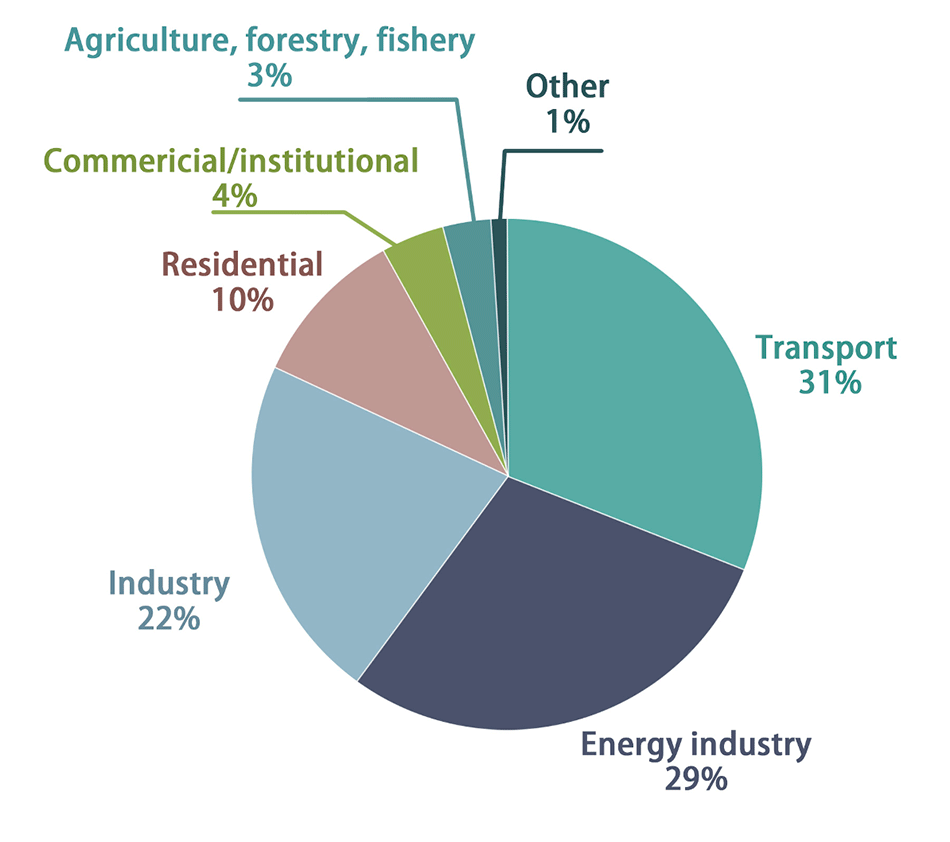
Figure 2 shows the contribution each sector makes to the carbon dioxide emissions of the EU. Together, the three sectors of transportation, energy, and industry make up nearly 82 per cent of all carbon dioxide emissions in the EU. Below, we analyse how the three main sectors contribute to the total EU emissions. Further, we review some of the policy guidelines proposed by the EU and discuss additional policies that could be implemented.
Figure 2: Distribution of carbon dioxide emission in the EU in 2019, by sector 6
Transportation
Transportation makes up the largest share of carbon dioxide emissions in the EU. Nearly a third of all emissions are generated through transportation. Cars, in particular, contribute heavily, as they make up more than 40 per cent of the emissions generated by the transportation sector. Heavy trucks and buses make up nearly 20 per cent 6. Emissions from the road transport sector – similarly to waste, agriculture, and buildings – are not covered by the ETS trading system. These sectors are subject to binding annual GHG emission reduction targets set for each member state 5. However, while greenhouse gas emissions from the transportation sector in the EU were on a declining trend from 2007 to 2013, they increased again from 2013 to 2019 7.
For a sustainable decrease in emissions from this sector, there needs to be a permanent reduction in travel by car. Regulatory measures, such as restrictions on driving in the inner city during certain time frames, may be helpful to incentivise people to use public transportation to get to work. For this shift to function properly, public transportation must be as attractive as possible. This can be achieved by reducing the ticket prices for public transportation. Further, an increase in the frequencies of trains would make individual trains less crowded. This is particularly important for people driving to work or going home. While the alternative of taking a car to work often means getting stuck in traffic during the same time frame, a crowded road does not impinge their personal space as much as a crowded train. Particularly in times of a global pandemic, this can result in making public transportation less attractive. However, many cities, such as Hamburg, Germany, have already implemented high frequencies for certain trains during rush hours. Most of the trains in Hamburg run on sustainable energy as well. In June 2022, the German government introduced a 9€ ticket for regional trains and buses across Germany. Such measures can help make public transportation more attractive in the short term. However, for a long-term transition to work, such proposals will have to be in combination with a permanent reduction in ticket prices. Therefore, large and sustainable investments in the transportation systems of EU cities will be necessary.
The pact focuses on coal and fossil fuels, loss and damage, climate finance, adaptation, carbon markets, and mitigation.
Nonetheless, public transportation should not be the only alternative to cars. A sustainable transportation system will have to rely on other forms of transportation, such as bicycles as well as e-scooters. One major problem here is the quality and quantity of cycle lanes throughout European cities. Most city streets were designed to provide infrastructure solely for cars. Except for the Scandinavian countries, the Netherlands, and a few other places, most European cities do not integrate bicycles well into their traffic systems. Although some major European cities are already trying to reverse this trend by building new bike lanes, this infrastructure must be given priority, so bicycles can be used as a more frequent alternative transportation.
Moreover, although the sustainable cities envisioned in the future will rely less on car traffic, cars will still play a major role. Therefore, a great expansion of electric vehicles is needed. Not only cars but also other vehicles such as buses need to shift towards running on electricity in the upcoming decades. The expansion of electric cars is already supported by many EU states through government subsidies. Other forms of transportation such as shipping must also transform towards sustainability. The technology already exists in many areas. For example, in late 2021, the world’s first electric autonomous cargo ship launched in Norway, shipping up to 120 containers.
Energy
The energy industry makes up another third of carbon dioxide emissions in the EU 8. This sector is responsible for the second-largest share of emissions in the EU. While the energy industry still contributes significantly to EU emissions, the climate policy of recent decades has played a notable part in reducing emissions. Emissions from the energy sector have been falling for more than a decade 8. The energy sector is currently shifting towards sustainability as part of the policy initiatives taken by the Green New Deal. The EU’s target is to reach net-zero greenhouse gas emissions by 2050. Most of the energy produced now comes from renewables and biofuels (ca. 30 per cent) 9. Approximately 22 per cent of final energy consumption comes from renewable sources 10. Sweden is leading in the share of renewables in consumption. Nearly 55 per cent of its gross final energy consumption comes from renewables. All in all, Scandinavian countries are consuming the cleanest energy, with Finland and Denmark in second and fourth place, respectively 11. While the EU has reached its 2020 targets of at least 20 per cent of energy consumption coming from renewables on average, almost one-third of EU members have not.
According to the European Commission, the strategy is to develop a power sector based largely on renewable sources and an integrated, interconnected, and digitalised EU energy market 6. However, nuclear energy still makes up almost a third of energy production in the EU. This share is likely to remain at such high levels, as the European Commission has recently decided to give nuclear energy and natural gas a green label under their taxonomy. The taxonomy serves as a rulebook of green investment, intending to direct the EU towards climate neutrality by 2050. According to the European Commission, the taxonomy is “a classification system, establishing a list of environmentally sustainable economic activities” in the context of the Green New Deal 12.
Furthermore, while the emission trading system (ETS) can help to reduce emissions in principle, its practical application has many problems. Among the main problems is financial speculation. According to a recent analysis, the EU carbon price market is more and more subject to speculation 13. Since a cap is set on the total amount of GHG emissions, some financial actors purchase emission allowances with the sole purpose of selling them for a profit, hoping that the price will increase in the future. Such speculations can lead to price volatility or bubbles. Furthermore, large financial actors may stockpile allowances to shorten supply and therefore increase prices.
Industry
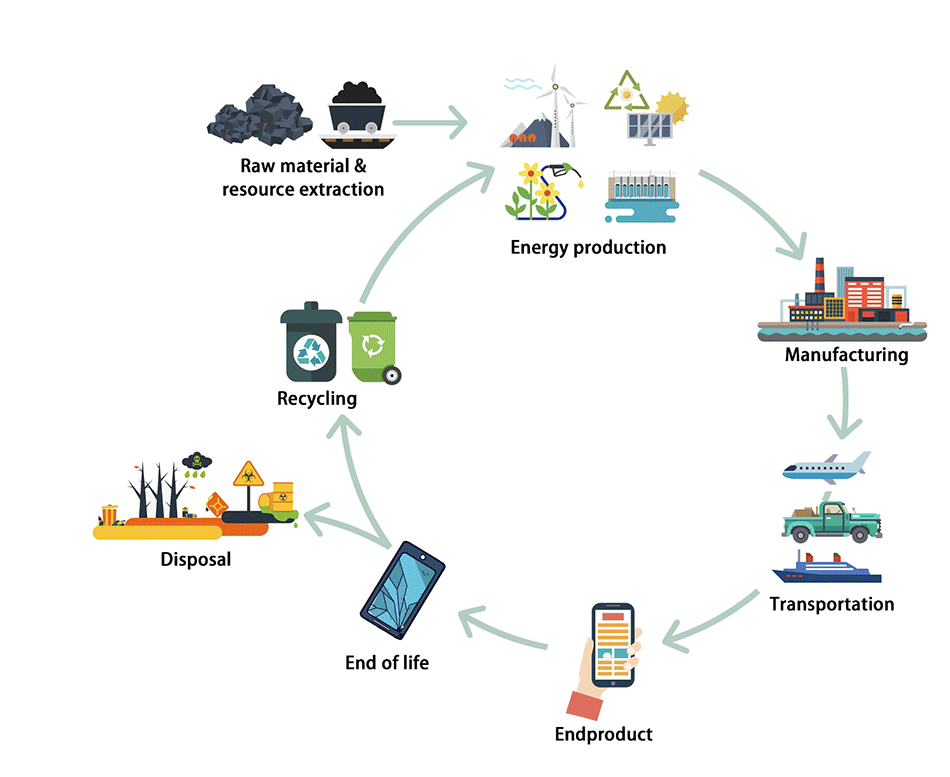
Industry is the third-largest sector contributing to emissions in the EU, making up more than 20 per cent of all emissions 7. If the EU economy is to shift towards sustainability, there needs to be a significant change in the way goods are produced and consumed. One particular area of change will be the life cycle of goods. In our current economy, the production of consumer goods works as follows. First, resources are extracted from the earth. They are then used for energy and material production to manufacture goods which are afterwards distributed to consumers. Finally, after consumption, the goods are often disposed of. This is a linear system, with little to no reintegration from the final stage of the process, the disposal, to other stages. Many consumer goods leave behind non-recyclable waste. Further, resource extraction, energy and material production, manufacturing, and the distribution of goods generate a high volume of emissions. However, there need to be two concrete changes to our current system of production.
First, we need to move away from a linear economy towards a circular economy. Figure 4 demonstrates this strategy. The initial steps up to the consumption of consumer goods are similar in a circular economy. The main difference is that the vast majority of materials manufactured for consumer goods are reintegrated into the production process of new products 14. If the final product cannot be fully recycled or reused after consumption, it should be produced in such a way that it leaves no waste behind. One current problem with moving towards such a production process is that only approximately 41 per cent of plastic is actually recycled in the EU, with high variances across countries 15. That is because many products use multiple types of plastic for one product package, making it difficult for recycling machines to recognise whether the package should be recycled. Many of those products often end up being burned instead of recycled. Therefore, one way of leaving behind less waste would be to change the regulatory framework for the use of plastic in production. Stricter regulations concerning the mix of different types of plastics for packages could be a way forward.
Second, in a sustainable economy, the life cycle of the majority of consumer goods ought to be sustainable. Sustainable products are products that are environmentally friendly throughout their lifespan. Thus, there ought to be no permanent damage to the environment from the moment the raw materials are extracted to the moment the final product is disposed of. Therefore, each process of our production and consumption needs to change. The extraction and usage of raw materials should leave no permanent damage to the environment. The energy used in the production process should be clean and environmentally friendly.
This also applies to other inputs used in the production process, such as the buildings or factories where the products are produced.
Figure 3: The sustainable life cycle of a product
There are many individual areas of our consumption that will need to change drastically if our industry is to be sustainable. One area is meat consumption. The livestock sector is responsible for 81-86 per cent of total agricultural GHG emissions, if emissions related to the production, transport, and processing of feed are included 16. Therefore, it is almost inevitable that meat consumption in the EU will have to be reduced in the upcoming decades.
Results of the EU climate policies
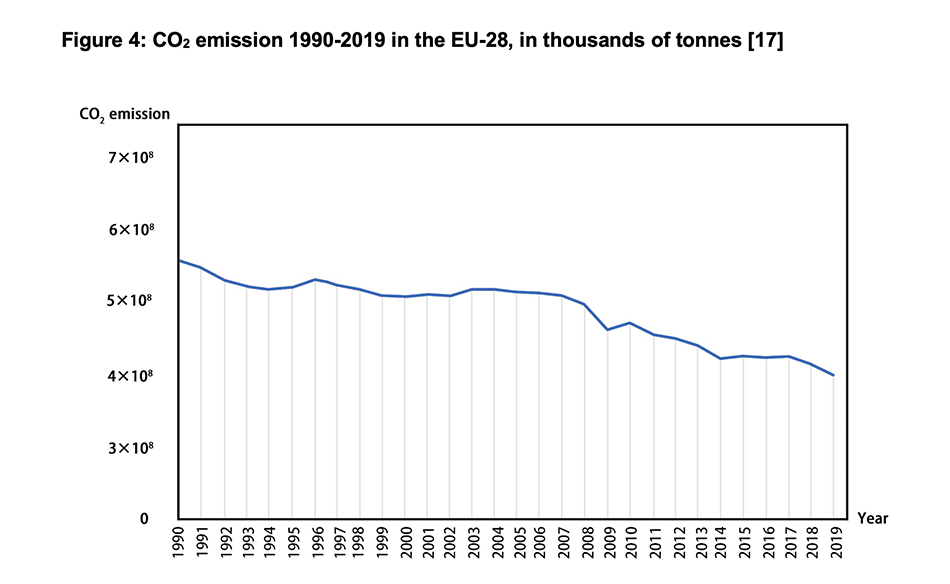
The EU policies have already had a notable effect on emissions. Figure 5 demonstrates this development. Between 1990 and 2019, the CO2 emissions of the EU-28 have been reduced by nearly a third 17. Within the EU, the largest emitter during this time frame was Germany, making up nearly 20 per cent of total EU-28 emissions. Germany is followed by the UK (13 per cent) and France (11 per cent).
Figure 4: CO2 emission 1990-2019 in the EU-28, in thousands of tonnes 17
However, although the climate policies have managed to reduce CO2 emissions by a significant amount during the last three decades, the current pathway is still far from what is needed. Given the history of Europe’s early industrialisation, the continent has a particular responsibility regarding the change of the climate. Moreover, taking another look at table 1 in the international comparison section, the EU is responsible for approximately the same amount of CO2 emissions as India, yet India’s population is nearly triple that of the EU. There is little doubt that a continuation of the pace of emission reduction would be very harmful to the world climate. Although the goals and commitments that are set in place, such as the net-zero target by 2050, go in the right direction, it is essential that these goals should actually be achieved.
Green investments
In terms of practical applications of climate policy solutions, the question of how to finance specific proposals is always among the main topics of discussion. Large-scale financial investments are needed within the EU to actively support innovative approaches to solving technological problems and incentivising sustainable consumption. The European Commission states that the offshore renewable energy strategy aims to encourage investment of almost 800€ billion by 2050 in offshore energy infrastructure and research 17. Such investment is desperately needed. New investments have been on a downward trend in Europe since 2008 18. Given that the current level of investment will not be sufficient to shift the European economies towards sustainability, European governments must increase their spending on green technology. Further, policy and regulatory frameworks should also incentivise private investment, even more than is currently the case.
While green solutions are often criticised for their costs, it is important to acknowledge that it is highly misleading to think solely in terms of the costs that a shift towards a sustainable, climate-neutral economy will produce. That is because simply counting the pile of money it will take to finance environmentally friendly energy and industry leaves out what the alternative of not doing so would cost – namely, making the planet unliveable for humans. The cost that would result from not being able to reduce global CO2 emissions far below 2°C and reaching certain tipping points would far exceed any costs of a shift towards a net-zero economy. According to a widely influential report about the economics of climate change, the management of global warming would cost 1 per cent of global gross domestic product (GDP) annually, as opposed to inaction, which could cost between 5 per cent and 20 per cent of global GDP 19. Further, it is essential that the financing of climate-friendly solutions should be social. If low- and middle-income families are burdened over-proportionally, this will likely lead to higher opposition to sustainability among the general population. Therefore, higher-income households and corporations must pay their fair share to finance the transformation.
Moreover, investments in developing countries will be just as important to finance sustainable technological solutions. The 2021 Glasgow Climate Pact 3 acknowledges with “deep regret” that developed countries, including EU countries, have missed their 2020 target of providing $100bn a year to help developing countries. The pact commits them to raising at least that amount by 2025, annually. In terms of adaptation, the Glasgow Climate Pact urges developed countries to “at least double” their support for adaptation measures, in contrast to 2019 levels, to assist developing countries in their preparation for climate change by 2025 3. This implies that adaptation funding could be around $40 billion annually, given that it was around $20 billion in 2019. Without the developing countries, there will be no sustainable solution.
The COVID-19 pandemic: A window of opportunity for the climate crisis?
As a result of the pandemic, fossil CO2 emissions in the EU-27 decreased by 10.6 per cent. Although this decrease in emissions, temporarily caused by large decreases in production and consumption, will not have a lasting effect in itself, it could be a window of opportunity. The pandemic has forced people and corporations worldwide to make behavioural adaptations to the crisis. The same will be necessary for the climate crisis. While this process has already begun in many ways, it must be accelerated significantly to deal with the climate issue. Further, the pandemic has also shown how quickly governments can act and how fast financial sources can be found in a crisis.
Social challenges: How climate migration could destabilise the EU
Climate change is expected to threaten food security across the globe, due to ecosystem degradation. This will disproportionately affect the poorer parts of the world and will likely intensify ongoing conflicts or help to create new wars over scarce resources, such as water. While water scarcity rises, crop productivity is expected to decrease. Further, the destruction of homes caused by extreme weather events will significantly increase as well, and the continuation of the rise in sea levels will make many places unliveable across the globe. These phenomena force millions of people to leave their homes. In 2014, more than 20 million people were forced to change their place of permanent residence due to factors related to climatic change 20. This figure is expected to rise substantially in the coming decades. According to estimates by the World Bank, there will be more than 143 million climate migrants by 2050 if no action is taken 21. In sub-Saharan Africa alone, there are expected to be 86 million climate migrants, while South Asia and Latin America are forecast to be home to 40 and 17 million climate migrants in 2050, respectively. Our current situation opens up two paths to deal with the climate-change migration situation.
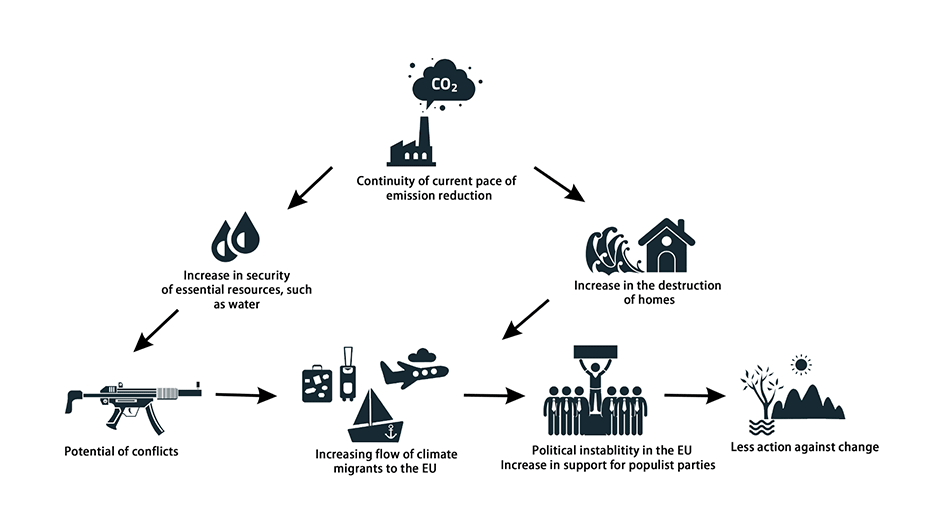
Scenario 1: We continue with the current pace of reduction in CO2 emissions and do not make extensive efforts to include climate migration in development planning. Further, in this scenario, we also find no legal framework for climate refugees. The likely outcome of this scenario will be large-scale migration to the EU and other places by people seeking refuge from the disastrous effects of climate change. In particular, the potential outbreaks or intensifications of conflicts due to environmental factors will make predictions regarding the timing and number of migrants rather difficult. This could mean a sudden large flow of migrants or refugees. In this scenario, with no clear legal framework on how to deal with climate migrants / refugees and limited efforts to deal with climate change altogether, this could cause large-scale political instability within the EU. The sudden and large-scale migration in 2015 following the events of the Syrian war demonstrates how such a situation could destabilise the EU by increasing support for populist parties. This could then lead to even less action against climate change. Figure 5 visualises this pathway. However, there is an alternative way of dealing with climate migration.
Figure 5: How climate migration could destabilise the EU
Scenario 2: In this scenario, the climate migration problem is taken seriously and governments around the world act accordingly to reduce or prevent the effects of scenario 1. The World Bank points out that the number of people who will be forced to leave their homes could be reduced by as much as 80 per cent if appropriate actions are taken 21. These actions include large reductions in greenhouse gas emissions, the inclusion of climate migrants in development planning, and increases in investment to improve our understanding of internal climate migration. Furthermore, a clear legal framework of how to deal with climate refugees should be developed. These actions would massively reduce the social consequences for the potential climate migrants themselves, as well as for the EU.
Summary
The EU is the third-largest emitter of CO2 in the world. It has managed to reduce its CO2 emissions by nearly a third in the last three decades. The three main sectors of transportation, energy, and industry make up more than 80 per cent of all carbon dioxide emissions in the EU. Transportation has overtaken energy as the largest-emitting sector, making up nearly a third of all EU emissions. Cars make up most of these emissions. While the majority of cars will have to be replaced by electric vehicles, there also needs to be a permanent reduction in travel by car. Therefore, public transportation must be as attractive as possible, by reducing ticket prices and increasing the frequencies of trains and buses. Moreover, other forms of transportation, such as bicycles or e-scooters, should be further supported.
Although the EU is doing relatively well in terms of emission reduction by international standards, it has not done nearly enough.
The second-largest emitting sector, the energy sector, has been in the middle of a transformation towards cleaner energy. However, despite the desperately needed shift to clean energy, there has been a significant lack of investment in clean energy during the last seven years. Industry contributes the third-largest emissions. In our current economy, there is only a very limited reintegration from the final stage of the process, the disposal, to other stages. In the coming decades, our economy will need to shift towards sustainability and circularity. Further, climate change increases all sorts of social issues, such as migration. Hence, a political solution will have to be found soon.
Outlook
While the shift towards sustainability challenges our economies in many ways, it also provides many opportunities. Green solutions will require creative, innovative ideas and incentivise entrepreneurship. Many new businesses and entire markets will be created. Reductions in single-person transportation will be a major part of the sustainable solutions. Further, a shift toward a circular economy and changes in the amounts and types of products we consume will be essential as well. The industry and transportation sectors will have to be based on renewable energies. International comparisons between the US and the EU show that emission reduction is not just about technology or financial means to invest. It is first and foremost about political will. Despite not being far ahead of the US in technology or gross domestic product, the EU has managed to reduce its CO2 emissions by far more than the US.
Although the EU is doing relatively well in terms of emission reduction by international standards, it has not done nearly enough. There is no principle of relativity in climate-change effects. Whether or not the EU has contributed less than other big emitters in relative terms does not decide how bad the environmental and social consequences will be for Europe. The EU emission reductions are still not in accordance with the demands of the scientific community. Further, while the climate policies of EU governments have historically focused on long-term goals, many of them have lacked clear communication on how to achieve those goals. The result was that many goals have not been achieved. The integration of the scientific community into many EU governments has helped to address this issue. Some governments are regularly now double-checked by a scientific panel, making sure that the policies are in compliance with climate goals. After all, what good are ambitious goals if they are not achieved? Nonetheless, the measurable effect of the EU climate policies has shown that climate policies are effective and do reduce CO2 emissions.
Acknowledgment
The authors would like to thank Prof. Dr Luz del Carmen Gómez Pavon, director Facultad de Ciencias de Electrónica FCE, Benemérita Universidad Autonóma de Puebla México, for years of support in this scientific area.
This article was originally published on April 14 2023
Davis Weidemann holds a BSc in Business Administration from the University of Southern Denmark. He is currently enrolled in a second BSc programme at Leuphana University, majoring in economics. Previously, he has taught micro- and macroeconomics as a student tutor at both universities. Besides economics, his research interests include political science, which he studies as a minor, as well as sociology and philosophy. He works as a student researcher at a market and consumer data company.
Michael Palocz-Andresen is working as a full professor at the Benemérita Universidad Autónoma de Puebla México. Since 2018 till 2022 he was a Herder-professor supported by the DAAD at the TEC de Monterrey. He became a full professor at the University West-Hungary Sopron, and a guest professor at the TU Budapest, the Leuphana University Lüneburg, and the Shanghai Jiao Tong University. He is a Humboldt scientist and an instructor of the SAE International in the USA.
Quemin, S. and Pahle, M. 2022: Financials Threaten To Undermine the Functioning of Emissions Markets. 24 March. Available at SSRN: https://ssrn.com/abstract=3985079 or http://dx.doi.org/10.2139/ssrn.3985079.
Millar, N., McLaughlin, E., and Börger, T. 2019: The circular economy: swings and roundabouts? Ecological economics 158; 11-19. 1016/j.ecolecon.2018.12.012.
European Commission, Directorate-General for Agriculture and Rural Development, Peyraud, J., MacLeod, M.2020: Future of EU livestock: How to contribute to a sustainable agricultural sector? Final report, Publications Office, https://data.europa.eu/doi/10.2762/3440 (Accessed: 17 April 2022).
Stern, N. 2007. The Economics of Climate Change – The Stern Review. Cambridge University Press. ISBN: 9780511817434; xv – xx.
Lukyanets, A., Ryanzantsev, S. 2016: Economic and Socio-Demographic Effects of Global Climate Change. International Journal of Economics and Financial Issues; 268-273.
Globalisation compelled labour markets to integrate and converge towards common standards. Preparing professionals on this requires multifaceted strategies, since the labour market has expanded towards international borders, prompting economies to underscore the importance of human resource development as key for competitiveness and mobility. In harnessing the opportunities that ASEAN MRAs bring, there is a need to facilitate the formation of a stronger skill base by underscoring knowledge capital alongside social and human capital.
ASEAN and MRAs
The establishment of the ASEAN Economic Community (AEC) is expected to ease the mobility of professionals in the region. To facilitate regional mobility of professionals, together with Mode 4 (Movement of Natural Persons) of the General Agreement on Trade in Services (GATS), ASEAN Member States (AMS) entered into Mutual Recognition Arrangements (MRAs), which are framework arrangements established to unify differences in standards and qualifications imposed by respective AMS on practising professionals. MRAs are geared towards supporting liberalisation of trade in services that will enable mobility of skilled labour and professionals in the region. To date, these arrangements cover those from the fields of dental services, nursing services, and medicine (i.e., highly regulated); accountancy, architecture, and engineering services (regulated); and tourism (i.e., unregulated) (Hamanaka & Jusoh, 2016). Acceding to MRAs implies willingness of AMS to collectively converge towards international standards, procedures, and qualifications (Iredale, 2001) that will promote the efficiency and competitiveness of service suppliers (Aldaba, 2013).
In harnessing the opportunities MRAs bring, there is a need to facilitate the formation of a stronger skill base by underscoring knowledge capital alongside social and human capital.
However, despite the existence of MRAs, the environment for the cross-border mobility of professionals remained very restrictive because of domestic regulations, which are compliance measures imposed by receiving economies on all foreign professionals to secure authorisation to supply services. Although these are not intended to exclude foreign service-providers (Crozet et al., 2016), they exist because of the continuous involvement and control of AMS in the process of allowing foreign professionals to practise in their labour market, rather than simply depend on an inexorable outcome of labour market internationalisation (Meyer et al., 2001). One of the intentions is to protect job opportunities for local service suppliers.
Although local professionals are deemed ready to participate as per the MRAs, the sufficiency condition requires that professional standards and protocols meet standardised regional specifications, which is challenging to accomplish. Hence, one may question whether MRAs are still important and relevant, given the constraints brought about by domestic regulations.
Relevance of MRAs
Despite MRAs becoming seemingly irrelevant because of domestic regulations, there is still value in them. We argue that AMS, particularly the developing economies, should continue investing in them. Rather than viewing MRAs as purely a facilitator of free movement of skilled labour in the ASEAN region, it can also be viewed as a significant avenue for improving human capacity. That is, even if receiving economies restrict professionals from sending economies because of their stringent domestic regulations, the sending economies still benefit from MRAs with their human resource development component.
Human resource development is the formation of the following dimensions of human capacity: human capital (i.e., motor, intellectual, and productive skills that can enhance an individual’s employability and increase lifetime income), social capital (i.e., human qualities, attitudes, and social skills that can enhance interpersonal relations, interdependence, cooperation, and teamwork), and knowledge capital (i.e., higher levels of knowledge and competencies resulting in growth of research capabilities of an economy through the creation of new innovations).
The formation of these dimensions is implied in the elements of MRAs. Despite the indirect link between MRAs and human resource development, this compels all economies participating in the MRAs to foster human resource development.
Key recommendation
The fact that MRAs can nurture human, social, and knowledge capitals has motivated all participating economies to upgrade their educational systems, training, accreditation, certifications, licensing, and professional regulatory frameworks to enforce higher standards in the conduct of professional practice. Given these elements of MRAs, economies have pursued the formation of human capital, the creation of new knowledge, and the building of social capital. Hence, professionals are compelled to continuously improve on their respective crafts.
In harnessing the opportunities MRAs bring, there is a need to facilitate the formation of a stronger skill base by underscoring knowledge capital alongside social and human capital.
In developing human and social capitals, among others, there is a need for professional programmes to continuously (1) improve their curriculum design and delivery; (2) upgrade faculty qualifications; (3) institute progressive systems of determining and improving professional hard and soft competencies; (4) enhance continuing professional development programmes by making them more developmental than regulatory; and (5) institute a strong academe-industry linkage that will allow professionals to accumulate relevant and significant experience, accredit programmes, and institute credible certifications and licences. All of which are geared towards uplifting and ensuring the quality of professionals’ competencies and bridging any competency gaps.
In developing knowledge capital, there needs to be investment in research and development that can stimulate technological development and create new practices that upgrade human resource practices. Incidentally, knowledge creation and technological development are vital in enhancing the conduct of professional practice. Although research is not always practicable (for example, in the academic context), it can generate patents, innovations, and new methodologies that can contribute to the development of society in the long run.
This recommendation hinges on the findings of various pieces of scholarly literature regarding the significant link between university research and productivity growth in developed economies. Research and development enhanced the productivity of human capital by accounting for the differential income of university graduates. It also enhanced the productivity of the rest of the economy, especially for firms that finance a good portion of university research. This created spillover effects that benefited other firms and enhanced the supply of human capital, particularly graduate students with specialisations in science and technology (Martin & Tang, 2007). Moreover, in the US, university research also facilitated the development of knowledge for the creation of new technology to aid developed economiesʼ lead in digital information (Lynch & Aydin, 2004; Frenkel & Leck, 2006). Furthermore, because of increased investment in education, research for skills development, and technology adoption, East Asian economies (China, Japan, and Korea) experienced sharp increases in national income and standards of living (Pandey, 2003). Therefore, engaging in research- and technology-oriented curricula as a subset of an export-led development strategy can provide demand signals for the skills required for improving competitiveness.
In developing knowledge capital, there needs to be investment in research and development that can stimulate technological development and create new practices that upgrade human resource practices.
Indeed, the formation of knowledge capital through research and technological development is a facilitating factor towards international competitiveness, thereby contributing to economic growth, efficiency, productivity, and competitiveness. In the midst of the Fourth Industrial Revolution (variously styled as “FIRe” or “4IR”), which changed the way people work and live, professionals must be able to swiftly adapt to a continuously changing demand that is becoming increasingly complex. Taking the lead from developed economies such as the US, China, Germany, Japan, and Singapore, they have taken advantage of FIRe to produce more research in engineering, computer science, chemistry, physics, biological science, social sciences, and environmental sciences in preparing their human capital.
While professionals from various AMS are deemed comparable with each other to participate in the regional mobility of labour, each AMS must go beyond comparability. Therefore, for developing economies to participate in FIRe, they should not only prepare their human capital, but they should also expand their knowledge capital in key areas that are being used for interconnectedness under FIRe. To sustain comparability and readiness, there has to be a continuous improvement in the education of faculty members who are handling professional degree programmes, through research and publication. Although publication is not required in professional practice, faculties should be experts in their respective fields. Otherwise, they become merely trainers that cannot articulate nuances and developments in their respective fields. With expert professors, appropriate training and education of professionals is ensured.
Acknowledgement This article is based on the study of Rivera et al. (2019) “Assessing the readiness of Filipino MRA-supported professions to participate in the mobility of skilled labor in the ASEAN region: Lessons for APEC economies”, released as Discussion Paper Series No. 2019-12 by the Philippine Institute for Development Studies (PIDS) and funded under the Philippine APEC Study Center Network (PASCN) Research Program (PASCN-RGA/18-2019/36).
This article was first published on September 29, 2022.
John Paolo R. Rivera is an economist with an extensive research portfolio in the areas of tourism development, poverty, remittances and migration, entrepreneurship, international trade, and development economics. He obtained his Doctor of Philosophy in Economics from De La Salle University School of Economics. He is currently the associate director of the Asian Institute of Management – Dr. Andrew L. Tan Center for Tourism.
Tereso S. Tullao, Jr. is a University Fellow and Professor Emeritus of Economics in De La Salle University. As a researcher, he has published several articles, monographs, and books in Filipino and English in the fields of economics of education, trade in services, movement of natural persons, migration, and remittances. He earned his Doctor of Philosophy at the Fletcher School of Law and Diplomacy, Tufts University.
References
Aldaba, R.M. (2013). “ASEAN Economic Community 2015: Labor mobility and mutual recognition arrangements on professional services” (PIDS Discussion Paper No. 2013-04). Makati City, Philippines: Philippine Institute for Development Studies.
Crozet, M., Milet, E., & Mirza, D. (2016). “The impact of domestic regulations on international trade in services: Evidence from firm-level data”. Journal of Comparative Economics, 44(3), 585-607.
Frenkel, A., & Leck, E. (2006). “Investments in higher education and the economic performance of OECD countries: Israel in a comparative perspective”. Samuel Neaman Institute.
Hamanaka, S., & Jusoh, S. (2016). “The emerging ASEAN approach to mutual recognition: A comparison with Europe, Trans-Tasman, and North America” (No. 618). Institute of Developing Economies, Japan External Trade Organization (JETRO).
Iredale, R. (2001). “The migration of professionals: Theories and typologies”. International Migration, 39(5), 7-24.
Lynch, T., & Aydin, N. (2004). “Literature review of the economic and social impacts of higher education research funding”. Florida State University.
Martin, B.R., & Tang, P. (2007). “The benefits from publicly funded research” (SPRU Electronic Working Paper Series No. 161). Science and Technology Policy Research.
Meyer, J.B., Kaplan, D., & Charum, J. (2001). “Scientific nomadism and the new geopolitics of knowledge”. International Social Sciences Journal, 53(168), 309-21.
Pandey, V.C. (2003). Education: Planning and human development. Gyan Publishing House.
Rivera, J.P.R., Cudia, C.P., & Tullao, T.S. (2019). “Assessing the readiness of Filipino MRA-supported professions to participate in the mobility of skilled labor in the ASEAN region: Lessons for APEC economies” (Discussion Paper Series No. 2019-12). Philippine Institute for Development Studies.
The digital revolution continues to redefine several aspects of our lives, and one area that particularly stands out is our way of consuming audiovisual content. Amidst this paradigm shift, IPTV (Internet Protocol Television) is an emerging technology that pledges to revamp our television viewing patterns. This discourse explores IPTV’s workings, its impact on the broadcasting sector, and its potential to reimagine home entertainment.
Decoding IPTV: The Functioning
IPTV is an innovative technology that facilitates the distribution of TV programs and video-on-demand over the internet. Traditional television relies on radio waves, satellite, or cable for delivering content, while IPTV utilizes the same Internet Protocol (IP) that connects devices to the internet. This enables users to demand and access their preferred TV shows or movies online, a user experience similar to streaming services like Netflix or Amazon Prime Video.
IPTV service providers supply a “lista IPTV” or a directory of channels and shows that users can choose from. This lista IPTV can be customized to suit the user’s tastes, offering a tailored viewing experience.
IPTV operates through three fundamental service types: video on demand (VOD), where users choose their preferred content; live broadcasting, analogous to traditional television; and subscription television, where a series of shows are broadcasted with the user deciding the timing and venue.
Predicting Television’s Trajectory with IPTV
Personalized Content and Viewer Autonomy
IPTV’s distinct advantage over traditional television lies in the personalization and control it grants to its users. Traditional television imposes a set programming schedule, whereas IPTV allows users to select their preferred content and the timing, encompassing a variety of genres from TV series and movies to live sports and educational content.
Several IPTV providers present a free “iptv teste” or IPTV trial to allow potential users to experience the service before subscribing to an IPTV plan. During this “iptv teste” or IPTV trial, users can sift through the vast “lista IPTV,” experiencing first-hand the convenience and customization that IPTV affords.
Advanced Broadcasting Quality
IPTV possesses the capability to deliver superior audio and video quality in comparison to traditional television. With its compatibility for HD, 4K, and 8K video quality, IPTV aims to offer an immersive and lifelike viewing experience. However, this largely depends on the speed and stability of the internet connection. With constant improvements in internet infrastructure globally, the quality of IPTV transmission is on an upward trajectory.
Borderless Content Access
An attractive feature of IPTV pago or paid IPTV is the unrestricted global access to content. Traditional cable or satellite TV may be subject to geographical limitations, but IPTV defies these borders. This implies that one can access their “lista IPTV” from any location in the world, provided an internet connection is available.
Analyzing IPTV: The Upsides and Downsides
Like every technology, IPTV has its set of benefits and drawbacks. Let’s explore them.
Merits of IPTV
Content-On-Demand: The most notable merit of IPTV is the freedom to choose content and schedule viewing times, an ideal advantage for those with irregular schedules or binge-watchers.
Superior Transmission Quality: As previously mentioned, IPTV has the potential to deliver an unparalleled audio and video quality compared to traditional TV.
Borderless Content Access: IPTV facilitates access to a broad array of global content, overcoming the geographical restrictions of traditional broadcasting.
Interactivity: The “iptv teste” or IPTV trial also showcases interactive features such as the ability to pause and record live shows, and integration with other IP-based services.
Demerits of IPTV
Internet Dependency: The biggest limitation of IPTV is its reliance on a stable, high-quality internet connection. Any disruption in the internet service can lead to a subpar viewing experience.
Potential Extra Costs: Although IPTV might seem cost-effective compared to cable TV, the expenses for high-speed internet and potential subscription charges could increase the overall cost.
Legal and Copyright Risks: Many IPTV providers operate in a grey area concerning copyright, lacking the necessary licenses for broadcasting specific content, which may pose legal problems for the users.
Security and Privacy Concerns: Like all internet-based services, IPTV is susceptible to privacy and security issues. Users should choose a reliable IPTV provider and consider additional safety measures like using VPNs (Virtual Private Networks).
The Impact of IPTV on the Entertainment Sector
IPTV’s rise also bears substantial implications for the entertainment industry. By reshaping the broadcasting landscape, IPTV allows new players to enter and introduces new revenue generation opportunities.
With IPTV, content providers can reach global audiences, bypassing geographical barriers imposed by traditional broadcasting. This freedom could usher in greater content diversity as creators can experiment with innovative formats and genres.
Additionally, IPTV could potentially disrupt the entertainment industry’s traditional business model. Moving away from advertisement or subscription-based revenues, content providers could explore alternate monetization models like pay-per-view or à la carte subscription services.
In conclusion, IPTV holds the promise to radically alter our television content consumption patterns. With the increasing penetration of the internet and relentless technological evolution, it’s plausible that IPTV will gain increased popularity, presenting a competitive alternative to traditional television. However, addressing the challenges related to internet quality, legal constraints, and security concerns is crucial for the long-term survival of this burgeoning technology.
It has become more important to take proactive measures and safeguard your financial security in today’s quickly shifting economic environment. Ensuring the security and growth of personal wealth is a primary concern in these uncertain times. This post will delve into a variety of effective and reliable methods that can assist individuals in strengthening their financial bases, optimizing their assets, and setting the stage for enduring prosperity.
1. Develop a Comprehensive Financial Plan
Building a strong financial plan forms the bedrock of wealth preservation and growth. Begin by setting specific, long-term financial goals that align with your objectives. Evaluate your current financial situation, including debts and assets. You should create a budget that aligns with your lifestyle. Ensure that it leaves aside enough money for your investments. A comprehensive financial plan should also incorporate risk management techniques like insurance coverage to protect your assets and mitigate unexpected financial setbacks.
Investment diversification is another critical aspect of financial planning. Consider a well-rounded mix of assets to spread risk and maximize potential returns. Regularly review and update your financial plan to ensure it remains relevant and aligned with your evolving circumstances and goals.
2. Prioritize Saving and Investing
Saving and investing are fundamental steps in preserving and growing wealth. Begin by putting aside three to six months’ worth of living costs in an emergency fund. This fund serves as a safety net in the case of an unanticipated occurrence, such as job loss or a medical emergency, decreasing the need to draw into long-term assets.
Once you have a solid emergency fund in place, focus on long-term investments that generate passive income and offer potential capital appreciation. You can determine the best investment for your unique situation and investment goals by consulting with a quantitative multi-asset specialist. Your risk tolerance and investing horizon plays a part in whether you choose low-risk and high-risk investments.
3. Effectively Manage Debt
Debt can impede wealth preservation and growth significantly. Prioritize paying off high-interest debts, such as credit cards or personal loans, as quickly as possible. Consistently make payments toward outstanding balances to avoid excessive interest charges and improve your credit score.
Consider refinancing current loans to benefit from reduced interest rates, perhaps lowering monthly payments and freeing up cash for savings or investments. However, exercise caution when taking on new debt, ensuring it aligns with your long-term financial goals and remains manageable within your budget.
4. Continuously Expand Your Knowledge
Financial literacy plays a pivotal role in preserving and growing personal wealth. Stay updated on economic trends, investment opportunities, and personal finance strategies. Engage in reading books, attending seminars, and following reputable financial resources to broaden your knowledge.
Developing a fundamental understanding of investment principles, tax strategies, and wealth management techniques empowers you to make informed decisions and avoid common pitfalls. By continuously expanding your knowledge, you can adapt to changing economic conditions and seize opportunities that arise.
5. Legally Minimize Tax Obligations
Taxes can significantly impact wealth accumulation. Explore legal strategies to minimize your tax liability. Contribute to investment like retirement accounts such as IRAs and 401(k)s, and take advantage of employer matching schemes. Consider investing in tax efficient vehicles such as index funds or exchange traded funds (ETFs) that generate minimal taxable distributions.
Periodically review your investments to identify opportunities for tax-loss harvesting and potentially reduce your tax bill. Seek guidance from a qualified tax advisor to ensure you capitalize on all available tax-saving opportunities while remaining compliant with tax regulations.
6. Regularly Assess and Adjust Your Portfolio
Maintaining alignment with your financial goals and risk tolerance requires regular review and adjustment of your investment portfolio. Market fluctuations can create imbalances in asset allocation, exposing you to higher risks or limiting potential returns. Periodically evaluate your portfolio’s performance and modify asset allocation as necessary to ensure diversification and minimize risk.
Rebalancing involves selling over-performing assets and reinvesting in underperforming ones to restore your desired asset allocation. This disciplined approach helps you stay on track toward your financial goals and mitigates the impact of market volatility.
7. Safeguard Your Assets
Preserving personal wealth involves protecting your assets from potential risks and uncertainties. Obtain adequate insurance coverage for your home, vehicles, and health to guard against unforeseen events. Review your liability coverage to shield your wealth from potential lawsuits or claims.
Estate planning is another vital aspect of asset protection. Develop a comprehensive estate plan that encompasses a will, trust, and power of attorney documents. This ensures your assets are distributed according to your wishes and minimizes estate taxes. Consult with an estate planning attorney to create a tailored plan that addresses your unique circumstances. It is also advisable to explore probate help to ensure a smooth transition of your assets to your heirs.
8. Embrace Discipline and Patience
Preserving and growing personal wealth necessitates discipline and patience. Adhere to your financial plan, avoid impulsive financial decisions, and resist the temptation to chase short-term market trends. Stay focused on your long-term goals and be prepared to weather temporary market downturns.
Avoid emotional investing and adopt a systematic investment approach that leverages dollar-cost averaging. By consistently investing a fixed amount at regular intervals, regardless of market conditions, you can mitigate the impact of market volatility and potentially accumulate wealth over time.
9. Insure Your Assets
One of the key steps in growing and safeguarding personal wealth involves ensuring sufficient protection for your valuable assets. Obtaining appropriate coverage, such as insurance for your home, vehicle, or business, plays a critical role in mitigating financial risks. Unforeseen incidents, ranging from accidents to natural calamities, can lead to significant financial setbacks if you lack adequate insurance. By thoughtfully evaluating your assets and selecting suitable insurance policies, you can fortify your wealth against potential losses.
Exploring a variety of insurance options and collaborating with reputable providers will grant you the tranquility of mind that your hard-earned assets are shielded. It is essential to bear in mind that while insurance may involve upfront expenses, the potential financial devastation resulting from inadequate coverage exceeds the initial investment.
Endnote
Preserving and growing personal wealth is a journey that requires meticulous planning and informed decision. By implementing these strategies, you can establish a robust financial foundation, manage debt effectively and safeguard your assets. Wealth preservation and growth are attainable with discipline, patience, and a proactive approach to financial management.
When it comes to relocating your belongings within the state or to another one, the level of stress might truthfully damage your sanity. If you don’t want to feel that overwhelmed, choosing the right strategy can significantly reduce the hassle and bring peace to the big day. Stay tuned to get acquainted with a professional checklist to take care of your belongings and the move itself. Mind the gap!
Get Rid of Stuff Before Your Big Move to California
Decluttering is one of the main responsibilities of customers before the moving day, especially when they cooperate with such a professional moving company as A2B Moving & Storage. Take your time to see what you put in those boxes ages ago and throw away, sell, or donate the items you won’t likely to ever use again in the future.
Moving into an Apartment Building? Check Your Options for Loading and Unloading
No matter where to move in Southern California or other regions, your belongings might cause a lot of trouble to take care of in advance. For instance, such cumbersome things like pianos or large pieces of furniture will be a hassle to relocate without measuring doorways and hallways. Accuracy is welcome in this case.
Going DIY? These Moving Truck Tips Can Help Ease Your Move to California
For high rises and walkups, feel free to invite your friends to help you relocate your belongings. By any means, spending your time with beloved ones during such a stressful occasion will certainly improve the mood. Besides, your DIY experience won’t be sufficient without the following:
Don’t forget about collecting the right documentation. Obtaining temporary tow-away signage will solve lots of issues during your transit in the city.
Check your route to see the most convenient way. The right choice shouldn’t always be the shortest one — avoiding heavy-traffic streets might pay it off on the big day.
Where to Get Moving Boxes in California?
Ordering boxes might be extremely expensive. If you don’t cooperate with teams like A2B Moving, who provide all the needed stuff for packaging, you can go for one of the options below:
Checking trash bins or asking your neighbors for assistance can bring unexpectedly successful results.
With services like Craigslist, you can get free boxes for moving without difficulty.
Start freecycling to achieve your goal.
Negotiate Dates to Make Moving in California Less Stressful
You have to consider how your personal affairs influence the experience and try to solve any possible problems ahead of time to secure the big day. Customary relocating experiences vary a lot, but you should definitely avoid booking any relocation-related services last minute.
Research California Movers and Service Options
On the one hand, the idea of renting trucks isn’t bad, especially if you know the target location well. If that’s not the case, opting for professional assistance seems a more advantageous decision. With experienced companies, you don’t have to worry about the documentation, trucks, packaging, and other things — you are completely backed up. On the other hand, the use of portable containers and storage options might be beneficial in particular cases.
Conclusion: It’s Moving Day in California
Last but not least important, don’t forget to check your neighborhood in the state. Although you don’t have to worry about public transport solutions or how to get from point A to point B in the fastest and safest way possible (it is a task for seasoned teams like San Francisco long distance movers), it will be a wise strategy to take those parameters into account not to struggle after the moving day.
In today’s world, providing the best education for their children has become a top priority for parents. One effective way to prepare for their future is by investing in a Registered Education Savings Plan (RESP).
An RESP is a government-approved savings account that helps families save money for their child’s post-secondary education. It offers numerous benefits and incentives, making it an attractive option for parents who want to secure their children’s educational journey.
By contributing to an RESP, parents can take advantage of the Canada Education Savings Grant (CESG), which matches 20% of the contributions made annually. This grant can significantly boost the savings potential and help accumulate a substantial amount over time. Butwhat is an RESP, and how does it work? Read on as we answer the most common questions about RESPs.
How Does an RESP Work?
Parents, family, or friends can contribute to an RESP up to the maximum lifetime contribution of $50,000 per child. This money is then invested in the RESP and allowed to grow. Due to the time it takes for contributions to grow in the RESP, they could end up with more money than you initially invested.
If you contribute $10,000 to an RESP in the name of an 8-year-old who dreams of becoming a doctor and it earns 4% annually over the next ten years, then your contribution could be worth up to $14,908.33 by the time they are ready to attend their chosen campus. This will cover a large number of science textbooks.
The money you put into your RESP does not earn you a benefit in terms of taxation. Your investment decisions will determine how much money you can grow. Your advisor can help you decide which investment options will fit your financial plan.
Starting an RESP
Set Up Your RESP Account
Once you have your information ready, it takes only a few minutes to create your RESP. A Social Insurance Number (SIN) is required for you and your children. A government-issued photo ID, such as a driver’s license or passport, for yourself and your children is also required. If you do not have a SIN, make sure to apply for one.
Contribute to Your RESP and Watch It Grow
After you’ve set up your RESP, you should take the time to determine what you can afford to contribute and how frequently. If you’re having trouble making a decision, be sure to consult a financial advisor who can do it for you. Your RESP will grow as you and your children get closer to graduation.
How to Use Your RESP Money
You can withdraw the money you need when your kid is ready to go to university or college. An advisor can help you with your RESP withdrawals by keeping in mind tax rates and the needs of your child.
When Should You Start Saving for an RESP?
The best time to begin saving for an RESP for your child is as soon as possible. The more time the money is allowed to grow, the greater the potential value when your child is ready to pursue their education dreams. No matter what you choose to do, you should always look for ways to maximize your RESP contributions.
What Is the Maximum Amount You Can Contribute to an RESP?
You can contribute a maximum of$50,000 for each beneficiary. You can contribute in different ways. You can decide to save $50 per month from the moment your child is born. Or you could make an annual contribution or deposit $50,000 as a lump sum if there’s a sudden windfall. You can choose how much to contribute if it doesn’t exceed the contribution amount. You will have to pay tax and 1% of the contribution amount per month until it is withdrawn if you contribute too much.
What Happens If Your Child Chooses Not to Pursue Post-Secondary Studies?
If your child opts out of post-secondary studies, you have several options.
If your plan allows, you can also name a beneficiary other than the child named in your plan.
The original contribution can be withdrawn tax-free, but grants and bonds must be returned.
If you have the contribution room, you may be able to transfer tax-free money up to $50,000 from your investment income to your Registered Retirement Savings Plans (RRSPs) or your spouse’s RRSP.
You can withdraw your investment income in cash, but you will have to pay tax on it as well as a 20% penalty.
Bottom Line
The best time to start an RESP for your child’s post-secondary education is when they are still babies. Investing in an RESP is an excellent way to secure your child’s future education while taking advantage of government grants and tax benefits.
By starting early and consistently contributing to this registered plan, parents can provide their children with the financial support they need to pursue higher education without the burden of excessive student loans or financial constraints.
In today’s global marketplace, sourcing products from overseas has become a common practice for businesses seeking competitive advantages. However, international sourcing can present significant financial challenges, especially for foreign buyers unfamiliar with the complexities of sourcing in a different country.
In the manufacturing industry, a notable trend has emerged: a contraction to a few key manufacturing players. This shift is driven by factors such as consolidation, economies of scale, and the need for streamlined supply chains. As a result, a smaller number of dominant manufacturers and suppliers now wield significant influence. This concentration brings both advantages and challenges. While it offers enhanced negotiation power and efficiency, it can also limit options and hinder smaller manufacturers.
Worldfinancialreview’s team meets with sourcingagentvietnam.com’s experts and explores some of the pain points and difficulties that foreign buyers may encounter in their sourcing journey to provide insights on how they should proceed, emphasizing the crucial role of a local sourcing agent.
Currency Exchange and Payment Risks
One of the primary financial challenges in sourcing is managing currency exchange rates and payment risks. When dealing with foreign suppliers, fluctuations in exchange rates can impact the overall cost of goods and affect profitability. Moreover, there is a risk of payment fraud or non-delivery of goods, particularly when dealing with unknown or unverified suppliers.
To navigate these challenges, foreign buyers should consider partnering with a reliable sourcing agent. A sourcing agent can provide valuable assistance by recommending trusted payment methods, conducting due diligence on suppliers, and facilitating secure transactions.
By leveraging their expertise, buyers can minimize currency exchange risks and ensure the integrity of their financial transactions.
Cost Estimation and Price Negotiation
Accurate cost estimation is crucial for budgeting and making informed sourcing decisions.
However, estimating the true cost of sourcing can be challenging, especially when factoring in hidden costs such as customs duties, taxes, shipping fees, and local regulations. Without a thorough understanding of the local market, foreign buyers may struggle to negotiate competitive prices and end up paying more than necessary.
Working with a reliable sourcing agent mitigates these challenges. Sourcing agents possess in-depth knowledge of the local market and have established relationships with manufacturers and suppliers.
They can provide insights on pricing trends, help negotiate favorable terms, and ensure that all relevant costs are accounted for in the sourcing process.
By using their services, foreign buyers can optimize cost efficiency and make informed decisions.
Quality Control and Product Compliance
Ensuring product quality and compliance with regulations is paramount for successful sourcing. Poor quality products not only impact customer satisfaction but also result in financial losses due to returns, replacements, or reputational damage. Additionally, failure to comply with regulatory requirements can lead to costly penalties and delays in bringing products to market.
Hiring a third party such as a sourcing agency can play a crucial role in managing quality control and product compliance. They conduct thorough supplier assessments, including factory visits, to verify production capabilities, quality control processes, and adherence to industry standards.
Sourcing companies can also assist in product testing and certification, ensuring that the sourced products meet the required quality and safety standards. By leveraging their expertise, foreign buyers can minimize the risk of receiving substandard products and mitigate potential financial liabilities.
Supply Chain Transparency and Financial Stability
Maintaining a transparent and financially stable supply chain is essential for long-term sourcing success. Foreign buyers may face challenges in assessing the financial stability of suppliers, especially in unfamiliar markets. Supplier bankruptcy or financial instability can disrupt the supply chain, leading to delays, product shortages, or even business closures.
By engaging a sourcing agent, foreign buyers can gain access to a network of pre-vetted suppliers with proven financial stability. Sourcing agents conduct comprehensive background checks on suppliers, assessing their financial health, reputation, and track record. This provides buyers with confidence in the financial stability of their sourcing partners, reducing the risk of supply chain disruptions and financial losses.
In conclusion, navigating financial challenges in sourcing requires careful consideration and expertise. Foreign buyers can mitigate these challenges by partnering with a well grounded sourcing firm. Sourcing agents offer valuable insights, mitigate risks, and ensure financial success by providing assistance with currency exchange, cost estimation, price negotiation, quality control, product compliance, supply chain transparency, and supplier financial stability.
When venturing into international sourcing, it is crucial to recognize the importance of leveraging the expertise and experience of an honest sourcing enterprise. By doing so, foreign buyers can navigate financial challenges with confidence, optimize their sourcing process, and achieve long-term success in the global manufacturing industry.
China, as we set out in our previous blog, is playing an increasing role in global financial markets and, by extension, investor portfolios. At the same time it presents investors with a number of unique Environmental, Social, and Corporate Governance (ESG), as well as political risks.
How do investors set the ESG boundaries to navigate around them? We believe the key should be focusing on what matters for the financial risk and respective returns.
China and ESG – what matters for financial returns?
Environment
China is one of the largest carbon emitters in the world but the government has committed to a net carbon target in 2060. While there is no conclusive evidence on how environment issues will affect financial returns over the long run, it is simply a risk that investors cannot ignore. At the end of April 2020, the MSCI China Equity Index’s carbon intensity (217) is still higher than the MSCI All Country World Index (179) but it is lower than the emerging markets (298).
Social
Awareness of human right and worker right issues in the international community is increasing. Some of the social issues as a result of government intervention decisions can spill over to companies; e.g. a number of companies (including global brands) were reported to have been using Uyghurs’ labour from the re-education camps. We expect to see impacts at a company level as a result of boycotting or sanction responses from international governments and activist groups. So far the impact of sanctions at an index level is not yet material. However, there is a risk that more companies will be sanctioned or affected by supply chain related boycotts in the future.
Governance
The political risk is essentially a form of governance risk at the government level which takes the form of interference. As a result, industries and financial markets lack true freedom and are highly affected by government decisions and policies.
Chinese companies have a lot to catch up on governance quality and State Owned Enterprises (SEOs) present the most prominent governance issues. They are often in industries with a role to carry out the country’s strategic planning, which leads to poorly aligned interest with the investors.
When comparing all the E, S, and G factors, governance has the most significant and direct impact on investment returns because it is an issue directly or indirectly associated with every Chinese firm. Company returns may be hurt by poor management and questionable accounting, and sector dynamics could be affected by government decisions rather than “the invisible hand” of the market.
When investing in China, always go back to the ABCs
The consideration shouldn’t just stop here. It is also important to go back to each investor’s Aims, Beliefs and Constraints, including their ESG policies.
Is an allocation to China an appropriate fit given the investor’s objectives? Is there a need for an additional growth allocation with low correlation to existing assets?
Does the investor have a long enough time horizon to see China’s growth story play out?
How much governance is the investor willing to carry out to understand the risks specific to China? How much time is the investor willing to budget to monitor the risks?
Does the investor believe that, in the long term, poor ESG credentials will lead to financial underperformance?
Is there a justification to avoid investing in China for ethical reasons? We touch on this further below.
Addressing ESG issues as an investor
Low governance investors could consider climate aware and ESG versions of the indices but we note that the efficacy is limited here. We believe the best way to address ESG risks in China is through active management where the ESG risks are considered in stock analysis and undesirable companies can be avoided. Investors can also help improve companies’ ESG standards and practices through active engagement.
Where there is an ethical reason to avoid China, careful considerations are needed on exclusion. Exclusion is likely to significantly reduce the investment opportunity set; e.g. China represents 40% of the emerging markets. Be mindful of crude exclusion rules because issues such as human right violation are not unique to China so it may lead to unintended exclusion.
Finally, investors seeking to avoid China exposure should be aware that for some companies, production and sales are increasingly linked to China if they do not already form a meaningful proportion. If investors are going down the exclusion route then where should that stop?
Positive changes in China for investors
Thanks to growing investor demand in ESG disclosure and integration in Chinese investments, China is making positive changes in environmental initiatives, policy and regulation, as well as ESG reporting. Foreign investors are playing a key role in guiding, engaging and rewarding positive progress.
The article was first published on Barnett-Waddingham website on 18 August, 2021
Shuntao Li is an experienced senior fund manager researcher. Her responsibilities include researching funds and managers across a spectrum of asset classes including multi-asset, equity and fixed income. She is also a member of Barnett Waddingham’s Strategic Research Team that directs the firm’s asset class research priorities and views. Shuntao has a Master Degree in Finance and Management at Loughborough University. Shuntao started her career at Barnett Waddingham in 2011 and is a CFA charterholder.
By Terence Tse
CFOs are evolving into AI-driven transformation orchestrators, balancing finance, technology, and strategy while upskilling teams, managing risks, and driving measurable business value.
A key insight from this year’s AI for CFOs event, organized...
The World Financial Review uses cookies to improve site functionality, provide you with a better browsing experience, and to enable our partners to advertise to you. Detailed information on the use of cookies on this Site, and how you can decline them, is provided in our Privacy Policy and Terms and Conditions. By clicking on the accept button and using this Site, you consent to our Privacy Policy and Terms and Conditions. ACCEPT
Privacy & Cookies Policy
Privacy Overview
This website uses cookies to improve your experience while you navigate through the website. Out of these cookies, the cookies that are categorized as necessary are stored on your browser as they are essential for the working of basic functionalities of the website. We also use third-party cookies that help us analyze and understand how you use this website. These cookies will be stored in your browser only with your consent. You also have the option to opt-out of these cookies. But opting out of some of these cookies may have an effect on your browsing experience.
Necessary cookies are absolutely essential for the website to function properly. This category only includes cookies that ensures basic functionalities and security features of the website. These cookies do not store any personal information.
Any cookies that may not be particularly necessary for the website to function and is used specifically to collect user personal data via analytics, ads, other embedded contents are termed as non-necessary cookies. It is mandatory to procure user consent prior to running these cookies on your website.




 Tim Maurer, CFP®, RLP® is Head of Wealth Management for Triad Financial Advisors. A central theme drives his writing: Personal finance is more personal than it is finance. Tim’s second book, Simple Money, applies the academic findings of behavioral finance to the discipline of personal finance. He is a CNBC contributor and also writes for Forbes.