Home Blog Page 1026

Imagine Having a Casino in Your Pocket? While Now You Can with Boomtown Bingos Mobile Casino Games 100%

If you want to make use of your leisure time to enjoy yourself while making money at the same time then there is a need to include a bingo game on your list. Progress on the Internet has created many opportunity possibilities and now we are able to do our business on the Internet that we never imagined. For example, you can enjoy playing bingo games 24 hours a day.


Review of online bingo games

Online bingo is the next best thing if your situation prevents you from playing a physical casino. In real bingo games, the player declares to play bingo. For boomtown bingos, mobile casino games where you will get all our services see them here, you can play cash bingo and win a lot of money. This means that people go to this type of online game to win cash prizes. This game is no longer dominated by men. Women have carved their niche and are now considered a significant force on online bingo sites. This is actually one of the main reasons why the online gaming business is growing.


Reasons to Play Bingo Game

You can have your own motivations to start with this very popular online game. A closer look at the reasons why many people become addicted to free bingo without a deposit will show that more stakeholders will continue to support this online entertainment due to its unlimited potential. Here are the main reasons why you should seriously consider playing this game online:


The game is comfortable and easy

You do not have to make big changes in your daily routine to play this game. With the online feature, you can start playing anytime, anywhere. This means that you are not associated with the opening and closing hours of bingo halls because online bingo sites are open 24 hours a day. Online bingo sites are extremely interesting and have an excellent comfort zone. This is due to the fact that online bingo sites remain open 24 * 7, so players can easily participate in them. You can also use these games while traveling if you have nothing to watch on TV. Sometimes these games are also popular when people have free time when they are at work. Therefore, it is obvious that you do not need to change your daily routine in order to start playing this popular game. All of these factors play a significant role in improving comfort.


The game takes place in the comfort of your own home

This is probably the main reason why many people now play this game. Save time and effort because you no longer have to visit bingo halls to enjoy bingo.


The possibility to play free bingo without online deposit

When it comes to costs, it’s the perfect way to start playing, because you don’t have to spend money in advance. Now there are many online bingo sites that offer this feature where players can even earn money from non-deposit bingo games. This is an ideal way to start a profitable online business.Life-changing jackpots encourage players to play bingo online. Revenues increased as the online bingo community grew. This means that online bingo sites can now offer better winnings, which increases the chances of increasing popularity.


Keep anonymity during the game

There are people who are not too interested in the prospect of being seen by others while playing this game. If you are concerned about privacy, you should consider online gambling. In fact, you can hide your identity even from other players.


Members can enjoy amazing bingo bonuses

If you decide to become a member, you will enjoy certain privileges and receive a certain amount of money that you can use at the beginning of the game. This gives you a better advantage in financial management because you do not have to use your money in the early stages of the game.


Conclusion

The social aspect of these games has also boosted the popularity of the online version of bingo. It also helps greatly enrich the gaming experience. This feature makes players constantly appear on the same site. Chats allow players to communicate with peers, receive information on how to win a particular game, interact, and ask questions about how to play these popular games. This feature also helps new players get valuable tips for experienced players. The best thing about these communities is the ability to be friends.

5 Benefits of Investing in Real Estate

Every investor aims to reap some benefits from their investment and these can be financial or non-financial, depending on the industry they choose. For instance, real estate is among the most lucrative investments that offer many advantages. There’s a reason why so many businessmen choose to invest in property rather than stocks, and that’s not just because they can make a safe and stable income from this investment. If you want to find out more, here are five benefits that you can get from working in this industry.


1.  Real Estate can help you generate income while you relax

The success of real investment depends on many factors, so you should always bear in mind that benefits do not come on a silver platter. If you decide to invest in real estate, you should know what to expect in this industry. This ranges from how to manage your tenancy agreements, to how much you can make through your real estate property, depending on where it is, and the state it is in.

When you invest in real estate, you will be able to generate revenue from your rental properties. Some individuals make millions from their properties while they can relax. Corporate organizations also generate billions from their properties every year. The handsome returns do not just come overnight, but once you are established in the industry, you can enjoy a passive income that is tax-free, in some instances, for the rest of your life. You can get money from your properties without putting any effort once the business begins to operate smoothly.


2.  You can enjoy a comfortable lifestyle from investing in real estate

People who invest in real estate enjoy better lifestyles, compared to other individuals who work in other booming industries. If you have purchased valuable property, you can enjoy your day-to-day lifestyle living the way you want. You can also enjoy peace of mind, especially when you know that you are safe and that your property is secure.

Another added benefit is that you can enjoy a quality lifestyle in retirement, since you can retreat in your peaceful and comfortable home away from the city. If this is what you’re after, it’s best to choose a home in suburban locations or small towns. In Canada, some ideal places are British Columbia, Alberta, and Quebec. Kleinburg is another good location known for its tranquil atmosphere and heritage houses. As such, investing in townhouses in Kleinburg would prove to be valuable especially if you want a calm lifestyle in a small village.


3.  Investment in real estate contributes to community development

Many people pride themselves on the beauty and attractiveness of their communities. Different types of properties uplift the appearance of the community, and they also determine its value. The prices for homes in different areas significantly differ, and this is due to factors such as the quality of the property found there. The same applies to property rentals.

The value of properties in certain areas helps promote economic development in communities. Upscale market communities boast state-of-the-art amenities, and other services, simply because they have a higher value, which attracts higher bills. The other advantage of investing in real estate is that it is easy to maintain peace and order in well-built environments.

4.  Properties appreciate value

The other benefit of investing in real estate is that properties appreciate value in the long run, depending on how well they are managed and maintained. Unlike investing in other movable assets like vehicles, which depreciate over time due to wear and tear, buildings instead gain value.

If you decide to sell your property at a later date, you can get more money as determined by the current market value. In other words, real estate is a safe investment as opposed to interest from a savings bank account, seeing as currency can suffer market forces such as inflation. In the case of a financial recession, the real estate sector is affected, but it remains a major indicator of economic performance. Generally speaking, economic recovery is determined by the real estate industry during economic recessions.


5.  Real estate generates employment

When you invest in real estate, you will positively contribute to the development of the economy through employment creation. The rate of employment in a particular place is an indicator of the economy. Many people will get employment in the retail industry, and this helps to improve their welfare.

This, in turn, helps reduce other social ills like crime, which can disturb peace in different communities. When many people have jobs, they will also contribute towards the development of their areas. They can also build their homes, which help spruce their communities.  

Investing in real estate is a good idea since the industry can generate many advantages if it is properly managed. The sector generates many benefits, which are both financial and non-monetary. If you decide to venture into this particular field, chances are high that you can reap various benefits, depending on how your business performs.    

5 Types of Insurance You Can’t Go Without

There seems to be insurance for everything, right? There are celebrities who get various parts of their bodies insured just in case – and people who insure their prize-winning pets. There’s probably fifty different types of insurance when it comes to wedding planning – if you have ever planned one, you’ll agree that most of them are necessary in order to give you peace of mind. And some other types of insurance – like the infamous alien abduction insurance, are downright frivolous.

But what types of insurance do you actually need and shouldn’t go without? A lot of people these days struggle to afford basic health insurance but they know that going without it might actually cost them more in the long run, or can even mean bankruptcy in extreme cases of illness or injury.

We have listed the 5 types of insurance that we think you really shouldn’t go without – we have listed them and done the research – what will cost you more if heavens forbid the alignment of the planets don’t go your way?


Life Insurance

This type of insurance might not be on your immediate list of insurances you get – after all, life insurance doesn’t affect you when you’re dead. It’s not like you will have an extra life delivered (much like your cat does). But whom does it affect?

Your family. Life insurance can not only pay for a funeral. It’s a substantial cost, and a lot of families that aren’t prepared for a loved one’s death in the event of an accident or sudden illness can be forced to make emergency loans. Talk about a lack of closure.

If you’re getting your life insurance in Canada, the United States or England, the payout will not be taxed. And according to Anarak Life Insurance, you can even adjust the payouts to include things like your kids’ tuition.

We think that getting the bare-bones life insurance is a must.


Health Insurance

Health insurance is probably even more important than life insurance – to you, personally. After all, having great health insurance will prevent you from needing life insurance for as long as possible.

It’s important to consider your age, gender and the necessary things that the insurance should cover. The important thing is never to assume that you’re in total control of your life. Because you’re not. Accidents happen, but so do illnesses and pregnancies – did you know that a lot of women opt out of the pregnancy option in an insurance plan simply because they might not be thinking about pregnancy at the moment? When you’re in the middle of trying, it’s often too late to get a good deal. This applies to everything when it comes to good health insurance.

We’ll leave you with a thought – even if you think you’re invincible, it’s important to have regular check-ups that are hassle-free and covered by insurance. They might not make you immortal but will make you a whole lot more invincible indeed.


Flood Insurance

A flood is a gamble – if you live in a place where there have been known floods in the past 200 years, better be safe than sorry. There are clearly marked flood danger zones – some places will even require you to have flood insurance when you buy a new property.

Don’t be fooled by your particular zoning not requiring flood insurance. Also, if you’re renting – check with your landlord if they have it. A lifetime’s worth of belongings isn’t worth one bad decision. Why are we so adamant about it? A lot of zoning laws are made to help developers. Sometimes, a strict flood insurance guideline might raise their costs too much.

This is especially important if you live near a hurricane area, a river or the coast. Check the history of a property if you’re a new buyer. Many times, cities allow aggressive rebuilding after disasters like floods – if you are in the danger zone, this insurance is a must-have.


Fire Insurance

With the brutal wildfires ravaging the US and Australia, it’s time to turn our eyes to fire insurance. Areas that we thought were safe and quiet urban, like California’s wine country cities are now in danger of serious firestorms.

If you are forced to evacuate in moment’s notice, what can you take with you that money can’t buy and what is replaceable but expensive? Fire insurance will not only help you rebuild but will help you to replace valuable objects like laptops, phones, clothes or even your car.

Let’s forget about epic fire-related disasters and think about if you left your stove on this morning. If you had to think about that for longer than 2 seconds, this insurance is for you.


Auto Insurance

Thankfully, this insurance is part of the law. You have to have it. And we think it’s absolutely, 100% necessary. But you do get a choice. The law says that you have to have the basic insurance – this way, if you cause an accident, the innocent victim can get paid.

But what about you? We think that on top of this being one of the topmost important types of insurance you can get, this is absolutely the one you should splurge on. Go crazy. We know that it’s more expensive – but if you’re in a hit and run while parked on a busy street, or if you’re involved in an accident that’s your fault (it’s everyone’s fault in real life, isn’t it?) you won’t be left empty-handed.

If you’re worried about the cost, think about how much it will cost you to find a new car, or rent a car while trying to scrape together money to have costly repairs done. How will you get to work? Is biking in the rain really all it’s cracked up to be? It’s paying it forward to yourself.


Get Insured!

Insurance shouldn’t be a luxury. All of these types of insurance we have listed are important real-life necessities because they will save you a lot of money in the long run. And after all – aren’t all types of insurance things that you hope you never have to actually use? Don’t gamble against yourself – it’s too easy to lose big.

The 5 Best Places to Put Your Savings

Working and earning is not only about spending money but also about saving. People save money for numerous reasons, for a new car or flat, for luxurious holidays in an exotic country, or the wedding. How do they usually keep their savings? Are they still socking money away, or do they prefer using other, more modern methods? There are many places where you can put your savings so that they wouldn’t tempt you, and they could even go up. The most popular way is to put them into an interest-earning account, where they grow gradually with little or no associated risk. This way, you’ll not only put your money aside but also earn guaranteed sums.


Savings Accounts

One of the most frequently-chosen places to put your savings is a traditional savings account, proposed by almost every bank. It is run by bank workers who create, own and manage it, and it’s insured by the Federal Deposit Insurance Corporation (FDIC), however, with some restrictions. For example, a user may be forced to pay an additional fee if they exceed the number of monthly transactions.

You should also remember that money from a savings account can’t be withdrawn anytime you wish, either through check-writing or sometimes even from an ATM. Hence, it’s recommended for you to find out in advance what limitations will be exposed to you by your bank.

Interest rates of most savings accounts are pretty low. There are other higher-yield savings accounts offered by online banks, though. They may earn more money because of a higher initial deposit and limited access to your account. To set up such an account, you’ll need to have some transfers from another bank to deposit and withdraw a sum directly from the online bank.


Bitcoins

Moving on to another way of saving your funds, it’s also worth mentioning something more unconventional, namely- a bitcoin. In other words, it’s a cryptocurrency, a type of a digital currency sent from user to user on the peer-to-peer bitcoin network without any intermediary. It’s relevantly a new tool, having been in use since 2009 when its source code was released as open-source software. Invented by an unknown figure or figures under the name Satoshi Nakamoto, it’s getting more and more popular among people buying bitcoin with credit cards. That’s undoubtedly a speculative boom in managing your funds, used commonly as a safe investment, recommended even by some of the Nobel laureates in economics.


Certificates of Deposit

Traditionalists, however, would prefer to stick with more typical methods of saving money, for instance, Certificates of Deposit, which, similarly to savings accounts, are insured by FDIC. The main difference is only the interest rate, which in this case, is usually much higher. But it’s connected with larger and longer deposits that must be kept for a specific period of time, most often six months, one year or five years.


Money Market Funds

For people who don’t like taking any risk, the best method to save their money will be a money market fund, considered as the lowest risk type of funds. They provide users with a return similar to short-term interest rates. It’s insured by the Securities and Exchange Commission’s Investment Company Act of 1940. Most banks and brokerage firms usually offer these money market funds, but interest rates aren’t guaranteed. So, before deciding to put your money there, you’d better find a money market fund with good performance.


Bonds

A low-risk debt investment for your money is also a bond issued by many companies, local authorities, states, and governments for a particular time at a fixed interest rate. Buying a bond is equal to lending your money to one of these institutions, which in turn pays the interest rate for the whole period of the existing bond and returns the face value of the bond at maturity.

However, various bonds may differ in the degree of risk, returns, and maturity periods. And you should be careful with some penalties which may be exposed to you due to early withdrawal, for required commissions, or for the risk of the company going bankrupt if you use corporate bonds.

As has been demonstrated, saving your money can be done in many ways. It doesn’t have to be hidden in your sock or money box. You can take advantage of both traditional bank tools, such as savings accounts, certificates of deposit, money market funds, and more offbeat methods, like bitcoins or bonds. All these solutions are equally effective and can bring you many financial benefits. However, before deciding on any of these things, firstly consider how much deposit you have, how long you want it to keep safe, and how much you wish to earn. Only then will you be able to determine which tool is the most suitable for your financial needs.

Step-by-Step Guide Book: Buying Life Insurance Cover For Family

As the earning member of your family, you are not only responsible for supporting them emotionally, but financially as well. This is not only true while you’re alive but also in your absence. Of course, your demise will put your family through an emotional turmoil, but having a permanent life insurance plan can save them from the financial burdens that follow.

The plethora of insurance policies available in the market can be a bit overwhelming at times. So, how do you know which policy you should buy? Moreover, what should be the premium that you should pay for your insurance plan?

In this article, you will learn about the answers to all such questions. Here, in this article, we’ve put down a step-by-step process for you to choose the best plan that suits your family needs.


Step 1. Know the Right Time to Make the Purchase

Often people get a life insurance policy either too early or too late. Notably, if you have no dependants on you, it is perhaps too early for you to be investing in life insurance policies. On the other hand, if you are too aged, you are too late for it. Usually, the best time to invest in any life insurance policy is when you have entered your parenthood. This could help you plan your finances better and get the maximum returns on your investment. After all, insurance policies are also a form of investment that you should expect returns on.


Step 2. Learn About the Types of Policies Available

Since there are over a hundred types of insurance policies available in the market, choosing the right one needs some extra efforts. However, these policies can be differentiated into three types primarily, depending upon the type of returns they offer. These include Term Insurance Plans, Insurance With Savings Benefits, and Endowment/Pension Plans. As the name suggests, the first one does not offer any investment benefits and are available for a limited period only, say 30 years. On the other hand, if you seek benefits other than an insurance cover you should choose from the other two types. These offer returns such as interim payments or maturity bonuses after maturity of the policy. However, it is still advised that you should read the offer document carefully before investing.


Step 3. Calculate the Value of Policy You Need

The policy cover requires you to pay a premium to the insurer, either annually or a lump-sum, up-front. Depending upon the type of policy, your age, the number of dependents, your annual income and the term of the policy, the premium you pay will vary. For example, if you opt for a term plan, your premium can be marginal to your income, whereas if you go for an endowment plan, the premium can chop off a chunk from your pocket.


Step 4. Compare the Available Plans

Once you’re aware of all the plans that are available to you, the next step should be to compare them. Of course, you need to make a well-evaluated decision, as it is important for you as well as your family after you. An easy way to compare plans is online resources. For example, you can go through the available choices at SimpleLifeInsure.com, and compare the best plans that meet your budget and needs simultaneously. Online resources can be pretty helpful, even if you haven’t consulted any insurer beforehand. Besides, they also offer a personalized consultation to clear any doubts.


Step 5. Decide How You Wish to Pay Your Premium

When an insurance company offers you a cover, they also offer you a choice to pay your premium in installments or a lump-sum advance. According to experts, choosing to pay in installments is a better option. Especially, for candidates who seek retirement benefits or are looking forward to life insurance for investment purposes. Whereas, for people who seek interim returns on their investment at regular intervals, paying up a lump-sum advance premium is a better choice.


Step 6. Finally, Make the Purchase!

By now, you have all the pieces of your puzzle sorted. You have the right policy that can fit in your budget and also offer the needed cover to your nominees. You have a clear plan for paying the premium and also the benefits that you expect out of your investment. Now, all that’s left to do is making the initial payment and signing a piece of paper that states the terms of your policy and other details, including you nominated as the insured.

In the end, it is still advised that investing in insurance covers is a risky market. It is best to consult with the experts and make the right decision.

China’s Pioneering Effort to Contain Virus Outbreak Economic and Human Costs of the New Coronavirus

Medical workers transporting a coronavirus patient into an isolation ward in Fuyang, China, on Saturday. Experts fear a coronavirus pandemic, but its severity is uncertain. Credit...Chinatopix, via Associated Press

By Dan Steinbock

Chinese government has used strong measures to contain the spread of the coronavirus outbreak in Wuhan. The human costs and economic impact will depend on the eventual diffusion and infectiousness of the new virus.


As the number of the infected continues to accelerate and evidence of human-to-human transmission has been discovered in and outside China, the World Health Organization (WHO) declared global health emergency.

During the weekend, Philippines confirmed the first novel coronavirus death outside China.

The inconvenient truth is that the Wuhan outbreak is neither the first nor the last of its kind. However, China’s effort to reduce fatalities in megacities is a pioneering one.


Despite enhanced capabilities, new risks

After the outbreak of a new coronavirus – the 2019 novel coronavirus acute respiratory disease (2019-nCoV ARD) – and evidence of human-to-human transmission, China’s central government urged people to stay at home, restricted travel and cancelled major public events. That caused travel to plunge during the Lunar New Year, but likely saved countless lives. Moreover, China has extended the holiday period to keep people at home and reduce the risk of the spread, while extending several billions of dollars to help contain the virus.

While the full effect of the outbreak on the Chinese and the global economy is too early to assess, probable impact scenarios can be assessed.

Internationally, markets have usually responded to virus outbreaks with sharp but temporary early reactions until the spread has been halted. With the new coronavirus, analysts initially relied on the Severe Acute Respiratory Syndrome (SARS) in 2002-3, as a guideline to these projections. But that was premature.

Despite similar transmissibility, mortality rate in coronavirus seems to be a fifth relative to SARS (11%) and far lower relative to the Middle East Respiratory Syndrome MERS (35%).

In the early 2000s, China’s efforts to control SARS were criticized as the disease spread internationally before the global outbreak was subdued. A decade later, Chinese response to the Avian influenza (H7N9) was significantly faster, broadly praised and the disease did not spread widely.

In recent years, China has significantly strengthened its national and local surveillance systems to prevent and control diseases. Laboratory and hospital capacity have been significantly reinforced. The record in emergency management is varied at local level, however. In the case of the new coronavirus, Chinese authorities alerted relatively quickly outside bodies, including the WHO.

Despite improved Chinese capabilities, there are now new risks, due to greater global integration. In 2003, China’s air, rail and road travel was only a fraction of what it is now and most Chinese lived in the countryside. Today, China has the world’s largest logistical hubs and 60% of people reside in densely-populated cities. That’s the reason for the effort to insulate Wuhan and its 11 million people, Hubei province, and other proximate urban centers, altogether 56 million people – which is comparable to the population of South Korea or South Africa.

The timing also differs. Unlike SARS, the current outbreak took place right before the Chinese Lunar New Year, which is accompanied by the world’s largest human migration. That’s why the government took extraordinary measures to reduce the risk of accelerated spread, which may set a new norm for the struggle against epidemics in megacities.


Early human costs

During the SARS outbreak, 8,100 people worldwide were infected, while 774 died mainly in Chinese mainland and Hong Kong; 10% of the total. Transmissibility, which is measured by the basic reproduction number (the number of people a newly-infected person is likely to pass the virus to), was about 2-5.

With the new coronavirus, there are currently (12.00 Wuhan time, Feb 2) 14,551 confirmed cases around the world, while 304 have died; 2.1% of the total. Assuming present pace, the number of the cases will exceed 20,000 soon. According to early evidence, the reproduction number is 3.3-5.5. Despite similar transmissibility, mortality rate in coronavirus seems to be a fifth relative to SARS (11%) and far lower relative to the Middle East Respiratory Syndrome MERS (35%).

Importantly, the mortality rate is relatively highest in Wuhan (5.5%). When the province of Hubei with its 58 million people is removed from the Chinese data, the national mortality rate plunges dramatically to 0.3%. If Chinese data is excluded from the international mortality rate, it plunges to zero (0%). Interestingly, no deaths have been reported outside the country, for now. Wuhan is the outbreak’s storm center.

And since symptoms may not show during the 2 to 14-day incubation period, it would seem to undermine the traditional containment practices because asymptomatic people could be spreading the disease undetected. That’s why some observers under-estimated the crisis in the early phases. If the new virus can be detected only after collateral damage, there is worse ahead, as Chinese authorities suggest.

There could be room for some hope, however. Recently, Zhong Nanshan, a renowned scientist at China’s National Health Commission, said he thought the outbreak “should reach a peak in a week or around ten days”; after the first week of or mid-February. Mortality rate could continue to fall, thanks to life support technology and extraordinary efforts by researchers and medical workers.

What analysts are now monitoring is the milestone when the number of new infections begins to decelerate because it could signal the turning point for sentiment as well. But that may still be some way ahead.


Early economic costs

In the Chinese mainland, the new coronavirus outbreak has already hit transportation, tourism and travel, restaurants and retail, which will impair near-term consumption data, while harming stocks most exposed to consumer markets.

Globally, the early damage was first felt in commodities, which react fast to outbreaks when even small changes can cause a large plunge in prices penalizing the sales of jet fuel, diesel and gasoline. On January 3, crude oil was still trading at $64, but has since then plunged to $51.5; almost 20%. In light of the current data, the adverse impact is disproportionate, yet typical.

While all early impact scenarios are subject to great epidemiological uncertainty, economic damage in past outbreaks typically hits first household consumption and trade. It is likely to be compounded in huge regional hubs, such as Wuhan, “China’s Chicago.” Moreover, as the government response takes off, outbreak spending accelerates in emergency services. Yet, such measures, though critical for human lives, do not usually have a significant impact on the overall economy.

If outbreaks prove protracted, they may penalize companies’ capital expenditures, which are sensitive to demand expectations, and cause disruptions in supply chains as reduced mobility generates temporary outages. As Wuhan was positioned to record solid 7.8% growth in 2020, the outbreak damage in the city and broader region will have an impact on economic data.

Moreover, as the outbreak is still spreading across borders, global companies with broad presence in China, including US companies, have begun to suspend operations restricting travel. Meanwhile, the WHO has recommended against “measures that unnecessarily interfere with international trade or travel.”

Since stringent financial conditions in markets are likely to further amplify collateral damage and thereby risk aversion, such accelerated measures will soon begin to have an impact on global markets, as evidenced the 600-point plunge by Dow Jones last week.


In the “disruptive impact scenario,” the adverse impact is harder to assess. Whether of natural or synthetic descent, the new coronavirus occurred in the worst time (before the largest human migration) in the worst place (huge regional hub).

Impact scenarios in China

Before the outbreak, China was moving toward a mild recovery. Despite US trade war, GDP growth amounted to 6.1% in 2019. Given progressive deceleration, which is normal after industrialization, China was expected to grow by 5.8%-6.2% in 2020.

Today, three scenarios prevail. In the “SARS-like impact scenario,” a sharp quarterly effect would be followed by a rebound in short order. The broader impact would be relatively low and regional. The impact on annualized growth would be relatively low.

In the “accelerated impact scenario,” the adverse impact would be steeper in terms of damage, while a rebound would follow only later. The impact on annual growth would prove more significant, along with the broader impact.

In the “disruptive impact scenario,” the adverse impact is harder to assess. Whether of natural or synthetic descent, the new coronavirus occurred in the worst time (before the largest human migration) in the worst place (huge regional hub).

Oddly enough, it is not the only recent anomaly. Last fall, African swine fever (ASF), which had never before seen in China but now mysteriously appeared with the onset of the US trade war, decimated half of China’s pigs, which doubled pork prices and contributed to inflation causing pricy US pork exports to double in China.

The odds for two such consequent anomalies, timing and location are exceedingly low. Yet both did occur in almost perfect sequence. The question is why and how.

For now, central government seeks to use maximum efforts to contain the outbreak of the novel coronavirus. Over time, it is likely to boost further national and local surveillance systems, and emergency management in megacities, while protecting China against potential external bio-threats that have destabilization potential.

Dr. Dan Steinbock is an internationally recognized strategist of the multipolar world and the founder of Difference Group. He has served at the India, China and America Institute (USA), Shanghai Institutes for International Studies (China) and the EU Center (Singapore). For more, see https://www.differencegroup.net

This is the third updated/revised version of the original commentary, which was first published as an op-ed by China Daily on January 31, 2020

Best Ways To Repair Your Credit Score

If you are trying to improve your credit score, it can sometimes seem like an impossible task. If you have a long history of poor credit then it may be difficult to improve your score, but thankfully there are some simple tips that may be able to help you. 

Here are some of the best tips that you should follow if you are trying to repair your credit. 


Lower your credit card utilization rate 

If you want to improve your credit score you will need to make sure you learn about something called credit card utilization rate. Your credit card utilization rate is a metric used by credit because to help determine what your credit card score is. It is calculated by dividing the current amount of outstanding credit card debt by the total amount of credit available to you. Generally, the lower your credit card utilization rate the better as it will show lenders that you are responsible enough to handle having a large amount of credit available to you at any given time. If you want to improve your credit score you will want to make sure that your rate is low and this can be achieved by charging less to your credit card and paying off your balance regularly before your payment is due. If you can do this you will help improve your credit score. 


Catch up on late payments 

One of the most common reasons why your credit card score will remain low is due to having outstanding credit card payments. If you want to increase your score you will have to reduce the amount of your outstanding credit balance, A good way to do this is by using your credit card less, and making sure to put extra payments on your card so that you can eliminate your outstanding balance and improve your score. 

Avoid hard credit checks 

One of the best ways to help repair your credit is by avoiding hard credit checks. If you are new to the world of credit cards, then you may be wondering what a hard credit check is. When you apply for a bank loan, mortgage, or new line of credit, the banks will perform something called a hard credit check. When they do this, they will pull a full credit report from various credit bureaus and they will detail your credit history. Lenders do this so that they can determine your creditworthiness and this will help them determine if they should loan you more money. The one thing that you want to remember is that these hard credit checks can also happen when you check your credit score and they can temporarily decrease your score. This is why if you are trying to find out what your score is you should try and use an application that only performs soft checks as this will not have a negative impact on your credit score. 


Credit repair companies 

If you have already tried all of these options and you have not noticed any charge to your credit score then you may want to consider reaching out to a company that specializes in credit repair. Often times it can be hard to repair your score if you have had a long history of late payments or significant debt. In these instances, you will want to use a company that has experience dealing with these types of situations because it will be the best bet when it comes to repairing your credit. One thing that you will want to remember when reaching out to a credit repair company is that there are many different companies out there and you will want to do your research so that you can hire the best one. The good thing is that generally these credit repair companies are affordable and they will normally see improvements in your score within a few months or even weeks. 

If you have a poor credit score it may affect your ability to get new credit cards or apply for a mortgage. If you are at the point in your life where you are looking to purchase a home it is very important to make sure that your credit score is in good standing so that you can get approved for a mortgage and take advantage of lower interest rates. When you are trying to repair your credit remember that there are many simple tricks that you can use to help repair your score. Also, if you have tried lowering your credit card utilization rate, catching up on late payments, and avoiding hard credit checks, and neither of those seems to have worked, make sure you speak to a credit repair company. 


Spiritual Tourism: Tourists First, Tour Operators Second, And Destinations Third

By Professor M.S. Rao, Ph.D.

“The world is a book and those who do not travel read only a page.” —Saint Augustine

With a growing number of tourists globally, there is an increased emphasis on spiritual tourism than ever before. Spiritual tourism is to travel to find purpose and meaning to your life. It elevates your physical, mental, and emotional energies. It develops, maintains, and improves your body, mind, and spirit. In a nutshell, it connects your body, mind, and soul. Hence, spiritual tourism can be defined as traveling on pilgrimage to acquire enlightenment, entertainment, and education to leave your footprints and take your memories back to your home by expressing your gratitude to God. 

Spiritual tourism is to travel to find purpose and meaning to your life. In a nutshell, it connects your body, mind, and soul. Spiritual tourism is not connected with any specific religion.

Spiritual tourism is not connected with any specific religion. It is different from religious tourism. Spiritual tourism is to connect your body, mind, and soul while religious tourism is to seek blessings from God based on your religious faiths and beliefs and attain salvation. Spiritual tourism is a broader perspective than religious tourism. Religious tourism is a subset of spiritual tourism. 

There are various types of tourism such as spiritual tourism, adventure tourism, cruise tourism, eco-tourism, event tourism, medical tourism, sex tourism, special interest tourism, volunteer tourism, wedding tourism, and rural tourism to name a few.


The Significance of Spiritual Tourism

Spiritual tourism falls in the services sector. It increases employment opportunities and contributes to a nation’s GDP growth. There are innumerable advantages of spiritual tourism. It brings inner peace and happiness. It provides purpose and meaning to your life. It encourages local cultures and their traditions. It protects their natural gifts, talents, and arts. With the rapid growth in technology, there is more disturbance to locals and natives. But with increased spiritual tourism, there are opportunities to protect the nature and the natural talents of local communities.  

The local communities are fortunate to see various people and observe their cultures, and customs by staying in their native places. They feel empowered because they take pride in their cultures and customs. They become more interested to protect their history, traditions, and environment. They become more engaged and integrated with mainstream society. 

Spiritual tourism encourages foreign investment indirectly as tourists bring foreign exchange. However, there are several demerits with spiritual tourism. It increases sexual exploitation and crimes. It destructs nature and disturbs the ecology. Overall, the merits outnumber the demerits. Hence, spiritual tourism must be encouraged to enhance empathy, compassion, peace, and prosperity. 

There is a growing number of employees globally going for spiritual vacations. It helps them reflect and acquire peace, solitude, and relaxation. It improves their decision-making and leadership abilities and skills. 


Be a Traveler, Not a Tourist

Some people confuse between a traveler and a tourist. In fact, there are differences between them. The World Tourism Organization defines tourists as people “traveling to and staying in places outside their usual environment for not more than one consecutive year for leisure, business, and other purposes.” There is a difference between a tourist and a traveler. Most people are tourists while only a few people are travelers. Tourists follow the road traveled while travelers follow the road less traveled. Tourists observe locals and stay away while travelers gel with locals and integrate with them. Tourists eat their own taste of food while travelers eat local foods and cuisines. Tourists emphasize their native language while travelers empathize with the locals’ language. Tourists often remain in their comfort zones while travelers come out of their comfort zones and enter into effective zones. 

Tourists are time conscious and sensitive as they have to travel the destinations as per their schedule. Hence, they don’t mix and interact with locals unless they have specific needs. In contrast, travelers have a luxury of time and take time to mix and interact with locals. It is obvious that tourists plan an itinerary and follow it meticulously while travelers are wanderers with ample amount of time without any itinerary. Tourists are the jack of all trades while travelers are master of a few trades. Tourists intend to know something about everything while travelers intend to understand everything about something. Tourists are ordinary people while travelers are extraordinary people with a passion for traveling. 

Tourists take selfies while travelers take photos with locals and nature. Tourists often ask, ‘what are the prominent places to see here?’ while travelers often ask ‘what are the unique and interesting places to see here?’ Tourists proceed with a purpose while travelers travel to search meaning for their lives. Tourists go for various reasons including education and enlightenment while travelers go for entertainment. Tourists follow the brochures while travelers go beyond the brochures whenever and wherever they travel. Tourists travel occasionally while travelers travel frequently. Tourists are missionaries while travelers are visionaries. Over a period of time, tourists can transform into travelers. Succinctly, tourists are subsets of travelers. 

There are employees who take sabbatical leave to travel to various destinations to unwind themselves and explore the world. There are global organizations that encourage their employees to proceed on business travel to overcome their pressure, enjoy the pleasure of traveling and improve the organizational bottom lines.  It is obvious that there is an increased emphasis on travel globally by all stakeholders. With the rapid growth in technologies, it has become easier for people to travel as everything is thrown open.


Traveling and Leadership

Traveling has innumerable advantages. One of them is to build leadership skills to lead people effectively. Traveling helps you discover yourself. It makes you emotionally more intelligent to excel as a leader. Traveling is essential to excel as a well-rounded personality. It helps you plan and organize well. It inculcates self-discipline. It helps you encounter new challenges and overcome the fear of failures and unknown.

Traveling helps you discover yourself. It helps you to be open-minded, offers a break to your routine life, and provides patience. It relieves stress and unwinds your mind. You will discover your strengths and weaknesses.

Traveling broadens your horizons.  It helps you to be open-minded, offers a break to your routine life, and provides patience. It relieves stress and unwinds your mind. You can make new friends. You will discover your strengths and weaknesses. You can observe the behavior of the people around you. 

Traveling makes you confident. When you travel independently, you learn how to make decisions in volatility, uncertainty, complexity, and ambiguity. You become an effective leader. It is one of the reasons, traveling is encouraged in educational institutions to enable students to see the outside world, understand the practical challenges, and develop tolerance and empathy.  

When you travel, you come out of your comfort zone and think more because you have to manage your time and finances. If you go with a group, you learn to get along with others and develop team-building skills because you have to coordinate with the team members. You organize and plan well. You adapt to new environments. You observe different people and their practices and start respecting them. You become a risk-taker and a better decision-maker. You encounter setbacks and failures and become resilient. You think creatively to come out with innovative ideas. You look at commonalities and ignore differences. You excel as a global leader. 


A Blueprint to Develop, Brand, and Market Spiritual Tourism

There are some countries that depend solely on tourism because tourism contributes to a major portion of their GDP. For instance, countries including Thailand, Malaysia, and Maldives depend heavily on tourism. But there are no effective strategies to brand and market spiritual tourism currently. Hence, there is an urgent need to brand and market spiritual tourism globally. 

United Nations World Tourism Organization (UNWTO) identified spiritual tourism as one of the fastest-growing travel segments. Therefore, it is essential to brand and market spiritual tourism. Branding creates desired perceptions on specific destinations and helps to recall tourist destinations and spread through the word of mouth. A successful branding process goes in the direction from the location to a destination and from the product to a brand. The destination must be clearly differentiated from others to enhance its brand image. Nations must convert their locations into destinations through the right branding and marketing tools and techniques. Here are some strategies to brand and market locations into destinations. Do research to identify whether the locations are ideal for a shorter period or longer period. Carve a niche area to invite the attention of others.  Highlight the unique features. Showcase the products and services to the target audience. Coin a unique slogan that is catchy and easy to remember by tourists globally. Provide package tours and tailor-made tours to attract a varied segment of travelers. Organize fairs and exhibitions. Distribute brochures. Contact through foreign agencies. Connect with the agents in other countries. Encourage and inspire the local tourist operators because they connect with audiences directly. Provide basic infrastructure and amenities for tourists. Offer adequate accommodation facilities in the destinations. Align the expectations of travelers with their experiences to attain credibility and visibility globally. Ensure proper coordination between tourism department and tour operators. Offer incentives to tour operators to motivate them. Ensure that the destinations are not in the news for negative reasons. Harness digital technology to enhance travel and tourism competitiveness. Use digital platforms including Instagram, Facebook, Snapchat, Twitter, and LinkedIn to enhance online image positively. Adopt the philosophy of ‘tourists first, tour operators second, and destinations third’ to achieve the desired outcomes. Scholars, practitioners, and academicians must collaborate to draw a blueprint to brand and market spiritual tourism. 

Don’t get into the rat race. Follow the road less traveled. Provide training and development to the employees regularly. Offer additional services and several leisure options to tourists. Ensure easy access to information for tourists. Create high-potential tourism products and services. Harness technology judiciously. Travel agencies must be encouraged to provide tourism products. Explore options to improve the quality of tourism services. Ensure adequate infrastructure and development of tourism resources. Break bureaucratic bottlenecks to ensure better service. Remember not to promote destinations excessively to ensure ecological balance and sustain spiritual tourism.


Adopt the Philosophy of ‘Tourists First, Tour Operators Second, And Destinations Third’ 

Tourists are the people who provide bread and butter to tour operators when they travel to tourist destinations. Hence, tourists come first. It is the tour operators who work hard, identify and elevate tourist destinations through various means including online and offline. Hence, they come second. It is the tourist destinations the tourists visit to spend their precious time on vacation. Hence, tourist destinations come third. There are many such tourist destinations which are still lying untapped due to the dearth of publicity by tour operators and the tourism department. 

Tourists have various roles and responsibilities while traveling to different tourist destinations. Although spending leisure time is the main thing, they must understand and respect local traditions and cultures. They must keep the environment safe by not polluting. They must empathize with locals and respect them. They must encourage locals. They must purchase locally made goods and avail the facilities of hotels and accommodations by paying reasonable prices. In this way, tourists can promote destinations and sustain tourism. 

Tour operators provide information to the tourists about tourist destinations, plan, and coordinate with various agencies to create customized packages and services. Hence, they serve as the bridge between the tourists and the destinations. They must provide genuine and accurate information to the tourists. They must plan in such a way that the tourists save their time and enjoy the destinations. They must also charge prices reasonably to the tourists because all the tourists are not rich. Some of the tourists maybe with a low budget but are passionate about traveling. The tour operators must educate tourists about the local customs and cultures and ensure safety. If tourists are satisfied, they hire the same tour operators to visit the destinations. They can also refer to others through the word of mouth. 

The local people in the tourists’ destinations must treat tourists as guests and welcome them wholeheartedly. They must be warm and friendly with the tourists. At the same time, they must take adequate precautions because all tourists may not be good intentions. They must showcase their local cultures and customs to attract tourists and enable the latter to return with sweet memories. They must provide safety to the tourists and keep them in good humor. They must guide tourists in the right direction and cooperate with the tour operators who work hard to bring the tourists to the destinations. Above all, they must not compromise with their cultural identity. 

United Nations World Tourism Organization (UNWTO) identified spiritual tourism as one of the fastest-growing travel segments. But there are no effective strategies to brand and market spiritual tourism currently.

Conclusion

If tourist destinations are improved and elevated by tour operators, tourists provide repeated business to tour operators by posting online reviews and spreading through word of mouth. If tourists are satisfied with the services of tour operations, they stay for a longer duration in tourist destinations. Therefore, it is essential to prioritize tourists over tour operators, and tour operators over tourist destinations. To summarize, there must be coordinated and integrated efforts between the tourists, tour operators, officials from the tourism department to promote tourism globally. To conclude, adopt the philosophy of tourists first, tour operators second, and destinations third to promote spiritual tourism globally.


Note: This article is an adapted excerpt from my book, “Spiritual Tourism: Tourists First, Tour Operators Second, And Destinations Third.”

Professor M.S. Rao, Ph.D. is the Father of “Soft Leadership” and Founder of MSR Leadership Consultants, India. He is an International Leadership Guru with 38 years of experience and the author of over 45 books including the award-winning ‘21 Success Sutras for CEOs’ URL: http://www.amazon.com/21-Success-Sutras-Ceos-Rao/dp/162865290X. He is a C-Suite advisor and a sought-after keynote speaker globally. He brings a strategic eye and long-range vision given his multifaceted professional experience including military, teaching, training, research, consultancy, and philosophy. His vision is to build one million students as global leaders by 2030 URL: http://professormsraovision2030.blogspot.in/2014/12/professor-m-s-raos-vision-2030-one_31.html. He advocates gender equality globally (#HeForShe). He can be reached at [email protected].

Affordable Housing in Emerging Economies and The Case for Steel

By Akbar Imran Butt

July the 16th, 2019 commemorates the 50th Anniversary of NASA spacecraft Apollo 11’s  moon landing. Astronaut Neil Armstrong, accompanied by Buzz Aldrin, descended from the lunar orbit to be the first human to ever set foot on the moon. During the 20th Century the pace of technological advancement was such that it took only 66 years for man to learn how to fly and then to land a spacecraft on a distant celestial body. However exponential growth in technology wasn’t the only thing that characterized this period, the 20th century culminated in an explosion of human population and mass urbanization.

During the 1960’s the population of the world was close to over 3 billion people. At the turn of the previous century, in the year 2000, it had swelled to over 6 billion. In a period of mere 40 years the population had almost doubled the size it was for all previous history. According to a report published by the United Nations Department of Social and Economic Affairs (see figure 1), the population of the world is expected to grow from 7.7 billion in 2019 to somewhere between 9.4 and 10.1 billion in 2050. As people started to move to urban areas in search of greener pastures, cities began to expand at an unprecedented rate. While 60 percent of people worldwide are projected to be concentrated in urban areas by 2030, cities around the world are finding it increasingly difficult to provide safe, adequate and affordable housing to a vast majority of its low and middle income populations. The McKinsey global institute estimates that if current trends in urbanization persist, a third of urban dwellers – 1.6 billion people – could struggle to secure decent housing by 2025.

Figure 1


Crises in the Developing World

Although the scarcity of affordable housing in cities is a global phenomenon, it is the emerging economies that suffer the most. This is partly due to the fact that almost 90 percent of the growth in the world’s urban population is expected to take place in low- and middle-income countries of Asia and Africa where cities will need to absorb close to 2.3 billion people by 2050.

According to the Bloomberg Global Housing Affordability Index (see figure 2), of the top 20 cities with least-affordable housing relative to income, seven are in Asia and six are in Latin America.

Cities around the world are finding it increasingly difficult to provide safe, adequate and affordable housing to a vast majority of its low and middle income populations.

This means that in countries of the developing world like India, Pakistan, Bangladesh and Nigeria, building affordable and sustainable accommodation is one of the biggest urban challenges of modern times. Mumbai, one of the largest cities in India has close to half a million vacant houses. This is despite the fact that demand for urban housing has skyrocketed in recent years. Reason, most of the incoming migrants find themselves unable to afford these housing units. Alternatively, they have to settle for informal settlements around the city. In Pakistan’s most densely populated metropolis Karachi, almost half of its 15 million residents live in slums. In recent years, the governments of these countries have taken initiatives to make affordable housing accessible for all. In India, the government expects to build 20 million affordable housing units by 2022 under the “Pradhan Mantri Awas Yojana (PMAY)”. A publically funded housing project. Similarly in Pakistan, where the country faces a backlog of around 10 million housing units, the government has introduced the “Naya Pakistan Housing scheme” under which it plans to build 5 million low cost homes in a period of five years. Even though efforts such as these are commendable, policy makers and key government figures need to completely understand the dynamics of the issue. At its core, affordable housing crises is a multifaceted problem. A new report by the world economic forum “Making Affordable Housing a Reality in Cities” sheds some light on the demand and the supply side aspects of the issue. An important highlight of the report is that even though the cost of land accounts for a major chunk in the overall cost of housing, design and construction costs do not lag far behind and can significantly affect affordability. This is especially valid for developing countries like India and Pakistan where the use of ground only traditional brick and mortar structures is the preferred form of housing construction. Innovations in design, construction and productivity can play a significant role in alleviating some of the major costs involved and can have positive social, economic and environmental impacts.

Figure 2


Steel, No Less Than a Miracle. 

Iron – first discovered by the people of Egypt and Mesopotamia as a gift of the gods falling from the sky – was initially used for making exquisite weapons and ornaments. Thousands of years later, iron workers discovered an accidental by product, steel. Infinitely recyclable, strong, durable and sustainable, its discovery helped shape the modern world. Today, steel is the fourth most commonly used metal in the world. From building construction to automobiles and home appliances it has become an irreplaceable part of our daily lives. So important, its per capita consumption is often considered a measure of economic success of a country.

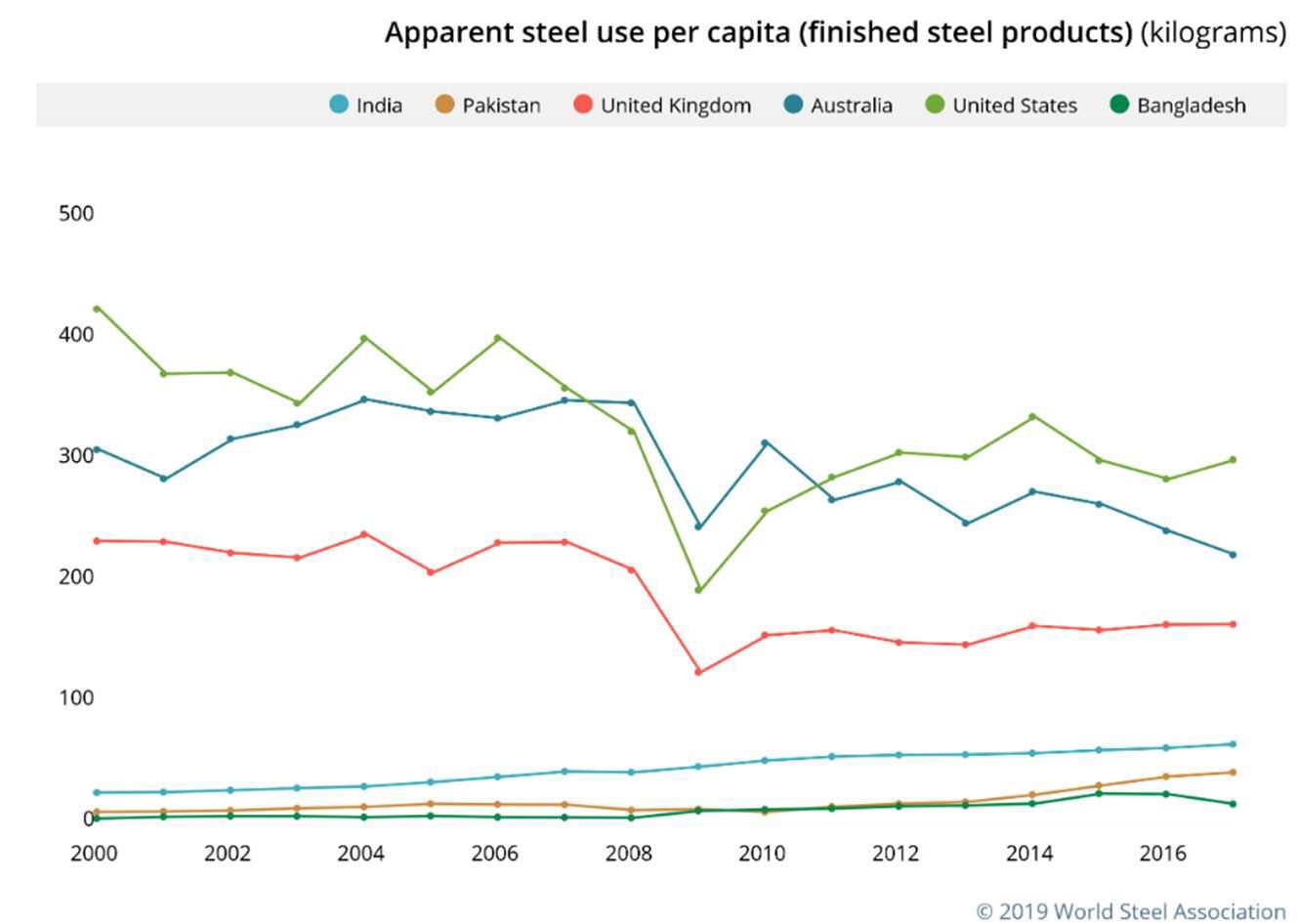
Although the per capita consumption of steel in Pakistan is quite low compared to the developed world, the use of pre-engineered steel structures for large scale industrial buildings has taken off since recent years. This is primarily pertaining to the economic benefits that come along with the use of steel particularly for large span buildings. However, in residential construction, use of steel is still a novelty or rather something unheard of in Pakistan as in other developing economies of the region.

Although the per capita consumption of steel in Pakistan is quite low compared to the developed world, the use of pre-engineered steel structures for large scale industrial buildings has taken off since recent years..

Light gauge steel, also known as cold formed steel is a tried and tested construction material used in developed countries such as UK and Australia since decades. The technology involves use of off-site prefabricated panels made of steel studs that are ready to be assembled once they reach site. This enables manufacturers to standardize structural elements such as walls, floors etc. and achieve economies of scale while increasing productivity. With its innate properties such as a high strength to weight ratio, non-combustibility, termite resistance and cost effectiveness, Steel appears to be a good antidote to the very high design, construction and maintenance costs associated with the traditional brick and mortar structures. The use of light gauge steel can cut build times by up to 30 percent that can lead to indirect financial savings.

The realization that cold formed steel is the answer to growing need for efficient, safe and cost effective housing units in cities has led to an increase in popularity among professionals related to the construction industry. In October last year, the Indian Institute of Technology Hyderabad organized a workshop on ‘Affordable housing for all’ where experts spoke about the need to promote steel as a sustainable alternative to conventional construction practices. Emphasis was laid on the importance of light gauge steel for cost reduction and the positive impacts of its use on the environment. While there is an infinite potential to harness these properties to address the issue of affordable housing in emerging economies, there are certain barriers that need to be overcome first.


Challenges Unique To Emerging Economies

While countries worldwide are adopting different approaches to address the issue of affordable housing, there are challenges unique to emerging economies that intensify the severity of the crises. The governments of emerging economies find themselves financially and logistically incapable to do so much in so little time, they cannot deal with the crises on their own. If private sector can come up with innovative solutions, we can hope to address the issue through public private partnerships. However, for the technology to appear promising to private sector entrepreneurs, it needs to be accepted by the public.

The barriers to public acceptance of new technologies and materials particularly in the construction sector are more cultural and social rather than economic. It is an established fact that the mere availability of technology isn’t enough to motivate people to embrace it. This is despite the fact that there might be a substantial monetary benefit to gain from it. Since time immemorial, brick and mortar structures are the pre dominant way of housing construction here in the developing world. People have no patience with fancy materials that are contradictory to their previous ways of living. For them, building a house means making a once in a lifetime investment and they are certainly not prepared to risk it by adopting an approach different from their forefathers and better off peers. One reason behind the success of steel in the industrial sector is that instead of general population, the end users happen to be well informed national and multinational co operations competing with each other to give best value to their customers while keeping expenditure at bare minimum. With obvious benefits, steel is the material of choice.

Figure 3


This issue is further augmented by the presence of Institutional voids. A term coined by Harvard University professors Tarun Khanna and Krishna G. Palepu in their article which refers to the absence of credible intermediary institutions, regulatory systems, accessible while dependable sources of communication, redress and contract enforcement mechanisms that are essential for businesses to operate and thrive and are often taken for granted in the developed world. This coupled with turbulent market conditions provides poor ground for profits especially for tech based firms. It boils down to the absence of one fundamental element that is vital for businesses to thrive, a relationship of trust between prospective buyers and sellers.


The Way Forward

While Governments of developing countries are inevitably going to rely on the private sector to address this issue, policy makers need to draft policies to create conditions that will encourage entrepreneurs to venture in the field of new technologies. Priority should be given to institution building to make it easier for people to do business in the country.

On part of the entrepreneurs, they need to finds ways around the barriers that might exist. There is a need to understand that in emerging economies, people have well defined norms which they seldom deviate from and before technology can become useable, a whole bunch of stuff has to happen. This basic understanding of the functioning of a society is often what distinguishes a successful entrepreneur from an unsuccessful one. The key lies in adopting a business strategy and planning that is tailored to the underlying conditions of a particular economy. For now, increasing awareness among people about potential benefits of new technologies particularly steel construction can help pave the way.

There are many socioeconomic benefits that come along with a well-managed urbanization, with that being said if entrepreneurs can come up with a way to develop the adoptive and absorptive capacity of emerging markets while addressing the functional fixedness of the society, it would be – as Neil Armstrong said when he first set foot on the moon – “One small step for man, one giant leap for mankind”

About the Author

Akbar Imran Butt is a civil engineer by profession who is working in the industrial steel buildings sector for the past few years in Pakistan. Apart from being a steel enthusiast, his research interests include entrepreneurship and use of technology to solve real world problems. He can be reached at: [email protected]

The Climate Crisis Dilemma

(Photo: Robdownunder/Flickr)

By Graham Vanbergen

The climate crisis is now changing global finance – Graham Vanbergen asks the question do we want to pay for it now – or pay for it later.

In 2019, analysis found that the world’s largest investment banks provided more than $700bn of financing for the fossil fuel companies that were most aggressively expanding into new coal, oil and gas projects since the Paris (climate) Agreement in 2016.

Thirty-three powerful financial institutions have, between them provided an estimated total of $1.9tn to the fossil fuel sector between 2016 and 2018. For context, this is enough money to eradicate global poverty for a decade.

And one of the most prominent of those financiers has been led by the Wall Street giant JPMorgan Chase. It provided $75bn (67bn Euro) to companies expanding in energy sectors such as fracking and Arctic oil and gas exploration. But Barclays, one of the most heavily invested, has provided $85bn (£65bn) of funding to fossil fuel firms and carbon-intensive projects. 


Wind of change

In January, Barclays was formally challenged by some of its shareholders to stop financing fossil fuel companies that are driving the climate crisis, in the first resolution of its kind filed against a European bank.1

Eleven pension funds managing £130bn have filed the motion calling on Barclays to bring its activities into line with the Paris Agreement.

This is just the start of the ‘uncoupling’ of big finance and the fossil fuel industry. 

Mark Carney, the outgoing Governor of the Bank of England recently said — financial firms had been too slow to reduce investment in fossil fuels and warned that many assets were at risk of being rendered “worthless” by the climate crisis. In December, the Bank of England then became the first central bank in the world to announce what it terms a banking stress test on climate change. If, for instance, a British bank loans money to a company building a coal-fired power plant, the BoE will require the bank concerned to hold a substantial amount of additional capital to cover the risks of the project being abandoned because of new regulations or other climate change-related factors.2

In the same way, if an insurance company has granted cover to houses on a flood plain, or to coastal properties which could be subject to rises in sea level, or mortgages granted on them — additional money needs to be set aside.  

Echoing BoE warnings — environmental concerns dominated long-term global risks for business leaders, investors and policy-makers at Davos for the first time. Its annual risks survey put climate and other other environmental threats ahead of risks posed by geopolitical tensions and cyberattacks. Even its 81-year-old founder Klaus Schwab, said the world is facing “a state of emergency”.

After more than a year of grim scientific projections, environmental disasters and growing activism, world leaders and the public alike are increasingly recognising the severity and urgency of the climate crisis. Tipping the scales are organisations like Extinction Rebellion (XR), the fastest-growing political pressure group in the world and climate activist rockstars such as Greta Thunberg.


Climate change counterweight

However, weighing heavily on the side of fossil fuel use is a global population that continues to grow. A population the size of Germany (80m or 1.1% pa) is added each year to our planet – putting even more pressure on energy resources. And research shows that we are on track to produce 120% more fossil fuels in 2030 than in 2020. At the same time, a recent survey found that climate breakdown is viewed as the most important issue facing the world, ahead of migration, terrorism and the global economy, in seven out of the eight countries surveyed. 

This is the dilemma. Do we kill the patient before coming up with a cure — or die waiting for it.

XR’s motives are seemingly moral and justified. But climate pressure groups are more likely to galvanise investor-led change if they acknowledge the bitter truth. As the FT recently remarked — “Without fossil fuel energy — societal collapse and mass death is equally likely to occur if fossil-fuel producers are deprived of financing too quickly.” And here’s another truth — the global energy consumption trend is very closely aligned with global GDP growth and renewables simply can’t keep up. Worse still is that the climate crisis problem will never be resolved with existing renewable technology. Therefore, the real crisis to human existence is that even doing too much could lead to global societal collapse.

This is the dilemma. Do we kill the patient before coming up with a cure — or die waiting for it. From the competing predicament posed by fossil fuel use and the climate crisis, global economic losses from a rise in temperatures of 4 degrees celsius, the current trajectory, has been estimated at $23 trillion per year. Again, for context, this staggering number is twelve times current global military defence spending.3


Physical risk to financial risk

Inevitably, this asset-cum-environmental catastrophe will soon pose two kinds of risks to the financial system: physical risk from natural disasters, and financial risks from transitioning away from fossil fuels.

Even if every country were to fulfil their current emissions reduction pledges from the Paris Agreement, we are still heading for a 3.2c increase in global temperatures. This is double the threshold before the climate crisis becomes a daily crisis for millions with trillions needed to be spent combating it.

According to the International Energy Agency, a third of the Earth’s electricity will come from renewables by 2024 (a surge by 50% globally in the next five years) – but we will still be “well short” of what’s required to meet anything like the targets set.

While nations are quickly adopting solar and wind, the IEA said coal is still expected to be the largest source of power globally in 2024. However, China is expected to overtake the EU as early as 2021 as the leader in solar panel use.

It’s worth remembering that at least 16 insurance companies were bankrupted after Hurricane Andrew hit the USA in 1992 because they didn’t anticipate the magnitude of the damage.

While the physical risks are calculable, it’s worth remembering that at least 16 insurance companies were bankrupted after Hurricane Andrew hit the USA in 1992 because they didn’t anticipate the magnitude of the damage. And mother nature has more lessons to teach us for our global indifference to her needs.

When Hurricane Dorian hit the Bahamas (population 395,000) last year, it was the worst natural disaster in that country’s history and is expected to cost $4bn ($10,125 per person) in insurance payouts. But this is dwarfed by the Australian bushfires. As at mid-January, economist John Quiggin at the University of Queensland put the total (tangible) cost at $100 billion, the costliest natural disaster in its history. Like Hurricane Andrew – both disasters were anticipated, the scale of them was not.

Columbia professor Adam Tooze estimated last year that of the total equity and fixed income assets in the world, as much as one-third are exposed as carbon-sensitive, and investors have increased their holdings in these assets significantly over the past three years. Potential losses from the value of carbon-sensitive assets are now estimated to be valued at $18 trillion.4 Whatever happens, the transition either now or when it’s too late will be painful and extremely costly. One could argue, not as costly as the loss of human life, but reality tells us that won’t win the debate. Part of the problem is that what we are facing is unknown and therefore its calculations are estimates, not foregone conclusions, which fuels the rhetoric of the climate science deniers.

World leaders and financial regulators can play a significant role in protecting the planet by helping to provide a workable solution in preventing systemic risk. In so doing, the transition to renewables would be quicker and ultimately less painful.

The question is, do we want to pay for it now – or pay for it later?

About the Author

Graham Vanbergen is the founder and contributing editor of
TruePublica.org.uk and author of Brexit – A Corporate Coup D’état.


References
1 https://www.theguardian.com/environment/2019/oct/13/top-investment-banks-lending-billions-extract-fossil-fuels
2 https://truepublica.org.uk/united-kingdom/world-first-bank-of-england-unveils-climate-stress-test-to-banks-and-insurance-companies/
3 https://www.independent.co.uk/news/business/news/barclays-bank-shareholder-climate-change-resolution-fossil-fuels-a9275926.html
4 https://prospect.org/environment/the-biggest-threat-to-financial-stability-is-the-climate/

EDITOR'S PICK OF THE WEEK

China economic growth

China’s Challenging Search for a New Model of Economic Growth

By Danny Leipziger China cannot continue to rely on exports to drive its growth, but what are the alternatives? China ran a $1.2 trillion trade surplus last year, and despite admonitions from the IMF to rely...

WISE DECISION MAKER GUIDE

POWER INFLUENCERS

Emerging Trends

The Future of Global Trade