Home Blog Page 99

Your CRM Marketing Just Got a Whole Better With This Video Platform

In today’s digital landscape, integrating personalized video content into Customer Relationship Management (CRM) systems has become a game-changer for businesses aiming to enhance customer engagement and drive conversions. One platform leading this transformation is Blings, which offers real-time personalized, interactive videos that seamlessly integrate with existing CRM systems.

The Power of Video in CRM

Video content has proven to be a powerful tool in marketing and sales strategies. According to Clum Creative, using the word “video” in an email subject line can boost open rates by 19%, increase click-through rates by 65%, and reduce unsubscribe rates by 26%.

Additionally, adding a product video on landing pages can increase conversions by 80%. It can also increase the time people spend on your page, allowing the brand message to sink in. After all, videos are effective in explaining complex ideas, particularly with new product launches. They can get your message across faster than having the consumer read in the same amount of time.

Blings’ MP5 Technology: Revolutionizing Video Content

Blings has developed proprietary MP5 technology that redefines video content creation and delivery. Unlike traditional static videos, MP5 treats video as dynamic code, allowing for real-time rendering and personalization based on viewer data. This means each viewer experiences a uniquely tailored video, enhancing engagement and relevance.

The efficiency of MP5 technology is notable. Videos are incredibly lightweight, at just 60kb. This ensures quick load times and seamless playback across all devices, making it particularly advantageous for mobile users who often face bandwidth limitations.

Seamless CRM Integration

One of Blings’ standout features is its ability to integrate effortlessly with existing CRM systems. The platform offers quick integration, allowing businesses to embed videos into their CRM in under five minutes. This seamless integration ensures personalized video content consistently aligns with customer data, enabling more targeted and effective communication.

Enhancing Customer Engagement and Conversion

Personalized interactive videos have been shown to significantly boost customer engagement. For instance, brands using Blings’ technology have reported an 8.5x increase in customer engagement and a 4x uplift in conversion rates. These interactive elements transform passive viewers into active participants, fostering a deeper connection with the brand.

Several global brands have leveraged Blings’ technology to achieve remarkable results:

  • McDonald’s achieved a 4.2x increase in sales by utilizing personalized promotional videos within its app.
  • Live Nation achieved an 83% engagement rate by incorporating Blings-powered videos into their marketing campaigns.
  • With their personalized, interactive World Cup-themed video campaign, WPP got an impressive 46% click-through rate. They also have plans to expand in the future.

Beyond sales and engagement, businesses also use Blings for customer support, onboarding, and loyalty programs. By incorporating personalized video messages, brands can humanize their interactions and make customers feel more valued and understood. This is particularly crucial in industries such as finance, healthcare, and e-commerce, where clear communication and trust-building are essential.

Security and Compliance

In an era where data privacy is paramount, Blings ensures videos are rendered securely on the user’s device, with no exposure to personal identifiable information to the platform. Blings is fully GDPR and CCPA-compliant, providing businesses with peace of mind regarding data protection.

Why Blings is the Future of CRM Video Integration

Integrating Blings into your CRM system can significantly enhance customer engagement and drive conversions through personalized interactive videos. The platform’s seamless integration, real-time personalization, and robust security features make it a valuable addition to any business looking to elevate its customer relationship strategies.

With digital interactions becoming the norm, adopting a video-first approach can help brands stay ahead in an increasingly competitive market. 

India at a Crossroads: Trade Reforms or Protectionism in the Face of Trump’s Tariff War?

 India has historically turned to economic reforms in times of crisis—most notably in 1991 when it embraced liberalization to overcome a financial meltdown. Now, as U.S. President Donald Trump’s trade war reshapes global commerce, the world’s fifth-largest economy faces a pivotal choice: deepen its integration with global markets or retreat further into protectionism.

Trump has repeatedly labeled India the “tariff king,” pointing to its 12% average tariff—one of the highest globally. By contrast, the U.S., China, and Japan maintain significantly lower rates. High tariffs raise costs for businesses and consumers alike, limiting India’s ability to compete on the world stage. Despite an expanding export sector, India’s global trade share remains a mere 1.5%, underscoring the urgency for change.

Recent moves by Prime Minister Narendra Modi’s government suggest a shift. In a bid to ease trade tensions, India has reduced tariffs on select U.S. goods and engaged in trade talks with Washington. Commerce Minister Piyush Goyal has urged Indian exporters to shed their protectionist mindset, while India actively negotiates free trade agreements with the U.K., the European Union, and New Zealand.

A surprising development has emerged in the telecom sector, with Reliance Jio and Bharti Airtel partnering with Trump ally Elon Musk’s SpaceX to introduce Starlink satellite internet in India. This unexpected alliance signals potential shifts in trade and technology collaborations.

Yet, challenges persist. Critics argue that protectionist policies have hindered Modi’s Make in India initiative, limiting industrial competitiveness. Reducing tariffs could make India a key hub in global supply chains, but experts caution against risks like market dumping—especially from China.

As global trade dynamics evolve, India has a rare opportunity to position itself as a leader in a re-globalized world. Whether it seizes this moment or remains tethered to protectionism will define its economic trajectory for years to come.

Related Readings:

Tlcan flags

economic tariffs trade war with tax barrier between United States of America and China.

USA and China trade war economy recession conflict tax business finance to worldwide

Challenges and Opportunities as AI Impacts and Transforms the BPO Industry in Philippines

The Philippine Business Process Outsourcing (BPO) industry employs about 1.7 million people and generated nearly US$38 billion in revenue in 2024. It contributes 8.5% to the country’s GDP, representing one of the most reliable drivers of national progress. These figures do not include freelancers who provide services via platforms like Freelancer.com, Remotasks, UpWork, and Fiverr – up to 1.5 million Filipinos are registered on international online platforms for freelancing services.

Yet the growing use of artificial intelligence (AI) technologies is rapidly transforming employment in this dynamic industry. Many BPO workers are at risk of job loss as AI increasingly automates customer support tasks, including individuals who perform voice-based services and write social media and market content. 

AI tools can now engage with customers worldwide without language barriers, thus diminishing companies’ plans for outsourcing their services to any single country. That will be especially the case if businesses in higher-income countries choose to invest in AI solutions instead of continuing to outsource services to humans abroad.

Business process outsourcing (BPO) has been one of the most dynamic sectors of the Philippine economy over the past 25 years – 1.82 million Filipinos employed nationwide, with the sector outpacing the global outsourcing average of 3.5% by achieving 7% growth in 2024 -. By tapping into a large pool of English-speaking college graduates and having an affinity with the United States and its culture, the Philippines has become a leading beneficiary of international subcontracting of certain business functions to overseas vendors. 

Today, US firms and companies around the world rely on Philippines-based workers to perform voice and non-voice services such as data entry and analysis, customer service, document transcription, IT support, fulfilment of e-commerce orders, software development, sales and marketing, game development, payment processing, accounting, and other tasks, including creative services and design. Among the sectors that outsource activities to the Philippine BPO industry are IT, health care, legal, and finance. Hundreds of BPO companies operate in Metro Manila, Cebu City, and other Philippine urban centres like Clark, Davao, and Iloilo

However, rapidly emerging AI-driven technologies, including virtual assistants, chatbots, and automated customer service platforms, have begun to take over tasks previously handled by humans, especially for routine customer inquiries and screening and directing customers’ calls. Indeed, the rapid adoption of chatbots to answer common questions threatens to suppress demand for entry-level customer service representatives. New technologies are being quickly adopted to improve efficiency, consistency, and quality while simultaneously lowering costs. Even companies that prioritize a human touch are forced to use the tech to satisfy clients who are demanding greater automation.

Transforming Jobs

It estimates that the number of BPO industry jobs in the country will actually increase by 1.1 million between the end of 2023 and 2028. While AI has been displacing workers in the Philippines and in other countries — it has also created new employment opportunities. People continue to be needed to perform tasks like classifying content, coding, data editing, strategy and annotating.

As routine tasks are automated, the need for advanced technical skills — such as programming, managing, and maintaining AI systems — is growing. The Philippines’ BPO industry has historically prioritized a workforce with strong communication abilities over technical expertise. However, the transition to AI demands workers skilled in data analytics, machine learning, and AI system management.

For instance, BPO firms can use machine learning algorithms to automate many of their repetitive tasks to free up human workers to do higher-value operations. They can also leverage AI to produce insights and accurate data analyses.

BPO companies can also use AI to improve processes already there, and accurately predict customer needs and trends, giving business leaders the opportunity to make well-informed decisions. These insights also allow companies to improve their recruitment and training strategies.

Individuals are also being employed to differentiate objects and living beings in videos that are used to formulate the algorithms for autonomous driving and to label images so that AI can, for example, generate representations of public figures. Technological solutions are not infallible, and many require — or at least benefit from — human involvement. For example, AI can be used to analyze large amounts of data quickly, providing initial insights that help BPO workers resolve complex customer issues more efficiently. 

Need for Policy

For the industry to comprehensively adapt to the coming wave of AI innovation, government and industry leaders need to co-operate to develop policies and practices that boost investment in AI education and training. Such collaboration is also important for nurturing opportunities that arise through a human-AI hybrid approach, which could help mitigate the negative impacts of AI on employment. 

The CCAP, a non-profit organisation consisting of more than a hundred local BPO firms, has been a strong supporter of AI integration in the Philippines. The group recently reiterated its stance that generative AI can benefit not only contact centres but other IT-BPM companies as well.

Since 86% of Filipino white-collar workers already use AI to “boost productivity, efficiency and creativity,” according to the 2024 Work Trend Index created by LinkedIn and Microsoft; advanced language, emotional recognition, and generative AI tools have made work more demanding for BPO workers, and outsourcing clients are requiring more automation and AI integration in workflows, the chances for AI technology to become a contribution to the BPO force rather that a constrain are greater than ever.

Conclusion

AI represents both a challenge and an opportunity for the Philippine BPO industry. The automation of routine tasks, cost-efficiency of AI, and changing skill demands pose significant risks to the industry and those employed within it. However, by investing in upskilling, embracing AI as a complementary tool, and adopting policies that foster innovation, the industry can adapt and continue to thrive in the future. 

AI technologies allow agents to concentrate on more important tasks such as completing complex transactions. This would result in better productivity, as well as a much more positive experience for both workers and customers.

Yet policies that encourage investment in AI education and training could help mitigate the negative impacts of automation. Additionally, fostering partnerships between educational institutions, private companies, and the government to develop AI-related curricula could help equip the workforce with the necessary skills to thrive in the evolving job market.

The key lies in being proactive, adaptable, and forward-thinking, ensuring that the Philippines remains a global leader in outsourcing services in an AI-driven world. Thinking more ambitiously, there is even potential for the Philippines to position itself as a hub for AI services, providing expertise in AI management, data annotation, and machine learning model training.

From Concept to Completion: The House Flipping Process Explained

The allure of house flipping lies in the potential to buy low, sell high, and earn significant returns on investment. It’s a journey from a simple concept, through a well-planned renovation, to a profitable completion. But the road to a successful flip is paved with research, planning, and execution of key strategies that hinge on market knowledge and financial acumen. For those curious about this lucrative yet challenging venture, gaining an understanding of the entire process is crucial. Keep reading to uncover the key phases and best practices in flipping a property from the ground up.

Renovation and Remodeling: Maximizing Property Value

Renovation and remodeling are where a flipper can truly make their mark and add value to a property. Effective planning and a clear understanding of what adds value, versus what constitutes unnecessary spending, are paramount. Prioritizing renovations that increase curb appeal and structural integrity, like updating the kitchen and bathrooms, can offer a significant return on investment.

It’s also essential to manage the renovation process effectively, ensuring quality work is done while keeping costs within budget. Hiring reliable contractors and closely monitoring their work can help prevent costly mistakes. For example, tackling significant structural issues, like foundation repairs, first can avoid redoing cosmetic improvements later on due to unforeseen issues.

For those working in the Cherry Hill area, coordinating with services like junk removal in Cherry Hill, NJ can greatly facilitate the cleanup and preparation of a property for renovation or eventual sale. A clear space allows for more accurate renovation planning, faster work, and a more appealing home presentation.

Selling the Flip: Marketing and Closing the Deal Successfully

After the renovation work is completed, the focus shifts to selling the property – the most exhilarating stage of house flipping. Effective marketing strategies can greatly enhance visibility and appeal to potential buyers. High-quality photographs, virtual tours, and strategic online listings are just a few ways to showcase the newly renovated property.

Properly pricing the home is another critical step. A price that’s too high can prolong the period the home remains unsold, while a price that’s too low can erode profits. Conducting a comparative market analysis and possibly working with a real estate agent who has in-depth knowledge of the local market can assist in setting a competitive price point.

Throughout the final stages of sealing the deal, it’s also important to have strong partners to ensure a smooth closing process. Partnering with reputable companies like Beaver Heating & Air in Yuba City CA can ensure any HVAC systems in the flipped properties are well-maintained and functioning optimally, which can be a significant selling point.

Crafting a Strategic Plan for Your House Flipping Project

Successful flipping entails far more than just buying a property and making superficial changes. It requires a comprehensive strategic plan that addresses budgeting, timeline, renovation scope, and resale tactics. The plan must be grounded in realistic expectations and informed by a thorough market analysis to ensure the final product will be desirable to buyers.

Developing a budget is one of the first and most critical steps when planning a flip. This budget should account for the purchase price, renovation costs, holding costs, and unexpected expenses. Being meticulous in this step can prevent cost overruns that could potentially derail the entire project.

Timeline management is another key component. Efficient scheduling of contractors, material delivery, and permitting processes can greatly influence the success of a flip. Delays can increase holding costs and may cause investors to miss the optimal selling window, thereby affecting the profitability of the project.

Financing Your Flip: Options and Strategies for Investors

Funding a house flip can be achieved through a variety of means, each with its own advantages and considerations. Traditional financing through banks may be ideal for those with excellent credit and the ability to navigate longer approval processes. However, for many flippers, alternative sources of funding like hard money lenders or cash investors may be more appropriate.

Hard money loans are a popular choice due to their quick approval times and asset-based nature, allowing investors to obtain funds based on the property’s potential value post-renovation. However, these loans typically come with higher interest rates and shorter repayment terms, which can add to the overall cost of the flip.

Altogether, house flipping can be a profitable real estate investment strategy when executed with careful planning, detailed budgeting, and a clear understanding of market dynamics. Overall, success in flipping requires a mix of savvy investment strategies, a keen eye for potential, and the ability to navigate the renovation and sales processes with finesse.

Generative AI Isn’t Intimidating When You Learn It This Way

By Dr. Gleb Tsipursky

Peer mentoring is a transformative strategy that can revolutionize how organizations embrace generative AI  (Gen AI). By leveraging the power of personal connections and shared expertise, peer mentoring accelerates learning, fosters collaboration, and fuels innovation. In today’s fast-paced business environment, where the mastery of Gen AI tools can mean the difference between staying competitive and falling behind, this approach is nothing short of essential.

The Human Element of Embracing Gen AI

Generative AI tools promise efficiency, creativity, and transformative possibilities, but for many employees, navigating these tools can feel daunting. That’s where peer mentoring steps in, offering a bridge between uncertainty and confidence. When employees learn directly from colleagues who have already mastered Gen AI, they gain not just technical know-how but also context-specific insights tailored to their unique roles.

Imagine being guided through a new tool by someone who understands the nuances of your workload, rather than sitting through a generic training webinar. Peer mentors personalize the learning process, breaking down complex concepts and demonstrating their application in real-world scenarios. This one-on-one guidance makes Gen AI tools more accessible and, importantly, more relatable, while managing risks.

Empowering Early Adopters as Mentors to Embrace Gen AI

Organizations often underestimate the goldmine of talent within their own ranks. Early adopters of Gen AI—those employees who have enthusiastically embraced these tools to enhance tasks like coding, content creation, and data analysis—are an invaluable resource. Peer mentoring programs tap into this resource, positioning these employees as mentors who guide their colleagues toward Gen AI proficiency.

Peer mentoring programs tap into this resource, positioning these employees as mentors who guide their colleagues toward Gen AI proficiency.

Take, for example, one of my clients, a mid-sized professional services company whose leadership I helped recognize its Gen AI-savvy employees as catalysts for broader adoption. These early adopters, once scattered across departments, were brought together under a structured peer mentoring program. Their mission? To mentor colleagues eager to learn Gen AI tools but unsure where to start. This deliberate approach ensured the company didn’t just rely on scattered pockets of expertise but actively spread that knowledge across teams.

Building Bridges Through Tailored Learning for Embracing Gen AI

The beauty of peer mentoring lies in its flexibility and relevance. Unlike traditional training methods, which often feel detached from day-to-day responsibilities, peer mentoring sessions are tailored to the specific needs of mentees. For example, an employee in marketing might focus on content creation and effective Gen AI prompting, while a colleague in engineering could delve into coding automation.

This tailored approach was a hallmark of the aforementioned professional service company’s program. Mentors shared the practical tips and tricks they had discovered, demonstrated advanced techniques, and even helped troubleshoot challenges mentees encountered. Group workshops further amplified this knowledge-sharing, allowing mentors to showcase their expertise to a broader audience while building confidence among mentees.

A Win-Win for Mentors and Mentees

Peer mentoring doesn’t just benefit those learning Gen AI; it’s equally rewarding for the mentors. Early adopters gain recognition for their expertise, boosting their professional visibility and pride in their contributions. Mentors also develop their leadership and communication skills, positioning themselves as thought leaders within the organization.

Meanwhile, mentees experience an equally significant transformation. Armed with hands-on guidance and personalized support, they become more confident in their abilities to leverage Gen AI tools effectively. This confidence translates into tangible improvements in productivity and innovation, as employees feel empowered to experiment, iterate, and innovate.

The Ripple Effect on Workplace Culture

The impact of peer mentoring extends far beyond individual skill development—it transforms organizational culture. Over the course of a 12-month peer mentoring initiative, the professional service company observed a noticeable shift: employees not only became more proficient with Gen AI tools but also more eager to share their newfound knowledge with others.

This knowledge-sharing created a ripple effect, fostering a culture of collaboration and continuous learning.

This knowledge-sharing created a ripple effect, fostering a culture of collaboration and continuous learning. Employees across departments connected over shared experiences, strengthening professional relationships and breaking down silos. The workplace evolved into a vibrant hub of innovation, with employees actively seeking out new ways to integrate Gen AI into their workflows.

Real Results for Embracing Gen AI: Productivity, Quality, and Innovation

The results of the peer mentoring program were undeniable. Productivity soared as employees streamlined their workflows with Gen AI tools, completing tasks faster and with greater precision. The quality of work improved as employees applied advanced Gen AI techniques to tasks like content creation, data analysis, and client outreach. And perhaps most significantly, the organization’s culture shifted toward one of enthusiasm for learning and innovation.

Metrics underscored the program’s success. Teams using Gen AI reported significant time savings of over 25%, while cross-departmental collaborations increased by 30%. Employees consistently rated the program as one of the most impactful initiatives for their professional growth, with many noting that it demystified Gen AI and made it feel approachable.

Why Peer Mentoring Is the Future of Embracing Gen AI

As businesses navigate the rapid evolution of Gen AI, traditional training methods are proving insufficient. Peer mentoring offers a dynamic, scalable solution that not only accelerates learning but also strengthens the fabric of workplace relationships. By harnessing the expertise of early adopters and fostering a culture of collaboration, organizations can ensure that their employees are not just users of Gen AI tools but pioneers of innovation. In an era where technology often feels impersonal, peer mentoring injects a much-needed human touch into the learning process. And for organizations ready to embrace Gen AI, it can be one of the most powerful tools they have.

About the Author

Dr. Gleb TsipurskyDr. Gleb Tsipursky was named “Office Whisperer” by The New York Times for helping leaders overcome frustrations with Generative AI. He serves as the CEO of the future-of-work consultancy Disaster Avoidance Experts. Dr. Gleb wrote seven best-selling books, and his two most recent ones are Returning to the Office and Leading Hybrid and Remote Teams and ChatGPT for Leaders and Content Creators: Unlocking the Potential of Generative AI. His cutting-edge thought leadership was featured in over 650 articles and 550 interviews in Harvard Business Review, Inc. Magazine, USA Today, CBS News, Fox News, Time, Business Insider, Fortune, The New York Times, and elsewhere. His writing was translated into Chinese, Spanish, Russian, Polish, Korean, French, Vietnamese, German, and other languages. His expertise comes from over 20 years of consulting, coaching, and speaking and training for Fortune 500 companies from Aflac to Xerox. It also comes from over 15 years in academia as a behavioral scientist, with 8 years as a lecturer at UNC-Chapel Hill and 7 years as a professor at Ohio State. A proud Ukrainian American, Dr. Gleb lives in Columbus, Ohio.

The Drug Crisis Duterte Inherited

By Dan Steinbock         

With the deportation of former President Duterte, the Philippines seems to be moving toward increasing political instability and economic uncertainty.

On March 11, 2025, former Philippine president Rodrigo Duterte was arrested by the Philippine National Police and Interpol on the basis of an International Criminal Court (ICC) warrant charging him with crimes against humanity in connection with the Philippine drug war.

To Duterte’s critics, it was a day of triumph. To Duterte’s supporters, it was a day of infamy. In December 2023, President Marcos Jr vowed that his government would not cooperate with the ICC’s investigation into the previous administration’s war on drugs. As Marcos stated, “This government will not assist the ICC in any way, shape or form.” He added he would “continue to defend and assert the sovereignty of the Republic of the Philippines at all times.”

In international media, the full reversal has been commented mainly by Duterte’s old critics and the champions of the incumbent government, in line with their political interests.

What is missing is the coverage of the drug crisis Duterte inherited from President Benigno Aquino III. It was the proliferation of drugs and associated corruption and violence that paved the way to Duterte’s landslide triumph.

Drugs, syndicates and corruption

During the rule of President Aquino III until mid-2016, complacency with drug lords and narco politicians went hand in hand with the rise of hundreds of thousands of addicts, particularly in urban slums and poorer regions. Prior to his presidency, Duterte warned the Philippines was at risk of becoming a narco-state pledging that his government’s fight against illegal drugs would be relentless.

In his inaugural State of the Nation Address, Duterte said that data from the (PDEA) showed there had been 3 million drug addicts, which he said may have increased to 3.7 million. International media disputed some of the data. Reuters reported that half of the users favored milder drugs once in a year. But that still left some “860,000 who had consumed crystal meth, or shabu, the highly addictive stimulant widely blamed by officials for high crime rates and other social ills.”

Furthermore, these numbers continued to rise. And as the leaders of the poorer Filipino barangays knew only too well, the problem was severe, pressing and getting worse.

Due to its geographical location, international drug syndicates used the Philippines as a transit hub for the illegal drug trade. Some local syndicates and gangs were also involved in narcotics, seeking to export small amounts of illegal drugs to other countries, as Al Jazeera reported in its documentary “Filipino drug mules” in 2011.

Duterte took the drug problem seriously, as did most Filipinos whose neighborhoods had been invaded by drugs for more than a decade. During the period, the drug crisis was downplayed by the mainstream media and largely ignored by international media.

There certainly were no efforts to target Philippine political and military leaders who allegedly protected the narco-bosses.

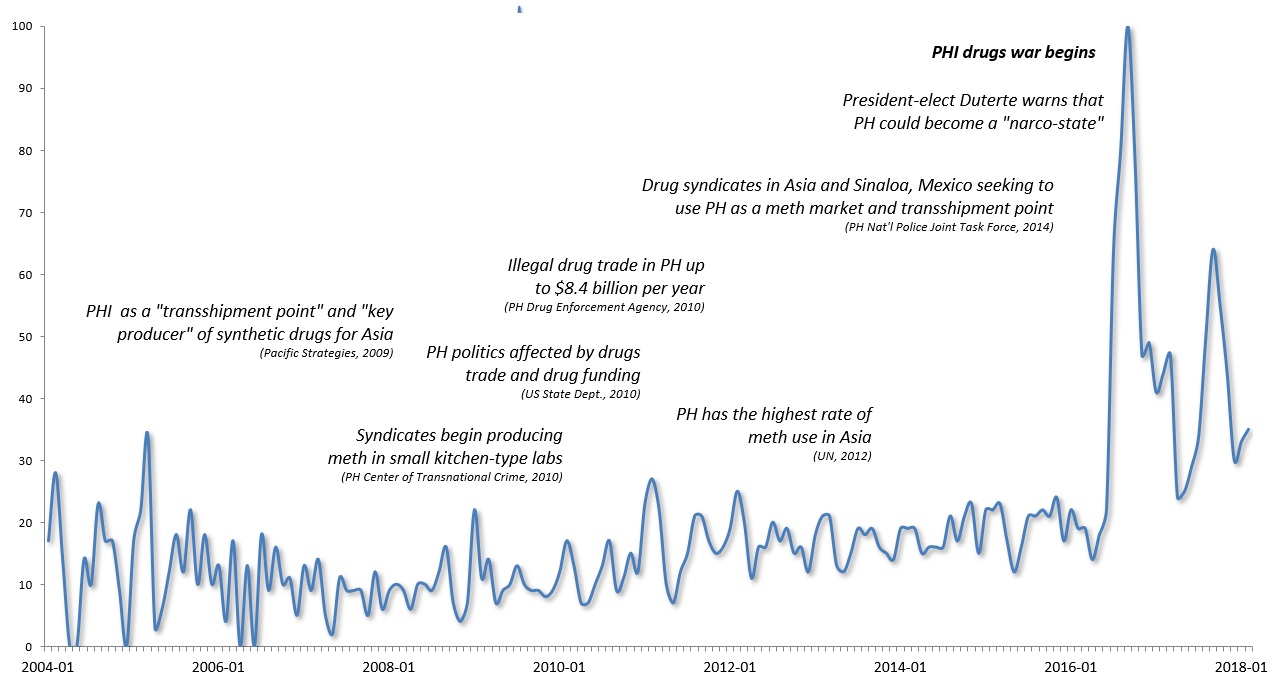
Yet, as a Google Trend search demonstrates, it was only when Duterte began the war against the drugs that critics awoke, as evidenced by soaring story mentions about the Philippines and drugs in international media, mainly in the US and Europe.

The long silence about Philippines drugs invasion until the Duterte Era

The long silence about Philippines drugs invasion until the Duterte Era
Sources: Google Trends; various Philippines, international, US and UN Sources

Under the watch of President Aquino and his Liberal Party (LP), drug syndicates began to produce meth in kitchen labs. It caused illegal drug trade to soar to $8 billion, according to the 2010 US International Narcotics Control Strategy report. US State Department warned that drug trade and funding was affecting Philippines politics, as corruption undermined the rule of law.

Drug syndicates in Asia and Sinaloa, Mexico, saw the Philippines’ transshipment potential. But these plans were derailed. In the 2016 election, Mar Roxas, former interior minister and ex-investment banker in Wall Street, was Aquino’s designated successor, but Duterte triumphed. As a net effect, LP suffered a meltdown.

During his campaign Duterte warned the Philippines was on the way of becoming a “narco-state,” whereas LP leaders accused him of inflating the problem. Ordinary Filipinos disagreed and voted accordingly.

Only days in the office, Duterte named five “narco-generals” believed to be protecting drug lords that allowed shabu (meth) sales to flourish during the Aquino era. Some of them had been linked with Roxas, who denied all ties with these generals.

Erosion of stability

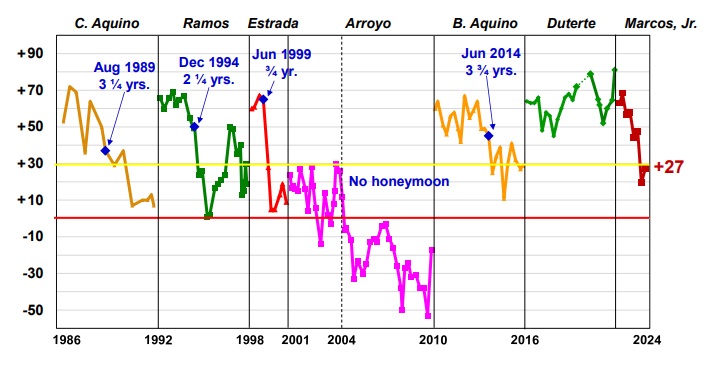
President Duterte began and ended his term with extraordinarily high ratings (80%), according to Philippines surveys). He remains very popular in the Philippines, particularly in his primary base in Davao and the south, but also across the nation. No other Philippine president since 1986 has managed to achieve equally high ratings. President Marcos’s current rating is far behind (19%) and has been falling ever since the government’s reverse course and political infighting at the expense of Filipinos’ daily economic and social concerns.

Net satisfaction ratings of Philippines presidents: 1986-2024

Net satisfaction ratings of Philippines presidents: 1986-2024
Source: Fourth Quarter 2024 Social Weather Report (Social Weather Stations, Philippines)

During his term, the Philippines “recalibrated” its foreign policy between the United States and China, seeking to cooperate with the former in security and fostering economic cooperation with the latter. As the promise of the Philippines as a large emerging economy was strengthened, peace and stability fostered economic growth and development. After the pandemic years, a strong recovery remained viable.

These were the objectives that the incumbent government vowed to build upon starting in 2022. But ask ordinary Filipinos today, “are you doing better economically?” or “are you more secure than before?” and the response is a subdued sigh or a bitter smile.

With the eclipse of the recalibration in foreign affairs, the Philippines now has more rotating foreign military bases than ever before. Despite the ongoing battle over controversial budget items, arms imports are booming. With the consequent tensions and instability, the country’s economic promise appears to be dimming.

Those Filipinos who saw Duterte as a representative of popular masses are angry, disappointed and feel betrayed. That’s what happens when the internal battles of the political class and their economic financiers ignore the legitimate economic and social concerns – particularly social ills – of the people.

The original commentary was published by The Manila Times on March 17, 2025.

About the Author

DDr Dan Steinbockr. Dan Steinbock is an internationally recognized strategist of the multipolar world and the founder of Difference Group. He has served at the India, China and America Institute (USA), Shanghai Institutes for International Studies (China) and the EU Center (Singapore). For more, see https://www.differencegroup.net

Rising Temperatures, Rising Stakes: How Climate Change is Reshaping Greenland

For Karl Sandgreen, the changes in his hometown have been stark. “Everything changed after 1997,” says the 45-year-old director of the Icefjord Centre. Once, sea ice covered the bay until early summer. Now, it vanishes far earlier, a visible sign of the accelerating climate crisis gripping Greenland.

The Arctic is warming nearly four times faster than the rest of the world, and Ilulissat’s towering icebergs serve as both a warning and an economic opportunity. The Sermeq Kujalleq glacier, one of the most active in the world, has retreated by more than 40 kilometers since 1850, with the pace quickening since 2000.

For Greenlanders, climate change brings both hardship and new possibilities. Traditional hunters struggle as ice conditions become unpredictable, while fishermen catch more halibut using boats instead of sled dogs. Meanwhile, warming temperatures allow for local farming, reducing reliance on costly imports from Denmark.

Beyond local impacts, the retreating ice has global significance. Melting glaciers contribute to rising sea levels, but they also open up mineral-rich lands and navigable shipping routes. The number of ships crossing the Arctic has surged, and nations like China and the US are eyeing Greenland’s rare earth resources with growing interest.

“Greenland is like a sweet shop for rare earths,” says climate researcher Pelle Tejsner, highlighting the geopolitical race unfolding in the Arctic. As the ice melts, a new chapter begins—one of both climate peril and economic ambition.

Related Readings:

Greenland at a Crossroads

Plug, plant growing inside the light bulb and United States Flag

The Role of Fintech in Modern Wealth Management

By Paul Skidmore

Fintech has changed and continues to change how people manage their money. Now, with just a smartphone, anyone can save, invest and plan their finances. No need for a personal banker. No huge fees.

More people are turning to this way of managing their wealth. The global fintech market is said to be worth almost 400 billion USD and is set to reach 1,127 billion by 2032. Apps and online platforms make wealth management easier and more accessible.

Whether it’s AI-powered investing or using real-time budget tools, finances are changing. Let’s look in more detail at how fintech is making wealth management smarter, safer, and more convenient.

How Fintech Makes Wealth Management More Accessible

Fintech is making wealth management easier for everyone. No need for a financial advisor or a big bank account.

Apps and robo-advisors let people invest in a few taps. Many have low fees and automatic features to help users grow their money. AI-powered tools give personalized advice based on spending and saving habits.

For example, budgeting apps track expenses in real time. Investment platforms suggest stocks or funds based on risk levels. Everything is simple and user-friendly. More people can now take control of their finances—no expert knowledge needed.

Digital Payments Are Everywhere

I remember as a young girl, my mother would note down every transaction she made on her bank card in the back of her cheque book. At the end of the month, she’d check everything off and make sure everything was accounted for. In a generation, digital payments have made everything so much easier. You can pay with a tap, send money in an instant and double check your balance in less than one minute. This is a huge win for users who want things fast and secure.

Security and Transparency in Fintech

Fintech makes money management safer and more transparent. Strong encryption protects personal and financial data. Many platforms also use blockchain to keep transactions secure and trackable.

Real-time updates let users see exactly where their money is going. No hidden fees, no surprises. Banking and investment apps send instant alerts for transactions, withdrawals, or changes in account value.

Many industries rely on secure payment methods, including UK top online casinos. These platforms use advanced security measures to protect user funds and ensure smooth transactions. Fintech is bringing the same level of safety to everyday banking and investing.

The Future of Fintech in Wealth Management

Automation and AI-driven tools are making financial planning easier. In the future, we can expect further advancements. Robo-advisors will be even smarter. They’ll offer real-time investment advice telling us when to buy and sell.

Decentralised finance (DeFi) is also growing. And quickly too. Digital currencies and blockchain technology mean there are new ways to invest and transfer money. Cryptocurrencies are highly volatile; however, there is some uncertainty about the role they will play in financial stability and asset management. More people are exploring these options for greater control over their finances, but it’s not without risk.

Traditional banks aren’t ignoring changes. Many are launching their own fintech solutions, from AI-powered budgeting tools to instant mobile payments. As fintech keeps evolving, managing money will become even more seamless and accessible.

Final Thoughts on Wealth Management and Fintech

In summary, fintech is changing wealth management. It is now more accessible, secure, and efficient. With the further rise of automation, AI, and decentralised finance, the future of personal finance will be even better. Traditional banks are adapting, but fintech companies are leading the way. As technologies continue to evolve, managing wealth will become simpler and more personalised. Individuals are better able to take control of their financial future.

Red States Sideline Data, Push Office Mandates in Political Move

By Dr. Gleb Tsipursky

In a sweeping return-to-office (RTO) push, Republican-led states are rolling back flexible work policies for government employees, ignoring mounting evidence that remote and hybrid work models enhance efficiency and cut costs. Governors in Nebraska, Ohio, Oklahoma, and Wisconsin are issuing strict office mandates, aligning with the Trump-era federal RTO push—moves critics argue are more about political posturing than sound management.

Increasingly partisan debate over work location—one that has turned remote work into an ideological battleground rather than a productivity decision.

Nebraska’s Gov. Jim Pillen, for example, has mandated full-time in-office work, affecting nearly 2,250 state employees who had been working remotely or hybrid. The order has ignited a legal standoff over labor contracts, sparking backlash from state workers. “Who cares where our IT developers are sitting, as long as the work gets done?” asks Justin Hubly, executive director of the Nebraska Association of Public Employees, which represents over 8,000 workers. His frustration highlights a broader, increasingly partisan debate over work location—one that has turned remote work into an ideological battleground rather than a productivity decision.

Ohio’s Gov. Mike DeWine has implemented similar measures, while Oklahoma’s Gov. Kevin Stitt signed an executive order demanding full-time office attendance. In Wisconsin, Republican lawmakers, led by Speaker Robin Vos, have proposed reinstating pre-pandemic office levels, despite Democratic Gov. Tony Evers pledging to veto any such mandate.

Even Utah—once a trailblazer in remote work—has reversed course. Gov. Spencer Cox, who in 2019 dubbed himself a “televangelist for telework,” is rethinking the state’s flexible work policies. Though he once praised telework for saving taxpayer dollars and improving air quality, his recent comments suggest a shift in priorities, signaling that remote work, while valuable, requires careful management—a nuance that blunt-force RTO mandates fail to acknowledge.

Politics Over Performance

By prioritizing ideological purity over pragmatic governance, red state leaders are sidelining substantial evidence that remote work reduces expenses, improves employee retention, and enhances productivity. Instead of treating flexible work as a tool for efficiency, they’ve cast it as a front in the culture wars—risking long-term damage to government workforces.

Research overwhelmingly supports the benefits of remote work. The U.S. Office of Personnel Management (OPM) found that federal agencies saved millions in operational costs while maintaining or improving productivity with telework. Yet, despite these findings, several Republican governors are clinging to an outdated notion of workplace effectiveness, using executive orders to enforce full-time office attendance. Their goal appears less about optimizing performance and more about reviving a nostalgic vision of the workplace—one that aligns with broader conservative efforts to shrink government and weaken public-sector unions.

History suggests that rigid RTO mandates come with real costs. Even President Biden’s relatively moderate 2022 hybrid return-to-office policy—requiring federal employees to be in-office at least 60% of the time—triggered a spike in workforce attrition. A study led by Mark Ma at the University of Pittsburgh, using data from Revelio Labs, found that the policy led to a 26% increase in turnover among senior government employees and a 32% jump among highly skilled staff—a brain drain that disrupted key agencies.

Red-state RTO mandates are even stricter than Biden’s, raising the risk of replicating—and amplifying—this instability.

The Productivity Myth

Contrary to claims that remote employees are less efficient, a growing body of research demonstrates the opposite. A recent study by Alessandra Fenizia (George Washington University) and Tom Kirchmaier (London School of Economics) found that public-sector employees working remotely were 12% more productive than their in-office counterparts. Their research, based on extensive administrative data, attributed these gains to fewer distractions, reduced workplace interruptions, and greater focus.

hybrid models—where employees split time between home and office—proved especially effective, balancing individual productivity with periodic in-person collaboration.

The study also dispelled fears that remote employees lack accountability. Not only did they complete more tasks per day, but the quality of their work remained unchanged—debunking the notion that in-person oversight is necessary for effective performance. Moreover, hybrid models—where employees split time between home and office—proved especially effective, balancing individual productivity with periodic in-person collaboration.

Evidence-Based Policy or Political Theater?

Decisions about government work models should be guided by data, not ideology. The federal government’s experience with hybrid work mandates showed that even moderate office requirements can trigger damaging turnover. Meanwhile, international examples—such as the European Central Bank’s decision to extend its remote work policy for two more years—demonstrate that flexible models can sustain productivity while improving work-life balance.

Yet, in red states, the push for rigid office mandates appears driven by politics rather than performance. By dismissing the overwhelming evidence supporting remote and hybrid work, these leaders risk compromising government effectiveness in pursuit of a symbolic return to pre-pandemic norms.

Instead of using work location as a political cudgel, policymakers should adopt strategies that reflect modern workforce realities—prioritizing efficiency, cost savings, and employee retention over nostalgia-driven mandates.

About the Author

Dr. Gleb TsipurskyDr. Gleb Tsipursky was named “Office Whisperer” by The New York Times for helping leaders overcome frustrations with hybrid work and Generative AI. He serves as the CEO of the future-of-work consultancy Disaster Avoidance Experts. Dr. Gleb wrote seven best-selling books, and his two most recent ones are Returning to the Office and Leading Hybrid and Remote Teams and ChatGPT for Leaders and Content Creators: Unlocking the Potential of Generative AI. His cutting-edge thought leadership was featured in over 650 articles and 550 interviews in Harvard Business Review, Inc. Magazine, USA Today, CBS News, Fox News, Time, Business Insider, Fortune, The New York Times, and elsewhere. His writing was translated into Chinese, Spanish, Russian, Polish, Korean, French, Vietnamese, German, and other languages. His expertise comes from over 20 years of consulting, coaching, and speaking and training for Fortune 500 companies from Aflac to Xerox. It also comes from over 15 years in academia as a behavioral scientist, with 8 years as a lecturer at UNC-Chapel Hill and 7 years as a professor at Ohio State. A proud Ukrainian American, Dr. Gleb lives in Columbus, Ohio.

Inclusive Banking in 2025 – How AI is Closing the Gap for the Unbanked 

By Giovanni Oppenheim

Globally, approximately 1.4 billion adults remain unbanked, according to the World Bank. Many of these individuals lack access to financial services due to thin credit histories or systemic biases in traditional lending models. At the same time, according to a recent survey of 350 UK bank decision-makers in retail banking, AI is poised to become the most significant technological investment in the next two years, with applications ranging from credit decisioning to fraud prevention. So, where do these two worlds meet – what role does AI play in helping improve financial inclusion by serving unbanked and underbanked populations? 

The Inclusion Imperative 

In the UK, the Earnix banking survey showed that 59% of lenders identify rapidly changing consumer circumstances as their top challenge in pricing loans. AI-driven solutions offer a way forward by enabling banks to evaluate creditworthiness through alternative data, including utility payments, transaction histories, and digital footprints. 

By integrating these diverse data sources, AI systems can build a comprehensive financial profile for individuals who have been excluded from traditional banking systems. This capability supports personalised lending products that align with both regulatory requirements and consumer needs. 

AI and Consumer Duty 

At the same time, the Financial Conduct Authority’s (FCA) Consumer Duty regulatory framework has set a higher bar for financial services, requiring firms to deliver fair value, improve consumer understanding, and provide accessible products. AI plays a pivotal role in helping banks meet these demands. For instance, predictive analytics and automated underwriting can tailor loan terms to individual circumstances, ensuring fairness and transparency. 

Indeed, 35% of UK lenders have already adjusted their pricing strategies to align with Consumer Duty. AI-driven tools enable lenders to optimise pricing models while maintaining a clear audit trail, making compliance seamless and fostering consumer trust. 

Driving Financial Inclusion with AI 

AI-powered analytics are particularly impactful in expanding access to credit. Traditional credit scoring models often overlook individuals with irregular incomes, such as gig workers or recent immigrants. By contrast, machine learning algorithms can evaluate a broader range of factors, identifying patterns that indicate creditworthiness beyond standard metrics. 

For example, a self-employed individual with fluctuating monthly earnings might struggle to secure a loan under traditional criteria. AI can assess their spending and saving habits, enabling the bank to offer a personalised loan product that reflects the applicant’s true financial capacity. This approach not only widens access to credit but also strengthens customer relationships by addressing specific needs. 

Overcoming Challenges 

While AI offers enormous potential, its implementation must be carefully managed to ensure ethical and unbiased outcomes. Regulators in the UK and US are increasingly scrutinising AI systems to prevent discrimination and ensure transparency. Earnix’s research indicates that banks are prioritising explainable AI models to meet these standards, providing clear reasoning behind lending decisions to both regulators and consumers. 

In doing so, financial institutions can transform banking into a more inclusive and equitable system, ensuring that no one is left behind in the digital age.

About the Author

GiovanniFor over a decade, Giovanni Oppenheim, Director of Banking Solutions, Earnix, has headed up the delivery of analytics and implementations for global financial institutions at Earnix. Giovanni works with Tier 0-3 banks and global financial institutions as a trusted advisor and industry expert to define strategic requirements for Earnix products and accelerate adoption of advanced analytical capabilities in the realm of pricing and product personalization for both retail and commercial lenders. 

EDITOR'S PICK OF THE WEEK

CFO's new mandate. CFO explaining the presentation

The Performance and Transformation Orchestrator: The CFO’s New Mandate in the Age of AI

By Terence Tse CFOs are evolving into AI-driven transformation orchestrators, balancing finance, technology, and strategy while upskilling teams, managing risks, and driving measurable business value. A key insight from this year’s AI for CFOs event, organized...


WISE DECISION MAKER GUIDE

POWER INFLUENCERS

Emerging Trends

The Future of Global Trade