Home Blog Page 960

Reasons Why Payday Loans Are A Better Option

Payday loans have become increasingly popular nowadays. There are tons of lending companies that offer these short-term loans online. With these types of loans, you can get a reasonable amount of money to settle your needs. You’ll then be required to repay it once your next salary has been paid. This guide provides a deeper insight into payday loans and how you can benefit by making them your ultimate financial choice.

They’re Quick

Payday loan offer a quick way to get money. Most lenders will disburse money into your account within 1 to 2 hours of application approval. If you have pressing emergencies like car repairs, medical expenses, broken boilers, or rent to pay, these types of loans could be an excellent option for you.

The application process is simple and fast. Applicants can apply online and get their funds within a few hours.

They’re Convenient

The payday loan application has never been this easy. The process has been completely digitalized. You no longer need to leave the comfort of your home to get a loan. As long as you have access to the internet, you can easily apply for a payday loan. And once your request is approved, you can expect money to hit your account within a few hours. So, don’t get stressed. If you have any financial emergencies, consider applying for a payday loan.

They’re Better Regulated

For many years, payday loans have been plagued by high fees, aggressive call centers, as well as, data-selling brokers. However, a huge clean up was recently done by the FCA (Financial Conduct Authority). A massive crackdown was done on the industry and stricter rules were launched. Because of this, only reputable, lenders were left to trade in the industry. Plus, a price cap was introduced to ensure that borrowers don’t repay double the amount they borrowed

Thus, if you’re planning to apply for a payday loan, you can relax knowing that you’ll be working with well-regulated companies. You’ll be charged reasonable rates and your personal details will be stored safely.

Larger Borrowing

If you successfully repay your payday loan on time, the lender might offer you a higher amount on your next borrowing. For certain lending companies, there’s a maximum amount of first-time customers can borrow, but it can increase significantly once you have successfully repaid on time.

Borrowing from the same company increases your loyalty score. It provides the lender with a better history of you and how honest you’re. If you default payment, this might jeopardize your chances of getting approved for another loan. Plus, you’ll be charged a higher rate.  

The Bottom-Line

Contrary to most people’s opinions, payday loans typically come with numerous benefits. They’re readily available and easy to obtain. Most lenders now offer online services. So, you don’t have to leave the comfort of your home to obtain a payday loan. Simply identify a reputable lender and fill in the application forms online. And once your request is approved, the money will be sent to your account within a few hours. 

China’s Economic Recovery Gains Momentum

By Chan Kung and Wei Hongxu

China’s economy has rebounded significantly in the second quarter after suffering the shock of the COVID-19 pandemic and a sharp decline in the first quarter. The country’s National Bureau of Statistics (NBS) will soon release key macroeconomic data for September and the third quarter, and various institutions forecasting GDP growth of more than 5% in the third quarter. If the overall economic situation does not change much, judging from the various data released so far, in the fourth quarter, China’s economy may continue to maintain the “v-shaped” recovery from the pandemic hit. In the long run, however, China’s economy remains on an “L-shaped” cyclical track.

Recently, the People’s Bank of China (PBOC) released financial data for September, indicating that the overall economic situation will continue to develop in a positive direction from the perspective of monetary growth and the scale of social financing. In terms of money issuance, broad money issuance rose again after a two-month slowdown. At the end of September, the balance of broad money (M2) was RMB 216.41 trillion, an increase of 10.9% year-on-year, 0.5 percentage points and 2.5 percentage points higher than that at the end of last month and the same period of last year, respectively. The balance of narrow money (M1) was RMB 60.23 trillion, up 8.1% year-on-year, 0.1 percentage points, and 4.7 percentage points higher respectively than that at the end of last month and the same period of last year. The balance of money in circulation (M0) was RMB 8.24 trillion, up 11.1% year-on-year. This growth has come as monetary policy shifts to neutral and the central bank moderately tightens its “massive easing”. The acceleration of money turnover means that economic activity is strengthening.

In September, the scale of social financing also maintained the momentum of growth. At the end of September, the stock of social financing stood at RMB 280.07 trillion, up 13.5% year-on-year. Among them, the outstanding loans to the real economy were RMB 168.26 trillion, up 13.2% year-on-year. Structurally, the balance of RMB loans to the real economy at the end of September accounted for 60.1% of the stock of social financing in the same period, 0.1 percentage point lower than that of the previous year; the balance of entrusted loans accounted for 4%, 0.8 percentage points lower than that of the previous year; the balance of trust loans accounted for 2.5%, 0.6 percentage points lower than that of the previous year; the balance of corporate bonds accounted for 9.8%, 0.6 percentage points higher than that of the previous year; the balance of government bonds accounted for 15.9%, 0.9 percentage points higher than that of the previous year; the balance of domestic equities of non-financial enterprises accounted for 2.8%, 0.1 percentage point lower than that of the previous year. This structural change reflects the effect of capital market reform and financial supply-side reform. The bond market, as the direct financing of the market, continues to expand, while bank credit, mainly indirect financing, has decreased. Of course, it can also be seen that government financing has been expanding, reflecting the growing role of fiscal policy in economic growth in the second half of the year.

From the perspective of production and consumption, the data of industrial added value and retail sales of social consumer goods in July and August indicate that industrial production and household consumption have maintained a sustained recovery; the decline in fixed-asset investment, which is growing relatively slowly, has also continued to narrow. The PMI data for September, as well as the sharp improvement in exports in September, suggest that the overall positive economic trend in the third quarter will be further consolidated. Most institutions predict that industrial production will continue to recover in September and consumption will continue to improve as both supply and demand sides recover. The growth rate of fixed-asset investment and infrastructure investment is also expected to turn positive on the back of increased government investment. This means that the trend of China’s overall economy recovering from the pandemic has become clear.

China’s economic recovery has led various institutions, including the IMF, to raise their forecasts for the Chinese economy this year. The Bank of China Research Institute report pointed out that in the third quarter of 2020, the macroeconomic sentiment continued to rise on the basis of the “v-shaped” reversal in the second quarter. China’s GDP is expected to grow by about 5.1% in the third quarter, and the GDP growth in the fourth quarter is expected to be higher than in the third quarter. The IMF forecasts China’s economic growth of 1.9% in 2020, up 0.9 percentage points from June, and a recovery of 8.2% in 2021.

Based on the current situation, the PBOC will maintain the current moderate easing policy to maintain support for the economic recovery, despite the continued increase in money supply and social financing. China’s credit and financial sector have grown at a reasonable pace in the first three quarters of this year, and have not yet reached a situation of rapid growth, according to Ruan Jianhong, director of the survey and statistics division of the PBOC, at a press conference. The macro leverage ratio should be allowed to rise periodically to expand credit support for the real economy. It should be said that this policy has achieved remarkable results, highlighted by the steady growth of the national economy. In this light, the PBOC is relatively satisfied with the current policy strength and is not expected to change much this year.

China’s relatively rapid recovery reflects the resilience of its economy. Fundamentally, the effective recovery of China’s economy has actually benefited from the effective control of the pandemic and the effective maintenance of the stability of China’s internal economic development. But the way to improve the resilience of the economy remains a long-term problem to be solved. The effective recovery of the Chinese economy not only benefits from the effective macro policies, but also has much to do with the intensified efforts of a series of reform policies since the beginning of this year, which has released the vitality of the economy itself. Globally, while the COVID-19 pandemic continues, some external factors restricting China’s economic growth have not eased, which means that China’s economy will not be able to fully recover to the previous level within the short term. In addition, COVID-19 has actually accelerated the pace of adjustment in the global industrial chain, and there are still many uncertainties in the strategic friction between the U.S. and China, which is also an adverse factor restricting China’s economy. In the long run, China’s economy is still in an L-shaped cycle.

Final analysis conclusion:

Financial data for September exceeded expectations, suggesting that China’s economy will continue to recover rapidly in the third quarter, reflecting the resilience of China’s economic “internal circulation”. However, in the long run, the pandemic and the uncertainty of U.S.-China relations remain a constraining factor, and reform is still needed to create breakthrough in the bottleneck of economic progress and achieve sustainable long-term development.

About the Authors

Founder of Anbound Think Tank in 1993, Chan Kung is now ANBOUND Chief Researcher. Chan Kung is one of China’s renowned experts in information analysis. Most of Chan Kung‘s outstanding academic research activities are in economic information analysis, particularly in the area of public policy.

Wei Hongxu, graduated from the School of Mathematics of Peking University with a Ph.D. in Economics from the University of Birmingham, UK in 2010 and is a researcher at Anbound Consulting, an independent think tank with headquarters in Beijing.

Rebooting Philippine Tourism from the COVID-19 Pandemic

Revitalizing tourism activities has become one of the primary concerns for the Philippines. In the short run, domestic tourism is expected to play a vital role in supporting the initial recovery phase of travel. With its presumed impact on travelers’ behavior and business operations, an analysis of the Filipino travelers’ sentiments and the existing domestic travel market is necessary in presenting effective strategies in the midst of the new normal in Philippine travel.

Introduction

The Philippine tourism economy has been heavily hit by the measures implemented to contain the spread of COVID-19. The pandemic has prompted an unprecedented crises with projections and revised scenarios suggesting that the shock in global tourism could be at 60-80% for the entire 2020, translating to a loss of approximately 67 million international arrivals or USD 80 billion in exports from tourism, while putting 100 to 120 million direct tourism jobs at risk. While affecting all economies, the Asia-Pacific region has been projected to suffer with the highest impact, affecting about 33 million arrivals (United Nations World Tourism Organization [UNWTO], 2020).

Tourism is a significant pillar in many economies in the region, especially in the Philippines, where in 2019, it contributed 12.7% share in the country’s GDP, and employed 14 out of 100 or 5.7 million of Filipinos (Philippine Statistics Authority [PSA], 2020). Following the outbreak of the pandemic, estimates for the first three months of 2020 suggest that revenue from foreign arrivals decreased by 35%, and employment in the industry may be reduced by about 33,800 to 56,600 (CGTN, 2020). Several months into the implementation of stay-at-home and quarantine policies, travel in the Philippines remains uncertain. Travel restrictions and limits in people-to-people interactions are likely to be in place for a long period of time, thus bringing the industry to a standstill.

With the expectation that domestic travel will recover faster than international tourism, insights on the possible strategies that can help bootstrap the Philippine tourism economy should be discussed. Critical to this approach is an understanding of the Filipino travelers’ sentiments towards travel and a marketing analysis which scrutinizes ways to revive travel demand and resume operations in the face of the new normal in tourism. This article will look into the variety of conducted surveys regarding travel perceptions and will reintroduce the concept of space travel to guide the creation of strategies towards travel in the new normal.

Redefining Travel in the New Normal: The Filipino Travelers’ Sentiments

In these times of uncertainty in the outlook of travel in the Philippines, a data-driven approach to support the revival of the industry has become an imperative. During the period of March to May 2020, several public and private organisations deemed it necessary to conduct surveys to understand stakeholders’ perceptions on travel in relation to the pandemic. Given mobility restrictions, surveys have been conducted online while targeting a range of stakeholders from enterprises, decision makers, to tourists. Conducted in varying time frames, general survey results suggest that travel sentiments might have evolved over periods of time. Insights on travel perceptions are necessary in crafting strategies for tourism recovery. Thus, consumer perception on the future of travel should be taken into consideration in planning interventions and strategies. Table 1 presents the surveys conducted in relation to travel and pandemic.
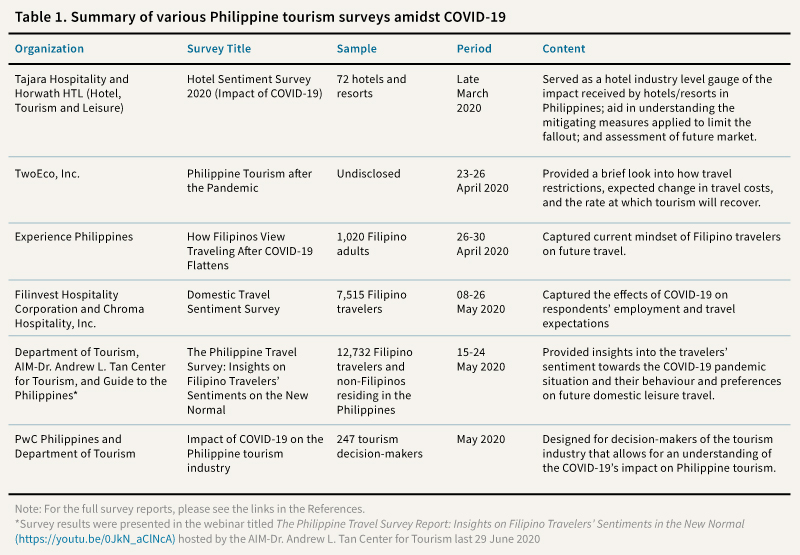
From the results of the surveys, several insights about the future of travel in the Philippines were made: First, domestic travel will be a priority. Travelers opt to either engage in land travel or air travel. Second, travelers will prioritise travel in rural, secluded, and natural areas once restrictions are lifted. Travel away from mainstream and overcrowded destinations are expected, although beach destinations are still considered ideal destinations post-pandemic. Furthermore, due to the restrictions imposed by the pandemic, travelers are now more open to digital travel experiences. Similarly, travelers are likely to choose customised travel experiences over packaged group tours. Third, health and safety protocols will be their number one priority once travel resumes. Thus, effective communication of safety measures and protocols implemented in destinations and enterprises will greatly influence travel choices. Perception towards the health and safety in travel will therefore predict where travelers will travel, when they will be traveling, and what kind of experiences they hope to obtain. Fourth, while domestic travel is expected to resume within four to twelve months after easing of travel restrictions, sentiments are primarily dictated by perceptions on public health and safety. Finally, given that the pandemic has affected people’s source of income and their personal finances, travelers seek more cost-effective experiences.

Re-Introducing Space Travel

As emphasised in the webinar entitled Space travel: A conversation on strategies to revitalize Philippine tourism post-COVID-19 (https://www.youtube.com/watch?v=Zq-Co_DWg8E) hosted by the AIM- Dr. Andrew L. Tan Center for Tourism last 28 July 2020, much has been said about the world getting smaller, we forget that the world is actually big. There are still so many places to explore and to visit, much to learn and to unlearn. Overcrowding (i.e., mass tourism) is no longer an option because of the established physical/social distancing, health and safety protocols that require decongestion of tourist attractions. To care for earth by giving nature room to flourish, to give fellow travellers the room to breathe, to explore, to grow, to reflect and participate in the lives of others, and to give destination stakeholders time to recover from visitor activities is the essence of space travel. It is a literal practise of giving each other and the earth space.

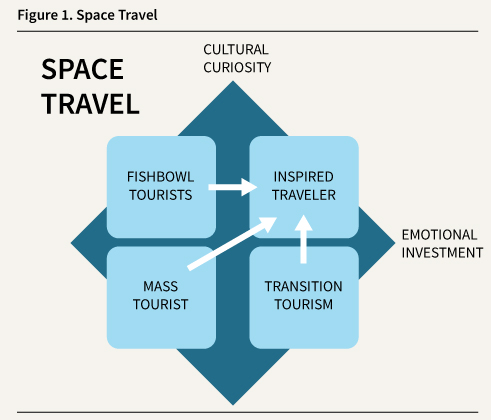
Tourists who routinely return to familiar destinations are considered second home tourists. These tourists are in the best position to care for a destination because they are invested in this as their go-to place for sanctuary. On the other hand, for those who travel to experience destinations from a distance, risking the alteration of local behaviour and culture are deemed fishbowl tourists. By including activities that increase their involvement in local custom, rather than just mere observation can transform these tourists and their attitude towards travel. Those who immerse themselves and make their experience a journey is called the inspired travellers, who imbibe sustainable tourism when they protect and safeguard the earth by their conscious defence and accountability of environments and travel behaviour.

Until restrictions are lifted and travelling returns to normal, tourism needs to adjust and adapt to reflect the present restrictions, initiating a new way of serving travellers called transition tourism. This type of tourism distributes the business amongst many stakeholders – accommodations, transportation, alimentation, security, and sanitation – in small groups triggering a collaborative rebooting of a local economy in many areas. Thus, for space travel to take root, transition tourism must inspire fishbowl and mass tourists to become inspired travellers (see Figure 1).
By working together, stakeholders and travellers alike, in stimulating local economies as a tight organism is to think small. It reduces the unwieldiness of the task of re-booting economies and industries. When each one of us does our little bits, we can save our big world by thinking small.

Moving Forward: From Crisis Response to Recovery

Further discussions, through webinars, have been initiated among experts and stakeholders on rebooting Philippine tourism. In the webinar titled Bootstrapping Philippine tourism: Recalibrating our priorities during and after COVID-19 (https://www.youtube.com/watch?v=3kNhIZqy92I) hosted by the AIM-Dr. Andrew L. Tan Center for Tourism last 03 June 2020, the following discussions have been featured: best practices on how tourism industries recover from disasters; strategies on how tourism stakeholders can manage COVID-19’s impacts; and insights on resilient recovery from a disaster risk-reduction management lens and how these can be applied for tourism recovery efforts.

During the webinar, Aileen C. Clemente (President, Rajah Travel Corporation) highlighted the following lessons from the pandemic: “it takes a while for people to get from philosophical discussion to general frame working to actual implementation”; “those who had a lot of excuses not to implement what needed to be implemented have no choice but to now implement them; and “greed has been tempered”. From these, Clemente cited the four stages of recovery as per the World Travel & Tourism Council – managing and mitigating the crisis, restarting the sector’s operations, reaching recovery, and redesign for the new normal.

 In line with this, Maria Cherry Lyn S. Rodolfo (Consultant, Department of Tourism) explicated that the tourism industry must have a calibrated recovery plan, in which domestic tourism should be given priority. That is, tourism authorities and enterprises must incessantly develop safety and health protocols that will ensure domestic travel is safe, secure, and seamless. Rodolfo also emphasised that the pandemic warranted the need for “strong, innovative, and responsive network” in moving towards recovery, reset, and resiliency. Rodolfo also highlighted the role of “cohesive and collaborative networks” in tourism reboot. There should be: call to action for inclusive recovery assistance, innovation, infrastructure, and institutional strengthening; community engagement in utilizing the resources of networks and in leveraging local with national and international networks; and a communication plan that will cascade tourism reboot strategies to both existing strong and weak networks in the industry.

In doing so, Clemente argued that in the new normal, repositioning product offerings, raising levels of service, defining world-class destination, re-examining consumption of tourism products and services, and increasing awareness about mass tourism are essential. Similarly, Lesley Jeanne Y. Cordero (Senior Disaster Risk Management Specialist, World Bank) stressed that in transitioning towards the new normal, there is a need to redefine tourist experience and destination management; invest in innovative and creative ways of product development; promote sustainability, inclusivity, and resiliency; recalibrate travel timelines, concepts, spaces and experiences; shift and share burden by collaborating with government, stakeholders, communities and tourists. 

Conclusion

While information about the impact of the COVID-19 pandemic has already dominated discourses on tourism, only a few discussions have been made regarding strategies to accelerate tourism recovery. With tourism activities at a standstill, an opportunity to adapt new models for conducting tourism activities has opened. More than ever, the role of tourism stakeholders in transitioning to the new normal has become more apparent.

In addressing the question on how tourism can recover after the COVID-19 pandemic, we analysed existing data regarding travel perceptions and conducted a marketing analysis to identify ways to revive travel demand and operations in the new normal. Our analysis suggest that existing business models may have become obsolete, thereby needing adjustments and re-assessments. While travel restrictions remain, transition tourism takes place. Crucial at this period is considering travelers’ perceptions and sentiments. Following the findings in the various surveys conducted, travelers are expected to engage in tourism activities with health and safety as their priority, which further suggests their preference towards natural areas and uncrowded destinations, digital travel, and customised experiences.

Reflected by these findings is a paradigm shift in the future of travel—from fishbowl tourism to inspired travellers, which also tantamount to a shift from mass tourism to a more sustainable form of tourism. However, this shift does not occur without the collaborative rebooting of the local economy by using local tourism as a springboard. Thus, stakeholders need to work together, along with tourists, to create a tightly knit industry that fosters thinking small.

About the Authors

Eylla Laire M. Gutierrez is Adjunct Faculty at the Asian Institute of Management and Research Manager of the AIM–Dr. Andrew L. Tan Center for Tourism. Prior to joining AIM, she served as intern at the Konrad Adenauer Stiftung (KAS) Philippines. She obtained her Master of Arts in Development Policy from De La Salle University, Manila, Philippines.
Email: [email protected]

John Paolo R. Rivera, Ph.D. is Adjunct Fcaulty at the Asian Institute of Management and Associate Director of the AIM–Dr. Andrew L. Tan Center for Tourism. Prior to joining AIM, he was Associate Professor at the School of Economics of De La Salle University, Manila, Philippines, where he also obtained his Doctor of Philosophy in Economics.
Email: [email protected]

Fernando Martin Y. Roxas, D.B.A. is a Full Professor at the Asian Institute of Management (AIM). He teaches Operations Management, Quantitative Analysis, Systems Thinking, Project Management, and other basic modules in the Degree and Executive Learning Programs of the Institute. He is also the Executive Director of the Asian Institute of Management (AIM) – Dr. Andrew L. Tan Center for Tourism. He obtained his Doctor in Business Administration from De La Salle University, Manila, Philippines.
Email: [email protected]

Milette L. Zamora is an Adjunct Faculty at the Asian Institute of Management. She was formerly a full-time Assistant Professor at the College of Business of De La Salle University where she taught Basic and Major Marketing subjects in the undergraduate and graduate programs. She obtained her Masters in Business Management from the Asian Institute of Management.
Email: [email protected]

References

Looking for a business loan? Follow these simple steps

Choosing the right financial partner to help you with your business credit may seem a daunting task initially. But it is a relatively straightforward process if you have a well-structured plan both on paper and in your mind. Your idea must demonstrate how well you put the money to use and eventually pay off the loan on time.

Many small and big businesses are in constant need of cash. It either supports their on-going business operations, starts a new venture, and funds long-term projects with positive cash flows. Whether it is to fund short term working capital requirements or to support long-term business projects, business owners look for easy-to-avail funding opportunities. It doesn’t matter if they are small or big money lenders as long as they offer business-friendly timelines and costs. In the ever-interconnected world we live in today, finding the right financial partner is not that difficult a task.

One has to look for business loans online, and there are many options available to choose from. To analyze the credit line and develop a creative loan strategy, one must consult experienced financial advisors from hasanovcapital.com. They will ensure you that the money borrowed is put to the right use, and the company can pay it back within the agreed timelines.

Putting things in context and for clarity purposes looking for online loans is not a difficult task today. Just look it up online! For example, if you are a resident in New Zealand, you can search for ‘online loans in NZ’ to get the best offers for loans, interest rates, and repayment schedules.

It will also help you reviewing recommendations and avoiding any professionals who may seem reasonable but offer awful services.

Following is a simple guideline to help you prepare for finding relevant funding opportunities for your business or personal financial needs.

Step 1: Why do you need the loan?

It is the most crucial step. Once you have decided why you need the loan, the rest of the measures would not be difficult to follow. Before jumping off to looking for a loan for funding any part of your business, ask yourself this question: do you need a loan? It entails asking other fundamental questions about your need for cash. For example, have you already used other funding opportunities, which could be taking money from the retained earnings, asking from friends and family, and asking partners to pool in more capital?

Have you already exhausted other areas of funding your business needs? Have you decided that from all the available funding opportunities, taking out a loan seems to be appropriate? Are you sure that it is a less costly option? Finally, have you penned down how much loan do you precisely need? Do not just arrive at an estimate, be specific! If all the questions mentioned are answered with a yes, take input from stakeholders, and take out the loan.

Step 2: What Type of Loan do you need?

Some business owners, if not all, are likely to confuse their financial needs with other needs. For example, your business might need new equipment, and you think you can only buy the equipment you need if you can arrange for the money. There are multiple ways to have that equipment become a part of your business operations. For example, you can look for options where you can lease the equipment as well. This way, your business might not face the financial burden of paying back the loan and its interest. It might be a better idea in case the equipment is needed only for a short-term basis.

Step 3: Have a Plan to repay the loan

Most Businesses do not manifest the seriousness in coming up with a plan to repay the loan they take – mostly small business loans. The loan repayment schedule must be prepared with sheer sincerity and not with a whimsical attitude, e.g., “oh boy, we have taken such loans in the past, we know how to pay them back.” It requires strict scrutiny of the current business operations and the business’s capacity to forecast the micro and macro business environments in the future only to ensure its ability to earn profits and pay back the loan on time.

Step 4: Check for timelines and Look for partnership

It is for the businesses to decide on the timelines for repaying the loan. Alongside the timelines, corporations, small and big both, must also precisely calculate how much cost they can bear on a particular business loan. This method helps the financial partner understand how much they would be able to earn on their lending.

This exercise might involve preparing a timeline for cash returns on a particular project and discussing it with the lender. The more transparent the process, the better it is for prospective lenders to develop trust with you and your business prospects and projects. As opposed to considering your financial lenders as stakeholders in the business, consider them as your partners. They might offer more flexibility in terms of customized repayment plans and a lower fee. 

Step 5: Creditworthiness, Personal Profile, and References

Depending on the size of the business and the loan, some financial lenders may ask for collateral. Such a strategy secures the loan provider if the borrower cannot pay back the loan. The people in the business seeking loans must be mindful that they might have to offer security against the loan they take out to fund their business needs. It requires business owners or people in businesses seeking loans to assess their creditworthiness with utter seriousness and assess themselves if they are eligible to take out loans. Moreover, small business owners and individuals need to develop a strong professional and personal profile to instill trust in their financial partners about the point that the funds their financial partners will provide will be in safe hands. A much better way to do this is to arrange for references from business partners, customers, and former lenders. In other words, seasoned business people must have a strong profile prepared at all times if they often come across the need to arrange for liquid assets. For SMEs in Singapore, you can also consider A1 Credit.

Step 6: Look for easy options first

There is this perception that business loans come with a lot of unfathomed consequences, especially in the event when there might be a delay in paying back the loan or the incapacity of paying back the loan at all. Many financial lenders today offer flexibility and advice both. The search for the right lender has to be another significant step in the process. One does not necessarily have to join hands with a finance company that is not flexible for its business reality. There are easy options available too. Look hard, and do not lose hope.

Step 7: Exude Confidence

Business owners have to ensure that they follow all of the above steps before seeking out a loan. After that, all they need is to show genuine confidence in their business plans and their intention to pay back the loan within the agreed timelines.

Conclusion – Choose Wisely

Financial lenders also look for making money. They look for the best deals and best lending opportunities. However, their best business opportunity might not be your best funding opportunity. In a world where businesses exist to maximize profits, loan seekers should look for a win-win and not for a win-lose deal. The last bit of advice would be choosing wisely.

6 Simple Ways to Streamline Your Financial Workflows: A Guide for Small Businesses

Good financial management is essential if you’re running a small company. In most cases, margins are tight and cash reserves are limited. What’s more, SMBs don’t have the same kind of financial buffer that large enterprises enjoy. Minor inefficiencies and losses, although insignificant on the surface, can quickly grow into big problems. 

The prospect of setting up an efficient workflow might seem daunting. But it needn’t be. Small business owners and managers now have access to an array of time-saving, easy-to-use tools that take care of most everyday tasks. They will also provide a full overview of your financial situation and allow you to track your business’ performance and drive further efficiencies moving forward. Before anything else, you may want to start reading up on the importance of credit card readers too.

All of this means that you’ll have more time and resources to focus on the important priorities of serving your customers and growing your business. Let’s dive in. 

1. Take Care of the Basics: Use Modern Accounting Software

First things first. If you’re still using a legacy system, spreadsheet, or (even worse) a pen-and-ink logbook, now is the time to update to modern, cloud-based accounting software. Dedicated small business accounting apps have broad feature-sets which enable you to input transactions and sales, create and send invoices, track financial performance, generate reports, manage employee payroll, and more, in a fraction of the time it would usually take. 

Even better, most well-known brands offer comprehensive onboarding materials and training (which may even include one-on-one time), so learning how to use a new platform won’t be an issue. Because browser-based software is installed, updated, and run in the cloud, as opposed to on your own servers, you won’t have to worry about any technical or maintenance tasks.

2. Sync Your Apps With an Automation Tool

Manual data entry can easily take up multiple hours of employee time every week. And this time represents a wasted resource that could be allocated to more important priorities. 

There is, however, a straightforward solution: integration and automation. By integrating your accounting software with other parts of your tech stack, such as your customer relationship management solution (CRM) and banking app, you can ensure the fast and error-free transfer of data between platforms, with very little or no direct input from you. 

Most apps have their own library of native integrations. For those that don’t, you can always leverage an “intermediary tool” like Zapier or IFTTT (If This Then That)

3. Use a Point of Sale System (POS) to Accept Card Payments 

If you’re not already accepting card payments, you’re likely cutting yourself off from potential and repeat customers, irrespective of whether you run a product or service-based business. Clients that are able to pick from a variety of payment options are more likely to return in the future. And by accepting card payments for items, you won’t have to turn away customers that don’t carry cash. 

Many small business owners and managers worry that installing a point-of-sale system, with barcode scanners, digital registers, payment terminals, and so on, will be a prohibitively complex and expensive process. But this is far from the case. Most modern POS systems aimed at small businesses are inexpensive (even when accounting for hardware) and come with extensive onboarding packages. Most will also integrate with your website so you can sync online and offline sales. 

4. Integrate Payment Buttons Into Business Documents

Consider the document approval process from the perspective of a typical client. After receiving a quote, proposal, or contract, the recipient has to print the document, hand-sign it, scan it back onto the computer, and manually process any corresponding payments. And even if they have their own electronic signature tool, they still have to log into their online banking dashboard to send money. 

Adding electronic signature fields and payment buttons to important documents will significantly cut down on the effort required from clients to process business documents, leading to higher conversion rates, faster payments, and happier customers. Approval management software provides access to all the features business owners need to streamline their document workflows and integrate with their preferred online payment processor.

5. Track Employee Expenditure

Managing employee expenses can be a chore. Often, a complete picture of employee spending isn’t available until the end of the month, when all receipts are reviewed. And employees can become dissatisfied when they’re not quickly reimbursed for business expenses. 

Expense tracking apps like Expensify and Rydoo solve these problems. They provide business owners with a real-time overview of the ways in which employees are spending money and ensure that receipts are saved online at the point of sale. Automated notifications for high-ticket expenses also make the approval process much smoother. 

Conclusion

Financial management is one of those areas where it’s possible to drive significant improvements for minimal cost. All of the software suggestions in this article are inexpensive and easy to use (for both you and your team). Most apps nowadays are offered as monthly subscriptions, so you don’t have to cough up hefty fees before you can get started. 

Spend some time researching the various options available and commit to building an integrated, automated technology infrastructure to power your small company’s financial tasks. You’ll save time and resources while also limiting the potential for costly errors and employee oversights. 

Online Personal Loans: Top Benefits For A Poor Credit Score

Most of the time, people with poor credit scores find themselves in a very difficult state when the need for money comes to light. Many people turn to credit card cash advances. However, when you do not have a high credit limit or do not have a credit card, a credit card cash advance is not an option.

In many instances, getting a personal loan from an online lender or brick and mortar bank is hardly the way to deal with this financial hardship. Personal loans are the fastest and easy access to quick cash because the approval process can be carried out in no time.

For a little help, here are the top benefits and perks of online personal loans for people with bad credit scores. Read on to know more!

Before Anything Else: Break Your Bad Financial Habits

Before you decide to take out another loan, make sure that you resolve your bad financial habits first so that you won’t repeat the same mistakes again. Say, for instance, being in debt. The following are some habits that you should avoid and break:

  • Mood-based shopping
  • Impulse buying
  • Not having a budget
  • Undisciplined saving
  • Not repaying debt
  • Ignoring money problems

Have better money habits by beating these bad financial habits.

Online Personal Loan For Bad Credit Scores: The Benefits

Once the approval and disbursement of the loan are done, it is now the borrowers’ responsibility to do well. By that, we mean a stellar credit score is needed to ensure the fast approval of personal loans.

Even so, the good news is that online lenders offer leniency in this area since they provide personal loans for people with bad credit.

Collateral-Free

A personal loan requires no collateral, meaning borrowers don’t have to secure any valuable items or assets to borrow cash. The personal loan given here is deemed to be unsecured. Also, the lender does not have any guarantee or assurance to fall back upon if the borrower defaults on his or her payments.

Speedy Disbursement

Take note that we live or reside in a progressive and developing digital age and a sensible, modern personal loan option that is readily available to most people these days. What’s more, taking out a personal loan does not involve lots of paperwork, prepayment charges.

Not only that, taking out a personal loan bears low rates, offers instant processing and approval times, plus, you can transfer significant borrowing amounts to your account almost immediately.

Fixed Interest Rate

Fixed interest rates refer to the owed or borrowed rate that is laid down for your loan term. In general, fixed interest rates are at least 1 or 2 percent higher compared to the floating or varying interest rates.

Moreover, fixed interest rates personal loans offer an insight of assurance and guarantee to the borrowers regarding the loan tenor and monthly installments beforehand. Keep in mind that it is much wiser to be ready with the installment panning. On the other hand, variable interest rate loans are set to the existing discount rate.

Multipurpose Personal Loan

Personal loans are multipurpose loans that can be obtained or acquired for many reasons or purposes, especially when quick cash is needed. These kinds of loans don’t require any collateral guarantee.

If the criteria or standard for eligibility are met for the loan, lenders won’t ask about any collateral. Additionally, personal loans are considered multi purpose since they require hardly any paperwork compared to other loans such as business loans, payday loans, car loans, or home loans.

Easy Equated Monthly Installment Facility

The equated monthly installment process for online personal loans is much easier and simpler than before. If you choose the EMI option during the transaction, at a brick and mortar store or online, is only a click away.

For offline transactions, the voucher printed on the POS machine contains almost all information such as EMI amount, Rate of Interest, Loan Amount, and whatnot. However, for online transactions, the details will be immediately shown on the POS machine.

Flexible

Personal loans have flexible loan tenure. This perk is very advantageous to those who currently earn enough money because their source of income could fall down throughout the loan tenure. With this benefit, borrowers have the option of repaying a lower equated monthly installment in the introductory years and slowly rising in the coming years.

Takeaway

Regardless of the well-known benefits of online personal loans for bad credit scores, there are some instances that lenders reject borrowers with bad credit, perhaps because of other factors or reasons. Even so, it is important to keep a good credit score to avoid getting rejected for a loan. Start by making some positive financial habits, such as creating a budget, planning, and avoiding impulsive buying. Save for yourself and your family.

Why Investing in Renewable Energy is Safe Business

One of the primary arguments used against the widespread adoption of renewable energy revolves around the supposed viability of sources like wind and solar, but this ignores the challenge facing fossil fuels in the next 40 years.

More specifically, it’s the world’s carbon-based economy that’s largely unsustainable, with the global fossil fuel supply expected to be depleted by 2060 if we continue to burn through this at the existing rate.

This is just one reason why we should consider investing in renewable energy in the near and medium-term, as it can be derived from natural resources that are organically replenished on a viable human timescale. Here are some other ideas to keep in mind:

1. Renewable Energy Assets are More Lucrative

According to recent research released by the Imperial College London and the International Energy Agency, renewables investments in Germany and France have yielded returns of 178.2% over a five-year period.

This compares incredibly favourably with fossil fuel investments during the same period, which delivered a negative return of -20.7%. In the UK alone, investments in green energy generated returns of 75.4% during the same five-year period, with the corresponding figure for fossil fuels trailing behind at just 8.8%.

This highlights a clear trend in the world’s financial markets, as the renewables sector continues to grow at an exponential rate while traditional energy sources such as oil remain undermined by geopolitical factors and their finite nature.

Greater profitability can also be achieved by investing in a diverse energy and infrastructure portfolio, which helps to minimise exposure and provide far greater coverage of a fast-growing market.

2. Tap into Far Greater Energy Security

On another note, the level of energy security is far greater and much-improved when investing in renewable sources.

The reason for this is simple; as renewable sources such as energy and wind can be generated from within the boundaries of the UK, which in turn means that we no longer have to rely on importing energy and fossil fuels from overseas.

On a similar note, there’s no need to factor in the price volatility of fossil fuels such as oil, which have continued to fluctuate wildly as the asset has endured a sustained imbalance between supply and demand. This is inherent with fuel sources such as oil, with the finite nature of their supply causing significant and long-term pricing issues.

As of October 28th, the price of WTI crude had slumped by 2.06 to $37.51 per barrel, with the existing imbalance being undermined by a global decline in demand as a result of the coronavirus.

3. Environmental Impact and Transparency 

As the trend for corporate social responsibility highlights, brands are increasingly inclined to invest in sustainability and align themselves with the ever-changing expectations of their customers.

A similar trend is prevalent in the financial markets, with renewable energy becoming increasingly popular and ethical thanks to its capacity for reducing pollution, lowering cO2 emissions and minimising harm to the planet.

This is particularly ideal for anyone interested in creating an ethical portfolio, and one that can also sustain growth over an extended period of time.


What 2021 is Likely to Bring for Online Gaming and Casinos

Within the ever-changing climate of technology and innovation in the 21st century, each year brings new opportunities for things to be done better and faster while eliciting the most friendly and fun experience for the end-users. This is even more true in the world of gaming and online casinos which have seen a dramatic increase in traffic, especially in 2020. One thing is for certain: the market is growing and people are responding.

Although it’s impossible to predict the exact future of the industry, we can form an opinion based on what already happened this year. Let’s take a look at possible further directions the industry will move towards in 2021.

A Rising Popularity in Esports

Already having seen a large expansion in the sector over the last few years, Esports became especially popular when gamers began to come together to compete in tournaments and playing for fun in an interactive online setting. This soon converted into games being played for huge, real-money prizes as dedicated gamers began to place bets and partake much more competitively.

The astounding payouts have attracted many to the world of Esports and the global fanbase is only predicted to grow faster in the coming years. Just one example is last year’s Dota 2 tournament, a competition in an online battle arena that holds one of the top five spots for the largest overall prize pools in Esports history, in which each winning player won over two million dollars. With the winner’s rewards growing and greater technological improvements being made within different games, we can only expect that Esports will thrive even more in 2021.

A Continued Increase in Mobile Gaming

The convenience of gaming from a PC or laptop has been overridden by the even more user- friendly play from a mobile device. While many people still opt for the desktop view, more and more users are turning to their smartphones which always remain within reach. The surge of free-to-play applications available for download on Android and iPhones make this possible, and in 2021 studies have shown that mobile gaming will take over the market with a potential 59% increase. It’s already predicted that operators using these F2P apps to attract customers will cater to them even more so in the future, moving the user towards real-money play, and in doing so increasing market revenue.

Payment by Cryptocurrency Will Become a Way of Life

Cryptocurrency based casinos have already made their appearance all over the globe with the entrance of the Bitcoin into mainstream society over ten years ago and its reputation as a reliable form of currency and a good investment. Within the casino gaming world, the growth of their use online is due to many factors such as the low transaction fees, with many bitcoin casino sites even offering zero fees. In addition, by providing guaranteed autonomy through blockchain technology, Bitcoin casinos are even safer, more secure, efficient, and reliable than ever before. As people are realizing that users often prefer this method to traditional payment options, transfers within Bitcoin casinos are expected to rise in 2021 and beyond with more online casinos offering them. Cryptocurrency exchanges could quite possibly become the new norm much sooner than we think.

Virtual Reality Will be Used Much More

Virtual reality headsets will dramatically transform online casinos for the better. With the look and feel of gaming goggles, the experience they provide for users is unlike any other and highly stimulating. Already available in some in-person casino rooms, the next step coming shortly is to use them in the digital sphere as more and more people flock to online gaming. The only barrier as of now is the expensive nature of the software and machinery involved with getting these devices up and running for everyday customers. However, as VR continues to take the world by storm it’s predicted that further tech advancements will be made to make this a possibility very soon.

Flexible Payment Options: How They Help Increase Sales And Retain Customers

Have you noticed how customers keep asking about the payment options you offer? Let’s talk about installments, more specifically about periodic payment plans. 

Not all of us can afford to pay for something at once. For example, you currently own a store, selling gardening tools. Some of them are more expensive than others, such as lawnmowers, and you notice how many customers are interested in this product. Still, the majority of them keep skipping this product category because they haven’t seen any options for flexible payments. Now, if you’re willing to increase revenue and sell more of these products, you can make a deal with any local bank or financial institution. 

Once they approve this type of payment, there are ways to promote the products and services by partnering with various catalogue-specialized websites and get featured in their periodic online catalogues. These websites often create and publish weekly payback catalogues, which are really popular among shoppers nowadays. Millions of people seek to buy more products and pay in weekly or even monthly installments instead of all at once, so they often visit these sites and check out all the latest special offers. This is a great way to have your items promoted online and be seen by many potential customers.

Now, let’s talk about how having flexible payment options is a win-win situation for both your business and customers.

Why offering flexible payment options is beneficial to your business

All products come in different packages and are of various values. It’s the main reason why price tags may vary from $1 to $1,000,000. 

Is it possible to sell more expensive products continuously, and still increase both sales and customer satisfaction? Sure, one way to do it is to offer customers to pay via installments.

In case you’re wondering whether or not this method will benefit your business, don’t even hesitate. Yes, you will still make the big sales and create a steady income every week, rather than having to chase the customers with “deeper” pockets. Since banks take care of the financial part, all that’s left for you to do is keep promoting the products, offering easy periodic payments to attract new and retain old customers. 

How is payment flexibility beneficial to your customers?

By telling a business owner to ‘put themselves in their customer’s shoes’, they can see how a customer reacts to the prices and products. This way, it allows owners to change a few things in order to ease the whole shopping process. That is the case with payment flexibility. These changes will surely benefit the business by attracting a much wider audience. 

Let’s take buying a new car for example. The majority of us can’t afford to go to the car dealer and buy a brand new Porsche. However, the car dealer offers monthly installments so that more people can buy the latest Porsche Carrera. 

More customers mean more profits, as many industries have found out throughout the past few decades. Businesses have learned – by making payment options flexible, more customers will buy the products, and returning customers will create more opportunities for profit. 

Let’s talk about how it feels being a customer, i.e. the other side of the business.

Increase in customer satisfaction

If you were to buy a pricey tux for your best friend’s wedding, and you couldn’t afford it, you would probably feel disappointed. That’s exactly how customers feel when they browse the Internet for the products they need. However, when you find that a famous luxury brand offers tuxes with flexible payment options of up to 12 monthly installments, you’d probably feel relieved by the opportunity.

Basically, whenever customers come across companies offering products paid in weekly or monthly installments, they feel relieved. A certain need for specific products and the ease of payments is the main reason behind increased customer satisfaction.

So, you can now attend your best friend’s wedding, buy them a great gift, and still have enough money left to get through the month. Sounds easy, right? This is another example of how it feels to be satisfied as a customer. Having to pay for something during a longer period, instead of paying it all at once helps other customers feel the same way.

Increase customer loyalty and retention

Let’s say you’ve found the perfect clothing store for work. You’ll need to buy new pants, shirts, shoes, and accessories every couple of months. Worst case scenario, you need to shop for new clothes at least twice a year. You already pay the mortgages, car loans, and your kids’ college tuition fees. 

Still, after you pay all the bills, there’s not much left for new clothes. However, the local clothing store allows for buying their products in monthly installments. That way, you’ll still have some cash left and have new clothes at the same time. Most importantly, you won’t “feel” the money flowing away since they only take a portion of your remaining monthly budget. 

Brands awareness – word-of-mouth marketing

Now, let’s get back to attracting and retaining customers. What’s essential here is the increase in the popularity of your business by providing flexible payment options. Your customers will have an extra reason to be satisfied, as well as spread the word about your products. All of a sudden, you will most likely see an increase in customers, most of them agreeing to pay in monthly installments.

From anyone’s perspective – it’s a fair trade. There are more sales and stable periodic income for businesses, and less cash to be spent all at once for customers. The process sounds about right from anyone’s perspective. Any real-life example of companies offering periodic subscriptions or installments will prove just why they’ve grown so fast, in such a short time.

Conclusion

So, what’s at stake here? Allowing people to purchase products and services while their monthly budget remains intact is, above all, an integral part of marketing. The more payment options and payment flexibility, the more customers you will acquire and retain. It’s a simple, yet proven formula, applicable to most businesses, both small and medium-sized. In short, it’s a must for any company, offering different payment forms and using different payment providers.

Emerging Digital Infrastructure Needs for the Developing Economies

“In the digital age of ‘overnight’ success stories such as Facebook, the hard slog is easily overlooked.”

Sir James Dyson | Founder of Dyson

The upper statement quoted by James Dyson has inspected trims and authentic possibilities generated from digitalization. Evolving the entrepreneurial vision in various sectors – manufacturing, retail / real estate, communication, logistics, etc –  to involve in the digitalization approach. Reflecting, how Facebook’s infrastructure alone is revolving around worldwide communicated societies, and have emerged digital technologies or its usage up to a standardized level, where people are quite common in what’s evolving outside their village. While online businesses (public or private) are making ICT policies and interactive schedules through social communication development among countries to highlight economic verticals. It has become a key success for developing countries to generate international bridges outside of a single state in attracting customers, entrepreneurs, and investors from all over the globe. The policymakers in these countries are navigating an entirely transformed era, and admitting the whole credit on the side of information and communication technology.

In terms of digital commerce:

By 2021, ahead of time adopter trademarks that remodel their online portals to hold up the voice and visual search will escalate digital transactions or exportation profits by 30%.

This perspective has threshold the luxury brands installment for The U.S and China like establishments, mostly supported by millennials – 92 million millennials of 15-35 age only in the United States. The largest scale of Millennials’ coordination with digitized responsibility has been recorded to originate motivational selling among any niche customer line. Increasing stock exportation for any nature of the product, outside the border, and ultimately fulfilling the economical image of the country.  

On the other pole, under-developed or undeveloped countries, that are lacking the digital extension still in business or government policy management, could find a narrow path to chase points of opportunities. Orienting that digital infrastructure is mandatory for countries to reflect a quality life for citizens with better economic shape. 

Investing private equity in digital commerce/economy could bring functional paths for private firms. Professional assistance is already available to clarify random directions into the directional module, as provided by Investable Universe. To let entrepreneurs concede how Stonepeak Infrastructure joined Tech All-Stars through Digital Edge APAC Data Center Platform.

Digital Infrastructure has been Expected to Multiply by 2020 

As the internet has penetrated down to root level, users have gained excessive connection, and due to the least price tags on devices to purchase them up, it has been expected that digitized users would be raised to 1 billion by 2020. This analysis in general has also predicted the digital economy to be multiplied up to manifolds. Reporting that the specific GDP revenue uplifted by the digital economy would be converted to $6.6 trillion this year, interconnected 30-50 billion dollars product to get sold digitally; including automobiles/vehicles/jet/aircraft. 

Why is it still expanding on the government policymakers’ desk? Because statistical mining of digitalization has the capability to lighten a fire under shredded postulates of a successful economy. Also, it’s enhancing not only economics but configuring political conditions by providing management the swift and accessible devices for public relief.   

Features to note before Investing in Digital Economy

Mr. Fernando Loureiro claimed that the conception of digital technologies has built resources for corporations, particularly about hybrid-boundary co-operations. Evoking Intel’s struggles in technological advancements, he claimed that as the system is registering a digital transmutation method operated by statistics, cloud services must be consolidated. He declared that fundamental latest technologies necessitate being conveyed into plans instantly 5G, machine learning, augmented reality (AR), and artificial intelligence (AI). He clarified that a geographical setting to lure venture investments and to alter the policy-developing of digital economics is necessitated. With this regard, he recommended the subsequent features to be brought into the report:

  • Paced modification conditions need policies that encourage discoveries without interruption or limits.
  • The Internet must be positioned on developing criteria.
  • Digital policies should be centered on affirming ICT preferably rather than formulating it.
  • An achievable and guarded digital background is obliged.
  • Trust is key, and discussions on cybersecurity should be increased.
  • Repeatedly adhering and judging connections on posts are significant.
  • Satisfactory tax strategies are required.

Therefore, many companies after targeting the highest rank in digitalization have learned how to mature their economy by raising the demand for products. And, France reflects its capital illustration, investing yearly five percent extra since 2003, to enlarge social communities by technological availability.

EDITOR'S PICK OF THE WEEK

CFO's new mandate. CFO explaining the presentation

The Performance and Transformation Orchestrator: The CFO’s New Mandate in the Age of AI

By Terence Tse CFOs are evolving into AI-driven transformation orchestrators, balancing finance, technology, and strategy while upskilling teams, managing risks, and driving measurable business value. A key insight from this year’s AI for CFOs event, organized...

WISE DECISION MAKER GUIDE

POWER INFLUENCERS

Emerging Trends

The Future of Global Trade