Home Blog Page 96

FundingPips Announces MT5 as their Newest Trading Platform

FundingPips celebrates the firm’s milestones with the MT5 trading platform announcement this week. The rapid progression of the prop trading industry is defined by those who work around the clock to improve the realm and make an impact that gives more to traders and the trading community, and FundingPips is not just keeping up – it is setting the pace.

In just Q1 of 2025, the firm has hit significant milestones, staying true to its core mission: putting traders first. “Built by traders, for traders” is not just a slogan – it is the foundation of everything FundingPips stands for and their merit to continuously improve and evolve.

With FundingPips’ ever growing global footprint, it is creating and expanding opportunities for traders worldwide. Launching the MT5 trading platform marks a significant leap forward, giving traders more flexibility, better tools, and a seamless trading experience. In a data and statistics driven world, numbers speak louder than words – FundingPips now boasts over 1 million users worldwide, with more than $110 million in rewards paid out to date.

FundingPips’ impact lies in its community with feet and foundations that are steady on solid grounds; it is always more than just another prop firm; it is a movement reshaping the industry, breaking down barriers, and making online trading more accessible to skilled traders.

With new innovations and major expansions on the horizon, the firm and the traders it empowers are looking at a future brighter than ever. This gives more opportunities to its community and every trader pursuing making money online around the globe. The first quarter of 2025 indicates the beginning of a new era for the proprietary trading industry.

Breaking the Barriers of Traditional Prop Trading

The FundingPips has made a promise to traders to always empower them and provide favourable trading conditions”. 2022 was the birth of a promise that offers traders globally an opportunity to succeed and make an impact. In an industry where access to a funded account remains one of the biggest hurdles for aspiring traders, FundingPips is shaking up the proprietary trading space with a model designed to empower every trader and Forex trading enthusiast wherever they are.

Offering master accounts with competitive evaluation criteria, the firm has quickly gained traction among traders looking to scale their strategies without the burden of personal risk.

“Every milestone reflects our commitment to our community. Their support has been instrumental in motivating our continuous efforts since the birth of FundingPips in 2022.” Khaled Ayesh, CEO and founder of FundingPips, says.

A Modern Take on Proprietary Trading Models

Proprietary trading firms have traditionally catered to seasoned professionals, often with restrictive conditions and steep capital requirements. FundingPips has changed that narrative by making funded trading accounts more accessible than ever, including a more comprehensive traders’ scale. Passing the evaluation process grants traders access to a more rewarding trading opportunity – allowing them to trade without risking their own funds.

What sets FundingPips apart is its trader friendly model. The firm operates with a rule-based evaluation system, focusing on consistency rather than aggressive risk-taking. Unlike other evaluation modules within the industry that are too expensive, restrictive trading conditions, or unrealistic targets, FundingPips offers a structured yet flexible pathway for traders to qualify for funding.

How the FundingPips’ Models Work

At its core, FundingPips follows a two-step evaluation process, where traders must demonstrate their ability to manage risk and achieve sustainable returns. Once they pass the challenge, they receive a master account and can keep rewards of up to 100% of the profits.

Traders and industry enthusiasts can choose an evaluation account that fits their experience level, style, and budget. Whether they are just starting out or looking for a challenge, different models designed for each type are within reach.

FundingPips users can practice in a simulated environment. With five flexible account sizes from $5K to $100K in Instant, 1-Step, 2-Step, and 2-Step Pro, FundingPips makes it easier to find a path that aligns with each user’s trading goals – all at accessible price points and with the best trading conditions in the market.

Key advantages of the FundingPips model include:

  • Reward Splits – Traders can retain up to 100% of their earnings, making it a lucrative opportunity for those who prove their skills.
  • No Liability for Losses – Unlike trading with personal capital, traders do not bear the downside risk of losses beyond their evaluation fees.
  • Diverse Trading Conditions – With access to multiple asset classes and flexible strategies, traders are not limited to a single approach.

Technology & Trader Support: Action is the only acceptable reaction.

FundingPips has been listening closely to what traders want. The firm’s birth was a response to the trading community’s calls for help after multiple frustrations with unfair former firms that have exited the market drastically. It prioritizes technological solutions to enhance the trading experience. The powerhouse of trading platforms, MetaQuotes’ MetaTrader 5 offers traders of all levels and styles swift execution and seamless experience with reliable market access.

Traders benefit from real-time performance tracking and analytics tools in FundingPips dashboard ; this allows traders to refine their strategies based on detailed factual metrics and analytics tools,allowing traders to focus on continuously improving their performance based on data driven decisions

Beyond accessible trading, the company invests in trader development through educational resources, webinars on all its social media channels, and a growing online community. This approach fosters a more supportive trading environment, and places FundingPips as a safe haven for traders.

The Future of Proprietary Trading

As demand for evaluations continues to rise, FundingPips is positioning itself at the forefront of the industry’s evolution. With a strong emphasis on transparency, technology, and trader-centric policies, the firm is attracting a new generation of eager and encouraged traders.

For those looking to take their trading to the next level without risking personal funds with a trustworthy name, FundingPips presents a futuristic take with a compelling alternative – one that could redefine the future of trading with every step it takes.

The photo in the article is provided by the company(s) mentioned in the article and used with permission.

Investico.com Enables Easy and Quick Transaction Processes

Johannesburg, South Africa – Investico.com, is a brand operated by Faraz Financial Services (PTY) Limited, a company that provides CFD trading services. The company has introduced a system designed to simplify transaction processes, making financial transactions quicker and more accessible. By focusing on speed and efficiency, it ensures that individuals can execute trades and manage financial operations without delays. The platform is designed to enhance the overall trading experience.

Faraz Financial Services (PTY) Limited has developed a system that prioritizes reliability and speed, implementing features that allow transactions to be completed in a short time. Many traders face difficulties when executing financial operations, and delays can often lead to missed opportunities. Investico has taken steps to address these concerns by ensuring that processes are handled smoothly and efficiently, enhancing the CFD trading experience.

A key aspect of the platform is its ability to offer solutions without unnecessary procedures. Many financial transactions involve multiple steps that may slow down execution. Investico has refined its system to eliminate complexities while maintaining security and accuracy. The focus remains on allowing users to transact with ease while meeting all necessary regulatory and operational requirements.

Another important point mentioned in the Investico.com review is the company’s efforts to make its services user-friendly. Financial operations can sometimes be complex, and a system that is clear and straightforward can make a difference. It has developed its platform to ensure that individuals can execute trades without unnecessary complications. According to the review sources, simplifying processes has been a major focus of the company.

The financial industry has evolved significantly, and efficiency has become increasingly important in CFD trading. Companies that offer seamless and fast execution often attract traders looking for improved services. Investico.com has positioned itself as a platform that understands these needs, offering a system that aligns with current market demands.

CFD trading involves various market conditions, and having a platform that ensures smooth execution can be beneficial. The ability to place trades efficiently and securely helps traders focus on market strategies without worrying about delays. This content is based on observations and serves as an independent perspective on the company’s support structure and user engagement.

About Investico.com

Investico.com is a CFD trading platform operated by Faraz Financial Services (PTY) Limited, which provides its services under this brand name. The company focuses on improving its practices for CFD trading for individuals and businesses by offering a system that prioritizes speed, accessibility, and security. Faraz Financial Services (PTY) Limited is regulated by the Financial Sector Conduct Authority of South Africa as a Financial Service Provider (FSP) with license number 45518.

Investico has gained attention for its efforts in improving the CFD trading experience. By focusing on user-friendly features and efficient trade execution, the platform has positioned itself as a provider of CFD trading solutions that enhance market accessibility. Through continuous innovation, Investico remains committed to offering services that align with the needs of traders looking for a seamless and effective trading experience.

Company Details

  • Company Name: Faraz Financial Services (PTY) Limited
  • Email Address: [email protected]
  • Company Address: Unit 9, 31 First Avenue East, Parktown North, Johannesburg, Gauteng 2193, South Africa.
  • Company Website: https://www.investico.com/international/

Understanding QMS: What is ISO 9001, Why is it Important, and How to Comply?

Making sure that your business operation is running smoothly comes in a few different ways. Being the founder, owner, and CEO comes with a lot of responsibility, and in the modern day and age, it is not enough to make sure you remain competitive and take care of your staff. There are many new ways in which a business can thrive and it involves the latest spoils of modern technology. If the 21st century and the digital age of information have taught us one thing, it is that keeping up with the times is crucial in remaining not only relevant but operational. Those who fail to keep up with what the industry standards are, despite them changing at a rapid pace, will be overtaken by the competition and forgotten.

For that not to happen to you, there needs to be some change, and out of everything, quality management systems (QMS) and their standards are prevalent. One of the most important of those is certainly the ISO 9001. This internationally recognized standard for quality management systems is issued by the International Organization for Standardization (ISO) and it provides the main framework that organizations can use to make sure their services and products consistently meet customer requirements and improve overall quality. This standard focuses on process management, continual improvement, and customer satisfaction. For these reasons, every serious organization needs to have it incorporated into their ongoing operations.

What is ISO 9001 and Why is it Important?

From the name alone, this standard does not say a lot so we need to dig a bit deeper. The full name is ISO 9001:2015, with the number following the semicolon indicating the latest revision as a more risk-based approach to quality management is emphasized. The standard applies to any organization, regardless of its size or even the industry they are a part of. Those who use it aim to improve operational efficiency and customer trust. Essential for more than one reason, it is crucial for those who want to build a strong reputation and gain a competitive edge. Here is why it is important and what its key benefits are.

Improved Quality and Efficiency

By focusing on processes like these, organizations can identify inefficiencies and reduce waste while enhancing their products and services. Consistent focus on quality leads to greater customer satisfaction and repeat business, which is the ultimate goal of any company as it is how revenue is secured for longer.

Customer Satisfaction

Speaking of customers, meeting their expectations is at the very heart and core of ISO 9001. Companies that are certified with this standard demonstrate their commitment to providing high-quality products and services. This dedication fosters trust and customer loyalty that the clients love to see and reward with their loyalty.

Global Recognition

ISO 9001 certification is recognized all over the world, which is the idea with standardizations like this one. They exist to unite industries and make people realize what it means when a company has it. Therefore, it makes it easier for businesses to work with international partners but also to offer their products and services outside the borders of their country. Doors are open to new markets as companies often require proof of quality of management practices before committing and engaging in partnerships and collaborations.

Risk Management

There is also the issue of encouraging a proactive approach to identify risks and opportunities that could affect the quality of products and services, but also the health and safety of the staff and equipment. This ISO standardization makes it possible and it results in a more resilient business that can adapt to changes and challenges. No matter how safe on the surface level, every business is susceptible to certain dangers and risks so a QMS backed up by ISO 9001 is the best course of action.

Regulatory Compliance

Last but not least, many industries have baseline standards that every company that is a part of it has to meet. Meeting these legal and regulatory requirements is done in a straightforward way when ISO 9001 is introduced. Adhering to its principles makes companies compliant with exactly what the industry demands and allows them to stay ahead of further issues.

Making Sure You Follow It

Last but not least, a simple guide on how to follow ISO 9001 is in order. First, understand the standard and what it implies, and then establish leadership commitment. Define your quality management system (QMS) and involve the employees so everyone is on the same page. Conduct risk-based thinking, monitor and measure performance, and then conduct internal audits. Continual improvement needs to take place as you obtain certification and then do everything you can to maintain being certified.

What is an Assumable Mortgage?

An assumable mortgage allows a homebuyer to take over the seller’s existing loan, including its interest rate and repayment terms. This option can be especially appealing in a market where interest rates are rising because it lets buyers secure lower borrowing costs.

Assumable mortgages are most commonly found in government-backed loan programs like FHA, VA, and USDA loans. Homebuyers searching for assumable mortgage listings can find opportunities that offer financial advantages over traditional loans. However, lender approval is typically required, and not all mortgages qualify.

Understanding how assumable mortgages work can help buyers determine if this financing option is right for them. Let’s dive in!

How Do Assumable Mortgages Work?

An assumable mortgage allows a buyer to take over a seller’s home loan while keeping the same interest rate, loan balance, and repayment terms. Instead of applying for a new mortgage at current rates, the buyer assumes the existing one, which can lead to significant savings if the original loan has a lower rate. 

To assume a mortgage, the buyer must qualify with the lender, just as they would for a traditional home loan. This process typically includes a credit check, income verification, and debt-to-income ratio assessment. Once approved, the lender transfers the mortgage to the buyer, and the seller is released from future liability. 

One key consideration is the down payment. If the home’s sale price exceeds the remaining loan balance, the buyer must cover the difference in cash or secure secondary financing. While assumable mortgages offer financial benefits, they are not as widely available as conventional loans.

What Are the Types of Assumable Mortgages?

Not all mortgages can be assumed, but certain loan types allow buyers to take over the seller’s existing terms. The most common assumable mortgages are government-backed loans, including FHA, VA, and USDA loans. 

FHA Loans

Insured by the Federal Housing Administration, FHA loans are widely assumable, but buyers must meet the lender’s credit and income requirements. 

VA Loans

Backed by the Department of Veterans Affairs, VA loans can be assumed by both veterans and non-veterans, though lender approval is required. If a non-veteran assumes the loan, the seller may lose their VA entitlement. 

USDA Loans

Designed for rural homebuyers, USDA loans are also assumable, provided the buyer meets eligibility requirements set by the U.S. Department of Agriculture. 

Conventional loans are typically not assumable unless specifically structured to allow it. Most conventional mortgages include a due-on-sale clause, which requires full repayment when the property changes ownership. 

What Are the Pros and Cons of Assumable Mortgages?

Buyers with assumable mortgages can benefit from lower interest rates, lower closing costs, and easier qualifications.

However, disadvantages include the potential for a large down payment if the home’s market value exceeds the remaining loan balance, difficulty finding a home with assumable mortgages, and a seller’s VA entitlement risk. If a VA loan is assumed by a non-veteran, the seller may lose their eligibility to use VA benefits for future home purchases. 

While assumable mortgages offer advantages, they require careful evaluation to determine if they are the right financial choice.

How Can You Qualify for an Assumable Mortgage?

To assume a mortgage, buyers must meet the lender’s qualification criteria, similar to applying for a traditional home loan. The lender will evaluate the buyer’s credit score, income, and debt-to-income ratio to ensure they can handle the existing loan payments. 

For FHA and USDA loans, buyers typically need a credit score of at least 580, though requirements may vary by lender. VA loans may have stricter qualifications, especially if the original borrower is a veteran and wants to preserve their VA loan entitlement. 

In addition to meeting credit and income standards, buyers must provide proof of funds for the down payment if the home’s purchase price exceeds the remaining loan balance. Lenders may also require an assumption fee, though this is generally lower than the closing costs associated with a new mortgage.

Once approved, the loan is transferred, and the seller is released from liability, completing the assumption process. 

Assumable Mortgages: A Smart Move for Homebuyers

An assumable mortgage can be a valuable financing option, especially when interest rates are high. By taking over an existing loan, buyers can benefit from lower borrowing costs, reduced closing fees, and an easier qualification process for government-backed loans. However, it is important to consider factors like down payment requirements and lender approval.

While assumable mortgages are not as widely available as conventional loans, they can provide significant savings for those who qualify. Understanding the process and requirements can help buyers determine if assuming a mortgage is the right choice for their home purchase. Good luck!

The Consequences of the Trump Administration’s Attack on the Labor Department

By Dr. Gleb Tsipursky

As the Trump administration pushes sweeping changes to the federal government’s structure, one agency stands as a canary in the coal mine: the U.S. Department of Labor. My interview with leaders of AFGE Local 2391—which represents federal employees in the Department’s Pacific Region—reveal the dire consequences of proposed workforce reductions, early retirement offers, and ideological shifts in governance. For President Aliyah Levin, Executive Vice President Rob Sax, and Vice President Omar Algeciras, this moment is not just about protecting jobs—it’s about protecting the mission of the Department and, by extension, the American people.

The Trump Administration’s Attack on Public Servants

At the core of the union leaders’ concerns is the administration’s clear hostility toward federal civil servants. As Levin put it bluntly, “What is wrong with this administration that they’ve made public servants the enemy?” Across agencies, career employees are being pushed out—whether through incentives like deferred resignations or potential early retirement packages that could lower eligibility thresholds from 20 years of service to 15. And planned reductions in force include as much as 90% for some units in the Department, such as the Office of Federal Contract Compliance Programs, which ensures that employers doing business with the Federal government comply with non-discrimination regulations. Such policies seem at odds with the administration’s supposed intention to combat antisemitism.

According to Sax, “If that happens, easily 10 to 15 percent of the workforce could leave—and not just any workers, but the most experienced ones.” The institutional knowledge lost from such an exodus would cripple the Department’s ability to carry out its legally mandated responsibilities. These are not plug-and-play jobs. A Bureau of Labor Statistics (BLS) data collector, for instance, takes three to five years to reach journeyman status. Mine inspectors and OSHA compliance officers undergo similar years-long training curves.

The administration’s view that such roles can be easily filled by private contractors or new hires reflects, in Sax’s words, “a 19th-century mindset.” It ignores the specialized and high-stakes nature of federal oversight—work that directly impacts worker safety, fair wages, and economic stability.

A Blow to Public Safety and Accountability

The consequences of gutting the Department of Labor would be felt most immediately in worker safety. With too few inspectors and too little training for replacements, dangerous conditions would go unaddressed. Sax warned, “A new mine inspector will miss something, and a miner could get injured. An OSHA inspector may not be able to respond to emergencies.”

Already, mine-related deaths are ticking up—an early sign of what a weakened oversight regime looks like. OSHA’s inspection staff is so depleted that it would take over 12,000 years to inspect every U.S. workplace at current staffing levels. Cutting further is not a budgetary decision—it’s a gamble with American lives.

At the same time, the administration is attacking the agencies that protect workers’ rights. Omar Algeciras pointed to the Wage and Hour Division, which enforces everything from child labor laws to protections for H-2 visa holders. These are complex, multi-layered legal issues that require years of experience to navigate. “You can’t enforce these laws properly without trained professionals,” he said. “And without that enforcement, workers—many of whom are among the most vulnerable—will suffer.”

Levin, speaking from her experience with the Office of Federal Contract Compliance Programs (OFCCP), highlighted another alarming move: the elimination of Executive Order 11246 enforcement, which prohibits federal contractors from discriminating in employment. “Now OFCCP is left with just two laws to enforce. This is about dismantling anti-discrimination enforcement,” she said.

Undermining the Data that Drives the Economy

While public safety garners the headlines, the damage extends deeper. Sax, a self-described “statistics wonk” who worked for the Bureau of Labor Statistics, underscored the economic danger of politicizing or degrading data integrity. After all, the Trump Administration already threatened to politicize the data by changing the way GDP is calculated.

“Trillions of dollars in decisions—from interest rates to pensions—depend on BLS data,” Sax explained. “If that data becomes politicized or less reliable, economic planning will unravel.” And replacing federal analysts with private contractors won’t solve the problem. It will raise costs—contractors charge more—and erode expertise.

That problem is compounded by years of budget stagnation. Agencies were forced to absorb pay increases without additional funding, resulting in an estimated 18% reduction in real resources over the past decade. This underinvestment limits training for new hires and capacity to maintain existing services. Any further cuts, Sax warned, would cross a tipping point.

“You’ll be paying more for less—less oversight, less reliability, and ultimately less justice,” he said.

Serving the Constitution, Not an Ideology

All three union leaders echoed a commitment not just to their agencies, but to a higher ideal: the Constitution. “I took an oath to the Constitution, not the president,” Sax declared. “The founders did not want a king, and yet here we are being subjected to loyalty tests.”

Algeciras spoke with deep emotion about his work. “Our customer is the American people. We’re here to help those who file complaints. We don’t charge. We do it because it’s the right thing to do.” Whether it’s enforcing minimum wage laws, protecting veterans’ employment rights, or investigating agricultural violations, federal labor employees see their role as one of service.

Levin added that in many countries, public servants are respected. “In Italy, when someone hears you work in civil service, they’re impressed. Why are we so denigrated here?” she asked.

This isn’t just a battle over early retirement or job classifications. It’s a philosophical assault on the very premise of a professional, nonpartisan civil service. And the consequences aren’t theoretical—they’re immediate and human. Workers injured. Data distorted. Discrimination unchecked.

A Looming Catastrophe

The Trump administration’s approach to the Department of Labor, as described by the union leaders, is not reform—it’s demolition. “This is the deconstruction of the American government,” Levin said flatly. “This is catastrophic.”

The union isn’t standing still. AFGE 2391 is taking legal action on telework rollbacks, encouraging employees to resist hasty exits, and lobbying members of Congress to intervene. But they know they’re up against an administration driven more by ideology than by evidence.

“This isn’t about fiscal prudence,” Sax concluded. “It’s about ideology. And the cost of that ideology will be borne by American workers.”

In a time of political division, the Department of Labor’s mission should be a unifying one: fair wages, safe workplaces, equal opportunity. To erode its capacity is to break faith with the American people. What’s happening now is not just a staffing issue. It’s a national crisis—and it’s unfolding in real time.

About the Author

Dr. Gleb TsipurskyDr. Gleb Tsipursky was named “Office Whisperer” by The New York Times for helping leaders overcome frustrations with hybrid work and Generative AI. He serves as the CEO of the future-of-work consultancy Disaster Avoidance Experts. Dr. Gleb wrote seven best-selling books, and his two most recent ones are Returning to the Office and Leading Hybrid and Remote Teams and ChatGPT for Leaders and Content Creators: Unlocking the Potential of Generative AI. His cutting-edge thought leadership was featured in over 650 articles and 550 interviews in Harvard Business Review, Inc. Magazine, USA Today, CBS News, Fox News, Time, Business Insider, Fortune, The New York Times, and elsewhere. His writing was translated into Chinese, Spanish, Russian, Polish, Korean, French, Vietnamese, German, and other languages. His expertise comes from over 20 years of consulting, coaching, and speaking and training for Fortune 500 companies from Aflac to Xerox. It also comes from over 15 years in academia as a behavioral scientist, with 8 years as a lecturer at UNC-Chapel Hill and 7 years as a professor at Ohio State. A proud Ukrainian American, Dr. Gleb lives in Columbus, Ohio.

Getting Over the Uncanny Valley in Gen AI Adoption

By Dr. Gleb Tsipursky

When generative AI burst into the workplace in late 2022, many organizations scrambled to make sense of the technology and how it could fit into their workflows. At Mural, a leading visual collaboration platform, the response was swift but measured. According to my interview with Jim Kalbach, Chief Evangelist at Mural, the company embraced the opportunity—but never at the expense of security, compliance, or user trust.

Embracing Gen AI, With a Dose of Caution

As a tech-forward, fully remote company with about 400 to 500 employees, Mural recognized the potential early on. “We have very high security standards, mostly because of our enterprise customers,” Kalbach explains. “But even so, we moved quickly to bring AI into our workflows.” From drafting emails in Gmail to summarizing conversations in Slack and fine-tuning workshop descriptions with an in-house AI chatbot, generative AI began seeping into everyday tasks across departments.

Still, Kalbach acknowledges there’s a divide. “There are power users, and there are skeptics. Some folks are just creeped out,” he admits. That discomfort, what he describes as a kind of uncanny valley, stems from AI’s speed and uncanny output—but also deeper concerns around data privacy and job security. “People feel like AI is getting too close, like someone standing too near you when they talk.”

These concerns are not unfounded. Headlines about job cuts linked to AI, such as Workday’s recent layoff of 1,800 developers, fuel the fire. “That uncertainty breeds hesitation,” says Kalbach. “People start thinking, ‘If AI can do this much now, what does that mean for me later?’”

Rolling Out Gen AI Thoughtfully

Despite these concerns, Mural didn’t let hesitation stall progress. The company rolled out a clear, early policy encouraging experimentation with generative AI—while maintaining strong boundaries around privacy and security. Led by the CIO and security teams, the policy balanced openness with compliance, enabling employees to explore use cases while staying within the lines of SOC 2 Type 2 certification requirements.

Interestingly, while security policies were clear, training on how to use Gen AI—what prompts work best, what tasks it excels at—was left more to individual initiative. “We didn’t get formal training on prompt engineering or use cases,” Kalbach notes. “A lot of learning happens through osmosis, conversations in Slack, or during brainstorming sessions.”

That lack of structured enablement, however, may limit the technology’s broader impact. “There’s a big imagination gap,” Kalbach explains. “People don’t always know how their work could be enhanced by AI, especially in a visual, non-linear space like Mural. They need help making that leap.”

From Magic to Muscle: Gen AI Inside Mural

Where the rubber really meets the road is in Mural’s own product, where Gen AI has been integrated into the core experience. As Kalbach puts it, “Mural is strongest in the fuzzy front-end of work—planning the plan, organizing chaos, bringing multiple perspectives together.” And this is exactly where Gen AI shines.

One of the most compelling use cases is mind mapping. Users can input a central idea and ask Mural’s AI to generate branches of sub-ideas—instantly populating the visual canvas. Need deeper ideation? Ask for ten more branches. Want to categorize sticky notes from a brainstorming session? Mural’s clustering and summarizing features use AI to do just that.

One feature Kalbach finds especially powerful is the AI chat panel, which is aware of the canvas content. “I had a bunch of sticky notes with dollar values. I asked it to sum them up and add the result to a new sticky note on the board. It worked like magic. I didn’t even need a spreadsheet.”

This kind of interaction, blending spatial reasoning and machine intelligence, is where Kalbach believes Gen AI moves from being a command-line tool to a graphical user interface—a GUI for the AI age. “For me, it makes AI tangible. I’m not just typing prompts into a black box. I’m interacting with ideas, seeing them come to life in a visual space.”

Still, while customers are often inspired by these capabilities, there’s a learning curve. Many enterprise clients—banks, consultancies, global corporations—are still working on their AI governance policies. As a result, Mural has seen faster adoption among smaller teams, startups, and individual users, while large enterprises move cautiously. “It was ironic. At first, we thought Gen AI would be a premium feature for our enterprise customers. But it turned out they were the slowest to adopt, simply because their policies weren’t ready.”

Bridging the Imagination Gap

To close this adoption gap, Mural is investing in customer enablement, peer mentorship, and success programs tailored to specific use cases. But even with the right tools, the leap to productive AI usage remains psychological. “You have to experience it,” Kalbach emphasizes. “Theory isn’t enough.”

His advice for organizations? Start small. “Try planning your day in Mural with AI. Or map out a vacation. Something low-risk, personal. Get used to the interface, the back-and-forth. Then pick one work habit—maybe summarizing a brainstorming session—and make that your AI habit. Once you see the value, it’s easier to expand.”

Kalbach also encourages companies to appoint AI champions—those naturally inclined to explore and teach. “I learn the most when I’m helping others,” he says. “Every time I explain a use case to a customer, I discover something new myself.”

Looking Ahead: AI as the Invisible Collaborator

As generative AI matures, Kalbach sees even more integration across internal functions. From software development acceleration to legal document redlining and real-time team transparency, the potential is vast. He envisions AI helping remote teams by connecting employees across time zones, surfacing relevant information, and even suggesting who to ask for help based on project histories.

But for now, the focus remains on cultivating trust and familiarity. “We’re still early. Gen AI is powerful, yes, but it’s also unfamiliar,” Kalbach says. “And people need time to reconcile that—between the magic and the unease.”

What’s clear is that Mural isn’t waiting for the uncanny valley to disappear. Instead, the company is building the bridges—policy, tooling, and training—that help people cross it. Step by step, use case by use case, the future of Gen AI is becoming less mysterious and more meaningful. And in that process, imagination becomes action.

About the Author

Dr. Gleb TsipurskyDr. Gleb Tsipursky was named “Office Whisperer” by The New York Times for helping leaders overcome frustrations with hybrid work and Generative AI. He serves as the CEO of the future-of-work consultancy Disaster Avoidance Experts. Dr. Gleb wrote seven best-selling books, and his two most recent ones are Returning to the Office and Leading Hybrid and Remote Teams and ChatGPT for Leaders and Content Creators: Unlocking the Potential of Generative AI. His cutting-edge thought leadership was featured in over 650 articles and 550 interviews in Harvard Business Review, Inc. Magazine, USA Today, CBS News, Fox News, Time, Business Insider, Fortune, The New York Times, and elsewhere. His writing was translated into Chinese, Spanish, Russian, Polish, Korean, French, Vietnamese, German, and other languages. His expertise comes from over 20 years of consulting, coaching, and speaking and training for Fortune 500 companies from Aflac to Xerox. It also comes from over 15 years in academia as a behavioral scientist, with 8 years as a lecturer at UNC-Chapel Hill and 7 years as a professor at Ohio State. A proud Ukrainian American, Dr. Gleb lives in Columbus, Ohio.

Rescue Efforts Intensify as Myanmar Earthquake Death Toll Rises

Rescue teams are racing against time to find survivors more than three days after a devastating 7.7-magnitude earthquake struck Myanmar, toppling buildings as far away as Bangkok and sending tremors through nearby Chinese provinces. The first 72 hours following a quake are considered the “golden window” for survival, but with that period now passed, hopes are beginning to fade.

The confirmed death toll has risen to at least 1,700 in Myanmar, making this the most powerful earthquake to hit the country in more than a century. Experts warn the final toll could be far higher, with the United States Geological Survey (USGS) estimating it may exceed 10,000 as rescue efforts continue. Nearly 3,400 people are reported injured, with 300 still missing.

The quake’s epicenter was in Myanmar’s central Sagaing region, near Mandalay, home to around 1.5 million people. The collapse of a key bridge over the Irrawaddy River has left many in the hardest-hit areas cut off from aid. Historic temples, palaces, and vital infrastructure have suffered extensive damage, leaving thousands displaced and without shelter.

In Bangkok, more than 18 people have died, with dozens still trapped in the rubble of an under-construction high-rise that collapsed during the quake. Rescue teams are searching for around 80 missing individuals as desperate families wait for news.

Amid the devastation, Myanmar’s military junta has issued a rare plea for international assistance. Aid has started arriving from China, Russia, the United Kingdom, and Australia, with the UN pledging $5 million in emergency relief. The U.S. has also promised assistance, with President Donald Trump calling the disaster “terrible.”

Efforts to deliver aid face major challenges due to damaged infrastructure and ongoing civil conflict. Communication blackouts, impassable roads, and medical shortages are hampering relief operations, with emergency responders struggling to provide care for the thousands injured.

The International Federation of Red Cross and Red Crescent Societies (IFRC) has launched an urgent appeal for $113 million to support relief efforts over the next two years. “The need for support is urgent,” said Alexander Matheou, regional director for the IFRC.

Seismologists warn that aftershocks could continue for months. The earthquake, which struck along the active Sagaing fault, released energy equivalent to 334 atomic bombs, shifting the earth by up to 16 feet in some areas. Scientists fear that Myanmar’s weakened infrastructure will continue to collapse under the strain of repeated tremors, further endangering survivors and rescue teams alike.

Related Readings:

los angeles

Plug, plant growing inside the light bulb and United States Flag

2050

How Women in Leadership Can Overcome Imposter Syndrome

By Adeolu Adewumi-Zer

Imposter syndrome remains a significant challenge for women in leadership, often fostering self-doubt and limiting potential. This article explores strategies to overcome it: recognizing its prevalence, shifting from perfectionism to a growth mindset, and building strong support networks. By embracing authenticity and self-awareness, women can confidently step into leadership and maximize their impact.

In honour of Women’s History Month, I would like to yet again address a challenge that many women (and men!) in leadership roles face: imposter syndrome. This phenomenon, broadly defined as the fear of being exposed as a fraud despite evidence of competence, is particularly prevalent in contexts marked by unique pressures and expectations. As an Afro-optimist and someone who has navigated the complexities of leadership across multiple industries, countries and regions, I have witnessed firsthand how this fear can hinder the progress and impact of phenomenal women. Despite my own achievements, and as a mathematician who leans on facts, there have been times that I’ve even questioned if I was truly good enough or if I belonged in certain rooms. The reality is that throughout my career, I have frequently been “the only one” in various contexts – the only woman, the only person of color, the only African, and so on. While I cannot change my identity, I have learned to lean into these differences, ensuring they make me memorable and allowing me to transform “the only” into “the expert.” This personal experience underscores the importance of recognizing the commonality of imposter syndrome and actively working to dismantle its grip. 

Similarly, despite the remarkable achievements of women leaders globally, many still grapple with feelings that they are not as good as others think they are. Research indicates that a significant percentage of professional women have experienced imposter syndrome. This internal battle can lead to self-doubt, reluctance to take risks, and ultimately, prevent women from fully embracing their leadership potential. Drawing insights from my book, Afro-Optimism Unleashed, I aim to provide three actionable strategies for women to not only recognize but also overcome these feelings of inadequacy.

Firstly, one of the fundamental steps in overcoming imposter syndrome is recognizing that these feelings are common and do not reflect reality. As I highlight in my book, a key aspect of embracing your potential is to acknowledge your “awesomeness” as a challenge to your negative self-talk. Imposter syndrome often manifests as an internal critic that constantly undermines your achievements and amplifies your perceived shortcomings. Consciously identify these negative thoughts and replace them with positive affirmations, reminding yourself of your strengths and past successes. Deliberately recognize your skills, accomplishments, and the value you bring to the table by keeping a record of your achievements, both big and small, to serve as tangible evidence of your capabilities when self-doubt creeps in. Remember, you are not alone in these feelings, and acknowledging your worth is the first powerful step forward.

Secondly, it is crucial to shift your mindset from perfectionism to growth. Imposter syndrome often thrives in environments where mistakes are perceived as failures. Instead, view challenges and setbacks as learning opportunities. As leaders, we are constantly evolving, and embracing this journey of continuous learning is vital. This perspective aligns with the concept of Afro-optimism, which acknowledges challenges while focusing on progress and potential. True leadership involves a relentless pursuit of excellence, but this doesn’t mean striving for an unattainable perfection. It means recognizing that setbacks are inevitable and using them as stepping stones for development. By adopting this growth mindset, you not only allow yourself the grace to learn and improve but also, as an added bonus, you foster a culture where your team feels empowered to learn and innovate, ultimately leading to greater resilience and success for your organization. Embrace the understanding that growth comes from navigating challenges, not avoiding them.

Finally, building a strong support network is another powerful tool in combating imposter syndrome. Connect with mentors, sponsors, and peers who can offer guidance, encouragement, and a different perspective. Sharing your experiences with others who may have faced similar challenges can be incredibly validating and help you realize that you are not alone in your feelings. Leveraging a global mindset, as discussed in my book, can also play a role in overcoming imposter syndrome. By recognizing the diversity of leadership styles and approaches across the world, you can become more comfortable with your own unique way of leading. There is no one-size-fits-all approach to leadership, and embracing your individuality is a strength, not a weakness. Seek out those who believe in you and can remind you of your capabilities during moments of self-doubt.

Throughout all this, remember the importance of building trust and credibility by being transparent and authentic. Authenticity in leadership involves embracing your unique strengths and perspectives, rather than trying to fit into a preconceived mold of what a leader should be. When you are genuine and true to yourself, it fosters stronger connections with your team and stakeholders, which can in turn boost your confidence and sense of belonging. Allow your unique voice and perspective to shine.

In conclusion, overcoming imposter syndrome is an ongoing process that requires self-awareness, self-compassion, and a conscious effort to challenge negative thought patterns. By recognizing your accomplishments, embracing growth, and building a strong support network, while leading with authenticity, women in leadership can silence their inner critic and fully step into their power. As Afro-optimists, we believe in the immense potential within ourselves and our continent. Let us unleash that potential by overcoming the internal barriers that hold us back and by celebrating the remarkable contributions of women in leadership.

About the Author

Adeolu Adewumi-ZerAdeolu Adewumi-Zer, a renowned Afro-optimist, is a global strategist and has championed African excellence for over twenty-five years. As the founder of ZER Consulting Africa, and author of Afro-Optimism Unleashed, she empowers leaders and businesses across the continent to achieve sustainable growth and impact. Having spearheaded strategic growth initiatives across Africa, before leading a major financial institution in Nigeria, Adeolu’s strategic insights and unwavering commitment to excellence have earned her numerous accolades. A mother of two global Africans, her Afro-optimism extends beyond business as she advocates for financial inclusion, gender equality, and quality education.

How Quality SEO Tools Can Drive Organic Traffic and Boost Revenue

Successful online businesses recognize that mastering search engine optimization (SEO) is crucial for driving organic traffic and generating more revenue. With the right set of SEO tools, you can uncover insights, optimize content, improve site performance, and stay ahead of algorithm changes that impact your site’s visibility. These tools serve as your digital compass, precisely guiding the optimization process toward your desired audience. This article will delve into the pivotal role of SEO tools in amplifying organic reach and exploring methods to leverage these tools for substantial business growth. Keep reading to unlock the strategies that can transform your website’s performance.

How Conversion Rate Optimization Tools Can Directly Increase Revenue

Person holding pencil near computer
Photo by Scott Graham on Unsplash

SEO isn’t just about attracting visitors; it’s also about converting them into customers. Conversion rate optimization (CRO) tools are designed to help businesses identify and implement changes that can lead to higher conversion rates. This direct focus on conversions can be the difference between a website that garners traffic and one that significantly boosts revenue.

These tools facilitate A/B testing of different web pages or elements, such as headlines, call-to-action buttons, or images. By experimenting with different variations, businesses can discover which configurations resonate best with their audience and lead to increased conversions. For businesses considering marketing outsourcing, leveraging CRO tools ensures that external efforts align with internal goals to optimize both traffic and conversions.

CRO tools often come with features that allow for nuanced analysis of visitor behavior, such as heat maps that show where users are most likely to click or how far they scroll on a page. These insights are key to understanding how to create a more compelling user journey that encourages conversions.

Integrating the use of CRO tools within an SEO strategy ensures that the generated traffic is capitalized upon. This final step—from visitor to customer—determines the revenue impact of a business’s online presence. Among the various tools available, SearchAtlas Reviews indicate how such platforms can provide comprehensive solutions for SEO and CRO, streamlining efforts to grow and monetize organic traffic.

The Impact of Keyword Research Tools on Content Strategy

Business Laptop Teaching

Keyword research tools are arguably one of the most crucial components in a robust SEO toolbox. Keywords act as the cornerstone of content strategy, defining the topics and themes that will attract the target audience. It’s through these keywords that potential customers may find a website amidst a sea of online content.

Utilizing keyword research tools enables businesses to delve into the search terms that their target audience is using. This encompasses not just high-volume keywords, but also long-tail phrases that can attract highly targeted traffic. By focusing on these terms, content can be crafted to meet an audience’s specific needs and questions, thus improving relevance and engagement.

Content strategists can identify emerging topics and diminishing interests by analyzing keyword trends and search volumes. This proactive approach keeps content fresh and aligned with user search behavior. Additionally, it can inform seasonal or event-based content that capitalizes on spikes in search traffic during particular times.

The strategic use of keyword research tools thus informs a dynamic content strategy that resonates with users and builds authority in the topics that matter to them. Not only does this improve organic visibility, but it also enhances user engagement, which are two critical factors in successful SEO.

Utilizing SEO Analytics Tools to Tailor User Experience

User experience (UX) has become an integral part of SEO, with search engines increasingly favoring sites offering smooth and satisfying UX. SEO analytics tools can provide detailed insights into how visitors interact with a website, pinpointing possible improvements to enhance the user’s journey.

Aspects such as page load time, mobile responsiveness, and easy navigation are all scrutinized within these tools. Diagnosing issues that could be causing friction for users allows webmasters to take corrective action. By enhancing the overall UX, websites not only please visitors but also stand a better chance of ranking well in SERPs.

SEO analytics tools can also track conversions, enabling businesses to see the paths users take that lead to a sale or a desired action. This understanding of user behavior is invaluable for optimizing conversion funnels and eliminating roadblocks that could hinder conversions.

Overall, leveraging quality SEO tools is essential for driving organic traffic, enhancing user experience, and ultimately boosting revenue. By integrating keyword research, conversion rate optimization, and analytics tools into a cohesive strategy, businesses can refine their approach, attract the right audience, and maximize their online growth potential.

Price Rise. What’s Behind the Fall of US Gas Reserves by 25% in 2025 

By Edward Nikulin 

Various interrelated factors, including production levels, storage capacity, market dynamics for power demand, gas imports, LNG exports, and weather conditions, shape North American natural gas markets. How each of them affects the cost of the commodity, explained Edward Nikulin, weather model expert, Mind Money. 

Storage capacity in Europe will remain 24% lower than average in 2024, while in the U.S., it will be 25% lower than in 2024, forcing operators to buy gas at any price. Various interrelated factors, including production levels, storage capacity, market dynamics for power demand, gas imports, LNG exports, and weather conditions, shape North American natural gas markets.  

U.S. storage capacity  

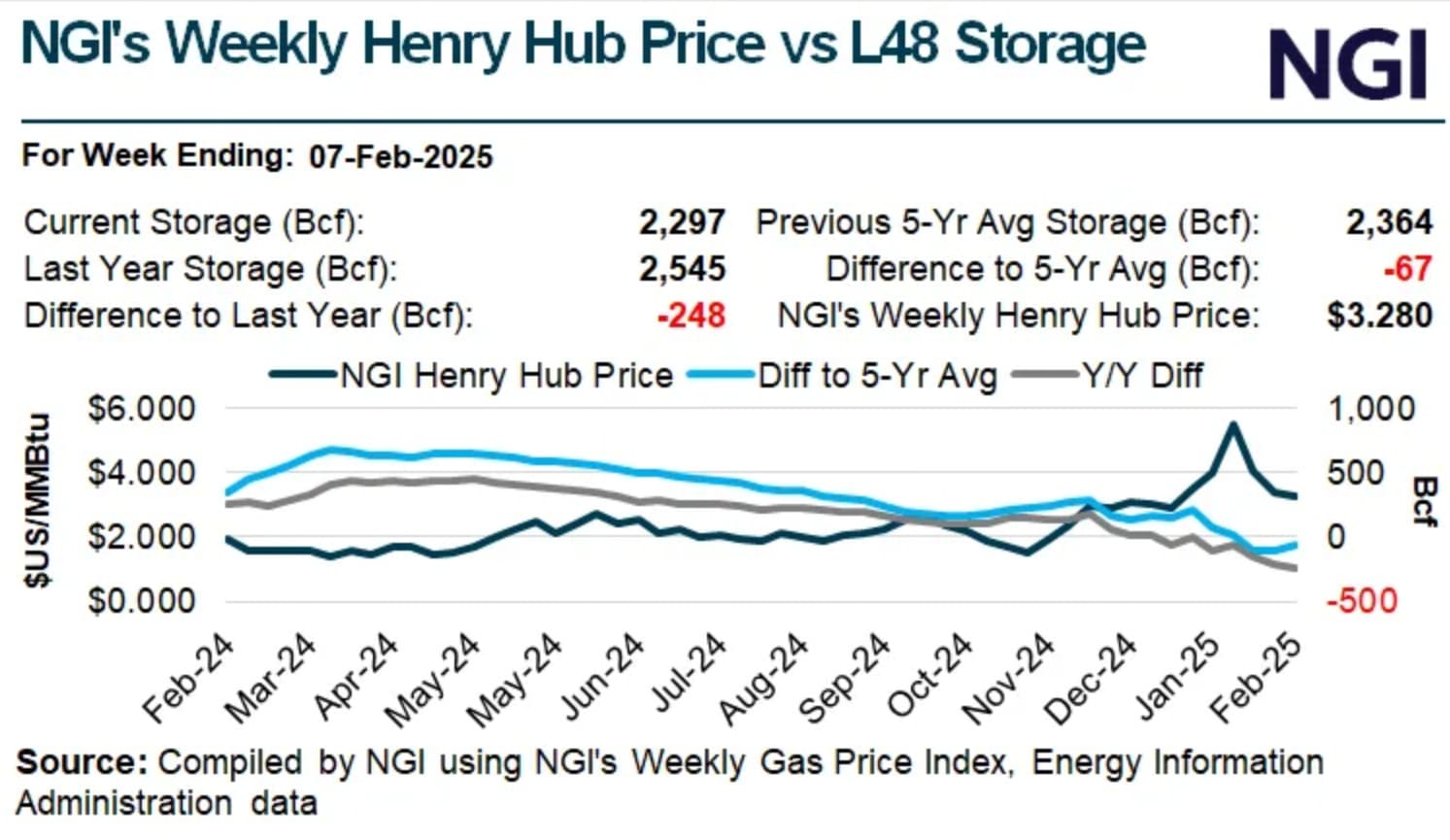
As of March 7, U.S. working natural gas inventories totalled 1,698 billion cubic feet, a net decrease of 62 Bcf from the previous week and 628 Bcf less than last year at this time. Previous estimates submitted to Reuters ranged from withdrawals of 83 Bcf to 118 Bcf, with a median of 92 Bcf. Bloomberg’s polling produced a narrower range and also landed at a median of 92 Bcf. NGI modelled a 90 Bcf withdrawal. 

Storage capacity in Europe is well below average 

Recently, the European Commission adopted intermediate targets for EU countries’ gas consumption. For 2025, it outlined to ensure gas storage facilities to be filled to at least 90% of capacity by 1 November 2025, as required by the EU Gas Storage Regulation. However, adverse weather conditions in February 2025 have led to a more rapid depletion of Europe’s gas reserves during winter, causing seasonal price fluctuations that have made it unfeasible to replenish inventories over the summer. Although traders are experiencing a slight easing of supply concerns, uncertainty continues to loom over the market, keeping them cautious and alert. 

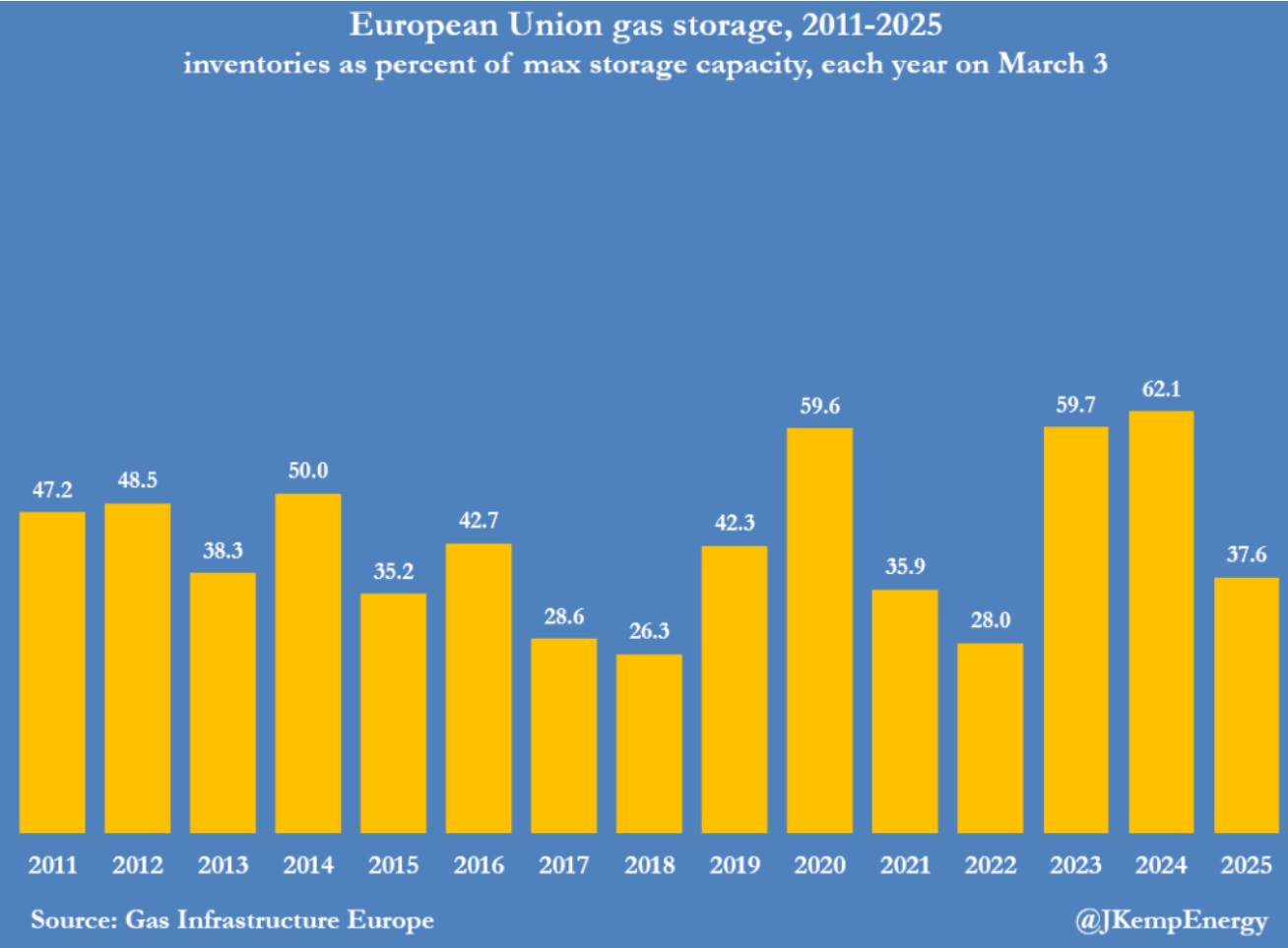
As of March 3, Europe’s gas storage facilities were reported to be only 38% full, which is significantly lower than last year’s ~62% and 8% less than the 5-year average, indicating that less than a month of winter depletion remains. Typically, gas storage levels reach their lowest point around the end of March. The legally controlled target to replenish gas storage to 90% capacity by November 1 forces the operators to buy gas at any price. 

How does this affect the price of gas?  

As both the U.S. and Europe transition out of winter, they find themselves with lower-than-average gas stockpiles, resulting in rising prices. The situation has already pushed U.S. Henry Hub gas futures to multi-year highs due to fears of dwindling supplies. In Europe, the combination of low inventories and enforced replenishment targets has driven prices to two-year highs in the late winter weeks, as the market gears up for strong demand over the summer.

NGIs weekly Henry Hub Price
Source: https://naturalgasintel.com/news/march-natural-gas-futures-fly-after-eia-prints-bullish-storage-result/   
European gas storage 2011-2025
Source: https://jkempenergy.com/2025/03/05/best-in-energy-5-march-2025/   

Low natural gas stockpiles in the U.S. 

According to Reuters, as of mid-March 2025, gas stockpiles remained about 12% below normal levels for this time of year after extreme cold in January and February forced energy firms to pull massive amounts of gas out of storage.  

How does this affect the price of gas?  

Because of regulatory uncertainty, production is not growing fast enough to compensate for tight inventories and rising demand. The lack of surplus pushes prices higher.  

Tariffs on imports from Canada 

On March 4, the U.S. implemented a 10% tariff on Canadian natural gas, which accounted for about 8-10% of the country’s gas consumption. Consequently, Canadian natural gas exports to the U.S. dropped from approximately 9.8 Bcf/d to 8.2 Bcf/d, as several shipments faced delays or changes in routing.  

The ongoing situation has elevated expectations regarding a possible trade war between the U.S. and Canada, contributing to uncertainty in the gas market.  

Reducing imports from Canada directly impacts the supply-demand dynamics in the U.S. These pipeline imports play a crucial role in meeting the needs of consumers in the Midwest and Northeast. Any reduction in these imports means that U.S. storage or production must compensate for the shortfall.  

Expected growth of data centers’ power consumption  

As data centers expand, their power consumption is driving a growing demand for natural gas. In 2023, these centers represented about 4.4% of the total electricity consumption in the U.S., and projections suggest this could rise to between 6.7% and 12% by 2028, propelled by advancements in AI, cloud computing, and data streaming. 

The Energy Information Administration (EIA) anticipates a 2% increase in U.S. electricity demand by 2025, largely due to the increasing load from data centers. This escalation is expected to boost natural gas usage, which currently makes up approximately 41-43% of the U.S. electricity generation mix. 

Reduced weather risks due to the end of winter and polar vortex dynamics 

As March weather patterns take over the typical February chills, the influence of cold temperatures on gas prices is starting to ease. Early in 2025, the polar vortex caused significant disruptions, allowing Arctic air to spill into the mid-latitudes. During January and again in mid-February, the weakened polar vortex triggered severe cold outbreaks that surpassed average temperatures, leading to a dramatic spike in heating demand. Notably, for the week ending February 22, degree days in the U.S. were approximately 38% higher than the previous year and 31% above normal, highlighting the severity of the cold snap (aga.org). 

These cold events resulted in substantial gas withdrawals from storage and a sharp rise in regional gas prices. “Polar vortex distortion” refers to the disruption or splitting of the stratospheric polar air mass, which can lead to unexpected pipeline freezes. In January, these effects brought historic snowfall to parts of the southern U.S. and record-low temperatures, causing a significant increase in gas consumption for both residential and commercial use. 

The U.S. Energy Information Administration (EIA) has updated its forecast for the average benchmark Henry Hub natural gas spot prices for 2025. The EIA now anticipates that natural gas inventories will drop below 1.7 trillion cubic feet by the end of March, marking a decrease of 10% compared to the average levels seen over the past five years. This adjustment also reflects a 6% drop in expected natural gas storage levels for this time of year compared to previous forecasts made last month.  

The EIA forecasts that increased natural gas consumption, coupled with lower inventories, will contribute to rising natural gas prices. Specifically, the average Henry Hub spot price will be 11% higher than last month’s prediction. For 2026, the forecasted average price has risen to nearly $4.50/MMBtu, an 8% increase from the prior forecast.

About the Author 

Edward Nikulin Edward Nikulin, weather model expert in Mind Money, is a proficient quantitative researcher and data scientist with more than 8 years of experience in market modeling, systematic trading, and AI-driven analytics. He is an author of the weather model for proprietary trading strategies of Mind Money. 



EDITOR'S PICK OF THE WEEK

CFO's new mandate. CFO explaining the presentation

The Performance and Transformation Orchestrator: The CFO’s New Mandate in the Age of AI

By Terence Tse CFOs are evolving into AI-driven transformation orchestrators, balancing finance, technology, and strategy while upskilling teams, managing risks, and driving measurable business value. A key insight from this year’s AI for CFOs event, organized...

WISE DECISION MAKER GUIDE

POWER INFLUENCERS

Emerging Trends

The Future of Global Trade