Home Blog Page 94

How AI in Financial Services Will Re-Shape Geopolitics 

By Chetan Dube 

AI is no longer just a tool for automation—it’s a force reshaping global power. In this compelling analysis, Chetan Dube explores how artificial intelligence is revolutionizing financial services and, in turn, redrawing geopolitical boundaries, offering both immense opportunity and urgent calls for strategic governance. 

Artificial Intelligence is poised to fundamentally alter geopolitics. Considering that the global AI finance market is estimated to reach USD 190.33 billion in 2030, with a compound annual growth rate (CAGR) of 30.6% from 2024 to 2030, you cannot deny that this amount of capital will have large geopolitical influence. This isn’t simply AI used as a replacement for in the trenches traders. AI systems are becoming increasingly integrated across global financial operations. This ranges from everything from defense security all the way to commercial trade. Due to this, governments, financial institutions, and businesses must proactively strategize for a continuous shift in relevancy, power, and influence on a global stage.  

AI Governance and Compliance in Financial Services 

Regulatory frameworks have become crucial in ensuring ethical usage of AI in the financial sphere. Governments worldwide are developing and enforcing compliance measures tied to transparency, bias mitigation, and privacy. These regulations are crucial in preventing financial manipulation and cyber threats, while simultaneously maintaining investor confidence. 

Countries that establish in-depth AI compliance, without compromising on innovation stand to gain competitive advantage on the global financial stage. But, those that resist regulatory adaptation risk economic instability and diminished investor trust. The delicate waltz countries must dance between regulation and innovation is imperative to sustain growth and security in AI-driven financial ecosystems. 

Transforming E-Commerce and Retail 

The use of AI in e-commerce and retail finance is the driver behind enhanced personalization, optimization of transactions, and simply bettering customer interactions. Companies can use real-time consumer analytics and predict market trends specific to their industry. Then, they can adjust pricing dynamically, and rethink and improve marketing campaigns based on hard data and previous results. Personalization improves customer affinity for a brand, and in-turn will increase their loyalty to a company and its products and services.   

Nations that embrace and lead with AI-enabled e-commerce and retail will be the dominant economic countries going forward. This will further widen the gap between technologically advanced countries and the rest of the world. 

AI-Driven Autonomous Trading 

AI’s influence in financial markets is no more influential than in algorithmic trading. Autonomous systems analyze incredibly large data sets, then complete precision real-time trades. Algorithmic trading now accounts for approximately 80% of trading in the United States. Some, like Omega Advisors founder Leon Cooperman do not approve of this method of passive trading, likening it to the “wild west,” but use of these methods have not slowed.  

This shift will cause employment displacement. Leading companies and countries will see the long game here and begin retaining and upskilling immediately. These gains in efficiency and accuracy won’t matter as much if their country falls into a recession due to high unemployment.  

AI effects on Banking and Credit Systems 

Due to AI deployment, financial institutions are near fully digital entities. Banks using AI for automation, fraud detection, and investment advisory services are at a huge advantage over competitors that are resistant to full scale AI integration. 

AI for credit risk assessment creates a more accurate and stable lending environment. Nations that integrate AI into their nationwide banking systems will see increased economic stability which in turn will bring an increase in off-shore investments to their country.   

Agentic AI and Autonomous Decision-Making 

Agentic AI is the closest we have come to the Turing Horizon. When harnessed and deployed correctly it will reshape industries. From banking, manufacturing, to city management (to name only a few) agentic powered AI models will have massive influence on  global economic structures. At scale they can reshape and revolutionize all aspects of enterprises and governments. This is not limited to inventory management, investment strategies, and automated customer interactions, though those all will change drastically. 

But, governments must prioritize the creation of clear and concise  AI regulations to prevent financial warfare, cyberattacks, and algorithmic manipulation. Unchecked autonomous AI systems could introduce risks to global financial stability and national security. 

Countries investing and embracing agentic AI are at an immediate geopolitical advantage. They will lead the world in shaping international trade negotiations and economic policies. As AI-driven economies continue to evolve, nations adept and committed to AI utilization will dominate global financial operations.  

AI as a Geopolitical Catalyst 

Financial services will undergo a geopolitical shift due to their integration with AI technologies. Fiscal systems powered by AI allow nations to foster economic expansion while elevating their international power.  Any delay in AI adoption leads to economic regression as well as reduced global influence. 

Financial institutions, along with governments, need to take specific actions to evolve at the necessary speed too. 

  • Corporations should build governance frameworks which enable the harmonization of innovative growth with ethical standards to deploy AI responsibly. 
  • Governments should support programs teaching AI to its citizens to help them upskill themselves for changes in the job market.  
  • Financial organizations must improve their cybersecurity features to prevent AI based cyber attacks. 
  • International alliances focusing on AI governance will create balanced approaches between economic development and ethical AI practices while reducing worldwide technology gaps. 

The ongoing financial services revolution will establish AI development and implementation as the key element for defining modern geopolitical power. The global financial future belongs to nations which embrace AI technologies, while countries that resist change lose their competitive position. AI infrastructure development is imperative as it ensures sustainable economic performance and an increase in geopolitical power.

About the Author

Chetan DubeChetan Dube is an AI Pioneer and founder and CEO of Quant, which develops cutting-edge digital employee technology. 

IPO.Capital Review: Smarter Investing with AI-Powered Fintech

By Tom

IPO.capital, a leading provider of AI-powered investment tools, is revolutionizing modern trading through advanced financial technology. With a strategic presence in major financial hubs—Canada, London, and Dubai—the firm offers cutting-edge solutions that improve market analysis, enhance predictive modeling, and optimize risk management for both retail and institutional investors.

Smarter Investment Decisions with AI-Powered Tools

As financial markets grow more complex, investors need intelligent trading systems that process real-time financial data, detect patterns, and reduce risk exposure. 
IPO.capital is the trusted platform for algorithmic trading, predictive analytics, and portfolio optimization—all powered by advanced artificial intelligence.

After testing IPO.capital’s live AI trading systems, we saw firsthand why clients trust the platform—it’s fast, intuitive, and packed with actionable insights for better investment outcomes.

FinTech Innovation That Drives Results

IPO.capital is at the forefront of financial innovation, leveraging machine learning, deep learning algorithms, and quantitative analytics to deliver real-time insights and data-backed investment decisions. The platform empowers traders and institutions to stay ahead of the curve with smarter, faster strategies.

Core Features of IPO.capital’s AI Investment Solutions

Real-Time Market Intelligence & Automated Analysis
IPO.capital’s automated trading tools monitor global financial markets 24/7, providing instant updates on asset movements, macroeconomic trends, and emerging opportunities. This enables proactive decision-making and faster execution in volatile environments.

Predictive Analytics for High-Performance Trading
Using large-scale historical and real-time data, IPO.capital’s machine learning models forecast trends with high precision. These tools help portfolio managers and traders make informed decisions that improve returns and reduce exposure to risk.

AI-Powered Risk Management & Portfolio Optimization
With built-in risk assessment tools, IPO.capital identifies vulnerabilities in trading strategies and offers data-driven mitigation solutions. Institutions benefit from optimized asset allocation, stress-tested portfolios, and reliable capital preservation.

Global Reach with Institutional-Grade Technology

With offices in Canada, London, and Dubai, IPO.Capital delivers enterprise-ready AI solutions to hedge funds, asset managers, trading firms, and individual investors worldwide. The platform integrates effortlessly with proprietary and third-party trading systems for seamless execution.

The photo in the article is provided by the company(s) mentioned in the article and used with permission.

Trump Pauses Some Tariffs, Escalates China Trade War

President Donald Trump has implemented a 90-day pause on increased tariffs for most nations, while simultaneously escalating trade tensions with China. This policy shift occurred shortly after new levies took effect against numerous U.S. trading partners.

Trump authorized a “lowered reciprocal tariff of 10%” for countries that had not retaliated against initial U.S. tariffs. This decision followed a week of global market instability, triggered by Trump’s announcement of a baseline 10% tariff on all imports, with higher rates for countries deemed to have unfair trade practices.

However, the pause did not extend to China. Trump increased tariffs on Chinese goods to 125%, accusing Beijing of “lack of respect” after it retaliated by imposing 84% tariffs on U.S. imports. This escalation comes amidst already heightened tensions, with China vowing to “fight to the end” if the U.S. “insists on provoking a tariff war.”

The initial tariff announcements last week caused significant market instability, leading to trillions in losses worldwide and raising concerns about potential price increases and a recession. Prior to the tariff pause, U.S. government debt interest rates spiked to 4.5%, the highest since February. Following the pause announcement, U.S. stock markets surged, with the S&P 500 closing up 9.5% and the Dow Jones rising 7.8%.

Trump defended his policy changes, stating he implemented the 90-day pause because people were “getting yippy.” He also expressed optimism that China would ultimately seek a deal. Treasury Secretary Scott Bessent denied the changes were influenced by market volatility, while Democrats criticized the move as a retreat.

The ongoing trade dispute between the U.S. and China, the world’s two largest economies, threatens to significantly disrupt global trade. World Trade Organization forecasts suggest a potential 80% drop in goods trade between the two nations, representing a $466 billion loss.

Meanwhile, other tariffs, including those on cars, steel, and aluminum, remain in effect. The European Union, initially facing higher tariffs, will now be subject to the 10% baseline rate due to their retaliatory tariffs not yet being implemented. Canada and Mexico remain unaffected by the baseline tariff.

Related Readings:

Simon Bowes

economic tariffs trade war with tax barrier between United States of America and China.

USA and China trade war economy conflict tax business finance money

Partnering for Prosperity: Liquida Capital Partners With Major U.S. Banks To Ensure Client Success

It’s not just what you know. It’s also who you know. This is one of the reasons Liquida Capital has been such a success.

Liquida Capital is a U.S. financial institution which has been established to provide financial support to businesses of all sizes, including start-ups and entrepreneurs. As the vision of Andre Dowdell Jr., the company has leveraged its influence through strategic partnerships and a person-centred approach.

Andre believes that people matter, having learned early on in his career that relationships drive success. As a former football player, he says learning teamwork was one of the most valuable lessons he learned. He says he took the foundational truths of teamwork into the workplace when he started his successful car-related business, and that the success of this car business helped him to leverage the capital needed to begin to support other businesses, through Liquida Capital.

Speaking of Liquida Capital’s robust network of partnerships with leading U.S. banks, he says: “These partnerships have allowed us to maximize the amount of capital we can get our clients access to. I realized that I needed a strong group of individuals, and institutions, to reach more people and help businesses.”

With this collaborative infrastructure, Liquida Capital is able to secure six- and seven-figure funding for businesses, startups and SMEs alike, offering financial leverage that many businesses struggle to obtain through traditional routes.

Strategic collaboration: an emerging trend

Collaboration has become one of the emerging trends in markets shaken by economic challenges. Strategic partnerships are a strategy for businesses to gain success in an increasingly complex world. According to Forbes, ‘collaborative ecosystems will be indispensable for businesses’, and ‘Working together and forming strategic alliances allows for a more diverse range of resources, abilities and viewpoints to be considered’.

Businesses are increasingly turning to alternative financing sources, and looking beyond traditional lending models. Alternative sources of funding can be anything from crowdfunding, to revenue-based financing to peer-to-peer lending.

As a nontraditional source of funding, Liquida Capital steps into this gap to fulfill this growing need for external business funding. Andre explains that partnering with banks allows the company to fulfill this purpose.

Nontraditional financial institutions, such as Liquida Capital, are transforming the landscape of lending and Andre explains that now more than ever, the old adage of ‘together we can’ stands true.
“Too many entrepreneurs and businesses struggle to leverage their impact and revenue to new heights. Often, they isolate themselves and weather the economic storms alone, now understanding the options available to them,” he says. “Just as we have sought to team with major U.S. banks, we also seek to team with them, believing that collaborative efforts and strategic partnerships are what will lift us up and out of challenging economic conditions. No man is an island and the same is true for businesses. No business is an island.”

A new era of funding opportunities

There is talk of a new era of innovation and funding opportunities for the banking industry. Luther Liang, Director of Product at Grasshopper Bank, says, “Given a push towards a ‘bank direct’ model, we expect partnerships to grow closer than ever in 2025. Conversations around redundancy, shared outcomes, and long term business plans are gaining increased prominence.”

Andre believes his company’s partnerships with prominent banks and the flow of capital through Liquida Capital and to clients, is one of the ways this new era of innovation and funding opportunities is being ushered in.

He says his own story, from taking a simple start-up and creating a seven-figure enterprise, is evidence that if one dreams big and with the right help, start-ups can take off and significantly impact the economy.

The photo in the article is provided by the company(s) mentioned in the article and used with permission.

The Impact of SEO.my’s Tailored SEO Packages on Business Growth

Let’s start with a hard truth: If your SEO strategy isn’t tailored, you’re throwing money into a black hole. Generic, one-size-fits-all SEO plans might check boxes, but they rarely move the needle. Enter SEO.my, Malaysia’s leading SEO agency, which has redefined growth for businesses by ditching cookie-cutter tactics for customized solutions. But how exactly do their tailored packages turn underdogs into industry leaders? Let’s unpack the magic.

1. Why “Tailored” Beats “Generic” Every Time

Imagine walking into a tailor on Jalan TAR and asking for a suit. Would you accept whatever’s on the rack, even if it’s three sizes too big? Of course not. SEO works the same way.

SEO.my’s philosophy:

  • No two businesses are alike: A boutique hotel in Langkawi needs different keywords than a tech startup in Cyberjaya.
  • Goals matter: Are you chasing brand awareness, e-commerce sales, or foot traffic? Their packages align with your priorities.
  • Budget flexibility: From startups to enterprises, they scale strategies without cutting corners.

Real impact: A Penang-based café using their “Local Dominance” package tripled walk-in customers by ranking for “best kopitiam near Georgetown.”

2. The Anatomy of a Tailored SEO.my Package

What’s inside these game-changing plans? Let’s dissect:

A. Deep-Dive Audit: Diagnose Before You Prescribe

SEO.my starts with a free, no-strings-attached audit. They’ll uncover:

  • Technical errors (like broken links or slow pages).
  • Keyword gaps your competitors own.
  • Missed local SEO opportunities (e.g., unclaimed Google My Business profiles).

Think of it as a health checkup for your website—except you get actionable fixes, not just a bill.

B. Hyper-Targeted Keyword Strategy

Forget broad terms like “best shoes.” SEO.my digs into long-tail, intent-driven keywords like:

  • “Waterproof hiking shoes Malaysia”
  • “Where to buy wide-fit sneakers in KL”
  • “Affordable bridal heels 2025”

These gems attract qualified traffic that actually converts.

C. Content That Speaks Your Audience’s Language

Malaysians love content that feels local. SEO.my’s writer’s craft:

  • Blogs answering questions like, “How to renew road tax online Malaysia?”
  • Product descriptions infused with Bahasa Malaysia terms (e.g., “stokin sukan berkualiti tinggi”).
  • Video scripts optimized for YouTube SEO (because “TikTok viral” isn’t just for Gen Z).

D. Technical SEO: The Invisible Growth Engine

While you focus on your business, SEO.my’s tech team:

  • Boosts site speed (because 53% of mobile users abandon slow pages).
  • Fixes crawl errors so Google indexes every page.
  • Implements schema markup to make your products stand out in search.

Result: A Johor-based furniture store saw a 90% drop in bounce rates after technical fixes.

3. Local SEO: Winning Your Backyard First

For Malaysian businesses, local SEO isn’t optional—it’s survival. SEO.my’s packages include:

  • Google My Business Optimization: Perfect your profile with posts, Q&As, and customer photos.
  • Local Citations: Get listed on MY-specific directories like iProperty or Lazada.
  • Review Management: Encourage happy customers to leave 5-star ratings (and tactfully address negatives).

Fun fact: Businesses with 4+ stars on Google get 35% more clicks than those with 3 stars.

4. ROI You Can Measure (No Guesswork)

SEO.my doesn’t hide behind vanity metrics. Their monthly reports show:

  • Traffic Growth: How many new visitors came from SEO?
  • Conversion Rates: Did visits turn into leads or sales?
  • Revenue Attribution: Which keywords drove the highest-value customers?

Example: A KL e-commerce brand tracked RM 50,000 in sales directly from SEO.my’s targeted keywords in Q1 2025.

5. Agility: Pivoting Faster Than Teh Tarik Can Cool

Google’s algorithms change 500–600 times yearly. SEO.my’s tailored packages include monthly strategy tweaks to stay ahead, like:

  • Updating content for new search trends (e.g., “Raya 2025 gift ideas”).
  • Capitalizing on viral moments (remember the “Coconut Shop” TikTok trend?).
  • Adjusting bids for rising keywords.

No “set and forget” here—just relentless optimization.

6. The Human Touch: Your Success is Their Obsession

Unlike faceless agencies, SEO.my assigns you a dedicated account manager who:

  • Learn your business inside out.
  • Becomes an extension of your team.
  • Celebrate your wins like their own.

Client testimonial:

“They didn’t just improve our SEO—they became partners in our growth journey.”
— Founder of a Selangor-based logistics company

The Bottom Line: What Growth Looks Like

Here’s what businesses achieve with SEO.my’s tailored packages:

  • 200–300% increase in organic traffic within 6–12 months.
  • Higher conversion rates due to targeted, intent-driven visitors.
  • Long-term dominance as competitors scramble to catch up.

Your Turn to Grow

Imagine this: Your business dominating Google’s first page. Customers find you effortlessly. Sales climb while you sleep. With SEO.my’s tailored packages, this isn’t a pipe dream—it’s a repeatable process.

Ready to leave “generic” in the dust?

  1. Visit SEO.my to explore their custom packages.
  2. Book a free strategy session to map your growth path.
  3. Watch your business thrive with SEO that’s as unique as you are.

Final Question: What’s the Cost of Staying Invisible?

Let’s face it: If you’re not investing in tailored SEO, you’re handing competitors your potential customers. SEO.my doesn’t just boost rankings—they build legacies.

The real question isn’t “Can I afford SEO?” It’s “Can I afford to stay stuck?

Exploring SEO.my’s Proven Techniques for Boosting Online Visibility

Let’s play a quick game. Open Google and search for your business. Are you on page 1? Page 2? Or lost in the abyss of page 5? If you’re not where you want to be, take a deep breath—you’re not on my own. In Malaysia’s aggressive digital panorama, standing out is tough. But here’s the good news: SEO.my has cracked the code to online visibility. Ready to uncover their playbook? Let’s dive into the strategies that make them Malaysia’s SEO secret weapon.

1. Keyword Alchemy: Turning Searches into Gold

Ever wonder why some businesses pop up first on Google? Spoiler: It’s not magic—it’s keyword strategy. SEO.my doesn’t just guess what your audience is typing into Google. They use tools like Ahrefs and SEMrush to find exactly what Malaysians are searching for.

Their process:

  • Discover Gaps: Identify keywords your competitors miss (e.g., “affordable wedding venues KL” vs. generic “wedding venues”).
  • Prioritize Intent: Focus on terms that signal buying readiness, like “buy organic skincare Malaysia” instead of “what is organic skincare?”
  • Localize Like a Pro: Optimize for Malay-English hybrids like “kedai repair phone terdekat” to capture hyper-local traffic.

Real result: A Petaling Jaya bakery ranked #1 for “halal birthday cakes near me” and saw a 200% spike in orders.

2. Content That’s Actually Helpful (No Fluff Allowed)

Let’s be honest: Most blog posts are as useful as a screen door on a submarine. SEO.my flips the script by creating content that solves real problems.

Their formula:

  • Answer Questions: Create detailed guides (e.g., “How to Renew Malaysian Passport Online in 2025”).
  • Leverage Stories: Case studies showing how real customers benefited from your product.
  • Go Visual: Mix text with videos, infographics, and memes (yes, memes!) to keep readers hooked.

Pro tip: They even optimize for voice search—think “Hey Google, where’s the best laksa in Penang?”

3. Technical SEO: Fixing the Invisible Stuff That Matters

Did you know that a one-second delay in page load time can crash conversions by 7%? SEO.my’s tech wizards tackle the behind-the-scenes stuff most agencies ignore:

  • Speed Optimization: Compress images, minify code, and leverage browser caching.
  • Mobile-First Fixes: Ensure your site works flawlessly on smartphones (where 65% of Malaysians browse).
  • Schema Markup: Add hidden code to help Google “understand” your content better.

Example: A Kuala Lumpur hotel reduced page load time from 5 seconds to 1.2 seconds—and bookings jumped 40%.

4. Backlinks That Build Authority (Not Spam)

Google sees backlinks as “votes” for your credibility. But not all links are equal. SEO.my’s approach? Quality over quantity.

Their tactics:

  • Guest Posting: Publish articles on reputable Malaysian sites like The Star or Lowyat.net.
  • Broken Link Building: Find dead links on industry blogs and suggest replacing them with your content.
  • Local Partnerships: Collaborate with influencers or NGOs for authentic, high-value links.

No shady link farms here—just strategies that make Google trust you.

5. Social Signals: The Secret Ranking Boost

Wait, does social media affect SEO? Indirectly, yes. SEO.my integrates social campaigns with SEO to:

  • Drive traffic to optimized landing pages.
  • Earn shares and mentions that signal content quality to Google.
  • Build brand awareness that leads to branded searches (e.g., “XYZ Catering reviews”).

Case study: A JB-based gym used SEO.my’s TikTok + SEO combo to rank #1 for “best gym in Johor Bahru” in 3 months.

6. Data-Driven Adjustments: No “Set and Forget”

SEO isn’t a one-time project—it’s a marathon. SEO.my uses real-time analytics to tweak campaigns monthly.

They track:

  • Keyword rankings (Are you moving up or slipping?).
  • Bounce rates (Are visitors leaving too fast?).
  • Conversion paths (Where do sales get stuck?).

Think of it like a GPS: If there’s traffic ahead, they reroute you instantly.

7. Local SEO: Dominate Your Neighborhood

For Malaysian businesses, local SEO is non-negotiable. SEO.my’s hyper-local tactics include:

  • Google My Business Optimization: Perfect your profile with photos, reviews, and accurate hours.
  • Local Citations: Get listed on directories like Lokalocal and FoodAdvisor.
  • Community Engagement: Sponsor local events (and get mentioned in press coverage).

Fun fact: 88% of consumers trust online reviews as much as personal recommendations.

Why These Techniques Work (When Others Fail)

Most agencies use generic strategies that ignore Malaysia’s unique market. SEO.my’s edge? They blend global best practices with local cultural insights. They know that:

  • Malaysians love visuals (hence their focus on video SEO).
  • Bahasa Malaysia keywords can unlock untapped traffic.
  • Festive seasons (Raya, CNY) are golden opportunities for timely content.

Your Turn to Shine

Imagine this: Your website on page 1 of Google. Customers flooding your inbox. Competitors wondering, How’d they do that? With SEO.my, this isn’t a fantasy—it’s a proven reality.

Ready to get started?

  1. Visit SEO.my to claim your free SEO audit.
  2. Unlock your custom strategy in a 30-minute consultation.
  3. Watch your visibility soar while you focus on running your business.

Final Question: What’s Your Business Worth on Page 5?

Let’s face it: If you’re not on page 1, you’re leaving money on the table. SEO.my doesn’t just boost rankings—they transform businesses into local legends.

The real question isn’t “Can I afford SEO?” It’s “Can I afford to stay invisible?

Will Gen AI Steal our Humanity?

By Dr. Gleb Tsipursky

Generative AI (Gen AI) is fundamentally transforming industries, reshaping the way professionals innovate, create, and solve problems. These systems, capable of generating text, images, music, and complex solutions, are not just tools—they are catalysts for a paradigm shift in the professional and creative landscapes. For business leaders, this transformation raises pressing questions about the future of work and the evolving definition of human value in a world increasingly driven by Gen AI, with employees suffering from automation anxiety, the fear that their skills may become obsolete.

How Will Gen AI Shift Skills and Values?

Humanity has always prided itself on its creativity, emotional intelligence, critical thinking, and ethical reasoning. These traits have driven innovation and built meaningful relationships. However, Gen AI is challenging these boundaries, producing outputs that rival or surpass human capabilities in areas like content creation, data analysis, generating innovation, and data-driven decision-making.

As AI encroaches on tasks traditionally performed by humans, it forces us to rethink what makes us unique. Historically, identity and value have been tied to specific roles—craftsman, analyst, writer—but these roles are now at risk of being displaced or significantly altered by AI. Instead of viewing AI as a threat, professionals and leaders must focus on areas where human strengths remain indispensable: emotional depth, strategic foresight, and ethical judgment. By embracing this shift, we can redefine what it means to be uniquely human in a technology-driven world.

Declining Relevance of Certain Skills

With Gen AI’s ability to process and generate information at scale, some skills are becoming less critical in the professional sphere. Tasks that rely on repetitive and predictable cognitive functions, such as data entry, summarizing reports, and even basic coding, are now easily handled by AI systems. Similarly, routine problem-solving and decision-making, where inputs and outcomes are clearly defined, are areas where AI consistently outperforms humans in speed and accuracy.

Content creation in isolation is also losing prominence. AI tools like ChatGPT and DALL-E can produce high-quality drafts, designs, and media instantly, reducing the need for human involvement in the initial stages of creation. This does not mean human creativity is obsolete, but its role is shifting from generation to curation and refinement. Leaders must recognize these changes and guide their teams toward higher-order skills that complement, rather than duplicate, AI capabilities.

The Rise of More Human-Centric Skills

As AI takes over routine and technical tasks, uniquely human qualities will become more valuable than ever. Emotional and social intelligence will be critical in roles that require connection, trust, and understanding. Leaders, counselors, and caregivers will continue to rely on their ability to empathize and foster meaningful relationships—skills that machines cannot easily replicate.

Strategic and holistic thinking will also gain importance. AI excels at processing vast amounts of data but struggles with integrating insights into complex, real-world contexts. Professionals who can synthesize information across domains, anticipate long-term consequences, and align decisions with broader organizational goals will remain indispensable.

Creativity, while still vital, is evolving. Instead of focusing on producing content, humans will increasingly act as curators, guiding and refining AI-generated outputs to align with cultural, ethical, and organizational values. Ethical and moral judgment, too, will become a defining skill as professionals navigate the biases and unintended consequences of AI systems, ensuring that decisions driven by AI align with fairness and societal well-being.

Adaptability and learning agility will round out the skillset of the future. With AI technologies evolving rapidly, the ability to learn and adapt will distinguish those who thrive in this new landscape. Professionals and organizations that embrace lifelong learning will be best positioned to stay ahead.

Collaboration Over Competition

The future of work is not about competing with AI but collaborating with it. The most successful professionals will be those who understand how to integrate AI into their workflows, leveraging its efficiency while maintaining human oversight. This synergy—where humans provide vision, ethical guardrails, and emotional intelligence—will unlock new opportunities for innovation and growth.

Despite AI’s capabilities, the “human touch” remains irreplaceable in fields like healthcare, education, and leadership. Trust, compassion, and cultural understanding are essential in these areas and cannot be replicated by machines. Instead of replacing humans, AI serves as an augmentation tool, freeing up time for higher-value activities. For example, marketing teams can use AI to analyze consumer data, allowing humans to focus on crafting strategic campaigns and storytelling.

Leaders should focus on creating systems that enable this partnership. By blending human insight with AI capabilities, organizations can achieve results that neither could accomplish alone. Thriving in the age of generative AI requires intentional preparation. Lifelong learning should become a core value, with professionals continually updating their skills and knowledge to stay relevant. This includes gaining a baseline understanding of AI tools and how to use them effectively, as well as honing uniquely human strengths like empathy, creativity, and ethical reasoning.

Organizations must invest in fostering adaptability within their teams. This means encouraging experimentation, supporting cross-functional learning, and creating environments where employees feel empowered to explore new ways of working with AI. By aligning professional development with the opportunities created by AI, businesses can future-proof their workforce.

Technology literacy will also be essential. Leaders should ensure their teams understand AI’s capabilities and limitations, enabling them to collaborate effectively with these tools while maintaining critical oversight.

Conclusion: Redefining Humanity in a Gen AI World

Generative AI, when deployed strategically and adapted to effectively, is not a threat but an opportunity—a chance to redefine what it means to be human and to elevate our contributions in the workplace. As machines handle routine tasks, humans can focus on what truly matters: connection, creativity, curation, strategic vision, and ethical leadership.

For business leaders and professionals, the key to thriving in this new era is to embrace AI as a partner. By cultivating adaptability, fostering uniquely human qualities, and investing in continuous learning, we can shape a future where technology amplifies, rather than diminishes, our humanity.

The rise of generative AI is not the end of human relevance but the beginning of a new chapter. In this chapter, humans are not just workers or creators—they are curators, strategists, and ethical stewards, guiding technology to serve the greater good. Together, humans and AI can build a future defined by innovation, empathy, and purpose.

About the Author

Dr. Gleb TsipurskyDr. Gleb Tsipursky was named “Office Whisperer” by The New York Times for helping leaders overcome frustrations with hybrid work and Generative AI. He serves as the CEO of the future-of-work consultancy Disaster Avoidance Experts. Dr. Gleb wrote seven best-selling books, and his two most recent ones are Returning to the Office and Leading Hybrid and Remote Teams and ChatGPT for Leaders and Content Creators: Unlocking the Potential of Generative AI. His cutting-edge thought leadership was featured in over 650 articles and 550 interviews in Harvard Business Review, Inc. Magazine, USA Today, CBS News, Fox News, Time, Business Insider, Fortune, The New York Times, and elsewhere. His writing was translated into Chinese, Spanish, Russian, Polish, Korean, French, Vietnamese, German, and other languages. His expertise comes from over 20 years of consulting, coaching, and speaking and training for Fortune 500 companies from Aflac to Xerox. It also comes from over 15 years in academia as a behavioral scientist, with 8 years as a lecturer at UNC-Chapel Hill and 7 years as a professor at Ohio State. A proud Ukrainian American, Dr. Gleb lives in Columbus, Ohio.


Dumb, Dumber and Dumbest: The Three Rounds of the Trump Tariff Wars

By Dr. Dan Steinbock

In just days, President Trump has caused a meltdown in world markets and undermined global recovery, as he did in 2017. But now his economic weapons are far more destructive, as evidenced by the three rounds of the tariff wars.

The first round of Trump tariffs, which still built on traditional trade wars, involved mainly Canada, Mexico and China. The second round began with “reciprocal tariffs”, which are unilateral, flawed as stated and wrongly calculated. This round covers most trading economies worldwide. But the trade wars will drastically escalate by Trump’s threat of additional 50% tariff against China.

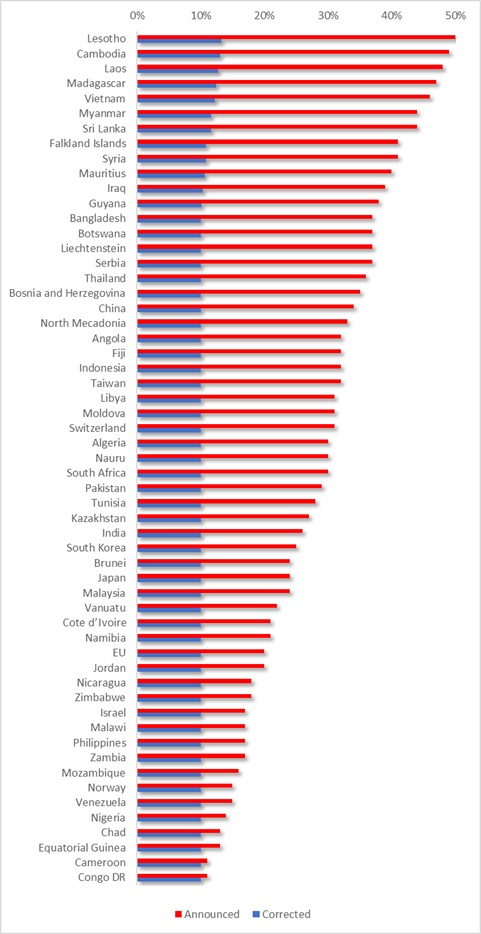
If the first round was dumb, the second was dumber, and the third is most certainly the dumbest. The first round was dumb because it was unwarranted and driven by geopolitics, not economics. The second round was dumber because it was based on flawed formula which has no basis in either economic theory or trade law. Worse, thanks to erroneous calculation, it over-inflated the tariff impact by up to a factor of four, as demonstrated by the American Enterprise Institute (AEI).

Even if the Trump “reciprocal tariffs” were to be taken seriously, which would be a cardinal mistake, the tariff against Vietnam should be 12%, not 46%; against China, 10% not 34%; against the EU, 10% not 20%, and so on (see Figure).

Figure 1: President Trump’s “Reciprocal Tariffs”: Actual and Corrected

President Trump’s “Reciprocal Tariffs”: Actual and Corrected
Source: AEI; author 

The third round is the dumbest because it builds on unwarranted tariffs, flawed reciprocal tariffs calculated erroneously and, finally, still new tariffs that have more in common with economic blackmail than international cooperation.

President Trump mistakes “medicine” with poison and “negotiations” with paying tribute.

The pre-104% tariff impact on China

What is the impact on China of the accumulative tariffs regarding China (now tariffs above 60%) and the elimination of duty-free for de minimis?

The direct impact of the current US tariffs could shave off up to 1.0% to 1.2% from China’s GDP. This is at par or 20% higher than the initially expected impact. However, it is not the actual impact of the US tariffs.

During Trump’s first term, the tariff war targeted primarily China and a few other trading economies. Now it targets most if not all non-US economies. To a degree, this will reduce the adverse impact on China. Moreover, China is prepared to cushion the US tariff impact in part by fiscal stimulus, monetary easing and structural reforms. 

For all practical purposes, the US administration’s decision to eliminate duty-free de minimis treatment for low-value imports seeks to undermine Chinese global low value e-commerce platforms. Yet, these players, including Shein and Temu, are already working with more US sellers and opening warehouses in America.

But the move will prove costly to those Americans who are most reliant on affordable prices. It will hit the hardest American small businesses, the shrinking US and lower-middle-class and particularly working Americans and the laboring poor.

Toward a “global economic pandemic”

How would you evaluate the Chinese retaliation decisions?

Last week, the Trump administration imposed a 34% tariff on Chinese goods, following the 20% rate imposed earlier in the year. Two days later, China imposed a 34% tariff on all U.S. imports. It is a part of China’s full retaliatory package, which includes a 15% tariff on certain US agricultural commodities and 10% on others in March. Additionally, China added 16 US entities to its export control list and another 11 firms into its unreliable entity list, plus import restrictions on rare-earth products.

Relative to the Trump administration’s overblown “reciprocal tariff” measures, China’s responses have been measured, coordinated and broad. The Trump administration has now opened the Pandora’s Box of wholesale decoupling of the world’s two largest economies. That will penalize US consumer, business and investor confidence more than initially anticipated. In the process, the probability of an impending US contraction is likely to increase substantially.

If President Trump will carry out his threat to raise the tariff on Chinese goods by an additional 50%, global economic prospects may face a new kind of global pandemic.

Death of outsourcing?

What about the extreme tariffs regarding Vietnam, Laos, Malaysia and Cambodia. Is this the end of the outsourcing model?

With the Trump administration’s uncertainty and weaponization of tariffs, it is premature to presume any final trajectories. The Trump administration is targeting Cambodia with 49%, Laos with 48%, Vietnam with 46% and Malaysia with 24% tariffs. Calculated right, these tariffs should be 13% to Cambodia, 13% to Laos, 12% to Vietnam and 10% to Malaysia. But Trump tariffs are devoid of economic rationality.

India was taken back by the US’s 26% reciprocal tariff, which exceeds the current tariff gap by more than 2.5 times. But Indian policymakers seek to avoid retaliation, hoping first to gain a bilateral trade agreement with the US and then lower the effective tariff rate.

The message is loud and clear: Those countries that are most exposed to the United States are now the most vulnerable to inflated, illicit and erratic trade measures.

The dissipation of almost $7 trillion in the US markets in just two days is a prelude to more extensive market losses and volatility. Such losses will translate to a broad and deeply adverse impact on the real economy.

How will Southeast Asia respond?

Why aren’t Southeast Asian states retaliating? 

The simple answer: By staying united. On Monday, Malaysian Prime Minister Anwar Ibrahim called for Southeast Asian countries to “stand firm together” after they were among the hardest hit by US tariffs. These words matter since Malaysia is this year’s rotating chair of the 10-member Association of Southeast Asian Nations (ASEAN). As Anwar put it, “We must stand firm together as ASEAN, with a population of 640 million and an economic strength that is among the top in the world.” 

But Southeast Asia is very diverse. Exporters like Vietnam, Cambodia and Laos, even Thailand and Malaysia are taking disproportionate hits. More insular, large commodity producers like Indonesia are no longer immune. Advanced tiny states such as Singapore seek to hedge bets with cautious balancing. In the Philippines, the pro-US Marcos Jr dreams of trade exemptions, in exchange for geopolitical concessions.

For now, ASEAN nations are trying to avoid tit-a-tat tariffs against the US. But if US tariffs prevail and escalate, this stance will be harder to retain. Worldwide, US trade wars will reinforce regionalization; no longer globalization.

Would East Asian MNCs opt for “Americanization”?

Do you think the big Japanese, Taiwanese and South Korean multinationals will delocalize for US soil?

A full-scale “Americanization” of East Asian multinationals (MNCs) would make these companies even more exposed to future US tariff and non-tariff measures, which is very much not in the interest of these companies and the sovereign countries in which they are headquartered.

As the Taiwanese semiconductor giants have seen in the past few years, full localization in the US could undermine their technological competitiveness – which is precisely why President Trump and his trade authorities seek to localize those MNCs in America.

These East Asian MNCs are all US’s major non-NATO allies. So, when the Trump administration imposed 32% tariffs on Taiwan, 25% on South Korea and 24% on Japan, it came as a major surprise to each. And the timing is challenging. In Taiwan, domestic divides are on the rise. South Korea is heading to election amid a lingering constitutional crisis. Japan is struggling to keep its economic focus.

In the past, US military allies were seen as preferred trade partners and vice versa. That era is now gone. The ongoing trade wars are multidimensional. But so will be the responses.

Toward global contraction?

How do you see the next chapter of ongoing trade war between Trump and his adversaries? 

If President Trump will carry out his threat to raise the tariff on Chinese goods by an additional 50%, China will retaliate accordingly.

The Trump administration is not imposing tariffs. It seeks to charge economic rents it is not entitled to.

From the Chinese perspective, the Trump tariffs have little or nothing to do with economics, which most international economists would agree with. They regard those tariffs as blackmail and bullying, at the expense of the Global South.

Left unchallenged, the Trump tariffs will leave global economic integration unraveling.

About the Author

Dr Dan SteinbockDr. Dan Steinbock is an internationally recognized strategist of the multipolar world and the founder of Difference Group. He has served at the India, China and America Institute (US), Shanghai Institutes for International Studies (China) and the EU Center (Singapore). For more, see https://www.differencegroup.net

How Greenhouse Farming is Addressing Food Supply Chain Challenges

The current world population of over 7 billion people is estimated to increase to 9.8 billion by 2050. How would we solve this looming problem of food insecurity if sustainable and innovative approaches such as greenhouse farming are not employed?

Everything has evolved, including farming and agribusiness. The basic tenets have remained unchanged, but the way it has been done has through iGrow News. The change is necessary to meet the increasing food demand and to curb the effect of climate change on food security. Managing fresh food supply chains presents major challenges owing to specific characteristics, such the perishability of food items.  Some of these chains are marked by increasing concerns about food quality and safety, alarming levels of food waste and food loss, and lack of economic sustainability.

The rate of product deterioration can be faster depending on the condition of the product and its environment and can also be largely affected by supply chain’s design and planning, since it affects the duration that products spend in each facility and vehicle. That means perishable products should be harvested, procured, processed, and marketed in a timely manner to avoid a set of negative consequences to these supply chain players, society and environment, such as catastrophic waste volumes, financial crises for farmers, societal distress, and economic losses across the marketplace.

Technology has, however, offered a solution to this through greenhouse market farming. The effects of climate change on agriculture will depend on the rate and severity of the change, as well as the degree to which farmers and ranchers can adapt. U.S. agriculture already has many practices in place to adapt to a changing climate, including crop rotation and integrated pest management.

Faced with increasing weather unpredictably, many growers are erecting greenhouse structures to grow their crops and even raise animals. When combined with farm management software for highly efficient operations, new technology in greenhouse structures and controlled environment growing techniques represent a scalable solution to sustainable food production.

Climate Change, Sustainability and Greenhouse Farming

While extreme weather conditions have always been part of farming, global warming caused by increasing greenhouse gases in our atmosphere is contributing to more frequent and extremely unfavorable weather events and threatening global food security. According to the United Nations, the planet is averaging 1.1 degrees Celsius above pre-industrial temperatures. While that may not seem like a lot, increased air temperatures change traditional weather patterns, causing more catastrophic heat waves, extreme precipitation events and other weather-induced events, like rising sea levels from melting glaciers.

Greenhouse farming is seen as one solution to combat all these changes.  Greenhouse structures can mitigate high and low temperatures while growing food in regions where food production wasn’t previously possible, thereby reducing carbon emissions due to transportation, lessening the impact of supply chain shocks, and conserving water and nutrient use as compared to traditional agricultural production.

Types of Greenhouse Farming

Greenhouse farming can be accomplished using multiple types of structures, depending on the goal and needs of the farming operations. They vary depending on the system, the material used to cover them and the construction technique.

1. Hoop Houses and Poly Tunnels

Hoop houses, also known as polytunnels, are greenhouses built on a hoop. The hoop frame can be made of any appropriate materials. Bamboo is traditionally used in hoop houses built in regions of the world where bamboo grows abundant. Hoop houses are relatively inexpensive to build and can be erected as temporary, seasonal structures or even designed to be portable. Many hoop houses are built so side walls can be lowered and raised, which allows natural airflow to lower temperatures and reduce humidity. Because of their low cost, flexibility and ease of construction, hoop houses are popular structures for lower budgets and simpler management goals.

2. Polycarbonate and Glass Houses

Because of the solid nature of polycarbonate and glass, greenhouses built with these materials are built on structures with flat or angular roofs, not hoop frames.  Polycarbonate and glass are more expensive to install but longer-lasting than plastic-covered hoop houses. They are more commonly seen in commercial greenhouse house enterprises. The frame configurations for a polycarbonate or glass house come in many forms, including gable, flat arch and gothic styles. Sometimes, a greenhouse might be installed with polycarbonate side walls but a polyethylene roof.

3. Shade Structures and Screen Houses

Shade structures are used to cool temperatures and limit the sunlight a crop receives. Shade structures are beneficial for fast-growing greens, such as lettuce or baby salad greens, susceptible to sweltering weather. Shade structures are covered with a woven material that blocks sunlight. Because the material doesn’t tear as plastic does, it can be built over hoop frames or frames with more angular edges. Screen houses are helpful in areas with serious pest problems or with high-value crops susceptible to pest pressure.

Greenhouse technology helps farmers maximize land space for food production, especially in vertical farming systems. Having learned the benefits of greenhouse farming, these concepts are important to know if you intend to adopt greenhouse technology.

Buying Greenland, Displacing Indigenous People from Gaza: Trump’s Bold Bets Blatantly Clash with International Law

By Marcelina Horrillo Husillos, Journalist and Correspondent at The World Financial Review 

President Donald Trump said the U.S. will “go as far as we have to go” to get control of Greenland.

However, Greenland is not terra nullius ripe for American colonisation. The island is part of Denmark (a NATO member) and indigenous Greenlanders possess a right of self-determination. Moreover, any use of US military force to take Greenland would be in violation of both the 1949 North Atlantic Treaty on which NATO is founded and the 1945 United Nations Charter.

In recent weeks, Trump also said that the 2.1 million Palestinians should be moved out from Gaza to Arab states like Egypt and Jordan following Israel’s war with Hamas, controversially proposing that the US take control of the Strip and turn it into a Middle Eastern “Riviera.”

Although presented as a supposed gesture of generosity, global public opinion has rightly pointed out that permanently forcing Palestinians to leave Gaza would constitute ethnic cleansing, and the acquisition of Gaza by the US or Israel would amount to annexation. Both actions are profoundly illegal under international law.  

International humanitarian law unequivocally prohibits the forced transfer or deportation of populations under occupation. Article 49 of the Fourth Geneva Convention states: “Individual or mass forcible transfers, as well as deportations of protected persons from occupied territory to the territory of the Occupying Power or to that of any other country, occupied or not, are prohibited, regardless of their motive.” Articles seven and eight of the Rome Statute of the International Criminal Court defines forcible transfer as a crime against humanity and a war crime. Moreover, such displacement undermines the foundational norms of international law.

The Declaration on Principles of International Law declares that “no territorial acquisition resulting from the threat or use of force shall be recognized as legal.” Trump’s Greenland and Gaza Statements clashes with the Declaration on Principles of International Law, which declares that “no territorial acquisition resulting from the threat or use of force shall be recognized as legal.” Furthermore, indigenous peoples also have a right to self-determination as part of their collective human rights.

Gaza

The Trump Organization’s growing real estate business interests in the region revived an idea previously touted by both him and his son-in-law, Jared Kushner. Both Trump and Kushner are clearly keen on the idea of developing Gaza in terms of a real estate project, rather than as a home for the more than 2 million Palestinians who currently live there.

In the last few years, The Trump Organization, the real estate and hospitality conglomerate currently run by Trump’s sons Eric and Donald Junior, have struck several agreements with Saudi Arabian real estate company Dar Global, the international arm of Saudi Arabia’s Dar Al Arkan Real Estate Development Company.

A luxury Trump-branded hotel and golf resort in Oman is in development, while The Trump Organization and Dar Global have announced plans for two Trump Tower projects, in Jeddah, Saudi Arabia and in Dubai, United Arab Emirates.

A previous Trump Tower for Dubai, comprising of a hotel and apartments, was announced in October 2005. However, the project was cancelled in 2011 due to the global financial crisis.

Trump already owns a golf club in Dubai, which was opened in 2017. The Dubai golf club was built in partnership with DAMAC Properties, run by Hussain Sajwani. In January 2025, Sajwani appeared alongside Trump at a press conference where it was announced that DAMAC would invest “at least” $20 billion (€19.39 billion) to build new data centres across the US.

Following World War II, the international community adopted the four Geneva Conventions of 1949, which form the cornerstone of international humanitarian law, regulating the laws of war and occupation. Today, 196 states – including the US and Israel – have ratified the Geneva Conventions.

Article 49 of the Geneva Conventions prohibits an occupying power from forcibly transferring or removing people from a territory. This is one of the foundations of international law since the creation of the United Nations. Forced displacement is recognized as an unacceptable consequence of wars, and its prohibition is meant to remove any political incentives for an acquisitive power to cleanse part or all of an indigenous population from its homeland.

Hence the US could only take control of Gaza with the consent of the sovereign authority of the territory. Israel can’t cede Gaza to the US. The International Court of Justice has ruled that Gaza is an occupied territory – and that this occupation is illegal under international law.

Greenland

Trump’s interest in Greenland is framed around US security. The island is strategically located in the GIUK (Greenland-Iceland-United Kingdom) Gap. The gap gained prominence during the Cold War as an area where Soviet nuclear submarines could operate in the Atlantic Ocean proximate to the US and its NATO partners. Denmark’s limited naval capacity meant these Soviet submarine incursions were uncontested.

Washington has always appreciated the strategic significance of Greenland. It was used during the second world war as a US military staging point due to its relative safety from the European theatre of war and its capacity as a stopover for aircraft to refuel.

Later, during the Cold War, the Thule US Airbase was constructed on its northwest coast, later becoming the Pituffik Space Base.

Trump is particularly concerned about Russian and Chinese ships operating offshore near Greenland in the Arctic Ocean, and with ensuring US access to rare earth minerals on the island.

The island is recognised as Danish territory. Any dispute over a Danish claim to the island was resolved by an international court in 1933, and since that time Denmark has overseen Greenlandic affairs without challenge. Any suggestion Denmark’s sovereignty over Greenland is contested has no foundation.

While Denmark has been a colonial power, there has been an active process underway to grant the 57,000 Greenlanders increased autonomy from Copenhagen. Home rule has been granted, a legislature has been created, and a road map exists for self-determination that may eventually see the emergence of an independent Greenland.

All five parties in Greenland‘s parliament have united to reject US President Donald Trump’s calls to take over the strategically important Arctic Island. Seeking to honour the responsibility Copenhagen feels for ushering Greenlanders through this process, Denmark has made clear that Greenland is not for sale.

International Law

International law prohibits annexation for several key reasons, including: use of force; violation of a state’s sovereignty and of a peoples’ right to self-determination; national security concerns, and violations of jus cogens norms—fundamental principles of international law that cannot be overridden.

In addition, the Organization of American States deemed the use of coercive economic measures as an illegal use of force. Article 20 of its Charter notes that “no State may use or encourage the use of coercive measures of an economic or political character in order to force the sovereign will of another State and obtain from its advantages of any kind.”

In 1932, the United States also adopted the Stimson Doctrine, which declared that territorial changes achieved through forceful annexation would not be acknowledged as legitimate. In other words, the United States refused to recognize such actions as lawful territorial claims.

When a state declares annexation on its own, the international community usually doesn’t recognize the act. The annexing state often faces legal consequences like sanctions or global condemnation.

The spectre of Trump’s earlier defiance of international norms looms large, fuelling concerns that legal frameworks may again be swept aside. In his first term, Trump unilaterally recognised Israeli sovereignty over occupied East Jerusalem and the Golan Heights, sweeping moves that directly contravened decades of international consensus. Both actions were rejected by the United Nations General Assembly, the Security Council and the International Court of Justice, as well as by a majority of states, which deemed the annexations to be violations of international law. If Trump’s Gaza scheme is anything to go by, he seems utterly unperturbed and ready to flout international law entirely if it suits him.

In what respects to Trump’s plans for Greenland, assuming Denmark agrees, the US can’t simply buy Greenland now. Especially not without the consent of the Greenlanders. Anything else would violate their right to self-determination. You can no longer sell off parts of a state territory. While the right to self-determination under international law is a more recent development, it goes back to the idea of popular sovereignty emerging during the Enlightenment. Accordingly, a monarch could no longer dispose of parts of his territory at will, even if this understanding was initially limited to European territory. The 20th century then saw the development of a general right to self-determination under international law, which is mentioned in the UN Charta and in the first article of both UN Human Rights Covenants. It provided the basis for decolonization during the postwar period. In 2019, the International Court of Justice reaffirmed its validity.

EDITOR'S PICK OF THE WEEK

CFO's new mandate. CFO explaining the presentation

The Performance and Transformation Orchestrator: The CFO’s New Mandate in the Age of AI

By Terence Tse CFOs are evolving into AI-driven transformation orchestrators, balancing finance, technology, and strategy while upskilling teams, managing risks, and driving measurable business value. A key insight from this year’s AI for CFOs event, organized...

WISE DECISION MAKER GUIDE

POWER INFLUENCERS

Emerging Trends

The Future of Global Trade