China has taken center stage in the Philippines’ midterm elections, with President Ferdinand Marcos Jr. turning simmering tensions in the South China Sea into a central campaign issue ahead of Monday’s vote.
Normally focused on local governance and Senate seats, this year’s polls have seen a marked shift. Marcos, elected in 2022, is using the election to rally public sentiment around national sovereignty, drawing sharp contrasts between his administration and that of former President Rodrigo Duterte, whose daughter, Vice President Sara Duterte, has emerged as a key rival.
“Will we allow ourselves to return to the time when our leaders wanted us to become a province of China?” Marcos asked supporters during a February rally, referencing Duterte’s historically warm stance toward Beijing.
The Marcos administration has taken a tougher line on maritime disputes, publicly condemning recent Chinese aggression in Philippine waters, from water cannon attacks on coast guard vessels to interference with local fishermen. His team has painted the opposition, particularly Sara Duterte, as soft on Beijing.
None of his endorsed candidates, Marcos claimed, ever applauded China “when our coast guard was being bombed with water” or when “our fishermen were being blocked.”
Public opinion appears to back Marcos’ approach. A recent nationwide poll showed that most voters favor Senate candidates who support defending the country’s maritime claims. Analysts say foreign policy, once a fringe topic during elections, has now taken center stage.
“These are hot-button issues now,” said Ederson Tapia, a public administration professor at the University of Makati. “Filipinos care more than ever about our sovereignty and our security.”
Tensions are also high on the political front. Sara Duterte is facing an impeachment trial on serious charges, including allegedly threatening to assassinate the president. She has denied wrongdoing and petitioned the Supreme Court to void the complaint. Her silence on Beijing’s actions has drawn criticism from the Marcos camp, who accuse her of political evasion.
With the Senate acting as jury in impeachment proceedings, the outcome of the vote could decide Sara Duterte’s political fate — and shape the 2028 presidential race. Marcos, limited to a single term, is widely expected to endorse a successor.
“A strong midterm showing would give Marcos momentum,” said political analyst Dindo Manhit. “It would also raise the stakes for those eyeing the presidency, including the vice president, who has yet to take a firm position on China.”
Meanwhile, concerns about foreign interference and disinformation have clouded the campaign season. Up to 45 percent of online election conversations are reportedly driven by fake or inauthentic accounts, and senior officials have alleged attempts by China-linked actors to sway public opinion — claims that Beijing has denied.
As the Philippines heads to the polls, the vote has become more than a test of political loyalties. It has become a referendum on the country’s identity, foreign alliances, and the future of its democracy.
Cardinal Robert Prevost of Chicago has been elected as the 267th pope, making history as the first pontiff from the United States. At 69, he chose the name Pope Leo XIV and stepped into the leadership of the world’s 1.4 billion Catholics.
On Thursday evening, Pope Leo XIV appeared on the balcony of St. Peter’s Basilica, greeting the thousands gathered in the square with the words, “Peace be with you all.” Dressed in traditional papal robes, he honored the late Pope Francis and called on the Church to continue its mission of unity, charity, and dialogue.
“We must be a missionary church. A church that builds bridges, shows charity, and enters into dialogue with love,” Pope Leo XIV said in Italian. He then addressed the people of Chiclayo, Peru, in Spanish, where he had served for years as a missionary and bishop. His deep ties to Latin America and his long global service played a crucial role in his swift election, which came just two days after the conclave began.
Pope Leo XIV succeeds Pope Francis, who shifted the Church’s focus away from divisive debates on sexuality and doctrine, instead championing the poor and vulnerable. Pope Leo XIV is expected to continue some of these reforms while forging his own path.
As the former head of the Vatican’s office overseeing bishop appointments, Pope Leo XIV is regarded as a calm and capable leader. He also led the Augustinian order for over a decade and holds both U.S. and Peruvian citizenship.
World leaders have welcomed his election. President Donald Trump called it a “great honor” for the United States, while Peru’s President Dina Boluarte praised Pope Leo XIV for walking with the poor and embracing the hopes of her people. Vice President JD Vance, a convert to Catholicism, offered prayers for Pope Leo XIV’s leadership.
Challenges lie ahead for the new pontiff. He must navigate a divided Church, address the ongoing clergy abuse crisis, and consider how to respond to global conflicts. While Pope Francis took significant steps to improve transparency and accountability, critics argue that much work remains.
In a past interview, Pope Leo XIV acknowledged the progress made and the work still to be done, saying, “There is still much to learn.”
Pope Leo XIV’s papacy begins just ahead of the Church’s 2025 Jubilee Year, a global celebration that will place him at the center of major religious events. How he balances tradition with reform, diplomacy with doctrine, and continuity with change will define his legacy.
When Joe Whittinghill talks about generative AI, it’s not from the outside looking in. As Microsoft’s recently retired Chief Talent and Learning Officer, Whittinghill spent 25 years at the tech giant, working across HR, finance, M&A, and most recently, spearheading culture and learning transformation efforts alongside the CEO and CHRO. He shared in my interview with him a deep understanding of organizational learning and talent development that has given him a unique vantage point on how generative AI is reshaping work—and why hands-on training is the key to unlocking its promise.
Embracing the Frontier of AI Through Practice
Whittinghill is quick to frame generative AI as not merely a trend, but a generational inflection point. “It’s going to be one of the biggest changes not only to work and learning, but to human life that we’ve seen in generations,” he says. From accelerating pharmaceutical development to transforming corporate education, the possibilities are vast—but so are the fears.
What he’s seen, both at Microsoft and in the broader landscape, is that anxiety around AI often stems from uncertainty. “People think they’re going to lose their job to a robot or some software program,” he explains. But the solution, he argues, isn’t to retreat from the technology—it’s to engage with it directly. That’s why, across Microsoft, from engineers to HR professionals, employees were encouraged to start experimenting with AI tools early and often.
“Just start playing with it,” he advises. “Familiarity brings down anxiety.” It’s a deceptively simple but profoundly effective strategy. Whether it’s a CEO or an early-career employee, hands-on interaction with AI helps demystify its capabilities and lowers the psychological barriers to adoption.
Why Hands-On Training Works
One of the biggest insights from Whittinghill’s experience is that active experimentation—what is called “learning in the flow of work”—is the most effective approach to AI adoption. “Hands-on training has been so far the most successful approach, because success begets success,” he notes.
This learning-by-doing model is powered by natural language processing (NLP), which allows users to engage with AI conversationally. The barrier to entry is lower than with earlier technologies. “You write a sentence like you’re talking to someone, like you’re asking a librarian,” Whittinghill says. “It’s not a search engine—it responds to your questions and remembers the conversation and builds on it.”
Because of that, microlearning modules, real-time coaching, and interactive workshops with live AI tools outperform traditional training formats. It’s not about memorizing functions, but about building confidence through use. The act of experimenting—and seeing meaningful results—is the most direct path to capability.
Addressing Fear and Building Trust
Despite its user-friendly interface, generative AI still generates resistance. One of the major roadblocks Whittinghill highlights is fear—specifically, fear of obsolescence. Citing the World Economic Forum’s projection that 40% of core skills used today will be irrelevant in a few years, he emphasizes that this kind of transformation can spark existential anxiety.
“When you impact people’s livelihoods, anxiety really spikes,” he says. But instead of avoiding that fear, Microsoft tackled it head-on with transparent communication, education, and clear examples of AI’s benefits at work and home. Whittinghill frequently pointed to real-world applications—like AI helping farmers optimize water use in drought-prone areas—to illustrate how the technology could support, not replace, human expertise.
Moreover, giving employees early wins with AI not only builds skills, it boosts morale. “Humans love to learn,” he adds, “but more than that, they love success.” That sense of accomplishment becomes a powerful motivator in reducing resistance to change.
Personalized Development, Powered by AI
Beyond learning, AI is also transforming people development. One of the most promising areas Whittinghill highlights is the rise of personalized AI agents that assist employees in real time. These tools go beyond training—they act as intelligent coaches, helping managers prepare for one-on-ones by recalling past conversations, nudging them with follow-ups, and even suggesting moments to discuss career goals.
These systems, while still maturing, promise to make employee development more timely, tailored, and human-centered. However, they hinge on privacy. “The AI needs to know who you are, and what you’re working on,” Whittinghill explains, “but only if that data is secure.” Microsoft, he says, has been vocal about calling for regulation and ethical boundaries to protect user data—especially in sensitive areas like mental health, where AI also holds great promise.
His work with the University of Washington’s mental wellness board has exposed him to the emerging potential of AI-driven therapy tools, but also the critical importance of human oversight. The message is clear: trust is as important as technology.
Shaping the Future of Work, One Prompt at a Time
Looking forward, Whittinghill is optimistic that AI can help organizations move toward more balanced, human-centered work models. He points to Northern European countries as examples of productivity without burnout. “They’re very focused when they’re at work, and they deeply value time with family and community,” he says. AI, he believes, can help other regions catch up—not by replacing work, but by making it more efficient.
Whether it’s AI preparing your taxes or organizing a family calendar, Whittinghill sees a future where technology frees us to spend more time on what matters. And yet, this isn’t a future that builds itself. It requires leaders and employees alike to get involved, iterate, and adapt.
He recalls a recent speech to broadband providers in Montana—organizations ranging from four-person teams to large companies. His advice was consistent: “Don’t start with your AI strategy. Just start using it. Unleash your employees to experiment.”
And perhaps most powerfully, he believes generative AI marks the return of a lost art: rhetoric. Not in the classical sense, but in the practical one. “It’s the skill of communication and persuasion,” he says. “Your prompts, your questions—that’s how you get clarity.” In his view, those who become rhetoricians of the digital age—clear, curious, and courageous—will thrive.
The Path Forward
Joe Whittinghill’s message is both simple and profound: the best way to learn generative AI is to do it. By encouraging curiosity, hands-on engagement, and a culture of safe experimentation, leaders can empower their organizations to embrace the AI era with confidence, not fear.
The future of work isn’t about mastering a new tool—it’s about evolving our mindset. And as Whittinghill makes clear, the sooner we roll up our sleeves and get our hands on the technology, the better prepared we’ll be to shape what comes next.
ADHD is a widespread disorder that affects many people, influencing how effectively they function in daily life and their relationships. Effective management requires choosing an appropriate treatment centre. This guide aims to support individuals seeking treatment options for themselves or their children by explaining how to select an ADHD treatment center.
Understanding ADHD
ADHD is a neurodevelopmental disorder that causes inattention, hyperactivity, and impulsivity. Symptoms vary widely and can affect academic performance, social interaction, and self-esteem. We are making strides toward a better quality of life through early detection and prevention of treatment. Finding anADHD treatment center in San Diego could be a helpful step for those seeking support.
Identifying Needs
Identifying specific needs is an essential step before selecting a treatment facility. Consider the patient’s age—children and adults often require different approaches. Evaluate the nature and severity of the disorder to decide the appropriate level of care needed. Knowledge of the previously mentioned factors can help narrow down some options!
Types of Treatment Centers
ADHD Treatment Centers: These can be outpatient programs or residential care. Outpatient centers are for people who require regular therapy sessions but do not need assistance with normal daily activities. Residential centers offer 24-hour intensive care for those needing more significant levels of support. Consider the options concerning unique individual situations.
Comparing Treatment Approaches
Treatment centers use various modalities to treat ADHD. These approaches include behavioral therapy, medication management, and counseling. Specific centers, however, may offer additional services such as work-related therapy, educational services, and parental therapy. Investigate the center’s therapeutic approach and ensure it matches the person’s needs and desires.
Evaluating the Expertise and Credentials
Of course, the qualifications and experience of the treatment staff are essential. Make sure centers have licensed professionals who treat ADHD. Check if the center has accreditation and a good reputation in the healthcare community. Positive reviews and testimonials give you an idea of its success and what its clients think.
Location & Transportation
We’re told that location is the first consideration when choosing a treatment facility. Especially for outpatient programs, distance from home can increase the burden of multiple visits over weeks or months. Think of transportation possibilities and the accessibility of the center. The accessibility of the treatment process could determine whether someone hesitant to engage in treatment continues.
Assessing Costs and Insurance Coverage
Costs of treatment vary significantly, and knowing the financial impact is crucial. Call possible centers to ask about fees and payment plans. Verify the center’s acceptance of insurance and the services it covers. This procedure allows for proper budgeting and ensures that treatment stays within a reasonable price range in the future.
Visiting Potential Centers
Visit centers before deciding on a place to go. Observing the community gives a lot of information about the quality of service. When visiting them, inquire about the daily activities, the staff-to-patient ratio, and the protocol for handling emergencies. An appointment with the staff could also reassure the treatment and services concerned.
Family Members and Support Systems
Including family members and support systems in the treatment process has benefits. Many centers provide sessions that integrate parts of family therapy to involve relevant individuals in the individual’s life. Family involvement can also increase encouragement and understanding, thus improving the whole treatment process.
Checking Support After Treatment
ADHD is unlikely to succeed in isolation. Ask what post-treatment services are available, including follow-up appointments, support groups, ongoing therapy sessions, and centers for long-term care to help maintain progress and prevent relapse.
Comparing Options
Research and compare various centers according to some of the most vital factors. Evaluate the quality of care, services offered, costs incurred, and their location. Compile your list of advantages and disadvantages of every particular facility so you can make a better decision. This approach provides them with a structure to ensure a holistic assessment.
Making a Decision
This decision must be well-informed by all information thus far. Be brave and trust your gut—you want to keep this person in the best state possible. The right centre can help manage ADHD more effectively, improve the quality of life, and allow people to reach their potential.
Conclusion
Choosing the proper ADHD treatment center is an essential step in the right direction when deciding how to manage the condition effectively. Individuals and households can weigh their options by carefully evaluating their needs, options, and critical factors. However, in a practical and supportive treatment environment, this ability to make changes can be substantive, allowing the individual to learn to empower themselves.
India launched a wave of airstrikes on what it called “terrorist infrastructure” inside Pakistan and Pakistan-administered Kashmir, dramatically escalating tensions between the two nuclear-armed neighbors. Branded “Operation Sindoor,” the offensive follows weeks of heightened hostility and marks one of the most dangerous flashpoints in the region in recent years.
Pakistan said the strikes killed at least eight people, including children. Officials in Islamabad condemned the attack as unprovoked and warned of severe retaliation, signaling a deepening crisis with potential global ramifications.
In response, Pakistan claimed to have shot down five Indian fighter jets and one surveillance drone. While India has not acknowledged the alleged losses, Pakistani sources reported that three of the jets were Rafale aircraft — state-of-the-art fighters recently acquired by New Delhi from France.
The airstrikes come on the heels of a deadly assault in Indian-controlled Kashmir last month, where gunmen killed 26 civilians, many of them tourists. India blamed Pakistan for orchestrating the attack, an accusation Islamabad rejected as baseless.
The contested Himalayan region of Kashmir remains at the heart of the conflict. Both India and Pakistan claim the territory in its entirety but currently control separate parts. The two countries have fought three wars since gaining independence, with Kashmir being the trigger for most confrontations.
Diplomatic channels between the rivals have remained largely frozen in recent months, leaving regional observers deeply concerned about the possibility of further military escalation. As tensions continue to mount, global powers are urging restraint and calling for immediate dialogue to prevent another war in South Asia.
At the forefront of workplace transformation stands Thomas Philippart de Foy, Chief Innovation Officer at Appspace, with a candid revelation: managing humans is far more complex than managing Gen AI. His perspective is grounded not in theory, but in twelve years of immersive leadership at Appspace and a legacy that traces back to his time at Cisco’s emerging technology group. As Appspace weaves Gen AI into the fabric of workplace communication and management, Thomas offers a rare, behind-the-scenes look in his interview with me into why it’s not the algorithms that test leadership most—it’s the people.
Unlocking Gen AI’s Operational Potential
While much of the workplace world is still figuring out how to tiptoe into Gen AI adoption, Appspace has charged full speed ahead. Internally, the company is already deploying Gen AI across nearly every team—from support ticket automation to code generation, internal communications to content narration. The company even uses its own app to communicate with its global employee base, applying Gen AI to curate tone, generate imagery, and translate and narrate content in multiple languages.
Externally, Appspace has done something rare: integrated Gen AI at the platform level, not as a bolt-on feature. This deep-rooted approach enables modular AI use across diverse customer-facing products. For example, a user can create a story in the platform, auto-generate a fitting image, request tone and length adjustments, and even receive AI-crafted summaries, captions, and tags. All this, in real time, across multiple formats—mobile, web, digital signage—and in multiple languages.
Yet the ambition doesn’t stop there. Thomas hints at what’s next: automated praise systems driven by user input, live video with multilingual narration, and location-aware content targeting. The scope is vast and future-forward. But as powerful as Gen AI has proven to be, Thomas is quick to remind us: “The untouched potential of the human being is even greater.”
Resistance, Integration, and Control: The Real Obstacles
Surprisingly, Thomas reports minimal resistance to Gen AI within Appspace’s own walls. The company culture is steeped in innovation and openness. But not all organizations share that mindset. “A year ago, we saw resistance from large corporations. That’s almost gone,” he says. “Every company now has an AI strategy.”
For companies still navigating the murky waters of AI integration, Appspace offers flexibility and governance. Organizations can plug in their own AI models or use Appspace’s, with the assurance that all content remains within the client’s environment. Nothing is shared externally. No data leaks. No corporate risk.
This is crucial as businesses grow wary of hallucinations, bias, and security vulnerabilities. By giving clients total control over their data and the option to integrate proprietary models, Appspace offers a rare antidote to the fear that often stalls AI adoption.
Still, Thomas acknowledges that the true barrier isn’t the AI. It’s ensuring humans use it well. “There’s a misperception that you’re educating your AI. No. You’re educating your users,” he emphasizes. His team now incorporates AI training into onboarding, teaching users how to create better prompts, reuse successful outcomes, and optimize intent formulation.
Human Complexity Outpaces Any Algorithm
In Thomas’ view, the more challenging endeavor isn’t aligning AI with corporate structure—it’s managing the unpredictability and creativity of human users. Clients are constantly repurposing Appspace’s tools in ways the company never envisioned. He recalls how one logistics giant turned a desk-booking feature into a shuttle reservation system. “It’s amazing to see how customers find a way to use AI to do something we hadn’t thought about.”
This creativity is a double-edged sword. It’s thrilling, yes. But it demands continuous engagement, education, and adaptability from the Appspace team. That makes human management an ongoing, high-stakes project—where Gen AI, by contrast, executes flawlessly when given the right inputs and constraints.
This sentiment echoes broadly across industries. AI learns and improves predictably. People, on the other hand, bring with them a rich mix of vision, resistance, misunderstanding, and ingenuity. That’s what makes leadership so difficult—and so vital—in an AI-integrated workplace.
The Future Is Personalized, Multilingual, and Always On
Thomas’ eyes are fixed on a near-term future where Gen AI enables highly personalized, location-specific workplace experiences. Imagine arriving at your desk to find content on a nearby screen tailored precisely to your role, mood, language preference, and meeting schedule. It’s not far off. Appspace is already experimenting with connecting desk bookings to content algorithms to dynamically deliver relevant information in real time.
He’s also bullish on video. Not just passive live streams, but events enriched with AI-driven translations and captions in multiple languages, offered live. “Creating content is one side,” he says. “Consuming content effectively is the other.” And ensuring global teams can understand and absorb information in their native language isn’t just convenient—it’s foundational to equity and engagement.
Even as the platform scales toward video, animation, and richer personalization, Thomas remains realistic about current limitations. “Image generation still struggles with corporate quality,” he admits. “We encourage clients to draw from licensed image databases instead of relying on generated visuals.” That humility—recognizing where AI still falls short—is part of what makes Appspace’s approach so trusted among its enterprise clients.
The Bottom Line: Technology Isn’t the Hard Part
Gen AI might be rewriting the rules of workplace communication and management, but it’s not the wild card. Humans are. The real art lies in understanding how to guide and unlock the potential of employees, clients, and stakeholders as they navigate these new tools.
Thomas sums it up succinctly: “Managing humans is harder than managing Gen AI.” And in a world obsessed with digital transformation, it’s a crucial reminder. No matter how sophisticated the software, people remain the heart—and the greatest challenge—of every innovation.
The future of distributed work is not a question of where people sit—it’s a matter of how deliberately organizations design their work environments. In a candid conversation with me, William West, Vice President of People at Wrapbook, laid out a compelling case for why intentionality must guide the evolution of remote and hybrid work. West, who has spent over 15 years shaping HR strategy across various organizations, brings both a strategic and deeply human lens to the challenges and opportunities of flexible work.
The Case for Going Distributed
Wrapbook, a financial services platform for the entertainment industry, made a strategic choice to build as a distributed organization, with employees spread across the U.S. and Canada. For West, the benefits are clear: access to broader talent, deeper DEI, and smart cost optimization.
Hiring across geographies has allowed Wrapbook to go beyond tech industry hotspots, tapping into exceptional talent often overlooked by coastal firms. “We’re not just trying to replicate the Silicon Valley model,” said West. “We’re building a team that reflects our mission and values.” That access to diverse perspectives and lived experiences is critical for serving Wrapbook’s varied client base in entertainment—an industry that thrives on creativity and inclusivity.
Remote work enables companies to hire in lower-cost cities while maintaining high standards.
From a cost standpoint, the math is simple but powerful. Remote work enables companies to hire in lower-cost cities while maintaining high standards. That’s not just about saving dollars; it’s about deploying capital more strategically. West emphasized that while they’ve kept the team within North America for cultural cohesion and communication alignment, they’ve still found ways to reduce operational costs without sacrificing quality.
On a personal level, West noted the lifestyle transformation that flexible work enables. “We got a puppy this year—that wouldn’t have been possible if I worked in a traditional office setup,” he shared. Beyond lifestyle perks, flexible work has sharpened his focus and time management. “When I can control my environment, I can be far more intentional with my time.”
The Friction Behind the Freedom
Yet West is quick to point out that distributed work isn’t without its challenges. He identified three key friction points that require ongoing attention: incomplete context, social isolation, and measuring productivity.
The first challenge—fragmented communication—arises from what West calls “incomplete stories.” In a remote setting, employees often receive snippets of conversations via Slack, Zoom, or shared documents. Without the serendipitous interactions of an office, it’s easy to misinterpret or fill in the gaps with assumptions. When things are going well, those stories remain optimistic. But when uncertainty creeps in, mistrust and miscommunication can grow.
That lack of context also feeds into the second challenge: loneliness. “It can be really isolating,” West admitted. “My wife and kids are out during the day, and there are times I don’t see anyone in person for hours.” This emotional gap affects more than morale. It can erode team cohesion and, ultimately, retention. Employees who feel disconnected are less likely to weather tough periods or invest in long-term commitment.
The third challenge is one every distributed leader wrestles with: measuring output. In a remote environment, trust is essential—but it must be balanced with systems that track real contribution. “You need more intentionality around evaluating productivity,” said West. “It’s not just about trusting that work is getting done. It’s about defining and measuring what success looks like.”
Designing Connection on Purpose
So how do you counter those challenges? According to West, it starts with talking about them openly—and designing your work culture with intentionality, not convenience.
Wrapbook has leaned into proactive strategies, starting with company-wide conversations about the pitfalls of remote work. “We hosted an hour-long session just on incomplete stories—why they happen and how to prevent them,” West explained. By addressing the issue before it became a problem, the company built shared awareness and language around the dynamics of distributed communication.
But words only go so far. In-person touchpoints are a critical supplement. Wrapbook organizes regular offsites, including company-wide retreats in places like Cancún. “Those few days of face-to-face interaction pay dividends for months,” West said. At the team level, smaller gatherings help managers and employees build the trust needed to sustain collaboration across distance.
The focus isn’t just on transmitting information but on creating shared meaning.
West also highlighted the importance of cadence—especially when it comes to communication. Where a quarterly all-hands might have sufficed in an office, Wrapbook now runs monthly sessions to maintain alignment and reinforce the company’s narrative. The focus isn’t just on transmitting information but on creating shared meaning.
The People Leader’s New Mandate
Central to all of this is the role of the manager. “Companies are made or broken by how well they equip their managers,” West emphasized. Wrapbook invests heavily in manager training, with a specific lens on the demands of remote leadership. That means teaching leaders to be proactive communicators, empathy-driven listeners, and clear translators of company strategy.
One standout practice: Wrapbook provides managers with not only performance data and strategic updates but also explicit instructions on how to cascade that information to their teams. “We give them the ‘what’ and the ‘how,’” said West. “That way they’re not spending energy decoding it themselves.”
Video communication has also emerged as a critical tool. “Seeing someone speak—even on a screen—adds tone, body language, and emotional nuance you just can’t get from text,” West noted. This shift toward video messaging, championed by both West and host Dr. Gleb Tsipursky, can reduce meeting fatigue while maintaining human connection.
These systems, West argues, aren’t temporary adaptations. They’re the foundation of a well-designed distributed culture.
The Future Will Favor the Intentional
As debates swirl around return-to-office mandates and hybrid compromises, West remains clear-eyed about the future of work. “The organizations that succeed in remote work will be the ones that build it with intentionality,” he said. Simply repackaging old habits into digital formats won’t cut it. The future belongs to those willing to rethink everything—from meeting structures to performance metrics—with clarity and purpose.
West believes that distributed work, especially for fast-growing and cost-conscious companies, isn’t just viable—it’s advantageous. But success requires more than policy shifts. It demands a systemic redesign of how teams communicate, connect, and collaborate.
In short, intentional design isn’t just a fix for the flaws of remote work. It’s the blueprint for a new kind of workplace—one built not on location, but on deliberate, human-centered systems. And as Wrapbook’s experience shows, when you build with intention, you don’t just keep up with change—you lead it.
President Donald Trump is embracing cryptocurrency to drive political fundraising, with two high-profile dinners this month targeting both elite donors and digital asset enthusiasts. The events are expected to bring in millions as Trump ramps up efforts to consolidate support.
The first, a $1.5 million-per-plate dinner scheduled for May 6, ranks among the costliest political fundraisers in recent memory. Hosted by pro-Trump super PAC MAGA Inc., the “Crypto & AI Innovators Dinner” will feature venture capitalist and tech figure David Sacks, a growing influence in Trump’s approach to digital assets and artificial intelligence.
Later in the month, Trump will participate in a second gathering — not funded by cash but powered by a meme coin. Set for May 22 at Trump National in the D.C. area, this black tie-optional event will welcome top holders of the $TRUMP token, a digital currency launched earlier this year. Rather than paying for a seat, attendees compete for access by accumulating tokens. The top 220 on the leaderboard will be invited to dine with the president, while the 25 leading holders receive a VIP White House tour and private reception.
The contest, running through May 12, has sparked both enthusiasm and controversy. Watchdog group Accountable.US slammed the initiative as an unprecedented self-enrichment scheme, warning that the token-based entry could allow anonymous or even foreign actors to gain influence in the White House.
Because cryptocurrency wallets are pseudonymous, the true identities of top participants remain difficult to verify unless voluntarily disclosed. The contest’s terms and conditions further note that Trump’s attendance is not guaranteed and that the event could be canceled for any reason. If that occurs, winners will receive a Trump-themed non-fungible token (NFT) instead.
Despite the uncertainty, the $TRUMP token has surged over 50% in value since the dinner was announced, significantly increasing the holdings of insiders. Around 80% of the token’s supply is controlled by the Trump Organization and related entities, according to the project’s own disclosures.
Trading in the token has already generated more than $324 million in fees through a mechanism that routes a cut of every transaction to wallets linked to the project’s creators. While those behind the coin have agreed not to liquidate their stakes for at least another 90 days, the structure has raised questions about transparency and ethical boundaries.
Meanwhile, the crypto community has applauded the administration’s evolving stance on digital assets. Sacks and other Trump-aligned officials have been credited with reshaping federal policy, leading to regulatory reversals viewed as more favorable to the industry.
Still, the intersection of campaign financing, blockchain technology, and presidential access is drawing intense scrutiny. Critics argue it sets a dangerous precedent, while supporters see it as an innovative way to merge grassroots engagement with tech-driven strategy.
As the contest continues and the dinners unfold, Trump’s digital currency experiment is testing new terrain in political fundraising — one where influence, access, and wealth intersect in virtual ledgers.
Generative AI is not just another technological evolution—it’s a disruption of identity, expertise, and the unwritten social contracts that shape how people perceive their value in the workplace. According to my interview with Amy Loomis, Research Vice President for the Future of Work at IDC, organizations must recognize that Gen AI adoption is not only about tools and processes. It’s also about people and adapting to new ways of working.
Many companies eager to adopt Gen AI sometimes underestimate the resistance that arises not from technical obstacles, but from psychological ones. Loomis shared that while a growing number of organizations—up from 35% to 61% in just one year—are applying Gen AI for tasks like assistance and information retrieval, far fewer are venturing into more complex implementations such as agentic AI. At the end of 2024 only 20% of IT leaders surveyed said they were already widely using AI agents. That said, far more were using these technologies in a few specialized areas (28%) or conducting initial POC’s (27%)
The deeper friction lies within the workforce itself—particularly among experienced professionals who may feel that Gen AI compromises the value of the very expertise they’ve spent decades building.
But the numbers only tell part of the story. The deeper friction lies within the workforce itself—particularly among experienced professionals who may feel that Gen AI compromises the value of the very expertise they’ve spent decades building. This isn’t simple expertise insecurity ; it’s IT leaders having to navigate new technological bona fides. And according to Loomis, organizations that want to succeed with Gen AI must address that emotional truth head-on.
Build Skills Where People Are, Not Where You Wish They Were
Companies that want to overcome reluctance to adopt Gen AI solutions – particularly use of AI agents must first move beyond outdated assumptions about learning. Traditional training, isolated from day-to-day workflows, is no longer sustainable. “Telling someone to take an hour-long training during their quota-driven workday just doesn’t work,” Loomis pointed out.
Instead, the most effective organizations are embedding learning into the flow of work through tools like digital adoption platforms that guide users step-by-step in real time. This allows for just-in-time learning that doesn’t demand more from workers—it meets them where they are. Complementary strategies like microlearning, experiential simulations with AR or VR, and real-time feedback loops based on metadata help create an ecosystem where learning becomes part of doing.
And critically, it’s not just about technical acumen. Loomis emphasized that what many call “soft skills” should be more accurately understood as essential human skills. In a Gen AI world, the ability to translate human insight into prompts, contextual understanding, and ethical decisions is as crucial as coding. Skills like flexibility, cross-disciplinary thinking, and emotional intelligence become differentiators.
Resistance Isn’t Always About Fear—Sometimes It’s About Pride
One of Loomis’ most compelling insights from the interview is that resistance to Gen AI is not always about fear of job loss per se. It can be about concerns about perceived relevancy at the tail end of a career. A seasoned developer who has spent decades mastering Java or managing legacy systems may worry about their perceived Gen AI learning curve – despite support from AI assistance and natural language coding capabilities.
People need to feel that their worth is not erased by new technology but amplified through new opportunities.
“Nobody wants to look like a noobie,” Loomis said. This kind of ego-based resistance isn’t irrational—it’s deeply human. Organizations need to respond accordingly. That might mean offering those individuals mentorship roles, allowing them to maintaining their sense of professional status as they pass on valuable expertise . It might mean identifying ways for them to steward legacy systems even as new tools are adopted. It definitely means acknowledging that some transitions require two steps back before one step forward—and that’s okay.
Creating a psychologically safe culture of learning is vital. People need to feel that their worth is not erased by new technology but amplified through new opportunities. And for this to happen, the system itself must support that journey, with integrated pathways to upskilling that don’t require sacrificing productivity or personal time.
Customization Is The New Standard—And It’s Exhausting
Gen AI differs from previous digital transformations in one major way: it doesn’t come with a universal playbook. Unlike deploying an ERP system or adopting Salesforce, Gen AI requires companies to deeply customize use cases based on function, role, and even individual workflows. And because the technology is evolving so rapidly, what doesn’t work today may suddenly work tomorrow.
This creates a paradox. On one hand, Gen AI promises transformative productivity. On the other, it demands a relentless pace of adaptation. As Loomis explained, functions like marketing—which tend to be more fluid and creative—have undergone significant restructuring to accommodate AI. Roles have blurred. New governance models have emerged.
By contrast, departments with deterministic workflows, such as finance or procurement, face a different kind of transition—less radical in process but no less important in implementation. Ultimately, organizations must assess the “context level” of each role to determine where Gen AI can be most effectively integrated and what kind of change management is required.
Let Governance Guide Innovation, Not Restrain It
One of the risks in navigating this transformation is swinging too far toward control and locking down experimentation altogether. Yet, as Loomis noted, “Just because you can automate something doesn’t mean you should.” Governance is critical—but it must be fluid enough to evolve with the technology.
Best practices emerging from the field include creating a Gen AI Center of Excellence that brings together cross-functional stakeholders to define and refine governance parameters. This model enables organizations to identify which tools are authorized, which guardrails are needed, and—importantly—how to encourage and evaluate grassroots innovation without losing control.
Additionally, governance must account for risk management. Security, data privacy, hallucinations, and prompt injection vulnerabilities are very real concerns. But Loomis observed a curious trend: in practice, fear of missing out is often more powerful than fear of failure. Companies are moving ahead anyway—cautiously, but determinedly.
AI should be trained to flag deviations and pause operations when thresholds are breached.
Mitigating risk requires both automation and human oversight. AI should be trained to flag deviations and pause operations when thresholds are breached. Simultaneously, employees must be equipped with the right training to recognize and report failures—intentionally or not, human behavior remains a significant risk vector.
The Future: Embedded AI, Invisible Interfaces, and Reimagined Roles
Looking ahead, Loomis sees Gen AI becoming an invisible layer of the workplace experience—like cloud computing today. Most employees won’t think in terms of bots and agents; they’ll simply get their work done through orchestrated digital workflows. But the impact on job roles will be profound.
New roles such as AI trainers, ethicists, and workflow designers will emerge. Existing jobs will be redefined. Entry-level roles may be replaced by automation, creating a gap in professional development that only AI tutors or embedded coaching systems can fill. As AI handles repetitive tasks, new hires will be expected to contribute at higher levels without traditional on-the-job learning—raising the bar for initial performance and onboarding.
Loomis summed it up with a metaphor: “Organizations are like fish. They have to swim to stay alive.” In the Gen AI era, that means continuously evolving through inclusive skill development, ego-sensitive change management, adaptive governance, and a relentless focus on embedding learning into the flow of work.
Because in the end, overcoming resistance isn’t about mandates. It’s about meaning. And leaders who understand that will be the ones who not only integrate Gen AI effectively but build the kind of resilient, forward-looking organizations that thrive in its wake.
I have no idea what Signal is. I don’t care what Signal is … All I can tell you is it’s just a witch hunt, and it’s the only thing the press wants to talk about, because you have nothing else to talk about. Because it’s been [sic] the greatest 100-day presidency in the history of our country.
– Donald Trump, NBC News (29 March 2025)
Secrets are the pillars of warfare security. Leaks picked up by adversaries can destroy a military strategy and vastly alter world history. That vast altering happened just over a century ago. One careless breach in messaging could cause a country to weaken its standing among allies. In this, I forward examples of how careful military leaders must be with their words, targets, dispatches, and communiqués. Though the most recent scandalous incident of insecure messaging had some luck, it lost allied intelligence fidelity, a reliance that is difficult to restore.
At the end of the summer of 1944, the 20th infantry division of the US Third Army, under the command of General Walton Harris Walker, had established a bridgehead on the Seine near Fontainebleau. The Germans were in retreat, fleeing Paris. My father and a British soldier (named Winslow, as I recall) who somehow was embedded with the Third Army, had the intrepid job of furtively tailing German PanzerKampfWagen tanks armed with 37mm L46 guns. The Panzers’ massive steel treads cut Allied communication wires spooled out along muddy, boot-sucking terrain that once had been fields of red poppies. My father’s job was to splice wires soon after being cut, so that George Patton’s Third Army could communicate with Omar Bradley’s Twelfth and Bernard Montgomery’s Twenty-first. In mid-August, Bradley gave the Germans an escape route out of Paris to save Patton’s outnumbered troops from a major assault. My father was justly forever proud to say that his brave splicing saved hundreds of American and British lives.
The Twenty-first Army Group controlled ground force operations with Polish, Dutch, Belgian, and Czech forces, but communications came through effective lines connecting operations involving supplies and reinforcements. Radio communication was too insecure on battlefields. Airwaves today are far less private than they were 81 years ago. So now, in March 2025, why were 18 people miles apart on a group chat revealing US war plans on cell phones easily hacked by adversaries? Military officers know not to use their phones if sharing operational details of a potential strike; that is basic military knowledge.
If a country wants isolation, it’s easy to accomplish it through intelligence breaches.
My readers know and understand that my column “Understanding War” rarely brings in specific wars unless there are examples that convey an understanding of the nature of wars and why they happen, being careful to not wander too far out of my depth. So please excuse, and stay with me, for this segue to an example of a particular military blunder that attaches itself to reasons for why such blunders can start and envelope intelligence agency disconnects to the point of breaking alliances apart, a point that can turn away any one of those friendly countries that militarily supported the United States in the Iraq and Afghanistan Wars. If a country wants isolation, it’s easy to accomplish it through intelligence breaches. But, as has happened in the past, a single decoded secret military message can change the path of history. Those not knowing that should not have any access to military secrets.
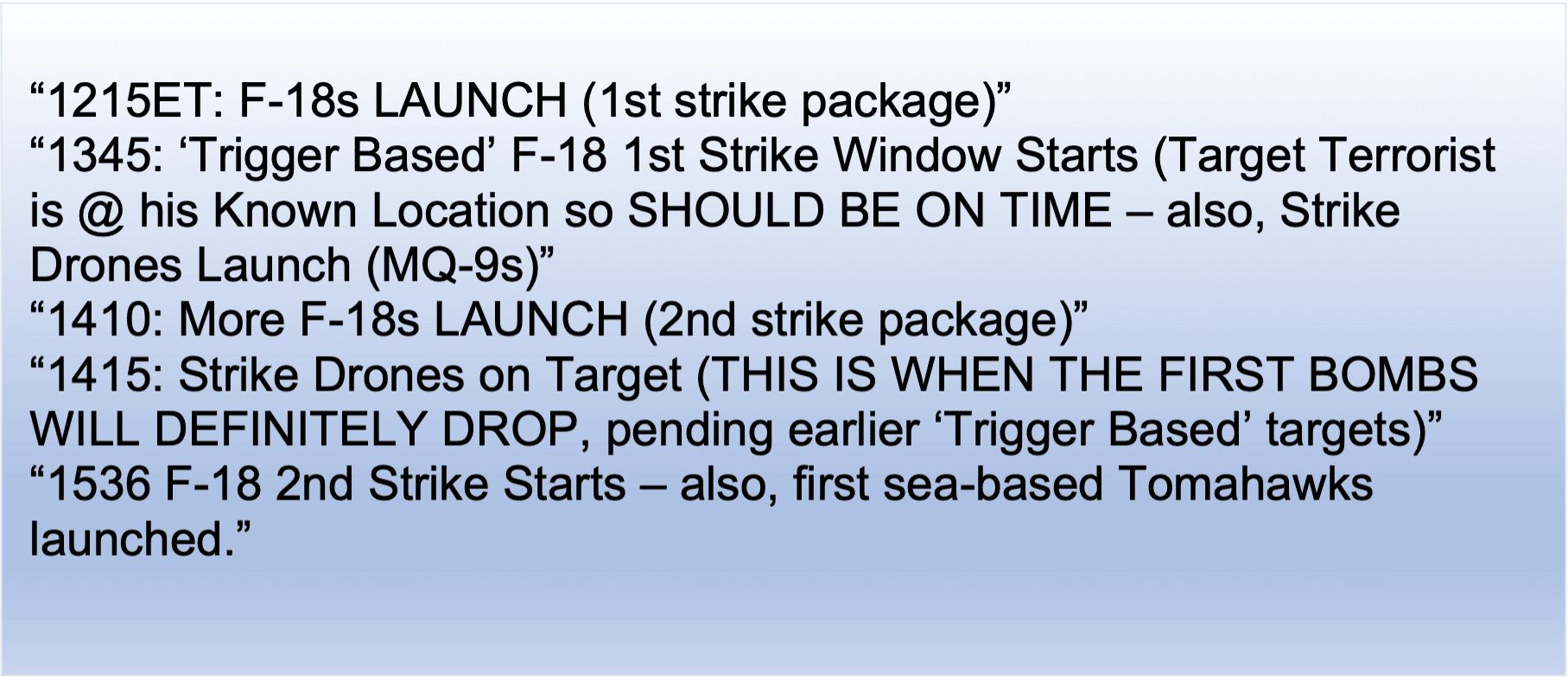
We do not have to be military geniuses when evaluating whether the information shared on Signal was classified. The evidence is clear, according to The Atlantic’s detailed publication of the back-and-forth texts sent at 10:15 ET, 15 March 2025, two hours before American airmen were in flight in their F-18s to attack Yemen:
Signal chat message of a war plan attack on Yemen to senior national-security officials on 15 March 2025[1]The Director of National Intelligence, Tulsi Gabbard, told the United States House Intelligence Committee, “There were no sources, methods, locations or war plans that were shared. This was a standard update to the national security cabinet that was provided alongside updates that were given to foreign partners in the region.”[2] European intelligence agencies – like everyone who has seen the evidence with a sense of truth – hesitate to share their most precious hard-earned secrets and prefer to ramp up their own highly protected sources.
Intelligence! What does that word mean? In military use, the context is the ability to collect valuable strategic information. Dictionaries claim it to be “the ability to acquire and apply knowledge and skills.” Both definitions entangle the two words, ability and knowledge. So, one would expect the United States Director of Intelligence to be “able” to appraise the difference between unsecured “valuable strategic information” and applicable “knowledge and skills.” For that matter, with 18 people on the Signal chat – including the Secretaries of Defense, State, and the Treasury, along with the director of the CIA – you would expect that at least one of those members of the inner sanctum of national security would have been smart enough to know that chatting about a secret military attack via Signal on a cell phone is dangerously wrong. But none had enough intelligence to halt the communication.[3] Was it a lapse in judgment? Likely! Or by an unlikely worse lapse in judgment, it could have been a diversionary scheme to stealthily punt power on its way to patrimony – create a scandal to divert the media from the stirring episodes of covert deviltries that would otherwise leak.
Why am I bringing this up when most of the world has learned about this incompetence through the news that has not let this go? The news of this Signal ignorance is constant for good reason. The answer is that one dumb move in military communications that does not take secrets seriously can bring half the world down militarily. When Pete Hegseth, Secretary of Defense, says, “THIS IS WHEN THE FIRST BOMBS WILL DEFINITELY DROP, pending earlier ‘Trigger Based’ targets,” gives the exact time of the drop two hours earlier, and later says, “Nobody’s texting war plans, and that’s all I have to say about that,” the crisis inflates to a collapse of allied trust. And trust is the basis of details of military accomplishments.[4]
That abandonment of taking secrets seriously has put the United States in the unfriendly position of being a soft ally not to be trusted with hard-earned information that could be compromised and could expose agents or battle plans to interception. In addition, several European allies say, “Our relations with the United States are over and … we can no longer depend on America.”
So, America seems to feel it can go it alone, if it needs to, without foreign intelligence. Example: The U.S. Secretary of Defense, a former television presenter who approved “swift and unrelenting” air bombings of remote Yemen mountains and deserts with “sublime ahistorical clumsiness” seemed to be not only without a realistic strategy to – as Trump hoped – “annihilate” the Houthis who for 18 months have been attacking ships in the Red Sea, but also without intelligence or expert advice. The U.S. Air Force did assassinate a Houthi commander. But history and expert foreign policy advisers tell us that “air power rarely wins wars, and the Houthis have the advantage of a remote, mountainous hinterland where much of their arsenal is probably safe from harm.”[5] David Frum, a staff writer at The Atlantic, says, “Americans have tried these narrow and selfish methods before. They ended in catastrophe. History does not repeat itself: The same mistakes don’t always carry the same consequences. But the turn from protector nation to predator nation will carry consequences bad enough.”[6]
Yes. But history does repeat itself in widening three-dimensional spirals. News of today can mimic those of fifty or a hundred years before. The same catastrophes recur because historic information eventually passes into bleary memory voids. And now, after a month of scandal, Hegseth comes into the news for a repeat performance on a cell phone, again on a second (or possibly the third or fourth) Signal group chat-sharing of sensitive, if not classified, information with his wife, brother, and lawyer.[7] Does Hegseth know that his “personal phone number, used in Signal chat, could have been found in a variety of places on social media and fantasy sports sites”?[8] It seems funny yet dumb. Sports sites? Gosh, David Gardner, Chief National Correspondent for The Daily Beast, agrees with The New York Times, saying that Hegseth’s number was on “WhatsApp, Facebook, Airbnb, a fantasy sports site and reviews left for a plumber and a dentist,” exposing national secrets to anyone listening in through a significant lapse in security protocols.[9] Though luck had saved the F-18 pilots, his future blunders seem to be aiming for a military catastrophe that will soon come to the Pentagon theater.
Could a wartime security breach perturb and ravage a longtime future of humanity?
Portion of the Zimmerman telegram decrypted by British Naval Intelligence codebreakers in Room 40 Public Domain
The most careless military communication of all was that of the now-famous Zimmermann telegraph, an encrypted Western Union message sent to Mexico suggesting that, if Mexico were to side with Germany in WWI, the winning side would award Mexico three American states that once belonged to Mexico – Texas, Arizona, and New Mexico.
It was the biggest mistake of the twentieth century, because it opened a series of possibilities that would have drastically changed a hundred years of history.
At that time, Arthur Zimmermann, a German foreign minister, decided that because the British had cut the transatlantic cables, his only path of trans-Atlantic communication would be by encrypted messaging sent by telegraph. It was the biggest mistake of the twentieth century, because it opened a series of possibilities that would have drastically changed a hundred years of history. Had Zimmermann acted more wisely, he would have sent his message through a safer route by an established secure courier. It would have been entirely possible that the United States would not have entered the war on the side of the Allies, and therefore opened the possibility that Germany would have either won that bloody war or accepted a truce. Had either happened, it’s likely, according to many historians, that the fascists of the early 1930s would have had a hard time to collapse the German Weimar Republic. Imagine how history could have unfolded without convincing arguments blaming Jews, homosexuals, people of color, or communists. Germany, before WWI, was a constitutional monarchy, an empire endowed with a strong economy, leaving Mussolini aspirants for the world to learn its lesson on how dehumanising fascism could be.
According to the U.S. National WWII Museum, roughly 3 percent of the world population would not have died by direct or war-related causes. That’s close to 70 million who might have lived longer lives. But America didn’t enter the war to save lives or combat the growth of fascism. Rather its decision to join was influenced by Britain’s Room 40, a secret cryptanalysis agency in the Old Admiralty Building in London, that intercepted and deciphered the Zimmermann telegram on its way to the president of Mexico.[10] Its contents were then passed on to the British Foreign Secretary, Arthur Balfour, who showed the decoded message to the U.S. Ambassador to Britain, Walter Page. From Page it went to Secretary of State Robert Lansing, who showed it to President Woodrow Wilson. Five days later, the Associated Press released the telegram contents to newspapers across the country. “And so,” David Kahn wrote in his book The Codebreakers, “it came about that Room 40’s solution of an enemy message helped propel the United States into the First World War, enabling the Allies to win, and into world leadership, with all that that has entailed. No other single cryptanalysis has had such enormous consequences. Never before, nor since, has so much turned upon the solution of a secret message.”[11]
Most spy communications are successful, so we never hear about them. In contrast to the Zimmermann blunder, I bring up a masterful spy story that few people know, though it happened at roughly the same time as the Zimmermann telegraph.
Black Tom Explosion Public Domain
At 2:08 am, Sunday, 30 July 1916, six months before the Zimmermann telegraph interception, New York and New Jersey residents were awoken by a series of massive explosions that sent shock waves in all directions as far as 90 miles, demolishing an entire island in New York Harbor. In Jersey City, the epicenter, and almost all of Manhattan south of Times Square, windows blew out. It was the most powerful explosion in the New York / New Jersey area in history – before 9/11, that is. So why is it that almost nobody knows about it, even older folks born and raised in New York? The explosions repeated in sequence until daylight. The story is extraordinary but let us return a few months before that disquieting Sunday. To tell the story briefly, we begin with Emanuel Voska, a stonemason born 4 November 1875, in Kunta Hora, a silver mining town in the Central Bohemian Region of the Czech Republic (Czechia). Voska was an unsung hero, an unknown to most Czechs, yet one who was most responsible for the founding of Czechoslovakia.
When war broke out on 28 July 1914, Voska cultivated a group of spy agents nested inside and out of the German embassy in New York City. Every night for two years, those agents stealthily steamed open diplomatic pouches, forwarding contents on German plans of sabotage to agents of the United States Bureau of Investigation (later to be called the FBI). Details were discovered of German U-boats close to the east coast of the US and particularly upsetting messages to and from German agents with sabotage plans for exploding railcars loaded with ammunition ready to be shipped to Russia for the war in Europe. Specific decoded facts divulged that underwater saboteurs were about to detonate ships of explosive cargo loaded from Lehigh Valley Railroad boxcars stationed at the Black Tom Island rail docks. How do I know about this? I was 16 when I first came across a book hidden in a crevasse of a monolith, Spy and Counterspy. From that, I learned about Voska’s spy ring. Through all the years of Voska’s espionage activity, no member of the ring was ever discovered.
When military secrets were secure, and when they were not
Sometimes military plans are shared between allied countries, sometimes not. Here are four examples.
1. Pagers sold to Hezbollah
On 17 September 2024, many members of Hezbollah were injured, and some were killed, by remote-controlled explosions of their newly acquired pagers and walkie-talkies. Concealed explosives were in batteries of devices secretly manufactured by a Hungarian firm and dispensed to Hezbollah commandos, allegedly by unsuspecting Iranian agents. Mossad was involved with three shell companies and Aman (the Israeli intelligence service). Yoav Gallant, Israel’s defense minister, accredited “excellent achievements, together with the Shin Bet, together with Mossad.” The significance was that the explosive material inside the pagers’ lithium batteries was undetected by both the border patrols and Lebanese security. Imagine how tight communications must have been for three countries (Taiwan, Hungry, and Israel) to secretly manipulate events involving thousands of explosive devices to reach Lebanon and explode on a specific day without a single communication leak.
2. Assassination of Osama bin Laden
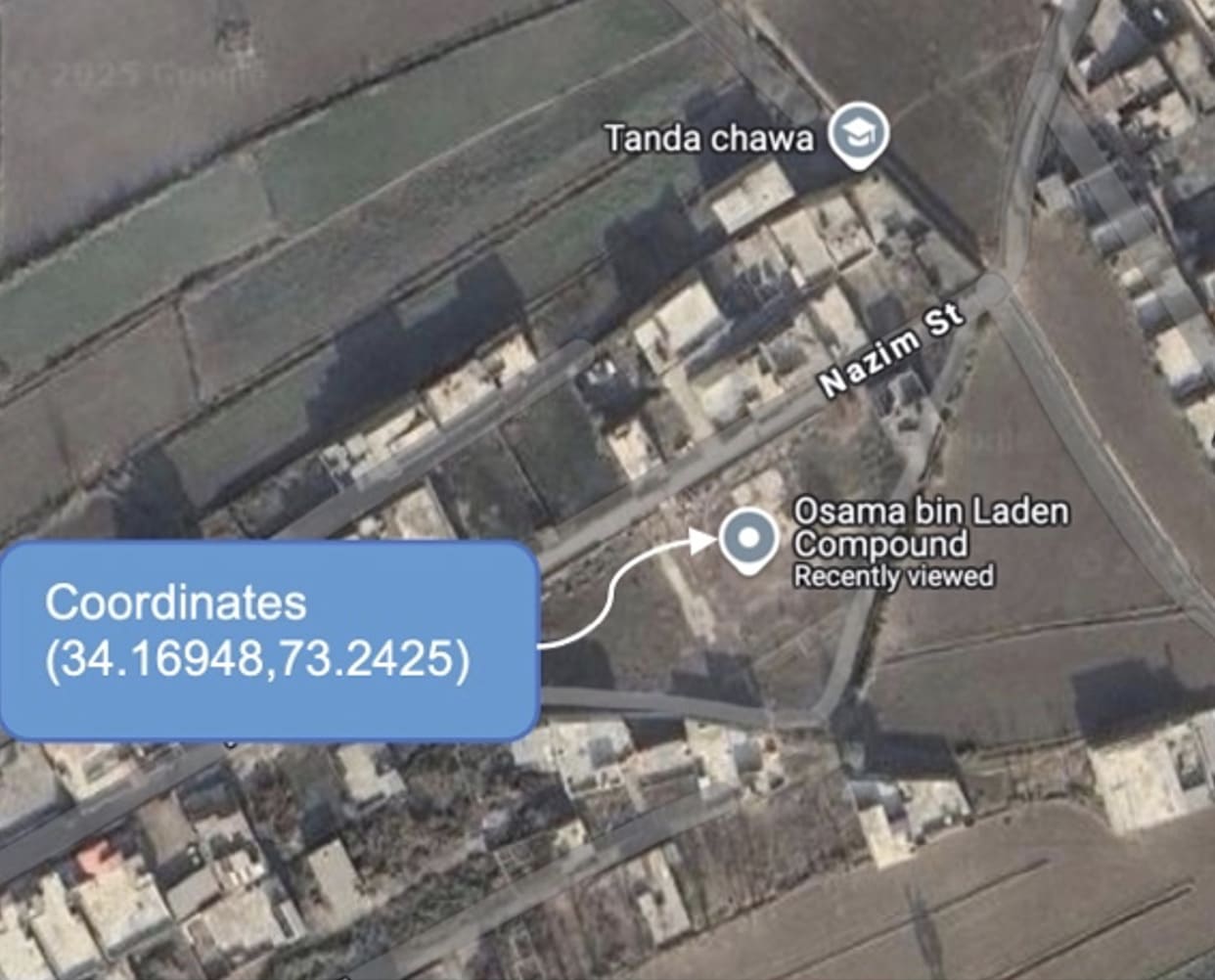
Goggle Maps pinpointing Osama bin Laden’s compound
A careless Osama bin Laden’s courier is a case of insecure communication that led to assassination. It didn’t take long for CIA agents to find bin Laden when his aids used cell phones to communicate. Phones of terrorist groups are always monitored, but in that instance, intelligence operations agents got connected to bin Laden’s personal courier. That courier picked up his phone to receive a call, and in that instant, the long search for bin Laden was over; U.S. intelligence traced the phone’s receiver precisely to Bilal Town, Abbottabad, Pakistan, coordinates (34.16948,73.2425). The assassination was coordinated and implemented with the Secretaries of Defense, State, and the Treasury, along with the director of the CIA and military personnel of the highest ranks – Barack Obama’s national security team. They were either in a Sensitive Compartmented Information Facility (SCIF) or the White House Situation Room (also a SCIF), watching in real time the assassination of the most wanted terrorist.
The group in the photo at the beginning of this article is watching in real time Navy Seals attacking Osama bin Laden’s compound in Abbottabad, Pakistan. The mission, from entry to exit from bin Laden’s compound, took just 38 minutes. It was a Navy Seal precision operation moving carefully through the compound, room to room, floor to floor, all accomplished by extraordinary intelligence. A culmination of years of intelligence work built inside sources, partly because phones, pagers, and computers were forbidden to be near his compound. Bin Laden was aware that the U.S. National Security Agency (NSA) was searching the airwaves for phone chatter connected to him. By chance, in the spring of 2011, the NSA established signals connected to bin Laden’s courier, which exposed the geographical coordinates of the compound. During subsequent development plans to get bin Laden, information was not shared, even with foreign intelligence communities, including the closest counterterrorism allies – Britain, Canada, and Australia.
3. Assassination of Russian generals
More than a dozen Russian generals died after they used their mobile phones at the beginning of the 2022 Russian invasion of Ukraine.[12] That is an extraordinary number and a huge upset for whatever prospects Putin had for a quick takeover of Ukraine. Retired four-star General David Petraeus quipped that Ukrainian troops “picked them off left and right.”
Russian military vehicles bombed and abandoned in Bucha after the 2022 invasion of Ukraine Wikipedia Commons
We don’t know for sure why so many commanders were targeted and killed. Experts speculate that the Russian military communications lines were not secure, since Ukrainian intelligence units were able to spot Russian invaders through their mobile phones. When tens of thousands of Russian troops were waiting for more than a month at the Ukrainian border, not knowing why they were there and what next, they spent a great deal of time on their cell phones calling home and texting friends. They did not disclose their coordinates, but just using their phones permitted foreign intelligence agencies to spot their phones with five-foot precision.
A secondary problem was the Russian plan of placing 20 generals in day-to-day tactical operations, preparing combat missions in the initial invasion. Aside from the loss of generals, close to 7,000 Russian troops were killed in the first three weeks of the invasion.[13] They were relying on ERA, a Southeast Asian PR network that was not as secure as they thought, according to Christo Grozev, an investigative journalist working for Bellingcat (an investigative journalism group working in the Netherlands), who investigated the deaths of the Russian generals.[14]
When Bellingcat intercepted a phone call, two Russian Federal Security Service (FSB) officers responsible for counterintelligence based in Ukraine asked their boss about the safety of using the ERA system. “The boss says Era is not working. Era is a super expensive cryptophone system that [Russia’s defense ministry] introduced in 2021 with great fanfare. It guaranteed [to] work ‘in all conditions’. Idiots tried to use the Era cryptophones in Kharkiv, after destroying many 3G cell towers and also replacing others with Stingrays.”[15] A Stingray is a cell site simulator that imitates and surveils cell towers to catch a mobile subscriber’s identity, locate phones, and intercept messages.
4. D-Day, Normandy landings
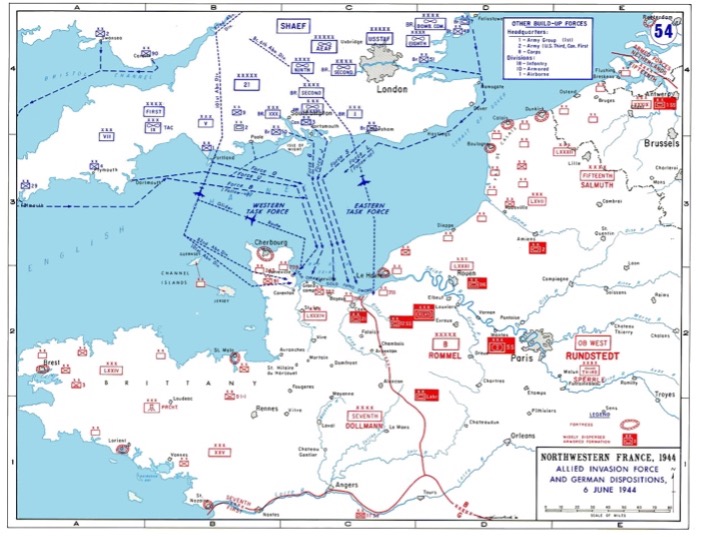
WWII D-Day communications between troop commanders were astounding examples of secrecy. On 6 June 1944, the German commanders believed that the Allied invasion from across the English Channel would be from Dover to Pas-de-Calais because 1) it was the shortest sea path, just 50 miles, a third the distance from Portland to the Normandy coast, and 2) the Germans were getting false chatter from intelligence. Codenamed Operation Neptune is still considered the largest military operation in history. See the photo of the landing and imagine how many commanders were involved in secrets that held tight for four months. Could that be done today?
D-Day June 1944 Meeting of the Supreme Command, Allied Expeditionary Force, London, 1 February 1944 Four months before D-Day invasion. Public Domain
As you look at the photo on the left, you see an enormous number of ships, trucks, and troops under the guidance of landing operations held secretly for months without a pinhole leak. Granted, 80 years ago, there were few options for leaks, unlike today’s communication possibilities.
D-Day invasion map Public Domain
Now, on to spy satellites and their vulnerabilities that tell us why warfare security matters
Even with today’s advanced technology, miscommunication, or insecure messaging risks of cyber-snooping, satellite systems have improved security to extend the safety of military synchronization and coordination. They have a long way to go to have iron-tight blockages of eavesdropping. Take Starlink. Is it a secure system for military communication, classified or not? That’s the big question to be answered by a serious investigation. The answer is clear: no satellite communications network should be used for relaying classified information, because airwaves are involved. Outside a SCIF, there is no assurance that some adversary is not listening.
The U.S. Department of Defense military communications – for ships at sea and bases around the world – goes by way of a constellation of satellites, including the old Defense Satellite Communication System (DSCS) replaced by the Wideband Global SATCOM system (WGS), Wideband Gapfiller Satellites (WGS), Advanced Extremely High-Frequency (AEHF) satellite communications, and at least a dozen others. Take AEHF, for instance. Lockheed Martin built it to serve several countries, including Canada, Netherlands, and the UK, to provide secure links for “military commanders transmitting sensitive information in contested areas.”[16] So far, It is probably the most secure system available for general military use; yet, even at that high frequency and impressive performance, it could be vulnerable to interception, and manipulation. Every satellite communication system, including the most sophisticated military systems, has some vulnerability. None are as secure as a SCIF, an enclosed spy-proof area with walls lined with acoustic baffles that block audio snooping. The Situation Room in the White House is one such area. Radio waves and loud music within and outside the walls prevent sounds from escaping within. No one without top-secret security clearances, including any general or congressional delegate, is permitted to enter. Those who do must surrender all electronic devices beforehand.
Defense Intelligence Agency (DIA) specializes in military communication.
We hardly hear about this U.S. agency that employs 17,000 career civilians and expert analysts, half of whom serve in various covert positions throughout 140 countries, many in U.S. embassies, and many others in secret places surveilling any military intentions of legitimate governments and non-state players such as paramilitary forces. We might consider them spies – they are, of course – but equipped with surveillance tools to collect and analyze any chatters of foreign military intelligence. DIA is, in other words, a military and counterintelligence spy agency watching and collecting threatening details of information, both big and small, including “capabilities and intentions; proliferation of weapons of mass destruction; threats of international terrorism; international narcotics trafficking; and defense-related foreign political, economic, industrial, geographic, and medical and health information” to relay them to the U.S. Department of Defense and other appropriate government officials.
DIA has had its troubles with counterspies who infiltrated the agency. While successfully recruiting spies, some were working against DIA to leak classified information to the KGB, China’s Ministry of State Security (MSS), Libya, and the intelligence agency of Cuba (G2). They were allegedly double spies who caught drifts of classified information. Still, in the 64 years since its founding, there were no inadvertent leaks – not one – in that enormous agency.
With that many people working top secret, it could have been impossible to avoid leaks through Russian agents caught sending secrets to Moscow and Cuba.
Spying goes back to wars of ancient history; however, in the early Cold War years, militaries relied on relatively sophisticated intelligence and surveillance with numerous slip-up leaks that called for a tighter intelligence operation. The British Secret Intelligence Service (MI6) started in 1909 and grew to involve 15 analysts before WWI began. That low-budget operation continued and managed a successful spy / saboteur ring in Germany throughout the First World War and into the Second. It now employs 3,544. Most countries involved in that war had some ramshackle organizations monitoring sabotages and spying. By WWII, intelligence operations became far more seriously implemented. The British-US Communication Intelligence Agreement (BRUSA) at Bletchley Park, working on Ultra, the codename for cryptographic intelligence, employed over 10,000 by 1945. With that many people working top secret, it could have been impossible to avoid leaks through Russian agents caught sending secrets to Moscow and Cuba.
Unlike the UK, during WWII, the U.S. had no extensive intelligence agency. Multiple offices, such as the Office of the Coordinator of Information, later called the Office of Strategic Services (OSS), were relatively small, with staff numbers close to 2,000. As the war progressed, that number doubled, and by the war’s end, staff numbers were close to 35,000. Under the National Security Act of 1947, the OSS morphed again to become the Central Intelligence Agency (CIA), a centrally controlled body that we recognize as one that carries intelligence secrets in almost every country.[17] It now employs 21,575.[18] Those early agencies have had leaks of secrets but, again, none that we know of from errors of methods and rules about conducting espionage.
The Signal chat message of a war plan attack on Yemen scandal on 15 March 2025 had been in the news for a month before slowly evaporating to make news of other scandals involving the Trump administration that distracts with breaking news designed to diminish stories of its blunders. News must be new to keep the public reading or listening. Otherwise, news flops.
So, what must happen before the world suffers from inept military intelligence leadership? First, the public must understand that, in Hegseth’s case, messing with intelligence is calculated to distract from experimental ideologies that favor patrimony. Second, in a democracy, even one that is not perfect, incompetence risks catastrophe, so the public must stand firm in protest to bring consequences to lawlessness and moral misbehavior, with a buck-ends-here responsibility of leadership. When any nation, especially any of the most militarily powerful, settles for an unfit defense secretary whose specialty is kowtowing to his political allegiance, its path leads to imminent threat. In Hegseth’s particular case, a short-term consequence will be the loss of trust from friendly nations or a catastrophe hard to predict and repair. Yes, the news media on his incompetence is still with us to keep the public interested, but it will soon become a bore. Then what?
Joseph Mazuris an Emeritus Professor of Mathematics at Emerson College’s Marlboro Institute for Liberal Arts & Interdisciplinary Studies. He is a recipient of fellowships from the Guggenheim, Bogliasco, and Rockefeller Foundations, and the author of eight acclaimed popular nonfiction books. His latest book is The Clock Mirage: Our Myth of Measured Time (Yale).
By Terence Tse
CFOs are evolving into AI-driven transformation orchestrators, balancing finance, technology, and strategy while upskilling teams, managing risks, and driving measurable business value.
A key insight from this year’s AI for CFOs event, organized...
The World Financial Review uses cookies to improve site functionality, provide you with a better browsing experience, and to enable our partners to advertise to you. Detailed information on the use of cookies on this Site, and how you can decline them, is provided in our Privacy Policy and Terms and Conditions. By clicking on the accept button and using this Site, you consent to our Privacy Policy and Terms and Conditions. ACCEPT
Privacy & Cookies Policy
Privacy Overview
This website uses cookies to improve your experience while you navigate through the website. Out of these cookies, the cookies that are categorized as necessary are stored on your browser as they are essential for the working of basic functionalities of the website. We also use third-party cookies that help us analyze and understand how you use this website. These cookies will be stored in your browser only with your consent. You also have the option to opt-out of these cookies. But opting out of some of these cookies may have an effect on your browsing experience.
Necessary cookies are absolutely essential for the website to function properly. This category only includes cookies that ensures basic functionalities and security features of the website. These cookies do not store any personal information.
Any cookies that may not be particularly necessary for the website to function and is used specifically to collect user personal data via analytics, ads, other embedded contents are termed as non-necessary cookies. It is mandatory to procure user consent prior to running these cookies on your website.







 Dr. Gleb Tsipursky








 Joseph Mazur