Mexico City is fast becoming the most active startup hub in the Spanish-speaking world. One of North America’s most populous cities with more than 22 million people, it brings the standard perks of a big city without the high operating costs.
In fact, as a result of the government and private sector’s efforts of developing a robust startup scene, Mexico City is now the birthplace of some pretty notable startups.
99 Minutos is a Mexican startup dedicated to last-mile delivery services. It mainly caters to e-commerce stores in Latin America by offering various services, including less than 99-minute delivery, same day, next day, and CO2-free delivery.
The startup operates in major markets across Latin America and South America and is popular in Mexico, Columbia, Chile, and Peru.
Recently, it raised a $40 million Series B investment that the startup will likely use to expand its logistics services to countries such as Argentina, Costa Rica, Panama, and Ecuador.
2. Aliada
An online platform that matches maids with customers in Mexico City, Aliada creates an innovative model for the household cleaning industry that is socially responsible.
Before Aliada, the situation for housekeepers was challenging. Agencies typically take an 80% cut of the fees they charge customers, and housekeepers do not choose where they work and have to spend expensive traveling fees.
But now, the benefits of Aliada go beyond better wages. Because not only does the company reduce the cut to only 20%, it also provides healthcare insurance for housekeepers through a nonprofit called Red de Aliadas, which offers 100,000 pesos for medical bill coverage.
With $800,000 in its seed financing, its vision is backed by some of Mexico’s most significant investment firms, including Capital Invent, Dila Capital, and Variv Capital.
3. Aprende Institute
One of the fast-growing startups in Mexico City, Aprende Institute is an edtech startup for vocational skills training in Latin America and Spanish-speaking people residing in the United States.
Aprende Institute learning programs provide practical 3 to 9 months programs specially developed for individuals interested in speaking Spanish. Since its inception in 2019, the startup has enrolled about 70,000 students in Mexico City, Bogota, Miami, Buenos Aires, and Lima.
In October 2021, the edtech startup raised $22 million in funding, which they will use to consolidate their presence and be more accessible to the Hispanic community in the United States.
4. Bitso
Starting in 2014, Bitso is a cryptocurrency exchange platform that enables low-cost and instant cross-border payments. The platform supports various digital currencies, including Bitcoin, Ether, Ripple, Litecoin, and XRP.
In the last year, Bitso has a million new users open accounts and hit a grand milestone of 3 million accounts. In 2021, the Mexico City-based startup raised $250 million in its Series C funding.
The round valued the startup with a $2.2 billion valuation, making it the region’s first cryptocurrency company to become a unicorn exceeding the $1 billion valuation mark.
5. Jüsto
Established in the last two years, Jüsto is an online platform to order groceries. It allows users to browse available products in their online supermarket that they claim are procured and delivered on the same day.
In fact, Jüsto prides itself on working directly with fresh produce suppliers to offer the freshest vegetables, fruits, and poultry in the market.
The startup’s goal is to become the most popular online supermarket in Latin America by 2030. It recently expanded into Brazil with a $40 million investment that was also used to recruit 300 local staff.
6. Kavak
Revolutionizing the second-hand car marketplace that has previously been informal, Kavak provides a platform that facilitates the online purchases and sales of second-hand automobiles.
Before this, the scenario for buying and selling used vehicles online was complex as few buyers trust a seller’s assessment of the car’s condition while sellers are not confident if buyers will actually pay.
But now, with Kavak’s app acting as the trusted middleman. People can buy and sell their second-hand cars more confidently. Currently, you can find the online used car platform in Mexico City, Argentina, and Brazil.
In September 2021, Kavak had secured $700 million in its Series E funding which places its valuation at an $8.7 billion valuation, making it one of the most valuable Mexican unicorns.
7. Homie
Founded in 2015, Homie is a proptech startup set to disrupt the stagnant real estate industry. It combines technology and expert customer service to provide an end-to-end home selling and buying platform.
The startup offers an online platform that facilitates the property buying, selling, and leasing processes. Through Homie, you can place rentals via its online platform, vet interested parties to organize viewings, and even provide contracts and undertake due diligence related to rentals.
Its algorithm even lets tenants pay rent through their platform, making it convenient for landlords. Tenants with a good credit history are also no longer required to have third-party endorsements or leave a security deposit when renting an apartment via Homie.
Its last round of financing was back in 2020 where it raised $23 million in a Series B funding round, which places the startup valuation between $100 million to $500 million.
Asking people to visit your website is a tall order. You have to compete with hundreds of websites offering the same products and services, and some of them have been in the business for a long time. Remember that everything starts with your website. You can entice people to patronise the brand once your website looks appealing. If you don’t think you’re driving enough traffic, something needs to change. Start by understanding the reason behind the low traffic rate.
You don’t do well with SEO
SEO is the process of enticing people to visit your website, where you use different tactics to optimise a keyword. When people search for information online, your goal is to be on the first page to increase your website’s likelihood of getting selected. If you don’t do well with SEO, it could be a problem. You become invisible, and your competitors will take the larger slice of the pie.
Your website looks messy
The organisation and responsiveness of your website are also part of why you don’t rank high on search engines. Make sure everything looks organised. If the website is messy, it will turn people off, causing them to leave right away. It also tells Google’s algorithms not to rank your website high since it’s not responsive to what potential visitors wish to see. You can work with experts like Oxford-based web designers if you want to improve in this regard. They know a lot about web design and how to make your website look appealing, especially to the local market. You won’t go wrong with web designers who worked with prominent clients before.
You don’t have social media engagements
Social media and search engine optimisation are inseparable. If you want people to visit your website, you must do well with social media engagements. Respond to comments and messages. Tell people to visit your website if they wish to know more about your company. Since there are more people on social media these days, you should do whatever it takes to convince them to visit your website. While you can post information on social media, it’s not enough to provide details.
You don’t have interesting blogs and articles
Don’t expect people to come and see your website even if it looks good. You must let them see the link to access your page. The best way to do it is by writing blogs and articles. You can use different article directories and embed the link naturally on your article. It helps establish authority in the industry, and exposing your web link to as many people as possible will increase traffic.
With these tips, you can see changes on your website soon. Monitor the numbers and determine which strategies are useful in achieving your goals. Don’t feel frustrated if you can’t see these numbers skyrocket right away. Be patient and try different tactics to invite people. Work with SEO experts and web design agencies to help make your page look more appealing. Finally, don’t forget that asking visitors to come is only the first step. You still have to do more.
Being able to prepare for all scenarios is an important part of business management. Your employees must be able to know what to do in serious situations. Crisis communication is a relevant topic in any field of work; here is why crisis communication is important to the state of your business.
What Exactly is Crisis Communication?
Crisis communication refers to a business plan that will be used during periods of crisis. Like any type of communication, crisis communication is equally as important to the function of a business. It is crucial that all of your employees and fellow managers are able to clearly communicate during a crisis. Whether you are a manager or employee, you probably know about some measures that you can take to help resolve certain issues. Whether it be safety threats, debt, or internal conflict, there must be methods to solve any crisis within the business you work at. “When businesses neglect having clear crisis communication, they will feel pressured when challenges pop up. Preparing for the unexpected is one of the best business investments that can be made,” reveals Anne Tucker, business writer at Resumention and Write my Australia.
Ways to Build Strong Crisis Communication
Many companies lack strong crisis communication. This is because they fail to provide proper training and information to their employees. These are some simple ways to ensure that there are strong crisis communication measures, expectations, and plans in your business.
Deciding On Crisis Leaders
There should be a few managers, supervisors, or experienced employees that will be leaders who will help resolve any crisis that may occur. Talk with people who you believe are able to handle the leadership role, and ensure that all leaders can work together without any issues. Once you have your leaders decided, you can make a crisis communications team. You can decide on how often they should meet and update crisis protocols. The crisis communications team will be responsible for preparing other employees for periods of trouble. Establishing a strong team will build a stable foundation for crisis communication at your workplace.
Properly Train Employees
It’s essential that all employees are prepared and trained to handle conflicts. Make sure to provide all necessary training and experience opportunities to prepare employees for the worst. If your employees don’t have any idea on how to work around a crisis, it can cause undesired consequences to follow. For example, let’s say an armed robber enters your building. If your employees don’t know about the lockdown protocols, their lives can be in danger. Even though events like that are rare, they still can happen at any time. Avoid putting your employees at risk, and take the time to prioritize proper training in your business.
Building Solid Protocols & Plans
Take the time to curate solid protocols and plans for any type of crisis with your communications team. Natural disasters, financial problems, and employee conflict are just some events that you have to prepare for. Overtime, make any relevant and useful changes to protocols. Consistently update and check in with employees in order to be safe and ready for any conflicts that may arise. “Planning is one of the best things you can do in your business. It may be annoying at first, but having a plan for any and all scenarios will pay off in the future, shares Alice Cherry, project manager at Australian reviewerand Write my essay.
Methods of Instant Communication
When a crisis arises, your employees need to have a way to instantly communicate with each other. Emails, phone calls, app updates, and other technologies can truly assist your company in a time of need. Quick communication methods should be used on a regular basis anyway. If your business has an established means of instant communication methods, you still have to ensure that your employees can successfully contact each other. Your employees should be capable of working as a team, especially during a crisis.
Crisis Communication in Your Business
All of these approaches will help your business to achieve a stable crisis communication plan. No matter what the situation is, having your employees and fellow managers ready to tackle it is highly important. Your business will benefit by having a stable foundation, and effective protocols.
In “China and Europe: Reconnecting across a New Silk Road” (Xiangming Chen and Julie Mardeusz ’16, The European Financial Review, February/March 2015), we included a short section about the China-Europe Freight Train (CEFT). The CEFT was then in its fourth year of running, while the Belt and Road Initiative (BRI) was officially only two years old. A total of 815 freight trains ran between China and Europe in 2015. The pandemic year of 2020 saw 12,406 trains between China and Europe, with another surge during the first six months of 2021. What has changed over a few short years? This article addresses this question by examining the scope of the CEFT’s connectivity and its impact on both ends of a transcontinental rail freight system across Eurasia.
Imagine a local resident in the ancient Silk Road city of Xi’an in northwestern China enjoying fresh Atlantic salmon from Norway in the summer. This is possible now, thanks to the China-Europe Freight Train (CEFT)1, which began to ship salmon overland to China in 2020. Leaving Narvik, the northernmost cargo railway yard on the coast of the Norwegian Sea, a freight train carrying containers of salmon travels to Haparanda on Sweden’s border with Finland, where the containers are switched to Finnish wagons. From Kouvola, Finland, the salmon cargo will cross into Russia and then follow the established rail cargo route via St Petersburg and Moscow into Kazakhstan and eastbound, to arrive in Xi’an in about 10 days.2
This freight connection from Arctic Norway to western China is only one line among a rapidly growing set of freight routes across Eurasia, the world’s oldest and longest route of overland trade connections, which once relied on camels and horses, dating back to the ancient Silk Road or even earlier. Fast-forward to the turn of the 20th century, British scholar Halford Mackinder saw the landmass of Eurasia as the pivot of global history and influence on geopolitical dynamics, at the central location of the planet (Chen and Fazilov 2018). He also foresaw trains covering this super-continent some day, although direct China-Europe freight services did not exist up to as recently as 2008 (Hillman 2020). Over one short decade since 2011, the CEFT has grown from 17 trains from China to Europe in 2011 to 7,377 trains heading in both directions in just the first six months of 2021. Regarding Mackinder’s foresight, it has taken a whole century for the CEFT routes to (re)connect the Eurasian landscape for greater cross-border trade.
Connecting and Growing Through a Trio of Eurasian Dyads
When the inaugural CEFT opened up a single route from the megacity of Chongqing in southwestern China to Duisburg, Germany in 2011, through Kazakhstan, Russia, Belarus and Poland, few would have imagined or envisioned an extensive transcontinental network of freight lines criss-crossing the vast Eurasia today. These routes had carried 41,008 trains between over 50 Chinese cities and 168 cities across 23 European and Asian countries by the middle of 2021.3Miraculous as it is, the geographical band of the CEFT signals straight, long-distance freight connections between China at the eastern end and Europe at the western end of Eurasia. The actual scope of these freight routes, however, has extended more broadly in an untidy and complex pattern. It has veered off the traditional Eurasian land bridge via Central Asia and the Trans-Siberian Railway via Russia to include routes to and through Iran and Turkey. The CEFT has also created multi-modal and intermodal shipping routes that stretch its connectivity to East Asia and Southeast Asia. These extended freight connections have turned the CEFT into a trio of dyadic transport/logistics ties between China-Europe, Europe-Asia and China-Asia.
The geographical band of the CEFT signals straight, long-distance freight connections between China at the eastern end and Europe at the western end of Eurasia.
To assess the geographical and economic importance of freight lines between each of these three pairs, it is crucial to show the main contour of the CEFT network. Figure 1 displays the main CEFT corridors/channels, eastern, central and western. The eastern channel links cities in northeastern and eastern China to Russia via the border city of Manzouli, northwest of Harbin. The central channel connects some northern Chinese cities to Russia via the border city of Erlianhot, northwest of Beijing in Inner Mongolia. Both channels meet in Russia and travel on the Trans-Siberian Railway until arriving in Moscow, where some trains would join the western corridor into Europe. The eastern and central channels align with the China-Mongolia-Russia corridor of the BRI. The western corridor brings freight trains from many of China’s coastal and interior cities to Europe along the Eurasian Land Bridge from Lianyungang to Amsterdam, through the cities of Alashankou and Khorgos on the border with Kazakhstan. It parallels the BRI’s new Eurasian Land Bridge corridor. The western corridor spins off from the south channel, also called the “middle corridor”, which runs via Almaty along the BRI’s China-Central Asia-West Asia corridor (Figure 1).
Figure 1: The China-Europe Freight Train’s travel corridors/channels
The western corridor has encompassed the largest number of specific routes and freight trains, as shown by the most recent evidence. In the first half of 2021, the western, central and eastern channels sent 3,810, 1,285 and 2,282 trains, which accounted for 51.6%, 17.4% and 30.9% of all CEFTs over that period, respectively. From a spatial matching perspective, the CEFT and the BRI have converged, with the former driving the latter to help keep trade flowing between China and Europe. In addition, these train runs and trade flows have covered main parts of Central and West Asia (see Figure 1). Not shown on this map are extended connections to East Asia and Southeast Asia, which suggests that other parts of Asia are now tied into the CEFT system.
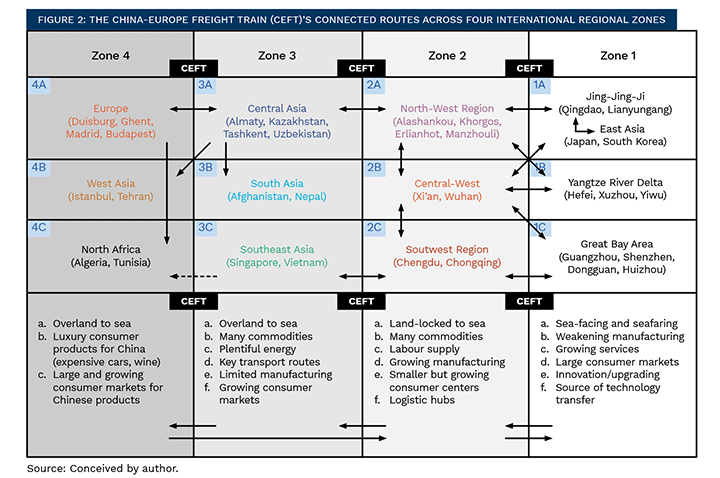
To get a more detailed picture of the freight connections between China-Europe, China-Asia and Europe-Asia in the tripartite CEFT system, Figure 2 organises the regions and cities that send and receive CEFTs through multiple international boundaries between China’s coast and Europe’s Atlantic coast. From east to west, corresponding to the rough geographical layout of a partial world map, zones 1 to 4 identify four connected regions with subregions that contain the departure, intermediate and arrival places for a variety of CEFT routes, and the general economic features and activities creating and sustaining these routes (see the bottom row of Figure 2). While zone 1 includes three subzones of China’s earlier and more opened and developed coastal cities, zone 2 refers to three interior and border regions that have become the most active and dominant drivers of CEFTs as late developers and beneficiaries of China’s “Go West” campaign. Zone 3 consists of three parts of Asia, by land primarily and sea partially, that serve as transit zones or final or trans-shipped destinations. Zone 4 covers three regions further west, featuring Europe anchoring the other end of the CEFT system opposite zone 2. It also includes few West Asian cities, such as Istanbul, along the less-travelled south channel or middle corridor (see Figure 1), with North Africa (4C) much less connected to China by land.
Figure 2: The China-Europe Freight Train (CEFT)’s connected routes across four international regional zones
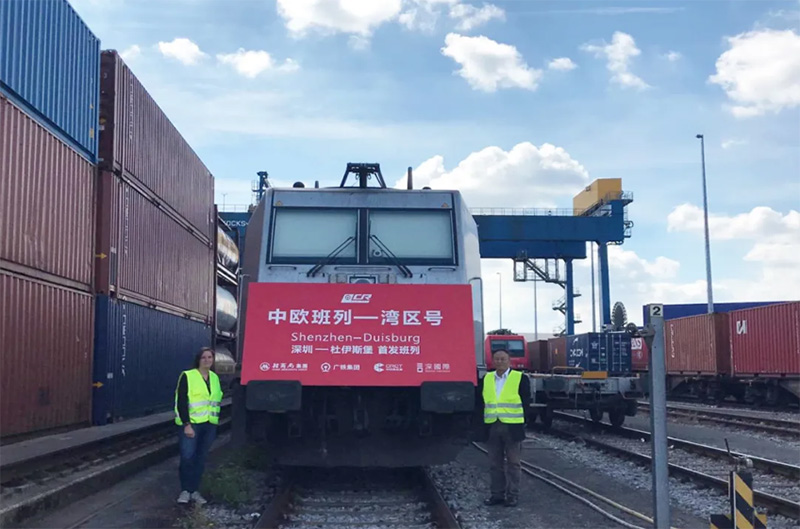
While Figure 2 can reveal and mask numerous bilateral and trilateral freight routes between China, Europe and Asia, I use it to highlight two examples that illustrate the ever-expanding and extending long lines across a diverse set of national and subnational areas, with elaborations in the last section. On 18 August 2020, a freight train carrying electronic products, consumer goods and PPEs left the Chinese city of Shenzhen (subzone 1C, which also refers to the Pearl River Delta) bordering Hong Kong for Duisburg (see photo, figure 3). It travelled through 27 other Chinese cities, including Chengdu (2C), exited at Alashankou (2A) on 23 August, passed through Kazakhstan (3A), and finally arrived in Duisburg (4A) 11 days later, after a journey of 13,438 kilometres.4 Sponsored by the China Merchants Group (CMG), headquartered in Hong Kong, and labelled “The Great Bay Express”, this service sent 262 freight trains to Europe from China’s top manufacturing region in 2020. This is the second-longest CEFT line, slightly shorter than the Yiwu-Madrid (1B-4A) route, covering roughly 13,500 kilometres (Chen 2018).
Figure 3: The first “Great Bay Express” freight train from Shenzhen arrived in Duisburg on September 4, 2020
Source: China Merchants Group photo; accessed from https://mp.weixin.qq.com/s/8BldmufNSlQGmV61QFPBcw.
The second exemplary route returns a freight train from Europe (4A) through Kazakhstan (3A) to Chongqing (2C), which on 16 March 2018 sent the first train south to Hanoi, Vietnam (3C) via the Chinese border city of Pingxiang, Guangxi Province. This rail-rail route, which reduces freight quotes and transport costs by one-third over shipping by sea, also extends south to the Chinese port city of Beihai, Guangxi Province, from where the cargo can be shipped to Singapore (also 3C) via rail-sea intermodal shipping. The China-Southeast Asia extended segment of this long route roughly aligns with the China-Indochina Peninsular Corridor of the BRI.
These two exemplary routes reveal the crucial intermediary role of key CEFT hubs in central and western China (2B and 2C) in linking a number of China’s coastal export-oriented centres (zone 1) to a large number of cities in Central Asia and Europe (3A and 4A). The spatial pattern within China is logically consistent with China’s goal of shifting development priority and opportunities from the coastal to the interior regions, especially the western region. The CEFT has created a geographically and functionally favourable opportunity for such northwestern and southwestern cities as Xi’an and Chengdu to catch up in development by prioritising transport logistics. This has further benefited these major interior cities by allowing them to shift from “going east” to attract cargo from export-heavy coastal cities to “going west” by sending exports to Europe by the CEFT more cost-effectively.
Figure 2 also points to the critical role of four small Chinese border cities, Alashankou and Khorgos (Xinjiang) and Erlianhot and Manzhouli (Inner Mongolia), as exit/entry points that have turned a few marginally located places into important gateways (2A) of the CEFT network. With the smallest population of the four at less than 30,000, Alashankou (Alataw Pass or Dzungarian Gate), on the border with Kazakhstan, led all four cities in processing 19,841 freight trains up to 23 May 2021 since seeing the very first train from Chongqing to Duisburg in 2011. Alashankou now links 22 CEFT lines from a variety of cities across China to many cities spread across 13 European and Central Asian countries. In the first half of 2021, 3,033 trains carrying 288,300 TEUs (twenty-foot equivalent unit) containers passed through Alashankou, representing 41.1% more trains and 48.6% more freight over the same period in 2020.5 The CEFT has turned Alashankou and the other three small border cities of China into new international logistics hubs.
As the number and extent of these CEFT routes have multiplied, they have expanded the number of departure, intermediate and arrival points across the four zones and thus accelerated the growth of CEFTs. While there were only 17 trips in 2011, the launch of the BRI in 2013 saw 80 trips, which rose to 308 in 2014. The number of trains jumped to 6,363 in 2018, almost equalling the total number of trips for the previous seven years. While the COVID-19 outbreak in China at the beginning of 2020 slowed the CEFT’s strong growth through 2019, the quick suppression of the virus halted the temporary slowdown and accelerated growth through 2020. By year-end, the 12,406 CEFT trips were 6.3 times those of 2016 and exceeded the record 2019 by 51%. The end of 2020 saw the cumulative number of CEFT trips reach 33,600, which had carried almost three million TEUs of traded goods, worth $160 billion.6This accelerated growth occurred at some expense in terms of reduced air and sea shipping during the pandemic. During January-June 2021, 7,377 CEFTs carried 707,000 TEUs, increases of 43% and 52% over the same period in 2020.7
As the number and extent of these CEFT routes have multiplied, they have expanded the number of departure, intermediate and arrival points across the four zones and thus accelerated the growth of CEFTs.
As the CEFT has grown, it has run more balanced directionally. Prior to 2014, every train ran from China to Europe. But the return or back-haul trips began to grow in 2016 and accounted for roughly one-third of all trips. Of the 3,673 trips in 2017, 1,225 (33.4%) trains went from Europe to China (Jakóbowski et al. 2018). In 2018, the 2,690 eastbound trains equalled 73% of the 3,670 westbound trains (Tjia 2020). To put it differently, the Europe-to-China trains accounted for 42% of all trips. By another metric, while 94% of the westbound trains were fully loaded in 2018, 71% of the eastbound trains carried a full load of containers. In 2019, eastbound CEFT trains rose to 45% of the total in both directions.8 This indicated an effective end of the “one-way street” before 2014. Moreover, this more balanced pattern has fostered extensions beyond the China-Europe and China-Central Asia connections, as indicated by the second example above.
The CEFT’s wide connectivity and rapid growth has impacted the relative positions and roles of the cities involved in relation to the spatial dynamics of production and consumption across Eurasia. While some small and marginally located cities like Alashankou have become specialised in border-clearing logistics, other second-tier or medium-sized cities have risen or revived to shape or redirect the geographical configuration and intersection of manufacturing supply chains and consumer goods flows within and across Europe and China, with important local consequences. I illustrate this cross-boundary impact of the CEFT using the ancient Chinese city of Xi’an and the historic river port of Duisburg, from their respective locations and in long-distance connection to some other cities across Eurasia (Figure 2).
Redirecting Production and Consumption: Xi’an
The eastern starting point of the ancient Silk Road, Xi’an in Shaanxi Province, has been a prominent historical, cultural and economic centre in China for over two millennia. It served as the capital for 13 dynasties. While much better known for the Terracotta Soldiers than its economic prowess, Xi’an became one of the earliest cities in the world during the Han dynasty (206 BC–220 AD) and Tang dynasty (618-907 AD), the early and peak periods of the Silk Road. Fast-forward to the contemporary era, Xi’an fell behind its historic peers, such as Hangzhou and Nanjing in the coastal region, and lagged further behind coastal powerhouses like Shanghai and Shenzhen. Shenzhen benefited particularly from being the major destination for people and companies that had left inland cities like Xi’an in the 1980s. Xi’an has regained some of its lost fortune since around 2000, after China’s “Go West” policy and later the BRI. This favourable turn for Xi’an, and other central and western cities, positioned them well to use the CEFT as a logistics strategy for catch-up development.
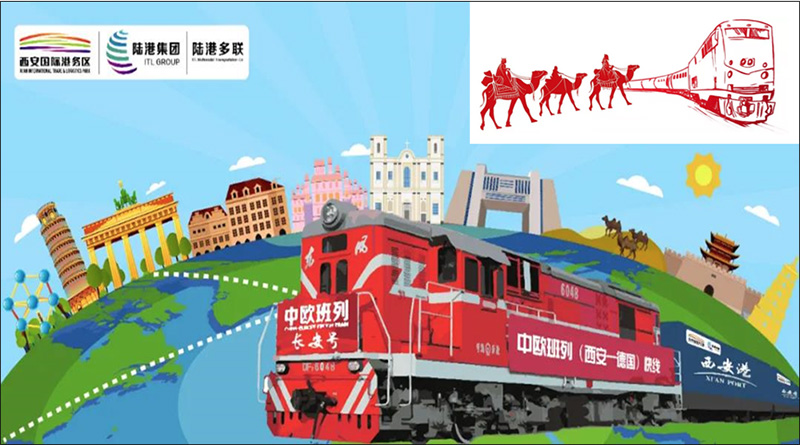
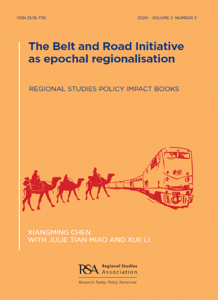
Xi’an’s logistics strategy began with the construction of the Xi’an International Trade and Logistics Park (ITLP) in 2008. The ITLP comprised three integrated zonal functions: 1) the Xi’an Comprehensive Bonded Zone; 2) the Xi’an rail container centre; and 3) the Xi’an inland road port. In 2009, the ITLP established and financed the Xi’an International Inland Port Investment & Development Group (ITL Group) as the ITLP’s operating arm. The ITL Group launched the first train to Almaty, Kazakhstan in 2013. From the outset, Xi’an idealised its CEFT with a reimagination of its ancient Silk Road position by invoking the metaphor of the “Iron Silk Road”. The Xi’an government named its CEFT after the old city name of “Chang’an (Forever Peace) Express”, which was used for the capital of several Chinese dynasties until it was renamed Xi’an (Western Peace) in 1369. The “Chang’an Express” also uses a fitting logo of three Bactrian camels walking next to a speeding train (see image, figure 4). Riding on the “Chang’an Express”, Xi’an rose to be a top-tier CEFT city in a few short years. In 2020, 3,670 CEFTs left and returned to Xi’an, ahead of Chengdu (2,800) and Chongqing (2,177) as the second- and third-ranked cities (Figure 2), accounting for almost one-third of China’s total number of CEFTs.9
Figure 4: The China-Europe Freight Train “Chang’an Express” (Xi’an): The corporate image and logo
Source: The China-Europe Freight Train “Chang’an Express” WeChat platform; accessed from https://mp.weixin.qq.com/s/ie84R92W5hns3s4p_VJ0YA.
Xi’an has reconfigured some transnational flows of trade and production through its newly established logistics role. In September 2019, the ITL Group dispatched the first “LG block train”, which carried exclusive liquid-crystal display (LCD) panels and electrodes to the factory owned by the large Korean manufacturer located in the Polish city of Sławków. Instead of around 40 days by sea, these containerised parts on a dedicated freight train arrived at the destination in 10-12 days. Since 2019, LG has already sent over 1,000 TEUs of parts to its factory in Sławków on the “Chang’an Express”, after shipping them from Korea to the Chinese port city of Qingdao and then to Xi’an for Europe.10 Via this logistical path from 1A->2B->2A->3A->4A (see Figure 2), which saves time and cost for LG, Xi’an has effectively redirected a global supply chain from East Asia via western China to central Europe.
Xi’an’s other logistical effect on production is more direct, as its transnational freight connectivity has lured more manufacturing companies to (re)locate locally in order to ship products and parts to European markets more quickly and cheaply. In 2018, the founder of Siying, an electronics manufacturing company in Shenzhen, originally from Xi’an, moved his entire factory back to his home town after realising that he could ship products to Central Asia faster (from around 40 to around 15 days) to lower costs and thus expand production. Since relocation, this company has reduced the cycle of its order placement and supply chain coordination from around 90 to 30-40 days, almost tripled its output, hired more local workers, and expanded its markets from Kazakhstan and Kyrgyzstan to France and Germany. This relocation of manufacturing production and faster shipping has involved a spatial movement of 1C->2B->2A->3A->4A (Figure 2).
Along with its impact on production, the “Chang’an Express” has strengthened Xi’an’s role in connecting and redistributing consumption across European and Chinese cities. For example, Volvo has benefited greatly from running a new regular train between Xi’an and Ghent, Belgium. In June 2018, a CEFT train departed from Ghent and arrived at Xi’an Vehicle Port with 160 European-made Volvo XC90 SUVs and V40 hatchbacks, after 16 days (see photo, figure 5). These more expensive models sell very well in China, the world’s largest market for Volvo cars. In 2019, a “Chang’an Express” train loaded with 160 XC60 SUVs arrived in Ghent, Belgium after an 18-day journey. Made at Volvo’s plant in Chengdu, China, the XC60 were sold in 25 European countries, including France and Germany.11 During the first three months of 2020, when China was seeing off the pandemic, 27 trains from Xi’an carried 3,377 XC60s (averaging 125 cars per block train) to the European markets through a fast and secure system from truck to train, without exposing the new cars to potential virus contamination (see photo, figure 6).12 While involving Central Asia only as the pass-through space, this bidirectional transportation and consumption of Volvo cars flows through zones 1-4 (Figure 2).
Figure 5: Volvo XC90 SUVs and V40 hatchbacks arrived at Xi’an Port from Ghent, Belgium on June 13, 2018
Source: China Daily photo; accessed from https://www.chinadaily.com.cn/a/201806/15/WS5b2387b9a310010f8f59d39f.html.
Figure 6: A freight train loaded with XC 60 SUVs arrived in Ghent, Belgium from Xi’an on July 4, 2019
Source: China Daily photo; accessed from http://www.chinadaily.com.cn/a/201907/08/WS5d22d625a3105895c2e7c40f_2.html.
From its geometrical central location in China, Xi’an has channelled imported consumer goods within and beyond China. In 2020, more than 20 provinces, with uneven access to overland exports, used the “Chang’an Express” to export and import their goods by means of consolidation and redistribution via Xi’an. More than half of the imported goods for Shaanxi province passed through Xi’an, which also moved over 70% of these goods to the rest of China.13 The “Chang’an Express” has brought such popular European imports as Dutch dairy products, French cosmetics, Georgian red wine, Italian clothing and Norwegian salmon to Chinese consumers. As China has become an even bigger consumer, whose share of global consumption rose from 9% during 2000-5 to 23% during 2013-18 (McKinsey & Company 2021), Chinese consumers have been buying more imported consumer goods, especially luxury European brands, with over half of this spending from second- or lower-tier interior cities, led by cities like Xi’an.14 This bodes well for Xi’an to continue its role in stimulating local consumption and spreading national consumption of global imports carried by its “Chang’an Express”.
Renewing Urban Development: Duisburg
While Xi’an is a good example of reviving itself through building up the ITLP and operating the “Chang’an Express”, I turn to Duisburg as a more compelling case where a deindustrialised city has renewed itself as Europe’s most important logistics hub for the CEFT.
As the world’s largest inland port, at the intersection of the Rhine and Ruhr rivers in central Germany, Duisburg has a strategic locational advantage in receiving freight trains from China and trans-shipping their cargo to other parts of Europe by river, highway and rail.
As the world’s largest inland port, at the intersection of the Rhine and Ruhr rivers in central Germany, Duisburg has a strategic locational advantage in receiving freight trains from China and trans-shipping their cargo to other parts of Europe by river, highway and rail. A river port for over three centuries (since 1716) and once a dominant coal-mining and steel-making centre in Germany’s industrial heartland of the Ruhr region, Duisburg has lost much of its manufacturing base since the 1960s with a weak economy and high unemployment, which stood at 11% compared with the average unemployment of 3% across Germany.15 In 1982, Duisburg became a sister city to the Chinese city of Wuhan, although it had not done very much with China before 2011. Wuhan is similar to Duisburg economically, as a steel-making centre on the Yangtze River and also a CEFT hub today, similar to Xi’an (see Figures 1 and 2). The 1980s also saw Duisburg build up its inland port facilities. In 1993, Duisburg combined the harbours of Duisburg and Ruhrort and created the modern logistics hub of Duisport, although it continued to suffer from a broader decline due to industrial restructuring in the Ruhr region and Germany as a whole. This suppressed Duisburg’s build-up and greater logistics capacities, leading to two decades of “relative stagnation” until 2011,16when it began to receive a growing number of CEFTs from China.
Duisburg now receives four out of five trains every day from China as their first European stop, averaging about 35-40 arrivals each week. This large freight cargo flow into Duisburg has produced an agglomerated effect through the expanded and clustered activities in customs clearance, bonded warehousing, loading and other areas of intermodal trans-shipping at and from the river and rail terminals (see photo, figure 7). Duisport’s CEO noted that its employment has grown from 19,000 to 50,000.17 This has also created new opportunities for more Chinese companies, numbering over 100, to set up shop in Duisburg, which in turn contributes further to the local economy. It is estimated that the combination of the CEFT cargo and other Chinese investment account for about 15% of Duisburg’s employment. The infusion of Chinese goods, capital and personnel has turned Duisburg from a traditional river port for local trade into a more expansive continental logistics centre capable of diffusing economic influence across Central and Eastern Europe through the multimodal distribution of cargo flows.18
Figure 7: The historic entrepôt river port with railway/road (autobahns) connections on the Rhine River, Duisburg, Germany
Source: Taken by author in July, 2016.
Besides the measurable economic impact in Duisburg, the city’s growing ties with China through and beyond the CEFT have brought about other positive local changes. About 2,000 Chinese students currently study at the University of Duisburg-Essen. Max Planck High School in Duisburg has become a leader in teaching Chinese. “The trend is clear: we must work together with China,” said principal Gabriele Rüken. To that end, she decided that as of 2020, students at her school would be able to start learning Chinese from their seventh year, alongside French and English. This educational initiative can help Germans better understand China and be prepared to deal with this global economic power with a long reach.19 On 14 April 2020, the first train for Europe from Wuhan arrived in Duisburg with large amounts of PPE, which reinforced the long-standing, long-distance sister-city relationship between the two cities. Now known as Germany’s “China City”, Duisburg has not only largely revived its eroded economy by becoming Europe’s central CEFT hub, but also created a broader foundation for more sustainable development and prosperity through logistical multipliers.
From Connectivity to Sustainability
Looking out from Xi’an and Duisburg as main CEFT hubs, the CEFT’s ever-expanding trans-border spaces (Figure 2) appear to be geographically confined and finite due to a variety of economic, spatial and market conditions, such as basic demand and passable topography, etc. The actual scope and edge of the CEFT’s connectivity, however, have been pushed further out toward unfamiliar territories and through more complicated intermodal extensions. This alerts us to consider where the most recent CEFT routes may lead and the additional actors and places involved.
On 24 July 2020, a freight train left Xi’an, travelling north via Erlianhot into Mongolia, through Russia and Minsk, Belarus, and then ran south past the town of Mostyska near the Ukrainian-Polish border, before arriving in Kiev. This became possible through cooperation between the Polish logistics company PCC and the Ukrainian company Global Ocean Link. They took advantage of the CEFT’s rapid expansion and Ukraine as the EU’s largest trading partner, with their bilateral trade having grown 10-15% during 2014-19.20 On 28 June 2021, the first-ever freight train travelled from Xi’an through Kazakhstan, Russia, Poland and Germany, before arriving in Paris after 18 days. From Paris, some cargo was transported to the port of Marseilles, and then shipped to Algeria, Morocco and Tunisia by sea (2B->2A->3A->4A->4C). This is faster than going through Duisburg and then to either Hamburg by water or any of the Mediterranean ports by truck for shipping to North Africa, reaching the edge of the CEFT’s conventional boundaries (Figure 2) via intermodal trans-shipment.
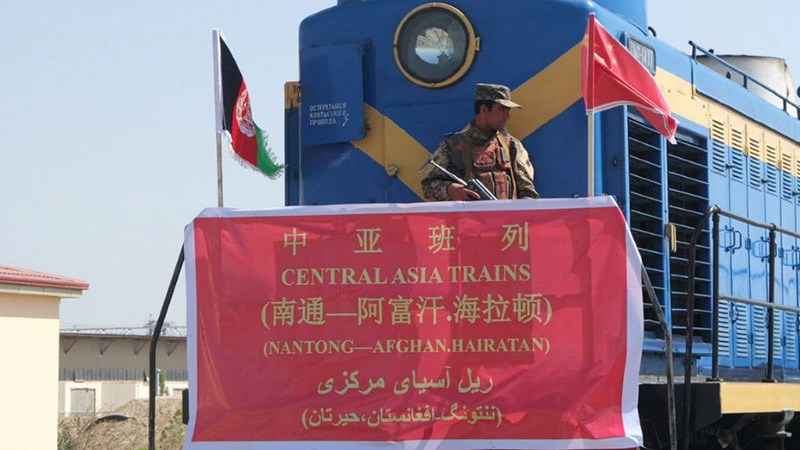
In November 2019, a “Chang’an Express” train left Xi’an, went through Kazakhstan and Baku, Azerbaijan across the Caspian Sea, passed the Georgian capital of Tbilisi and then the Turkish capital of Ankara, through the Marmaray tunnel below the Bosphorus Strait in Istanbul, and eventually arrived in Prague. It marked a rare land-sea-land intermodal run along the CEFT’s south channel or middle corridor (see Figure 1). This new line gained more use in early 2021, when the inaugural return train from Istanbul arrived in Xi’an after 15 days and thus launched the bidirectional Xi’an-Istanbul service (2B<->2A<->3A<->4B). Back in August 2016, Jiangsu Qingeng Industrial Co. and companies from Afghanistan jointly launched a freight train from the city of Nantong (Jiangsu Province), near Shanghai, to Afghanistan. The trip took 15 days to complete and passed through Alashankou, Kazakhstan and Uzbekistan before arriving at the land border port of Hairatan (Mazar-i-Sharif) in northern Afghanistan.21 A freight train returned along the same route in 2019 (see photo, figure 8). A rare China-Asia freight connection (1B<->2A<->3A<->3B), this difficult route to a risky destination heralds a potential new opportunity for China to engage with Afghanistan economically and logistically with the departure of the United States military.
Figure 8: A train loaded with Afghan goods heads to Nantong, China in September, 2019
As the CEFT connects more cities over wider geographies and longer distances, it has involved more diverse and competing players, most of which are local municipal governments, their subordinate entities and private logistics firms (see above), as well as their partnerships. The ITL Group worked with DHL in November 2019 to launch the “German Express” from Xi’an to Hamburg and Neuss, another logistics hub on the Rhine river, like Duisburg. The ITL Group has also cooperated with Deutsche Bahn (DB) in using the “German Express” to add a service to Vilnius, Lithuania. In March 2019, the ITL Group got Nippon Express, a top global logistics firm from Japan, to lure its clients like Olympus and Honda to use the “Chang’an Express” for shipping their exports from Xi’an to Europe (1A->2B->2A->3A->4A, Figure 2). This goes along with Xi’an’s greater role in adding air and sea extensions, which accounted for 40% of the “Chang’an Express’s” new business during the initial peak of the pandemic in early 2020.
From the European end, for example, the ÖBB Rail Cargo Group (RCG), a leading rail logistics company in Austria, entered the CEFT market in 2017, when it operated only 62 trains with a transport capacity of 3,000 TEUs. Due to stronger demand, RCG transported 35,000 TEUs between Europe and Asia in both 2018 and 2019. In 2020, it set a new record of over 700 trains with around 70,000 TEUs.23 As one of the EU’s only four landlocked countries, Austria stands to benefit from a stronger connection to the CEFT driven by RCG and its strong focus on creating and connecting the Eurasian freight routes through Russia.
Through the growing participation via both competition and collaboration between private and public logistics companies from Europe, China and East Asia, the CEFT has introduced more market efficiency into this vast cross-border logistics system. The CEFT-led initiatives by cities like Xi’an and Duisburg have driven the larger number of freight lines from below. To sustain the CEFT for the long run, the private sector and local government need to interface with the national governments and even supranational agencies of China, Europe and Asia more broadly. In July 2020, the most top-heavy national government of China issued a plan to consolidate the CEFT hub functions in five major cities, Xi’an, Chengdu, Chongqing, Urumqi, and Zhengzhou (Henan Province), which accounted for 63% of all CEFTs in the first half of 2021. This was a corrective measure to reduce the inefficiency cause by over-competition and duplication among many cities. It reflects the national government’s effort to catch up with local authorities and actors in developing and operating the CEFT by introducing a national vision and form of support. This is further exemplified by the national government’s requirement that subnational governments’ subsidies, including by Xi’an, for CEFT cargo trains should not exceed 50% of domestic railway costs and be reduced by 10% a year compared to the 50% level in 2018, with the prospect that all subsidies will be phased out by 2022.24
The CEFT’s expansion and sustainability will benefit from being the critical middle option of long-distance freight transport that is faster than sea and cheaper than air.
From the more collective and fragmented European end, the EU’s two-decade-old Trans-European Transport Network (TEN-T), which includes hundreds of air, rail, road and port projects to strengthen the cohesion, interconnection and interoperability of the trans-European transport network by 2030, appears to dovetail with the CEFT and the BRI. In reality, however, the TEN-T and the CEFT have not formally “met” through any direct dialogue and cooperation. In another complication, it is unclear how the CEFT will interact with the EU’s “Connecting Europe and Asia – Building blocks for an EU” strategy, introduced in September 2018. A new challenge to coordinate with the CEFT comes from the most recent EU initiative – “Globally Connected Europe” — which seems designed to counter the BRI, and by extension the CEFT, by coordinating and promoting investments in infrastructure projects to link Europe with the world from 2022. At the national level, however, Germany has more of its cities involved with the CEFT than any other EU member state, also evidenced by its discharging the second-largest number of TEUs from East Asia, including by sea, behind only Britain before it left the EU. It isn’t just coincidence that the departing German Chancellor Merkel has consistently taken the most pro-China stance among the major EU members, and also relative to the United States.
Finally, the CEFT faces a greater challenge in raising its share of carrying the China-EU trade cargo, especially against the dominant sea shipping. In 2018, the CEFT accounted for only 2.3% of China’s exports to Europe and 3.1% of China’s imports from Europe, while about 90% of China-Europe trade by weight and 60% by value went by sea (Tjia 2020). Aided by a shift of maritime cargo to overland rail shipping due to the pandemic, the share in Europe’s total imports from China by train rose from <1% in 2011 to 4% in 2020. The EU-China trade volume on rail more than doubled, with annual growth of 26.9% from 2016 to 2020.25Yet the 1,135,000 TEUs carried by the CEFTs in 2020 only equalled 2.6% of all the TEUs handled by Shanghai Port,26which is not surprising given the structural cost and scale advantages of sea shipping.
As trade continues to grow between China and the EU, as each other’s largest and second-largest trading partners respectively, the CEFT is poised to grow with it. This looks more promising as the CEFT consolidates its recently launched routes into round trips and to regular schedules, such as the new Xi’an-Istanbul line and a new Xi’an-Budapest line via Ukraine. It will help translate the CEFT-related dots and lines on the Eurasian transport map into a more formal and resilient network carrying a steadily growing share of the China-Europe and China-Central Asia trade cargo. The CEFT’s expansion and sustainability will benefit from being the critical middle option of long-distance freight transport that is faster than sea and cheaper than air. This bodes well for the CEFT to run not only more connected across Eurasia but also more sustainably into the future.
Acknowledgements
I thank the Henry Luce Foundation for an institutional grant to Trinity College and the Karen and David Thomas Urban China Endowment at Trinity College for supporting its Silk Road summer programme in 2018, which inspired part of this research. I also acknowledge a Regional Studies Association Policy Expo grant and the Paul E. Raether Distinguished Professorship Fund at Trinity College for financial support. Earlier ideas and information for this article have been presented in person or virtually at the Nordic Centre for Asian Studies in Copenhagen, the International Institute for Asian Studies in Leiden, the Leibniz Institute for Research on Society and Space in Erkner, Germany, the Mercator Institute for China Studies in Berlin, a World Bank workshop in Tashkent, Uzbekistan, the Shanghai Academy of Social Sciences, the Beijing Academy of Social Sciences, Nanjing University, Shenzhen University and Wuhan University. I am also grateful to anonymous informants based in the Chinese city of Xi’an for providing valuable information and sharing grounded insights. I am solely responsible for any remaining errors. “Through skillfully executed case studies of China’s growing nexuses with Europe, Asia and Africa, The Belt and Road Initiative as epochal regionalisation offers a timely look into how the BRI is reshaping globalisation, urbanisation and development via new cross-regional logistics connectivity, infrastructure-led city-building and special zone-induced industrialisation from China’s borderlands to far-flung places.” – Liu Zhigao, Associate Research Fellow, Institute of Geographic Sciences and Natural Resources Research, Chinese Academy of Sciences
Xiangming Chen served as the founding Dean and Director of the Center for Urban and Global Studies at Trinity College in Connecticut from 2007 to 2019. He is currently Director of the Urban Studies Program and Paul E. Raether Distinguished Professor of Global Urban Studies and Sociology at Trinity College, a distinguished guest professor at Fudan University, Shanghai, and an adjunct professor at the Graduate School of the Shanghai Academy of Social Sciences. He has published extensively on urbanisation and globalisation with a focus on China and Asia and conducted policy research for the World Bank, the Asian Development Bank, UNCTAD and OECD.
References
Chen, Xiangming. 2018. ”Globalization redux: can China’s inside-out strategy catalyze economic development across its Asian borderlands and beyond”, Cambridge Journal of Regions, Economy and Society, 11 (1), 35-58. doi:10.1093/cjres/rsy003.
Chen, Xiangming and Famiddin Fazilov. 2018. “Re-centering Central Asia: China’s ‘New Great Game’ in the Old Eurasian Heartland”, Palgrave Communications’ special issue on “China in the Global South.” doi: 10.1057/s41599-018-0125-5.
Hillman, Jonathan E. 2020. The Emperor’s New Road: China and the Project of the Century. New Haven, CT: Yale University Press.
Jakóbowski, Jakub, Konrad Popławski, and Marcin Kaczmarski. 2018. “The Silk Railroad and the EU-China Rail Connections: Background, Actors, Interests”, Working paper No. 72, Center for Eastern Studies. Warsaw, Poland.
McKinsey & Company. 2021. Understanding Chinese Consumers: Growth Engine of the World. China consumer report 2021.
Tjia, Yin-nor Linda. 2020. “The Unintended Consequences of Politicization of the Belt and Road’s China-Europe Freight Train Initiative”, The China Journal 83: 58-78. doi: 10.1080/10670564.2019.1637567.
Endnotes
The CEFT was officially designated as the China Railways Express (CRE) in 2016. I prefer the acronym of CEFT to convey the bidirectional and two-ended nature of this Eurasian transcontinental rail network that also includes the China-Asia and Europe-Asia freight routes and extensions.
“The China-Europe Freight Train has reached 41,000, reaching 168 cities in 23 European countries”, Sohu News, 12 July 2021; accessed from https://www.sohu.com/a/476907523_162758.
“The inaugural ’Great Bay Express’ arrived in Duisburg, Germany, after running for 13,438kilometers”, The China Merchants Group WeChat platform, 9 September 2020; accessed from https://mp.weixin.qq.com/s/8BldmufNSlQGmV61QFPBcw.
“Alashankou broke record on exiting and entering CEFTs again for the first half of 2021”, The Alashankou WeChat platform, 5 July 2021; accessed from https://mp.weixin.qq.com/s/NEunX2NkFH_TSBYRGSpbzw.
“New China Rail Express train service imports Volvo Cars to Xi’an”, China Daily, 15 June 2018; accessed from https://www.chinadaily.com.cn/a/201806/15/WS5b2387b9a310010f8f59d39f.html; “Volvo’s China-made SUVs exported to European market”, China Daily, 8 July 2019; accessed from http://www.chinadaily.com.cn/a/201907/08/WS5d22d625a3105895c2e7c40f.html.
“The China-Europe freight train for Volvo returns to normal”, Jiangxi TV Station, 8 April 2020; accessed from https://cn.chinadaily.com.cn/a/202004/08/WS5e8d742ba310395ca8f746bb.html.
“Using the CEFT to raise Xi’an’s large trading avenue”, Shaanxi.yidaiyilu.gov.cn, 9 April 2021; accessed from https://mp.weixin.qq.com/s/lI4-qs9pRGefpYFpe37Tkg; 8 June 2021; accessed from https://mp.weixin.qq.com/s/L-PcOWEzXKv38_xD-Z2lRxw.
Writing a business book is a great way to share your knowledge and expertise with the world. Not only will writing it help establish you as an authority in your field, but it can also be a powerful marketing tool that can attract new clients and customers. However, writing any book, especially ones related to your profession, can be a daunting task. If you want to write a great business book that will impress your readers, there are some simple steps you can follow.
1. Know The Market
Of course, as an expert in your field, you already know the market from the business side of things. However, that doesn’t necessarily mean you know what people want to read about. Talking to literary agents could give you a good idea of which specific segment of your profession could gain the most interest from readers. That way, you’ll know where to put the main focus of your book. These professionals spend their time reading manuscripts, so they probably have a good idea of what’s selling and what isn’t. On the other hand, if you haven’t seen a book on a certain topic you’re an expert on published, but really believe in the idea, talking to a professional publisher about it might be a way to get your thoughts out there in a completely unsaturated field, but in a more marketable way than you might have previously thought of on your own.
2. Include A Hot Topic
It’s always best to stick with what you know when it comes to writing a business book. That said, including a popular topic such as the need for brand development or social media marketing, even though you might not consider it the main focus of your book, will help increase its marketability. Since those are things you must have at least encountered in your line of work, giving your own take on the subject could give the book that extra oomph it needs to make it more interesting to readers. While a business book will mostly be targeted towards other professionals in your field, incorporating topics of wider interest can make more people open to picking it up and spending their free time seeing what you have to say. Who knows, maybe you can even inspire someone to get into your line of work after having read the book!
3. General Outline And Research
Once you have an idea of the marketability of your book, it’s time to start writing the outline. This document doesn’t have to be anything formal or extensive. In fact, a simple outline of the main points you want to make can keep you on track while you write. This way, you won’t have to worry about forgetting the main point or discussing something that doesn’t fit into the overall story. Think of it as a guideline you can use so that you don’t get overly caught up in one detail or another. Once you have that down, it’s time to do some research. While personal experience is what’s going to give flavor to the story, it’s important to be able to rely on proven facts when writing a business book. Finding reputable sources relevant to the subject matter of your book, whether it be through academic journals or even via social media, can give you the chance to inject more credibility into your work. Readers always prefer books where they can check facts and figures in a heartbeat, so providing them with these sources will make you seem that much more professional and enrich the air of authority.
4. Decide On The Narrative Style
The age-old question. Should you write a book in the first person or the third person? While this is a matter of personal preference, it’s important to consider the marketability and the approach your book will have. A first-person narrative style can allow you to connect more with readers by revealing a bit more about yourself as a writer. However, at times you might feel that for certain facts or details it would be better to include another source instead of yourself. The third-person narrative style allows you to explain things in a more factual, detailed manner without having to rely on your own personal anecdotes. You can even mix the two but in a very structured way. For example, after each chapter you write in the third person, you can add a short first-person perspective to introduce the next chapter, or validate the strict facts with a personal anecdote. This will make it easier for readers to follow what you’re trying to convey and understand your point of view as an author. It’s important to note, though, that if you decide to mix narrative styles, you should always do it in a set rhythm, so that the readers know what to expect. Otherwise, you might throw them off and make it harder for them to focus on the point you’re trying to make.
5. Establish An Outline For Each Chapter
The next step would be making your idea more concrete. Deciding on the headlines for each chapter and filling in some of the details will help you move on to the writing process with more confidence. This way, you’ll also have a better idea of what to research for each chapter. It’s best to start with the broad topics and then move on to the more specific ones so that you don’t get overwhelmed. Headlines are a great way to keep track of your thoughts and ideas, so you can always come back to them later on if you find yourself stuck in the writing process. A good idea is to always have something that ties it all together. Whether it’s the general tone, a sprinkling of anecdotes throughout the book that climaxes into a big ending and creates a story on their own, or something else that helps you bring out the main message of your book, having a general idea of how it will be read is essential. It’s always better to end a book on a high note rather than just let it simply end once you’ve laid your arguments out.
6. Set An Hour A Day For Writing
This is where the real work begins. It’s always advisable to set a specific amount of time for writing and then stick to it religiously. This way, you’ll be able to keep your momentum going and avoid procrastination. An hour a day should be enough, especially if you’ve already done the preliminary work such as coming up with an outline and doing your research. If you find that you’re struggling to meet this quota, then try to break it down even further into smaller increments of time so that it’s easier for you to achieve. The most important thing is to be consistent with it.
The bottom line is that writing a business book can be a daunting task, but if you take it step by step and allow yourself enough time to complete each stage, you’ll be well on your way to having a finished product. Just make sure that you’re always willing to revise and edit your work until it’s perfect.
Among the thousands of cryptocurrencies today, bitcoin tops the rank of the widely-used and – traded in the market. There are millions of people using this digital asset and the numbers continue to multiply as the industry becomes even more competitive. But from the huge volume of users, there are some neophytes who are still learning the protocols and rules surrounding various financial transactions in the network. For instance, they may assume that trading bitcoin is just about making profits without associated costs whatsoever. The truth is, popular cryptocurrency exchanges are adding a fee for trading bitcoin.
Customers who are purchasing and selling virtual coins have to pay the corresponding fees as charged in their transactions. Such fees generally include the Maker that adds to the order book liquidity through limit orders, and the Taker that subtracts liquidity from an order book through market orders. On some occasions, cryptocurrency traders may have to shoulder both fees if the limit order is already present in the order book.
Keep in mind that cryptocurrency exchanges calculate fees in two ways: as a flat fee per trade or as a percentage of the 30-day trading volume for an account. In both methods, a tiered structure is followed depending on the amount being traded. To better understand this crucial matter, the following are the information on trading fees at popular exchanges.
For traders who value security more than any other features, this trading platform guarantees safe transactions in the network to its users. It also provides innovative offerings such as InvestBox which investors can use to explore various transactions involving new altcoins. When it comes to fees, Coinsbit imposes 0.2% charge for every trading and has variable fees for deposit and withdrawal depending on the cryptocurrency being used. Some of the cryptocurrencies can be deposited and withdrawn for free. However, users who have just created new accounts are initially prohibited from making withdrawals. For subsequent transactions, the withdrawal limit is $500 for regular accounts, while $100,000 for enhanced accounts or equivalent in a 24-hour period.
This Bitcoin platform is very straightforward, helping traders find the best broker to get them started with a deposit of as little as $250 without upper limits. Afterwards, you can access the unlimited prime trading services and work to achieve your financial goals. The company goes the extra mile to provide tailored solutions to your needs, by accessing trustworthy brokerage services out there to get you started smoothly. It also guarantees that you don’t get ripped off by unauthorized brokers, which are now proliferating the online space. Start trading Bitcoin like a pro with this outstanding crypto reading website and app of 2021.
HCoin
One of the newly-launched trading platforms in the crypto market is the HCoin which started in 2018. It offers clients the opportunity to trade in a list of cryptocurrencies and fiat currencies, including bitcoin, litecoin, XRP, and USDT, among others. When it comes to fees, these are determined according to the base currency and volume and are listed in a chart on the exchange’s website. But the company does not appear to list any fees for funding an account through transfer of digital assets from another wallet. Likewise, it’s not clear whether the transaction fees change depending on the trading size.
LBank
To date, this is one of the highly-preferred cryptocurrency exchanges. Clients also take advantage of the innovations being promoted by LBank, aside from just serving as a trading platform. For instance, it supports altcoin space through the LBK Voting Listing event that pits 8 new crypto projects against one another for a chance to be included on LBank for free. Generally, it charges two types of fees: taker fee at 0.2% and maker fee at -0.05%. This means that makers can earn a portion of the generated trade fee on the transaction. However, each cryptocurrency is associated with different withdrawal rates set at fixed quantities.
BitForex
This digital trading platform offers a host of services such as margin trading, derivatives, and more. As such, it has a more complex fee schedule compared with other cryptocurrency exchanges. BitFox imposes a 0.1% fee for both maker and taker feeds. Clients can take advantage of discounted rates available for specialized market maker accounts on the platform. Likewise, deposits to this exchange are free, while withdrawals vary depending on the currency involved. There are also minimum and maximum withdrawal limits for each cryptocurrency in a 24-hour period.
Risk Note
Cryptocurrency exchanges have become a prominent venue for various traders in recent years. Many people are taking advantage of easy-to-use platforms to explore investment opportunities. Through the years, there were people who have grown their assets manifold. The risks may be high, but the chances of success are also promising!
The world is filled with talented athletes trying to make a name for themselves. However, finding enough monetary resources to sustain equipment, traveling, training, or living costs is not only troublesome, but also very much limited.
With digitalization and blockchain technologies, public subsidies can be replaced with new forms of acquiring financial support based on talent, and not on nationality, gender, education, and other determinants of social entitlement.
But, how prevalent is the funding problem, and how can something like blockchain-based digital collectibles or trading cardshelp?
Scarcity of Sport Funds
Scarcity in sports funding can be best illustrated with an example of the UK, where more popular sports are suffering from a lack of monetary resources. The home of football, cricket and rugby is starting to feel the consequences of the social and economic shifts associated with the COVID-19, adding more layers to the issue of allocating funding for athletes.
Even though the resources for the sports sector were massively cut down, popular sports are still being participated in. Nevertheless, without the proper governmental funding, and having to rely mostly on personal resources, ParalympicsGB managed to claim the first gold medal in wheelchair rugby in Europe at the Tokyo 2020 Paralympics.
In the words of Kylie Grimes, a member of the team, “I joined later but I had to work for two years without funding, paid for equipment, get to training, and have family support. We have had to dig deep.”
Funding for athletes is not only crucial to winning but also in providing the right resources available to the team and its members. This win allowed the wheelchair rugby team to make their way back into relevancy, and get the funding for the future of this sport.
Unfortunately, this isn’t just a sports-related issue, as immediately unprofitable areas like education and arts also struggle with getting the resources they need at the idealtime. This is why esports players have started to rely on crowdfunding services to get the needed sports funding support.
How can we invert the current economic system that is built around profit and not passion?
Alternative Ways of Support
An individual who cannot rely on public funding for athletes subsidies to support their career, and only a few options are available.
Self-Funding Platforms
While only a percentage of athletes manage to train and work at the same time, bearing the health costs of this consuming lifestyle, even fewer can rely on their families for financial support. So many have turned to self-funding platforms, unaware of the consequences using a service like this for sports funding support might have.
Borderless platforms like Patreon, Ko-Fi and GoFundMe have become the place for athletes to look for support worldwide. However, succeeding on these platforms often requires athletes to already have a big enough following. Although many people correlate joining Patreon with an increase in popularity, it is the fandom garnered before joining the platform that makes it profitable.
The collected profit, however, doesn’t go entirely to the athlete’s benefits. Depending on the Patreon plan athletes want to rely on, the platform can deduct even 12% from their sports funding support, not to mention payment processing fees for each individual transaction.
Platforms like Patreon also allow for a subscription tier system to make sports team funding more enticing. But this puts another layer of pressure onto the sportsperson, as they need to be available on a weekly or monthly basis to fulfill the requirements of the platform such as one-on-one time with the athlete or training plans for backers.
But getting support shouldn’t be so complicated, and withdigital trading cards, athletes might be able to exchange assets for unhindered support.
Each of those had different use cases: baseball cards were a way for baseball fans to get a hold of their favorite player in card format, Pokemon cards tied in with the massively popular video game and TV show, and Yu-Gi-Oh! and Magic: The Gathering cards apart from being a part of an overbearing narrative, are mainly playing cards.
Digital sports trading cards are able to combine the best characteristics of the mentioned classic trading cards and provide support to the person who created them. Powered by TurnCoin, VirtualStaX can be created by anyone looking to fund their journey. Supporters can purchase and trade these StaX to support said talent. Not to mention that the creator has the option to devote a percentage of their income to the Heart of Sport foundation, which supports sportspeople all around the globe.
The cards themselves picture the person behind the VirtualStaX, and some crucial statistics about their particular talent. The card’s details can be seen in StaXApp.
Creators, athletes, and influencers from all over the world can craft their own digital collectibles and enable friends, family, and all of their fans to pitch in and support them on their way to championships and future glory.
An instance of how StaX can help millions of talented people can be observed in the example of Ali Ann, a young, talented golfer from South Africa. Through VirtualStaX, Ali Ann has received support from her fans worldwide and made the life of herself and her parents easier (and her own training process more manageable) with the additional income that those digital sports trading cards provided her.
Creating Your Own Digital Trading Cards
Anyone can create their own VirtualStaX in the StaX App. Each VirtualStaX creator has StaX (cards) that they can sell to their fans through the Stax App. VirtualStaX are more than ordinary trading cards, they go beyond that. VirtualStaX allows supporters to be part of the individual’s journey for the long-run – from rising star to superstar. The whole TheXchange marketplace is powered by TurnCoin, a revenue-sharing digital security.
Depending on how the athletes share their journey, and how they interact with their supporters, among other factors, the value of their StaX can increase.
Whether you just want to provide funding for athletes and hold onto their StaX, play around and trade StaX, or support an up-and-coming talented individual all the way on their journey to fame, this is all possible in the StaXApp which launches in the US in Q1 of 2022.
By buying StaX, supporters are given the opportunity to follow the journey of any talented person across the globe. The digital trading cards can fund the careers of many people with different talents, and this is all possible with the current decentralized tools and support.
Going to find a Chinese partner? Then, you surely have loads of questions about them. Where to meet Chinese women? How to choose the best Chinese dating sites? Are Chinese women really that good? And what do you need to know to date attractive Chinese singles successfully? Continue reading this Chinese dating guide and get all your questions answered.
one of the best Chinese singles dating sites with a perfect app (only for Android smartphones) and thousands of Chinese ladies genuinely interested in dating a foreigner
This dating platform is just great—a lot of beautiful women from China and other Asian countries, fast registration (you’ll only need around 2-3 minutes to sign up), a lot of search filters (all of them are available for free), etc. EasternHoneys is not a free Chinese dating site, of course—free members can only create an account and browse profiles here.
If you’re going to send messages to women on this online dating platform, you’ll need to buy credits first—you can buy 20 credits for only $2.99 and it’s the best option for those who want to try this dating site without spending too much. By the way, you can also get some credits for free—after the registration, all the new users get 20 free credits (you’ll get 10 more if you confirm your email address).
The number of communication tools offered by this Chinese dating platform is just great—you can send emails and use a live chat here. If you want to send photos or videos, it’s possible with EasternHoneys, too—but keep in mind that chat videos are quite expensive here (you’ll have to pay 50 credits to view one). The mobile version of this website works great, too—it’s exactly as fast as the PC version.
Pros:
Fast and free registration
Lots of women are searching for a long-term relationship
Registration, contact request (in case 3,000 credits are spent), profile browsing
✔️ App
No
Whether you’re searching for a casual date or for something serious, Asian Melodies is a right choice for you. AsianMelodies is one of the biggest social networking apps (related to dating) in Asia—more than 500,000 people visit this website every single month! You can browse profiles and use search filters for free after the registration, but if you want to get access to more features, you’ll need to buy credits—that’s how it always works with international dating platforms and AsianMelodies is not an exception.
The number of paid features and services is quite high here—thus, you can use live chat, send emails, order flowers and gifts, and view the uploaded pictures and videos of other members. There is no matchmaking service affiliated with AsianMelodies and you can’t attend matchmaking events organized by this platform, but it’s still possible to turn your online relationships offline on AsianMelodies.
All you need to do to request a member’s details (personal information) or to send a meeting request is click the appropriate button—meeting request costs 625 credits and contact request is free (but you need to spend at least 3,000 credits communicating with this member first).
Pros:
A reputable, established site with more than 500,000 visitors
TheLuckyDate is not similar to other Asian dating sites on this list. First of all, unlike the other platforms on this list of China dating site, The Lucky Date has only one credit package available—you can only buy 2,000 for sending the first message to a Chinese woman costs 1,000 credits on this online dating platform—all the further messages cost 3,000 credits. The main problem of this Chinese dating platform is that you can’t buy 20,000 or 200,000 credits at once—the credit system itself is a good thing that allows people to save money and pay only for what they really need, but on this dating app, this system only makes it worse.
Another feature that makes The Lucky Date so different is the search tool—basically, you can only search by country here. That’s surely not the best search tool we’ve seen on China dating sites.
Other than that, everything is ok with this online dating app. It looks nice and simple, it works fast, and it has a lot of beautiful women from China and other Asian, European, and Latin countries.
Pros:
Affordable credits
Mobile version of this Asian dating site works nice
You don’t need to pay for paid membership here, only for credits
Probably the most popular dating site for those who are looking for a Chinese woman, CuteAsianWoman is certainly worth your attention. It’s one of the top Chinese dating sites regarding the assortment of features it offers—here, you can send voice and video messages, play different games, use the “Smart Matches” feature to get high-quality matches, and send virtual/real gifts and flowers to the ladies.
This website is extremely popular among both Western men and Asian women—CuteAsianWoman is not a Chinese-only dating platform, you can meet a lot of ladies from Japan, Korea, Vietnam, Thailand, and other countries here.
The male members need to buy credits to use all these features and services—a “free membership” only includes registration, uploading of a photo, and creating a profile (of course, free users can also use all the search tools on CuteAsianWoman).
Pros:
Video calls and voice calls
Real gifts
A lot of Chinese ladies
Cons:
Only paying members can send messages
Not all women are searching for serious relationships
If you’re searching for the best, the most reputable, and the most popular Chinese dating app, here it is—AsiaMe is the biggest player on the Asian online dating scene. Established in 2012 by a small but mighty team, this platform is not like a Chinese Tinder—it’s more like an Asian Badoo with more than half a million users.
The number of users is not the only advantage of this website. A great matchmaking service along with various search filters allows you to find a partner according to your requirements and preferences. A large set of messaging tools including live chat, email, and video calls, is another thing that makes AsiaMe stand out from the crowd of other Chinese dating apps. A great Android app makes AsiaMe a perfect option for those who prefer mobile dating—so if you’re looking for the best Chinese dating websites, you just can’t miss this one.
However, it’s not free—like all the dating sites in China, AsiaMe doesn’t allow the users to send messages or to communicate with other members for free. You will have to buy credits first—2 credits cost $10, but you can buy 2 credits for only $3.99 (it’s a special offer for the new users of this platform).
DateAsianWoman is one of the biggest dating sites for those interested in dating an Asian lady. You’ll find hundreds of thousands of women from Japan, Korea, China, Vietnam, Thailand, and other Asian countries on DateAsianWoman—but this is not the only reason why this platform made it to the top list of dating apps.
The main reason why you just can’t miss DateAsianWoman is the number of communication services it offers. You are not limited to live chat and text messages here—unlike some other popular dating sites and apps, DateAsianWoman has both video and voice call features. That’s not all—you can also send gifts to women on this website and the assortment of gifts is really wide. From jewelry and bouquets to smartphones and perfumes—there are a lot of gifts to choose from.
Obviously, all these features are not free to use. You’ll have to buy credits to chat with ladies, to send them gifts, and to have a video call—but the good news is that you don’t need to pay right away. The point is, you’ll get 2 chat vouchers right after the registration for free which means you’ll be able to test almost all the premium features offered by this platform for free!
China Love Cupid is one of the biggest dating websites for those searching for Chinese women. There are hundreds of thousands of women in their 30s (and younger users in their 20s) here, the registration is extremely fast on China Love Cupid, and the Android app works just great.
Unlike other dating sites and apps on this list that have a credit system, this one has a monthly ongoing membership pledge—here, you need to pay for a monthly premium membership. There are two types of premium subscription here—Gold and Platinum. Gold users can send messages without any limits—if you’re going to communicate with women on this dating platform, you need to be at least a Gold member. Platinum members get a VIP status—their profiles rank higher so they get more profile views and more messages from other users. Another good thing about Platinum/VIP status is that such members can get their messages translated by the team of specialists—that’s what you need to overcome the language barrier problem and that’s the feature no other dating apps on this list have.
Registration, profile browsing, creating a profile
✔️ App
Yes
Meet one of the best Chinese dating apps, FindAsianBeauty—this online dating app is certainly worth your attention if you’re interested in international dating. This Chinese dating app has literally all you need—a lot of messaging tools (email, live chat, video and voice messages), a lot of real and virtual gifts you can send to foreign women, a very wide assortment of search tools that allow you to find a woman according to your personal preferences, etc. That’s not all—advanced matching algorithms help users find their perfect matches, an Android app works perfectly, and this website is definitely one of the best Chinese dating sites in the world.
This app is not only about women from China—there are tens of thousands of ladies from Japan, Korea, Vietnam, the Philippines, and other countries here.
FindAsianBeauty is not a free dating platform—the best dating sites just can’t be free when we’re talking about international dating. However, you won’t need to buy a paid membership here—you’ll only need to buy some credits to send messages, use a video chat, and send gifts.
Pros:
Lots of women from China and other Asian countries
Simple interface
Android App
Cons:
Video calls are quite expensive
No app for iPhones
General information about online dating sites in China
Wondering how to meet Chinese women online? It’s not that hard, actually—thanks to dating sites like EasternHoneys, you can do it without even leaving your home. Read more about Asian dating sites.
However, there is a problem. The point is, women from China are different from American/Western ladies—they have different views, different cultural backgrounds, and even their dating etiquette is different from the American one. Like, did you know Chinese women are often so shy and introverted they don’t start the conversation on dating sites? These women are different—so it’s obvious that dating a Chinese lady is completely different, too.
Well, it’s not “completely” different, actually. If you don’t know where to start, read these simple Chinese dating rules and follow them—if you do so, your chances to do everything right will be much higher.
Find the best website possible
It all begins on a dating site—and choosing the best dating site is actually the most important thing you need to do. If a dating platform is not reputable, the chances to lose your money or waste your time are extremely high—and that’s definitely not what you’re looking for.
The sites like AsianMelodies or EasternHoneys are 100% worth your time and money—but you can always do your own research if you want to. Just make sure you’ve found all the possible Chinese dating site reviews and tested all the sites yourself—that’s how you choose the best dating site possible.
Pay for a premium subscription
It might sound a bit weird because you don’t need a premium subscription when using Tinder or Badoo—but Chinese dating apps such as TheLuckyDate are completely different. It’s not about Chinese platforms only, of course—that’s how all international dating platforms work: they are good only if they are paid. Only using paid dating sites you can be sure that all the necessary anti-scam and anti-fraud measures are being taken, that all the profiles are verified, and that women you’re chatting with are actually real. Find out list of the most popular international dating websites on the market.
But even if you’ve found a good and free dating platform, we still recommend you to buy a premium subscription. Premium profiles get much more attention and views than standard profiles—the more views your profile gets, the more messages you’ll receive!
Don’t wait for too long
There is a common problem with online long-distance relationships: they often don’t move offline. Being in an online relationship is convenient, simple, and not that expensive while going online is stressful (and quite expensive if we’re talking about another country)—that’s why a lot of men fall into the trap of not going online.
The sooner you meet your online Chinese single, the higher your chances to build a successful relationship, that’s how it works.
Be respectful
When it comes to meeting Chinese women or men, it’s all about respect. Respect to the partner is one of the core values of a Chinese family—so if you want to make a great first impression, always treat your online girlfriend with respect.
This also applies to sexting, by the way—even if it’s ok to start sexting in a week or so in your country, that’s not what Chinese person expect from a foreigner.
Give a sense of security
That’s what Chinese people call “anquangan”—women in this country expect their men to care for them, to protect them, and to be concerned about their future. It’s hard to explain this concept, but in short, you need to act like a mature man who makes his woman feel secure with him. That’s what they value most.
Make the decisions
In China, it’s always a man who makes the decisions and leads the relationships. That’s what these women expect from you, too—make the first approach, open up the conversation, ask for a date, etc.
Maximize your chances of success while dating online
How to be more successful regarding international dating? How to not lose money? Continue reading to find the answers.
Beware of inactive or fake profiles on a dating site
Inactive profiles are not dangerous—all you lose with such profiles is your time. Fake accounts are, however, a much bigger problem. For example, on TheLuckyDate the team of moderators takes measures to eliminate scammers and fake profiles, but the truth is there are actually no dating apps or sites without them.
There are actually two rules you have to follow in order to not get scammed. First, always google the photo of a woman you’re chatting with to make sure she is real. And second, never send them money and never reveal your personal/financial information to people you’ve never met in person!
High-quality photos on a Chinese dating app
Women spend around 3 seconds on the profiles of men they find attractive. This means that you only have 3 seconds to attract a woman on a dating website—and having a high-quality photo is extremely important.
Short and sweet bio on a Chinese dating site
Men spend 65% more time viewing the photo of a potential partner than women—at the same time, women spend 50% more time analyzing the profile overall, including the profile bio and headline. This means that your profile bio and description is even more important than a photo—so writing a catchy, interesting, and fun dating profile is certainly a good time investment.
FAQ
What are the most popular Chinese dating apps?
EasternHoneys, AsianMelodies, and TheLuckyDate are all reputable and well-established dating platforms. They attract hundreds of thousands of visitors monthly and have robust profile verification systems in place. Registration is free across all three, but only premium users can exchange messages, access private photos, and enjoy other online dating features.
What free dating sites do the Chinese use?
EasternHoneys, AsianMelodies, and TheLuckyDate are local favorites among dating apps. As a rule, registration, advanced search filters, and user profile browsing on these sites are free. However, they still have many premium features, including communication.
Why are Chinese women dating foreigners?
While there are 30 million more single men than women in China, Chinese ladies are more interested in Western culture. Many wish to break free from traditional gender roles and explore their options outside the rigid mores of Mainland China.
What is the best Chinese dating site?
EasternHoneys is the top choice for many Chinese singles thanks to multiple communication means on the site, from emails and live chat to photo and video messages. Besides, the signup is free and fast, and new users can test premium features with a welcome bonus before investing in credits.
Final thoughts about Chinese dating
Thanks to Chinese dating services, it’s extremely easy and convenient to meet Chinese women or men. You don’t need to go to China—you don’t even need to leave your home to meet thousands of beautiful people from this country. Just choose a trusted website, create an account (it’s 100% free here), and start chatting with Chinese, Japanese, Vietnamese, or Thai ladies or men—it’s really that simple and fast. Find the list of the best Asian dating sites with lots of beautiful women and men.
Many businesses tend to choose a Limited Liability Company (LLC) set up to avail of the benefits and owners protection that’s often associated with this business setup. Yet, there are specific details that one must take note of to maximize the profit and fully leverage the position of having an LLC.
Choosing the most appropriate tax classification for your LLC is a crucial business decision. Depending on your organization’s goals, there are default classifications an LLC can choose from. Note that other business structures are imposed with specific tax classifications as opposed to LLCs which can select their own.
This makes LLCs one of the most popular business models.
Default tax classifications
LLCs are assigned with the status of “pass-through” entities. This means that they are taxed through their members. In this case, a person or entity pays the business’s tax through their tax return.
This is significantly favorable compared to a C Corporation that is obligated to pay 21% corporate income tax before they disburse the earnings to their shareholders through dividends. These are subsequently charged with income tax at the individual level. This is the “double” taxation that the majority of the LLC members wish to avoid.
An LLC’s specific tax classification will depend on the number of its owners.
For single-member LLCs (an LLC owned by one owner), the U.S. tax law treats the owner as a sole proprietor. This disregards the LLC for tax purposes entirely. The owner simply reports the LLC’s income via their income tax return.
For LLCs that have more than one owner (Multiple-Member LLCs), the company is taxed as a partnership. This is similar to the method of taxation for sole proprietorship wherein taxes incurred are passed through directly to the members of the company.
Opting for other tax classifications
LLC’s have flexibility as one of their advantages. They may choose to stick with the default classification assigned to them or opt for either the C Corporation or S Corporation taxation.
For the C Corporation classification, the LLC will be taxed as a separate business entity. This means that taxes incurred by the business do not pass through the members’ taxes. Setting up these types of LLC tax classifications can be tedious and complicated for most business owners. However, it also has some advantages due to the separation of the owner’s personal and business revenues. Although this advantage is often overshadowed by the looming disadvantage of double taxation.
Meanwhile, choosing the S Corporation classification means that the LLC will be treated as a corporation. This will transfer all taxes incurred from business operations to the personal tax liabilities of the LLC’s members. This, likewise, has advantages such as avoiding double taxation. However, the process of changing the default tax classification may be tedious and complex. There are certain eligibility requirements to be taxed as an S corporation such as owner eligibility, a limited number of owners, and citizenship requirements.
Why choose the default classification?
Choosing the default tax classification brings several benefits to be considered by the LLC members. One of these is the ease of transaction. By choosing the default, no eligibility requirements would be necessary.
Consider that applying for an LLC is not an automatic procedure. That may take a significant amount of time and effort.
Opting for the default tax classification also brings the advantage of flexibility on the table. Although the S Corporation classification also avoids double taxation, remember that this transforms the LLC into a rigid structure with a required number of elections yearly. It also limits the LLC to one class of equity. This cancels the use of liquidation or distribution preferences as well as incentive equity.
LLCs are usually the business type of choice for startup owners that intend to spend their time and decision-making on things that would make their companies go forward. Opting for the default taxation is usually best for LLCs.
Whether you want to take out a home loan, credit card, or secure finance on a new car, understanding your credit score is an integral part of the borrowing process. After all, your credit score is what lenders use to determine how reliable a borrower you are and how likely you will be to make your repayments on time. As a result, your credit score is also the primary determinant of what interest rate you will be offered during your application, which significantly affects the overall cost of your credit.
What is a credit score in Australia?
As with most other countries, your credit score is calculated based on the information that is on your credit report. In short, this report shows a comprehensive record of your financial history, including things such as
Your current level of borrowing
Your previous history of borrowing
A list of all your lenders
Whether or not you have made your payments on time
Details of credit card/loan applications you have made in the past
History of bankruptcies, defaults, and court judgments in your name
Considering all of these things, your credit score is compiled into a number that ranges between zero and 1,200 (depending on the credit reference agency that is being used). In general, lenders use these scores as one of the primary factors in deciding whether or not they offer you credit (and at what cost). As you may have already guessed, the higher your score, the better – and the higher the likelihood that you will be accepted for a loan/credit card.
The leading credit agencies in Australia
There are three main credit reporting agencies; these are Equifax, Experian, and Illion (formerly Dun and Bradstreet). Let’s take a quick look into how each of them operates.
Equifax
Below Average
Average
Good
Very Good
Excellent
Score
0-505
506-665
666-755
756-840
841-1200
Equifax is Australia’s largest credit reporting agency and provides detailed personal and business information across the country. Equifax tracks the credit history of borrowers and sells this information to banks and other financial institutions to help them determine the risk for each of their customers. As you can see from the table above, to achieve a “good” score with Equifax, you need a rating between 666-755.
Interestingly, Equifax is the only credit bureau in Australia with a maximum score of 1200 (as opposed to 1000).
Experian
Below Average
Fair
Good
Very Good
Excellent
Score
0-549
550-624
625-699
700-799
800-1000
Experian is a data-focused credit agency that allows you to view your report and score for free. Your score is updated each month, which means you can easily keep track of how your current spending/borrowing habits affect your perceived creditworthiness. A “good” score with Experian means you fall within the range of 625-699.
Illion
Zero
Average
Room For Improvement
Good
Great
Excellent
Score
0
1-299
300-499
500-699
700-799
800-1000
Illion is another one of the big three credit bureaus in Australia. They create and keep hold of your credit reports before selling them to banks and other third parties once they request your information. Once again, you can request your data for free, after which Illion will send you a full credit report so you can gain a deeper understanding of your financial profile.
Illion breaks down their credit scores into six brackets, and if you want to find yourself in the “good” column, you will need a score between 500-699.
Are there any fundamental differences between the credit reporting bureaus?
Keeping track of all three of these bureaus while applying for credit can be a bit tricky. However, it’s vital to note that each of them evaluates your creditworthiness differently. Thus, if you want to increase your chances of a successful credit application, you must keep track of each of them separately.
For example, If you want to find the best personal loans in Australia, the banks and other financial institutions that you receive quotes from may all use varying bureaus to assess your risk profile. Since each bureau may put a varying emphasis on specific factors within your credit history, one lender may view you as a trustworthy customer while the other may decline to do business with you.
How to improve your credit score in Australia
Despite each credit bureaus operating slightly differently, the methodology behind improving your score is essentially the same. Remember, your score is by no means fixed. So, if you are unhappy with your score and can’t find a reputable lender that is willing to offer you credit, there are some steps you can take to boost your score. Here are a few things you could do:
Always pay your bills on time. Late and missed payments are some of the most damaging factors on your credit report, so make every effort to avoid them if possible. If you ever feel like you cannot make a payment, it’s better to contact your bank and inform them directly rather than miss a payment without reason. They will usually show you some leniency and offer a repayment plan without reporting a missed payment to the bureaus.
Apply for credit sparingly. Lenders don’t like it when they see multiple credit applications in a short period since it implies that you are desperate or over-reliant on borrowing. In addition to this, when you apply for credit and get rejected, this is visible to all other lenders via your credit report. As a result, a long string of rejected applications can raise concerns for lenders, which may make them more cautious when assessing your profile.
Close down old accounts. One of the main factors that lenders look at is the current level of credit that you have access to. If you are applying for a $5,000 loan but already have access to a further $10,000 on your credit cards, they may not consider your application. Of course, the circumstances of each case are different, although if you have any unused credit facilities, it would be wise to shut them down (or at least lower the limit).
Keep tabs on your credit score. As mentioned in this article, regularly checking your score can help you to improve your financial situation. Not only does it help to highlight the weak areas in your financial profile, but it also gives you a chance to dispute any inaccuracies and make amendments before sending further applications.
Final word
If you plan on applying for credit any time soon, you must understand how lenders will assess your creditworthiness and determine whether or not your application will be successful. As discussed, the three main credit bureaus in Australia are Experian, Equifax, and Illion. While each of these organizations uses its own scoring system to categorize what should be considered as a “good” credit score, they tend to look at (and assess) the same elements within your credit file. With this in mind, you should strive to maintain a good standing across all of your financial accounts while keeping an eye on your credit scores across these three agencies if you want to maximize your chances of securing (cheap) credit.
By Terence Tse
CFOs are evolving into AI-driven transformation orchestrators, balancing finance, technology, and strategy while upskilling teams, managing risks, and driving measurable business value.
A key insight from this year’s AI for CFOs event, organized...
The World Financial Review uses cookies to improve site functionality, provide you with a better browsing experience, and to enable our partners to advertise to you. Detailed information on the use of cookies on this Site, and how you can decline them, is provided in our Privacy Policy and Terms and Conditions. By clicking on the accept button and using this Site, you consent to our Privacy Policy and Terms and Conditions. ACCEPT
Privacy & Cookies Policy
Privacy Overview
This website uses cookies to improve your experience while you navigate through the website. Out of these cookies, the cookies that are categorized as necessary are stored on your browser as they are essential for the working of basic functionalities of the website. We also use third-party cookies that help us analyze and understand how you use this website. These cookies will be stored in your browser only with your consent. You also have the option to opt-out of these cookies. But opting out of some of these cookies may have an effect on your browsing experience.
Necessary cookies are absolutely essential for the website to function properly. This category only includes cookies that ensures basic functionalities and security features of the website. These cookies do not store any personal information.
Any cookies that may not be particularly necessary for the website to function and is used specifically to collect user personal data via analytics, ads, other embedded contents are termed as non-necessary cookies. It is mandatory to procure user consent prior to running these cookies on your website.