Home Blog Page 718

The Socioeconomic Effects Of COVID-19 On Women 

By Maria Demertzis and Mia Hoffmann

The pandemic has disproportionately affected women both professionally and at home. Although the gender gap in labour force participation since the onset of the pandemic hasn’t worsened, the policy still needs to tackle existing gender gaps, which for some EU countries are very substantive. 

Following widespread vaccination campaigns, European economies are beginning to emerge from the depths of the recession caused by the COVID-19 pandemic. And as billions are spent to accelerate the recovery and stabilize economic growth, it is important to understand that not all members of society emerge from this crisis in the same way. The COVID-19 pandemic affected women significantly differently from men along many dimensions. Long-time existing gender inequalities have been exacerbated, so much so, that it has been called a backward step for gender equality.  

The COVID-19 pandemic was different insofar as it affected another part of the workforce than regular recessions. In cyclical economic downturns, male workers tend to be more strongly affected, because men work predominantly in sectors that are more dependent on the business cycle, such as manufacturing and construction. The pandemic crisis, in contrast, affected a different set of industries than usual, and in particular those in which women represent a larger share of the workforce. Women represent the majority of workers in frontline services such as health, long-term care or education, which exposed them to high infection risks with the virus. Women make up the majority of employees in industries hit hardest by lockdown and containment measures, including retail, food services, accommodation and personal services like hairdressers (Figure 1). This in turn, placed them at an increased risk of job loss and precarious employment situation.   

Figure 1: Employment shares by gender in frontline and close contact sectors, EU28 figure1

Note: Sectors at 2-digit NACE Rev. 2 level, data for 2019Q4. Source: Eurostat LFSQ_EGAN22D 

Figure 2 plots the correlation between female employment shares in occupations and an occupational social interaction score. Women in the EU are disproportionately employed in occupations that require a lot of social interaction. They represent 82% of health professionals, and 80% of teaching professionals. Over two thirds of personal services workers are women, as are almost three in four sales workers.  

Figure 2: Female employment share and the social intensity of occupations figure2
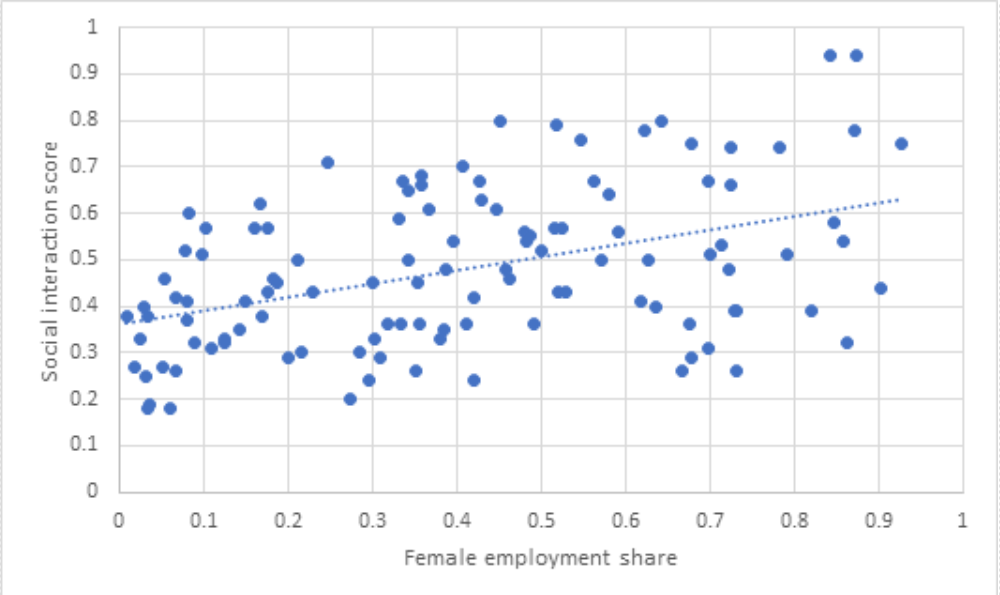
Note: Occupations at 3-digit ISCO level. Source: Bruegel based on social interaction score for occupations from Sostero et al. (2020) and employment data for 2019Q4 from the Labor Force Survey, Eurostat.  

At the EU level, the female unemployment rate increased slightly more heavily than men’s unemployment during the first wave of the pandemic, rising from 6.9% to 7.9% from the first to the third quarter of 2020, while men’s unemployment increased from 6.4% to 7% during the same period1. Following another peak in the first quarter of 2021, female and male unemployment rates recovered to 7.3% and 6.6%, respectively. The loss of jobs was particularly pronounced among women with low levels of education, who even before the onset of the crisis faced higher levels of unemployment than men with the same level of educational attainment. The same pattern, albeit smaller in magnitude, applies for women with upper secondary education (Figure 3). 

Figure 3: Unemployment rate by gender and educational attainment figure3

Note: Educational attainment levels based on ISCED2011. Low educated means primary or lower secondary education, intermediate education means upper secondary or post-secondary non-tertiary education, highly educated means tertiary education and higher. Source: Eurostat lfsq_urgaed.  

Women, who on average earn less than men and have accumulated less wealth than men are more likely to face financial difficulties following a sudden loss of income. The financial resilience of European households was already worrisome before the onset of the pandemic, with one in three EU households unable to face an unexpected financial shock. That number rises to 57% when considering single parent households, the majority of which are women. Levels of financial fragility, defined as the inability to finance an unexpected expense such as a funeral or the replacement of a washing machine, among single parent-households remained high during the pandemic but changes at the country level relative to pre-pandemic levels are mixed (Figure 4). While the rate grew significantly in Romania, Bulgaria, Lithuania, Slovakia, Greece and Malta, it also declined strongly in the Czech Republic, the Netherlands and Finland, and even more so in Estonia, Portugal and Croatia. Changes in other countries were moderate.  

It is highly unusual for such significant improvements to materialize from one year to another. We believe, instead, that these improvements in the financial situation of single parents are likely due to the outstanding policy response to the pandemic, in which many countries provided financial support to particularly affected groups. While this is an encouraging development, in this context it will be crucial to monitor how financial fragility levels develop when this support is withdrawn.  

Figure 4: Financial fragility among single parent households  figure4
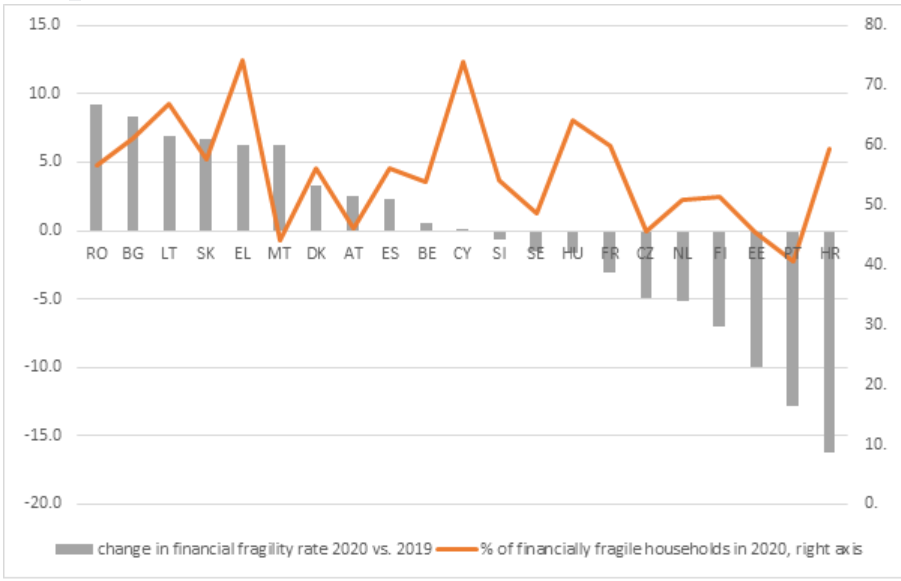
Note: Financially fragile households are defined as those that answer No to the question “Can your household afford an unexpected required expense (amount to be filled) and pay through its own resources?”. The amount is calculated as 1/12 of the at-risk-of-poverty-threshold, which is set as 60% of the national median disposable income after social transfers. Based on this, in 2019 the amount to be filled ranged from 367€ in Romania to 1447€ in Luxembourg, with an EU average of 871€. Source: Eurostat SILC.  

Demertzis et al. (2020) document a significantly higher level of financial fragility among single women than among single men in all EU member states except for Finland before the pandemic. Figure 5 shows the different financial fragility rates for single female and male households during the pandemic in 2020 for all member states for which data is available. The data confirms that women are still disproportionally affected by financial risks in the EU. Women remain more financially fragile than men in all but two countries, Denmark and the Netherlands. Sweden, Belgium and France also appear to offer an almost equal playing field. In contrast a worryingly sizable gender gap is present in eight EU member states: financial fragility affects over 10 percentage points more women than men in Bulgaria, Hungary, Slovenia, Portugal, Greece, Slovakia, Cyprus and the Czech Republic.  

Figure 6 depicts how the pandemic affected this gender gap, by comparing the gender gap from 2020 with that of 2019. Inequality deteriorated during the pandemic in 11 out of the 21 reporting countries, in particular in Croatia, Bulgaria and Portugal, where the financial fragility gender gap widened by 6%, 4.9% and 3.8% respectively. Conversely, the gender gap diminished in 10 countries, in particular in France and Slovenia.  

Figure 5: Financial fragility rate of households, 2020 figure5

Source: EU SILC 

Figure 6: Financial fragility gender gap, 2020 vs. 2019 figure6

Note: the gender gap is derived by subtracting the financial fragility rate of single male households from financial fragility rate of single female households. A positive (negative) change therefore indicates a widening (narrowing) of the gender gap between 2019 and 2020. Source: Bruegel based on EU SILC.  

Job leavers statistics indicate that women left their jobs at higher rates than men during the pandemic. Job leavers are all people who left their jobs in the previous three months, be it due to dismissals, retirement or voluntary quitting. In the two years before the pandemic, women and men left their jobs at the same rate of around 2% of total employment at EU level. This rate increased more strongly and persistently for women than for men in 2020, peaking in 2020Q2, with significant variation across member states.  

Figure 7: Recent job leavers by sex in 2020Q2 figure7
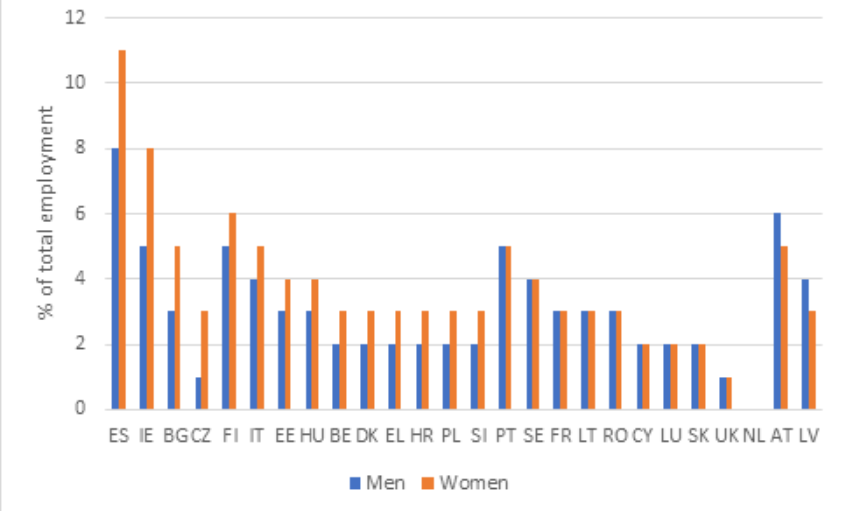
Source: Eurostat lfsi_lea_q. 

High female employment shares in close contact sectors and the ensuing rise in female unemployment are certainly drivers of this development. At the same time, owing to the closing of schools and childcare centres working parents had to balance (remote) work with caretaking responsibilities. Emerging evidence suggests that women bore the brunt of this additional load which led to a reduction of female labour supply at the extensive and intensive margin.  

A US survey by McKinsey found that a quarter of surveyed women considered leaving the workforce or downshifting their careers during the pandemic, compared to one fifth of men. When considering only parents of young children (<10 years), 23% of surveyed women considered leaving the workforce, 10 percentage points more than men.  

A number of studies has investigated the time-use patterns of heterosexual couples with children during the first wave of the pandemic in the US, the UK, Germany, Italy and Spain. While both fathers and mothers increased their engagement in unpaid work at home, all studies found a manifestation of traditional gender roles, with women taking over the majority of additional housework and caretaking responsibilities. Importantly, these results could not simply be explained by gender differences in work status or remote work opportunities. Mothers were found to reduce their paid work hours more strongly than fathers to accommodate increased childcare demands and spent more time simultaneously working and looking after their children. Women also interrupted their paid work more frequently to handle housework demands, as a result of which fathers had around twice as many uninterrupted work hours than mothers in the UK. Finally, studies show that the additional burden of caretaking and housework, and the unequal allocation of those tasks led to a deterioration of the subjective well-being of women.  

It is not unlikely that these situations affected the quality of work time and caused a reduction in productivity for workers, and much more so for women than for men. Task juggling and work interruptions have been found to lower productivity and potentially even negatively affect earnings. First evidence from gender shares of authorship of academic publications during the pandemic suggests this may indeed have occurred. In biomedicine, women’s share in academic research output fell significantly since the onset of the pandemic. This effect was particularly pronounced in emerging research relating to the pandemic. The same was found in economics, where female publication shares remained constant for non-Covid related output, but dropped significantly for research on pandemic-related topics. This effect was particularly pronounced among early- and mid-career economists. Such productivity slumps may have implications for women’s future career prospects, by reducing their chances of promotion or pay raises, contributing to a growing gender wage gap and general worsening of work outcomes for women.  

The implications of additional care and household burdens had on women’s productivity, work hours and wellbeing as a result of the pandemic need to be addressed in order to prevent an exacerbation of gender inequalities in the labour market. Even though caretaking responsibilities have returned to near-normal levels, as schools and childcare facilities reopened, the long-term consequences of the pandemic on labour markets are only beginning to materialize. One example is the growing importance of remote work or hybrid work models.  

A recent Eurofound survey found that women would prefer to work remotely more frequently than men, and this gap increased over the course of the pandemic. While in the summer of 2020, 43.6% of men said they would prefer to telework daily or several times a week, compared to 45.1% of women, the results from early in 2021 (Figure 8) show that this share increased for women to 49.1%, while it decreased slightly among men to 42.8%.  

Figure 8: Remote work preferences by gender figure8
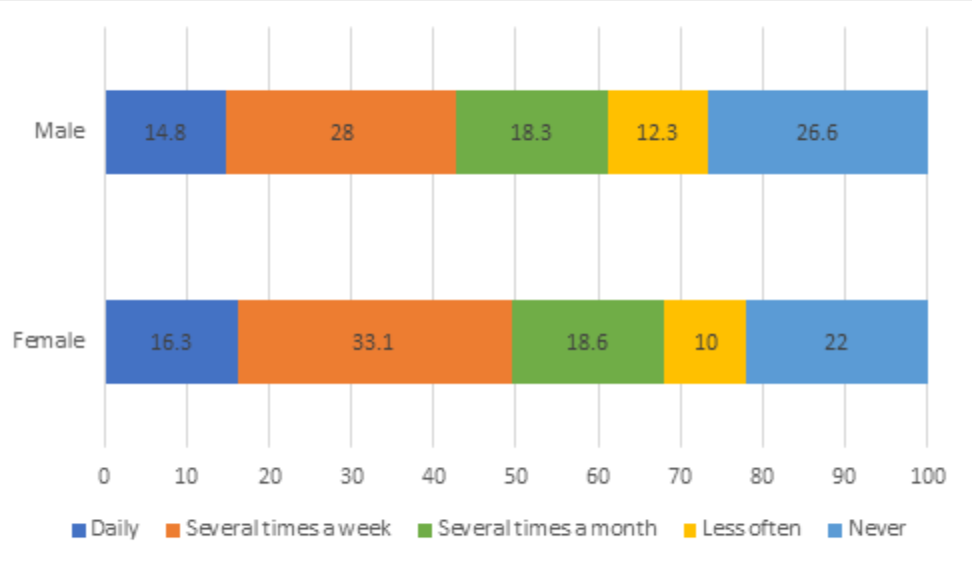
Note: Data from survey round 3 (Feb/Mar 2021). Respondents were asked:” If you had the choice, how often would you like to work from home if there were no restrictions due to COVID-19?”. Source: Eurofound (2020), Living, working and COVID-19 dataset 

Evidence from before the pandemic suggests that teleworking can deteriorate career advancement opportunities, which may be a result of one’s performance being less visible compared to that of colleagues that are working in the location. Working from home can also exclude employees from informal networking opportunities with colleagues and supervisors, and eliminate the potential for spontaneous involvement in decision-making and project assignments. When these disadvantages disproportionately affect women, they could perpetuate existing difficulties of female workers to build relationships with their often-male superiors. As argued in Grzegorczyk et al. (2021), unless the disadvantages created by selective teleworking are addressed, we will see gender inequalities deteriorate.  

Policy recommendations 

There is a significant risk of increasing divergences and persistence in the effects that we identify. Policymakers should monitor socioeconomic gender effects carefully as we recover from the crisis. This includes looking out for adverse consequences of the conclusion of pandemic support programs such as inequal increases in financial fragility or poverty rates. Policymakers should invest in financial literacy programs to improve people’s ability to manage their budgets before and during economic recessions. Financial literacy has been found to be an important element in reducing financial fragility, and financial literacy is lower among women then among men.  

In addition, policymakers should shift their attention to unpaid care work. Investments in long-term and elderly care and expanding childcare availability for parents of young children will support especially women and allow them to allocate more time to effective, paid work. Reforming current parental leave legislation to establish paid paternity leave beyond two weeks throughout the EU would furthermore contribute to a more equitable sharing of care responsibilities between mothers and fathers. 

More women lost their jobs during the pandemic. In particular women with low levels of education have not yet recovered fully from the unemployment shock of the crisis, and there is a risk that this larger gender unemployment gap will persist. At the same time, the crisis does not seem to have driven women out of the labor force at higher rates than men (Figure 9). According to the latest data, the gender gap in labor force participation has not worsened since the onset of the pandemic and even improved in a number of countries, which is good news for the economic recovery. Nonetheless, the gap remains substantial in many countries, and low female labor force participation is a structural problem worth addressing.  

Figure 9: The gender gap in labor force participation, 2021Q2 figure9
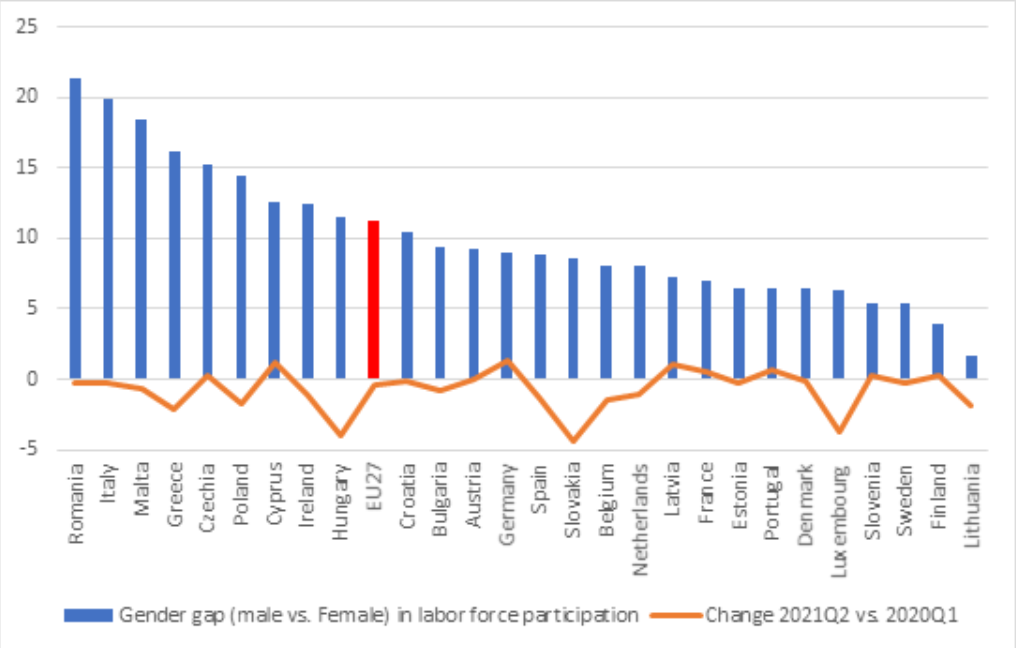
Bruegel based on Eurostat (lfsi_emp_q). Note: We calculate the gap by subtracting the share of women in the labor force from the share of men in the labor force. A positive bar therefore indicates lower female labor force participation. The change over time is calculated so that a positive (negative) value indicates a widening (narrowing) of the gap.  

In the future, there will be a permanent shift towards more remote working, which will be taken up at higher rates by women than men. Knowing that remote work can have adverse consequences for career opportunities and wages, policymakers should address the potential risks of deepening disadvantages for women in the workforce. This includes raising awareness for biased assessments of teleworking employees and carefully monitoring emerging trends and gender dimensions in labor market outcomes.  

The policy response so far to address the gendered impact of the pandemic has been limited. For example, only three countries dedicate any funds from their allotment of the Recovery and Resilience Facility (RRF) to initiatives specifically addressing gender inequalities. Austria, Belgium and Italy together will invest 878€ million on women’s issues in the areas of health, social infrastructure and labour markets. Extending the filter to include funding dedicated to the support of working parents, such as on childcare and nurseries, the amount climbs to 6.8€ billion which still only amounts to less than 1% of the RRF2.  

Next generation EU is not purely a tool to stimulate economic recovery, but has the explicit purpose to set the EU economies on a more sustainable, digital, future-proof growth trajectory. This structural orientation makes it the right tool to use to prevent a perpetuation of existing obstacles to female labor market participation, advancement and outcomes. Although the explicit spending on gender equality measures is small, the impact of the remaining 99% of investment on women is yet unknown, and we encourage the EU and its member states to conduct gender impact assessments of all initiatives to ensure investments contribute to a more equitable future for women and men.  
 
This article was originally published in Bruegel on 3 November 2021. It can be accessed here: https://www.bruegel.org/2021/11/the-socioeconomic-effects-of-covid-19-on-women/ 

About the Authors

Maria DemertzisMaria Demertzis is Deputy Director at Bruegel. She has previously worked at the European Commission and the research department of the Dutch Central Bank. She has also held academic positions at the Harvard Kennedy School of Government in the USA and the University of Strathclyde in the UK, from where she holds a PhD in economics. She has published extensively in international academic journals and contributed regular policy inputs to both the European Commission’s and the Dutch Central Bank’s policy outlets. 
 
Mia HoffmannMia Hoffmann works at Bruegel as a Research Assistant. She studied International Economics (BSc) at the University of Tuebingen, including one semester at the Università di Torino, and holds a Master’s degree in Economics from Lund University. Her previous research focused on the impact of migration on economic growth and analyzed the effects of childcare policy on household bargaining. Her current research interests involve issues related to trade, labor markets and inequality. 

Learning The Benefits Of Podcasts For Your Business Marketing

In recent years, the popularity of podcasts has skyrocketed so much that even Spotify, a music streaming company, has signed a deal with Joe Reagan to host his podcast on the platform exclusively. Podcasts were once thought to be an outdated trend but the outbreak of COVID-19, WFH (Work From Home) and lock-downs have changed that. Nowadays, even various internet influencers and 3Patti celebrities are starting their podcast sessions on multiple topics – be it technology, business, marketing or any other.

Since, more people are jumping on the podcast bandwagon, companies & businesses are considering the use of podcasts as one of their digital marketing strategies. Hence, it’s essential to learn more about podcasts and how you can use them for marketing your business – which is why we’re going to discuss the same in this comprehensive guide.

What Do You Mean By A Podcast?

A podcast can be defined by a series of different episodes, which are digitally formatted and programmed, focusing on a specific topic or theme such as start-ups, technology, Money Earning Games like poker, celebrity gossip, sports or any other. In other words, a podcast can be defined as radio, except in digital form.

Usually, podcasts are free to listen to and can be obtained on a variety of platforms. All you need is a compatible device along with an internet connection.

The origin of podcasting was in the year 2004 by a software developer known as Dave Winner and his buddy Adam Curry (who was an MTV VJ) and the term ‘podcast’ was first coined by Ben Hammersley. As of the year 2022, more than 900K podcasts are streaming and more than one million people are listening to them each month. Hence, the potential is huge.

The Rise In Popularity Of Podcasts

In the year 2009, it was reported that more than 9 per cent of adults aged between 18-49, were listening to podcasts. The percentage grew to 20 per cent in 2016. Then in the year 2014, BBC reported that their podcasts have been downloaded over 1.1 billion times in the UK itself.

Research says that more than 55 per cent of internet users know what podcasts are, which is indeed a massive benefit. Furthermore, the intimacy & convenience shown by pod casters is also one of the major reasons why podcasts have become so much popular.

Benefits Of Utilising Podcasts For Your Business Marketing

1. Podcasts Are Great For Audiences On The Go

If you’ve been in the marketing business for some time, then you probably have seen your clients utter the words – ‘didn’t have the time’ – multiple moments. To deal with such audiences, podcasts should be implemented because they can be consumed on the go. Since a podcast is an audio medium, your audience can listen whenever, wherever they want – whether they’re riding in a train or taking their pets out for a walk.

2. Podcasts Help In Company Promotion

Similar to other marketing assets, podcasts can also help you in building brand recognition & awareness. Since the podcast is from your company house, you can dictate the content as per your needs. For instance, if you have a product or service launch coming up, you can advertise the same with your audience.

3. Podcasts Help In Performing Deep Dive Into Various Topics

Even though marketing nowadays depends on short audio & video content, podcasts still provide the niche ability to create long-form content. It can be possible that you need more time to discuss something important with your audience and Youtube Shorts or TikTok will not be enough for the same. Times like these are when you need to utilise the benefits of podcasts because using podcasts you can create product reviews, interviews and even discuss important company affairs.

For more business-related inquiries, contact us today.

Safety and Security Tips for Your Supplement Business

If you’re an entrepreneur with a passion for health and wellness, the nutritional supplement industry is the perfect business opportunity for you. It’s an industry worth over $70 billion and is growing steadily at a rate of over 8 percent annually. Furthermore, people in the United States are more health-conscious than ever before, making this a great time to get into the nutritional supplements industry. However, it’s a tough business, and you need all the right resources to protect it from the many pitfalls that lie in wait.

Safety is one of the top concerns for brands in the supplement industry, as their customers expect them to deliver products that are both effective and safe to use. Furthermore, you must also invest in physical security to keep your business and team members safe from potential threats. There are a lot of supplement makers to look out for, which is why we’ve put together this brief guide to help you cover all the potential security threats. Continue reading to get some safety and security tips for your supplement company.

Do your due diligence when looking for a supplement manufacturer

As we mentioned in the introduction, customer safety is one of the most important concerns for supplement companies. Indeed, customer safety starts during the formulation process, which is why it’s important to work with the right supplement manufacturers to ensure the safety and efficacy of your products. Makers Nutrition is a supplement maker with years of experience in the nutritional supplement industry, and they provide private label services to supplement companies in need of top-notch labs and superior supplement manufacturing processes. Makers Nutrition has an FDA-approved lab, and they work closely with their clients to provide formulation and testing to ensure the effectiveness and safety of their nutritional supplements.

Use access control solutions to secure the premises

You should never underestimate the importance of physical security to your business operations. After all, the safer your team members feel, the better they’ll perform on the job. Swiftlane is one of the nation’s leading providers of access control systems. Their access control solutions enable users to lock and unlock doors and arm their alarm systems using a mobile app. Check out this SwiftLane review to get insights into how their mobile access systems can improve your building security.

Print all the necessary nutrition information on your labels

Another way to promote safety in your business is to go the extra mile to provide potential customers with all the information they need to make wise decisions about your products. Your labels should list all the active and inactive ingredients in your dietary supplements. Of course, FDA regulations dictate that you must list all the ingredients in your supplements on the fact sheets for your products. However, it’s a good idea to go the extra mile to provide consumers with any additional information that will tell them how the product works.

Invest in the right insurance products for your business

Another way to protect your business is to get the right insurance coverage for your company. As a supplement company, you’ll need general liability insurance and product liability insurance. Hopefully, you’ll never need to make claims on those policies, but it’s better to have them and not need them than the opposite.

Ultimately, making dietary supplements is all about helping people to achieve wellness and happiness, meaning safety should be a core tenant of your business model. The most important step to promoting safety in your business is working with the right supplement manufacturer. Makers Nutrition has years of experience in the industry, and they have a well-deserved reputation for making high-quality nutritional supplements. Working with a company like Makers Nutrition makes your job of keeping your company and customers safe much easier.

6 Smart Cookware Options For Healthy Cooking

It is not just the food that you eat, but also the cookware influences your overall health. All cookware is not built the same. Some of them are expensive while the others are pocket friendly. Some retain heat better than others. And some cooking materials may pose health risks that others don’t. Before you purchase a sparkly new set to cook meals for yourself and your family, it’s certainly important to know whether it’s safe.

In this blog, we are going to list the healthiest and safest cookwares for your kitchen.

Cast Iron

Out of all alternative options out there, cast iron is incredibly versatile, very durable, and relatively inexpensive – so, it’s no surprise that it’s one of the most popular cooking materials out there.

Molded  from a single piece of metal, an alloy of carbon and iron, cast iron uses no other additives or toxic substances. Cast iron is naturally non-stick, allowing anyone to replace non-stick pans and use this healthier alternative which consumes less cooking fat in the process.

Stainless Steel

A staple in many kitchens, stainless steel is made using steel forgings which guarantees strength and durability. But if you’re wondering whether stainless steel cookware is safe, well, it also comes with a couple of health concerns you should be aware of before purchasing.

The steel itself is not the problem. It’s completely non-toxic, the same as cast iron. The issue is the substance that coats it.

Usually, you’ll get one of the two options. It’s going to be either chromium or nickel. Chromium is essential for the human body, but only in small amounts, and can be derived from food. Nickel, on the other hand, is considered harmful to the human body as some of the residue is likely to get ingested with food overtime.

Aluminum

Aluminum is a terrific heat conductor, and aluminum cookware is really inexpensive. However, aluminum itself has a few problems: it reacts with acidic foods and leeches pretty badly. Aluminum consumption is linked to Alzheimer’s disease, as well as some other conditions.

But not to worry. There are two commonly-used options to treat aluminum cookware and avoid this problem. It’s either a non-stick layer or anodization.

Ceramic

Ceramic cookware has a reputation for posing a very low risk to your health. We have to agree. After all, at its core, ceramic is nothing but clay, baked at super high temperatures. It’s eco-friendly, entirely non-toxic, and non-reactive, making it a solid option for most cooks. However, a lot of it isn’t suitable for cooking on a stovetop, especially if it’s an induction one. Another problem with ceramic is the glaze and paint on the ceramic dishes (especially older ones), can potentially include lead – a highly toxic substance.

Granite

Modern graniteware cookware does not contain any widely-known harmful substances. It is oven and stove-ready. Although a drawback is that it’s not really non-stick and will require a big glug of fat for cooking pretty much anything. Also, modern graniteware utensils simply tend to be on the lighter side, meaning they won’t hold heat as well and won’t be suitable for all kinds of cooking.

Copper

Copper is less commonly found in a regular kitchen. The most expensive out of the options on this list, it’s valued for both the aesthetics and supreme heat conduction – it conducts the heat up to 5x better than regular iron, and up to 20x better, when compared to stainless steel! Copper cookware is usually lined with another metal, such as tin, which is not reactive, and won’t leach into your food. The drawback is that tin is also very soft and has a low melting point of around 450°F. This means that leaving the pan unattended over high heat and scrubbing hard while cleaning will remove the tin, and expose the copper.

Bottomline

Making healthier choices is an option while purchasing these cookwares. Know what works best with your lifestyle and choose accordingly.

The Different Tax Implications of a Lottery Jackpot Win

A syndicate recently celebrated winning the €19,060,800 jackpot in the Irish National Lottery, defying odds of 1 in 10,737,573 in the process, but what are the tax implications of winning a lottery jackpot?

This is a topic worthy of discussion as lottery players now have the opportunity to take part in international lottery draws worldwide.

Tax considerations for lottery players in the UK and Ireland

The good news for the Irish syndicate is that lottery winnings are not taxable on the Emerald Isle. But it is important to be aware that some taxes, such as deposit interest retention tax, gift tax and inheritance tax can apply at a later date.

Similarly, in the United Kingdom, there is no tax payable on lottery winnings, but again, players should note that income tax on deposit interest is payable and there are also potential gift tax and inheritance tax implications.

Tax implications for lottery players in the United States

These examples are in contrast to the situation in the United States, where US lotteries such as Powerball and MegaMillions are subject to federal tax and in some cases, state tax deductions.

For example, CNBC reported that in 2021, a single ticket won a $699.8M jackpot on the Powerball. As is customary, the winner has the choice of accepting their winnings as a lump sum or paid as an annuity over a period of 30 years. If the winner decides to elect for the lump sum, as the majority of lottery winners do, they will receive a sum of $496 million which would be subject to a 24% federal tax charge. So, after tax deductions, they would be left with approximately $377 million. However, the winners of a lottery jackpot would be likely to face additional tax payments to the IRS at tax time.

Nevertheless, some variations do exist in the USA. In California, there are generally no state tax deductions on lottery prize winnings but federal taxes still apply. In New York City, winnings are subject to a state income tax (10.9%) and a local tax (3.876%).

It is important to note that there are implications for non-US citizens when playing US lotteries such as Powerball and MegaMillions. Lottery winnings in the US are subject to tax, which means tax is deducted from the winnings of lotto players from abroad.  

players from abroad

Source: Lottoland

Winnings from the MegaSena lottery in Brazil are also subject to income tax at a rate of 13.8 percent and there are also some European countries that charge tax on lottery winnings. While the Spanish Christmas El Gordo lottery offers the best odds of winning the jackpot at 1 in 100,000, there is a 20% tax on winnings over €2,500.

Therefore, while tax is not payable on lottery winnings in the United Kingdom and Ireland, it is important to remember that some taxes, such as gift tax and inheritance tax can apply. In other countries such as Spain and Brazil, tax is payable on lottery winnings. As the example of the Powerball winner in the United States demonstrates, the tax charges can reduce the jackpot by a hefty amount, but the winners of mega jackpots will still be left with a large sum of money.

Vanguard Group Has Suspended Purchases Of Russian Securities

Regardless of your feelings towards Russia and Ukraine, the invasion is having an impact on just about everyone. In the US, sanctions on Russian fuel imports have already sent the gas price to historic highs. In the UK, Russian oligarch Roman Abramovic’s ownership of Chelsea Football Club is making it impossible for fans to buy tickets to matches. Around the world, it is impacting financial vehicles like mutual funds.

This last has become evident as Vanguard Group, the second-largest investment firm in the world, has announced that it will be suspending purchases of Russian securities for the foreseeable future.

It may not seem like such a big deal. After all, less than 0.01% of current clients’ assets will be impacted by the decision. Vanguard Group simply does not generally invest in Russian securities. However, considering the type of company Vanguard Group is, this decision has interesting implications.

What is Vanguard Group?

As mentioned, Vanguard Group is an investment firm and the largest provider of mutual funds and the second-largest provider of exchange-traded funds (ETFs) in the world. However, unlike many other investment firms, Vanguard Group’s ownership structure is entirely made up of its funds which are owned by shareholders. Shareholders are therefore the only true owners of Vanguard Group.

Any firm that is owned by its shareholders is somewhat restricted in its decision making. While the individuals running various parts of the firm make the majority of decisions without direct shareholder input, big decisions like these are generally controversial. There will be many shareholders who are happy to take a stance against the Russian invasion of Ukraine, but others may not be so eager to do so.

This decision is therefore a strong statement by the fund managers that they are ready to take on any backlash. It certainly helps that the wealth of their shareholders will likely not be particularly impacted by this decision. Still, it is a bold step to take for such a big investment firm with so many stakeholders.

Other Factors Dominate

Individuals with money at stake may be more consumed with other factors which will impact their money. The suspension of purchases of Russian securities will not have nearly as big an impact as the sanctions placed on Russia by the US and other countries. With the US now banning all fuel imports from Russia, there is serious risk of major economic implications to come.

The gas price has already risen to its highest ever value. This is likely to increase the prices of all consumer goods in the immediate future. Inflation has already been at record highs. Now there is the risk of so-called stagflation. Stagflation refers to a scenario where rising inflation does not coincide with economic growth.

Recession could be imminent, with many markets at risk of crashing after months of recovery. Individuals with wealth tied up in mutual funds could see their finances taking a major hit. It is unclear what the best course of action is, but it seems that, whatever happens, upheaval is guaranteed.

Russia’s Role

The question many shareholders might ask is whether Russia is really impacted by decisions like that of Vanguard Group. The reality is that a decision that will hardly impact shareholders is not going to have much of an impact on Russia. However, in scenarios like this one, it is a scale that these things make a difference. The more firms that implement restrictions on Russia, the harder it will be for this invasion to continue indefinitely.

There is also the matter of reputation. A firm like Vanguard Group cannot afford to take an ambivalent position on Russia’s invasion of Ukraine. Before their suspension of purchases of Russian securities, people were already asking questions of their intentions. This is not just happening to investment firms, but to whole industries and even governments around the world. Neutrality is simply not an option.

Fund managers at Vanguard Group are unlikely to face too much opposition or backlash from shareholders. There will always be those who do not like unilateral decisions being taken, even if they agree with them. But most people will recognize the fact that a failure to act would have been unsustainable.

It remains to be seen where the Russian invasion of Ukraine will take the world economy. For now, we can only hedge our positions and continue to monitor the situation.

How to Grow Your Retail Business

These are interesting times. Starting a retail business has never been simpler; all you need is an idea, a product and an online storefront. E-commerce has effectively lowered the barrier to entry for a rush of hungry entrepreneurs.

But growing a retail business? That’s another matter entirely. Because e-commerce has levelled the playing field for new businesses to sell various products (white-label, private label, etc.), expanding a retail business requires overcoming stiff competition. The same goes for brick-and-mortar retailers, who find themselves in the unenviable position of competing against physical and digital storefronts. A retail consulting company like https://www.heliotech.ca/ would be able to help identify areas to start improvement.      

Still, it’s possible to expand your retail store. Below, let’s explore how to grow your business by using retail data science, adopting a global mindset, shoring up your logistics and fulfillment solutions and crafting an omnichannel user experience.

Think Globally

At its most basic, growth requires expansion – expansion into new markets, new countries, and among new customers. It seems obvious, right?

But expanding into foreign markets requires research, scoping, preparation, and a renewed focus on shipping and logistics. In the sections below, we’ll cover how a creative logistics plan and strategic partnerships can aid in the foreign expansion process, but let’s tackle some first steps.

You can start by researching and calculating product demand (using competitor analysis tools, SEO tools and Google Trends) to determine where you should expand. Next, outline the scope of your expansion so you can create a workable roadmap toward your business goals. Price your products according to local competitors and local conventions (i.e., avoid the number “4” in China). Finally, prepare a customer service plan that addresses international customers.

Solve the Last-Mile Problem with a Smart Partnership

Whether you plan to grow locally, nationally or globally, you’ll need to address “the last-mile problem.”

A critical competitive differentiator in modern retail is how quickly you can get your product to a consumer. Customers have come to expect on-demand, same-day delivery. The “problem” is that this last leg of the supply chain process is often the most costly and time-consuming.

Therefore, one of the best pieces of advice for how to grow your business is to forge a partnership that deals with the last-mile problem. Look for a global network of micro-fulfillment centres, like REEF, that can position your product close to consumers. By situating your fulfillment solutions in dense, urban areas, you can turn a last-mile problem into a last-block solution, leveraging faster delivery – 30 minutes in some cases. Plus, you can advertise your products in their digital storefront, reaching a host of potential new customers.

Create an Intuitive, Omnichannel UX

Seamless user experience across channels is at the heart of contemporary retail growth. As McKinsey points out, while omnichannel used to be “the bleeding edge of retail,” it is now “a requirement for survival,” as most young consumers value seamlessness over traditional channel boundaries.

Creating an intuitive, omnichannel UX requires mapping the customer journey across your physical, web, social and mobile presences.You need to deliver cohesive, cross-channel touchpoints. If you aren’t sure what proactive steps to take toward the omnichannel experience, don’t worry; it takes some time to understand. To start, read through this list of omnichannel experience examples, which also includes advice for building an omnichannel marketing campaign.

Payday Loans: Financial Lifesavers, Not Predators

The Canadian economy has started to regain its footing. But, many households are still struggling to achieve financial stability. Given the drastic changes before, it may be hard to return to pre-pandemic life. Loans are still high, although the percentage of defaults decreased in 2020.

But these events have taught us the value of financial literacy. It is even more apparent now that interest rate hikes may happen soon. Payday loans are taking the spotlight today as bank loan approvals remain stringent. Hence, we will look at tips to avoid getting stuck with interest and borrowing fees.

The Financial Well-Being of Canadians in the Pandemic

In the last year, Canada has taken the path to recovery and post-pandemic growth. Along with it is the increased awareness of the importance of building and maintaining financial resilience. The unexpected events that transpired stimulated every household’s urge to create a financial safety net. The surge in hospitalization, borrowing, and bankruptcy revealed income and wealth disparity. As such, people became desperate to cover all constant and emergency expenses.

However, the lower-income employees and small businesses felt the most impact. The fiscal and monetary support was not enough to bridge the financial gap in the country. Financial vulnerability remains a concern for many individuals, especially the unemployed. In a survey conducted by Statistics Canada, 22 percent of Canadians had difficulty meeting their basic needs in 2Q 2020. The efforts were almost futile as the rate remained high at 21.7 percent in December 2020.


Even so, the financial literacy of many Canadians increased. The default loans became lower than their pre-pandemic level. In 2021, the recovery began as more businesses and jobs reopened. The percentage of difficulty covering basic needs went down to 19.3 percent at the end of the first half. In the same survey, the number of households below the poverty threshold also decreased.

These are the primary aspects that point toward improving financial resilience. The financial resilience score rose from February 2020 to February 2021 from 50 to 56. The demographics showed that 31.1 percent or 8.03 million people in Canada were financially resilient. Over seven million people, or 29.6 percent, were approaching financial resilience. But, the remaining 39.3 percent were still financially vulnerable.

But, the study showed an improvement in the behaviors of many households. For example, 62.1 percent of households reduced their non-essential spending. Another 23.9 percent said they have started to establish an emergency fund. It was higher than the previous year at only 18 percent, proving the increased financial literacy. So, more households today are geared towards recovery and resilience amidst their different paces.statistics canada

The Role of Payday Loans in Financial Stability Amidst the Pandemic

The restrictions led to limited operations, net losses, and massive layoffs. A recession lowered interest rates to encourage borrowings and spending. But, banks became more stringent, making it harder for the jobless and underemployed. The increased transmission and hospitalization further aggravated the situation. It was more felt by those within the poverty line.

Thankfully, payday lenders were more than willing to accommodate those who needed instant cash. They helped many lower-income households meet urgent expenses. They were prevalent among those earning less than the average salary.

Payday loans are non-discriminatory as everyone is welcome regardless of salary. The processing only takes a day, helping you get access to what you need immediately. The maximum amount you can borrow is $1,500, depending on your financial capacity.

In Alberta alone, 35 percent borrowed $150-500 per lender in 2020. It proves that most of them were either jobless or had lower earnings. The remaining 65 percent borrowed at least $500. And since the default loans were only 8.8 percent, it is safe to assume that the fees were still reasonable. As such, payday loans became a lifesaver, not a financial predator.alberta government

Tips to Avoid Getting Stuck With Payday Loans

Payday loans are more lenient than banks. The application and approval process is faster and more convenient. But, the interest rates can shock you. Here are the things you must remember before applying for a payday loan.

Make Sure that the Payday Lender is Regulated

Knowing whether a payday lender is regulated or not will help you avoid problems in the future. It assures you that you are protected by law. Many borrowers experienced harassment from unregistered payday lenders.

Read the Payment Information

Both payday and installment loans have fixed payment schedules and interest rates. Note that payday loans interest rates are not the same in all provinces. If possible, try to compute the accumulated interest and assess whether it is worth applying for or not. In Toronto, a borrower of $1,965 for a couch and other purchases ended up paying $5,850 in three years.

Borrow What You Need

Payday and installment loans are meant for emergencies and not for impulsive buying. Borrow the amount that will cover your essential purchases to avoid overspending or paying a higher amount.

Live Within Your Means

The first step to avoid borrowing is not spending more than you earn. If possible, set aside an amount for your savings and investments.

Always Pay on Time

Always pay on time to avoid paying higher interests and extra fees. Practicing it may help you finish your payment sooner than you expect.

Bottom Line

The financial capacity of many individuals is improving, although their struggles remain evident. Payday loans will help cover urgent expenses and stabilize finances. Their interest rates may be higher than usual, but their leniency is vital during unexpected events. And as long as you keep track of your finances, payday loans will not be a problem for you.

How can Human Resource Management Help Your Business Grow?

Human resource management (HRM) is the process of managing people in organizations in a structured and thorough manner. Using AI for recruitment software, human resources can improve their ability to find and hire the best-fit candidate from a pool of applicants in a smarter, faster manner, and without bias.

Human resources management involves all management decisions and actions that affect the relationship between the organization and its employees. The success of an organization lies on the shoulder of its human resource management.

Importance of Human Resource Management

HRM is an important aspect of sustaining and increasing the health of a business because a company is only as good as its employees. HR managers, often known as talent recruiters, watch the state of the job market to help the company stay competitive.

This could entail ensuring that salary and benefits are fair, that events are organized to keep employees from becoming burnt out, and those job duties are tailored to market conditions.

HR managers help recruit new professionals with the capabilities needed to advance the company’s goals. As well as assist with the trainings, HR courses, and development of current employees to meet objectives.

 Objectives Of Human Resource Management

The objectives of HRM are:

  • Maximize the productivity of an organization by increasing the effectiveness of its employees, part of which can be achieved through hr courses online. These courses can help hone the skills and abilities of each employee, providing the company with well-informed and proficient individuals.
  •  Provide and maintain productive employees by helping the organization achieve its goals.
  •  Make effective use of each of the employee’s skills and abilities
  •  Ensure employees receive the necessary training
  •  Communicate company policies, procedures, rules and regulations to employees.
  •  Maintain ethical, legal and responsible workplace policies and behaviors. 
  •  Manage external influences that may have an impact on people within the organization. 

HRM staff members are responsible for ensuring that the organization goals, visions, and values are shared and give an overarching reason for employees to want to work for their organization. These elements can be motivating and make employees feel as if they are part of something bigger than them.

They are mentors and members of employee teams that address philanthropic giving, employee engagement initiatives, and employee family gatherings.

Employees who work in HRM must also assist in protecting their employer and company from lawsuits and the resulting workplace disruption.

For a company to meet its goals, it must have employees who will help them meet them.

Ways HR Can Help Grow Your Business

1. Hire The Right People  

A well-running and successful business means that there are even more excellent people behind it. In order to build an outstanding team, you need to identify and hire the best candidates for the job. 

You can identify suitable personnel with the help of a talent acquisition management system. This software makes use of artificial technology (AI) to effectively filter employees with the greatest potentials. As such, it decreases the time spent on scouting new talents. 

The use of AI in recruitment does not only hire the best candidates, it also reduces the perennial problem of employment bias. Using a talent acquisition software eradicates human bias as it doesn’t consider anything else other than the applicant’s credentials. It’s a win for both the employer and applicant. 

2. Build Your Brand And Culture

The values, expectations, and practices that guide how your team collaborates are known as organizational culture. Every successful firm relies on its brand and culture, people’s perceptions of your company will be influenced by the organizational culture. HR has the time and resources to devote to developing a brand and culture that works for you and your team.

3. Plan For Growth 

You’ll need to hire more people as your company grows. Outsourced small business HR services plays an important role in growth planning since it is aware of the positions that need to be filled.

HR gives invaluable information about potential challenges and the time it will take to fill these roles, both of which are crucial to success. HR can assist you in developing a strategy to get top personnel on time by anticipating your future growth.

4. Employee Turnover

Planning management, training, and benefits help decrease poor retention rates and increase recruiting expenses. Employees who resign or are fired can have a negative impact on the organization in a variety of ways, including project delays, decrease in productivity, increased recruiting costs, training obligations, and a negative impact on team morale.  

HR planning can help you improve your ability to keep staff with the correct initiatives in place.  By conducting employee satisfaction surveys, putting in place policies and procedures to avoid confusion, developing morale-building programs, creating benefits packages, and instituting effective management-to-staff communication 

5. Invite Feedback

It’s important to request feedback from employees if you want to track employee satisfaction. Employee feedback is one of the most valuable data sets you can collect about how your company functions. And whether it is living up to the company culture you want to establish. 

Your HR team is in the ideal position to elicit employee feedback and analyze data to discover solutions to common concerns because they have access to everyone in your company. Employees are also more willing to provide feedback to HR since they know their problems will be addressed and their personal information will be kept secure.

6. Training New Talent

To welcome your new hire, your HR staff will need to develop an employee onboarding procedure. This will help them with the necessary skills and organizational knowledge. The sooner you teach your new staff the values of teamwork, transparency, and continual improvement, the better. Putting in place systems, processes, and policies that foster a positive employee experience. 

Every employee will be required to master the skills and procedures that are unique to their position. HR should standardize employee training, provide informational manuals, choose individuals to manage new hires, and so on. Having such a procedure in place will help new employees spend less time learning and more time delivering to their full ability in their new capacity.

7. Employee Growth & Performance Management

Employee development and performance management are two of the most crucial parts of an HR strategy for corporate growth. Monitoring staff development requires a robust performance management system. Tracking an employee’s performance, comparing it to particular key performance indicators, and identifying their strengths and areas for improvement are all part of how you keep track of their progress. 

Your HR department should be in charge of putting the performance management system in place. A performance management system’s data is a rich source of information about an employee’s goals and future career moves.

8. Perks and Benefits

Perks and benefits are important to employees, and HR understands this. Creating incentive and recognition programs that make employees feel valued and, as a result, increase their retention movement. 

9. Promote Leaders

People in positions of power must have the team’s respect. You’ll build a team that works together by working in conjunction with leaders and recognizing and promoting leaders. assisting people managers in enhancing their leadership and development skills.

Conclusion

A functional  HRM system enables an organization’s staff to contribute to the fulfillment of the organization’s objectives. Allow your human resources staff to assist you in growing your company. Give them the authority to build a workplace that attracts the finest and brightest. When you put the right people in the appropriate positions, you’ll be unstoppable. And that’s how you’ll be able to grow your company. Decades of research show that effective human resource management practices lead to higher business growth rates.

Filipino Bride Price—How Much Are Filipina Brides?

Fame about Filipino ladies for marriage has gone worldwide since these women have most qualities a perfect wife should have. It encourages foreign men to find a Filipina wife, and they start their search using a variety of different ways. Some guys decide to take advantage of the most popular and efficient approach of Filipina wife finder. They join popular platforms, see a range of paid services offered, and wonder, can you buy a Filipino bride indeed? Fortunately for all single men, it’s a popular tendency for Philippine women for marriage to become members of mail order bride platforms, like Eastern Honeys or Orchid Romance, and look for foreign husbands there. Excited to learn how it works and what an average Filipino mail order brides cost is? Follow this article to discover it!

Filipina mail order bride price on top sites in 2022

All you should know about Philippines brides prices is collected here. Take a quick look at how much it costs to find a Filipina wife on top mail order bride sites.

Site Membership Cost/Credits
Eastern Honeys Credits $44.99 (125), $149.99 (750)
CuteAsianWoman Credits $96 (16), $399 (100)
DateNiceAsian Credits $96 (16), $399 (100)
Orchid Romance Credits $44.99 (125), $149.99 (750)
AsiaMe Credits $96 (16), $399 (100)
AsianMelodies Credits $44.99 (125), $149.99 (750)


Though each of these sites offers to meet women from Philippines by paying a certain price, it has nothing to do with human trafficking. Users pay money for Asian online dating services that help to connect Filipino brides for marriage with western men looking for soulmates. Therefore, the opportunity to ‘buy a Filipina wife‘ shouldn’t be perceived directly—it’s rather an investment into the development of romantic relationships. 

What’s so special about Philippines ladies for marriage?

Lots of males are attracted to single Filipino women since they have a number of unmatched benefits over women from other countries. They’ve combined many positive features of a good wife, including the following ones:

  • Excellent moral characteristics and sincerity;
  • Good discipline, manners, and obedience;
  • Loyalty and traditional family values;
  • Conservative views and upbringing;
  • Endless patience and perfect listening skills;
  • Awesome housewives and inborn chefs.

How much does it cost to get a Filipino mail order bride?

The fastest and most success-oriented way to meet Filipino women for marriage is naturally mail order bride platforms. But they aren’t the only point included in the general Philippines bride price. Let’s see 4 major types of expenditures included in the final sum.

Philipino mail order brides online dating services

There are hundreds of Filipino wives online, and most platforms don’t charge money for searching them. But communication and additional services there are usually not free. Men should get a premium membership or buy a paid plan for a certain period of time to get access to a wider range of features and achieve their goal. The amount differs from site to site, but the average sum spent by men on online interaction with mail order brides from the Philippines is $200 – $250.

✅ Meet Philippines women for marriage NOW

Philippino brides courtship

An important part of the Filipina mail order bride budget is wooing. Though local women aren’t used to being spoiled with expensive presents and luxurious dates, they still want attention and care from the men’s side. Overseas guys can pamper them with flowers, lovely gifts, and compliments, but these surprises are usually reasonably priced and won’t cost more than $1,000 on average. If you prefer to impress women in your taste, this amount can get even higher.fillipino woman with foreign husband

Trip to the Philippines

A step forward in every relationship with a Philippines girl for marriage is a real-life meeting, so men interested in serious romances need to visit the Philippines. It turns out to be one of the most significant parts of the Filipino mail order brides cost. Let’s find out why it’s so!

  • Flight tickets: a cross-Atlantic flight is around $6,500 – $11,000, while a one-way airplane ticket to European countries is a little cheaper and ranges between $4,500 and $9,000.
  • Accommodation: hotels and apartments aren’t expensive on these Isles, so spending a night there may cost from $30-$40 to $180-$200.
  • Food, transportation, and entertainment: a simple meal in the local cafe is only $4-$5 per person, but if you plan to have dinner in a good restaurant, prepare around $25-$30. A premium-class vehicle to rent is estimated at $45 – $60 per day, while the most popular sights of Manila and other large cities are quite affordable. For example, two tickets to Manila Ocean Park are $22, while a buzzing night for two in a popular club called Republiq is around $23.

✅ Click Here To Meet Single Philippines Women NOW

Moving a Philippino wife to man’s native country

One more costly part of the total Filipina mail order bride price is her relocation to another country. When a man manages to find Phillipina wife and marry her, he should prepare a certain list of documents and buy tickets to bring her home. People from the majority of states can enter the Philippines without a visa, but a local woman may need this document to arrive in the country of her husband’s citizenship. The cost of the visa and possible translation services are evaluated at $250.

Naturally, the price for a ticket to another country starts from $5,000, so if a man plans to travel with his new life partner, the one-way flight may be over $10,000.

The average price of Filipino bride

If you calculate the total sum of all expenditures mentioned above, you can see that the average price of Filipino wife may reach $20,000 and more. It’s clear that every situation and couple is unique, so this amount is only approximate and may either be increased or eliminated at will. It’s worth mentioning that the cost of dating services offered by sites like CuteAsianWoman or Eastern Honeys may reduce this budget by almost 10%.

Filipino bride price on the most popular sites

Since every platform with pretty Filipino women has its own price on services, it’s worth considering how much communication on each of them may cost. The following table provides detailed price lists of top sites.


Site Cost in detail A week of interaction cost


Eastern Honeys 20 credits (first order) – $2.99

20 credits – $9.99

50 credits – $19.99

125 credits – $44.99

250 credits – $69.99

750 credits – $149.99

10 minutes of chat – 20 credits

1 mail – 10 credits

Chat video – 50 credits

CuteAsianWoman 2 credits (first order) – $3.99

2 credits – $15.99

16 credits – $96

100 credits – $399

10 minutes of chat – 1 credit

Chat video – 2.5 credits

1 mail – 1 credit to send and 1 credit to read


DateNiceAsian 2 credits (first order) – $3.99

2 credits – $15.99

16 credits – $96

100 credits – $399

10 minutes of chat – 1 credit

Chat video – 2.5 credits

1 mail – 1 credit to send and 1 credit to read

Orchid Romance 20 credits (first order) – $2.99

20 credits – $9.99

50 credits – $19.99

125 credits – $44.99

250 credits – $69.99

750 credits – $149.99

10 minutes of chat – 20 credits

1 mail – 10 credits

Chat video – 50 credits

AsiaMe 2 credits (first order) – $3.99

2 credits – $15.99

16 credits – $96

100 credits – $399

10 minutes of chat – 1 credit

Chat video – 2.5 credits

1 mail – 1 credit to send and 1 credit to read

AsianMelodies 20 credits (first order) – $2.99

20 credits – $9.99

50 credits – $19.99

125 credits – $44.99

250 credits – $69.99

10 minutes of chat – 20 credits

1 mail – 10 credits

Chat video – 50 credits


Calculations prepared by Asianwomenonline.org

As you can see, the prices on these websites are quite reasonable. They depend on the activity on the platform, so members can choose those plans that meet their needs the most.

Difference in Filipina brides cost: offline vs online

No matter whether you’ve chosen to meet Filipino girls on dating site like Eastern Honeys or you want to try a traditional way of making acquaintances, you should remember that the cost won’t differ greatly.

An average American spends around $250 per date in real life, and this amount is enough to communicate for a month or more on a mail order bride platform. If you plan to have at least 10 dates, give your girlfriend gifts and lovely surprises, and make a voyage to her country, you can expect to spend almost the same amount (around $20,000) or even more!filipinowomanformarriage

How much does it cost to marry a Filipina?

If you manage to meet your Filipina soulmate in real life or online on Orchid Romance, an inevitable step will be to marry her. If you decide to do it in her motherland, it’s necessary to prepare a certain amount of money for the wedding. There are several key points to consider:

  • Marriage license: both a groom and an Asian bride should apply for a marriage license before marriage and pay $2 for it. However, the cost of documentary requirements needed for this application is estimated at $60-$80.
  • Church fee: to hold a wedding ceremony in the church, get ready to pay around $14-$80.
  • Civil ceremony: a cozy civil format is around $500, but the price can grow depending on your desires;
  • Wedding reception: an average dress may cost from $500 to $4,000 depending on the style, while a celebration for 150 people can be as much as $10,000 and more. Other paid services of a photographer, makeup professional, wedding planner are charged additionally.

Is it legal to buy a Philippines wife?

Undoubtedly, Filipino mail order wives for sale are a fully lawful approach to finding life partners. Since it has nothing to do with direct sales of people and it’s just a process of providing matchmaking services online, this method can be referred to as international dating, which is legal in almost all countries on the globe.

Therefore, there’s no sense to doubt that you should meet single Filipino girls online. It’s also one of the safest and fastest ways to find a Filipina bride, so it’s a good idea to try it!

Final thoughts

Though it may seem that mail order Filipino brides cost a fortune, the experience of numerous men who tried this service confirms that it can be even cheaper than traditional dating. It’s enough to make the first step and register an account on such popular sites as CuteAsianWoman, DateNiceAsian, or Orchid Romance, and you’ll see that meeting Asian girls can be even cheaper than going on traditional dates. Naturally, the most expensive stage of all mail order bride relationships is a trip to the Philippines and moving your bride home, but you can combine business with pleasure and enjoy beautiful marine sceneries together with your beloved Filipina mail order bride being there!

EDITOR'S PICK OF THE WEEK

CFO's new mandate. CFO explaining the presentation

The Performance and Transformation Orchestrator: The CFO’s New Mandate in the Age of AI

By Terence Tse CFOs are evolving into AI-driven transformation orchestrators, balancing finance, technology, and strategy while upskilling teams, managing risks, and driving measurable business value. A key insight from this year’s AI for CFOs event, organized...

WISE DECISION MAKER GUIDE

POWER INFLUENCERS

Emerging Trends

The Future of Global Trade