Grants are monetary sums paid to individuals for a specific reason, such as so they can pay for their energy bills, or so that they can fund a business. Unlike government-backed loans, grants do not need to be repaid. While it is possible for private individuals to receive grants, more often than not they are paid out to state governments, businesses, or charitable organisations. Sometimes private organisations also issue grants to individuals to help them to find work, education, or housing.
This post will explore the subject of personal grants in greater detail, explaining how they are useful:
Grant Purpose
The purpose of grants is to give people who are struggling financially a much-needed cash injection. This article’s focus is on individual grants as ones given to state governments or businesses. The U.S. government did not traditionally give grants to private individuals. Instead, charitable organisations and funding groups did this. The U.S. government is now giving personal grants to people, because of the ongoing financial crisis and rising inflation. Grants do not have to be repaid, which means that individuals are able to take them out without having to worry about paying them back or having interest added on.
Federal Grants
Traditionally, grants were only issued to businesses or state governments. However, because of the COVID-19 pandemic (and the financial crisis that followed in its wake), the U.S. government has made available a number of grants for individuals, although you do need to meet a number of stipulations otherwise you won’t be eligible. Due to the high cost of gas, some states are also considering making grants available for $100 (or more) to help homeowners and tenants fuel their homes. In order to learn about which grants you might be eligible for, contact your local government office, or read a guide.
Eligibility
If you want to take out a personal grant, then you will need to meet the grant’s eligibility criteria. These criteria can be found on the actual grant application page. Thankfully, the criterion for many grants is not particularly strict at the moment. Unless you are making over a million dollars a year, you should qualify. Grants have been released so as to give cash injections to a variety of different households, from middle-class ones all the way down to lower class ones.
Non-repayable
Personal grants are non-repayable, meaning that you don’t have to pay them back, no matter how many you access. The only other option that many people have aside from personal grants is to take out a loan. The difference between a grant and a loan is that grants do not need to be repaid, so they don’t accumulate interest. Loans on the other hand are repaid over a fixed period of time, during which they accumulate interest and become a lot more expensive. Make sure that you are applying for government grants, however, and not government loans. It’s easy to confuse the two sometimes.
Straightforward
Applying for a government grant is straightforward. All you need to do is to fill out an online application and then wait for a response. If your grant is declined you will be given an opportunity to appeal the adjudicator’s decision. If your grant is accepted, then your money will reach your account on the day that’s stated in your acceptance letter. The benchmark is set very low for these grants, so unless you make a lot of money at work or have a huge amount of savings, you should be accepted for the grant that you are applying for.
Helpful
Grants are very helpful, especially for people that are struggling financially. The ability to be able to turn to the government and receive money is not one that’s found in many countries. The U.S. government is doing its best at this time to help people, ensuring that they receive the help that they need. If you are really struggling, you may also qualify for local state-government run food banks. A food bank is a place where food is distributed to people on low incomes and the homeless. They are different to soup kitchens, which are kitchens run for homeless people almost exclusively.
Short-term
Grants are a short-term fix. This is something that you need to bear in mind. The U.S. government isn’t going to continue to issue these kinds of grants to people for much longer. When the financial situation resolves, these grants will become a thing of the past. For that reason, you should try to apply, even if you don’t necessarily need to take out a grant at the moment. You can save the money and then use it in the future if you ever need to. If not, you can always return it as a state donation.
Crisis
The world’s experiencing an unprecedented financial crisis and a recession is looming. The price of food and gas is higher than ever before, so it’s not surprising that the U.S. government are issuing grants to help people to pay for these things. Taking out a grant is a great way to offset the cost of these things and still be able to pay for your essentials. As mentioned previously, you should apply for one of these grants even if you don’t absolutely need to, because you can’t predict when you might need to in the future. A government grant can help you to get through this current economic crisis unscathed.
Waterfall
Lastly, it’s worth knowing that government grants have a waterfall effect, meaning that once you qualify for one, you likely qualify for several others. It’s worth exploring the different grants that are available to you when you make your initial application and then apply for them if you are accepted for the first. By virtue of being accepted for a grant, it’s an indication that you are in a bad situation financially (or have the potential to be), which means that you should in theory also meet the criterion for other grants.
Personal grants are a godsend for many people. Unemployment is at an all-time high, inflation is growing by the day, and the prices of essential groceries are becoming almost unaffordable. A government grant could be just what you need to survive.
When it comes to someone’s retirement, people want to make sure that they are settled. There are many ways to do this, but one way is to utilize Noble Gold investments. Even though there are many different technological ways to plan for retirement, gold is still a good way for people to plan for their retirement.
Precious metals, including platinum and palladium coins, gold, and silver are all perfect metals. They can also be kept for generations to come. If someone has a precious metals IRA, then they will be able to hold their gold and silver coins.
Noble Gold Investments is one of the best companies to use because many people have reviewed this company. To find out more about Noble Gold, continue reading down below.
Some of the Noble Gold Highlights
Noble Gold Investments came about in 2017. Since its launch, it has continued to perform well amongst the competition and is becoming a leader in the industry. Compared to many different precious metals IRAs, this company has done a great job creating the right team for the customer and their needs.
Some of the highlights are:
The customer service team is excellent.
There is a wide range of precious metals.
People can read the free gold IRA guide that the company has made.
The company is not made up of aggressive sellers.
There are high-security storage facilities that people can use to keep their physical precious metals.
The team has over 25 years of experience with precious metals investments.
People can store their rare gold and silver coins like the Australian gold kangaroo coins.
Noble Gold Pros & Cons
Like with every business, there are both pros and cons people should be aware of before they use any investment opportunity.
Pros
The customer support is excellent.
Noble Gold is the only precious metals advisor with a Texas storage facility.
Home delivery is available for those who have a Royal Survival Pack.
The minimum investment amounts are some of the lowest in the country.
If you want an account, then it is easy to set up.
Cons
Since Noble Gold has only been around since 2017, it does not have a long-standing reputation compared to others.
All of the storage facilities are in North America.
The prices for the coins are not available online.
Everything You Need to Know About a Precious Metals IRA
An IRA is an Individual Retirement Account. A precious metals IRA or a gold IRA gives a person the opportunity to invest in gold coins or platinum coins. Similar to other IRA accounts, this account will help allow people to save these precious metals like when someone wants to save their paper assets.
The majority of gold IRA accounts are self-directed, so the holder controls when and how their gold is being used. Many people use precious metal IRAs because they hold in value over time.
The Different Packages You Can Get with Noble Gold Investments
There are many different account options available with Noble Gold, so people will be able to create the right plan for them.
Gold IRA
Most people have purchased the gold IRA option because it allows them to have many different precious metals. The Noble gold IRA will enable people to invest in gold without worrying about the market’s volatility.
Additionally, people will receive certain tax benefits if they use this Noble Gold IRA.
Silver IRA
If someone wants to open up a silver IRA, they will be pleased to know that it is the same as a gold IRA. Noble Gold has made the two options the same, but the only difference that can be found is that people will purchase different types of metal with it. Not surprisingly, a silver IRA will help people buy silver.
Royal Survival Packs
Noble Gold allows people to use a specialty service. The Royal Survival Packs have been made and can be utilized in an emergency. This is useful for preparing for when the bank collapses or when fiat currencies are no longer used. People will then be able to use the precious metals from their Noble Gold account to trade for goods.
The thought process behind this is to have assets that can people can use for survival purposes. If the stock market were to crash completely, precious metals would become easier to trade with. Typically, people keep precious metals and palladium coins with their Royal Survival Pack because they are easily tradable.
Another exciting feature of this account option is that it can be delivered to the house. Noble Gold Investments has created a program that will help those who collect gold and silver coins, so they can have them come to the house. This, according to Cayman Financial Review, is something that no other company does.
How Do You Purchase Precious Metals with Noble Gold?
Noble Gold offers several different ways for people to buy precious metals. It all depends on the type of account and the type of account the person wants to set up. Also, there are many different investment opportunities with Noble Gold. Some examples are:
Gold coins.
Gold bars.
Silver coins.
Silver bars.
Platinum coins.
Rare coins.
There is no surprise that people find opening an account with Noble Gold easy with so many options.
What Is a Noble Gold Representative Like?
Noble Gold is not a large corporation. Charles Thorngren and Colin Plume founded it, and they are still a part of the company today. The team works well together, and the two CEOs have made sure to stay involved with everything that goes through Noble Gold, so every customer is satisfied with their gold or silver IRA.
Back in 2017, Noble Gold was founded, which may put some people off because it is a relatively newer company. However, the founders have over two decades worth of investment experience, which does help to reassure people who want to get involved with precious metals.
Additionally, Noble Gold always wants to better its services. That is why the team is always asking for additional advice from some of the best financial planners in the industry.
Noble Gold Investments Reviews
When someone looks at the reviews for Noble Gold, they will be happy to find many positive ones. Many customers have said that the team is honest and open with their communication. They have been there to help people figure out which option is the right one for them. Also, there was always someone available to answer questions if there were any doubts.
Another comment has written that the team was never focused on making sales, so they were not aggressive when someone was to call. Instead, people felt as though Noble Gold offers an honest and truthful experience that allows every person to decide whether they want to buy one of the investment options.
Lastly, another review has said that they do not have anything bad to say about Noble Gold after being with them for over two years. This ensures future customers that they will enjoy their time with the company and that they will feel safe.
Noble Gold reviews like these are very helpful for those looking to purchase any gold IRAs or Royal Survival Packs. People will be able to feel at ease knowing that other people have all had positive experiences with the company.
Frequently Asked Questions
Is Noble Gold Legit?
It is smart to be cautious when purchasing any gold with a company, but people will be happy to know that Noble Gold is a legit company. The company is transparent with its information, which helps build trust with customers. Also, there are over three million customer reviews, which have all been verified to be real people.
Most of the reviews are positive, which is a great sign for those who want to make a precious metals investment. Also, the company is accredited by the better business Bureau.
What Is the Minimum Investment with Noble Gold?
There are many account options with Noble Gold, so it all depends on the person. It is not clear what the minimum investment is for every account option on the website, but there is some information about the Royal Survival Packs. People will need to deposit a minimum of $5,000 to $10,000.
However, Noble Gold is known for having one of the lowest minimum deposits available. After doing some searching, it can be concluded that Noble Gold does have an option for people to invest only $200. People do not know which account that option is for, so people should contact Noble Gold’s team to learn more.
Can I Sell Precious Metals?
Yes, people who have purchased their precious metals will be able to sell them again. Noble Gold is one of the few precious metals IRA companies that do this, so people have the option. Also, people will not need to explain why they want to sell them; the company will just repurchase them.
Conclusion
It is always good to prepare for retirement because no one wants to be left with no money. Luckily, investing in gold IRAs or other precious metals will help people plan their retirement. Also, Noble Gold is a legit company that is here to help, allowing people to have peace of mind when they think about their future.
Lastly, Noble Gold has many different account options that everyone can utilize. People should take their time and speak with a representative to learn more about what Noble Gold can do for them.
Bitcoin trading is gaining popularity in New Hampshire as more and more people are becoming aware of cryptocurrency. The state has a long tradition of being an early adopter of new technologies, and Bitcoin is no exception. You can also explore bitcoin code for gaining proper information about bitcoin trading.
A number of businesses in New Hampshire now accept Bitcoin as payment, and the state even has its own Bitcoin ATM.
The popularity of Bitcoin trading in New Hampshire is likely due to a combination of factors. First, the state has a relatively large population of tech-savvy individuals. Second, New Hampshire has a history of being friendly to new technologies and innovation.
Finally, the state’s low tax rates make it an attractive destination for those looking to invest in Bitcoin.
Whatever the reasons, it’s clear that Bitcoin trading is on the rise in New Hampshire. If you’re thinking about getting involved, make sure to do your research and approach the market carefully.
Bitcoin trading has become extremely popular in New Hampshire in recent years. The state has seen a surge in the number of people trading Bitcoin, and this trend looks set to continue in the future.
There are a number of reasons why Bitcoin trading is so popular in New Hampshire. Firstly, the state has a very favorable regulatory environment for Bitcoin. This means that there are no restrictions on how people can trade or use Bitcoin.
Secondly, the state has a very large and active community of Bitcoin users. This provides plenty of opportunities for people to meet others who are interested in Bitcoin trading.
Finally, the state has a number of exchanges that allow residents to buy and sell Bitcoin. These exchanges provide an easy way for people to trade Bitcoin without having to worry about the complexities of setting up their own exchange.
The popularity of Bitcoin trading in New Hampshire looks set to continue growing in the future. The state’s favorable regulatory environment, large and active community of users, and easy access to exchanges make it an ideal place to trade Bitcoin.
Bitcoin trading has become increasingly popular in New Hampshire in recent years. As the price of Bitcoin has risen, so has the interest in trading it.
There are a few different ways to trade Bitcoin. The most common way is through a cryptocurrency exchange. These exchanges allow people to buy and sell Bitcoin and other cryptocurrencies.
Another way to trade Bitcoin is through a peer-to-peer (P2P) platform. These platforms match buyers and sellers of Bitcoin directly. This can be a more convenient option for some people as it doesn’t require going through an exchange.
LocalBitcoins is one of the most popular P2P platforms for Bitcoin trading in New Hampshire. It allows people to buy and sell Bitcoin using a variety of payment methods, including cash.
Coinmama is another popular option for buying Bitcoin in New Hampshire. It’s a simple platform that allows you to buy Bitcoin with a credit or debit card.
Bitpanda is another option for buying Bitcoin in New Hampshire. It’s an Austrian-based platform that offers a variety of payment methods, including SEPA and SWIFT transfers.
These are just a few of the many options available for trading Bitcoin in New Hampshire. With so many options, it’s important to do your research before choosing a platform. Be sure to read reviews and compare fees to find the best option for you.
Bitcoin trading has become very popular in New Hampshire. In fact, the state has seen a surge in the number of people trading Bitcoin. This is likely due to the fact that the state has a very favorable tax environment for Bitcoin trading. Additionally, the state’s proximity to Boston and its large financial sector make it an ideal location for Bitcoin trading.
There are a few things to keep in mind when trading Bitcoin in New Hampshire. First, it is important to use a reputable exchange. There are many exchanges out there that are not very reliable. Second, always remember to keep your private keys safe. If you lose your private keys, you will lose all of your bitcoins. Finally, be sure to diversify your portfolio by investing in other cryptocurrencies as well. Doing so will help you mitigate the risk associated with any one particular currency.
The popularity of Bitcoin and other digital currencies has been growing rapidly in recent years. More and more people are investing in cryptocurrencies, and many are even making living trading them. You can also explore bitprime gold for gaining proper information.
Kansas is no exception. The state has seen a surge in Bitcoin trading activity in recent months.
There are a number of reasons for this. First, the price of Bitcoin has been on the rise. This has made it an attractive investment for many people.
Second, Kansas is home to a number of major exchanges that allow people to buy and sell cryptocurrencies. These include Coinbase, Kraken, and Bitstamp.
Third, the state has a number of Bitcoin ATM machines that make it easy for people to get their hands on the currency.
Fourth, Kansas has been working to attract more businesses that accept Bitcoin. The state recently launched a program that offers tax breaks to businesses that accept the currency.
Fifth, and perhaps most importantly, people in Kansas are beginning to realize the potential of Bitcoin and other digital currencies. as an investment.
In the past, many people were skeptical of investing in cryptocurrencies. However, as the price of Bitcoin has risen and more people have become interested in the technology, that skepticism is starting to fade away.
If you’re thinking about investing in Bitcoin or any other cryptocurrency, Kansas is a great place to start. With its growing popularity, favorable regulations, and easy access to exchanges and ATM machines, the state is poised to become a major player in the digital currency space.
Bitcoin trading has become quite popular in Kansas in recent years. With the state’s close proximity to Chicago, many people are finding it convenient to trade Bitcoin online. In addition, the state’s tax laws make it an attractive destination for Bitcoin Trader.
The most popular place to buy and sell Bitcoin in Kansas is through online exchanges. Popular exchanges include Coinbase, Kraken, and Gemini. These exchanges allow users to buy and sell Bitcoin using various fiat currencies including USD, EUR, and GBP.
Another popular way to trade Bitcoin in Kansas is through LocalBitcoins. This peer-to-peer platform allows users to trade directly with each other. The fees on LocalBitcoins are generally lower than those of online exchanges.
Finally, many people in Kansas also use Bitcoin ATMs to buy and sell Bitcoin. Bitcoin ATMs are machines that dispense Bitcoin in exchange for fiat currency. They are becoming increasingly popular as they provide a convenient way to buy and sell Bitcoin without having to go through an exchange.
Despite the growing popularity of Bitcoin trading in Kansas, there are still some risks involved. The most important risk is the potential for fraud or theft. Since Bitcoin is a decentralized currency, it is not regulated by any government or financial institution. This makes it difficult to track down thieves if your Bitcoins are stolen.
Another risk is that the value of Bitcoin can fluctuate wildly. The price of Bitcoin is particularly volatile because it is not backed by any physical commodity. This means that the value of Bitcoin could drop sharply if there is a sudden change in demand for the currency.
Finally, it is important to remember that Bitcoin is a relatively new technology. As such, there is still a lot of uncertainty about how it will develop over time. It is possible that new features or applications for Bitcoin will be developed that make it even more attractive to investors. However, it is also possible that the technology will not live up to its hype and will eventually be replaced by something else.
Despite these risks, the potential rewards of investing in Bitcoin are significant. The price of Bitcoin has grown exponentially in recent years, and there is no reason to believe that this trend will not continue.
The Kansas Securities Commission has issued a warning to investors about the risks associated with investing in Bitcoin and other digital currencies.
The commission says that there is no regulation of these currencies, so they are subject to wild swings in value. They also caution that some exchanges have been hacked, and that investors could lose all their money if they’re not careful.
Despite these warnings, interest in Bitcoin trading remains high in Kansas. The state’s two largest exchanges, Kraken and Coinbase, both reported record trading volumes in 2017.
There are a few reasons for this continued interest. First, the price of Bitcoin has been on a tear lately, hitting new all-time highs almost every day. This has attracted new investors who are looking to cash in on the hype.
Second, Kansas is home to a number of major corporations that are starting to accept Bitcoin as payment.
To anyone in the know, the word Theranos holds a significant amount of meaning in a variety of capacities. On top of that, the nature of that meaning has shifted vastly in an incredibly small window on top. At first, it was a shock to see a college student leave college to found a company which she labeled as her dream as well as the future of the medical industry. Then it was amazement as said company garnered enough funding to buy out multiple small countries entirely. Following that, skepticism reared its head as whispers of uncertainty and failure to meet expectations ran rampant throughout global media. Finally, came resolution paired with disappointment as the once massively promising startup completed its fall from grace with bankruptcy. The message of the story of Theranos is that of transparency. Alex Bogusky, a professional marketer, furthered this idea, “Transparency is not a choice. The only choice is, does it happen to you, or do you participate in it.”
Obviously, no startup wants to follow in the footsteps of the ill-fated Theranos. This is why we connected with a few business experts who will highlight the importance of transparency.
More ideas
Dawn Kendall is the co-founder of 8 Sheep Organics, a brand offering all-natural pregnancy products. She suggests leaning into crystal clear relationships because it presents more opportunities for good ideas.
“Take a few minutes to look through the Wikipedia pages of some of the biggest companies that immediately pop into your head. Now, I’d be willing to bet that every single one of those companies was not built on the backs of a single individual. This leads me to believe that when more people are involved, in a realistic manner, the better odds a company has to make an impact in whatever industry they’re attempting to navigate. Don’t close your company off to transparency because you’re just closing yourself off to the chance of more, and possibly impactful, ideas.
It’s a relationship builder
Few things are more effective at building trust than transparency. SaneBox is a business providing the ability to stop pointless emails from arriving in an inbox. Their head of partnerships, Thomas Yuan, advises this approach to help nurture said trust.
“Nobody wants to go into business with, or buy a product from, someone who they cannot place any confidence in. That’s just how humans work regardless of the situation. Building relationships is a surefire way to go about building said confidence. It starts with being honest and evolves from there. But you need that first element before anything substantial can happen. No entrepreneur sits around hoping their startup stands pat for the rest of their days. They likely want as much growth as they can secure. Just as you do, I assume. So dig into your relationships with honest vigor.”
Easy paperwork
Hybrid2Go specializes in replacement batteries for hybrid vehicles. Their COO, Cole Steverson, considers transparency imperative because seeking to avoid it will only create more problems.
“If you have any level of understanding for how large corporations have gone about money laundering or any other illegal activity, you know how much additional effort goes into covering, changing, or eliminating a paper trail. I really can’t think of an example where cutting red tape corners to save time or money has resulted in a positive outcome. After all, trained experts will view most of your important documents so sooner or later, even the smallest mistake could change the directory of your startup forever. Alongside this, keeping everything legal could actually save you money. All-in-all, it makes zero sense to lie your way through your work day.”
A better work environment
Brandon Lurie is the marketing director of Y Meadows, a brand offering customer service support technology. He cautions others to focus on transparency so as to foster a healthy workplace.
“Most of us have the ability to read a room as well as the people currently in the room. Somehow, we’re aware of whatever emotions are hanging in the air. If you’ve ever worked in an office space of any kind, you know just how true this is. If a boss or superior is outright lying, people are going to be quick to pick up on it. Trust has a trickle down effect so if your employees are trusting of you, your employees will extend that sentiment towards the people in their work life. And, there’s no better team than one who trusts its entirety.”
Operations
It may be impossible to find a startup which has no interest in running more efficiently. Diamond Mansion is a business providing affordable diamond jewelry. Their CEO and founder, Omid Semino, proposes striving towards transparency for efficiency’s sake.
“Without clarity, any type of business move that requires an incredible amount of attention will falter quicker than it takes to blink. Not literally, but you see my point. If people don’t know what they’re doing, who they’re supposed to communicate or even the general goals of the company, everything is going to fall apart rapidly. It’s easier said than done but be sure to work at demonstrating clarity. It will do more for you than you might imagine and those results will probably bring a financial windfall your way.”
Accountability
Allara specializes in virtual care for women who have polycystic ovary syndrome. Their founder and CEO, Rachel Blank, believes transparency allows for a sort of checks and balances to take place regularly within a company.
“By making openness accompanied by honesty a focal point, it inherently allows for tasks, projects, and people to be more accurately tracked and managed on a day-to-day level. Think about it this way, if everyone is aware not only of what they need to accomplish but also the responsibilities of their coworkers, a company comes close to eliminating as many blind spots as possible. There’s no reason for employees to work in the dark, figuratively speaking, so give this idea some serious consideration. If you can do less while your employees do more, it seems like a win-win to me.”
It involves the consumer
Guna Kakulapati, the CEO of CureSkin, a brand offering dermatologist given treatment kits. He advises others to guide their business’ in a way which incorporates the outside people’s tendency for keeping the business afloat financially.
“Our society has reached a day and age, thanks mostly to the internet, where every person online wants to be involved however they can. I suppose it’s a bit like online tribalism in that users will actively look for the areas they feel they fit in. The same is true of the consumer. Therefore, it’s in the best interest of all parties to be proactive about transparency. Without it, confusion will rule every interaction and lead to more than just a simple disruption. People would much prefer you welcome them into something so give that a shot often.”
The bottom line
All startups are in the business of making money, though their path of choice may be noticeably different. Nue Life is a business providing psychedelics paired with professional mental health help. Their co-founder and CEO, Juan Pablo Cappello, considers this vital to realize.
“Everyone who has launched their own business more than likely did so in the pursuit of turning a profit. There is absolutely nothing wrong with these intentions. In fact, they’re applaudable. Transparency on any and all levels can only be a good thing. Our human relationships are at their best when both parties have worked towards and gained clarity. By extension, the bottom line is at its best too. Don’t let this be your only driving force in this endeavor either or more problems will show up.”
As seen above, transparency can easily bring about more than what meets the eye. That being said, it is nothing to shy away from as it holds the power to make a significant difference to the recipient. Author Trent Shelton spoke to this, “Your transparency will lead to other people’s transformation.”
You have gone through the trouble of finding a suitable business insurance company for your construction or contracting business. Yet, it is already time again to consider insurance policy renewals.
As a result, you might be wondering what you have to do now to avoid last-minute decision-making on renewal.
Not planning ahead can result in settling for poor customer service or missing out on insurance coverage that may be crucial for your construction company in the next year.
Commercial insurance is a significant operational expense for most businesses of all sizes, including contracting companies. Did you know that construction businesses and contractors pay a median insurance premium of $825 per year, or about $70 per month, for general liability insurance?
Besides, when ensuring that your organization has healthy employees, business insurance also mitigates various financial and legal risks and helps your business attract top-notch job candidates.
Unless your small business or construction firm is very complicated, you should start considering the renewal of your current insurance policy about sixty days in advance. And before signing on the dotted line, you should review a renewal checklist. This checklist is important as it tells you what you have to know about preparing for an insurance policy renewal.
In this article, we will share some valuable tips on renewing your business insurance and what you should consider when renewing your business insurance.
What is the Renewal Process in Commercial Insurance?
The commercial insurance renewal happens at the end of your insurance policy period. Note that at renewal time, your insurance company will adjust coverages and insurance premiums before starting the subsequent policy period. Your insurance premiums can either decrease or increase depending on the risks your business faces. The insurance provider may also decide not to renew the policy, though they will only do that in specific uncommon circumstances.
Things to Consider When Renewing Your Business Insurance
Start the Insurance Policy Renewal Process Early
Are you wondering when to start the commercial insurance renewal process? Remember that your insurance renewal timeline depends on many factors, such as the size of your business, the complexity of your business, the specific risks your business is exposed to, and your specific insurance company.
You have to keep the insurance renewal date in mind, preparing for the insurance renewal process months before your renewal date or deadline approaches.
If your small business has experienced any significant changes in the past year, you should make sure that there is an adequate amount of time to make adjustments so your broker can discuss these changes with the underwriters and comply with their guidelines.
Use a Business Insurance Renewal Checklist
You should confirm whether your current insurance policy is enough to meet your needs. Keep in mind that many businesses have had to develop and adapt tremendously in order to survive the past few years. So, it is important to consider whether you have made specific business changes that may affect your insurance coverage needs when purchasing insurance.
You should ask yourself these important questions:
Have you hired new employees?
Have you added new services or changed your business goals and objectives?
Have you made key changes, such as upgrading equipment and machinery or renovating your office?
Did you file any insurance claims in the last year?
Has your construction or contracting business been involved in any legal proceedings?
Remember that any of these instances may result in different insurance coverage needs for your business, and it is a good time to address any issues.
Change in Risks
Have your business risks changed, or will they change soon? Maybe you’ve extended your territory, brought on a new director, or started offering a new service. Many changes may affect your exposures and commercial insurance needs.
Disclosures in Your Insurance Policy Renewal Application
Have you disclosed everything in your policy renewal application? You must disclose all known insurance claims, risks, and losses, which may lead to future business liability. This is why consultation between your risk management department and in-house counsel is vital for risk control.
Does Your Existing Policy Have Gaps?
As a business owner, you should know that renewal is an excellent time to look closely at your insurance policies terms and conditions, limits, and exclusions. You should also consider how well your primary insurance and excess programs fit together to ensure that your business is fully covered.
What are Your Competitors Doing?
Have you benchmarked recently to determine what other companies and businesses in your industry sector are insuring? If not, you might want to consider reviewing data and evaluating your risk appetite against that of your competitors and peers.
Consider New Coverages
There is no doubt that the business landscape is shifting and changing remarkably in the recent past. In that case, your business services might also have changed. You may want to consider other types of coverage like Professional Liability Insurance. It is important to see what insurance companies provide your type of business as well as consider common small business claims.
Use an Insurance Broker
Some commercial insurance policies can be tricky and complicated. This is where an insurance broker will help you understand the details of an insurance policy at the time of renewal and work out what level of coverage you need for your business. This will ensure that you are properly protected. Your commercial insurance renewal process must involve an experienced broker who understands your business operations and exposure and can help you mitigate business risk. Getting a broker is important as it makes everything easier.
Make a Decision
If you determine that your current insurance provider is meeting your needs and requirements and giving you excellent service, you can go ahead and renew the policy. On the other hand, if you realize that your current insurance service is unhelpful, has not met your needs, or that your insurance company did not suggest important coverage for your small business, it is the right time to make a change or ask for a renewal proposal from another company.
Conclusion
Commercial insurance renewals are usually standard processes with most types of insurance. However, if you are not aware of all the details, you might miss a better deal or even make a mistake. The commercial insurance renewal process can be considerably different for every business. However, each renewal tends to involve some common elements, such as exploring changes to your business or company and working with your insurance agent to respond to different market conditions.
Whatever you decide, it is important to take a moment to assess and evaluate your unique business needs and preferences and consider new options. You should certainly avoid going into auto-renewal without any consideration, and keep an eye out for your insurance policy renewal date – do not lose the valuable coverage – renew your policy before its expiration date.
If you want to learn more about insurance renewals and how an insurance agent can help, your questions can be answered by experienced insurance agents at Farmer Brown. They specialize in insurance for every kind of business. You can also get a quote in just 5 minutes.
Biden Administration, CNAS and WestExec: Revolving Doors, Collusion and Big Defence
The Biden administration is no longer in charge of the White House. Relying on a select network of think-tanks and their corporate proxies, the Big Defense is. What it wants, it seems to get.
US stocks, bonds, and cash seem to be in a bear market. The last two triple bear periods took place in the 1970s[1]; another decade of domestic polarization, misguided wars and disastrous stagflation. In the current one, the stakes are far higher.
Global macroeconomic conditions are deteriorating. The number of globally displaced people exceeds 100 million for the first time on record, propelled by the war in Ukraine and other fatal conflicts.[2] And the fragile status quo is more likely to worsen, due to the Fed’s rate hikes and quantitative tightening.
After four years of Trump devastation, the Biden administration had a historical opportunity to reset America’s trade policy and geopolitics. Instead, the White House has escalated the Trump tariff wars into a broader Cold War with China.
A key institutional role in this effort belongs to a think-tank called the Center for National Security (CNAS), its alumni and their corporate proxies, and the world’s largest defense contractors.
The dots have been identified and verified. Now it’s time to connect them. The method is simple: Follow the money.
Inflated China threat for more spending
In mid-May, the U.S. NBC’s Meet the Press aired a segment, which imagined a conflict over Taiwan in 2027. In the war game simulation, run by CNAS, the U.S.-Sino tensions burst into an open war over Taiwan (Figure 1).[3]
Figure 1: From Cold War to Hot Wars: CNAS War Games via NBC
Source: The Battle for Taiwan: CNAS Gaming Lab on NBC’s Meet the Press (Screenshots)
What made Beijing opt for the invasion of Taiwan in 2027? Nothing. The year was “postulated” in public Washington testimony in March 2021, by the ex-Commander of US Indo-Pacific Command, Admiral Philip Davidson, a Cold warrior.[4]
What’s the CNAS solution to such tensions? Strategic talks, international diplomacy? Not really. Michèle Flournoy, the co-founder of CNAS, is urging the U.S. to develop “the capability to credibly threaten to sink all of China’s military vessels, submarines, and merchant ships in the South China Sea within 72 hours.”[5] Whether that would contribute to peace is debatable, but it is certainly in line with the interests of CNAS’s Big Defense donors, including Northrop Grumman, Raytheon, Lockheed Martin, and, of course, the US-based Taipei Economic and Cultural Representative Office (TECO).
While CNAS was preparing American public opinion for a major U.S.-Sino conflict, ex-director of CIA John Brennan warned about “China’s growing military influence,” which he believed U.S. had to “counter.” By April, he joined WestExec Advisors, headed by Flournoy, to “advise on strategy and geopolitical risk, and help clients capitalize on key business opportunities.”[6]
Collusion with Big Defense, competition toward catastrophe
The key role in president Biden’s overall policy toward Asia belongs to Kurt Campbell, his Asia czar, who also serves as the coordinator for Indo-Pacific affairs on the National Security Council (NSC).
In 2019, Campbell and Biden’s national security adviser Jake Sullivan introduced their China doctrine of intense “competition without catastrophe,” which would allow America to “both challenge and coexist with China.” The doctrine is premised on the “pivot to Asia,” which Campbell developed during president Obama’s first term.[7]
The illusionary assumption of the doctrine is that the escalation of bilateral discord is viable without collateral damage. Yet, the net effect has been colossal bilateral damage that’s spreading and contributing to the dire global economic and geopolitical prospects.
Replacing the old Soviet Union with China, Campbell and Sullivan declared Beijing America’s pre-eminent rival; and hence the target of the “Indo-Pacific” containment. As in the ‘50s, the effective objective is to militarize containment and minimize US costs by diversifying risks to allies and proxy conflicts to Asia. Basically, it is an effort to clone the lessons of Ukraine in Asia. Perhaps, the idea is to fight to the last Asian.
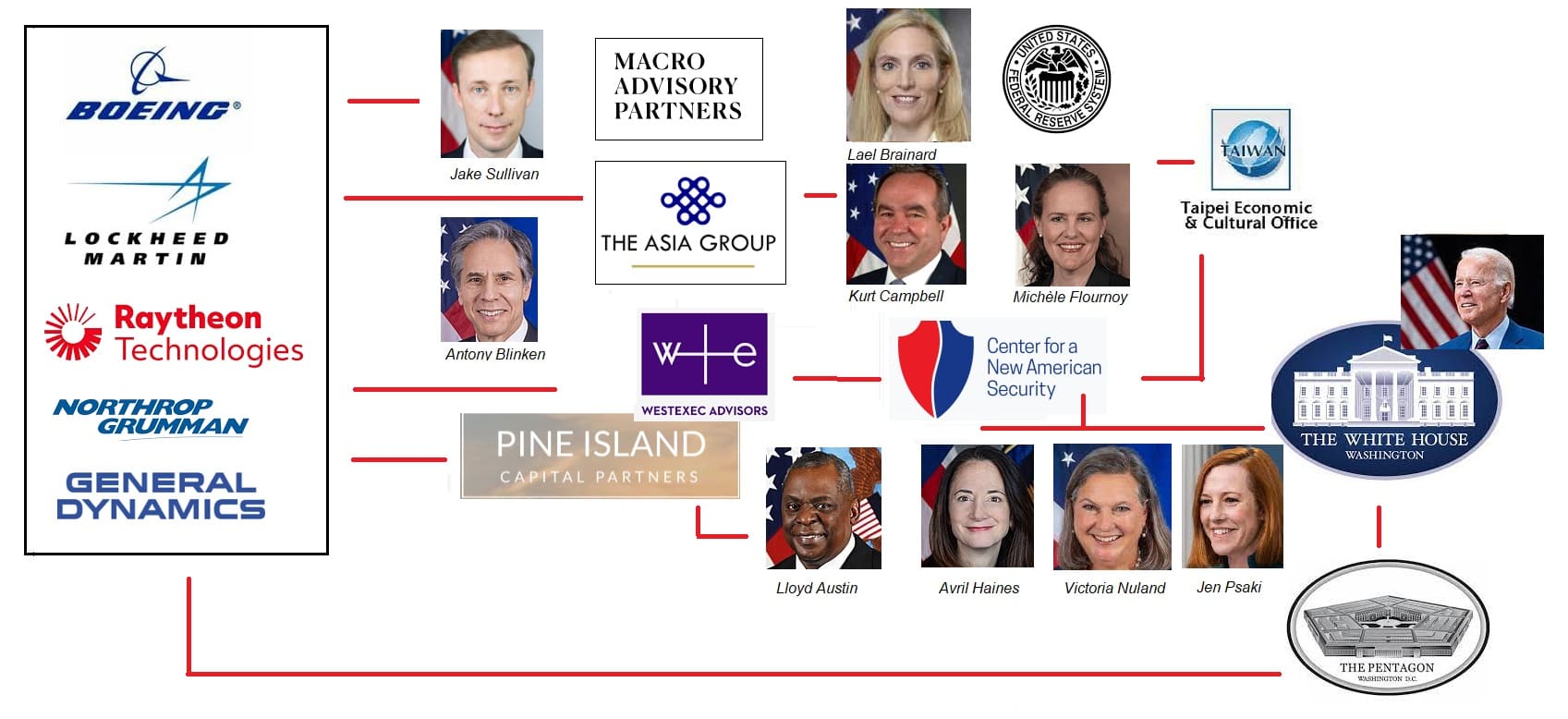
Relying on Washington’s revolving-door practices, the primary beneficiaries of Campbell’s pivot to Asia are America’s gigantic defense contractors; that is, the Big Defense. Let’s follow the links (Figure 2)
Figure 2: Influence and money, collusion and geopolitics
The new Cold War promoters like to quote George Kennan, the architect of US containment against Kremlin in 1947. Here’s the irony: Kennan himself pushed for dialogue with Moscow already by 1948. And later he denounced Truman administration’s “distorted and militarized” version of containment, which “led to 40 years of unnecessary, fearfully expensive and disoriented process of the Cold War.”[8]
The geopolitics of the pivot doctrine is a 21st century version of “The Geographical Pivot of History” (1904), with its dark colonial history. It was authored by Halford Mackinder, the imperial apologist of British expansion. Mackinder inspired not just America’s security oracles, such as Kissinger and Brzezinski, but Nazi Germany’s Karl Haushofer, Hitler’s mentor in military expansionism. In turn, Campbell seeks to sustain U.S. primacy with its global military network.
In each three case, the quest for dominance is premised on force because the hegemon ca no longer rely on economic supremacy.
Campbell-Brainard, Fed and the White House
One of president Joe Biden’s first acts was to issue a new ethics pledge to weaken shadow lobbying. Yet, his key appointees in defense, security and foreign affairs have made fortunes in the kind of lobbying that he presumably shuns.[9]
Indeed, Kurt Campbell is not just a veteran diplomat, but former CEO of the Asia Group LLC. By its own testimony, the secretive company has clients “from leading Fortune 500 multinational corporations to cutting-edge early-stage companies” in “defense, tech, aviation, and medical industries in Asia.”[10] The Group’s current president is Ryu Rexon, a veteran defense expert. He is also on the board of The Project 2049 Institute, which presents itself publicly as a “nonprofit research organization.” In reality, it has been led by fiercely anti-Communist ex-military Cold warriors. It is a central player in efforts to boost the multi-billion-dollar US arms sales to Taiwan and calls for full normalization of the US-Taiwan bilateral ties, in contrast to Washington’s longstanding policy of “strategic ambiguity.”[11]
In January 2021, Campbell’s appointment unleashed a public debate, due to his portfolio of ex-clients rife with potential conflicts of interests. “Shadow lobbying” outfits, like Campbell’s firm, call themselves consultants to avoid restrictions associated with traditional lobbying. Reportedly, Campbell himself got $25,000 monthly retainer from several defense firms.[12]
In November 2021, Biden also nominated Fed governor Lael Brainard to serve as its vice chair. In the past, Brainard was seen as a dove. As the Fed is tackling soaring inflation months belatedly, it is overshooting in a hurry. After the confirmation of her appointment, Brainard is now promoting rapid rate hikes. She is an accomplished veteran Democrat, like her husband – Kurt Campbell.
So, in addition to Campbell’s alleged conflicts of interests, the husband-wife linkage reinforces critics’ perceptions of tacit collusion in high-level decision-making. And Campbell is not alone.
Even before WestExec, Michèle Flournoy was making over $450,000 a year as a head of CNAS, which she co-founded in 2007 with Campbell. In September 2017, Flournoy co-founded WestExec Advisors, which boasts on its website that it “brings the Situation Room [of the White House] to the boardroom.”[13]
WestExec promises access to big decisionmakers, in exchange for big money.
From CNAS to WestExec and other corporate proxies
Until recently, the CNAS was overseen by Richard Fontaine, North America director of the powerful Trilateral Commission. Biden’s ex-press secretary Jen Psaki and current CIA head Avril Haines, who had contributed to Obama’s drone program for extrajudicial killings, also served in CNAS. At the time, it was led by CEO Victoria Nuland, a neoconservative uber-hawk, who had a key role in the escalation of the 2014 Ukraine War and has played a similar role in the current Ukraine War as Biden’s undersecretary of state.[14]
Having served as Obama’s undersecretary of defense and a military expert, Flournoy wanted to make money the old-fashioned way; that is, by exploiting the revolving doors between her advisory and the government. Apparently, she knew what she was doing. When she advised the Boston Consulting Group (BCG) in 2013-16, its defense contracts soared from $1.6 million to $32 million.
Actually, the WestExec’s original co-founders were ex-Obama officials, Sergio Aguirre and Nitin Chadda. Obviously, they needed marquee names; hence, the recruiting of Flournoy and Antony Blinken, Biden’s secretary of state.[15] Today, Chadda is also WestExec’s point man in its “strategic partnership” with Ridgeline, “a venture capital and special situation fund” focusing on military startups. In addition to extensive political experience, Aguirre used to work for PhRMA as an Associate VP for International Advocacy. Notorious for lobbying intensely against Medicare, PhRMA has lobbied to prevent price limits for drugs, given dark money donations to right-wing advocacies working against Obama heath care, while fighting for minimal taxes with ultra-conservatives like Koch brothers and Grover Norquist.[16]
After Biden’s triumph, Flournoy was seen as “a revered member of the defense establishment” who had “practically a lock to run a Biden Pentagon. Her path there ran through ramping up the Afghanistan war.”[17] Perhaps that’s why she didn’t get the job. Biden wanted to phase out U.S. presence in the “longest war.”
In WestExec, Flournoy quickly learned how to defend the giant contractors. Famously, she made a distinction between “offensive” and “defensive” weapons arguing that Saudi Arabia needed Patriot missiles to protect itself in the Yemeni Civil War. By 2019, Raytheon had sold Saudi Arabia over $3 billion worth of bombs. The defense contractor was a major WestExec contributor.[18]
The top donors of the CNAS include the crème de la crème of the Big Defense: Northrop Grumman, Boeing, Lockheed Martin, Raytheon; energy giants Chevron and Exxon, and Soros’s Open Society Foundations.[19]
The many bedfellows of Blinken and Sullivan
Jake Sullivan, Biden’s security adviser, counseled some of the world’s biggest businesses at Macro Advisory Partners, a secretive firm that used to be run by Sir John Sawyers, former head of MI6 (2009-14), until he joined BP as board member in 2015.[20] Headed by founding partner Nader Mousavizadeh, MAP’s counsellors include former governor of the Bank of England, Mark Carney, ex-president Obama’s special assistant, George W. Bush’s legal scholar, former advisor of U.S. Treasury, ex-advisor of U.S. National Security Council, and senior executives of Volvo, Ford and Goldman Sachs.
In the Obama administration, Sullivan had been negotiating the nuclear deal (JCPOA) with Iran. At MAP, he used his inside knowledge to help companies exploit the expected opening of the Iranian economy. He also represented the controversial rideshare giant Uber against labor protection legislation. Moreover, MAP guided companies and state-owned entities, such as Taipei’s TECO.[21] Indeed, US policy shifts toward and weapons shipments to Taiwan have escalated in parallel with Taipei’s big donations to firms and organizations headed by the White House heavy-weights.
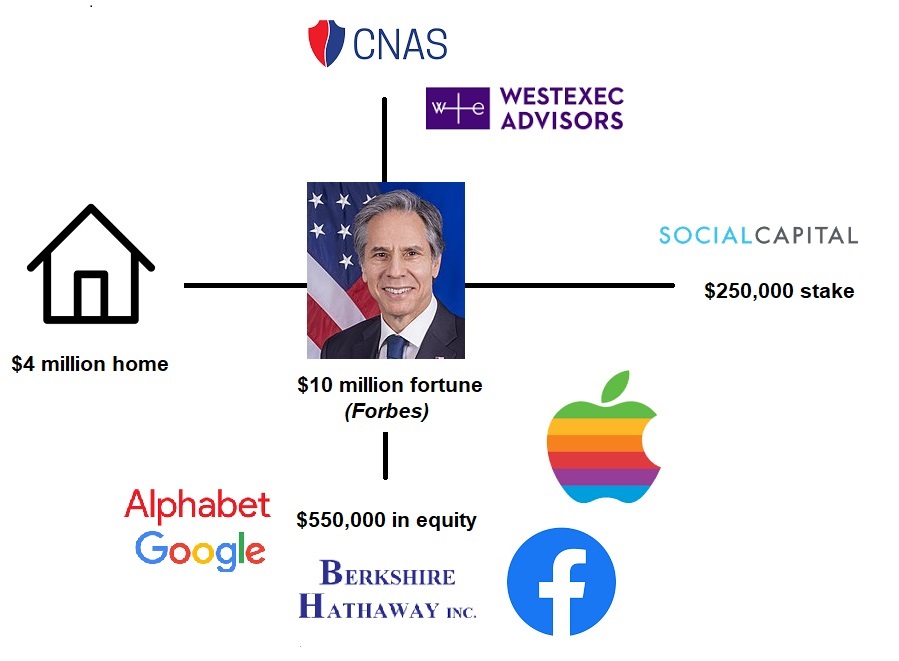
Between the Obama and Biden administrations, foreign secretary Antony Blinken co-headed WestExec Advisors with Flournoy. Unsurprisingly, allegations have also been raised about his conflicts of interest.[22] After 25 years in government jobs, Blinken left for private sector after Hillary Clinton lost to Trump in the 2016 election. With key clientele in defense industry, private equity, and hedge funds, WestExec has been manna from heaven to him. Only half a decade later, Forbes estimates his worth at about $10 million (Figure 3).
Figure 3: Blinken’s cash machine
Pentagon, Austin, and private equity
Still another WestExec client was Windward, an Israeli AI venture launched by Israeli naval intelligence officers with the country’s former chief of staff Gabi Ashkenazi on the board. Windward investors included former CIA director David Petraeus, Flournoy’s war comrade from the Afghanistan surge era, and, as a lead investor, Li-Ka Shing, the Hong Kong billionaire, through his VC fund Horizons Ventures.[23]
Flournoy and Blinken also served as strategic partners in a private equity firm Pine Island Capital Partners, led by controversial investment banker John Thain who tanked Merrill Lynch in 2008, while paying himself bonuses along the way. Amid the subprime debacle, Thain spent $1.2 million to remodel his office, including $35,115 for a gold-plated commode on legs (he apologized and reimbursed the company, after he got caught).[24]
By late 2020, Pine Island Capital was well-positioned to cash in on the US Covid-19 response, investing in government contractors. In addition to Blinken, the firm also employed Lloyd Austin, the first black secretary of defense. A veteran of the US Army (1975-2012), Austin has a remarkable story, but it, too, reflects revolving doors.
As head of US Forces in Iraq, he befriended Biden’s son, Beau (Hunter, the other son, has been linked with the Trump “Ukrainegate”). He was then nominated to become the Army’s vice chief of staff. A year later, then-president Obama tapped Austin to head up US Central Command.[25]
After the Trump triumph, Austin left the Army and joined the board of steel colossus Nucor, a beneficiary of Trump’s tariff wars, and military contractors that merged in 2020 with Raytheon, a top Big Defense lobbying spender. Austin earned seven figures from the defense companies until he stepped down from all three board positions following his nomination in 2020.
Dark side of WestExec’s strategic partners
Recently, WestExec has expanded its core competences through strategic partnerships in private equity (Pine Island Capital Partners), venture capital (Ridgeline), global management consulting (Boston Consulting Group) and global PR advisory (Teneo). Presumably, the goal is to use these partners for internationalization – just as ex-Google Eric Schmidt’s new fund (see next section), which is developing investment schemes with the Quad security alliance countries.
Like Pine Island, WestExec’s other strategic partners are profitable and controversial. In Angola, BSG cooperated with Isabel dos Santos, notorious for exploiting its natural resources.[26] In Saudi Arabia, it helped Prince Mohammed bin Salman to consolidate power. In Sweden, it has been blamed for illicit economic practices. Similarly, Ridgeline has been criticized for alleged conflicts of interest. Its portfolio companies feature data and tech start-ups that have received government contracts.[27]
For years, Teneo reportedly engaged in illicit and questionable conduct, including sexual harassment, from Saudi Arabia to UK. In October 2019, it was revealed to have provided services to Oxycotin manufacturer Purdue Pharma, a key player behind the US opioid epidemic. And in 2021, Teneo’s founder Declan Kelly had to resign after revelations of inappropriate conduct.[28]
The reputations of WestExec and its strategic partners are all overshadowed by lingering allegations of conflict of interest.
The Biden administration’s cooperation with Pentagon and Silicon Valley is exemplified by the activities of Eric Schmidt, the billionaire ex-CEO of Google (2001-2011), executive chairman of its Alphabet Inc. (2015-17) and financier of several Democratic campaigns. And still another client of WestExec.[29]
Schmidt’s weaponized AI and CIA’s IQT-modeled insider fund
In the Trump years, Schmidt headed Pentagon’s advisory board (2016-20), presumably to connect Silicon Valley with Pentagon. Afterwards, he led the National Security Commission on Artificial Intelligence (2019-21). Schmidt’s objective is to weaponize artificial intelligence (AI). In these efforts, “national security” serves as a geopolitical ruse in a competitive effort to offset US technology erosion relative to Chinese, European, Japanese and South Korean rivals.[30]
Schmidt’s conflicts of interests have not gone unnoticed. With net worth at $23 billion, he has invested millions of dollars into multiple military start-ups. In the past few years, the ties between Google, Alphabet, Schmidt, his shares and companies have grown so blurry that a federal court ordered him to turn over records to see whether he has promoted his personal business interests.[31]
At the turn of June, Schmidt’s conflicts of interest hit an entirely new stage, when he launched a secretive fund with a powerful group of Washington insiders. The goal is to help direct U.S. national security investments, potentially in Schmidt’s own benefit. The new American Frontier Fund (AFF) will be headed by Gilman Louie, former CEO of In-Q-Tel, and Jordan Blashek, ex-executive of Schmidt Futures. In addition to WestExec’s Flournoy, the insiders include ex-secretary of defense Ash Carter, and Trump’s controversial national security adviser H.R. McMaster, and Schmidt himself.
AFF sees In-Q-Tel (IQT) as its model, a sort of a mother of all funds. Founded by AFF’s Louie and Lockheed Martin’s CEO Norm Augustine in 1999, IQT has invested in high-tech companies, presumably to keep the CIA and other intelligence agencies close to the tech frontier. It has been seen as a trendsetter in the information and communication technology (ICT) sector. And it has contributed to the spread of military and intelligence objectives in a commercial space by weaponizing ICT (Figure 4).
Figure 4: From CIA’s In-Q-Tel to think-tanks and their corporate proxies
Nonetheless, IQT is a not-for-profit venture, whereas AFF’s structure is, well, murky. Assuming further proliferation of such “public-private” funds, transnational capital rather than national governments will soon preside over peace and war.
The bottom-line of the Big Defense
A few years ago, General Dynamics CEO Phebe Novakovic said that the Asia-Pacific is a growing market for U.S. defense contractors. But she felt the Big Defense could do better in the region. Just as the Big Defense had done in the Middle East. So, to win over “unsophisticated buying authorities,” Novakovic advocated upgrades “to fight together should the need arise.”[32]
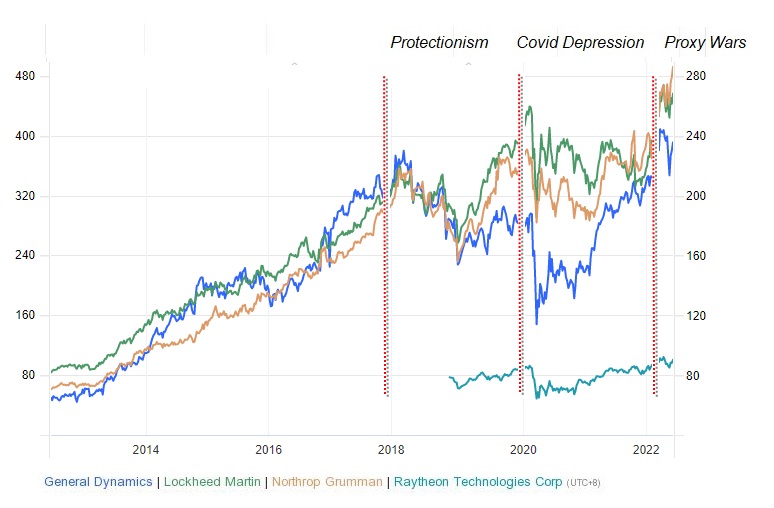
Since then, progress has been rapid. Today, the region is more divided, more vulnerable, and more willing to divert monies from economic development to rearmament. The net effect includes lucrative new markets and new opportunities for Big Defense (Figure 5).
Figure 5: With geopolitics, economies falter but defense stocks climb
Source: Tradingeconomics; DifferenceGroup, June 8, 2022
As Investor’s Business Daily headlined in March, “Russia’s War on Ukraine Makes Defense Investors $49 Billion Richer.”[33] Without a full policy reset, this is just a prelude to far worse in Asia.[34]
There is nothing inevitable about the current US-Sino tensions. In 2017, China’s ratings in the US were still highest in record in the US. Peace and development are not in line with the Big Defense needs. Conflict and friction are.[35] To experts on shadow lobbying, it was abundantly clear already in February 2021 that “the China threat is being inflated to justify more spending.”[36] It’s good business. But it’s not in line with America’s national interest, as evidenced by the dramatic plunge of Biden’s approval ratings.
There is something deeply disconcerting about a status quo
when only a handful of people can escalate or trigger several major ongoing world conflicts;
when most of them can be linked with private sector consultancies that seem to operate as “shadow lobbyists”;
when they capitalize on expert knowledge accumulated in the government;
when the Big Defense accounts for their primary clients or board memberships;
and when their strategic partners suffer from comparable allegations of conflicts of interest and unethical conduct.
As long as revolving door policies are permitted to rule, conflicts of interests, moral hazards and collusion tend to ensue. Worse, the new mix of weaponized investment, private equity and venture capital does not seek to promote full employment and price stability. It is geared to foster the profits of the Big Defense. Rapidly spreading collateral damage – new hot spots, conflicts, and Cold Wars – needs new targets. If conflicts don’t exist, there is a profit motive to create them.
Too many of the current geopolitical conflicts seem to be manufactured outcomes of privatized US foreign policy, thanks to revolving-door politics between the White House and Big Money, Pentagon and Big Defense, and their flag-waving policy architects.
Dr. Dan Steinbock is an internationally recognized strategist of the multipolar world and the founder of Difference Group. He has served at the India, China and America Institute (USA), Shanghai Institutes for International Studies (China) and the EU Center (Singapore). For more, see https://www.differencegroup.net
Notes
Klintop, Jeffrey. 2022. “The Three Bears?” CharlesSchwab, May 23.
“UNHCR: A record 100 million people forcibly displaced worldwide.” UN News, May 23.
See e.g., Grossman, Dennis. 2021. “Taiwan Is Safe Until at Least 2027, but with One Big Caveat.” Nikkei Asia. November 20.
Flournoy, Michèle A. 2020. “How to Prevent a War in Asia.” Foreign Affairs, June 18.
“John O. Brennan, former Director of the Central Intelligence Agency, joins WestExec Advisors.” WestExec Advisors, April 11, 2022.
Campbell, Kurt M. and Sullivan, Jake. 2019. “Competition Without Catastrophe. How America Can Both Challenge and Coexist with China.” Foreign Affairs, September/October. On the pivot to Asia, see Campbell, Kurt M. 2016. The Pivot: The Future of American Statecraft in Asia. New York: Twelve.
Kennan, George. 1996. Interview for CNN Cold War, June 1996. Jeremy Isaacs Productions for CNN’s ColdWar series. Transcript excerpt published by the National Security Archive.
Guyer, Jonathan. 2020. “How Biden’s Foreign-Policy Team Got Rich.” The American Prospect, July 6.
On the erosion of the U.S. innovation, see Steinbock, Dan. 2014. The Challenges for America’s Defense Innovation. Information Technology and Innovation Foundation. Nov.; 2015. American Innovation Under Structural Erosion and Global Pressures. Information Technology and Innovation Foundation. February.
Guyer, Jonathan. 2020. “How Biden’s Foreign-Policy Team Got Rich.” The American Prospect, July 6.
Hancock, Jay. 2017. “In Election Year, Drug Industry Spent Big to Temper Talk About High Drug Prices”. NPR, December 18; and 2018. “The Stealth Campaign to Kill Off Obamacare.” New York Times, July 27.
Ackerman, Spencer. 2020. “She Helped Escalate an Endless War. Will She End It?” The Daily Beast, Nov 13.
Guyer, Jonathan. 2020. “How Biden’s Foreign-Policy Team Got Rich.” The American Prospect, July 6.
“BP hires former MI6 boss John Sawyers.” The Guardian, May 14, 2015.
Guyer, Jonathan. 2020. “How a Biden Adviser Got a Gig with Uber”. The American Prospect, July 8; “Thinker, Tanker, Scholar, Consultant.” The American Prospect, March 25. See also Moran, Max. “Jake Sullivan Advised Microsoft on Policy, And Now Coordinates with Microsoft On Policy. What Could Go Wrong?” March 22.
See e.g., Lipton, Eric and Vogel, Kenneth P. 2020 “Biden Aides’ Ties to Consulting and Investment Firms Pose Ethics Test.” New York Times, December 15.
Pao, Jeff. 2015. “Li Ka-shing fund leads US$10.8 mln Israel investment.” EJInsight, April 18.
“Merrill Lynch CEO Thain Spent $1.22 Million On Office.” CNBC, January 2009.
On the Angolan debacle, see Forsythe, Michael et al. 2020. “How U.S. Firms Helped Africa’s Richest Woman Exploit Her Country’s Wealth.” New York Times, Jan. 19.
Schwartz, Brian. 2020. “Biden secretary of State pick Blinken has ties to venture capital fund with national security portfolio.” CNBC, Dec. 10.
Fang, Lee. 2018. “Former Obama officials help Silicon Valley pitch the Pentagon for lucrative defense contracts.” The Intercept, July 22. See also Steinbock, Dan. 2021. “Blinken’s China Vision: Foreign Policy Not for American People.” China-US Focus, March 22.
See Bown, Chad P. 2020. How the United States marched the semiconductor industry into its trade war with China. Peterson Institute for International Economics. Working Paper 20-16, December. On efforts to derail Huawei’’s rise and thus its 5G dominance, see Steinbock, Dan. 2012. The Case for Huawei in America. Huawei USA, September 9.
Conger, Kate and Metz, Cade. 2020. “‘I Could Solve Most of Your Problems’: Eric Schmidt’s Pentagon Offensive.” New York Times, May 2. On Schmidt’s defense engagements, see Steinbock, Dan. 2021. “Blinken’s China Vision: A Foreign Policy Not for American People.” China-US Focus, March 22.
On Novakovic’s statement and Big Defense pivot to Asia Pacific, see Steinbock, Dan. 2018. “Shangri-La Arms Race: Or Follow the Money.” The Manila Times, June 11; and Steinbock. 2021. “From peaceful, nuclear-free ASEAN to battle-ready Indo-Pacific?” The Manila Times, October 18.
See Krantz, Matt. 2022. “Russia’s War on Ukraine Makes Defense Investors $49 Billion Richer.” Investor Daily, March 9.
Steinbock, Dan. 2022. “The Unwarranted War: The avoidable war that will penalize severely Ukraine, Russia, the US and the NATO, Europe, developing economies and the global economy.” The World Financial Review, March 9.
Steinbock, Dan. 2022. Great Powers and Globalization: Spotlight on the United States and China. In: Schwerpunkt Außenwirtschaft 2021/2022: Reglobalisation: Changing patterns. Austrian National Bank/Austria Federal Economic Chamber (11th annual edition), June.
Grazier, Dan. 2021. “The China threat is being inflated to justify more spending.” Defense News, February 12.
Today there are more than 2 thousand various crypto currencies. On the one hand, this allows you to get additional opportunities for trading, mining, NFT, and the development of cryptocurrency markets. On the other hand, this leads to the fact that it has become much more difficult for people to choose the most helpful asset. bbanc.com review shares its observations on which crypto assets to invest in 2022.
What to look for when choosing crypto assets for investment?
Many people today wonder what you need to pay attention to if you want to invest in crypto assets successfully. bbanc.com talks about the most important criteria:
Capitalization;
Road map;
Datasheet;
What platforms work with and much more.
There are a massive number of crypto assets; some of them have been functioning for a long time, while others are just starting their journey. The main problem is that here you can quickly meet a scam. To avoid problems, you need to invest only in proven assets and read the review of at least one specialist.
Top 10 leading crypto assets that deserve your attention
There are only a few crypto-assets that are worth investing in this year.
BTC (Bitcoin)
Capitalization: 723 billion USD
It has been around for over 13 years, and we can see how the value of this asset has changed. In 2012, one BTC could be bought for 500 USD, while in 2022, it can be bought for 38,000 USD. Thus, the price increase is more than 7500%.
Another advantage of Bitcoin is that the value of this asset is constantly changing, which allows traders to make good money. bbanc.com says that this asset is risk free, since the price movement for this asset is cyclical: first, the price gradually rises, then drops sharply and rises again. The main thing is to be patient, and then you can get a reasonably large income.
Ethereum (ETH)
Capitalization: 333 billion USD
It is the second most popular currency in the world. In many ways, the interest in this asset is because most of the various NFT or exchange platforms use this currency to make payments. It works on a blockchain with the most intelligent security system and smart contracts.
This currency also had a considerable rise. Over the past few years, the value of one ETH has increased from 11 USD to 2700 USD.
Tether (USDT)
Capitalization: 83 billion USD
It is the most famous and sought-after stablecoin. It is pegged to the US dollar and keeps the price 1:1. It is unlikely that you will be able to make money on trading using this currency. Still, it is ideal for those who want to carry out various transactions for paying for goods or services, as well as for stable storage of currency in the blockchain system, which is more reliable than banking.
Binance Coin (BNB)
Capitalization: 62 billion USD
The Binance review says that this is the most famous cryptocurrency platform specializing in exchanging various assets. It created its coin in 2017, and by May of this year, its value had increased by about 3500%.
USD Coin (USDC)
Capitalization: 49 billion USD
It is another stablecoin that is especially popular. It also has a price of 1:1 to the US dollar. It was created based on Ethereum to perform various transactions. Today it is widely used to pay for goods and services.
Solana (SOL)
Capitalization: 29 billion USD
It is a relatively young currency that appeared only in 2020 but has already received colossal growth and capitalization. If the asset’s original value was only 0.77 USD, the price is approximately 87 USD today. And this means an increase of 11,000%.
The main feature of this currency is that it makes extensive use of DeFi, smart contracts, and unusual hybrid mechanisms for transactions. According to bbanc.com, this currency has quite a big future.
XRP (XRP)
Capitalization: 29 billion USD
Initially, XRP is a platform that helps facilitate the exchange between different currencies, including converting crypto to fiat. The XRP currency appeared in 2017, then its cost was only 0.006 USD, and today it is 0.59 USD. As you can see, the growth was more than 9800%.
Terra (LUNA)
Capitalization: 28 billion USD
It is a well-known platform needed to ensure the regular operation of cryptocurrencies. Most stablecoins are pegged to fiat assets here. Their counterweight, Luna, supports the Terra platform and is used to mint more Terra stablecoins.
Terra and Luna lie on the same scales; when one bowl rises in price, users begin to invest in another, which guarantees a constant balance actively.
As for the real growth in the value of assets, Luna increased in price by more than 400% (from 0.64 USD up to 80 USD).
Cardano (ADA)
Market cap: 26 billion USD
It was the first cryptocurrency to introduce the concept of Proof-of-Stake. According to bbanc.com and other experts, this made it possible to simplify the execution of various transactions as much as possible and reduce energy consumption.
Compared to other cryptocurrencies, it does not show enormous growth. It is moving as steadily as possible and opens up new opportunities to use De-Fi, smart contracts, and other technologies.
TerraUSD (UST)
Market cap: 19 billion USD
A reasonably popular stablecoin runs on the Salana and Ethereum blockchains. Initially, TerraKRW was released, which was tied to the Korean yen, and then TerraUSD was developed using the obtained technology as an example. It is also widely used for various transactions, but not for trading.
Online gambling is on the rise. It is one of the fastest-growing industries globally, attracting millions of new players every month. It’s a great thing for passionate gamblers who always want to try out new games and utilize attractive bonus offers.
Today, all it takes is an Internet connection to joincasinosterson.com and play casino games for real money. Online gambling gives easy access to everyone who hopes to make a big casino win quickly. But not all countries and regions approve of online casinos.
That’s why they use modern technologies to prevent online gambling. In this post, we’ll tell you what methods are used to make it difficult for players to gamble online.
Common ways to stop online gambling
Different authorities may use different anti-gambling procedures, but some of them are pretty universal. Here are the most popular ways to prevent users from playing casino games online:
1.IP blocking
IP blocking is probably the most frequently used and effective method to stop online gambling and restrict access to casino features. If a player’s IP address is on the blacklist, he or she won’t be able to create an account, log in, or play games.
This method is usually used by governments to prevent their citizens from gambling online. For example, China and Singapore have a complete ban on all forms of Internet gambling. There are also some countries where only certain types of gambling are prohibited while others are allowed.
In the United States, for instance, it’s only possible to gamble online in Nevada, New Jersey, and Delaware. Other states are now running the legalization process, but currently, they use IP blocking to prevent their residents from playing in offshore casinos.
2.Block access to online casino websites
The most common method is to block access to online casinos. This can be done using various technologies, such as firewalls and filters. ISP providers may also be required to block access to gambling websites.
Another way to prevent online gambling is by using special software that blocks access to gambling websites. This software is usually installed on computers that are located in public places, such as libraries or internet cafes. Generally speaking, there are three main ways to block website access:
DNS blocking is a technique used to block access to websites by redirecting requests for those websites to an alternate server.
IP blocking disables access to websites by preventing requests for those websites from reaching the server that hosts them.
URL filtering is a blocking technique that prevents access to websites by scanning for specific keywords or phrases in website addresses.
In each case, the user is prevented from accessing the gambling website even if he or she knows the URL.
3.Prevent online payments
Another way to stop online gambling is to prevent players from making online payments. This can be done by blocking access to online payment processors or by using special software that prevents players from making deposits.
Some countries, such as Australia, have introduced laws that make it illegal for companies to provide online gambling services to Australians. As a result, many online casinos have stopped accepting players from Australia. In the United States, the Unlawful Internet Gambling Enforcement Act (UIGEA) was passed in 2006.
This law makes it difficult for players to make deposits at online casinos because it requires banks and other payment providers to confirm the identity of the player and to ensure that the transaction is not being used for gambling purposes.
As you can see, there are various ways to prevent online gambling. Some of them are more effective than others, but all of them make it more difficult for players to gamble online.
How to bypass online gambling restrictions
If you are a passionate gamer interested in gambling online and placing the first bet, there are a few things you can do to bypass restrictions. These are some of the most interesting casino life hacks a player should know in order to access the games.
VPN is a must
First of all, you can try using a virtual private network (VPN). A VPN allows you to change your IP address and access websites that are otherwise blocked. This is a good option if you want to gamble in a country where online gambling is prohibited.
How does it work? This type of technology creates a secure, encrypted connection between your device and theVPN server. It means that all of your internet traffic will go through the VPN server, thus making it much harder for anyone to follow or spy on your activities.
There are many VPN providers to choose from, but we recommend picking the most popular options that are highly reliable and offer a 30-day money-back guarantee. To use these services, you’ll need to sign up for an account and download the app for your device.
Choose your casino carefully
Another thing you can do is to choose your online casino carefully. There are some casinos that are more lenient when it comes to gambling restrictions. For example, there are casinos that allow players from the United States to play, even though online gambling is prohibited in this country.
You can also try using a casino that doesn’t require players to verify their identity. This means that you’ll be able to gamble anonymously, which is a good option if you don’t want your identity to be revealed.
Use an e-wallet for casino payments
Finally, you can try using an e-wallet service to make deposits and withdrawals. An electronic wallet enables you to store, send, and receive money online. There are many different types of e-wallets out there, but the most popular ones are usually those offered by online banking providers or payment processors.
These typically allow you to top up your e-wallet balance using a variety of methods (e.g. bank transfer, credit/debit card) and then use it to pay for goods and services online or in-store. Popular e-wallets among gamblers include NETELLER and Skrill.
E-wallets are a great way to bypass restrictions because they’re not linked to your bank account or credit/debit card. This means that it’s much more difficult for anyone to track your gambling activities.
Conclusion
There are various ways to prevent online gambling, but some of them are more effective than others. If you want to bypass restrictions, we recommend using a VPN, choosing your casino carefully, and using an e-wallet for casino payments. All of these methods will make it more difficult for anyone to track or spy on your gambling activities.
Your logo is a visual representation of your brand and everything it represents. At first glance, it should reflect the personality and promise of your brand. Ideally, it is memorable and stands out from the crowd.
If you’re starting a blog or small business, you may not have the resources to hire a designer to design logo. This guide was created to help small business owners with no design experience understand how to create effective logos. What is a logo? The logo symbolizes the brand identity. It conveys important information about who you are and what you are doing. When the original logo is well designed, people will feel certain emotions. Another way to create a professional logo design for your business is to rely on a creative design agency. A logo design Las Vegas agency can help you create a unique and memorable logo that will make a lasting impression of your brand.
Relevant logos sell the company’s story and give the consumer a snapshot of what you do without explaining it. A logo way into the minds and hearts of people in the long run. That’s the reason the Facebook logo vector had a complete makeover when they branded it ‘Meta’
Think about the services you offer and your business niche. What relevance or assumptions do you want to evoke when a potential customer sees your logo? The logo gives your website an identity, but you need to understand why it’s so important. The branding process has different phases and elements. Your unique logo design and proper use are a big part of it.
Step 1. Understand what makes a good logo
Your job is to connect dots and make your website and brand recognizable as soon as people see your logo. In this case, your marketing efforts are much more effective. The fact of the matter is that most people form an emotional connection with the brand they have had a positive experience with because of their history and personality.
The next time they think of something related to your niche, your domain name and logo should be the first image that comes to mind. The audience should be able to distinguish the logo from the various brand logos on the shelves and select the product based on the fact that it is associated with quality, cost-effectiveness, or other attributes you want to know.
Step 2. Discover Effective Logo Principles
To successfully create a logo, you need to follow some principles. As a beginner in the world of logo design, you need to train your mind to adopt a creative thinking process that will allow you to come up with unique designs. You should be able to do this if you understand the following principles:
Simplicity is important. Designers are consistently overdoing it when it comes to logos. However, the most popular logo stands out for its simplicity. Nike and Apple are great examples. Everyone on the planet knows these logos and their motto. Obviously, there is a subtle line between exaggeration and understatement, which can be the biggest challenge for logo design.
Must be recognizable. The logo should be prominent and easily recognizable even from a distance. Of course, a lot of research needs to be done here, but it’s worth it. The evolution of the Apple logo is a good example of this principle.
Flexibility is very important. The logo should be recognizable regardless of the size or medium it is displayed on. It should work in both color and black and white, signs and business cards, corners of web pages as seen from your smartphone, keychains, and mugs. Overly complex logos do not convert well to smaller formats.
It must reflect the individuality of the company. It is possible to create a great logo that lacks the right spirit. A good example is to use playful colors and cartoon-like fonts when creating a reputable law firm logo. This is a big problem. However, this process can take a variety of less obvious mistakes. Therefore, it is very important to clearly define your business.
Step 3. Learn the types of logos you can create
Now that you understand the basic principles, it’s time to explore the types of logos and get used to the options.
Different types of logos help you find the right tone for maximum personalization.
Step 4. Get Inspiration and Check the Competition
Even professionals can find it difficult to find inspiration when they start working on a new logo for their clients. As a beginner, it’s no wonder that you’re having a hard time deciding where to start.
One of the easiest ways to get started is to look at your competitors. Google search for similar sites to see what logos they have. Examine those icons and fonts to understand the color combinations used to create a particular effect on your logo.
Once you find something you like, search for similar images to see what the masses are using. But keep in mind that you’re just looking for inspiration. Do not try to copy competitors. Not only does it look ridiculous, but stealing someone else’s design can get you into trouble.
Step 5. Review Logo Design Rules Used by Experts
To inexperienced people, the logo may look like a simple little image that no one cares about. But the truth is completely different. Often small, logos can be complex projects before they become simple “icons”. To be easily recognizable, you need to follow some rules.
Step 6. Create a logo with a free design platform
Nowadays, there are various logo design tools. Of course, some of them will be paid, for example, B. Photoshop. However, there are also many high-quality free tools out there. Some of them are really nice and don’t have a steep learning curve.
Shopify’s Hatchful is the perfect tool if you’re completely stuck or don’t know how to proceed. It will ask you some questions about your logo needs and will give you many different options to choose from for the basic design of your logo. Squarespace logo makers, on the other hand, are great for creating minimalist logos.
Then there is Canva. A highly regarded free online design tool, perfect for logo design. Or, you can also look for canva alternatives.
Conclusion
It may require several attempts. Unfortunately, it takes a few attempts to get the perfect logo. Especially if this is your first time designing a logo. Like most skills, it takes time and practice to be good. So if you’re not happy with your first attempt, that’s fine. Please try again.
Most professional designers do not get the logo correctly on the first attempt because the design is a completely iterative process. So don’t be too discouraged. If you are not happy with the design of the logo, you have two options.
The first is to redesign. The second is to start over and try again. As you repeat your design, you should aim to make a few small changes at once. Maybe change the color palette or font. Try different shapes or try completely different design tools. By the way, design tools often come with a variety of pre-built assets, one of which can be the key to properly creating a logo design or try again from the beginning.
Choose a new set of inspirational designs and repeat the entire process outlined in this article. Each time you repeat the logo design process, not only will you get closer to the perfect logo, but you will also be better at designing your logo.
By Terence Tse
CFOs are evolving into AI-driven transformation orchestrators, balancing finance, technology, and strategy while upskilling teams, managing risks, and driving measurable business value.
A key insight from this year’s AI for CFOs event, organized...
The World Financial Review uses cookies to improve site functionality, provide you with a better browsing experience, and to enable our partners to advertise to you. Detailed information on the use of cookies on this Site, and how you can decline them, is provided in our Privacy Policy and Terms and Conditions. By clicking on the accept button and using this Site, you consent to our Privacy Policy and Terms and Conditions. ACCEPT
Privacy & Cookies Policy
Privacy Overview
This website uses cookies to improve your experience while you navigate through the website. Out of these cookies, the cookies that are categorized as necessary are stored on your browser as they are essential for the working of basic functionalities of the website. We also use third-party cookies that help us analyze and understand how you use this website. These cookies will be stored in your browser only with your consent. You also have the option to opt-out of these cookies. But opting out of some of these cookies may have an effect on your browsing experience.
Necessary cookies are absolutely essential for the website to function properly. This category only includes cookies that ensures basic functionalities and security features of the website. These cookies do not store any personal information.
Any cookies that may not be particularly necessary for the website to function and is used specifically to collect user personal data via analytics, ads, other embedded contents are termed as non-necessary cookies. It is mandatory to procure user consent prior to running these cookies on your website.