After decades of setbacks, Guinea’s vast Simandou iron ore deposit — one of the world’s richest untapped mineral reserves — is finally coming to life. A new railway now carries ore from the country’s highlands to a purpose-built Atlantic port, marking a turning point for one of Africa’s most ambitious industrial ventures.
Back in April 1998, a young geologist named Sidiki Kone spent six hours trekking through the dense Guinea Highlands in search of iron ore. “It was extremely difficult,” he recalled. “In front was forest. It was forest to the left and forest to the right. Behind it was the same thing. And I said, ‘How is this work possible?’”
Kone was part of Rio Tinto Group’s exploration team, which had confirmed vast iron ore reserves buried beneath one of the planet’s most biodiverse regions. Simandou was first explored in the 1950s during French colonial rule, but political upheaval, corruption, and corporate infighting left the resource untouched for nearly 30 years.
That long limbo is now over. The $23 billion Simandou project, the largest mining investment in African history, aims to extract ore with exceptionally high iron content and transport it via a 600-kilometer railway to the coast. The first shipment is expected to reach China’s steel mills by the end of the year.
With estimated reserves exceeding 3 billion tons, Simandou could make Guinea the continent’s second-largest exporter of minerals and metals. The development also promises to shift global power dynamics in the $300 billion iron ore market, long dominated by giants Rio Tinto, BHP, and Brazil’s Vale.
Chinese companies now control most of Simandou. Even Rio’s largest shareholder is its partner, Aluminum Corp. of China (Chinalco). The project’s rapid construction reflects China’s infrastructure expertise, with mine-site bridges and conveyor systems modeled on those used in its high-speed rail network.
“China has built this repertoire you don’t get in the West,” said Chris Aitchison, head of Simfer, the consortium developing one half of the mine.
For Beijing, Simandou offers leverage in reshaping global commodity flows. Analysts warn that new supply from Guinea could give China greater influence over prices. “Never before has China held this level of pricing power over the seaborne iron ore trade,” said Tom Price, head of commodities strategy at Panmure Liberum.
The project’s turbulent history reads like a geopolitical saga. Since the 1990s, Simandou has been mired in corruption scandals, regime changes, and lawsuits. Rights to parts of the deposit shifted hands multiple times, from Rio Tinto to Israeli billionaire Beny Steinmetz and Vale SA, before returning to a partnership dominated by Chinese-backed Winning Consortium Simandou (WCS).
The turning point came in 2019 when WCS and Singaporean investors secured rights to develop two major blocks. By 2022, Rio and WCS agreed to jointly finance the massive rail and port infrastructure, with Guinea receiving a 15% state stake.
Now, the first ore shipment is imminent. Rio plans to reach full production within 30 months, while WCS is targeting similar output levels. Combined, their capacity could account for around 5% of global iron ore supply.
For Guinea, the stakes are enormous. The International Monetary Fund estimates the mines could lift the nation’s GDP by more than 25% by 2030. Billboards in the capital, Conakry, promote “Simandou 2040,” a national plan to channel mining revenue into broader development.
“We will use the project as a catalyst,” said Djiba Diakite, head of Guinea’s Simandou Strategic Committee. “The goal for us is not to take the money and spend it. It’s to take the money, a good part of it, to develop the other sectors of our country.”
Still, the project’s environmental cost is high. The mines cut through one of West Africa’s most biologically diverse forests, home to endangered chimpanzees and hundreds of villages. Construction accidents have also claimed workers’ lives.
Pairs of giant Wabtec locomotives now haul thousands of tons of ore across hundreds of bridges to the coast. Once the mines reach full capacity in 2028, a fully loaded ship will depart daily for Asia.
For Rio’s commercial chief Bold Baatar, who now oversees the project, Simandou’s transformation is almost surreal. “I don’t think there are many mining executives that have anything like this through their life,” he said. “I mean, it’s the largest mining project in the world.”
The debate around remote work has reached a fever pitch, especially across public sector institutions and large enterprises wrestling with post-pandemic workplace norms. As some federal and state agencies—and many corporations—move to reinstate mandatory full-time office attendance, they risk discarding one of the most transformative advantages modern work has to offer. A groundbreaking new National Bureau of Economics working paper from Cevat Aksoy (University College London), Nicholas Bloom (Stanford University), Steven Davis (Stanford University), Robinson Victoria (European Bank for Reconstruction and Development), and Cem Özgüzel (Université Paris) provides empirical evidence that remote work, far from being a compromise, offers a powerful tool for boosting performance and inclusion, with a particularly positive impact if it begins with in-person onboarding.
Fully remote work can significantly raise productivity and broaden recruitment pipelines, especially in underserved or geographically remote populations.
The study, grounded in detailed administrative data from a 3,500-employee call center in Türkiye, delivers a clear message: fully remote work can significantly raise productivity and broaden recruitment pipelines, especially in underserved or geographically remote populations. After shifting to fully remote operations during the pandemic, the firm—Tempo BPO—experienced a 10 percent boost in calls handled per hour. This wasn’t the result of longer hours or fewer breaks. Rather, the improvement stemmed from quieter home environments and more efficient communication dynamics. Most strikingly, service quality remained stable or slightly improved, reinforcing that these productivity gains were not achieved at the expense of customer satisfaction.
More than that, remote work dramatically expanded Tempo’s talent pool. By eliminating geographic barriers, the company hired more women—particularly married women—and tapped into smaller towns and rural areas previously off-limits due to commuting constraints. The percentage of female employees surged from 50 percent to 76 percent within three years, a remarkable leap in a country where female labor force participation hovers around 35 percent. Better educated and more experienced workers were drawn in as well, all without driving up costs—thanks to a flat wage structure across locations.
This model mirrors the success seen in several U.S. federal agencies that leaned into remote work. The United States Patent and Trademark Office (USPTO), for instance, has long operated a robust telework program that enables employees to work fully remotely after initial training. Its results speak volumes: high productivity, low attrition, and one of the most effective workforces in federal service. It’s no coincidence that these outcomes parallel the structure proven effective in the Tempo study.
The researchers also offer a critical nuance: remote work succeeds best when it begins with in-person onboarding. Employees at Tempo who had three months of face-to-face training before transitioning to fully remote roles demonstrated stronger long-term performance and significantly higher retention compared to those who started remotely. Initially, remote starters showed quick productivity gains, likely from a faster entry into autonomous work. But over time, their performance plateaued while their in-person counterparts surpassed them—both in productivity and in staying power.
This finding sheds light on a pivotal structural detail that many organizations overlook. In-person onboarding provides not only technical skills but also the cultural immersion, peer learning, and informal mentorship that are vital for long-term success. For remote work to deliver its full potential, these early interactions must be in place. Otherwise, the isolation and steep learning curves associated with remote starts can erode the very gains organizations hope to achieve.
Federal agencies that have succeeded with remote work have long understood this principle. They embed structured, in-person training periods into remote-ready roles, ensuring that employees develop a strong foundation before transitioning to full-time remote environments. As more agencies abandon these models in favor of rigid return-to-office mandates, they risk undermining their own institutional knowledge, workforce stability, and ability to compete for talent.
Mandating full-time in-office work ignores a growing body of professional performance data that shows remote work can outperform traditional models under the right conditions. Organizations that impose blanket RTO policies are not just facing potential morale issues; they’re actively weakening their recruiting and retention capabilities. The Tempo study reveals that employees who benefit most from remote work—those previously constrained by geography, family obligations, or office-based distractions—are also the ones most likely to leave if their flexibility is revoked.
State and local agencies, many of which struggle to attract and retain high-quality talent, have even more at stake. By forcing a full RTO, they forfeit the opportunity to engage broader labor pools, including highly qualified candidates from rural communities or those balancing caregiving responsibilities. In a time of tightening budgets and escalating service demands, giving up these advantages seems not only shortsighted but counterproductive.
State and local agencies, many of which struggle to attract and retain high-quality talent, have even more at stake.
Private companies, too, should take heed. While some high-profile firms experiment with in-person mandates, the evidence increasingly shows that remote work—when paired with intentional onboarding and inclusive hiring strategies—can yield stronger, more diverse teams without compromising output. The early gains observed in Tempo’s remote workforce became sustainable only because of a foundational investment in training and human connection.
What the National Bureau of Economic Research paper underscores is a need for nuance in remote work policy—not a binary choice between office and home, but a thoughtful design of hybrid systems that align with how people learn, perform, and thrive. Policymakers and organizational leaders should resist the allure of one-size-fits-all mandates and instead build models that reflect what the data makes clear: remote work works, but only if it starts right.
For government agencies aiming to modernize, or private firms hoping to boost performance without ballooning costs, the formula is now well-documented. Begin with in-person onboarding. Create structures for remote cohesion. Leverage the full range of geographic and demographic talent. Anything less is a missed opportunity.
As labor markets evolve and the post-pandemic dust settles, this insight couldn’t be timelier. Remote work isn’t a concession. Done correctly, it’s a competitive advantage. And the smartest organizations will be those that recognize its power—and implement it with purpose.
Donald Trump has threatened to sue the BBC for $1 billion after claiming a Panorama documentary misrepresented his January 6 speech by editing two separate segments together. His legal team has given the broadcaster until 14 November to issue a “full and fair retraction” or face legal action.
A leaked internal memo suggested the programme misled viewers by stitching together comments made more than 50 minutes apart. The edited clip appeared to show Trump urging supporters to attack the US Capitol after his election loss. The controversy has intensified turmoil at the BBC, prompting the resignations of director general Tim Davie and outgoing news CEO Deborah Turness.
Turness rejected accusations that the corporation is “institutionally biased”, while the memo’s author, former adviser Michael Prescott, alleged wider failures, including anti Trump and anti Israel leanings and concerns over transgender coverage. The Panorama edit aired in October 2024.
BBC chair Samir Shah acknowledged an “error of judgement” and apologised for the impression of a “direct call for action”, but insisted the memo did not expose buried issues. He told MPs the BBC had received more than 500 complaints since the memo became public.
Trump’s legal letter accuses the BBC of making “false, defamatory, disparaging, misleading, and inflammatory statements”. His attorney Alejandro Brito also alleges defamation under Florida law. Shah said the Panorama edit had been reviewed twice this year and that concerns were raised, but editors argued the clip aimed to convey how the speech was interpreted by Trump’s supporters.
The documentary showed Trump saying: “We’re going to walk down to the Capitol… and I’ll be there with you. And we fight. We fight like hell.” In the original speech, he told the crowd: “We’re going to walk down to the Capitol, and we’re going to cheer on our brave senators and congressmen and women.”
Political reaction intensified the fallout. Prime Minister Sir Keir Starmer does not believe the BBC is “institutionally biased”, while No 10 rejected Trump’s claim the broadcaster is “corrupt”. Conservative leader Kemi Badenoch pointed to longstanding concerns, calling the edit a “real problem”, while Liberal Democrat leader Sir Ed Davey accused Trump of seeking to “destroy the BBC”.
Nigel Farage said he spoke with Trump, recalling the president asked: “Is this how you treat your best ally?”
Shah defended the BBC’s coverage on Israel Gaza and gender issues, saying mistakes are addressed through disciplinary action, corrections and updated standards. He rejected claims of systemic bias but acknowledged individual errors.
Trump has a long track record of legal battles with the media. Earlier this year, CBS News and Paramount paid $16 million after he accused them of deceptive editing in a 2024 interview with Kamala Harris. He has previously taken action against the New York Times, CNN and the Des Moines Register.
Being a successful business owner requires knowing how to prioritize an endless list of demands and opportunities. That means identifying the select tasks that truly move the needle and enable smarter, more strategic decision-making. This is why using the 80/20 rule is so critical for maximizing profitability and growth.
The 80/20 rule — also called the Pareto Principle — helps business leaders identify and focus on the efforts that matter most. The goal is to zero in on the 20% of activities that generate 80% of results. Taking this approach allows you to reduce wasted effort, speed up progress, and secure long-term success. You can even use the rule to guide strategic partnerships. For example, you may find it’s best to partner with a PEO for small businesses to streamline HR and free up more time for growth-focused initiatives.
So, the real question is, how do you identify your 20% and put it to work? Let’s dive in.
Understanding the 80/20 Principle in Business
One of the great things about the 80/20 rule is that it’s universal—you can apply it to any role at any company in any industry. Most businesses use it to pinpoint the 20% of products, clients, or activities that produce the majority of their income, customer satisfaction, or operational success.
For some businesses, the top 20% is their most loyal customer segment, top-performing marketing channels, or most profitable service lines. No two businesses are the same, so the exact makeup will be different from one company to the next.
Recognizing your highest-impact contributors is a key part of strategically allocating time, talent, resources, and capital toward the most productive areas. Instead of trying to improve everything at once, it’s easier to concentrate on the few tasks that deliver the biggest results.
Here are the essential benefits of focusing on your highest-impact 20%:
Maximizes return on invested resources
Improves overall business efficiency
Boosts profitability in less time
Strengthens competitive market position
Reduces wasted time and effort
Enhances customer satisfaction and loyalty
Supports sustainable long-term business growth
A study found that companies who concentrate resources on their more profitable customers can increase profits by as much as 25% to 95% through improved retention alone.
Identifying the Activities That Drive the Most Growt
Identifying your most high-impact activities requires both data analysis and professional judgment. You need to focus on the most profitable opportunities for two reasons: (1) to build your strengths around proven results and (2) to put your resources toward initiatives that have the greatest return.
Here’s how to do that:
Create a complete list of all revenue streams.
Document every customer touchpoint across the business.
Map out your core operational processes.
Gather performance data for each area.
Evaluate profitability for every stream and process.
Measure client retention rates over time.
Track lead conversion rates to find top performers.
How Data Helps Pinpoint High-Impact Actions
As we said before, data analysis is a crucial part of validating which activities belong in the top 20%. Tracking KPIs and performance metrics across your sales, operations, and customer service will reveal where your time and money produce the most value.
Using data analysis to identify trends is also helpful because it helps avoid biases that can cloud judgment. For example, just because a certain marketing channel “feels” effective, it may be underperforming when compared to other measurable results. With robust analytics, it becomes much easier to prioritize strategies and act on findings that actually drive growth.
Leveraging Employees for Maximum Results
The 80/20 rule applies just as much to people and processes as it does to financial performance. You want to make sure your highest-impact workers have all the tools, training, and autonomy they need to amplify results across the whole company.
How to identify your top-performing employees:
Review performance metrics regularly
Assess consistency over time
Gather peer and manager feedback
Evaluate problem-solving skills
Monitor adaptability and learning
Track impact on company goals
Recognize innovation and creativity
Once you know who your best employees are, take these strategic steps to maximize their impact:
Provide advanced tools and resources
Offer continuous skill development opportunities
Delegate high-value tasks strategically
Streamline processes to reduce inefficiencies
Encourage collaboration among key players
Measure and reward impactful contributions
Further research shows that highly engaged employees deliver 21% greater profitability, reinforcing the importance of focusing resources on your top performers.
The Role of Strategic Partnerships in Accelerating Growth
When you focus on high-yield collaborations, you strengthen your company’s competitive position. Using the 80/20 rule to guide your partnership strategy is a smart way to highlight the small percentage of relationships that generate the majority of value.
For a lot of businesses, the best move is to engage a PEO for small businesses. This type of partnership allows companies to streamline HR operations and reduce administrative burdens—both of which free leadership to focus on the 20% of activities that drive the greatest results.
Handles payroll and benefits administration, including workers’ compensation
Provides access to expert HR guidance
Offers competitive employee benefits packages
Reduces administrative burdens
Minimizes legal and compliance risks
With the 80/20 rule, you finally have a way to focus on high-impact priorities instead of low-value tasks that waste time and resources. You’ll have a much clearer idea of which strategies, activities, and partnerships truly drive growth. You may find it’s best to partner with a PEO provider that offers HR outsourcing services to further streamline your operations. Just remember, no two companies are exactly alike, so the 80/20 rule will work differently for each business to deliver the best results.
For many growing businesses, financial management is both critical and challenging. Founders often realize too late that bookkeeping alone is not enough what they need is strategic financial direction. Yet hiring a full-time Chief Financial Officer can be costly. The smarter alternative is Fractional CFO services in Canada from TYM Business Consulting, a firm that delivers executive-level insight with flexible engagement models.
A Fractional CFO acts as a strategic partner, bringing clarity to complex financial data and helping leadership teams make informed decisions. At TYM, these roles are filled by dual-certified CPAs who understand both U.S. and Canadian standards, making the firm particularly valuable for companies operating across borders.
The benefits extend far beyond compliance. TYM’s Fractional CFOs guide businesses in cash-flow forecasting, capital planning, profitability analysis, and investor communication. They build financial systems capable of supporting growth — without the overhead of hiring a senior executive. Whether your company is raising funds, planning expansion, or preparing for acquisition, a fractional CFO provides the discipline and structure necessary to move forward confidently.
Flexibility is key. Businesses can scale engagement levels up or down as their needs evolve. This agility suits startups, SaaS companies, and service providers whose financial complexity changes rapidly. Each TYM partnership starts with a deep diagnostic review, followed by the creation of a customized roadmap aligning financial operations with strategic goals.
Cross-border finance adds another layer of nuance. Canadian firms entering the U.S. market must align two different accounting frameworks, currencies, and tax systems. TYM’s CFOs ensure complete compliance while identifying efficiencies that save time and reduce liability. Their ability to operate seamlessly between jurisdictions provides clients with a true competitive advantage.
The outcome is measurable: cleaner books, stronger forecasting, and decision-making rooted in data rather than intuition. Businesses working with TYM often report improved investor confidence, smoother audits, and a greater sense of financial control. In an unpredictable economy, this stability becomes a strategic asset in itself.
With Fractional CFO services in Canada from TYM Business Consulting, companies gain not just financial management, but financial leadership — the kind that translates numbers into direction, uncertainty into confidence, and goals into growth.
The U.S. Department of Agriculture told states Saturday to stop issuing full food stamp benefits for November and to “immediately undo” any payments already made, following a Supreme Court ruling that temporarily blocked a lower court order requiring full assistance.
Under the new directive, states must provide partial benefits, covering roughly 65 percent of the usual allotments, though some recipients may receive less depending on how benefits are calculated. USDA officials warned that states failing to comply could lose federal funding and be financially responsible for overpayments.
The action leaves millions of Americans who rely on SNAP in limbo. Earlier this week, the USDA had signaled it would provide full payments after a federal judge in Rhode Island ordered the agency to release $4 billion in assistance. That order followed lawsuits challenging the administration’s decision not to tap into a contingency fund to pay November benefits.
Justice Ketanji Brown Jackson on Friday temporarily paused the lower court mandate, siding with the administration for the short term. The decision has sparked confusion among states and frustration among Democratic governors.
Pennsylvania Governor Josh Shapiro said residents who received benefits can still spend them but paused new full payments. Maryland Governor Wes Moore criticized the USDA for creating “intentional chaos.” Wisconsin and Kansas already issued full benefits to residents before the Supreme Court’s pause, while North Carolina halted its planned full payments.
Massachusetts Governor Maura Healey encouraged residents to use the funds already loaded on their EBT cards and vowed to continue defending full benefits in court.
The legal battle highlights ongoing uncertainty surrounding SNAP during the government shutdown, with federal courts and the USDA issuing conflicting guidance on how to distribute critical food assistance.
The ICC has challenged Israel’s prime minister and his former defense minister for the Gaza atrocities. Several other cabinet members have contributed to these crimes. But none have been charged for these crimes. Should they be charged? Could they be charged?
Recently, a classified report by a U.S. government watchdog discovered that Israeli military units have committed “many hundreds” of potential violations of U.S. human rights law in the Gaza Strip. The findings by the State Department’s Office of Inspector General mark the first time a U.S. government report has acknowledged the scale of Israeli actions in Gaza that fall under the purview of Leahy Laws that bar U.S. assistance to foreign military units credibly accused of gross human rights abuses. Indirectly, these findings also highlight U.S. complicity in the Gaza genocide, due to continuing arms transfers and financing.
Conveniently, the story was released only after two years of Israel’s genocidal atrocities in Gaza. In light of an avalanche of international reports during the period, the classified report represents a tip of iceberg.
These findings also highlight U.S. complicity in the Gaza genocide, due to continuing arms transfers and financing.
And yet, in November 2024, after an investigation of war crimes and crimes against humanity, the International Criminal Court (ICC) issued arrest warrants for only two Israeli government leaders: Prime Minister Benjamin Netanyahu, and his former Minister of Defense Yoav Gallant. The two were alleged to be responsible for the war crime of starvation as a method of warfare and for crimes against humanity of murder, persecution, and other inhumane acts in early Gaza war (genocide was not included.)
Notably, the warrant against Netanyahu was the first against the leader of the U.S.-led West-backed country for war crimes. But were the two really the sole cabinet leaders responsible for the genocidal atrocities?
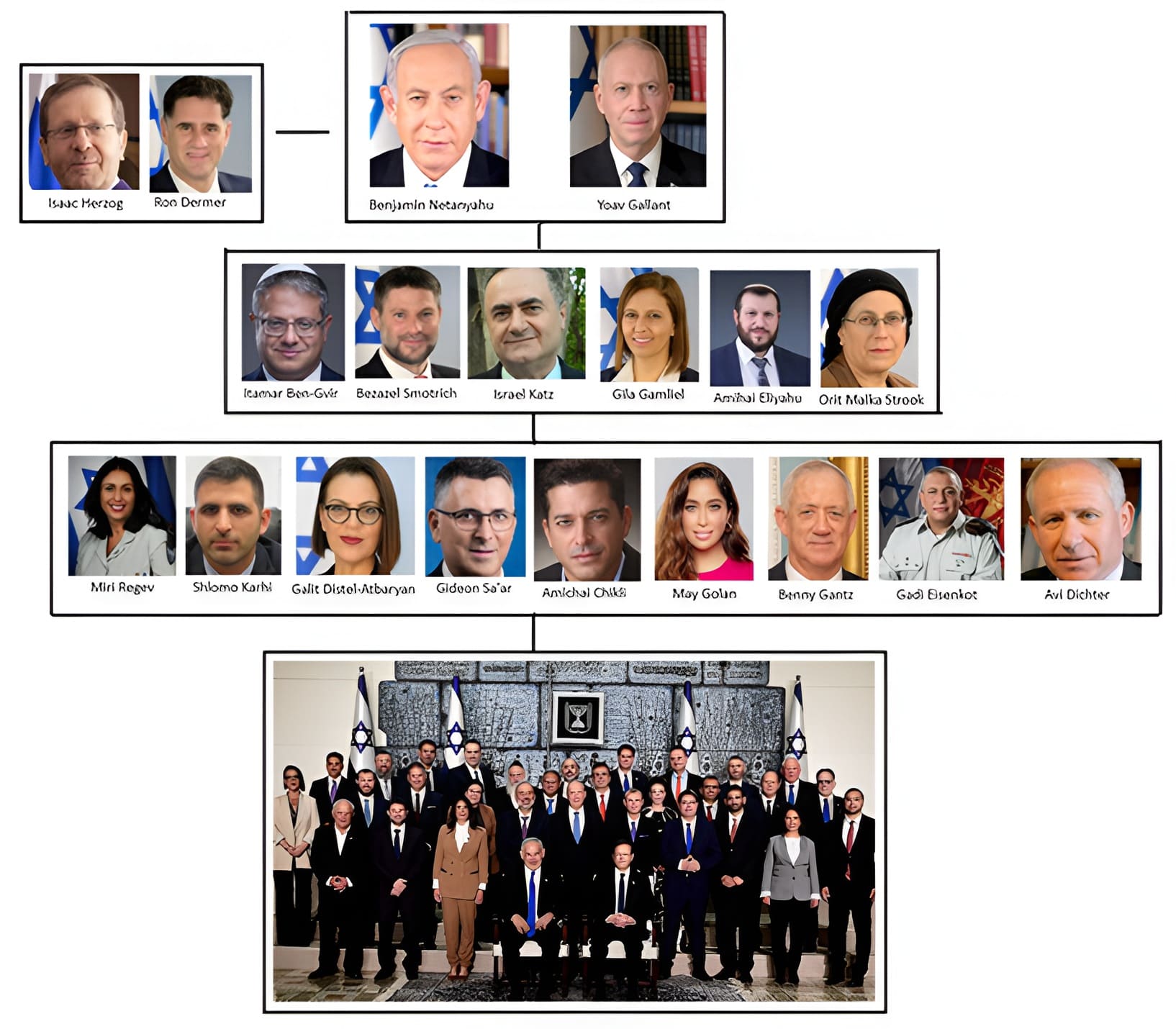
Effectively, there are circles of Israeli officials who share complicity for the Gaza genocide, including high-profile ministers, internationally-less known enablers, military and intelligence architects of obliteration, Netanyahu’s veteran advisor and the president.
Israel’s War Cabinet
Source: Wikipedia (officials’ photos and the group portrait)
The key ministers
Supporting Netanyahu and Gallant, there were at least half a dozen cabinet members who contributed to those brutalities, with some insisting on more destructive measures and protracted bombardment.
Even before Israel’s genocidal atrocities in Gaza, the Minister of National Security Itamar Ben-Gvir, the leader of the far-right and supremacist Jewish Power party, had long promoted the expulsion of “non-loyal” Arab citizens, the full blockade of Gaza, the Judaization of Israel-occupied Palestinian territories and total elimination of Hamas and all who support Palestinian resistance.
Ben-Gvir has been seconded by Bezazel Smotrich, the far-right leader of the national religious Zionists and Netanyahu’s Minister of Finance and Defense, who has tried to use the Gaza War to annex the West Bank to the pre-1967 Israel. A self-proclaimed racist and fascist, Smotrich promoted the blockade of the Gaza Strip calling for the expulsion of Palestinians from Gaza.
Still another hardliner is Netanyahu’s Foreign Minister Israel Katz. As Netanyahu’s Energy Minister in October 2023, Katz had famously declared a complete siege of Gaza: no “electrical switch will be turned on, no water hydrant will be opened and no fuel truck will enter.” More recently, now-Defense Minister Katz pledged that Gaza will be destroyed, and that anyone who stays in Gaza City will be considered “terrorists and terror supporters.”
Objecting to any humanitarian aid to Gaza, Heritage Minister Amihai Eliyahu, Ben-Gvir’s party colleague, suggested “nuking” the Strip to get rid of the “monsters of Gaza,” including women and children. Despite a global debacle, Netanyahu did not fire Eliyahu. In May 2025, the emboldened minister said Israel should bomb Gaza’s food and fuel reserves, to starve the population.
Like Eliyahu, Settlement Minister Orit Strook believes that death and devastation in Gaza served God’s purpose: Israel’s national redemption. That’s why she opposed all ceasefire efforts. Hamas and Palestinians had to be eradicated so that the Messianic Jewish settlers can rebuild Azza; that is, the Judaized Gaza.
The enablers
Though less known internationally, another set of cabinet members contributed to the protracted genocidal atrocities. After October 7, then Information Minister Galit-Distel Atbaryan posted her infamous tweet: “Erase Gaza from the face of the earth… and fire and brimstone on the heads of the Nazis in Judea and Samaria (the Hebraized term for the West Bank).”
Transportation Minister Miri Regev, a former IDF brigadier-general and IDF spokeswoman who likes to describe herself as a “happy fascist,” criticized efforts to detain Israeli soldiers in the notorious Sde Teiman detention camp – the Israeli version of Abu Ghraib and the best-known node of “a network of torture camps.”
Promoting the full removal of all Palestinians from Gaza, Minister of Communications Shlomo Karhi had a central role in the censure of international media in Israel and the occupied territories, including the shutdown of Al Jazeera’s Israel bureau. Many of these views were supported by Foreign Minister Gideon Sa’ar, a promoter of the West Bank’s annexation.
Months before October 7, Diaspora Minister Amichai Chikli stated that the Palestinian Authority was a “neo-Nazi entity” and antisemitic and that it was necessary to “examine alternatives to its existence.” Chikli has built special ties with European far-right movements and led over 100 civil initiatives to align international sentiments with the cabinet’s view that Hamas is a collection of human animals and Nazi antisemites. In October, he invited Tommy Robinson, a British far-right anti-Islam activist with a dark history of criminal convictions, to Israel – despite objections and criticism by the Jewish Leadership Council and the Board of Deputies of British Jews.
Then there was the Minister for Social Equality and as Minister for Women’s Empowerment May Golan, long haunted by bribery and fraud allegations. Golan is Netanyahu’s openly racist appointee, who had hoped to serve as Israel consul general in New York City until her appointment was rejected. She called for another Nakba” (lit. “Catastrophe” in Arabic referring to the mass displacement and dispossession of Palestinians in 1948), to cleanse all Palestinians from Gaza.
Despite their supportive roles and accessorial liability in the Palestinian genocide, none of these cabinet members have been charged by the ICC.
The architects of obliteration
Another set of decision-makers features those Israeli leaders who have had a direct or indirect role in the military doctrine that was deployed in Gaza. Gila Gamliel belongs to Netanyahu’s set of key ministers but as the Minister of Intelligence she also represented the country’s intelligence elite. Since October 2023, she has been in charge of plans of Gaza’s ethnic cleansing to cash on the expulsion via real estate development and by resettling far-right Messianic settlers in Gaza.
The Netanyahu cabinet has also included veteran military leaders whose role was crucial long before and after October 7. They pioneered what can be called the obliteration doctrine, a lethal mix of scorched earth policy, collective responsibility and civilian victimization, coupled with massive indiscriminate bombardment and systematic use of artificial intelligence. As Prof. William Schabas, a leading scholar of genocide, has noted, ‘the obliteration doctrine’ “adds a new term to the lexicon on genocide, notably in the application of international law and its judicial mechanisms.”
As I have demonstrated, this doctrine accounts for the decimation of urban infrastructure and the genocidal atrocities in Gaza. Already in 2006, it was first tested in Dahiya, a Shia Muslim enclave in Beirut. Gadi Eisenkot, the former IDF chief of staff, was its architect who pledged it would be used “in the next war.”
In spring 2024, Benny Gantz, the leader of a center-right party and former IDF chief of general staff, was portrayed as a “moderate” alternative to Netanyahu by the U.S. Secretary of State Blinken. And yet, Gantz sat in Netanyahu’s cabinet through the most devastating phase of Israel’s assault against Gaza. Worse, in the past, he has been haunted by several war crime allegations.
Then there was the controversial and tough-talking Avi Dichter, a former head of Israel’s internal security Shin Bet and veteran politician whose brutal methods in the occupied territories have sparked charges of extrajudicial killing and war crimes since early 2000s. Soon after October 7, Dichter disclosed the Israeli goals: “We are now rolling out the Gaza Nakba,” adding “Gaza Nakba 2023, that’s how it will end.”
None of these architects of obliteration were featured among the ICC warrants, either.
Netanyahu’s right-hand and the president
The portrait of Netanyahu’s cabinet also features Isaac Herzog, the Israeli president. Right after October 7, Herzog condemned all residents of Gaza for “collective responsibility” in the Hamas attack on Israel. In this view, there were no innocents in Gaza. The doctrine legitimized the killings of Palestinian women and children who account for 70 percent of the perished in Gaza.
The portrait also includes Ron Dermer, Netanyahu’s Minister of Strategic Affairs, who recently left the cabinet but remains PM’s close advisor. He was intimately linked with the PM’s fatal decisions regarding Gaza. These included a covert plan to “thin” the Palestinian population in Gaza “to a minimum,” by the creation of a “humanitarian crisis” to transfer the refugees away from the area.
Neither Herzog nor Dermer have had to worry about an ICJ warrant.
Furthermore, these high officials represent just the tip of their bureaucracies in which armies of subordinates implemented their decisions, from Netanyahu’s close confidant Dermer to soldiers who were guided to target women and children, including emergency workers who sought to save the victims; journalists who were silenced; and children who were deliberately shot in the head or the left side of the chest.
In light of the track-record of these and other high-level officials, the ICC arrest warrants for PM Netanyahu and his ex-defense minister Gallant would seem to be largely symbolic.
Symbolic justice
Normally, a prosecution team would draw a long list of potential indictees and then decide who could be prosecuted, relying on the strength of available evidence and the resources of the prosecution team.
It is still another instance of “victors’ justice,” as the former colonial powers continue to undermine appropriate genocide prosecution.
In light of the ICC’s arrest warrants, the prosecutor’s office reportedly had a wider net of names that were considered. The decision to zoom onto just Netanyahu and Gallant was likely motivated by the view that they represented the apex of Israel’s military campaign against Gaza and its people.
Furthermore, the two were charged mainly with war crimes and crimes against humanity, not genocide.
Presumably, the ICC prosecutor office may wait until there is a final ruling on South Africa’s charge of genocide – likely in late 2027 or early 2028 – before deciding whether to add genocide to the list of charges against Netanyahu, Gallant and anyone else that they add to the list.
The effort to charge two Israeli leaders rather than the entire cabinet, whose members have had a substantial role in the genocidal atrocities, does not represent the pursuit of “victims’ justice.” In substance, it is still another instance of “victors’ justice,” as the former colonial powers continue to undermine appropriate genocide prosecution.
The original version was published by Informed Comment (US) on Nov, 7, 2025.
As extreme climate is evolving into the new norm in the Philippines, it will exacerbate the political and economic storms, which loom ahead.
As typhoon Tino (Kalmaegi, internationally) left over 200 Filipinos dead while affecting nearly 2 million people, President Marcos Jr declared “a state of national calamity.”
After the super typhoon Uwan (Fung-Wong) will add to the devastation, mass protests against huge flood control corruption are expected in the country.
In 2022, the Marcos Jr government pledged it would build on the legacy of the Duterte years and make Filipinos more prosperous and more secure. Critics claim both objectives have failed.
Billions of dollars lost to corruption
On July 27, Senator Panfilo Lacson warned that half of the 2 trillion pesos ($17 billion) allocated to the Department of Public Works and Highways (DPWH) for flood control projects may have been lost to corruption in the past 15 years.
And yet, almost in parallel, President Marcos Jr stated his administration had implemented over 5,500 flood control projects and announced new plans amounting to more than $10 billion over the next 13 years.
Ever since then, Manila’s political class has been swept by allegations on corruption, mismanagement, and irregularities in government-funded flood management projects. In August, the Senate Blue Ribbon Committee launched a high-profile investigation into the irregularities, focusing on the “ghost” projects, license renting schemes and contractor monopolies.
Corruption has long been pervasive in Philippine politics, economy and society. In the Corruption Perception Index, the country has consistently scored among the worst in the region. Even in peacetime, it is at par with the civil war-torn Sierra Leone and oil-cursed Angola.
In the era of former President Duterte, corruption fight was spotlighted. Now it thrives again. According to surveys, 81% of Filipinos believe corruption has worsened since martial law was declared 53 years ago. It is compounding misguided economic policies.
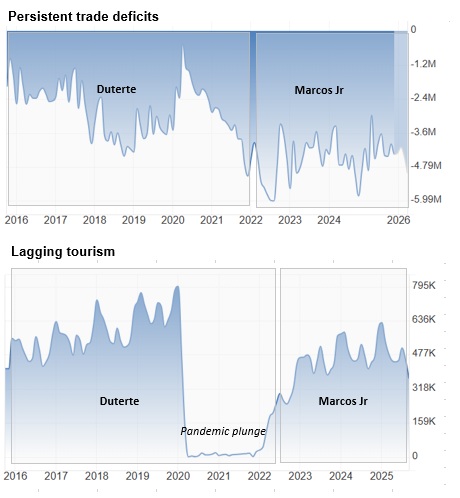
Rising trade deficits, slowing investment
In the Duterte era, exports were led by electronics, with significant growth in tourism and business process outsourcing. Those times are now gone.
In the Duterte era, the effort was to attract multinationals, particularly Chinese firms, to serve as anchor companies that would foster Philippine suppliers. But due to the government’s geopolitics, Chinese – and increasingly Western – multinationals see too much economic and geopolitical risk in the country. And so, the investments that could have come to the Philippines have gone to Vietnam, Malaysia and Thailand in the region.
In Southeast Asia, Chinese tourism has played a vital role in the post-pandemic recovery. Before the pandemic, Chinese tourists accounted for 40-60% of the regional total.
Subsequently, regional recovery was fueled by Chinese tourism. The only exception? The Philippines.
In 2019, Chinese tourist arrivals in the country soared to over 1.7 million. As of September 2025, the Philippines has reported less than 204,000 Chinese arrivals for the year, a figure that is far, far below the government target. The country was banking on a 2-million visitors from China.
The sharp decline is attributed to geopolitical tensions, the suspension of the e-visa program, even safety concerns.
Even if the 2025 total would climb closer to 300,000, that would be just 15-20% of the 2019 level. It’s a catastrophic missed opportunity.
Sources: Trade deficits: Author, Philippine Statistics Authority; Tourism: Author, National Statistical Coordination Board Philippines; Exchange rate: Bangko Sentral ng Pilipinas
BPO outsourcing at risk
Digital economy is a major component of the GDP. But in the absence of domestic ICT anchor firms, the sector is at the mercy of Western offshoring. And that spells huge trouble at a time, when the West prioritizes trade wars, as evidenced by Manila’s costly losses in US tariff wars.
Meanwhile, geopolitics has alienated investments by Chinese ICT giants, which could have catalyzed ICT ecosystems in the country.
And there’s worse ahead. The Philippine outsourcing sector is a $30 billion industry that accounts for 7% of the Philippines’ GDP and commands 15% of the global market. Yet, one-third of its jobs in the Philippines are at risk from artificial intelligence (AI), with those in the BPO sector most vulnerable. Sadly, college-educated, young, urban, female, and well-paid workers in the services sector will be most exposed.
In addition to AI, US protectionist initiatives could perfect the jobs devastation in the Philippine outsourcing industry. Introduced in July, the bipartisan “Keep Call Centers in America Act” proposes to penalize US companies that offshore a significant portion of their call center jobs. The recent Halting International Relocation of Employment Act (HIRE Act) aims to curb outsourcing by imposing a 25% excise tax on payments to foreign workers.
If these realities kick in, US vulture capitalists can be expected to target and short the Philippines, which could compound challenges, as in the past.
Economic growth, missed opportunities
In early 2024, US news agency Bloomberg asked President Marcos Jr whether the Philippines could achieve an 8% growth rate. “Why not?” the president replied. “Yes, I think it is, I think it is doable.”
Yet, at the time, GDP year-on-year growth decelerated to barely 5.2%.
Have things got better? No.
In 2025, the government’s target was reduced to 5.5-6.5%. Just weeks ago, the International Monetary Fund (IMF) downgraded the Philippine growth projection to 5.4% this year. More recently, economic growth slowed to just 4.0% in the third quarter – the slowest since early 2021, when the COVID-19 pandemic caused a contraction.
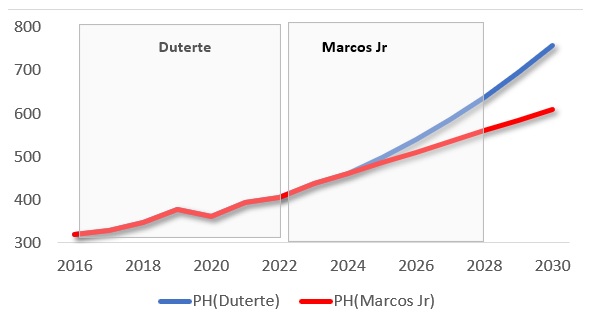
Unsurprisingly, critics claim the incumbent economic policies have failed. Here’s a thought experiment about the extent of that failure. During the Duterte era, Philippine GDP increased from $329 billion to $404 billion, despite the pandemic plunge. On the back of that performance, IMF expected Philippine GDP to climb close to $640 billion by 2028.
Current IMF estimates suggest that by 2028, Philippine GDP would be less than $560 billion. So, the government is set to underperform by $80 billion.
That’s the cost of missed opportunities – although the final cost could prove higher.
Dr. Dan Steinbockis an internationally recognized strategist of the multipolar world and the founder of Difference Group. He has served at the India, China and America Institute (USA), Shanghai Institutes for International Studies (China) and the EU Center (Singapore). For more, see https://www.differencegroup.net
Taking a brand new car home is a big moment. In the excitement, the dealer may offer to add an insurance policy before you roll out. Saying yes is pleasing, but the choice you make now will shape your premium, claim experience, and peace of mind for the following year.
This honest comparison looks at dealer-provided insurance versus arranging your own new car insurance, weighing convenience, cost, flexibility, and support at claim time so you can decide what truly suits your budget, driving needs, and plans for the year ahead.
Why Dealer-Provided Insurance Feels Convenient
Dealer teams often have tie-ups with insurers, so they can:
Finish proposal forms along with the vehicle paperwork.
Start the cover from the exact delivery time, which some buyers find reassuring.
Add popular extras in a ready-made pack, such as zero depreciation, engine protection, and roadside assistance.
Offer hand-holding at claim time through their workshop relationship.
Why Buying Your Own Policy Gives You More Control
Sorting out new car insurance yourself opens up a choice. You can compare plans, tailor add-ons to your usage, and see a clear price and benefit breakdown. The primary wins are:
Custom fit: City driving, highway runs, monsoon-heavy regions, or regular night travel all call for different add-ons.
Flexibility on the insured value: You can check the declared value and ensure it reflects your comfort level on risk and premium.
Clarity on deductibles and limits: A lower upfront price sometimes hides a higher excess or tighter caps on parts.
The Must-Have Checklist for Policy Comparison
Use this quick checklist to weigh cover type, add-ons, insured value, and claims support, so your new car insurance fits your budget and day-to-day driving.
Third Party or Comprehensive
Every vehicle in India needs third party car insurance at a minimum. It protects against legal liability to others. For a new vehicle, most owners prefer comprehensive cover, which includes own-damage protection.
Add-Ons that Matter for a New Vehicle
Pointers:
Zero depreciation: Reduces your out-of-pocket expenses on plastic, fibre, and rubber parts.
Engine and hydrostatic lock protection: Worth considering in flood-prone zones.
Consumables cover: Covers small parts that add up during repairs.
Roadside assistance: Useful for long trips and late-night breakdowns.
Insured Value and Deductibles
Check the declared value and the compulsory and voluntary deductibles. A slightly higher voluntary deductible can shorten the premium, but only choose it if you are comfortable paying that amount during claims.
Cashless Network and Claims Help
Look for cashless garages near where you live and where you drive often. Ask about digital claim filing, pick-up and drop-off, and whether the workshop handles documentation for you.
When a Dealer Policy Makes Sense
Pointers:
You need delivery without delay and do not want to misrepresent quotes.
Your company lease or loan mandates a packaged plan for the first year.
You value the dealer’s single point of contact for claims through their workshop.
A Simple Way to Decide in the Showroom
Ask the dealer to share the full proposal sheet and the premium split. Then, before you sign:
Confirm start time and delivery time align, so you are covered the moment you take possession.
Check the cancellation and refund process if you change your mind before registration.
Ensure the policy carries your details exactly as per registration documents to avoid claim delays.
Set Yourself Up for a Smooth Renewal
Good renewal planning saves money and stress later:
Review your driving pattern; remove add-ons you did not use and add ones you now need.
Keep your no-claim bonus certificate safe if no claim is filed; it can lower your next premium.
If the car will be used less in the coming year, consider adjusting coverage, but think carefully before dropping own-damage on a relatively new vehicle.
The Role of Third-Party Car Insurance Over Time
Minimum third-party car insurance keeps you legally compliant. For a brand new vehicle, comprehensive cover is usually the sensible route. As the car ages, some owners revisit the mix. Until then, safeguarding the value of a new purchase with a well-built plan tends to pay off during repairs and parts replacement.
Final Thoughts
Buying your own plan wins on choice, transparency, and long-term control. For most Indian buyers, the smart move is to compare like for like, choose comprehensive cover with the right add-ons, and make an informed call rather than a hurried one. Treat new car insurance as part of your buying decision, not an afterthought. A few careful checks today will reward you throughout the year, and when it matters most during a claim.
The rapid advancement of generative AI (Gen AI) presents both a tremendous opportunity and a significant challenge for organizations. To fully capitalize on this transformative technology, leaders must prioritize continuous learning and development, ensuring their workforce possesses the skills and knowledge necessary to thrive during workplace transitions.
By doing so, leaders will empower employees to embrace innovation and drive organizational success.
The Foundation: Gen AI Demands a Growth Mindset
Leaders can cultivate this mindset by providing ample opportunities for ongoing education and development.
At the heart of any successful continuous learning initiative lies a growth mindset. This belief that abilities and intelligence can be developed through dedication and hard work is essential for employees to embrace the challenges inherent in mastering new technologies like Gen AI, as a McKinsey report shows.
Leaders can cultivate this mindset by providing ample opportunities for ongoing education and development. This includes:
Targeted Training Programs: Offering access to advanced Gen AI courses, specialized workshops, and professional certifications focusing on the latest tools and techniques.
External Exposure: Sponsoring attendance at industry conferences and seminars to expose employees to cutting-edge developments and best practices for improving effectiveness and efficiency while ensuring ethical Gen AI deployment and managing risks.
Recognition and Rewards: Recognizing and rewarding learning achievements to sustain engagement and motivation. When employees feel valued for their efforts to expand their knowledge, they are more likely to continue investing in their own development.
Integrating Learning into the Workflow
Making continuous learning a seamless part of daily work routines is crucial. This ensures that learning is not viewed as a separate activity but rather as an ongoing process embedded in employees’ everyday tasks. Strategies for integration include:
Embedded Resources: Integrating learning resources, such as Gen AI tutorials, videos, and knowledge bases, directly into the tools and platforms employees use regularly, such as the company intranet or project management software.
Dedicated Learning Time: Scheduling regular “learning sprints” or “innovation hours” to allocate specific times for upskilling or experimenting with new tools, without the pressure of usual responsibilities.
Practical Application and Experimentation to Meet Gen AI Demands
Encouraging employees to immediately apply new knowledge in their work is vital for reinforcing learning and demonstrating its practical benefits. When employees use newly acquired skills in real-world scenarios, they are more likely to retain that knowledge and gain confidence. This can be achieved by:
Real-World Projects: Tasking employees with applying newly learned Gen AI techniques to current projects after completing relevant training. This immediate application solidifies understanding and showcases the tangible benefits of continuous learning.
Fostering Experimentation: Creating an environment that supports experimentation and innovation. Allowing employees the freedom to explore new ideas and test out the latest Gen AI tools can lead to breakthrough innovations.
Safe Testing Grounds: Providing access to sandbox environments or pilot projects where employees can safely experiment with new Gen AI tools before deploying them on a larger scale. This minimizes risk and encourages exploration.
Case Study: Transforming a Mid-Size Manufacturing Company with Gen AI
As a consultant specializing in organizational learning and development around the future of work, I recently worked with a mid-sized manufacturing company of about 250 staff looking to integrate Gen AI into their operations. The firm faced challenges in upskilling their workforce to effectively utilize these new technologies. Over a six-month deployment period, we implemented the following strategies:
Growth Mindset Training (Months 1-2): We conducted four two-day workshops (averaging 20 participants per workshop) emphasizing the growth mindset and its importance for embracing Gen AI. Pre- and post-workshop surveys revealed a 35% increase in employees’ self-reported confidence in learning new technical skills. This helped employees overcome initial anxieties and approach Gen AI with a more positive and receptive attitude.
Embedded Learning Platform (Month 2 onwards): We integrated Gen AI tutorials, short videos (averaging 5 minutes each), interactive quizzes, and a searchable knowledge base directly into their existing project management software (used by 100% of production staff). Usage metrics over the six months showed an average of 12 learning module completions per employee per month, with peak usage immediately following training sessions and prior to project implementations.
Pilot Project Implementation (Months 3-6): We launched a pilot project with a team of 15 maintenance technicians applying Gen AI-driven predictive maintenance techniques to their CNC machining centers. This provided a practical application of their new skills. Over the pilot period, we observed a 15% reduction in unplanned downtime on the targeted machinery, translating to an estimated cost savings of $75,000 in lost production time and repairs. The accuracy of predictive maintenance alerts increased from 60% (using previous methods) to 92% with the Gen AI system, reducing false alarms and wasted technician time.
Innovation Hour Initiative (Months 3-6): We implemented weekly “Innovation Hours” (one hour per week, participation optional) where employees could explore new Gen AI tools and experiment with different applications. Average weekly attendance was 30 employees. Over the six months, these sessions generated 12 distinct process improvement ideas, three of which were selected for further development and implementation. One implemented idea, using Gen AI for optimized material cutting layouts, resulted in a 5% reduction in raw material waste, equating to approximately $20,000 in material cost savings over three months of implementation.
Cultivating a continuous learning culture focused on Gen AI is not merely a trend but a necessity for organizations seeking to thrive in the age of AI.
Due to these interventions, the company saw not only a significant increase in employee engagement with Gen AI and a more proactive approach to leveraging it for business advantage, but also realized substantial cost savings and efficiency gains within a relatively short timeframe. This case study demonstrates the powerful impact of a structured, multi-faceted approach to upskilling and integrating Gen AI within a manufacturing environment.
Conclusion
Cultivating a continuous learning culture focused on Gen AI is not merely a trend but a necessity for organizations seeking to thrive in the age of AI. By fostering a growth mindset, integrating learning into the workflow, encouraging practical application and experimentation, and providing safe testing grounds, leaders can empower their workforce to embrace Gen AI and drive innovation. As the case study demonstrates, these strategies can lead to tangible results, transforming organizations into agile and adaptable entities ready to harness the full potential of this transformative technology. By investing in continuous learning, organizations are not just investing in their employees; they are investing in their future.
By Danny Leipziger
China cannot continue to rely on exports to drive its growth, but what are the alternatives?
China ran a $1.2 trillion trade surplus last year, and despite admonitions from the IMF to rely...
The World Financial Review uses cookies to improve site functionality, provide you with a better browsing experience, and to enable our partners to advertise to you. Detailed information on the use of cookies on this Site, and how you can decline them, is provided in our Privacy Policy and Terms and Conditions. By clicking on the accept button and using this Site, you consent to our Privacy Policy and Terms and Conditions. ACCEPT
Privacy & Cookies Policy
Privacy Overview
This website uses cookies to improve your experience while you navigate through the website. Out of these cookies, the cookies that are categorized as necessary are stored on your browser as they are essential for the working of basic functionalities of the website. We also use third-party cookies that help us analyze and understand how you use this website. These cookies will be stored in your browser only with your consent. You also have the option to opt-out of these cookies. But opting out of some of these cookies may have an effect on your browsing experience.
Necessary cookies are absolutely essential for the website to function properly. This category only includes cookies that ensures basic functionalities and security features of the website. These cookies do not store any personal information.
Any cookies that may not be particularly necessary for the website to function and is used specifically to collect user personal data via analytics, ads, other embedded contents are termed as non-necessary cookies. It is mandatory to procure user consent prior to running these cookies on your website.








 Dr. Gleb Tsipursky