Home Blog Page 516

PreMarkets Review – Gateway to the Modern Markets

Trading is a game of assets and markets. The more access traders have, the more opportunities they get. Retail traders need a brokerage that will give them access to various financial instruments to build strong and diverse portfolios. PreMarkets wants to become the modern gateway for retail traders by giving them access to various assets and markets. In addition, it will provide the tools they need to trade these assets.

PreMarkets has many features that help users get an edge in the market. There are many perks for users to enjoy while they use this service. We will examine some of these features and their benefits in our platform review. This is the place to be if you want to join the platform. Want to know more? Read our review of the PreMarkets features below.

PreMarkets Features

Zero Trading Fees

PreMarkets does not charge users for buying and selling assets on the platform. Traders can buy all the available assets on the brokerage without paying any fees for processing the transaction. PreMarkets eliminates these fees to give users a level playing field. In addition, it ensures that users do not have to worry about how fees will eat into their gains. Without these fees, retail traders can maximize the amount they make from their trades. This feature ensures that traders cannot restrict their trading and can purchase more assets.

Market and Asset Updates

Regular updates are uploaded on the PreMarkets service. These updates keep traders abreast of market news and information. This information ensures that users can stay ahead of the market and protect their portfolios from volatility. In addition, users do not need an extra app or service to stay updated with the happenings in the market. Traders need all the information they can get to drive their decision-making. As PreMarkets provides these updates, users can adjust their trading strategies and position themselves for better outcomes. The best part of this feature is that traders will always be able to avoid sudden price changes in the market.

Diverse Trading Assets

There are numerous assets available for users on the platform. Furthermore, the assets can be traded or added to the user’s portfolios. PreMarkets has created an open channel that gives users access to as many assets as needed to give them options. In addition, these assets ensure that traders have all they need and do not require an extra brokerage account to purchase unavailable assets. Some of the available assets on the platform include CFDs, ETFs, cryptocurrency, indices, bonds, and stocks. Whatever the asset, users will find it on the platform.

Portfolio Tracking Tools

Traders need to know how well they are doing in the market to ensure their portfolios are secure. To help traders monitor their positions better, PreMarkets provides users with portfolio tracking tools. These tools ensure that users can manage their assets and expectations by giving them accurate data about the state of their assets. It would also let users know how effective their trading strategies are and what assets are underperforming/outperforming the market. In a nutshell, users will be able to accurately measure their trading impact and make the necessary corrections to impact their portfolios positively. 

Demo Trading Accounts

How do traders improve their skills without risking their funds? PreMarkets has provided dummy accounts that allow users to practice risk-free. These accounts are accessible to all users on the platform. In addition, traders can easily switch between their live and demo trading accounts. The accounts are in a simulated environment that copies the movement of the live market. Therefore, traders will have a feel of the live markets, which will make their practice sessions more believable. Users are encouraged to use these accounts to learn more about market movements.

Conclusion

The brokerage wants its users to have full access to the financial markets. Its features ensure that users can buy and sell assets seamlessly. For more details, visit the PreMarkets website.

Disclaimer: This is a sponsored marketing content.

How Much Income Does A Super Bowl Weekend Generate For A City

The Super Bowl is one of the world’s most highly anticipated sports events in the world, with millions of eager fans tuning in to watch their favorite teams battle it out to lift the Lombardi Trophy.

So, it may come as no surprise to learn that the Super Bowl is one of the biggest earning and spending events of the entire year. From A-list musicians at the half-time show to huge commercial opportunities for brands to up their sales, the event has a huge revenue stream. 

With Super Bowl LVII fast approaching, fans everywhere are looking forward to the festivities associated with one of America’s most iconic events. Check here for the best NFL Player Props Bets 

Yet before kickoff, there’s an unseen battle that takes place that viewers aren’t privy to; which city will host the big game. This has become nearly as competitive as the game itself, with cities willing to bend over backward to claim the hosting honors. 

Not only do they get bragging rights for hosting the game but the potential profit opportunities are immense, and potentially even life-changing for the city.

But does the hosting city benefit from holding the Super Bowl on home ground? If so, how much income does it generate for the city? Let’s dive in and find out! 

How Are Super Bowl Host Cities Chosen?

In the past, the NFL would seek out and invite different cities to make a bid to become the host. Then, from the list of cities that applied, the options would be narrowed down to a handful of finalists. 

These finalists would then be asked to submit their bid or presentation to become the Super Bowl host city.

The NFL now directly contacts the chosen venue and requests that they put together a suitable proposal, showing exactly why they are the most suitable host city for the event.

How Much Income Does A Super Bowl Weekend Generate?

This is a hard concept to generalize for every city. This is because the total revenue generated will vary depending on where the event takes place. 

There is no doubt that host cities see a huge uptick in the number of hotel guests, dollars spent in local stores, and a huge increase in attendance at restaurants and bars all over the area. 

According to the NFL, the usual economic take for any Super Bowl is somewhere in the range of $300 million and $500 million for any host region. Yet the reality is that these places will likely see an economic boost ranging from $30 million to around $150 million instead.

While this is still an impressive amount of money to earn in a single weekend, it is a far cry from many of the projected figures. 

The huge difference between these figures is largely based on the astronomical costs splurged by the city to host the game. This takes a sizable chunk from any of the potential profits.

Financial Factors to Consider

The NFL has multiple revenue streams stemming from the Super Bowl regardless of where the event is hosted. For instance, companies will shell out millions of dollars for a single space of advertising, and eager fans will rush to get their hands on every piece of merchandise that they can. 

Other costs associated with hosting the Super Bowl (pre-game) are as follows: 

  • Annual television rights paid by NBC, FOX, and CBS every year: approx. $3 billion
  • Total revenue from ticket sales: a minimum of $65 million 
  • Expected total ad revenue paid to TV networks: $340 million
  • 30-second advertising spots for TV networks: just over $5 million
  • Money spent by individual fans: $90
  • Nationwide fan spend for the Super Bowl: nearly $14 billion

There are also significant increases in music sales, television sales, and also in the popularity of food delivery services such as Domino’s Pizza or McDonald’s.

Warm-weather locations are also set to make more money from the Super Bowl than colder cities as visitors are a lot more likely to remain in the vicinity than just the weekend. A byproduct of this will be to spend more money, thus increasing the total amount of income that a host city generates during this weekend.

Not All That Glitters is Gold

The simple fact of the matter is that the estimates made by the NFL may be grossly overestimated. This means that the financial gain associated with hosting the Super Bowl may not be quite as extravagant as some host cities expect.

Because of this, some host cities have reported making no revenue at all. Some cities have even recorded losing money while hosting the Super Bowl!

For example, Arizona’s hosting responsibility in both 2005 and 2008 resulted in a significant financial loss on both occasions. Unfortunately, it does not end with Arizona. 

When San Francisco hosted the Super Bowl in 2016, the total cost of transit and police services came to an eye-watering $5 million.  

Is Hosting the Super Bowl Truly Worth It?

Again, this depends on multiple factors, and every situation is unique. Even if the host city does not generate the estimated $500 million that the NFL promises, there’s still an incredible opportunity to earn a massive financial increase for the area. 

If a city has an existing stadium that accurately meets (or even exceeds) the NFL’s overall standard, it may help to offset a lot of the cost. After all, there is not a lot of value if a city must build a stadium worth $1 billion to host the event!

Summary

Hosting a Super Bowl is a brilliant way to naturally increase tourism in a specific city which, in turn, drives income to new heights. Fans will flock to the area, paying for food, drinks, accommodation, and transport – in addition to their expensive stadium tickets for the game. 

Essentially, American football fans are enthusiastic and dedicated enough to be willing to spend as much money as is necessary to make the most out of their trip away.

Leaps And Bounds: Marketing Tricks For An Athletic Equipment Business

As a business owner, you’ll need to learn how to market your products and services effectively. If your business is related to sports, marketing can be a bit trickier. If you’re in the market for a new business or are starting your own sports equipment business, then you may need some help.

Here are some marketing tips for an athletic equipment business.

Use Social Media

Social media is the best way to market your athletic equipment business. It’s free and easy to use, and it reaches a broad audience. Your social media posts can be used to promote your business, but they can also be used to engage customers.

You can use social media to tell your customers about new products, promotions, and services. Your social media posts can be used to educate customers about your products and services, too. For example, if you sell basketball equipment, you can post about the latest basketball trends. This will help your customers stay current on the latest products.

Offer Free Promotional Products

Creating and giving away promotional items is a great way to advertise your athletic equipment business. Custom rally and sports towels are an especially effective promotional item, as they can be used by athletes and fans alike.

Sports-related promotional products are an ideal way to market a sports equipment business. Some of the most popular promotional items include custom t-shirts, hats, water bottles, and other branded merchandise. These products can be printed with your company name, logo, and slogan, and they make great gifts for customers and athletes alike. Other unique and creative promotional items include custom rally towels, foam fingers, and even inflatable mascots. These promotional items are great for drawing attention to your business and creating an atmosphere of enthusiasm and excitement for your brand. No matter what type of sports equipment business you own, promotional products are a great way to get your name out there and show your customers that you care.

Your brand is the image that customers see when they think about your athletic equipment business. It’s important to carefully consider the name and logo that your business will use. Unique business names are likely to stand out more and make you different from any other brands in the industry, the same goes for the logo you will use.

Work With Relevant Influencers

If you’re in the sporting goods business, you’ll have plenty of relevant influencers to work with. You can work with people who are interested in or passionate about sports. Influencers are also a great way to promote your business because they give credibility to your brand.

If you sell basketball shoes, you could work with a basketball player who is well-known in the industry. Working with influencers will help you gain exposure for your business and it will encourage customers to trust your brand.

Have Real Marketing Ideas

If you’re new to marketing an athletic equipment business, you may not know what kinds of marketing strategies will work for your company. While there are many different ways to market an athletic equipment business, there are also many different marketing strategies that can work for a specific type of business. If you’re in the market for a new business or are starting your own sports equipment business, you may need some help figuring out marketing strategies that will work for you. You may need some help from outside experts or from people who have experience running similar businesses in the past.

If you’re in the market for a new sports equipment business, you may want to consider advertising on local radio stations or TV stations in your area. You may also want to consider advertising on billboards in your area or looking for sponsorships with local businesses or sporting events in your area. You may also want to consider advertising on social media sites such as Facebook and Instagram. This can be an effective way to reach out to potential customers and build up awareness of your business.

Educate Your Customers

Many people don’t know much about sports equipment or sports in general, so it’s important that you educate your customers about what they’re buying when they purchase your products or services. This can be done through the website that you create for your athletic equipment business or through social media sites such as Facebook and Twitter. You can also include educational information on packaging when you send out orders to customers. For example, include educational information about the product on the box that it comes in, or include educational information on the packaging when it’s sent out by UPS or FedEx.

Document Your Successes (And Failures)

You’ll need to document your successes and failures when it comes to marketing an athletic equipment business online. This will help you improve your marketing strategies for the future and it will help other people who are interested in starting their own athletic equipment businesses learn from your mistakes so they don’t make them themselves.

Marketing an athletic equipment business can be a lot of work, but it’s important to take the time to figure out what will work for your company and to put in the effort to make your customers happy. By following these tips, you’ll be on your way to success in the sports equipment business world.

What Is Data Matching, And What Are Its Common Applications

Data matching is a process used to identify identical, similar, or related records within and across data sources. It helps to clean up customer databases and connect disparate sources of data into one unified view. This technique is commonly used by businesses to ensure customer data accuracy, manage and reduce the risk of fraud, as well as to leverage insights from consolidated information. Data matching is usually done with the help of data matching and cleansing tools such as WinPure, which helps to determine similarities between data and match them, returning the most accurate result possible.

What is the Data Matching Process? 

Data matching involves the process of comparing records between two or more data sources in order to identify potential duplicates. It is used in a wide range of industries, from customer service and marketing to healthcare and law enforcement. 

At its core, data matching works by looking for similarities between records. This can be done by examining attributes such as names, addresses, phone numbers, emails, or social security numbers. The process typically involves comparing each record for common characteristics that suggest it may be the same individual or entity represented by multiple records in different databases. For example, if two records have the same first name, last name, address and phone number it’s likely they refer to the same person

refer to the same person
Example of records having the same details but in different formats

Data Matching Techniques 

Data matching algorithms are powered by sophisticated technologies such as artificial intelligence (AI) or machine learning that can detect slight variations in data points such as names, addresses, and phone numbers. 

For example, if two customers have slightly different versions of their name due to different spellings (e.g., John Smith vs Jonathan Smith), the data matching algorithm can detect that they are the same person and merge them into a single record. 

The three most common data matching techniques are fuzzy, numeric, and exact which are used on text, numeric, and non-numeric information to assist in identifying patterns or relationships between data elements that could point to discrepancies in records or data sets. 

Techniques such as phonetic analysis can be used to compare words based on how they sound rather than their spelling. Similarly fuzzy logic algorithms can use probabilistic measures to determine how closely related two pieces of data might be even when there are inconsistencies between them.

Data matching can also link together different pieces of information from multiple sources into one unified view – for example, combining online purchase history with demographic information from a loyalty program. This provides businesses with an integrated picture of each customer and their preferences which can be used for personalized marketing campaigns or other business objectives. 

Common Applications of Data Matching

The applications of data matching are vast and diverse; they include identity management, risk management, customer segmentation, fraud detection and prevention, credit scoring/risk assessment and compliance monitoring. Data matching is also commonly used in government and educational organizations to map students’ performance with the benefits they receive (such as free school lunch) and so on. Over the years, as organizations strive to become more data-driven, smart data matching solutions can enable companies to consolidate their data faster and better for more accurate results. 

Some common applications of data matching include: 

Identity Management 

Identity management is one of the most common uses for data matching technology; by cross-referencing customer information with other databases organizations can quickly verify key details about customers such as age and address before proceeding with financial transactions or issuing new services/products. Risk management solutions use similar techniques to screen out those individuals deemed too much of a risk for a particular product or service due to past behavior flagged up in credit reports or public databases; this helps organizations reduce losses from fraudulent applications or delinquencies on loans. 

Identity Verification 

Another application of data matching is in identity verification processes, which are usually required before granting access to sensitive services such as banking applications or e-commerce stores. In this case, the algorithm will compare all the relevant user details such as name, address, date of birth etc with official government records to verify whether the person is who they claim to be. To gain a deeper understanding of how cutting-edge technology is revolutionizing identity verification, particularly in customer-centric industries, you can explore the comprehensive insights provided at https://microblink.com/resources/blog/customer-identity-verification-software/.

Fraud Detection 

One important application of data matching is in fraud detection; for instance, it can help identify suspicious patterns in transactions or detect fraudulent accounts that use duplicate personal details across multiple websites or applications. Companies must also consider privacy regulations when using data matching – for example, European regulations like the General Data Protection Regulation (GDPR) require companies to obtain explicit consent before collecting and processing customer data. 

Financial Modeling 

Credit scoring models rely heavily on data matching technologies in order to assess an individual’s creditworthiness so that lenders can make informed decisions about who should receive access to funds or services without encountering too much risk (i.e., not many defaults). Finally compliance monitoring solutions safeguard businesses from legal action taken against them due to noncompliance with industry regulations through regular checks against relevant databases ensuring any changes are picked up quickly allowing swift corrective action where necessary. 

Customer Segmentation 

Data matching also has important applications in customer segmentation – grouping customers into different categories based on their shared characteristics – which enables companies to tailor their offerings more precisely based on each segment’s needs and preferences; this helps cut costs with targeted advertising campaigns while also increasing engagement levels with existing customers through personalized outreach tailored specifically to them. 

Understanding the Challenges with False and Negative Positives

Data matching algorithms are not perfect however; they may produce false positives (matching inaccurately) or false negatives (not detecting correct matches). To reduce errors when cleaning up large databases with complex rulesets and multiple attributes, businesses should make use of advanced technologies such as AI/machine learning which can quickly process large amounts of information efficiently and accurately. 

Conclusion

In conclusion, data matching is an essential technology for enterprises looking to build a comprehensive view of their customers while ensuring accuracy and compliance with privacy regulations. By leveraging powerful algorithms based on AI/machine learning technology businesses can clean up their databases more effectively and gain valuable insights from consolidated customer information without compromising accuracy or security concerns.

Bardya Ziaian – From Fintech Expert to Filmmaker

Throughout his career as a fintech entrepreneur, few would have anticipated that Bardya Ziaian would go from this niche to something completely different: filmmaking.

The path was set

A Toronto-based executive, Bardya Ziaian started his career with specific expertise in the areas of fintech, brokerage services, and financial systems. A long-time entrepreneur, Ziaian has founded several companies, including Robo Advisor, a wealth management company, Virtual Brokers, a discount broker ranked #1 in Canada, and SITTU Group, a think tank company. Additionally, Ziaian designed and created a self-clearing and trading system in Canada and the United States.

His path seemed established even during his time at York University in Toronto, with his undergraduate and Master’s degrees in mathematics. From there he began working as a senior software engineer and project manager. By 2004, he was in charge of multi-strategy books at Royal Capital Management and in 2008, he founded BBS Securities and Virtual Brokers, a Canadian Broker dealer and discount broker he later sold to CI Financial in 2017.

Today, he is President and CEO of SITTU Group Inc., consulting with companies, designing systems, and investing in early-stage businesses.

Something missing—the pivot

Yet, with his appreciation for finance and with his success in highly technical fields, Bardya still felt something lacking in his life: creativity.

“There comes a point in life where you feel like it’s now or never: you either go for your dreams or regret not trying for the rest of your life,” Ziaian explained. “Sure, I had those moments of doubt in the beginning. I had that little voice in my head that said, ‘You don’t have the experience.’ But I am also business savvy and know plenty of successful people in the world who didn’t begin with the requisite experience. You confront that by strategically building a remarkable team.”

The film production company Bardya Ziaian Pictures Ltd, was launched in 2020.

Launching a production company during a pandemic

Ziaian and his team faced not only the challenges of kicking-off a start-up production company, but of doing so during a global pandemic. Still, the team overcame an abundance of obstacles to produce its first film, Super Dicks.

They took all possible safety measures and were able to provide jobs for those in the arts, which was a particularly challenging job market during the pandemic.

The film features a colourful cast of leads including Kim Coates (Netflix’s “Bad Blood”), Ambyr Childer (Netflix’s “You”), Marie Avgeropoulos (Nexflix “The 100”), and Michael Ironside (“Total Recall”).

“I always wanted to make movies,” said Ziaian. “I have a passion for bringing stories to life on the big screen, even though my career path makes this decision seem a little nuanced, if not completely unexpected.”

According to Ziaian, the research and development for the film began pre-COVID-19. Despite having the option to postpone, Ziaian and his team made the decision to continue moving the project forward. At the time, he felt that the world “needed a laugh more than anything,” while also creating important jobs for talented artists.

He was able to draw from his entrepreneurial background and management skills, which gave him the edge to build and delegate his team to get the project done on time and on budget.

While being the producer of the film, Ziaian also makes a cameo appearance.

The adventures continue

Bardya Pictures Ltd. recently announced that it would begin production on a new comedy called Golden Boy. This is the second film produced by the company and is written by Ziaian and Juliet Wanng and directed by film veteran Damian Lee.

“While most of the details of the movie are still under wraps, I can say that we’ve been lucky enough to find a stellar cast and already have a very funny script that I think will resonate with a lot of people,” Lee told newswire.com.

As Ziaian continues to explore his passions, he says he’s excited to see what the future holds.

“We’re just getting started. I’m excited to see us expand into new projects as we gain traction and industry knowledge,” said Ziaian. “Is there anything better in the world than to learn and create with amazing people?”

The Advantages of Converting PDFs to Word Documents 

PDFs are the go-to for sharing documents due to their universal availability and compatibility across operating systems. However, PDFs can be difficult to customize or edit after they have been created. That’s why converting your PDFs into Word documents can benefit you in many ways. Read on to find out more about the advantages of converting PDFs to Word documents. 

The Benefits of Converting PDFs to Word Documents

Editing is Easier 

One of the greatest benefits of converting a PDF to a Word document is that editing is made much easier. If you need to make changes or move or convert a PDF to Word, this is far simpler when you have a Word document than with a PDF. You will also be able to add images, links, and other elements that are not available when working with a PDF file. 

Easier Collaboration 

If you are working with multiple people on the same project, it makes sense to convert your PDF into a Word document so that everyone can easily collaborate on the same file without any difficulty. Multiple users can work from one document at once within Microsoft Office applications such as Word and Excel, which makes it easier for teams to stay organized and productive.  

Optimization Options 

When you convert your PDF into a Word document, you will have access to more optimization options as well. For example, if you want to use SEO keywords in your content, this is much easier when working in a Word document as opposed to a static format like a PDF file. This will allow you to rank higher in search engine results pages (SERPs) and gain more visibility for your content online.  

Compatibility Across Operating Systems 

Another advantage of converting your PDF files into Word is that they are now compatible across all operating systems including Windows, macOS, and Linux. This means anyone who has access to these operating systems will be able to open up and view the file without any issues or difficulties – something that may not be possible if left in its original form as a PDF file.  

Time-Saving Benefits 

Converting your files can also save time by streamlining processes such as editing and collaboration efforts across multiple teams or departments within an organization. It’s also much faster than retyping information from scratch if needed – something which could take hours depending on the size of the file!  

Keeping these advantages in mind, it’s clear to see why converting PDFs into Word can be beneficial. Not only will it save you time and make editing much easier, but it will also allow for better collaboration between teams and optimize content when needed.  So if you’re looking for a way to make your workflow more efficient and effective, consider converting your PDF files now!

Converting PDF files into Word documents provides many benefits including easier editing, improved collaboration capabilities, optimization options, compatibility across operating systems, and time-saving opportunities. If you want to improve the efficiency of your workflow or gain greater visibility with search engine rankings, then converting your PDF into a Word document is definitely worth considering.  

Remember the key advantages of converting PDFs to Word documents and start taking advantage of them today!  With the key advantages of converting PDFs to Word documents, you can streamline your workflow and improve online visibility. Start taking advantage now!

In the end

In conclusion, converting your PDF files into Word documents offers numerous advantages such as making editing easier, improving collaboration efforts between teams or departments within an organization, and optimizing content for better search engine rankings and compatibility across different operating systems. Ultimately it saves time while ensuring the accuracy of information – two things that should always be taken into consideration when creating digital content!

12 Tips To Help You Manage Your Loans

Are you struggling to keep up with your loan payments? Are you looking to stabilise your accounts to get caravan loan deals in Australia? Or are you feeling overwhelmed and stressed out about your debt? You are not alone. Millions of people are struggling with debt every day. But don’t worry, there are things you can do to help manage your loans and get your finances back on track. In this blog post, we will discuss twelve tips that will help you take control of your loans and get them under control!

1. Start by creating a budget and sticking to it

Since loans are an inevitable part of life, it’s important to establish a budget so that you can manage your loan repayments more effectively. Make sure to factor in payments for groceries, rent, utilities, and other necessary expenses as well as some extra money for leisure activities. Once you have created the budget, stick to it and use it as a guide for managing your loans.

2. Prioritize high-interest loans first

If you have multiple loans, it’s important to prioritize which ones need to be paid off first. Generally speaking, you should focus on the loans with the highest interest rates, as those are usually the most expensive and will end up costing more than other loans in the long run. Plus, paying off the highest-interest loans first will help to reduce your overall debt.

3. Take advantage of automatic payments 

Automatic payments can be set up with your bank, so you don’t have to remember when payments are due. You also might receive a discount if you set up automatic payments. And, if you’re worried about making sure money is in your account, you can set up payments to occur after your paycheck is deposited.

4. Consolidate your loans

If you have multiple loans with different interest rates or payment amounts, consider consolidating them into one loan with one manageable monthly payment. Sometimes, you can even negotiate a lower rate. Keep in mind that consolidation extends the length of your repayment period, so you will be responsible for more payments.

5. Don’t ignore the loan servicer’s notices

Loan servicers are responsible for sending out billing statements, collecting payments, and helping with any problems that come up. If you’re having trouble making payments, the first step is to contact your loan servicer and discuss options. Additionally, it’s important to read the documents you receive from them so that you stay up-to-date on your loan terms and conditions.

6. Remember that student loans are generally not dischargeable in bankruptcy 

Student loans aren’t like other types of debt; they don’t go away if you file for bankruptcy. This means it’s important to make sure you have a repayment plan that works for you so you don’t find yourself in too much debt. And if you do find yourself in too much debt, consider options other than bankruptcy to get out of it. 

7. Consider debt review 

One way to deal with your loans is to go through a debt review, which will look at all of your debts and determine a payment plan that’s manageable for you. This can be a great way to keep up with payments and get out of debt more quickly. Just make sure you find a reputable debt review company before signing any agreements. 

There are pros and cons to debt review, so it’s important to think carefully before committing. Be sure to discuss the details with a professional who can help you decide if this is the right option for you. 

When it comes to the pros, debt review can make it easier to manage payments, lower interest rates, and possibly even waive some fees. And the disadvantages of debt review include a negative effect on credit scores, longer repayment terms, and higher monthly payments. So, make sure to weigh all your options before making a decision. 

8. Take advantage of grace periods

If your loan comes with a grace period, use it to get ahead on payments or pay off more than what’s due each month. Make sure you understand when and how much interest will be charged during the grace period. And remember to read the terms of your loan carefully. 

9. Take advantage of automated payments

Automated payments can help you pay off loans faster by ensuring that your payments are made on time each month. Many lenders offer discounted interest rates for those who opt-in for automatic payments, so be sure to check with them first to see if there are any special discounts available. 

10. Make extra payments whenever possible

Set up an automatic payment schedule to make sure you pay on time, but also consider making extra payments when it is feasible. Paying more than just the minimum due each month can help you save on interest and shorten your loan’s repayment period. Not only will you pay off your loan faster, but you may also save a considerable amount of money in interest payments. 

11. Get a lower interest rate on your loans

One way to reduce the burden of paying off your loans is to shop around and find a lower interest rate. You could look into refinancing your loan with a different lender or consolidating multiple loans into one loan with a lower interest rate. This can potentially save you thousands over the life of your loan.

12. Shop around for the best loan rates

Of course, you don’t want to take out a loan with an exorbitantly high-interest rate. Shopping around for different lenders can help you find the best deal and save you a lot of money in the long run. Pay attention to the annual percentage rate (APR), which is the amount you will be charged each year on your loan.

charged each year on your loan

Lastly, managing your loans doesn’t have to be an arduous process. With a little planning and effort, you can manage your loans in order to pay them off as quickly as possible while still maintaining financial health. Hopefully, these 12 tips have provided you with some ideas on how to manage your loans more effectively. Thanks for reading!

Struggling With Poor Credit Scores? Follow These Tips For Better Results

If you want to maintain a good credit score for smooth loan transactions in future, your credit score is worth paying attention to. A high credit score makes it easier for applicants to approve their loans and save money on loans and insurance rates.

Maintaining a good credit score is crucial for securing loans, financing big purchases, and getting the best interest rates for our credit cards. But it isn’t always easy to keep that number high. Many don’t know what factors into your credit score at all! Fortunately, there are a few habits people can practice to maintain a healthy high credit score:

1. Pay Back Balances On Time Every Month

This is the best way for consumers with an excellent track record to pay back debts on time. Paying back balances every month prevents late fees from being incurred and keeps your credit utilization ratio low, which lenders use to determine if you’re a responsible borrower. It’s best not to spend over what you can afford and pay off the monthly balance. Having a good credit score will prove a great help with your car finance.

2. Only Apply for Credit When You Need It

While you must maintain a good credit score by paying bills on time, don’t apply for new credit whenever it seems like there isn’t enough money to get through the month. It’s tempting to apply for a new card when an existing one has a high-interest rate and try to get a better deal with another company or retailer.

However, this only increases the amount of credit you have in your name, negatively affecting your credit score. In addition, if you end up not using the card, the company has to pay a fee for late payments or other penalties, resulting in them passing those fees along to you.

3. Pay Loans With Low-Interest Rates First

This habit will help improve your risk level by reducing your debt load and keeping any unnecessary cards with higher interest rates in good standing. In addition, by paying off your debt before paying back any bills, you decrease your risk of late and forward payments while making it easier to get approved for new loans.

4. Stay on Track With Loan Installments

This habit is especially important for those who have large loans or really expensive credit cards and want to avoid the possibility of late payments and repossession. By planning, you can pay your loan each month before the payments are due, minimizing the chance of falling behind on them by an extra day or two.

In addition, experts from a chattel mortgage can help you keep your statements accurate and can help prevent any negative feedback for not paying bills on time.

5. Do Not Hold Your Credit Card Balances

If you want to hold on to a high credit score, the card companies mustn’t feel you’re relying too much on them. While this can be hard at the beginning of the month when bills are due, if you make sure to pay off your cards every month, this will improve your creditworthiness and enable you to take advantage of low-interest rates for balance transfers or purchases elsewhere.

Conclusion

If you want to improve your credit score and prevent the possibility of repossession or late payments, then you can use these above-shared financial habits to stay on track and avoid any negative effects. You can keep your credit score high by following these tips consistently.

Toward 2023: Preparing for Tectonic Shifts in the World Economy

By Dan Steinbock                         

Colossal structural shifts are taking place in the global economy, as evidenced by the huge challenges during the ongoing year. In 2023, China seeks recovery, but the West – the US, the Eurozone and the UK, and Japan – will cope with recession and the specter of a debt crisis.

In a recent Foreign Affairs commentary, Mohamed A. El-Erian warned that we are not facing just extraordinarily challenging business-cycle fluctuations, but structural and secular long-term pressures. As a result, “the global economy may never be the same.”

In reality, the “old normal” has been history since 2008 and the consequent debt crises. During the past decade, world economy has been driven by geopolitical agendas, not by economic priorities. And the results have been predictable: catastrophic.

Today, the risk of recession casts a dark shadow over the US economy. The Eurozone is facing a deep recession, Japan’s economy is shrinking, and the United Kingdom is struggling with the worst fall in living standards since records began.

West’s tough 2022 and darker 2023   

In early 2022, the US, the Eurozone, the UK and Japan pledged geopolitical loyalty and ignored economic realities while promoting the worst military overstretch in decades. Thanks to the US/NATO-led proxy war against Russia in Ukraine, the costs of the misguided economic policies and geopolitics were predictable already in March.

Until recently, Western economies seemed fairly resilient. In 2022, US GDP growth on a year-to-year basis is likely to remain around 1.3% to 1.8%, though significantly below the 2021 projections. In the Eurozone, the comparable figure is likely to be higher; about 3.1% to 3.3%; and in the UK over 4.0%. Whereas in Japan, it is likely to be only 1.5%.

Nonetheless, the resiliency is elusive because it is based on soaring debt (Figure 1).

Figure 1 The West’s Debt Spiral

Gross Government Debt as % of GDP (2012-2022)

Gross Government Debt as % of GDP (2012-2022)

Source: Trading Economics; Difference Group

In the Eurozone, government debt to GDP remains close to 100%. Ironically, that’s 40 percentage points higher than the region’s own debt limit. In the UK, the figure has doubled since 2008 to almost 100%. In Japan, the figure is the worst among all high-income economies; close to 265%, thanks to over two decades of secular stagnation.

In the US, the debt ratio has doubled and is inching toward 140%. That’s over 20 percentage points higher than that of Italy amid Rome’s 2010 debt spiral. But unlike Italy (and its bygone lira), America is a global anchor economy and US dollar still dominates international transactions. So, when the US debt crisis ensues, adverse reverberations will be felt from the world economy to global foreign-exchange markets.

Yet, tragically, these are still the “good times.” The year 2023 will be more perilous.

In the US, growth will be at best stagnant around 0.1% to -0.2%. In the Eurozone, recession will be rough at -0.5%; in the UK, even worse at -1.0%. Thanks to recession in Germany and stagnation in France, Europe’s twin engines will both be spluttering. In Japan, stagnant growth is likely to stay around 1.0%.

In each case, the growth figure will require still more debt. Consequently, downside risks far outweigh upside risks. in adverse conditions, a cyclical downturn could unleash a secular nightmare.

China: From headwinds to recovery            

In this dire international landscape, China is moving toward recovery in 2023, which could alleviate global economic prospects. Until the fall, Chinese economic data reflected mainly challenges. Yet, the story of 2023 is likely to be the impending recovery of the Chinese economy – if the current Covid ailments can be overcome.

A central determinant in unleashing the Chinese consumption potential, private sector investment and investor confidence hinges on the success of the more flexible Covid-policy and the consequent broad-based recovery. Though gradual, the new Covid impact could result in a surge of pent-up demand by the second quarter of 2023.

Such progress would strengthen economic data. In the property markets, the new support measures, particularly the government’s 16-point recovery plan, will contribute to stabilization.

Industrial production would pick up. Despite demand destruction in the West, the Belt and Road Initiative (BRIA) will promote steady progress on the back of recovery in Southeast Asia, which China is both driving and benefiting from. Less fixed asset investment by the public sector would reduce local governments’ debt pressures.

Chinese investors would return to equity markets, which would also be attractive to overseas investors seeking short-term bargains and long-term diversification. The MSCI China Index heralds the turnaround; it was 24% up in November, compared to only 2% for the S&P 500 Index.

Certainly, domestic challenges will remain tough. Nonetheless, the aging-related reduction of the labor force will be smaller than expected, as the new UN projections attest. Furthermore, the share of investment to GDP likely peaked at 42 percent in the past half a decade, with a gradual decline set to ensue. And thanks to continued reforms and “common prosperity” policies, Chinese catch-up in productivity and per capita incomes has climbed to more than a third of the US level, even as secular growth is decelerating to 4% in the late 2020s. Like in postwar Europe, living standards rise, even though aggregate growth is slowing (Figure 2).

Figure 2 China’s Sustained Catch-Up

Annual GDP Growth and GDP Per Capita (PPP)

Annual GDP Growth and GDP Per Capita (PPP)

Source: Trading Economics; Difference Group

Thanks to the expected rebound, China’s growth could climb to around 4.0 to 4.5 percent in 2023.

US-Sino relations: Enduring thaw or calm before storm?          

There is one common denominator that unites the economic outlook of the United States, the Eurozone and the UK, as well as Japan and China. And that’s the compelling need for the global landscape to remain manageable, as indicated by the easing of Sino-US tensions after the recent meeting between President Joe Biden and President Xi Jinping.

However, the question is, whether the current relative calm heralds a nascent bilateral thaw or whether it reflects an elusive calm before an impending storm.

The Biden White House can no longer control that future. While the US midterm elections were not as catastrophic to the administration as initially expected, Republicans did advance in all political fronts. The Senate is now bitterly divided and the House under Republican control.

In the medium-term future, naïve expectations should be shunned. The global economy is facing a perilous transition and the West’s recent  track-record – especially the penchant for covert geopolitics at the expense of economic development – is perilous. In the past, Western governments, despite their ailing economies, have mainly “intensified their weaponization of trade, investment, and payment sanctions,” as El-Erian warned.

Globalization has come to a halt, even reversed. In the rejuvenation or degeneration of future globalization, U.S.-Sino relations will play a critical role – in good and bad.

Misguided economic policies, unwarranted economic crises

In effect, the West’s post-2008 track record has been a cumulative sequence of ever-worsening economic disasters. The list starts with the failure of post-crisis cooperation. It escalated with the missed global recovery of 2017 followed by vaccination apartheid; the failure of Covid multilateralism and the consequent global depression – up to the present proxy and Cold Wars that could unleash a global debt catastrophe (Figure 3).

Figure 3 The West’s Cumulative Economic Disasters

Real GDP growth (annual percent change)
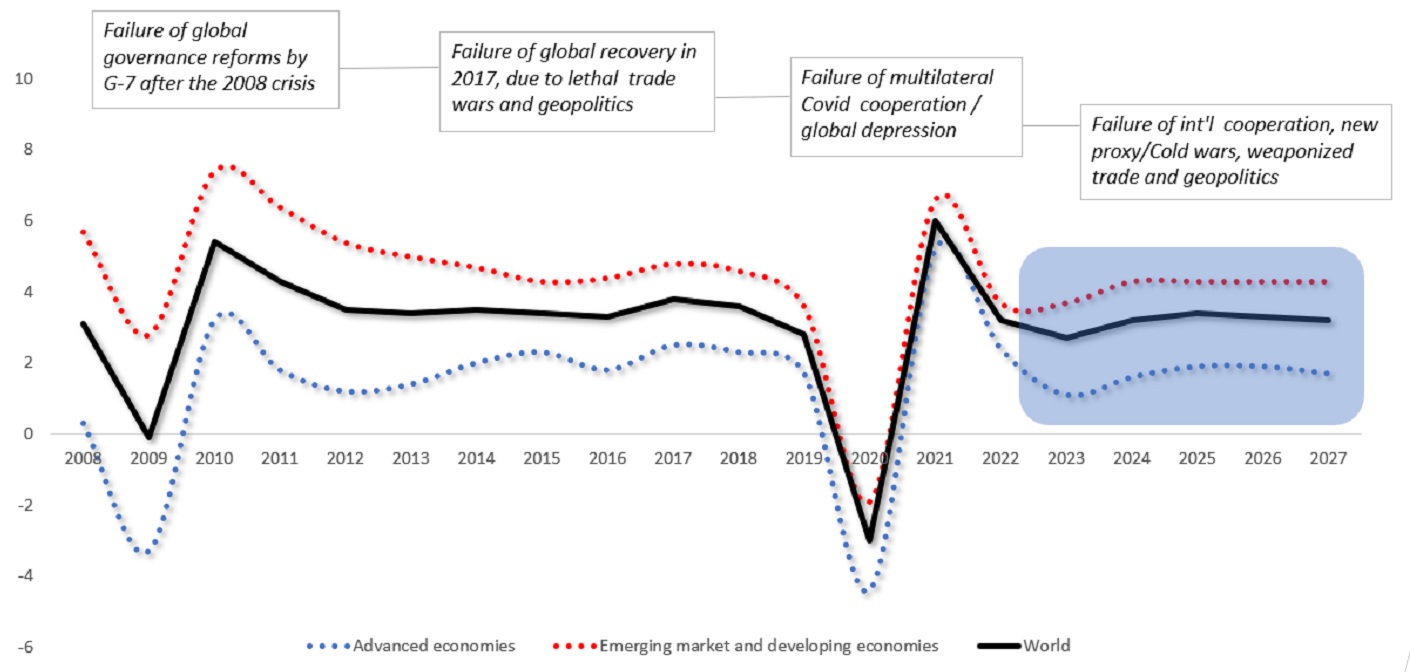
Real GDP growth (annual percent change)

Source: IMF; Difference Group

Notice that through the past years, these ill-advised policies have cost the deepest relative growth deceleration in the West; slowed rather than fostered global growth prospects; and hindered rather than supported the rise of emerging and developing economies.

Meanwhile the absence of international multilateral cooperation has systematically undermined initial growth projections (and the years 2023-27 are not likely to prove an exception).

Certainly, there is nothing inevitable in such calamitous global prospects. These cumulative disasters were unwarranted. With sensible multilateral cooperation, most of the collateral damage – trillions of dollars in economic costs, millions of lost human lives – could have been significantly reduced, even avoided.

But without a comprehensive global reset, darker scenarios are now a matter of time.

The original version of the commentary was published by China-US Focus on December 16, 2022

Dr. Dan Steinbock is an internationally recognized strategist of the multipolar world and the founder of Difference Group. He has served at the India, China and America Institute (USA), Shanghai Institutes for International Studies (China) and the EU Center (Singapore). For more, see https://www.differencegroup.net

Reskill Not Just To Thrive, But To Survive

By Aileen Allkins

“The time is now for companies to make bold investments in technology and capabilities”, according to a recent study from McKinsey. In fact, some might suggest it is well past time – while spending on tech may have once been a luxury, in the digital era it is a necessity for businesses looking to remain competitive and ready for the future.   

For the full benefits of new technology to be achieved, a business must be equipped with the appropriate skillsets to properly deploy and use it, making talent requirements more complex. The key hurdle here, however, is a substantial global digital skills gap.

In a recent report by AND Digital, 81% of UK managing directors reported that a lack of digital skills was negatively impacting their company. With demand for skills far outweighing available talent, there is an opportunity for organisations to set themselves apart from competitors by investing in their people through digital upskilling. Filling specific skills gaps will create a capable, resilient and adaptable workforce that can prosper in the fourth industrial revolution.


Which new tech skills are a priority will vary by industry, and every company’s digital transformation journey will be unique. However, some stand-out industries have set strong examples of how to capitalise on upskilling initiatives.  

TMT proves the consumer is key

The way the public consumes media has undergone a rapid evolution with the explosion of streaming platforms and social media. Furthermore, the constant arrival of new challengers in the TMT space has rendered fast adaptation a necessary survival skill for all telecommunications firms. Indeed, a Deloitte report recently highlighted that a strong driver of this has been the need to “transform into more customer-centric organisations that respond to consumer needs more rapidly and effectively”. 

In this highly competitive arena, being the first to adopt, develop, and offer the most cutting edge and innovative services is central to not just growth, but staying in the race. Businesses that have prioritised internal upskilling have risen to the top. For example, in the US, telecoms giant AT&T recognised the need to pivot from a voice network to a data network, and invested in upskilling its workforce in data science, computer science and cybersecurity. It is now the leading provider of mobile services in the US. 

In the UK, BT is streamlining its customer experience with an integrated design and shipping platform, restructuring processes for agility and efficiency. This transformation, which has been heavily dependent on the business’ ambitious internal upskilling programmes, has ensured that it can provide best-in class customer service that can stand up to the challenge from newer market entrants. 

Manufacturing – man vs machine?

8.5% of manufacturing jobs could be replaced by robots by 2030, according to a 2019 report by Oxford Economics. With AI and automated systems becoming more sophisticated, it begs the question: what is next for the human workforce? 

Automated systems have huge potential for increasing efficiencies in the manufacturing industry, but these machines are no direct swap for current staff. Systems will always require management, maintenance and troubleshooting, and therefore will always need human intervention. Those best placed for these roles are staff already on the ground, with experience of the jobs themselves. 

For Jaguar Land Rover, digitisation and innovation for sustainability go hand in hand. In looking to automate, the company first identified areas to prioritise, such as accounts payable, invoice reconciliation, and data analytics.

The business was then able to reinvest value generated by its automated systems into the business, including providing substantial training to 60% of their workforce on electric vehicle manufacturing. From upskilling engineers in battery development technology to reskilling servicing technicians in electrification, these training efforts are a crucial strategic aspect of Jaguar Land Rover’s green evolution, allowing the company to stay on the front foot of innovation.

Talent and tech growing in tandem will not only help future-proof the operations of the business, but it shows commitment to employee progression, which in turn encourages employee buy-in and helps with staff retention.

Banking on new skills

Financial services firms are dependent on their ability to accurately predict future outcomes and stay ahead of the competition – a skillset crucial for success in both the financial sector and in developing and adopting the next generation of financial technology.

According to a Bank of England report, the majority of financial services organisations are currently using AI. Tools such as neural networks and tree-based models are being used to improve pricing, fraud prevention and other crucial banking functions. 

More traditional firms should not fear robo-advisory services, automated analytics, or smart contract writing systems, but rather recognise the skilling pathways that open up through widespread fintech uptake. 

Back in 2017, JPMorgan Chase & Co’s CEO Jamie Dimon forecast that his firm’s headcount would continue to rise to match the rate of digitisation, and time has proven him right. Financial services leaders who invest in growing a digitally skilled talent pool capitalise on cutting-edge, emerging technologies, and remain at the forefront of their industry.

An open door

PwC predicts that up to 30% of jobs could be automated by the mid-2030s. The potential that this unlocks is profound, but only if the upskilling of existing talent follows suit. Industries that look to evolve their workforces along with new technology are truly futureproofing their business; those remaining stagnant, however, are in danger of getting left behind.

About the Author

Aileen AllkensAileen Allkins is the Chief Revenue Officer of Elev8

EDITOR'S PICK OF THE WEEK

CFO's new mandate. CFO explaining the presentation

The Performance and Transformation Orchestrator: The CFO’s New Mandate in the Age of AI

By Terence Tse CFOs are evolving into AI-driven transformation orchestrators, balancing finance, technology, and strategy while upskilling teams, managing risks, and driving measurable business value. A key insight from this year’s AI for CFOs event, organized...

WISE DECISION MAKER GUIDE

POWER INFLUENCERS

Emerging Trends

The Future of Global Trade