Home Blog Page 511

12 Tips To Help You Manage Your Loans

12 Tips To Help You Manage Your Loans

Are you struggling to keep up with your loan payments? Are you looking to stabilise your accounts to get caravan loan deals in Australia? Or are you feeling overwhelmed and stressed out about your debt? You are not alone. Millions of people are struggling with debt every day. But don’t worry, there are things you can do to help manage your loans and get your finances back on track. In this blog post, we will discuss twelve tips that will help you take control of your loans and get them under control!

1. Start by creating a budget and sticking to it

Since loans are an inevitable part of life, it’s important to establish a budget so that you can manage your loan repayments more effectively. Make sure to factor in payments for groceries, rent, utilities, and other necessary expenses as well as some extra money for leisure activities. Once you have created the budget, stick to it and use it as a guide for managing your loans.

2. Prioritize high-interest loans first

If you have multiple loans, it’s important to prioritize which ones need to be paid off first. Generally speaking, you should focus on the loans with the highest interest rates, as those are usually the most expensive and will end up costing more than other loans in the long run. Plus, paying off the highest-interest loans first will help to reduce your overall debt.

3. Take advantage of automatic payments 

Automatic payments can be set up with your bank, so you don’t have to remember when payments are due. You also might receive a discount if you set up automatic payments. And, if you’re worried about making sure money is in your account, you can set up payments to occur after your paycheck is deposited.

4. Consolidate your loans

If you have multiple loans with different interest rates or payment amounts, consider consolidating them into one loan with one manageable monthly payment. Sometimes, you can even negotiate a lower rate. Keep in mind that consolidation extends the length of your repayment period, so you will be responsible for more payments.

5. Don’t ignore the loan servicer’s notices

Loan servicers are responsible for sending out billing statements, collecting payments, and helping with any problems that come up. If you’re having trouble making payments, the first step is to contact your loan servicer and discuss options. Additionally, it’s important to read the documents you receive from them so that you stay up-to-date on your loan terms and conditions.

6. Remember that student loans are generally not dischargeable in bankruptcy 

Student loans aren’t like other types of debt; they don’t go away if you file for bankruptcy. This means it’s important to make sure you have a repayment plan that works for you so you don’t find yourself in too much debt. And if you do find yourself in too much debt, consider options other than bankruptcy to get out of it. 

7. Consider debt review 

One way to deal with your loans is to go through a debt review, which will look at all of your debts and determine a payment plan that’s manageable for you. This can be a great way to keep up with payments and get out of debt more quickly. Just make sure you find a reputable debt review company before signing any agreements. 

There are pros and cons to debt review, so it’s important to think carefully before committing. Be sure to discuss the details with a professional who can help you decide if this is the right option for you. 

When it comes to the pros, debt review can make it easier to manage payments, lower interest rates, and possibly even waive some fees. And the disadvantages of debt review include a negative effect on credit scores, longer repayment terms, and higher monthly payments. So, make sure to weigh all your options before making a decision. 

8. Take advantage of grace periods

If your loan comes with a grace period, use it to get ahead on payments or pay off more than what’s due each month. Make sure you understand when and how much interest will be charged during the grace period. And remember to read the terms of your loan carefully. 

9. Take advantage of automated payments

Automated payments can help you pay off loans faster by ensuring that your payments are made on time each month. Many lenders offer discounted interest rates for those who opt-in for automatic payments, so be sure to check with them first to see if there are any special discounts available. 

10. Make extra payments whenever possible

Set up an automatic payment schedule to make sure you pay on time, but also consider making extra payments when it is feasible. Paying more than just the minimum due each month can help you save on interest and shorten your loan’s repayment period. Not only will you pay off your loan faster, but you may also save a considerable amount of money in interest payments. 

11. Get a lower interest rate on your loans

One way to reduce the burden of paying off your loans is to shop around and find a lower interest rate. You could look into refinancing your loan with a different lender or consolidating multiple loans into one loan with a lower interest rate. This can potentially save you thousands over the life of your loan.

12. Shop around for the best loan rates

Of course, you don’t want to take out a loan with an exorbitantly high-interest rate. Shopping around for different lenders can help you find the best deal and save you a lot of money in the long run. Pay attention to the annual percentage rate (APR), which is the amount you will be charged each year on your loan.

charged each year on your loan

Lastly, managing your loans doesn’t have to be an arduous process. With a little planning and effort, you can manage your loans in order to pay them off as quickly as possible while still maintaining financial health. Hopefully, these 12 tips have provided you with some ideas on how to manage your loans more effectively. Thanks for reading!


Struggling With Poor Credit Scores? Follow These Tips For Better Results

credit score

If you want to maintain a good credit score for smooth loan transactions in future, your credit score is worth paying attention to. A high credit score makes it easier for applicants to approve their loans and save money on loans and insurance rates.

Maintaining a good credit score is crucial for securing loans, financing big purchases, and getting the best interest rates for our credit cards. But it isn’t always easy to keep that number high. Many don’t know what factors into your credit score at all! Fortunately, there are a few habits people can practice to maintain a healthy high credit score:

1. Pay Back Balances On Time Every Month

This is the best way for consumers with an excellent track record to pay back debts on time. Paying back balances every month prevents late fees from being incurred and keeps your credit utilization ratio low, which lenders use to determine if you’re a responsible borrower. It’s best not to spend over what you can afford and pay off the monthly balance. Having a good credit score will prove a great help with your car finance.

2. Only Apply for Credit When You Need It

While you must maintain a good credit score by paying bills on time, don’t apply for new credit whenever it seems like there isn’t enough money to get through the month. It’s tempting to apply for a new card when an existing one has a high-interest rate and try to get a better deal with another company or retailer.

However, this only increases the amount of credit you have in your name, negatively affecting your credit score. In addition, if you end up not using the card, the company has to pay a fee for late payments or other penalties, resulting in them passing those fees along to you.

3. Pay Loans With Low-Interest Rates First

This habit will help improve your risk level by reducing your debt load and keeping any unnecessary cards with higher interest rates in good standing. In addition, by paying off your debt before paying back any bills, you decrease your risk of late and forward payments while making it easier to get approved for new loans.

4. Stay on Track With Loan Installments

This habit is especially important for those who have large loans or really expensive credit cards and want to avoid the possibility of late payments and repossession. By planning, you can pay your loan each month before the payments are due, minimizing the chance of falling behind on them by an extra day or two.

In addition, experts from a chattel mortgage can help you keep your statements accurate and can help prevent any negative feedback for not paying bills on time.

5. Do Not Hold Your Credit Card Balances

If you want to hold on to a high credit score, the card companies mustn’t feel you’re relying too much on them. While this can be hard at the beginning of the month when bills are due, if you make sure to pay off your cards every month, this will improve your creditworthiness and enable you to take advantage of low-interest rates for balance transfers or purchases elsewhere.

Conclusion

If you want to improve your credit score and prevent the possibility of repossession or late payments, then you can use these above-shared financial habits to stay on track and avoid any negative effects. You can keep your credit score high by following these tips consistently.

Toward 2023: Preparing for Tectonic Shifts in the World Economy

economic shift

By Dan Steinbock                         

Colossal structural shifts are taking place in the global economy, as evidenced by the huge challenges during the ongoing year. In 2023, China seeks recovery, but the West – the US, the Eurozone and the UK, and Japan – will cope with recession and the specter of a debt crisis.

In a recent Foreign Affairs commentary, Mohamed A. El-Erian warned that we are not facing just extraordinarily challenging business-cycle fluctuations, but structural and secular long-term pressures. As a result, “the global economy may never be the same.”

In reality, the “old normal” has been history since 2008 and the consequent debt crises. During the past decade, world economy has been driven by geopolitical agendas, not by economic priorities. And the results have been predictable: catastrophic.

Today, the risk of recession casts a dark shadow over the US economy. The Eurozone is facing a deep recession, Japan’s economy is shrinking, and the United Kingdom is struggling with the worst fall in living standards since records began.

West’s tough 2022 and darker 2023   

In early 2022, the US, the Eurozone, the UK and Japan pledged geopolitical loyalty and ignored economic realities while promoting the worst military overstretch in decades. Thanks to the US/NATO-led proxy war against Russia in Ukraine, the costs of the misguided economic policies and geopolitics were predictable already in March.

Until recently, Western economies seemed fairly resilient. In 2022, US GDP growth on a year-to-year basis is likely to remain around 1.3% to 1.8%, though significantly below the 2021 projections. In the Eurozone, the comparable figure is likely to be higher; about 3.1% to 3.3%; and in the UK over 4.0%. Whereas in Japan, it is likely to be only 1.5%.

Nonetheless, the resiliency is elusive because it is based on soaring debt (Figure 1).

Figure 1 The West’s Debt Spiral

Gross Government Debt as % of GDP (2012-2022)

Gross Government Debt as % of GDP (2012-2022)

Source: Trading Economics; Difference Group

In the Eurozone, government debt to GDP remains close to 100%. Ironically, that’s 40 percentage points higher than the region’s own debt limit. In the UK, the figure has doubled since 2008 to almost 100%. In Japan, the figure is the worst among all high-income economies; close to 265%, thanks to over two decades of secular stagnation.

In the US, the debt ratio has doubled and is inching toward 140%. That’s over 20 percentage points higher than that of Italy amid Rome’s 2010 debt spiral. But unlike Italy (and its bygone lira), America is a global anchor economy and US dollar still dominates international transactions. So, when the US debt crisis ensues, adverse reverberations will be felt from the world economy to global foreign-exchange markets.

Yet, tragically, these are still the “good times.” The year 2023 will be more perilous.

In the US, growth will be at best stagnant around 0.1% to -0.2%. In the Eurozone, recession will be rough at -0.5%; in the UK, even worse at -1.0%. Thanks to recession in Germany and stagnation in France, Europe’s twin engines will both be spluttering. In Japan, stagnant growth is likely to stay around 1.0%.

In each case, the growth figure will require still more debt. Consequently, downside risks far outweigh upside risks. in adverse conditions, a cyclical downturn could unleash a secular nightmare.

China: From headwinds to recovery            

In this dire international landscape, China is moving toward recovery in 2023, which could alleviate global economic prospects. Until the fall, Chinese economic data reflected mainly challenges. Yet, the story of 2023 is likely to be the impending recovery of the Chinese economy – if the current Covid ailments can be overcome.

A central determinant in unleashing the Chinese consumption potential, private sector investment and investor confidence hinges on the success of the more flexible Covid-policy and the consequent broad-based recovery. Though gradual, the new Covid impact could result in a surge of pent-up demand by the second quarter of 2023.

Such progress would strengthen economic data. In the property markets, the new support measures, particularly the government’s 16-point recovery plan, will contribute to stabilization.

Industrial production would pick up. Despite demand destruction in the West, the Belt and Road Initiative (BRIA) will promote steady progress on the back of recovery in Southeast Asia, which China is both driving and benefiting from. Less fixed asset investment by the public sector would reduce local governments’ debt pressures.

Chinese investors would return to equity markets, which would also be attractive to overseas investors seeking short-term bargains and long-term diversification. The MSCI China Index heralds the turnaround; it was 24% up in November, compared to only 2% for the S&P 500 Index.

Certainly, domestic challenges will remain tough. Nonetheless, the aging-related reduction of the labor force will be smaller than expected, as the new UN projections attest. Furthermore, the share of investment to GDP likely peaked at 42 percent in the past half a decade, with a gradual decline set to ensue. And thanks to continued reforms and “common prosperity” policies, Chinese catch-up in productivity and per capita incomes has climbed to more than a third of the US level, even as secular growth is decelerating to 4% in the late 2020s. Like in postwar Europe, living standards rise, even though aggregate growth is slowing (Figure 2).

Figure 2 China’s Sustained Catch-Up

Annual GDP Growth and GDP Per Capita (PPP)

Annual GDP Growth and GDP Per Capita (PPP)

Source: Trading Economics; Difference Group

Thanks to the expected rebound, China’s growth could climb to around 4.0 to 4.5 percent in 2023.

US-Sino relations: Enduring thaw or calm before storm?          

There is one common denominator that unites the economic outlook of the United States, the Eurozone and the UK, as well as Japan and China. And that’s the compelling need for the global landscape to remain manageable, as indicated by the easing of Sino-US tensions after the recent meeting between President Joe Biden and President Xi Jinping.

However, the question is, whether the current relative calm heralds a nascent bilateral thaw or whether it reflects an elusive calm before an impending storm.

The Biden White House can no longer control that future. While the US midterm elections were not as catastrophic to the administration as initially expected, Republicans did advance in all political fronts. The Senate is now bitterly divided and the House under Republican control.

In the medium-term future, naïve expectations should be shunned. The global economy is facing a perilous transition and the West’s recent  track-record – especially the penchant for covert geopolitics at the expense of economic development – is perilous. In the past, Western governments, despite their ailing economies, have mainly “intensified their weaponization of trade, investment, and payment sanctions,” as El-Erian warned.

Globalization has come to a halt, even reversed. In the rejuvenation or degeneration of future globalization, U.S.-Sino relations will play a critical role – in good and bad.

Misguided economic policies, unwarranted economic crises

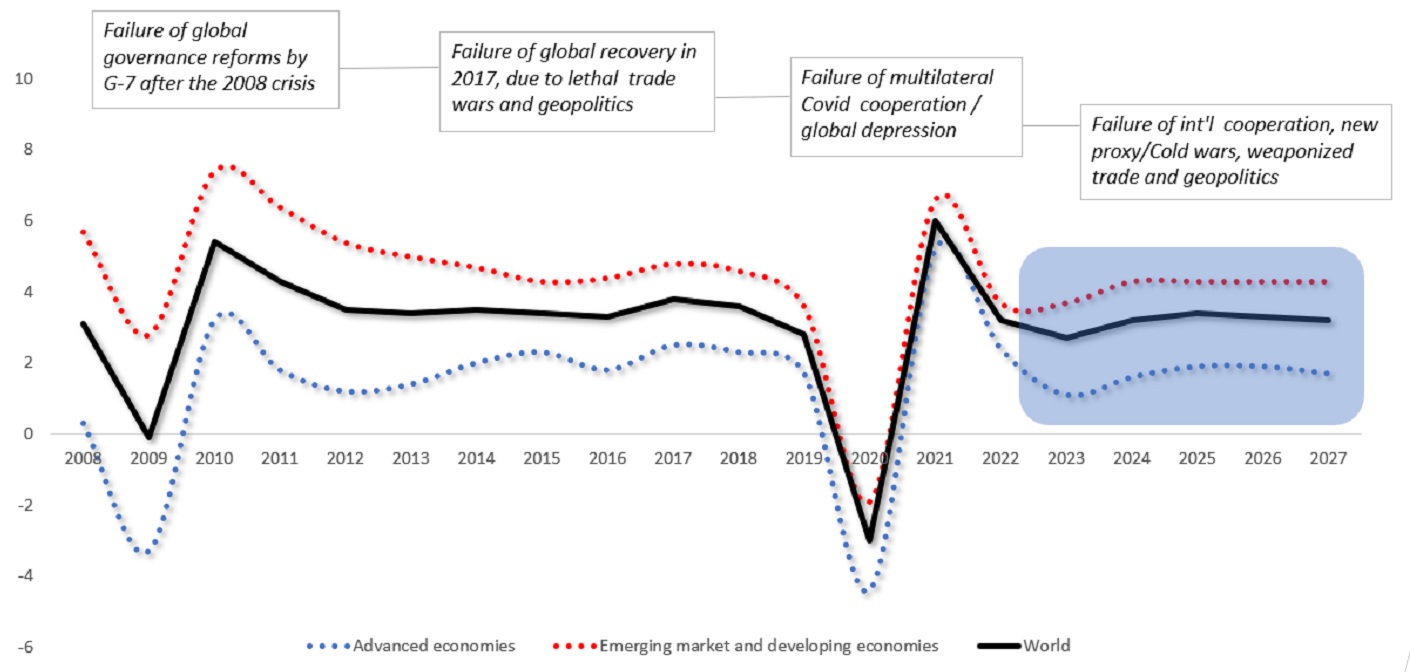
In effect, the West’s post-2008 track record has been a cumulative sequence of ever-worsening economic disasters. The list starts with the failure of post-crisis cooperation. It escalated with the missed global recovery of 2017 followed by vaccination apartheid; the failure of Covid multilateralism and the consequent global depression – up to the present proxy and Cold Wars that could unleash a global debt catastrophe (Figure 3).

Figure 3 The West’s Cumulative Economic Disasters

Real GDP growth (annual percent change)

Real GDP growth (annual percent change)

Source: IMF; Difference Group

Notice that through the past years, these ill-advised policies have cost the deepest relative growth deceleration in the West; slowed rather than fostered global growth prospects; and hindered rather than supported the rise of emerging and developing economies.

Meanwhile the absence of international multilateral cooperation has systematically undermined initial growth projections (and the years 2023-27 are not likely to prove an exception).

Certainly, there is nothing inevitable in such calamitous global prospects. These cumulative disasters were unwarranted. With sensible multilateral cooperation, most of the collateral damage – trillions of dollars in economic costs, millions of lost human lives – could have been significantly reduced, even avoided.

But without a comprehensive global reset, darker scenarios are now a matter of time.

The original version of the commentary was published by China-US Focus on December 16, 2022

Dr. Dan Steinbock is an internationally recognized strategist of the multipolar world and the founder of Difference Group. He has served at the India, China and America Institute (USA), Shanghai Institutes for International Studies (China) and the EU Center (Singapore). For more, see https://www.differencegroup.net

Reskill Not Just To Thrive, But To Survive

business tech

By Aileen Allkins

“The time is now for companies to make bold investments in technology and capabilities”, according to a recent study from McKinsey. In fact, some might suggest it is well past time – while spending on tech may have once been a luxury, in the digital era it is a necessity for businesses looking to remain competitive and ready for the future.   

For the full benefits of new technology to be achieved, a business must be equipped with the appropriate skillsets to properly deploy and use it, making talent requirements more complex. The key hurdle here, however, is a substantial global digital skills gap.

In a recent report by AND Digital, 81% of UK managing directors reported that a lack of digital skills was negatively impacting their company. With demand for skills far outweighing available talent, there is an opportunity for organisations to set themselves apart from competitors by investing in their people through digital upskilling. Filling specific skills gaps will create a capable, resilient and adaptable workforce that can prosper in the fourth industrial revolution.

Which new tech skills are a priority will vary by industry, and every company’s digital transformation journey will be unique. However, some stand-out industries have set strong examples of how to capitalise on upskilling initiatives.  

TMT proves the consumer is key

The way the public consumes media has undergone a rapid evolution with the explosion of streaming platforms and social media. Furthermore, the constant arrival of new challengers in the TMT space has rendered fast adaptation a necessary survival skill for all telecommunications firms. Indeed, a Deloitte report recently highlighted that a strong driver of this has been the need to “transform into more customer-centric organisations that respond to consumer needs more rapidly and effectively”. 

In this highly competitive arena, being the first to adopt, develop, and offer the most cutting edge and innovative services is central to not just growth, but staying in the race. Businesses that have prioritised internal upskilling have risen to the top. For example, in the US, telecoms giant AT&T recognised the need to pivot from a voice network to a data network, and invested in upskilling its workforce in data science, computer science and cybersecurity. It is now the leading provider of mobile services in the US. 

In the UK, BT is streamlining its customer experience with an integrated design and shipping platform, restructuring processes for agility and efficiency. This transformation, which has been heavily dependent on the business’ ambitious internal upskilling programmes, has ensured that it can provide best-in class customer service that can stand up to the challenge from newer market entrants. 

Manufacturing – man vs machine?

8.5% of manufacturing jobs could be replaced by robots by 2030, according to a 2019 report by Oxford Economics. With AI and automated systems becoming more sophisticated, it begs the question: what is next for the human workforce? 

Automated systems have huge potential for increasing efficiencies in the manufacturing industry, but these machines are no direct swap for current staff. Systems will always require management, maintenance and troubleshooting, and therefore will always need human intervention. Those best placed for these roles are staff already on the ground, with experience of the jobs themselves. 

For Jaguar Land Rover, digitisation and innovation for sustainability go hand in hand. In looking to automate, the company first identified areas to prioritise, such as accounts payable, invoice reconciliation, and data analytics.

The business was then able to reinvest value generated by its automated systems into the business, including providing substantial training to 60% of their workforce on electric vehicle manufacturing. From upskilling engineers in battery development technology to reskilling servicing technicians in electrification, these training efforts are a crucial strategic aspect of Jaguar Land Rover’s green evolution, allowing the company to stay on the front foot of innovation.

Talent and tech growing in tandem will not only help future-proof the operations of the business, but it shows commitment to employee progression, which in turn encourages employee buy-in and helps with staff retention.

Banking on new skills

Financial services firms are dependent on their ability to accurately predict future outcomes and stay ahead of the competition – a skillset crucial for success in both the financial sector and in developing and adopting the next generation of financial technology.

According to a Bank of England report, the majority of financial services organisations are currently using AI. Tools such as neural networks and tree-based models are being used to improve pricing, fraud prevention and other crucial banking functions. 

More traditional firms should not fear robo-advisory services, automated analytics, or smart contract writing systems, but rather recognise the skilling pathways that open up through widespread fintech uptake. 

Back in 2017, JPMorgan Chase & Co’s CEO Jamie Dimon forecast that his firm’s headcount would continue to rise to match the rate of digitisation, and time has proven him right. Financial services leaders who invest in growing a digitally skilled talent pool capitalise on cutting-edge, emerging technologies, and remain at the forefront of their industry.

An open door

PwC predicts that up to 30% of jobs could be automated by the mid-2030s. The potential that this unlocks is profound, but only if the upskilling of existing talent follows suit. Industries that look to evolve their workforces along with new technology are truly futureproofing their business; those remaining stagnant, however, are in danger of getting left behind.

About the Author

Aileen AllkensAileen Allkins is the Chief Revenue Officer of Elev8

Equidem Report Fingers Qatar, not European Contractors

Quatar World Cup

By Duggan Flanakin

On November 10, 2022, less than two weeks before the start of the Qatar World Cup, a London-based organization, Equidem, released a report on working conditions at the soccer stadiums’ construction sites. The report has attracted substantial media interest, with the migrant workers’ issue already in focus. The 75-page report alleges that migrant workers at World Cup stadium sites in Qatar have faced discrimination and exploitation and calls for urgent action to protect labor rights. 

But Equidem’s report has severe flaws. It is marred by obvious factual failings and a biased viewpoint. It is superficial and misleading. 

Blame Qatar for everything

Equidem was first established as a limited company in 2018 under the name Equidem Research and Consulting. In May 2021, a charity called Equidem was also incorporated in the UK.

Equidem released its first report in November 2020. It was mainly about the impact of Covid-19 on migrant workers in Qatar. Since then, Equidem has published three more reports. Two of them were about Qatar.

The November 2022 piece was supposed to be about the “major construction firms building stadiums.” Curiously, like the other Equidem papers, this report heavily implies that the government of Qatar is responsible for human rights abuses. 

How leading European companies were labelled as Qatari-owned

Most major project contractors of a World Cup stadium were not local companies, as Equidem suggests,  but large multinational corporations. 

Six Construct Qatar and Joannou & Paraskevaides Qatar WLL are accused of several human rights violations (nationality-based wage discrimination, barriers to advancement, physical violence, verbal abuse, and absence of safe procedures to report rights violations at work). 

Equidem fails to mention that both Six and Joannou & Paraskevaides are not Qatari-owned companies but subsidiaries of large European corporations. Cyprus-based Joannou & Paraskevaides was the main contractor of  Education City Stadium. Six Construct is a subsidiary of Besix Group, Belgium’s largest construction company. Besix was a contractor at Al Janoub Stadium and Khalifa International stadium.

The main construction contractor of Al Janoub Stadium and Khalifa International stadium was Vienna-based Porr, one of the leading construction companies in Europe. Porr is not even mentioned in the report. On the other hand, the report refers several times to Salini Impregilo, the main contractor of Al Bayt stadium. Equidem does not mention that Salini Impregilo (currently Webuild) is an Italian company.

The inexisting construction firm on the Khalifa Stadium

Equidem claims its investigations “documented significant labour and human rights violations at all eight FIFA World Cup Qatar 2022 stadiums.” These investigations, Equidem says, consisted of interviews carried out between September 2020 and October 2022 with 60 migrant workers employed at various stadiums.

But some data are obviously incorrect. For example, Equidem states it documented practices of “wage theft” (unpaid overtime, non-payment of severance) and “nationality-based wage

discrimination” at the Khalifa International Stadium. The accusations are based on an interview with “a Bangladeshi worker employed by Salini Impregilo Group on Al Bayt and Khalifa International Stadiums.” The same employee of Salini Impregilo is cited multiple times for various claims of rights violations at Khalifa Stadium: barriers to advancement, non-payment or underpayment of severance, and excessive work.

The simple truth is that Salini Impregilo has never worked at the Khalifa International Stadium.

The two “all-knowing” Bangladeshi security guards

Many of Equidem’s findings on work conditions on the stadiums’ construction sites came from interviews with workers who were not engaged in construction.

The most quoted workers are two Bangladeshi security guards employed by the same company in three different stadiums. 

One of the security guards is mentioned eight times within the report as a source for Equidem’s conclusions on inadequate nutrition, inability to leave the employer and seek alternate employment, absence of safe procedures to report rights violations at work, health risks on stadium sites and in transit to work, barriers to promotion and advancement, understaffing and overwork, excessive heat and cold, creating a captive workforce. 

The other is quoted seven times as a reference for occupational injuries, barriers to promotion and advancement, invisible workers and rights violations, understaffing and overwork, excessive heat and cold, inability to obtain and afford nutritious food, creating a captive workforce.

Buried in the report is the caveat that the “srious human rights abuse” at the hands of “major construction firms building stadiums” occurred “despite labour reforms by the Qatar government and measures by FIFA and its partners set up specifically to protect migrant workers from abuse.” Only four of the contractors even bothered to respond to Equidem inquiries, and all denied all of the allegations made by Equidem’s interviewees.

While the abusive treatment of migrant workers at the construction sites of the World Cup is undeniable, finding accurate and reliable data on the issue has been a big challenge. But the lack of information should not be used as an excuse for creating and sharing an inaccurate and misleading report.

About the Author

DugganDuggan Flanakin (M.A., Public Policy, Regent University; B.A., History, Louisiana State University) has a long career as a journalist, poet, policy analyst, and advocate for human rights. An expert on environmental, energy, economics,  and education policy, Flanakin has maintained a keen interest in the developing world. His writing can be found at Townhall.com, International Business Times, Real Clear Energy, European Times, The National Interest, and many others.

List of Upcoming IPOs in India

IPOs in India

Something new happens every day around the world, and some of them are just mind-blowing. There is also another place where new things take place every day, and these new movements bring in drastic changes. We are talking about the IPO market and the new companies that go public all the time. What a lot of changes they bring forward – don’t they?

Before that –

What is the Meaning of an IPO?

The Initial Public Offering, or IPO, is a one-of-a-kind process that allows a private firm to become a public company by issuing shares. The issuance of public shares allows the company to raise capital while also providing an outstanding chance for the general population to invest and earn returns on that investment.

A private company expands at first with its early investors, founders, and stakeholders. When a firm achieves a specific goal, the management realizes that it is stable enough to handle SEC (Securities And Exchange Commission) laws, grow, and diversify utilizing money from the general public; the company decides to issue an Initial Public Offering. Through this, the general public is given a stake in the firm in the form of shares.

New IPOs are Coming Out Right Now!

In India, 2021 has been an exceptional year for initial public offerings. In 2021, the market saw a record number of enterprises listed. This has been made feasible by the government’s pro-business policies, as well as fast digitization. There has also been a continuous growth of participating investors.

Experts predict that the IPO market will see a similar surge in 2022. Let’s look at some of the future IPOs that investors are anticipating.

Here is some of the upcoming IPO list you would like to see to know:

  • Arohan Financial

Arohan Financial specializes in offering microfinance solutions to unbanked people. It has filed an Rs. 1,800 crores DRHP with the market regulator. This includes Rs. 850 crores in new equity shares. The remainder would be made up of secondary components totaling 2,70,55,893 shares.

  • Mobikwik

MobiKwik, a leading digital payment provider, has filed for an initial public offering (IPO) in July 2021. MobiKwik IPO would be a combination of a fresh equity share issue of Rs. 1,500 crores combined with an offer for sale by chosen promoters and shareholders for Rs. 400 crores. Currently, the platform serves 3 million retailers and over 120 million customers across the country.

  • Penna Cement

Leading cement company Penna Cement is planning to generate Rs. 1,550 crores through its first public offering. This IPO would consist of a new share offering for Rs. 1,300 crores and an OFS worth Rs. 250 crores. It has already received approval from SEBI to launch its IPO. Penna Cement has a substantial presence in Eastern and Southern India, with a manufacturing capability of around 10 million tonnes per year.

  • Fincare Small Finance Bank

Fincare Small Finance Bank filed for an IPO in the month of May 2021. This IPO will be a combination of new share issuance worth Rs. 330 crores and a share sale for Rs. 1,000 crores. Between FY18 and FY20, it also had the highest growth rate in India among all small financing entities.

  • Pharmeasy

API Holdings, the parent company of India’s top digital healthcare platform PharmEasy, has filed for IPO in November 2021 with market regulator SEBI. The PharmEasy IPO will be worth Rs. 6,250 crores. This will be a completely new share offering. This IPO will not result in any shareholder or investor selling their position in the company.

  • Bajaj Energy

Bajaj Energy is a private key operator in the thermal power generation industry. Its total capacity is 24,330 MW. The company wants to raise Rs. 5,450 crores through this IPO. The Bajaj Energy IPO would include a fresh issue share of Rs. 5,150 crores as well as an offer for the sale of Rs. 300 shares.

  • Gemini Edibles and Fats

Gemini Edibles, one of the biggest manufacturers of sunflower oil, will raise Rs. 2,500 crores through an initial public offering. It will be purely an offer for sale, and the business would not get any proceeds from its public offering. One of the biggest investors selling shares worth Rs. 750 crores is Golden Agri International Enterprises.

  • ESAF Small Finance Bank

ESAF Small Finance Bank, founded in 2016, is one of the newest members in the small finance market. However, it has grown rapidly in the last four years, with over 400 outlets spread over India. The primary issue for the Rs. 998 crore ESAF Small Finance IPO would be Rs. 800 crore. The remainder will be an OFS from significant investors such as PNB Metlife and Bajaj Allianz.

  • VLCC Healthcare

VLCC Health Care is one of India’s most well-known health and beauty companies. It filed its DRHP with the market authority for its IPO in September 2021. This IPO will include a new share issue of Rs. 300 crores, as well as an offer for sale from existing shareholders and promoters. The profits from its first public offering will be used to establish new wellness centers in India and the Gulf area.

  • Century Metal Recycling

Century Metal Recycling has filed with the market regulator its DRHP for a public offering. It is India’s largest recycling company in the aluminum recycling business. With an annual production base of 2,18,000 metric tonnes, CMR is also the largest manufacturer of aluminum and zinc die-cast alloys.

Conclusion

This is just a small part of the whole part, given that it is much easier to go public these days; there are a lot more companies that go public quite often. But, once you know these few, it gets easier to know about the rest.

Hassle-Free Moves for Your Business with Experienced Commercial Movers

commercial mover

Moving your business can be a stressful and time-consuming experience, making it important to have the right commercial movers to help the transition go as smoothly as possible. 

Experienced commercial movers can help you make a hassle-free move that will save you time, money, and energy. With years of experience in the industry, Vancouver commercial moving companies can provide comprehensive services to ensure your move goes smoothly. From help with planning and packing to providing the right equipment for the job, commercial movers can help you stay on track, on budget, and on time with your move. 

In this blog post, we will discuss the benefits of working with experienced commercial movers and how to find the right mover for your business’s needs. We will also provide tips and advice on making your move stress-free and ensuring your belongings arrive safe and sound. With the right movers and the right plan, your business move can be a smooth and organized process.

1. Determine Your Moving Needs

Before you even contact a commercial mover, it’s important to know what you need. List out all your requirements and the services you’ll be looking for from the commercial mover. 

This includes weighing the cost of the move, the amount of furniture and equipment you have, the size of the facility, and the distance of the move. 

Be sure to include any special requirements, like packing services or secure storage. Having this list before you start your search helps you find the right commercial mover who can accommodate all your needs.

2. Obtain Cost Estimates

After you have a list of potential commercial movers, you should obtain cost estimates from each one. 

This is a crucial step in selecting the best commercial movers for your business. Be sure to get an itemized list of services so that you can compare the costs and make sure that you are getting the best value for your money. 

Make sure that you know exactly what is included in the cost estimate, and what is not. Ask about any additional fees that may be charged and make sure that you are getting the services that you need.

3. Professional Packing Services

If you’re looking to reduce the time and stress of moving your business, professional packing services are the way to go. Professional packers will handle all the details of packing up your office or store, from labeling boxes to properly wrapping fragile items. 

They’ll also ensure that all of your items are securely packed so that you don’t have to worry about anything getting damaged during the move. With professional packing services, you can be sure that your move will be quick and hassle-free.

4. Experienced Moving Crews

When moving your business, it’s important to have experienced moving crews on your side. Experienced commercial movers know the ins and outs of relocating a business, from packing and transporting office furniture and electronics to setting up and installing machinery. 

Not only will they help you move your business quickly and safely, they’ll also be able to provide assistance with organizing and packing your items, as well as utilizing specialized equipment to ensure your items are kept safe during transit. With experienced commercial movers on your side, you can be sure that your business will be relocated with minimal disruption to your operations.

5. Quality Moving Equipment

Moving your business can be a hassle-free experience if you have the right equipment. Quality moving equipment is one of the key elements in a successful, stress-free move. 

Experienced commercial movers will bring the best quality moving equipment, such as packing materials, moving blankets, furniture pads, hand trucks, ramps, and dollies to ensure your items are moved safely and securely. 

With the right equipment, your business move can be successful and hassle-free, with your items arriving in the same condition they left in.

In conclusion, if you’re looking for a hassle-free move for your business, it’s best to leave the job in the hands of experienced commercial movers. 

Not only will they make sure that everything is moved safely and securely, but they can also provide you with all the necessary packing materials, storage solutions, and other services to make sure that your move is as stress-free as possible. With the right commercial movers, you can rest assured that your business’s move will go as smoothly as possible.

5 Common Problems with Risk Parity Strategies

Common Problems with Risk Parity Strategies

By Natalie Redman

For any investor, one of the most significant decisions that they need to make is allocating assets in their portfolio. As such, many investors have found themselves looking at risk parity as a potential strategy for investment.

However, there are a number of caveats surrounding risk parity that make this methodology somewhat problematic.

As of 2020, the composition of assets in the average investor’s portfolio worldwide varied according to Statista. In that year, the majority of their investments were allocated to traditional assets (72%) followed by private equity and real estate, both at 10%.

With risk parity, it allows investors the opportunity of risk-adjusted returns that are relative to those portfolios that have a traditional asset allocation – which appears to be the majority. However, despite its appeal, there are some common problems that come with risk parity strategies, problems that need highlighting.

What is risk parity

What is risk parity? Well, in layman’s terms, risk parity is the goal of balancing the contribution of all portfolio risk from each asset class.

Risk parity seeks to disperse the risk found in traditional portfolios that may, for example, consist of a 60% equity and 40% fixed income portfolio.

With a risk parity strategy, there’s the belief of risk and return having this one, constant relationship. As such, it’s assumed that all assets will have similar risk-adjusted returns.

Essentially by balancing the risk within this diversified portfolio, an investor can enjoy fewer fragilities within their investments. Hopefully, returns on their investments can continue to be fruitful in performance.

The relevance of using risk parity

With a strong relationship between bonds and equities, the relevance of using risk parity in these diversified portfolios makes sense to an extent. Certain investments have higher risk factors and so to help counter-balance that high risk, holding lower risk, lower expected return assets like bonds, are assumed to be financially beneficial.

The relevance of using risk parity is that it’s designed with the intention of investors to successfully maintain their portfolios with risk diversification. Through the use of leverage, the investor will hopefully still meet their expected returns.

It all seems like a viable solution to help balance risk, correct? Well, in theory, maybe, but in reality, the outcome may not be as clear-cut.

5 common problems with risk parity strategies

According to one source, at least $100bn has already been invested in risk parity strategies. Before you go jumping on the bandwagon though, it’s important to be aware of common problems that come with using this type of strategy. 

1. The strategy ignores asset returns

With how risk-parity strategies are constructed and leveraged, returns on individual asset classes have no involvement when it comes to deciding risk parity allocation.

This seems like a bizarre approach, especially as most investors will agree that returns on investment are often the most important concern.

It’s believed that maybe the reason for ignoring asset returns is that these future returns are purely speculative and don’t hold a guaranteed weight. This is made even more confusing when risk parity is based on correlation and volatility.

It’s suggesting that investors will assume that past volatility and correlations will continue in the future but the same cannot be said for past returns.

2. The use of volatility as a measurement is flawed

It‘s considered that volatility as a measure of risk, is flawed. It’s not an appropriate measure of risk because volatility doesn’t always apply in the same way to asset classes. This volatility can change at any number of times due to a variety of reasons. For example, a recession may have a significant impact on losses but a recession in itself is a rare event.

Common Problems with Risk Parity Strategies

To use volatility as a measurement for risk is flawed because the parameters that govern assets – aka volatility – are always changing.

This underestimation of how volatility fluctuates can be detrimental to those who use risk parity as a strategy for investments.

3. Risk parity underperforms when risk-adjusted returns vary.

In relation to the first point of risk parity ignoring past returns or future returns in its methodology, risk parity often underperforms when risk-adjusted returns vary.

You may or may not believe that risk-adjusted returns do vary across asset classes but if they do, then this is where a risk parity strategy can end up underperforming as a result.

This strategy relies on leveraging low-risk assets. They end up leveraging these low-risk assets, primarily bonds, to level out the risk from all other asset classes. However, despite its good performance over the years, the current market of today’s interest rate environment may not help the performance of bond ownership in the future.

While a gradual rise in interest rates helps risk parity strategies, a decline doesn’t. It’s important not to put all your trust in bonds being the sole asset to help balance all of the risks out

4. Risk parity portfolios aren’t just risk parity.

It’s important to flag that just because a portfolio has been diversified using risk parity strategies, doesn’t just make it exclusive to risk parity. No investment portfolio is directly the same as another, which means a one size fits all approach doesn’t work. This type of risk model isn’t going to work on solely creating a risk parity portfolio.

Not all investors are taking equal risk across assets so using one unified risk model doesn’t help those who have a variety of risk-adjusted returns within their portfolio.

5. It only works in certain economic situations.

The relevance of risk parity strategies has come under more scrutiny perhaps due to the current economic state that we’re in as of 2022.

In an ideal world, risk parity works when all the conditions are in their favor. When it isn’t, many investors end up losing faith in it. COVID-19 has also added some frictions to global supply chains, which has impacted bond assets. What is risk parity based around? Bonds.

While it may be useful to implement a risk parity strategy, it’s not a strategy that’s the be-all and end-all of diversifying your portfolio. It will only perform best when the assets within the portfolio are all similar in risk-adjusted returns. Where these risks are unequal, risk parity doesn’t perform as well.

Additional tips for diversifying a portfolio to reduce risk and losses

While risk parity isn’t completely flawed in its approach, there are other ways to help diversify a portfolio to help reduce risk and losses.

Use hedging as a security

No, it doesn’t have anything to do with sprucing up your backyard. Hedging your portfolio is to reduce that unsystematic risk. It involves buying or selling an investment to help reduce the risk of loss when in an existing position.

There are a number of hedging strategies worth looking at that can help reduce market risk on your investments.

Include foreign investment into the mix

One problem with risk parity is that it doesn’t factor in foreign investments. Risk-adjusted returns aren’t equal, especially when it comes to foreign currency risk. It’s a risk that investors don’t like to take and as such, foreign investment into currency-based assets may have lower risk-adjusted returns.

Try looking beyond your own country for investments and start looking further afield.

Explore different sectors

Like foreign investment, it’s important to switch up your asset choices by exploring different sectors. Spreading the wealth across different sectors is going to further avoid putting all your eggs (or money) in one basket. From stocks to exchange-traded funds and real-estate investment trusts, there’s a lot to choose from.

bitcoin

Cryptocurrencies and NFTs are just a couple of the latest investment opportunities that may be worth exploring to further diversify your own portfolio. Spreading the risk around is going to help lead to bigger rewards – hopefully.

Be careful not to over-diversify

It seems counter-productive to tell you not to over-diversify when this whole article is aimed at diversifying a portfolio. However, there is validity when it comes to avoiding over-diversifying.

While it is important to diversify, having too many securities can be problematic. Not only that but it can be difficult to manage everything all at once. You could effectively self-sabotage your own efforts as a result. If you own too much of one stock, then it might be worth liquidating it, to then put it in another asset.

Know when to get out

Finally, it’s important to be aware of when investments have peaked or may be heading south. An understanding of the market in relation to all your asset classes can be helpful in staying ahead and getting out before you start losing money.

Avoid using risk parity as a lone investment strategy

While there are some advantages to using risk parity for balancing risk in your investment portfolio, it’s not a guaranteed, fool-proof solution. Avoid using risk parity as a lone investment strategy and focus on diversifying and spreading risk in other ways.

About the Author

Natalie Redman

Natalie Redman is a freelance writer with two years of experience in web page copywriting for businesses across many industries. She’s also an owner of two blog websites and a Youtube content creator.

Seven Amazing Strategies to Generate Leads for a B2B Company

B2B-Generator

Sales representatives can contact qualified B2B sales prospects and make sales to them. Of course, it takes time to produce high-quality leads that will become customers, that’s why it’s crucial for you to understand how to find leads. But if done correctly, it will support your company’s growth and help you outperform the competition. In addition, B2B buyer behavior is evolving at a dizzying pace, driven by various emerging technologies and fresh insights. So it makes sense that B2B marketers find it challenging to adjust their lead-generating tactics in this constantly changing environment.

Growingly informed consumers had been produced due to the explosion of content addressing customer concerns at every stage of the buying process. Here are some efficient B2B lead-generating tactics to step up your game. 

Exit-Intent Popup Forms Can Be Added to Collect Leads

Visitors may occasionally leave your website without making a purchase. Use exit-intent popups to help you collect their information before they leave. When a visitor is ready to close your window, these show up. The intention is to get them to divulge their information before leaving. For instance, you may request their name and email address in exchange for a free download or coupon code.

Leads can be re-engaged with on-site retargeting

Retargeting techniques are another approach to using exit-intent popups. To do this, recommendations are made based on historical site visitor behavior. For instance, set up a popup to provide a discount for a product the visitor viewed as they were ready to leave.

Create an automated email marketing campaign

You may need more time to write emails daily as a B2B marketer. It would be a great help if you didn’t have to, either. You may quickly increase traffic to your website with email marketing automation. Just give yourself a week to set up the segments, compose the emails, and select the activity triggers that will signal when they go out. For instance, people who subscribe to your newsletter will be added to the lead nurturing campaign. If a returning consumer leaves their cart empty, they can get an email with a coupon code.

Case studies can be used to boost sales

Some of your leads would prefer to purchase your goods or services. How, then, can you persuade them to convert? The benefits of your product can be demonstrated, for example. Case studies are a great way to demonstrate the value of your goods and services. Consider including them in your social media marketing, blog posts (as links or stories), and email campaigns (i.e., boosted posts or social ads).

Create a business blog to raise awareness

When done correctly, blog content aids in decision-making for your audience, which is why it is effective. Because readers value them, educational blog entries like how-tos, tutorials, buying recommendations, and listicles are often seen. By providing insights, you may establish your brand as an authority in the field and increase interest in it.

To increase engagement, concentrate on producing more material for your blog. Just be careful to maintain depth and quality. Then, to continue attracting people and search engines, keep adding value.

Optimize Every Piece of Content You Post to Boost Your Ranking

Search engines like Google and others index a wide range of digital content. Press releases, blog entries, guest posts, images, memes, videos, and infographics fall under this category. Use relevant keywords to optimize your content formats so your target audience can find and rank them.

Provide a complimentary eBook, data report, or whitepaper

This B2B lead generation and sales method has probably been used on other websites; after spending some time on a particular page, a popup window appears providing a free eBook or another helpful resource. This is an excellent B2B lead generation method because it allows for something of value in exchange for someone’s contact information.

Create a valuable material jam-packed with helpful information, and publish the download link in the proper places on your website. Visitors should be directed to a specific landing page via the link or popup where they can complete a B2B lead form to receive the free download.

Apply the recommended practices for landing pages above, and stress that downloading is free.

Wrapping up

Profitable businesses are those that are expanding. Profitability, however, can only be achieved when the correct clients use your goods and services. So even though it’s not impossible, finding clients and prospects is a process that must be treated carefully.

All of your subsequent steps in the sales cycle will be built on a solid foundation of lead generation tactics. Be clever and original while attracting visitors and encouraging conversions.

Home Loan Guide For First-Time Buyers 

House-Loan

Buying a house can be a huge milestone in anyone’s life, irrespective of age or financial standing.

But with every life-changing decision comes a ton of responsibilities, and here also, choosing the right home loan is the first crucial step ahead!

After all, there’s a reason why the average home loan size for first-time buyers is $485,014 in Australia alone.

So if you’re also a first-time buyer, you must be overwhelmed with numbers and interest rates.

But don’t worry, this guide here will be your companion to making things simpler!

1. Have a clear idea about your finance

Okay, this is the first step while understanding how much loan you should apply for. Make an honest list of how much you’re spending every month and see the costs that can be reduced.

Try applying for special schemes designed by your government. If you live in Australia, for example, you also need to see if you’re eligible for First Home Owner Grant (FHOG), a scheme made exclusively for first-time homeowners by the Australian Government.

Ask yourself where you’re currently standing as far as finances are concerned, how much you can afford to repay every month, and what sort of mortgage will suit you the best. Alternatively, you can work with mortgage brokers for first home buyers to make sure you’re on the right track. To further streamline your budgeting for a home, calculate mortgage expenses to understand the monthly payments you’d be responsible for, ensuring they align with your financial planning.

2. Explore home loan rates

Next up, you need to check the home loan rates as applicable in your state or country so that you can choose one which works best for you.

You can begin your search from Real Simple Home Loans, Australia. It allows you to compare the interest rates and talk to the experts about how to apply for it.

Not just that, the mortgage brokers at Real Simple Home Loans will walk you through the entire process so that you don’t have to take the entire burden upon yourself!

After the papers are in order, you will be asked to produce the necessary documents for pre-approval. This process can last between 3 to 6 months.

3. Choose the location wisely

Yes, bank loans are important but did you know that they are dependent on the location of your dream house? Here again, keeping your finances in check can be useful because then you’ll get a clear picture of how much to spend.

For example, prime locations in the city will cost more than a suburban home, but they can be ideal for young professionals. Check if commute services are available nearby or not.

Once you have decided, talk to your bank about the location and the home loan rates in that area. You can even talk to your real estate agent and figure out a plan to get a home loan at lower interest rates.

4. Figure out the type of house to buy

Now that you’ve identified the ideal location, it’s time to choose your ideal home. Do you want a small one-bedroom apartment or a two-storeyed bungalow? Are you buying a house to expand your family or to shorten the distance between your house and your office?

Make a list of “must haves” and “may haves.” In the first list, mention essential things, like commute services or schools for your children.

In the second one, write down things you don’t necessarily need but would still wish to buy- an outdoor garden or pool.

Next, stick to your price range and never go above it. If pre-approved for a $400,000 loan, don’t waste time looking for houses advertised at $500,000.

5. Try negotiating

Lastly, negotiating is never a bad idea, especially if you’re buying for the first time. If you’re not sure, talk to Real Simple Home Loans. Or you can even attend different auctions to see how negotiating works.

Bring along a professional or an experienced family member or friend to help you out. Since there’s no cooling-off period in an auction, you’ll be expected to pay a certain amount right away, say 10% of the total deposit.

Next, the seller will prepare an official contract, but you must go through the terms and conditions carefully. Many contractors might try to deceive you as an amateur, so be very careful.

Over to you…

Buying your first house might seem pretty complicated, but it doesn’t have to be! Just breathe and remember to take every step carefully. And don’t let the excitement blur your future vision.

EDITOR'S PICK OF THE WEEK

CFO's new mandate. CFO explaining the presentation

The Performance and Transformation Orchestrator: The CFO’s New Mandate in the Age of AI

By Terence Tse CFOs are evolving into AI-driven transformation orchestrators, balancing finance, technology, and strategy while upskilling teams, managing risks, and driving measurable business value. A key insight from this year’s AI for CFOs event, organized...

WISE DECISION MAKER GUIDE

POWER INFLUENCERS

Emerging Trends

The Future of Global Trade